
Uffington, United Kingdom · 1001 BCE · United Kingdom
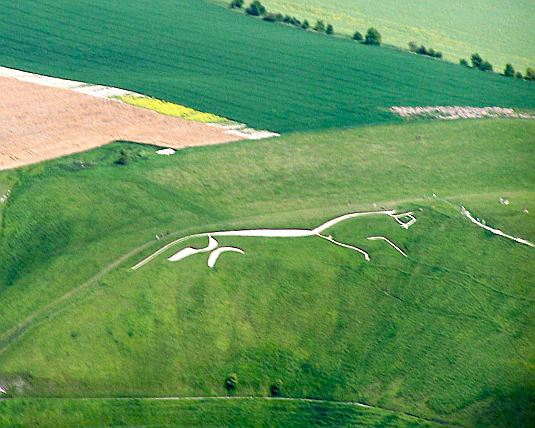
- A chalk horse cut into Whitehorse Hill at Uffington, Oxfordshire, above the Vale of White Horse.
- The first cutting is placed in the late Bronze Age or early Iron Age, between 1380 and 550 BC, with other ranges of 1380 to 210 BC and 1740 to 210 BC.
- A horse-shaped trench was packed with fresh chalk, and the beak and the segmented body were part of the original figure.
- People have scoured the chalk for centuries, and a 2022 survey found the lines had shrunk by about forty percent before restoration began in 2024.
- The figure lies below the Iron Age hillfort of Uffington Castle, beside Dragon Hill and the dry valley called the Manger.
Visiting
Entry is free. The site is open any reasonable time during daylight hours. The hill is open from dawn to dusk. Dogs on leads are allowed to enter at all times.
Smoking, vaping, barbecues and naked flames are not allowed.
History
The Uffington White Horse is a chalk figure on the upper slopes of Whitehorse Hill, in the parish of Uffington in Oxfordshire, on the scarp of the Berkshire Downs above the Vale of White Horse. It was made by digging a horse-shaped trench, probably with bronze or iron tools, and packing it with fresh chalk in successive layers. The beak and the sinuous, segmented body were part of that original cutting. Its length is given as 100 metres, as 110 metres, as 111 metres from the tip of the tail to the ear, and as 120 metres.
Silt against the chalk has been dated between 1380 and 550 BC, and other accounts give 1380 to 210 BC and 1740 to 210 BC. Those ranges place the cutting in the later Bronze Age or the Iron Age, across the end of Bronze Age Britain and the start of the British Iron Age. Earlier explanations had put it near 100 BC, with Hengist and Horsa, or with Alfred the Great after his victory at the Battle of Edington in 878. The buried sediments put the first horse more than a thousand years before Alfred was born.
Uffington Castle, about 170 metres north-east of the figure, is an early Iron Age hillfort with a Bronze Age phase beneath it. The enclosure is about 220 by 160 metres, given both as about 3 hectares and as about 3.2 hectares, with a chalk rampart, a ditch, and an outer bank, though one account describes a single rampart and ditch. It was probably built in the eighth or seventh century BC, and a narrower estimate of 750 to 650 BC overlaps the horse's silt dates, so the two could belong to the same generations. Postholes inside the fort have been read as round huts and also as isolated features without clear buildings.
The figure has been called a horse since the eleventh century, when a cartulary of Abingdon Abbey named the hill of the white horse. It may have been a tribal mark of the people who built the fort, a fertility image, or a solar horse aligned with the midwinter sun. Scholars have compared it with the goddess Epona and with Rhiannon, and with horses on the coins of the Dobunni and the Atrebates, while also noting that Iron Age horses are often more curving than this one.
Local people scoured the chalk for centuries, in a cleaning reckoned every seven years, with a midsummer festival from at least 1677 and a dated series from 1755 until 1857, when a crowd of 30,000 was called too rowdy. Francis Wise described the custom in 1736 as already immemorial, and the owner of the hill revived it in 2009. During the Second World War the horse was covered with turf and hedge trimmings, then uncovered by William Francis Grimes. Later, brief additions of a rider, dogs, and a jockey were denounced or simply weathered off the chalk.
Excavation after 1979 showed that the figure was a built trench, not a scrape of turf, and the opened beak is said to have disproved the idea of a larger natural horse underneath. Another account, from aerial photographs, still sees a larger and more conventional horse beneath the present lines, lost to soil creep and recutting. In 2022 a drone survey found the white lines had shrunk by about forty percent, trenches in 2023 confirmed the turf was closing in, and in 2024 a restoration began to return the figure to its 1980s outline and to take new dating samples. A tighter date from those samples has not been published.
In 2019 a water-pipe excavation at Childrey Warren uncovered an Iron Age and Roman settlement, reported both as 26 skeletons and as more than 30 burials, some of them unusual pit burials. Sacrifice was raised as a possibility from evidence at other sites, not as a finding demonstrated on these bones. The diggers presented the settlement as a window onto communities otherwise known for monuments such as this horse, rather than as proof that these were the people who cut it.
Images


Detailed History
The Uffington White Horse is a prehistoric hill figure on the upper slopes of Whitehorse Hill, in the civil parish of Uffington in Oxfordshire. The hill forms part of the scarp of the Berkshire Downs and looks north over the Vale of White Horse. The figure stands about 16 kilometres east of Swindon, about 8 kilometres south of Faringdon, a similar distance west of Wantage, and about 2.5 kilometres south of the village of Uffington. The clearest views are from the air, or from directly across the vale, especially around Great Coxwell, Longcot, and Fernham.
The figure itself is placed at 261 metres, or 856 feet. The hillfort on the summit above it is placed at 860 feet, or 262 metres, and is called the highest point in Oxfordshire, with a view across six counties.
The length of the horse is not a single agreed measurement. One account gives 110 metres, or 360 feet. Another gives 100 metres, or 330 feet. A third measures 111 metres from the tip of the tail to the ear.
A fourth says the figure is 120 metres long. It was formed from deep trenches filled with crushed white chalk. The trenches are segmented, and the body is a sinuous line rather than a solid outline. The head now has a prominent eye and a tusk-like beak at the mouth.
The age is also given as more than one range. Silt buried against the chalk has been dated between 1380 and 550 BC, and that span is the one attached to the construction of the first horse. Another account gives 1380 to 210 BC. A history of the hill gives 1740 to 210 BC.
All three ranges put the cutting in the later Bronze Age or the Iron Age. The figure is also described as a Bronze Age chalk figure, as perhaps over 3,000 years old, and as an image that has been guarded for more than 3,000 years. It is the oldest chalk-cut hill figure in Britain, and it has been called the oldest hill figure in Europe. Later white horses in Britain were inspired by it and use an entirely different design.
Bronze Age Britain ran from about 2500 to 2200 BC until about 800 BC. It followed the Neolithic and was marked by the use of copper and then of bronze. The beginning of bronze metalworking in Britain is tied to the arrival of the Bell Beaker culture. The spread of that culture is linked with Indo-European migrations and with a large genetic shift, in which about 90 percent of the gene pool was replaced within a few hundred years, from about 2400 BC to 2000 BC, as people with Early European Farmer ancestry were mostly replaced by people with Western Steppe Herder ancestry.
The Wessex culture was the main early Bronze Age culture in central and southern Britain. The British Iron Age followed, from about 800 BC until the Roman period in the first century AD. It was marked by iron tools and weapons, by the adoption of some Hallstatt and La Tène ways of making things from mainland Europe, by a marked increase in hillforts, and, in Scotland, by brochs. The earliest known outside account comes from the Greek geographer Pytheas, around 320 BC, who called the island Albion, one of the Pretannic isles, and called the inhabitants Keltoi.
Most people of the British Iron Age were Insular Celts, later called Celtic Britons, and they spoke Celtic languages. The silt dates for the horse sit across the end of Bronze Age Britain and the opening of the British Iron Age.
The figure was not made by scraping turf off natural chalk. A horse-shaped trench was dug, probably with bronze or iron tools, and the spoil was carried away in baskets. Fresh chalk was then put into the trench, and later generations added further layers. In the beak the fill is about one metre deep, in successive layers of chalk.
That section was drawn in the early 1950s, during the restoration that followed the wartime covering of the figure, and the drawings were later found in the archives of the Ministry of Works. When the beak trench was reopened, the drawings proved accurate. No pottery, coins, or bone were recovered from the chalk layers, so the date could not come from objects or from radiocarbon samples of organic material. The date came from silt.
Quartz and feldspar in buried sediment hold a luminescence signal that grows in the dark after sunlight has emptied it at the moment of deposition. Mike Tite and Julie Rees-Jones, of the Oxford laboratory, took the samples from the belly. Those samples were among the first optically stimulated luminescence dates from an archaeological site, and one account calls them the first such dates obtained from an archaeological site in Britain.
The belly samples were taken in 1994. Sample 962a came from 0.4 metres below the present surface, from a layer of colluvium that overlies one chalk figure and is cut by a later figure above it. Sample 962b came from 0.6 metres further along the section, away from the horse, from a colluvial layer underneath all the preserved chalk figures. For the horse, the feldspar and quartz dates of sample 962a agree within one standard deviation, and the quartz date of sample 962b agrees with them.
That agreement is taken to mean that the horse sediments were fully bleached by sunlight before burial, so the dates can be treated as accurate. The same kind of test, applied to a nearby ditch, produced the opposite pattern and showed what incomplete bleaching looks like. The water content of the horse samples, measured while it was raining, was already low, at 20 percent of saturation, and the error allowed for water content covers the chance that a drier soil would have raised the dose rate and made the age look too old. The growth curves used for the equivalent dose were linear, which removes one known route to an exaggerated age.
The dose rate was measured in two independent ways, portable gamma spectrometry and thick-source alpha counting with potassium flame photometry, and the two ways agreed. Taking the earliest date as sample 962b, from below every preserved chalk figure, and the latest as sample 962a, from above one chalk figure, the laboratory gave an approximate range of 1380 to 550 BC for the construction of the first horse. The earliest layer in the belly is dated to that same span. The result is not a single year.
It is enough to place the figure in the late Bronze Age or the early Iron Age, rather than in the later centuries that had been preferred before the silt was measured.
Before that measurement, the figure had been given several later origins. In the seventeenth century John Aubrey attributed it to Hengist and Horsa, and he also ascribed it to the British Celts, noting the likeness of the image to pictures on native Iron Age coins. In 1931 Stuart Piggott compared the design with Celtic coinage and suggested about 100 BC. Stuart Piggott, Stuart Ernest Piggott, lived from 28 May 1910 to 23 September 1996 and is known for his work on prehistoric Wessex.
In 1967 Ann Ross carried the comparison with the coins further. In 1949 Morris Marples argued for a Bronze Age date by setting the design beside figures across Europe and North Africa. Francis Wise speculated that Alfred the Great had the image made to celebrate his victory at the Battle of Edington. The silt leaves those later stories as explanations people have offered, not as the date of the cutting.
Alfred the Great was born about 849 and died on 26 October 899. He was King of the West Saxons from 871 to 886, and King of the Anglo-Saxons from 886 until his death. He was the youngest son of King Æthelwulf and of Æthelwulf's first wife Osburh, both of whom died while he was young. Three older brothers, Æthelbald, Æthelberht, and Æthelred, reigned in turn before him.
Under him, administrative and military reforms were introduced that prompted lasting change in England. After he took the throne he spent several years fighting Viking invasions. He won at the Battle of Edington in 878 and made an agreement that divided England between Anglo-Saxon territory and the Viking-ruled Danelaw, which consisted of Scandinavian York, the north-east Midlands, and East Anglia. He also oversaw the conversion of the Viking leader with whom he had just fought.
The Battle of Edington, or the Battle of Ethandun, was fought in May 878 near Edington in Wiltshire, between Alfred's West Saxon army and the Great Heathen Army led by the Danish warlord Guthrum. Early in 878 Guthrum launched a surprise attack on Chippenham and forced Alfred into hiding in the marshes of Athelney. After rallying local forces, Alfred defeated Guthrum at Edington, then besieged the Viking position until it surrendered. Guthrum agreed to baptism, to withdrawal into East Anglia, and to peace through the Treaty of Wedmore.
The outcome preserved Wessex as an independent kingdom. That is the victory Francis Wise attached to the chalk horse. The silt dates put the cutting more than a thousand years before Alfred was born.
Francis Wise was born in Oxford on 3 June 1695 and died at Elsfield on 5 October 1767. His father, also named Francis Wise, was a mercer. After New College School he matriculated at Trinity College, Oxford, in 1711, became a fellow in 1718, and was ordained deacon and priest in 1721. He served as under-keeper of the Bodleian Library from 1719.
He tried and failed to become Bodley's Librarian in 1729, and he tried and failed to become President of Trinity College in 1731. In 1726 he won election as Keeper of the Archives, and he was the only Whig candidate. He carried out no new work with the archives, unlike his predecessors. In 1748 he became the first librarian of the Radcliffe Library, a sinecure at an institution that began with few books and even fewer readers.
Francis North, 1st Earl of Guilford, the father of one of his pupils, aided his parish appointments. Wise became curate of Wroxton in Oxfordshire in 1723, held Harlow in Essex briefly in 1726, and held Elsfield, near Oxford, from 1726. Trinity College appointed him rector of Rotherfield Greys in 1745, and he resigned his fellowship. He improved the house and garden at Elsfield.
The writer Samuel Johnson and the poet Thomas Warton visited him there in 1754, and Wise helped to ensure that Johnson received an honorary degree from the university later that year. Wise worked on numismatics and on Anglo-Saxon studies. He attempted the first scholarly edition of Asser's Life of Alfred, trying to separate the genuine medieval text from later additions. He also worked with others toward an illustrated edition of the Junius manuscript, but the cost stopped the plan.
He catalogued the coins in the Bodleian and left his own collection to the Radcliffe Library. He was buried at Elsfield without a gravestone. About seventy years later Trinity College erected a memorial in the church. In 1736 he wrote that the ceremony of scouring the horse, from time immemorial, had been solemnized by a numerous concourse of people from all the villages round about.
In 1742 he published Further Observations on the White Horse and other Antiquities in Berkshire, the study in which he tied the figure to Alfred.
About 170 metres north-east of the horse, on the summit of Whitehorse Hill, stands Uffington Castle. It is an early Iron Age hillfort with an underlying Bronze Age phase, and it is univallate. The enclosure measures about 220 metres by 160 metres. One account gives the area as approximately 3 hectares, or 7.4 acres.
Another gives about 3.2 hectares, or 7.9 acres. A wide chalk-stone bank, the inner rampart, is about 12 metres wide and 2.5 metres high, and it was formerly lined with sarsen, a local sandstone. Around that bank is a grass-covered ditch about 3 metres deep, and a further, smaller bank forms an outer rampart. One description of the same fort calls it a simple design of one rampart and a ditch.
Another describes two earth banks separated by a ditch, with the entrance at the western end. A causeway, flanked by the out-turned ends of the inner rampart, provides the western entrance, and it would have been closed by a gate. A second entrance, at the eastern end, was apparently blocked up a few centuries after the fort was built. The original defensive ditch was V-shaped, with a small box rampart in front and a larger one behind it.
Timber posts stood on the ramparts. Later the ditch was deepened and the extra material was dumped on the ramparts to increase their size. A parapet wall of sarsen stones lined the top of the innermost rampart.
The fort was probably built in the eighth or seventh century BC and continued to be occupied throughout the Iron Age. A separate suggestion dates the construction of the hillfort to 750 to 650 BC. That narrower span overlaps the horse's range of 1380 to 550 BC, so the horse and the fort could be contemporaneous. The renewal of the horse's dating places the building of the fort in the same late Bronze Age or early Iron Age period as the figure, the period in which horses became of vital importance to prehistoric tribes in Britain.
Postholes and pits found in excavation have been read as evidence of structures inside the enclosure, and the Iron Age buildings have been described as likely to have been large round huts, each housing an extended family. Another account of the excavations says that the postholes inside the fort were isolated and that no evidence of buildings was found, while pottery, loom weights, and animal bone still suggest some form of occupation. Pottery and coins have been found in burial chambers close by. The greatest quantity of activity appears to belong to the Roman period, attested by artefacts in the upper fills of the ditch.
The ramparts were then remodelled to provide more entrances, and a shrine seems to have been built in the early fourth century AD. In the Middle Ages the land inside the enclosure was ploughed, and earthworks still mark the ridge and furrow. Large Iron Age hillforts are rare. Most lie on the high chalklands of southern England, and this fort is regarded as an outstanding example.
There was no dense population living in the fort itself. Contemporary farmsteads are known, thatched round houses surrounded by fields, scattered across the downs and the vale. Those communities probably came together to build the hillfort and the horse and to hold regular festivals. They were skilled farmers and metalworkers.
They probably spoke a form of Celtic or Gallic, although they left no written evidence. Genetic evidence points to immigration from Europe and Asia at this time. In this period the horse, for riding and for pulling chariots and carts, was imported from the Continent. The animals transformed travel, made a mounted aristocracy possible, and became an important element in religion.
Comparable changes are traced on the steppes of Eurasia, in China, and, later, across the Plains of America.
The chalk figure is thought to represent a tribal symbol, perhaps connected with the builders of the fort. It resembles horses on the coinage of the pre-Roman population, and horses depicted on the Marlborough Bucket, an Iron Age burial bucket found at Marlborough in Wiltshire. The coins in question are those of the local tribes, the Dobunni and the Atrebates. A closer look at the bucket has also been used the other way.
The resemblance was once used to date the horse to the Iron Age, but the figure was cut earlier, and it does not compare exactly with Iron Age representations, which are often much curvier. The Dobunni were one of the Iron Age tribes living in Britain before the Roman conquest. Roman histories and inscriptions refer to them seven times. Stephen J.
Yeates has suggested that the latter part of the name may derive from a word for a cup or vessel, with a meaning related to the later tribal name Hwicce and to the cult of a Romano-British goddess. Several archaeologists have sharply criticised that view. Miles Russell has suggested that the original name may have been Bodunni, from a Celtic word meaning victorious, in the sense of the victorious ones. The Atrebates were a Belgic tribe of the Iron Age and the Roman period, their name glossed as dwellers, landowners, or possessors of the soil.
They originally lived in the Artois region. After Caesar defeated the tribes of Gallia Belgica in 57 BC, 4,000 Atrebates took part in the Battle of Alesia in 52 BC, led by their chief Commius. They revolted again in 51 BC. After that they kept a friendly relationship with Rome, and Commius received sovereignty over the neighbouring Morini.
The quality of their woollens was still mentioned in 301 AD in Diocletian's Price Edict. An offshoot of the tribe probably entered Britain before 54 BC, where it was ruled in succession by Commius, Tincommius, Eppillus, and Verica. After 43 AD only parts of that area were still controlled by King Claudius Cogidubnus, and then they fell under Roman power. The likeness of the chalk horse to coins of these tribes is a comparison of images.
It does not by itself name the person who ordered the cutting.
It has long been debated whether the figure was intended as a horse or as some other animal, such as a dog or a sabre-toothed cat. It has been called a horse since at least the eleventh century. Its function is not certain. It may have been a territorial marker or a fertility symbol.
Joshua Pollard, an archaeologist at the University of Southampton, has pointed to the horse's alignment with the sun, particularly in midwinter, when the sun appears to overtake the horse. He reads the figure as a solar horse, reflecting a belief that the sun was carried across the sky on a horse or in a chariot. The connection is also drawn from the sight of the sun rising over the body of the horse and flooding the hill with light. Some scholars have compared the figure to the Celtic goddess Epona, or to the later Rhiannon of the Mabinogi.
In Gallo-Roman religion Epona was the goddess of horses and ponies. She was also a fertility and mother goddess. She is frequently shown mounted, usually sidesaddle, or sitting on a throne with foals, or standing beside a foal. She is typically depicted holding a patera, a cornucopia, fruit, or bread, or accompanied by a foal or foals.
She may have had an aspect as a goddess of death, and it has been speculated that she and her horses were regarded as escorting souls to the afterlife. Scholars also point to the parallel between Epona and Rhiannon, who is closely associated with horses. In the first branch of the Mabinogi, Rhiannon rides up to meet Pwyll. Rhiannon is a protagonist of the Mabinogi in its First and Third Branches, and she also appears in fourteenth-century Welsh poetry.
Ronald Hutton has called her one of the great female personalities in world literature. In the stories she is a strong-minded ruler, a lady of the courts, and a devoted mother, famed for conversation, looks, wealth, and gifts to minstrels. In the First Branch she chooses Pwyll, prince of Dyfed, as her consort, breaking a contract with another prince, Gwawl. The chalk figure carries neither of those names.
The medieval records already call it a horse, and the comparisons with Epona and Rhiannon are later readings.
A cartulary of Abingdon Abbey, compiled between 1072 and 1084, refers to mons albi equi at Uffington, the hill of the white horse. Abingdon Abbey, formally the Abbey of Saint Mary, was a Benedictine monastery at Abingdon-on-Thames, near the River Thames, in what is now Oxfordshire. It was founded about 675 and dedicated to Mary, the mother of Jesus. It was disestablished in 1538 during the dissolution of the monasteries.
A few physical remnants of the buildings survive in the town. The Llyfr Coch Hergest, the Red Book of Hergest, of 1375 to 1425, states that near the town of Abinton there is a mountain with a figure of a stallion upon it, and it is white, and nothing grows upon it. In the Middle Ages the figure was recorded as one of the wonders of Britain, along with Stonehenge.
Local legend associates the horse with Saint George and the dragon, and that is why the mound below is called Dragon Hill. Saint George, also George of Lydda, died on 23 April 303. He is venerated as an early Christian martyr. Tradition says he was a soldier in the Roman army, of Cappadocian Greek origin, and a member of the Praetorian Guard under the emperor Diocletian.
During the Diocletianic Persecution he was sentenced to death for refusing to recant his Christian faith. Since the Crusades he has been venerated especially as a military saint, and hagiography immortalises him in the legend of Saint George and the Dragon. Dragon Hill is a natural chalk mound, round or roundish, about 10 metres high, with an artificial-looking flattened top. It is likely to have been formed by glacial erosion.
It is also said to be the place where Saint George slew the dragon, and that the blood poisoned the ground and left a white chalk scar. The steep-sided dry valley below the horse is the Manger, and legend says the horse grazes there at night. The Manger has steep rippled sides left by retreating permafrost at the end of the last Ice Age, and those ripples are known as the Giant's Steps. To the west, ice-cut terraces are known as the Giant's Stair.
Some believe the terraces at the bottom of the valley are the result of medieval farming, or that they were used for early farming after natural processes had formed them.
Wayland's Smithy, a Neolithic long barrow and chamber tomb, lies 2.4 kilometres, or 1.5 miles, southwest of the horse. Another account places it about a mile to the west of the fort. It stands next to the Ridgeway. That ancient track ran from Dorset to the Wash and still crosses the chalk ridges of the Berkshire Downs.
It passes by the northern side of the hillfort, links to the Icknield Way at the Goring Gap, passes close to Avebury, and heads south across Salisbury Plain. The Ridgeway National Trail follows the old route from Overton Hill, near Avebury, to Ivinghoe Beacon in Buckinghamshire. The same trail is also described as a route of about 90 miles from Overton Hill in the Wiltshire Downs to Ivinghoe Beacon in the Chilterns, running along the southern boundary of this downland. The Blowing Stone, a perforated sarsen, lies in a garden at Kingston Lisle, about 2 kilometres away, and it produces a musical tone when blown through.
Whitehorse Hill is a Site of Special Scientific Interest. It is a geological one because of its Pleistocene sediments, and a biological one because it holds one of the few remaining unploughed grasslands along the chalk escarpment in Oxfordshire. Burial mounds across the property date from the Neolithic and were reused up to the Saxon age. The largest is said to have contained 47 skeletons, and it can be seen, if one looks carefully, while walking up to the horse from the car park.
Two oblong mounds lying nearby are also described, one containing 46 Romano-British burials and one containing eight Saxon burials. The numbers 46 and 47 are close, and the accounts are not worded as the same count. They remain two descriptions of the mounds on the hill.
The horse has stayed free of turf through a long life of cleaning, except when it was deliberately covered. If regular cleaning is halted, the figure quickly becomes obscured, and if it were left untouched for a decade or more it could disappear. No other monument in the country is said to claim the same continuity of attention through changes of language, ruler, and religion, a continuity reckoned at perhaps a hundred generations. Until the late nineteenth century the horse was scoured every seven years as part of a more general local fair on the hill.
Another account says that once every seven years, from at least 1677 until the late eighteenth century, a midsummer scouring festival was held, at which local people cleaned the chalk and enjoyed a feast inside the hillfort. Francis Wise, in 1736, wrote that the ceremony had been solemnized from time immemorial by people from all the villages round about. The first of the festivals for which a year is known took place in 1755, and they lasted until 1857, when 30,000 people turned up and were called too rowdy. After the scouring, a rural festival was held, sponsored by the lord of the manor.
Sports of all kinds were held, and rivalry was maintained not only between the inhabitants of the local villages but between local champions and people from distant parts of England. Thomas Hughes, the author of Tom Brown's Schooldays, who was born in Uffington, published The Scouring of the White Horse in 1859. It is a semi-fictional recounting of his visit to the 1857 event, and he records being told that the local towns had laid claim to a tradition of scouring since Saxon times. In the Idylls of the King, written between 1859 and 1885, Tennyson compares King Arthur's removal of corrupt judges installed by his predecessor Uther to the way men weed the white horse on the Berkshire hills to keep him bright and clean.
The owner of the hill revived the tradition in 2009. On the Spring Bank Holiday weekend, local volunteers replaced a layer of freshly quarried chalk. Periodic scouring has continued. On a chalking day, volunteers with hammers, buckets of chalk, and kneepads kneel and smash the chalk to a paste, whitening the paths cut in the grass inch by inch.
Volunteers also re-chalk and restore the figure in other years, and there have been alterations as well as maintenance.
During the Second World War the figure, easily recognisable from the air, was covered with turf and hedge trimmings so that enemy pilots could not use it for navigation during bombing raids. It was uncovered after the war by the Welsh archaeologist William Francis Grimes. His biographical heading is W. F.
Grimes. He was known as Peter, he lived from 31 October 1905 to 25 December 1988, he devoted his career to the archaeology of London and the prehistory of Wales, and he was appointed a CBE in 1955. In August 2002 the figure was defaced by the addition of a rider and three dogs, the work of members of a group calling itself the Real Countryside Alliance. The Countryside Alliance denounced the act.
For a couple of days in May 2003 a temporary hill-figure advertisement for the fourth series of the television programme Big Brother was placed near the horse. In March 2012, as publicity before the Cheltenham Festival, a bookmaker added a large jockey to the figure.
John Aubrey, who had given the horse both to Hengist and Horsa and to the British Celts, lived from 12 March 1626 to 7 June 1697. He was an English antiquary, natural philosopher, and writer, and a pioneer in recording megalithic and other field monuments in southern England, often for the first time. He is particularly noted for his systematic examination of the Avebury henge. The Aubrey holes at Stonehenge are named after him, although there is considerable doubt as to whether the holes he observed are the ones that now bear the name.
He was also a pioneer folklorist, collecting customs, traditions, and beliefs under the title Remaines of Gentilisme and Judaisme. He set out to compile county histories of Wiltshire and of Surrey, and both projects remained unfinished. Hengist and Horsa are legendary Germanic brothers who, according to later English legend, led the Angles, Saxons, and Jutes in their invasion of Britain in the fifth century. Tradition lists Hengist as the first of the Jutish kings, or alternatively as the founder of the kingdom of Kent.
Modern scholarly consensus regards Hengist and Horsa as mythical, given their alliterative animal names, the seemingly constructed nature of their genealogy, and the unknowable quality of Bede's sources. Their later detailed representation in texts such as the Anglo-Saxon Chronicle says more about ninth-century attitudes to the past than about the time in which they are said to have lived. According to early sources they arrived at Ebbsfleet on the Isle of Thanet and for a time served as mercenaries. Aubrey's story about them belongs to that legend.
It is not the date written in the silt.
The horse was scheduled as an ancient monument in 1929. The hillfort was included in the Ancient Monuments Protection Act of 1882 as one of the first 68 sites in Britain and Ireland to receive legal protection. By the 1970s the surroundings of the horse were scarred by erosion, ploughing, and over-grazing. In 1979 the Rt Hon David Astor donated the land surrounding the horse to the trust that now owns the hill, and renewed research became possible.
The initial surveys, starting in September 1980, had to answer how old the figure was and how it had been made. The owner and the heritage agency were at first reluctant to allow excavation into the horse itself. The general belief was that the figure had been formed by clearing turf and exposing the underlying chalk, so there should have been no stratified layers, no artefacts, and no opportunity for a date. Attitudes changed when long-ignored files in the Ministry of Works archives, in London, produced drawings and plans of a forgotten excavation.
After the wartime covering, during the restoration of the early 1950s, a trench had been dug into the beak. The section showed successive layers of chalk in a trench about one metre deep. The horse had been constructed, and it had a stratigraphy.
Through the 1980s the work proceeded slowly. Aerial and geophysical surveys were made, and small trenches established the position, character, and reuse of prehistoric burial sites. The burials were left where they were found. Gary Lock and Chris Gosden, from the University of Oxford, joined with their students to investigate the fort and other features around the hill.
They also excavated the neighbouring hillforts, Segsbury to the east and Alfred's Castle to the west, and those places showed a different character. David Miles, of the Oxford Archaeological Unit, is named for the 1995 excavation of the fort, and Simon Palmer worked with him on the dating of the horse. To protect the figure, the trenches of the early 1990s were limited and were positioned for two questions. The first was to reopen the 1950s trench in the beak and test the old plans.
The plans were accurate. The figure had not been scoured into natural chalk. The beak was an original feature, and so was the sinuous segmented shape. That investigation is said to have disproved the theory, set out by Diana Woolner in 1967, of a larger natural horse underlying the lines that are seen today.
The horse had shrunk a little, and the plane of its body had originally stood at a steeper angle, so the figure was once more visible to observers in the vale. A different account says that the shape has changed over the centuries, that the present outline may be only a part of the original, and that aerial photography shows a larger, more conventional shape of a horse lying beneath. That account attributes the loss of shape to slippage of the topsoil and to repeated recutting. Both accounts stand.
The opened beak says the beak and the segmented body were cut on purpose. The aerial reading still sees a broader horse under the modern outline.
The second question for those trenches was the date, and by the 1990s optically stimulated luminescence could be applied, with the result already described. In 1995, sediment samples were also taken from a linear ditch and from a rectangular enclosure beside the fort. One sample from the linear ditch and the sample from the enclosure could not be dated. For the two samples that could be measured in the linear ditch, the feldspar dates were significantly higher than the quartz dates, and the dates fell in reverse order to the stratigraphy, the upper sample appearing older than the lower one.
Because quartz bleaches more rapidly than feldspar, the discrepancy is read as evidence that neither sample was fully bleached at deposition, and that the ages are over-estimates. Of the fractions that were dated, the quartz component of the lower sample came nearest to a complete bleaching and was still not necessarily fully bleached. The only inference drawn for that ditch is that its final refilling must have started sometime after about 400 BC, with an uncertainty of 210 years, a date not inconsistent with the Roman pottery found in the ditch fill. Those ditch ages are not the age of the horse.
In 2019 a water-pipe scheme intended to protect a rare chalk stream exposed a settlement at Childrey Warren, near the village of Childrey in Oxfordshire. Paolo Guarino directed the excavation. The first public notice reported 26 human skeletons, believed to be from the Iron Age and the Roman periods, some of them likely to have been involved in ritual burials, together with evidence of dwellings, animal carcasses, and household items including pottery, cutting implements, and a decorative comb. Neil Holbrook said the Iron Age site gave a glimpse of the beliefs and superstitions of people living in Oxfordshire before the Roman conquest, and that evidence elsewhere suggests that burials in pits might have involved human sacrifice.
He set that challenge to modern perceptions beside people who lived and died more than 2,000 years ago. The same discovery was also described as dating back almost 3,000 years. A later account of the excavation reported more than 30 human burials, half of them buried in Iron Age pits and the remainder from a small formal Roman cemetery. Sharon Clough, examining the bones, said that burial in pits is a fairly common finding on Iron Age settlement sites and that the bodies are usually placed on their side in a crouched position.
One woman at Childrey Warren was different. She had been placed with her arms draped over her head, her hands together, and her legs bent up with the knees wide apart. Her feet had been detached and placed, still articulated, by her right arm. The remains of a newborn baby were found in the same pit, beneath her body.
The infant was probably interred at an earlier date, and scientific analysis was left to test the relationship between the two burials. The comb is a relatively pristine bone comb of late Roman date, decorated with zoomorphic and geometric designs. Its two halves are riveted together by a bone carving of a small and stylised horse. Guarino said the findings open a window into the lives and deaths of communities often known only for their monumental buildings, such as hillforts or the Uffington White Horse, and that analysis of the artefacts, the animal bones, the human skeletons, and the soil samples would add to the history of the communities that occupied these lands.
He did not say that these were the people who cut the horse. A newspaper account of the same dig said the people were probably linked to the well-known horse on the nearby hillside. Another public summary said the skeletons suggest human sacrifice and that the settlement belonged to the same community involved in creating the figure. Those stronger sentences sit beside the excavators' limits: some burials are likely to have been ritual, sacrifice is inferred from evidence elsewhere rather than demonstrated on these bones, and the settlement is a way into the lives of communities otherwise known for monuments such as this one.
The finds were removed for examination. The pipe that the excavation had cleared the way for is six kilometres long. After consultation with residents it was to supply nearby villages with water taken from groundwater boreholes near the River Thames, and not from Letcombe Brook. The findings were shared with residents at events in the village halls of Letcombe Bassett and Letcombe Regis.
People living across the vale had been saying that the horse was becoming less clear, almost disappearing from view. In 2022 a detailed drone survey compared the figure with a century of earlier drawings and aerial photographs. The results suggested that the white chalk lines had shrunk by some forty percent in the past forty years. A shorter statement of the same survey says the lines were shrinking by as much as forty percent in recent years.
In 2023 narrow trenches across some of the lines confirmed the aerial results. Soil had crept down the hill and turf had colonised the chalk. In August 2023 a restoration was planned, with the archaeologist Adrian Cox, to quantify and reverse the gradual shrinking since the 1980s. In the summer of 2024 the restoration began.
Mark Dodd directed the project, with Simon Palmer and David Miles, working with the ranger Andy Foley, with Adrian Cox, and with volunteers. The plan was to remove the recent build-up of soil and return the horse to its position in the 1980s. From drawings and records the shape seems to have been remarkably consistent since the early 1800s. The old excavation trenches were to be reopened for new luminescence samples.
Jean-Luc Schwenninger leads the Oxford laboratory that was to analyse them. The laboratory pioneered the method and now believes a more accurate result is possible. Thirty years on, the technique is more sophisticated. The project pages set out that hope.
They do not publish a new numerical range from the 2024 samples. The owner of the hill has separately described work with archaeologists to widen areas of the figure. The survey and the dating were financed by the archaeological team and by a donation from Ian Godfrey and Lecki Ord. The horse and the surrounding archaeological features stand on land belonging to the trust that cares for the hill, and they are protected as scheduled monuments in guardianship.
The figure has a long afterlife in writing, music, and pictures. G. K. Chesterton features the scouring in his epic poem The Ballad of the White Horse, published in 1911, a romanticised depiction of the exploits of Alfred the Great.
Gilbert Keith Chesterton lived from 29 May 1874 to 14 June 1936. He was an English journalist, novelist, essayist, poet, and Christian apologist, born at Campden Hill in Kensington. His father was Edward Chesterton, an estate agent, and his mother was Marie Louise, née Grosjean, of Swiss-French origin. He was baptised at one month into the Church of England, though his family were irregularly practising Unitarians.
He wrote that as a young man he became fascinated with the occult and, with his brother Cecil, experimented with Ouija boards. In Orthodoxy he stated that he was a pagan at twelve and completely agnostic by sixteen. He was educated at St Paul's School, then attended the Slade School of Art to become an illustrator, and he also took classes in literature at University College London, without completing a degree in either subject. He married Frances Blogg in 1901.
He credited Frances with leading him back to Anglicanism, though he later considered Anglicanism a pale imitation, and he entered into full communion with the Catholic Church in 1922. The couple were unable to have children. He created the fictional priest-detective Father Brown and wrote on apologetics in Orthodoxy and The Everlasting Man. He has been called the prince of paradox.
From September 1895 he worked for the London publisher George Redway for just over a year, then from October 1896 until 1902 for T. Fisher Unwin. In 1902 The Daily News gave him a weekly opinion column, and from 1905 he wrote a weekly column in The Illustrated London News for the next thirty years. John Gardner's Ballad of the White Horse, of 1959, was inspired by Chesterton's poem.
It was later recorded by the City of London Choir, accompanied by a concert orchestra and conducted by Hilary Davan Wetton.
David Bedford's Song of the White Horse, of 1978, was set for ensemble and children's choir and commissioned for a television programme. It depicts a journey along a footpath beside the horse, includes words from Chesterton's poem, and requires the choir to inhale helium in order to sing the highest notes of the climax, accompanied by aerial footage of the horse animated so that it rears up from the ground. A recording produced by Mike Oldfield was released in 1983. David Bedford, David Vickerman Bedford, lived from 4 August 1937 to 1 October 2011.
He was an English composer and musician who wrote and played both popular and classical music. He was the brother of the conductor Steuart Bedford, the grandson of the composer, painter, and author Herbert Bedford and of the composer Liza Lehmann, and the son of Leslie Bedford, an inventor, and of Lesley Duff, a soprano. He was born in Hendon. At nineteen he worked as a porter at Guy's Hospital as a conscientious objector, national service then still being mandatory.
He studied at the Royal Academy of Music under Lennox Berkeley and later in Venice under Luigi Nono. His early influences included Nono, Paul Hindemith, Arnold Schoenberg, and Anton Webern. From 1969 to 1981 he was composer in residence at Queen's College, London, and from 1968 to 1980 he taught music in London secondary schools. In 1996 he was appointed composer in association with the English Sinfonia, and in 2001 he became chairman of the Performing Right Society.
In 1978 the horse was central to the television serial The Moon Stallion, written by Brian Hayles, who later novelised the series. Brian Leonard Hayles lived from 7 March 1931 to 30 October 1978. He was an English television and film writer, most notably for Doctor Who, for which he wrote six stories. He is known for the Celestial Toymaker, introduced in 1966, for the Ice Warriors, introduced in 1967, and for the feudal planet Peladon.
His other Doctor Who stories were The Smugglers and The Seeds of Death. He novelised The Curse of Peladon and The Ice Warriors, and the novelisation of The Moon Stallion was published by Mirror Books in 1978. He also wrote for radio, including a novel of The Archers called Spring at Brookfield, and the screenplays for the films Nothing But the Night and Warlords of Atlantis. His final screenplay was Arabian Adventure, which he completed shortly before his death.
The novelisation of that film was dedicated to his memory.
In 2001 Alexander James Adams founded a new band, Uffington Horse (band), together with Andrew Hare and Dan Ochipinti, and he continued to perform solo between band appearances. Adams, formerly Heather Alexander, was born on 8 November 1962. He is an American singer, musician, and songwriter in Celtic and world music, and also in filk, and he has won Pegasus awards. In 2004 a limited run of a promotional recording by the band was offered to fans to help finance the first studio album, Enchantment, published in 2004.
In 2002 he said that he tended to think of himself as a musical entertainer who sings, plays, composes, and tells stories. In early 2007 he transitioned, and from April 2007 he performed in many of the venues where he had formerly played under his earlier name. He also formed the band Tricky Pixie with S. J.
Tucker and Betsy Tinney. His last public performance under the earlier name was at OryCon in 2006, and his debut under the name Alexander James Adams was at Norwescon in Seattle on 6 April 2007. The account of the band does not say that the musicians excavated the hill or maintained the chalk. The shared name is the connection with the figure.
The horse is illustrated on the cover of English Settlement, the 1982 album by the Swindon band XTC. It also appears, among other symbols copied from The Woman's Dictionary of Symbols and Sacred Objects by Barbara G. Walker, on the back cover of Nirvana's album In Utero, of 1993. Barbara G.
Walker was Barbara Goodwin Walker, née Jones. She was born in Philadelphia on 2 July 1930 and died in Sarasota, Florida, on 21 December 2025, of metastatic abdominal cancer. She was an American author and feminist, a knitting expert, and the author of more than ten encyclopedic knitting references, although she did not take to knitting when she first learned it in college. In the 1960s and 1970s her knitting treasuries documented more than a thousand stitches.
She also wrote on religion, the occult, spirituality, and mythology. The Woman's Encyclopedia of Myths and Secrets was published in 1983. She studied journalism at the University of Pennsylvania and worked for the Washington Star. While serving on a local hotline for abused women and pregnant teenage girls in the mid-1970s she became interested in feminism.
She described herself as an atheist. She was married to Gordon Walker from 1952 until his death in 2017, and they had a son. The American Humanist Association named her Humanist Heroine in 1993, and in 1995 she received a Women Making Herstory award from New Jersey NOW. Her encyclopedia of myths has been criticised for resting on the idea of a Great Mother, as in the writings of Robert Graves and Erich Neumann, and for rewriting myths so that they would support a Great Goddess.
The horse inspired the 2022 novel Skandar and the Unicorn Thief by A. F. Steadman. Annabel Steadman, who writes as A.
F. Steadman, was born in 1992. She was educated at The King's School, Canterbury, from 2005, on music and academic scholarships, then studied law at Selwyn College, Cambridge, and took a Master of Studies in creative writing at Cambridge. In 2020 she received a seven-figure contract for three books in a fantasy series about bloodthirsty unicorns, believed to be the largest advance then made for a debut children's writer.
In the same week Sony Pictures acquired the film rights. Skandar and the Unicorn Thief was published in 2022, and The Sunday Times called it an engrossing tale. In November 2022 Simon and Schuster acquired three further books, bringing the Skandar series to five books plus one untitled novel. Skandar and the Phantom Rider was published on 2 May 2023, Skandar and the Chaos Trials on 25 April 2024, Skandar and the Skeleton Curse on 10 October 2024, and Skandar and the Spirit War, the fifth and final book of that series, on 28 August 2025.
On 23 August 2025 she announced a prequel, The First Unicorn Rider, for release on 6 November 2025. The horse is also a significant setting, plot point, and symbol in the 2018 novel Lethal White. It is an important narrative element of the 2022 novel Assassin's Creed Valhalla: Sword of the White Horse, written by Elsa Sjunneson. Elsa Sjunneson was born in 1985.
She is an American writer of speculative fiction, an editor, a media critic, and a disability rights activist. She has been deafblind since birth, from congenital rubella syndrome, which resulted in hearing loss, cataracts in both eyes, and a heart defect. She is legally blind and wears an artificial eye and bilateral hearing aids. She earned a bachelor's degree in history from Gonzaga University in 2008 and a master's degree in women's history from Sarah Lawrence College in 2011.
She lives in Seattle. Her memoir Being Seen, published in October 2021, explores cultural perceptions of disability together with her own experience. She won the Hugo Award for Best Fan Writer in 2021. She has been a Hugo finalist seven times.
As nonfiction editor of Disabled People Destroy Science Fiction, an issue of Uncanny Magazine, she shared in the 2019 Hugo Award for Best Semiprozine and the 2019 Aurora Award for Best Related Work. She was the first blind person to win a Hugo Award, although Edmund Meskys, editor of a Hugo-winning magazine, became blind after his win. In 2026 she published Dear Blind Lady.
Other echoes of the figure are scattered and specific. Rosemary Sutcliff's 1977 children's book Sun Horse, Moon Horse tells a fictional story of a Bronze Age creator of the figure. The horse and Wayland's Smithy appear in a 1920s setting in the novel A Pale Horse by Charles Todd. Tom Shippey has suggested that the horse may have inspired the banner of the horsemen of Rohan in J.
R. R. Tolkien's legendarium, a white horse on a green field. Terry Pratchett said that, by an amazing coincidence, the horse carved on the chalk in A Hat Full of Sky is remarkably similar to the Uffington horse, and that book describes it as not what a horse looks like, but what a horse be.
A direct influence is traced in the Kilburn White Horse of 1858 in Yorkshire, in the Folkestone White Horse of 2003 near the Channel Tunnel terminal in Kent, and in a white horse cut from heather that existed at Mossley, in Greater Manchester, from 1981 until the mid-1990s. The first Westbury White Horse, which faced left, is believed to have been inspired by this one. A lookalike facing left was cut at Ciudad Juárez in Mexico. Direct replicas stand at Cockington Green Gardens in Australia and at Hogansville in Georgia.
In Wiltshire the figure inspired Julie Livsey's sculpture White Horse Pacified, of 1987, in Swindon, and Charlotte Moreton's sculpture White Horse, of 2010, at Solstice Park in Amesbury. Swindon itself was once considered for a white horse of its own, and that figure was never cut. A public mural of the English Settlement sleeve, painted in 2024 and prominently showing the horse, stands on Crombey Street in Swindon. The horse is the emblem of the Vale of White Horse District Council, of the Berkshire Yeomanry, and of schools including Faringdon Community College.
The landowner's volunteers continue to refresh the chalk, and the 2024 restoration was undertaken so that the lines would be easier to see from a distance, while a tighter date for the first cutting was still being sought.
Sources
- Uffington White Horse — Wikipedia
- History of Uffington Castle, White Horse and Dragon Hill — English Heritage
- The Uffington White Horse Project — English Heritage
- Uffington Castle, White Horse and Dragon Hill — English Heritage
- White Horse Hill — National Trust
- Uffington White Horse — Oxford Archaeology
- Why do we investigate the Uffington White Horse? — Oxford Archaeology
- How do we confirm the age of the White Horse? — Oxford Archaeology
- Optically stimulated luminescence dating results from the White Horse and linear ditch — Oxford Archaeology
- Iron Age settlement at Childrey Warren, Oxfordshire — Cotswold Archaeology
- Unusual Iron Age burial uncovered at Childrey — Current Archaeology
- Uffington Castle — Wikipedia
- White horse from air.jpg — Wikimedia Commons
- Panoramic view from White Horse Hill - geograph.org.uk - 58278.jpg — Wikimedia Commons
- Aerial view from Paramotor of Uffington White Horse - geograph.org.uk - 305467.jpg — Wikimedia Commons
- Aerial view from Paramotor of White Horse, Uffington - geograph.org.uk - 305664.jpg — Wikimedia Commons
- The Eye of the Uffington White Horse - geograph.org.uk - 908841.jpg — Wikimedia Commons
- Above the Uffington White Horse - geograph.org.uk - 933005.jpg — Wikimedia Commons
- Some people just don't care - geograph.org.uk - 1015919.jpg — Wikimedia Commons
- Eyeing the Manger - geograph.org.uk - 1226117.jpg — Wikimedia Commons
- A piece of the Uffington White Horse - geograph.org.uk - 1438893.jpg — Wikimedia Commons
- The giant's stair.jpg — Wikimedia Commons