
Settlement
London Mithraeum
mithraeum discovered at Walbrook, London, United Kingdom

City of London, United Kingdom · Roman Empire, Romano-British period · United Kingdom
- A Roman temple of Mithras on the east bank of the Walbrook, in the City of London, built partly underground beside the river.
- Dated to the mid-third century and to about AD 240–250, with a 1955 dating to the mid-second century and a bull-slaying relief of AD 180–220 found in 1889.
- Excavated by W. F. Grimes and Audrey Williams, with the marble head of Mithras found on 18 September 1954.
- Dismantled and rebuilt at street level in 1962, then returned near its Roman site seven metres below the street for a free display that opened on 14 November 2017.
- The later dig recovered more than 14,000 objects, including the wooden tablets that hold London’s earliest financial document, dated 8 January AD 57.
Visiting
Entry is free, visits are self-guided and take about one hour, and a free ticket booked in advance is encouraged to guarantee admission, though pre-booked tickets are not required. Opening hours are Tuesday to Saturday from 10.00 to 18.00, Sunday from 12.00 to 17.00, Wednesday during term time from 12.30 to 18.00, and the first Thursday of the month from 10.00 to 20.00. The museum is closed on Mondays and on the Christmas and New Year bank holidays, including 25 December, 26 December, and 1 January. Timed entry to the temple is every 20 minutes, on the hour, at 20 past, and at 20 to the hour, and flash photography is prohibited in the temple.
Visitors may not enter with suitcases, large rucksacks, or bicycles, and assistance animals are welcome.
History
The London Mithraeum is a Roman temple of Mithras on Walbrook, in the City of London. It was built partly underground, in the manner of a cave, on the east bank of the Walbrook at the head of navigation, about 200 metres from the Thames. The ground under it had been raised from the marsh after London was burned, and the walls now shown stand a little west of the Roman footprint, seven metres below the modern street.
Londinium was founded just east of this ground within five years of the invasion of AD 43. In AD 60 or 61 Boudica’s rebels burned the town after Suetonius Paulinus abandoned it. Rebuilders then dumped soil and rubbish on the marshy banks, and the waterlogged fill kept leather shoes and hundreds of wooden writing tablets from the AD 50s to the 80s.
The earliest financial document in that collection is dated 8 January AD 57. Addresses of AD 62 and AD 70 are the earliest mentions of the city’s name. The tablets belong to the rebuilt town, not to the temple, which was set up on the same ground nearly two centuries later.
The temple is dated to the mid-third century, to about AD 240, and to AD 240 to 250. A note of 1955 placed it in the mid-second century. The bull-slaying relief is dated AD 180 to 220, and it was already out of the Walbrook in 1889.
The house was about 58.5 feet by 26 feet, east to west, with the apse at the west, seven columns, raised aisles, a well, and little or no light. Wet ground cracked the southwestern ceiling in the late third century. Early phases kept the sunken nave, and then the columns came out, cult images were buried, and the west end was rearranged.
Early in the fourth century the floor rose and the well was covered. A slab inscribed to the unconquered god is dated 307 to 308, while a longer inscription is dated 307 to 310. The building was probably given to Bacchus, one reading keeps Mithras until about 350, and the ruin is said to have lasted into the Anglo-Saxon period.
The marble figures, carved in Italy, include Mithras in a Phrygian cap, Minerva, Mercury, and Serapis, with local clay figures of Venus. Ulpius Silvanus, a veteran of the Second Augustan Legion, dedicated the bull-slaying scene, either after a vision or after initiation at Orange. The images were buried with care when the cult in the room changed.
W. F. Grimes and Audrey Williams uncovered the temple in the clearance for Bucklersbury House. The dig is dated from 1952 and to 1954, and the head of Mithras was found on 18 September 1954, the last planned day.
The prime minister lengthened the work, and tens of thousands of people came to look.
In 1962 the stones were rebuilt at street level on Queen Victoria Street, higher than the Roman site and turned so that the apse stood at the north. That reconstruction was listed on 25 January 2007. A new scheme for the block stalled in 2008, and the site was bought in 2010.
A fresh excavation, dated across 2010 to 2014, recovered more than 14,000 objects from the old landfill. The temple reopened in its Roman neighbourhood on 14 November 2017, rebuilt as it looked in October 1954, with about 600 objects kept on display. In March 2025 the rest of the collection was promised to the London Museum, whose new galleries are due to open on 28 November 2026.
Images






Detailed History
The London Mithraeum, also called the Temple of Mithras, Walbrook, is a Roman sanctuary in the City of London. It stands at 12 Walbrook, where the temple was found during construction in 1954 and where it is shown again, a little west of its Roman position and seven metres below the modern street, inside the European headquarters opened in 2017. In Roman times the building stood on the east bank of the Walbrook, then an open river and a main source of fresh water in Londinium, at the head of navigation and about 200 metres from the Thames. The ground had been reclaimed from the marsh.
The temple was built partly below ground, in the manner of the cave in which Mithras was believed to have killed the bull.
Londinium was founded by Rome immediately to the east of this ground, within five years of the invasion of Britain in AD 43. The Walbrook marked the limit of that first settlement. Roman Britain, the province of Britannia, was held from AD 43 until the withdrawal around AD 410. Julius Caesar had landed in 55 and 54 BC, taken tribute, and left.
In AD 43 Claudius sent four legions to restore Verica of the Atrebates. One of those legions was Legio II Augusta, commanded by Vespasian, who led it against the Durotriges and the Dumnonii and marched it across the south. The legion was posted at Alchester, probably moved in AD 49 to the fort at Lake Farm and then to Bradford Abbas, held small forts at Hod Hill until about AD 50 and at Waddon Hill until about AD 60, was based at Exeter from AD 55, and was possibly at Gloucester from AD 66. Its emblems were the Capricorn, Pegasus, and Mars.
It may have taken the name Augusta from a victory or a reorganization under Augustus, after earlier service that is traced either to Julius Caesar's Legio II at Munda in 45 BC or to a Legio II raised by Gaius Vibius Pansa in 43 BC, and after Actium in 31 BC.
In AD 60 or 61, a little more than ten years after London was founded, Boudica of the Iceni burned the city. The king of the Iceni had died, and the revolt drew in the Trinovantes. Camulodunum fell first. The only troops on hand in London, apart from a few in the colony, were 200 auxiliaries, who were not equipped for that army.
Suetonius Paulinus, campaigning on Mona, reached Londinium ahead of the rebels and abandoned it. The town was burned, and the people who stayed were killed. Verulamium was sacked as well. Tacitus and Dio put the dead at about 80,000.
The acting commander of Legio II Augusta, the camp prefect Poenius Postumus, did not obey the order to join Suetonius, perhaps because the legate and the tribunes were already with the governor, and Postumus later killed himself. The Ninth Legion under Petillius Cerialis had already been cut apart on the way to Camulodunum.
After the fire, London was rebuilt on made ground. Soils and rubbish collected elsewhere were laid down to raise the marshy banks of the Walbrook. The waterlogged fill preserved leather shoes and a great mass of wooden writing tablets. The tablets are not the temple archive.
They belong to the city of the mid and later first century, the decades before and after the burning, on the ground where a temple would be built nearly two centuries later. One count gives 405 stylus tablets, together with two stylus labels and two ink tablets, more than doubling every stylus tablet previously excavated in London. Another count speaks of over 400 tablets, and another of more than 400 fragments. About 80 of the new tablets can be read.
Before this dig, only 19 legible tablets were known from London, and another account says that 19 writing tablets had been found in 150 years of earlier Roman recoveries in the city.
Romans used waxed wooden tablets as paper, for notes, accounts, letters, and legal papers. The wax has gone. The words survive as scratches in the wood, made by a stylus that cut through the dark wax to the paler surface. Eight of the documents carry a date.
The great majority belong to the AD 50s, 60s, and 70s, and run on into the 80s, earlier than the fort letters from Vindolanda, which belong to the AD 80s and continue to about AD 110. Some tablets seem to have been cut from imported barrels. The earliest financial document from the city is dated AD 57, and more precisely 8 January AD 57. It sits beside the description of London, on the eve of the burning, as a place full of businessmen and commerce.
Two addresses, of AD 62 and AD 70, are the earliest mentions of London by name in this collection, and the group is also described as holding the first known reference to London and the earliest handwritten document in Britain.
A contract of 21 October AD 62 arranges the carriage of 20 loads of provisions from St Albans to London, evidence that both towns were trading again within a year or two of the fire. Other letters concern a note of hand, the loss of transport animals, a plea for working capital, and advice to a financier whose bad loan had made him a laughing-stock through the whole market. A loan note is dated 15 March AD 82. A preliminary court decision of 22 October AD 76 sets a hearing for 9 November.
Ninety-two people are named. Letters are addressed to about 25 recipients, three of them explicitly to people in London. One recipient is Tertius the brewer, also known at Carlisle. Slaves and freedmen appear as agents of owners and patrons.
One recipient is an imperial veteran. Women do not appear. Soldiers do. The texts allude to the cohorts of the Vangiones and the Lingones, name cavalrymen and their officers, and mention Classicus, prefect of the Sixth Cohort of Nervians, who can be identified with the man who rebelled in AD 70.
The garrison had been reinforced after Boudica.
Near the old streambed, not as part of the tablet archive, a small square of hammered lead was found. Someone had written the name of Martia Martina backwards and thrown the sheet into the stream, a Celtic way of reaching the gods that also left swords in rivers from the time of La Tène into the Roman centuries.
Legio II Augusta remained a British legion long after the revolt. From AD 75 it was based at Caerleon, the fortress built in the war of Julius Frontinus, governor from 74 to 78, against the Silures. Vexillations fought at Mons Graupius under Agricola. In 139 the legion helped build the Antonine Wall.
It was among the forces that fought the revolt of 155 to 158, after which reinforcements were brought from the German provinces. In 196 its men supported Clodius Albinus, governor of Britain, when he claimed the throne. Septimius Severus defeated him. While the legions were away, northern tribes overran the province.
Severus campaigned in Scotland, and the legion was stationed near Carpow. It received the surname Antoniniana, either under Caracalla or under Elagabalus. Under Severus Alexander the Scottish gains were given up and the legion returned to Caerleon, where it was still recorded in 255. The last placement, in the Notitia Dignitatum, puts it at Richborough, which implies that Caerleon had been left.
A veteran of this legion, Ulpius Silvanus, is the man named on the bull-slaying relief from Walbrook.
The temple itself is a third-century building, set up long after those tablets. The dates do not all match, and each figure has to be kept. The building is placed in the mid-third century. It is also placed around AD 240, in 240 to 250, and in 240, with use for Mithras until 350.
The first phase now shown in the reconstruction is the building of around AD 240. An official account says that a Roman Londoner built a temple to Mithras in the third century, nearly 200 years after the founding of the city, on the reclaimed ground beside the river. Maarten J. Vermaseren, writing in 1955, dated the new temple to the mid-second century.
The later reading rests on early third-century pottery, studied by Joanna Bird, and on a sestertius of Hadrian, which together give a date after which the building must have been put up. The bull-slaying relief has been dated AD 180 to 220, earlier than the mid-third-century walls, and it was found in the Walbrook in 1889, before the temple was recognised.
That century was a hard one for the Roman Empire. The first two centuries had been the long peace of the Principate, after Octavian's victory at Actium in 31 BC and the grant of the name Augustus in 27 BC. Trouble grew under Commodus, and in the third century a crisis of about fifty years brought civil war, plague, and invasion. The Gallic and Palmyrene empires broke away.
Aurelian, ruling from 270 to 275, pulled the empire back together. Diocletian, ruling from 284 to 305, ended the civil wars and set up separate courts in the Greek east and the Latin west. Constantine, ruling from 306 to 337, was the first Christian emperor and in 330 moved the imperial seat from Rome to Byzantium, which he renamed Constantinople. The western empire later ended in 476, when Odoacer deposed Romulus Augustus.
None of that political list is carved on the Walbrook stones, but the temple was built, altered, and rededicated inside it.
Roman Britain felt the same century in its own way. After Commodus died, Clodius Albinus, governor in Britain and commander of three legions, was promised the title of Caesar by Septimius Severus and then destroyed at Lugdunum in 197. Albinus had shown the structural problem of the province: three legions were needed to hold it, and those same legions made a governor dangerous. Around 197 Severus divided Britain into Britannia Superior and Britannia Inferior, a split that restrained rebellion for nearly a century.
The following decades are called the Long Peace, though buried hoards grow more common, and forts along the southern coast, later known as the Saxon Shore, multiplied against piracy. London, with a smaller administrative territory after the split, still gained from the northern wars and from the wall. The northwest fort was abandoned and taken down, and building in the city picked up. In the middle of the third century, while the Roman Empire was shaken by invasions and pretenders, Britain seems to have escaped the worst of the fighting, but inflation reached it.
From 259 to 274 Britain belonged to the Gallic Empire of Postumus, until Aurelian reunited the provinces in 274. Around 280 Bonosus, a half-British officer, was crushed after the German burning of the Rhine fleet. An unnamed British governor rebelled and was put down by Probus with Vandals and Burgundians sent across the Channel. From 286 to 296 the Carausian revolt produced a separate Britannic empire.
Carausius, a Menapian commander of the British fleet, took Britain and part of northern Gaul after Maximian ordered his death. Constantius Chlorus besieged Boulogne in 293. Allectus replaced Carausius and was defeated after a landing near Southampton. In London itself, a riverside wall was begun from about 255 against Saxon pirates, and a third-century altar records that Marcus Martiannius Pulcher, governor of Britannia Superior, rebuilt a temple of Isis.
An earlier flagon inscription shows that Isis already had a place in the first-century city. The Mithraeum belongs in that same religious landscape, on the east bank of the Walbrook, west of the forum basilica and southeast of the Cripplegate fort, set perpendicular to the stream.
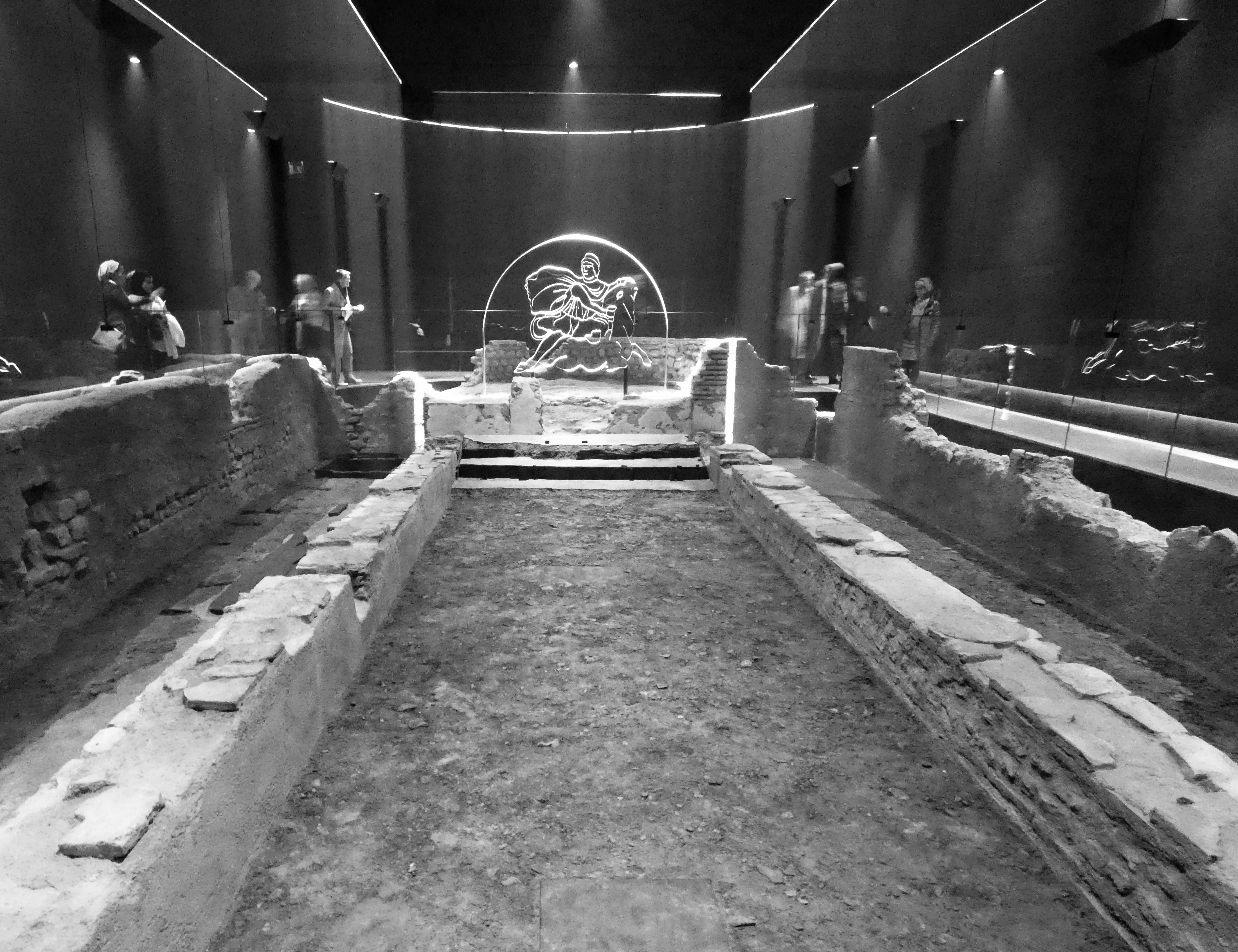
The building was about 58.5 feet long and 26 feet wide, oriented east to west, with the apse at the west. The plan was a rectangle with a nave and raised side aisles, a central door at the south in one description of the rebuilt ruin, and a projecting apse. Foundations, walls, buttresses, the apse, and the sleeper walls were of mortar, Kentish ragstone, and tile. Mortar went down first, then ragstone, then courses of ragstone and tile.
Ashlar was used for quoins, column bases, the door sill, and the jambs. Seven stone columns stood on the sleeper walls. Wooden planks in the north and south aisles may have been benches. A stone-lined square well lay at the north end of the west aisle.
A raised dais at the west would have carried the cult image and the bull-slaying scene. There were no windows, or only small windows set high, so that the room stayed dark. Candlesticks were found. The narthex could be only partly excavated, because it ran to the edge of the dig.
The ground was wet and unstable, both while the temple was built and later. In the late third century the southwestern ceiling collapsed. Three buttresses on the apse, and the sleeper walls, are signs of that weakness. The modern cellars of 7 to 9 Walbrook later cut the Roman walls and destroyed much of the post-Roman layering.
John Shepherd divided the life of the building into Phase I, Phase IIa, Phase IIb, Phase III, and Phase IV. The early phases keep the sunken nave and the columned plan. In Phase III, in the late third century, the collapse, the removal of the columns, the burial of cult images in Floor 5, and a rearrangement of the west end all fall together. Early in the fourth century the interior became more open.
Floor 6a includes a slab inscribed INVICTO and dated 307 to 308. Floor 3 brought the floor up to the top of the steps into the nave, so the room was no longer sunken. By Floor 5 the well had been covered. Whether that was the end of Mithras in the building is disputed.
Sculptures and offerings of Bacchus were used to argue that it had become a temple of Bacchus. Another reading keeps the Mithraic use until about 350. The standing ruin is said to have lasted into the Anglo-Saxon period. The fourth-century province around it had been divided into four, under a vicarius of the Diocese of the Britains, himself under the praetorian prefect of the Gauls at Trier, with a fifth province, Valentia, attested later.
The cult that the first phases served was the Roman mystery of Mithras. It appears in Rome in the first century and spreads for about 300 years after that, above all among soldiers, merchants, and imperial administrators. It reached its widest following in the second and third centuries, in the same generations in which Sol Invictus entered the public cults. Commodus is said to have been initiated, but the mysteries never became a state cult.
Porphyry described the Persian temple as a sign of the cave where Mithras killed the bull, and as a model of the universe. Firmicus Maternus mocked initiates for meeting in a dark cave away from the light. The bull-slaying scene, the tauroctony, was the centre of almost every mithraeum. Mithras drives a knife into the bull.
Cautes and Cautopates, the torch-bearers of light and darkness, stand with him inside the wheel of the zodiac. Sol rises in a two-horse chariot. Luna descends in hers. The wind gods Boreas and Zephyros occupy the lower corners of the Walbrook relief.
Other reliefs add a dog, a snake, and a scorpion, and one sculpture shows grain coming from the wound. Stars on ceilings at other temples stood for the cosmos, and one reading takes them for the dead who had been raised to immortality. The London relief is 0.53 metres high, in white marble. Ralph Merrifield judged that the sculptures found in the Walbrook in 1889 probably came from this temple, though nobody knew that at the time.
The inscription on the relief has two translations, and both have to stand. It reads, in the Latin that was cut, as a vow of Ulpius Silvanus, veteran of the Second Augustan Legion, made at Arausio, that is Orange. One translation takes it as an altar raised because of a vision. The other takes it as a vow fulfilled because he had become a Mithraist at Orange.
A further reading treats him as a principal donor, and takes the gift as thanks for being saved from danger so that he could live out his retirement in Londinium. He is not given a rank inside the seven grades. An inscription from Caerleon, the legion's fortress, is also dedicated to the unconquered Mithras by men of the same legion. The London temple is unusually large for a mithraeum, and it stands in a port city rather than beside a fort.
The Cripplegate fort, found by the excavators of the 1950s, was by then part of the town wall and only thinly occupied in the third century. A military following is likely, and a merchant following is likely as well. Ostia, another port, has at least 17 mithraea. Isotopic tests on the London marbles point to the quarries of Carrara or Docimaeum, so the finest figures were carved in Italy and brought north.
One argument is that an official from Italy brought his cult with him. Another is that local soldiers and veterans were enough, because the cult was already established in Britain, especially near the northern frontier, at places such as Carlisle, Stanwix, Lanchester, Corbridge, Castlesteads, Housesteads, Carrawburgh, and Rudchester.
Seven grades of initiation are listed by Jerome, and the number seven has been tied to the planets. In rising order they are Corax, the raven, under Mercury; Nymphus, the bridegroom, under Venus; Miles, the soldier, under Mars; Leo, the lion, under Jupiter; Perses, the Persian, under Luna; Heliodromus, the sun-runner, under Sol; and Pater, the father, under Saturn. A mosaic at the Mithraeum of Felicissimus in Ostia sets the grades out with their signs. The seven columns in London have been taken as a possible echo of the seven grades.
Membership lists that survive elsewhere, at Dura-Europos and on the album at Virunum, name only men, and historians including Richard Gordon have taken the cult as closed to women. Porphyry refers to female initiates. A. S.
Geden thought that a misunderstanding, given the military colour of the cult. David Jonathan has argued that women took part in at least some groups. Soldiers are prominent, and so are merchants, customs officers, and minor officials. Senators are rare until the pagan revival of the mid-fourth century.
Freedmen and slaves are present throughout. Only about 14 percent of Mithraic names inscribed before 250 identify a grade, which has been used to question whether every initiate held one. The London evidence for a ritual meal is animal bone, of chicken, sheep, cattle, pig, and dog, scattered through the floors and a little rarer in the layers after the Mithraic phase. Burned patches in Floor 2 are not enough to prove a kitchen.
At Carrawburgh a hearth in the anteroom, and kitchens at Lentia and Ostia, make the meal clearer elsewhere.
The sculptures buried in the temple are the strongest evidence of who was worshipped, and of the moment when that worship changed. They were packed away with care at the rededication. Among them are fine Italian marbles of Minerva, of Mercury as guide of the dead, and of the joined gods Mithras and Serapis, and coarser local clay figures of Venus combing her hair. The head of Mithras wears the Phrygian cap.
Its base is tapered to fit a body that did not survive. One dating of that head is 150 to 250. The head of Serapis is bearded and wears the grain-measure, the modius, on his hair. A water deity may be Oceanus.
A genius figure carries a ship among waves and a horn of plenty. A river god, large and bearded, may stand for the Thames. At the rededication, probably early in the fourth century and probably to Bacchus, these images were hidden. An inscription dated AD 307 to 310, and in another account 307 to 308, asks salvation for our lords the four emperors and the noble Caesar, and addresses Mithras the unconquered Sun from east to west.
The four emperors are not named on the stone as it has been read. The slab with INVICTO belongs to the same years, when the floor was being raised and the old sunken plan was being given up. Martin Henig argued from the Bacchic sculpture that the building was no longer a mithraeum. The same pairing of Mithras and Bacchus is noted at Apulum.
Use then continues, in one account, until the building fell out of use late in the fourth century.
The temple was not identified in 1889. It was found in the clearance of bomb damage for Bucklersbury House. The dates of the dig are given as 1952, as 1952 to 1953, as 1952 to 1954, and as 1954. The last planned day was Saturday 18 September 1954.
On that day the marble head of Mithras came out of the rubble of postwar London, and the building nearby could be named as his temple. W. F. Grimes directed the work with Audrey Williams.
Grimes, known as Peter, was born at Pembroke on 31 October 1905 and died on 25 December 1988. He studied Latin at Cardiff under Mortimer Wheeler and Cyril Fox, took a first in 1926, and became assistant keeper at the National Museum of Wales. His master's dissertation was on the Roman pottery from the Twentieth Legion's works at Holt. He met Audrey Williams in 1935 at Swansea, and they later married and dug together for years.
In 1945 he succeeded Wheeler as director of the London Museum, then at Lancaster House, and took on the excavation of Blitz sites before rebuilding. The City gave him its freedom in 1952. He was appointed CBE in 1955. In 1956 he succeeded V.
Gordon Childe as director of the Institute of Archaeology and professor of archaeology at the University of London. The Walbrook dig was the public peak of that London work. The ruin was at first hoped to be an early Christian church. The head ended that hope.
Alan Sorrell drew the find, and the pictures were issued on 2, 9, and 16 October 1954. Press and public interest was immediate. There were debates in Parliament and discussion in the Cabinet. Winston Churchill, the prime minister, supported an extension of the dig, and the excavation was lengthened, which held up the building.
Tens of thousands of people queued to see the Roman walls in a city that was still in ruins. One woman who was pregnant at the time named her baby Mithra. The recovery of objects in 1954 was uneven: workmen picked pieces up and handed them in. Bucklersbury House, a 14-storey block for Legal and General, was built over the site.
Its basements were deep, except on one side, where they were kept shallow so as not to threaten a church by Christopher Wren on the opposite corner. That shallow side is why later excavators still had Roman deposits to dig.
As a compromise between a new design and the loss of the ruin, the stones were taken apart and moved. The distance is given as 100 metres, as about 85 metres, and as 75 metres to the northwest and six metres above the Roman site. The new display was at Temple Court on Queen Victoria Street. The foundations were reassembled at street level in 1962, for an open-air exhibit.
The orientation was changed: the apse, which had been at the west, was shown at the north. The materials were wrong, hard cement was used, archaeologists did not supervise the work, and Grimes was dismissive of it. On 25 January 2007 the reconstruction on Queen Victoria Street was listed at Grade II, as a Roman temple of about AD 240 to 250, probably given to Bacchus from the early fourth century until it went out of use late in that century, and as the only known mithraeum from Roman London and one of only a handful from Roman Britain. The list describes the rebuilt fabric, not a cellar display: rubble of Kentish ragstone with tile, the foundations remade in modern mortar, and the interest judged to lie in the Roman stone rather than in the 1960s reconstruction.
Bucklersbury House and Temple Court, designed by O. Campbell-Jones and Sons between 1953 and 1962, were not treated as part of that interest.
In 2007 a scheme called Walbrook Square was drawn for the block after Bucklersbury House and four other buildings were to come down. Foster and Partners and the French architect Jean Nouvel, born at Fumel in 1945 and awarded the Pritzker Prize in 2008, were the designers. Legal and General and Metrovacesa fell into dispute. In October 2008 the project was stopped and Bovis Lend Lease took its team off the site.
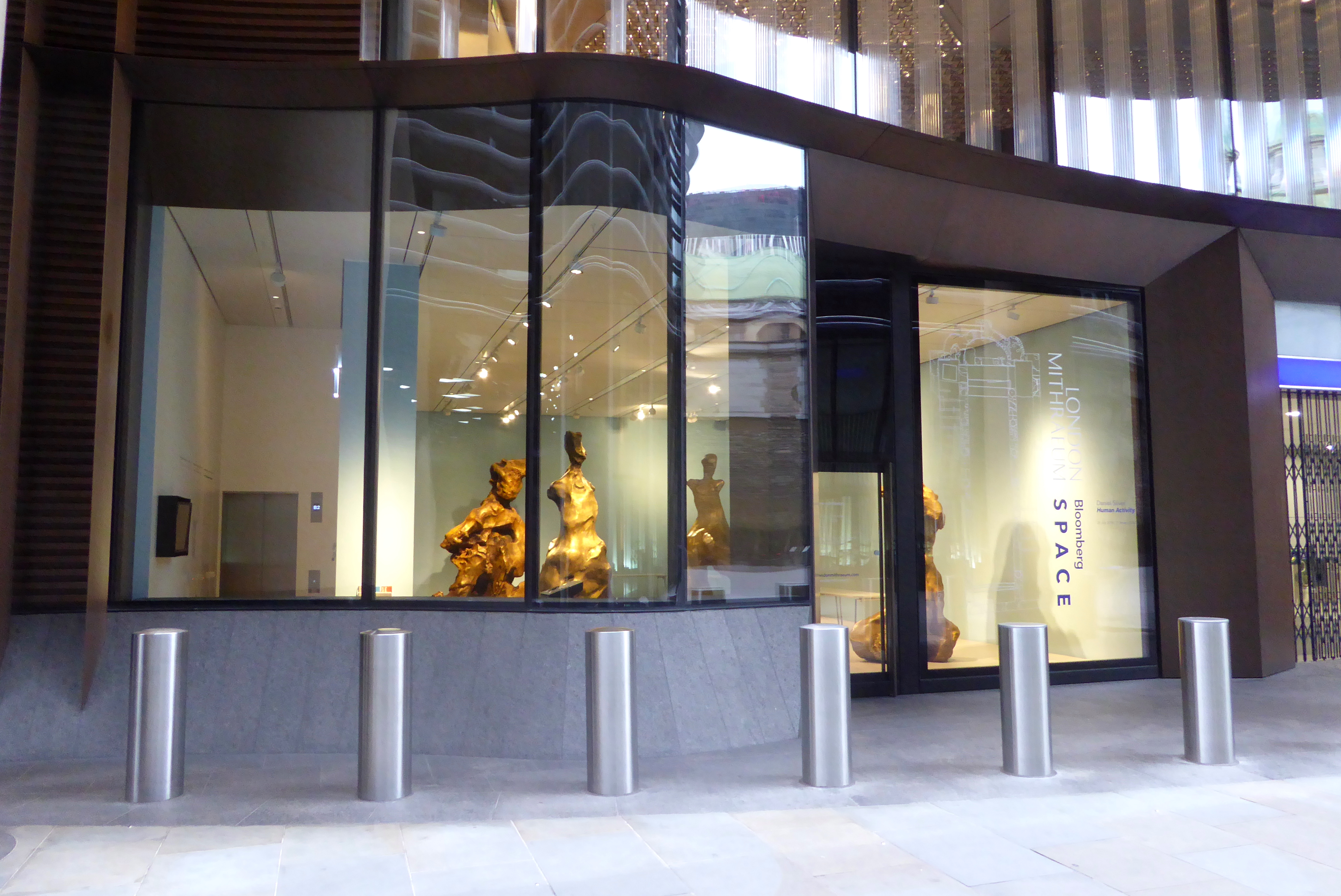
Metrovacesa left in August 2009. There was talk in May 2010 of reviving the scheme. Bloomberg L.P. bought it in 2010 and in December 2010 began a new European headquarters between the Bank of England and St Paul's. The site covers 3.2 acres and about 1.1 million square feet, with two public spaces, a retail arcade on the line of a Roman street, and the temple display.
Before that building rose, a fresh excavation opened the Walbrook valley. The dates given for it are 2010 to 2013, 2010 to 2014, and 2012 to 2014. A team of more than fifty archaeologists, from Museum of London Archaeology, did the work. On 9 April 2013, BBC News carried the account that entire streets of Roman London had been uncovered in the City.
The dig recovered more than 14,000 objects, a figure also given as about 14,000, including a large set of tools. Those objects, like the tablets, are understood as material brought in with the landfill that raised the banks after the Boudican fire, not as furnishings of the third-century temple. The headquarters, and the temple display with it, opened in 2017, and the public opening of the display is given as 14 November 2017. About 600 of the objects were placed on show with the temple and were to remain there.
The ruin was rebuilt as it looked at the end of the dig in October 1954, which is the first phase of around AD 240, without the later Roman additions. Most of the stone and brick is Roman. The wood, the render, and the lime mortar are new, matched to mortar from other Roman buildings in London. The temple was shifted a little west of the Roman footprint so that walls still in the ground, missed in 1952 to 1954 and too fragile to show, could be left alone.
Lights, haze, and sound were added to suggest the dark room and the rites. Entry was free.
On 18 March 2025 it was announced that the Bloomberg collection of more than 14,000 Roman objects would join the archaeological archive of the London Museum, with a gift of 20 million pounds toward the museum's new home. The temple, and about 600 objects, stay on permanent free display in the Walbrook building. Much of the rest of the collection had not been shown. New pieces were planned for the public when the museum's galleries open in 2026, with the opening dated 28 November 2026, and with the Poultry Market, for exhibitions, stores, and learning, scheduled for 2028.
The temple on Walbrook remains the place where the Roman walls can be seen.
Sources
- London Mithraeum — Wikipedia
- W. F. Grimes — Wikipedia
- Ralph Merrifield — Wikipedia
- Jean Nouvel — Wikipedia
- Roman Britain — Wikipedia
- Londinium — Wikipedia
- Roman Empire — Wikipedia
- Legio II Augusta — Wikipedia
- Boudica — Wikipedia
- Mithraism — Wikipedia
- About the London Mithraeum — London Mithraeum
- Plan your visit — London Mithraeum
- Roman London's Temple of Mithras — London Museum
- Bloomberg collection and London Museum gift — London Museum
- Opening of the London Mithraeum — Museum of London Archaeology
- Roman London's First Voices — Museum of London Archaeology
- The Unique Nature of the London Mithraeum — The Posthole
- Temple of Mithras, Queen Victoria Street — Historic England
- The excavation that brings Roman London back — The Guardian
- London Mithraeum, Bloomberg’s European headquarters, London (25502116578).jpg — Wikimedia Commons
- Artefacts from the Mithraeum in the City of London.jpg — Wikimedia Commons
- Entrance to the London Mithraeum.jpg — Wikimedia Commons
- Entrance to the London Mithras Temple.jpg — Wikimedia Commons
- Bull plaque - London Mithraeum.jpg — Wikimedia Commons
- Archaeological finds at Temple of Mithras.jpg — Wikimedia Commons
- London Mithraeum (43991742740).jpg — Wikimedia Commons
- London Mithraeum (30868704667).jpg — Wikimedia Commons
- London Mithraeum 01.jpg — Wikimedia Commons
- London Mithraeum 02.jpg — Wikimedia Commons