
Palace · Fortification
Hever Castle
Grade I listed country house in Hever, Kent, England, UK

Hever, United Kingdom · 1271 CE · United Kingdom
- Hever Castle is a moated stone house at Hever in Kent, dated both to about 1270 and to a licence of 1383 for John de Cobham.
- Geoffrey Boleyn bought it in 1462, and it was the childhood home of Anne Boleyn, second wife of Henry VIII.
- After 1540 Anne of Cleves held it, and the Long Gallery is credited both to her and to work of 1584.
- William Waldorf Astor bought the castle in 1903, restored it, and added the Astor Wing, the lake, and the Italian garden.
- The house and its registered garden are both Grade I, and the castle is not a World Heritage site.
Visiting
The grounds open at 10:30 and the castle opens at 12:00, though the castle may open earlier when no morning private tour or filming is booked. From 11 February to 27 March, and again from 25 October to 1 November, the grounds and castle are open daily, with last entry at 15:00 for the grounds and 15:30 for the castle, and closing at 16:30 and 16:15. From 28 March to 24 October the grounds and castle are open daily, with last entry at 16:30 for the grounds and 17:00 for the castle, and closing at 18:00 and 17:45. From 4 November to 19 November the grounds and castle are open from Wednesday to Sunday, with last entry at 15:00 for the grounds and 15:30 for the castle.
The castle and gardens are closed on Monday and Tuesday until 30 November. Christmas tickets for 20 November 2026 to 2 January 2027 go on sale on 23 September for annual members and on 30 September for other visitors. From 2 September to 19 November 2026 an adult castle and gardens ticket is £25.50 if bought online and £28.40 on entry, and an adult gardens-only ticket is £19.95 online and £22.20 on entry. A senior or student castle and gardens ticket is £22.60 online and £25.10 on entry.
A child ticket for ages 5 to 17 is £14.05 online and £15.60 on entry for the castle and gardens, and a child ticket from birth to 4 years is free. A family ticket for two adults and up to three children, or one adult and up to four children aged 5 to 17, is £66.60 online and £74.00 on entry for the castle and gardens. Annual membership includes free daytime admission. Audio guides are included in the castle admission.
Carer tickets are free on a one-to-one basis when proof of disability is shown on arrival. Dogs are not allowed inside the castle, cafés, restaurants, shops, mazes, play areas, or Festival Theatre, except assistance dogs, and dogs in the grounds must stay on a lead. Dogs are not allowed in the bed and breakfast rooms. Flash photography is not permitted in the castle, and tripods and selfie sticks are not allowed there.
Commercial filming is not allowed without permission. Smoking and vaping are not allowed in the indoor buildings or the playground. Bikes and scooters are not allowed in the grounds. Drones are not allowed to take off or land without approval.
Four manual wheelchairs are available to hire if you book in advance, with a refundable deposit of £25. Visitors are allowed to enter the grounds with a picnic. School groups are asked to follow a dress code for unheated rooms and time outdoors, and suitable footwear must be worn in the water maze because visitors may get wet.
History
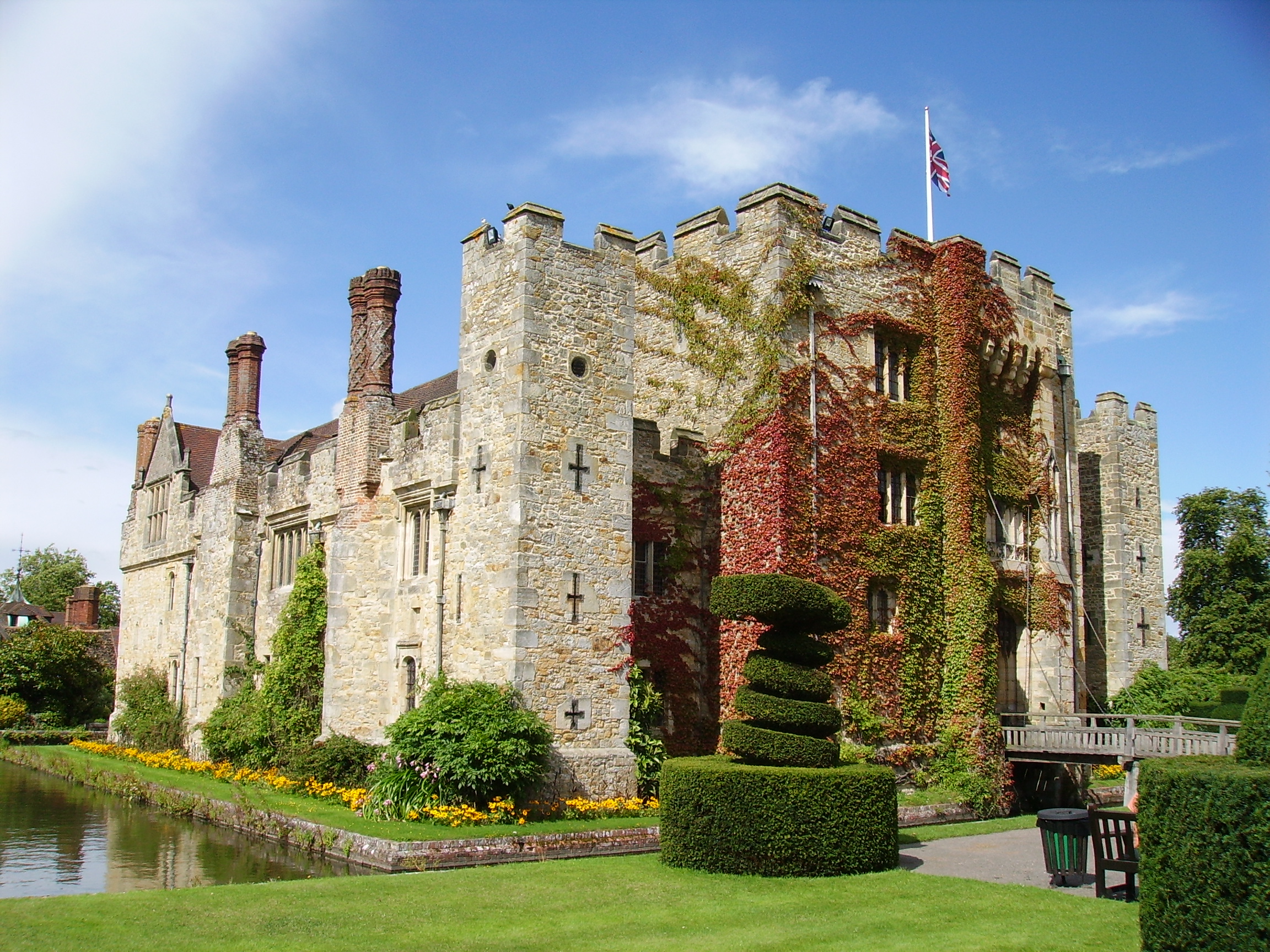
Hever Castle is a moated stone house in the village of Hever in Kent, near Edenbridge. It is about 26 metres square, with a tiny courtyard and an inner moat, and an outer moat once fed by the River Eden has largely been turned into ornamental water. The house is listed Grade I, the park and garden are registered Grade I, and the castle is not a World Heritage site.
The date of the stonework is disputed. One account places the oldest work in 1270, or about 1270, and runs the building history from 1267 to 1903, with licences to crenellate in 1340 and 1384. Another, announced in January 2023, concludes that this castle was built in 1383 for John de Cobham of Devonshire, and that the licence of 17 January 1271 belonged to the separate manor of Hever Brocas.
The de Hever family had a manor here by 1200, and the site of that first house is unknown. Stephen de Pencester, Lord Warden of the Cinque Ports from 1267 to 1299, held the land of both later manors. John de Cobham inherited a building on the castle site in 1362, received a licence from Richard II in 1383, and died in 1399.
The gatehouse and battlements are treated as fourteenth-century work, and the house is said to have the oldest working original portcullis in England. The architectural historian Simon Thurley called the defensive timberwork probably unique in Europe. A turret window carries the date 1584, and much of the present interior belongs to the restoration of 1903 to 1907.
Sir Stephen Scrope held the castle from 1399 until he died in Ireland in 1408. His widow Millicent Tiptoft married Sir John Fastolf, who kept the heir’s inheritance until 1459, although the castle itself was sold to raise money for the French wars. Sir Roger Fiennes bought it in 1423.
Roger’s brother James Fiennes, 1st Baron Saye and Sele, was beheaded by Jack Cade’s crowd in 1450. James’s son William sold the castle in 1462. Geoffrey Boleyn, Lord Mayor of London in 1457 to 1458, bought it that year and died in 1463.
William Boleyn inherited in 1463, was sheriff of Kent in 1489, and died on 10 October 1505. His son Thomas Boleyn, 1st Earl of Wiltshire, was born at Hever about 1477 and died on 12 March 1539, a date also given as 12 March 1538/9. Henry VIII made him Viscount Rochford in 1525 and Earl of Wiltshire and Earl of Ormond in 1529.
Thomas and Elizabeth Howard had three children who lived: Mary Boleyn, George Boleyn, and Anne Boleyn. Anne was born about 1501 or about 1507, lived at Hever, and was sent to the court of Margaret of Austria, with a French letter home from Mechelen in 1514. She returned to England early in 1522.
Henry VIII, king from 22 April 1509, began his pursuit of Anne Boleyn in February or March 1526. She refused to be his mistress. Seven of his love letters reached her at Hever in 1528, while another account places the courtship at nearby Bolebroke. They married in secret on 14 November 1532 and formally on 25 January 1533.
Anne was crowned on 1 June 1533 and gave birth to Elizabeth on 7 September. She was arrested on 2 May 1536, convicted on 15 May, and beheaded on 19 May. George Boleyn was executed on 17 May, or, in one account, three days before his sister. Most historians dispute the charges of adultery, incest, and a plot against the king.
Thomas kept Hever and the earldom of Wiltshire, lost Ormond and the privy seal, and died at the castle less than two years later. One account says Henry then bestowed the house on Anne of Cleves in 1540. Another says Thomas’s brother James sold it to the crown for £200 on 31 December 1540, and that Anne leased it for £9 13s 3½d a year.
Anne of Cleves, born in 1515 and dead on 16 July 1557, was Henry’s fourth wife from 6 January to 12 July 1540. The 2023 research gives her the Long Gallery, the Staircase Gallery, and a new dining-hall ceiling. An older account gives the Long Gallery to Charles Waldegrave in 1584, the year cut on the turret. There is no evidence that Henry visited her here, or that Elizabeth I ever came.
In 1557 Sir Edward Waldegrave assigned the estate to himself. He died in the Tower in 1561. Later Waldegraves are described both as residents who refurbished the house and as landlords who let it for their whole ownership. A grandson sold it in 1715 or in 1718, and the Humphreys family, also spelled Humfreys, sold it on in 1749.
Timothy Waldo bought the castle and 1,300 acres in 1749. By 1841 it had passed to the Meade Waldos, who leased it as a farm. David Cox Jr. painted the view from the moat about 1850. In the 1890s the roof leaked, damp rose from the moat, and the tenant Captain Sebright hoped to buy it.
William Waldorf Astor bought Hever in 1903, restored it by 1907 or 1908, and added the Astor Wing, the lake, and the Italian garden with Frank Pearson and Joseph Cheal. He is called a baron of 1916 and Viscount of Hever in 1917, and one account instead gives him a barony in 1956. His son John Jacob, first Baron Astor of Hever in 1956, died in 1971.
Gavin Astor opened the castle to the public in 1963. After floods in 1968, John Guthrie and Broadland Properties bought it in 1983, which is also given as the year it opened to the public. A yew maze was planted in 1904, and a water maze opened in 1999. Two of Anne Boleyn’s prayer books are on show, and a bed once sold as hers is a Victorian composite.
Images



Detailed History
Hever Castle stands in the village of Hever in Kent, near Edenbridge, about 30 miles, or 48 kilometres, south-east of London. It is a small stone house in a moat, about 26 metres square, with a tiny inner courtyard. A second, outer moat once enclosed a larger area and was fed by the River Eden and by a small stream on the east. Much of that outer water has been remodelled into ornamental stretches, and one survey found no trace of the northern arm.
The place is both a fortified house and a later family home. It is listed Grade I, and the park and garden around it are registered Grade I. It is not a World Heritage site.
The age of the stonework is told in more than one way. One account says the oldest part dates to 1270, or about 1270, and that the main periods of construction run from 1267 to 1903. That account treats the castle as a late thirteenth-century or early fourteenth-century keep, with links to square towers on the east and west, and it gives a licence to crenellate in 1340 and another in 1384. It supposes that John de Cobham largely rebuilt the house when he received the later licence, while judging that much of the outer wall is earlier.
The south front, a rectangular three-storey gatehouse with angle turrets, is called the oldest part and is dated from 1270. A further account says the original country house was built in the thirteenth century, and that its oldest work of 1270 was the gatehouse and a walled bailey.
A body of research announced on 12 January 2023, and set out more fully the following month by the castle historian Owen Emmerson, moves that early date off this building. Tradition had long said that William de Hever built Hever Castle in the early 1270s, inferred from a licence to crenellate a manor at Hever granted by King Henry III on 17 January 1271. King Richard II issued a second licence to fortify an estate at Hever in 1383, about 112 years later. John Goodall, Anthony Emery, and Nicolaus Pevsner had already argued from the style that the castle belonged to the later of those two dates.
The new research concludes that this castle, at first called Hever Cobham, was built in 1383 for John de Cobham of Devonshire, and that the licence of 1271 belonged to a different manor, Hever Brocas, less than a mile away. The castle’s own short history now says the original defensive castle, with its gatehouse and walled bailey, was built in 1383. The building account’s licence of 1340 is not part of that two-licence explanation, so the 1340 date and the 1383 or 1384 date both remain in the record of the house.
The land itself is older than either licence. The de Hever family are said to have come to England at the Norman conquest, and it is not known whether they took their name from the place or the village took its name from them. Most of the Weald is absent from Domesday, so the name of the ground in 1086 is unknown, though the church of St Peter is named in the Textus Roffensis of 1124. Three families held the ground that became Hever: the de Hevers, the de Penchesters, also spelled de Pencester, and the de Cobhams.
An earlier William de Hever, son of Walter, granted the church of St Peter to Combwell Abbey, and his heirs confirmed the grant in 1220. In 1268 the priory presented another Walter de Hever, son of Lord Ralph de Hever, to the living. That Walter’s son William became a custodian of both Canterbury and Arundel Castle. The de Hevers had a manor at Hever by 1200.
Where that first house stood is still unknown.
Stephen de Pencester, Lord Warden of the Cinque Ports for 32 years from 1267 to 1299, held land at both of the later manors. Hever Brocas descended from him. He died without a male heir, and the manor passed to John de Lynchpole, who granted it to Ralph de Hever and his wife Hawise. Their son Thomas was given free warren in his demesne at Hever in 1331.
The manor passed through Thomas’s daughter Margaret to John Brocas, who held it in 1378. When John died without children, the land went to Joan, a descendant of Ralph de Hever. Joan married Nicolas Weston, and the manor was then granted to Sir Reynold de Cobham. On that inheritance it was first called Hever Brocas.
The 1271 licence is attached to this manor, not to the castle that stands now.
The ground of Hever Cobham also came from Stephen de Pencester. His daughter Joan inherited her mother’s dower, which included land at Hever, and she married Henry Cobham of Randall. Their son Stephen de Cobham, baron of Rundall, who died in 1322, held land, a messuage, and rents at Hever. The holding passed to his son John, who died in 1362, then to John’s son Thomas, who died in 1393 or 1394, and then to Thomas’s brother, John de Cobham of Devonshire.
A pre-existing building on the castle site is also said to have descended in the Cobham family until 1362, when this John inherited it. He was a tax collector and a justice of the peace in Sussex and Surrey. In 1383 Richard II granted him a licence to crenellate. In 1392 he was appointed a deputy to Thomas of Woodstock, Duke of Gloucester, as constable in the Court of Chivalry, and he went with Richard II to Ireland as an esquire of the household.
John died in 1399 and was buried under the belfry of St Peter’s Church in Hever with his second wife, Joan Lewknor, and their son Reynold. His will provided £30 for the funeral and twenty poor men to stand vigil at the tomb for forty days.
The gatehouse and the battlements are described as original to the fourteenth century, together with a portcullis mechanism. The house is also said to have the oldest working original portcullis in England. Simon Thurley, the architectural historian who carried out the 2023 research, suggested that the gatehouse is a remarkable, not to say unique, sequence of defensive features, and that there is probably no other sequence of medieval defensive timberwork surviving like it anywhere in Europe. Rectangular gatehouses stand on the north and south.
The south gatehouse has no windows. The north has fifteenth- and sixteenth-century windows, mostly square-headed, of one, two, or three arched lights under a hood-mould. A wooden footbridge leads to the portcullis in a slightly projecting centrepiece of the late fourteenth century, with machicolation above. An octagonal turret beside the hall window has three storeys of four-light windows, and the date 1584 appears in the top row.
Tall brick chimneystacks are of the sixteenth century. A rib-vaulted entrance arch opens into the small courtyard. That arch, and much of the interior, belongs to the campaign of 1903 to 1907.
Sir Stephen Scrope owned the castle from 1399 to 1408. He was the third son of Lord Richard Scrope, a minister of Richard II, and the family held land in Yorkshire and Northumberland. Richard II appointed Stephen Lord Justice of Ireland, and Henry IV made him governor of Roxburgh Castle in 1400. His elder brother William was titled king of the Isle of Man after their father bought the island for him for £10,000 in 1392.
In 1397 Thomas de Beauchamp, Earl of Warwick, was charged with treason and sentenced to banishment on the island. Stephen and his brother were to take the earl there and keep him without letting him depart. After the death of Richard II in 1400, Stephen was charged with imprisoning the earl. In 1402 Stephen went to Ireland as lord deputy to Thomas of Lancaster, the third son of Henry IV.
He died in Ireland in 1408 and left a teenage son, also Stephen. His widow, the heiress Millicent Tiptoft, then married Sir John Fastolf.
On Stephen’s death the Hever estate was released to Millicent and to Fastolf, and the boy became Fastolf’s ward. Fastolf is said to have enjoyed that inheritance for 51 years, until his own death in 1459. He was a soldier in the Hundred Years’ War, and he has lasted in reputation as Falstaff in the plays of Henry IV and in The Merry Wives of Windsor. The owners’ index also spells his name Falstolf.
One of his servants wrote that he had ever been cruel and vengible, and for the most part without pity and mercy. The stepson was treated in that spirit. Stephen came of age in 1421 and was not given his inheritance, so he joined the French wars under Humphrey, Duke of Gloucester, to get free of his stepfather. His mother persuaded him to enter Fastolf’s service in France as secretary, and Hever Castle was sold to raise money for the campaigns.
Sir Roger Fiennes, treasurer to Henry VI, purchased the castle in 1423. One account of the same sale says the Scrope family sold it in 1423 to Roger and to his brother James.
Three Fiennes owned the castle in the fifteenth century. Roger built Herstmonceux Castle in 1441 and died four years later. His estates passed to his brother Sir James, James Fiennes, 1st Baron Saye and Sele and Lord High Treasurer. One shorter account places James Fiennes, 1st Baron Saye and Sele, as owner at the early castle, without the 1423 purchase.
In the spring of 1450, Kentish peasants led by Jack Cade protested against the weak leadership of Henry VI, against unfair taxes, and against injustices in government. James was captured by the crowd and beheaded with other favourites of the king. Their heads were set on pikes and made to seem to kiss. That death is staged in the play of Henry VI.
The estates and titles passed to his son William, the second Lord Saye and Sele, who owned Hever for the next twelve years. William’s principal house was Herstmonceux. Hever was a small source of income, and it was sold in 1462 to fund his building at Broughton in Oxfordshire.
Geoffrey Boleyn bought Hever Castle in 1462. He was born in 1406 and died in 1463, and his name is also written Jeffray Bulleyn and Bullen. He was a merchant and Lord Mayor of London from 1457 to 1458, also given as about 1457. He bought the manor of Blickling in Norfolk from Sir John Fastolf in 1452, and he was the great-grandfather of Anne Boleyn.
His brother Thomas Boleyn was prebendary of St Stephen’s, Westminster, precentor and sub-dean of Wells, Master of Gonville Hall, Cambridge, from 1454 to 1472, and master of the college at Maidstone. One account calls Geoffrey the younger brother of that Thomas. Their father was an elder Geoffrey, a yeoman of Salle who died in 1440, and their mother was Alice Bracton. Geoffrey went to London, took the freedom of the city as a hatter in 1428, and transferred to the Mercers in 1435 or 1436.
He was sheriff of London in 1446 to 1447, a member of parliament for the city in February 1449, an alderman from 1452, and master of the Mercers in 1454. Henry VI knighted him. In November 1457, when Yorkist and Lancastrian leaders gathered in the city, he raised citizens to keep the peace. In the first year of Edward IV the manor of Abbotsley in Huntingdonshire was confirmed to him.
At Hever he is said to have converted a castle then in need of repair into a manor, and to have added a dwelling within the walls. The park account says the Boleyns made internal alterations for a family home and added the central projecting bay on the gatehouse in the late fifteenth century. Back wings of about 1500, in stone, with steep tiled roofs and mullioned and transomed windows, are part of the same later medieval house, and windows of that period were inserted in the older keep.
His parents are commemorated by a brass in Salle Church, the two figures standing with a Latin prayer on a scroll between them. A sister, Cecily Boleyn, was granted the manor of Stiffkey in chief in 1455 and, by the inscription on her own brass at Blickling, died unmarried on 26 June 1458 at the age of fifty. A brother, William Boleyn, died in 1427 after settling in Lincolnshire, where he is said to have founded that county’s branch of the family. John Leland noted that Geoffrey built a fair house of brick in Norfolk.
The purchase of Blickling from Sir John Fastolf was followed by a Chancery suit over the terms of the sale. As alderman he moved from Castle Baynard ward to Bassishaw ward, which he represented from 1457 until his death in 1463.
William Boleyn inherited the castle on his father’s death in 1463. He was born in 1451 at Blickling and died on 10 October 1505. He held Blickling and Hever, and he was sheriff of Kent in 1489 and sheriff of Norfolk and Suffolk in 1500. His elder brother Thomas died in 1471, and William then succeeded to Blickling, Hever, and the other estates.
He was admitted to the Mercers in 1472 and, by special admission, to Lincoln’s Inn in 1473. He was made a Knight of the Bath at the coronation of Richard III in 1483. In August 1483 John Howard, 1st Duke of Norfolk, made him deputy for life for the coasts of Norfolk and Suffolk. Henry VII charged him with the beacons that warned of attack.
One account calls him a baron of the Exchequer and the Duke of Norfolk’s deputy. Before November 1469 he married Margaret Butler, who died in 1539 or 1540, the second daughter and co-heiress of Thomas Butler, 7th Earl of Ormond. She brought the manor of Aylesbury. They had six sons and four daughters.
Their eldest surviving son was Thomas Boleyn, 1st Earl of Wiltshire.
Two daughters never carried the Hever inheritance. A daughter Anne was born on 18 November 1475 and died on 31 October 1479, aged three years, eleven months, and thirteen days, and the brass at Blickling that marks her grave shows her as a grown woman. Another daughter, called Amy or Amata or Ann, and sometimes Jane, was born about 1475, was still living after 1521, and married Sir Phillip Calthorpe of Erwarton in Suffolk.
Thomas Boleyn, 1st Earl of Wiltshire, was born about 1477 at Hever Castle and died on 12 March 1539, a date also given as 12 March 1538/9. He was an English diplomat and politician, the father of Anne Boleyn, and so the maternal grandfather of Elizabeth I. Henry VIII made him a Knight of the Garter in 1523, Viscount Rochford in 1525, and in 1529 Earl of Wiltshire and Earl of Ormond. He also became Lord Privy Seal.
In his youth he was active at the court of Henry VII. He attended the wedding of Prince Arthur and Catherine of Aragon. In 1503 he escorted Princess Margaret Tudor to Scotland for her marriage to James IV, which is also the first mention of him in one castle account. He was a Knight of the Bath at the coronation of Henry VIII in 1509.
In February 1511 he rode in the Westminster tournament that celebrated the birth of Henry, Duke of Cornwall, paired with Thomas Grey, 2nd Marquess of Dorset, in costumes marked with the pilgrimage to Santiago. His embassy to the Low Countries in 1512 brought him to the regent, Archduchess Margaret of Austria, who accepted his daughter Anne as a maid of honour. He was sheriff of Kent in 1511 and again in 1517. He was ambassador to France from 1518 to 1520 and began the arrangements for the Field of Cloth of Gold between Henry VIII and Francis I, then was replaced by Sir Richard Wingfield.
He was envoy to the emperor Charles V in 1521 and 1523, one of a large embassy to France in 1527, and in 1529 an envoy to Charles V and Pope Clement VII to seek support for annulling the marriage of Henry VIII and Catherine of Aragon. In 1522 he was treasurer of the household. He inherited Hever in 1505 on the death of William Boleyn.
He married Elizabeth Howard, eldest daughter of Thomas Howard, then Earl of Surrey and later 2nd Duke of Norfolk, and of Elizabeth Tilney. Five children are attested, and three survived childhood. A son Thomas, born in 1496, and a son Henry, born in 1500, died young in 1506, possibly of the sweating sickness. Mary Boleyn was born about 1499 and died on 19 July 1543.
George Boleyn was born about 1504 and died on 17 May 1536. Anne Boleyn was born about 1501 or about 1507 and died on 19 May 1536. Thomas wrote after the executions that his wife had given him a child every year. The marriage is placed between 1498 and 1499, which, if that letter is taken literally, puts all five births between 1500 and 1504 and makes George the youngest.
The children were probably born at Blickling and spent most of their childhood at Hever, which became the chief residence in 1505.
Anne Boleyn was Queen of England from 1533 to 1536, the second wife of Henry VIII. The castle history says she was queen for just 1,000 days. Her birth year is not certain. Eric Ives argues for about 1501, and Retha Warnicke for about 1507.
The written evidence includes a letter she wrote in French to her father in 1514, while she was at Mechelen in the Habsburg Netherlands and he was still in England. One account says she was sent there in 1513 to be educated at the court of the Archduchess Margaret, and that she lived at Hever until that departure. She was also educated in France. She returned to England early in 1522 so that she might marry her cousin James Butler, 9th Earl of Ormond.
That plan was broken off, and she became a maid of honour to Catherine of Aragon. She continued to visit Hever. Early in 1523 she was secretly betrothed to Henry Percy, heir of the 5th Earl of Northumberland. The earl refused to support the match, and Cardinal Thomas Wolsey refused it in January 1524.
Henry VIII was born on 28 June 1491 at Greenwich and died on 28 January 1547. He was king of England from 22 April 1509. He was the second son of Henry VII and Elizabeth of York, and he became heir when his brother Arthur died in 1502. He was created Prince of Wales in 1504 and inherited the throne at seventeen.
A papal dispensation let him marry Catherine of Aragon, his brother’s widow. In 1493, at two years old, he was named Constable of Dover Castle and Lord Warden of the Cinque Ports, an office Stephen de Pencester had held for three decades in the thirteenth century. Henry grew dissatisfied with the marriage because he wanted a male heir. In February or March 1526 he began his pursuit of Anne Boleyn.
She refused to become his mistress, as her sister Mary had been. Seven of his love letters were sent to her at Hever in 1528. Another account says he often used the nearby house of Bolebroke for the courtship. What was at stake was the succession, the standing of the Boleyn family, and the authority of the pope in England.
After Wolsey failed to obtain an annulment from Clement VII, Henry and advisers such as Thomas Cromwell moved to break the power of the Church in England and to close the monasteries. Anne’s refusal to be a mistress rather than a wife is the reason the castle history gives for that split and for the creation of the Church of England.
He was baptised by Richard Foxe, Bishop of Exeter, in the church of the Observant Franciscans beside the palace. As a boy he was looked after by Elizabeth, Lady Darcy, and then by Elizabeth Denton. He became fluent in Latin and French and learned at least some Italian. On 9 February 1506 the emperor Maximilian I made him a Knight of the Golden Fleece.
A joust in 1536 left a gangrenous wound in his leg, and in his last years he was immobile and morbidly obese. He was buried in St George’s Chapel at Windsor Castle. His only surviving son, Edward VI, succeeded him. The Acts of Supremacy named him Supreme Head of the Church of England, and the closure of the monasteries brought their wealth to the crown.
Henry and Anne married in secret on 14 November 1532 and formally on 25 January 1533. On 23 May 1533 Thomas Cranmer, Archbishop of Canterbury, declared the marriage to Catherine null. Five days later he declared the marriage to Anne valid. Clement excommunicated Henry and Cranmer.
Anne was crowned on 1 June 1533. On 7 September she gave birth to the future Elizabeth I. Henry was disappointed by a daughter, hoped for a son, and said he loved Elizabeth. Anne then had three miscarriages.
By March 1536 he was courting Jane Seymour. In April 1536 Anne was investigated for high treason. She was arrested on 2 May and sent to the Tower of London. The jury included Henry Percy, her former betrothed, and her uncle Thomas Howard, 3rd Duke of Norfolk.
She was convicted on 15 May and beheaded four days later, on 19 May 1536. The charges included adultery, incest with her brother George, and a plot to kill the king. Most historians dispute them. George Boleyn was executed on 17 May 1536.
One account says he was beheaded three days before his sister.
George Boleyn, Viscount Rochford, was the only surviving son. From 1529 he used his father’s junior title, created in 1525, as a courtesy title. He was introduced at court at about ten, at the Christmas festivities of 1514 to 1515, where he attended an indoor melee with his father and acted in a mummery with his father, Charles Brandon, and Nicholas Carew. He soon became one of the king’s pages.
George Cavendish wrote that George was about twenty-seven when he joined the Privy Council in 1529, using that age as a ceiling so the verse would scan. Foreign diplomats thought him too young to be ambassador to France in October 1529. On his mother’s side he was nephew of the 3rd Duke of Norfolk and cousin of Henry Howard, Earl of Surrey, of Mary Howard, and of Catherine Howard, later the fifth wife of Henry VIII. Catherine Howard is also spelled Katherine Howard in questions put to the castle.
Henry later ordered her beheading as well as Anne’s. After Elizabeth became queen in 1558, Anne was venerated as a martyr and heroine of the English Reformation, especially through the writings of George Wyatt. She has been called the most influential and important queen consort England has ever had, because she was the occasion for Henry to declare the English Church independent of the pope.
After the executions the king left Thomas Boleyn, 1st Earl of Wiltshire, alone. Imagining the king’s death was treason, and most families in that position lost everything. Thomas kept Hever and the earldom of Wiltshire. He lost the earldom of Ormond and the office of Lord Privy Seal.
He retired to the castle and died there less than two years later. His wife is said to have died before him and to have been buried in the Howard vault at St Mary’s, Lambeth, while he left his elderly mother, Margaret. There are no original Boleyn papers still at the castle. The books of hours associated with Anne were bought back later by the Astors or by the Guthrie family.
Two prayer books that belonged to her, with her inscriptions and her signature, are shown to visitors. A story that three pearls now on the Imperial State Crown came from her B pendant is only hearsay and cannot be proved. A small upstairs room has long been called her bedroom. The oldest periodical found to use that name dates from the late eighteenth century, so the name is not a Victorian invention.
Queen Victoria visited in 1838 and called the castle a curious old place. A bed bought by William Waldorf Astor in the early 1900s as Anne’s is now known to be a Victorian assembly of late sixteenth- and seventeenth-century chests and coffers, with a little real bed-wood. The crest on the headboard has the royal arms supported by a lion and a unicorn, and the unicorn belongs to James I of England and James VI of Scotland.
The castle is said to have come to Henry VIII after Thomas died in 1539, and to have been bestowed on Anne of Cleves in 1540 as part of the settlement after their annulment. Another account says that Thomas’s brother James then inherited and sold the castle to the crown for £200 by an indenture of 31 December 1540. Anne of Cleves was born in 1515, on 28 June or on 22 September, at Düsseldorf, and she died on 16 July 1557. She was the second daughter of John III, Duke of Cleves, and Maria of Jülich-Berg.
She grew up at Schloss Burg. Her father was influenced by Erasmus, sided with the Schmalkaldic League, and opposed Charles V. Her brother William became duke on their father’s death in 1538 and was called the Rich. Her sister Sibylle married John Frederick, Elector of Saxony.
In 1527, at eleven, Anne was betrothed to Francis, the nine-year-old heir of Lorraine. The betrothal was unofficial because he was under the age of consent, and it was cancelled in 1535. In March 1539 Henry VIII negotiated with the German Protestants against France and the Empire, and Thomas Cromwell urged the match. Hans Holbein the Younger painted Anne and her sister Amalia at Düren.
A marriage treaty was signed on 4 October 1539. Anne reached England in December 1539. Henry met her in disguise in January 1540. They married on 6 January and the marriage was annulled on 12 July, unconsummated, after six months.
She was given a generous settlement and called the king’s beloved sister, also the king’s sister. She received £500 a year, a household, and two houses, and she was allowed to lease further manors, including Hever, at a rent of £9 13s 3½d a year. One register spells her name Cleeves and says the castle was her home until 1557. She made alterations during that occupancy and spent a good part of her time here.
Letters she wrote from Hever to her brother survive in German archives. The only surviving letter in a British institution was written to Mary Tudor in 1554 and signed from her poor house of Hever. There is no evidence that Henry VIII visited her at Hever. There is also no evidence that Elizabeth I ever visited the castle, though Elizabeth visited the Sidneys at Penshurst, about three miles away.
Anne attended Mary’s coronation on 1 October 1553, outlived Henry’s other wives, and was buried as a queen in Westminster Abbey. On her death in 1557 the estate reverted to the crown.
Anne of Cleves had no formal schooling. She was skilled at needlework. Holbein’s portraits of Anne and of her sister Amalia are now in the Louvre and in the Victoria and Albert Museum. Another portrait of 1539, from the school of Barthel Bruyn the Elder, is at Trinity College, Cambridge.
Her mother, Duchess Maria, was described as a strict Catholic. Her father’s quarrel with Charles V over the duchy of Guelders, after the Truce of Nice, is the reason the family suited an English alliance.
The 2023 research gives Anne of Cleves the Long Gallery, which had been attributed to Thomas Boleyn, 1st Earl of Wiltshire. She is also credited with the Staircase Gallery on the floor below, linking the two wings, and with remodelling the ceiling of the dining hall. Those works are used to argue that she spent more time at Hever than earlier accounts allowed. A different account says Sir Charles Waldegrave created the Long Gallery in 1584, and perhaps the oratory.
The panelling of the gallery, which runs above the hall and the whole length of the north front, is placed about 1584, when gables were put in to light it, and the turret carries the same date. Among the fittings treated as older than the twentieth-century restoration are the moulded beams in the room called Henry VIII’s, a stone chimneypiece with frontal caryatids in the morning room and an overmantel above it dated 1603 from Sparrowe’s House at Ipswich, a coarse overmantel in the withdrawing room from a house in Devon, and foreign-looking wooden reliefs of Genesis scenes in the room called Viscount Rochford’s, in the east range. The castle still has one of the private locks Henry VIII carried from house to house and fitted to doors for his security. A Chinese ginger jar of about 1850, painted with peonies and chrysanthemums on a pink ground, was bought by the Astors and is kept as a later household object.
In 2007 the castle bought a mid-sixteenth-century portrait then thought to be Catherine Howard, once at Trentham Hall. It is one of three versions of a painting whose original, by Holbein, is at Toledo. Lionel Cust in 1909, publishing in 1910, named the sitter Catherine Howard. Roy Strong in 1967 named her Elizabeth Seymour, Lady Cromwell.
David Starkey, Alasdair Hawkyard, and Bendor Grosvenor in 2007 argued from a jewel in the 1540 inventory of the queen’s jewels, Holbein’s medallion of Lot’s wife. Susan James has since proposed Lady Margaret Douglas. The sitter is inscribed as in her twenty-first year. The identity remains disputed.
In 1557 Sir Edward Waldegrave, a member of Mary’s council and one of the commissioners for the sale of crown land, assigned himself the castle and estate. When Elizabeth came to the throne he was deprived of his appointments and arrested for allowing Mass in his house. He was sent to the Tower and died there in 1561. The Mass may have been at Borley rather than at Hever.
His son Charles had been a privy councillor and master of the queen’s horse. He lost those offices, retired to Hever with his wife Jeronyma, and, as a Catholic shut out of national affairs, spent his time refurbishing the castle. He died in 1589. His son Edward made Hever his principal residence.
In 1642, at the age of seventy, that Edward raised a regiment of horse and joined Charles I in the Civil War. He was created first baronet of Heaver Castle, the title using that spelling, and he died two years later, in 1644. Against this account of a family living in the house, the 2023 rebranding says the Waldegraves were landlords who let the castle for the whole of their ownership, and a 2020 conservation note says they rented it out and did not live there, which is offered as one reason Elizabeth I would not have visited. The castle is also said to have been almost continuously occupied from 1557 to 1903.
Edward was succeeded in 1644 by his son Henry, the second baronet. Henry died in 1658 and was succeeded by his son Charles, who died in 1684. Charles’s son Henry inherited and married Henrietta Fitzjames, natural daughter of James, Duke of York, and Arabella Churchill. When William and Mary came to the throne, the Catholic Waldegraves faced a hard future.
Henry’s son James took the oath of supremacy, conformed to the Church of England, and sat in the House of Lords. One account places that decision in 1689 and adds that he became ambassador to France and an earl, and that the castle was sold in the early 1700s because it was too small for his rank. Another account dates the sale to 1718, to Sir William Humphreys. The park register dates Humphreys’s acquisition to 1715.
A further span gives the Waldegraves the castle from 1557 to 1715. Humphreys, also spelled Humfreys, had been made a baronet in 1714 while he was Lord Mayor of London. He married Margaret Wintour and had a son, Orlando, and his second wife was Ellen Lancashire. Orlando inherited the baronetcy and the estate in 1735 and married his stepsister Ellen.
Two of their sons died. Orlando gave Hever to his surviving son Robert, who died in 1736 at the age of twenty-eight, a year before his father. The estate passed to Robert’s sisters. Mary’s husband William Bell Waring died in 1746, and she married John Honeywood, who died two years later.
Mary’s mother Ellen remarried in 1746 to Charles Gore, member of parliament for Hertfordshire. Mary then married Thomas Gore, uncle of her mother’s new husband, and so became both daughter and aunt to her mother. Ownership was too tangled to keep, and the estate was sold in 1749.
Timothy Waldo, a lawyer and City merchant, bought the castle and 1,300 acres in 1749. The park register gives the Waldo family the castle from 1750 until 1903 and says they let it, because it was never their main residence. Waldo was attorney of the King’s Bench, a solicitor in Chancery, and liveryman and clerk of the Salters’ Company. He was knighted in 1769.
He married Catherine Wakefield in 1736 and had one daughter, Jane. Jane inherited in 1786, by which time she had married George Medley of Buxted, member of parliament for East Grinstead. She outlived him, died childless in 1829 at the age of ninety-one, and left the estate to a cousin, also Jane Waldo. That Jane died in Tunbridge Wells in 1841, and this branch of the family ended.
In 1830 Edmund Wakefield Meade, connected to the Waldos by marriage, had taken the additional name Waldo. He inherited in 1841, had no love for Hever, lived in the north of England, and bought and restored Stonewall Park, three miles from the castle. Hever became a working farm, leased to tenant farmers. David Cox Jr. painted it in those years.
David Cox Jr., born on 9 July 1809 and dead on 6 December 1885, was an English watercolour landscape painter, taught by his father David Cox, who lived from 1783 to 1859. He was born in Dulwich, educated at Hereford Grammar School, and used a brighter palette than his father. He exhibited at the Royal Academy from 1827 and, from 1848, at the Society of Painters in Water Colours, where he eventually showed 580 works. He died at Streatham and was buried at West Norwood.
A watercolour captioned Hever Castle from the Moat is dated about 1850 and is his. Another watercolour of the castle is placed about the same year.
The last tenants were Captain Guy Thomas Saunders Sebright and his wife Olive, who leased the castle in 1895 from Edmund Waldo, son of Edmund Wakefield Meade Waldo. Edmund Gustavus Bloomfield Meade Waldo, an ornithologist, succeeded in the family, and his wife Ada Coralie believed the castle was haunted and complained that the ghost of Anne Boleyn made it unpleasant. By then the house was uninhabitable: the roof leaked, and damp rose from the moat. Sebright began a restoration in the hope of buying it.
Meade Waldo sold instead, in 1903, to William Waldorf Astor. The early nineteenth-century interior restoration recorded for the house sits in this long period of private tenants, and the library is said to differ in size and appearance from the room as it was before the years 1830 to 1897. Exposed framing in the courtyard was restored. The medieval exterior was judged to have survived the later work.
William Waldorf Astor bought Hever in 1903. On his father’s death early in 1890 he had inherited a fortune that made him the richest man in America. He grew disenchanted, said America was no longer a fit place for a gentleman to live, and in 1891 moved to England with a reputed 100 million dollars. Between 1903 and 1908 he restored the castle, built the Astor Wing, and created the lake and the gardens.
The building work is also dated 1903 to 1907. One account gives the lake as 35 acres. The architect was Frank Pearson, also named F. L.
Pearson, who lived from 1864 to 1947, and one account of the wing names J. L. Pearson with him. The nurseryman was Joseph Cheal.
The wing, called the Tudor village and later the Astor Wing, was guest and service accommodation on the north side, of one and two storeys, brick and stone with half-timbered upper floors, linked to the castle by a covered bridge. Some roofs are tile and some Horsham stone. Many gables are jettied, and some timbers are carved. A little loggia turns the angle nearest the castle and leads to the bridge.
The Italian garden was made to hold Astor’s ancient Greek and Roman sculpture, and the grounds also came to include a fernery, rose gardens, a herb garden, and topiary. A yew maze was planted in 1904. The new work is described as Edwardian craft carried out without damaging the medieval exterior. One account makes William Waldorf Astor a baron in 1916 and the first Viscount of Hever in 1917.
Another ennobles him as Baron Astor in 1956, the year his son received a different barony.
Astor died in 1919. His son John Jacob Astor inherited. John Jacob had won gold for Great Britain in the men’s doubles at rackets at the London Olympics of 1908. In 1922 he became member of parliament for Dover, and he bought The Times, remaining chairman until 1959, when his son Gavin took over.
He was created first Baron Astor of Hever in 1956. In 1962 he placed the castle in trust for Gavin and retired to France, where he died in 1971. In 1963 Gavin opened the castle and gardens to the public for the first time. After floods in 1968 the cost of the estate became too heavy, and in 1983 the castle and some 3,000 acres were sold to John Guthrie.
A county record instead dates the public opening to 1983. The northern parkland was bought for a golf club and laid out as a course in 1990. The castle and ornamental grounds went to Broadland Properties, a company founded in 1950, and were run as Hever Castle. In 1997 the whole estate was still in private ownership.
John Guthrie is dated 1906 to 1992 and called chairman of that family business. The estate’s own account, still written as if he were living, calls him a chartered surveyor from a Yorkshire family based in Scarborough and says he chairs the company that bought the castle and its collection in 1983. The company has added to the collection, rebuilt the 1970s restaurant as the Guthrie Pavilion in a classical style beside the Italian gardens, installed a woodchip boiler that supplies more than 90 per cent of the hot water and heating, and replaced a century-old sewage system with wetland lagoons.
The castle is now a tourist house. Its three floors hold antique furniture, the prayer books, a display of instruments of torture, and a large collection of Tudor paintings. A separate building holds a museum of the Kent and Sharpshooters Yeomanry. The grounds cover 125 acres in one visitor account.
A water maze, opened in 1999, asks the visitor to reach a folly at the centre without getting wet. A tower maze in the children’s playground is recorded as undergoing reconstruction, without a date for that work. Twenty-eight rooms in the Astor Wing can be rented. The castle has been used for the 2020 series The Third Day, for a peace conference set in the lakeside loggia in The Great, for scenes in the second season of Andor that stood in for Naboo, and earlier for The Phantom Menace, and for the films The Passionate Pilgrim, The Princess Bride, and Inkheart.
It has also been used for music videos, for summer jousts and archery, for a September exhibition of patchwork and quilting, and for a triathlon and open-water swimming. It is privately owned and does not belong to the National Trust or to English Heritage.
The building was listed Grade I on 10 September 1954, after the Tudor village had been added, and the entry was given a minor amendment on 27 February 2013. The park and garden were registered Grade I on 1 May 1986 as an early twentieth-century formal garden around the castle, set in parkland of the same period. The published protections named for the place are that listing and that registration. In March 2020 the castle conservationist Alison said that something had been found in the castle and that the research was still going, and she did not describe the find.
The 2023 work was documentary and architectural, not a reported excavation. It put de Cobham, Boleyn, Cleves, and Astor on the flag, and it took down de Hever and Waldegrave. The ground-floor displays were to be rearranged by 26 March 2023, after a reopening on 8 February 2023, with the upper floors to follow. A county archaeologist, commenting on a proposal that year for new buildings on the estate, wrote that the visible fabric and the later alterations leave a very high chance that the earliest structures are buried, and that a desk-based assessment was required before a decision.
No list of finds from a completed modern dig has been published with that warning. The gatehouse, the moat, and the portcullis remain the medieval core inside a house that Anne Boleyn knew as a child, that Anne of Cleves altered, and that William Waldorf Astor rebuilt as an Edwardian home.
Sources
- Hever Castle — Wikipedia
- Anne Boleyn — Wikipedia
- Anne of Cleves — Wikipedia
- Henry VIII — Wikipedia
- Thomas Boleyn, 1st Earl of Wiltshire — Wikipedia
- William Boleyn — Wikipedia
- David Cox Jr. — Wikipedia
- Geoffrey Boleyn — Wikipedia
- George Boleyn — Wikipedia
- History of Hever Castle — Hever Castle
- Hever Castle Rediscovered — Hever Castle
- Rediscovering Hever Castle: A tale of two Hevers — Hever Castle
- Cobham family, owners of Hever Castle — Hever Castle
- Scrope family, owners of Hever Castle — Hever Castle
- Fastolf, owner of Hever Castle — Hever Castle
- Fiennes family, owners of Hever Castle — Hever Castle
- Boleyn family, owners of Hever Castle — Hever Castle
- Anne of Cleves, owner of Hever Castle — Hever Castle
- Waldegrave family, owners of Hever Castle — Hever Castle
- Waldegraves continued, owners of Hever Castle — Hever Castle
- Humphreys family, owners of Hever Castle — Hever Castle
- Waldo family, owners of Hever Castle — Hever Castle
- Meade Waldo family, owners of Hever Castle — Hever Castle
- Astor family, owners of Hever Castle — Hever Castle
- Guthrie family, owners of Hever Castle — Hever Castle
- Opening times — Hever Castle
- Ticket prices — Hever Castle
- Visitor questions — Hever Castle
- Questions for the castle conservationist — Hever Castle
- Hever Castle listed building — Historic England
- Hever Castle park and garden — Historic England
- Hever Castle monument record — Kent Historic Environment Record
- Hever Castle research record — Heritage Gateway
- Hever Castle.jpg — Wikimedia Commons
- Hever Castle 10.JPG — Wikimedia Commons
- Hever Castle 14.JPG — Wikimedia Commons
- Hever Castle - geograph.org.uk - 122418.jpg — Wikimedia Commons
- Castle Walls, Hever, Kent - geograph.org.uk - 1389362.jpg — Wikimedia Commons
- Entrance to Hever Castle Estate, Hever, Kent - geograph.org.uk - 1383491.jpg — Wikimedia Commons
- Gardens at Hever Castle, Kent - geograph.org.uk - 1389401.jpg — Wikimedia Commons
- Flickr - law keven - From the Floor boards Up....jpg — Wikimedia Commons
- HEVER CASTLE AND GARDENS Castle Gatehouse.JPG — Wikimedia Commons
- Front view of Hever Castle, Kent.jpg — Wikimedia Commons