Fortification
Herstmonceux Castle
castle near Herstmonceux, East Sussex, England; formerly a manor

Eastbourne, United Kingdom · 1401 CE · United Kingdom
- A red-brick fortified house begun in 1441 for Sir Roger Fiennes, treasurer of the household of Henry VI, beside the Pevensey Levels.
- Richard Fiennes, 7th Baron Dacre, continued the building, and in 1541 the estate was forfeited after Thomas Fiennes was hanged for a killing committed on a poaching raid.
- George Naylor bought the castle in 1708, and in 1776–77 the Hare family stripped the interior so the walls would stand as a ruin.
- Claude Lowther and Sir Paul Latham, 2nd Baronet, restored the house in the early twentieth century, and from 1946 to 1988 the estate was the Royal Greenwich Observatory.
- Alfred Bader and Isabel Bader gave it to Queen’s University, which opened a study centre in 1994 and repaired the fabric for a return to teaching in 2026.
- The moat, the walled garden, and a national collection of hardy water lilies lie in a medieval park where excavation has traced an earlier manor.
Visiting
The gardens and grounds are open from 1 April to 31 October from 10 am to 5 pm, with last admission at 4 pm, and from 1 November to 31 March from 10 am to 4 pm, with last admission at 3 pm. Adult tickets are £11, visitors aged 60 and over pay £10, children aged 4 to 17 pay £5.50, and children under 4 and carers are admitted free. Tickets can be bought online or on site by cash or card. A tour ticket is required for the castle interior, and that ticket costs a further £6 at selected times.
History
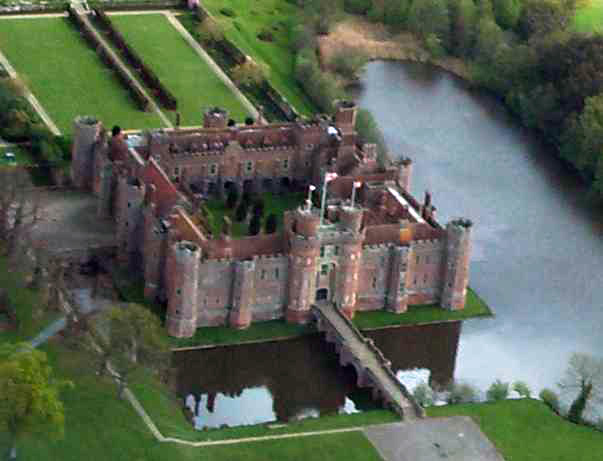
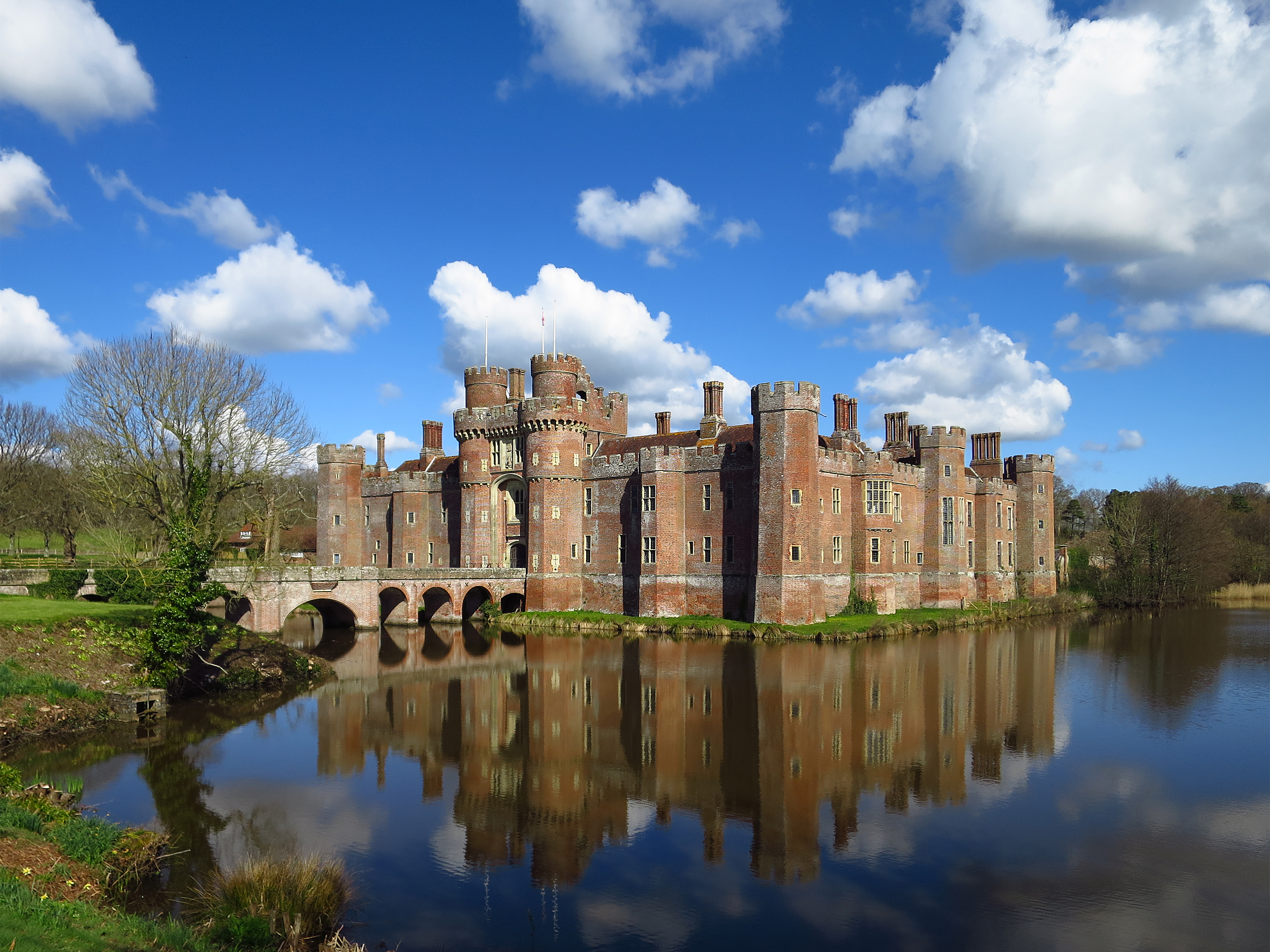
Herstmonceux Castle is a red-brick house of 1441 in the parish of Herstmonceux, where a stream valley leaves the Weald for the Pevensey Levels. Sir Roger Fiennes, treasurer to Henry VI and a veteran of Agincourt and the Norman campaigns, built it with brick made from local clay by Flemish workmen, at a cost of three thousand eight hundred pounds. The house was a palace with towers and a moat, raised for a man whose income and offices had outgrown the old manor his family had held since 1330.
The manor is on record from 1086, and it took its name when Idonea de Herst married Ingelram de Monceux. Roger inherited it in 1402 as a royal ward, enlarged the park, and in February 1441 received licence to crenellate and to enclose six hundred acres. His son Richard Fiennes, 7th Baron Dacre, finished the work and, in right of his wife Joan Dacre, held the Dacre title after a settlement of 1473. Joan died in the castle in 1486.
In 1541 Thomas Fiennes, 9th Baron Dacre, was hanged at Tyburn after a poaching affray in which John Busbrig was killed. Busbrig is described both as a servant and as a gamekeeper, and the estate was taken by the Crown before it returned to the family. The Lennards held it until 1708, when George Naylor, a lawyer and member of parliament, bought it for 38,215 pounds. His heirs, the Hare Naylors, moved to Herstmonceux Place in 1775 and, on Samuel Wyatt’s advice, stripped the castle interior in 1776 and 1777 so that the walls would stand as a ruin in the park.
Claude Lowther began the rebuilding in 1913, and Sir Paul Latham, 2nd Baronet, finished it in 1933 with the architect Walter Godfrey, whose work Nikolaus Pevsner called exemplary. The four old courtyards became one lawn court, the moat was flooded again, and the walled garden was given the formal plan it still has. In 1946 the Admiralty bought the estate for the Royal Observatory, which worked here from 1948 until it left for Cambridge in 1988, a move also dated to 1990. The six telescope domes remain as a science centre, and the empty dome of the Isaac Newton Telescope, inaugurated here in 1967 and later sent to La Palma, is still a landmark.
Alfred Bader and Isabel Bader gave the castle to Queen’s University at Kingston in 1993, and a study centre opened in 1994, later named Bader College. Operations stopped on 13 November 2023 when the fabric was found unsafe after years of piecemeal repair. The south wing, the gatehouse parapet, and the south-west tower were conserved for a return to teaching in 2026, on a new pattern of short courses rather than a resident undergraduate college.
The park of about 148 hectares keeps the line of a medieval deer park, a moat, clay ponds, and a walled garden. Excavation has found an earlier manor on the edge of the Levels, a post-medieval stable west of the castle, and a scatter of medieval writings.
A collection of hardy water lilies was recognised in 2025, and the moated house has served as a film set, including for an adaptation of a story by C. S. Lewis.
Images


_for_the_challenge_(15401286554).jpg)


Detailed History
Herstmonceux Castle is a red-brick fortified house in the parish of Herstmonceux, in East Sussex, set at the south end of a shallow stream valley where the wooded edge of the Weald gives way to the flat wetlands of the Pevensey Levels. The house is square in plan, with a gatehouse, angle towers, and a moat, and it is one of the oldest significant brick buildings still standing in England. It was among the first great English houses to be built of brick, the bricks fired from local clay by builders from Flanders. Construction began in 1441 for Sir Roger Fiennes, treasurer of the household of Henry VI.
The building was a palatial residence dressed with towers and battlements, not a fortress designed for a siege, and it took the place of an older manor on an estate the Fiennes family had held since 1330.
The ground itself had been occupied long before the brick. The first written notice of a settlement called Herst is the survey of 1086, which records a priest named Edmer there in 1066 and, twenty years later, a tenant named Wilbert holding the manor from one of William the Conqueror's close supporters. By the end of the twelfth century the family at the manor house had enough standing for a lady called Idonea de Herst to marry a Norman nobleman, Ingelram de Monceux. Their son Waleran de Monceux held it in 1211, and his son William de Monceux in 1216.
A further Waleran followed, then John de Monceux in 1279, another John in 1302, and another John in 1316. Around this time the manor began to be called the Herst of the Monceux, the name that settled into Herstmonceux. In 1330 the heiress Maud de Monceux married Sir John Fiennes, and the estate passed to the family that would build the castle. Her son William Fiennes held it from 1351, and his son Sir William Fiennes from 1359.
Even before the brick towers, the property was valuable and wet. In 1375 Herstmonceux was reckoned to be worth as much as forty pounds a year, although the land was for the most part waterlogged. The park is likely to have existed by the twelfth century, though the moment of its making is unrecorded. The early fifteenth-century manor stood in a deer park.
A survey of 1570 still describes that park as bounded by a pale, a third of it laid to lawns with great timber trees and stocked with fallow deer. John Norden's map of 1595 shows an oval paled enclosure with a central lake and a stream flowing south. The medieval park once reached farther south, and also north and north-west toward Windmill Hill and Gardener Street. By 1570 the estate had been reduced to about 160 hectares.
The east and west road boundaries of the present park appear to be of early fifteenth-century origin and to have held their line since then. West of the park, hedged pasture runs out into the open water system of the Pevensey Levels, a great sheet of grazing meadow and ditch between Hailsham and the coast, important for wetland birds and for a rich fauna of freshwater molluscs.
Sir Roger Fiennes was born into this inheritance and baptised at Herstmonceux on 14 September 1384. He was the son of Sir William Fiennes, sheriff of Surrey and Sussex in 1396, and of Elizabeth Battisford. His mother was a daughter and coheir of William Battisford of Wartling and of Margery, daughter and heir of Simon Peplesham. His younger brother was James Fiennes, later Lord Saye and Sele, who was born at Herstmonceux on 22 September 1395.
Roger was seventeen when his father died in 1402 and he inherited the family estates. He was made a royal ward. Sir John Pelham, constable of the nearby castle of Pevensey and a king's knight, paid the Crown two hundred marks for the right to arrange the boy's marriage. When Roger's maternal grandmother died early in 1407 he added a second manor at Herstmonceux and land at Wartling, next to the Fiennes manor of Old Court.
He had delayed a formal proof of age, and he now made it so that he could take both his father's lands and his grandmother's. His paternal grandmother, Joan, who had died in 1378, was a daughter of Geoffrey, Lord Say. After the failure of other lines, a third of the Say estates came to Roger. During his minority that share had been in Pelham's hands.
The young heir was soon in local trouble. In October 1408 he had to ask Pelham for securities of two hundred pounds and to undertake not to harass the canons of Michelham Priory. A month later he and a kinsman, Lord Clinton, sought a royal pardon for having entered parts of the Say inheritance without due process. Two years after that the two of them pushed the vicar of Bourne out of other Say property.
In 1411 Fiennes put his estates into the hands of feoffees headed by Pelham. Two years later those feoffees applied for a royal licence to stop up a road that ran through Herstmonceux park. That licence opened the long building works of his ownership. In the tax assessment of 1412 his Sussex estates were valued at a hundred pounds a year, his Hampshire lands at twenty marks, and his Kentish holdings at fifty-two pounds.
With manors in three further counties and his share of the Say inheritance, his income stood well above the hundred and sixty-five pounds those figures record.
Roger Fiennes was knighted before November 1412. He was probably overseas that year in the company of the Duke of Clarence. In 1415 he provided seven men-at-arms and twenty-four archers for the invasion of France by Henry V, and on the field at Agincourt, fought on 25 October near Azincourt, he took prisoners. The battle was an English victory in the Hundred Years' War, won by a tired and outnumbered army that had already lost many men to disease at the siege of Harfleur and was trying to reach Calais.
The victory opened about fourteen years in which English arms were dominant in France, until the reversal at Orléans in 1429. From November 1416 Roger received a retaining fee of forty pounds a year, half from the fee farm of Cambridge and half from the wool customs at Southampton. For the king's second expedition, in 1417, he contracted to bring nine lances and thirty archers. He served through the conquest of Normandy, including the sieges of Louviers and Rouen.
After Rouen fell in January 1419 he was empowered to take the surrender of Caudebec in the king's name. He was bailli of Caux from 23 January 1419 until 18 January 1421, captain of Longueville from 14 February 1419, and captain of Piercourt from 28 March 1420, and he was granted land in the duchy to hold in tail male. He seems to have stayed in France through 1419 and 1420, and he came home with the king in February 1421.
In April 1421 Henry V gave him the keepership of Portchester Castle for life, a fortress commanding the entrance to Portsmouth harbour. He followed the king back to France in June and within a month was serving in the Bastille at Paris. He did not see England again until after Henry V's death. Henry VI, born at Windsor on 6 December 1421, became king of England on 1 September 1422 at the age of nine months, and in October, under the Treaty of Troyes, he became titular king of France on the death of his grandfather Charles VI.
He is the only English monarch to have been crowned both at Westminster, in November 1429, and at Notre-Dame in Paris, in December 1431. During his minority England was governed by a council. John, Duke of Bedford, conducted the war in France, and Humphrey, Duke of Gloucester, was lord protector in England, with Henry Beaufort, Bishop of Winchester, powerful on the council. The boy king assumed a measure of independent authority in 1437, at sixteen.
He was shy, pious, and averse to bloodshed, and he let a small circle of favourites dominate a court already divided over whether to keep fighting in France. English power there, which had peaked under the regency, was already slipping after the death of Bedford in 1435 and the successes of Joan of Arc's party from 1429.
The council confirmed Sir Roger's annuities and his keepership of Portchester. He was considered at one point for mayor of Bordeaux, but he stayed at home and served as sheriff of Surrey and Sussex. One account places that shrievalty in 1422 and again in 1434. The dated appointments run from 14 February to 13 November 1423, and again from 3 November 1434 to 7 November 1435.
In March 1425 he agreed to recruit thirty men-at-arms and eighty archers for John, Duke of Bedford, and to command the force that crossed in June. He was home after six months. In February 1430, during his second parliament, he contracted to join the young king's household for the coronation in France, and he was away for about two years, probably his last journey overseas. He had been a knight of the shire for Sussex in 1416, and he sat again in 1429, 1439, 1442, and 1445.
He was also keeper of the king's wardrobe.
The profits of those campaigns were put into land in the south-east. With his brother James he bought two manors at Hever in Kent and other property in Surrey. After Sir John Pelham's death in 1429, Roger obtained releases from castle guard and suit of court owed to the honour of Hastings, and he secured the hundred of Foxearle from the Pelhams. In 1436 he took an Exchequer lease of two manors of Ogbourne Priory.
The next year he persuaded the council to let him seize the goods of the prior of Michelham, renewing an old quarrel, and the order was hastily withdrawn when the council found it had been misled. In April 1438 he took a general pardon for offences before the previous October, ransoms owed to the Crown excepted, and he was exempted from being forced into office against his will. The exemption did not keep him from the treasurership. On 9 April 1439 he became treasurer of Henry VI's household, and he held the post until 12 November 1446.
His brother James, an esquire of the body with an annuity of a hundred pounds, was well placed at court, and James, as sheriff, returned Roger to the parliament of 1439. The Commons attacked the state of the household finances. While parliament sat, the treasurer received commissions to inquire into wool exported in evasion of customs, especially from London.
His own finances were in good order. In 1440 the Ogbourne lease was extended and then granted for life at a reduced farm. He bought from the Duke of Gloucester the wardship of the Malefaunt heir for a hundred pounds and resold it at a profit of forty. In February 1441 the king licensed him to furnish his manor house at Herstmonceux with towers and battlements and to enclose six hundred acres to enlarge the park.
He then set out to build a castle. One account places the new work on the site of the old manor house. Another says he resolved to build on a new site. Either way, the brick house that rose from 1441 was the house a treasurer needed.
The cost is given as three thousand eight hundred pounds, paid for out of the profits of the French war and out of the office that let him afford it. In June 1441 he became chief steward of the duchy of Lancaster in the south parts and in Wales, an office he held until 11 December 1447 and whose salary he was allowed to keep for life after he retired. He was re-elected to the parliaments of 1442 and 1445. During the latter, while his brother sat for Kent, Roger was probably busy with arrangements for the coronation of Margaret of Anjou, whom Henry married in 1445 in the hope of peace.
The peace failed. By 1453 Calais was the only English possession left on the continent, and the king suffered a mental collapse that opened the way to the Wars of the Roses.
Roger Fiennes resigned the treasurership at the end of 1446 and, at sixty-three, gave up the stewardship a year later. In March 1448 he was pardoned, as late treasurer, for negligence, concealment, debts, and accounts. He was less closely tied to William de la Pole, Marquess and later Duke of Suffolk, than his brother and his sons were. His will, made at Buxted on 29 October 1449, was proved on 18 November.
He asked to be buried at All Saints, Herstmonceux. He had married, before 1422, Elizabeth Holland. One account makes her a daughter of Sir John Holland and his second wife Margaret, and places her grandfather as Robert, Lord Holland, brother of Thomas Holland, Earl of Kent. A closer reading finds her parentage obscure, treats her as the sister of a Sir John Holland of Northamptonshire, and judges her unlikely to have been a granddaughter of the Thomas Holland who died in 1329.
Roger and Elizabeth had two sons, Richard and Robert, and a daughter, Margaret, who married Sir Nicholas Carew of Beddington. In 1446 he had arranged marriages for his sons to the two granddaughters and heirs general of Thomas, Lord Dacre of Gilsland.
Richard Fiennes, 7th Baron Dacre, was born in 1415 and was his father's heir and the hereditary keeper of Herstmonceux Castle. In June 1446 he married Joan Dacre, daughter of Sir Thomas Dacre and Elizabeth Bowett, born at Gilsland about 1433. Their son Sir John Fiennes was born about 1447 at the castle and later married Alice FitzHugh. Other children were Sir Thomas, Elizabeth, who married John Clinton, Lord Clinton, Richard, and Roger.
On his father's death in 1449 Richard continued the building. Joan succeeded her grandfather Thomas, Lord Dacre, in her own right on 5 January 1458, a date also given in the old style as 1457/58. By a patent of 7 November 1458 Henry VI accepted Richard as Lord Dacre, and writs of 1459 and 1482 summoned him to parliament as Baron Dacre. Her uncles were attainted after the Battle of Towton, and the Dacre manors were awarded to Richard in right of his wife.
A dispute with her uncle Humphrey Dacre followed. In 1473 Edward IV made the final award. Most of the estates went to Humphrey, the heir male, with remainder to the heir general, while the peerage went to Joan and to Richard in her right. Humphrey, freed from the attainder, received the manor of Gilsland and was created Baron Dacre of Gilsland, with precedence immediately after Richard.
Lawyers have argued ever since over whether Richard's summons created a new barony. He died on 25 November 1483. Joan died at Herstmonceux Castle on 8 March 1486, a date also given as 1485/86, and the title passed to their grandson Sir Thomas Fiennes, 8th Baron Dacre.
The political world into which the castle had been built did not spare the family. James Fiennes fought in the Hundred Years' War, was sheriff of Kent in 1436 and of Surrey and Sussex in 1438, and from 1447 was constable of Dover and warden of the Cinque Ports. He is said to have been created Baron Saye and Sele by letters patent in 1447, and he was lord high treasurer from 1449 to 1450, during the shortage of bullion and the slump. He was a supporter of Suffolk, the man behind Henry VI's throne.
Roger lived to see that rise and died before Suffolk's impeachment. In 1450, after Suffolk's fall and murder, James was imprisoned in the Tower with his son-in-law William Cromer. The king handed him to the rebels as a gesture of peace. Jack Cade's men gave him a sham trial at the Guildhall, found him guilty of treason, paraded him through London, and beheaded him at the Standard in Cheapside on 4 July 1450.
Cromer was killed the same day outside the walls. The heads were put on pikes and pushed together as if to kiss. James was buried in the Franciscan church at Newgate, and settlers newly driven from Bayeux and Caen reversed his coat of arms on the pillar by the grave. Roger's own Sussex lands were among the chief centres of Cade's rising.
The brick house at Herstmonceux was therefore not a retreat from that crisis. It was the seat of a household officer whose brother was pulled down by it.
The castle remained with the Fiennes and then with the heirs of Margaret Fiennes. Sir Thomas Fiennes is listed in 1483, another Sir Thomas in 1533, and his eldest son Thomas in 1541. That son was Thomas Fiennes, 9th Baron Dacre, born in or before 1516, who succeeded his grandfather in the title in 1533 after his own father had died in 1528. The castle was the family seat.
In 1536 he married Mary, daughter of George Neville, Lord Bergavenny, and they had three children: Thomas, who died at fifteen in 1553; Gregory; and Margaret. He sat on the jury that tried Anne Boleyn in 1536, on the juries of Lord Darcy and Lord Hussey in 1537 for their part in the Pilgrimage of Grace, and on the jury of Lord Montagu and the Marquess of Exeter in 1538. He attended the baptism of Prince Edward in October 1537, carried the canopy at Queen Jane's funeral, and was among the lords who met Anne of Cleves at Rainham Down at the end of 1539.
On 30 April 1541 he led a poaching party onto the lands of Sir Nicholas Pelham at Laughton. With him were John Mantell, his sister Anne's husband, John Frowds, George Roidon, Thomas Isleie, and two yeomen, Richard Middleton and John Goldwell. They met Pelham's servants John Busbrig, James Busbrig, and Richard Summer. The affray left John Busbrig fatally wounded.
He is also described as a gamekeeper. Dacre was charged with murder and with robbery of the king's deer, and he was arraigned before the Lord High Steward, Lord Audley, on 27 June. He first pleaded not guilty, then was persuaded to plead guilty and to throw himself on the king's mercy. Henry VIII did not spare him.
Unlike many nobles he was not beheaded. On 29 June 1541 he was led on foot between the two sheriffs of London from the Tower through the city to Tyburn and hanged there as a common murderer. His body was buried at St Sepulchre's. Mantell, Frowds, and Roidon were also executed.
The Herstmonceux estate was taken into the king's hands for a time and later restored to the family during the reign of one of Henry's children. Gregory Fiennes is listed as holder in 1553, and the title itself was restored to him, as 10th Baron Dacre, in 1558. The office of hereditary keeper of the castle, which had descended in the family, ended with the execution.
Margaret Fiennes, Gregory's sister, married Sampson Lennard and is listed at Herstmonceux in 1594. Their son Henry Lennard, 12th Baron Dacre, followed in 1612, then Richard Leonard in 1616, Francis Leonard in 1630, and Thomas Leonard in 1662. A line of sweet chestnut running north for about 820 metres from the south-west corner of the moat toward the dam below the pond in Comphurst Wood marks a medieval northern approach, and the trees are most likely to have been planted in the seventeenth century by Sir Thomas Lennard. In 1708 the spending of the 15th Baron Dacre forced a sale.
George Naylor, a lawyer of Lincoln's Inn, bought the estate for 38,215 pounds.
George Naylor was born on 21 October 1670, the eldest son of Francis Naylor of Staple Inn, a Chancery lawyer, and of Bethia Beadnall. He matriculated at St John's College, Oxford, in 1684, entered Lincoln's Inn in 1685, and was called to the bar in 1694. On 4 July 1704 he married Grace Pelham, daughter of Thomas Pelham, Lord Pelham. He sat as a Whig for Seaford in her father's interest from a by-election in December 1706, supported the naturalisation of the Palatines in 1709 and the impeachment of Dr Sacheverell in 1710, lost his seat that year, returned in 1713, and voted against the expulsion of Richard Steele in 1714.
Re-elected in 1715, he was a commissioner for building fifty new churches. When the Whigs split in 1717 he followed Walpole rather than his brother-in-law, who had been created Duke of Newcastle. He was not put up again in 1722. Walpole made him an usher of the Exchequer that year, and he gave the post up by August 1727.
Grace had died in 1710, and their daughter died without children. George Naylor died on 29 January 1730 and left Hurstmonceaux, as the name was then often spelled, to a nephew, Francis Hare, who took the surname Naylor. The descent is also described through Bethaia Naylor, who became heiress on the death of her brother's only daughter, married Francis Hare, and left the property to their son Francis.
The Hare Naylors did not keep the castle as a house. In 1775 they left it for Herstmonceux Place, in the north-west corner of the park, which already had an entrance front of about 1720. Robert Hare, also called Robert Hare-Naylor, and described both as Francis Naylor's half-brother and as the eventual possessor, took down the interior in 1776 and 1777. He did so at the insistence of his second wife, Henrietta Henckell, and on the advice of the architect Samuel Wyatt, who urged that the castle be reduced to a picturesque ruin in the grounds of the Place.
Wyatt, born in 1737, was a neoclassical architect and engineer, trained as carpenter and clerk of works under Robert Adam at Kedleston, and later the designer of country houses, lighthouses, and the first steam-powered mill in London. At Herstmonceux his advice was destructive. The interior was demolished, the gatehouse and the outer walls were left standing, and the moated shell became an eye-catcher. Thomas Lennard, 17th Baron Dacre, cared enough for the house his family had sold to commission James Lambert of Lewes to record it in 1776, before the dismantling of 1777.
The ruin stood through the nineteenth century. Wyatt also enlarged Herstmonceux Place for the Hare Naylors when they moved, adding two new elevations.
The Hare connection with the parish outlived the demolition. Robert Hare, rector of Herstmonceux, died in 1832. The living was in the gift of the family. Augustus Hare, the writer, was born in Rome on 13 March 1834, the youngest son of Francis George Hare, and was adopted by his aunt Maria.
His uncle Julius Hare accepted the rectory, travelled to Italy, and settled at Buckwell Place. The infant Augustus was brought to Herstmonceux, and Maria rented Lime House nearby. Augustus Hare grew up between that house and the rectory, later wrote travel books and an autobiography, and died on 22 January 1903. He was not the man who ruined the castle, but his childhood sat in the shadow of the family that had.
After the Hares, the estate was sold in 1807 to Thomas Read Kemp, whose surname is also given as Reed. In 1819 it was bought for John Gillon, a member of parliament, and in 1846 Herbert Barrett Curteis, also a member of parliament, of nearby Windmill Hill Place, acquired it. It passed to his son Herbert Mascall Curteis and then to Herbert Curteis. By the tithe survey of 1839 much of the old park had already been divided into fields.
In 1911 the castle and the park around it were sold away from Herstmonceux Place, which went to the James family and kept a large share of the parkland. The Jameses added a terrace on the south-east front of the Place early in the twentieth century.
Lieutenant-Colonel Claude Lowther bought the castle in 1911 and began to make it a house again. Claude Lowther, born on 26 June 1870, was the only son of Captain Francis William Lowther and Louise Beatrice de Fonblanque. His father was an illegitimate son of William Lowther, Earl of Lonsdale, and of the singer Emilia Cressotti, and he inherited a large sum on the earl's death. Claude was educated at Rugby, served briefly as honorary attaché at Madrid, and was commissioned in the Westmorland and Cumberland Yeomanry in 1899.
In the South African war he served with the Imperial Yeomanry. At Faber's Put on 30 March 1900 he and two troopers brought in two wounded men under fire, and Sir Charles Warren recommended him for the Victoria Cross without success. He sat as a Unionist for Eskdale from the election of 1900, lost the seat in 1906, chaired the Anti-Socialist Union from 1908 to 1911, lost again in January 1910, and regained Eskdale that December. In September 1914 he raised and equipped the 11th, 12th, and 13th battalions of the Royal Sussex Regiment, known as Lowther's Lambs, recruited from men of the South Downs.
He did not command them in France. He returned to Herstmonceux, and on 30 June 1916 the Lambs were badly cut up in an attack meant to distract from the offensive on the Somme. He later sat for Lonsdale, voted to end the coalition with Lloyd George, and in 1922 failed at Carlisle in a last campaign. At the castle, radical restoration began in 1913, to a design by the architect Walter Godfrey, also recorded as Walter Hines Godfrey, who lived from 1881 to 1961.
Lowther joined the four internal courtyards into the idea of a single great court, laid the courtyard to lawn with a flagged path lined by Irish yews, widened the southern arm of the moat to about twice its old width of some twenty metres, and redesigned the walled garden with a central axis, roses, and herbaceous borders. He died on 16 June 1929.
Reginald Lawson bought the castle in 1929. In 1932 Sir Paul Latham, 2nd Baronet, bought the castle estate together with Herstmonceux Place and finished the restoration under Godfrey in 1933. Latham was born on 22 April 1905, educated at Eton and at Magdalen College, Oxford, and sat on the London County Council for Lewisham East from 1928 to 1934. He failed at Rotherham in 1929 and won Scarborough and Whitby at a by-election in May 1931, holding it as a Conservative until 1941.
The interiors of the castle largely date from his campaign and from Lowther's, and they incorporate architectural antiques brought from England and France. Nikolaus Pevsner called the work exemplary and the high point of Godfrey's career. Godfrey, between 1933 and 1935, gave the walled garden its present formal plan and added the northernmost compartment and its loggia. In 1933 Latham cleared the moat and flooded it again, and Godfrey built West Lodge beside the south-western entrance.
Latham also built, at the north-east end of Temple Field, a folly in the manner of a small eighteenth-century house, placed so that it could be seen from his rooms.
During the war Latham volunteered for the army although he was exempt, and he served as an officer in the Royal Artillery. In 1941 he was arrested for sexual offences with three gunners and a civilian, after letters were found. On 31 July the Secretary of State for War told the Commons that Latham was under arrest for trial by court martial. He tried to kill himself by riding a motorcycle into a tree.
He had an artificial leg, and the court later heard that the disability may have affected the foot brake. The court martial opened in September 1941. Reports differ as to thirteen or fourteen charges. He was acquitted on three and convicted on eleven, dishonourably discharged, and imprisoned for two years without hard labour.
It was the first court martial of a sitting member of parliament who was also a serving officer since Sir John Murray in 1815. On 18 August 1941 he resigned his seat by accepting the stewardship of the Manor of Northstead. He served the sentence at Maidstone and was released in 1943. One account gives his death in 1952.
His biography dates his death to 24 July 1955.
In 1946 he sold the castle and its park to the Admiralty, which then ran the Royal Observatory for the government. The observatory had been founded by Charles II at Greenwich in 1675 so that an Astronomer Royal, the first of them John Flamsteed, could correct the tables of the heavens and the places of the stars and so improve the finding of longitude at sea. Christopher Wren sited the building on the hill of Greenwich Castle, and it was finished in 1676. The growth of London spoiled the observing, and in the early twentieth century a move to a darker rural sky was planned.
The office of the Astronomer Royal was transferred to Herstmonceux in 1948. The move of the institution took a decade and was complete by 1957, when the working observatory, now called the Royal Greenwich Observatory, was established in the castle grounds and the old hilltop site at Greenwich became a museum. New buildings rose in the park, above all the six domes of the equatorial group, erected in 1958 on higher ground east of the castle, and the hundred-inch Isaac Newton Telescope, an aperture of 254 centimetres. The equatorial group is a landmark from a long way to the south and west.
Dome A holds the 30-inch Thompson reflector, Dome B the 36-inch Yapp reflector, Dome C a 34-inch Hewitt camera, Dome D the 13-inch astrographic refractor, Dome E the 26-inch Thompson refractor, and Dome F the 38-inch Schmidt telescope. The Isaac Newton Telescope was inaugurated at Herstmonceux in 1967 by Elizabeth II. Sussex weather was poor, and air travel had made an overseas station practical, so the telescope was moved to La Palma in the Canary Islands. One account places that move in the 1970s.
Another says it was shipped in 1979 and saw light again there in 1984, with a mirror of Zerodur glass in place of the original Pyrex. The empty dome remains on the estate and can be seen from far off. In 1965 the observatory passed from the Admiralty to the Science Research Council. It left Herstmonceux for Cambridge in 1988, a departure also dated to 1990, and the institution was closed in 1998.
The domes are now the Observatory Science Centre, a museum, observatory, and planetarium open to visitors, which took on the care of the grade II-star observatory buildings after they had fallen into disrepair. A drive from the south-west entrance, probably the principal approach in the fifteenth century and recorded in 1570, is known from the observatory years as Flamsteed Road.
The castle and park were sold in 1989 to a development company, James Developments, then passed to a receiver, the Guinness Mahon bank. In 1992 Alfred Bader, a graduate of Queen's University at Kingston in Ontario, heard that the castle was empty and offered to buy it for his wife. She declined, saying there would be too many rooms to clean. Alfred Bader had been born in Vienna on 28 April 1924, of a Czech Jewish father and a Hungarian Catholic mother, and was raised as a Jew by an aunt after his father died within two weeks of the birth.
In June 1938 he was forced out of school because Jewish children were barred beyond the age of fourteen. On 10 December 1938 he was sent to England on a Kindertransport. His adoptive mother later died at Theresienstadt. In 1940 he was interned in Canada, sat McGill examinations in the camp, and in 1941 was taken in by a family in Montreal.
Queen's University accepted him after McGill and Toronto had not. He took a degree in engineering chemistry in 1945, a degree in history in 1946, and a master's degree in chemistry in 1947, then a master's degree and a doctorate in organic chemistry at Harvard, in 1949 and 1950. He became a chemist, a businessman, a collector of paintings, and a philanthropist, and he died on 23 December 2018. In 1993 he and Isabel Bader bought Herstmonceux and gave it to Queen's.
After intensive renovation the Queen's International Study Centre opened in 1994, for undergraduates in arts, science, and commerce and for graduate students in international law and international business law. Summer programmes in engineering, archaeology, health, and law followed. In late January 2009 the centre was renamed the Bader International Study Centre. New science and innovation laboratories were opened for the twenty-fifth anniversary.
In 2022 the name became Bader College.
On 13 November 2023 the university suspended operations and future admissions after engineering investigations found the building unsafe. A condition survey concluded that the exterior had suffered a period of ad hoc maintenance and that nearly twenty-eight years had passed since a full inspection of the kind normally made every five years. The university undertook to let such surveys guide future repairs. Essential work set out by the architects Gould Baxter, including a rebuilt gatehouse parapet and repairs to the south-west tower, was due to finish in the autumn of 2025, with further work planned over later years.
On 2 February 2026 the university announced that conservation of the south wing was complete: parapet walls of the gatehouse, masonry and brickwork, replacement of corbels, and renewal of roofs and drainage, carried out by Valley Builders with the stone conservators of Archer. The provost, Matthew Evans, said the restored south elevation allowed the castle to open again for teaching, scholars' retreats, and events in 2026. The academic pattern was changed. Instead of a standing undergraduate college, the plan was for short, intensive visits: faculty-led groups from Queen's and from other universities, research and writing residencies, partnerships, and courses for older and local learners.
Academic courses were scheduled to return in May 2026, with the international law programme first. Earlier in 2026 a three-week law course brought eighty students from Queen's and from other Canadian schools to the castle before they went on to France. During the closure, students from the University of Wisconsin-Milwaukee recorded the brickwork by laser scanning, photogrammetry, and digital modelling, under Matt Jarosz and Amanda Wagner, and a further group was due in the summer of 2026.
The land around the house carries the same long history as the walls. The registered park, with Herstmonceux Place, covers about 148 hectares. The castle stands in the middle of the valley, its show front to the south, though the entrance used today is on the west. Two arms of the moat, on the south and the east, are what remain of a square that was probably complete in the fifteenth century.
A northward extension of the eastern arm, forming a broad mere in the valley, may also be fifteenth century. The mere, restored by Latham, is now a reed bed, and the feeder stream runs in two channels of open water into the moat. The survey of 1570 already shows the moat drained, and by the late eighteenth century it held gardens. South of the castle, level lawns replaced an arena made by Lowther, and beyond them the pasture preserves the earthworks of medieval water meadows and reed-bed irrigation, with a long view over the Levels.
North-east of the house the stream drops through a chain of ponds and dams. Those ponds were most likely dug for the clay of the castle bricks, and they may be among the four stew ponds named in 1570. The valley, called Temple Field, is now a meadow.
The walled garden, listed at grade II, runs about two hundred metres north from the castle over rising ground, in three compartments on one axis. Nearest the house, a flagged path laid in 1995 in place of grass is flanked by five freestanding stretches of clipped yew, with lawns, a perimeter path, and borders along the east and west walls. Steps rise to a compartment about fifty metres long, where the path once circled a pool and now circles a rose bed. A loggia in the north wall opens into a third compartment divided by yew: a box parterre in the centre, on the site of a lily pool or swimming pool, a tennis court to the west, and a rose garden to the east.
The walled garden seems to have been laid out soon after the castle was built and to have been lengthened before the seventeenth century. In the eighteenth century it was a kitchen garden and orchard. The present north end is Godfrey's.
The castle, with the bridges on the north and south and the causeway and moat walls on the west, is listed at grade I, the designation dating from 24 July 1989, and the monument is scheduled as a place of national importance. The park was registered at grade II-star on 25 March 1987. The science centre was listed at grade II-star on 26 March 2003. Service buildings probably once stood west of the house, where twentieth-century lodges now stand, one of them a visitor room.
Archaeology has begun to test the documents. In 1998, drainage in a field about a hundred metres west of the castle uncovered brick walling that had not been recorded. Over five years Jenny Compton traced a rectangular building of three phases. The finds point to a stable and perhaps a coach house, begun in the last years of the 8th Lord Dacre, before the sale of 1708, and rebuilt or enlarged under the Naylors, before the abandonment of 1777.
The excavation was published in 2018. A watching brief in 2001, during the digging of a reed bed in the grounds, found no archaeology in place. The ground may already have been dug for clay. The spoil yielded one prehistoric flint flake and one sherd of post-medieval pottery.
From about 2007 Scott McLean studied the archaeology of the estate, and a new programme, supported by a grant of 200,000 dollars and shared with the University of Waterloo, set out to learn how the medieval household coped with the storms and rising water of the cooling that began in the thirteenth century. The estate of about six hundred acres lies against the Pevensey Levels, which were flooded again and again from that time. In the first summer the diggers, working at a place called Mota Piece, found evidence of an early manor house on the edge of the Levels and about a hundred medieval documents that had not been known. The dig was planned to continue until 2017.
The moat and the ponds have a later botanical history. In the late 1980s Ken Warner, who as a child in the 1940s had played in the grounds while the castle was still a ruin, and who had built a trade in aquatic plants, brought hardy water lilies of the Latour-Marliac kinds to the estate with the help of the estate manager Keith Newman. Those hybrids, raised in the nineteenth century by Bory Latour-Marliac, had added reds and peach colours to the old white and yellow flowers, caused a sensation at the Paris exhibition of 1889, and were the plants Claude Monet grew at Giverny. Warner had come to them through Ray Davies, who later owned the Latour-Marliac nursery.
The lilies were set in the formal gardens, the moat, the folly pond, and the ponds by the observatory. In 1994 the International Water Lily Society held its symposium at the castle. Warner's wife Madelaine supported the work. In 2025 the collection was recognised as a national collection of hardy water lilies, and it was also given the status of a national plant collection in the historical class.
Their son Graham Warner and the head gardener Carl Welch spoke for the award as a way of keeping the plants.
The estate is also a place of performance and of study. Part of The Silver Chair, a 1990 adaptation of the book by C. S. Lewis, one of The Chronicles of Narnia, was filmed at the castle.
Lewis, born in Belfast on 29 November 1898 and died on 22 November 1963, was the scholar and writer whose Narnia stories made the moated brick a stand-in for a fictional stronghold. Comedians used the gardens for a sketch, a soft-drink company hired the castle in August 2002 as a setting for a Harry Potter prize, a painted view of the house appeared as a cursed object in a television episode, and the series My Lady Jane used the castle as a location. Re-enactors, among them archers, knights, and falconers, perform in the grounds, and a medieval weekend is held in August. The house is also let for weddings.
A rewilding of about 240 acres, in partnership with a nature-restoration company, has been started on farmland that had been let and cropped hard for decades, with surveys of soil, plants, and greenhouse gases, and a public launch planned for an autumn. About three hundred acres of woodland, meadow, and garden are opened to visitors. The gardens and grounds are open every day. From 1 April to 31 October the hours are 10 am to 5 pm, with last admission at 4 pm.
From 1 November to 31 March the hours are 10 am to 4 pm, with last admission at 3 pm. An adult day ticket is eleven pounds, a visitor of sixty or over pays ten pounds, a child from four to seventeen pays five pounds and fifty pence, and a child under four, or a carer, is admitted free. Tickets may be bought online or at the gate by cash or by card. There is no public access to the rooms of the castle except on a guided tour, offered at selected times for a further six pounds.
The brick shell that Wyatt reduced to a ruin, that Lowther and Latham rebuilt, and that astronomers and students have since occupied, is once again a house that has to be mended if it is to be used.
Sources
- Herstmonceux Castle — Wikipedia
- Roger Fiennes — Wikipedia
- Richard Fiennes, 7th Baron Dacre — Wikipedia
- Thomas Fiennes, 9th Baron Dacre — Wikipedia
- Joan Dacre, 7th Baroness Dacre — Wikipedia
- James Fiennes, 1st Baron Saye and Sele — Wikipedia
- George Naylor — Wikipedia
- Claude Lowther — Wikipedia
- Sir Paul Latham, 2nd Baronet — Wikipedia
- Alfred Bader — Wikipedia
- Augustus Hare — Wikipedia
- C. S. Lewis — Wikipedia
- Henry VI of England — Wikipedia
- Battle of Agincourt — Wikipedia
- Royal Observatory, Greenwich — Wikipedia
- Isaac Newton Telescope — Wikipedia
- Samuel Wyatt — Wikipedia
- Pevensey Levels — Wikipedia
- FIENNES, Sir Roger (1384-1449), of Herstmonceux, Suss. — History of Parliament Trust
- Herstmonceux Castle and Place — Historic England
- Herstmonceux Castle with attached bridges — Historic England
- Opening times and prices — Herstmonceux Castle Estate
- Uncovering Herstmonceux Castle history — Queen's University
- Bader College to re-open in 2026 — Queen's University
- South wing restoration complete — Bader College
- Study at Bader — Bader College
- The excavation of a post-medieval site at Herstmonceux Castle, 1998-2003 — Archaeology Data Service
- An archaeological watching brief at Herstmonceux Castle — Archaeology Data Service
- Historical water lilies awarded national honour — BBC News
- Water lily collection receives national acclaim — Herstmonceux Castle Estate
- Herstmonceux castle aerialview.jpg — Wikimedia Commons
- Herstmonceux Castle with moat.jpg — Wikimedia Commons
- Bridleway near Herstmonceux Castle - geograph.org.uk - 743262.jpg — Wikimedia Commons
- Ceiling of the Staircase Hall of Herstmonceux Castle - geograph.org.uk - 1536541.jpg — Wikimedia Commons
- 'Ruins' of Herstmonceux Castle, Sussex (late 1800s?) (265440044).jpg — Wikimedia Commons
- England's Medieval Festival.jpg — Wikimedia Commons
- England's Medieval Festival grand parade.jpg — Wikimedia Commons
- Black and white challenge day by lizzyandphil sorry its late in the day I have been up a mountain most of the day --) for the challenge (15401286554).jpg — Wikimedia Commons
- Denkmal John Flamsteed.jpg — Wikimedia Commons
- Aerial video of Herstmonceux Castle.webm — Wikimedia Commons