
Scottish Borders, United Kingdom · 1240 CE · United Kingdom
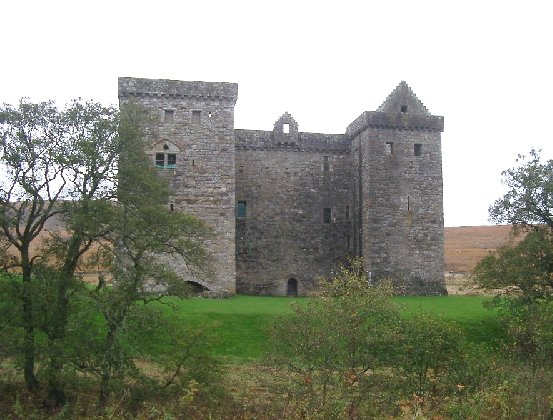
- Hermitage Castle stands in Liddesdale, in Roxburghshire, a ruined tower over an older English lord’s house in the valley of the Hermitage Water.
- Nicholas de Soulis is said to have built a timber castle about 1240, and John of Fordun places a castle here in 1242 that nearly brought Scotland and England to war.
- William Douglas, 1st Earl of Douglas, took the lordship after the Knight of Liddesdale, and the Black Douglases raised the stone tower in the later fourteenth century.
- Mary, Queen of Scots, rode from Jedburgh in 1566 to the wounded Earl of Bothwell, and the Battle of Carberry Hill in 1567 ended his hold on the castle.
- The fifth Duke of Buccleuch repaired the ruin in 1820 and again in the 1830s, and the castle and chapel came into state care in 1930.
Visiting
The castle is open daily from 10am to 4pm from 1 April to 30 September. Last entry is 30 minutes before closing, and the site is closed from 1 October to 31 March. The castle has also been described as open from 1 April to 31 October. Book online in advance for the best ticket price: an adult ticket for ages 16 to 64 is £7.50 online and £8.50 in person, a concession ticket for ages 65 and over is £6 online and £6.80 in person, and a child ticket for ages 7 to 15 is £3.50 online and £4 in person.
Members are admitted free, and visitors with disabilities pay the standard admission without proof of disability. Up to two accompanying carers receive free entry on that admission. Explorer Pass tickets, a Scottish Young Person discount, and partner organisation tickets are also available. Dogs are welcome in the outdoor areas, and assistance dogs are allowed to enter roofed areas.
A visitor centre stands on the way to the monument, with toilets and a picnic area.
History
Hermitage Castle stands in the valley of the Hermitage Water, in Liddesdale in Roxburghshire, near Newcastleton. It was called the guardhouse of the bloodiest valley in Britain and the Strength of Liddesdale. The name is thought to come from an Old French word for a guardhouse, while the earthworks by the western chapel may also preserve a late twelfth-century hermitage linked with Kelso Abbey.
Nicholas de Soulis is said to have raised a timber motte and bailey about 1240, and the family is said to have kept it until about 1320. John of Fordun, writing in the fourteenth century, placed the work in 1242, when a castle called Hermitage nearly brought Scotland and England to war, and treated the builder as one of the de Soules moving from Liddel Castle.
Ranulf de Soules had received Liddesdale from David I. William de Soulis forfeited the castle about 1320, suspected of witchcraft and of trying to kill Robert I. Legend boils him in lead at Ninestane Rig, but he died a prisoner in Dumbarton Castle.
Edward I paid for repairs in 1300, and the castle changed hands through the wars of independence. Ralph Neville held it for England in 1335, and in 1338 Sir Ralph de Neville was besieged by Sir William Douglas, the Knight of Liddesdale, whose capture of the place is also put in 1341. The knight starved Sir Alexander Ramsay of Dalhousie there. After Neville’s Cross the castle passed to William Dacre, and a fortified house of about 1350, or of the years after 1358, or of a widow’s marriage placed in 1342, remains inside the later masonry.
William Douglas, 1st Earl of Douglas, was born about 1323 and died on 1 May 1384. He killed the Knight of Liddesdale in 1353, or in the other account in 1342, and a charter of February 1354 gave him Liddesdale. As a march warden he seized Hermitage from the English around the Treaty of Berwick in 1357, and he was created earl on 26 January 1358. From 1371 the Black Douglases built a tower over Dacre’s house, in phases of about 1360, before 1388, and the late fourteenth and early fifteenth centuries, with corner towers and flying arches that carried a timber hoarding.
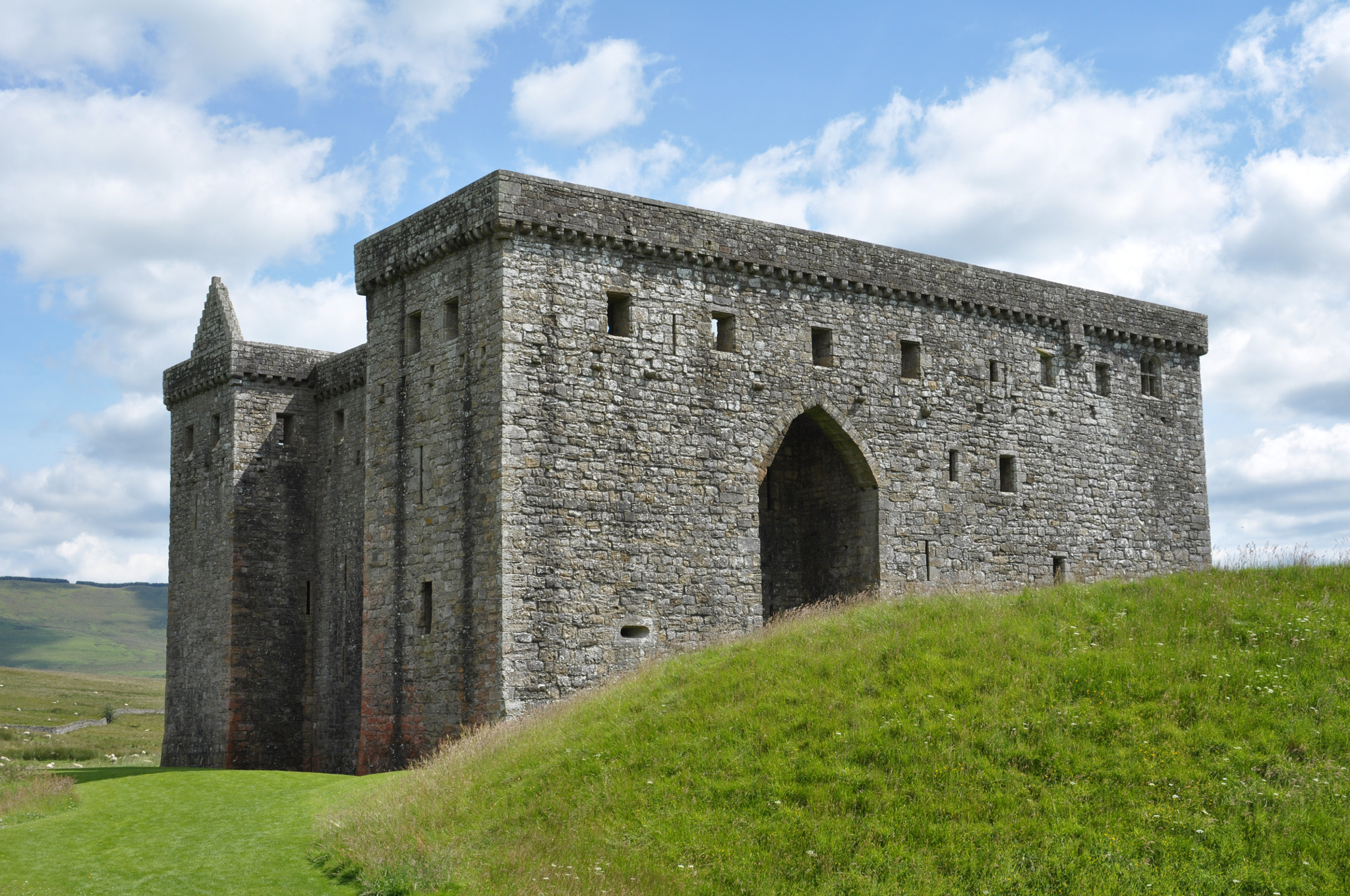
The plan reads as an H, or as an east-west block with four corner towers. Crookston is the only other Scottish castle named in that form. The original west door was blocked and given a gunhole of about 1540, and the present south entrance, restored about 1830, opens into Dacre’s old courtyard. Two wells, a prison and a pit, a kitchen, and the lord’s rooms in the southwest wing organised the interior, and a long great hall on the second floor was later divided.
The chapel, about 330 metres west, was excavated in 1900 and in 1926. Its remains are measured at 14 by 5.5 metres and at 15.7 by 7.4 metres, and they are dated both to the later thirteenth century and to the fourteenth. A moated enclosure and a second enclosure with stone footings lie beside it. A deer trap narrows to about 10 metres just west of the tower.
The White Dyke climbs 1.2 kilometres up the hill. A rental of 1376 mentions the park, walls were built in 1750 and 1752, and the deer-park label of 1863 may be a confusion, because the outer ditch suggests cattle rather than deer. A farmstead to the east is on the estate plan of 1718.
On the death of James Douglas in 1388 Archibald Douglas claimed Hermitage, but by 1400 George Douglas is said to have held it, while another account keeps the Black Douglases until a forfeiture in 1455. On 6 March 1492 Patrick Hepburn, 1st Earl of Bothwell, took Liddesdale from Archibald Douglas, Bell the Cat, and gave up the lordship of Bothwell in exchange. Wide gunholes of about 1540 mark a short time in crown hands, though the Bothwell earls stayed wardens of the Middle March.
In December 1562 Mary, Queen of Scots, demanded the castle for John Stewart of Traquair. In 1566 she rode from Jedburgh to the wounded James Hepburn, 4th Earl of Bothwell, a few weeks after the birth of her son, and on the way back her horse stumbled and she nearly died. Bothwell had been hurt by John Elliot of Park. Mary married Bothwell on 15 May 1567.
At the Battle of Carberry Hill on 15 June 1567 she surrendered, and Bothwell escaped.
James VI became king on 24 July 1567, at thirteen months old. Bothwell was imprisoned in Norway on the complaint of Anna Throndsen, whom he had engaged about 1560, and he died at Dragsholm in Denmark. Francis Stewart, keeper after a new creation as earl, was attainted on 21 July 1593. Sir Walter Scott of Buccleuch received the castle the next year, or by 1600.
After the union of the crowns in 1603 the stronghold decayed into a ruin.
The fifth Duke of Buccleuch repaired it in 1820 and carried out a major reconstruction in the 1830s, including much of the northeast tower. The castle and chapel passed into state care in 1930, and the chapel earthworks followed in 1979. Sir Walter Scott favoured the ruin, and border poems kept the stories of Lord Soulis and of Mary. Watching briefs in 1999, 2006, and 2015 found rubble and landscaping, not a new medieval discovery, while the carved fragments come from the chapel digs of 1900 and 1926.
Ghostlore still names Redcap Sly and Mary, Queen of Scots.
Images




Detailed History
Hermitage Castle stands in the remote valley of the Hermitage Water, in Liddesdale, in Roxburghshire, in the Scottish Borders, near Newcastleton. The stone tower is partly ruined. It has long been called one of the most sinister and atmospheric castles in Scotland, the guardhouse of the bloodiest valley in Britain, and the Strength of Liddesdale. The name is thought to come from an Old French word, l'armitage, meaning a guardhouse.
A separate account leaves open a late twelfth-century hermitage in the area, connected with Kelso Abbey. Neither the place nor the form of that hermitage is known, but the earthworks around the chapel to the west may be a remnant of it.
The first castle is placed in more than one year, and with more than one builder. One account says Nicholas de Soulis built it about 1240, as a timber motte and bailey, and that it stayed with his family until about 1320. Another, drawing on John of Fordun, who wrote in the fourteenth century, says that in 1242 the building of a castle in Liddesdale called Hermitage nearly brought Scotland and England to war. That first castle was probably a timber fortress set inside the outer earthworks that still surround the stone tower, and the chapel is said in that account to belong to the same period.
The builder is there called one of the de Soules, lords of Liddesdale and hereditary butlers of Scotland, moving to Hermitage from their older stronghold of Liddel Castle. Ranulf de Soules, an Anglo-Norman, had been given the lordship of Liddesdale by David I, whose reign ran from 1124 to 1153. The distance of that older castle is given as seven kilometres to the south, and also as six kilometres to the south-southeast. A further account says Hermitage was not the centre of the de Sules lordship before about 1300, and that Liddel Castle held that role until then.
The earthworks around the later stone castle may be an early timber castle raised in the early 1300s after Liddel was abandoned. The surviving banks around both the stone castle and the chapel are also thought to be of the thirteenth century, and the chapel itself may be of that century.
William de Soulis, a descendant of Nicholas, forfeited the castle about 1320. He was suspected of witchcraft and of trying to kill King Robert I of Scotland. Legend says his tenants, worn down by his cruelty, seized him and, at the stone circle of Ninestane Rig, wrapped him in lead and boiled him to death. The recorded end is different.
He died a prisoner in Dumbarton Castle.
In the early fourteenth century Hermitage was a major border stronghold in the wars of independence. In 1300 Edward I paid for repairs, and the castle changed hands more than once. In 1335 it was in English hands under Ralph Neville. In 1338 the English incumbent, Sir Ralph de Neville, was besieged by Sir William Douglas, the Knight of Liddesdale, called the Flower of Chivalry.
A third date puts the knight’s capture of the castle in 1341. It was here that the knight imprisoned Sir Alexander Ramsay of Dalhousie and starved him to death. Ramsay was his rival for royal favour. The Scots Peerage, the compilation associated with James Balfour Paul, is the reference given for that death in the castle, and Michael Penman’s life of David II is the other reference given for the rivalry.
John of Fordun gives the murder of Ramsay as a cause of the later hatred between the knight and his kinsman. The knight is also said to have killed Sir David de Barclay, and to have fallen from favour at court.
After the Battle of Neville’s Cross, in the years 1346 and 1347, King David II and many nobles, including the Knight of Liddesdale, were prisoners in England. The castle then passed for a time to the English, and to the keeping of William Dacre, 2nd Baron Dacre. Other accounts place the Dacre holding differently. One says the family had the castle for a short time after 1358.
The synopsis of the castle’s history says the great masonry of the Black Douglases, built in the later 1300s, incorporates a fortified house built about 1350 by Lord Dacre. Another entry puts the murder of the knight in 1342, says that his widow Mary then married Lord Dacre, and treats the core of the present building as the work of Dacre’s tenure. The same survey says the knight afterwards joined the English, and that David II then granted Hermitage to the knight’s nephew, also called William, later the first earl.
That nephew is William Douglas, 1st Earl of Douglas. He was born about 1323 and died on 1 May 1384. He was the son of Sir Archibald Douglas, who died in 1333, and of Beatrice de Lindsay, daughter of Sir Alexander de Lindsay of Crawford. He was the nephew of Sir James the Good, the trusted deputy of Robert I.
After his father was killed at the Battle of Halidon Hill he was the ward of his kinsman and godfather, the Knight of Liddesdale, and he was educated in France. In 1342, under pressure from the knight, his uncle Hugh the Dull resigned the lordship of Douglas to him. While William was still a ward, the knight administered the estates and took some of the Douglas lands as his own. William returned to Scotland in 1348 and began to recover his house.
Edward Baliol had used the captivity after Neville’s Cross to ravage the south. William drove the English from Douglasdale and then fought a guerrilla war in Ettrick Forest and the Jedburgh forests, in the manner of his uncle Sir James. He was one of the commissioners who negotiated for the release of David II.
In 1353 Edward Baliol was at Buittle in Galloway, on lands that had been forfeited and given to Sir James Douglas in 1324. William raided Buittle to drive him out. Coming back through the Forest he found the Knight of Liddesdale hunting on ground William regarded as his own. Years of resentment over the knight’s seizure of the Douglas inheritance came to a head there.
William set upon the knight and killed him. A charter of February 1354 from David II then gave William the lands of his uncle Sir James, of his father Sir Archibald, and of Liddesdale itself. This 1353 killing, and the charter of February 1354, sit beside the account that places the same murder in 1342 and the Dacre marriage immediately after it. Both dates are in the written record of the castle and of the man.
In 1355 the truce with England ended. William and the Earl of Dunbar and March attacked Norham Castle. Sir William Ramsay of Dalhousie was sent to burn the town and draw the garrison out. Sir Thomas Grey of Heaton and Lord Dacre chased him.
William and March were camped in woodland seven miles south of Duns. The English were ambushed and overwhelmed at the Battle of Nesbit Moor. William, March, the Earl of Angus, and French allies under Sir Eugene de Garencieres then took the town of Berwick but not the castle, and they withdrew before Edward III. Edward wasted the Lothians in the burning known as the Burnt Candlemas.
His supply ships were lost in a storm, Scots had stripped the country, and he turned for home. Near Melrose, William’s men ambushed him and nearly took him. William then made a truce with William de Bohun, 1st Earl of Northampton, to last until Michaelmas. He obtained a safe conduct to visit the captive king.
He afterwards crossed to France with a large following and fought for Jean le Bon against Edward of Woodstock, the Black Prince. At the Battle of Poitiers the French king knighted him. He fought in the king’s own battle. When the field turned he was pulled out of the melee by his own men.
Jean Froissart wrote of the Earl Douglas of Scotland that he fought valiantly for a time and then departed and saved himself, because he would not be taken by the English and would rather have been slain. He escaped. Among those he left slain or captive was his first cousin Archibald the Grim, later the third Earl of Douglas. The chronicle’s use of the earl’s title sits beside the later date of the creation.
William was back in Scotland by the middle of autumn and joined the peace talks. One result was the office of march warden, and he was one of them. In that office he seized Hermitage Castle in Liddesdale from the English, answering their raids on Eskdale. He sat in the parliament at Berwick in 1357 that settled David II’s release by the Treaty of Berwick, and he was one of the securities for that release.
He was created Earl of Douglas on 26 January 1358. In 1357 he had married Margaret of Mar, daughter of Domhnall II, Earl of Mar, and Isabella Stewart. She succeeded her brother Thomas as Countess of Mar. Their children were James Douglas, 2nd Earl of Douglas, who lived from 1358 to 1388, and a daughter.
By Margaret Stewart, 3rd Countess of Angus, widow of Thomas, Earl of Mar, and the earl’s sister-in-law and mistress, he had two illegitimate children. One was George Douglas, born in 1380 and died in 1403, who inherited Angus and was later created Earl of Angus in his mother’s right. Another daughter, Joan Douglas, is said to have married William Dacre, 5th Baron Dacre. To mark his new rank the earl built Tantallon Castle, a curtain-walled castle that became the home of Margaret Stewart and of their son George.
In 1364 he joined David II in a proposed treaty with England that would have cancelled Scotland’s debt if Robert the Steward, the king’s nephew and formerly William’s ally, were kept from the succession. Lionel of Antwerp, son of Edward III, would have taken the Scottish throne, Scottish independence was to be guaranteed, and a clause was to restore the English estates of the Douglases. The plan failed. When Robert the Steward became Robert II, William was reconciled and in 1372 was made Justiciar South of the Forth.
His last years were spent in border raids. He died at Douglas in South Lanarkshire on 1 May 1384.
The stone castle is tied to this earl and to his house, again with more than one building sequence. On the knight’s death, at the earl’s hands, one account gives the castle to William while he was still a baron and not yet earl, and credits him with most of the present building, possibly with the help of John Lewin, master mason at Durham Cathedral. The survey of significance says that in 1371 Earl William reclaimed Hermitage, and that over the next thirty years or so the Black Douglases built a great stone tower house over and around Lord Dacre’s building, with towers at each of the four corners. The standing plan falls into four main phases: the first about 1360, the second before 1388, and the third and fourth in the late fourteenth and early fifteenth centuries.
It describes an approximate H on plan, with a central hall block, small square towers at the northwest, northeast, and southeast corners, and a larger oblong wing at the southwest. It says the earliest phase still visible was a small central court bounded by cross-wings to east and west and by screen walls to north and south, a layout with some likeness to fortified houses of northwest England, perhaps reflecting the short Dacre possession after 1358. The central court was later taken into a single large tower, and further towers were added at three corners around 1400. That arrangement is compared with the Northumbrian castles of Haughton, Tarset, and Dally more than with other Scottish strongholds.
A 1956 inventory of Roxburghshire called Hermitage the most perfect of the medieval castles on the Scottish border. Bothwell Castle and Tantallon, the other great Douglas houses named beside it, were essentially curtain-wall castles. On the death of James Douglas in 1388, Archibald Douglas, who had rebuilt Bothwell in the years after 1362, claimed Hermitage, but he and his supporters could not keep it. By 1400 it was under George Douglas, first of the Red Douglas earls of Angus, who also held Tantallon.
The castle article instead keeps Hermitage with the Black Douglases until 1455, when James Douglas, 9th Earl of Douglas, was forfeited and never returned to Scotland, and the family’s grants, including Hermitage, passed to the Red Douglas line. The control of branches of the Douglas family is also given as running from 1342 until 1491. The son James, second earl, lived from 1358 to 1388, and George, the illegitimate son, lived from 1380 to 1403, so the 1388 claim and the holding said to be George’s by 1400 fall inside those lives, while the forfeiture of 1455 is a later break.
The tower the Black Douglases built is of an unusual design. It is a rectangular block aligned east to west, with smaller towers at the four corners. Crookston Castle is named as the only other Scottish castle of a similar form. The basement keeps a substantial part of Lord Dacre’s manor house, aligned north to south.
The Douglas work is of roughly coursed blocks of coarse sandstone. Dacre’s work is reddish sandstone ashlar, and it is of finer quality. The east and west faces are dominated by high flying arches linking the corner towers. Those arches in part carried a timber hoarding, a defensive gallery, around the whole top storey.
The corbels and the putlog holes remain, and above them a row of small rectangular doorways, rebated for external shutters, opened onto the fighting platform. That hoarding is a rare survival. Threave Castle, another Black Douglas stronghold of the same years, has a similar arrangement. The tower elevations have few openings, except on the southwest tower, where the openings are clearly later additions.
Wide-mouthed gunholes were inserted about 1540.
The principal entrance of the Douglas tower was at first-floor level on the west. It was later blocked, and a gunhole of about 1540 was set in the blocking. There was a postern at ground level in the southeast tower. The present entrance is through the south wall.
That opening was the original door of Dacre’s manor house. The Douglases blocked it when they built the tower. It was probably reopened after about 1540, but the opening as it stands is a restoration of about 1830. Inside, the present door enters what had been the cobbled courtyard of Dacre’s house.
Round-headed doorways lead into the ground floors of the east and west ranges, probably cellars. The east cellar keeps a two-light window onto the courtyard. The west cellar has a well, one of two in the building. A third doorway, at the north end of the courtyard, opened onto a spiral stair, partly restored, which rose to the upper floors of the two ranges, of which little survives.
The stair once went higher, perhaps to a wall-walk. When the Douglases converted the house, the courtyard and the flanking ground floors became three unlit cellars, reached from above.
The Douglas entrance passage still shows the evidence of two portcullises, one just inside the outer portal and one at the inner end. The first floor of the main block held two chambers of uncertain use, probably a lower hall and a chamber. The second floor seems to have been a single long room, well provided with windows and a fireplace, and this is taken to have been the great hall. The space was later divided into two smaller chambers.
The floor or floors above probably served the wall-walk and the defensive gallery. The roofs were probably flat or of low pitch, as at Threave, so that they could carry light siege engines such as springalds.
The doorways into the four projecting towers suggest that the towers were intended from the start, even though they can look like afterthoughts. The southeast tower holds the second well and the ground-floor postern, the portcullis mechanism on the first floor, and a chamber on the second. The northeast tower held the prison on the first floor and a miserable pit below it. Its second floor was a latrine closet for the great hall.
The northwest tower has no agreed interpretation. The southwest tower was the most important, both because it is larger and because the workmanship is better. Its ground floor, in effect the basement, was the kitchen. The first floor was probably a hall, with its own fireplace and latrine.
The second and third floors were well-appointed chambers, presumably for the lord or for his castellan. The wide-mouthed gunholes of about 1540, and the added windows high in the southwest tower, belong to this later life of the building. In the sixteenth century the castle was for a short time crown property when those gunholes were made, about 1540, but the earls of Bothwell, as wardens of the Middle March, kept control of Hermitage. The castle’s role was to hold the passage through Liddesdale while cross-border raiding, the reiving of that valley, continued.
Around the tower the earthworks are on a large scale. A great ditch bounds the castle on the west, north, and east. Beyond it to the north is a rectangular courtyard bounded by ramparts and ditches, about 80 metres east to west and 43 metres across. The castle stands on a level platform about 30 metres north of the Hermitage Water, at about 160 metres above the sea.
The upstanding masonry was cleared of rubble in the 1830s, which is likely to have disturbed the archaeology of the interior. The earthworks may represent the early timber castle, with hall, chamber block, stables, workshops, stores, servants’ rooms, and stockyards, some of them in that northern courtyard. Buried artefacts and plant and animal remains in ditches, pits, and structural features could show trade and the use of the land. The dates of the enclosures are not known, but they are likely to be older than the first phase of the stone castle.
A review last made in 2011 still listed, as open questions, when and by whom the earthworks around the stone castle were made, what form they took, how the tower house was organised internally, and when and by whom the earthworks west of the chapel were made, and how that complex related to the castle.
The chapel lies about 330 metres west of the castle. Its excavated plan is given as 14 metres east to west by 5.5 metres across, and also as a single-cell building of five unequal bays measuring 15.7 by 7.4 metres. The floor of the easternmost bay was raised for the altar. The plan and the remains of a window have been read as fourteenth-century, and the plan and the surviving window fragments have also been read as later thirteenth-century.
It sits inside an earlier moated enclosure, almost square, 33 metres east to west by 31 metres across, bounded on the west, north, and east by two banks and two ditches. Immediately west is a rectangular enclosure, bank and ditch on the west, north, and east, of 76 by 38 metres, divided by a bank, with footings of large stone buildings in both the east and the west compartments. The chapel earthworks are likened to medieval moated manorial centres, while the castle earthworks are read as the timber castle. Two centres of lordship so close together are compared with Garpol Water, where a moated homestead stands within 200 metres of a timber castle, and the chapel enclosures are compared with moated sites near Jedburgh at Muirhouselaw and Timpendean.
The chapel was excavated in 1900 and again in 1926. Carved fragments remain at the site and at nearby Hermitage Farm. The chapel survives only as those excavated foundations. Visitors treat the chapel ground as a place of quiet, and it is used for Easter services.
The chapel’s setting, near the wooded banks of the Hermitage Water and at a distance from the tower, is described as more welcoming than the castle.
A probable deer trap survives as two banks, each with a ditch, forming a funnel that narrows from the northwest to a point just west of the castle, where the mouth is only about 10 metres wide. One bank starts near the northwest corner of the rectangular enclosure, runs north, then curves east toward the castle. The other starts some 600 metres to the north, just east of the Lady’s Sike burn, and curves down the slope to meet it. A wider bank and ditch, the White Dyke, encloses the castle and a tract of hillside reaching 1.2 kilometres to the north, rising to about 320 metres above the sea.
It begins near the Hermitage Water about 450 metres southeast of the castle and runs north along the east bank of the Green Sike, at first a low bank with a ditch on the east, the outer side. Higher up, a stone wall up to a metre high takes the line, probably built in works of 1750 and 1752. To the west the visible dyke fades on Coldwell Snab. About 200 metres east of that point a straighter bank and ditch run south toward the chapel.
A land rental of 1376 mentions the park, and by then it may already have been a grazing enclosure for the demesne herd. Hermitage Park is mentioned again in the Braidlie day book, which records a wall built in 1750 and 1752, perhaps the wall that restates the older bank and ditch on the hillside. The land north of the castle is not called a deer park in the documents until the first-edition map of 1863, and that name may reflect a memory that large parts of Liddesdale had once been deer forest, rather than the function of this enclosure. The ditch on the northeast arc lies outside the bank, the reverse of the usual deer-park arrangement, which suggests an enclosure for cattle.
After the sixteenth century the written record, as reviewed for the designation, suggests a further change in Liddesdale from intensive farming to large flocks of sheep.
About 80 metres east of the castle, on the edge of a terrace, a farmstead shows as low stone walls: three buildings and two enclosures, the buildings set on three sides of a courtyard. Farther east are five turf-walled stock enclosures that may belong with it. The farmstead is on the estate plan of 1718. The deer trap is a rare survival beside a medieval castle, and it suggests a landscape set out for a formal hunt in front of the tower, while the park boundary, probably later, suggests a shift toward systematic grazing.
The de Sules lords had forest rights in Liddesdale from the earlier twelfth century. By the late fourteenth century the park is thought to have supported demesne herds. Deer parks such as the large example at Kincardine put the ditch inside the bank. The Hermitage park does the opposite.
Linear traps on Rum, and deep ditches west of Falkland at Chancefield, are the comparisons offered for the funnel itself.
King James IV distrusted Archibald Douglas, 5th Earl of Angus, called Bell the Cat, and his dealings with Henry VII of England, and ordered him to give Hermitage to the crown. On 6 March 1492 Patrick Hepburn, 1st Earl of Bothwell, received a charter of the lands and lordship of Liddesdale, including Hermitage, on the resignation of Archibald Douglas, Earl of Angus. Angus received in exchange the lordship of Bothwell, but not the earldom, which Patrick resigned for the swap. The year is also given as 1491 for the end of Douglas control, and as 1492 for James IV entrusting the castle to Patrick Hepburn, Earl of Bothwell.
The Hepburns, rising in the king’s favour, became keepers and lords of Hermitage.
In December 1562 Mary, Queen of Scots, sent Adam MacCulloch, Marchmont Herald, to Hermitage to demand its surrender to John Stewart of Traquair. James Balfour Paul edited the accounts of the treasurer, and volume 11, published in 1916, at pages 234 and 235, is the record cited for that mission. Traquair received money and cereal from the thirds of benefices toward the castle’s provisions. Gordon Donaldson’s edition of the thirds of benefices, published in 1949, at the introductory pages and at pages 127, 131, and 157, is the record cited for those supplies.
Gordon Donaldson, born on 13 April 1913 and died on 16 March 1993, was a historian of Scotland and of Mary’s reign. He edited that volume of the thirds while he was still early in a career that later included a life of Mary, a study of power in her Scotland, and an account of her first trial. James Balfour Paul, born on 16 November 1846 and died on 15 September 1931, was Lord Lyon King of Arms from 1890 until the end of 1926, and he oversaw The Scots Peerage, nine volumes issued from 1904 to 1914, as well as the treasurer’s accounts that record the herald’s journey to this castle.
In time James Hepburn, 4th Earl of Bothwell, held Hermitage. Mary made a famous long ride on horseback from Jedburgh to visit him there while he lay wounded, only a few weeks after the birth of her son, in the account given with the castle. The year of the visit is 1566. A separate account of the same visit says she came to her lover while he recovered from injuries taken in a skirmish with border reivers, and that on the return to Jedburgh her horse stumbled and she nearly died.
Bothwell had captured John Elliot of Park, called in one telling Little Jock Elliot, together with other border reivers, and had brought Elliot to Hermitage. Elliot tried to escape. Bothwell shot him with a pistol. The wounded man still managed to hurt Bothwell with a two-handed sword.
Lorna Hutson’s 2023 study, England’s Insular Imagining, at pages 149 to 151, is the reference given for that fight. Lorna Hutson, born on 27 November 1958, is a scholar of English literature and of law in early modern writing, and that book is her study of Elizabethan writing and the erasure of Scotland. The castle article does not give a day in October, or any day, for the ride, only the year 1566 and the phrase a few weeks after the birth. James VI, the son, was born on 19 June 1566 at Edinburgh Castle.
Mary and Bothwell married soon after the murder of her second husband, Henry Stuart, Lord Darnley, although Bothwell was among those implicated. The marriage itself is dated 15 May 1567. On 12 May 1567 Mary had made Bothwell Duke of Orkney and Marquis of Fife. In April he had been accused of Darnley’s murder and acquitted.
Darnley’s father, the Earl of Lennox, did not appear, after his three thousand armed men were turned back by Bothwell’s four thousand. James Murray, brother of the laird of Tullibardine, offered to fight Bothwell or to prove the guilt on Bothwell’s henchmen. Many of the lords who opposed the marriage in June, among them Maitland, Morton, Balfour, and Murray of Tullibardine, had signed the Ainslie Tavern Bond in April in support of it.
The Battle of Carberry Hill was fought on 15 June 1567, near Carberry Tower in East Lothian, a few miles east of Edinburgh. On 11 June the Confederate Lords had assembled in arms in Edinburgh, proclaiming that they would deliver the queen, revenge Darnley, and preserve the prince. Mary and Bothwell were at Borthwick Castle. The lords began a siege, Bothwell escaped, and Mary, dressed as a page, rode to Dunbar to meet him.
The French ambassador Philibert du Croc described their march from Dunbar, with men joining at Haddington, a proclamation at Gladsmuir, a night at Seton Palace, and the next day at Prestonpans. The lords were at the Magdalen bridge west of Fisherrow, then crossed the Esk toward Dalkeith. The two forces took hills two or three crossbow shots apart. On the morning of 15 June, with only the Hamiltons in support, Mary and Bothwell left Fa’side Castle and stood at Carberry Hill.
John Knox wrote that they used an entrenchment the English had made for the Battle of Pinkie twenty years before, with cannon and pole-arms from Dunbar. A letter to the Archbishop of Glasgow gives the queen two hundred hagbutters under Captains Alexander Stewart and Hew Lauder, and seven or eight cannon from Dunbar at the old fort by Fawside. Bothwell’s men brought three hundred pikes from Dunbar. David Calderwood put the lords’ army at two thousand, with only a few volunteer harquebusiers from Edinburgh.
Knox wrote that they came round the hill from Carberry village so as not to have the sun in their eyes. Mary’s side at first thought the lords were slipping away to Dalkeith.
The stand lasted from eleven in the morning until five in the afternoon. Du Croc tried to negotiate. The Earl of Morton told him the lords would fight the murderer of Darnley. Bothwell fired cannon at cavalry prickers who tried to draw the queen’s side out.
He offered single combat, accepted the idea of William Kirkcaldy and then refused him as only a baron, refused James Murray, and was reluctant to fight Lord Lindsay. Mary forbade any single combat. The day was hot and her men had nothing to drink. Edmund Blackadder and the laird of Wedderburn, seeing that Bothwell meant to leave, apologised to the queen and rode away.
Mary agreed to surrender to Kirkcaldy on an oath the lords had given. He led her horse down the hill to Morton’s camp, and the formal surrender is said to have been made at Cousland Castle. Bothwell rode for Dunbar with twenty-five horsemen. The lords then took Mary to Edinburgh.
Some accounts hold her first in the lodging of Simon Preston of Craigmillar. Breaking the oath, they imprisoned her in Lochleven Castle, near Kinross, under Sir William Douglas, half-brother of James Stewart, 1st Earl of Moray. Kirkcaldy was furious at the breach of the promise he had carried to her. She remained a prisoner for eleven months.
Bothwell got a ship, went first to Shetland, where Olave Sinclair helped him, evaded Murray of Tullibardine and William Kirkcaldy, whose ship the Lion ran aground, and then crossed to Norway, captivity, and madness. Mary escaped from Lochleven, made for Dumbarton, was defeated at Langside, sought safety in England, and was executed in 1587. Her supporters in Scotland fought a civil war for five years.
After the confrontation at Carberry Hill, Mary was forced to abdicate. Bothwell, facing treason, fled, and an act of parliament forfeited his titles and estates. While he tried to raise an army to restore her, he was arrested by the men of King Frederick for breach of a marriage contract with Anna Throndsen, and he was imprisoned at Dragsholm Castle in Denmark, where one account says he died insane in appalling conditions. His mummified body could at one time be seen at Fårevejle Church nearby.
Anna Throndsen, also called Anna Tronds and Anna Kristoffersdatter, and after her death Anna Rustung, was a Dano-Norwegian noblewoman, born about 1539 and died in 1607, daughter of the admiral Kristoffer Throndsen. She was engaged to Bothwell about 1560, while he was doing business in Denmark. Under Dano-Norwegian law the engagement was treated as valid. English and Scots historians have treated it as dubious or void, and many English books call her a mistress or a jilted lover.
Her lawsuit at Bergen in 1567, which charged him as a husband, and writings of the Earl of Moray, are the grounds given for thinking a legal commitment had been made. Ludvig Ludvigsen Daae concluded in 1872 that they were engaged but not fully married. A travel paper of about 1563 indicates that she spent time in Scotland in the first half of the 1560s. A rumour that she then bore Bothwell’s only known child, a son William, is called very unlikely, because the Bergen trial did not raise it.
From 1565 she is recorded in Norway. In 1566 Bothwell married Lady Jean Gordon, and soon afterwards turned to Mary.
In 1567, by chance, Bothwell met Anna again at Bergen. He had been stopped in the port for lack of proper exit papers. She was living nearby, most probably at the Ænes farm in Kvinnherad, where she had family. Erik Rosenkrantz, the Danish commander of Bergenhus, ordered him into Rosenkrantz Tower on her complaint that he had used her as his wife and that her dowry should be restored.
She testified that he had three wives alive, herself among them. He settled out of court, giving her one of his ships and promising an annuity he never paid, because he never went free. Frederick II noticed him as a political piece. Elizabeth I wanted him sent back to stand trial for Darnley’s murder.
Frederick did not hand him to England. He transferred him to Dragsholm, where Bothwell died after many years. That longer imprisonment is the account on Anna’s side of the story. The castle’s account has him dying insane at Dragsholm, with the body later shown at Fårevejle.
Anna was nicknamed Skottefruen, the Scottish lady, in her lifetime after she returned from Scotland and settled near Bergen. She has been proposed, and largely dismissed, as a writer of some of the Casket Letters of early 1567. The case against her authorship is that she had lived in Norway since at least 1565, that a Nordic noblewoman of her background is argued not to have written that French, and that handwriting comparison has been used to set the idea aside. The idea itself was first suggested by the novelist Robert Gore Browne in 1937.
The letters were found among the belongings of a servant of Bothwell after his flight, and they were used by Regent Moray against Mary.
James VI became king of Scotland on 24 July 1567, at the age of thirteen months, after his mother was forced to abdicate. He had been born on 19 June 1566, son of Mary and of Henry Stuart, Lord Darnley. His mother was a Catholic and he was raised a Protestant. Four regents governed in his minority.
The minority ended officially in 1578, though he did not fully control his government until 1583. In 1589 he married Anne of Denmark. The children who survived to adulthood were Henry Frederick, Elizabeth, and Charles. He was king of Scotland until his death on 27 March 1625, a reign of 57 years and 246 days, the longest of any Scottish monarch.
From 24 March 1603 he was also king of England and Ireland, in the union of the crowns, and he styled himself king of Great Britain and Ireland. He lived in England after that union and returned to Scotland only once, in 1617.
Thomas Kerr of Ferniehirst was made keeper of Liddesdale and of Hermitage in 1584. David Masson’s edition of the register of the privy council, volume 3, published in 1880, at pages 699 and 700, is the record cited for that appointment. Bothwell’s nephew, Francis Stewart, 1st Earl of Bothwell, received a new creation as earl and was made keeper of the castle. As a grandson of James V, through an illegitimate line, he was seen by some as a possible replacement for James VI.
In 1591 he was arrested, tried, imprisoned, and forfeited for his supposed part in the North Berwick witches. He obtained a pardon in 1593, intrigued again, and was attainted by act of parliament on 21 July 1593. Hermitage returned to the crown. Another account dates the forfeiture of the fifth earl to 1591, says the castle then reverted to the crown, and says that by 1600 it was in the hands of the Scotts of Buccleuch.
A further account says that the following year James granted the castle to Sir Walter Scott of Buccleuch, called the bold Buccleuch, a border reiver, warden of the western marches, keeper of Liddesdale, and the leader of the raid on Carlisle Castle that rescued Willie Armstrong of Kinmont. The grant the year after the attainder of 21 July 1593 falls in 1594, which sits beside the statement that the Scotts had the castle by 1600.
The castle became obsolete after the union of the crowns in 1603 and fell into disrepair. By the turn of the eighteenth century it was a ruin, and by the late eighteenth century it is also described as ruined. Hermitage gave its name to the viscountcy of Hermitage, conferred in 1706 on Henry, third son of the first Duke of Buccleuch, as a subsidiary title of the earldom of Deloraine. The title died out in 1807.
Some repairs were carried out in 1820 by the fifth Duke of Buccleuch. Major repairs and reconstruction are also placed in the 1830s, by the same duke, prompted by the fame of the gaunt ruin and its bloody history. That work rebuilt much of the northeast tower and probably the north wall, and it included new battlements and wall-walks, with extensive repairs elsewhere. The 1830s restoration damaged the archaeological integrity of the standing masonry, and major consolidation in the 1980s was undertaken to address that damage.
The duke’s work is itself treated as significant, a mark of nineteenth-century interest in the medieval past, and as a contrast with the more stylised eye-catcher made at Hume Castle about fifty years earlier. The Scotts descend in the female line from the Douglases of Drumlanrig, a cadet branch, and sometimes use the surname Montagu-Douglas-Scott.
The castle remained with the Scotts until 1930, when it was handed to the care of the nation. The castle and chapel were taken into state care in 1930, as guardianship. The substantial earthworks around the chapel were taken into state care in 1979. The castle, with the chapel, the enclosures, the deer trap, the park boundary, and the farmstead, is a scheduled monument.
The designation was added on 31 December 1921 and was last amended on 24 March 2017. The scheduled area is irregular, drawn to include the remains and the ground where evidence of construction, use, and abandonment is expected. It excludes the above-ground parts of modern buildings, boundary walls, fences, gates, railings, fixtures, and fittings, the above-ground walls around the chapel, signage and services, and the top 300 millimetres of modern paths and paved areas, and it excludes existing fences on the boundary of the area. The remains as a whole run from the twelfth century to the nineteenth, though the castle itself was largely built in the fourteenth and fifteenth centuries and extensively restored in the 1830s.
Hermitage was probably Sir Walter Scott’s favourite castle, and it was the background when he was painted by Sir Henry Raeburn. His Minstrelsy of the Scottish Border, poems and ballads published in 1802, brought the history and traditions of the district to a wide public, and his essays and novels carried a romantic reading of the border that lasted for decades. Hermitage was prominent in that reading. John Leyden, Scott’s collaborator, wrote Lord Soulis and The Cout of Keeldar, recalling the dark deeds of Lord Soulis, the wizard lord of Hermitage.
The castle’s place in nineteenth-century history and literature is given as a reason for its continuing importance. It is also an icon of strength in Liddesdale, closely associated with the Elliot reivers, and a strong draw for visitors because of Mary. It stands remote from modern settlement and plays little part in local social life beyond tourism. The walls are massive, sheer, and almost without features.
The flying arches, the quality of the Dacre masonry, and the later windows in the southwest tower are the exceptions named inside that grim impression. The hills around it are comparatively bare, and the tower reads as a closed, inward-looking ruin.
A review last made in 2011 said that no modern archaeological excavation had been carried out on either the castle or the chapel, and that the buried potential was exceptionally high, the site being, apart from the 1830s restoration, one of the least disturbed major medieval castles in Scotland. Watching briefs sit beside that judgment. In 1999 the cutting of channels for drainage pipes on the track leading to the castle was monitored. The track’s date remained unclear, but the deposits disturbed were judged likely to belong after the restoration, to the nineteenth and twentieth centuries, and no deposits of archaeological interest were found.
The earthworks of the castle, a defensive earthwork about 400 metres to the west, and a possible settlement beyond it were the reasons given for watching even that outlying work. In February 2006 a foundation pad for access stairs inside the property was watched. The interior ground had already been altered in modern times. Redeposited gravelly clay dominated the area.
The masonry exposed was only the footing of an earlier wooden stair, and the trench was not deep enough to reach underlying archaeological deposits. In 2015 a watching brief during work for new signs opened two small trenches. Both showed landscaping and clearance, as rubble-rich deposits under the present surface. The debris was read as a spread after demolition, forming the wide terrace around the castle.
The ground near the standing walls had been landscaped after clearance and excavation in the twentieth century. Spoil had been used to level the surface, and it lay over earlier demolition debris. Those three watches found modern and post-restoration material. They did not produce a new find of medieval objects, and they did not test the undisturbed levels the 2011 review still regarded as exceptionally promising.
The chapel digs of 1900 and 1926 remain the excavations that recovered carved fragments.
Local ghostlore says the castle is haunted by Redcap Sly, the familiar spirit of de Soulis, and by Mary, Queen of Scots. A radio programme on redcaps, the fourth part of a series called Mythical Creatures, presented by Rhianna Pratchett and first broadcast on 21 December 2023, is one of the tellings cited with that redcap story at Hermitage. Rhianna Pratchett, born on 30 December 1976, is a writer of video-game scripts and a journalist, and that 2023 programme was her first radio series, on creatures of British folklore. The redcap and the queen are the two presences the castle’s own ghostlore names.
The stories of Soulis boiled in lead, of Ramsay starved, of Mary’s ride, and of Bothwell’s fall are the historic, heroic, and horrific associations that later writers attached to the ruin.
Public opening has been given as running from 1 April to 31 October, with the castle closed in winter, and also as daily from 10am to 4pm from 1 April to 30 September, with last entry thirty minutes before closing and with closure from 1 October to 31 March. Tickets are sold online and in person. An adult aged 16 to 64 pays £7.50 online and £8.50 in person. A concession for a visitor of 65 or over pays £6 online and £6.80 in person.
A child aged 7 to 15 pays £3.50 online and £4 in person. Members enter free. Visitors with disabilities pay the standard admission, and proof of disability is not required. Up to two accompanying carers receive free entry on the same transaction.
Explorer Pass tickets, a Scottish Young Person discount, and partner organisation tickets are also offered. Dogs are welcome in the outdoor areas. Assistance dogs are allowed to enter roofed areas. There is a visitor centre, toilets, and a picnic area.
The place that remains is the tower, the chapel, the moated enclosures, the deer trap, the White Dyke, and the farmstead, held in turn by the de Soules, the Dacres, the Black Douglases, the Red Douglases, the Hepburns, and the Scotts of Buccleuch.
Sources
- Hermitage Castle — Wikipedia
- William Douglas, 1st Earl of Douglas — Wikipedia
- Anna Throndsen — Wikipedia
- Battle of Carberry Hill — Wikipedia
- James VI and I — Wikipedia
- Gordon Donaldson — Wikipedia
- James Balfour Paul — Wikipedia
- Lorna Hutson — Wikipedia
- Rhianna Pratchett — Wikipedia
- Statement of Significance: Hermitage Castle — Historic Environment Scotland
- Hermitage Castle, castle, chapel, enclosures, deer trap, park boundary and farmstead — Historic Environment Scotland
- Plan your visit: Hermitage Castle — Historic Environment Scotland
- HSCO-90161-2015-01 Hermitage Castle — Archaeology Data Service
- Hermitage Castle — Historic Environment Scotland
- Hermitage Castle.jpg — Wikimedia Commons
- Guardhouse of the bloodiest valley in Britain - geograph.org.uk - 571742.jpg — Wikimedia Commons
- Castle hidden in the Trees - geograph.org.uk - 828680.jpg — Wikimedia Commons
- Field by Hermitage Castle - geograph.org.uk - 968327.jpg — Wikimedia Commons
- Hermitage - My Favourite Castle - geograph.org.uk - 1301404.jpg — Wikimedia Commons
- Hermitage Castle (2477738925).jpg — Wikimedia Commons
- Hermitage Castle (2102536).jpeg — Wikimedia Commons
- Hermitage Castle (48861210321).jpg — Wikimedia Commons
- Hermitage Castle (48861205041).jpg — Wikimedia Commons
- Hermitage Castle (48861200326).jpg — Wikimedia Commons