
Palace · Fortification
Framlingham Castle
grade I listed historic house museum in Framlingham, Suffolk, England, UK

Framlingham, United Kingdom · United Kingdom
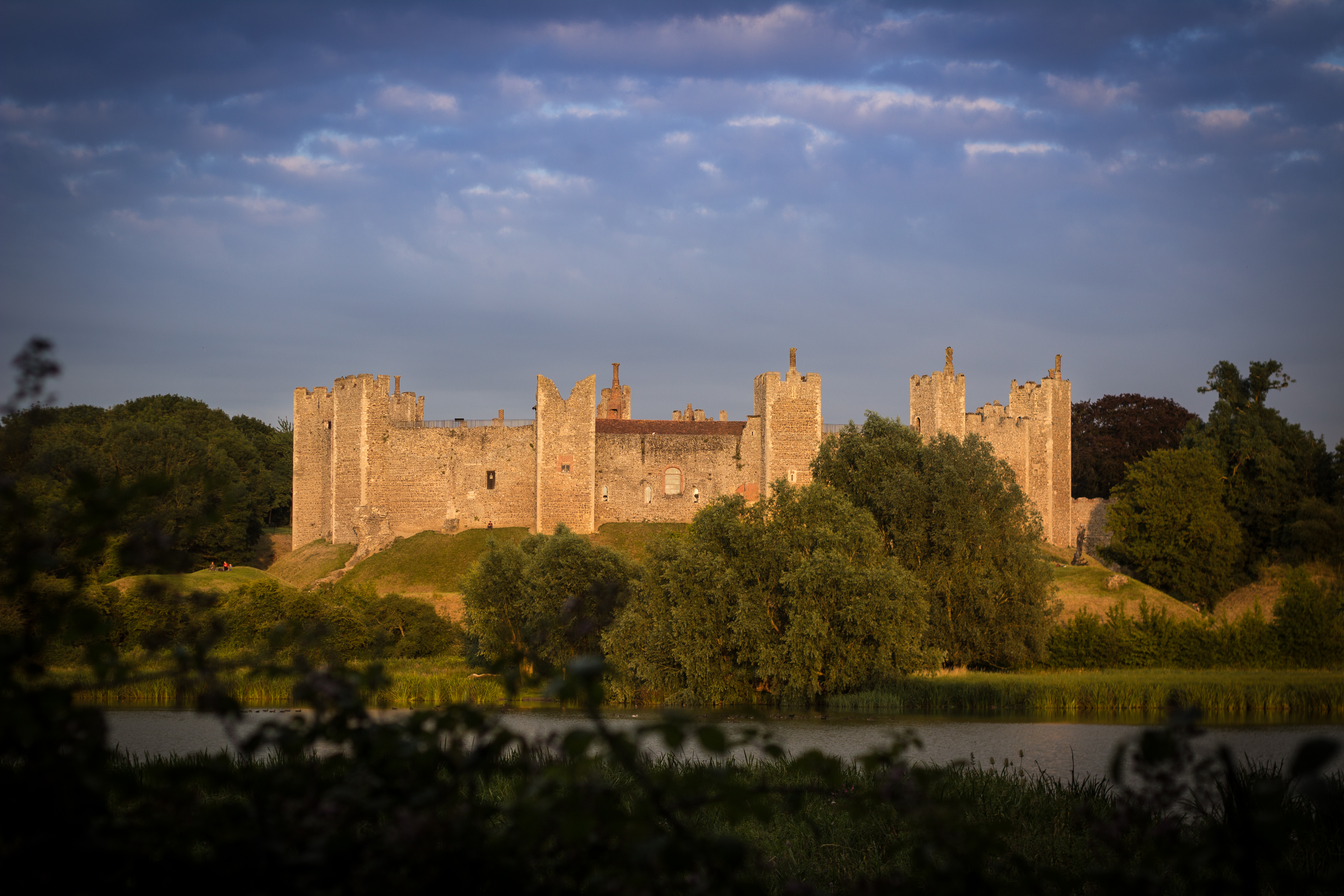
- Framlingham Castle is a flint and septaria curtain wall of thirteen open-backed towers, with no keep, above a mere in Suffolk.
- Hugh Bigod lost the castle after the revolt of 1173, and Roger Bigod, 2nd Earl of Norfolk, rebuilt the stone defences by 1213.
- John of England took the castle in March 1216 after a two-day siege in the First Barons' War.
- Mary was proclaimed queen here on 19 July 1553 after supporters gathered against Lady Jane Grey.
- Sir Robert Hitcham left the castle for a poorhouse, which closed in 1839 after use as a home for the local poor.
- Excavation under the courtyard found a motte or raised platform destroyed in the later twelfth century.
Visiting
The castle is open on Saturdays and Sundays from 10am to 4pm, with last entry at 3.30pm. A ticket booked online before midnight on the day before a visit is sold at a discount, and a ticket bought on the day, online or at the entrance, is full price. Tickets are valid all day within the opening hours. Admission is free for members who bring a membership card.
Visitors may not enter the sections of the wall walk that are closed for maintenance.
History
Framlingham Castle is a stone enclosure above a mere at the north end of Framlingham in Suffolk. A curtain wall of flint and septaria, about 10.5 metres high, carries thirteen open-backed towers, and there is no keep. The wall stands on an earthen platform, with a kidney-shaped bailey to the east and south and a smaller Lower Court toward the water.
The town ditch outside the bailey may be older than the stone castle, perhaps the boundary of an Anglo-Saxon manor or of an earlier fortress. About fifty burials found in 1954 under the later entrance predate that stonework. Pottery near them has been read as Middle Saxon, of about 650 to 850, though the graves are also argued to belong to a twelfth-century chapel cemetery, with the earlier finds not clearly tied to the bodies.
After 1066 Framlingham grew to a town of at least six hundred people. Hugh d'Avranches granted the region to Roger Bigod, sheriff of Suffolk, and Henry I gave Roger the Framlingham lands around 1100 or in 1101. Roger's son William drowned in the White Ship in 1120, and Hugh Bigod inherited. The first written mention of a castle here is 1148, and the first fortress may date from around 1100, from the 1140s, or from two successive builds.
Hugh was made Earl of Norfolk during the Anarchy and received Archbishop Theobald at Framlingham in 1148. Henry II of England took his submission in 1157 and confiscated the Bigod castles, returning Framlingham and Bungay in 1165 for a fine of £666. Hugh joined the revolt of the king's sons in 1173. Robert de Beaumont marched from the coast to Framlingham, and the two earls took Hagenet before Leicester was captured at Fornham on 17 October.
Hugh's son Roger fought for the king at Fornham. Hugh had to surrender his castles, and between 1174 and 1176 the engineer Alnoth slighted Framlingham and filled the moat. Hugh was dead by March 1177, perhaps in 1176 if he died in Palestine, and Henry refused Roger the earldom until Richard I confirmed it in 1189.
Roger Bigod, 2nd Earl of Norfolk, rebuilt the castle, complete by 1213 and largely finished by 1216. The new work relied on the curtain and the thirteen towers rather than a keep. In 1213 he entertained John of England here. Two years later he was one of the twenty-five barons of Magna Carta, and in the First Barons' War the castle surrendered on 14 March 1216 after John's army had arrived on the 12th.
The garrison, counted as 26 knights with sergeants, crossbowmen and a priest or chaplain, yielded without a fight, with Rochester's fate the year before in mind. Roger made peace with Henry III's regents in 1217 and died in 1221. A grandson inherited Framlingham in 1225.
The Great Park, first noted in 1270, covered 600 acres to the north, with a lodge and later a garden, and charcoal was burned there in 1385. Roger Bigod, the 5th Earl, lived in state and borrowed from the Jewish community at Bungay, then from Italian merchants after 1290. Edward I seized the lands and took them for the Crown when Roger died in 1306. Edward II granted the estates to his half-brother Thomas of Brotherton, Earl of Norfolk.
Thomas's daughter Margaret, most likely born at the castle, was the first woman made a duchess in her own right, in 1397, and she held Framlingham for some seventeen years. The Mowbrays then used it as a main seat. In 1385 and 1386 the household spent more than £1,000, including tens of thousands of gallons of ale and of loaves. William de Ufford held the castle during the Peasants' Revolt of 1381, much of which broke out nearby.
The castle passed to John Howard in 1476, or on another reckoning in 1483. Brick chimneys, lowered battlements and the Howard arms on the gatehouse belong to that Tudor reworking, and by 1524 there were at least twenty-nine rooms. John Howard was killed at Bosworth in 1485. His son Thomas recovered the castle after Flodden in 1513 and died at Framlingham in 1524.
Mary, daughter of Henry VIII and Catherine of Aragon, gathered her supporters at Framlingham in July 1553 against Lady Jane Grey. She arrived on 12 July, was proclaimed queen there on 19 July, and was crowned in London on 1 October. She restored the Howards. After the 4th Duke was executed in 1572 the castle returned to the Crown, and by 1600 it held forty Catholic prisoners.
Theophilus Howard, 2nd Earl of Suffolk, sold the castle and the former park to Sir Robert Hitcham in 1635 for £14,000. Hitcham left them to Pembroke College so that the internal buildings would come down and a workhouse rise in their place. The Red House and later poorhouses occupied the court from the 1650s until 1839, when the inmates moved to Wickham Market. The site was also a plague ward in 1666, a store for the local volunteers, a drill hall and a county court.
Pembroke placed the castle in state care in 1913. During the Second World War the army used it in the regional defence against invasion, with a pillbox nearby and huts and a lorry park in the bailey. Since 1984 it has been managed as a place for visitors. The mere belongs to Framlingham College and is run by the Suffolk Wildlife Trust.
The courtyard was quarried for stone for centuries, and in 1808 thousands of cartloads were removed. Excavation from 1968 to 1972 found the footings of Roger Bigod's hall and an earlier, narrower hall, above deep made ground. That depth is read as a motte or platform in the northern half of the court, destroyed in the later twelfth century. Later surveys traced the Lower Court walls, ranges inside the ward, and medieval cobbles and pottery under the poorhouse.
Images




Detailed History
Framlingham Castle stands on a bluff at the north end of the market town of Framlingham in north-east Suffolk. The stonework that survives is a curtain wall of local flint and septaria, with sandstone at the corners, about 10.5 metres high and 2.3 metres thick. Thirteen square mural towers, each about 14.3 metres high and open at the back, rise from that wall, and a wall-walk runs around the top. There is no central keep.
The castle sits on a large earthen platform surrounded on most sides by a wide dry ditch, with a kidney-shaped outer bailey to the east and south and a smaller Lower Court to the west, above a mere.
The castle stands above the River Ore. On the north-west the ground falls about forty feet into the valley of the river Alde, there about three hundred yards wide, while from the south the land rises gently from that river through the town. Only on that north-western side do the builders seem to have used a natural drop. The platform itself is barely higher than the bailey to the south and east.
It is roughly oval, about 98 metres long and 71 metres wide, and it stands between about 6.4 and 10.7 metres above the ditch bottom.
The town ditch, outside the bailey on the north and east, is thought to be older than the present stone castle. It may have bounded an Anglo-Saxon manorial complex, or the first castle of the early twelfth century. It survives in places about 11 metres wide and 1.1 metres deep, with an internal bank about 4 metres wide. On the north it forms the strip called the Back Meadow.
Further south-west it has been lost under later streets and houses.
In March 1954 a drainage trench under the entrance to the later stone castle uncovered a cemetery. About fifty burials were excavated between 30 March and 13 April that year. Pottery found close to the burials has been taken for Middle Saxon Ipswich ware, of about 650 to 850, and the graves clearly predate the Norman stone entrance. A later reading of the same ground is more cautious.
The stratigraphy does not support a middle Saxon cemetery, none of the middle Saxon finds were clearly associated with the burials, and a graveyard here is more likely to belong to the castle chapel, perhaps the original parish church, in the twelfth century.
After the Norman Conquest the population of Framlingham rose sharply, and the place became a small town of at least six hundred people in one of the richer parts of the country. The region was held by Hugh d'Avranches, Earl of Chester, who granted it to Roger Bigod, sheriff of Suffolk. By the time of the Domesday survey the Bigod family already held one hundred and seventeen lordships in Suffolk. Around 1100, or in 1101, Henry I gave Roger Bigod the lands at Framlingham, and it is likely that a fortified dwelling followed soon after.
Roger died in 1107. His eldest son William inherited, and drowned without children when the White Ship sank on 25 November 1120. Hugh Bigod, the second son, then succeeded to the stewardship and to many East Anglian estates. He became constable of Norwich Castle in 1122.
The first documentary mention of a castle at Framlingham is in 1148, and the date of the first fortress is disputed. One view is that Roger Bigod built it in the late eleventh century or around 1100, as he founded his caput at Eye. Another is that his son Hugh built it in the 1140s, during the Anarchy, on the site of a manor house, much as the family fortified Bungay. A third is that there were two castles: an earlier one thrown down by Hugh in the 1160s to make room for a larger successor.
It has also been suggested that, if the first work was eleventh century, it stood on earlier Anglo-Saxon buildings of high status, a pattern known elsewhere in East Anglia and perhaps echoed at Castle Acre. The eleventh-century date has no document behind it, and lords in this region built relatively few castles so early. The 1140s date fits the first written reference and Hugh's earldom, but leaves open what the family did with the site for the first forty years. The two-castle idea also lacks firm evidence.
Hugh's career during the Anarchy shows why a castle here mattered. He first supported Stephen of Blois. It was Hugh who claimed that Henry I, on his deathbed in 1135, had named Stephen king rather than his daughter, the Empress Matilda. In 1136, when a rumour spread that Stephen had died, Hugh seized Norwich Castle.
Stephen recovered, besieged the city, and Hugh surrendered. In February 1141 Hugh fought for Stephen at the first Battle of Lincoln, then deserted the king after Stephen was captured. In July that year the Empress granted him the earldom of Norfolk, though he seems to have kept an armed neutrality rather than campaigning steadily for her. His lands as earl included Castle Acre, Geldeston, Hethel, Earl Soham, Framlingham and Thetford.
In 1143 and 1144 he backed his first wife's brother-in-law, Geoffrey de Mandeville, Earl of Essex, in rebellion against Stephen. In 1148, during Stephen's quarrel with Archbishop Theobald, Hugh received the archbishop in his stronghold at Framlingham and joined the talks that reconciled king and archbishop.
Henry II of England, son of the Empress Matilda and Geoffrey Plantagenet, was born at Le Mans on 5 March 1133. In 1153 he and Stephen both took places that year: Hugh held out in Ipswich while Henry besieged Stamford, and both places fell to Stephen. The Treaty of Wallingford left the kingdom to Henry. He became king in 1154, on Stephen's death, and ruled until 6 July 1189.
He held England, parts of Wales and Ireland, and a great share of France, later called the Angevin Empire, and he set out to recover the royal rights his grandfather Henry I had enjoyed. In January 1155, or thereabouts, a charter confirmed Hugh in the earldom and the stewardship. Order was another matter. By 1159 scutage, a payment in place of military service, was becoming the centre of Henry's military system.
Hugh resisted. In 1157 Henry marched into the eastern counties and took his submission.
The king's seizure of the Bigod castles is dated to 1157, and also to 1157 and 1158. Hugh held Walton, Bungay and Framlingham in Suffolk, and by the late twelfth century the family also had Thetford. Framlingham was the chief of the Suffolk three, largely because of its position. Walton stayed in royal hands until it was destroyed in 1175.
Framlingham and Bungay were returned in 1165 for a fine of £666, about the yearly income of the richest baron in England around 1200. The immediate cause of the confiscation is not known. While the Crown held Framlingham, a royal garrison occupied it. In the same years Henry was spending heavily on a new castle at Orford, more there than on any castle except Dover and Nottingham.
It is unlikely he would have done so if Framlingham had still been only a simple motte and bailey, and unlikely that Hugh, who was rebuilding Bungay with a great square keep, would have ignored the royal castle on his doorstep.
The first stone buildings inside Framlingham, including a hall, are placed in the 1160s. Two round stone chimneys, the moulded rear-arch of a round-headed window in the hall, and a plain round-headed window in the chapel have been used to date that hall and chapel to about 1150 to 1160. Those features could belong anywhere in the second half of the century, and the two chimneys, which reuse mid-twelfth-century flues, are the earliest circular chimneys still standing in England. The chapel had to point on a north-east to south-east axis, so it projected well out into the bailey, as the chapel does at White Castle.
Its shape can still be read on the curtain wall. Neither hall nor chapel can have stood while a motte or high platform still filled the northern half of the court.
Hugh joined the revolt of Henry's sons in 1173. Henry the Young King, eighteen and married to Margaret of France, asked his father in February that year for England or Normandy and, when refused, withdrew in March to the court of Louis VII. His brothers Richard and Geoffrey followed. Their mother, Eleanor of Aquitaine, was stopped on her way to join them and imprisoned until Henry's death in 1189.
The Young King promised lands to the counts of Flanders, Boulogne and Blois, and northern English lands to William the Lion, king of Scots. Among Henry's own earls, four joined: Hugh Bigod, Hugh of Cyfeiliog, Earl of Chester, Robert de Beaumont, Earl of Leicester, and William de Ferrers, Earl of Derby. A grant of three Anjou castles to the child John, as part of a betrothal, had helped to provoke the heir. The killing of Archbishop Thomas Becket in 1170 had already left Henry isolated.
The revolt lasted eighteen months and failed.
In England the fighting came to Hugh's own lands. The Young King had promised him custody of Norwich Castle. On 29 September 1173 Robert de Beaumont landed at Walton in Suffolk and marched to Framlingham. Together he and Hugh besieged and took the castle of Hagenet on 13 October, held for the Crown by Randal de Broc.
Leicester then set out from Framlingham and was defeated and captured on 17 October at the Battle of Fornham, near Bury St Edmunds, by the justiciar Richard de Luci and other barons. Roger Bigod, Hugh's son, remained loyal to the king and fought on the royalist side at Fornham that day. The royalists then turned on Hugh. He was not strong enough to fight them, opened talks, and is said to have bought them off while securing a safe passage home for the Flemings in his service.
Defeated, he had to surrender his castles, but he kept his lands and his earldom.
Henry ordered the destruction of the rebel castles. His engineer Alnoth, also called Alnodus, slighted the fortifications at Framlingham and filled the moat between 1174 and 1176, at a cost of £16 11s 12d, about the yearly cost of maintaining an ordinary castle. The royal accounts for the work fall in 1174–5 and 1175–6. Alnoth brought carpenters and masons, and it is widely thought that the internal stone buildings were shored up rather than smashed.
He was one of Henry's principal master builders, usually employed in London on the Tower or the palace of Westminster, and this demolition was one of his rare tasks outside the city. At least twenty castles of the rebels were slighted after the war. Hugh was reportedly in Palestine at the end of his life. His son Roger appealed to the king on 1 March 1177 in a dispute with his stepmother, and Hugh was already dead.
If the news had to travel from Palestine, the death was in 1176. The earldom's own notice of him gives 1177. Henry took the chance of the appeal to seize the late earl's treasure, and he refused Roger the earldom and the estates, including Framlingham, while the stepmother pressed the claims of her own sons.
Roger Bigod, 2nd Earl of Norfolk, was born about 1144 or 1150, the son of Hugh and his first wife, Juliana de Vere. Around Christmas 1181 he married Ida, apparently Ida de Tosny. Their children included Hugh, the 3rd Earl, who married Maud, a daughter of William Marshal, in 1206 or 1207; William; Ralph; another Roger; Margery, who married William de Hastings; and Mary, who married Ralph fitz Robert. A further daughter, Alice, wife of Aubrey de Vere IV, Earl of Oxford, has been suggested, though that marriage would have sat close to the forbidden degrees.
Richard I confirmed Roger in the earldom and the family honours in 1189, sent him as an ambassador to France that same year, and left him the office of royal steward. Roger took part in the talks that freed Richard from prison, and after the king returned he became a justiciar.
Roger then rebuilt Framlingham. The work went quickly. The new castle was certainly complete by 1213, and it was largely finished by 1216. It comprised the Inner Court with its thirteen mural towers, an adjacent Lower Court with smaller stone walls and towers, and a larger bailey with timber defences.
The curtain stands on the earthen platform. The gate tower is a plain twelfth-century design. The fashion for much grander gatehouses began shortly afterwards. A castle-guard system granted local lands in return for knights or soldiers to hold the place.
The late twelfth-century defences have been read in more than one way. They have been called advanced for their time, a shift away from the keep that had dominated earlier Anglo-Norman castles, and close in spirit to Henry's work at Dover and Orford. Ground-level arrow loops could give flanking fire. The weaknesses are just as clear.
The bailey overlooks the Inner Court. The north side is largely exposed. Many of the loops ignore much of the castle. Open-backed towers were cheaper than closed ones, but once the wall was crossed they were hard to hold, and because they project only a little they offer little fire along the foot of the wall.
From that, it has been argued that the architecture answered political and cultural needs as well as military ones. A further reading would bring a visitor in from the north end of the Lower Court, through ornamental gardens, and up by the gate at the Prison Tower, more a barbican than a simple tower, so that a guest saw the castle at its most imposing. That route may have been awkward for ordinary use, though it would have suited a hunting party bound for the parks.
For much of John's reign the earl was often with the king or on royal business. In 1213 Roger entertained John of England at Framlingham. By 1215 the relationship had broken. John had lost Normandy and most of his other French lands to Philip II in 1204, after the collapse that followed the Battle of Bouvines in 1214.
His quarrel with Pope Innocent III over Stephen Langton had brought an interdict from 1208 to 1214 and his own excommunication from 1209 to 1213. He raised heavy taxes to fund the attempt to recover his French lands. Roger, with twenty-five other barons, challenged those military levies and forced John to accept Magna Carta. John sealed the Articles of the Barons on 15 June 1215.
The barons renewed their fealty on 19 July, and the formal charter was dated 15 July. Roger and his heir Hugh were among the twenty-five named to enforce it. Clause 61 allowed those barons to use force against the king, a power called distraint that feudal custom had not before applied to a crowned king. In December 1215 the pope excommunicated Roger and Hugh.
The First Barons' War followed, from 1215 to 1217, because John would not keep the charter. The rebel barons, led by Robert Fitzwalter, turned to Prince Louis of France. What happened at Rochester in the autumn of 1215 showed what a garrison could expect. John reached Rochester on 11 October, mined a corner of the keep with the fat of forty pigs, and took the castle on 30 November by starvation.
He meant to hang the whole garrison. A captain persuaded him that hanging men who had surrendered would set a precedent if he himself ever had to yield, and only one man, a young bowman who had once served John, was hanged. Few would trust in castles after a siege pressed so hard and resisted so well.
John's army reached Framlingham on 12 March 1216, and John of England came the next day. On the 14th, with his leave, messages went to Roger, who was not in the castle. Remembering Rochester, Roger agreed that the garrison could surrender without a fight. One list gives 26 knights, 20 sergeants, 7 crossbowmen, a chaplain and 3 others.
Another gives 26 knights, 20 sergeants, 7 crossbowmen and a priest. The castle fell after two days. The garrison may have been large enough to wait for Roger, and the yield was most likely a political choice. John's troops had already plundered the surrounding lands.
They moved on into Essex. Louis landed in Kent in May 1216, was proclaimed king in London though never crowned, and took much of the country before John died of dysentery at Newark on 19 October 1216.
John's death changed the war. The barons began to prefer his nine-year-old son to a French prince. Henry was crowned at Gloucester Abbey on 28 October 1216 with a gold necklace, London being in Louis's hands, and Magna Carta was reissued in his name on 12 November without the security clause. Louis was beaten at Lincoln on 20 May 1217 and at sea off Sandwich on 24 August.
The Treaty of Lambeth, on 11 September 1217, made him abandon the crown and leave. Roger made peace with Henry III's regents in 1217. He seems then to have left public life. He died in 1221 with his lands intact.
The date on which he actually recovered Framlingham is unclear. His grandson, another Roger, inherited the castle in 1225.
A large park called the Great Park is first recorded in 1270, though it may be earlier. It enclosed 243 hectares, or 600 acres, and stretched about 3 kilometres north of the castle. Its bank-and-ditch boundaries, common in England, were very unusual in Suffolk. They let deer jump in and kept them from jumping out.
A lodge stood in the park, and a pleasure garden was later made around it. The park was not only for hunting. Charcoal was burned there in 1385. Four smaller parks lay nearby, so the hunting ground ran in a long east-west belt.
The Great Park was disparked and turned into fields in 1580.
In 1270 Roger Bigod, the 5th Earl, inherited Framlingham and renovated it while living in great state. The family was still rich, but it was borrowing, first from the Jewish community at Bungay and, after the expulsion of the Jews in 1290, from Italian merchants. By the end of the century this Roger was also deep in debt to Edward I. He led the baronial opposition to Edward's demands for further taxes and for support in the French wars.
Edward seized the lands and returned them only on condition that they pass to the Crown at Roger's death. Roger agreed. On his death in 1306 Framlingham went to the Crown. Until that year it had stayed with the Bigods.
By the end of the thirteenth century a large prison stood in the castle, probably in the north-west corner of the Lower Court, under the eye of the Prison Tower. Medieval prisoners there included local poachers. In the fifteenth century the prison held religious dissidents, among them Lollard supporters. From 1580 the castle was a prison again, as the laws against Catholics tightened.
By 1600 it held forty prisoners, Roman Catholic priests and recusants.
Edward II, king from 1307 until he was deposed in January 1327, gave the Bigod estates to his half-brother Thomas of Brotherton. Thomas was born on 1 June 1300 at Brotherton in Yorkshire, the eldest son of Edward I by his second wife, Margaret of France, and so a younger half-brother of Edward II. The earldom of Cornwall, once intended for him, went instead to Piers Gaveston. When Thomas was ten, the king assigned to him and to his brother Edmund the estates of Roger Bigod, 5th Earl of Norfolk, who had died without heirs in 1306.
Thomas was created Earl of Norfolk in 1312 and Earl Marshal on 10 February 1316. He was heir presumptive until the future Edward III was born in 1312. He suffered from the Despensers, joined Queen Isabella and Roger Mortimer when they invaded in 1326, judged the Despensers, and later commanded the right wing at Halidon Hill on 19 July 1333. He died in August or September 1338 and was buried at Bury St Edmunds.
Around the time the castle passed to Thomas, the rooms were only partly furnished. It is not clear whether the household was small, whether furnishings travelled with the owner from house to house, or whether the place was simply being refitted. On Thomas's death in 1338 the castle passed first to his widow, Mary de Brewes, and then in 1362 to the Ufford family. His daughter Margaret of Brotherton, most likely born at Framlingham, succeeded to the earldom of Norfolk and the office of Earl Marshal in 1338.
She called herself Countess-Marshal. She was the first woman to be made a duchess in her own right, created Duchess of Norfolk for life on 29 September 1397, and she died on 24 March 1399. For some seventeen years Framlingham was in her hands, and she was known for a lavish life there. Her grandson and heir, Thomas de Mowbray, Duke of Norfolk, inherited after her.
The Mowbrays seem to have used the castle as their main seat for most of the fifteenth century. In 1397, the year of Margaret's dukedom, Thomas Mowbray was made Duke of Norfolk, and the title later passed to the Howards by marriage.
William de Ufford, 2nd Earl of Suffolk, held Framlingham during the Peasants' Revolt of 1381, and much of that rising happened close to the castle. The revolt ran across a large part of England that summer. It followed the Black Death, which had killed about half the people in 1348 and after, the attempt of the Ordinance of Labourers of 1349 and the Statute of Labourers of 1351 to freeze wages, and the taxes of the French war. In the south-east, serfdom was already rarer than in much of the country.
The castle's own estate still drew on unfree labour. Between 1275 and 1276 it received £434 from the surrounding region, about two-thirds of a great baron's income, and the demesne attached to the castle covered 168 hectares, or 420 acres, with 5,000 days of serf labour owed under feudal custom.
As many as eighty-three people lived in the castle at one time, and the household pulled hard on the local economy. In the twelve months of 1385 to 1386 more than £1,000 was spent, including 28,567 imperial gallons of ale and 70,321 loaves of bread. That sum was about the ordinary yearly income of a baron in the early fifteenth century. Wine came from France, venison from parks as far off as Northamptonshire, and spices from the Far East through merchants in London.
Salt was bought at the Stourbridge Fair at Cambridge, then one of the great markets of Europe. A vineyard had been planted at the castle in the late twelfth century. By the fourteenth century there was a bakery and a horse mill.
Two meres were made by damming a local stream. The southern mere, still there, began as a smaller natural lake. Once dammed it covered 9.4 hectares, or 23 acres, with an island and a dovecote. A dovecote stood somewhere in the mere by 1386 or 1387.
The water protected the birds from vermin. The meres were fished and boated on, and they were meant to be looked at. A survey in 1997 found the mere to be an artificial digging. The old shore is a broken scarp, up to about a metre high, around a kidney-shaped area of 9.38 hectares.
In the fourteenth century it was called the Great Lake beneath the castle. It was still a fishery in the early seventeenth century. Maintenance probably stopped as the castle declined in the later sixteenth century, and much of the bed went back to meadow. When the meres were first made is disputed.
One view puts them in the early thirteenth century, though no document mentions them before the 1380s. Another puts them in the first half of the fourteenth century, about when the Lower Court was built. A third gives them to the Howards in the late fifteenth century, as part of a modernisation. A study of the earthworks treats the mere as dug during or soon after the stone castle at the end of the twelfth century.
The Lower Court was added after the curtain wall. It is a level platform about 59 by 40 metres, banked on three sides, and it was walled and given two towers. Thirteenth-century accounts say the walls were stone, and a geophysical survey in 2002 found buried walls under the banks. The court is thought to have held granaries, barns or stables.
By the sixteenth century it was a garden, with walks down to the water. By the eighteenth century two fishponds lay in the middle, still visible in the late nineteenth, and their scarps remain. A northern gap in the bank lines up with an unfaced masonry block in the ditch, read as the abutment of a bridge from the court to the mere and the park. An irregular mound south of the court, about 60 metres by 38 and 6 metres high, looks like an outwork knitting the court to the bailey.
The bailey ditch is about 30 metres wide, U-shaped, some 4.4 metres below the outside ground and 6.4 metres below the bailey. Part of it was later dammed into an ornamental pond. The south-west bailey is now a bowling green, car park, small garden and ticket office. Houses on Castle Street, many of them sixteenth or seventeenth century, are terraced into the southern bank of the ditch.
In 1476 the castle passed to John Howard, Duke of Norfolk, who probably began the Tudor improvements. Another account places the Howard inheritance in 1483. Under the Howards fashionable brick was added, ornamental chimneys went up, the battlements were lowered to make the walls look taller, and the Howard arms were set on the gatehouse. The Great Chamber was probably built across the Inner Court, linking the hall to the chapel and the rooms on the east.
By 1524 there were at least twenty-nine rooms. Thomas Howard, 2nd Duke of Norfolk, commissioned a hanging of Hercules for the Great Chamber. The drawbridge was replaced by the present permanent bridge between 1524 and 1547, and a half-moon work of stone was built to cover it. Brick piers of a late fifteenth- or early sixteenth-century bridge, with chequered flushwork of brick and flint, survive in the north-east ditch.
A pleasure garden in the Lower Court, in place by the sixteenth century, had ornamental ponds and terraced walks, and probably fruit trees, herbs and fountains. Another garden occupied the bailey, with a second bridge from the Inner Court. The Prison Tower was rebuilt with much larger windows as a gallery looking over the new gardens.
The Wars of the Roses set John Howard, a Yorkist, against the Lancastrians. He was killed at Bosworth Field in 1485. His son Thomas, the 2nd Duke, was attainted, lost the family property and titles, and was sent to the Tower of London. Henry VII, the Lancastrian winner, granted Framlingham to John de Vere.
Thomas fought at the English victory of Flodden in 1513, regained the favour of Henry VIII, and received the castle back. The dukedom was restored. He spent his retirement at Framlingham, and he set his table with gold and silver plate taken from the Scots at Flodden. The rooms were rich in tapestry, velvet, silver fittings in the chapel, and fine bedlinen.
A hundred suits of armour were stored, and more than thirty horses stood in the stables. He is thought to have done much of the Tudor remodelling, including the gatehouse and the brick chimneys. He died at the castle in 1524, regarded then as a national hero.
The 3rd Duke, also Thomas, used the castle far less. His main houses were first Stoke-by-Nayland and then Kenninghall. His son Henry Howard was executed in 1547. Thomas himself was attainted that year.
Rivals led by Edward Seymour, Earl of Hertford, had pressed the fear, which was misplaced, that the Howards meant to take the throne. Henry VIII died the day before Thomas was to be executed at the Tower. Edward VI left him there. Framlingham was given to Mary.
One account puts her possession in that aftermath. Another says that in 1552 she inherited the castle, having been granted the Howard estates in East Anglia.
Mary was the daughter of Henry VIII and Catherine of Aragon, born on 18 February 1516. She had been declared illegitimate after the annulment of her parents' marriage, then restored by the Third Succession Act of 1543. Edward VI, a Protestant, tried to keep her from the throne because he expected her to undo his religious settlement. He died on 6 July 1553.
The Duke of Northumberland moved to put Lady Jane Grey, his daughter-in-law, on the throne. Mary learned of a plan to capture her and fled to Framlingham, arriving on 12 July. Thousands of supporters gathered. On 19 July 1553 she was proclaimed Queen of England at the castle.
She is also said to have received there the news that Northumberland had surrendered and that she had been proclaimed the first ruling queen. She left Framlingham for London and was crowned on 1 October 1553. One of her first acts was to restore the Howard estates and dukedom. Thomas was released and retired to Kenninghall rather than to Framlingham.
The castle was leased. Setting aside the disputed claims of Jane and of the Empress Matilda, Mary was the first queen regnant of England.
The 4th Duke, another Thomas, was executed for treason by Elizabeth I in 1572, and the castle returned to the Crown. Repairs had already been slight from the 1540s, and after Mary left the place declined quickly. A survey in 1589 found that stone, timber and brick all needed urgent work, at a possible cost of £100. In 1613 James I gave the castle back to Thomas Howard, Earl of Suffolk.
It was derelict, and he lived at Audley End House instead. His son, Theophilus Howard, 2nd Earl of Suffolk, fell heavily into debt. Born on 13 August 1584 at Saffron Walden, Theophilus succeeded his father in 1626 as earl and as lord-lieutenant of Suffolk, Cambridge and Dorset. He sold Framlingham Castle, the estate and the former Great Park to Sir Robert Hitcham in 1635 for £14,000.
The park was broken up, as the parks at Eye, Kelsale and Hundon were. Theophilus also owned Audley End, which his father had built. He died in 1640 at Suffolk House by Charing Cross and was buried at Saffron Walden.
Hitcham was a rich lawyer and philanthropist. In 1616 he had become the king's senior serjeant-at-law. He died in 1636, the year after the purchase, and left the castle and manor to Pembroke College, Cambridge, where he had studied. The gift required the internal buildings to be destroyed and a workhouse built, under the Poor Relief Act of 1601.
The estate was to be held in trust for three towns, Framlingham, Debenham and Coggeshall, the last of them now in Essex. The instruction was that all the castle save the stone building be pulled down. After the Howards fell, Suffolk was run by an oligarchy of Protestant gentry and took no great part in the English Civil War of 1642 to 1646. Framlingham escaped the slighting that brought down many other castles in those years.
The bequest was caught in the courts, and work on the poorhouse did not start until the later 1650s. By then the internal buildings were being broken up for their stone. The chapel had gone by 1657. One account puts the first new building, the Red House, in 1654, and says that it soon became the poorhouse, too small for the numbers, and that a much larger poorhouse was built inside the walls in 1664 after the parish found more money.
Another places the first poor families in the Red House in the middle of the seventeenth century. The Red House proved unsatisfactory. After the funds were mismanaged it was closed and used as a public house. In 1699 a further attempt opened a poorhouse and brought the destruction of the Great Chamber around 1700.
That attempt failed as well. In 1729 the Great Hall was pulled down and the poorhouse that still stands was built on its site. The poor were to work there to qualify for relief. A new building to house them is also dated to 1729.
Opposition to the old Poor Law grew, and the law was reformed in 1834. The poorhouse closed by 1839. The inmates were moved to the workhouse at Wickham Market, and the building on the castle site became a parish hall.
Other uses filled the same years. During the plague outbreak of 1666 the castle was an isolation ward. During the Napoleonic Wars it stored the equipment of the local Framlingham Volunteer regiment. After the poorhouse closed it was a drill hall and a county court, and it held the parish jail and the stocks.
Bullets from the nineteenth-century drill hall have been found in the upper layers of the courtyard. The poorhouse itself is three wings: the seventeenth-century Red House to the south, an eighteenth-century middle wing, and a north end that keeps part of the original Great Hall. All of it was altered in the nineteenth century. Five carved medieval stone heads, taken from the older buildings, are reset in the walls.
The Red House is now a dwelling. The poorhouse has since been refitted as a place to explain the castle and its landscape.
In 1913 Parliament passed the Ancient Monuments Consolidation and Amendment Act. Pembroke College put Framlingham into the guardianship of the Commissioner of Works, also described as a gift to the Ministry of Works. The uneven Inner Court was levelled as part of that care. The castle had been scheduled on 7 August 1916, and the scheduling was amended on 15 May 2014.
The standing remains were listed in 1985. Since 1984 the castle has been managed by English Heritage and opened to visitors. The former poorhouse holds the display, and the visit includes the Lanman Museum of local history. The mere belongs to Framlingham College and is run by the Suffolk Wildlife Trust.
In 2007 three living oaks west of the castle, at the mere, were cored. They looked alike, but their estimated ages ran from about 174 to 321 years. One may have been planted in the late seventeenth or early eighteenth century, as documents had suggested. Sections of the wall-walk are at times closed for maintenance, while the rest stays open.
A visitor can book a ticket online before midnight on the day before a visit and pay a reduced price. A ticket bought on the day, online or at the gate, is full price. Tickets last all day inside the opening hours, and members enter free if they bring a membership card. The castle is open on Saturdays and Sundays from 10am to 4pm, with last entry at 3.30pm.
During the Second World War the British Army used Framlingham in the regional defence against a possible German invasion. At least one concrete pillbox was built near the castle. Nissen huts were put up in the bailey, and a lorry park was made there. The war, from 1 September 1939 to 2 September 1945, began with the German invasion of Poland and the British and French declarations of war.
After France fell in June 1940, Britain faced Germany and Italy through the Battle of Britain, the Blitz and the Battle of the Atlantic. The castle's wartime buildings belonged to that home defence, not to a battle fought on the walls.
The ground inside the curtain has been dug more than once. In 1808 several thousand cartloads of stone and other material were taken out of the interior. No cellars, dungeons or underground passages appeared. The diggers found one mass of material in chaotic confusion.
That clearance was probably the last of a long quarrying. From the sale in 1635 the castle had been a convenient source of stone. In 1968, during repairs to the Poor House, which stands on the site of Earl Roger's great hall of about 1200, a trench 12 feet wide was cut across the north end. No floor of the hall was found, so the beaten earth of the Poor House is probably close to the floor level of about 1200.
The footings of a wall about 3 feet wide, of flint and septaria with a few ashlar blocks, ran at right angles to the curtain and were probably the north end of the hall. A narrower trench, continued in 1969 and 1970, never reached the old ground. Tip lines of mixed soil sloped from the plateau toward the Lower Court and the mere. The curtain foundation sat in those tips.
Its bottom 8 or 9 feet were a mortared rubble of flint and stone, laid from above. A fissure in it may be a join between gangs or a sign that the earth moved. Above a rough plinth the wall is face-built in courses of septaria and flint. Two sherds of late thirteenth-century jugs came from later makeup in the hall, so the levels were remade.
A burnt patch with a quantity of lead under the Poor House doorway may belong to demolition in the eighteenth century, before the present building, which would again put the hall floor near the present earth floor. Below the wall, clay and sand rested on peat, perhaps the start of an early moat, with a chalk and flint mass on the east that might be a revetment. That could not be proved.
In August 1970 trenches were laid across the inner courtyard on the same line. The top 3 or 4 feet were recent and badly disturbed, with nineteenth-century pits and drains. Apart from four pieces of foundation, no building of the present castle survived in those upper layers. A wall of coursed flint, septaria-faced on the east, ran parallel to the west wall of the hall and is reasonably the hall's east wall.
The gap implies a hall about 45 feet wide, and so probably aisled. A slighter flint foundation, partly sealed by that wall and set on dark clay, is earlier. It is too slight for a curtain, and the great hall of about 1200 largely destroyed it. A robbed wall about 3 feet 6 inches wide, its base about 6 feet 6 inches down, is the west wall of an earlier hall with an internal width of about 18 feet.
In one place the dig reached an old ground surface, a black silty soil with bone, shell and charcoal, above a hard brown clay that held a sherd of Romano-British pottery. Elsewhere the make-up was so deep that a cross-section to natural ground was never finished. Tip lines show spoil from a moat thrown up as a bank, with the centre then filled. The depth and the confusion of the upper tips point to a motte, or at least a raised platform, in the northern half of the court, destroyed in the second half of the twelfth century.
Of eleven twelfth-century castles known in Suffolk, six of the survivors, leaving Framlingham aside, are mottes and baileys. A trial trench about 100 feet west of the chapel tower was abandoned at 11 feet, and in February 1972 was taken to 13 feet, still without a ground surface. Mortar through those layers, dying out at the bottom, may mark a building phase after the motte and before the present curtain. The pottery from sealed layers was scarce.
One small group included sherds of a green-glazed jug from south-west France.
In January and February 2002 the castle, the mere and the earthworks were surveyed, and magnetometer and earth-resistance surveys covered the outer bailey and the Lower Court. The magnetometer and resistance plots picked out that hidden masonry most clearly. In May and June 2019 resistance, magnetic and ground-penetrating radar surveys, with a vertical electrical section, were made in the Inner Ward, which these methods had not covered before. They traced modern services, possible wall footings of former buildings by the north-east curtain and the kitchens, the cloister range known from documents crossing the ward east to west, and less well preserved buildings to the south.
The depth of the remains was estimated from the radar and from the electrical section, which was also placed to test the mound and a possible moat of an earlier motte. A watching brief on a cable trench found medieval pits and walls of the earlier building under the Poor House, further stretches of medieval wall, cobbled surfaces that may be medieval and may show a continuous footing for the curtain, and medieval pottery. The later pits, walls and dumps belong to demolition, clearance and reuse since the sixteenth century. The inner court, which looks empty now, once had timber, stone and Tudor brick ranges lining the walls and making inner yards.
Many of them stood until the seventeenth century.
The castle has also stayed in the memory of the town. Ed Sheeran, born in Halifax on 17 February 1991 and raised in Framlingham, referred to it in his 2017 song Castle on the Hill. The walls above the mere are the part that most visitors come to see: the open-backed towers, the Tudor chimneys, each with a different brick pattern and most of them ornamental, the well in the middle of the court, 30 metres deep, and the poorhouse standing on the hall. What the excavations and the later surveys add is the earlier castle under that court, the motte or platform that Alnoth's workmen levelled, and the long use of the same ground as fortress, palace, prison, poorhouse and drill hall.
Sources
- Framlingham Castle — Wikipedia
- History of Framlingham Castle — English Heritage
- Framlingham Castle — English Heritage
- Prices and Opening Times at Framlingham Castle — English Heritage
- Recent Excavations Within Framlingham Castle — Suffolk Institute of Archaeology
- Framlingham Castle and its associated landscape — Historic England
- Roger Bigod, 2nd Earl of Norfolk — Wikipedia
- First Barons' War — Wikipedia
- Hugh Bigod, 1st Earl of Norfolk — Wikipedia
- Henry II of England — Wikipedia
- Theophilus Howard, 2nd Earl of Suffolk — Wikipedia
- Mary I of England — Wikipedia
- Revolt of 1173–1174 — Wikipedia
- Second World War — Wikipedia
- Geophysical surveys at Framlingham Castle, May 2019 — Historic England
- Framlingham Castle monument record — Suffolk Heritage Explorer
- Cable trench at Framlingham Castle — Suffolk Heritage Explorer
- Edward II of England — Wikipedia
- Thomas of Brotherton, 1st Earl of Norfolk — Wikipedia
- Margaret, Duchess of Norfolk — Wikipedia
- Peasants' Revolt — Wikipedia
- Franglingham Castle 01.jpg — Wikimedia Commons
- Framlingham Castle reflected in The Mere,at dawn. - geograph.org.uk - 1293414.jpg — Wikimedia Commons
- Framlingham Castle Sunset.jpg — Wikimedia Commons
- 'Framlingham Castle Suffolk' RMG PY6149.tiff — Wikimedia Commons
- 170529 Framlingham 2 (35666357002).jpg — Wikimedia Commons
- A rainy August day at Framlingham Castle - geograph.org.uk - 2070242.jpg — Wikimedia Commons
- Approach to Framlingham Castle - geograph.org.uk - 3571097.jpg — Wikimedia Commons
- 1030383 I Framlingham Castle, curtain wall Framlingham 20260524 0001.jpg — Wikimedia Commons
- 1030383 I Framlingham Castle, curtain wall Framlingham 20260524 0002.jpg — Wikimedia Commons
- 1030383 I Framlingham Castle, curtain wall Framlingham 20260524 0003.jpg — Wikimedia Commons