
Llantysilio, United Kingdom · United Kingdom
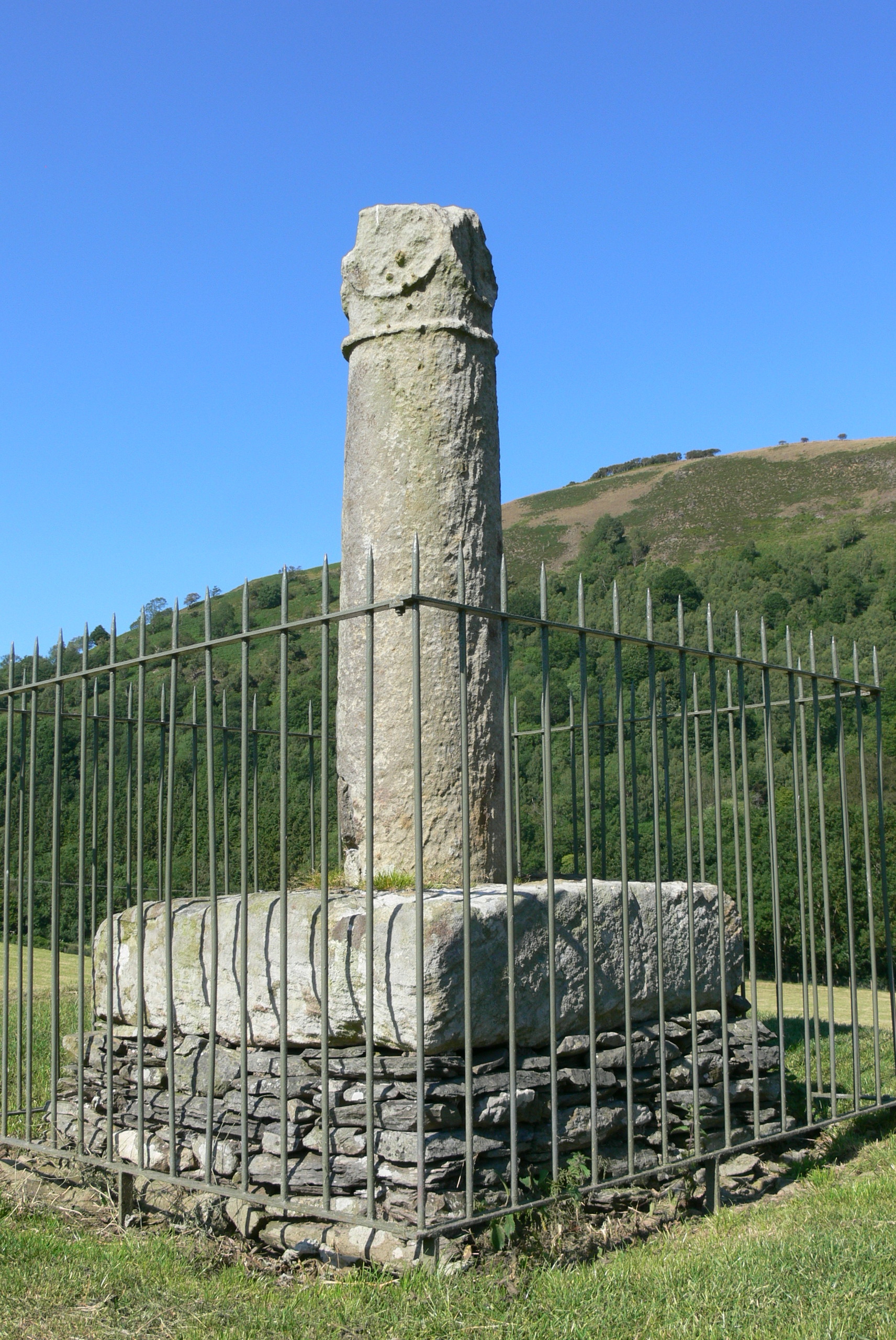
- Eliseg's Pillar is the rounded upper shaft of a ninth-century cross, reset on an Early Bronze Age burial cairn in the valley of the Nant Eglwyseg near Llangollen.
- Cyngen ap Cadell, king of Powys, raised it for his great-grandfather Elisedd ap Gwylog, spelled Eliseg on the stone.
- The Latin inscription, now illegible, set out a royal genealogy, a war with the English, and an ancestry reaching to Magnus Maximus.
- The shaft fell in the seventeenth century, was copied by Edward Lhuyd in 1696, and was set up again by Trevor Lloyd in 1779.
- Digging in 2010, 2011, and 2012 found three stone cists, one holding the largest cremated burial yet recorded in Wales.
Visiting
Entry is free. The monument is open all year, from 1 April to 31 March, during reasonable daylight hours. Please only attend during the set opening hours.
History
Eliseg's Pillar is the surviving upper shaft of an early ninth-century cross near Llangollen, reset in its original base on a burial cairn in the valley of the Nant Eglwyseg. The visible shaft is 2.42 metres high and at most 580 millimetres across, and the cross-head and the lower shaft are gone. Cyngen ap Cadell, king of the Kingdom of Powys from 808, raised it for his great-grandfather Elisedd ap Gwylog, whose name is spelled Eliseg on the stone, a form taken to be a carver's mistake.
The cross belongs to the years between about 808 and Cyngen's death. That death is given as 854, on pilgrimage to Rome, as 855, and as 854 or 855, while a letter of 1702 put it at about 840. A nineteenth-century reading placed the pillar in the seventh century by tying a name in the genealogy to a battle of 603. Another pedigree, closer to the inscription, brings the stone to the middle of the ninth century.
The shaft was carved, the inscription says, by Conmarch at the king's demand. The Latin text, once thirty-one lines and now almost illegible, opens with the genealogy from Guoillauc to Concenn. It says Eliseg united the inheritance of Powys and took land back from the English with sword and fire. The reader is asked to bless Eliseg's soul.
Later lines name Magnus Maximus, Vortigern, Germanus, and Sevira, and they close like a land charter, with a blessing on Cyngen ap Cadell and on Powys. The stone was meant to be read aloud. The Kingdom of Powys was the Welsh kingdom that claimed this ground after Roman rule, pressed along its eastern side by Mercia.
Elisedd ap Gwylog, who died around 755, or is listed as reigning from about 725 to about 755, is remembered for winning territory back. His war is placed against Æthelbald's Wat's Dyke and also against Offa, who died in 796 and attacked Powys from 760. The inscription calls Eliseg a man who fought the English, and it also sets him in Offa's time. Both accounts stand.
Under the cross, the mound is an Early Bronze Age cairn. One account dates the first phase, a kerbed platform about 20 by 15 metres, by its type to around 2000 BC. The form, the flint knife, and the bone pins are also placed between about 2350 and 1500 BC, with the cairn discussed as about 2100 to 1700 BC.
A small cist held the burnt bone of at least one adult, later disturbed. A second cist, never reopened until the modern dig, held a minimum of six people, children and adults, weighing 8956.4 grams, a figure also given as 7 kilograms. A raised cairn about 12 metres across then took a larger cist. That cist is said both to have held no human remains and to have held 3 grams of cremated bone.
The cross may have marked an assembly or an inauguration place for the rulers of Powys, on a ridge that forms a natural amphitheatre beside the route from Mercia and the road north over the Horseshoe Pass. No ninth-century building or object was found on the mound. After Cyngen's death, Rhodri Mawr of Gwynedd took Powys. Around 1200 or 1201 Madog ap Gruffudd founded Valle Crucis Abbey, the Valley of the Cross, on land that included the pillar, and princes of northern Powys were buried at the abbey.
The abbey closed in the autumn of 1536 or early in 1537. The shaft is said to have been thrown down by Roundheads in the English Civil War, and also to have fallen or been toppled in the late civil wars or sooner. That fall is placed most likely in the early 1640s, or by about 1642. Robert Vaughan copied sixteen lines in 1648.
Edward Lhuyd, also recorded as Edward Lluyd, copied the rest of the inscription in the summer of 1696, and his transcript is the record of a text that can no longer be read. In 1908 John Rhys discussed the pillar and the etymology of Eliseg, using that transcript. In 1779 Trevor Lloyd set the upper shaft back in its base and cut a new inscription recording the restoration.
An opening of the mound in the 1770s found bone between flat stones. A later story of a giant skeleton, a gilded skull, and a large piece of silver does not match the acid soil or the hole found on the west side. Excavation in 2010, 2011, and 2012, directed by Nancy Edwards, Gary Robinson, and Howard Williams, recovered the Bronze Age sequence, the eighteenth-century disturbance, and the reshaping of the cairn for the restored column. The finds and the human remains are kept at Llangollen Museum, which also holds a replica of the cross.
Images


Detailed History
Eliseg's Pillar, also called Elise's Pillar and, in Welsh, Croes Elisedd, stands in the valley of the Nant Eglwyseg near Llangollen in Denbighshire, in the community of Llantysilio. The Nant Eglwyseg is a tributary of the River Dee and runs along a major route from the east into Wales. The monument sits at about 120 metres above sea level on the west side of that narrow valley, on the southern end of a glacial ridge, roughly 400 metres north-west of the ruins of Valle Crucis Abbey. The ridge makes the stone look higher than the valley floor alone would suggest.
To the south the ground falls away. To the north the same ridge opens like a natural amphitheatre. About three kilometres to the south-east, the pass of Bwlch yr Oernant, the Horseshoe Pass, crosses Maesyrychen Mountain at 417 metres and links the Vale of Llangollen with the Vale of Clwyd. The east side of the valley rises sharply to about 378 metres.
A rocky outcrop on the west reaches about 230 metres, and the uplands beyond rise above 500 metres. The field around the pillar is farmland, used in turn for pasture, barley, and root crops, and it has been ploughed for a very long time.
What remains above ground is not a complete cross. It is the upper part of an incomplete cylindrical shaft, reset in its original square base on a dry-stone plinth on top of a burial cairn. The visible shaft is 2.42 metres high and at most 580 millimetres across. A horizontal roll moulding separates the round shaft from a quadrangular top, and each face of that top is marked by a curved swag.
The base is 420 millimetres high, 1.5 metres wide, and 1.48 metres deep. The cross-head is gone, and so is the lower part of the shaft. The stone has been identified as likely Gwespyr sandstone, which outcrops a few kilometres away. The long Latin inscription that once covered the shaft, in thirty-one lines, is now so weathered that only the bands of the lettering, and a few broken letters, can be made out in strong oblique light on the side that now faces east.
A second, much later Latin inscription was cut on another face in 1779.
The pillar was raised in the first half of the ninth century, within the lordship of Yale, by Concenn, the modern Welsh Cyngen ap Cadell, the last early medieval ruler of the Kingdom of Powys in the old line. He set the cross up for his great-grandfather Eliseg, the Elisedd ap Gwylog of later writing. The spelling Eliseg on the stone is taken to be a mistake by the carver. The monument is dated between about 808, when Cyngen ap Cadell became king, and 854, the year most often given for his death.
His death is also given as 855, and as 854 or 855. In a letter of 20 December 1702 the antiquary who had copied the inscription put that death at about the year 840, and he dated the cross itself to about 850. A nineteenth-century reading, which tied a name in the genealogy to a battle of the early seventh century, placed the pillar in the seventh century instead. The same writer noted another pedigree, closer to the inscription, which brings the stone to the middle of the ninth century.
The shaft is one of the longest inscribed stones to survive from Wales before the Viking age.
The cairn under the cross is much older than the cross. It is a burial monument of the Early Bronze Age. One account dates the earliest phase, a kerbed platform cairn, by its type to around 2000 BC. The form of the monument, and the burnt flint knife and bone pins found with the dead, are placed in the Early Bronze Age, with the cairn discussed as belonging to about 2100 to 1700 BC, the knife as typical of about 2350 to 1500 BC, and the pins as most likely of about 2350 to 1600 BC.
Cremated burials of this kind in Wales that have been dated mostly fall between 2200 and 1700 BC, and multi-phase mounds of the period are placed around 2100 to 1800 BC. Charcoal and burnt bone from the cairn were submitted for radiocarbon dating. A later account of the dig says that the Early Bronze Age origin of the kerbed platform, with two of its cists, is backed by those dates, and that the mound was then raised for a third cist. The numbers of those laboratory dates are not set out in the excavation account used here, so the ranges above are the figures the work itself gives.
The first phase was a low oval cairn about 20 by 15 metres. It was built straight onto natural glacial boulder clay, on a slight rise formed by a linear glacial mound at the scarp of an old river terrace. Samples that looked at first like an old land surface under the stones turned out to be natural silt washed down through the cairn onto the mineral soil. The edge was a substantial kerb of large slate slabs and rounded igneous boulders, set in a foundation trench cut into the subsoil.
In the areas opened, only one kerbstone was missing. Plough-cleared field stones piled against the monument had helped to protect that kerb. The body of the cairn was made of large river boulders set close together, with flat slabs laid on them to level the platform, and through-stones near the kerb for support. The kerbstones are a local sandstone of the Elwy Formation, of Ludlow age, about 427 to 423 million years old, together with other local sandstones, siltstones, and a few rounded boulders brought from the north side of the valley.
A geophysical survey had suggested a ring-ditch around the mound. Trenches on the west and north found none. A dip in the subsoil at the end of the western trench was tested by extending the cut, and it proved natural. Medieval ridge and furrow was visible in the section, and at some depth beyond the cairn.
Inside the first cairn were two stone cists. The smaller, called Cist 1 in the dig, measured 0.3 by 0.25 metres. Four blue-grey mudstone slabs were set on end, with a single slab for the floor. It is thought to have stood on the natural subsoil, and it could not be separated from the body of the cairn, so it is taken as the earliest burial found.
The agreement under which the dig was done did not allow the cist itself to be lifted. Antiquarian digging had already broken it. The capstone was missing, and the fill was the same loose mix as the later backfill. The fill had no objects, but a little burnt bone survived at the base and between the floor and the side slabs, enough to show that it had been a grave.
Small patches of burnt bone and charcoal on the cairn surface nearby suggest that the contents were cleared out and scattered when the mound was opened in the eighteenth century. The bone from that disturbed material is a minimum of one adult, whose sex could not be told. The fragments are badly broken, which fits both the acid soil and the eighteenth-century disturbance.
Cist 3, found just behind the kerb, was 0.38 by 0.33 metres, built of four grey slabs, and it had not been opened in modern times. It held the great cremation deposit of the site. The weight of that bone is given both as 7 kilograms and as 8956.4 grams. Of the larger figure, 8829.1 grams came from inside the cist and 127.3 grams from just outside it.
The count of the dead is a minimum of six people: two young children aged about 1 to 6, one adolescent aged about 12 to 17, or in one listing about 13 to 17, one young adult aged about 18 to 25, one middle or older adult over 25 who is a possible man, and one older adult over 40 who is a probable woman. Another summary speaks of numerous adults, juveniles, and infants, which is a looser description of the same grave. The bone at the bottom, relatively free of soil, is read as a first burial of at least four people: a young child, an adolescent, a young adult, and the older woman. With them were a complete plano-convex flint knife, an almost complete burnt bone pin with an eyelet, and a fragment of a second burnt pin.
All three had been through the fire. Green and blue stains on a few skull fragments suggest a copper or copper-alloy object that was not found. Later burials were put into the same cist, at least a second young child and the possible man, though the bones were too mixed for an exact order. The cist seems to have been reopened at least once.
Clusters of bone hint that some of the dead were brought in bags or other organic containers. Reopening a cist for further cremations had not, at the time of the dig, been clearly shown in a Welsh burial mound.
The bodies had been fleshed and complete when they were burned. The bone is mostly white, which means the pyre reached at least about 700 to 800 degrees Celsius. Thicker pieces, the inner layers of the skull and some long-bone fragments, stayed light grey, because they take longer to burn through. Curved breaks, splitting, and warping are the marks of flesh still on the bone.
Every part of the skeleton is present. The bone from Cist 3 is the least broken of the three graves: between about a third and about seven tenths of it is larger than 10 millimetres. On the older woman and the other adults there are signs of illness and age. A porous patch on a left cheek bone may be bleeding from scurvy, a lack of vitamin C.
Schmorl's nodes on a thoracic vertebra record a slipped disc. Osteophytes on the atlas and on finger and toe bones, pitted thoracic vertebrae, and osteoarthritis of a spinal joint and a knee, most likely the older woman's, show worn joints. A little cremated animal bone, between 1.4 and 13.2 grams in the samples that had any, was mixed in. Animals may have been put on the pyre, or the scraps may have been picked up by accident when the human bone was gathered.
The second phase raised the cairn. Its diameter was about 12 metres, smaller than the first mound and set off centre in the south-west quadrant. Into that raised cairn went Cist 2, a large stone box with a heavy capstone, big enough for an unburnt body. No unburnt bone was found, which may be the acid soil rather than an empty grave.
One account of the second phase says that this large cist held no human remains. The bone study records 3.0 grams of cremated human bone from it, a minimum of one person whose age and sex could not be told, in the upper 50 millimetres, perhaps a later token burial. A small unburnt flint flake came from the same cist. The last phase of the mound is relatively modern and belongs with the re-erection of the cross, when stone was added and the profile changed so that the shaft and its base would read clearly from a viewpoint to the south-east.
Cist 3 is the largest Early Bronze Age cremation yet recorded in Wales, both by weight and by the minimum number of people. Most undisturbed cremations in Wales weigh between 120 and 2800 grams, with an average around 1007 grams. The nearest comparisons are a pit at Tandderwen in Denbighshire, with at least five people, and a barrow at Trelystan in Montgomeryshire, with 5904 grams but only two people. Kerbed platform cairns are rare.
Only twenty-three are known in Wales, all above 230 metres, and only three others had been excavated when this mound was dug: one at Brenig in Denbighshire, one at Aber Camddwr in Ceredigion, and Pond Cairn in Glamorgan. The Eliseg cairn is unusual among them in standing low in a valley, at about 120 metres, rather than on the high moors. Other Early Bronze Age cairns cluster on the limestone above the valley, at Creigiau Eglwyseg, Aber Sychnant, Cefn-y-Gader, and Craig-y-Forwyn, and in smaller groups on Moel y Gamelin and Gribin Oernant. Many of those upland cairns have old holes dug into the top.
An 1879 dig at Creigiau Eglwyseg found an urn and a cremation in a stone-lined pit. An 1890 dig at Aber Sychnant found ash, bone, a horse's tooth, and a flint arrowhead. The Eliseg graves sit near the edge of the platform, which leaves open the chance of a central burial still under the unexcavated part of the mound. The mix of adults and children, and the reopening of Cist 3, fits the idea that such mounds were the burial places of a family or a small clan, used over a fairly short span.
There is no trace of Iron Age activity at the pillar itself. Castell Dinas Brân, on a steep hill about 2.5 kilometres to the south-east, is thought to have begun as a univallate hillfort, though it cannot be seen from the pillar. Other nearby enclosures, Pen-y-Gaer, Vivod, and Wern Isaf, are also presumed to be Iron Age. No Roman site is recorded in the immediate valley.
A sherd of Roman orange ware was found in 2008 in a trial trench on a mill site at Pandy, north of the later abbey.
The inscription on the shaft reaches back, in its broken lower lines, to the end of Roman rule. It names Maximus of Britain, the Magnus Maximus who was Roman emperor in the West from 383 to 388. He was born in Gallaecia, in Hispania, about 335, on the estates of Count Theodosius, to whom he claimed kinship. As a young man he served with the future emperor Theodosius I in the army of Theodosius the Elder in Britain.
He served under Count Theodosius in Africa in 373. Sent to Britain in 380, he defeated an incursion of Picts and Scots in 381, which has been taken as a sign that he was by then the commander of the army in Britain. In the spring of 383 the army in Britain proclaimed him emperor in place of Gratian. One early writer called him energetic and worthy of the throne had he not broken his oath, and said the troops proclaimed him against his will.
Another portrays him as stirring the revolt because Theodosius had been made emperor and he had not. He took at least part of the British garrison to Gaul. How many soldiers left Britain is not known. After five days of skirmishing near Paris he beat Gratian, who fled and was killed at Lyon on 25 August 383.
In 384 Valentinian II and Theodosius I recognised him as Augustus in the West, while he accepted Valentinian's hold on Italy, Africa, and Illyricum. He ruled from Augusta Treverorum, Trier, over Britain, Gaul, and Spain, issued coins, and reordered the provinces of Gaul. He had Priscillian and six companions executed on a charge of magic, after they had been pursued as heretics. Ambrose and Martin of Tours protested at a secular court deciding a matter of doctrine.
The executions went ahead, and the confiscations that followed strengthened his treasury. In 387 he invaded Italy. Theodosius I defeated him at the Battle of Poetovio in 388, and he died on 28 August 388. Some historians treat that death as the end of direct imperial presence in northern Gaul and in Britain.
Welsh legend later kept his name. The Kingdom of Powys traced its dynasty, the Gwrtheyrnion, to the marriage of Vortigern and Sevira, called a daughter of Magnus Maximus.
The inscription's broken lines name that claim in the form the carver used. After a gap and the word monarchy, they give Maximus of Britain, then Pascent, Maun, and Annan, then Britu, son of Guarthigirn, whom Germanus blessed, and whom Sevira bore to him, the daughter of Maximus the king, who killed the king of the Romans. Guarthigirn is Vortigern. Britu is also written Brydu.
Germanus may be Germanus of Auxerre, who visited Britain in the second quarter of the fifth century, or the local saint Garmon, whose life is told in the Historia Brittonum, an early text written around 828. That same text describes Cadell Ddyrnllwg as the man Germanus blessed, and as the successor of Benlli Gawr, rather than Vortigern's son. The pillar and the text therefore do not agree on who received the blessing. The names Pascent and Maun Annan are too broken to carry a secure story beyond the fact that the carver set them in this ancestral list.
The Kingdom of Powys was a Welsh successor kingdom after Roman rule. Its name is thought to come from Latin pagus, the countryside, and pagenses, the people of the countryside. In the Roman period the region took in the lands of the Ordovices in the west and the Cornovii in the east, from the Cambrian Mountains to what is now the West Midlands, including the valleys of the Severn and the Tern, later called the Paradise of Powys. The Roman city of the Cornovii was Viroconium Cornoviorum, at Wroxeter, the fourth largest Roman city in Britain, later given up in favour of Deva Victrix at Chester.
Viroconium lasted as a town unusually far into the sixth century and may have been an early centre for Powys. The Historia Brittonum lists it as Caer Guricon, one of twenty-eight British towns. An older name, Teyrnllwg, was claimed for Powys in the nineteenth century and was said to appear in the medieval chronicle of the princes, but it is likely an imaginary territory traced to the forgeries of Iolo Morganwg, built by misreading the name Cadell Ddyrnllwg.
Through the early Middle Ages, English settlement from Mercia pressed on the eastern border of Powys. That pressure was gradual, and English control of the West Midlands was still uncertain until the late eighth century. In 549 the Plague of Justinian reached Britain. Welsh communities were devastated.
The English, with fewer trading contacts to the continent at that time, were less affected. With fewer people and more Anglian settlement, Brochwel Ysgithrog may have moved the court from Caer Guricon to Pengwern. Pengwern's site is unknown. It has been placed at Shrewsbury, or at the more defensible Din Gwrygon, the hillfort on the Wrekin.
In 616 the army of Æthelfrith of Northumbria met Powys. He invaded the northern lands of the kingdom, forced a battle near Chester, and defeated Selyf ap Cynan and his allies. At the start of the fighting he killed 1,200 monks from the monastery of Bangor-on-Dee in Maelor, saying that they fought against him because they opposed him by their prayers. Selyf was killed, and he may have been the first king of Powys buried at the church of St Tysilio at Meifod, which became a burial place of the dynasty.
The year of that battle is also given as 607, corrected to about 615, and as 603, the date used when a later writer tied the pillar's Brochmail to the battle of Bangor Iscoed. Thomas Pennant, in the late eighteenth century, was the first to identify the Brochmail of the pillar with the Brochmail whom Bede says was killed at Chester. That identification is rejected. The Brochmail of the inscription is a man in Cyngen's genealogy, not the seventh-century king.
If Cynddylan of Pengwern was of the Powys royal line, men from Powys may also have fought at the battle of Maes Cogwy in 642. The englyn cycle Canu Heledd, probably of the ninth century, tells of Pengwern sacked soon afterwards, its royal family killed, and most of its land taken by Mercia, some by Powys. That poem is now generally read as a ninth-century imagination of the seventh century, shaped by the political situation of Powys in the ninth century, which is the century of the pillar.
Powys is said to have recovered with successful campaigns against the English in 655, in 705 to 707, and in 722. By 717 the court had moved to Mathrafal in the valley of the Vyrnwy, possibly under Elisedd ap Gwylog. He was king of Powys in eastern Wales, son of Gwylog ap Beli, a descendant of Brochwel Ysgithrog, and he is said to have died around 755. A regnal list gives him the years 725 to 755, with question marks on both ends.
Little narrative survives for him beyond the pillar and a few poems. Those poems give him a special crown, a chain of twisted gold links, and gold armlets and anklets, called the badges of sovereignty of Powys. He appears to have taken back territory the English had overrun. His successes are said to have led Æthelbald of Mercia to build Wat's Dyke.
That earthwork, running north from the Severn valley to the Dee estuary, may have been made with Elisedd's agreement, because it left Oswestry, Croesoswallt, on the Powys side. Offa of Mercia, who died in 796, continued the frontier with the longer work known as Offa's Dyke, Clawdd Offa. A study of the dyke has been read as evidence of some consultation with the kings of Powys and of Gwent. On the Long Mountain near Trelystan the dyke bends east and leaves fertile slopes in Welsh hands.
Near Rhiwabon it was laid out so that Cadell ap Brochwel kept the fortress of Penygadden. For Gwent, Offa built on the eastern crest of the Wye gorge, leaving the river and its traffic to that kingdom. The new line put Oswestry back on the English side. Offa attacked Powys in 760 at Hereford, and again in 778, 784, and 796.
The inscription's Eliseg is described as a contemporary of Offa. If Elisedd ap Gwylog died around 755, and Offa attacked from 760, the two were only briefly contemporaries, or the death date and the claim of contemporaneity do not sit easily together. Both are recorded, and the inscription itself does not give a year for the war. Elisedd was succeeded by his son Brochfael ab Elisedd, listed as reigning from about 755 to 773.
The cross and its text belong to the next generations. The opening of the inscription is a genealogy of the later eighth century and the first half of the ninth. Concenn son of Cattell, Cattell son of Brochmail, Brochmal son of Eliseg, Eliseg son of Guoillauc. Each section began with a cross.
Concenn, great-grandson of Eliseg, erected this stone for his great-grandfather Eliseg. It was Eliseg who united the inheritance of Powys, and who, by force, took land back from the power of the English with his sword and with fire. The Latin is broken. One translation says he joined the inheritance of Powys throughout nine years.
Another leaves the span unread and gives "through force" and "land with his sword by fire". Whoever reads the hand-cut text aloud is asked to give a blessing on the soul of Eliseg. A further broken section speaks of Concenn himself, of his hand, of his own kingdom of Powys, and of the mountain, and it seems meant to set his deeds beside his great-grandfather's. Then come the lines on Magnus Maximus, Vortigern, Germanus, and Sevira.
Conmarch painted this writing, or, in another translation, represented it pictorially, at the demand of his king, Concenn. The text ends with a blessing of the Lord on Concenn, on his whole household, and on the whole region of Powys, until the stone breaks off. That closing form is the language of documents that transferred land. The word chirographum, a deed or charter, and the verb for reading aloud, show that the inscription was meant to be proclaimed, not only cut.
It has been read as a victory monument, as a claim to land won back from the English, and as propaganda at a time when the kingdom was under threat. It may have been all of those at once.
Cyngen ap Cadell, also spelled Concenn, was king of Powys from 808 until his death. He was of the line of Brochwel Ysgithrog. After a long reign he went on pilgrimage to Rome and died there in 854. He is thought to be the first Welsh ruler to visit Rome after the breach between the Welsh church and Rome over the date of Easter had been healed.
He had four recorded children: Elisedd ap Cyngen, Ieuaf ap Cyngen, Aeddan ap Cyngen, and Gruffydd ap Cyngen. He was the last of the original line of kings of Powys in the Gwertherion dynasty. On his death the kingdom was taken by Rhodri Mawr, ruler of Gwynedd, who had inherited Gwynedd the year before his uncle's death. Rhodri was his nephew if Rhodri's father, Merfyn Frych, had married Cyngen's sister, Nest ferch Cadell, as some pedigrees, including Jesus College 20, say.
Other pedigrees, including Mostyn 117, make Rhodri the son of Essyllt ferch Cynan, thought to be a daughter of Cynan Dindaethwy of Gwynedd. Traditional Welsh law does not seem to have allowed inheritance through a woman, so Rhodri is presumed to have taken Powys by conquest either way. His control of both kingdoms was the basis of Gwynedd's claim to overlordship of Powys for the next 443 years. The raising of the cross, between about 808 and 854, falls in the years when that takeover was approaching.
Quarrying, moving, and shaping a shaft of this size took royal resources. The choice of an ancient cairn, in a valley that is a route from Mercia and a route north to the coast, fits a place where a king might be proclaimed. No early medieval structure was found in the trenches, and no object of that date came from the mound. The soil is acid, the topsoil on the ridge is thin, and the field has been ploughed for centuries, so a periodic gathering, perhaps under tents, could have left little.
Assembly places elsewhere in north-west Europe are often just as faint. The wording of the stone, the reuse of the cairn, and the amphitheatre of the ridge remain the reasons for thinking this was a place of assembly, and perhaps of inauguration, for the rulers of Powys.
Two metal finds from the neighbourhood, reported while the mound was being dug, show that the valley was not empty in these centuries. In 2011 a metal detector found an incomplete cast copper-alloy zoomorphic strap-end of the tenth or eleventh century, of a type most common in Hiberno-Scandinavian Dublin, which may have been a book clasp. In 2012 five copper-alloy Northumbrian stycas of the mid-ninth century were found in redeposited ground on the bank of the Dee, most likely from trade. A penannular brooch of the fifth or sixth century, of type G1, was already known from Trevor Rocks.
None of these came from the cairn.
After Cyngen, the next clear use of this ground is monastic. The Cistercian abbey of Valle Crucis, the Valley of the Cross, was founded about 1201 by Madog ap Gruffudd, prince of northern Powys. A poetic chronicle places the foundation in the meadow of the ancient cross in Iâl under the year 1200. Madog gave the township of Llanegwestl, and other estates he held by hereditary right, for the monastery.
The freemen of Llanegwestl were moved and given lands near Wrexham. The exact site of Llanegwestl is unknown, though the name continued as a Welsh name for the house. The element llan may point to an earlier church or Christian enclosure. Other Cistercian houses in Wales, notably Margam, and also Llanllŷr, and possibly Neath and Strata Florida, stand at or near earlier ecclesiastical sites.
Madog was giving royal land, and that land included the pillar. Nothing is known of the monument in the three and a half centuries between Cyngen's death and the abbey. It is tempting to tie Llanegwestl directly to the cross, but the evidence for that link is lacking. What is clear is that the Latin name of the abbey was taken from the pillar, that the cross would have been the landmark for anyone coming down from the pass, and that it could have served as a station for prayer.
The abbey gatehouse may have stood on the site of the present Abbey Farm. Madog ap Gruffudd, who died in 1236, was buried in the abbey church, and other members of the ruling family of northern Powys were buried there too. Madog ap Maredudd, who died in 1160, grandson of Bleddyn ap Cynfyn, named his youngest son Elise. In the same decades the princes built the stone castle of Dinas Brân inside the old hillfort above the Dee.
In the years about 1480 to 1500, under Abbot Dafydd ab Ieuan, Valle Crucis was a centre of learning and of poetic patronage. Gutun Owain, active from about 1460 to about 1498, a poet, chronicler, and copyist from nearby Dudleston, mentions the cross several times and, in the Black Book of Basingwerk, places the abbey's foundation in the meadow of the ancient cross. Guto'r Glyn, active from about 1435 to 1490, probably from Dyffryn Ceiriog or Glyndyfrdwy, spent his last years at the abbey and writes of Pant-y-groes, the valley of the cross. The only later medieval object from a stratified context in the dig was a single sherd of a small wheel-thrown vessel, most likely the base of a baluster jug of the fourteenth or fifteenth century, in a fabric like pottery from the abbey.
It lay in the fill of the later antiquarian hole, so it was not in its original place.
The abbey was closed in the autumn of 1536 or early in 1537, at the dissolution of the monasteries. Over about the next 120 years the buildings and the adjoining land passed through several owners, until in the 1660s the estate was bought by John Trevor of Llys Trevor. His descendant Mary Trevor, who inherited in 1693 and repaired the abbey buildings, married Thomas Lloyd of Glanhavon in Mochnant, high sheriff of Mochnant in 1749. The abbey and the pillar passed through their daughter Mary, who had married Edward Lloyd of Pentrehobyn, to Trevor Lloyd of Trevor Hall.
What happened to the shaft between the dissolution and the later seventeenth century is not fully recorded, and the accounts disagree. One says that Roundheads threw the pillar down during the English Civil War and opened a grave beneath it. Another says it was probably pulled down sometime after 1536 or 1537, most likely in the early 1640s. Edward Lhuyd, who is also recorded as Edward Lluyd, wrote on 14 September 1696 that in the late civil wars, or sooner, it was thrown down and broken in several pieces, which is why the inscription is so imperfect.
In 1682 John Aubrey noted that a Mr Meredith Lloyd had told him the monument had fallen at least forty years before, which would put the fall at or before about 1642. It is therefore unclear whether the shaft fell or was toppled, and whether that was in the war or earlier. The cross-head and the bottom of the shaft do seem to have been lost then. The English Civil War, also called the Great Rebellion, was the series of wars and political struggles between Royalists and Parliamentarians in the kingdom of England from 1642 to 1651, inside the wider Wars of the Three Kingdoms from 1639 to 1653.
The first war was fought over the balance of power between Parliament and Charles I, and it ended in June 1646 with the king in custody. Parliamentarian victory in the second war led to the execution of Charles I in January 1649 and to the Commonwealth. Wales, annexed into the kingdom of England, was drawn into the same crisis. Supporters of the king were nicknamed Cavaliers, and supporters of Parliament were nicknamed Roundheads, from the close-cropped hair of some Puritans and London apprentices.
Destruction of crosses is known in neighbouring Cheshire in the seventeenth century. At Tarvin, east of Chester, fragments of a cross-head and shaft were found in a seventeenth-century ditch, and monuments there had already been attacked, with a failed prosecution in the Court of Star Chamber in 1614. The pillar may have suffered in the same climate of iconoclasm. Two joining sherds of a Midlands purple jar, of a type used in the sixteenth and seventeenth centuries and thought to have been in use during the war, were found in the later capping of the cairn.
They cannot be tied securely to a destruction, because they may equally be from manuring, from a disturbed pit, or from occupation nearby.
Antiquarian interest in the fallen stone begins in that same century of loss. The first known copy of the inscription was made in 1648 by Robert Vaughan of Hengwrt, near Dolgellau, a collector of manuscripts who also copied other early inscribed stones and cared about royal genealogies. His copy, in his commonplace book, gives only the first sixteen lines, the last of them very broken. The stone was already incomplete when he saw it, and it is unlikely to have been standing, because the lower lines would have been easier to read on an upright shaft than the upper ones.
His copy does not separate the words. Word division is not usual on Welsh inscriptions of this date, so in that respect his copy may be the more accurate. He had sent a version to Archbishop Ussher, who sent it to Gerald Langbaine of Queen's College, Oxford. Edward Lhuyd hoped in 1696 that this copy might still be found.
Where the two transcripts overlap they are close, but toward the end Lhuyd could read more.
Edward Lhuyd, also spelled Edward Lluyd, was born in 1660 at Loppington in Shropshire, or in 1659 or 1660, and he died on 30 June 1709. He was the illegitimate son of Edward Llwyd of Llanforda, at Oswestry, and of Bridget Pryse of Llansantffraid. He grew up at Llanforda, only a few miles south of Llangollen. He attended Oswestry Grammar School, went up to Jesus College, Oxford, in 1682, and left before taking a degree.
In 1684 he began assisting Robert Plot, keeper of the Ashmolean Museum, and in 1690 he became the second keeper, holding the post until his death. He travelled Wales, and later Scotland, Ireland, Cornwall, Brittany, and the Isle of Man, recording burial mounds, inscribed stones, and grave slabs. In the summer of 1696 he copied what he could still read of the pillar. Two copies survive, one in his letter of 14 September 1696 to John Mill, principal of Edmund Hall, and one sent to Bishop Humphrey Humphreys of Bangor, whose judgement he trusted.
He called it a stately pillar of very hard stone, described the shaft and the pedestal accurately, and said it had stood on a small mount which seemed to have been cast up for that purpose. Despite his knowledge of prehistoric burial mounds, he did not recognise this one as ancient. He also thought the pillar had never been intended as a cross, a view that influenced later writers, including W. T.
Simpson in 1827. He did connect Concenn with the early rulers of Powys. In the Archaeologia Britannica of 1707 he used the inscription, dated by him to about 850, as evidence that certain Celtic sound changes had already happened. His transcript is the main record of a text that is now illegible, and it has been judged remarkably accurate.
The lower half of the shaft afterwards disappeared from view. The upper half was set upright again in 1779.
In 1908 John Rhys discussed the pillar and the etymology of the name Eliseg, and his discussion includes the translation made by Edward Lhuyd. John Rhys, born John Rees at Ponterwyd in Ceredigion on 21 June 1840 and dying on 17 December 1915, became the first professor of Celtic at Oxford in 1877. He was knighted in 1907, and from 1908 until his death he was the first chairman of the commission on the ancient and historical monuments of Wales. His treatment of the name sits with the wider conclusion that Eliseg on the stone is a carver's error for Elisedd.
The shaft lay fallen through the middle of the eighteenth century. On 20 May 1773 a letter from Daines Barrington was read to the Society of Antiquaries in London. It passed on a copy of the inscription that he had from Jonathan Shipley, bishop of St Asaph, a copy which seems to go back to Lhuyd, and it noted another copy in the British Museum. With the letter was a tinted drawing of the stone as it then lay, and as it was supposed once to have stood.
The artist is unknown. Moses Griffith, who worked for Thomas Pennant, is one possibility. The lower half of the drawing shows the fallen shaft, the base tilted on what seems to be the mound, and the broken top lying in the grass. The upper half restores it not as a cross but as an obelisk with a point, and it runs the lines of writing, wrongly, the whole length of the shaft.
Antiquaries of that generation often called early medieval cross shafts obelisks. Pennant himself, after seeing the Ruthwell cross lying in pieces in 1772, called that monument an obelisk once of great height.
Around the same years Trevor Lloyd, the landowner, opened the mound. Thomas Pennant, whose tour of Wales was published between 1778 and 1783, says that within a few years the tumulus was opened and the remains of bones were found, placed as usual between flat stones. He gives the dimensions and the opening genealogy, and by then he found the original inscription illegible. The 1784 edition includes an engraving after Moses Griffith, showing the column upright with the new inscription, and dotted lines relating it to the base.
The caption is Pillar of Eliseg, the name still used. A fuller story was written about fifty years later by W. T. Simpson, in a guidebook of 1827, from two old men who said they had helped to open the mound.
They described digging under the flat pedestal, a layer of pebbles, then a large flat slab, and a stone box of large blue slabs in which a body had lain. The bones were said to be entire and very large, the skull and teeth white and perfect. One version says the skull was sent to Trevor Hall, returned, and put back. Another says a large piece of silver was found in the coffin and kept, that the skull was gilded, and that the bones broke like gingerbread.
Simpson took this to mean that Eliseg had been buried here and had not been old. The excavation of the western side of the mound found the antiquarian hole: a shallow scoop of small stones, with fill under it, cutting into Cist 1 and apparently running under the reset pillar. Sherds of domestic blackware and slipware of the mid-seventeenth to early eighteenth century date that fill. Pennant's short account matches what was found.
Only the first part of Simpson's story, a stone setting and bones, fits the ground. An entire skeleton of giant size, a gilded skull, and a large piece of silver do not. Unburnt bone is unlikely to have lasted in this acid soil, silver is not a normal Early Bronze Age grave gift and would hardly have survived, and giant skeletons are a commonplace of eighteenth- and early nineteenth-century barrow tales. By the 1820s at the latest, the mound was being shown to visitors as the grave of Eliseg, and the supposed skeleton was the proof.
Lloyd did not stop at the hole. In 1779 he had the surviving shaft set back in its original base on a dry-stone plinth, and he had a new Latin inscription cut on the north-east face, opposite the old text. It reads, in translation, that what remains of this old monument, long removed from sight and neglected, T. Lloyd of Trevor Hall at last restored in the year 1779.
The face below the old inscription was by then badly damaged. Four fragments of that face were pinned back with iron bars, now themselves broken. A fifth fragment is lost, and the initials W L are lightly cut on the flat surface beneath. The new lettering records the restoration rather than destroying the early text, which was already on the other side.
The shaft, broken and reset, took on the look of a ruined classical column. Lloyd also remodelled the top of the cairn, hiding the coursed plinth so that the monument would read from his summer house about 400 metres to the south-east, at Valle Crucis, as part of a picturesque estate centred on the abbey ruins. Thomas Pennant brought that landscape, and the restored pillar, to a wider public.
The mound was surveyed in 2008 by Dai Morgan Evans and Susan Youngs, with resistivity and magnetometry on the ridge to the north by Sarah Semple and Alex Turner, and a ground-penetrating radar survey of the mound itself. The excavation that followed was directed by Nancy Edwards, Gary Robinson, and Howard Williams, of Bangor University and the University of Chester, with Carol Ryan Young, and with students and local volunteers in partnership with Llangollen Museum. It ran for seven weeks over three seasons: 19 July to 1 August 2010, 3 to 17 September 2011, and 26 August to 15 September 2012. The aims were to date and phase the mound, to test whether the cross had marked an assembly or an inauguration place, to record the eighteenth-century disturbance, and to help the long-term care of the monument.
Tree roots on the west and sheep scrapes around the kerb, worse in hard winters when only the pillar and not the whole mound was fenced, were part of that care.
In 2010 three trenches were opened. One, 20 by 5 metres, ran west from the pillar past the foot of the mound, where the slumped profile and the radar suggested the antiquarian cut and where a ditch had been suspected. A 4 by 4 metre extension dealt with tree-root damage. A second trench, 15 by 5 metres, examined the north side.
A third, 10 by 10 metres, was cut on the ridge about 40 metres north-north-west, where the survey had shown anomalies. That trench found loose brown glacial gravel and very thin topsoil, and no archaeological features. The anomalies were geological or agricultural. The trench was recorded and backfilled.
In 2011 the western trench was reopened, the antiquarian disturbance was dug, a baulk one metre wide was left down the centre, and Cist 1 and Cist 2 were found but not yet emptied. In 2012 the area north of the baulk was opened with the root-damage trench, the sequence was recorded, Cist 1 and Cist 2 were excavated, and Cist 3 was found and fully excavated. A topographic survey used readings every 0.05 metres. All digging was by hand.
Deposits were sieved on a 5 millimetre mesh and checked with a metal detector. Sealed contexts were sampled, 40 to 60 litres where the soil allowed. At the end of each season a geotextile was laid and the trenches were backfilled and returfed. The archive, the objects, and the human remains went to Llangollen Museum.
A replica of the cross is also kept there for visitors who want to see the form of the lost parts.
The dig found no feature and no object of the ninth century on the cairn. It did find the Bronze Age sequence, the scale of the eighteenth-century hole, and the later reshaping of the mound for the restored shaft. The biography of the place therefore runs from a family cemetery on a valley-floor knoll in the Early Bronze Age, through a ninth-century royal cross that used that cemetery as a stage, through a monastic landmark, a fall in the century of the English Civil War, a careful copy made while the letters could still be read, and an eighteenth-century restoration that made a broken column the eye-catcher of a picturesque estate. The inscription, surviving only because Edward Lhuyd and Robert Vaughan wrote it down, remains the voice of Cyngen ap Cadell speaking for Elisedd ap Gwylog, for a kingdom pressed by Mercia, and for an ancestry the carver traced to Magnus Maximus.
Sources
- Pillar of Eliseg — Wikipedia
- Cyngen ap Cadell — Wikipedia
- Elisedd ap Gwylog — Wikipedia
- Edward Lhuyd — Wikipedia
- John Rhys — Wikipedia
- Magnus Maximus — Wikipedia
- Kingdom of Powys — Wikipedia
- English Civil War — Wikipedia
- Eliseg's Pillar — Cadw
- Excavations at the Pillar of Eliseg, Llangollen, 2010-2012 — Bangor University and the University of Chester
- Early Medieval Inscription on the Pillar of Eliseg — Bangor University and the University of Chester
- Vlog to Death: fieldwork and the life of the Pillar of Eliseg — Internet Archaeology
- Elisegs Pfeiler 5 Südost.jpg — Wikimedia Commons
- Eliseg's Pillar - geograph.org.uk - 206975.jpg — Wikimedia Commons
- Eliseg's Pillar - geograph.org.uk - 1587578.jpg — Wikimedia Commons
- Eliseg pillar.jpg — Wikimedia Commons
- Elisegs Pfeiler 1 Westen Hügel.jpg — Wikimedia Commons
- Elisegs Pfeiler 2 Westen.jpg — Wikimedia Commons
- Elisegs Pfeiler 3 Norden Hügel.jpg — Wikimedia Commons
- Elisegs Pfeiler 4 Norden.jpg — Wikimedia Commons
- Colofn Eliseg ger Abaty Glyn y Groes.JPG — Wikimedia Commons
- Colofn Eliseg ger Abaty Glyn y Groes 3.JPG — Wikimedia Commons