

Moray, United Kingdom · 1224 CE · United Kingdom
- Elgin Cathedral, the Lantern of the North, was the seat of the bishops of Moray from its dedication to the Holy Trinity on 19 July 1224.
- Andreas de Moravia built the first church on land granted by Alexander II of Scotland, after the see moved from Spynie.
- A fire in 1270 was followed by a larger choir, double nave aisles, and the octagonal chapter house.
- Alexander Stewart, Earl of Buchan, the Wolf of Badenoch, burned the cathedral and the manses in June 1390.
- The central tower fell on Easter Sunday 1711, and the ruin was cleared and repaired from the 1820s onward.
- The west front, the chapter house, a Pictish cross-slab, and a collection of about 480 carved stones remain on the site.
Visiting
From 1 April to 30 September the cathedral is open daily from 10am to 5.30pm. From 1 October to 31 March it is open from 10am to 4pm on Monday, Tuesday, Saturday and Sunday, and closed on Wednesday, Thursday and Friday. Last entry is one hour before closing, and the site is closed from 24 December to 4 January. Adult tickets are £10 if booked in advance and £11 in person, concession tickets are £8 in advance and £9 in person, and a child aged 7 to 15 is £5 in advance and £5.50 in person.
Member tickets are free, and a carer ticket is free, limited to two carers on one booking. Tours run at 11am and 2.30pm until 30 September, subject to availability, and visitors are asked to book in advance. Scaffolding and fencing are in place while conservation work continues at the wall tops, and entry is down six stone steps with a central handrail and then up four more stone steps, with a level route also available. Entry is by stone steps without a handrail down into the chapter house.
Assistance dogs are allowed to enter roofed areas. Other dogs are allowed to enter the grounds on a lead and are not allowed in roofed areas, and they must not be left unattended.
History
Elgin Cathedral was the seat of the bishops of Moray and is still called the Lantern of the North. It stands at the east end of Elgin, dedicated to the Holy Trinity, and it was the second largest cathedral in Scotland after St Andrews. The west front, the south transept, the choir aisle, the presbytery, and the octagonal chapter house survive above a graveyard that has served the town since the sixteenth century.
Before the move to Elgin the bishops had no fixed church. Gregory, also called Giric, is the first named bishop, and later bishops used Birnie, Kinneddar, and Spynie. Bricius de Douglas fixed the see at Spynie after a bull of 7 April 1206. Andreas de Moravia, his successor, obtained leave in 1224 to move the cathedral to Elgin.
Alexander II of Scotland had already granted land for the purpose, and the translation took place on 19 July 1224. One account treats the ground as previously unoccupied. Another places an earlier church of the Holy Trinity on the site.
The first church was a smaller cross-shaped building, with an aisleless choir and a single aisle on each side of the nave. Twin western towers were added while the nave was still going up, so that Elgin had three towers in its first phase. A fire in 1270 destroyed the church and the canons’ houses. Bishop Archibald and the chapter rebuilt on a larger plan, doubling the eastern limb, adding outer nave aisles, and building the octagonal chapter house.
Those double aisles are unique in Scotland. Edward I was in Elgin in 1296 and 1303, and Edward III assaulted Moray in 1336, without the cathedral being touched. Alexander Bur, bishop from 1362, came into conflict with Alexander Stewart, Earl of Buchan, the Wolf of Badenoch.
In June 1390, after Forres had been burned in May, Stewart burned Elgin, the cathedral, and the manses. One dating of the fire is 17 June. The central tower, the nave arcades, and the west gable had to be rebuilt. A further attack in July 1402 burned the manses, and one account says the cathedral itself was attacked.
Rebuilding continued under John Innes, Columba de Dunbar, John de Winchester, and Andrew Stewart, whose arms stand on the chapter-house pier of 1482 to 1501. The central tower partly collapsed in 1506 and is also said to have been rebuilt in 1538. The college lived by prebends drawn from parish churches across four deaneries.
In 1452 the barony of Spynie became a regality. By 1560 the cathedral had twenty-five canons, but Elgin was already served by St Giles, and the congregation left the cathedral when parliament made the mass illegal. Patrick Hepburn (bishop), the last Catholic bishop, died at Spynie on 20 June 1573. Lead was stripped from the roofs in 1567 or 1568 and the ship carrying it sank in Aberdeen harbour.
The eastern roof fell in a storm on 4 December 1637. The rood screen was broken up for firewood in 1640, and the great west window is attributed to the soldiers of Oliver Cromwell between 1650 and 1660. John Slezer drew the church while the central tower still stood.
That tower fell on Easter Sunday 1711 and brought down the nave. John Shanks cleared about 2,853 cubic yards of rubble in the 1820s, and Robert Reid roofed the chapter house in 1824. A Pictish cross-slab found near St Giles in 1823 now stands at the crossing. Later repairs reroofed the chapter house and the western towers.
Excavation in 1996 found two walls older than the chapter house, and two probable medieval burials that were left in the ground. About 480 carved stones were returned to the cathedral for display in April 2016, and coloured light on a bishop’s effigy follows traces of its paint. The effigy is called both a fourteenth-century work and a possible image of Bishop Archibald.
Images


Detailed History
Elgin Cathedral stands at the east end of Elgin in Moray, on low ground beside the River Lossie. It was the seat of the bishops of Moray, a secular cathedral with a college of canons, and it is still called the Lantern of the North. The church was dedicated to the Holy Trinity. Much of what remains is a ruin, yet the thirteenth-century west front, the south transept, the south choir aisle, the presbytery and east gable, and the octagonal chapter house still rise above a graveyard that has been the town burial ground since the sixteenth century.
The cathedral was the second largest in Scotland after St Andrews. A scheduling record dated 6 February 1995 covers the surviving church, the chapter house, the cathedral lodge, and the graveyard up to and including the boundary wall and gates, an area of about 130 metres from east to west and 90 metres from north to south. Another measured extent of the same ground is given as 133 metres by 91 metres. The building is also a Category A listed building, with that listing dated 26 January 1971.
It is not described as its own world-heritage inscription.
The diocese of Moray was a regional bishopric, distinct from St Andrews. Bishops of Moray before about 1120 are uncertain. The earliest known prelate was Gregory, also called Giric. He may later have been translated to Dunkeld, and he was probably bishop in name only.
One chronology places his first appearance around 1114 or 1115. He witnessed the foundation charter of Scone Priory issued by Alexander I between December 1123 and April 1124, and a later charter of the same house, and his last recorded appearance is as a witness to a charter of David I for Dunfermline Abbey around 1128. There is no basis for later claims that he was a promoted monk of a Pictish church. No cathedral site is known for him.
After the suppression of the rebellion of Óengus of Moray in 1130, David I treated a bishopric in Moray as necessary to the stability of the province. During his reign Elgin became the lay provincial centre, probably with the first castle, later associated with Ladyhill. The next bishop, William, held the see from 1152 to 1162. He had been David’s chaplain since 1136, remained an absentee, and died in 1162.
Felix is thought to have followed from 1166 to 1171, though the dates are uncertain. He appears once, as a witness to a charter of William the Lion at a court held in Elgin. Simon de Toeni, a kinsman of King William and a former abbot of Coggeshall in Essex, was the first of these early bishops to take an active part in the diocese. He died on 17 September 1184.
A claim that he was buried at Birnie Kirk, near Elgin, did not appear until the eighteenth century. Richard of Lincoln, another royal clerk, succeeded him and is regarded as the first significant resident bishop. He had to build the revenues of the see during and after the insurgency of Domnall mac Uilleim, also called Donald MacWilliam.
Through the twelfth century the bishops had no single cathedral. They moved between Birnie, Kinneddar, and Spynie. Fragmentary sculpture suggests that Kinneddar was an important religious centre in the eighth or ninth centuries, and early episcopal centres have also been suggested at Mortlach and Rosemarkie. The seat of the north-eastern bishopric is thought to have moved to Aberdeen as part of David I’s reorganisation, in the same effort that created the diocese of Moray.
On 7 April 1206 Pope Innocent III authorised Bricius de Douglas to fix the cathedral. One account sends that move from Birnie to Spynie. Another describes the bull as fixing the church of the Holy Trinity at Spynie, with the inauguration held between spring 1207 and summer 1208, and the move probably complete by June 1208. A later summary places the move to Spynie after 1207.
The chapter then had eight clerics, counted as five dignitaries and three ordinary canons, and its constitution was modelled on Lincoln. The bishops of Aberdeen, Brechin, Caithness, Orkney, and Ross later shared the same arrangement, in which the bishop sat in chapter only as an ordinary canon and the dean led.
Bricius de Douglas, sometimes anglicised as Brice, died in 1222. He had been prior of Lesmahagow before he became bishop of Moray in 1203. The manner of his election and consecration is unknown. Unlike the two bishops before him, there is no evidence that he was appointed at the wish of King William.
The powerful de Moravia family of Duffus may have secured him. The name Bricius in this period is often a Latin form of the Gaelic Máel Brigte or Gilla Brigte, though it may have been his own name. He is called Bricius Douglas in one conciliar collection, and two men named Archibald and Henry are called his brothers. He appears to have been a son of William de Dufglas and to have had five brothers, four of whom became clerics in Moray.
The fifth, and presumably the eldest, Archibald of Douglas, succeeded to the barony of Douglas in Lanarkshire. In 1207 Innocent III made him judge-delegate in a dispute between Melrose Abbey and the Earl of Dunbar. In 1215 he was one of three Scottish bishops at the Fourth Lateran Council in Rome, with William de Malveisin, bishop of St Andrews, and Walter, bishop of Glasgow. He returned to Rome in 1218 with Walter of Glasgow and Adam, bishop of Caithness, to seek absolution from Pope Honorius III for the excommunication laid on Alexander II of Scotland and the whole kingdom.
Papal records say that Bricius solemnly denied having practised divine offices during the interdict. His own episcopate then fell into disrepute. The archdeacon and chancellor of Moray reported that he over-taxed his flock, dissolved lawful marriages for payment, tolerated unlawful ones for payment, took procurations without making the proper visitations, and spent a good deal of the proceeds on the services of women. On 30 January 1219 Honorius III instructed the abbots of Cupar Angus, Scone, and Dunfermline to investigate.
The result is not known. He died in 1222. Later writers who call him St Brice have confused him with Brice, archbishop of Tours.
Before July 1216, Bricius de Douglas petitioned to move the seat from Spynie to Elgin, where the castle offered better security. The move waited for his successor. Andreas de Moravia, also called Andrew of Moray and Andrew de Moravia, was a younger son of Hugh de Moravia, of the Flemish family who were lords of Duffus and of other lands in the wider Moray region. He may have been a native Scot.
During the episcopate of Bricius, from 1203 to 1222, a man called Andreas was rector of the church of St Peter at Duffus, and this may have been the same person. Andreas was elected bishop of Ross in 1213, refused the election, and obtained leave from Innocent III to resign. In 1222, after the death of Bricius, he accepted election as bishop of Moray. He was in Rome before April 1224, already styled bishop, and was probably confirmed and consecrated at the curia in that stay.
On 10 April 1224 Pope Honorius III authorised an inquiry into moving the cathedral from Spynie to Elgin. The legates were Gilbert de Moravia, bishop of Caithness, Robert, abbot of Kinloss, and Henry, dean of Ross. They approved the move. On 5 July, Alexander II of Scotland issued a writ consenting to the transfer and referring to a land grant he had already made for the purpose.
Because that grant predates the papal mandate, it has been suggested that building began before the death of Bricius. That suggestion is generally treated as unlikely. It is generally accepted that Andreas began the work. One assessment calls the ground a virgin site, and another calls it previously unoccupied.
A third account says the cathedral was built on the site of an earlier church of the Holy Trinity, and that work may have begun before the see left Spynie. The translation was performed on 19 July 1224 by the bishop of Caithness and the dean of Ross. The same day is also given as the ceremonial laying of the foundation stone. Spynie had been described as isolated, exposed, and inconvenient for trade.
The bishops themselves kept Spynie Palace as their chief residence. The last upstanding remains of the church at Spynie fell in 1850. Spynie lies about 3 kilometres, or 2 miles, north of Elgin.
Alexander II of Scotland was born at Haddington on 24 August 1198 and died on 8 July 1249. He was the son of William the Lion and Ermengarde de Beaumont, and he succeeded in 1214 at the age of sixteen. His Gaelic name is given as Alaxandair mac Uilleim and, in a later form, Alasdair mac Uilleim. He ruled for thirty-five years.
His early reign was taken up with John of England and the First Barons’ War. He supported the rebel English barons and campaigned mainly in northern England, then made peace with Henry III after John’s death in 1216. His marriage to Joan of England in 1221 strengthened that peace. A second marriage, to Marie de Coucy in 1239, tied Scotland to France.
In 1237 the Treaty of York with Henry III settled the border in terms that largely endured. Inside Scotland he put down repeated rebellions in Ross and Moray and in Galloway, including the final destruction of the MacWilliam line, and he pushed royal authority into the west against Norse-influenced lords. He died on the island of Kerrera in 1249, during a campaign toward the Hebrides, and was succeeded by his seven-year-old son, Alexander. The cathedral belonged to that effort to hold the north.
Alexander II of Scotland also founded a chaplaincy for the soul of King Duncan I, who died in battle with Macbeth near Elgin. A town account places that death in August 1040 at Bothganowan, also called Pitgaveny.
Andreas issued a new constitution in 1226 and raised the canons from eight to eighteen, one of the prebends being held by the bishop of Moray. He added the offices of succentor and subdean and appointed further canons with prebends. By his death the chapter had twenty-three prebendary canons, and two more were added before the Reformation. Another count says the staff rose from eighteen in 1226 to twenty-three by 1242, and to twenty-five canons by 1560.
He first provided for seventeen vicars, seven priests, five deacons, and five sub-deacons, a number later raised to twenty-five. A letter of Pope Gregory IX on 13 April 1231 told the dean and chapter that elections to the bishopric should be free, which suggests that the clergy feared his death and that he may have been ill. He lived for another decade and died late in 1242. He was buried on the south side of the choir under a large blue marble stone.
He witnessed charters of Alexander II of Scotland and was the principal consecrator of William de Bondington as bishop of Glasgow. The de Moravia family contributed heavily to the endowments. The first build was completed sometime after 1242. Andreas, as head of one of the more important Scottish sees, left Elgin Cathedral as the church where every later medieval bishop of Moray had his cathedral.
The first church was cruciform and smaller than the plan that stands now. The choir had no aisles and was shorter. The nave had a single aisle on each side. A central tower rose over the crossing and may have held bells in its upper storey.
The north wall of the choir is the earliest surviving fabric, from the years immediately after 1224. Its clerestory windows belong to the rebuilding after 1270. Blocked windows in that wall come down to a low level, showing that it was once an outside wall and that the eastern limb then had no aisle. The south wall of the south transept is nearly complete and is the best-preserved part of the first campaign.
Its windows use the pointed arch that appeared in France in the middle of the twelfth century and in England around 1170, and that hardly appeared in Scotland until the early thirteenth century, together with round-headed openings that Scotland kept using through the Gothic period. The windows and quoins are finely cut ashlar. A doorway in the south-west of that wall has heavy mouldings and a pointed oval window above it, with two lancets beside the door and three round-headed windows at clerestory level. The north transept survives in smaller part.
Taken with a drawn view made in 1693, it matched the south transept except that it had no external door and had a stone turret with a stair. The two western towers may not have been in the very first plan, because the base course around their feet differs from that of the transepts. The decision to add them came while the nave was still in progress, and the towers and nave were built into one another. They stand 27.4 metres, or 90 feet, high, and they were finished with wooden spires covered in lead.
Of the major thirteenth-century Scottish cathedrals, only Elgin had three towers built in the first phase. Aberdeen and Glasgow reached three towers only near the end of the Middle Ages. St Andrews and Kirkwall may have been planned with western towers that were never built. Triple towers were also built or planned at the royal abbeys of Arbroath, Dunfermline, and Holyrood, and at Kilwinning and Paisley, but they were always exceptional.
A three-bay chapel was then added at the south-east of the nave. No closely comparable chapel is known at another Scottish cathedral, and its dedication is unknown. It was later absorbed into an outer south aisle. The closest plan among Scottish cathedrals is Dornoch, moved to its present site under Gilbert de Moravia between 1222 and 1245.
Gilbert was a kinsman of Andreas. Dornoch was far less ambitious, and its diocese was less well endowed. The nave at Elgin may have been intended as six bays with one aisle on each side. The aisleless eastern limb would then have been internally about half the length of the aisled nave.
The three western piers of each nave arcade, and the western responds, survived later rebuilding. The responds remain complete inside the towers. The stumps of the piers remain.
John of Fordun recorded, without a cause, that in 1270 fire destroyed the cathedral and the houses of the canons. A history of Scotland written in the 1440s also places a fire here in 1270, and traces of burning in the choir may belong to it. The church was rebuilt larger, and that work is believed to have been finished by the outbreak of the Wars of Scottish Independence in 1296. Bishop Archibald and the chapter used the fire as the occasion for an elaborate rebuilding.
A fine tomb built into the new presbytery was probably made for Archibald himself, and he is the bishop thought to have ordered the new campaign. One dating of his episcopate runs from 1253 to 1298. His effigy was recovered during conservation in the 1930s and still carries evidence of paint. After 1270 the eastern limb was doubled in length.
A single wide aisle was added along each side of five of its bays, leaving two eastern bays of the presbytery to project so that the high altar could have windows on three sides. The only part of the first eastern limb to survive was the north choir wall, and even that was heavily remodelled. The new aisles contained recessed tombs and chest tombs. Outer aisles were added along the nave, taking in the three-bay south chapel and matching its width on the north.
Chapels in those outer aisles were divided by wooden screens. The western bay of each outer aisle, next to the towers, had no chapel and instead had a door for the laity. A two-bay porch covered the main south door for the laity. The western towers were raised by an additional storey, and the centre of the west front was partly rebuilt.
The octagonal chapter house, with a vestibule, was added on the north side of the choir, possibly as a slight afterthought. An east gable of this enlarged church is described with one large rose window and ten lancets. The great west window is described as a rose above eight narrow lancets. The west doorway is called an ornate French processional double door, surrounded by carvings and statues.
The longer eastern arm, aisled and then ending in a short aisleless presbytery, already had a history in Scotland. St Andrews, begun under Bishop Arnold between 1160 and 1162, was probably the first cathedral on that plan, and Jedburgh may have set out such an eastern limb soon after its foundation around 1138. Arbroath and Dryburgh used variants in the late twelfth century. The new east gable recalls early thirteenth-century work in northern England, with similar treatments at Whitby and Beverley, treated here as a mature use of ideas current in both kingdoms rather than as a copy.
The double nave aisles are unique in Scotland. The only other cathedral in Britain where the aisles were systematically doubled is Chichester, where the work of the later 1200s was probably drawn from continental examples. It is unlikely that Chichester was the direct source at Elgin, and the designers may have looked to the continent themselves. At St Giles in Edinburgh, multiple aisles came from the piecemeal addition of chapels, and that church became a cathedral only in 1633.
Elgin’s chapter house is the only one at a Scottish cathedral known to have been a centralised polygon. An earlier thirteenth-century example stands at the Augustinian abbey of Inchcolm, and excavation has traced another at Holyrood. About thirty centralised chapter houses in England supplied the type. The interior of the Elgin chapter house was later given a vault on a single pillar.
It measures 10.3 metres, or 34 feet, high at the apex, and 11.3 metres, or 37 feet, from wall to opposite wall.
Edward I of England brought an army to Elgin in 1296 and again in 1303, and the cathedral was left untouched, as it was when his grandson Edward III assaulted Moray in 1336. On 10 and 11 September 1303, after the castle had become unusable, Edward I stayed in the wooden Duffus manse inside the chanonry. King James II of Scotland stayed in the same manse in 1455. Soon after his election in 1362 or 1363, Alexander Bur asked Pope Urban V for money to repair the cathedral, citing neglect and hostile attacks.
Alexander Bur died in 1397. He may have come from Aberdeenshire, though that rests only on the surname being found there. He entered the service of David II sometime after 1343, perhaps in the exiled court at Château Gaillard. He already held prebends in Aberdeen and Dunkeld, and a canonry at Dunkeld, when David petitioned Pope Clement VI for a further canonry in Moray.
By 1350 he was a royal clerk and a licentiate in canon law. On the death of Adam Penny, also called Adam Parry, archdeacon of Moray, Bur became archdeacon. In the autumn of that year David II went north, apparently to escape the Black Death and to reassert his authority, and he seized Kildrummy Castle from Thomas, Earl of Mar. John de Pilmuir, bishop of Moray, died while David was in the north.
David was staying at the episcopal castle of Spynie, which one account calls a possession of the bishop of St Andrews, and his presence is taken to have secured Bur’s election. Bur was at Avignon in late December 1362, named as bishop-elect and confirmed, and the pope consecrated him between early January and early February 1363. His appointment is also read as a way for David II to limit the influence in the region of David’s nephew Robert Stewart. Bur spent the early years of the bishopric trying to recover ecclesiastical rights and income, and that brought him into conflict with the Stewarts.
He died at Spynie Palace on 15 May 1397.
Alexander Stewart, Earl of Buchan, called the Wolf of Badenoch, was born about 1343 and is the man who burned the cathedral. He was the fourth son of Robert II by his first wife, Elizabeth Mure, and a royal prince. Charters call him Alexander Senescalli. On 14 August 1370 he issued letters from Ruthven Castle promising protection to the bishop of Moray and to all his lands, men, and property in Badenoch.
The cathedral narrative places the start of protection payments in August 1370. His father, Robert the Steward, had probably acquired Badenoch from Euphemia, countess of Moray, who became his second wife. In 1368 parliament required Robert and his sons to swear that they would control their followers, and later that year Robert and Alexander were imprisoned in Lochleven Castle. When Robert became king, Alexander was made lord of Badenoch on 30 March 1371.
The grant has been read as giving Badenoch in regality, and therefore authority over church land, but the copy in the register of the great seal does not mention regality, and Bur may have protested. Alexander was to hold Badenoch with no more authority than John Comyn had held a century earlier. In March 1372 the restoration of the earldom of Moray to John Dunbar did not take Badenoch from him. In October 1372 he received the royal lieutenancy for lands outside the earldom of Moray, north and west of Inverness, with further lands in Aberdeenshire and north Perthshire, and in the same year he was royal justiciar in the Appin of Dull, so that crown authority in his hands ran from north Perthshire to the Pentland Firth.
He leased Urquhart from his half-brother David Stewart and obtained the barony of Strathavon. In June 1382 he married Euphemia, countess of Ross. He became earl of Ross in her right for his own lifetime, and he held Lewis, Skye, Dingwall, and Kingedward jointly with her. Days after the marriage Robert II gave him the title of earl of Buchan, because Kingedward had been a large part of the old earldom of Buchan.
He ruled with private cateran forces. There is no proof that the name Wolf of Badenoch was used in his lifetime.
In 1365 Bur had persuaded David II that church lands in Badenoch and Strathspey should be governed as if in regality, and the protection agreement of 1370 was drawn so that the lord of Badenoch would have no hold on the bishop, his lands, or his people. Caterans, whether directed by Alexander or acting on their own, pressed the church lands of both Moray and Aberdeen. On 20 April 1382 Bur gave up rights in estates including Rothiemurchus. Neither bishop could appeal to a secular court, because Alexander was himself lord of Badenoch and royal lieutenant, so they appealed to the king.
In November 1384 John, earl of Carrick, with the general council, took executive authority from the ageing Robert II, with northern lawlessness among the reasons. Sir David Lindsay recovered Strathnairn. In April 1385 Alexander’s brother David claimed that Urquhart was held unlawfully, Sir James Lindsay of Crawford revived a claim to the lordship of Buchan, and the earl of Moray demanded prosecution for the killing of his men. Alexander nevertheless kept Urquhart after his brother’s death, and in the autumn of 1386 he gained Bona at the head of Loch Ness from the earl of Moray and Abriachin from Sir Robert Chisholm.
Sometime before February 1387 he was justiciar north of the Forth. Late in 1388 Robert, earl of Fife, later duke of Albany, became the effective ruler and within days removed Alexander from the justiciarship. Bur aligned himself with Fife and made a new protection agreement with the earl of Inverness. In February 1390 Buchan was excommunicated.
Bur then turned to Thomas Dunbar, sheriff of Inverness and son of the earl of Moray.
Robert II died at Dundonald Castle in Ayrshire on 19 April 1390. A chronicler places his burial at Scone on 13 August 1390, the day before his son John, earl of Carrick, was crowned as Robert III. Fife remained guardian, against Buchan’s hopes. John Dunbar, earl of Moray, and Sir David Lindsay of Glenesk were both away at a tournament at the court of Richard II of England.
In May Buchan burned Forres. In June he burned Elgin, the cathedral, and the manses. One dating of the cathedral fire is 17 June 1390. The attackers are called wyld, wikkit, heland men, and also wyld wykkyd helandmen.
He is also believed to have burned Pluscarden Priory, which was under the bishop’s protection. His destruction of the church possessions in the town is described as complete: the cathedral, the Greyfriars, the parish church of St Giles, and the hospital of Maison Dieu were all set alight. Eighteen residences of canons and chaplains were burned with the church. A short chronicle calls the church of Moray the wonder of the land and the ornament of the realm, and says that the books, charters, and other goods stored in it were burned.
Bur’s own appeal says that his church had been the particular ornament of the fatherland, the glory of the kingdom, the joy of strangers and incoming guests, and an object of praise in other kingdoms because of its decoration, its high bell towers, its furnishings, and its jewels. Another account says the west window, the nave arcades, and the chapter house were destroyed, that the attack was revenge against Alexander Bur, and that Stewart did penance and contributed largely to the rebuilding. The central tower had to be completely rebuilt, with the principal arcades of the nave. The whole western gable between the towers was reconstructed, and the main west doorway and the chapter house were refashioned.
The fire of 1390 had destroyed many charters. Robert III granted Bur an annuity of twenty pounds for life, and the pope provided income from the Scottish church over the following decade. Buchan had to appear at the church of the Friars Preacher in Perth, before his brothers Robert III and the earl of Fife and before the council-general, to plead for forgiveness. Absolution was given by Walter Trail, bishop of St Andrews.
The assault did not free him from Fife. He lost the lordship of Urquhart in 1392, and his claim on Ross ended with his wife’s divorce in the same year. His sons did not stop. Near Pitlochry, Duncan and Robert Stewart led caterans in a fight that killed Sir Walter Ogilvie, Walter de Lychton, and their followers.
Three of Buchan’s sons were imprisoned in Stirling Castle from 1396 to 1402. On 3 May 1398 Robert III ordered Buchan, then at Spynie Castle, to deliver it to William, bishop of Moray. He appears as baillie of the earldom of Atholl in 1402 and is mentioned at Perth in 1404. Several accounts nevertheless place his death in July 1394, which leaves the later notices unexplained unless they belong to a son of the same name.
His own life gives his death as about 20 July 1405, and also as 24 July, from a damaged Latin inscription on his tomb. He was buried at Dunkeld Cathedral. The chest tomb, with an effigy in armour, is one of the few Scottish royal monuments of the Middle Ages to survive. A legend says he died at Ruthven Castle after a night of chess with a tall man dressed in black, and that he was found dead in the hall in the morning with his men dead outside the walls.
The legend is not a record of the death.
In 1400 Bur complained to the abbot of Arbroath that prebendal churches were not paying their dues for the restoration, and he told the rector of Aberchirder that three years of arrears were owed from a subsidy imposed on non-prebendal churches in 1397. On 3 July 1402 the burgh and the cathedral precinct were attacked again. One account names Alexander of Lochaber, brother of Domhnall of Islay, lord of the Isles, and says he spared the cathedral and burned the manses. Another names Alexander MacDonald, a son of the lord of the Isles, and says the cathedral itself was attacked.
A third says the chanonry was plundered. Lochaber and his captains were excommunicated. He returned in September, made reparations, and received absolution. In 1408 money saved during a vacancy in the see was turned to the rebuilding, and in 1413 a grant was made from the customs of Inverness.
The appropriation of parish revenues left many churches dilapidated and unable to attract educated clergy, and by the later Middle Ages pastoral care outside the main burghs had declined.
Bishop John Innes, from 1407 to 1414, is credited with a large share of the rebuilding. An inscription on his tomb praises the work. One reading says he began the reconstruction of the central tower. He was buried beside a north-eastern tower pier which he is traditionally supposed to have rebuilt, and a kneeling bishop’s effigy in the south-east nave chapel is supposed to have come from that tomb.
On his death the chapter met in secret, in a chamber in the bell tower of the church of Moray, and agreed that if one of their own were elected bishop he would give one third of the bishopric income each year until the reconstruction was finished. Another account says the central tower, begun by Innes, was completed by his successor, Bishop Henry of Lichton, and it gives Henry the same dates, 1407 to 1414, that are also given to Innes. The tower partly collapsed again in 1506. A further note says it was rebuilt in 1538.
Only late seventeenth-century drawings preserve its appearance. Two of four oversized stone figures that stood in niches high on that tower, one a bishop and one a knight, survive and are displayed in the south-east nave chapel. Major changes to the west front were finished before 1435 and carry the arms of Bishop Columba de Dunbar, bishop from 1422 to 1435, who was born about 1386. Above the great door a large pointed arch held a series of windows, the uppermost a circular or rose window dated between 1422 and 1435.
Three shields sit above it: the bishopric of Moray, the royal arms of Scotland, and the arms of Columba de Dunbar. The only clearly late medieval features on the west front are the inner face of the west doorway and the window and gable above it. A large vesica in the tympanum was presumably meant to hold an image of the Holy Trinity, the dedication of the church. Fragments of a fine rose window were found in 1936 in the south choir aisle during work on the vaults.
Research in 2002 examined how that western rose was built and where it sat. One account says a rose, whose fragments were later packed into the vault over the south choir aisle, occupied the space above the processional entrance until the fire of 1390. The tracery in the collection is also described as coming from a thirteenth-century rose window. The east gable rose was restored in 1904.
The north and south aisles of the choir were likely complete before 1460. The south aisle holds the tomb of John de Winchester, bishop from 1435 to 1460, or in another count from 1436 to 1460. Some vault bosses in the south choir aisle suggest a date after 1390, so the vault was partly rebuilt then, and the aisle windows are of that time. The remodelled choir aisles influenced St Duthac’s at Tain and the south nave chapel at Fortrose, the latter built for Euphemia, countess of Ross, the estranged wife of the earl of Buchan.
Two lateral gables in the third and fourth bays of the south chapel aisle may have given the outer aisle a saw-tooth roofline, an idea perhaps brought from the Low Countries when architectural exchange with England had nearly stopped. The final large work was the chapter house between 1482 and 1501, under Bishop Andrew Stewart. His arms are on the central pier. Seven of the eight walls were refaced, smaller windows were inserted, and the central pier and vault were rebuilt.
Five seats under trifoliate arches, for the dean and the dignitaries, are also of the late fifteenth century. One period note says the chapter house itself was built in 1482 to 1501, while the building account places the octagon in the work after 1270 and the late fifteenth century as a remodelling. A small annexe east of the vestibule, likely a sacristy, is the only addition to the ground plan after 1390 and perhaps after 1402. The delay until Andrew Stewart’s episcopate is itself evidence of how severe the damage of 1390 had been.
The internal carving of the entrance, with branches, vines, acorns, and oak leaves, is late fourteenth or early fifteenth century.
Andrew Stewart, bishop from 1482 to 1501, was the youngest son of James Stewart of Lorne and Joan Beaufort, the widow of James I. He was therefore half-brother of James II and a figure in the reign of his nephew, James III. After James III’s death in 1488 he was out of favour at the court of James IV and spent more time in the diocese. He died in 1501 and was buried at the cathedral.
In May 1489 he called a general convocation to repair the college. The Panns Port, also spelled Pans Port, and the west gate were to be repaired, and a new north gate was to be cut in the precinct wall beside the manse of Botarie. Thirteen prebendaries, including the archdeacon and the succentor, were ordered, on pain of fines, to build and repair their manses and garden walls inside the college. The south gate was at that moment the only fully working entrance, which was unacceptable.
Some manses, perhaps never replaced after the burnings of 1390 and 1402, were still missing.
The chanonry, called in the records the college of the chanonry or simply the college, held the cathedral and the houses of canons, vicars, and chaplains. A wall enclosed it, reported as more than 3.5 metres, or 11 feet, high, about 2 metres, or 6 feet 7 inches, thick, and about 820 metres, or 2,690 feet, long. Four gates served it. The west gate opened toward the burgh.
The south gate faced the lands of the Maison Dieu hospital and the king’s highway. The east gate, the Panns Port, led to the meadow called Le Pannis and still shows the portcullis slot of the old gatehouses. The north gate gave a shorter way to the bishop’s mill and to Spynie Palace. On 14 December 1360 Bishop John Pilmuir, whose episcopate is given as 1326 to 1362, gave land outside the west wall, feued from the brothers of St Lazarus, for four chaplains, who were to pray for his soul and for his parents.
The manse of Rhynie and the houses of five or more chaplains also stood outside the west wall. A map of the college rests on a late nineteenth- and early twentieth-century description of the manses, laid onto a nineteenth-century town plan whose roads have changed little. Three manses still exist in part: Inverkeithny, the precentor’s, and the archdeacon’s. Duffus and Unthank can be placed by comparing the pre-Reformation and later layouts.
King Street, made in 1830, divided those two properties. Neither had stood back from the road. A length of wall about six feet thick, built into a house on Collie Street, is one marker of the precinct line. The exact course of the rest of the wall is uncertain.
The precentor’s manse, often miscalled the Bishop’s House, is partly ruined and is dated 1557. It carries an armorial panel of Patrick Hepburn and a skewput with that date. The building is L-plan and of three storeys, with a wing added to the stair tower later in the sixteenth century, and it is that later part which mostly survives. It had a vaulted kitchen and cellar, a hall on the first floor, chambers above, crow-stepped gables, and a small oriel on the upper east front.
The precentor’s manse was granted to Alexander Seton when he became lay commendator of Pluscarden. In 1604 he became chancellor of Scotland, and in 1606 first earl of Dunfermline. He renamed the house Dunfermline House. He was provost of Elgin from 1591 to 1607 and provost of Edinburgh from 1598 to 1608, and he died in 1622.
Traces of the Inverkeithny manse and of the archdeacon’s manse survive inside private buildings.
Two friaries stood in the burgh. The Dominican house, the Black Friars, was founded in the western part of the town below the castle, around 1233. A Franciscan house of Grey Friars, Friars Minor Conventual, stood in the eastern part sometime before 1281. That house may not have lasted.
Between 1479 and 1513 an Observant Franciscan house followed. The building passed to the burgh around 1559 and became the court of justice in 1563. In 1489 the chapter founded a school that was both the song school of the cathedral and a place where some children of Elgin learned music and reading. The hospital of Maison Dieu, dedicated to St Mary, stood near the precinct and was founded by Andreas de Moravia before 1237 for the poor.
It burned in 1390 and again in 1445. It was at first a benefice for the cathedral clerks, then fell into disrepair. On 17 November 1520 Bishop James Hepburn granted it to the Blackfriars of Elgin, perhaps to keep it alive. After the Reformation the crown took it, and in 1595 James VI granted it to the burgh for education and charity.
An almshouse replaced it in 1624. A storm in 1750 left it ruined, and it was demolished in a nineteenth-century redevelopment.
The chapter followed Lincoln in its constitution and Salisbury in its liturgy, the Sarum rite. Canons met each morning in the chapter house, where a reading from the Rule of St Benedict preceded the day’s business. The diocese was divided into four deaneries: Elgin, Inverness, Strathspey, and Strathbogie. The dean of Christianity supervised the parish clergy of his deanery.
Most churches were appropriated to individual canons as prebends, and a smaller number were held in common. The bishop drew mensal and prebendal income in his two capacities, as prelate and as canon. He appointed officers for ecclesiastical, criminal, and civil courts. With the chapter he issued statutes, enforced at diocesan synods by himself or, in his absence, by the dean.
Consistory courts, sitting at Elgin and at Inverness, dealt with tithes, marriages, divorces, widows, orphans, and wills. On 8 November 1451 James II gave Bishop John Winchester the barony of Spynie, gathering scattered church lands into one estate. On 15 August 1452 he raised the barony to a regality, so that the bishop’s courts could hear crimes that had previously belonged only to the sheriff. The charter of 1451 named much, but not all, of the diocesan land.
Other lands appear only when they were set in tenancy or defended in court. The bishops kept the lands of Spynie and the adjoining barony of Kinneddar, immediately north of Elgin, as demesne. Beyond that, church land lay on the east side of the Spey in Strathbogie, including the mensal barony of Keith in Strathisla, and south into Strathspey as far as Logynkenny near the border with Lochaber. West of the Spey it lay on the coastal plain between Elgin and Inverness, down both sides of the Great Glen, and in Glenfiddich, Strathavon, the Findhorn valley, Strathnairn, and Badenoch.
The Spey enters the Moray Firth about 14 kilometres, or 9 miles, east of Elgin. From the middle of the fourteenth century to the early fifteenth, much church land became leasehold, and the bishops still defended it when lay lords encroached. There had been no single dominant lay potentate in Moray in the twelfth and thirteenth centuries, and the bishops had ruled with a great deal of independence. That changed when Robert I raised his nephew Thomas Randolph to the earldom of Moray sometime between 12 April and 29 October 1312.
The earldom returned to the crown on the death of Thomas’s son John in 1346 and lay vacant for twenty-six years.
By the episcopate of Alexander Bur, from 1362 to 1397, the cathedral had fifteen canons besides the dignitaries, twenty-two vicars choral, and a similar number of chaplains. Not every canon was present. The dean was permanently resident. The precentor, chancellor, and treasurer served for half the year.
Other canons attended for three continuous months. In 1240 the chapter penalised a canon who stayed away in breach of his agreement by deducting one seventh of his income. In 1488 many canons broke the terms of their leave. Each was warned and summoned.
Ten still refused to appear, and each lost one seventh of his prebendal income. When an important decision required it, an absent canon appointed a procurator, usually one of the dignitaries. The bishops kept a body of graduate vicars and chaplains who could stand in for absentees. Seven services were held each day, mostly for the clergy, behind the rood screen that separated the high altar and choir from lay people.
In 1350 the vicars’ stipends were too small, and Bishop John of Pilmuir supplemented them from two churches and from the patronage of another, given by Thomas Randolph, second earl of Moray. By 1489 the stipends varied: one vicar received twelve marks, six received ten, one received eight, three received seven, and six received five. A canon had to give four months’ notice to dismiss his vicar. Vicars choral served the choir.
Chantry chaplains served particular altars, and the duties sometimes overlapped. Fines and even corporal punishment were used in the chapter house, administered by the subdean before the chapter. The chapel most often named is St Thomas the Martyr, in the north transept, supported by five chaplains. Other chaplaincies were the Holy Rood, St Catherine, St Duthac, St Lawrence, St Mary Magdalene, St Mary the Virgin, and St Michael.
In the enlarged plan the southern chapel of the presbytery aisles was dedicated to Our Lady and the northern chapel to St Columba. Clerks and lawyers kept the chapter’s business. Masons, carpenters, and glaziers maintained the fabric. At Spynie the bishop’s household included a kitchen, bakehouse, brewhouse, granary, and stables.
In August 1560 the canons were supported by thirty-nine parish churches, most of them holding more than one prebend. Sixty-two clerics were attached to the cathedral: twenty-four canons, six of them pluralists who may have served elsewhere, twenty-four vicars, and fourteen chaplains. At least eighty clerics, counting unbeneficed curates, worked in the parishes.
In August 1560 parliament in Edinburgh declared the Scottish church Protestant, removed papal authority, and made the Catholic mass illegal. Elgin was already served by the kirk of St Giles, so the cathedral was abandoned as the place of the congregation, and the post-Reformation bishops used St Giles. On 14 February 1567 an act authorised the privy council of the regent, Lord James Stewart, to strip the lead from the roofs of Elgin and Aberdeen and sell it to support the army. The ship carrying the cargo for Holland capsized in Aberdeen harbour.
Another account dates the order to 1567 or 1568, says the lead and the bells were taken to Aberdeen and were probably bound for the Netherlands, and says the vessel was so overloaded that it foundered in the harbour. A third account says the lead was stripped in 1568 by order of the earl of Moray. In July 1569 the regent Moray and the bishop ordered repairs. Hew Craigy, parson of Inverkeithing, was named master of the work and was to collect contributions from the canons.
None were made. There is no evidence that the ordered replacement of the lead was carried out.
Patrick Hepburn (bishop) was the last Catholic bishop of Moray. He was born in 1487 in East Lothian to Patrick Hepburn of Beinstoun and Christian Ogilvie, and he died on 20 June 1573. He entered the college at St Andrews now called St Mary’s, then simply the Pedagogy, in 1509. He became parson of Whitsome in 1521.
On 10 June 1524 Pope Clement VII appointed him coadjutor to his uncle John Hepburn, prior of St Andrews, with the right to succeed. He took a seat in parliament in 1525 and was secretary to James V from March 1525 to June 1526. He succeeded his uncle on 15 January 1526. After the death of Alexander Stewart, bishop of Moray and commendator of Scone, Patrick received crown nomination to both offices on 1 March 1538 and papal provision on 14 June, on condition that he resign the commend of St Andrews Cathedral Priory.
His episcopate is remembered for the leasing away of a huge part of the diocese. In 1547 Scone Abbey itself went on a nineteen-year lease to John Erskine of Dun. As early as 1529, while he was still commendator-prior of St Andrews, the canon Alexander Alesius preached against his way of life. He sat on the privy council of the governor, James Hamilton, earl of Arran, later duke of Châtellerault, but he opposed Arran’s wish to put the young Mary, Queen of Scots, in English custody, and in that he stood with Cardinal David Beaton.
He attended the provincial council of 1549, an attempt to reform the church without leaving Rome, and he was present at the burnings of Protestants in 1550 and in 1558. A historian of the episcopate called him a voluptuary whose main object was to keep his revenues for his lifetime, and found no evidence that he took an interest in religious change. In 1559 Archibald Campbell, fifth earl of Argyll, and Lord James Stewart saved Hepburn’s palace-abbey from the reformers, on condition that he aid them with men and arms and with a vote against the clergy in parliament. He did not attend the Reformation parliament of 1560.
In 1561 he and George Gordon, fourth earl of Huntly, advised Mary to land at Aberdeen rather than Leith, hoping to improve the chance of restoring the old order. The chronicler Robert Lindsay of Pitscottie wrote that Hepburn was a master of whores all his days and committed whoredom and adultery with maidens and with men’s wives. By at least five mistresses he had at least thirteen illegitimate children. With Isabel Liddell he had Patrick, Adam, George, John, and Jane.
With Marion Strang he had a son, William. With Janet Urquhart he had Patrick, David, Thomas, and Joanna. With Elizabeth Innes he had a son, Alexander. By a mistress whose name is not preserved he had two further daughters.
He had ten of these children legitimised, and their names survive largely because of that effort. He seems to have been uneasy with the Reformation. He agreed in principle to alter Elgin Cathedral for Protestant worship, but few leading reformers trusted him. During the civil war of 1567 he pledged support to James Hepburn, earl of Bothwell, and was accused of sheltering Bothwell on his flight toward Scandinavia.
The removal of the lead has been read as a reprisal for that defiance. Parliament forfeited him of the bishopric in August 1571. He held out in Spynie Palace and died there on 20 June 1573. He was buried in the cathedral choir.
In 1573 George Douglas became the first bishop of Moray who was not a Catholic. A period note records a Bloody Vespers in 1555, a clash in the cathedral between the clans of Innes and Dunbar, without further detail of the fight.
In 1615 John Taylor, called the Water Poet, described a fair and beautiful church with three steeples, its roofs, windows, and many marble monuments and tombs already broken and defaced. A map drawn by Timothy Pont around 1590 still shows the cathedral roofed. In 1594, after the battle of Glenlivet, in which the Catholic earl of Huntly defeated a government force, mass was celebrated in the cathedral. The roof over the eastern limb fell in a storm on 4 December 1637.
In 1636 the funeral of George Gordon, first marquis of Huntly, was held here with much ceremony. The Gordons had taken the south choir chapel as their burial vault. In 1638 Bishop John Guthrie was removed after the General Assembly at Glasgow abolished episcopacy. In 1640 the General Assembly ordered the removal of the rood screen, which was chopped up for firewood.
The same destruction is credited to two local lairds, of Innes and of Brodie. The breaking of the great west window is attributed to the soldiers of Oliver Cromwell between 1650 and 1660. Oliver Cromwell was born at Huntingdon on 25 April 1599 and died on 3 September 1658. He was a Parliamentarian commander in the Wars of the Three Kingdoms, a leading advocate of the execution of Charles I in January 1649, and Lord Protector from December 1653 until his death.
He left Ireland in May 1650 and invaded Scotland after the Scots proclaimed Charles II king. On 3 September 1650 his army broke the Scottish army under David Leslie at Dunbar, killing about 4,000 and taking about 10,000 prisoner, and then took Edinburgh. On 3 September 1651 he destroyed the last major Scottish royalist army at Worcester. In the last stage of that campaign his men under George Monck sacked Dundee, killing up to 1,000 men and 140 women and children.
No account places Cromwell himself at Elgin. The window damage is attributed to his soldiers, and the years given for it run past his death in 1658 to 1660. In 1662, after Charles II’s return, episcopacy was restored and Murdo Mackenzie, minister of Elgin, became bishop of Moray. The Incorporated Trades used the chapter house as a meeting room from 1671 to 1676 and again from 1701 to about 1731.
In 1685 the town council repaired the boundary wall and forbade the use of cathedral stone. In 1689 episcopacy was abolished and the revenues passed to the crown. William Hay, called the last bishop of Moray, died in 1707, the year the parliaments united. No stabilisation was carried out.
On Easter Sunday 1711 the central tower collapsed and demolished the nave. Stone was then quarried for local buildings. One account says the ruins were used as a quarry until 1807, when a wall was put around them. Another dates the town council’s rebuilding of the perimeter wall to 1809, with rubbish cleared about 1815.
The enclosing rubble wall with a rounded coping is dated 1807, and one note says the government took responsibility for the ruins in that year. In 1815 a Mr Gillespie, possibly George Gillespie Graham, was engaged for works. Travellers were already coming by the end of the eighteenth century. In 1773 Samuel Johnson recorded that he had been given a pamphlet of the cathedral’s history.
John Slezer drew the cathedral while the central tower still stood. He was a German-born military engineer and artist, born before 1650 in a German-speaking region, possibly the upper Rhineland, and he may have served the house of Orange. He arrived in Scotland in 1669 and was appointed surveyor of stores and magazines, which meant surveying fortifications. He is known for the Theatrum Scotiae, engravings of castles, abbeys, towns, and noble seats made while he travelled as captain of the artillery company.
He was raised to captain in 1688 and imprisoned later that year as a supporter of James VII after the deposition in favour of William III and Mary II, then released the next year. The first volume of the Theatrum Scotiae appeared in 1693. Sales were poor. A proposed continuation, called Scotia Ilustrata, was never produced.
Debt drove him to spend his last years in the sanctuary of Holyrood Abbey. He married Jean Straiton of Dundee. The heading of his life gives his death as 1717, and the narrative of the same life gives 24 June 1714. His 1693 view is the evidence for the likeness of the north transept to the south, and his late seventeenth-century drawings are the evidence for the appearance of the central tower after the partial collapse of 1506 and before the fall of 1711.
The lord provost asked the king’s remembrancer for help to roof the chapter house, and in 1824 the crown provided 121 pounds to the architect Robert Reid. Reid later became the first head of the Scottish Office of Works, and it was probably during that tenure that the supporting buttresses of the choir and transept walls were built. In 1834 extensive reinforcement of the walls was carried out under his direction. John Shanks, a cobbler of Elgin, also called a drouthy cobbler and a shoemaker, cleared centuries of rubbish and rubble.
By 1826 he had removed about 2,853 cubic yards, made up of grouted building stone and earth, separated the stone from the earth, stacked the stone, and levelled the ground with the earth. He was appointed keeper and watchman in 1826. He died on 14 April 1841, aged 82, and was buried in the cathedral graveyard. His clearance is valued for bringing the ruin back into public view, and it is also blamed for the loss of buried evidence.
Further clearance in the 1920s and 1930s suggested that much of his disturbance may have been limited to soil dumped after the Middle Ages. Lowering of the ground inside the church in those decades was not done under modern archaeological conditions. It is unlikely to have reached medieval floor levels except where drains were needed. A damaged effigy of a thirteenth-century bishop was found in the west side of the chapter house.
In 1823 a Pictish cross-slab found near St Giles was moved to the cathedral. One account says it was found on the site of that parish church, and another says it was found under the High Street and is the Elgin Pillar, a ninth-century stone of the second class. It now stands where the north-east crossing pier once stood. It is carved from grey granite with large crystals of feldspar.
The front shows the four evangelists around the cross. The back has, from the top, a rectangle divided into three and filled with spirals, then the double-disc and Z-rod, then the crescent and V-rod, and at the bottom a hunting scene that includes a rare image of falconry. It is evidence for early Christianity in the Elgin area, though it did not originally stand on the cathedral site. In 1826 St Giles was demolished and memorials from it were re-erected in the chapter house.
In 1847 and 1848 several old houses on the west side were demolished, the boundary wall was extended, and the so-called Bishop’s House was saved from demolition and given to the town council. Patrick Sellar was buried in the graveyard in 1851. The graveyard also holds John Rutledge, who fought in the Napoleonic wars, including at Waterloo, and later was governor of Elgin prison. In 1857 the Pans Port was repaired and given battlements and gunholes that do not belong to its medieval date.
A brewery on the east bank of the Lossie, directly opposite the cathedral, was removed around 1912. One description places the river to the west of the cathedral, and another places a bridge over the Lossie to the north-east. The medieval street plan has been partly lost, so the church is easy to pass by, but quiet roads on three sides of the enclosure and the river keep the ground comparatively still. The dominance of the cathedral and of the castle on Ladyhill is best read on a town map of 1822.
A tradition recorded in 1845 says the building stone came from a quarry on the south side of Quarrelwood.
The Pans Port and a surviving stretch of precinct wall came into public ownership, and into state care, in 1938. The precentor’s manse came into public ownership, and into state care, in 1954. In the 1930s a protective roof was put over the vault of the south choir aisle. In 1924 the ground level was lowered and the seventeenth-century tomb of the earl of Huntly was moved.
Some nineteenth-century buttresses were partly taken down in the 1930s, sections of the nave piers were rebuilt with recovered stones, and an external roof was added over the south choir vault in 1939. From 1960 decayed sandstone was replaced. Between 1972 and 1989, or in a closer count between 1976 and 1988, the chapter-house window tracery was replaced and glazed and the building was re-roofed to protect the vault. Floors, glazing, and a new roof were added to the south-west tower between 1988 and 1998, and comparable work was finished on the north-west tower between 1998 and 2000.
A viewing platform was made at the top of the north tower. There have been no extensive modern excavations inside the cathedral. Excavation at the Bishop’s House in the late 1980s revealed a little more of its plan. Excavation further west in the 1970s produced some evidence for the wider precinct.
In 1976, before a relief road was built, a pit produced stained glass that may have come from the early cathedral. In 1989 an area between the chapter house and the Brodie Aisle, to the east of the octagon, was examined because rainwater would not drain. In 1996, when an electricity supply was to be brought through the south-east wall of the chapter house, an excavation between the chapter house and the Brodie Aisle found, just under the topsoil, two modern pits. One was a sump for rainwater from the chapter-house roof.
The other held many disarticulated human bones, probably from burials disturbed by earlier work. Lower down were two undisturbed burials, probably medieval, which were not dug. Two east-west walls, each only 0.55 metres, or 1.8 feet, wide and 8.5 metres, or 28 feet, apart, ran under the north and south walls of the Brodie Aisle. The foundations of the north-east and south-east buttresses of the chapter house had cut them, so they are earlier than the chapter house.
They could not be dated more closely, and no function could be given to them. Trenches inside the Brodie Aisle in 1995 failed to trace their eastward courses. Cable trenches north of the cathedral at the same time produced nothing of archaeological interest. A watching brief immediately south of the Bishop’s House in 1996 recorded only twentieth-century features in two machine trenches.
A proposed soakaway south of the south tower was abandoned after topsoil stripping showed disturbed ground and seven graves, including a fragment of the base of a table tomb. A narrow trench against the south-west angle found a modern drain cut against the tower and a rubbish-filled soakaway at the bottom step. No undisturbed natural soil was seen. In December 1999 a cable trench under the flagged floor of the chapter house was watched.
In June 2012, a date also given in a report title as June 2010, a trench for an information board found made ground and disarticulated human bone, which was reburied. In 2014 the removal of an access ramp and of two stone steps, for a new path from the graveyard to the south porch, showed that the steps had been made from a split sandstone grave slab of a burial of 1724. The steps were probably put in during the late nineteenth century, changing the layout shown on a town plan of 1868. The other material looked like mixed demolition debris.
Masons’ marks recorded on the fabric, including by a masons’ marks survey, total 194 marks of 83 masons. Monumental inscriptions in the churchyard were recorded between 2005 and 2009.
The cathedral has the largest group of medieval memorials of any Scottish cathedral. Eighteen bishops were buried here, seven of them in the choir. Besides Andreas de Moravia, the choir holds David de Moravia and William de Spynie. The canopy tombs have mostly gone.
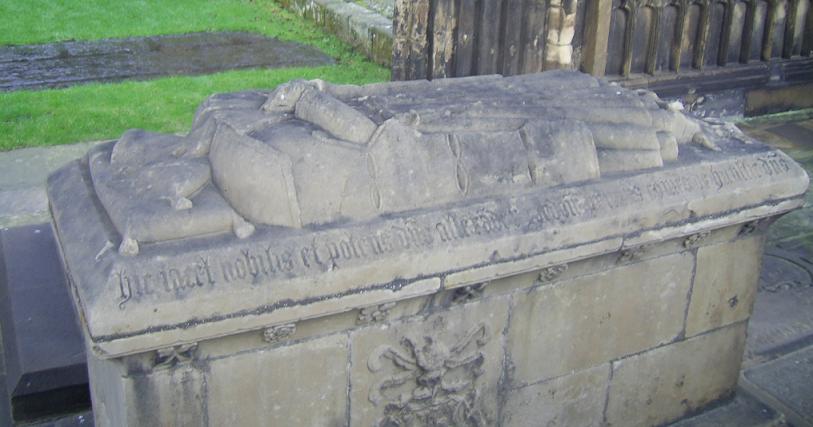
The wall tomb of John of Winchester in the south choir chapel shows him in mass vestments on a chest with an arcaded front, under an ogee arch. Traces of the angels that once surrounded him remain on the underside of the canopy. The same south choir chapel holds the tomb chest and effigy of Alexander Gordon, first earl of Huntly, who died in 1470. The south choir aisle holds the armoured effigy of William de la Hay, lord of Lochloy, who died in 1422.
Several memorials were made for inset brasses. None of the brasses survive, though a rubbing of one thought to have come from the cathedral was published in 1906. George Gordon, first duke of Gordon, and his wife Lady Elizabeth Howard are also buried here. The collection of loose carved stone is among the finest in Scotland: about 480 pieces, including vault bosses, corbels, capitals, monuments, effigies, and a large amount of rose-window tracery.
After years in store, the collection was returned to the cathedral in April 2016 and became a major part of the interpretation. Mary Márkus catalogued the stones by date, style, and function. New work examined how the rose tracery was constructed, analysed pigment on a bishop’s effigy, studied heraldry to identify families, and looked at the geological source of the stone. The main displays are in the north and south towers.
The Bishop’s House holds the rest in publicly accessible storage. The ground floors give an overview. An interactive catalogue includes views of the upper displays and a panorama from the top of the tower. Three upper rooms take the themes of animals, faces, mystical beasts, trees, and foliage.
Three more explain the building of the church, the mason’s work, and the job of each kind of stone. A segment of the rose window is shown with fragments of medieval window glass from the cathedral, on loan from the Moray Society. Coloured light projected onto the bishop’s effigy, made in 2016 with researchers at Napier, also called Edinburgh Napier, recreates the richness indicated by the pigment. One account calls that effigy a work of the fourteenth century.
Another says the lighting lets a visitor see the carving as it would have been seen in the thirteenth century, and thinks the effigy may be Archibald, bishop of Moray from 1253 to 1298. The paint was sampled and examined by X-ray fluorescence and by ultraviolet photography. The 2015 assessment separates a damaged thirteenth-century bishop’s effigy found on the west side of the chapter house from Archibald’s effigy, recovered from the presbytery tomb in the 1930s and still showing paint. The graveyard stones include emblems of death and the trades of Elgin.
The monument of John Geddes and Isobel McKean shows a glove with a flared cuff and a pair of shears, the tools of a glover. Against the south choir aisle stands the gravestone of the Anderson family, called the tallest in Scotland, at 5 metres. The site is important as a bat roost, and the grassland of the grounds is otherwise of little wildlife value. Weddings are held here.
Carol concerts have been held since 2007, attended by about a thousand people and led by several ministers. There are Easter services, and smaller services by local congregations. People also come to look for ancestors among the stones. The towers lost their spires.
The nave walls are now low or at foundation level, except one stretch of the south wall near its original height, whose fifteenth-century windows may replace thirteenth-century openings after the attack of 1390. Nothing of the elevated nave remains, though its line can be read in the scars on the east walls of the western towers. Nothing of the crossing remains after 1711. Conservation of the wall heads is still in progress, with scaffolding and fencing on the site.
Sources
- Elgin Cathedral — Wikipedia
- Alexander Bur — Wikipedia
- Alexander II of Scotland — Wikipedia
- Alexander Stewart, Earl of Buchan — Wikipedia
- Andreas de Moravia — Wikipedia
- Bricius de Douglas — Wikipedia
- Patrick Hepburn (bishop) — Wikipedia
- John Slezer — Wikipedia
- Oliver Cromwell — Wikipedia
- Elgin Cathedral — Historic Environment Scotland
- Plan your visit: Elgin Cathedral — Historic Environment Scotland
- Elgin Cathedral Statement of Significance — Historic Environment Scotland
- Elgin Cathedral designation — Historic Environment Scotland
- Elgin Cathedral building record — Aberdeenshire Council Archaeology Service
- Case Study 21: Elgin Cathedral Redisplay Project — Scottish Archaeological Research Framework
- Discoveries in Scotland unearthed with the help of science — Historic Environment Scotland
- Elgin Cathedral from Newmill Road.jpg — Wikimedia Commons
- Alexander Gordon.JPG — Wikimedia Commons
- Aisle against Quire.jpg — Wikimedia Commons
- Cathedral 3.jpg — Wikimedia Commons
- Cathedral 2.svg — Wikimedia Commons
- Cathedral churches of Moray.png — Wikimedia Commons
- Cathedral floor plan 1230.jpg — Wikimedia Commons
- Cathedral floor plan 1224 to1270 edited-1.jpg — Wikimedia Commons
- 2008 Elgin (3998767275).jpg — Wikimedia Commons
- 2008 Elgin (3999531894).jpg — Wikimedia Commons