
Highland, United Kingdom · United Kingdom
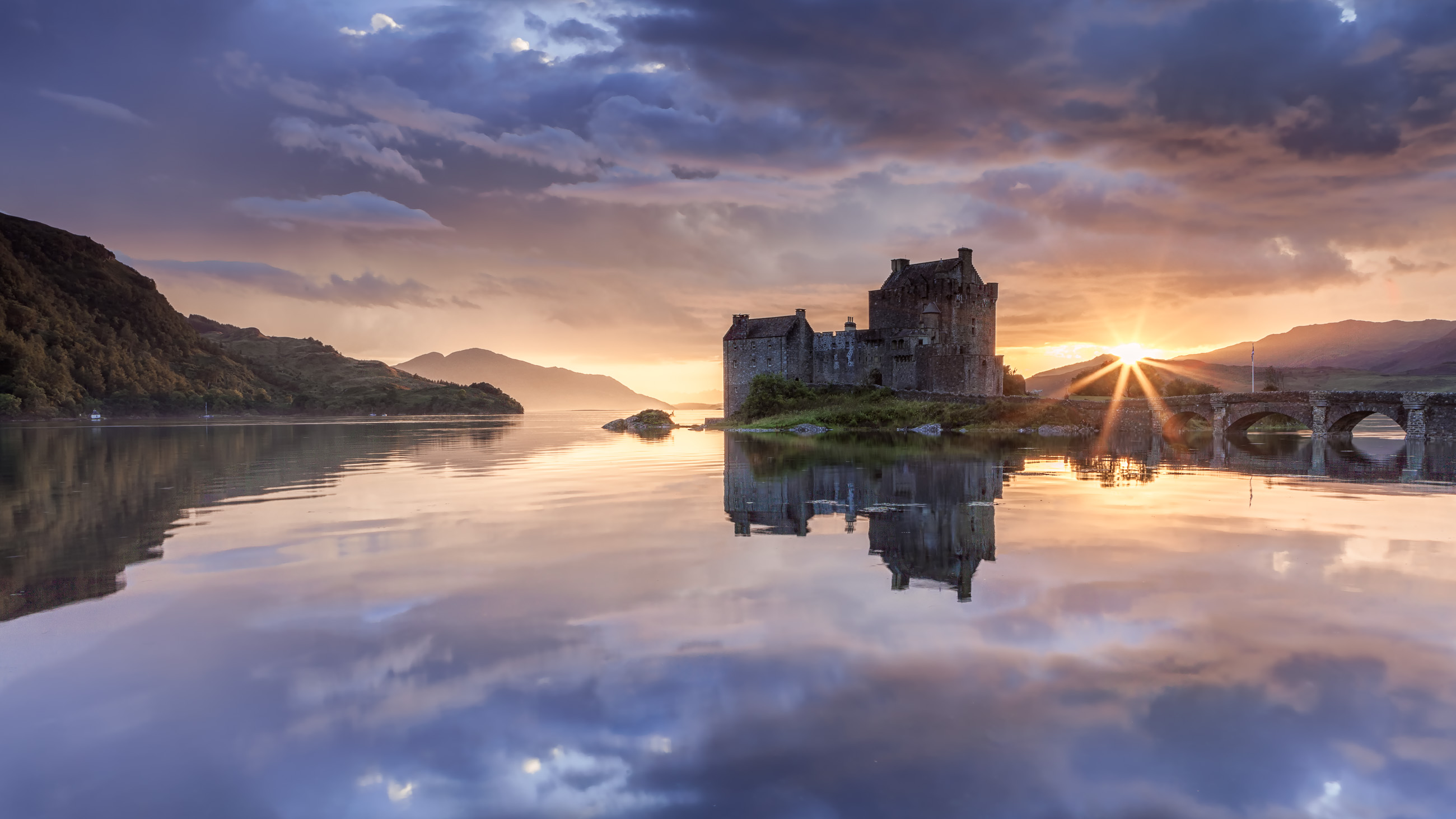
- Eilean Donan Castle stands on a tidal island at the meeting of Loch Duich, Loch Long and Loch Alsh, near Dornie, and takes its name from Donnán of Eigg.
- A curtain-walled castle of the thirteenth century later passed through Mackenzie and Macrae hands, and it was blown up in 1719 after Spanish soldiers occupied it for James Francis Edward Stuart.
- Lieutenant-Colonel John MacRae-Gilstrap rebuilt the ruin with George Mackie Watson between the 1910s and 1932, and the castle opened to the public in 1955.
- Excavation since 2007 has found a red-deer-antler gravoir, crucibles used for copper, silver and gold, and the debris of a smithy and of shipwrights.
- The rebuilt castle is listed in Category A, and the buried remains on the rest of the island were scheduled in 1998.
Visiting
Admission tickets can only be purchased on site on the day of the visit, and there is no advance online ticket. From 1 February to 28 March 2026 the castle is open from 10.00am to 4.00pm, with last admission at 3.00pm. From 29 March to 30 April 2026 it is open from 10.00am to 6.00pm, with last admission at 5.00pm. From 1 May to 31 May 2026 it is open from 9.30am to 6.00pm, with last admission at 5.00pm.
From 1 June to 31 August 2026 it is open from 9.00am to 6.00pm, with last admission at 5.00pm. From 1 to 30 September 2026 it is open from 9.30am to 6.00pm, with last admission at 5.00pm. From 1 to 24 October 2026 it is open from 10.00am to 6.00pm, with last admission at 5.00pm. From 25 October to 22 December 2026 it is open from 10.00am to 4.00pm, with last admission at 3.00pm.
The castle is closed on 1, 7, 8 and 15 November, on 4 December, for the whole of January, and on 14 February 2027. An adult ticket is £13, a concession for a visitor aged 60 or over is £12, a child over 5 is £6.50, and a child under 5 is free. A family ticket for two adults and three children aged 5 to 15 is £38. Rucksacks and large bags are not allowed inside the castle, and free security lockers stand beside the visitor centre.
The visitor centre is currently open from 10.00am to 3.00pm, the gift shop from 10.00am to 4.00pm, and the coffee shop from 10.00am to 3.00pm, while the food hall and the Heilan Scran takeaway are currently closed. Dogs are allowed to enter the island, but they are not allowed inside the castle. Registered disabled visitors are offered free admission onto the island, and a free virtual tour can be requested in the visitor centre. Wheelchair users are not allowed to enter the castle interior because of uneven steps and narrow stairways, while the visitor centre doors are wider than 80 centimetres.
History
Eilean Donan Castle stands on a tidal island where Loch Duich, Loch Long and Loch Alsh meet, about a kilometre from the village of Dornie. The name means the island of Donnán. It remembers Donnán of Eigg, whose death is placed on 17 April 617, in 616, and, in the castle’s own history, against an arrival around 580 and a cell in the late seventh century. No trace of a church was found on a visit in 1966, though vitrified stone and a shell heap have been read as an earlier fort.
A curtain wall enclosed much of the island in the thirteenth century, under Alexander II, or in a wider twelfth- or thirteenth-century range that also allows Alexander III or an earl of Ross. Clan histories bring the Mackenzies and their Macrae bodyguard here soon after the Treaty of Perth in 1266. A review of the documents instead keeps the Mackenzies out until the later fifteenth century and treats the castle as a seat of the earls of Ross. In 1331 fifty men were executed and their heads set on the walls before a visit by Thomas Randolph, Earl of Moray.
The great tower, probably of the fourteenth century, measures either 16.5 by 12.4 metres with walls about 3 metres thick, or 57 by 43 feet with walls 10 feet thick. The outer circuit was later reduced, dated to the end of the fourteenth century, to the later fourteenth or early fifteenth, and to a later fifteenth-century contraction with a lime kiln. Timothy Pont remembered seven towers. Fieldwork has defined four.
Hector Roy Mackenzie of Gairloch held the castle through his nephew John’s minority and gave it up in 1511. The same years are also told as a siege, as a garrison lured out in 1503 or 1504, and as a Great Seal charter of 1509. In 1539 Donald Gorm Macdonald of Sleat was mortally wounded at the postern. A hornwork and a seven-sided entrance, later called a water cistern, were added in the sixteenth century.
Farquhar Macrae was born in the castle in 1580, became constable and minister of Kintail in 1618, and was the last constable to live there until the modern rebuilding. His removal is dated to the 1640s, to 1650 and to 1651. In 1715 Macraes are said to have danced on the roof before Sheriffmuir, in a rising for James Francis Edward Stuart. In May 1719 Spanish soldiers occupied the castle.
Three frigates bombarded it, and the magazine of 343 barrels of powder destroyed what remained. The garrison is given as forty-six Spaniards, as thirty-nine Spaniards with a handful of others, and as part of a force of three hundred.
Lieutenant-Colonel John MacRae-Gilstrap bought the ruin in 1911, in 1912, or across 1911 to 1913, and rebuilt it with the architect George Mackie Watson and the carpenter Farquhar Macrae. Completion, the bridge and a formal opening fall in July 1932, on the 22nd. The castle opened to the public in 1955. It is a twentieth-century interpretation on a medieval footprint, not a survival of the old silhouette.
Christopher Lee played Kato when the castle stood in for a film fortress in 1987. He was not a resident.
Excavation since 2007 has recovered curtains, towers, a smithy, shipwrights’ roves, crucibles for copper, silver and gold, and an antler gravoir dated both to the thirteenth century and to the fourteenth. The assemblage was acquired for the national collections in 2025. The standing building is listed in Category A, dated 24 March 1971 and 25 March 1971. The island remains around it were scheduled in 1998, excluding the rebuilt castle itself.
Images




Detailed History
Eilean Donan Castle stands on a small tidal island where three sea lochs meet in the western Highlands: Loch Duich, Loch Long and Loch Alsh. The island lies about one kilometre from the village of Dornie, in the parish of Kintail, within the Lochalsh district of what is now the Highland council area. Its highest ground rises only about 3 metres, or 10 feet. At full tide the rock was once cut off from the mainland.
A footbridge of the early twentieth century, later an arched bridge, now joins the island to the shore. In 2001 the island had a recorded population of one person. At the census of 2011 it had no usual residents. The island sits inside the Kintail National Scenic Area, one of forty such areas in Scotland.
The name Eilean Donan, in Scottish Gaelic Eilean Donnain, means the island of Donnán. It is given for Donnán of Eigg, a Gaelic priest, likely from Ireland, who tried to bring Christianity to the Picts of northwestern Scotland. His life places his death on 17 April 617, and he is the patron of Eigg, where he was killed. The Martyrology of Donegal, compiled by Michael O'Clery in the seventeenth century, calls him Donnan of Ega, an abbot, and says that sea robbers came to the island while he was celebrating Mass.
He asked them not to kill him until the Mass was said. They waited, and he was afterwards beheaded with fifty-two of his monks. That account dates the killing to the year 616. A Hiberno-Latin account in the Book of Leinster tells a different story.
A rich woman had grazed her flocks on Eigg before Donnán came. Out of ill feeling she persuaded bandits to kill him and his community. The bandits found them chanting psalms in the oratory and could not kill them there. Donnán led his people into the refectory, saying that they could not die where they had done their all to please God, but that where they had served the body they might pay the price of the body.
They were killed in the refectory on the eve of Easter, and fifty-four others died with him. Another tradition says that a pagan Pictish queen had him and one hundred and fifty others burnt. He is thought to be buried at Kildonan on the Isle of Arran. His feast day is 17 April.
At least eleven Scottish churches bear his name, among them places called Kildonan, Kildonnan and Kildonnen from Arran and Sutherland to Skye, South Uist, Little Loch Broom and Lewis, and a chapel at Kishorn. The castle history gives him as a sixth-century Irish saint and bishop who came to Scotland around the year 580, and it places a small cell or community on the island in the late seventh century. The island account allows an early Christian cell in the sixth or seventh century, dedicated to the man martyred on Eigg in April 617, and says that no Christian building survives. A castle chronology places the name in the sixth or seventh century through use of the island as a chapel.
A visit on 29 September 1966 found no local knowledge of a church and no trace of one. The figure carved on a later hair tool has even been read as possibly Saint Donan himself.
Dornie, in Gaelic An Dòrnaidh, is the small former fishing village beside that meeting of the lochs. The village runs along the water, with houses, one tiny shop, a hotel and two bars. Before a bridge was built, the road to Skye passed through the centre of the village and crossed Loch Long by a short ferry. Among bagpipers the strathspey Dornie Ferry is well known.
St Duthac's Catholic Church in the village dates from 1860 and was designed by Joseph A. Hansom. It is Gothic, with a stone reredos of polished granite shafts and a demi-octagonal stone pulpit, an unusual feature in a Scottish church. The castle on the nearby island became the famous sight of this shore.
Fragments of vitrified stone, stone that has been heated until it fuses, have been found on the island, and they are read as a sign of an Iron Age or early medieval fortification. In 1912 a wall of considerable size was still visible on the landward side, and part of a later castle wall was said to stand over a shell heap. A visit on 29 September 1966 found only some heaped stone close by the water cistern, and treated the castle as a thirteenth-century keep, formerly ruined and then restored, possibly on the site of a vitrified fort. A further visit on 19 June 1974 traced a straight length of collapsed walling some 55 metres long close to the shoreline on the north-west side of the bridge.
Loose pieces of vitrified material lay among the debris. That stretch may be relatively modern, yet the same visit left little doubt that a vitrified structure had once occupied the island. The scheduling of the island remains treats reports of vitrified material and shell middens as pointers toward a prehistoric settlement, and it compares the later castle with Eilean Tioram in Moidart.
In the earlier thirteenth century, during the reign of Alexander II, who ruled from 1214 to 1249, a large curtain wall was built around much of the island. The castle history places the first fortified structure in the early thirteenth century, as a defence of Kintail against Norse raids, settlement and control of the north and the western isles between about 800 and 1266. A castle chronology widens the first castle to the twelfth or thirteenth century, and allows it to Alexander II, to Alexander III, or to Farquhar II, Earl of Ross. A monument summary likewise thinks of a build in the twelfth or thirteenth century, and a period label even reaches back, with a question, toward 1101.
The ground enclosed above the high-tide line is taken to have been about 3,000 square metres. Scant remains of the wall can still be traced around the northern end. The eastern and southern lengths are largely hidden by later work. At the northern point the foundations of a large tower survive, about 12 by 13 metres.
Further towers are suggested at the north-east and south-west corners. Boats could be drawn up at a sea-gate in the north-west curtain, where there was a small beach, and another beach to the south-west may have been a second landing. A narrow passage between two walls seems to have formed the entrance from the loch on the west, once perhaps a steep stair and later only a slope of stones.
The island then stood at the boundary between the Norse-Celtic Lordship of the Isles and the Earldom of Ross, and the rock was a strong point against Norse expeditions. A founding legend says that the son of a Matheson chief gained the power to speak with birds and, after adventures overseas, won the respect of Alexander II, who asked him to build the castle. From the mid-thirteenth century the same coast is also described as part of the separate sea kingdom of the Lord of the Isles, where power was counted in men and in galleys, or birlinns, and the island offered a perfect defensive seat. A review of the written evidence supports a castle here in the thirteenth century, holds that the Mackenzies, the Clann Coinnich, are not supported at the site before the later fifteenth century, and treats the castle as developed and held by the earls of Ross.
The medieval earldom of Ross stretched from the firths of Cromarty and Beauly in the east to the lordship of Skye in the west. From the early thirteenth century until 1475 the island is described as the symbolic and administrative centre of the lordship of Kintail within that earldom. From here the earls pushed west toward Man and the Isles, in competition with the MacDonald kings of Argyll and the Godredsson kings of the Isles. The rock also linked the earldom overland by Glen Affric and Glen Urquhart to the eastern seaboard.
It watched the north-south coastal passage, the Sound of Sleat, the haven of Loch Alsh, and the Inner Sound between Skye and the mainland.
Clan histories tell an earlier Mackenzie story, with little if any contemporary support. They make the Mackenzies of Kintail, at first vassals of William I, Earl of Ross, the holders of the castle, garrisoned by Macraes and Maclennans. After the Treaty of Perth in 1266, by which Magnus VI of Norway ceded the Hebrides to Scotland, Earl William is said to have demanded the castle back from his kinsman Kenneth Mackenzie so that he could expand into the isles. Kenneth refused.
The earl assaulted the island, and the Mackenzies and their allies drove him off. The same histories claim that Robert the Bruce sheltered here in the winter of 1306 to 1307. The castle is otherwise kept out of the Wars of Scottish Independence.
In 1331 Thomas Randolph, Earl of Moray and Warden of Scotland, sent an officer ahead to warn of his visit. Fifty wrongdoers, called misdoers in one chronology, were rounded up and executed, and their heads were displayed on the walls for his approval. By the middle of the fourteenth century the Mackenzie histories place the kindred on the losing side against the earls of Ross. In 1342 William III, Earl of Ross, granted Kintail to Raghnall Mac Ruaidhrí.
With the help of Leod Macgilleandrais the earl is said to have seized Kenneth Mackenzie, third of Kintail, and to have had him executed at Inverness in 1346. Through that period Duncan Macaulay is said to have held the castle for the Mackenzies against the earl and his allies. Kenneth's young son Murdo is said to have escaped the earl's attempts to kill him. On the return of David II from exile, a charter of 1362 is alleged to have confirmed Murdo in Kintail and in the castle.
No trace of that charter survives. A castle chronology places the coming of the Macraes to Kintail after 1362. Another account puts their settlement as a body in the earlier fourteenth century, migrating from the Beauly Firth, gaining the trust of the Mackenzie lairds through kinship and an advantageous marriage, and serving as the chief's bodyguard. They acquired the name Mackenzie's shirt of mail.
A tower house or keep was built against the curtain at the high point of the island, probably in the fourteenth century. One older description puts the keep at the north-east angle, its north and east walls set on the older wall, and dates it probably to the fourteenth century. The tower measured 16.5 by 12.4 metres, that is 54 feet 2 inches by 40 feet 8 inches, with walls 3 metres, or 9 feet 10 inches, thick. An older measured plan gives the keep as 57 feet by 43 feet, with walls 10 feet thick, and the foundations of that size were said to exist all round, with fragments of the north and south walls still standing high.
The official account of the 1719 bombardment says that the walls were in some places up to 14 feet thick. The vaulted ground floor was originally split in two, with a stair in the north wall rising to the first-floor hall. Above that there were probably two further storeys, including a garret. A drawing of 1714 shows crowstep gables, a wall-walk, and bartizans at the corners.
At an unknown time, probably in the later fourteenth century or the early fifteenth, the outer wall was given up for a smaller enclosure about 25 metres square, entered from the east. A smaller circuit would have been easier to defend, though the reason is not certain. The castle history places the reduction around the end of the fourteenth century and says that the castle then covered about a fifth of its original area, probably because fewer men were needed, or available, to hold it. The main keep remained on the highest point.
Excavation has also tied a contraction to the later fifteenth century, when the outer ward walls were reduced and a lime kiln was built to make slaked lime for mortar. After the kiln went out of use, the rubbish included high-status food: domestic mammals and a range of fresh seafood, with evidence for the making of skins, for continental pottery used with wine, and for decorative mail. A smithy of that later phase forged and welded large pieces, probably blades, and is read as a sign of hereditary smiths on the island. Timothy Pont, who lived from about 1565 to 1614, described the castle from what was already folk memory by about 1580.
He wrote of a strong and fair dungeon, meaning a donjon or keep, upon a rock, with another tower compassed by a fair barmkin wall, with orchards and trees, all within an island of the length of two pairs of archery butts, almost round. It was said of old that the castle had consisted of seven towers. That memory of seven towers is one reason for thinking the outer ward had already contracted by his time. Fieldwork has defined four of the lost towers, including the north-west tower and two interval towers, together with the west and north curtains and timber buildings inside them.
James I, set on pacifying the Highlands, went to Inverness in 1427 and invited the principal chiefs to meet him. Among them, the clan histories say, was the young Alexander Mackenzie, called in that account the sixth Earl of Kintail. James arrested the chiefs on arrival. Several were executed or imprisoned.
Alexander, because of his youth, was sent to school at Perth. His uncles tried to seize Kintail, but the constable Duncan Macaulay held the castle for him. Fionnla Dubh mac Gillechriosd, treated by clan historians as the founder of the Macraes in Kintail, was sent to bring the young laird home. During his lairdship Alexander is said to have supported the Crown against the MacDonald Lords of the Isles and to have been rewarded with another charter of Kintail in 1463.
He died about 1488 at a great age. He was succeeded by Kenneth Mackenzie, seventh of Kintail, who won the Battle of Blar Na Pairce against the MacDonalds. Kenneth died a few years later. His eldest son followed him, and on that son's death in 1497 the second son, John of Killin, still a minor, was the heir.
The earldom of Seaforth, a later Mackenzie title, was created only in 1623, for Colin Mackenzie of Kintail.
Hector Roy Mackenzie of Gairloch, who died in 1528, was the son of Alexander Mackenzie, chief of the clan, by his second wife Margaret Macdonald, daughter of Roderick Macdonald of Clanranald, third of Moidart. When Alexander died in 1488, Hector's half-brother Kenneth succeeded. Kenneth died in 1491 and was followed by his son Kenneth Og, with Hector as tutor. Kenneth Og is thought to have died in 1497, and the succession became uncertain.
The elder Kenneth had another son, John, by Agnes Fraser, daughter of Lord Lovat, but the union had been irregular and John was widely regarded as illegitimate. Hector was made John's tutor, and he had higher ambitions. He kept possession of Eilean Donan until an order of the Privy Council compelled him to give it up to John in 1511. From 1501 to 1508 he collected the rents of Kintail without accounting for them.
In 1509 he accounted for twelve months, and for the two years after that he retained the rents again, while he seems to have held the stronghold without disturbance. No record has been found of any answer he made to the summons, if he appeared at all. The likely reading is that he held the castle in order to force his nephew to settle their joint rights in Kintail, not in order to keep John out for good.
That dispute sits beside an earlier reward and a bloody inheritance in Gairloch. When a faction of the nobility took arms against James III, Alexander of Kintail sent his sons Kenneth and Hector with a retinue of 500 to the royal standard. Kenneth, hearing at Perth that his father was dead, went home at the request of the Earl of Huntly, and Hector Roy led the clan to the Battle of Sauchieburn, near Stirling, in 1488. The royal forces were defeated and the king was killed.
Hector narrowly escaped, returned to Ross-shire, took Redcastle from Rose of Kilravock, who held it for the rebels, and put in a garrison. He then joined Huntly and the northern clans who were rising to avenge the king, until the young James IV, who had been among the conspirators, ordered the northern chiefs to lay down their arms. A manuscript history of the Gairloch family says that James received him with favour and, to reward his fidelity and bind him for the future, gave him the barony of Gairloch by knight-service, and also Brahan, Moy, and Glassletter of Kintail, a royal forest made part of that barony. In Strathpeffer he had Castle Leod, later a seat of the Earl of Cromarty, with Achterneed and Kinellan.
He had the barony of Allan, now Allangrange, Fairburn Wester, both the Scatwells, Kinlochewe, and the half of Kintail, of which he had been left joint heir with his brother Kenneth.
James I had granted Gairloch in 1430 to Neil Macleod. Hector held crown charters to at least two-thirds of the lands, but he struggled to take them from the Macleods and their chieftain Allan MacRory. Allan had married, first, a daughter of Alexander Mackenzie and sister of Hector Roy, and had three sons by her, and second, a daughter of Roderick Macleod of Lewis, by whom he had a son also called Roderick. Two brothers of Macleod of Lewis are said to have resolved that no Mackenzie blood should run in the future head of the Gairloch Macleods, and to have set out to kill Allan's children by Hector's sister so that their own niece's son would succeed.
They crossed to the mainland, and they killed Allan and two of his three sons by that sister. Hector carried the bloodstained shirts of his nephews to the king at Edinburgh as evidence. The king granted him a commission of fire and sword against the murderers and a crown charter of Gairloch in his own favour dated 1494. The assassins were soon slain at a hollow between Port Henderson and South Erradale, nearly opposite the northern end of Raasay.
John De Vaux, Sheriff of Inverness, confirmed Hector's ownership of Gairloch by a deed of 10 December 1494. A royal precept of 5 March 1508 confirmed Brahan and Moy.
Hector declared John illegitimate and held the estates, and the clan submitted to him. In 1499 George, Earl of Huntly, then the king's lieutenant, warranted Duncan Mackintosh, eleventh of Mackintosh, John Grant of Freuchie and others, with three thousand men, to proceed against the Mackenzies as the king's rebels for the slaughter of Harold of Chisholm in Strathglass and for other raids in the lordship of Ardmeanach. The warrant does not appear to have been carried out. Hector and John eventually came to terms.
In the traditional account, they did so after John had surrounded Hector's house at Fairburn and set fire to it. The Earl of Cromartie told the dispute, and so did the Reverend John Macrae, who died in 1704, in the Ardintoul manuscript. A history of the western Highlands and Isles says that since the death of Kenneth Og in 1497, and during John's minority, Hector had commanded the clan, in name as guardian. Under him the Mackenzies feuded with the Munros and others, and Hector himself became obnoxious to the government.
His intentions toward the young laird were thought dubious. Once the young man's fears were raised, Hector was compelled by law to yield the estate and the command to the proper heir.
The castle's own story of those years is more violent on the island itself. Hector tried to usurp the Mackenzie lands and installed his own constable, Malcolm Mac Ian Charrich Macrae. Hector's lawless acts caused the Mackenzies to be branded rebels. In 1503 the Earl of Huntly offered to deliver the castle to the king and to hold it for him, and James IV supplied a ship.
A castle chronology places the same effort in 1503 and 1504, names Alexander, Earl of Huntly, and says he took two castles thought necessary for the daunting of the Isles, especially Strome and Eilean Donan, written then as Alanedonane. The castle was occupied, but the garrison was lured out and promptly dispatched, and the place was again a Mackenzie stronghold. John at last compelled his uncle to relinquish the claim, and Hector agreed to hand the castle over. The constable refused.
John's supporters laid siege. Hector persuaded Malcolm to give it up, after which Malcolm was dismissed. Christopher Macrae, Gillechriosd Mac Fionnlagh Mhic Rath, was appointed in his place around 1511. A chronology simply says that in 1511 the Macraes became constables.
John of Killin obtained a further charter of Kintail and of the castle in 1509. Hector's life dates a Great Seal charter of Kintail to John on 25 February 1508–9, the same year in which Hector received Brahan and Moy, and it dates a new Great Seal charter to Hector, of Gairloch, Glasletter and Coirre-nan-Cuilean, to 8 April 1513. Only two years after John raised the action, Hector was still in crown favour, and nephew and uncle are said to have lived on friendly terms afterwards.
In 1497 Hector Roy is said to have defeated the MacDonalds of Lochalsh at the first Battle of Drumchatt. Mackenzie chronicles claim a signal victory over the Munros at a second Battle of Drumchatt in 1501, under his leadership. In acknowledgment of the king's favour he gathered his western followers, joined his nephew John of Killin, and fought in command of the clan at the Battle of Flodden. Both narrowly escaped.
Most of their followers were killed. Hector died in 1528. On 8 September that year a grant is recorded to Sir John Dingwall, provost of Trinity College beside Edinburgh, of the ward of the lands of Gairloch which had pertained to the late Hector Mackenzie. The lands of Gairloch are still held by his descendants, more than five hundred years after they were acquired.
He had been betrothed to a daughter of the Laird of Grant, probably Sir Duncan, who flourished from 1434 to 1485, but she died before the marriage. He had a son by her, Hector Cam, blind in one eye, to whom he gave Achterneed and Castle Leod. Hector Cam married a daughter of Angus Roy Mackay, ninth of Strathnaver, ancestor of Lord Reay, and had two sons, Alexander Roy and Murdo. After the death of Grant's daughter, Hector Roy married his cousin Anne, daughter of Ranald MacRanald, known as Ranald Ban Macdonald of Moidart and Clanranald.
Anne had previously been married to the MacLeod chief William Dubh MacLeod of Harris and Dunvegan. Hector and Anne had four sons, John Glassich Mackenzie, his heir, Kenneth, John Tuach and Dougal Roy, and three daughters who married Bayne of Tulloch, John Aberach Mackay, and Hugh Bayne Fraser of Bunchrew, a natural son of Thomas, Lord Lovat, killed at Blar-na-Leine and ancestor of the Frasers of Reelick.
In 1539 Donald Gorm Macdonald of Sleat ravaged the lands of MacLeod of Dunvegan on Skye and then attacked the Mackenzie lands of Kinlochewe, where Miles, or Maolmure, brother of Christopher Macrae, was killed. After retaliatory raids, Donald Gorm learned that the castle was weakly held and launched a surprise attack. Only two people were inside: the recently appointed constable Iain Dubh Matheson and the warden. Duncan MacGillechriosd of the Macraes, son of the former constable, arrived as the attack began and killed several MacDonalds at the postern.
Arrows from the attackers killed Matheson and the warden, but Duncan, with his last arrow, hit Donald Gorm and wounded him fatally. The MacDonalds retreated. Duncan expected the constableship. He was thought too headstrong.
The local clergyman John MacMhurchaidh Dhuibh, John Murchison, was appointed as a compromise between Macrae and Maclennan interests. Furious, Duncan left Kintail for the service of Lord Lovat, though he later returned and settled at Inverinate. An aggrieved Maclennan is said to have shot Murchison in the buttocks with an arrow.
Duncan's son Christopher Macrae became constable in turn and held the castle through another feud, this time with the MacDonalds of Glengarry. Fighting broke out in 1580 and lasted almost twenty-five years. Around 1602 the castle was the base for a sea skirmish at the narrows of Kyle Rhea, led by Christopher's son Duncan. The MacDonalds were driven onto the Cailleach Rock at the eastern tip of Skye, and Angus, son of MacDonald of Glengarry, was killed.
Christopher was succeeded as constable by the Reverend Murdoch Murchison, minister of Kintail.
During the sixteenth century two buildings were added along the southern side of the reduced enclosure. A small house stood in the south-east angle, with a round stair tower on its north side giving access to the walk along the eastern curtain. Just inside the gate, it is likely to have been the constable's house, and it is the only roofed building on the survey of 1714. At the south-west corner an L-plan block was raised, possibly as late as the early seventeenth century.
Its southern part lies outside the inner curtain, and a northern wing, perhaps a little later, lies inside. In the later sixteenth century the castle was extended eastward into a bastion, or hornwork, to defend the entrance more strongly. The castle history places that hornwork in the sixteenth century and calls it a firing platform for the newly introduced cannon. A pair of walls enclosed a triangular court and linked the east wall to an irregular six-sided, or seven-sided, structure about 11.5 metres, or 37 feet 9 inches, across.
At its lowest level is a well about 5 metres, or 16 feet, across and about 10 metres, or 33 feet, deep. Older writers called this a water tower or cistern, a seven-sided tower about 20 feet across internally, set well below the courtyard. The walls that joined it to the castle were about 5 feet thick and probably once about 15 feet high, enclosing a long sloping court. A door on the east side, visible in nineteenth-century photographs, shows that the structure was built as the main entrance.
Attackers would have had to cross the water-filled interior on a removable bridge, climb a flight of steps into the triangular court, and pass the gate in the east curtain. The six-sided bastion may have been roofed as a gun platform. When the reservoir was dredged in 1893, two brass guns were recovered, called double hagbuts, each about a metre long with a bore of about 25 millimetres. A yett, an iron gate, was recovered with them.
It had probably hung in the east door of the bastion, and it is now displayed inside the castle. At some point in the seventeenth century this elaborate approach was abandoned, and a more convenient entrance was opened in the south wall of the hornwork.
Farquhar Macrae, son of Christopher Macrae, who died in 1615, and of Isabella Murchison, was born at the castle in 1580, where his father was constable. He was sent to Perth for five years and then finished his education at the University of Edinburgh. Kenneth Mackenzie, Lord of Kintail, met him there and invited him north to raise the spiritual and educational life of the people. Farquhar accepted, and so turned down the chance to succeed his teacher, James Reid, as regent, or professor.
He began as headmaster of Fortrose Grammar School, was admitted to holy orders, and gained a name as a sound, learned, eloquent and grave preacher. When ironworks began at Letterewe in Gairloch, English workers were brought north, and Sir George Hay, later Earl of Kinnoull, asked Farquhar to be vicar of Gairloch so that he could serve them in English. A Gaelic-speaking pastor served the rest of the parish. Farquhar also served the ground north of Loch Maree, then treated as part of Lochbroom.
He lived at Ardlair, near a boulder called the minister's stone, from which he preached in English and in Gaelic. On 1 December 1611 he married Christina Macculloch of Park. Their children included Alexander Macrae of Inverinate, born in 1612, whose son Duncan became a celebrated Gaelic poet; John, minister of Dingwall, born in 1614 and died in 1673; Donald, minister of Kintail, born in 1615; Miles, born in 1616 and killed at the Battle of Auldearn in 1645; Murdoch, who lived from 1617 to 1700; John, called Ian Breac, who died in 1696; Christopher, born in 1619; Thomas, born in 1620; Isabel, born in 1621, who married first Malcolm Macrae and then William Mackenzie; and Helen, born in 1624, who married John Bayne of Knockbain.
In 1610, after Mackenzie had acquired Lewis, he took Farquhar with him. Farquhar baptised all the islanders under forty, because Lewis had had no minister of the Gospel for forty years. So many came that he is said to have used a heather besom to sprinkle the crowds rather than baptise each person. He married many couples who had been living as husband and wife by cohabitation with habit and repute, and so legitimised their children, and he ended the custom of men putting away their wives upon the least discord.
In 1616 Sir George Hay left Letterewe for Edinburgh and urged Farquhar to seek a wider field in the south, with a pension and a choice of parishes of which Hay was patron, and he sought a promotion for him. Farquhar at first agreed. He was then persuaded, either by the young Colin Mackenzie, Lord of Kintail, or by his own uncle Roderick Macrae, tutor of Kintail, that the north needed him. It has been said that, had he gone south, his career in the Church would have been a very successful one.
To keep him, Mackenzie promised him the vicarage of Kintail when it fell vacant. It was then held by his elderly uncle, the Reverend Murdoch Murchison. When Murchison died in 1618, Farquhar became vicar of Kintail and, at the same time, constable of the castle, long in Macrae keeping. A chronology says that his life in the castle was lived in an opulent and flourishing condition, much given to hospitality and charity.
Colin Mackenzie of Kintail was created Earl of Seaforth in 1623. He lived mainly at the Chanonry of Ross in Fortrose, but he visited the castle regularly, and the constable had to entertain him, a retinue of between three hundred and five hundred retainers, and the neighbouring lairds. In 1635 George Mackenzie, second Earl of Seaforth, appointed Farquhar tutor to his six-year-old son Kenneth, who was then raised at the castle. In the civil wars of the middle of the seventeenth century the earl sided with Charles I.
In 1650, after the king's execution, the Parliament of Scotland ordered a garrison into the castle. Local people did not welcome it. When a party of thirty soldiers came out to demand provisions, a band of ten men who opposed them met the soldiers. An argument followed, and the garrison men were driven off with several casualties.
A chronology of the same years says that the commander, John Campbell, was killed in a dispute with local men. Soon afterwards the garrison left.
The next year the earl's brother, Simon Mackenzie of Lochslin, gathered troops for the royalist cause around the castle. For reasons that were not recorded, he fell out with Farquhar and demanded that he leave. Farquhar resisted at first. Despite the young Kenneth's interventions, Lochslin and George Mackenzie, later Earl of Cromartie, marched him out.
He was at last persuaded to go without violence, saying that he was too old to live in the cold castle. A chronology places that expulsion in the 1640s and gives his words as pleasure at being rid of the island, because it was a bad habitation for a man of his age and corpulence. His own life dates the ouster to 1650 and says that one Mackenzie brought it about, the minister being aged and the castle too cold for his health. His descendant's life dates the removal of the last resident constable to 1651 and counts that constable among his ancestors.
Farquhar was the last constable to live in the castle until the twentieth-century rebuilding, though he kept the ministry of Kintail until his death in 1662, at the age of eighty-two. He moved to Inchcruiter and stayed eleven years, helped by grandchildren who lived with him after his wife's death. He received all sorts of people there, being generous, charitable and free-hearted. He was buried in the Macrae burial ground at Clachan Duich, also called Kilduich, an old kirk in Kintail dedicated to Dubhthach.
After he left, the Earl of Balcarres and his wife occupied the castle for a time. They were in the Highlands in support of the Earl of Glencairn's royalist rising, though Balcarres later disagreed with Glencairn and departed. In June 1654 General George Monck, military governor in Scotland for Oliver Cromwell, marched through Kintail while suppressing that rising. His troops destroyed much property and took 360 of Farquhar's cattle, though only one man was killed.
A chronology says that in 1654 Monck took retribution by plundering and burning Kintail. Farquhar, like Monck in one sympathetic reading of the minister's politics, is also described as a royalist. After the Restoration he was advised to seek compensation for the cattle. His loyalty to Charles II was such that he would not hear of it.
He held the king's successful restoration to be compensation enough for any loss in the royalist cause. He lived to see that restoration in 1660. By the time he died he is said to have rebuilt the herd, which might even have passed its old size had it not fed so many grandchildren and their bairns. By 1650 the castle itself seems to have been poorly maintained.
It was at times garrisoned by Covenanters and by Cromwellian forces, and it played little part in the wider civil war.
In 1689 King James VII of the House of Stuart was declared to have forfeited the throne, and the crown was offered to William of Orange, in the Glorious Revolution. The revolution also established Presbyterianism in Scotland, while the Highlands generally remained Roman Catholic and loyal to the Stuarts. A series of Jacobite risings followed, and the government's military presence in the Highlands grew. The man in whose name those risings were fought was James Francis Edward Stuart, born on 10 June 1688 at St James's Palace and died on 1 January 1766 at the Palazzo Muti in Rome.
He was the only surviving son of James II and his second wife, Mary of Modena, both Catholics. He was Duke of Cornwall and Duke of Rothesay from birth, and he was created Prince of Wales in July 1688. His birth was unexpected. It came five years after his mother's tenth pregnancy, and none of those infants had lived more than a few days.
Because the new prince would be raised a Catholic, rumours spread that the child had been stillborn and that the baby shown as prince had been smuggled into the birth chamber in a warming pan. Some Protestants found it suspicious that those attending the birth were said to be Catholic, although the Protestant Lady Belasyse testified that she saw the child taken from the bed with the navel string hanging to its belly. Another rumour said that James II was not the father. To counter the talk, James published the testimonies of more than seventy witnesses, taken before the Privy Council on 22 October 1688.
The birth put the succession in doubt. James II's daughters Mary and Anne had been raised as Protestants, and many had expected Mary to succeed. In November 1688 an attempt to send the infant out of the country failed when Lord Dartmouth would not prepare a boat. On 9 December Mary of Modena disguised herself as a laundress and escaped with the child to France.
He was brought up at the Château de Saint-Germain-en-Laye, which Louis XIV had given to the exiled king. His father, dying in 1701, implored him never to give up the Catholic faith. On his father's death in September 1701 he claimed the thrones of England, Ireland and Scotland. Louis XIV proclaimed him king, despite having recognised William under the Treaty of Ryswick in 1697.
Spain, the Papal States and Modena also recognised him, and refused to recognise William, Mary or Anne. He was attainted for treason in London on 2 March 1702, and his titles were forfeited under English law. As a Catholic he had already been excluded from the succession by the Bill of Rights of 1689. He is known as the Old Pretender and as the Chevalier de St George.
A French invasion on his behalf in 1708 failed. Delayed by measles, he tried to land at the Firth of Forth on 23 March 1708. The fleet of Admiral Sir George Byng intercepted the ships, and bad weather helped to prevent a landing. In 1715 his supporters rose in Scotland and in Cornwall to put him on the throne as James III and VIII.
William Mackenzie, fifth Earl of Seaforth, joined that army and led out men of the Mackenzies and the Macraes. The Macraes mustered at Eilean Donan. They are said to have danced on the roof of the castle before setting out for the Battle of Sheriffmuir, where fifty-eight Macraes were among the Jacobite dead. An older parish memory says that the oldest inhabitant could recall Kintail men under arms dancing on the leaden roof as they set out for that battle.
The battle was indecisive, and the rising collapsed soon after. Sheriffmuir was fought on 13 November 1715. James himself reached Scotland only on 22 December, after Sheriffmuir and after the Battle of Preston, landing at Peterhead. He soon fell ill with fever in the winter.
In January 1716 he set up court at Scone Palace. Learning that government forces were approaching, he sailed from Montrose on 5 February 1716. The abandonment of his allies caused ill feeling in Scotland. Louis XIV had died on 1 September 1715, and the French government found James an embarrassment.
A castle chronology says that in 1715 the castle was garrisoned by government troops and then retaken by the Jacobites before Sheriffmuir. Both accounts can stand: a government garrison overcome, and a Macrae muster dancing on the roof before the march.
After 1715 James lived in papal territory, at Avignon from April 1716 to February 1717, at Pesaro in 1717, and at Urbino from July 1717 to November 1718. Pope Clement XI offered him the Palazzo Muti, or Palazzo del Re, in Rome. A life annuity of 12,000 Roman scudi, obtained through Cardinal Filippo Antonio Gualterio, let him keep a Jacobite court there. The next attempt on his behalf brought Spanish soldiers to this castle.
Following the failure of 1715, the Jacobites found support from Spain, then opposed to both Britain and France in the War of the Quadruple Alliance. The Duke of Ormonde led the main invasion fleet from Spain. An advance party of three hundred Spanish soldiers under George Keith, tenth Earl Marischal, arrived in Loch Duich in April 1719 and occupied the castle. The expected rising of Highlanders did not happen, and the main Spanish fleet never arrived.
James had gone to Spain in the hope of taking part. When the great expedition was abandoned he was forced back to Italy. He was not in the castle. On 3 September 1719, after the Highland landing had already failed, he married Maria Clementina Sobieska at Montefiascone, near Viterbo.
Their elder son, Charles Edward Stuart, born on 31 December 1720 and died on 31 January 1788, later led the rising of 1745, which began in August 1745 and failed in April 1746. That later rising did not return this castle to war.
At the beginning of May 1719 the Royal Navy sent ships into the loch. Early on Sunday 10 May, HMS Worcester, HMS Flamborough and HMS Enterprise anchored off the island and sent a boat ashore under a flag of truce. The Spanish soldiers fired on the boat. It was recalled, and all three frigates opened fire for an hour or more.
The next day the bombardment continued while a landing party was prepared. In the evening, under a heavy cannonade, a detachment went ashore in the ships' boats and captured the castle against little resistance. The Worcester's log listed, inside, an Irishman, a captain, a Spanish lieutenant, a serjeant, one Scottish rebel and thirty-nine Spanish soldiers, with 343 barrels of powder and 52 barrels of musket shot. The ships spent the next two days in the castle and landed twenty-seven barrels of gunpowder.
The official castle history says that forty-six Spanish soldiers held a magazine and were waiting for weapons and cannon from Spain, that the bombardment lasted three days and met with limited success because the walls were in places up to fourteen feet thick, and that Captain Herdman of the Enterprise then sent his men ashore, overwhelmed the defenders, and used the 343 barrels to blow up what the guns had left. A castle chronology agrees that Herdman went ashore to destroy the magazine, and that the explosion destroyed much of what remained. The naval logs are curiously worded. One reading is that they conceal a Macrae success in destroying the castle, already in naval hands, so that the English could not garrison it.
In any event the castle was demolished by exploding gunpowder. Another account says that British troops captured it and blew it up so that Jacobite supporters could not use it again. A parish statistical account says that it was demolished in 1719, after the Battle of Glen Shiel, by a warship. The remaining Spanish troops were defeated on 10 June 1719 at the Battle of Glen Shiel, also written Glenshiel and Glensheal.
Flamborough took the Spanish prisoners to Edinburgh. An architectural narrative, counting four years on from the survey of 1714, also speaks of complete demolition in what would be 1718, beside the naval date of 1719. By 1714 the castle was already largely derelict.
The only drawing made before the destruction was the work of Lewis Petit, about 1665 to 1720, a military engineer of the Board of Ordnance who came to Scotland in 1714 to survey Fort William and other defences. His plan and elevation, made while he was surveying fortifications for the government, show a dilapidated castle, largely roofless except for a small building by the entrance, the house at the south-east corner. The sheet is marked as surveyed and delivered by him. It has no date of its own, but there is a copy dated 1741.
By 1912 very little of the old castle was still standing. For the best part of two hundred years the ruins lay open to the weather. The island has been called Donnan, Donan, Eileandonan, Ellandonan, Ylen Donen, Island Dounan and Ellandolla, and the castle itself Castle Donnan.
The man who brought the walls back was Lieutenant-Colonel John MacRae-Gilstrap, born on 31 December 1861 and died in January 1937. He was a British army officer and a senior figure of the Macraes. He contested a rival claim to the chiefship, and he purchased and restored the castle. He was the second son of Duncan MacRae and Grace Stewart, born in the Punjab, where his father had served as a surgeon with the East India Company during the Indian Rebellion of 1857.
The family returned to Scotland. Duncan lived at Kames Castle on Bute and became deputy lieutenant of Buteshire. John's older brother Stuart, also born in India, later played international football for England in the 1880s. His grandfather, Major Colin MacRae, served in India with the 75th Highlanders.
His great-great-grandfather was John MacRae of Conchra, one of the Four Johns of Scotland killed fighting for the Jacobites at the Battle of Sheriffmuir in 1715.
In 1883 he joined the 1st Battalion of the Royal Highland Regiment, the Black Watch, as a lieutenant. The next year he was posted to Egypt for the Mahdist War and fought at the Battle of Tamai on 13 March 1884. In September he was placed in charge of a division of boats in the Nile expedition under General Earle. The expedition failed to relieve the siege of Khartoum and was attacked at Kirbekan in February 1885.
The Mahdists were defeated. He was mentioned in despatches and received the Egypt Medal and a bronze Khedive's Star. After the withdrawal from Sudan he went with the regiment to Malta and returned to Perth in 1889. He was promoted captain the following year.
In 1901 he was appointed to the Royal Company of Archers, the sovereign's ceremonial bodyguard in Scotland. On 4 March 1889, at St Peter's, Eaton Square, in London, he married Isabella Mary Gilstrap, second daughter of the late George Gilstrap of Newark. She was the niece and co-heiress of Sir William Gilstrap, a wealthy maltster and philanthropist. When Sir William died in 1896, the will required John to take the additional surname Gilstrap and to take a senior role in Gilstrap, Earp and Company, then the largest malt-producing business in Britain.
In 1897 they lived at 65 Northgate, Newark. In 1899 they bought Ballimore House at Otter Ferry, near Taynuilt in Argyll. They had five daughters and one son. Isabella lived until 1949.
He belonged to the Macraes of Conchra, descended from Alexander MacRae, who in 1677 received a wadset, a form of mortgage, of the lands of Conchra on Loch Long, 2 kilometres, or 1.2 miles, north of the castle. The Conchra line is one of several branches that trace themselves to Fionnla Dubh mac Gillechriosd. The other principal families are MacRae of Inverinate, MacRae of Torlysich, and the Clann Ian Charrich, who claim an even earlier ancestor. Each has claimed seniority.
The Reverend Alexander MacRae's history of the clan, first published in 1899, places Inverinate first, and the argument went on. No MacRae had ever been formally recognised as chief. In 1909 Sir Colin MacRae of Inverinate petitioned the Lord Lyon for the right to use a historical coat of arms as Chief of the Name of MacRae, saying that his family had long been unofficially acknowledged as chiefs. John had already lodged a caveat, asking to be told if anyone sought matriculation of arms as chief, and to be allowed to speak.
At the Lyon Court he was challenged because he was not the senior representative of his own family. He answered that he was there to protect himself, and that he would not acknowledge the Inverinate branch in any shape or form as chief of the clan or as his chief. He maintained that all the MacRae families were more or less equal, and that the Macraes were a clan which had no chief other than Seaforth. He denied Inverinate seniority even though he was accused of having conceded it before, and Sir Colin's counsel accused him of picking and choosing his evidence.
In April 1909 the Lord Lyon, James Balfour Paul, confined himself to heraldry. He found that Sir Colin had not proved a right to the chiefly arms, and he did not decide the chiefship itself. Sir Colin went on calling himself chief. John went on opposing him, including in a letter of 20 August 1927.
The castle he bought had, on his own life's account, probably first been built in the thirteenth century as a Mackenzie stronghold, with generations of Macraes as constables, and had been demolished by government forces after the Spanish surrender in 1719. By 1912 it was a few fragments of masonry on an island in Loch Duich. In 1912 he bought it from Sir Keith Fraser of Inverinate, and so became the first MacRae for many years to hold land in Kintail. The castle history says that he bought the island in 1911.
A chronology spreads the purchase across 1911 to 1913 and calls him the second son of the MacRae family of Conchra. At first he meant only to preserve the ruins. He employed a local stonemason, Farquhar MacRae, to clear the site. This Farquhar is not the seventeenth-century minister of the same name.
John was away during the First World War. Returning to Kintail in 1919, he found the stonemason preparing a full restoration. Farquhar claimed to have had a dream in which he saw, in the most vivid detail, exactly how the castle had originally looked. John agreed to go on, and he commissioned the Edinburgh architect George Mackie Watson to draw the plans.
The castle was fully rebuilt between 1920 and 1932. In 1932 the bridge to the mainland was finished, and a formal opening was held on 22 July. The cost was around £250,000, largely from the Gilstrap inheritance. Other accounts date the rebuilding to 1912–32, to 1919–1932, and to a twenty-year labour formally completed in July 1932.
The architect's own list of works enters restoration and consolidation at the castle under the year 1912. The listing enters the castle as rebuilt in 1912–32 in a later medieval manner, as a free interpretation of the former castle on the thirteenth-century site, incorporating some remains of the keep and the enclosing walls, and names George Mackie Watson of Edinburgh as architect.
George Mackie Watson, 1860 to 1948, was a Scottish architect who trained in the office of Robert Rowand Anderson and designed and reconstructed several churches. From 1912 to 1932 he was involved in the total rebuilding of this castle for John. He was born at 1 Teviot Row on the south side of Edinburgh, the fourth son of George Watson, a cabinetmaker, and Agnes Shaw. He was educated at George Watson's College.
In 1876 he was articled to Robert Rowand Anderson and worked on the McEwan Hall and the National Portrait Gallery in Edinburgh. He was promoted chief assistant in 1884. As assistant he also contributed to Holy Trinity Episcopal Church in Stirling in 1876, the Glasgow Central Station Hotel in 1877, Mount Stuart on Bute in 1879, Ballochmyle House at Mauchline in 1885, the restoration of Dunblane Cathedral in 1889, King's College Chapel at Aberdeen in 1890, and the restoration of Paisley Abbey in 1898. In 1892 he began teaching architecture at Anderson's Edinburgh School of Applied Art, while still doing some work for Rowand Anderson.
In 1899 he set up on his own at 4 Hope Street, just off Charlotte Square. From 1911 his office was at 50 Queen Street. His independent works include the restoration of Strachur church in Argyll in 1899, a feuing plan for the Hailes estate on the Lanark Road in Edinburgh in 1900, St Serf's Church at Goldenacre in 1901, an unsuccessful entry for the Peace Palace at The Hague in 1907, the restoration of Kirkwall Cathedral in 1908, St James's Church at Portobello and the remodelling of New Castle Lachlan and of Falkirk Old Parish Church in 1910, this castle from 1912, and Knockdown House at Toward in Argyll in 1919. He died on 7 May 1948 and was buried in Grange Cemetery in the south of Edinburgh.
The grave is on the south side of the main north path and is marked by a small stone. He was married to Jean Steedman Mirylees, who died in 1949. They lived first at 8 Scotland Street in the Second New Town and later at 17 East Claremont Street. The works list on the island names him with Farquar MacRae as carpenter-in-charge.
The castle history spells that clerk of works Farquar Macrae and says the two of them gave the next twenty years to the reconstruction. The twentieth-century Farquhar is also called the carpenter-in-chief. The medieval great tower formed the core of the 1920s campaign and still lies at the heart of the buildings.
The survey drawings by Lewis Petit were not found again until the restoration was almost finished. The rebuild therefore followed less accurate readings, including the late nineteenth-century plan of the ruins by MacGibbon and Ross. The new work followed the surviving ground plan, but the details differ from the original. John Gifford, setting the building against Petit's survey, noted a fussy elaboration of what was probably plain, and an omission of decoration where it had once existed, and he called the interior a rubbly Edwardian stage-set for life in the Middle Ages.
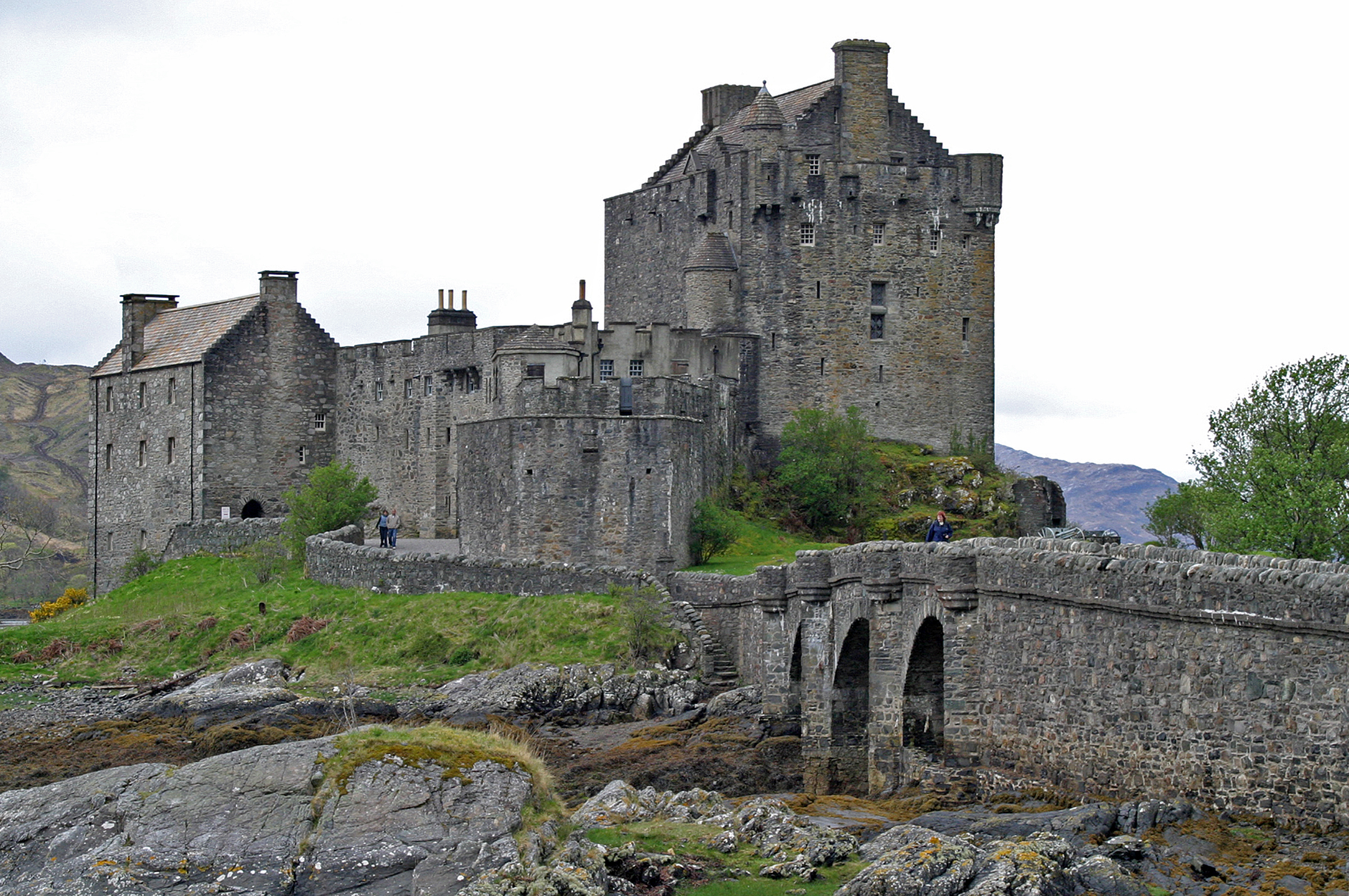
Another architectural guide calls the result a romantic reincarnation in the tradition of early twentieth-century castle revivals. The listing describes rubble walls with tooled dressings, a fanciful gatehouse and allied buildings of 1912 projecting into the courtyard, with a stair turret, a corbelled angle turret, a corbelled and arcaded watch house on the outer wall, and crude crenellation running onto the curtains. To the west is a two-storey block over a vaulted basement, of three bays on early footings, now with a crowstepped roof. The tall keep is rectangular, with a caphouse, a crenellated wall-walk and angle turrets.
A forestair leads to the barrel-vaulted billeting room and to the banqueting hall, spelled banquetting hall in that description, with a heavy oak ceiling and a large chimney-piece in a fifteenth-century manner. All the buildings are linked by battlements. The original seven-sided water cistern projects from the south-east angle. A causeway and a three-arched bridge, with rounded cutwaters and corbelled refuges for people on foot, join the castle to the mainland.
The castle is now entered from the south, through a modern portal with a portcullis. Above the door a Gaelic inscription reads, in translation, that as long as there is a Macrae inside there will never be a Fraser outside. It refers to a bond of kinship between the two clans, and to a similar inscription that once adorned the Fraser house at Beaufort Castle. Above that is the coat of arms of John MacRae-Gilstrap.
The courtyard has been lowered, exposing the bedrock around the tower. The buildings at the south-east reflect the older forms, including the round stair tower, but they are larger. To the south-west only the southern part of the old L-plan block was rebuilt, as a plain three-storey house. In place of the northern wing is an open platform looking over the loch.
A small tower occupies the north-west angle. The keep follows the original dimensions, but the once-divided ground floor is now a single tunnel-vaulted room, the Billeting Hall. Above it, the Banqueting Hall has an oak ceiling, coats of arms, and a fireplace in a fifteenth-century style. The main ceiling beams are of Douglas fir, shipped from British Columbia as a gift from the Macraes of Canada.
Small mural chambers in the thickness of the walls open from each hall. John also set up a war memorial to the Macrae men who died in the First World War. It carries lines from John McCrae's poem In Flanders Fields and is flanked by grey field guns of that war. The above-ground structures of that memorial, together with the slipway and the floodlights, and the terrace between the south-west wall and the sea, are excluded from the scheduled area, as is the present castle itself.
John MacRae-Gilstrap died in January 1937 at the castle and was buried at the Macrae cemetery at Clachan Duich, at the head of Loch Duich. A chronology records the death simply as 1937. His estates passed to his son, Captain Duncan MacRae, who lived from 1890 to 1966, and then to that son's son, John MacRae, who lived from 1925 to 1988. This younger John, grandson of the rebuilder, opened the castle to the public in 1955.
A chronology names Mr John MacRae, grandson of John MacRae-Gilstrap, as the man who opened it that year. In 2009 more than 314,000 people visited, and the castle was the third most visited castle in Scotland. In 1983 he established the Conchra Charitable Trust to care for the castle. The castle history and a shorter chronology also place the trust's formation in 1983, by the Macrae family, to maintain and restore the building.
A purpose-built visitor centre opened on the landward side of the bridge in 1998. His daughter, Baroness Miranda van Lynden, great-granddaughter of John MacRae-Gilstrap, is the present head of the Macraes of Conchra, and she has spoken as head trustee of the trust that owns the castle. The trust commissioned the modern excavations because surprisingly little was known of life here in the thirteenth and fourteenth centuries.
The castle has been used again and again as a film set, which is a twentieth-century afterlife rather than a medieval one. It appeared in Bonnie Prince Charlie in 1948 and in The Master of Ballantrae in 1953, in the opening episode of the 1976 series The New Avengers, and in the 1980 short film Black Angel, made to accompany screenings of The Empire Strikes Back. In 1984 the singer and composer Jesse Rae filmed the video for Over the Sea here. In 1986 Highlander used the castle as the home of Clan MacLeod, a film identity rather than the Mackenzie and Macrae history of the rock.
In 1987 it was the home of the antagonist Kato in Mio in the Land of Faraway. Kato was played by Christopher Lee. Christopher Lee, born Christopher Frank Carandini Lee on 27 May 1922 in Belgravia and died on 7 June 2015, was an English actor and singer. He was knighted for services to drama and charity in June 2009.
He was not a resident of this castle, and he was not the man who rebuilt it. His mother later married a banker who was an uncle of Ian Fleming, so Fleming, author of the James Bond novels, became his step-cousin. In 1999 the castle served as the Scottish headquarters of a secret service in The World Is Not Enough. In 1998 it was the backdrop to a dance in the film Kuch Kuch Hota Hai, and a Tamil song from Kandukondain Kandukondain was filmed here.
In 2007 it stood in for Fotheringhay Castle in Elizabeth: The Golden Age. It can also be seen as the groom's family home in Made of Honor. It is regularly described as one of the most photographed monuments in Scotland, and its image has been used on packaging for shortbread, whisky and other goods. That fame belongs to the rebuilt silhouette, not to the buried medieval plan.
Archaeological work since 2007, by Field Archaeology Specialists, has shown how much of the medieval castle still lies under the turf to the north of the rebuilt walls. A survey in March 2008 produced an outline plan of known medieval features and of the twentieth-century reconstruction. In September and October 2008 five trial trenches, numbered 3 to 7, were dug by hand to shape a conservation and research plan, and to answer particular questions. The north-west tower was cleared of vegetation and the rubble inside it was removed.
The deposits were not deep, which suggests that the area had been cleared before. The plan of the tower could then be fixed, and the inner faces recorded. Just south of that tower, excavation found the western curtain and showed that the ground had been truncated. Medieval occupation and an iron-smithing level, including a hearth still in place, were met, but a later episode of wall-chasing had cut the relationships between the deposits and the walls.
A trench on the northern curtain found a substantial rubble wall and medieval occupation, again disturbed by wall-chasing, and a twentieth-century midden of mortar and stone thought to come from the recycling of building stone in the 1920s and 1930s. The possible north-east tower proved probably medieval: a truncated wall, with a mass of rubble behind it that looked like the infill of a tower. A single trench on the south of the island found a massive curtain more than 5 metres wide, surviving to more than 1.3 metres in depth. No south-western tower was identified.
Any such tower may have been built as part of the curtain and so may not show as a separate plan. A later watching brief on a sewer-pipe trench exposed a length of substantial curtain foundation, perhaps associated with two areas of lime-mortar surface, and a spread of demolition that may mark a former building. The pipe was diverted to avoid the wall. Excavations in 2008 and 2009 confirmed the curtains and found that metalworking had taken place in the northern part of the castle.
The present castle is much smaller than the original fortification. The lost ground plan of the thirteenth-century castle included buildings in the north outer ward and a circuit of walls and towers.
Radiocarbon dates on the earliest archaeological deposits place them in the fourteenth century onwards. An early midden inside a timber building returned a range of about 1308 to 1420. People here were largely fed from the rural hinterland. Fourteenth-century food includes the ordinary farm animals, together with hunted meat: venison, ducks and other wild birds.
A wide range of seafood was eaten, and lead fishing weights and iron hooks were found. Oats and barley in the environmental evidence must have been brought in as provisions. Animal bone shows venison on the table and hunting dogs kept at the castle, with oats, beef and lamb as steady foods. Later bone assemblages show the skinning of cattle and of dogs, and those remains returned a date of about 1444 to 1625.
Personal objects include copper-alloy stick pins, a small ring brooch, decorative strap ends, coins, and knives with decorative handles.
The most striking object is an antler gravoir, a hair parter. It is 111.5 millimetres long, 15.2 millimetres wide and 7.4 millimetres thick, carved from the tine of a red deer, with a hooded figure holding a book. The archaeological case study dates it to the fourteenth century and places it in a small European group of high-status items that includes decorated knife handles. It is the only example known from medieval Scotland in that account, and one of very few from Britain.
Mark Hall compared it with the European series. The Parisian fashion would not have been lost on the owner. A later announcement, on 29 September 2025, of the acquisition of the assemblage for the national collections, calls the same tool a rare thirteenth-century object, one of only three examples from the United Kingdom and the first found in Scotland. Gravoirs are generally of ivory.
This one is a European type made in a local material. The fashion for parting the hair with such tools spread from Paris, or from France, across northern Europe in the thirteenth and fourteenth centuries. The figure might be an elite and learned woman, a reference to the owner, or a saint, or even Saint Donan, for whom the island is named. Dr Alice Blackwell, a senior curator of medieval archaeology and history, said that the object shows elite inhabitants engaging with continental fashions, and that the wider assemblage lets one imagine the full social range inside the walls, from hair styling to work in a smithy and simple toys for children.
Miranda van Lynden said that the trust commissioned the excavations to recover stories of the thirteenth and fourteenth centuries, and that she hoped the collection would introduce that history to new audiences.
More than sixty fragments of vitrified crucibles, mostly from a late medieval midden, show the working of copper, silver and gold. A burnt hazelnut shell with those fragments returned a date of about 1295 to 1397. The crucibles are small. Their rims and bases are hard to tell from late Iron Age and early historic forms, and comparable groups of this medieval date have not yet been identified.
Scientific analysis of the metal traces places copper, silver and gold working in the fourteenth century. A silver brooch found on the site in the nineteenth century is now lost. Recent work recovered copper-alloy pins, buckles, brooches and other dress fittings. The group is described as one of the most important collections of medieval metalworking in the United Kingdom, from buckles to swords made on the site.
It fills some eighty boxes at the collection centre in Granton. From the late fifteenth century this part of the island held an iron smithy. Nails, bolts and roves for building were made, with knives, keys and other household things. Some bolts may belong to the making or repair of boats.
Strips of unfinished roves, clench bolts and large spike nails are read as the work of shipwrights. A large grinding stone beside the smithy suggests that swords were sharpened, made or maintained here. Clumps of iron mail, some with decorative copper links, were found with medieval iron arrowheads, including armour-piercing heads or crossbow bolts. Hammerscale mapped across a floor, with the position of an anvil implied, and large smithing cakes, mark the working surface.
A burnt nutshell from that floor returned a date of about 1450 to 1640. Ironworking and sword-making appear to have been hereditary specialisms, and smiths held a particular place in medieval Gaelic society. The same craftworkers have been compared with those found at Finlaggan on Islay, the seat of the Lord of the Isles, and with the late medieval ironworking at Portmahomack. They sit in the background of a professional warrior caste and of the West Highland sculpture on their graves.
Play is as clear as work. A small buzz-bone, or snaring bone, an iron jaw harp, and four gaming pieces appear in the excavation case study. The longer museum account distinguishes two decorated bone gaming pieces found in the nineteenth century, for board games such as tables, related to draughts, or chess, from two further pieces found in the recent digs, each cut from a broken pot, plate, bowl or jug. Several small pig bones, each with a hole through the centre, were once read as toggles.
Identical objects were used, until recently, as toys: the bones were strung, the thong was twisted, and the release made a buzz. The buzz-bones here were probably made from kitchen waste for the children of the household. The castle was staffed all year, but the earls were part-time residents, moving among their houses. When the earl's family was in residence the household swelled, with larger gatherings, law, feasting and celebration.
Storytellers, smiths, poets, servants and law-givers all had a place. A full account of the excavations from 2009 to 2017 was published in 2023.
A watching brief in October and on 6, 7 and 8 November 2023, during two extensions to the visitor centre, one behind the building for a staff room and storage and one to the south for shop and kitchen storage, found bedrock under levelling deposits that contained late twentieth-century rubbish, probably from the construction of the visitor centre in the late 1990s. That landscaping shows the area had been stripped, and in places the bedrock levelled, when the centre was built. The monitoring was curtailed once it was clear that those footprints had little remaining potential. The brief did not touch the medieval deposits on the island.
The castle itself had already been transformed by the reconstruction, and much material was lost then, which is why the early plan was hard to read from documents alone. Very little written evidence survives beyond the clan histories, Pont, Petit, and the naval logs.
The standing castle was added to the list of buildings of special architectural or historic interest in the highest category, Category A, on 25 March 1971, and the same listing is also dated 24 March 1971. The list places it in the parish of Kintail. It calls the building a scheduled monument as well. The separate scheduling of the remains associated with the castle was added on 20 February 1998, and the supplementary information was last updated on 11 March 2021.
That scheduled area takes in the whole island and principally excludes the present castle. It also excludes the terrace between the south-west wall and the sea, and the above-ground memorial, slipway and floodlights. The area is irregular and measures about 120 metres from north to south by 80 metres at its widest. The scheduling calls the castle the main social and political focus of Kintail through the later Middle Ages, still habitable until 1719, when it was drawn into the abortive Jacobite rising.
A visitor access statement describes the castle as one of Scotland's scheduled monuments and says that, because of that protection, the trustees may not add banisters to the outside stairs or install elevators. The scheduling record and that visitor statement therefore do not draw the boundary in the same place. The statement also says that uneven steps, narrow stairways, corridors and changes of floor level make access very difficult for less able visitors, and nearly impossible for wheelchair users, and that free entry onto the island is offered to registered disabled visitors so that they can at least cross the bridge and see the exterior. Some of those exterior areas are gravel.
A touch-screen virtual tour, free on request in the visitor centre, shows rooms the public do not normally enter. The visitor centre was designed for level access. Its doors, including those of the gift shop and coffee shop, are wider than 80 centimetres. There are two accessible toilets, with twist locks, space for a sideways transfer, grab rails and alarm cords.
Dogs may come onto the island. They are not allowed inside the castle, because of the steep, narrow spiral stairs. Rucksacks and large bags are not permitted inside the castle. Visitors are asked to leave them in the car or in the free lockers beside the visitor centre.
Tickets are sold only on the site, on the day. There is no advance online ticket.
The published hours for 2026 run in bands. From 1 February to 28 March the castle is open from 10.00am to 4.00pm, with last admission at 3.00pm. From 29 March to 30 April it is open from 10.00am to 6.00pm, last admission 5.00pm. From 1 May to 31 May it opens at 9.30am and closes at 6.00pm, last admission 5.00pm.
From 1 June to 31 August it opens at 9.00am and closes at 6.00pm, last admission 5.00pm. From 1 to 30 September it opens at 9.30am and closes at 6.00pm, last admission 5.00pm. From 1 to 24 October it is open from 10.00am to 6.00pm, last admission 5.00pm. From 25 October to 22 December it is open from 10.00am to 4.00pm, with last admission at 3.00pm.
It is closed on 1, 7, 8 and 15 November, on 4 December, for the whole of January, and on 14 February 2027. An adult ticket is £13. A concession for a visitor aged 60 or over is £12. A child over 5 pays £6.50, and a child under 5 is free.
A family ticket for two adults and three children aged 5 to 15 is £38. At the time those prices were published, the visitor centre and the coffee shop were open from 10.00am to 3.00pm, the gift shop from 10.00am to 4.00pm, and the food hall and the Heilan Scran takeaway were closed.
What the excavations changed is the picture of the medieval island, not the silhouette that visitors photograph. Between the thirteenth and fifteenth centuries this was one of the largest castles in the region, with seven towers in memory and massive curtains in the ground. It was a place of lordship, metalworking, boat repair, hunting, music and games, staffed through the year and swollen when the earl came. It contracted, was neglected, was used as a Jacobite magazine, and was blown apart in 1719.
The castle that stands now is the twentieth-century interpretation raised by John MacRae-Gilstrap, George Mackie Watson and Farquhar Macrae the carpenter, on the footprint of that ruin, and opened again to the public in 1955.
Sources
- Eilean Donan Castle — Wikipedia
- Donnán of Eigg — Wikipedia
- Dornie — Wikipedia
- John MacRae-Gilstrap — Wikipedia
- Christopher Lee — Wikipedia
- Farquhar Macrae — Wikipedia
- George Mackie Watson — Wikipedia
- Hector Roy Mackenzie — Wikipedia
- James Francis Edward Stuart — Wikipedia
- History — Eilean Donan Castle
- Timeline — Eilean Donan Castle
- Opening Hours and Admission — Eilean Donan Castle
- Access Statement — Eilean Donan Castle
- Eilean Donan Castle, listed building — Historic Environment Scotland
- Eilean Donnan, remains associated with Castle Donnan — Historic Environment Scotland
- Eilean Donan Castle — Highland Historic Environment Record
- Case Study: Eilean Donan Castle — Scottish Archaeological Research Framework
- Evidence for medieval hair styling at Eilean Donan castle — National Museums Scotland
- Excavating medieval Eilean Donan — National Museums Scotland
- Eilean Donan — Historic Environment Scotland
- Eilean Donan at Dusk.jpg — Wikimedia Commons
- 00 103 0359 Kilchurn Castle - Schottland.jpg — Wikimedia Commons
- 00 0466 Eilean Donan Castle - Scotland.jpg — Wikimedia Commons
- 2012 Eilean Donan Castle.JPG — Wikimedia Commons
- 00 103 0360 Kilchurn Castle Loch Awe - Schottland.jpg — Wikimedia Commons
- 00 4360 Eilean Donan Castle - Scottish Highland.jpg — Wikimedia Commons
- 00 1364 Eilean Donan Castle - Scotland.jpg — Wikimedia Commons
- 2018 07 14 Schottland (37) - Kopie.jpg — Wikimedia Commons
- 2018 07 14 Schottland (35) Eilean Donan Castle - Kopie.jpg — Wikimedia Commons
- 2018 07 14 Schottland (36) - Kopie.jpg — Wikimedia Commons