Sacred place · Fortification
Durham Castle and Cathedral
World Heritage site in Durham, County Durham, England, UK

City of Durham, United Kingdom · United Kingdom
- Durham Castle and Cathedral share a defended peninsula in a bend of the River Wear, inscribed together in 1986, with Palace Green brought inside the boundary in 2008.
- The cathedral was begun on 11 August 1093 to house Cuthbert and Bede, and its nave vault is the earliest surviving pointed rib vault.
- William the Conqueror ordered the castle in 1072 as the palace of the prince-bishops, and from 1837 it has been the home of University College.
- The shrine of Cuthbert, Bede’s tomb in the Galilee, and the head of Oswald of Northumbria keep the Northumbrian church on this rock.
- Digging at St John’s College has traced occupation here to about 7,000 years ago, and work in 2025 and 2026 found original timbers in the Chapel of the Holy Cross.
Visiting
The cathedral is open from 8am to 6pm Monday to Saturday, with visitor hours from 9.30am to 4.30pm, and it is open from 8am to 5pm on Sunday, with visitor hours from 12.30pm to 3pm and also from 12pm to 4pm. There is no entry fee for the cathedral, and visitors are asked to donate £5 if they are able. A cathedral tour ticket is £8.50 with Gift Aid or £7.50 without for an adult, and under 18s are free when accompanied by someone aged 18 or over. The central tower climb is 325 steps, adult tickets are £11 with Gift Aid or £10 without, children aged 8 to 17 are free when accompanied by an adult, and children under 8 are not allowed to climb.
Castle tickets are for a guided tour of about 50 to 60 minutes, also given as about 45 to 50 minutes, at £7.50 for adults, £6 for ages 16 to 18 and for students from outside the university, and free for children under 16, for infants, and for the university’s own staff and students. Tours are not run every day and visitors are asked to book in advance, while selected days in July, August and September are self-guided rather than guided. Assistance dogs are allowed to enter on castle tours, and family pets are not allowed. Wheelchair users and pushchairs are not allowed through most of the castle, where the route has many uneven steps.
The visitor centre on Palace Green is open daily and free to enter.
History
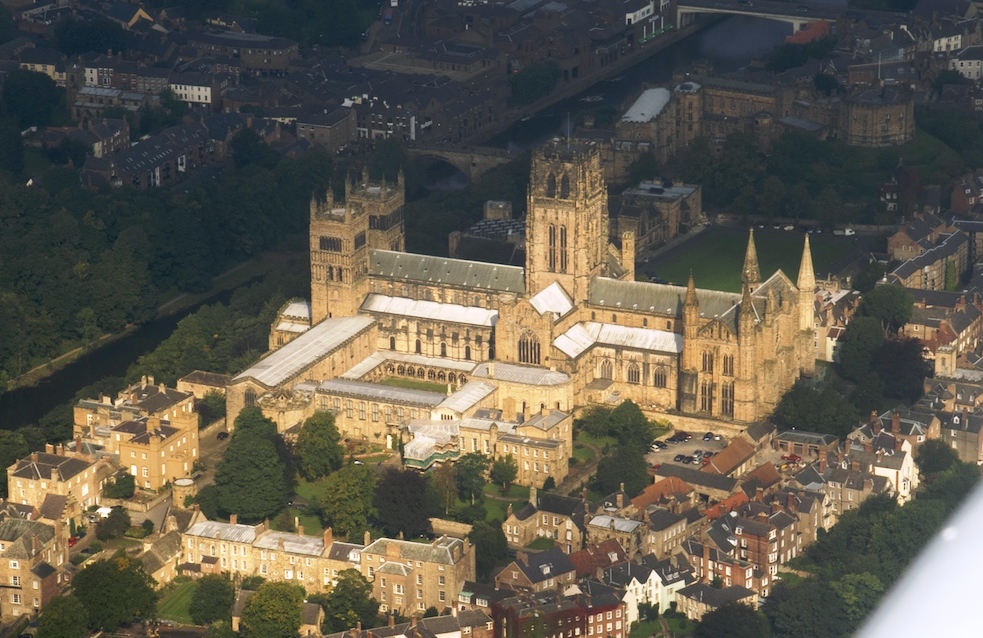
Durham Castle and Cathedral share a peninsula where the River Wear bends back on itself. Steep wooded banks defend three sides, and the castle holds the neck of the land. The cathedral stands inside that precinct, with Palace Green between them. The World Heritage Committee inscribed the pair in 1986.
A boundary change in 2008 added Palace Green and drew the castle and cathedral into one line of 8.79 hectares. The river banks and the full castle precinct still lie outside that line, and an extension is under review. The inscribed area follows the inner bailey and the cathedral close, and it takes in 83 listed buildings. The cathedral is listed at Grade I, with the designation dated 6 May 1952, and seventeen parts of the castle are listed at the same grade.
The church inherits Lindisfarne, which Oswald of Northumbria gave to Aidan. Cuthbert, bishop there from 685 until his death on 20 March 687, was carried off when the monks fled in 875. They settled at Chester-le-Street from 882 until 995. Aldhun brought the body to Durham in 995, a move told as a vision, as a wagon that would not go on, and as the legend of a dun cow.
A stone White Church was consecrated in 998.
William the Conqueror ordered the castle in 1072, six years after the Norman Conquest. Waltheof supervised the work until his execution in 1076. Bishop Walcher began the prince-bishops, who could raise troops, tax and mint coin, and rebels killed him in a four-day siege in May 1080. One account ends their virtual autonomy in 1603.
Another ends the temporal powers in an Act of 1836.
William de St-Calais replaced the married canons with monks in 1083. With Prior Turgot of Durham he laid the foundation stone on 11 August 1093, after the site had been dedicated on 29 July. The choir was ready by his death on 2 January 1096. The nave walls were finished by 1128 and the high vault by 1135, though the nave is also left unfinished until 1130.
The nave vault is the earliest surviving pointed rib vault, and the church is called both the largest and finest Norman building in England and the most perfect monument of that style. It is set beside Speyer, also spelled Spire, and Cluny as an experiment that looked ahead, without being treated as the first Gothic church. The castle chapel is dated 1075, shortly after 1080, and about 1080.
Ranulf Flambard carried the building on, translated Cuthbert in 1104, finished Framwellgate Bridge in 1120, and levelled Palace Green. Hugh de Puiset built the Galilee in 1175 after an eastern chapel failed in bad ground, and he built Elvet Bridge and the Norman gateway of the castle. In 1177 the king seized the castle after a quarrel with him.
Richard le Poore added the Chapel of the Nine Altars. Antony Bek built the castle’s great hall in the early 14th century. The hall is now 14 metres high and more than 30 metres long. Thomas Hatfield rebuilt the keep and added a minstrels’ gallery.
The shrine was destroyed in 1538, and the monastery was dissolved on 31 December 1540, when the last prior, Hugh Whitehead, became the first dean.
After the Battle of Dunbar (1650) the cathedral held up to 3,000 Scottish prisoners, of whom about 1,700 died. Bishop John Cosin refurnished the church from 1660. William Van Mildert, the last bishop to rule the palatinate, gave the castle to the university he helped to found. The college took possession in 1837, after Edward Maltby’s repairs.
It still houses more than 100 students.
The cathedral remains a working church and received 393,090 visitors in 2024. A prospectus for 2024 to 2035 counts 373,165 cathedral visitors in the year it calls the last year. Digging at St John’s College has put people on the peninsula about 7,000 years ago. In the Chapel of the Holy Cross, work in 2025 and 2026 uncovered original timbers, and the room opened on 4 September 2026.
Images


Detailed History
Durham Castle and Cathedral occupy one peninsula in the City of Durham, where the River Wear bends so tightly that steep wooded banks form a natural line of defence. Only the neck of the peninsula was easy to approach, and that is where the strongest castle works stand. The cathedral lies within the castle precinct. Palace Green, the open space between them, was a place for the prince-bishops’ processions and is still used for public gatherings.
The inscribed property covers 8.79 hectares. A minor boundary change in 2008 drew the castle and the cathedral into one line and brought in Palace Green, which had at first stood outside the designation. The World Heritage Committee inscribed the pair in 1986. Even after that change, the steep banks of the Wear and the full extent of the castle precinct still lie outside the boundary, and an application to extend the line is under review.
The inscribed area follows the inner bailey and the cathedral precinct. It takes in 83 listed buildings: the castle and the Palace Green and Owengate buildings, mostly in the care of the university; the cathedral church, cloister, college and chorister school; and, on the west side of the Bailey, the Chapel of St Mary-the-Less, Cranmer Hall of St John’s College, and Prebends’ Bridge. The inscription account names that viewpoint bridge as Pretends’ Bridge.
The place is a working cathedral, a chorister school in continuous operation since 1414, a college of a university founded in 1832, and St John’s College, which has trained church leaders since 1909. The castle has been home to University College since 1837 and houses more than 100 students. The university is described as the third oldest in England, and its history is treated as part of the inscription, in the same way that a university history belongs to the inscription at Coimbra. The principal landowners are the university, the county council, the cathedral and St John’s College.
They share the management and together fund a coordinator. There is no separate legal body. Large proposals are referred onward for advice to the World Heritage Committee. The cathedral is one of only three cathedral World Heritage sites in the United Kingdom, and it was inscribed before Canterbury and before Westminster.
People were on this peninsula long before the community of Cuthbert. A 2017 excavation for the Learning Resource Centre at St John’s College, the newest building inside the boundary, recovered animal bone, pottery and metalwork from prehistory to recent centuries and pushed the evidence of occupation back by about 7,000 years. That is Mesolithic settlement, an Iron Age farmstead, and life on the peninsula before the community of Cuthbert arrived. The same reading of the ground is also put as far back as the Stone Age.
Roman pottery sherds are the earliest ceramics, though most of the pottery is medieval and local. A brown-glazed Cistercian-ware foot, perhaps a cup base, belongs to about 1450–1600. A jug handle is of the 13th or 14th century. Thumb prints survive in clay about 700 years old.
An iron rotary key of 1450–1600 may once have opened a chest, at a time when locks were usually affordable only to clergy and nobles. Interlaced metalwork is estimated to the 13th century. A double-sided bone comb, possibly of the 15th or 16th century, looks like a recycled long bone. Medieval diners here preferred cattle for meat and dairy.
Later they relied more on sheep for mutton and wool. A horn core from an elderly ewe, of the 14th to 16th century, is pitted from malnutrition, which suggests a winter death. A horse femur shows disease that the animal survived for some time, so it was cared for. Disease among the livestock and companion animals was otherwise uncommon.
Earlier work in 2010–2012 at 6 South Bailey, reaching into numbers 5, 7 and 8, produced the first clear evidence of a baileys’ defensive bank older than the stone curtain, together with ovens, hearths and what may have been open ground for quartering troops and horses. A post-medieval pleasure garden was also seen. The bank is placed between 901 and 1099, buildings between 1066 and 1540, a garden wall between 1401 and 1599, a formal garden and rubbish pits in the 17th century, and a further rubbish pit in the 19th. Carved stones in the chapel grounds at St John’s are provisionally dated about 1130–1150.
Their exact origin is unknown. The Learning Resource Centre finds, including the pre-Norman settlement, were noted again in November 2023 and were due to be published in 2025. An exhibition, made with the site’s youth ambassadors, has shown the objects in the college and online.
The church on the peninsula is the heir of Lindisfarne. Oswald of Northumbria, king from 634 until his death, gave the island to Aidan. Oswald was born about 604, the son of Æthelfrith of Bernicia and Acha of Deira. After Æthelfrith was killed at the River Idle around 616, Oswald grew up in exile in Dál Riata, where he became a Christian, and he may have fought in Ireland.
Edwin, Acha’s brother, was baptised by Paulinus of York in 627 and was killed by Cadwallon ap Cadfan and Penda of Mercia at Hatfield Chase in 633 or 632. Oswald’s brother Eanfrith was then killed by Cadwallon. At Heavenfield, near Hexham, Oswald set up a wooden cross, held it until it stood, and prayed. The night before, in an account heard from Oswald himself, Columba told him to be strong and promised that Cadwallon would be delivered into his hands.
Cadwallon was killed. Oswald reunited Bernicia and Deira, acted as Aidan’s interpreter because Aidan did not know English well, and was the most powerful king in Britain for eight years, a ninth year being counted by assigning him the heathen year between Edwin and himself. Bede, writing less than a century later, is the main account of him and regarded him as a saintly king, though Bede never calls him a martyr. At an Easter dinner Oswald had a silver dish of food broken up for the poor, and Aidan said of his right hand, “May this hand never perish.” Oswald was killed on 5 August 641 or 642 at the Battle of Maserfield, a site traditionally identified with Oswestry, and his body was dismembered.
His head was later placed in the coffin at Durham with Cuthbert. Other claimed heads exist on the Continent, and one arm was taken to Peterborough. His feast is 5 August.
Cuthbert was born about 634, perhaps at Dunbar, about the time Lindisfarne was founded, and he died on 20 March 687. He is patron of Northumbria. His feast is kept on 20 March, and also on 4 September. One account fosters him near Melrose and treats the fostering, and his riding as a boy, as signs of noble birth.
Another reads his years as a shepherd on the hills as a sign of low birth. He seems to have served as a soldier before a vision, on the night Aidan died in 651, turned him to the monastic life. He was guest-master at Ripon soon after 655 under Eata, and he returned to Melrose when Wilfrid was given the house. He became prior of Melrose about 662, after Boisil’s death in 661, and prior of Lindisfarne around 665.
He accepted Roman customs after the Synod of Whitby in 664 and was sent to introduce them at Lindisfarne. People called him the Wonder Worker of Britain. In 676 he withdrew, first to a place identified either as the island near Lindisfarne or as a cave near Holburn, and then to Inner Farne, two miles from Bamburgh. In 684 a synod at Twyford, believed to be present-day Alnmouth, elected him bishop of Hexham.
He was reluctant. After a visit that included King Ecgfrith he accepted Lindisfarne instead, and Eata went to Hexham. Archbishop Theodore and six bishops consecrated him at York on 26 March 685. He is also described simply as bishop of Lindisfarne from 685 until his death.
After Christmas 686 he returned to Inner Farne and died there on 20 March 687, probably in his early fifties, and he was buried at Lindisfarne the same day. In 698 his body was moved into the decorated oak coffin, the coffin dated to that year, after it had been found incorrupt eleven years after his death. Bede wrote a verse life and a prose life of him around 720.
Bede himself was born in 672 or 673 on the lands of Monkwearmouth–Jarrow, with a tradition that the birth was at Monkton, two miles from the later site of Jarrow. At seven he was given as a child to the monastery to be taught by Benedict Biscop and then by Ceolfrith. Jarrow was founded in 682, and Bede probably moved there that year. A dedication stone of 23 April 685 still existed in 1969, and he may have helped with the building.
In the plague of 686 only Ceolfrith and a boy, almost certainly Bede at about fourteen, could sing the full office. He was ordained deacon about 692, at about nineteen, by Bishop John of Hexham, well under the usual age of twenty-five, and priest about 702. He wrote more than sixty books. His Ecclesiastical History of the English People was finished about 731, when he implies he was in his fifty-ninth year.
He helped to spread dating from the birth of Christ. In 708 monks at Hexham accused him of heresy because he reckoned 3,952 years from creation to the birth of Christ rather than a figure over 5,000. He died at Jarrow on 26 May 735, the feast of the Ascension, though by a midnight reckoning the day of the final dictation may still have been 25 May. A disciple, also named Cuthbert, described the last hours: breathlessness, swollen feet, a box of pepper, napkins and incense given to the priests, and a last sentence dictated to a boy named Wilberht.
A five-line vernacular poem is attached to that death, but not every manuscript names Bede as its author. His body was taken to Durham Cathedral around 1020, or more cautiously at some point in the 11th century, and laid in the same tomb as Cuthbert, then moved in 1370 to his own shrine in the Galilee. The shrine was destroyed in the Reformation. The tomb was looted in 1541 and the contents were probably put back in the Galilee.
In 1831 the bones were dug up and reburied in the tomb that is still there. Other churches claimed relics at York, Glastonbury and Fulda. In 1899 he was canonised and named a Doctor of the Church, the first native of Great Britain to be so named. Feasts are kept on 27 May, on 25 May, and again on 27 May.
After repeated raids the monks left Lindisfarne in 875 with Cuthbert’s body. The see stayed on the move until 882. One account gives seven years of wandering, including Melrose, before Chester-le-Street, where the church still stands, and another removal to Ripon in 995 during a further attack. The cathedral account places them at Chester-le-Street from 882 until 995, sixty miles south of Lindisfarne and six miles north of Durham.
Aldhun, also Ealdhun, last bishop of Lindisfarne at Chester-le-Street and first bishop of Durham, died in 1018 or 1019 after twenty-four years as bishop, of heartbreak after the defeat at Carham, where the people of St Cuthbert, between Tees and Tweed, lost to the Scots. In 994 Æthelred II paid Danegeld to Sweyn I of Denmark and Olaf I of Norway. The peace encouraged Aldhun to take the relics back to Lindisfarne. On the way he said Cuthbert told him to bury them at Durham.
Symeon of Durham is the narrative of the move, and Uhtred the Bold helped clear the site. The new church was consecrated in 998. A second telling has the coffin wagon stick on the road back toward Chester-le-Street in 995, which the community took as the saint’s will. A third telling is the legend of the dun cow: two milkmaids searching for a dun-coloured cow led the monks onto the peninsula, and the coffin became immovable.
A plainer explanation is the defensive ground and the protection of the Earl of Northumbria, with whom Aldhun had family ties. His daughter Ecgfrida married Uhtred, earl from 1006 to 1016, and their son Ealdred was the grandfather of Waltheof, Earl of Northumbria. Dun Cow Lane remembers both the legend and the small dun cows that later grazed nearby. A timber shelter was followed by a sturdier wooden White Church, replaced in 998 by a stone White Church, complete except for its tower in 1018.
The relics were enshrined on 4 September 999, a date kept as the feast of the translation. Canute came as a pilgrim and gave privileges and estates. Alfred the Great’s house had already attached itself to Cuthbert. Æthelstan, on pilgrimage while the shrine was at Chester-le-Street, placed in the tomb vestments of 909–916 in Byzantine silk.
In 1069, at the start of the Harrying of the North, Bishop Æthelwine tried to carry the body to Lindisfarne to get it away from William the Conqueror. William, born about 1028 and duke of Normandy from 1035, died on 9 September 1087. The Norman Conquest was his invasion after Edward the Confessor died in January 1066. Harold Godwinson succeeded.
Harald Hardrada won at Fulford on 20 September and was killed at Stamford Bridge on 25 September. William landed at Pevensey on 28 September. Harold was killed at Hastings on 14 October. The castle on the peninsula was begun in 1072 on William’s orders, six years after the Conquest, in the motte-and-bailey form the Normans favoured, and soon after they reached the north.
Waltheof, Earl of Northumbria, supervised the work until he rebelled and was executed in 1076. Stone was cut from the cliffs below the walls and raised on winches. Bishop Walcher was the king’s man in the north and, by buying the earldom of Northumbria, began the line of prince-bishops. A prince-bishop is a bishop who is also the civil ruler of a secular principality.
These bishops could raise an army, levy taxes and mint coin. They were a buffer against Scotland and against revolt at home. One account ends that virtual autonomy in 1603. Another ends the temporal powers in the Durham (County Palatine) Act 1836.
By the later 11th century the Liberty of Durham, later the palatinate, lay between Tyne and Tees, and the bishop’s power there was compared with the king’s. The people were the haliwerfolc, the people of the saint. In May 1080 rebels besieged the castle for four days and killed Walcher. The earliest buildings may have been timber, with stone from the end of the 11th century.
William de St-Calais, also William of St. Carilef and William of St. Calais, died on 2 January 1096. William the Conqueror nominated him bishop on 9 November 1080, after Walcher’s death, and he was consecrated on 27 December 1080 or on 3 January 1081.
He was a monk of Saint-Calais in Maine and abbot of Saint-Vincent near Le Mans from about 1078. He replaced the married canons with monks. In 1083 he brought a small community from Jarrow, founded there by Reinfrid and Eadwine, and he named Eadwine prior. The cathedral account instead names Aldwin as first prior, with Turgot of Durham as Aldwin’s successor.
Turgot, about 1050 to 1115, was archdeacon and prior of Durham and later bishop of St Andrews. Only one of the expelled clergy joined the new house. The monks came from Wearmouth and Jarrow. Lands were divided between the bishop and the priory.
St-Calais was a Domesday commissioner in 1086, and some argue he organised the whole survey, though others name Samson of Worcester. His exile in 1088 is said to have interrupted Little Domesday. In the rebellion of Odo of Bayeux he shut himself in Durham Castle. He was the only bishop who did not actively help William Rufus.
Tried at Salisbury on 2 November 1088, he refused a secular court. Lanfranc argued that the lands were a fief. The record of the trial, De Iniusta Vexacione Willelmi Episcopi Primi, is the earliest detailed contemporary report of an English state trial, though some have doubted it. Rufus told him he would not go back to Durham until the castle was released.
He was held at Wilton until the castle was surrendered, then exiled, and he advised Robert Curthose. He was restored on 14 November 1091 and was back in Durham on 11 September 1091. Malcolm Canmore, king of Scots, and his wife helped lay the foundation stone of the new church. Malcolm was killed in 1093 on another raid.
The Anglo-Saxon church of Aldhun was demolished. The site was dedicated on 29 July 1093, and on 11 August 1093 St-Calais and Prior Turgot laid the foundation stone. St-Calais died at Windsor on 2 January 1096, was taken to Durham, lay for a night in the church of St Michael, and was buried on 16 January in the chapter house. David Rollason has argued that this St Michael’s was the Norman chapel in the castle.
A grave found in 1796, when most of the chapter house was demolished, held sandals that still survive and fragments of a gold-embroidered robe.
The present cathedral was built chiefly between 1093 and 1133 to house Cuthbert and Bede. The choir was done by 1096, in time for St-Calais’s burial. The nave walls were finished by 1128 and the high vault by 1135. Another account has the nave unfinished until 1130.
The chapter house rose between 1133 and 1140. It is the largest and finest Norman church in England, and it is also called the largest and most perfect monument of that style. The nave vault is the earliest surviving pointed rib vault. Whether the choir aisle had the earliest ribs in England, whether Lessay offered an earlier experiment, and whether the high vault was four-part or six-part, are all still argued.
One account calls the choir ribs the earliest of their kind in Europe and says a six-pointed vault, a pointed arch combined with another rib, passed to Saint-Étienne at Caen and toward the early Gothic of the Île-de-France. Another account warns against calling the cathedral the first Gothic building, because the link with the 12th-century churches of the Île-de-France is not obvious, and sets it beside Speyer, also spelled Spire, and Cluny as an experiment ahead of its time. The small castle chapel, called the astral chapel in the inscription, is dated about 1080 and is treated as a turning point in 11th-century Romanesque sculpture. Groined vaults survive there.
A slightly later Norman gallery at the east end of the castle keeps chevron and zigzag ornament. Drum columns alternate with compound piers. Frosterley marble, a black limestone full of fossil coral, is used in some ribs. The interior length of the cathedral is 469 feet, or 143 metres.
Ranulf Flambard, about 1060 to 5 September 1128, was given Durham in May 1099 and consecrated on 5 June 1099. He had kept the vacant see from early 1096. He was the son of Thurstin, a priest of Bayeux. The nickname means torch-bearer, incendiary or a devouring flame.
He likely worked on Domesday and kept the king’s seal from about 1085. Once, captured by pirates in the Thames estuary, he threw the seal into the sea. Under Rufus he was called treasurer, procurator and manager of the whole kingdom, and he is treated as the first chief justiciar even though he never held that title. He administered sixteen vacant abbeys or bishoprics.
William of Malmesbury accused him of paying 1,000 pounds for Durham. He built the first stone bridge in London, a wall around the White Tower, and the hall at Westminster whose outer walls remain. Henry I imprisoned him in the Tower on 15 August 1100. On 3 February 1101 he became the first prisoner to escape, climbing down a rope smuggled in a flagon of wine.
He returned after the Battle of Tinchebray. At Durham he carried the cathedral on from St-Calais. At his death the walls were complete up to the covering, probably the vault rather than the roof. He translated Cuthbert in a lavish ceremony in 1104, when the coffin was opened again.
Inside was a small Gospel of John, 138 by 92 millimetres, the oldest Western book still in its original binding, and vestments of 909–916. He finished the first stone bridge at Durham in 1120, Framwellgate Bridge, called a work of wonderful workmanship. He levelled Palace Green between castle and cathedral, walled the castle, and built Norham Castle. He was buried in the chapter house.
The tomb was opened in 1874. The skeleton suggests a height of about 5 feet 9 inches, and the body lay on charcoal over alternating lime and earth. Three bishops, St-Calais, Flambard and Hugh de Puiset, lie in the rebuilt chapter house.
Hugh de Puiset, also Pudsey and Hugh of Le Puiset, was born about 1125 and died on 3 March 1195. He was elected on 22 January 1153, consecrated on 20 December 1153 by Pope Anastasius IV, and enthroned on 2 May 1154. He was a nephew of King Stephen and of Henry of Blois, and through his mother Agnes a great-grandson of William the Conqueror. He ruled the diocese for forty-two years.
He built the New Bridge, now Elvet Bridge, the second stone bridge in the city, and with the king of Scots the first bridge over the Tweed at Berwick. He decorated the cathedral with marble and stained glass, made a shrine for Bede’s bones, and built the Galilee at the west end in 1175, after a Lady Chapel at the east end failed because the ground subsided and cracked. The Galilee has five aisles and quatrefoil piers. It held an altar of the Virgin that blocked the great west door through the Middle Ages.
The door is now blocked by the tomb of Bishop Thomas Langley. Bede’s remains lie in the Galilee. The ironwork of the north and south doors is estimated to Hugh’s years, 1153 to 1195, about the time the sanctuary ring was fixed to the north door. The ring and the 12th-century sanctuary knocker belong to that entrance.
In the castle he built the Norman archway and the gallery above it, part of a hall in the bailey. In 1177 Henry II seized the castle after a quarrel with him. After the revolt of 1173–1174, when Hugh was suspected of favouring Henry the Young King and of allowing William the Lion free passage across church land, Henry ordered Northallerton castle destroyed and the surrender of Hugh’s other castles, though Hugh kept an exemption for Northallerton and also rebuilt Norham in stone in place of Flambard’s work. In 1189 he paid 2,000 pounds for the earldom of Northumbria and the shrievalty of Northumberland, and a further 1,000 pounds for a share of the justiciarship and release from a crusading vow.
By the middle of 1190 William Longchamp had the office alone. Hugh’s inquest of 1183 became the Boldon Book. He commissioned two great Bibles, one of which remains in the cathedral library. King Stephen had already granted him the mineral rights of Weardale, including lead, and silver from that ore probably fed the bishops’ mint.
In 1228 Richard le Poore came from Salisbury, where he had just rebuilt the cathedral in the Gothic manner, and employed Richard Farnham. The result was the Chapel of the Nine Altars, so that many monks could say the office at once. In 1250 the original choir vault had cracked badly and was replaced by the vault that is there now. The western towers are early 13th century.
The central tower, struck by lightning, was rebuilt in two 15th-century stages by the master masons Thomas Barton and John Bell. A later account of the same tower says it was extensively rebuilt after strikes in 1429 and 1459, and that it stands 218 feet, or 66 metres, with 325 steps. About 1229 the agreement called Le Convenit set the terms between the bishop, temporal lord of the palatinate, and the prior, who held his own courts. Antony Bek, bishop of Durham, also spelled Beck and Beke, and in one list Anthony Bek, was born about 1245 and died at Eltham on 3 March 1311.
He was elected on 9 July 1283, consecrated on 9 January 1284, and enthroned on 25 December 1285. His term is also given as ending in 1310 and as running 1284–1310. He was buried in the cathedral on 3 May 1311. He built the great hall of the castle in the early 14th century.
Bishop Thomas Hatfield later added a wooden minstrels’ gallery, rebuilt the keep and enlarged the motte in the 1300s. The hall was then enlarged and afterwards reduced. It is now 14 metres, or 46 feet, high and more than 30 metres, or 98 feet, long. Bek led a division at the Battle of Falkirk in 1298, received John Balliol’s surrender at Brechin in 1296, and quarrelled with Prior Richard de Hoton until he locked the cathedral and the priory.
His lands were confiscated after 1301, restored in 1303, confiscated again in 1305, and restored by Edward II in September 1307. On 26 February 1306 he was named patriarch of Jerusalem. He took Edward I’s funeral at Westminster on 27 October 1307. His retinue was 140 knights, and his estate at death was valued at 6,000 marks.
At Neville’s Cross in 1346 the prior was said to have raised the corporal cloth of Cuthbert as a banner. The banner was carried against the Scots until the Reformation. A modern banner, designed by Fiona Raeside-Elliott and embroidered by Ruth O’Leary, hangs at the shrine.
The shrine stood in the eastern apse and stayed in that place when the apse gave way to the Nine Altars. The line of the old apse wall is marked in the floor. A monk wrote in 1593 that the shrine was among the most sumptuous in England. Henry VIII’s order destroyed it in 1538.
The body was found uncorrupted, according to that same late account, and was reburied under a plain slab now worn by pilgrims’ knees, with the Norman paving around it left intact. The monastery was dissolved on 31 December 1540. Hugh Whitehead, the last prior, became the first dean. The coffin was opened again in the 19th century.
On 17 May 1827 a gold cross set with garnets, the cross later used in the arms of the two universities, was found in it. In 1898 the grave was opened under Greenwell, the coffin was in fragments, and the draughtsman William George Footitt worked out how the apostle side had fitted. His diary of that work was published in December 2025. The carved coffin, reconstructed by Ernst Kitzinger and others, is on show.
The cathedral’s own library holds books from the 6th century onward, and the priory’s manuscripts, from the 6th to the 16th century, are being digitised with the university. The monks’ refectory now holds part of that library.
Cuthbert Tunstall’s chapel in the castle is of the 16th century and was altered in the 17th by Bishop John Cosin. After the Battle of Dunbar (1650), fought on 3 September 1650, Oliver Cromwell’s New Model Army defeated David Leslie. The English had crossed into Scotland on 22 July with over 16,000 men, after the Scots recognised Charles II on 1 May 1650. The cathedral was then used as a prison for up to 3,000 Scottish soldiers.
About 1,700 died of cold, hunger and thirst. They burned much of the woodwork, but they spared Prior Castell’s clock because it carried a Scottish thistle. The dead went into unmarked graves. Survivors were sent to the American colonies as indentured servants.
A plaque set up in 2011 and dedicated again in 2017 remembers them. In 2013 a mass grave was found just outside the precinct, near Palace Green, and some of the prisoners have been identified in it. Cosin, bishop from 1660 to 1672, put in new stalls, a litany desk and a font canopy, and an oak organ screen in place of a stone screen taken down in the 16th century. Dean John Sudbury founded a library of early printed books on the old refectory.
Through the 18th century the deans often held a second post in the south and stayed only as long as the statutes required. In 1777 George Nicholson, having built Prebends’ Bridge, persuaded the chapter to let him scrape the outer stone, which changed the building’s character. His successor William Morpeth demolished most of the chapter house. In 1794 James Wyatt proposed to demolish the Galilee among other changes.
The chapter refused many of them. Wyatt renewed the 15th-century tracery of the rose window and filled it with plain glass after a storm had blown the old glass out. In 1829 a meridian line was cut in the floor and wall of the north cloister. An opening about an inch across, about 10 feet above the floor, throws a sunbeam onto the line at noon.
William Lloyd Wharton of Dryburn and Mr Carr, then head master of Durham School, made it. Anthony Salvin took out Cosin’s wooden organ screen in 1847 and restored the cloisters in 1858. George Gilbert Scott, with Edward Robert Robson as clerk of works for six years, restored the tower in 1859–60, and in 1874 designed the marble choir screen and pulpit. Charles Hodgson Fowler, Scott’s pupil, rebuilt the chapter house in 1892 as a memorial to Bishop Joseph Barber Lightfoot.
Dean George Waddington gave the west window, a Tree of Jesse, in 1867. Clayton and Bell made that window, the Te Deum in the south transept in 1869, the Four Doctors in the north transept in 1875, and the rose of Christ in Majesty about 1876.
William Van Mildert, born 6 November 1765, was bishop from 1826 until his death on 21 February 1836, the last bishop to rule the county palatine, and a founder of the university. Auckland Castle became the bishops’ residence in 1832, about ten miles to the south, and the bishop still keeps offices there. Van Mildert gave Durham Castle to the university. The college did not move in until 1837, after Edward Maltby, the next bishop, had finished renovations.
The gift is also dated 1837. A statue of Van Mildert stands in the cathedral. The palatine powers ended under the 1836 Act. Van Mildert College was founded in 1965, and a chair of divinity carries his name.
The Norman chapel is the oldest room in the castle that can be entered, and it is called the oldest building in the city. Its date is given as 1075, as shortly after 1080, and as about 1080. It measures 32 feet 10 inches by 20 feet 9 inches, that is 10.01 by 6.32 metres. Six columns with carved capitals carry the vault.
It was built against the inner bailey wall. In the 15th century the enlarged keep almost blocked its three windows. It was disused until 1841, when it became a passage to the keep. In the Second World War it was a command and observation post for the air force, and for the rest of the 1940s it was a bicycle shed.
It was consecrated again in the 1950s and is still used for a weekly college service. In the early 2020s the outer walls were dug out to ease the damp, and conservation of the chapel began in November 2022. The cathedral, marked for a bombing raid, was saved when fog hid it from the pilots. Seventeen parts of the castle are listed at Grade I: the keep, the north and west ranges, the gatehouse, a bastion, and twelve lengths of wall.
The cathedral is listed at Grade I, with the designation dated 6 May 1952, and it is also protected through the church’s own system. The whole property sits in the city-centre conservation area.
Dean Cyril Alington began restoring the shrine in the 1930s, and the work resumed after the war. Ninian Comper designed four candlesticks and a tester about 1950. In 2001 Thetis Blacker added batik banners of Cuthbert and Oswald. Hugh Ray Easton made windows in the 1930s and 1940s.
Mark Angus’s Daily Bread window is of 1984. In 1992 Josef Pyrz’s Annunciation and Leonard Evetts’s Stella Maris window went into the Galilee. Two altars in the Nine Altars chapel were dedicated to Hild of Whitby and Margaret of Scotland. Paula Rego’s painting of Margaret with her son, the future King David, was dedicated in 2004.
That year Fenwick Lawson’s Pietà and Tomb of Christ were placed in the same chapel. In 2010 Thomas Denny’s Transfiguration window was dedicated for Michael Ramsey, former bishop of Durham and archbishop of Canterbury. In 2016 the monks’ dormitory and the prior’s kitchen reopened as an exhibition, and a model of 300,000 toy bricks, 5 feet 6 inches tall and 12 feet 6 inches long, was finished. It is no longer on show.
A further opening of the exhibition in 2017 put the coffin and relics on view. In February 2018 the exhibition was opened again and a blue plaque was unveiled at St John’s. In 2019 a display of maps included what is called the world’s first atlas. A light festival in November 2009 put a crown of light on the north front, a quarter-hour telling of Lindisfarne drawn from the Lindisfarne Gospels.
It has returned every two years, most recently in 2023, when about 120,000 people came over four nights. Female choristers were admitted in November 2009. Girls and boys sing on alternate weeks and together at Easter, Advent and Christmas. Ten bells hang for change ringing.
The tenor weighs 28 long hundredweight, 0 quarters and 6 pounds, 3,142 pounds or 1,425 kilograms, and is 54.63 inches across, tuned to D. Bells 4, 7, 8, 9 and 10 were cast in 1693. The others date from 1780, 1781, 1896 and 1980. An organ by Smith was replaced in 1876 by Henry Willis, and some of its pipes were reused in the castle chapel.
Harrison and Harrison worked on it from 1880, restored it between 1905 and 1935, rebuilt it in 1970, and made further changes in 1981 and 1996. The cases of 1876 are by C. Hodgson Fowler and Clayton and Bell. The first recorded organist is John Brimley in 1557.
Daniel Cook succeeded James Lancelot as master of the choristers in 2017, with Joseph Beech as sub-organist. The bishop is Rick Simpson and the dean is Philip Plyming, who was to be installed on 16 September 2023.
The cathedral received 393,090 visitors in 2024. A prospectus for the years 2024 to 2035 counts 373,165 visitors into the cathedral in the year it calls the last year, and 30,000 visitors and 20,000 students into the castle, against about 4.4 million visits to the city. The university counts about 200,000 former students, and the city now has about 20,000 students, about a third of them from abroad. The site serves a region of about half a million people.
Since 1897 the bishop has blessed miners’ banners at the annual festival service. The Friends of the cathedral were founded in 1933 and have about 3,000 members. Youth ambassadors are aged from 12 to 26. A visitor centre on Palace Green is free and open seven days a week, as are the museum of archaeology and Cosin’s library.
The tombs in the cathedral can be visited without a charge.
Recent care of the fabric includes the reopening of the 15th-century Exchequer, once the bishop’s law courts, after conservation costing 1.2 million pounds; a 1.9 million pound repair of the central tower, completed in 2019 after work that the prospectus also places in June 2019; and the new college library. In February 2022 a new lighting scheme cut the cathedral’s carbon emissions by 33 per cent. In April 2022 Bishop Cosin’s library reopened. In May 2023 nest boxes and a radio link were put in the belfry for swifts.
In August 2023 the public realm of the Baileys was repaired. A setting study was commissioned in January 2024. In May 2024 the cathedral museum received full museum accreditation. Repairs to Palace Green library were to finish early in 2025, with Bishop Cosin’s almshouses to follow.
The cathedral is conserving the deanery, College Gate, St Helen’s chapel and the clergy houses. The cloister, which needs major repair, is also the place where remains of the Saxon church may still lie, and archaeologists are looking for the origins of the Norman church as the 900th anniversary of its completion, in 2033, approaches. A synthesis of recent digging was planned for 2026. Prebends’ Bridge is a scheduled monument and is on the heritage-at-risk register.
Increased rain, high groundwater and more frequent floods are eating the soft sandstone. Anniversaries fall in 2026, forty years after the inscription, and in 2032, two hundred years after the university’s foundation.
In the Chapel of the Holy Cross, work from October to December 2025 removed internal walls and found original timber beams in the ceiling void, to be kept and shown. From January to March 2026 the historic terracotta tiles were lifted for underfloor heating. More than 30 tonnes of rubble came out, and the resident archaeologist, Norman, recorded the makeup of the floor. The Friends’ account of the same room says the work began in autumn 2025, that oak beams were uncovered and a lintel raised, and that the room opened on Friday 4 September 2026, with a further programme expected in spring 2027.
They also paid for conservation of the north and south doors, cleaning wood and iron and taking off old wax, while earlier paint on the metal is examined for its date. Palace Green itself is flanked by the cathedral on the south and the castle on the north, with university departments to the east and the music school and special collections to the west. Owengate was formerly Queen’s Street. Windy Gap leads down to the river.
Early in the 20th century one of those western buildings was the home of the novelist J. Meade Falkner. The green was added to the designated site in 2008.
Sources
- Durham Castle and Cathedral — Wikipedia
- Durham Cathedral — Wikipedia
- Durham Castle — Wikipedia
- Cuthbert — Wikipedia
- Bede — Wikipedia
- Oswald of Northumbria — Wikipedia
- Aldhun — Wikipedia
- William de St-Calais — Wikipedia
- Ranulf Flambard — Wikipedia
- Hugh de Puiset — Wikipedia
- Antony Bek (bishop of Durham) — Wikipedia
- William Van Mildert — Wikipedia
- William the Conqueror — Wikipedia
- Norman Conquest — Wikipedia
- Battle of Dunbar (1650) — Wikipedia
- Palace Green — Wikipedia
- Turgot of Durham — Wikipedia
- Prince-bishop — Wikipedia
- World Heritage Committee — Wikipedia
- Durham Castle and Cathedral — UNESCO World Heritage Centre
- World Heritage — Durham World Heritage Site
- What is Durham's Significance? — Durham World Heritage Site
- Management Plan Prospectus 2024-2035 — Durham World Heritage Site
- Durham Castle and Cathedral — UK National Commission for UNESCO
- Plan your visit — Durham Cathedral
- Welcome to Durham Cathedral — Durham Cathedral
- Tours and Experiences — Durham Cathedral
- Cuthbert Centre for Pilgrimage and Prayer — Durham Cathedral
- Friends of Durham Cathedral — Durham Cathedral
- Tickets and Times — Durham University
- Our Heritage — St John's College, Durham
- Under the Library — Durham University
- Exhibition showcases artefacts from dig under Durham library — The Northern Echo
- Footitt's diary reveals role in secrets of St Cuthbert's coffin — The Northern Echo
- Archaeological Investigations 2010-2012, St John's College, 6 South Bailey — Archaeology Data Service
- Durham Cathedral and Castle.jpg — Wikimedia Commons
- 1161023 Cathedral Church of Christ, Blessed Mary the Virgin and St Cuthbert of Durham, Chapterhouse, Cloisters Durham 20240523 0109 DxO.jpg — Wikimedia Commons
- 1161023 Cathedral Church of Christ, Blessed Mary the Virgin and St Cuthbert of Durham, Chapterhouse, Cloisters Durham 20240523 0110 DxO.jpg — Wikimedia Commons
- 1161023 Cathedral Church of Christ, Blessed Mary the Virgin and St Cuthbert of Durham, Exterior, East End Durham 20240523 0013 DxO.jpg — Wikimedia Commons
- 1161023 Cathedral Church of Christ, Blessed Mary the Virgin and St Cuthbert of Durham, Exterior, North Aisle Durham 20240523 0010 DxO.jpg — Wikimedia Commons
- 1161023 Cathedral Church of Christ, Blessed Mary the Virgin and St Cuthbert of Durham, Exterior, North Aisle Durham 20240523 0011 DxO.jpg — Wikimedia Commons
- 1161023 Cathedral Church of Christ, Blessed Mary the Virgin and St Cuthbert of Durham, Exterior, North Transsept Durham 20240523 0012 DxO.jpg — Wikimedia Commons
- 1161023 Cathedral Church of Christ, Blessed Mary the Virgin and St Cuthbert of Durham, interior Durham 20240523 0100 DxO.jpg — Wikimedia Commons
- 1161023 Cathedral Church of Christ, Blessed Mary the Virgin and St Cuthbert of Durham, Interior Durham 20240523 0170 DxO.jpg — Wikimedia Commons
- 1161023 Cathedral Church of Christ, Blessed Mary the Virgin and St Cuthbert of Durham, Interior Durham 20240523 0171 DxO.jpg — Wikimedia Commons