

Highland, United Kingdom · 1220 CE · United Kingdom
- Dunvegan Castle stands on a basalt rock in Loch Dunvegan on Skye and remains the seat of the chief of Clan MacLeod.
- A thirteenth-century curtain and sea gate were followed by a fourteenth-century keep, the Fairy Tower of about 1500, Rory Mor’s range of 1623 and a south wing dated 1686, later gathered under nineteenth-century battlements.
- Alasdair Crotach MacLeod, Iain Ciar MacLeod and Iain Borb MacLeod are among the chiefs whose fights, from Harlaw to Bloody Bay, were remembered in the house.
- The Fairy Flag, the Dunvegan Cup and Sir Rory Mor’s Horn are still kept there, and Hugh Magnus MacLeod of MacLeod, the thirtieth chief, lives between the castle and London.
- The castle was placed in the highest listing category in October 1971, and the designed landscape was inventoried in the summer of 1987.
Visiting
Dunvegan Castle and Gardens is open daily from 26 March to 15 October, from 10am to 5.30pm, and last entry is at 5pm. The closing time requires every area to be vacated by 5.45pm. Castle and gardens admission is £18 for an adult, £12.50 for a child aged 5 to 15, and £15.50 for a student, a person aged 65 or over, armed-forces personnel and veterans with a valid identity card, or a group of at least ten. A family ticket for two adults and four children is £46, and a family ticket for two adults and up to four children is also £46.
Gardens-only admission is £16.50 for an adult, £10.50 for a child, and £13.50 for a student, a person aged 65 or over, or a group of at least ten. There is no need to book in advance. An e-ticket must be presented at the ticket office, and a ticket cannot be refunded, exchanged or replaced after purchase. Complimentary tickets are issued at the main gate ticket office to Friends of Dunvegan, RHS Partner Gardens, Historic Houses Friends, BBC Gardeners World 2 for 1 card holders, and Blue Peter badge holders.
Cruise-ship admission is £34 a passenger, including landing, and it is also £31 a passenger, including landing, for parties of at least ten. Dogs are allowed to enter the gardens only on a lead. Dogs are not allowed inside the castle unless they are assistance dogs. Registered assistance dogs are allowed to enter every public area.
After admission, children under 12 must be supervised by an adult. Pushchairs and baby backpack carriers are not allowed inside the castle. Non-commercial photography without flash, selfie sticks or tripods is permitted inside the castle, and mobile phones must be silent or switched off there. Drone filming is not allowed without prior consent, insurance and a licence.
Guided tours depart during opening hours between 10.30am and 4.15pm. A seal-boat ticket, valid with a castle or garden ticket, costs £14.50 for an adult, £10.50 for a child and £13.50 for a student, a senior or a group, an infant under 5 goes free, and the boats run on Monday to Friday from 26 March to 30 September between 10am and 4.30pm. A fishing or loch-cruise ticket for at least two people must be booked at least two days in advance and costs £115 for an adult and £105 for a child.
History
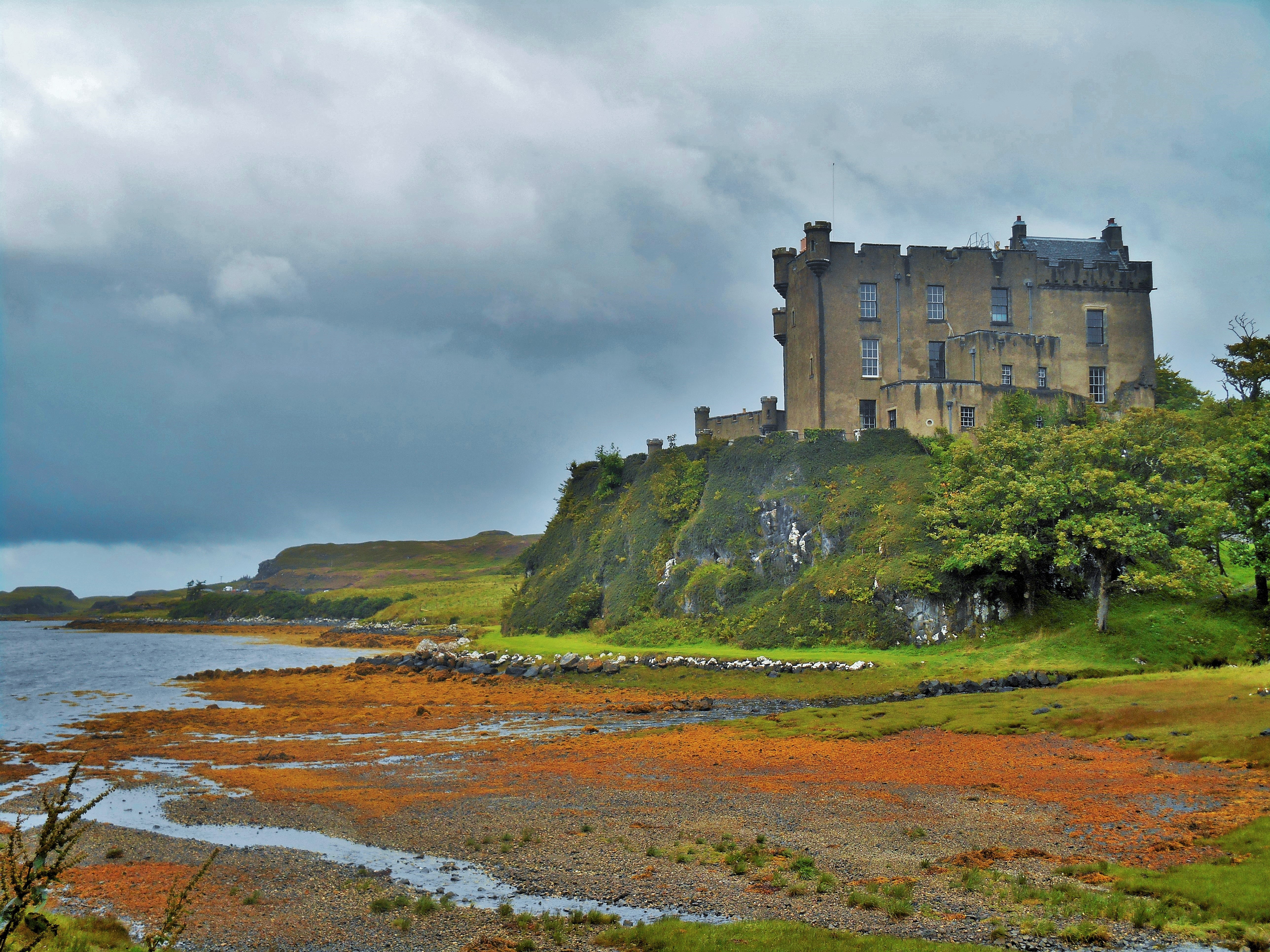
Dunvegan Castle, called Caisteal Dhùn Bheagain and also Caisteal Dhùin Bheagain, stands on a basalt rock in a north-facing inlet of Loch Dunvegan on the Isle of Skye. The rock is given as 50 feet, or 15 metres, and also as 49 feet, with the tide on three sides. A landward ditch is given as about 60 feet wide and 18 feet deep, and the depth is also given as 18 feet, or 5.5 metres. The name is said to mean the fort of Began, a forgotten Norse occupant, and the summit’s earlier structure is said to have been swept away by the medieval walls.
The chiefs of Clan MacLeod still live in the castle. Occupation by the same family is put at 800 years, at 750 years, and, in one caption, at 900 years. Leod, treated as the younger son of Olaf the Black or as a man whose parentage is still debated, is said to have died in 1290, after the Hebrides passed from Norse rule in 1265 and Alexander III’s annexation in 1266. His marriage, to the daughter of MacRald Armuial or to the heiress of Armuin MacRaild, is what the clan accounts credit with bringing him Dunvegan.
The two branches, Siol Tormoid of Dunvegan and Siol Torquil of Lewis, are both traced to him.
A curtain wall and a sea gate closed the rock in the thirteenth century, and that sea entrance is said to have remained the only way in until 1748. The keep at the north-east is placed in 1340 to 1360 under Malcolm, the third chief, in the later fourteenth century, and in the late fourteenth century as a four-storey tower of 48 by 35 feet, kin to the towers of Kisimul Castle and Caisteal Maol. From 1439 the family called itself of Dunvegan. The fourteenth-century core now sits inside the north drawing-room wing.
Iain Ciar MacLeod, the fourth chief, born about 1330 and chief sometime between 1360 and 1370, is remembered as the most tyrannical of the line. Tradition says his wife had two daughters buried alive in the dungeon after they tried to leave with two MacQueen brothers from Roag. He was killed at Rodel in an ambush, the year given as 1392 or as soon after Robert III’s accession, and he was buried on Iona. Iain Borb MacLeod, the sixth chief, inherited as a child.
MacDonalds besieged the castle and were driven off by Torquil of Lewis. As an adult he fought at the Battle of Harlaw in 1411, took a head wound that never healed, and bled to death on Pabbay in 1442.
His son William Dubh was killed at the Battle of Bloody Bay in 1480, the last chief buried on Iona. Alasdair Crotach MacLeod, eighth chief from 1450 to 1547, succeeded him. Crotach means humpbacked, from wounds taken in a fight at Aird Bay. He lost Duntulm, answered James IV, and received grants of Trotternish lands in June and October 1498, with another account placing a confirmation and a promise of three ships on 15 July 1498.
He added the Fairy Tower around 1500, placed either at the south-east corner or at the south-west angle, and he was buried at Rodel rather than Iona.
The Fairy Flag kept in that tower is a fragile silk square of about 18 inches. Its cloth is placed in Syria or Rhodes, in the fourth century, and also in the fourth or the seventh.
A. J. B. Wace read the darns as Near Eastern work, and a family reply insisted the fairies had given it.
Traditions give it three uses, among them the unfurlings claimed for Bloody Bay and for Glendale, and they do not agree with one another. Ruairidh Mòr built the range between the old tower and the Fairy Tower in 1623. Neil Mackinnon, the first Protestant minister on Skye, contracted on 4 August 1633 to foster the later chief Iain Breac. The south wing and a rebuilding dated 1686 belong to Iain Breac’s years, recorded on a stone naming John Macleod and his wife Flora.
The landward door of 1748, the steps drawn by Thomas Pennant in 1772, and the visit of Samuel Johnson and James Boswell in September 1773 turned the house toward the land. Johnson told Lady MacLeod to keep the rock. Flora MacDonald, born at Milton on South Uist in 1722, helped Charles Edward Stuart leave Benbecula after Culloden and was held in the Tower of London before the amnesty of June 1747. Her life does not place her in the castle.
She died on 5 March 1790.
In 1790 the twenty-third chief, called Norman the General and also called John, had the castle reworked by William Boak, who is also named Walter Boak, at a cost of nearly £4,000. He is said to have died in 1801, while one garden account also has him planting the policies in the later nineteenth century. John Norman MacLeod, born in India on 3 August 1788, added the causeway, the drawbridge and the walled garden, and the portico is placed in 1814, the year Walter Scott described those works as still proposed. Norman, the twenty-fifth chief, employed Robert Brown, junior, from 1840, or from 1840 to 1850, at a stated cost of £8,000.
William Burn is also named, with a question, beside that remodelling. Dummy pepper-pots and a full battlement joined ten periods of building into one outline.
Sir Reginald opened the house to visitors in 1933, two days a week. His daughter Flora MacLeod of MacLeod, born on 3 February 1878, became the twenty-eighth chief in 1935, and her life says that she opened the castle to tourists in later years. A fire is dated 24 November 1938 and also 1939. Dame Flora is said to have brought out the Fairy Flag, after which the wind dropped.
Rebuilding is credited both to Colin Simpson and to Colin Sinclair, with a Glasgow contract of £2,256 signed on 17 April 1939. She held the first clan parliament at the castle in 1956, in the presence of Elizabeth II, and died on 4 November 1976.
The castle and its causeway were placed in the highest listing category on 5 October 1971 and also on 4 October 1971. The designed landscape, 42 acres or 17 hectares, with the formal policies also given as five acres, was inventoried on 30 June 1987 and on 1 July 1987. It is not a world-heritage inscription of its own. Hugh Magnus MacLeod of MacLeod, born in 1973, inherited on 12 February 2007 and took on the estate in 2008, a date also given for the inheritance itself.
Repairs since then are costed at about £6.6 million and at more than £4 million, with £3 million still to do. In February 1998 a carved male head, read as the fifteenth or sixteenth century, was found on the beach to the north and taken into the museum at Inverness. The thirtieth chief still lives on the rock.
Images









Detailed History
Dunvegan Castle, also named Caisteal Dhùn Bheagain and Caisteal Dhùin Bheagain, stands on a rocky basalt promontory on the eastern shore of a north-facing inlet of Loch Dunvegan, on the north-west coast of the Isle of Skye. The rock rises some 50 feet, or 15 metres, above the sea, and the same height is also given as 49 feet. Water lies on three sides, and the tide washes the foot of the walls. On the landward side a ditch, partly natural and partly artificial, cuts the rock off from the ground to the east.
One account gives that ditch as about 60 feet wide and 18 feet deep in its present state. Another gives the depth as around 18 feet, or 5.5 metres, and does not give a width. The castle sits about 1 mile, or 1.6 kilometres, north of the village of Dunvegan. By a straight line it lies some 14.5 miles, or 23 kilometres, from Portree, and the road around the coast is longer.
The name is said to mean Began’s dun, the fort of a Norse man called Began who is otherwise forgotten. A Latin inscription of 1686 styles a later chief lord of Beganoduni, the fort of Began. People had used this rock long before the MacLeods. One account notes widespread traces of Pictish occupation in the immediate country, and holds that the naturally defensive rock was already a strategic seat when the clan first took it.
Any prehistoric structure on the summit itself is said to have been swept away when the medieval walls were built.
The chiefs of Clan MacLeod still treat the castle as their seat, and the family still lives in it. One account says the same family has occupied it continuously for 800 years, and calls it the only Highland fortress with that record. Another says the chief has had his home here for 750 years, and for more than 750 years. A caption joined to a 2023 account of the same building calls the castle 900 years old.
The clan has two main branches. The MacLeods of Dunvegan, Harris and Glenelg are Siol Tormoid, and their chief is MacLeod of MacLeod. The MacLeods of Lewis, Assynt and Raasay are Siol Torquil, and their chief is MacLeod of the Lewes. Both branches are traced to Leod.
One account calls Leod the younger son of Olaf the Black, one of the last Norse kings of Man, who died in 1265, the year the Hebrides were ceded to Scotland. Another says Leod’s parentage is still debated, and that he may have been Olaf’s son, with the support of the Earl of Ross and of his foster father Paul Balkasson, seneschal of Skye. Leod is said to have held Lewis and Harris, and on Skye the lands of Sleat, Trotternish, Waternish and Snizort. By marriage he is said to have received Glenelg, Duirinish, Minginish, Bracadale, Lyndale and Dunvegan Castle.
One account names his wife as the daughter of the Norse seneschal of Skye, MacRald Armuial. Another names her as the heiress of Armuin MacRaild, and says the castle can only have been one of several houses. Leod is said to have died in 1290, after which the lands were divided between his two sons. A survey of the rock places the first stone enclosure in the thirteenth century, after Alexander III annexed the Western Isles in 1266.
There is no clear evidence of the form of the castle in the thirteenth century. The summit was presumably closed by a wall, perhaps replacing an earlier timber palisade, with domestic buildings inside it. One account describes an original fort of the late thirteenth century, enclosed by a massive curtain wall with a single, easily defended entrance on the loch side. Another says that after 1266 the summit was enclosed by a curtain wall with an arched entrance, the sea gate, from which steps led up to the platform, and that this remained the only entrance until 1748.
A writer in 1549 called it a strong strength built upon a rock. The sea gate that survives on the west is described as early, probably of the fifteenth century, with a filleted cavetto moulding, a simple cornice and a yett. The landward side of the enclosure was built up in later centuries. The western side was left open and became the court now called the Gun Court.
Until the eighteenth century the principal rooms looked over that court toward the loch, and the only way in was a narrow flight of steps cut in the living rock from the foreshore. Both details show how completely the life of the house still faced the sea.
The curtain was followed by a keep at the north-east angle of the rock. One account places that keep in 1340 to 1360 and names the builder as Malcolm, the third chief. Another places it in the second half of the fourteenth century and gives the plan as 48 feet by 35 feet. A third places a four-storey tower house in the late fourteenth century, similar in style to the towers at Kisimul Castle and Caisteal Maol.
A fourth says the tower was probably built in the later fourteenth century, an ambitious four-storey block on a rectangular plan, set over the north-east of the courtyard wall and holding the principal domestic rooms. From 1439 the family began to describe itself as being of Dunvegan, a change that has been read as a sign of this larger house. The fourteenth-century core is now incorporated in the nineteenth-century drawing-room wing on the north, which ends in a square corbelled and crenellated tower. The old tower is said to have been abandoned for a time and brought back into use only in the late eighteenth century.
Iain Ciar MacLeod is considered the fourth chief. He is estimated to have been born in 1330, or possibly later, the eldest son of Malcolm, and he is thought to have succeeded sometime between 1360 and 1370. Clan tradition calls him the most tyrannical of all the MacLeod chiefs, equally feared and hated by his vassals and by his own family. He is said to have married a daughter of an Irish O’Neil chief, and the tradition makes her as cruel as her husband.
When two of her daughters tried to leave with their lovers, two MacQueen brothers from Roag, she is said to have had the brothers flogged to death and their bodies thrown into the sea, and to have had the daughters buried alive in the dungeon of Dunvegan Castle. A manuscript claims that he received a charter from Robert II for Trotternish and his other lands on Skye, though a later clan historian could find no evidence of that charter. The same tradition tells of a hunt in a forest on Harris, once owned by the MacGhitthich, the children of the Wolf, who still held part of it while paying tribute. Iain Ciar MacLeod grew angry that the party had not found a white stag, offered a reward for the person who had killed it, and, on an enemy’s word, had the MacGhitthich chief killed by forcing the antlers of a large deer into his body.
When the hunters returned to Rodel to sail for Dunvegan, the dead man’s people attacked. Iain Ciar MacLeod was struck by an arrow. His son William Cleireach rallied the clan and held the attackers off. The chief’s wife, three of his illegitimate daughters and other women fled in a galley that was blown across the Minch and broken on rocks called the Maidens.
The wounded chief was taken to the church at Rodel and died that evening. His body was taken to Iona. One historian placed the death shortly after the accession of Robert III. Another thought the year was 1392.
He was succeeded by his second and only surviving son, William Cleireach. Tradition says the first seven chiefs were buried at Iona. In the choir of the abbey, mostly of the early sixteenth century, a large stone that once held a monumental brass, said by tradition to have been silver, measures 7 feet 9.25 inches, or 2.37 metres, by 3 feet 10 inches, or 1.17 metres, and has been suggested as the marker of Leod and several of his successors.
Iain Borb MacLeod, John the Turbulent, is considered the sixth chief, and the dates given for him are 1392 to 1442. He is the first MacLeod chief to whom heraldry can be assigned. He was the son of William Cleireach. Tradition says he was only ten when his father died, and that for six years an incompetent guardian led the clan to its lowest point.
The guardian named in the manuscript is Iain Mishealbhach, John the Unlucky, a cousin. Many in the clan preferred Tormod Coil, who had slain Alastair Cannoch at the Battle of Sligachan, and Tormod Coil seized part of Glenelg. In that disorder the MacDonalds landed at Sleat, took the castles of Dunscaith and Camus, and drove the MacLeods out of Sleat. They invaded North Uist and defeated the MacLeods at Cailus, taking further land.
They then besieged Dunvegan Castle, where the widow of William Cleireach was living. Torquil, chief of the MacLeods of Lewis, came in force, relieved the castle, defeated the besiegers at Fiorlig, and took the family to Lewis until Iain Borb MacLeod came of age. His first act as chief, in the manuscript, was to hang Iain Mishealbhach, confiscate his lands and banish his family. He then made an agreement with Domhnall, Lord of the Isles.
The MacDonalds gave back the lands they had taken, except those on North Uist. Iain Borb MacLeod swore vassalage and, under that agreement, fought for the MacDonalds at the Battle of Harlaw in 1411. The manuscript says he commanded all the MacLeods, including those of Lewis, and that they had the honour of the right of Domhnall’s army. Historians of Clan Donald writing in the early twentieth century placed both MacLeod clans in the main body under Domhnall, and gave the right wing to the MacLeans under Hector MacLean of Duart, called Red Hector of the Battles.
Iain Borb MacLeod was wounded in the head. The wound never fully healed, and for the rest of his life it bled when he was agitated. He lived mostly at his castle on Pabbay, which he renovated and enlarged. During a fencing match with his foster-brother Somerled MacConn the wound opened and he bled to death.
There is disagreement about which of his sons was the eldest. William Dubh was the son who succeeded, after the death in 1442.
William Dubh, the seventh chief, is given the span of about 1415 to 1480. He was killed at the Battle of Bloody Bay in 1480. Clan tradition says that when he fell, his men began to lose heart, and that a priest ordered the hereditary bearer, Murcha Breac, to unfurl the Fairy Flag. Until that moment the MacLeods of Harris and Dunvegan had been on the opposite side from their kinsmen of Lewis.
When the Lewis men saw the flag they changed sides and joined their kinsmen. The battle had already turned, and both MacLeod clans were on the losing side. Murcha Breac and the twelve guardians of the flag were among the dead. William Dubh was buried on Iona with his predecessors, and Murcha Breac was placed in the same tomb, which the tradition calls the greatest honour that could be given him.
He is thought to have been the last MacLeod chief buried on Iona. A later historian rejected the story that the flag was used at Bloody Bay, because the MacLeods lost, and he believed the flag would only have been waved twice.
Alasdair Crotach MacLeod, in Gaelic Alasdair Crotach MacLeòid, is considered the eighth chief. The dates given for him are 1450 to 1547. He was the son of William Dubh and succeeded in 1480 after Bloody Bay. The word crotach means humpbacked.
Tradition says he earned the name from wounds that crippled him for the rest of his life. In the late fifteenth century Angus Og MacDonald, illegitimate son of John MacDonald, Earl of Ross and Lord of the Isles, tried to depose his father. Angus was backed by the branches of Clan Donald and by the MacLeods of Lewis. The MacLeods of Harris and Dunvegan, the MacLeans and the MacNeils backed John.
One skirmish, fought while William Dubh was away, brought a large force of MacDonalds under Evan MacKail, son of the chief of Clanranald, to Aird Bay to waste MacLeod land. Alasdair Crotach MacLeod rallied the clan and met them near their galleys. Evan MacKail struck him in the back with a battle axe. As he fell he pulled Evan down, killed him with his dirk and cut off his head.
The MacDonalds were defeated, losing most of their men and ten galleys. The manuscript’s writer, working in about the 1830s, said heaps of skulls and bones could still be seen on the ground. After Bloody Bay, Angus followed the victory by invading Trotternish. Duntulm Castle was taken by surprise, and the MacLeods never recovered it.
The manuscript places a further MacDonald attack, the Battle of Glendale, in about 1490, and says the mother of Alasdair Crotach MacLeod ordered the Fairy Flag unfurled when both MacLeod clans were about to give way. They renewed the fight and won, at immense loss. The bearer Paul Dubh carried the flag until he was killed, and was buried in a deep stone coffin with a metal grate. The historian J.
L. Roberts thought several battles had been confused in the tradition, and that the fight at Glendale was much later than the manuscript says. He suggested the MacDonalds may have landed on the north-west coast of Skye after Alasdair seized Dunscaith Castle following 1513, and that the armies met at Glendale. In June 1498 the king granted Alasdair Crotach MacLeod many lands on Skye, among them two unciates of the barony of Trotternish and the office of bailie of those lands.
In October of the same year the king granted the same again. Another account places a royal confirmation of his ancestral lands across Harris and Skye on 15 July 1498, in return for three ships in the king’s service, one of 26 oars and two of 16. That charter is called the earliest document to survive at the castle. James IV was then trying to draw the western chiefs into his power.
Most ignored him. Alasdair Crotach MacLeod was one of the few who answered, and the link with the court has been offered as a reason for the next building at the castle.
Alasdair Crotach MacLeod added the Fairy Tower as a separate building around 1500. One account places it at the south-east corner of the rock. Another places a smaller tower of about 1500 at the south-west angle of the enclosure. A third places the Fairy Tower in the early sixteenth century, at the south-east.
He was the first MacLeod chief not buried on Iona. His tomb, in St Clement’s Church at Rodel on Harris, is one of the most richly carved of its time in Scotland. He was succeeded by his son William. The tower takes its name from the Fairy Flag, Am Bratach Sith, also written A’ Bhratach Shìth.
The flag is silk, yellow or brown, a square of about 18 inches, or 45 centimetres, on each side. It is ripped and tattered and extremely fragile, covered with small red marks called elf dots. In the early nineteenth century it also carried small crosses, which have since disappeared. One account says the silk probably came from Syria or Rhodes and was woven in the fourth century.
Another says it has been dated to the fourth century and to the seventh, long before the Crusades. Its weave has also been compared with Levantine silks of the early first millennium. A. J.
B. Wace examined it and concluded that the silk was woven in Syria or Rhodes and that the darns were made in the Near East. He thought the original cloth had been precious, perhaps a relic such as the shirt of a saint. Because the chiefs were then believed to descend from Harald Hardrada, who had spent time in Constantinople in the eleventh century and was killed in 1066, it was suggested that the cloth passed from Harald to Leod.
When Sir Reginald had the flag conserved and sealed in a frame, he heard that theory and answered that the examiner might believe it, but that he knew the fairies had given it to his ancestor. The examiner bowed to what he called superior knowledge. Thomas Pennant, on his tour of 1772, called the flag the Braolauch shi and said Titania, the Ben-shi and wife of Oberon, had given it to the family. Sir Walter Scott, at the castle in August 1814, called it a pennon of silk with something like round red rowan berries worked on it.
John Francis Campbell, in 1871, called it yellow raw silk with figures and spots worked in red. In 1927 it was described as square and brown, once much larger, with the tears carefully mended and the crosses gone.
The traditions of the flag do not agree with one another, and they are kept here as traditions. One gives it to an infant chief in the Fairy Tower, wrapped round him by a fairy while his nurse was at a feast in the keep, after which unseen singers filled the room. Another has a chief marry a fairy, live with her for a year and a day, or in another telling for twenty years, and part from her at the Fairy Bridge, where she gave him the banner and warned that it would bring victory only three times. The bridge is placed about 3 miles, or 5 kilometres, from the castle.
A third sends a MacLeod on crusade, through a hermit’s warning, to kill a spirit called the Daughter of Thunder, Nein na Pheupere or Nein a Phaipen, who gave him her girdle for a banner and her spear for a staff, and told him the future of the clan. A fourth puts a fairy maiden in a river on the way back from the Holy Land, and a nest of scented boxes whose innermost held a banner that would call up armed men, with a warning not to open it within a year and a day. The powers claimed for it include multiplying a clan’s men, saving named lives, curing a murrain of cattle, aiding fertility if spread on a marriage bed, and bringing herring into Loch Dunvegan. Pennant said it had already been produced three times: once in an unequal fight with the Macdonalds of Clanranald, when the MacLeod force was multiplied by ten; once to save the lady of the clan and thus the heir; and a third time, so tattered that Titania did not think it worth taking back.
Scott was told of three properties: multiplying men in battle, fertility, and herring. Another tradition limits a true unfurling to three occasions, after which the flag would vanish or lose its power, and the bearer might be taken with it. The manuscript of about 1800 says the third unfurling was always resisted. It also says only the eldest male of a hereditary family might unfurl it.
Pennant calls that family Clan y Faitter, with free lands in Bracadale. The manuscript calls them Clan Tormad Vic Vurichie, the children of Tormod son of Murchadh, descended from Sìol Torcaill. The first bearer was buried in the chiefs’ tomb on Iona. A later bearer was buried at St Clement’s, Rodel, in a stone coffin six feet deep with an iron grate about two feet below the lid, so that each new body sifted the bones of the last through the grate.
The writer said his own father had seen the last male of the family interred in that way, and that the family had become miserably poor before it died out. R. C. MacLeod found no trace of such a coffin at Rodel, though he thought it might lie buried or inside a wall.
He also thought the flag had been waved at a battle in Waternish in about 1580, and once to stop a cattle plague, and he wondered whether it was waved in 1600 when the clan was hard pressed by the Macdonalds of Sleat.
Between the old tower and the Fairy Tower, new ranges went up in the seventeenth century. Ruairidh Mòr, Sir Roderick, the fifteenth chief, built the state apartment. One account dates Rory Mor’s House to 1623. Another dates the roof by a large delivery of lead from J.
Colquhowne in 1623. His ceremonial drinking horn and a gourd are kept with the flag and the Dunvegan Cup. Neil Mackinnon enters the story of the house in the next generation. He was the first Protestant minister on Skye, for many years in the seventeenth century the Episcopalian minister first of Strath and then of Sleat.
He was the eldest son of John Og MacKinnon, probably the brother of Sir Lachlan MacKinnon of Strath. Clan tradition says his life was in danger as a child and that he hid in a cave still called Slochd Altrimen, the Nursing Cave. He took an M.A. at the University of Glasgow in 1626. In 1627 he was appointed to Cill Chriosd, or Kilchrist, the parish church of Strath, and he swore to give the Clerk of Council the names of all the Catholics he knew in the Isles.
By 4 August 1633, when he entered a contract to foster Iain Breac Macleod of Dunvegan, he had been moved to the parish of Sleat, where he was confirmed in 1661. He was noted for preaching in full Highland dress, and, because of the times, he did not go to the pulpit unarmed. The Synod of Argyll called him a man able in the Gaelic language. In October 1651 the synod appointed him twelve bolls of victual out of the vacancies of Kintyre, partly for translating the Shorter Catechism into Gaelic and partly because of his poverty.
He married Janet Macleod of Drynoch. They had five sons, including Donald, who from 1675 served as minister of the united parishes of Strath and Sleat.
Iain Breac, John the pockmarked, is named as the eighteenth chief and as the grandson of Rory Mor. In 1664 he employed the mason Donald Ross to build the Pipers’ Gallery, with a balustraded parapet on the landward side. The listing describes a two-storey balustraded range of two bays linking the entrance to the south-east tower, and it calls the balustrade late seventeenth century. From 1684 the masons John Ross and John Nicolson added the south wing to the Fairy Tower, on the site of an old chapel.
One account places the south-west wing, or the south wing, between 1684 and 1690, and says the grandson rebuilt Rory Mor’s work in the late seventeenth century. A datestone of 1686, kept inside the castle, records the rebuilding by John Macleod, Lord Dunvegan, and Flora, his wife. A Latin inscription, in a literal reading, says that John MacLeod, lord of Beganoduni and ruler of his clan, restored this tower of Dunvegan, proof of the most ancient occupation and for a long time deeply ruinous, in the year commonly called 1686. By the late seventeenth century the bones of the present plan were set.
A manuscript places a crisis in the succession after Tormod, son of Iain Breac, died. It says his young widow, only six weeks married, refused to give up the castle to the heir of Talisker because she knew she was pregnant, and in time bore Tormod, the next chief. Around then a man trying to please the Talisker heir tried to steal the flag from an iron chest whose key was held by the hereditary keepers. The flag was found again.
The staff and the iron chest were not. The historical notes attached to that story place the death of the elder Tormod in the autumn of 1706, and the birth of his son Tormod in July 1705, which does not sit easily with a widowhood of six weeks followed by a birth.
The sea gate remained the only entrance until 1748, when the first landward front door was made. A long flight of steps was needed to reach that door above the ditch. Thomas Pennant’s illustration of 1772 shows those steps, a small wood in the glen to the east, and bare moor round about. In September 1773 Dr Samuel Johnson came with James Boswell and stayed just over a week.
Boswell recorded Lady MacLeod’s complaint that there was nowhere near the castle to make a good garden. When she spoke of leaving the inconveniences of the house, Johnson told her that the seat of the family should always be upon the rock of Dunvegan. If once you quit this rock, this centre of gravity, he said, there is no knowing where you may settle. You move five miles first, then to St Andrews, then to Edinburgh, and so on until you end at Hampstead or in France.
No, no, keep to the rock. It is the very jewel of the estate. It looks as if it had been let down from heaven by the four corners, to be the residence of a chief.
Flora MacDonald belongs to the generation before that visit, and to Skye. Her life, as it is told, does not place her inside Dunvegan Castle. She was born in 1722 at Milton on South Uist, the third and last child of Ranald MacDonald, who died in 1723, and his second wife Marion. Her father was a tacksman of Milton and Balivanich, of the minor gentry of Clanranald.
She had two brothers, Angus, who later held the Milton tack, and Ronald, who died young. She came from the Protestant minority of South Uist. Bishop Robert Forbes wrote that she was Protestant, descended from Clanranald by her father and from an Episcopal clergyman by her mother. Through her uncle she was first cousin to the poet Alasdair mac Mhaighstir Alasdair.
Her mother married again in 1728, to Hugh MacDonald, tacksman of Armadale on Skye, and Flora MacDonald was brought up by her father’s cousin, Sir Alexander MacDonald, chief of the Macdonalds of Sleat. Suggestions that she was educated in Edinburgh have not been confirmed. She was visiting Benbecula when Charles Edward Stuart and a few aides took refuge there after the Battle of Culloden. The battle is placed in April 1746, and the refuge on Benbecula in June 1746.
Félix O’Neille, a distant relative, asked for her help. Benbecula was held by a pro-government company commanded by her stepfather. She obtained passes, though she is said to have hesitated for fear of the consequences, and witnesses later claimed that Hugh had advised the prince where to hide from his own search parties. On 27 June the party landed near Sir Alexander’s house at Monkstadt, near Uig in Snizort.
Charles travelled disguised as an Irish maid, Betty Burke, in a party of eight. In Sir Alexander’s absence his wife Lady Margaret lodged them with her steward, who told Charles to take off the disguise because it made him more conspicuous. The next day the prince was taken from Portree to Raasay, and Flora MacDonald stayed on Skye. She later said she had helped him from sympathy for his situation, not from support for the Jacobite cause.
She was arrested and held in the Tower of London. After Lady Margaret spoke for her to Duncan Forbes, the chief Scottish legal officer, she was allowed to live outside the Tower under a King’s Messenger, and she was released under the general amnesty of June 1747. Sympathisers collected more than £1,500 for her. On 6 November 1750 she married Allan MacDonald, a captain whose father was Sir Alexander’s steward and tacksman of Kingsburgh on Skye.
They had seven surviving children, two daughters and five sons. Two sons were lost at sea in 1781 and 1782. A third, John, made a fortune in India and gave his parents comfort in their last years. In 1773 the couple emigrated to North Carolina.
Their support for the British government in the American War of Independence cost them their American estates, and they returned to Scotland. Flora MacDonald died on 5 March 1790.
The next transformation of the house belongs to the twenty-third chief. One account calls him Norman, known as the General, and says he remodelled the castle in 1790, commissioning the architect William Boak, and that he died in 1801. His son’s life calls the father Major-General Norman MacLeod, twenty-third chief. A later ancestry calls him Lieutenant-General Norman MacLeod.
Another account calls the twenty-third chief John, a soldier of the Anglo-Mysore wars and of the American War of Independence, captured in Boston and on friendly terms with George Washington, and says the work from 1790 was done by the builder and architect Walter Boak at a cost of nearly £4,000. That work is said to have restored the fourteenth-century keep as a drawing room, created a new landward entrance hall, and raised a north range beside the keep, reputed to be a barracks for a battalion of the Black Watch raised from the MacLeod tenantry. A small bridge was built across the burn before the General’s death in 1801. The same garden account that gives his death in 1801 also says the policies were planted by the General in the latter half of the nineteenth century.
The two statements stand side by side.
John Norman MacLeod, the twenty-fourth chief, was born in India on 3 August 1788 and died on 25 March 1835. He was the son of Major-General Norman MacLeod. He married Anne Stephenson, sister of the banker Rowland Stephenson, and a family table also names her parents as John Stephenson and Mary Broadley. They had nine children.
He was elected at a by-election in 1828 as member of Parliament for Sudbury and held the seat until 1830. He was buried at Old Kilmuir cemetery, Dunvegan. His son Norman succeeded as the twenty-fifth chief. After his father’s death he added a new causeway and an ornamental drawbridge to the little bridge, and he built the stables and the walled garden.
The castle’s own history places the land bridge and the colonnaded portico entrance in 1814, built by him. Sir Walter Scott, visiting in 1814, wrote approvingly of plans, not of a finished work: a portal between two advanced towers and an outer court, from which John Norman MacLeod proposed to throw a drawbridge over to the high rock in front. The walled garden is placed around 1810, to the south of the castle, though Boswell in 1773 had already mentioned an earlier orchard inside low walls. There are no records that confirm when the gardens as a whole were laid out, and no known designer of the landscape.
Norman, the twenty-fifth chief, employed Robert Brown, junior, of Edinburgh. One account places the restoration in 1840. Another places it from 1840 to 1850, to Brown’s plans, at a total cost of £8,000. A third speaks of remodelling in 1840 to 1850 and also names William Burn, with a question mark, beside Brown.
Drawings for Brown’s changes dated August 1840 survive, including alternative designs for a conservatory, one of them Gothic. Brown fused the separate buildings with new parapets, battlements and turrets, reworked the entrance stair, and formed an interconnected dining room and library. A billiard room, now the North Room, was made in the former barracks wing. The present appearance is placed around 1840, when this baronialisation was completed, and the castle today is described as a unified design with Victorian dummy pepper-pots and battlements along the whole roofline, over at least ten building periods from the 1200s to the 1850s.
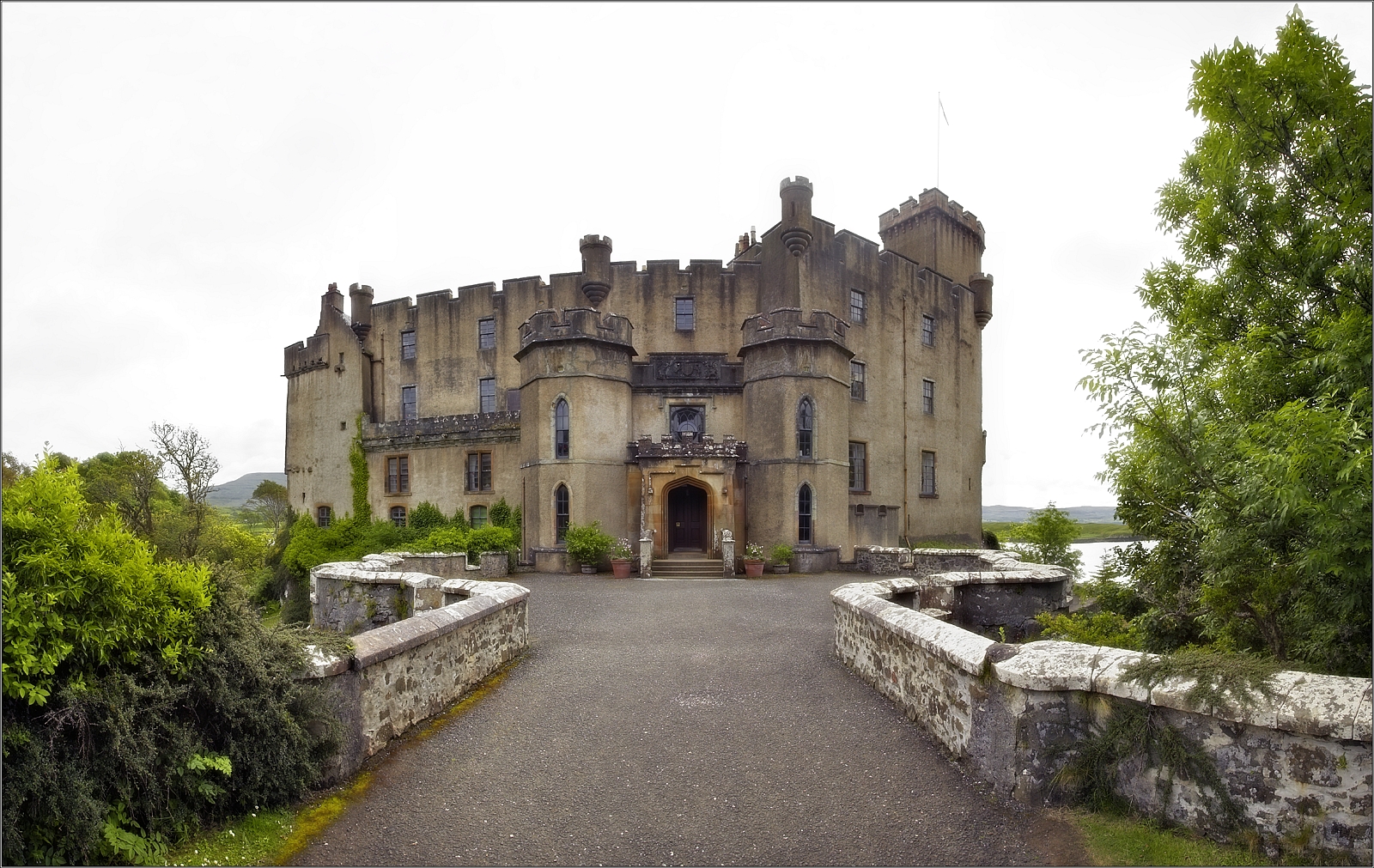
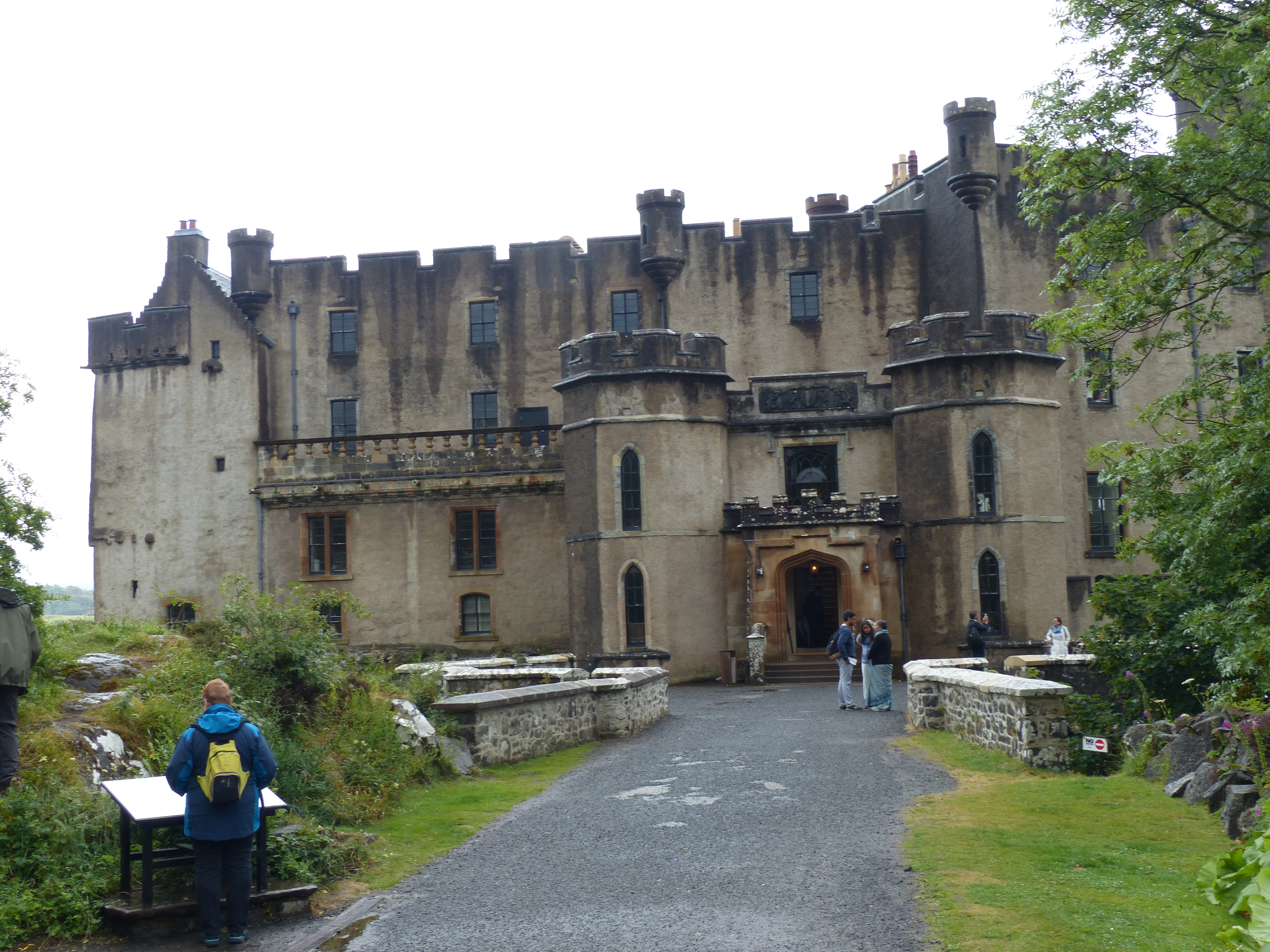
Under that skin, five separate buildings remain. The listing, which places Brown’s work in 1840 and a later restoration in 1939, describes a building whose dates run from the fourteenth century to the twentieth, harled, with ashlar margins. Apart from the south-east tower, the rest looks mid-nineteenth century: roughly rectangular, of four storeys, crenellated, with corbelled turrets at every angle. The east front is a gatehouse, with octagonal Gothic towers flanking a projecting central porch with a four-centred head, a recessed hoodmoulded window, and a carved panel above.
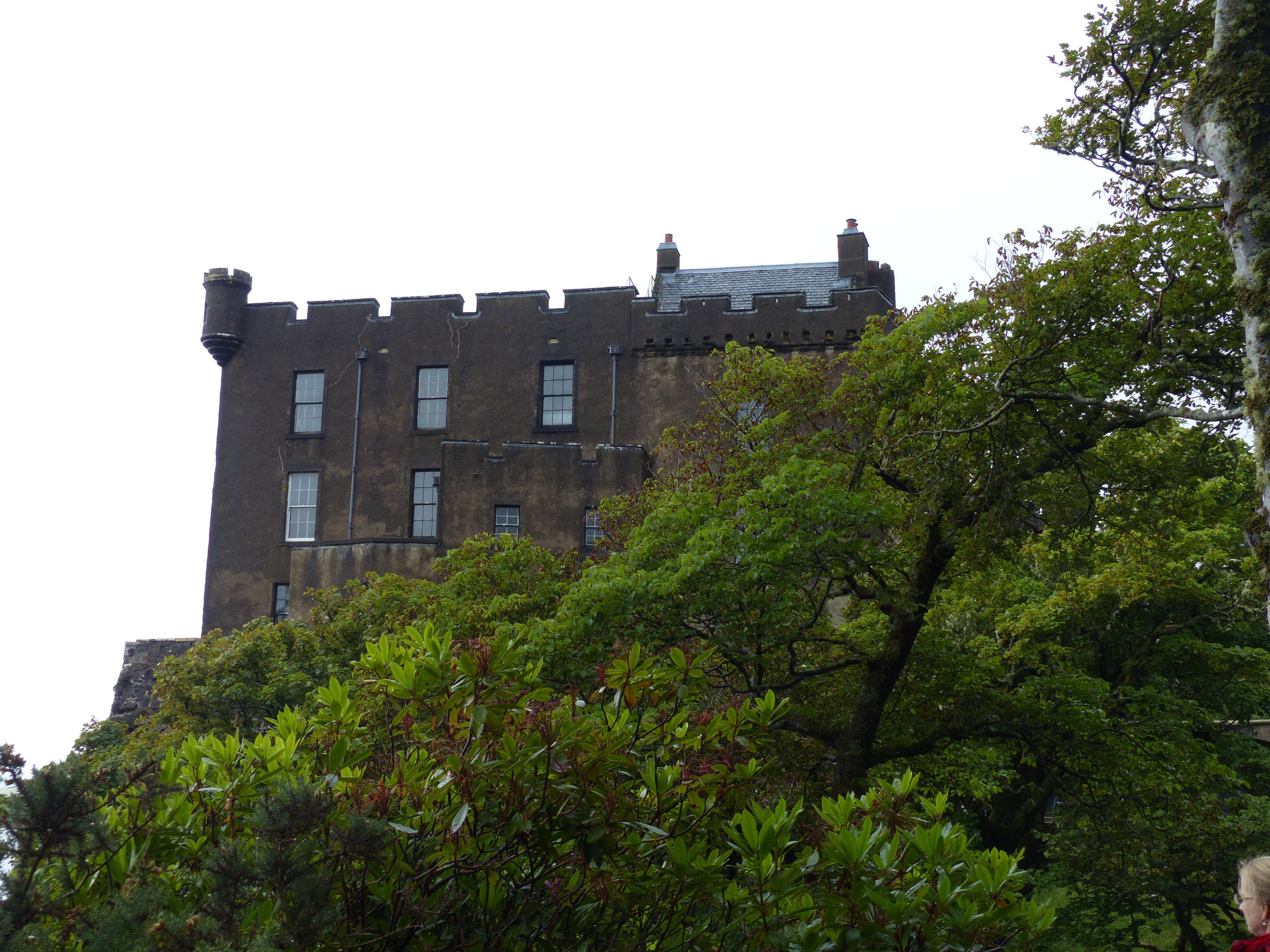
The south-east tower house is of three storeys, square, of the sixteenth or seventeenth century, with a corbelled and crenellated parapet and a crowstepped caphouse. The interior is mainly mid-nineteenth century, with a staircase from the east entrance to the first floor and enriched plaster ceilings. In the 1880s the whole was called an amorphous mass of masonry of every conceivable style, in which the nineteenth century jostles the ninth. Full-length portraits in the dining room are by Allan Ramsay, and a portrait of Dame Flora hangs over that fireplace.
A portrait of Sarah in the drawing room, the room made in the 1790s inside the fourteenth-century keep, is by Johann Zoffany. The library has an eighteenth-century fireplace carved with the goddess Diana. The North Room now holds a display of Jacobite, MacLeod and St Kilda heirlooms.
The designed landscape is given as 42 acres, or 17 hectares. The formal garden policies are also given as five acres. The extent of the policies is said to have stayed the same since the woods were planted, matching the first-edition map of about 1870. Soils are acid, and what can be grown depends on shelter from the west wind.
Cnoc Mor rises steeply to the east, its lower slopes in conifer. The burn Abhuinn Dubh Bhreac cuts through the woods and enters the loch in the small bay south of the castle. Woods east of the road are mostly conifer plantations. Those to the west are mostly deciduous, with older beech, naturalised birch, mature oak, ash, and an understorey of Rhododendron ponticum.
The woodland walk north of the castle runs through silver birch, ash, rowan, gorse and old rhododendrons. New paths there were cleared by young members of the clan at the clan parliament of 1982. The water garden is built around a waterfall that drops a sheer basalt cliff and breaks into channelled rivulets, with paths and bridges, primulas, Meconopsis, hostas, ferns and Gunnera, and a second waterfall grown over with fuchsia. A tulip tree is among newer planting.
A summerhouse east of the water garden has been lost. The late nineteenth-century garden nearer the house is now mostly lawn, with a monkey puzzle, a large yew, a box parterre bedded out each year, and a beech hedge. The square walled garden, put in around 1810, was described in a late twentieth-century survey as mainly disused, though part of it still grew cut flowers, with fruit bushes espaliered on the wall, a cottage at the south end and glasshouses to the north. A sixteenth-century sundial stands in it.
More recent work has brought new paths, bridges, planting, restored garden buildings and pieces of contemporary sculpture, including a turning stone called the Dunvegan Pebble. Over 40,000 trees were blown down in the gales of 1921. Much of the replanting was done by the twenty-seventh chief, Sir Reginald. The laundry, formerly the factor’s house, is dated 1754 and stands in the highest listing category, as the castle does.
The gatepiers, put up by tenants and clansmen in 1938 in memory of three MacLeod brothers, Norman, Reginald and Roderick, with wrought-iron gates and a plaque, are in a lower category, as are the walled garden, the sundial, the stables and the saw mill. The pier, of the early nineteenth century, is in a lower category again. A smaller single-arched bridge, of the late eighteenth century, carries the estate road toward the laundry over the burn beneath the south-east tower.
Sir Reginald MacLeod, the twenty-seventh chief, is the man for whom a nursemaid is said to have sung the fairy lullaby at the castle in 1847, the year of his birth. He is also given the dates 1847 to 1935. The castle’s own history says he was the first chief to open the house to the public, in 1933, for charity, two days a week, and that the visitors have since grown from a few hundred to hundreds of thousands. His daughter’s life says that he became chief in 1929, that she inherited on his death in 1935, and that years later, to raise an income, she opened the castle to tourists.
Both accounts are left standing. Flora MacLeod of MacLeod, Dame Flora, was born Flora Louisa Cecilia MacLeod on 3 February 1878 at 10 Downing Street, the house of her grandfather Sir Stafford Northcote, then Chancellor of the Exchequer. Her mother was Lady Agnes Mary Cecilia Northcote. She became president of the clan society and lived with her father at the castle, where she was a county councillor for Bracadale.
In 1901 she married Hubert Walter, a journalist, and they had two daughters, Joan and Alice. Hubert Walter died in 1933. On her father’s death in 1935 she was recognised as the twenty-eighth chief. She was made a DBE in 1953.
She lived at the castle until 1973, then moved to Ythan Lodge in Aberdeenshire, and died on 4 November 1976, aged 98. She is buried in the clan burial ground at Kilmuir, near Dunvegan. Her grandson John MacLeod of MacLeod succeeded her. A piping trophy in her name has been given since 1969 to the best piper at the Grandfather Mountain Highland Games in North Carolina.
After the Second World War she travelled widely and set up clan societies through the British Commonwealth. In 1956 she inaugurated the first MacLeod parliament at the castle, in the presence of Elizabeth II and the Duke of Edinburgh. The castle’s own history places that first parliament in the presence of the Queen in 1956, and says the gatherings have been held at the castle ever since, with clansfolk returning from all over the world every four years. A 2023 account says the parliament has met regularly since 1956 and met most recently in July of that year, after a delay caused by the pandemic.
A fire determines the next repair, and the accounts do not agree on the year or the architect. Drawings are described as designs for restoration after a fire of 24 November 1938. One narrative places the fire in November 1938 and says Dame Flora unfurled the Fairy Flag in the face of the flames, that the wind then dropped, and that the fire was put out after gutting only the south wing. The castle’s own account of the flag places a fire in the south wing in 1939, and says that when the flag was carried to safety the wind dropped and the flames were seen to abate.
Another account places the fire in 1938 and says the flames were checked when the flag was carried past. During the Second World War, Dame Flora is said to have received a letter from a clansman who credited his luck on bombing missions to a photograph of the flag in his pocket, and she is also said to have offered to wave the flag on the white cliffs of Dover against an invasion. Pilots of the clan are said to have carried its picture as a talisman. The rebuilding of the burnt wing is credited to Dr Colin Simpson, a Glasgow-born fellow of the Society of Antiquaries of Scotland, and also to Colin Sinclair of the Glasgow practice H and D Barclay.
The listing dates Sinclair’s restoration to 1939. A survey dates his repairs after the fire to 1938 to 1940. A garden account dates the restoration to 1940 and names Colin Sinclair. The builder is named as John Adam, or Adam and Company, of Glasgow, who signed a contract for £2,256 on 17 April 1939.
The castle, with its approach causeway and bridges, was added to the highest listing category on 5 October 1971, and the same designation is also dated 4 October 1971. It stands in the parish of Duirinish. The designed landscape was added to the inventory of gardens on 30 June 1987, and the same inventory entry is also dated 1 July 1987. The interest of the landscape is judged high for its history, because of the long link with the clan, even though the planting is largely of the end of the nineteenth century and no designs survive.
The architectural and scenic interest are judged outstanding. Horticultural and artistic interest are judged only some, the first for the water-garden plants and the second for the layout of that garden. Nature conservation is judged high, for coast and wood inside moor. Archaeology was not assessed.
It is not a world-heritage inscription of its own.
Hugh Magnus MacLeod of MacLeod, born in London in 1973, is the thirtieth chief. He represents the Associated Clan MacLeod Societies on the Standing Council of Scottish Chiefs, and the Court of the Lord Lyon recognises him as Chief of the Name and Arms of MacLeod in Scotland and in the United Kingdom. On 12 February 2007 he inherited the castle and the ancestral territories, still more than 42,000 acres, or 17,000 hectares, on Skye, following the death of his father, John MacLeod of MacLeod. He took on management of the estate in 2008, and a 2023 account says he inherited the estate in 2008.
He attended Michael Hall, a Rudolf Steiner school in East Sussex, and in 1995 graduated with a B.A. in film and modern history from the University of London and the Sorbonne. After a short time at a saleroom and at a communications firm, he worked in television. A documentary he was commissioned to direct and produce, Champagne and Canvas, was nominated for best video at the 1998 BBC British Short Film Festival. He has continued as a freelance director, producer and writer, and he divides his time between Dunvegan and London.
On 28 September 2002 he married Frédérique Feder, daughter of Serge Feder. The marriage was dissolved on 25 March 2020. Their son is Vincent Liam MacLeod of MacLeod Younger, born in 1999.
Since 2008 the estate has funded a rolling restoration. One account puts the cost at about £6.6 million, beginning with a grant of £650,000 toward a roof and window project of £1.2 million in 2010, the estate meeting the rest by taking on heavy debt, and the balance of £5.95 million coming from income after tax. Another account places the urgent £1.2 million roof renewal at the start of the work, with support from a public grant, and places the replacement of failing masonry and window furniture from 2011. It says the projects have cost more than £4 million, with an estimated £3 million of work still to do, and that 170,000 or more people a year come to the castle.
Floors have been relaid, servicing of the 1920s removed, and the staircase hall, drawing room, dining room and library redecorated. The family portraits, including those by Allan Ramsay and Johann Zoffany, have been in a phased conservation programme of fourteen years, described in 2023 as nearing completion. The North Room display was renewed in new cases. The castle became an RHS Partner Garden in 2022, and the same year is also given as a win for RHS Partner Garden Scotland.
It received a restoration award in 2019, a tourism award called Helping it Happen in 2018, and a five-star quality mark since 2016. It was also shortlisted for heritage and rural awards in 2019. The work is described as an attempt to show more of the original fabric and to add new work that still belongs to the place. A photographic record of projects from 2008 to 2025 notes that the car park was resurfaced in 2009 and greatly extended between 2022 and 2024.
In February 1998 a fragment of carving was found on the beach to the north of the castle. It shows a male face, eyes open, with hair, beard and moustache still readable. It is broken along the bottom and at both sides, and flat on the top of the head, which suggests it once carried another stone or an arch. It has been read as the fifteenth or sixteenth century, a fine grey-white stone, perhaps sandstone, about 105 millimetres long, 100 millimetres wide and 75 millimetres thick.
It was treated as medieval or later, submitted for allocation in 1998, and placed in the museum at Inverness. The medieval building is said to have removed whatever earlier structure had stood on the summit. The house remains occupied. The thirtieth chief and his family live there, and in the open season the state rooms and the gardens are shown to visitors, with the collection of the flag, the cup and the horn still in the rooms those chiefs assembled.
Sources
- Dunvegan Castle — Wikipedia
- Hugh Magnus MacLeod of MacLeod — Wikipedia
- Alasdair Crotach MacLeod — Wikipedia
- Flora MacDonald — Wikipedia
- Iain Borb MacLeod — Wikipedia
- Iain Ciar MacLeod — Wikipedia
- John Norman MacLeod — Wikipedia
- Neil Mackinnon — Wikipedia
- Fairy Flag — Wikipedia
- Flora MacLeod of MacLeod — Wikipedia
- Dunvegan Castle, approach causeway and bridges — Historic Environment Scotland
- Dunvegan Castle designed landscape — Historic Environment Scotland
- Castle history — Dunvegan Castle
- The Fairy Flag — Dunvegan Castle
- Clan MacLeod — Dunvegan Castle
- Visitor information — Dunvegan Castle
- Book tickets — Dunvegan Castle
- Restoration — Dunvegan Castle
- Eight hundred years of Dunvegan Castle — Country Life
- Dunvegan Castle — Highland Historic Environment Record
- Carved stone head found north of Dunvegan Castle — Highland Historic Environment Record
- Dunvegan Castle - entrance.jpg — Wikimedia Commons
- Dunvegan Castle & Gardens.jpg — Wikimedia Commons
- Dunvegan Castle at low tide.jpg — Wikimedia Commons
- 2007-07-05-06347 GreatBritain Skye Dunvegan.jpg — Wikimedia Commons
- 2018 07 15 Schottland (44).jpg — Wikimedia Commons
- 2018 07 15 Schottland (45).jpg — Wikimedia Commons
- 2018 07 15 Schottland (46).jpg — Wikimedia Commons
- 2018 07 15 Schottland (47).jpg — Wikimedia Commons
- 2018 07 15 Schottland (55).jpg — Wikimedia Commons
- 2018 07 15 Schottland (56).jpg — Wikimedia Commons