

County Antrim, United Kingdom · United Kingdom
Podcast
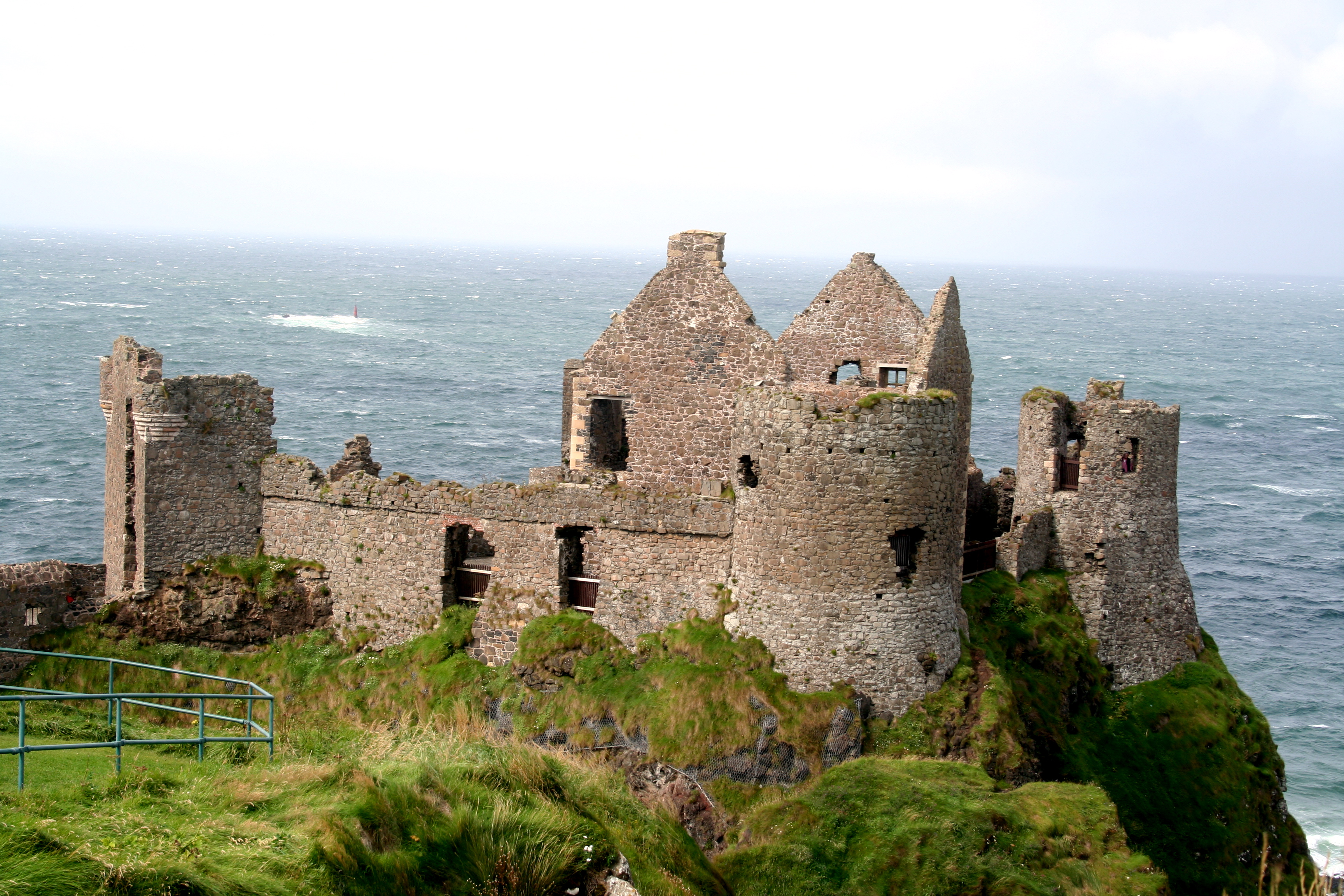
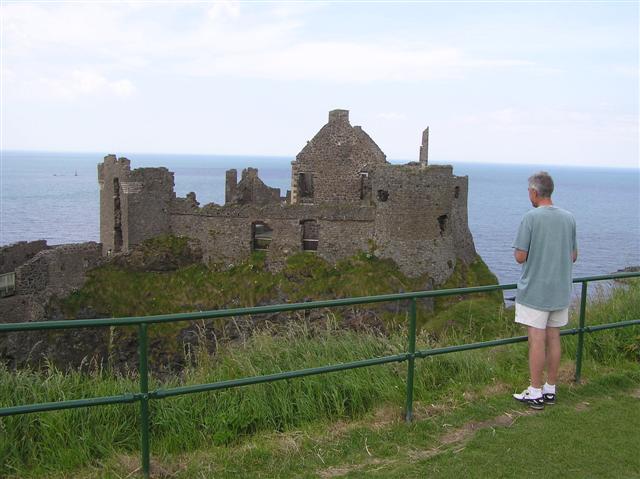
- Dunluce Castle is a ruined stronghold on a basalt cliff between Portballintrae and Portrush, reached by a bridge over steep drops.
- Richard Óg de Burgh is credited with a first castle in the thirteenth century, while the MacQuillans held the rock by 1513 and raised the great drum towers.
- Sorley Boy MacDonnell took the castle in the later sixteenth century, submitted in 1586, and was made constable of Dunluce.
- His son Randal MacDonnell, 1st Earl of Antrim, laid out a Scottish town beside the castle around 1608.
- The town was burned in the Irish Rebellion of 1641, and the castle was abandoned after the Battle of the Boyne.
- Excavation from 2008 to 2015 uncovered cobbled streets, merchants' houses, and a late medieval settlement outside the gate.
Visiting
Tickets are purchased from the ticket office on the site. The castle is open to the public during opening hours, and charges may apply.
History
Dunluce Castle is a ruined stronghold on a basalt outcrop between Portballintrae and Portrush, joined to the mainland by a bridge above very steep drops. The Irish name is Dún Libhse. An early fort may have stood on the rock, and the cliffs may have drawn early Christians and Vikings.
Who first built in stone is told in more than one way. Richard Óg de Burgh, 2nd Earl of Ulster, the Red Earl, is credited with a castle in the thirteenth century. The MacQuillans are credited with a castle around 1500, and the earliest written record of them holding it is from 1513. Digging found thirteenth- or fourteenth-century footings, and a large stone foundation under the later house that may be a MacQuillan hall.
Two drum towers on the east, each about nine metres across, belong to the MacQuillan stronghold after they became lords of the Route, near the mouth of the River Bush. They held that country from the late thirteenth century until the MacDonnells defeated them twice in the sixteenth century. The castle then became a seat of Clan MacDonnell of Antrim and of Clan MacDonald of Dunnyveg.
The MacDonnell claim on this coast grew from the marriage of John Mór Tanister to Margaret Bisset of the Glens, and from sixteenth-century settlement by galley on Rathlin and the mainland. English governors feared a Bruce-style invasion if these Scots joined the O'Neills and O'Donnells. A period of Scottish royal favour ended at the Battle of Belahoe in 1539.
Sorley Boy MacDonnell, born about 1505 at Dunanynie near Ballycastle, spent his life securing the Route. He was imprisoned in Dublin Castle in 1550, then turned on the MacQuillans and in 1559 drove them through fights at Glenshesk, Bonamargy, and Beal a Faula. In 1565 Shane O'Neill captured him at the Battle of Glentasie and took Dunluce. After Shane was killed at a feast in Cushendun, Sorley returned with six hundred redshanks and swore never to leave Ireland.
He blocked English plantation schemes, survived the massacre of his people on Rathlin by a force under John Norris and Francis Drake, and in 1583 broke a last MacQuillan attack in a bog at Slieve na Orra. Some histories date that fight to 1559 and others to 1583. Sir John Perrot's campaign of 1584 and 1585 drove him back for a time. He regained the castle, submitted in Dublin in 1586, and was made constable, with a grant of most of the Route between the Bann and the Bush.
In 1588 the Armada galleass La Girona was wrecked at Lacada Point near Ballintoy, with about 1,300 people aboard and nine survivors. He sent the survivors toward Scotland and is believed to have salvaged the wreck in secret. Her cannon were set in the gatehouses, and the cargo was sold to pay for repairs. He died in 1590 at Dunanynie and was buried at Bonamargy Friary.
His son Randal MacDonnell, 1st Earl of Antrim, helped fortify Dunluce in 1597 and fought in the Nine Years' War. After his brother James died at the castle in 1601, he was chosen by tanistry, submitted to Mountjoy, and in 1603 received nearly 340,000 acres from Larne to Coleraine. Dunluce was left out of that grant and restored to him in 1615. He did not join O'Doherty's Rebellion, and Antrim was kept outside the official plantation because Scots were already settling there.
Around 1608 he laid out a town of Scottish settlers beside the castle, with terraced gardens on the cliff, and it was meant to administer his estates and to rival the towns of the London companies. Indoor privies and a grid of streets may have made the housing unusually new for its time. He became Viscount Dunluce in 1618, a creation dated either 28 May or 29 June, and Earl of Antrim on 12 December 1620. He remained Catholic, died at Dunluce on 10 December 1636, and was buried in a vault at Bonamargy.
A granddaughter named Rose was born in the castle in 1613. Later, Randal McDonnell, Earl of Antrim, and Katherine Villiers, Duchess of Buckingham, furnished the house lavishly. A tale says the kitchens fell into the sea on a stormy night in 1639.
The excavated town has a harder ending. It was burned in the Irish Rebellion of 1641, with the fire placed in that year, in the following winter, or in January 1642. The settlement is also said to have lasted about twenty-five years.
The Irish Rebellion of 1641 began on 23 October as an attempt to recover planted land and to seize government. It overran Ulster, killed and expelled settlers, and grew into Confederate Ireland and the Wars of the Three Kingdoms. Dunluce town was abandoned by the 1680s and lay under about a foot of earth, which preserved its streets. The castle was given up in 1690, when the family was impoverished after the Battle of the Boyne, and stone was taken for other buildings.
The Battle of the Boyne, fought near Drogheda on 1 July 1690, was William III's victory over James II. James fled to France, and the war in Ireland ended with the Treaty of Limerick in 1691. Williamites feared a repeat of 1641. For Dunluce, the political result was the loss of the house.
Excavation from 2008 to 2015, funded by the Northern Ireland Environment Agency and dug by Colin Breen with teams from the University of Ulster and Queen's University Belfast, uncovered the merchant town. A Scottish house still had plaster to waist height, a privy, and a fireplace, and a Polish coin kept as a token recalled migration to Poland. A wealthy stone house had Dutch tiles on the kitchen fireplace, a Lithuanian coin worn as a pendant, and was later split to hold a byre. A smithy stood where the two main streets met.
A stone building south of the gate, about fifteen metres long, had no hearth and was not a dwelling, though it faced the cobbled approach. Beside it, a timber-framed house burned, probably in 1641, leaving North Devon pottery, a pipe bowl marked RB, and a thick layer of burnt soil. A silver groat of Queen Mary from the 1550s, a seal that seems to show the castle flying flags, and traces of a late medieval settlement outside the gate were found as well. Andrew Gault read a sudden disaster in the abandonment of valuable metal, and he placed it in the late fifteenth century, which is not the date of the groat.
The ruin is a monument in state care and is open to the public. Edward Norman Hay's tone poem Dunluce, written in 1921, was played at the London Proms in 1925.
The cliff is thought to have inspired Cair Paravel in the stories of C. S. Lewis. Ron Moody and Jack Wild filmed Flight of the Doves here in 1971.
Exterior views of the ruin were used for an island fortress on screen. The same cliff appeared on an album cover.
What changed on this cliff was a Gaelic lordship that became a Scottish earldom, then a short-lived merchant town, and at last a buried plan of streets. The privies, tiled hearths, foreign coins, and burned floors are what the digging found of that town.
Images






Detailed History
Dunluce Castle is a ruined medieval castle on the north coast of County Antrim. Its Irish name is Dún Libhse. It stands on a basalt outcrop between Portballintrae and Portrush, and the only approach from the mainland is a bridge. The drops on either side are extremely steep.
Those cliffs may have drawn early Christians and Vikings to a place where an early Irish fort once stood.
Portrush, the town just along this coast, occupies the peninsula of Ramore Head. Flint from the late Mesolithic shows that people used the spot long before the castle, and a church on the headland was wealthy enough to appear in the papal taxation of 1306. Two castles once stood on that promontory, one perhaps destroyed in the late sixteenth century and another that may belong to the early seventeenth, and nothing of either remains. After the Wars of the Three Kingdoms, Portrush became a small fishing town and, in the nineteenth century, a resort.
Dunluce kept a different kind of past.
Accounts of the first stone walls do not agree. One says that in the thirteenth century Richard Óg de Burgh, 2nd Earl of Ulster, the Red Earl, built the first castle here. He held the earldom from 1271 until his death in 1326, ranked among the greatest Anglo-Norman lords in Ireland, fought in Edward I's Scottish wars, and was the father of Elizabeth, who married Robert the Bruce. Another account says the MacQuillan family built the castle on these cliffs around 1500, and that the earliest written record, placing it in their hands, is from 1513.
Excavation in 2009 found the footings of a thirteenth- or fourteenth-century building, associated with Anglo-Norman activity. Under the later Jacobean house inside the castle, the same season uncovered the foundations of a large stone structure that may be a hall of the MacQuillans, who held Dunluce until the MacDonnells drove them out in the middle of the sixteenth century. The standing eastern towers can be read with that later phase. They are two large drum towers, each about nine metres across, described as relics of the stronghold the MacQuillans raised after they became lords of the Route.
The MacQuillans held the Route, the northern part of Antrim, from the late thirteenth century. Their castle stood near the mouth of the River Bush. They lost the lordship after two major defeats by the MacDonnells, one in the middle of the sixteenth century and one near its end. The family that took the rock came out of Clan Donald.
Dunluce became the seat of the chief of Clan MacDonnell of Antrim and of Clan MacDonald of Dunnyveg.
The Antrim claim reached back to a marriage. Late in the fourteenth century John Mór Tanister, an ancestor of the later chiefs, married Margaret Bisset, of the coastal lordship called the Glynns, or Glens. John Mor MacDonald, remembered as a son of John of Islay, Lord of the Isles, by Margaret Stewart, daughter of Robert II of Scotland, stands in that same kindred. MacDonnell settlement in the Glens and on Rathlin grew in the early sixteenth century, by galley, after the clan turned away from James IV of Scotland.
The English still treated the Bissetts as lords of the Glynns as late as 1515. The last known Mac Eoin Bissett lord, a supporter of the O'Neills, was killed in battle in 1522, and only afterwards do the MacDonnells appear as claimants. How the lordship changed hands is not known. English officials feared a fifth column: an understanding between these Scots and the O'Neills and O'Donnells might open a Bruce-style invasion of Ireland.
The newcomers did spread into Clandeboye and the Route.
James V of Scotland first favoured the rival Campbells, then in the 1530s restored MacDonnell lands in Kintyre and Islay and encouraged the move into Ireland. That royal favour ended in 1539 at the Battle of Belahoe, where an English army beat a combined Irish force that included the MacDonnells. Plans for a Scottish invasion of Ireland were set aside. The French landing in England that Henry VIII had feared did not come.
Sorley Boy MacDonnell was born about 1505 at Dunanynie Castle near Ballycastle. His father was Alexander Carragh MacDonnell of Dunyvaig, lord of Islay and Kintyre, and his mother was Catherine, daughter of the lord of Ardnamurchan. He is also called Somerled of the yellow hair. He married Mary, daughter of Conn O'Neill, and, past the age of eighty in 1588, a daughter of Turlough Luineach O'Neill.
His life was spent planting the MacDonnells in Antrim and resisting both Shane O'Neill and the English crown.
In 1550, during a Dublin campaign in the Route, Sorley Boy MacDonnell was taken and held in Dublin Castle for twelve months. He was freed in exchange for prisoners held by his brother James, then leader of the clan. After his release he seized the constable of Carrickfergus Castle and took a large ransom. He then turned on the MacQuillans, recent allies, who still dominated the Route from Dunluce.
In 1558, on the death of his brother Colla, the chieftain committed the Route to him. He raised men on the Scottish coast and landed at Marketon Bay in July 1559. The MacQuillans were posted at the foot of Glenshesk and attacked his camp at Bonamargy, and both sides suffered heavily. He struck them at Beal a Faula, drove them south, and in further fights pushed them out of the Route.
Queen Elizabeth I could not ignore him, any more than she could ignore Shane O'Neill. For about twenty years Ulster moved between war and alliance, and the queen tried to feed the rivalry between the two kindreds. The Protestant revolution in Scotland in 1560 reduced the chance of an invasion of the sort her father had feared in 1539. Ulster stayed tangled all the same.
Shane was allied by marriage with the Campbells, while Sorley's wife was Shane's half-sister.
On Elizabeth's accession in 1559, Sorley Boy MacDonnell submitted to Thomas Radclyffe, Earl of Sussex, and was confirmed in his Irish lands. In 1562 Shane O'Neill went to London and won recognition as head of the O'Neills. In 1563 Sussex campaigned against him with Sorley's help, then withdrew. Shane attacked the MacDonnells in the name of clearing Scots from Ireland.
Near Coleraine in the summer of 1564 he defeated Sorley and wasted his country.
In 1565 Shane invaded the Glens, destroyed the Scottish settlements, and won the Battle of Glentasie. James MacDonnell and Sorley Boy MacDonnell were captured, and Dunluce Castle fell into O'Neill's hands. James died soon afterwards. Sorley remained a prisoner until 1567 and seems to have gained his captor's confidence.
After the O'Donnells defeated Shane at Farsetmore, Shane sought MacDonnell help and came to a feast at Cushendun, bringing Sorley and James's widow, Agnes, to seal an alliance.
At that feast Shane O'Neill was stabbed to death by his hosts, an outcome that appears to have had the approval of the lord deputy, Henry Sidney. Sorley Boy MacDonnell went to Scotland at once. He returned to Marketon Bay with six hundred redshanks and, in their presence, swore that he would never leave Ireland. In 1569 the alliance was renewed on Rathlin, when Shane's successor, Turlough Lynagh O'Neill, married Agnes.
The next years were spent blocking English plantation schemes, first those of Sir Thomas Smith and then those of the Earl of Essex. Sorley would treat if his title was admitted. Essex wanted unconditional submission. After a retreat to Scotland, an attempt on the crown garrison at Carrickfergus failed.
He did come to terms with Smith, who would support his claim to the Route if he took the reformed religion. In 1573 the crown addressed letters of denization to him, but Essex revived the plantation and blocked them.
Essex, having made a deal with Turlough Lynagh, defeated Sorley around Castle Toome, where the Bann leaves Lough Neagh, and then fell back on Carrickfergus for lack of provisions. He ordered a further blow. John Norris and Francis Drake took a force by sea from Carrickfergus to Rathlin, where the children, the valuables, and the families of the chief retainers had been lodged. Sorley was at Ballycastle, within sight of the island, when the garrison and the civilians hiding there were massacred.
He answered with a raid on Carrickfergus. The garrison broke before a highland charge, and he partly recovered his hold on the Glens and the Route. In 1583 the MacQuillans made a last attempt to take the Route back, choosing a moment when many MacDonnell fighters were away in the west with Turlough Lynagh. They joined Sir Hugh MacPhelim Bacagh O'Neill of Edenduffcarrick and two companies of English musketeers under Captain Chatterton, seneschal of Clandeboye, and raided the northern glens.
Sorley Boy MacDonnell threatened their camp on a ridge near Slieve na Orra. Cavalry and heavy infantry charged across ground that looked firm and rode into a deep bog, where they were broken. Hugh MacPhelim and Chatterton were hunted down and killed near the summit of Orra. Rory Oge MacQuillan fled to a crannog at Loughgile and was killed there.
The fight is called the battle of Slieve-an-aura. Some histories date it to 1559, and others to 1583.
Lord Deputy Sidney accepted a ceasefire, while still supporting the MacQuillan claim to the Route and the claim of Sorley's nephews, the sons of Agnes, to the Glens. He sent Sorley's petition for a title to London, where it sat for years without an answer. The MacDonnells strengthened themselves by alliance with Turlough Lynagh and by a new immigration from the Scottish isles. In 1584 the new lord deputy, Sir John Perrot, brought an army north to push the Scots out.
A shorter account of the castle dates the seizure of the Antrim Glens to 1584, on the death of James MacDonald, sixth chief of Clan MacDonald of Antrim and Dunnyveg, and calls Sorley Boy MacDonnell one of his younger brothers. That account says Sorley then took the castle, kept it, and rebuilt in the Scottish manner. The fuller narrative of his life places the death of his brother James soon after Glentasie, and places the death of his own son James at Dunluce on 13 April 1601. The two Jameses, and the two dates, are not the same story.
After a journey to Scotland for men, Sorley landed at Cushendun in January 1585 with a large force. Early success was followed by a retreat. He offered the terms Sidney had once proposed. Perrot refused.
Sorley returned and regained Dunluce Castle. Negotiation followed, through Sir William Warren, whose father Humphrey had dealt with him in Sussex's time. In the summer of 1586 he went to Dublin and submitted.
Shown the severed head of his son, nailed above the gate of Dublin Castle, he answered that his son had many heads. In the written submission he condemned himself for leaving men in Dunluce who claimed to hold it in the name of the king of Scots, and he put himself on Elizabeth's mercy. He then received, for himself and his heirs, most of the Route between the Bann and the Bush, a district then called the Boys, with other lands to the east. He was made constable of Dunluce Castle.
A month earlier his nephew had received most of the Glens on similar terms. A clause in the Treaty of Berwick, made at the same time, recognised the right of Clan MacDonnell to remain in Ireland.
He gave the Dublin government no further trouble, except that in 1588 he helped survivors of the Spanish Armada leave Ireland. He died in 1590 at Dunanynie, where he had been born, and was buried at Bonamargy Friary in Ballycastle, the family burying place. Before the plantation of the province he was the most powerful Scoto-Irish lord in Ulster. For forty years he had used the narrow sea between Antrim and the Scottish isles, and by the end the family's claims were largely accepted.
King James I later renewed the grants of the Route and the Glens for his son Randal.
The ship in that Armada story was La Girona, a galleass of fifty guns, home-ported at A Coruña. She was named for the Girones family, who had just become dukes of Osuna and viceroys of Naples, not for the city of Girona. Her captain was Hugo de Moncada y Gralla. Damaged in her rudder, she anchored at Killybegs, was repaired with help from the Irish chief MacSweeney Bannagh, and sailed for Scotland on 25 October 1588.
About 1,300 men were aboard, among them Alonso Martínez de Leiva.
A gale drove her onto Lacada Point and the rocks later called the Spanish Rocks, near Ballintoy in the Route, on the night of 26 October 1588. Nine people survived. Two hundred and sixty bodies washed ashore and were buried in a common grave in the local churchyard. Dunluce lies just to the west, on cliffs above this coast.
Sorley Boy MacDonnell sent the survivors on to Scotland, and he is believed to have made the first clandestine salvage of the wreck. Her cannon are also said to have been set in the gatehouses, and the rest of the cargo sold to pay for restoring the building.
Between 1967 and April 1968, off Portballintrae in Port-na-Spaniagh Bay, the diver and historian John MacLennan and a team of Belgian divers, including Robert Sténuit, raised what was then the greatest quantity of Armada treasure yet recovered. Gold, silver, jewellery, weapons, and ordinary objects from the galleass are displayed in the Ulster Museum in Belfast. The underwater site was designated on 22 April 1993.
Sorley's fourth son was Randal MacDonnell, 1st Earl of Antrim. He was fostered with a Presbyterian Stewart family on the island of Arran, and so was called Arranach. His mother, Mary O'Neill, died in 1582. His father died in 1590, and an elder brother, James, succeeded as lord of the Route.
In 1597 Randal offended the crown by helping James fortify Dunluce Castle, and that same year he helped defeat Sir John Chichester at the Battle of Carrickfergus. Chichester, brother of Arthur Chichester, was killed.
Randal joined Hugh O'Neill, Earl of Tyrone, in the Nine Years' War, and early in 1600 he went with Tyrone into Munster. James died suddenly at Dunluce Castle on 13 April 1601, leaving a son, Alistair Carragh. By tanistry the clan named Randal as successor and set the boy's claim aside. Expecting the rebellion to fail, he negotiated with Lord Deputy Mountjoy, who knighted him on 13 May 1602.
In August 1602 he submitted at Tullyhogue and offered to serve against Tyrone in Fermanagh with five hundred foot and forty horse, at his own expense.
James VI and I acceded in England on 24 March 1603. On 28 May 1603 Randal was granted the Route and the Glynns, from Larne to Coleraine, nearly 340,000 acres, and Rathlin was added the following year. In 1604 he married Alice, also called Ellis, a daughter of Hugh O'Neill by Siobhán O'Donnell. She died in 1665.
Their sons were Randal, born in 1609, who inherited the baronies of Dunluce and Kilconway with the castle, and Alexander, born in 1615, who inherited Glenarm. Six daughters were each left £2,800.
In 1606 the castle, the priory of Coleraine, a large share of the Bann fishery, Olderfleet at Larne, and lands of the diocese of Down and Connor were excepted from his grant. Dunluce was restored to him on 21 June 1615. He called his portion of the Bann fishery the best stay of his living, and he disputed it for years with James Hamilton, Viscount Claneboye. In 1607 Christopher St Lawrence, Baron Howth, accused him of a part in the Flight of the Earls, pointing to his old tie with Tyrone and to his marriage with Tyrone's daughter.
He appeared of his own accord before Lord Deputy Sir Arthur Chichester, denied the charge, and heard no more of it.
The Flight of the Earls left him the most senior Gaelic noble still living in Ulster. In 1608 Sir Cahir O'Doherty burned Derry and began O'Doherty's Rebellion. Randal did not join him. O'Doherty was defeated and killed at the Battle of Kilmacrennan.
The government then widened the plantation. Antrim and Down were left outside it, because Scots were already settling there in numbers. Another plot, in 1614, would have replaced Randal with his nephew Alexander, the man passed over in 1601. Alexander was pardoned, and in 1627 he was made a baronet.
Around 1608 Randal laid out a small town beside the castle, before the official plantation. Scottish settlers were brought in to live there. He also made formal terraced gardens on the cliffs above the Atlantic, and the town was meant to be the administrative centre of the MacDonnell estates in County Antrim. It may have contained some of the most novel housing then being tried in Europe, including indoor privies, which were only beginning to appear, and a street plan laid out on a grid.
As of 2011, ninety-five per cent of that town had still not been uncovered.
The excavators described a complete town, established by the first earl to rival the towns of the London companies and to take advantage of the politics and the economy of the early seventeenth century. It was a Gaelic Scottish settlement. That character stands against a picture of plantation Ulster as mainly an English enterprise. His care over the Londoners' plantation at Coleraine, and his work on his own estates, helped clear the memory of his part in the war.
He was created Viscount Dunluce in 1618. One dating of the creation is 28 May, and another is 29 June. He was admitted to the Irish privy council, made lord lieutenant of Antrim, and given a regiment. On 12 December 1620 he became Earl of Antrim.
He remained a Roman Catholic. In 1621, on the information of Alexander Boyd, he was charged with harbouring priests. He confessed, promised not to do it again, was pardoned, and was made to pay Boyd the reward for the information.
When he sought confirmation of his estates in 1629, Cahil O'Hara of Kildrome claimed some of the lands in the original grant, and those claims were allowed. He sat in the Irish House of Lords when Thomas Wentworth opened parliament on 14 July 1634, and on 28 July he was excused on grounds of health. In January 1635 he bargained with James Campbell for the lordship of Kintyre, which the MacDonnells had lost in 1607. The Lord of Lorne opposed the purchase, and the earl's death stopped it.
He died at Dunluce on 10 December 1636 and was buried in the vault he had built in 1621 at Bonamargy Friary. Shortly before he died he finished the castle at Glenarm.
A granddaughter named Rose was born in the castle in 1613. The first earl's daughter Rose married Colonel George Gordon, a brother of the Earl of Sutherland, who came to Ulster in 1642 as an officer in Major-general Monro's army and later helped the Marquess of Antrim escape from prison at Carrickfergus. The castle continued as the seat of the Earl of Antrim. Randal McDonnell, Earl of Antrim, and his wife Katherine Villiers, Duchess of Buckingham, bought lavish furnishings.
A tale told of the place speaks of a banshee, and of the kitchens falling into the sea on a stormy night in 1639. That is a tale, separate from the excavated history of the town.
The Irish Rebellion of 1641 began on 23 October 1641. Irish gentry and officers aimed to end English rule, to recover lands taken in the plantations, and to control the government of Ireland. It was planned as a swift capture of Dublin. The attempt on Dublin Castle failed.
Felim O'Neill then overran most of Ulster, the region of the newest confiscations, and issued the Proclamation of Dungannon, a forgery claiming that Charles I had authorised him to secure Ireland against the king's opponents in England and Scotland.
Royalist Catholics of the older English descent joined, and the rising spread. In November the rebels besieged Drogheda and defeated a relief force at Julianstown. In Ulster especially, thousands of Protestant settlers were driven out or killed, and Catholics were killed in reply. By April 1642, royal troops held Dublin, Cork, and the districts around them, a Scottish Covenanter army and local Protestant militia held much of Ulster, and about two thirds of Ireland was in rebel hands.
In May 1642 the Catholic bishops met at Kilkenny, declared the war just, and with the Catholic nobility formed Confederate Ireland.
For the next ten years that confederation fought a four-sided war against Irish royalists, Scottish Covenanters, and English parliamentarians, inside the wider Wars of the Three Kingdoms. The roots of the rising lay in the Tudor conquest and in the plantations that followed. Gaelic Irish and Old English landowners, long hostile to one another, had drawn closer, and a shared Catholicism set them against the newer Protestant settlers. Land, public office, and the memory of confiscation were all at stake.
Dunluce town stood inside that argument: a settlement of Scots on the estate of a Catholic earl, outside the official plantation counties.
One account says the town was razed in the uprising of 1641. Another says fire destroyed it during the Irish Rebellion of 1641 and 1642, and a further account dates the burning to January 1642. The town is also said to have lasted only about twenty-five years before the rebelling Irish attacked and burned it. Counted from a foundation around 1608, a life of about twenty-five years and a burning in January 1642 are not the same span.
The fire began a decline that ended in abandonment by the 1680s.
After that, the streets and house floors lay under about a foot of earth. No new settlement and no intensive farming took the field, which is why the plan survived. The town had also been the place of the Dunluce fair, and traces of beer booths and food stalls were found among the ruins. One of the first earl's sons, Maurice MacDonnell, was hanged at Coleraine in 1643 for his part in the rebellion.
The castle itself was given up in 1690, when the MacDonnells were impoverished after the Battle of the Boyne, and stone was later taken from the ruin for buildings nearby.
The Battle of the Boyne was fought on 1 July 1690, old style, across the river near Drogheda. The deposed James II met William III, who with Mary II had taken the crowns of England, Scotland, and Ireland in 1689. William's army defeated James's, much of it raw recruits. James fled to France and did not return.
Fighting in Ireland continued until the Treaty of Limerick in October 1691. The victory helped secure the Protestant ascendancy.
In Ireland the war was also a conflict of faith and of people, in many ways a return of the wars of the 1640s. Jacobites fought for Irish sovereignty, for Catholic worship, and for land. Williamites fought to keep Protestant rule, and they feared a repeat of the killings that had marked the Irish Rebellion of 1641. For this castle the result was narrower.
The family could no longer keep the house. From 1690 the buildings decayed on the cliff.
The ground around the walls waited until the present century for a long excavation. Substantial digging on the lands around Dunluce ran from 2008 to 2015. Houses, businesses, gardens, and cobbled streets lay close under the turf, preserved for nearly four hundred years. Muster rolls and hearth-money rolls name Scottish, Irish, and English people who lived and worked in the town.
The project was conceived and funded by the Northern Ireland Environment Agency, with support from the Heritage Lottery Fund, and the digging was done by archaeologists from the University of Ulster and Queen's University Belfast.
Colin Breen, of the School of Environmental Sciences at the University of Ulster, led the digging of 2009 and 2011. In May 2009, after survey and historical research, a two-month season began. The earliest material was the thirteenth- or fourteenth-century footings. Inside the castle, foundations beneath the first earl's Jacobean house may belong to a MacQuillan hall.
East of the walls, the footings of a Scottish merchant's house of the first two decades of the seventeenth century fronted a wide cobbled street. Plastered walls still stood about waist high, with an internal privy and a fireplace.
Bone and pottery from that house speak to daily meals and to trade. A sixteenth-century Polish coin, kept as a token, was read as a reminder of earlier Scottish migration to Poland. The town is described as lasting about twenty-five years before it was attacked and burned, with the absence of later settlement explaining why so much survived. The same years of digging also revealed a substantial stone house of one and a half storeys, with thick rendered walls, a slate roof, glazed windows, and plaster.
Its kitchen fireplace was lined with Dutch tiles, and it faced a cobbled street about eleven metres wide.
A Lithuanian coin made into a pendant was found in that house, and it has been taken to suggest ties with Scottish settlement in eastern Europe. Probably after the 1630s the house was subdivided to hold a byre, a shift from merchant life toward subsistence. A further change, probably in the middle of the seventeenth century, added an internal partition and a new clay floor, a drop in the standing of the people who lived there. Another large house just outside the gates was examined as well.
The smithy, among the important buildings of the town, stood where the two main cobbled streets met.
In June 2011 a wide trench was opened south of the castle, between the gate and Dunluce House, across a ruined rectangular building about fifteen metres long and six and a half metres wide inside. The walls, about eighty centimetres thick, were faced with roughly cut basalt and filled with rubble in a lime mortar mixed with tiny pebbles and shell. Nine courses still stood in places, about 2.2 metres above the ground. The lower part of a plain southern gable survived.
Two doors opened in the west wall, one a metre wide and the next about 1.2 metres, both splayed on the inside.
No hearth was found, and the places where windows might have been are not certain, so the building does not read as a house. It nevertheless occupied a prominent position, facing the open cobbles that led down to the castle gates. Those cobbles, of fairly large beach stones, lay less than fifteen centimetres under the grass, with drains built of inward-slanting flat stones. An Elizabethan coin came from rubble that landscaping in the early 1970s had disturbed, so it was not in its original place.
An early seventeenth-century belt buckle was found on the street. A late Mesolithic or early Neolithic axe lay on the cobbles, probably lost by someone who had kept it as a curiosity.
Immediately north of the stone building, part of a timber-framed house survived. Landscaping in the 1970s and a later path had destroyed much of its north and east sides. It was about 5.5 metres wide inside and at least ten metres long, and the roof had been slate. Stone survived only on the west, as a plinth for timber, while the gable and the east side had stood on timber sills.
A projecting bay about 1.15 metres deep may have been a window or a door. The fireplace against the southern gable had a wide, partly paved hearth, and the fallen stone showed that a chimney and a curved arch had once stood there.
Branches recovered from a gap in front of the hearth were wood for the fire. An alcove to the east held sherds of Ulster medieval coarse pottery, used for cooking, together with animal bone. An early coin, a pipe bowl marked with the initials RB, and sherds of North Devon ware date the occupation to the opening decades of the seventeenth century. A band of burnt soil about fifteen centimetres thick lay across the paving.
The house appears to have burned, probably in 1641. Behind the masonry building, a shallow oval pit had been used as a cesspit, and a sherd of a Frechen jar lay face up at the bottom.
Later seasons examined the terraced gardens, the network of streets, and buildings that had fronted them. Beneath the town and the gardens was late medieval occupation, previously unrecognised, which had been cleared away to make room for the seventeenth-century layout. Finds included a silver groat of Queen Mary, minted in the 1550s, and a seventeenth-century seal matrix that may have belonged to a Scottish merchant. The picture on the seal appears to show the castle with flags flying from the towers.
A metal belt buckle and the groat were found where buildings had burned.
Metal was scarce in the sixteenth century and was a mark of status. Andrew Gault, who led the dig, said such objects were very unlikely to have been left behind, and he read the abandonment as a sudden catastrophe, which he placed in the late fifteenth century. The groat belongs to the 1550s, so the date he gave the disaster and the date of the coin are not the same. In January 2015 Mark H.
Durkan, then Environment Minister, said that extensive late medieval settlement was coming to light just outside the original gate, close to the cliffs, and that it mattered as much as the later town. Very few fifteenth-century buildings in Ulster, other than those built entirely of stone, have left anything an excavator can study.
Gault called the buried town exceptionally well preserved, in effect an untouched settlement of the plantation years, and of wider interest because colonies such as Jamestown were founded in the same period. Evaluation trenches dug with Queen's University Belfast were meant to prepare a five-year programme of research and conservation. People can now walk among the cobbled streets and the stone merchants' houses, and a discovery room shows objects from the dig and how the layers were taken apart. The ruin itself is a monument in state care, in the townland of Dunluce, and the castle is in the care of the Northern Ireland Environment Agency.
Earthworks beside it are a scheduled monument. The shell on the cliff is open to the public.
The rock also entered music, fiction, and film. Edward Norman Hay, a Northern Irish composer born on 19 April 1889 and died on 10 September 1943, wrote an orchestral tone poem called Dunluce in 1921. It was played at the London Proms in 1925. Among his other orchestral works is an Irish Rhapsody, and his Paean was given at the Three Choirs Festival in Worcester in 1932.
Dunluce Castle is thought to be the inspiration for Cair Paravel in The Chronicles of Narnia, by C. S. Lewis, who was born in Belfast on 29 November 1898 and died on 22 November 1963.
In 1973 the ruin appeared on the inner gatefold of the Led Zeppelin album Houses of the Holy. Exterior views were later used for Pyke, the island of House Greyjoy, in Game of Thrones. In 1971 Ron Moody menaced Jack Wild and Helen Raye at the castle in the film Flight of the Doves. Ron Moody, born Ronald Moodnick on 8 January 1924, and Jack Wild, born on 30 September 1952, had already appeared together in Oliver!.
The filmed cliff is the same rock that lords, merchants, and soldiers had fought over.
What was at stake, across those centuries, was the Route itself: a coast that faced Scotland, a fishery on the Bann, and a lordship that Dublin, the O'Neills, and the MacQuillans all tried to hold. Sorley Boy MacDonnell turned a captured castle into a recognised constableship and a grant between the Bann and the Bush. His son took an Irish earldom while remaining Catholic, and he tried to build a Scottish town of his own in the years when Ulster's land was being reassigned. The Irish Rebellion of 1641 burned that town.
The Battle of the Boyne, a generation later, left the family too poor to keep the castle. When the streets were opened again, the privies, the tiled hearths, the foreign coins, and the burned floors showed a short merchant settlement, Scottish, Irish, and English at once, which the official plantation had not founded and which the rising had ended.
Sources
- Dunluce Castle — Wikipedia
- Sorley Boy MacDonnell — Wikipedia
- Randal MacDonnell, 1st Earl of Antrim — Wikipedia
- Richard Óg de Burgh, 2nd Earl of Ulster — Wikipedia
- Girona (ship) — Wikipedia
- Battle of the Boyne — Wikipedia
- Irish Rebellion of 1641 — Wikipedia
- Portrush — Wikipedia
- C. S. Lewis — Wikipedia
- Edward Norman Hay — Wikipedia
- Jack Wild — Wikipedia
- Ron Moody — Wikipedia
- Dunluce Castle — Department for Communities
- Castles and historic sites — Discover Northern Ireland
- Dunluce Castle, 2009 excavation — Excavations.ie
- Dunluce Castle, 2011 excavation — Excavations.ie
- Lost Dunluce town reveals plantation secrets — BBC News
- Dig at Dunluce Castle — BBC
- Late Medieval Settlement Found at Dunluce Castle — Archaeology Magazine
- Discover Dunluce: the Castle and Lost Town — Discover Ulster-Scots
- Dunluce3.JPG — Wikimedia Commons
- Castillo de Dunluce.jpg — Wikimedia Commons
- Castillo de Dunluce01.jpg — Wikimedia Commons
- Castillo de Dunluce03.jpg — Wikimedia Commons
- Brinkview Dunluce Castle.jpg — Wikimedia Commons
- Awesome Dunluce Castle.jpg — Wikimedia Commons
- Dunluce - geograph.org.uk - 468532.jpg — Wikimedia Commons
- Admiring the view, Dunluce Castle - geograph.org.uk - 1373641.jpg — Wikimedia Commons
- Castello dunluce particolare.JPG — Wikimedia Commons
- Castello dunluce particolare2.JPG — Wikimedia Commons