

Fife, United Kingdom · United Kingdom
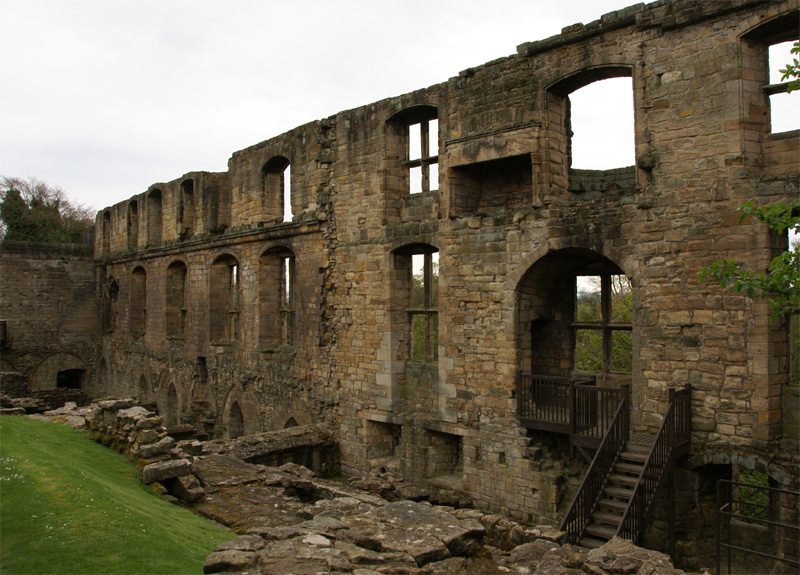
- Dunfermline Palace is the ruined guest house of Dunfermline Abbey in Fife, and its south wall, kitchen and cellars stand above the Lyne Burn with a view over the Firth of Forth.
- Malcolm III made the town his capital, Margaret founded the priory in 1070, and David II and James I were born at Dunfermline, David on 5 March 1324 or, in one account, in 1323.
- James IV remodelled the guest house around 1500, and in 1589 James VI gave the palace to Anne of Denmark, also called Anna, who built the Queen's House in 1600.
- Charles I was born here on 19 November 1600, the last monarch born in Scotland, and Charles II was the last monarch to stay, in 1650, just before the Battle of Pitreavie of 20 July 1651.
- By 1708 the palace was unroofed, the Queen's House was gone by the 1790s, and the ruins are closed while conservation continues.
Visiting
Entry is free, and donations are welcome. From 1 April to 30 September the abbey nave and grounds are open daily from 10:00 to 16:30. From 1 October to 31 March the site is closed on Monday and Sunday, and open from 10:00 to 16:00 on the other days. Last entry is 30 minutes before closing in summer and 45 minutes before closing in winter.
One account gives last entry as 15:45. The site is closed on 25 December and stays closed until 4 January. The palace ruins are closed while conservation works are ongoing, and visitors are not allowed to enter them. The abbey church is a working church, and its opening hours may vary because of services and events.
The abbey church is open for morning worship on Sunday at 10:30. Visitors are asked to book in advance. Visitors with disabilities are charged standard admission rates, and up to two accompanying carers receive free entry. Assistance dogs are allowed to enter.
History
Dunfermline Palace is the ruined royal lodging on the south side of Dunfermline Abbey in Fife, between the church and the gorge of the Lyne Burn. The kitchen, its cellars, and a south wall some 205 feet long and 60 feet high still look over the Firth of Forth, joined to the old monastic rooms by a gatehouse over a pend. The ruins are in state care, together with the other domestic buildings of the abbey, and the palace is closed while conservation continues.
Malcolm III made Dunfermline his capital in the eleventh century, with his own tower a few hundred yards to the west, and his queen Margaret founded a Benedictine priory here in 1070. Their son David I raised the priory to an abbey in 1128, and the later palace stands on the monastic guest house, which was likely a royal lodging from the start. Edward I stayed through the winter of 1303 and 1304, and the damage is placed both in 1303 and in a sack of the domestic buildings in 1304 that may have spared the guest house. Robert I financed the rebuilding and is said to have added a palace.
David II was born on 5 March 1324, though one account of the palace gives 1323, and James I was born at Dunfermline in late July 1394, the son of Robert III and Annabella Drummond. Timber for the royal lodgings was bought in 1429. James IV remodelled the guest house around 1500, a date tied to a fireplace of that year, while another reading holds the conversion into a palace until after 1589. In November 1504 Margaret Tudor left for Edinburgh during a false plague alarm, and the household that went with her included the African women known as the More lasses.
James V and Mary of Guise used the palace, and on 14 June 1562 Mary, Queen of Scots, took out a heart-shaped diamond after dinner and said she would send it to Elizabeth with verses of her own in Italian. After the Reformation the nave became the parish church, and in 1589 James VI gave the palace to Anne of Denmark, also called Anna. She was known as the Lady of Dunfermline, and in 1600 she finished the Queen's House, a tall cruciform block with a pend through the basement, later demolished in 1797 or between 1790 and 1792. She gave birth here to Elizabeth in 1596, to Charles on 19 November 1600, and to Robert in 1602, while a survey of the burgh also names a daughter Margaret in 1598.
Charles stayed on for a year after the court left for London in 1603, a sickly child in the care of Alexander Seton and of Grissal Leslie, also written Grizel, and by July 1604 he could walk the great chamber without a stick. Charles I made only a short visit in 1633, when he came north for his coronation. Charles II stayed in 1650, just before the Battle of Pitreavie, fought on 20 July 1651 and also called the Battle of Inverkeithing, and Anne Halkett met him at the palace. By 1708 the roof had fallen, and the south wall that remains is the view drawn by John Slezer and later engraved by William Miller (engraver).
Images




Detailed History
Dunfermline Palace is a ruined royal lodging in Dunfermline, in Fife, set on the south side of Dunfermline Abbey between the church and the steep gorge that falls toward the Lyne Burn. What remains is the kitchen, its cellars, and a long south wall with a wide view south over the Firth of Forth. The wall is given as 205 feet long and 60 feet high on the outside. A gatehouse over a pend, one of the medieval yetts of the town, joins the palace to the old monastic quarters.
The ground is a south-facing slope about 85 metres above the sea, looking over Pittencrieff Park. The standing church is not part of the same protected area as the domestic ruins. That area takes in the palace, the kitchen, the gatehouse, the refectory, the dormitory range and the latrines. Buried deposits may go back to the tenth century, while most of the standing masonry is of the thirteenth to the sixteenth century.
The designation of those abbey remains is dated 5 December 1994. The ruins are in state care. The palace itself is closed while conservation work continues, and it can be seen from the street.
Documented royal residence at Dunfermline begins in the eleventh century with Malcolm III, later called Canmore, who made the place his capital. He was king of Alba from 1058 until his death on 13 November 1093. His kingdom did not cover the whole of later Scotland: much of the north and the islands was Scandinavian, and south of the Forth there were other realms, including Strathclyde and Bamburgh. He led at least five invasions into English territory.
His own seat was Malcolm's Tower, a few hundred yards west of the later palace, on a summit too narrow for a large house. A dig in 1988 read the tower ruins as probably fourteenth century on the pottery, which does not rule out an earlier royal house on the same rock. A clearance in 1843 found charcoal and an iron coin punch later attributed to David II. In 1883 and 1884 the landowner laid the tower out for display and rebuilt a boundary wall with stone taken from the estate entrance by the palace.
If those tower walls are of the fourteenth century, one survey reads them as a defence for the western approach during the wars with England, while still allowing an older residence underneath.
Malcolm's queen was Margaret, born in Hungary about 1045 into the House of Wessex, and queen from about 1070 until her death on 16 November 1093, three days after him. She married him by the end of 1070. She founded a Benedictine priory at Dunfermline in 1070, on the ground where she had married, and brought a small community of monks from Canterbury, the first Benedictine house in Scotland. She also set a ferry across the Forth for pilgrims going to St Andrews, and the crossings at Queensferry take their name from that work.
Their youngest son, David I, was king from 1124 to 1153. He had spent part of his youth at the court of Henry I of England, and in 1124 he took the kingdom against his nephew Máel Coluim. In 1128 he raised the priory to an abbey and had a great church built. The Romanesque nave that still stands is compared with Durham, and the same masons are thought to have carved it.
The palace that later stood against the abbey occupies what had been the monastic guest house. Medieval abbeys kept several grades of lodging, and it is likely that this guest house was a royal residence from the start. One survey presumes that, if the old castle had been given up for the abbey by the late twelfth century, Alexander III was in that guest house when a ballad places the king in Dunfermline drinking wine.
The First War of Scottish Independence ran from the English invasion of 1296 to the Treaty of Edinburgh–Northampton in 1328, and the second war from Edward Balliol's invasion in 1332 to the Treaty of Berwick in 1357. Edward I of England, king from 1272 to 1307 and called the Hammer of the Scots, stayed at the abbey in the winter of 1303 to 1304, and he is also placed there in 1291 and 1296. One account says he badly damaged the abbey in 1303. Another says that when he sacked the domestic buildings in 1304 he may have spared the guest house where he himself had stayed, because he came back a couple of months later.
At his invasion of 1296 the buildings were already extensive, though it is not known whether they yet included a palace. Robert I, Robert the Bruce, born on 11 July 1274, was king from 1306 until his death on 7 June 1329. He financed a rebuilding after the English damage, and the refectory, raised on the slope, is read as a sign of confidence after the wars. He is also said to have added a royal palace.
He was the first king since the early part of the reign of William the Lion to stay at Dunfermline for any length of time, and he issued six charters there. He was buried before the high altar in 1329, and his heart was carried on crusade and later buried at Melrose. In 2024, the 750th year since his birth, a model of his face was shown in the abbey church. Ground-penetrating radar in the lost choir, a project dated to 2016, 2019 and 2022 and also described as work since 2015 under Michael Penman, found the lines of that choir, settings for the high altar, a southern chapel and aisle of St John the Baptist, signs of later Catholic burial, and more than fifteen possible elite graves, and it reopened the question of where Bruce himself lies.
Those readings belong to the church, not to the palace undercroft.
David II, son of Robert I, was born on 5 March 1324. An architectural account of the palace instead gives his birth in 1323. He became king in 1329 at the age of five, was crowned at Scone in November 1331, and was the first Scottish monarch anointed at his coronation. Edward III backed Edward Balliol, and after the English victory at Halidon Hill in 1333 David and Queen Joan were sent to France until 1341.
In 1336 a council at Dunfermline, meeting either in the guest house or in other abbey buildings, reappointed Sir Andrew Moray as Guardian. David invaded England in 1346 in support of France and was defeated. Robert II, king from 1371 to 1390, issued fifteen charters from Dunfermline, and Robert III, king from 1390 to 1406, issued eighteen.
James I was born in late July 1394 at Dunfermline. His own life places the birth in Dunfermline Abbey, to Robert III and Annabella Drummond. The palace account simply says he was born at Dunfermline, and a survey of the burgh treats both his birth and David II's as belonging to the guest house that later became the palace. He was the youngest of three sons.
His brother David, Duke of Rothesay, died in the keeping of their uncle Robert, Duke of Albany, and another brother, Robert, died young. In the winter of 1405 to 1406 he was sent toward France for safety. In February 1406 he took refuge on the Bass Rock after his escort was attacked, and on 22 March English pirates took his ship and handed him to Henry IV. Robert III died on 4 April, and the boy of eleven was king in captivity.
He remained king until he was killed on 21 February 1437. Timber for the royal lodgings at Dunfermline was bought in 1429, during his reign. There are few records of the conversion of monastic rooms into a palace.
The guest house has been read in more than one way. One architectural reading sets the guest house as two portions, apparently of one build and of the fourteenth century. The western part was lower. The eastern part held the hall.
The western undercroft was not vaulted at first. The eastern undercroft was a vaulted hall of seven bays by two. Both undercrofts were later divided and then given barrel vaults. A fine newel stair on the north is not original and may belong to that division.
The same reading puts the east end at a mixture of round and pointed arches, either the change from Norman to Early English or the early thirteenth century, puts the lower south front in the work of Bruce and his successors in the fourteenth century, and puts the upper south wall in the later fifteenth century. Another account dates the gatehouse and the adjoining guest house to the fifteenth century, the dormitory and reredorter to the late thirteenth century, surviving Edward's destruction, and the refectory undercroft to the 1320s. A third account, from trenches dug in 1975, sees three periods in the standing work: first the refectory and the south-west range, then the pend that links them, then the alteration of that range into a royal palace at the turn of the sixteenth and seventeenth centuries. Excavation in 1855 found the east and north foundations of the refectory and a passage in its west gable.
Work in 1920 to 1924 exposed a fragment of the dormitory undercroft and the reredorter, and the refectory foundations again. The west range of the cloister has gone. A stair tower remains where it met the refectory. A stable and byre replaced that range in 1753, and those buildings were taken down in 1822 when the ground was levelled.
James IV was king from 11 June 1488, when he was fifteen, until he was killed at Flodden on 9 September 1513. His father, James III, had died at Sauchieburn in the rebellion that put the son on the throne. James IV built up the navy, including the ship Great Michael, the largest warship of her time, and he patronised print, the university at Aberdeen, and the surgeons in Edinburgh. He and Margaret Tudor stayed often at Dunfermline.
Around 1500 he remodelled the monastic guest house into the form that the surviving walls largely still show. In 1507 he came to the palaces and gave tips to the masons and craftsmen. A fireplace dated to 1500 is the evidence for reading some of that work as his, and one survey says only that he may have carried it out. The same survey holds the enlargement of the guest house into a palace until after 1589.
The heritage account of the site says a new palace was made after the Reformation out of the guest house and the west range.
Margaret Tudor, born on 29 November 1489, was the eldest daughter of Henry VII and Elizabeth of York and the elder sister of Henry VIII. She married James IV in 1503, at thirteen, under the Treaty of Perpetual Peace, and she was queen until Flodden. They had six children, of whom one, James V, reached adulthood. Through her the Stewart line later reached the English throne.
In November 1504 she was at Dunfermline while James IV was in the north. Two people were suspected of plague. She left for Edinburgh with her household, including African women known as the More lasses, who went first to Inverkeithing. The alarm was false.
After Flodden she was regent for her son and fought to keep that regency. She died on 18 October 1541.
James V was born on 10 April 1512 and became king on 9 September 1513, at seventeen months. He was crowned on 21 September. His mother was regent until she remarried, and then John Stewart, Duke of Albany, governed. James escaped the custody of his stepfather, Archibald Douglas, sixth Earl of Angus, in 1528, exiled Angus, and began to rule.
He founded the College of Justice in 1532. He and his second wife, Mary of Guise, used Dunfermline Palace. A stone carved with his arms impaled with hers, Marie de Guise, was built into a stable in 1790 and is now shown in the visitor centre at the abbey. Mary of Guise, also Mary of Lorraine, was born on 22 November 1515 into the House of Guise, married James in 1538, and was queen until his death on 14 December 1542.
She was regent for their daughter from 1554 until her own death on 11 June 1560. Annie Cameron, later Annie Dunlop, born in Glasgow on 10 May 1897 and died on 23 March 1973, edited the Scottish correspondence of Mary of Lorraine and the calendar of Scottish state papers for 1593 to 1595. That correspondence is the published body of Guise's Scottish letters, and the later calendar is where the queen's Dunfermline household of the 1590s is listed.
Mary, Queen of Scots, was born on 8 December 1542, six days before her father died, and she was queen from 14 December 1542 until she was forced to abdicate on 24 July 1567. She was sent to France in 1548 during the Rough Wooing, married the dauphin Francis in 1558, was queen consort of France from 1559 until his death in December 1560, and returned to Scotland in August 1561. On 14 June 1562, after dinner at Dunfermline, she produced a gold ring set with a heart-shaped diamond and said she would send it to Elizabeth with verses she had written herself in Italian. A meeting of the two queens was being discussed at that time.
She was executed on 8 February 1587. The Scottish Reformation had already broken the old church. In 1560 the Lords of the Congregation took the government, and the Reformation Parliament rejected papal authority and set a Protestant confession. James VI ratified those acts in 1567.
John Knox led a Presbyterian and largely Calvinist kirk. After 1560 the abbey nave became the parish kirk, and the choir was left to fall. A new parish church was built on the choir between 1818 and 1821.
George Durie, born about 1496 and died in 1577, was abbot of Dunfermline and archdeacon of St Andrews, a son of John Durie of Durie in Fife and brother of Andrew Durie, bishop of Galloway. From 1527 to 1530 he acted at Arbroath and used the title of abbot of Dunfermline under his uncle, Archbishop James Beaton. When Beaton died in 1539, James V gave him the office in full. The carved stone from the palace is described differently: it carries his arms as commendator from 1526 until he fled abroad in 1560.
In 1812, during repairs by the laird of Pittencrieff, that stone was found. It had formed the ceiling of an oriel window on the second storey and bears a carving of the Annunciation. It is now in the visitor centre. In 1997 the surviving capstone of the eastern oriel was noticed to have a carved underside, possibly of the same kind as the fallen western capstone.
From 1500 the abbey had been held by commendators who took the revenues. In 1589 James VI granted the monastery to his wife.
James VI was born on 19 June 1566, the son of Mary, Queen of Scots, and he became king of Scots on 24 July 1567, at thirteen months, when she abdicated. He was raised as a Protestant. He was king of England and Ireland as well from 24 March 1603 until his death on 27 March 1625. The Union of the Crowns was that accession, after the death of Elizabeth I, and it was a personal union.
England, Scotland and Ireland kept their own parliaments, laws and courts until the Acts of Union of 1707 joined England and Scotland. There was a republican interval in the 1650s. In June 1585 James stayed at Dunfermline Palace to avoid plague in Edinburgh, and he had a proclamation made to set the prices of food, drink and lodging for his courtiers in the town. David Masson, born on 2 December 1822 and died on 6 October 1907, edited the register of the privy council from 1879 and became Historiographer Royal for Scotland in 1893.
The volumes of that register contain the 1585 proclamation and, later, the order of 1602 that stopped the ferries.
Anne of Denmark, also Anna, was born on 12 December 1574, the second daughter of Frederick II of Denmark and Sophie of Mecklenburg-Güstrow. She married James on 20 August 1589, at fourteen, and she was queen of Scotland from then, and queen of England and Ireland from 1603, until her death on 2 March 1619. She used Scottish faction against James over the custody of Prince Henry and over his treatment of her friend Beatrix Ruthven. The couple grew apart and lived apart, though the marriage continued.
In 1589 the palace was given to her as a wedding present. James had to compensate the Master of Gray, who held the title of abbot or commendator, and he assigned him 12,000 merks out of a subsidy paid by Elizabeth I. Anne was given the lands that had belonged to the abbey, and in charters she is the Lady of Dunfermline. The burgh had remained with the abbey's lay commendators.
A charter of 1588 has been claimed as the act that made Dunfermline a royal burgh, but that reading is rejected as a mere confirmation of older privileges. The annexation of the abbey to the Crown in 1593 is the step after which the burgh sat in parliament, from 1594. In February 1596 Alexander Seton, Lord Urquhart, was appointed her bailie and the keeper and constable of the palace. Seton, later first Earl of Dunfermline, was born in 1555 and died on 16 June 1622.
He was lord president of the Court of Session from 1598 to 1604 and lord chancellor from 1604 until his death.
The household included the keeper John Gibb, the chamberlains David Seton of Parbroath, William Schaw and Henry Wardlaw of Pitreavie, the gardener John Lowrie, the plumber James Coupar, who mended the lead roofs, and Thomas Walwood, foreman of the coal pits. An English musician, John Norlie, played for the queen, and her fool was Tom Durie. William Schaw, about 1550 to 1602, was master of works to James VI and to Anne, and he worked on the palace in 1590 to prepare it for her. Anne sometimes went between Edinburgh and Dunfermline by boat and took meals at South Queensferry.
She improved the house through the decade. In 1599, when George Bruce took lands near the town, he undertook to carry sand to the building works. In 1600 she finished a new building called the Queen's House, also Queen Anna of Denmark's House and the Queen's Jointure House. It was demolished in 1797 in one account.
In another it was already ruinous late in the eighteenth century and was taken down between 1790 and 1792: it appears on a sketch plan by Baine in 1790 and is absent from a drawing of the west front by Edward Dayes in 1792. The new work was cruciform and tall, with a carriage pend through the basement in place of an older gateway. That arrangement is compared with the house at Greenwich, also built over a road. A Latin inscription, now lost, recorded that the gateway and a temple-like superstructure had been rebuilt for Anne.
Charles McKean, the architectural historian born on 16 July 1946 and died in Edinburgh on 29 September 2013, discussed Dunfermline Palace and Stirling Castle in the time of Mary of Guise and of Anne. That discussion was published in 2014, after his death, as a paper on the separate lodgings of a prince and a princess. Houses for the senior officers of Anne's estates stood near the west front of the abbey. There was a tennis court in the old cloister.
In 1760 Bishop Pococke was shown the place of the skaipell, or tennis court, between the monastic refectory and the abbey tower.
The palace filled three sides of a triangular court at the south-west corner of the abbey and took in the west range of the cloister. The south-west range was the extended guest house, joined at its east end to the gatehouse. The Queen's House stood at the north angle, close to the south-west tower of the abbey, and it contained the main gate from St Catherine's Wynd. A north-west range ran from the Queen's House to the west end of the south-west range.
East of the Queen's House was the Constabulary and Regality House, where the regality court met. Of the south-west range, the east end is an undercroft with a kitchen above, read as the late fifteenth-century guest house, and the west end was rebuilt in the late sixteenth century for Anne and may have held her chamber. Another reading says the walls were cut down to the lowest floor and rebuilt to their present height for her. Only the facade and the undercroft of that range still stand.
Drawings and engraved views show battlements and stair towers with conical roofs. A seventeenth-century drawing of the palace and the abbey is by John Slezer. An engraving of the palace seen from the Lyne Burn is by William Miller (engraver).
Anne gave birth at the palace to Elizabeth in 1596, Charles in 1600 and Robert in 1602, attended by her German physician Martin Schöner. A survey of the burgh adds a daughter Margaret in 1598, and calls Elizabeth the later Winter Queen of Bohemia. Anne's own life counts three children who lived past infancy: Henry Frederick, Prince of Wales, who died before his parents; Elizabeth, who became queen of Bohemia; and Charles. Elizabeth Stuart was named for Elizabeth I.
She was the elder sister of Charles, and part of the Gunpowder Plot, unknown to her, was a scheme to put her on the throne in her father's place. Robert, born in 1602, died in infancy. The last royal burial at Dunfermline is given as an infant son of James VI in 1602, perhaps in a vault Anne made outside the east end of the south side of the nave, which she granted to Sir Henry Wardlaw of Pitreavie in 1616. At Charles's birth in November 1600 a new bed of green velvet and taffeta was made for Anne.
His life dates the birth to 19 November 1600. Margaret Douchall, wife of Jerome Bowie, attended the queen. The nursery was run by Margaret Stewart, Mistress of Ochiltree. Isobel Colt was one of the nurses.
It is said that Margaret MacBeth, widow of Henry Durie of Craigluscar, brought herbal remedies and was present at the births.
Tom Durie, also Duri, Dury and Derry, is on record as Anne's fool from about 1600 to 1634. A story written down in 1623 by Thomas Rant, a Roman Catholic, from a Mr Gray, places him at the palace in 1600. Anne was pregnant with Charles and asked to hear Mass at night. The fool watched and told James it had been a midnight feast.
James was jealous, and then satisfied when he heard it was the Mass. Rant told the story to show that James was indifferent to his wife's religion, which was often said to lean toward Rome. In May 1603 Durie was bought a green cloth coat to go with Anne to England after the union. In 1604 his keep was paid to John Gibb.
On 3 October 1604 the queen's secretary, William Fowler, wrote that Thom. Ducie was missing and that there was no news of his wandering. In August 1607 James was amused by a letter from Robert Cecil about a courtier's promotion in Anne's household, and the reply said Cecil was so good a fool that he need only fear Thom. Durey.
James himself called Cecil his little beagle, or young Tom Durie. In 1614 Anne had Durie painted by Marcus Gheeraerts the Younger, and again at full length by Paul van Somer. The Gheeraerts portrait is displayed in Edinburgh. At Denmark House in 1619 his picture hung in the passage between the queen's withdrawing room and the gallery.
Under Charles I that space was painted and the accounts mention the colouring of Tom Derry's gallery. A 1649 inventory at Somerset House gives the gallery picture to Van Somer. Another portrait hung in the north gallery at Oatlands, was sent to be reframed, and was then missing. In the 1630s the Gheeraerts painting was in the queen's gallery at Greenwich with portraits of Anne's Danish family.
A note by Fowler for the portrait includes the Latin line that he hated a drinking companion with a good memory. The meaning of the large silver cup in the picture is unknown. Durie was given mourning clothes when Prince Henry died in 1612. In that year his weekly board, and that of John Mawe, his man, was seven shillings.
A list of horses in 1618 includes mounts for Archie Armstrong, for Thom. Derry, and for John Mawre, his keeper. In June 1619 a grey nag was bought for him for twelve pounds, and he was by then the king's fool. He was still being boarded in 1620 at nine shillings and sixpence a week.
The last payment to John Maure for his keep was in June 1634.
In November 1601 Anne prepared a lodging for Princess Elizabeth, but the girl stayed at Linlithgow because the king ordered it. Outside Anne's bedchamber a steep stair dropped away, and in March 1602 the English courtier Roger Aston fell down it and was unconscious for three hours. There was again a fear of plague in Edinburgh. The privy council did not want the sickness to reach the ordinary residence of the queen and of the children.
Ferry crossings to and from Dunfermline were stopped, except for councillors and household servants who carried a clean bill of health.
After the union in 1603 the court moved to London and a monarch rarely came back. Prince Charles, a sickly child, stayed at Dunfermline for a year. His guardians were Alexander Seton and his wife, written both as Grissal Leslie and as Grizel Leslie. Jane Drummond, later Countess of Roxburghe, looked after him.
An older woman, Marion Hepburn, rocked his cradle. Hepburn had already rocked the cradles of his sisters Margaret and Elizabeth. He was slow to walk. He was given an oak stool with running wheels, described in Scots as a tymber stule with rynand quheillis to gang in.
Robert Carey came to Dunfermline, stayed with Seton, and wrote that the prince was a very weak child. In July 1604 Dr Henry Atkins wrote to Anne from Dunfermline that Charles could walk the length of the great chamber, also called the longest chamber, several times a day without a stick, like a gallant soldier all alone, and that without a staff he was not so bold as Ajax but as wary as Ulysses. Atkins said the journey to England began on 17 July 1604, crossing the Forth to the lord secretary's house near Edinburgh. Seton and Grizel Leslie brought him south.
He met his parents at Easton Neston and was lodged at Oatlands Palace. Carey and his wife were appointed to look after him.
That wife was Elizabeth Trevannion, later Countess of Monmouth, who died in 1641. She was the daughter of Hugh Trevannion of Caerhays and Sybilla Morgan, and she first married Sir Henry Widdrington, who died in 1592. She married Robert Carey on 20 August 1593. They were first cousins.
She lived with him at Carlisle Castle, where he was deputy to Lord Scrope, then at Widdrington, then at Denham near Uxbridge, where their son was born in January 1596. After the union she was sworn a lady of the privy chamber and mistress of the sweet coffers, in charge of perfuming Anne's wardrobe, probably on 2 July 1603 at Windsor, when the great ladies paid homage and the Knights of the Garter were installed. In November 1603 the Spanish ambassador, the Count of Villamediana, asked the Duke of Lennox and the Earl of Mar to bring the Scottish ladies to dinner. Jane Drummond, Anna Hay and Lady Carey went.
He gave Carey Spanish leather gloves and afterwards a gold chain that went twice around her neck. On 23 February 1605 she was made governess of Prince Charles, now Duke of York. Between 1604 and 1611 he learned to ride and to shoot in the Careys' care. Her daughter Philadelphia was brought up with Princess Elizabeth at Coombe Abbey.
Carey was made Earl of Monmouth in 1626. Elizabeth died in 1641 at Monmouth House in Watford and was buried at Rickmansworth.
Several servants came south from Dunfermline with the prince and were pensioned: Marion Hepburn, the seamstress Joan Drummond, the laundress Agnes Fortune, the chamber-door keeper George Kirke, and the cook John Lyle. In 1605 Agnes Fortune said that Thomas Percy, one of the Gunpowder plotters, had asked her about Charles's lodging at Whitehall and about his movements. She knew Percy's face because she had seen him with Lady Carey at Greenwich. She told him that Lady Carey had changed the way from the hall to the duke's rooms to make it more private.
Thomas Winter's confession says Percy meant to carry the duke away after the explosion at the House of Lords. A Latin narrative of the plot, sent to Christian IV of Denmark, mentions that plan.
Ten tapestries from the royal collection were still at Dunfermline in 1616, left from the time the infant Charles had lived there. In 1618 John Taylor, the Water Poet, spent a night in the house of John Gibb, keeper since 1584, which is taken to have been part of the palace. He called it the queen's palace, a delicate and princely mansion, and he saw the ruins of an old abbey, with fair gardens, orchards and meadows belonging to the palace. When Anne died in 1619 the palace and her Scottish lands passed to Prince Charles.
A new great seal of the lordship was made, and the new great house his mother had built was repaired. On 25 May 1624 a fire devastated the town, and Prince Charles sent five hundred pounds sterling in aid. After that fire the town was treated as his, inherited from his mother. In February 1633 Lord Traquair, the treasurer depute, inspected Linlithgow Palace, Dunfermline Palace and Stirling Castle and estimated repairs before a royal visit.
The last recorded repairs are those of 1633. Charles I came back to Scotland in 1633 for his coronation and made only a short visit to the place where he was born. He had become heir in 1612, when Henry Frederick died. He was king of England, Scotland and Ireland from 27 March 1625 until he was executed on 30 January 1649.
He was the last monarch born in Scotland. Royal interest in Dunfermline had already thinned when James and Anne left for London in 1603, and the palace then declined.
The last monarch said to have occupied the palace is Charles II, who stayed at Dunfermline in 1650, just before the Battle of Pitreavie. Anne Halkett described meeting him there. Charles II was born on 29 May 1630, the eldest surviving child of Charles I and Henrietta Maria. After the execution, the Parliament of Scotland proclaimed him king on 5 February 1649.
Another account of the same proclamation gives 6 February 1649. England was then a republic under a government that Oliver Cromwell came to lead. Cromwell invaded Scotland in July 1650. The Scottish army under David Leslie would not fight until 3 September, when it was beaten at Dunbar.
The English took Edinburgh, and the Scots held the line at Stirling. On the night of 16 to 17 July 1651 Colonel Overton landed about two thousand men on the north shore of the Forth. By 20 July the parliamentarian force was about four thousand five hundred, dug in on the Ferry Hills, facing about the same number of Scots on Castland Hill under James Holborne, also written Holburne, with the cavalry under Sir John Browne. The battle that followed is the Battle of Inverkeithing, fought on 20 July 1651, and it is also called the Battle of Pitreavie, because the Scottish infantry fell back north toward Pitreavie Castle and made a last stand there.
John Lambert commanded the English force. One account of the lands of Dunfermline says that neither Charles II nor Cromwell was on the field. The Scots were overrun. It was the last major battle of the Wars of the Three Kingdoms in Scotland, and from 1652 the country was under the Protectorate.
Cromwell then beat Charles at Worcester on 3 September 1651, and Charles left for the continent. The stay at the palace in 1650 therefore sits in the year of the invasion and of Dunbar, and the palace account places it just before Pitreavie, while the battle itself is dated to the following July.
Anne Halkett, born Anne Murray about 1623 and died in 1699, was an English religious writer. Her father, Thomas Murray, had been tutor to the children of James VI and later provost of Eton. Her mother, Jane Drummond Murray, had been governess to those children. Anne was taught French, dancing, medicine, music, needlework, religion and surgery.
She came to Scotland and met King Charles at Dunfermline Palace, which is the meeting the palace account places in 1650. Before that, during the civil war, she had helped Colonel Joseph Bampfield to take James, Duke of York, later James II, out of parliamentary captivity, disguising the boy as a woman. She later found that Bampfield's wife was still alive. She practised medicine at Kinross and at Fyvie.
In 1656 she married Sir James Halkett. She wrote an autobiography around 1677, meditations, and a mother's will to her unborn child. When her husband died she taught the children of noble families, and James II gave her a pension for the help she had given him in the war. She left twenty-one manuscript volumes, written between 1644 and the late 1690s.
Soon after the Cromwellian occupation the palace was abandoned, and by 1708 it had been unroofed. One account says that part of the walls and the roof fell in 1708, and that only the Queen's House was still in use. The north-west range was removed during the eighteenth century. John Slezer, a German-born military engineer and artist, whose life is headed as before 1650 to 1717 and whose death is also given as 24 June 1714, arrived in Scotland in 1669.
He was surveyor of the king's stores and magazines, and as captain of the artillery company he drew views of castles, abbeys and towns that became the Theatrum Scotiae, first published in 1693. He was made captain in 1688 and imprisoned that year as a supporter of James VII after the king was deposed in favour of William III and Mary II. He was released the next year. Sales were poor.
He asked for a grant to continue the work as Scotia Ilustrata, which was never finished, and he spent his last years in the sanctuary of Holyrood Abbey to escape his debts. He married Jean Straiton of Dundee. His drawing is the seventeenth-century view of the palace and the abbey. William Miller (engraver), born on 28 May 1796 and died on 20 January 1882, was an Edinburgh Quaker, a line engraver and a watercolourist, apprentice to William Archibald from 1814 and then, from the end of 1819, to George Cooke in Hackney.
He became one of the principal engravers after Turner. His plate is the view of the palace from the Lyne Burn, made when the Queen's House had already gone and the south wall stood alone.
In 1871, after a long dispute, the Crown obtained the ruins from the Pittencrieff estate. In 1975 T. M. Robertson opened three trenches at the pends for the department then responsible for the works, so that the ground could be landscaped, the later soil taken down to the medieval surface, and the full height of the late medieval facade exposed.
Medieval flooding and the narrow trenches stopped a full reading, especially of the first trench. In the third trench the line of the destroyed north-east wall of the palace block was found at about a metre and a half down, as ashlar running diagonally. A ruined return wall and a mass of mortared masonry were read as a possible porch of the first period, with a ground surface at about two metres that the excavator took for the original level. The refectory buttresses were underpinned with rubble.
The possible porch was also reported at a depth of a metre and a half, and it is possible that the north-west range still lies under the present ground. In 1994, before a new drain, six trenches were watched outside the south wall. The deposits under the topsoil grew deeper toward the west, where there may be midden. They were left unexcavated because the drain did not threaten them.
In 2025 the abbey, not the palace wall, was inspected at height. Teams abseiled and used a platform of 73 metres to check the masonry by hand. The spire, about 40 metres high, was among the tallest structures in that round of inspections.
The palace was a royal house for the Stewart court while the court still lived in Scotland, and it was Anne's own house in the years when three kingdoms were about to share one king. What a visitor sees now is the south wall and the kitchen cellar of that house, shut for conservation, with the abbey nave and the later parish church still open beside it.
Sources
- Dunfermline Palace — Wikipedia
- Dunfermline Abbey and Palace — Historic Environment Scotland
- History and stories, Dunfermline Abbey and Palace — Historic Environment Scotland
- Plan your visit, Dunfermline Abbey and Palace — Historic Environment Scotland
- Visit us — Dunfermline Abbey
- Dunfermline: from Saracen castle to populous manufacturing royal burgh — Proceedings of the Society of Antiquaries of Scotland
- Recent excavations at Dunfermline Abbey, Fife — Proceedings of the Society of Antiquaries of Scotland
- Dunfermline Palace — Trove
- Dunfermline Abbey (SM90116) — Historic Environment Scotland
- Uncovering forgotten history and shaping a sense of place — University of Stirling
- Battle of Inverkeithing — Wikipedia
- Battle of Inverkeithing II — Trove
- Lands of Dunfermline — Royal Dunfermline
- Battle of Pitreavie — South Dunfermline Community Council
- John Slezer — Wikipedia
- Tom Durie — Wikipedia
- William Miller (engraver) — Wikipedia
- Anne Halkett — Wikipedia
- Annie Cameron — Wikipedia
- Charles McKean — Wikipedia
- David Masson — Wikipedia
- Elizabeth Trevannion — Wikipedia
- James I of Scotland — Wikipedia
- David II of Scotland — Wikipedia
- Anne of Denmark — Wikipedia
- Charles I of England — Wikipedia
- Charles II of England — Wikipedia
- Mary, Queen of Scots — Wikipedia
- Union of the Crowns — Wikipedia
- The second battle of Inverkeithing — Stewart Society
- Dunfermline Palace south wall and Gatehouse.JPG — Wikimedia Commons
- Dunfermline Palace Southern View.jpg — Wikimedia Commons
- Dunfermline Palace engraving by William Miller after W Brown.jpg — Wikimedia Commons
- Scotland Dunfermline 20070725 0034.jpg — Wikimedia Commons
- DunfermlinePalace.jpg — Wikimedia Commons
- Dunfermline Palace 20080503 from north west.jpg — Wikimedia Commons
- Dunfermline Palace 20080503 from east.jpg — Wikimedia Commons
- Dunfermline Palace 20080503 annunciation stone.jpg — Wikimedia Commons
- Dunfermline Palace and Abbey - geograph.org.uk - 129154.jpg — Wikimedia Commons
- Dunfermline Palace (ruin) - geograph.org.uk - 809827.jpg — Wikimedia Commons