
Moray, United Kingdom · 1140 CE · United Kingdom
- Duffus Castle, near Elgin on the Laich of Moray, was a motte-and-bailey fortress and residence from the twelfth century until the early eighteenth.
- Freskin raised the earth and timber castle after Oengus of Moray was defeated in 1130, and a stone keep later replaced it.
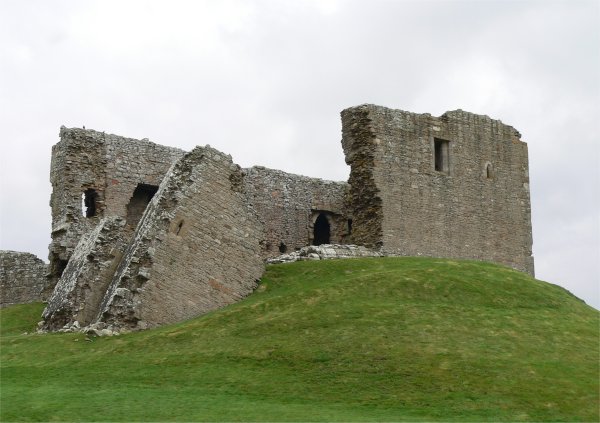
- The north wall of the keep slipped down the mound, and the household moved to a range in the bailey.
- James Sutherland, 2nd Lord Duffus, entertained Viscount Dundee here in 1689, before the Battle of Killiecrankie.
- Digs in 1984 and 1985 found twelfth-century occupation and later masonry, and the castle is free to enter all year.
Visiting
Admission is free, and the site is open year round. Visitors are allowed to enter by the older bridge around the moat.
History
Duffus Castle, near Elgin, stands on the Laich of Moray, the low coastal plain that was once the boggy foreshore of Spynie Loch. It was a motte-and-bailey fortress and a residence from about 1140, a date also given as about 1150, until it was left as a dwelling in the early eighteenth century. It is the best-preserved castle of that form in state care, second only to the Mote of Urr, and it keeps one of the finest stone keeps in Scotland.
The timber castle followed the revolt of Oengus of Moray, also called Óengus, against David I of Scotland in 1130. Oengus, the last king of Moray of the native line and a grandson of King Lulach, invaded with Máel Coluim mac Alaxandair and five thousand men while David was at Woodstock. They were defeated at the Battle of Stracathro by Edward Siwardsson, and the figures for the dead are given both as four thousand of Oengus's army and one thousand of Edward's, and as four thousand Moravians and one thousand Gaels.
David then settled Moray with men he trusted. Freskin, who died before 1171, is treated as a Fleming already holding Strathbrock in West Lothian, and also, less probably, as an Anglo-Saxon or a Scot who had fought for the king. He held Duffus, Roseisle, Inchikel, Machir and Kintrae from David, and he raised the earth and timber castle on a man-made motte with a palisaded summit and a lower bailey for the brewhouse, bakehouse, stables and workshops. David is placed at Duffus in the summer of 1151, inspecting work at Kinloss Abbey, and the castle is treated as certainly standing by that visit.
Freskin's son William took the name de Moravia. By 1200 the family was among the most powerful in the north, a judgment also given as the early thirteenth century, and from them came Clan Murray and the earls of Sutherland. They are credited with Saint Peter's in the kirktoun, their burial place and, with the castle, one of the two centres of the medieval parish.
A church on the old parish site is separately placed in the ninth century. The house later held Bothwell on the Clyde.
Around 1270 the castle passed by marriage to the Cheynes of Inverugie. Sir Reginald le Chen, who died before November 1312, married Mary, also called Mary de Moravia, in about 1269 or 1270. He was sheriff of Inverness in 1297.
His son, another Reginald, was taken at the Battle of Dunbar, freed in 1299, and sealed the Declaration of Arbroath in 1320. That younger lord died in 1345, a death also placed about 1350, and his heiress, called both Mary and Mariot, married Nicholas Sutherland.
What happened in 1297 is not agreed. The timber castle may have been destroyed in the wars of independence, it is said to have been burnt by the Scots, and it is said to have been burnt by the forces of Edward I of England. In 1305 that king granted Reginald two hundred oaks from Longmorn and Darnaway, a grant also told as oaks from Darnaway alone, to build his manor of Dufhous. The wood is read as repair for the timber castle or as floors, roofs and scaffolding for the stone one.
Robert the Bruce is tied to the castle in three ways. It might have suffered in his Moray campaign of 1306. His northern war of late 1307 and 1308 is said to have included the taking of Duffus Castle before the Battle of Inverurie in May 1308.
A third account, set in 1308, says it is not known whether he attacked the Cheynes here at all. The stone keep is placed in the early fourteenth century, in the late thirteenth or early fourteenth, about 1305, or about 1320.
The keep is called both a two-storey tower and a three-storey tower. It was not vaulted. Floors ran on timbers spanning twelve metres, also given as eleven metres, with a portcullis at the single ground-floor door and two doors from the upper floor onto the curtain walk.
The north-east corner collapsed because a heavy stone tower had been set on a mound made for timber, and a slice of the north wall still lies at the foot of the motte. Repairs to cracks and window arches had been made before that wall went.
The household moved to a range on the north side of the bailey, with kitchen, cellars, hall and an oven of clay and stone. That range is called fifteenth-century work, perhaps begun when the keep was abandoned around 1350, and it is also placed as late as the seventeenth century because part of it sits in the motte ditch. A period note adds a sack in 1452, with later alterations. The outer wet moat, enclosing about eight acres, may be a garden boundary of the sixteenth or seventeenth century, or a work of the castle's last years.
Nicholas Sutherland, second son of Kenneth de Moravia, fourth Earl of Sutherland, held Duffus after the Cheynes. Kenneth himself had been killed at Halidon Hill on 19 July 1333, before the castle passed. In 1370 Nicholas killed two Mackay chiefs in their sleep at Dingwall, and in 1408 he was named lord of the castle of Duffus. The Sutherlands kept the place until the early eighteenth century and altered it further.
James Sutherland, second Lord Duffus, died on 24 September 1705. In 1689 he entertained John Graham, Viscount Dundee, just before the Battle of Killiecrankie, where Dundee was killed on 27 July. One account moves the family to Duffus House soon after that visit.
Another holds the move to 1705, when the castle had become unfit to live in, and the abandonment is also put in the late seventeenth century and in the early eighteenth. In 1793 there was still a fruit garden inside the ditch. The sale to the Dunbars is placed in 1712, in the seventeenth century, and shortly after 1793.
The castle came into state care in 1925, also given as 1926, and clearance then was concentrated on the motte, its ditch and the hall, leaving most of the bailey untouched. Digs in 1984 and 1985 found twelfth-century occupation and a masonry phase of the fourteenth and fifteenth centuries. Later watching briefs, in 2001, 2002, 2007 and 2014, traced the buried west wall, an older land surface, and a steeper original moat, and they found no significant new objects.
Mortar was sampled in 2018, with no date published from it. Two coins found to the east in 1992, a halfpenny of John Balliol and a half-groat of Robert III, went into the national collection.
William Douglas Simpson, the Aberdeen historian of castles, reconsidered Duffus with Rait and Morton in 1958 and 1959. He dug at other castles and is not recorded as an excavator here. The mound, the fallen north wall and the open bailey remain the visible history of a seat that began in a conquered province and ended as a ruin above a drained loch.
Images


Detailed History
Duffus Castle stands near Elgin in Moray, on the Laich of Moray, the rich coastal plain also called the Laigh of Moray and, locally, the Laich o' Moray. The plain runs from Fochabers to Brodie and takes in Elgin, Forres, Lossiemouth, Burghead, Hopeman and Lhanbryde. Laich is the Scots word for low-lying land. The castle was a motte-and-bailey fortress and a residence, in use from about 1140 until 1705, and it was altered many times across those centuries.
The ground it occupies was boggy foreshore of Spynie Loch, then a sea loch, and the bishops of Moray had their house at Spynie on the opposite shore. Long after the loch was drained, the flat fields make the site look less defensive than it once was. For much of its history the castle stood on the north bank of that loch. The parish name Duffus, in Gaelic Dubhais, is read as a joining of dubh and uisg, dark water or black water, and the loch and stagnant pools were once the conspicuous feature of a district that had lain below the sea.
The place is one of the finest motte-and-bailey castles in Scotland, and it is the best preserved of that form in state care, second only to the Mote of Urr in Galloway. It is also credited with one of the finest stone keeps in the country. The surviving remains are a high man-made motte, separated from a larger but lower bailey on the east by a broad deep ditch, with a ruined masonry keep on the mound and a stone curtain along the edge of the bailey. Low ground around the whole work is encircled by a water-filled moat.
The protected area is an irregular oval, at most about 235 metres from east to west and 240 metres from north to south, taking in the boundary ditch and everything inside it.
The castle was a fortress-residence for more than five hundred years, from the 1100s to the 1700s. At its establishment it was among the most secure fortifications in Scotland. By the time it was given up it was a decaying ruin, though the mound and the broken red sandstone keep still rise abruptly from the level Laich. It was added to the schedule of monuments on 26 September 1996 as a secular castle.
The timber castle belongs to the years after a revolt in Moray. Oengus of Moray, also written Óengus, Oenghus mac inghine Lulaich and king of Moray, was the last king of Moray of the native line. He was the son of a daughter of King Lulach, which is perhaps how he came to rule the men of Moray, and his last known predecessor was his uncle Máel Snechtai, who died in 1085. If he ruled through that whole gap, he was the king who incurred the wrath of Alexander I when the people of Moray killed Ladhmunn, Alexander's nephew.
In 1130 he led a rebellion against David I of Scotland. He and David's nephew Máel Coluim mac Alaxandair invaded with five thousand warriors. David was then in southern England, at Woodstock, sitting as a judge in the treason trial of Geoffrey de Clinton. His wife, Matilda of Huntingdon, died in that same year, and the rising is placed while he was still away.
The rebels advanced into Angus and were met by David's general, an old Anglo-Saxon noble and Mercian constable, Edward Siwardsson, also named simply Edward. The fight is the Battle of Stracathro, near Brechin. One reckoning says that four thousand of Óengus's army died, Óengus among them, and that one thousand of Edward's army died as well. Another reckoning says that four thousand Moravians were killed and only one thousand Gaels.
Edward then marched into Moray, which lacked a defender and a lord, and obtained that wide district. Máel Coluim escaped. Four further years of civil war followed, a struggle for survival on David's side. Henry I sent a fleet and a large force of Norman knights, Walter Espec among them, to Carlisle.
The fleet was used in the Irish Sea, the Firth of Clyde and along the Argyll coast, where Máel Coluim was probably among supporters. In 1134 Máel Coluim was captured and imprisoned in Roxburgh Castle.
How long Moray itself took to pacify is not known. David appointed his nephew William fitz Duncan to succeed Óengus, perhaps in compensation for the coming of age of David's son Henry, which closed the nephew out of the royal succession. William may have been given Óengus's daughter in marriage. The burghs of Elgin and Forres may have been founded at this point, and David founded Urquhart Priory, possibly as a thanksgiving house, and assigned it a share of his tribute from Argyll.
William fitz Duncan's death is placed in 1147, and after that death Moray is described as colonised, to some extent, by David's French, Flemish and English followers, most of whom in the longer term became Gaelicised. In the 1120s, before this war, David's power outside his Cumbrian principality and the southern fringe of the kingdom had been slight. He was a Scoto-Norman king, the label used for the kings from his reign to the Stewarts, and the same label covers Norman, French, Flemish and Breton people settled in medieval Scotland and the habits formed where their culture met Gaelic society.
David began to settle the province with men he could trust. Among them was Freskin, a nobleman probably of Flemish origin, already holding Strathbrock, now Uphall, in West Lothian. He is called a Flemish soldier and Lord of Strathbrock, a Fleming who came north in the first half of the 1100s, and the progenitor of the Murray and Sutherland families. He died before 1171.
The name Freskin is Flemish, and Flemish origin is treated as virtually certain: he belonged to a large group of Flemish settlers who arrived in the middle decades of the twelfth century and were found especially in West Lothian and the valley of the Clyde. He was one of several Flemings given lands in Moray in an attempt to replace a native Gaelic nobility that had resisted the kings and, above all, had risen in 1130 under Angus, Earl of Moray, the same Oengus.
Other origins are left open and are called unlikely. He may have been an Anglo-Saxon, or a Scot, who fought for David and for Edward Siwardsson in Moray. When Flemish nobles were identified by nationality in writs, which was rare, they were styled Flandrensis. Freskin appears in no contemporary source, and he was never referred to by a national origin.
A charter of William the Lion to one of his sons shows that Freskin had held from David the lands of Strathbrock in West Lothian and, in Moray, Duffus, Roseisle, Inchikel, Machir and Kintrae. One claim is that he married a woman who asserted descent from the old royal line of Moray, so as to legitimise the lands he had been given. He probably had only one son, William. Hugh and Andrew are sometimes called his sons and sometimes treated as sons of William instead.
Freskin built the great earthwork and timber motte-and-bailey on the boggy Laich. The building is placed in about 1140 and in about 1150, and he is said to have been sent north as the king's representative after the 1130 rising and given the estate of Duffus, where he built an earthwork-and-timber castle. The castle was certainly in existence by the time the king came in 1151. David I of Scotland is placed at Duffus in the summer of 1151 while he inspected building work at his new foundation, Kinloss Abbey.
That residence is itself known from a later medieval notice, so the visit and the certainty that the castle already stood are not told in quite the same way.
The motte is a massive man-made mound of classic truncated-cone form, with steep sides and a wide deep ditch at its base, separating it from the bailey. Timber buildings stood on the flat top, inside a wooden palisade around the edge of the summit, housing the lord and his immediate household. The motte was reached from the bailey by steps cut into the mound. The bailey is a wide stretch of earth, raised above the surrounding ground but lower than the motte, and it uses a natural rise immediately to the east.
It held the buildings that kept the household going: brew house and bake house, workshops, stables, ancillary halls, lodgings and service offices, and perhaps a chapel. It is now a broad grass expanse. The whole site, about eight acres, is enclosed by a water-filled ditch, crossed by a stone causeway that still survives. That outer water has been read as a boundary more than as a serious defence.
William, Freskin's son, inherited and took the name de Moravia, of Moray. By the early thirteenth century the family was one of the more powerful in northern Scotland. Other judgments place them, by 1200, among the most influential dynasties in the north-east, or as the most influential noble family in the north, giving rise to the earls of Sutherland and to Clan Murray, whose chief now holds the title Duke of Atholl. By the end of the twelfth century they are also called the most important dynasty in the north, with their caput at Duffus.
Their first castle there was the timber motte and bailey. They are credited with building Saint Peter's in the kirktoun of Duffus, which served as the family mausoleum. In medieval times the castle and that church were the twin centres of the parish, and the lords of Duffus were patrons and chief heritors. A chapel for the daily use of the lord and household was probably inside the castle as well, though where it stood is not known.
A church on the site of the old parish church is placed in the ninth century, as a replacement for the church of Saint Aethan inside Burghead Fort after Vikings destroyed that church. The parish of Duffus included Burghead, and the dedication to Saint Peter has been linked to an early medieval pattern, also seen at Bamburgh and Canterbury, of giving that saint to a kingdom's chief royal centre, here the Pictish kingdom of Fortriu. The spelling of the estate shifts in the records: Dufhus in 1290, Dufhous in the building grant of 1305, and Duffous in 1512. The ancient barony covers what is now the parish, 9,565 acres.
The present village, New Duffus, is a planned grid of 1811, replacing a medieval settlement about four tenths of a kilometre to the east, of which the ruined old parish church remains.
Hugh, one of William's sons, acquired a large tract in Sutherland. Hugh's son William took the surname Sutherland and was created earl of that region in the 1230s, a title his descendants still hold. The kinship of Murrays and Sutherlands is carried in their arms: the Murrays bear azure, three stars argent, and the Sutherlands bear gules, three stars or. It is also treated as quite possible that the house of Douglas descends from Freskin's family.
Bricius de Douglas, son of William, Lord of Douglas, became Bishop of Moray in 1203. A Freskin of Kerdal appears among the benefactors of the cathedral at Spynie, and Bricius calls him uncle. That Freskin of Kerdal was likely a descendant, perhaps a grandson, of the first Freskin, though his parentage is not known. Both families bear three silver stars on blue, in differing arrangements, and a belief in the common descent of Murrays and Douglases was already current in the early fifteenth century.
In the thirteenth century the house of Moray became lords of Bothwell on the Clyde and built there Bothwell Castle, called the best surviving castle of enceinte in Scotland. Duffus was the ancestral home of that house.
Around 1270 the direct line of Freskin ended, and the castle passed by marriage to the Cheynes of Inverugie. Sir Reginald le Chen (d.1312), also Cheyne, was born about 1235 and died before November 1312. He was sheriff of Nairn, sheriff of Inverness, and Baron of Inverugie. His father was Sir Reginald le Chen, who died in 1293, and his mother was a daughter of John Comyn of Buchan.
He was sheriff of Inverness in 1297. He married Mary in about 1269, a date also given as 1270, daughter of Freskin de Moray of Duffus and of Strabok, and of Johanna, or Joanna, de Strathnaver. The castle's own descent calls her Mary de Moravia, a descendant of the first Freskin, and the heiress through whom he obtained Duffus. Almost nothing is recorded of Johanna except a single charter.
She had come to control lands in the far north-west that the family of Harald Eiriksson had taken from the jarldom of Orkney, and she held Strathnaver independently of the jarl and of Sutherland. She granted that territory, in some sense, to Elgin Cathedral, which rented it back to Reginald for a twice-yearly payment. The charter does not explain why. The arrangement is treated as the beginning of a close bond between Strathnaver and Sutherland, with which that country is now merged.
Reginald le Chen (d.1312) had a son Reginald of Inverugie and Duffus, who married Helen, daughter of Malise, Earl of Strathearn, and Joan, or Joanna, Menteith. He had a son Francis of Straloch, who married Isabel, daughter of John Comyn, Earl of Buchan, and Isabella MacDuff. A daughter Elena married William de Moubray. Another daughter, probably Beatrix, born about 1266, married Andrew Fraser of Touch Fraser and Cowie.
The younger man is Reginald le Chen (d.1345), Baron of Inverugie and Duffus, son of Sir Reginald le Chen of Inverugie and Mary de Moravia. He was taken prisoner by the English at the Battle of Dunbar and held in England until his release in 1299. He set his seal to the Declaration of Arbroath in 1320. His daughters were Mary, who married Nicholas Sutherland, and Mariota, who married first John Douglas, son of John Douglas of Lothian, and second John Keith, second son of Sir Edward Keith, eleventh Marischal of Scotland, and Isabella de Synton.
He died in 1345, and the two daughters inherited the titles and lands between them.
The timber castle may have been destroyed in 1297, during the first war of independence, and it might have suffered further during a campaign of Robert the Bruce in Moray in 1306. Another account says the timber castle was burnt by the Scots in about 1297 and then rebuilt in stone, probably in the early fourteenth century. A third account says that in 1297 the castle was burnt by the forces of Edward I of England, early in the wars of independence. Those three versions do not agree on whether the burning is certain, or on whether the burners were Scots or English.
The year 1297 is also the year Reginald le Chen (d.1312) was sheriff of Inverness, and the year Andrew de Moray in the north and William Wallace in the south broke the settlement Edward I of England thought he had completed in 1296. On 11 September 1297 a smaller Scottish army under Wallace and Moray routed John de Warenne, Earl of Surrey, and Hugh de Cressingham at Stirling Bridge. Edward, returning from Flanders, defeated Wallace at Falkirk on 22 July 1298. None of those field battles is placed at Duffus.
They are the war in which the burning, whoever did it, is set.
Edward I of England had invaded in 1296 after the Scots allied with France and attacked Carlisle, refusing his demand of military service against France. He took Berwick-upon-Tweed, with a massacre of civilians, and resistance was crushed at the Battle of Dunbar, the fight at which the younger Reginald was taken. Edward carried off the Stone of Destiny. He believed the conquest finished when he left in 1296.
It was not. By 1304 most Scottish nobles had pledged allegiance, Stirling Castle had been retaken, and in 1305 Wallace was handed over by John de Menteith and executed in London. With the country largely under English control, Edward put Englishmen and collaborating Scots in charge. In that year, 1305, Reginald le Chen (d.1312), described as a prominent supporter of Edward, received two hundred oaks from the royal forests of Longmorn and Darnaway, the grant also told as oaks from Darnaway alone, "to build his manor of Dufhous".
The wood is read as scaffolding, flooring and roofing for a new stone fortress, or as repairs to the timber castle, or as material for a masonry castle that used a great deal of timber. The stone work is dated to the early fourteenth century, to the late thirteenth or early fourteenth century, to the 1300s, and to about 1305. It may have been built by the elder Reginald, who is said probably to have raised the square keep and the curtain, or by the younger Reginald.
Robert the Bruce was crowned king of Scots on 25 March 1306, after the killing of John Comyn in February, and Edward I defeated him at Methven in June. One account places further harm to Duffus in his Moray campaign of that year, 1306. His own campaigns are also told as a move into Aberdeenshire in late 1307, illness near Banff, and then a return west in which he took Balvenie and Duffus Castles, then Tarradale on the Black Isle, looped by Inverness, failed again at Elgin, and defeated John Comyn, Earl of Buchan, at Inverurie in May 1308. A third account, set in 1308, says he swept through the north-east against the pro-English Comyns, besieged and took Elgin Castle, and that it is not known whether he attacked the Cheynes at Duffus.
The taking of the castle, a possible attack in 1306, and an open question in 1308 are all on the record, and they are not the same story. In 1320 the younger Reginald's seal on the Declaration of Arbroath is read as his entry into King Robert's peace. Architectural details of the keep are compared with masonry of about 1300 at Morton in Dumfriesshire, Rait in Nairnshire and Tulliallan in Fife, houses held by supporters of Edward I and showing English architectural character. From that comparison two building dates are left open: after the 1297 burning, about 1305, or later in Robert's reign, about 1320.
The stone keep is a two-storey rectangular tower on the motte, and it is also described as standing three storeys high. It was the main residence. It was not vaulted in stone. The floors were carried on huge timber joists spanning twelve metres, a figure also given as massive timbers eleven metres long.
Not enough survives to show the exact internal layout. The ground floor was probably for service offices and storage, and it is also said to have housed the lord's household as well as the main stores. The upper floor, called the first floor in one description, very likely held a large hall, with chambers and latrines in the thickness of the walls, and bed chambers. The keep was defensive, with a small number of narrow slit windows, heavily chamfered lancets.
There was one entrance, at ground level overlooking the bailey to the east, protected by a portcullis. From the upper floor two doors opened onto the wall-walks of the curtain. The defences at the wall-head are not known. Shoulder-headed lintels and a broad chamfered triple base course belong with the lancets to the group of details dated about 1300.
The keep has few parallels and is not easily dated from fabric alone. Passages survive inside the walls. It is roofless.
A heavy square stone tower had been set on a mound made for a lighter timber structure. The north-east corner collapsed, and a slice of the north wall still lies at the foot of the mound where it slid. It is not known when the serious subsidence began. Repairs were made to subsidence fractures, and to the rear-arches of windows, before the north wall went.
The tower shows no further repairs after the slip and may have collapsed early. The household then moved to a newer hall, which became the main residence and was altered over a long time. By about 1350 the keep may already have been abandoned because it was beginning to slip, and a new residence established at the north of the bailey.
The bailey curtain is probably of the same build as the keep. It is roughly oval. The main entrance was at the north-east corner, and there were at least three posterns. Putlog holes, also called put-log holes, show that buildings once stood against the wall.
Apart from a kiln on the east range, to the right of the main entrance, the only surviving structures are along the north side. They are foundations, and they included a kitchen, cellars, a hall and a chamber, a reception room and the great chamber bedroom. An oven of clay and stone is recorded on the east of that range. The range is called a fifteenth-century domestic block that replaced the abandoned tower and may have been greatly remodelled by the late seventeenth century, and by the time a guest dined there in 1689.
Because its western part is built into the motte ditch, it has also been placed late in the castle's life, perhaps even in the seventeenth century, and that late range is the one in which the guest of 1689 is thought to have been entertained. It may have been the work of the Sutherlands. The Sutherlands did alter the castle further after they received it.
The last Cheyne lord of Duffus is placed at his death in 1345, in about 1350, and in the 1350s. The barony then passed by marriage to Nicholas, second son of Kenneth de Moravia, 4th Earl of Sutherland. The heiress is called Mariot in one account and Mary in the accounts of her husband and her father. Nicholas Sutherland, 1st of Duffus, was seated at the castle in the fourteenth and fifteenth centuries.
Through the marriage the estate returned to the family of de Moravia, from whom he descended in the male line. At that time the earls of Sutherland had not yet dropped the surname de Moravia. Kenneth de Moravia, 4th Earl of Sutherland, also called Kenneth Sutherland, was the second son of William de Moravia, second earl, and succeeded a brother, William, the third earl. He appears on record in December 1330, when Reginald Moray of Culbin renounced claims inside the earldom.
He was killed fighting the English at the Battle of Halidon Hill on 19 July 1333, so he was dead before Duffus came to his son. He is said to have married Mary, or Marjorie, daughter of Domhnall I, Earl of Mar. Their children were William, fifth earl; Nicholas; and Eustachia, who married, about December 1330, Gilbert Moray, son and heir of Reginald Moray of Culbin and grandson of Richard de Moravia.
William, the fifth earl, confirmed to his brother Nicholas a charter of the barony of Torboll dated 13 September 1360, and David II confirmed it to Nicholas on 17 October 1362. In 1370 Nicholas Sutherland of Duffus murdered Iye Mackay, fourth of Strathnaver, and his son Donald Mackay, fifth of Strathnaver, chiefs of Clan Mackay, while they slept at Dingwall Castle, after they had met there to settle a dispute with the Sutherlands peacefully. In 1408 he was named lord of the castle of Duffus. His sons were John Sutherland, second of Duffus, whose dates are given as 1408 to 1427, and Henry Sutherland of Torboll.
Henry received from Robert Sutherland, sixth earl, the forty-pound lands of Torboll which Nicholas had resigned to the earl. Henry married Margaret Mureff, or Moray, and their son Alexander, third of Duffus, succeeded his father in Torboll and his uncle in Duffus. One period note places a sack of the castle in 1452, with alterations and additions afterwards. Other narratives of the fabric do not give that year.
The outer moat's date is unclear. It has been suggested that it belongs to gentrified landscaping of the sixteenth or seventeenth century, when the grounds were laid out as gardens and orchards. The humped stone bridge that carries the access over the moat at the north-east corner is read as fitting that garden phase. It is also possible that the wet moat belongs to the twilight of the castle.
In 1793 the ground inside the ditch was described as a fine orchard and garden, stocked with the best kind of fruit tree, which hints that the family was still using the ancient site after the house itself had been given up. Visitors now reach the interior by an older bridge, about 180 metres around the moat. Beyond it, paths run through long grass. The site is steep and uneven, with a very steep slope up to the keep, and signs mark places where erosion is being managed.
There are no toilets. Admission is free, and the site is open year round. Parking sits about fifteen metres from the entrance. The castle is about five miles north-west of Elgin, toward Burghead.
The Sutherlands kept the castle until 1705. James Sutherland, 2nd Lord Duffus, died in that year, on 24 September. He was the eldest son of Alexander Sutherland, first Lord Duffus, and of Jean, daughter and co-heiress of Colin Mackenzie, first Earl of Seaforth, and widow of John Sinclair, Master of Berriedale. He succeeded his father in 1674 and was served heir on 10 November 1674.
He sat in the Parliament of Scotland in 1678, 1681 and 1685, and he became a privy councillor in 1686. He was heavily in debt and sold or mortgaged estates to his second son. In 1688 a creditor, William Ross the younger of Kindeace, pressed him for payment. While they walked between Balnagowan and the ferry of Inverbreakie, Lord Duffus killed Ross by running him through with a sword, then fled to England until friends obtained a remission.
His mother wrote that many a man had fallen in a worse accident and had afterwards lived at peace with God and the world. The remission came quickly. On 16 March 1689 he was among those who subscribed the act declaring legal the meeting of the Estates summoned by the Prince of Orange, and on 15 April 1690 he took the oath of allegiance to that prince as William III of England.
In 1689, the same spring and summer, John Graham, 1st Viscount of Dundee, was a guest of Lord Duffus at the castle, just before the Battle of Killiecrankie. Graham, also John Graham of Claverhouse, was born on 21 July 1648. He was a major-general, a Tory and an Episcopalian, and he had policed the south-west against Covenanting unrest, which brought him the name Bluidy Clavers. James VII made him Viscount Dundee.
After James went into exile in December 1688, Dundee stayed loyal. He left Edinburgh on 18 March 1689 at the head of about fifty dragoons. One account puts the raising of the royal standard on Dundee Law on 13 April 1689. Another puts the offer of the Scottish throne to William and Mary on 11 April, and the raising of the standard on the following day.
The townsfolk of Dundee are described as stony-faced toward him. He was killed at Killiecrankie on 27 July 1689. One account says a musket ball from a volley struck him through the head as he led the charge down the hill at sunset. A legend says he was shot through the breastplate later kept at Blair Castle, a hole a blacksmith is supposed to have bored when the Duke of Atholl asked for it, although the body had been stripped.
He was afterwards called Bonnie Dundee. He would be one of the last important visitors before the castle was abandoned. The history of the visit also names him simply Viscount Dundee, dining with James, Lord Duffus, before a victory over the government forces of King William II.
The Battle of Killiecrankie was fought on 27 July 1689 in the Jacobite rising of that year. A Jacobite force led by Ewen, or Ewan, Cameron of Lochiel and Viscount Dundee defeated a Scottish government army under Lieutenant-General Hugh Mackay. James had landed in Ireland on 12 March 1689 and opened the Williamite war there while Dundee rose in Scotland. The Jacobite commanders hoped a decisive victory would bring wider support.
They were outnumbered and short of supplies. The victory came, and so did heavy casualties, and Dundee was killed in the final moments, so the success could not be used. A letter sent in his name to James, reporting the victory, is generally thought to be a forgery, though it summarises the action.
Mackay commanded about 3,500 men at the start of the campaign, including his own regiment, Balfour's and Ramsay's from the Scots Brigade, two newly raised Scottish units, and Ferdinando Hastings' regiment of the English army. In April Dundee joined Lochiel at Glenroy. On 18 May he took about 1,800 Highlanders and tried to bring Mackay to battle, failed, and returned in June, after which most of the clansmen went home and left him with fewer than two hundred men. On 27 June he wrote to the Earl of Melfort for reinforcements.
The loss of Kintyre after the Battle of Loup Hill made supply from Ireland very difficult. Edinburgh Castle surrendered on 14 June. The only reinforcement sent was three hundred Irish soldiers under Alexander Cannon, who landed near Duart Castle on 21 July. Dundee and other Scottish Jacobites were mostly Protestant compounders, who thought concessions necessary, and they were viewed with suspicion by the Catholic non-compounders at James's court in Ireland.
A Jacobite garrison under Patrick Stewart of Ballechin held Blair Castle, which controls the way to the Lowlands and was the seat of John Murray, first Marquess of Atholl. Atholl claimed ill health, went to England, and left his eldest son, also John Murray, to besiege the family house. Stewart had been a trusted retainer. In late July Jacobite reinforcements reached Blair, Murray withdrew, and Mackay moved north with somewhere between 3,600 and 5,100 troops.
Dundee set out to intercept them and ordered the clans to follow with all haste. Lochiel and 240 Camerons, plus Cannon's Irish contingent, reached Blair on 26 July. Lochiel's sons had been sent to raise more men.
On the morning of 27 July, Dundee learned that Mackay was entering the Pass of Killiecrankie, a track nearly three kilometres long with the River Garry on the left and steep hills on either side. Sir Alexander McLean and four hundred men were sent to skirmish with the advance guard, while Dundee formed the rest on the lower slopes of Creag Eallich, north of the pass. The government army had the Jacobites above them and the river behind, and the narrow track made either advance or retreat dangerous. Mackay halted, left the track, and deployed facing uphill in a line only three men deep.
The Scots Brigade under Balfour and Lauder, the most experienced troops, stood on the left, where the field of fire was best. The Jacobites were in column by late afternoon. Dundee waited until sunset, just after eight in the evening, to attack. Balfour's front rank fired three volleys and killed nearly six hundred Highlanders, but a shallow terrace masked part of the fire, and the regiments to the right apparently fled without firing.
The Highlanders fired one volley at about fifty metres, dropped their muskets, and broke Mackay's centre with axes and swords. This is the first major action in which British troops are known to have used the plug bayonet. Once the bayonet was plugged into the barrel the musket could not be reloaded, so it was fixed at the last moment. Inexperience and the speed of the charge left the government line defenceless.
Balfour was killed, and so was James Mackay, Hugh's younger brother. Many fled.
Mackay reformed Hastings' regiment and Leven's from the centre and the right. About eight hundred men got back to Stirling with relative ease, and others straggled in over the following days. The Highlanders stopped to loot the baggage, and their own losses were enormous, between six hundred and eight hundred killed or wounded, mostly on the government left. Government losses, from muster rolls before and after, were about two thousand killed, wounded or missing, though some of the missing may have deserted, and colonels were paid by head, so the rolls before the battle may have been inflated.
Losses of up to half the government force are treated as possible. Dundee was fatally wounded toward the end and died shortly afterwards.
Alexander Cannon took command. He was less able than Dundee and faced the same limits: no siege equipment with which to take a port, almost no way to resupply, and a lack of cavalry in open country. The Camerons, his most reliable unit, had suffered particularly badly, and many other Highlanders went home with loot. An assault on Dunkeld in August was repulsed with heavy losses, and Cannon ended the campaign.
Mackay spent the winter reducing Jacobite strongholds and building a new base at Fort William, while bad weather brought severe shortages of food. Thomas Buchan replaced Cannon in February 1690, could raise only about eight hundred men, and was surprised at Cromdale in May. Mackay pursued him into Aberdeenshire and in November 1690 gave up the command to Livingstone. In 2004 a fragment of a hand grenade was found on the battlefield, taken as evidence of their first use in Britain, thirty years earlier than the use previously recorded at Glen Shiel in 1719.
A survey in 2015 confirmed where the close fighting had been most intense and found large numbers of pistol and musket balls. Those objects belong to the pass, not to the mound at Duffus.
Soon after the 1689 visit, one account says, Lord Duffus moved to the nearby Duffus House and the castle quickly fell into decay. Another account holds the move and the abandonment to 1705, when James died and the castle had become totally unsuitable as a dwelling, the family then moving to Duffus House. A third places abandonment in the late seventeenth century, and the monument record also says the castle was abandoned early in the eighteenth century. He had married, by contract of 5 September 1674, Margaret, eldest daughter of Kenneth Mackenzie, third Earl of Seaforth.
She survived him by less than a year and died in August 1706. Their children included Kenneth, third Lord Duffus; James, who later took the surname Dunbar; William of Roscommon, forfeited for the Jacobite rising of 1715; John; Alexander; Elizabeth; Frances; Henrietta, born 21 February 1684; Mary, who married James Sinclair of Mey; and Katharine, who married John Cuthbert, town-clerk of Inverness. In 1695 an act gave him two yearly fairs and a weekly market at Duffus. In 1701 he voted for the Darien scheme and against an increase of the forces.
What happened to the estates after him is told in more than one way. One account says his second son James acquired them and raised the purchase money by a loan from Archibald Dunbar of Thunderton, could not repay it, and had to give the estates to that creditor. Another treats that story as unlikely, because both James, the second lord, and Kenneth, the third, were parties to the transaction, and Archibald Dunbar obtained two decrees of adjudication on 20 February 1712 against Kenneth. James the son married, after 1704, Elizabeth, the only surviving child of Sir William Dunbar, first baronet of Northfield, and took her surname.
His descendants later succeeded to the title of Duffus as Dunbars. A further account says the castle was sold to Sir Archibald Dunbar shortly after 1793, when the orchard inside the ditch was described. The Dunbar baronets of Northfield are also said to have lived at the Duffus estate since the seventeenth century. Those dates, 1712, the seventeenth century, and a sale soon after 1793, are not reconciled in the records.
W. Douglas Simpson, William Douglas Simpson, was born in Aberdeen on 2 August 1896 and died on 9 October 1968. He was an academic and writer on medieval architecture and archaeology, librarian of the University of Aberdeen for forty years from 1926, Rhind Lecturer in 1941 and Dalrymple Lecturer in 1950, chairman of the Ancient Monuments Board for Scotland, and a member of the royal commission on ancient and historical monuments. He directed excavations at Kildrummy, Coull, Kindrochit, the Doune of Invernochty, Esslemont, Dundarg and Finavon.
His digging has been superseded, and his building studies remain in use. He was not a trained archaeologist. A study of 1958 to 1959 reconsidered the castles of Duffus, Rait and Morton together, which is the published link between his name and this keep. The list of excavations attached to his career does not include a dig at Duffus.
He wrote guides, some of them still issued for other castles, and he was appointed OBE in 1954 and CBE in 1962, and Commander of the Royal Norwegian Order of Saint Olav. Nothing in that career makes him an owner or a resident here.
The castle was entrusted to state care in 1925, as guardianship, and it is also said to have passed into state care in 1926. The designation describes it as in the care of the Secretary of State. After it came into care there was a programme of clearance and of consolidating the masonry. The clearance seems to have been limited, concentrating on the motte, the motte ditch and the hall range, and leaving most of the bailey untouched.
It will have damaged the archaeological potential of the areas it touched. The bailey and the ground around it remain sensitive. Questions still open are whether anything stood here before the twelfth century, what the timber castle looked like, when exactly the keep was built and how it was arranged inside, and what date the wet moat belongs to.
Small excavations in 1984 and 1985, in the north-east corner of the bailey, before and after emergency work to stabilise a leaning stretch of the north curtain, were very limited. They produced clear evidence, including ceramics, for a primary occupation in the twelfth century, and for a substantial masonry building phase in the fourteenth and fifteenth centuries. John Cannel and Christopher Tabraham reported that work. Their report is dated 30 November 1995, in a volume numbered 124 that is also dated 1994, on pages 379 to 390.
In October 2001 two small test pits were dug. They showed that at least the west wall continues below ground, and that an electricity cable along the inside face of that wall is likely to have disturbed deposits there. A restored landslide on the west side of the mound showed that the site was still unstable. The clay was highly plastic and may be redeposited topsoil from the immediate area, which would itself help to explain the instability.
In September 2002 the bridge over the outer moat was replaced. Four concrete emplacements from the most recent bridge were removed, two deep trenches were dug by hand into both banks down to the water, and a machine then cut one trench across the moat below the water line. The concrete and a borehole belong to that latest bridge, which had replaced a footbridge at the same point, marked by rubble and stone spreads on both banks. Thick debris on the south bank contained shattered clay drainpipe among clay and boulders and is redeposited material of the last two hundred years.
Boulders on the north bank may fill a shallow field drain running into the moat from the direction of the present car park. A level on the field surface fifty metres north of the moat matches the top of a brown clay horizon in both trenches and is read as the general land surface before work on the castle began. Clay and peat below that horizon are natural.
In January 2007 a watching brief during two stages of remedial work, where drainage and erosion were a problem, looked at the moat north and south of the castle. The original profile of the moat was a steeper, more V-shaped cut. No other features or finds of archaeological significance were seen, and no further dating evidence for the moat came from it. In October 2014 two test trenches were watched ahead of proposed pinning to stabilise the motte.
Most of what was removed was imported soil from landscaping in the 1920s and from remedial work in 2001. No features or artefacts of archaeological significance were uncovered. Consent for a masonry survey and for materials sampling and analysis was granted on 29 December 2016, after an application validated on 9 November 2016. In 2018 the University of Stirling, as part of a radiocarbon project on Scottish medieval castles and chapels, sampled constructional mortar to assess whether it had archaeological and environmental potential.
No date for the walls is given from that sampling.
Two coins were found to the east of the castle by metal detectorists in 1992. One is a halfpenny of John Balliol, of his second coinage. The other is a half-groat of Robert III, heavy coinage, second issue, struck at Edinburgh. They were taken into the national collection.
That find is separate from the trenches inside the moat, which did not produce a published catalogue of objects beyond the twelfth-century ceramics and the evidence for later masonry. The monument record that gathers these events was updated on 12 September 2024. A separate note of the coins was compiled on 22 September 2023 and updated on 2 October 2023.
The castle is still used. Local families roll eggs on the grassy slopes at Easter, and the ruins have occasionally been used for weddings. Those present uses sit on top of a mound whose north wall has already fallen, and on a bailey whose greater part has never been dug. The keep remains an unusual early stone tower of its kind, built for a family that began as Flemish, or possibly other, settlers in a conquered province, passed through the Cheynes in the wars of independence, and ended, as a house, with James Sutherland, 2nd Lord Duffus, in the year of his death.
Sources
- David I of Scotland — Wikipedia
- Duffus Castle — Wikipedia
- Freskin — Wikipedia
- James Sutherland, 2nd Lord Duffus — Wikipedia
- Reginald le Chen (died 1312) — Wikipedia
- Reginald le Chen (died 1345) — Wikipedia
- Nicholas Sutherland, 1st of Duffus — Wikipedia
- Kenneth de Moravia, 4th Earl of Sutherland — Wikipedia
- Óengus of Moray — Wikipedia
- Edward I of England — Wikipedia
- Robert the Bruce — Wikipedia
- John Graham, 1st Viscount Dundee — Wikipedia
- Battle of Killiecrankie — Wikipedia
- W. Douglas Simpson — Wikipedia
- Duffus — Wikipedia
- Laich of Moray — Wikipedia
- History and stories — Historic Environment Scotland
- Plan your visit — Historic Environment Scotland
- Duffus Castle — Historic Environment Scotland
- Duffus Castle Statement of Significance — Historic Environment Scotland
- Duffus Castle designation — Historic Environment Scotland
- Duffus Castle — Aberdeenshire Council Historic Environment Record
- Duffus Castle coins — Aberdeenshire Council Historic Environment Record
- Excavations at Duffus castle, Moray — Proceedings of the Society of Antiquaries of Scotland
- Duffus Castle — Trove
- Scoto-Norman — Wikipedia
- Duffuscastle1.jpg — Wikimedia Commons
- Duffus Castle slide down 1.jpeg — Wikimedia Commons
- Duffus Castle courthard.jpeg — Wikimedia Commons
- Duffus castle location.png — Wikimedia Commons
- Duffus Castle - geograph.org.uk - 9620.jpg — Wikimedia Commons
- Duffus Castle, from the East - geograph.org.uk - 13966.jpg — Wikimedia Commons
- Duffus Castle, from the South-East - geograph.org.uk - 13964.jpg — Wikimedia Commons
- Duffus Castle - geograph.org.uk - 217158.jpg — Wikimedia Commons
- Duffus Castle - geograph.org.uk - 259770.jpg — Wikimedia Commons
- A big bit of subsidence^ - geograph.org.uk - 771555.jpg — Wikimedia Commons