

Duffield, United Kingdom · United Kingdom
- Duffield Castle was a Norman outpost of the Ferrers family on a promontory above the Derwent at Duffield, first of earth and timber and later a stone hall-keep.
- The stone keep is dated either to about 1177, after the timber castle was put out of commission, or to a rebuild for a later earl who was a favourite of King John.
- Robert de Ferrers was captured at Chesterfield on 15 May 1266, the castle was pulled down, and his lands passed to Edmund Crouchback.
- The keep is given as about 98 by 95 feet, only slightly smaller than the White Tower, and digging since 1886 has found Roman pottery and a disputed early burial.
- The marked foundations stand on ground given over in 1899, open from dawn to dusk, and dogs are allowed to enter.
Visiting
The castle is open from dawn to dusk. Dogs are allowed to enter the site.
History
Duffield Castle stood on a rocky promontory where the Ecclesbourne meets the Derwent, at the northern edge of Duffield. Henry de Ferrers, a Norman follower of William the Conqueror, is credited with an earth-and-timber outpost here, dated either in or around 1066 or about 1080, while Tutbury remained his chief seat. Roman pottery of the third and fourth centuries, and a burial with an amber bead and a cruciform brooch that was read as sixth- or seventh-century and later doubted, show earlier use of the hill.
Robert, the first Earl of Derby, led Derbyshire men to the Battle of the Standard on 22 August 1138 and was made earl, a title also given as Earl of Ferrers and Earl of Nottingham. In the revolt of 1173 to 1174, William, the third earl, lost Tutbury and Duffield. One reading treats that loss as the timber castle and dates a stone hall-keep to about 1177. Another places the stone rebuild with a later William, a favourite of King John.
The keep is given as about 98 feet by 95 feet, only slightly smaller than the White Tower, and also as 31 metres each way. Robert, the sixth earl, was captured at Chesterfield on 15 May 1266. Demolition is dated both to 1266 and, with the final transfer of his lands, to 1269. Those lands passed to Edmund Crouchback, Earl of Lancaster from 1267 and Earl of Derby from 1269.
Excavation from 1886 found the timber postholes, a well, and pottery concentrated between 1150 and 1250. The walls visible today are a nineteenth- or twentieth-century outline of a wider buried plan. In 1899 the mound was given to the National Trust. Duffield Castle is not a world-heritage inscription of its own.
The town lies by the Derwent Valley Mills inscription of 2001, and the castle has been placed in the buffer of that inscription.
Images


Detailed History
Duffield Castle stood on a rocky promontory at the northern edge of Duffield, where the River Ecclesbourne meets the River Derwent. The town lies on the western bank of the Derwent, in the Amber Valley of Derbyshire, and a modern account of the town places it five miles north of Derby. The hill faces the river and was easy to defend. Whether anyone lived on it in prehistoric times is still debated.
A palaeolithic hand axe has been found near the head of the Ecclesbourne at Hopton, and settlement by Celtic people in the Duffield area has been placed at 400 BCE, with a suggestion that farmers used the plains and moved to higher ground in the winter floods. Those finds belong to the district. They are not a dated occupation of the castle mound itself.
The Roman question is equally open. It has been suggested that a fort guarded the ford where convoys of lead from Lutudarum, possibly Wirksworth, joined Rykneld Street at Derventio, now part of Derby, on the way towards the North Sea ports. The town account places the arrival of Roman power in the area in 43 CE and repeats the idea of a fort, while also calling that fort disputed. What the hill itself has produced is pottery and tile, not a proven fort plan.
Considerable amounts of Roman or Romano-British pottery, including roof tiles of Roman pattern, have come from the castle and from the gardens around it. The 1957 excavation treated the main occupation as third-century, because the dating then attached to Derbyshire ware points to that century. A survey of the same ground has also recorded pottery of the third and fourth centuries. The sherds are mostly Derbyshire ware, gritty, and more often grey than blue, red, or orange, with bell-mouthed jars and jars with simple rolled rims.
Smaller grey wares include a few with a burnished surface, one rouletted piece, and one with part of a lattice. A kiln waster was among pottery from a garden on Avenue Road. Stray Roman sherds turned up in almost every layer in 1957, but the bulk lay in hillwash at the foot of the motte, which the excavator read as ground the castle builders had not stripped. Some of the objects went to Derby Museum, some were kept in the Parish Room, and many have since disappeared.
That pottery belongs to the last centuries of Roman rule in Britain, late in the life of Ancient Rome. In modern historiography Ancient Rome runs from the founding of the city in the eighth century BC, traditionally 753 BC beside the Tiber, to the collapse of the Western Roman Empire in the fifth century AD, through kingdom, republic, and empire. At its height in AD 117 that empire is estimated at about five million square kilometres, with perhaps fifty to ninety million people. Roads were among its works.
Nothing on the Duffield hill dates the local sherds back to Romulus, Remus, or Aeneas, and the excavators did not claim a fortress plan.
After that Roman material, the next dated episode on the hill is Anglo-Saxon. The Anglo-Saxons, in some contexts simply called Saxons or the English, were a cultural group who spoke Old English and inhabited much of what is now England and south-eastern Scotland in the Early Middle Ages. They traced their origins to Germanic settlers who had become one of the most important cultural groups in Britain by the fifth century. Their period in Britain is taken to have started by about 450 and to have ended in 1066, with the Norman Conquest.
By the eighth century an identity generally called Englisc had grown out of contact with the existing Romano-British culture. Bede, who died in 735, gave the earliest detailed account of their origins and thought of them as long divided into smaller kingdoms, with settlers drawn from Old Saxony, from the Jutes of Jutland, and from the Angles whose homeland he placed between those two. Near the north-west corner of the later keep, the 1886 excavation found the bones of a young woman together with an amber bead, part of a brooch of the type called a cruciform fibula, and a stone spindle whorl. Those grave-goods were read as sixth- or seventh-century, and as evidence that levelling for the motte had cut into an Anglian cemetery, with further burials expected both inside and outside the later scheduled ground.
The amber bead was afterwards crushed to powder in the post. The other objects were said to be in Derby Museum. A reappraisal in 2015 cast doubt on the provenance of the bones, and held that even if they did mark a burial on the site, one grave in isolation would mean little. Remains that look Anglo-Saxon have also been cited more generally, with a suggestion that people of some standing lived here, possibly a thane named Siward or his relatives.
That suggested thane is not the same statement as the record of Siward Barn.
Siward Barn was an English leader in the revolt that followed 1066. In the autumn of 1069 he is named, with the Ætheling, Waltheof, Gospatric, Mærle-Sveinn, and others, among the English who joined a Danish fleet under Sweyn Estridsson. The winter of 1069 to 1070 brought the Harrying of the North. After the revolt of 1071, Henry de Ferrers received Siward Barn's lands in Derbyshire, Gloucestershire, Nottinghamshire, and Warwickshire, with further land in Berkshire and Essex.
A forest account calls Siward Barn Anglo-Saxon and treats those estates as Henry's major holding. The suggestion of a thane called Siward on this hill does not by itself identify him with Siward Barn.
The Normans who took England in 1066 were a population formed in the medieval Duchy of Normandy from Norse settlers and the people of West Francia. The Norse settlements followed raids on the northern French coast, mainly from what is now Denmark. They were legitimised when Rollo agreed to swear fealty to King Charles III of West Francia after the siege of Chartres in 911, and the County of Rouen grew into the duchy. The settlers adopted the language, religion, and customs of the West Franks.
Their descendants were famed for martial spirit and for Romanesque building. An expedition under their duke, William the Conqueror, won the Battle of Hastings in 1066. Between 1066 and 1204 most kings of England were also dukes of Normandy. In 1204 Philip II of France seized mainland Normandy, and the Treaty of Paris in 1259 left the English king with the Channel Islands.
William the Conqueror, born about 1028 and died on 9 September 1087, was Duke of Normandy from 1035 and king from 1066. He was the son of the unmarried Duke Robert I and Herleva. He defeated Harold Godwinson at Hastings and spent the rest of his life holding England and his continental lands, with difficulty from his eldest son, Robert Curthose.
Henry de Ferrers, also spelled Ferrars, was a Norman magnate in that settlement. He died by 1100. He was the eldest son of Vauquelin de Ferrers and, in about 1040, inherited lands centred on Ferrières-Saint-Hilaire. He served William I and William II, and he is said to have been castellan of Stafford Castle.
His English lands came in stages from dispossessed holders. About 1066 or 1067 he received the lands of Goderic, former sheriff of Berkshire, in Berkshire and Wiltshire. By about the end of 1068 he obtained lands of Bondi the Staller in Buckinghamshire, Essex, and Northamptonshire, with more in Berkshire. After 1071 he received the lands of Siward Barn.
In 1070, when Hugh d'Avranches was promoted Earl of Chester, the wapentake of Appletree, which had been in Hugh's hands and stretched across Derbyshire, Leicestershire, and Staffordshire, passed to Henry. Tutbury Castle, at the centre of that wapentake, became his domestic headquarters. In about 1080 he and his wife Bertha founded Tutbury Priory, endowing it with two manors, and Tutbury at that time seems to have been a dependency of the Norman abbey of St Pierre-sur-Dives. In 1086 he was one of the royal commissioners for the Domesday survey, which records his 210 manors.
His death is not agreed. One excavation account places it in 1089. His son's succession is placed in 1088. His own life places the death between September 1093 and September 1100, with burial at Tutbury Priory.
He and Bertha, perhaps of l'Aigle, had four known children. William, probably the eldest, kept the Norman estates, supported Duke Robert Curthose, and was captured at Tinchebray. Enguenulph, also spelled Engenulf, was keeper of Duffield Castle and did not long outlive his father. Robert inherited the estates in England and was made Earl of Derby.
Amice married Nigel d'Aubigny of Cainhoe. Among Henry's under-tenants were families believed to have come from villages near Ferrières-Saint-Hilaire: the Curzons from Notre-Dame-de-Courson, the Baskervilles from Saint-Martin-de-Boscherville, and the Levetts from Jonquerets-de-Livet. The first earl's life gives the same undertenants as Curzon of Kedleston, Livet or Levett, and Boscherville or Baskerville.
The castle at Duffield is attached to Henry in every account, and the date and the first material are not. One account says that in or around 1066 he received estates in Derbyshire which became known as Duffield Frith, extending between Heage and Shottle on the north and Tutbury on the south, and that he needed an outpost to protect his lands further north, so he built another castle, probably of wood, at Duffield, while Tutbury remained his chief seat. The forest account says he built two castles besides Tutbury, probably typical timber mottes and baileys. Pilsbury Castle, on the west bank of the River Dove, watched his holdings in the wapentake of Hamston, in a county much of which the Domesday survey records as waste after the Harrying.
Duffield commanded an important crossing of the Derwent and oversaw the parts of the wapentakes of Litchurch and Morleyston to the west of the river, and the land that would become the Frith. The excavated sequence puts an earth-and-timber motte and bailey at about 1080, erected by Henry. The mound is a natural promontory, levelled and scarped. One survey gives the motte as 4.5 metres high, on a knoll of 12 metres.
In 1957 only the south side remained intact, and on that side the motte was 15 feet high. Part of the crest proved to be undisturbed clay passing into decayed rock and then solid rock, so not all of the mound is made ground. The builders stripped the top down to solid rock and scarped a natural ridge. Postholes under the later stone keep, and postholes sealed by a concrete apron on the west, were read as an earlier timber castle.
No continuous timber palisade was found on the lip of the ditch, and the castle was read as a separate motte and bailey, with the enclosed bailey to the west between the ditches. The first phase of the south ditch was read as dry.
Duffield Frith was the hunting country controlled from this castle. It ran, in one account, from Duffield to Wirksworth and from Hulland to Heage, and in another from Heage and Shottle south to Tutbury. Most of it became the ancient parish of Duffield, with the townships of Hazlewood, Holbrook, Makeney, Milford, Shottle, and Windley, and the chapelries of Belper, Heage, and Turnditch. The Domesday survey records the place as Duvelle, in the wapentake or hundred of Morleystone.
The ground was noted for fallow deer and for wild boar, and for wolves at least until the end of the thirteenth century. It is not clear how much of the land between the Derwent and the Dove, from the Trent at Tutbury north to the Forest of the High Peak, was kept specifically for hunting. Much of the estate was granted to knights who had served Henry, among them the Curzons of Kedleston Hall. The first earl's tenure of the Frith in 1129 to 1130 includes an interest in the lead mines at Wirksworth.
Around 1135 is also the time at which he granted the church of Potterspury in Northamptonshire to Bernard the Scribe.
Robert de Ferrers, the first Earl of Derby, was born about 1068 in Derbyshire and died in 1139. He was a younger son of Henry and Bertha. He succeeded to the English estates in 1088. A later summary gives the Derbyshire grant as 114 manors, beside the 210 manors recorded for Henry at Domesday.
From the beginning Robert gave great support to Henry I. In his last years he was a leading supporter of King Stephen. He took a large body of Derbyshire men northwards to help repel an invasion by David I of Scotland, nominally on behalf of Matilda. The Battle of the Standard, sometimes called the Battle of Northallerton, was fought on 22 August 1138 on Cowton Moor near Northallerton in Yorkshire.
English forces under William of Aumale repelled a Scottish army led by David. King Stephen, fighting rebel barons in the south, had sent only a small force, largely mercenaries, so the English army was mainly local militia and baronial retinues from Yorkshire and the north Midlands. Archbishop Thurstan of York had raised it, preaching that to withstand the Scots was to do God's work. The centre of the English position was a mast mounted on a cart, bearing a pyx with the consecrated host and the banners of the minsters of York, Beverley, and Ripon.
That cart-mounted standard was a northerly example of the Italian carroccio. David had entered England for two declared reasons: to support his niece Matilda against Stephen, who was married to another niece, and to enlarge his kingdom beyond earlier gains. His forces had already taken much of Northumberland apart from the castles at Wark and Bamburgh. Early on 22 August the Scots found the English drawn up on open fields about two miles north of the town, and they formed four lines.
The first attack, by unarmoured spearmen against armoured men, including dismounted knights, failed under archery. Within three hours the Scottish army disintegrated, apart from small bodies of knights around David and his son Henry. Henry then led a mounted charge, and he and David withdrew separately in relatively good order. Heavy Scottish losses were claimed, in the fighting and in the flight.
The English did not pursue far. David fell back to Carlisle and reassembled an army. Within a month a truce left the Scots free to continue the siege of Wark, which eventually fell. Despite the defeat, David was afterwards given most of the territorial concessions he had been seeking, which the chronicles say he had been offered before he crossed the Tees.
He held them through the war between Stephen and Matilda. On his death, his successor Malcolm IV was soon forced to surrender those gains to Henry II of England. Some chronicle accounts include an invented speech before the battle on the deeds of the Normans. On Robert's own life he is called mainly instrumental in securing the victory, while that same life says little actual fighting took place.
The castle account says he distinguished himself against the Scots in 1138 and was made Earl of Derby. Charters and chronicles of the time refer to him interchangeably as Earl of Ferrers, Earl of Nottingham, or Earl of Derby. He died in the following year, 1139.
His elder son William was murdered in London sometime before the succession, and the earldom passed to the second but eldest surviving son, Robert, the second Earl of Derby, often called Robert de Ferrers the Younger. This Robert was born about 1100. He succeeded in 1139. One account says he died before 1160.
His son's life says the son succeeded as earl in 1162. Little is known of him beyond his generosity to the church. In 1148 he established Merevale Abbey in Warwickshire and asked to be buried in an ox hide. He founded the Priory of Derby, which later moved to Darley Abbey, and its abbot was granted many privileges in Duffield Forest and Chase.
He continued the family's part in the civil war that arose from the contest between Empress Matilda and Stephen. Support for Stephen brought him the revenues of the borough of Derby in 1139, though in 1149 Stephen granted that borough to the Earl of Chester. After Tutbury Castle was besieged in 1153 he threw in his lot with the future Henry II. When Henry came to the throne in 1154 he withdrew the right to use the title of earl and the right to the third penny on the profits of the county.
Around 1135 Robert married Margaret Peverel, daughter of William Peverel the Younger of Nottingham. Their children included Isolde, who married Stephen de Beauchamp, William, who became the third earl, and another Robert.
William, the third Earl of Derby, died in 1190. He resided at Tutbury and was head of the family which controlled a large part of Derbyshire known as Duffield Frith. He was also a Knight Templar. He was the son of the second earl and Margaret Peverel, and he married Sybil, daughter of William de Braose, third Lord of Bramber, and Bertha of Hereford.
Robert, his father, had supported Stephen. Henry II had accepted that father at court but had denied the title of Earl of Derby to him and to his son. William also had a grudge over Peveril Castle. He believed he should have inherited it through his mother, and Henry II had confiscated those lands in 1155 when William Peverel fell into disfavour.
Henry II was king of England from 1154 until his death on 6 July 1189. He was born at Le Mans on 5 March 1133, the eldest son of Geoffrey Plantagenet, Count of Anjou, and the Empress Matilda, daughter of Henry I. By fourteen he was involved in his mother's claim against her cousin Stephen. He became Duke of Normandy in 1150, inherited Anjou, Maine, and Touraine in 1151, and by marriage to Eleanor of Aquitaine gained her duchy.
The Treaty of Wallingford left him Stephen's heir, and he inherited the kingdom at Stephen's death. In 1173 his heir, Henry the Young King, rebelled, and was joined by his brothers Richard and Geoffrey and by their mother. Several European states allied with the rebels. William de Ferrers was one of the earls in that revolt of 1173 to 1174, and he sacked the town of Nottingham.
With the failure of the revolt he was taken prisoner by the king at Northampton on 31 July 1174, along with the King of Scots and the earls of Chester and Lincoln and a number of his Derbyshire underlings, and he was held at Caen. He was deprived of his castles at Tutbury and Duffield. Both were put out of commission, and possibly Pilsbury as well. Henry also levied a forest fine of 200 marks.
Tutbury is counted among at least twenty rebel castles slighted in 1173 to 1174. The castle account dates the destruction of both Tutbury and Duffield to 1173. An earlier historian thought the demolition order of the nineteenth year of Henry's reign, 1173, cannot have been carried out, because a castle still stood at Duffield until the 1260s. The 1957 reading was that the castle destroyed then was the early timber one, and that a stone keep followed when William regained the king's confidence, around 1177, during the further favour he enjoyed from Richard I up to his death in 1190.
He showed that fidelity by going with Richard on the Third Crusade, and he died at the siege of Acre in 1190. He was succeeded by his son William, the fourth earl. A Knight Templar preceptory in Burton upon Trent, William de Ferrars Preceptory, is named after him.
The date of the stone keep is one of the open questions. In 1931 the character of the masonry was judged to suggest a date after 1138, and that judgment was used to suggest a build by Robert, between 1139 and 1162. Diagonal point-dressing on the keep, and two capitals with dogtooth ornament found in 1886, were later read as work from some time after the early twelfth century, with the capitals able to belong to the second half of the century. The basement plan, divided by a wall, was compared with the hall-and-solar arrangement seen in the keeps of Middleham, dated about 1170, Portchester, dated about 1160, and Castle Hedingham, dated about 1140.
On that reading the stone keep belongs in the lifetime of William, the third earl, from 1162 to 1190, rather than in his father's, and the years around 1177 fit the recovery of royal favour. There is no evidence that the rest of the castle was rebuilt in stone at the same time. The diggers of 1886 looked in vain for a stone curtain. The next elaboration of the outer defences was placed after about 1250.
The castle account tells the rebuild differently. It moves from the William who joined the king's sons against Henry II to a second William, a favourite of King John, who restored the earldom along with Wirksworth, Ashbourne, and later Horston Castle, and it says that at some time Tutbury and Duffield were rebuilt, this time of stone. That second William is the fourth earl. The excavated preference and the monument sequence put the stone keep in about 1177, or in 1177 to 1190.
Both accounts are on the record, and they do not name the same builder.
The keep those accounts describe was very large. It is given as about 98 feet in length and 95 feet in breadth, only slightly smaller than the White Tower in London, and also as 31 metres in length and width, about 0.24 acres. The whole castle has been estimated at over five acres. The White Tower is the old keep at the Tower of London.
It was built by William the Conqueror during the early 1080s and later extended. The castle that became the Tower was begun in 1066 as a timber fortification inside a palisade, and in the next decade work began on the stone keep. The precise foundation date is unknown. It is traditionally held that construction began in 1078, because the Textus Roffensis records that Gundulf, Bishop of Rochester, oversaw the work under William.
Tree-ring evidence suggests the start fell in 1075 to 1079. The standing building has been read as showing a pause between 1080 and 1090 to 1093, while another reading, made in 1995, finds evidence that building was completed at about two-thirds of the present size, with a pitched roof, and was enlarged to its present size by William Rufus after a storm in 1090. The White Tower was probably complete by 1100 at the latest, when it was used to imprison Ranulf Flambard, Bishop of Durham. A forebuilding on the south side, to cover the entrance, is placed in the reign of Henry II and has not survived.
Henry III ordered the tower whitewashed in 1240. Duffield's keep was faced with large blocks of sandstone dressed with diagonal points. The ground floor was divided by a wall, which has been taken to mean a hall keep, a rarer type of tower keep. In the north-west and south-east corners were the remains of newel, or spiral, stairs.
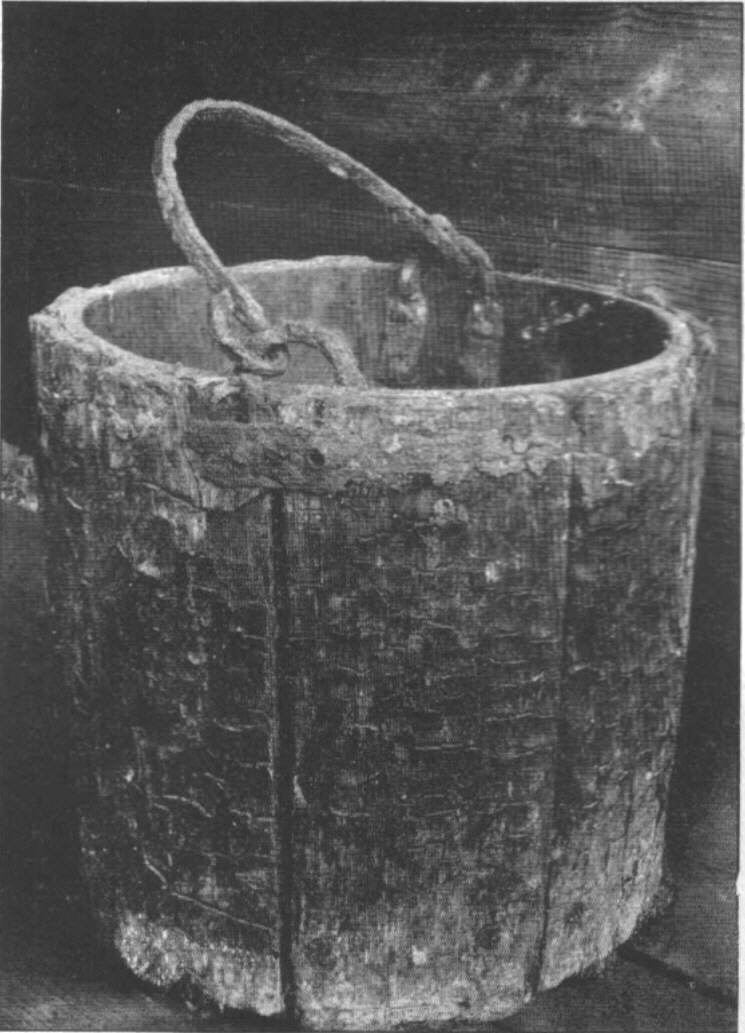
In the south-west corner was a well. Entry was on the west, through a forebuilding or entrance annexe which would originally have contained a staircase to the first floor. In 1924 it was argued that a series of stairways and entrances on the west led to the first floor, because of a lack of windows or entrances at ground level, that the first floor held a guardroom or stateroom and some private inner rooms, and that the second floor held domestic and small apartments, kitchens, private retirement rooms, and possibly a chapel. A Norman capital from the castle, and a Norman bucket from the well, are among the objects associated with the site.
The bucket is now in Derby Museum. The monument record also associates a medieval bucket, an architectural fragment, a spade, a spur, a bridle, a horseshoe, and a knife, together with pottery running from the Roman period into the Middle Ages.
William, the fourth Earl of Derby, was born about 1168 and died about 1247. He succeeded to the estate, but not the title, when his father died at the siege of Acre in 1190. He was head of the family which controlled a large part of Derbyshire, including Duffield Frith, and he was a favourite of King John. John, the youngest son of Henry II and Eleanor of Aquitaine, was king from 1199 until his death on 19 October 1216.
He was born at Christmastide in 1166 or 1167 and was nicknamed Lackland, because as a younger son he was not expected to inherit significant lands. He lost Normandy and most of his other French lands to Philip II, and the baronial revolt at the end of his reign led to the sealing of Magna Carta. On Richard's return from the Third Crusade, William, in company with David Ceannmhor and the Earl of Chester, took a leading role in besieging Nottingham Castle on 28 March 1194, which supporters of Prince John were holding. For seven weeks afterwards he was sheriff of Nottinghamshire and Derbyshire.
On John's accession in 1199 William gave him allegiance and became a great favourite. John restored to the family the title of Earl of Derby, along with the right to the third penny, and soon afterwards bestowed the manors of Ashbourne and Wirksworth, with the whole of that wapentake, subject to a fee-farm rent of 70 pounds a year. The castle account says the restored earldom came with Wirksworth and Ashbourne, and later Horston. In 1213, when John surrendered his kingdoms of England and Ireland to the pope, William was one of the witnesses to the Bulla Aurea.
In the following year he gave surety for the king for a yearly tribute of 1,000 marks. In that same year, 1214, the king granted him the royal castle of Harestan, also called Horsley Castle and Horston. It is also said that the castle was given in 1215 as a residence for his wife during a planned absence with the king on crusade. Horston is a separate place, about a mile south of the village of Horsley and some five miles north of Derby.
It was a Norman motte and bailey founded by Ralph de Buron. In the thirteenth century John built a stone castle there, adding a keep, a chapel, a gatehouse, and a barbican. In 1514 Henry VIII granted it to the Duke of Norfolk for services against the Scots, and it later came to the Stanhope family. Quarrying has damaged it, and the keep is largely overgrown.
In 1216 John made William bailiff of the Peak Forest and warden of Peak Castle. John died that year and was succeeded by the nine-year-old Henry III. Henry III, also called Henry of Winchester, was born on 1 October 1207 and died on 16 November 1272. He was king, Lord of Ireland, and Duke of Aquitaine from 1216.
He was the son of John and Isabella of Angoulême. He acceded in the middle of the First Barons' War. Cardinal Guala Bicchieri declared the war against the rebel barons a religious crusade, and Henry's forces, led by William Marshal, defeated the rebels at Lincoln and at Sandwich in 1217. Because of discontent over John's breaches of Magna Carta, some barons had approached Prince Louis of France, who invaded in 1216.
William de Ferrers assisted Marshal, the Earl of Chester, and others in defeating the rebels at the siege of Lincoln. He was allowed to retain the royal castles of Bolsover, Peak, and Horston until the king's fourteenth birthday. Henry reached that birthday in 1222, and the administration sought to recover the three castles, to William's indignation. In 1254 those castles would pass to Edward, Henry's son, which sharpened the resentment of Robert, the sixth earl.
In 1223 Henry III granted William the castle of Lancaster with the county and honour of Lancaster. They would be lost to the crown in the rebellion of his grandson Robert, and that loss is dated 1267 in this life, beside the 1266 and 1269 dates of the Duffield forfeiture told below. In 1227 William was one of the earls who rose against the king on behalf of the king's brother Richard and made him restore the forest charters. In 1237 he was one of three counsellors forced on the king by the barons.
He was a patron of at least two abbeys and four priories. His wife is named Alice of Chester, sister of Ranulph de Blondeville, fourth Earl of Chester, and the marriage is said to have lasted fifty-five years. Their son's life names the mother as Agnes de Kevelioc, a daughter of Hugh de Kevelioc, fifth Earl of Chester, by Bertrada de Montfort. Both names are on the record.
By the death of the earl of Chester in 1232, his sister, this wife, inherited a vast estate between the Ribble and the Mersey. As William aged he suffered severe gout, and the disease ended his life in about 1247. He was succeeded by his elder son, also William, the fifth earl. Their other children included Thomas of Chartley, Hugh of Bugbrooke, who died shortly before 10 August 1257, another Robert, Ranulph, parson of St Michael's on the Wyre, and daughters Bertha, Agnes, and Sybil.
William, the fifth Earl of Derby, was born about 1193 and died on 28 March 1254. He was of Chartley Castle in Staffordshire. Like his father he suffered from gout from youth, and after the 1230s he took little part in public affairs, travelling always in a litter. In 1230 he accompanied Henry III to France and attended parliament in London in the same year.
He was accidentally thrown from his litter into the River Great Ouse while crossing a bridge at St Neots in Huntingdonshire. He escaped death but never recovered. He succeeded to his father's title in 1247 and lived another seven years. Unable to play much part at court or in war, he followed his father in managing the land.
The original holdings centred on Tutbury and stretched into the south of Derbyshire and the west of Nottinghamshire. The death in 1232 of his uncle Ranulf de Blondeville, here called the sixth Earl of Chester, brought vast new estates, including Chartley, much of Lancashire between the Ribble and the Mersey, and manors in Northamptonshire and Lincolnshire. He encouraged towns and markets, exploited the forests of Needwood and Duffield Frith, and took advantage of rising prices. By his death his income placed him among the top six English nobles, and he also left his son considerable debts.
He married first Sibyl, also spelled Sybil, Marshal, daughter of William Marshal, first Earl of Pembroke, and Isabel de Clare. By her he had seven daughters: Agnes, Isabel, Maud, Sibyl, Joan, Agatha, and Eleanor. He married second, in 1238, Margaret or Margery de Quincy, daughter of Roger de Quincy, second Earl of Winchester, and Helen of Galloway. By Margaret he had Robert, the sixth earl, born in 1239, William of Groby, born in 1240, and daughters Joan, Agnes, and Elizabeth.
He died on 28 March 1254 and was buried in Merevale Abbey in Warwickshire. He was succeeded by his fifteen-year-old son Robert, who in 1249, aged ten, had been married to Mary de Lusignan, a niece of Henry III, and knighted. The wardship was granted to the king's eldest son, the future Edward I. The Irish estates of the first wife, chiefly the county of Kildare, passed to her seven daughters.
Robert de Ferrers, the sixth Earl of Derby, was born in 1239 at Tutbury and died shortly before 27 April 1279. He was the son of the fifth earl by Margaret de Quincy, who was born in 1218. In 1249, at the age of ten, he married the seven-year-old Mary, or Marie, daughter of Hugh XI of Lusignan, Count of La Marche, the eldest of Henry III's half-brothers, at Westminster Abbey. The match has been taken as a sign of Henry's regard for Robert's father.
William died in 1254, so Robert became a knight and inherited while still a minor, and he and his estates became a ward of Prince Edward. In 1257 Edward sold the wardship to the queen and to Peter of Savoy for 6,000 marks, which might have been a source of Robert's later antipathy to the prince. He came of age in 1260 and took possession of the estates. They included the large part of Derbyshire later known as Duffield Frith, parts of Staffordshire and Nottinghamshire, Chartley, and all Lancashire between the Ribble and the Mersey, the last of these from Ranulph de Blondeville, whose sister Robert's grandfather had married.
Careful management had made the estate worth around 1,500 pounds, so that the family was among the wealthiest in the country. Charges from William's death crippled it. A third of its worth was his mother's dower, which included Chartley. Nearly half supported a debt of around 800 pounds which the exchequer was calling in.
To pay that he had taken a further loan, possibly from Jewish financiers in Worcester. There was also provision for his brother William and for Mary, who held two manors herself. Before the inheritance, his only income seems to have been the maritagium bestowed by Henry. Unlike his predecessors he was described as impetuous and violent, in part perhaps because he had inherited a severe form of gout from his grandfather, and as unreliable and lacking in political sophistication.
Almost as soon as he took control he attacked the priory of Tutbury, of which his family were patrons.
In the early years he took little interest in politics. He was acquainted with the reforms then being pursued, and with Richard de Clare, Earl of Gloucester, and with Simon de Montfort, friends of the family. The Second Barons' War, from 1264 to 1267, was a civil war between barons led by Simon de Montfort and the royalist forces of Henry III, led at first by the king and later by his son, the future Edward I. The barons sought to make the king rule with a council of barons rather than through his favourites.
Montfort, French-born and Earl of Leicester through his mother, had married Henry's sister Eleanor with the king's permission but without the agreement of the English barons. He had been one of the foreign councillors many lords loathed, and he was later put on trial for his actions as lieutenant of Gascony. When he returned to England in 1263 to begin the rebellion, Robert had to take sides and moved towards him. The motives were read less as support for reform than as hatred of Edward.
That hatred had several roots: the old Ferrers claim to Peveril through Margaret Peverel's marriage to the second earl, John's grant of the stewardship to the fourth earl and Henry's taking it back for Prince Edward, Edward's custody during the minority, and land that had not been relinquished. Robert of Gloucester observed that of no one was Edward more afraid. During May and June 1263 Robert is on record as taking the Three Castles, Grosmont, Skenfrith, and Whitecastle in south Wales, which belonged to Edward. In January 1264 Louis IX of France declared the Provisions of Oxford unlawful.
In February 1264 Robert attacked Worcester, sacking the Jewish quarter, plundering religious and private houses, damaging the fences and lands of the royal parks, and carrying away the bonds that recorded his loans. He then joined Montfort's forces at Gloucester Castle, recently taken by Edward. To Robert's annoyance Edward escaped, having made a truce with Henry de Montfort, Simon's son. That escape let Edward attack Northampton Castle, where in March 1264 Ferrers' brother William, Anker de Frescheville, lord of Crich, and Baldwin Wake, lord of Chesterfield, were taken prisoner.
Edward went on to attack Ferrers at Chartley and later to destroy Tutbury. A separate account of Tutbury says the castle was nearly destroyed by Prince Edward in 1264. Robert did not join Montfort at the Battle of Lewes in May, which has been taken to show that his actions were largely self-interested. Once the prince and the king had been captured, Ferrers took the royal castles of Bolsover, Horston, and Tickhill in Yorkshire.
By the end of 1264 he had also taken Peveril and, it is believed, Chester.
Montfort's parliament of 1265 broadened representation beyond the nobility. Some barons thought he had gone too far. In May the Earl of Gloucester deserted to the king. With that help, and with Roger de Mortimer, Edward escaped from Kenilworth.
He defeated Montfort at the Battle of Evesham in August 1265, and the rebels were shown little mercy. In spite of Robert's attacks on Edward's estates, his support in the north Midlands and his money were potentially useful to Henry. He was released and, on paying 1,500 marks, was given a pardon. His inheritance was secured, and mediation was arranged in his quarrel with Edward.
Far from accepting that fortune, in 1266 he joined other former supporters of Montfort, including Baldwin de Wake, lord of Chesterfield, in a fresh rebellion. At first the rebels seem to have gathered at his substantial castle of Duffield. From Tutbury the royalist army, under Prince Henry, a nephew of Henry III, bypassed Duffield and went on to Chesterfield to intercept a force from the north under John d'Ayville. Robert was compelled to move north, crossing the River Amber, which was then in flood, and he reached Chesterfield on 15 May 1266 just as d'Ayville arrived from Dronfield.
That prince is Henry of Almain, also called Henry of Cornwall, born on 2 November 1235 and killed on 13 March 1271. His name in Anglo-Norman is Henri d'Almayne, from a vowel shift in d'Allemagne, because his father was the elected German king. He was the eldest son of Richard, Earl of Cornwall, afterwards King of the Romans, by his first wife Isabel Marshal. He was knighted by his father the day after Richard was crowned King of the Romans at Aachen on 17 May 1257.
As a nephew both of Henry III and of Simon de Montfort, he wavered at the beginning of the war, then took the royalist side. He was among the hostages taken by Montfort after Lewes in 1264, was held at Wallingford Castle, and was later released. The Battle of Chesterfield was a minor skirmish in the latter stages of the Second Barons' War, part of the mopping up of baronial opposition after Evesham. The fighting took place in and around Chesterfield on 15 May 1266.
The baronial leaders were Robert Ferrers, Earl of Derby, Baldwin Wake, lord of Chesterfield, and John d'Ayville. The royalist forces were led by Henry of Almain. Thomas Wykes, in his chronicle, mentions the royalists using covered wagons to gain entry to the town, and a reference explains that the men of Brampton, a suburb of Chesterfield, rushed to the church and defended the part of the wall for which they were responsible, presumably to avoid the cost of repair. Wykes also explains that Ferrers was stricken by gout and was taken ignobly.
It is likely that he was captured in the church. A legend that he was betrayed by a woman of the town, and an assertion that he was hiding under sacks of wool stored in the church, have no contemporary documentary evidence. According to the chronicles of Walter of Guisborough, John d'Ayville forced his way through the enemy, unhorsed Sir Gilbert Haunsard with his lance, wounded several others, and escaped. One account of Robert's life suggests the rebels were surprised in their quarters and that most of them were killed.
Other accounts suggest that Ferrers himself managed to take Chesterfield but was left exposed when the others were defeated. Most of them withdrew into the forest and lived as outlaws for two years. Following his capture, Robert was taken in irons to London and, at the Westminster parliament later that year, was totally disinherited. Baldwin Wake escaped and joined other disinherited barons at the Isle of Axholme before surrendering to Prince Edward.
John d'Ayville was later at the siege of Kenilworth before he surrendered. Robert's own life says he was attainted of high treason and imprisoned in Windsor Castle until 1269, and that Duffield Castle was pulled down and Henry's second son, Edmund, was given possession of his lands and goods.
The date of that end is not a single date. The castle account says Robert rebelled against Henry III, that Tutbury was destroyed, that although pardoned he rebelled again, and that being defeated at Chesterfield he was dispossessed in 1269 and Duffield Castle was destroyed, the lands going to Prince Edmund, who was shortly afterwards created Earl of Lancaster. A properties note of 1963 says the foundations are those of the Norman keep of the Ferrars which was razed to the ground in 1266 by Prince Henry, nephew of Henry III. The present account of the site says that in 1266 King Henry III destroyed one of England's largest medieval castles.
The excavated summary follows the capture of Robert in 1266 and a final demolition in 1266, with the site then granted to Prince Edmund, Earl of Lancaster. The fourth earl's life dates the loss of the castle and county of Lancaster to the grandson's rebellion in 1267. The forest account says that in 1266, after Robert's rebellion against Henry III, the lands were confiscated and passed to Prince Edmund to be part of the Duchy of Lancaster. Tutbury's own history says the castle was nearly destroyed by Prince Edward in 1264, and that in 1269, after a further rebellion, the lands were given to Edmund Crouchback and have remained part of the Duchy of Lancaster.
Edmund Crouchback was born in London on 16 January 1245 and died on 5 June 1296. He was a member of the Plantagenet dynasty and the founder of the house of Lancaster. He was Earl of Leicester from 1265 to 1296, Earl of Lancaster from 1267 to 1296, and Earl of Derby from 1269 to 1296, and Count Palatine of Champagne from 1276 to 1284. The title of Earl of Lancaster was created in the peerage of England in 1267, for him, and was succeeded by the title Duke of Lancaster in 1351.
He was the second surviving son of Henry III and Eleanor of Provence, younger brother of Edward I, and he was named after the ninth-century East Anglian king and saint to whom Henry had prayed for a second son. He was baptised by 3 February 1245 and spent most of his childhood at Windsor with his siblings. In 1254, at nine, he was drawn into the Sicilian business, in which his father accepted a papal offer of the kingdom of Sicily. Henry could not fund it.
The papacy withdrew the grant and gave it to Edmund's uncle, Charles I of Anjou. The affair outraged the barons led by Simon de Montfort and was cited among the reasons for limiting Henry's power. Edmund supported the royal government in the Second Barons' War. After Montfort's death at Evesham in 1265 he received the lands and titles of Montfort and of the defeated barons Nicholas Segrave and Robert de Ferrers, and he became earl of Lancaster, Leicester, and Derby.
He was primarily known as earl of the first of those counties and became the most powerful baron in England. The name Crouchback is traced to his crusade with his brother Edward in the Holy Land, as a corruption of "cross back", from a cross stitched on his garments. After the death of his first wife, Aveline de Forz, his aunt Margaret of Provence arranged his second marriage to Blanche of Artois, widowed queen of Navarre and countess of Champagne. With Blanche he governed Champagne as count palatine in the name of his stepdaughter Joan until Joan came of age.
He helped Edward in the conquest of Wales. In 1293, when Philip IV of France demanded that Edward come to Paris over damages by English mariners, Edward sent Edmund to mediate. The agreement that France would occupy Gascony for forty days, and that Edward would marry Philip's half-sister Margaret, was broken when Philip refused to relinquish Gascony. Edmund and Edward renounced their homages.
Edmund sailed for Gascony, besieged Bordeaux, could not pay his troops, was deserted, retreated to Bayonne, and died there of illness in 1296. His body was brought back to England and buried in Westminster Abbey in 1301.
The Dictum of Kenilworth, issued in October 1266, provided that Robert could reclaim his lands for a redemption of seven times their annual value. They were returned at Windsor in 1269, with a debt of 50,000 pounds to be paid to Edmund by 9 July. The chance of finding such a sum was remote. Edmund and his associates made their position more secure by a move unlikely to have been intended by the drafters of the Dictum.
Robert was taken to the manor of Cippenham in Buckinghamshire, the property of Richard, Earl of Cornwall. There, in the presence of John Chishall, the chancellor, he was required to assign the lands to twelve manucaptors. He was kept at Richard of Cornwall's castle of Wallingford until the end of May, and on 9 July the estate was transferred to Edmund. In time it provided a considerable part of the revenues of the Duchy of Lancaster, while Robert was left virtually landless and deprived of his title.
He lived another ten years and tried to regain the estates, with little success, because the proceedings at Cippenham had been quietly supported by the king and his council. Edmund was absent on crusade until 1273, and no legal redress could be sought until then. Soon after Edmund's return, Robert seized his old castle of Chartley by force and was soon ejected. He then enlisted Gilbert de Clare, Earl of Gloucester.
In 1274, when Edward, now king, returned to England, Robert pleaded that he had accepted the Kenilworth ruling and its seven-year redemption, and that Edmund had refused. Edmund's defence was the Cippenham agreement and Robert's failure to meet its terms. Robert argued that the agreement was made under duress. It was held that the chancellor's presence gave it full legal validity.
The case was dismissed. In 1275 he recovered the manor of Chartley, but not the castle. That marked the end of the great position of the family. His first wife, Mary, had died sometime between 1266 and 1269, and the marriage had been childless.
On 26 June 1269 he married Eleanor, daughter of Humphrey de Bohun of Kimbolton and Eleanor de Braose, and granddaughter of Humphrey de Bohun, second Earl of Hereford. Until 1275 the family appears to have lived on his mother's dower lands in Northamptonshire. They had two children: John, born at Cardiff on 20 June 1271, who later became the first Baron Ferrers of Chartley, and Eleanor, wife of Robert FitzWalter. Sir Robert de Ferrers, sometime Earl of Derby, died shortly before 27 April 1279 and was buried at St Thomas's Priory at Stafford.
In Michaelmas term 1279 his widow sued Edmund, the king's brother, for dower in a third of Tutbury, Scropton, Rolleston, Marchington, Calyngewode, Uttoxeter, Adgeresley, and Newborough in Staffordshire, and of Duffield, Spondon, Chatesdene, and nine other vills in Derbyshire. Edmund appeared and stated that he held nothing in Spondon or Chatesdene.
After 1266 the Frith passed with those lands into the Duchy of Lancaster. From 1285 it is called a royal forest with its own forest courts. Another passage in the same account says the records do not begin until the confiscation, and that, being part of the duchy, the area was not properly a royal forest until the reign of Henry IV, though Edmund was allowed to hold forest courts for Duffield as part of the honour of Tutbury. Edward I hunted there between 1290 and 1293, and Edward II visited in 1323.
Possibly around 1225, when the forest of east Derbyshire was abolished, Morley Park, which included Belper, was added. There were four wards: Duffield, Belper, Hulland, and Colebrook. Within them were enclosed parks for buck and doe, in contrast to the much larger ward of Campana in the Forest of the High Peak, which was intended for hart and hind. Henry, Earl of Lancaster, listed seven of these parks in 1330: Ravensdale, Mansell, Schethull, which is Shottle, Postern, Bureper, which is Belper, Morley, and Schymynde-cliffe, which is Shining Cliff.
A town account speaks of seven parks and names Ravensdale, Schethull, Postern, Bureper, Morley, and Schymynde-cliffe, without Mansell. Another park, Champain, or Champain Park, lay on the southern border on what is now Cumberhills, south of Duffield, near Champion Farm. In 1314 there was a great larder at Belper, where the venison was salted for winter, and a large cow-house stood in the lower part of Shottle, on the lane later listed as Cowhouse Lane and also as Cowers Lane. The Frith was a valuable source of timber.
In 1375 orders are recorded for oaks to the Carmelite friars of Nottingham, the Dominican friars of Derby, and the abbot of Darley. In September 1405 Henry IV ordered the chief forester to supply twelve timber oaks towards the repair of Duffield church, and in 1411 to deliver to the tenants of Duffield enough wood for shoring Duffield Bridge. The chapelry of Belper, or Beaureper, was built by the Duke of Lancaster for the use of the foresters. For many centuries Duffield was by far the largest centre of population in the parish.
St Alkmund's church was built about a quarter of a mile south. Its position, so far from the village, has been thought to come from an Anglo-Saxon purpose of serving travellers crossing the river between Ashbourne and Nottingham. The original part of the present building is Norman. Duffield Bridge was built across the river, next to the present Bridge Inn, in the thirteenth century, and was widened in the eighteenth.
It later became the main road to the north, and in the eighteenth century the road along Duffield Bank was improved as the new Chesterfield turnpike. The Ferrers lands, including the manor of Duffield, remained with the Duchy of Lancaster until the reign of Charles I. In the parliamentary commissioners' report of 1650, Belper is described as a hamlet appertaining to Duffield. The forest had plentiful game and oak, and the farmland was fertile though prone to flooding.
Even after weirs and dams in the eighteenth century, the centre of the village flooded regularly until the middle of the twentieth century. A notable resident of the sixteenth century was Anthony Bradshaw, who erected a monument in the church to himself and his large family and was distantly related to John Bradshaw, who condemned Charles I. Sir Roger Mynor was high sheriff in 1514, sergeant of the king's cellar, an official of Duffield Frith under the duchy, and a commissioner of the peace for Derbyshire. He and his wife have a table tomb in St Alkmund's.
The first school, now the William Gilbert School, began with a surrender at a court of the manor of Duffield Frith on 21 June 1565, when William Gilbert surrendered a cottage and lands to sustain a man to teach boys, the wages settled at twelve pence a quarter for every scholar.
Tutbury, the chief seat, went on after Duffield had been pulled down. By the 1300s it was largely repaired, though as a residence rather than a strong point. Thomas, the second Earl of Lancaster, repaired the damage from the earl of Derby's time and made it his principal residence. His housekeeping in 1313 was reckoned, in a nineteenth-century comparison, at 22,000 pounds of the money of 1836.
Some time before 1370 John of Gaunt rebuilt it more substantially. From 1372 until her death in 1394 it was the permanent residence of his wife Constance. In June 1568, after Mary, Queen of Scots, fled to Carlisle following Langside, the English council considered lodging her at Nottingham, Fotheringhay, or Tutbury. She arrived at Tutbury on 4 February 1569, complained of the damp, the wet plaster, and the draughty old carpentry, and compared the enclosure on a slight hill to the Bois de Vincennes.
She was moved to Wingfield Manor in April, brought back in September, rushed to Coventry in November during the Rising of the North, and was back at Tutbury on 2 January 1570. That imprisonment belongs to Tutbury, not to the mound at Duffield. Tutbury today is a scheduled monument and a listed building of the highest grade, in the ownership of the Duchy of Lancaster and hence of the Crown.
At Duffield the castle was literally razed to the ground. Much of the stone was scavenged for other buildings, and the site became overgrown. Enough stone was robbed to build a small structure. Memory persisted in the name Castle Orchard, which extended from the cottages of that name at the base of the mound to the Hazlewood road.
The site was rediscovered in 1885. The first excavation is dated 1886, when the foundations of a massive stone keep were discovered, and it was reported by J. C. Cox in 1887, with some account of the seven Earl Ferrers who held the castle.
William Bland lectured on the recent excavations and discoveries on Castle Hill, the lecture dated 11 January 1887. By 1957 the foundations, except in two places, stood only one course high above an offset course level with the turf of the interior. They were faced with large sandstone blocks with diagonal point-dressing, as Cox had planned them. A trench inside the keep, 15 feet 6 inches from the south-east corner, found the foundations below the offset to be of rubble and concrete, 2 feet 4 inches thick, standing in a rock-cut trench filled with sand and stones to only half the height of the foundation.
The solid rock north of that trench had a crushed appearance and held two shallow postholes, one with two packing stones. Those postholes, and the postholes under the concrete apron, are earlier than the stone foundation and were read as the timber castle. The west wall, where the 1886 excavators had placed the forebuilding and the entrance, retained only the wall core of rubble and concrete. The facing stones had been removed by robbers.
They had been laid on a layer of mortar resting directly on undisturbed rock. The concrete apron in front of the keep, found in 1886, was up to 6 inches thick, soft and sandy, with much gravel, and it rested on the rock except where grey soil filled two postholes and a stepped gully. It ended 14 feet from the edge of the wall core. There another posthole, 6 inches deep, was packed with small stones, among them a piece of tile and a stone disc.
At the western end of that trench a rock-cut rubbish pit, 3 feet 5 inches deep, cut through a layer of concrete. Its upper fill held animal bones, potsherds, pieces of iron, and much charcoal.
On the south-west, between the ditch and the base of the motte, a level shelf widened as the motte curved north. At its western end was a low bank 1 foot high, 35 feet across, and 60 feet long. Two masonry blocks were partly embedded in the old surface under that bank. They were sandstone, wedge-shaped, weathered on their upper faces, and dressed with the same diagonal points as the keep.
They seem to have lain exposed before the bank was thrown over them. Medieval pottery from the bank was dated to about 1250. That bank, and a shallow ditch cut at the north-west end of the terrace in the Middle Ages, were read as an elaboration of the outer defences after the keep had been built, and the scheduling text allows a stone gatehouse as a possibility at that time. The shallow ditch held more Romano-British and medieval pottery, a piece of daub, corroded iron, and a sherd of Saxo-Norman Stamford ware, contemporary with the timber castle.
The outer ditch on the south-west, a small piece of the south ditch or fosse marked on the 1886 plan, survives in what was the orchard of Castle House. In 1957 it was 40 feet across the top and 7 feet deep, with a flat bottom 16 feet across. The original bottom, reached only at the south end before the trench flooded and collapsed, was irregularly dug into soft black shale and had been 15 feet deep. A later summary gives the same ditch as 40 feet, or 12 metres, wide at the top, 16 feet, or 4.8 metres, wide at the bottom, and originally 15 feet, or 4.5 metres, deep, with dumped and washed material reducing the visible depth to about 2 metres at the north-west end, while the south-east end appears to drop towards the original depth.
From there it may formerly have run round the south side of the mound through the garden of Castle House, though that is not entirely clear. The lower filling suggested a dry ditch in its first phase. A layer of dark clay was read as water-laid, so that during the later elaboration the outer ditch may have been converted into a moat by damming the lower end, which would have been a military weakness on this hillside. In 1999 five trial trenches in the newly scheduled area, thought to be a relatively undisturbed part of the outer defences, found no undisturbed medieval or earlier stratigraphy.
Pottery from the twelfth or thirteenth century to the twentieth century was recovered, all from post-medieval or contaminated contexts. It was suggested that the ditch may have been a natural feature, such as a watercourse, before the castle was built. Pollen analysis of the ditch deposits gave poor results.
The medieval pottery of 1957, reported by T. C. M. Brewster, is very fragmentary and falls into three classes.
Saxo-Norman pottery comprised two sherds of Stamford ware and part of a cooking-pot base from the lower foot of the deposit at the base of the motte, with two further small sherds like Stamford ware from hillwash and from inside the keep. The 1886 finds had included the remains of a bridge-spouted pitcher. The bulk of the pottery is coarse pustula cooking pots, in colours from red and orange to buff and grey, a fabric found widely in northern England. Glazed wares are mostly the same fabric, with green speckled glaze, except for fragments of a jug in grey ware with orange surfaces.
The principal groups came from the bank, the hillwash, the interior of the keep, the rubbish pit, and the later building. From the bank, a sharply everted rim with an incised wavy line is a thirteenth- or early fourteenth-century decoration, and a large jug with vertical slashings around the base, instead of the usual thumb impressions, and with applied strip decoration, was dated to about 1250. A large sherd from a hollow under the bank could be of twelfth-century date. The rubbish pit produced speckled green glaze of the late twelfth or early thirteenth century.
Apart from the Stamford ware, which dates from the eleventh century, the bulk is not earlier than the twelfth century and not later than the thirteenth or early fourteenth. On that evidence the principal occupation was concentrated in those two centuries, and most of the material, including the pit, would fall between 1150 and 1250. The bank must date from around 1250.
The animal and bird bones from the rubbish pit were reported by D. Bramwell. Of wild animals there were an old and a young red deer. The adult's long bones had been split for marrow.
A tibia had a maximum proximal width of 72 millimetres, and an astragalus measured 53 by 34 millimetres. A few fragments of metacarpal were referred to roe deer. Of domestic animals, the only bone referred to ox was a single phalanx of a small animal, with a fragment of radius from a lower layer of the pit. Several bones belonged to a small breed of sheep, with a lower jaw whose tooth row measured 68 millimetres, comparable with sheep from Early Iron Age and Romano-British sites.
Pig bones were more numerous than those of any other animal, but small, and so placed in the domestic category. A young animal near full size had a cheek-tooth row of 95 millimetres, the last lower molar erupted but unworn. Other pig bones included half a pelvis, foot bones, two jaws of two different animals, an astragalus of 37 by 21 millimetres, and part of a radius. Birds included a small to medium domestic fowl, with a femur 74 millimetres long, a goose represented by the front of a sternum, which could not be called wild or tame, and a coot represented by a perfect humerus.
The collection was too small for conclusions about food preferences. It did show a varied meat supply. The size of the sheep and the pig was said to show no appreciable difference since the Early Iron Age farmers of Glastonbury. The water birds were taken to suggest sport on the river as well as in the woods.
Small finds of iron were a single-edged knife with a broad back, a bent nail of square section, a rectangular piece of iron 3.8 by 1.9 inches and 0.4 inches thick, pieces of slag, a corroded nail head, and a piece of iron plate. Stone finds were a dark grey quartzite ploughshare pebble rubbed smooth on one surface, a brown flint flake with a notch, another flint flake not certainly struck by a person, and a disc of dark brown sandstone with rubbed edges from the packing of a posthole. Pieces of daub came from the terrace, the hillwash, and the pit.
A wall crossing a trench 46 feet west of the keep was of rubble embedded in earth. Some pieces were burnt and carried diagonal point-dressing. West of the wall a posthole cut into loose rock was 2 feet 7 inches across and 1 foot 4 inches deep, with four packing stones, the largest dressed on one face like the keep. Six medieval sherds, a little animal bone, and a rectangular piece of iron lay in the soil over the rock.
There was no sign of earlier disturbance. The wall and the posthole were read as a peasant building put up after the destruction of the keep, using stones from the ruins. Its pottery dates to the thirteenth or early fourteenth century. The scheduling text includes the remains of a small medieval building constructed after the demolition of the castle, and it places that demolition in the early thirteenth century, which does not match a demolition in 1266.
Masonry from the site was subsequently removed, leaving only the foundations, and enough stone was robbed to construct that small building.
Further Roman pottery was found south of the motte in 1931, when F. Williamson reviewed the Roman and other remains and the 1886 work. In 1953 R. G.
Hughes carried out a small excavation in the garden of 1 Avenue Road, on the north-west side of the motte, and obtained a quantity of Romano-British Derbyshire ware, including a kiln waster, from disturbed material. Mrs F. Jacobson collected much Roman pottery from the garden of 4 Avenue Road, west of the motte. The purpose of the 1957 work, by T.
G. Manby and the Prehistory and Roman Section of the Derbyshire Archaeological and Natural History Society, was to establish the nature of the Romano-British occupation and to throw more light on the Norman castle. Permission came from the parish council, from the trust that holds the mound, and from the ministry then responsible for works. In May 2001 the University of Bradford carried out an earth-resistance survey over parts of the upper bailey.
It indicated a possible building to the south-west of the keep. A magnetometer survey of the same ground was mostly ineffective, because modern debris interfered with the readings. A further potential rectilinear building was suggested to the south of the keep. The castle account says the 2001 work revealed traces of other structures to the south and the south-east which would appear to date from the same period, and that the trust was then considering how to raise funds for further investigation.
Between 2009 and 2010, also given as 2009 alone, Archaeological Services WYAS dug eighteen trenches by hand in and around the footprint of the stone keep. They established that the existing above-ground representation of the keep is of nineteenth- or twentieth-century construction and contains no medieval masonry in place. The buried medieval footprint of the west wall and of the internal wall is wider than the walls now marked on the surface. Most of the stone from the core, and almost all the dressed facing stone, has been robbed, but some medieval archaeology survives below ground.
Three sherds of the eleventh to thirteenth centuries were recovered. A conservation plan of 2007, a watching brief of 2007, and a design study of 2017 for a new presentation of the castle are on the monument's list of reports. The records read here do not set out a find catalogue from those three studies. The 2015 reappraisal by Oliver Jessop is the study that doubted the provenance of the bones found in 1886.
Between 20 November 2018 and 18 March 2019, also described as autumn 2018 to spring 2019, the installation of a new information board and a bench was watched. The two pits for the sign lay away from the crest of the motte, and the bench needed no groundworks of any depth. No archaeological feature or structure of the scheduled monument was identified, and no artefacts were recovered.
The castle site was given over in 1899, but the surrounding land was sold and slowly developed with housing and access roads between 1901 and about 1950, much of it in the 1920s. Gardening and small excavations south-west of the mound, and in gardens along Avenue Road, have produced considerable quantities of Romano-British pottery, so earlier remains survive in the suburban ground. They are not included in the scheduling except where the south-west ditch and a small part of the bailey lie alongside the former driveway from Lime Avenue to Castle House, because their extent and preservation are not well enough understood. Cox described a bailey or outer enclosure west of the motte, separated from the mound by ditches on the north-west and south-west.
The north-west ditch no longer survives as a visible feature and is buried under later housing. Part of the south-west ditch can still be seen beside that old driveway, and the remnant of bailey which flanks it is included. On the excavation evidence that strip is considered likely to retain Romano-British remains as well as medieval service buildings, workshops, and corrals for stock and horses. The scheduled area was extended in 1997.
The monument includes part of the twelfth-century tower keep, part of the eleventh-century motte and bailey which preceded it, part of an Anglian cemetery, and part of a Romano-British settlement, together with the small building put up after the castle was demolished. An observation in 1966 recorded an impressive mound, 4.5 metres high, on a knoll of 12 metres, with keep foundations varying from 0.4 metres to 1.2 metres and a concrete capping for preservation. A condition survey in 1985 was made before proposed improvements, including clearance of trees, consolidation of masonry, and the grassing over of internal floor areas.
In 1899 the Hon. F. Strutt and Mr G. H.
Strutt gave the site to the National Trust. A properties note of 1963 calls it two and a half acres. The castle account calls the gift one of the earliest archaeological monuments in that care, and says that for many years the parish council carried out the upkeep, which the trust has since taken back. The ground open today is given as one hectare, nestled in the village and bounded on all sides by housing and roads.
That hectare matches the two and a half acres of the gift more nearly than the five acres once estimated for the whole castle. What remains on the surface are the foundations, the view, and the stories. The town of Duffield is described as lying within the Derwent Valley Mills area. That inscription, of December 2001, runs along the Derwent in Derbyshire from Matlock Bath in the north to Derby in the south, a stretch of about 24 kilometres, and takes in the communities of Cromford, Belper, Milford, and Darley Abbey.
It marks the water-powered cotton mills developed from Richard Arkwright's work in the 1770s, after John Lombe's silk mill in Derby. The monitoring of 2018 to 2019 places the castle site in the buffer of that inscription. The monument record lists world-heritage protection beside the scheduling. Duffield Castle is not a separate world-heritage inscription of its own.
It has been suggested that the Ferrers centre of iron manufacture in Normandy was the origin of nailmaking in Belper. That remains a suggestion.
Three other houses in Derbyshire are not this castle and have no part in its building. Alfreton Hall is a country house in Alfreton, at the heart of local social and industrial history, especially coal. The estate goes back to Norman times. By the seventeenth century it was owned by the Morewood family.
The older hall stood on the site of Hall Farm, east of the present building. Rowland Morewood, born in 1682, high sheriff of Derby in 1706 to 1707, built a new hall around 1724 to 1725. William Palmer-Morewood added a wing in 1855, to designs by Benjamin Wilson. Barlborough Hall is a sixteenth-century country house in Barlborough, near Chesterfield, listed at Grade I.
It was built around 1583 to 1584 for Sir Francis Rodes, with the date 1583 on the porch and 1584 on the chimneypiece of the Great Chamber, and it is attributed to Robert Smythson. It was the seat of the Rodes baronets until the fourth baronet, Sir John Rodes, died in 1743. It passed to the Hatfield and Heathcote families, was sold in 1935, and was sold again in 1938 to the Jesuits of Mount St Mary's College. A preparatory school founded there about 1939 closed in 2025, with the college, because of financial difficulties.
Bradbourne Hall is a country house near All Saints' church in the parish of Bradbourne, near Ashbourne. It is privately owned, listed at Grade II star, and not open to the public. The estate was attached to Bradbourne Priory, whose remaining building is the church, recorded in the Domesday survey of 1086. The hall stands on the site of the rectory, known to have existed by 1278.
Geffrey de Cauceis gave the land to Dunstable Priory in 1205. At the dissolution it was forfeited to the Crown. In 1609 George Buxton bought the glebe, about 260 acres, demolished the old rectory, and built the hall about 1610. It was later let, among others to Colonel David Wilkie and to the archaeologist Albert Hartshorne, and it was sold in the 1920s.
Sources
- Duffield Castle, Derbyshire — Wikipedia
- Duffield — Wikipedia
- Henry de Ferrers — Wikipedia
- Robert de Ferrers, 1st Earl of Derby — Wikipedia
- Robert de Ferrers, 2nd Earl of Derby — Wikipedia
- William de Ferrers, 3rd Earl of Derby — Wikipedia
- William de Ferrers, 4th Earl of Derby — Wikipedia
- William de Ferrers, 5th Earl of Derby — Wikipedia
- Robert de Ferrers, 6th Earl of Derby — Wikipedia
- Battle of the Standard — Wikipedia
- Battle of Chesterfield — Wikipedia
- Edmund Crouchback — Wikipedia
- Henry of Almain — Wikipedia
- Duffield Frith — Wikipedia
- Tutbury Castle — Wikipedia
- Derwent Valley Mills — Wikipedia
- Twelfth century tower keep castle, including sites of an eleventh century motte and bailey castle, an Anglian cemetery and a Romano-British settlement — Historic England
- Duffield Castle (remains of), Duffield — Derbyshire Historic Environment Record
- Duffield Castle — National Trust
- Remains of Duffield Castle — National Trust Heritage Records
- Possible Saxon Burial, Duffield Castle — National Trust Heritage Records
- Duffield Castle Excavations 1957 — Derbyshire Archaeological Journal
- Duffield Castle: A reappraisal of Duffield Castle — Archaeology Data Service
- Duffield Castle, Duffield, Derbyshire: Archaeological Watching Brief Report — Archaeology Data Service
- Duffield Castle 225335 a19c01e6.jpg — Wikimedia Commons
- Duffield Castle Norman bucket.jpg — Wikimedia Commons
- Duffield Norman Capital.jpg — Wikimedia Commons
- Duffield Castle - geograph.org.uk - 1704604.jpg — Wikimedia Commons
- Derby Museum bucket.jpg — Wikimedia Commons
- Duffield castle well covering.jpg — Wikimedia Commons
- Duffield castle keep.jpg — Wikimedia Commons
- Duffield Castle Remains.jpg — Wikimedia Commons
- Remains of Duffield Castle - geograph.org.uk - 3942976.jpg — Wikimedia Commons