
Argyll and Bute, United Kingdom · 1201 CE · United Kingdom
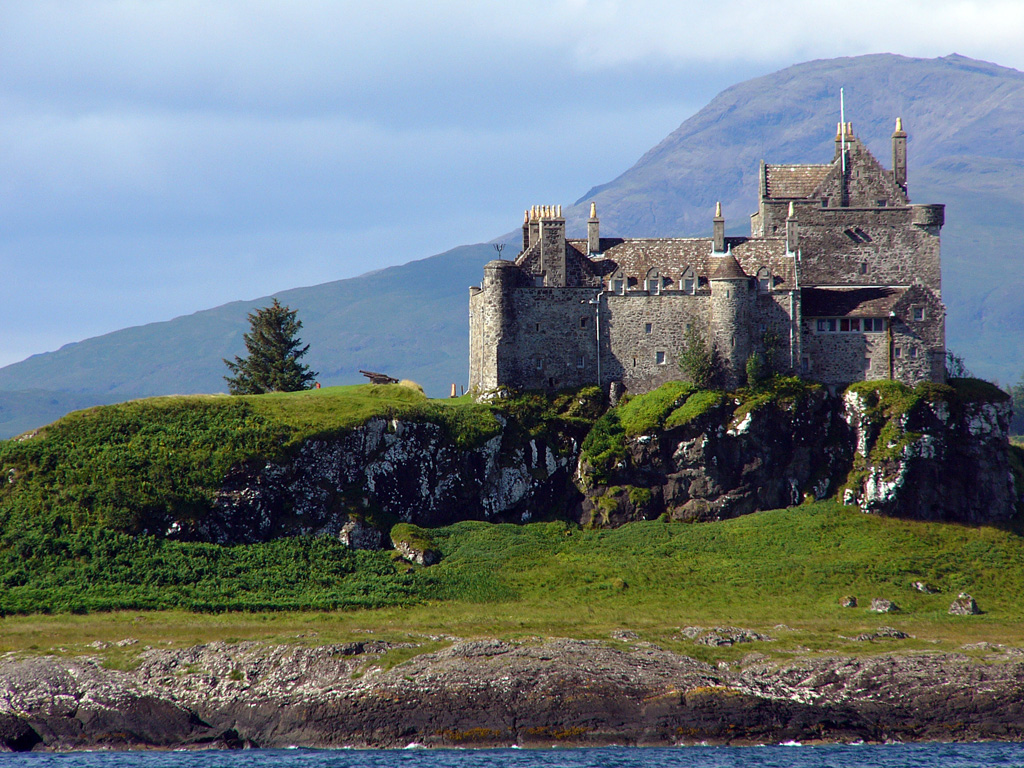
- Duart Castle, Caisteal Dhubhairt, stands on a rock of the Isle of Mull beside the Sound of Mull and is the seat of Clan Maclean.
- A thirteenth-century curtain and a later fourteenth-century tower were followed by courtyard ranges, a gatehouse, and a house whose lintel reads SAM 1653.
- The Macleans held it from a fourteenth-century marriage and charter until the Campbells took it in 1691 or 1692, and Sir Fitzroy Donald Maclean bought the ruin back in the early twentieth century.
- A Commonwealth warship believed to be the Swan was lost off Duart Point in 1653, and the wreck was excavated and then protected in 2013.
- The colours of the 236th Battalion, the New Brunswick Kilties, hang in the Great Hall, and the castle has been a film place as well as a family seat.
Visiting
Opening hours from 1 April to 30 April 2026 are 10.30 am to 4.00 pm, seven days a week. Opening hours from 1 May to 30 September 2026 are 10.30 am to 5.00 pm, seven days a week. Opening hours from 1 October 2026 are 10.30 am to 4.00 pm, seven days a week, and the season is also given as ending on 18 October as well as on 25 October. Entry to the castle is by ticket only, and admission may be bought on arrival or booked before the visit.
Adult admission is £13, child admission for ages 5 to 15 is £6, family admission for two adults and up to three children aged 5 to 15 is £34, and concession admission for a senior aged 65 or over or a student aged 16 or over is £12. An organised group of 15 or more may be able to receive admission at a group rate. Dogs are not allowed inside the castle, the tearoom or the shop, except assistance dogs, and dogs are welcome in the grounds. Members of the Historic Houses Association receive free admission on presentation of a valid membership card.
Outside these opening hours the grounds remain open for a view of the exterior.
History
Duart Castle, Caisteal Dhubhairt, stands on a rocky promontory of the Isle of Mull beside the Sound of Mull, in the parish of Torosay. It is the seat of Clan Maclean. The earliest work is read as a thirteenth-century curtain around a courtyard, with a tower added in the later fourteenth century, ranges and a gatehouse after that, and a house whose north-east lintel is inscribed SAM 1653.
The MacDougalls, descendants of Somerled’s son Dougall, held Mull after 1164 and are the clan credited with building the castle in the thirteenth century. They lost the island in the Wars of Independence, and in 1354 the MacDougall heir quitclaimed Mull to the Lord of the Isles. The Macleans, traced to Gillean of the Battle-Axe and to a fourth chief, Iain Dubh, who settled on Mull, come into the castle in the following century.
Lachlan Lubanach Maclean, fifth chief, married Mary, daughter of John of Islay. The wedding is placed in 1350 and in about 1364, and a papal dispensation of 3 May 1367 approved a marriage already made. One account gives Duart and much of Mull as her dowry, and another gives the Mackinnon lands, after a story that Lachlan had kidnapped her father.
Donald of Islay confirmed the castle by charter in 1390, and a further account says the MacDonalds had given control of Duart to Maclean of Duart by the end of 1395. Lachlan is regarded as the first Maclean of Duart because the oldest surviving charter is his, and he had died before 28 January 1405. His son Red Hector of the Battles, sixth chief, was killed at Harlaw on 24 July 1411 in single combat with Sir Alexander Irvine.
The lordship of the Isles was abolished in 1493, and Duart and Lochbuie then held of the king. Lachlan Maclean of Duart was killed at Flodden on 9 September 1513. Lachlan Cattanach, eleventh chief, was murdered in Edinburgh on 10 November 1523 after he had marooned his wife on a rock in the Sound. She is named both Catherine Campbell and Lady Elizabeth Campbell, and she was rescued.
Hector Mor, born in 1497, succeeded in 1527, strengthened the south-east range and added the gatehouse. He had been kidnapped at a dinner off Aros and released only when he agreed to destroy his galleys. Sir Lachlan Mor was killed on Islay at Traigh Ghruinneart on 5 August 1598. On 3 September 1631 a Maclean chief was created a baronet of Nova Scotia, the start of a century of Stewart loyalty that ended in the loss of the lands.
In 1647 one account says Campbell troops besieged Duart and were driven off, and another says General Leslie’s invasion left the chief unable to hold it. At Inverkeithing on 20 July 1651, Hector Maclean of Duart and 500 Highlanders were wiped out in the retreat, and the chief was killed. Sir Allan Maclean became chief that year, aged six, on the death of his brother Sir Hector, second baronet.
In September 1653 a Commonwealth flotilla under Colonel Ralph Cobbett came to take the castle. A storm lost three ships, named as the Swan, the Martha and Margrett of Ipswich, and the Speedwell of Lyn. The arrival is dated both 5 September and 13 September. The wreck believed to be the Swan lies off Duart Point and was excavated from the early 1990s to 2003.
The protected area around that wreck was designated on 1 November 2013. Finds include a drake gun of John Browne, navigational instruments, and the bones of a seaman whose teeth were read as a Yorkshire childhood. A second wreck, the Dartmouth, is placed in an attack on Duart in 1690. The castle itself passed to the Campbells in 1691, or in 1692, after campaigns dated from 1674 through 1678, 1679, 1680 and 1681.
Sir John Maclean, called both fourth and fifth baronet, and the sixteenth and last laird, surrendered the castle and later fought at Killiecrankie, then died at Gordon Castle in March 1716. The Campbells scattered stones from the walls, and the fifth laird of Torloisk built a cottage with some of them. The tower was roofless by 1748, and the remains are also said to have been abandoned by 1751, after the ruin that followed Culloden.
Descendants of the first duke sold the ruin in 1801. It passed to the Campbells of Possil and then, in 1865, to A. C. Guthrie with the Torosay estate.
Sir Fitzroy Donald Maclean, twenty-sixth chief, bought it back, the date given as 1910, as 11 September 1911, and as 1912. John James Burnet is named as the restorer, and the colours of the 236th Battalion, the New Brunswick Kilties, hang in the Great Hall.
A memorial light to the novelist William Black stands south-east of the castle, dated both 1900 and 1901. The building is listed in category A, the date given as 19 July 1971 and as 20 July 1971. Those records do not describe the castle as its own world-heritage inscription. The family still owns it, and the chief named in the clan account is Sir Lachlan Hector Charles Maclean, who lives in Perthshire while the castle opens in the summer.
Water through failed mortar brought down four ceilings in the winter of 2013 to 2014. An appeal launched in 2014 had raised £1.57 million by March 2024, and nine phases of repair had cost £2.67 million. Phase 11, the wall-walks, was planned to start in April 2024. The castle has also been a film place, as the Castle of Sorne in I Know Where I’m Going!, as a location in When Eight Bells Toll with Anthony Hopkins, and as an exterior in Entrapment with Sean Connery and Catherine Zeta-Jones.
Images


Detailed History
Duart Castle, Caisteal Dhubhairt in Scottish Gaelic, stands on a rocky promontory of the Isle of Mull, beside the Sound of Mull, in the parish of Torosay and the council area of Argyll and Bute. The Sound is the stretch of the Atlantic between Mull and the mainland of Morvern. Its largest settlement is Tobermory, near the northern entrance. Ferries use it between Oban and Craignure, whose main pier was built in 1964, and also between Tobermory and Kilchoan and between Fishnish and Lochaline.
Three castles face the Sound in one account of the water: Ardtornish, a fourteenth-century ruin of Clan Donald; Aros, a ruined thirteenth-century castle of Clan MacDougall; and Duart, dated to the thirteenth century and called the seat of Clan Maclean. The island itself is the second-largest of the Inner Hebrides, covering 875.35 square kilometres, with a coastline of 480 kilometres and a population given as 3,063 in 2022. Ben More, at 966 metres, is its highest point. One account of the island names four castles, including Duart and the keep of Moy.
The clan name is explained in two ways. One account says Maclean means son of Gillean, taken from the thirteenth-century warrior Gillean of the Battle-Axe, and that he was related to the kings of the ancient province of Dalriada. Another says the surname is an anglicisation of MacGilleEathain, a patronymic meaning son of the servant of Saint John. That account names Gillean of the Battle Axe as founder, with the years 1210 to 1263, calls him a judge and a councillor to David I, and places him at the Battle of Largs in 1263 during the Scottish–Norwegian War.
His son Malise is also said to have led followers at Largs and to have written his name as Gillemor Mcilyn on the third Ragman Roll of 1296, swearing fealty to Edward I. A grandson, Malcolm, the third chief, is said to have fought at Bannockburn in 1314 beside Robert Bruce and to have died in the reign of David II, leaving sons John, Donald and Neil. Iain Dubh, also Iain Dhu, the fourth chief, settled on Mull. One son, Lachlan, called Lachainn Lubanach, became the progenitor of the Macleans of Duart.
The other, Hector, called Eachainn Reaganach, became the progenitor of the Maclaines of Lochbuie.
Before that settlement, Mull had lain with the MacDougalls. After Somerled’s death at the Battle of Renfrew in 1164, his son Dougall held most of Argyll and the islands of Mull, Lismore, Jura, Tiree and Coll, and was styled king of the South Isles and lord of Lorne. Dougall’s name is derived from dubh-gall, dark foreigner. His descendants Duncan and Ewan built Dunstaffnage, Dunollie, Duntrune, Aros, Cairnburgh, Dunchonnel and Coeffin.
Dunollie, thought to have been fortified since the sixth century, became the chief’s seat. In 1263 Haakon IV brought a fleet off Oban. Ewan did not join him, and after Largs he attacked part of the Norse fleet. The Treaty of Perth, three years later, ceded the Hebrides to Scotland.
In the Wars of Independence the MacDougalls sided with the Comyns. John MacDougall of Argyll fought the Campbells at the Red Ford in 1294, where Sir Colin Campbell was killed. After Robert Bruce killed John Comyn in Greyfriars church at Dumfries in 1306, the MacDougalls defeated Bruce at Dalrigh and took the Brooch of Lorne. Three years later Bruce’s veterans broke them at the Pass of Brander, and the king forfeited their lands to the Campbells.
John Gallda, grandson of John of Lorne, later regained much of Lorne by a charter of David II, though the lordship of Lorne passed to the Stewarts after his death. On Mull itself, the MacDougalls are credited with the twin castles of Aros and Ardtornish, which together controlled the Sound. At the end of the thirteenth century they backed John Balliol while the MacDonalds and MacRuairis backed Bruce. After Bruce’s victory their lands were divided.
Angus Og received Islay, Jura, Gigha, Colonsay and Mull, with Duror, Glencoe, Ardnamurchan, Lochaber, Morvern and Kintyre. In 1354 John, the MacDougall heir, though in exile, quitclaimed any rights over Mull to the Lord of the Isles. When David II restored MacDougall authority over Lorne in 1357, that quitclaim split Mull from Lorne and left the island with the lordship.
The castle’s own account says Duart was probably built by Clan MacDougall in the thirteenth century and appears to have come to Clan Maclean in the following century. The MacDougall account says the same. A survey of the fabric reads the earliest work as a rectangular wall of enceinte around a courtyard measuring 19.7 metres from north-west to south-east by 21.5 metres across, with the entrance in the south-west curtain and lean-to buildings of stone or timber along one or more sides. Clear dates are lacking, but the stronghold is placed with a class of western seaboard castles attributable to the thirteenth century.
The lower north-west end of the rock lay outside that wall and may have held a small outer court, a kitchen and the well, which alone survives there. The listing calls the curtain on the three sides other than the keep probably earlier than the keep, with the entrance on the south-west approached by stairs.
John of Islay, also John MacDonald, died in 1386 and is counted as lord of the Isles from 1336, styling himself Dominus Insularum, though the title is also traced earlier, and an Irish annal calls him king of the Isles shortly after his death. He was the son of Aonghus Og, who had gained Ardnamurchan, Lochaber, Duror and Glencoe from Robert I. In 1336 Edward Balliol confirmed those lands and added Kintyre, Knapdale, Gigha, Colonsay, Mull, Skye, Lewis and Morvern, grants later treated as void, while David II confirmed the older possessions in 1343. In 1346 John inherited Garmoran through his marriage to Amie mac Ruari.
In 1350 he married Margaret Stewart, daughter of Robert II, and received Knapdale and Kintyre as her dowry, divorcing Amie so that her sons would be passed over. He submitted to David II at Inverness in 1369. David died on 22 February 1371, and Robert II, John’s ally, kept Badenoch and left John with Lochaber. John died at Ardtornish in 1386 and was buried on Iona.
He controlled Iona through the MacKinnons and founded an Augustinian priory at Oronsay. Among his children the accounts name Mary, who married Lachlan Maclean of Duart, and say she may have been a daughter of the first marriage rather than of Margaret.
The marriage that brought Duart to the Macleans is dated differently. The castle account says that in 1350 Lachlan Lubanach Maclean of Duart, the fifth clan chief, married Mary Macdonald, daughter of John of Islay, and that Duart was part of her dowry, and that John’s son Donald confirmed the castle by charter in 1390. The clan account places the marriage in about 1364, calls Mary the daughter of John and the granddaughter of Robert II, and says a papal dispensation of Pope Urban V on 3 May 1367 approved an already consummated marriage, the first mention of a Maclean in an official record, given so that the marriage could not be annulled for politics. That account says the dowry included Duart and much of Mull, and that Lachlan received the hereditary lieutenancy of the Isles and was recognised as the superior Maclean on Mull.
His own life says it is not known when he became fifth chief in succession to Iain Dubh, probably before 1365, that he feuded with the MacDougalls and the Camerons, and that under Domhnall, the second lord, he had his lands confirmed by charter in 1390. Donald’s life says the MacDonalds had given control of Duart Castle to Maclean of Duart by the end of 1395, in the same passage that places them in possession of Urquhart Castle by the end of that year. The castle’s own history says the first recorded mention of the Macleans of Duart is the dispensation of 1367 allowing Lachlan Lubanach to marry Mary, that the match is said to have been a love match, and that her father allowed it only after Lachlan had kidnapped him, in an incident in which the chief of the Mackinnons was killed. That history says the Macdonalds then gave the Mackinnon lands as a dowry, so that the Macleans came to own much of Mull, and that Lachlan then built the keep that stands today, while the great curtain walls were probably of the previous century.
Lachlan’s life says he is generally regarded as the first Maclean of Duart because the oldest surviving charter is in his favour, but that this does not imply he was the first possessor. A fictionalised account of the marriage and of the coming into possession of Duart was given by Fitzroy Maclean in The Isles of the Sea. Lachlan’s life says he lived to a great age and must have died before 1405, because on 28 January 1405 at Dundonald his son Hector witnessed a charter. The clan account gives Lachlan the years 1325 to 1405 and gives the brother Hector the years 1328 to 1407, with Lochbuie granted in the late 1300s.
The children named on Lachlan’s life are Red Hector, his successor at Duart, John, Lachlan, Neil, Somerled, and Finvola, who married Celestine MacDonald of Lochalsh, a natural son of Alexander MacDonald, earl of Ross.
Red Hector of the Battles, Eachann Ruadh nan Cath, the sixth chief, died in 1411. He was noted as a swordsman. A renowned knight of Norway is said to have challenged him, and they fought at Salen on Mull, where the Norwegian fell, a green mound and cairn on the shore marking the burial. An old Gaelic poem has Hector taking a fleet to Ireland, defeating ships of the king of England, putting Dublin under contribution and burning the country.
Holinshed’s chronicle of Ireland records that in 1400, at Whitsuntide, in the first year of Henry IV, the constable of Dublin and others at Stanford in Ulster fought by sea with the Scots, and many Englishmen were slain and drowned. Hector married a daughter of the earl of Douglas, either the third or the fourth earl. He refused to leave his uncle Domhnall of Islay, lord of the Isles and earl of Ross, who was moving toward war with Robert, duke of Albany, the regent, while James I was a prisoner of Henry IV. At the Battle of Harlaw, near Inverurie, on 24 July 1411, Hector commanded as lieutenant-general under Donald and led the right flank against a mounted force under Alexander Stewart, earl of Mar.
He and Sir Alexander Irvine, third chief of Clan Irvine and laird of Drum, killed one another in single combat. The poet Iain mac Ailein was later counted a descendant of Red Hector.
The castle’s list of lairds continues with Lachlan Bronneach, seventh chief and third laird; Lachlan Og, eighth chief and fourth laird; Hector Odhar, ninth chief and fifth laird; and Lachlan, tenth chief and sixth laird. The wider record of the fifteenth century includes a battle at Corpach against the Camerons in 1439, and the Battle of Bloody Bay in 1484, or in another account about 1482, on the side of the lord of the Isles. In 1493 the lordship was abolished. Duart and Lochbuie then held their lands by charter from the king, and Lochbuie became independent of Duart.
By the end of the fifteenth century the Macleans are said to have owned Mull, Tiree, Islay and Jura, and on the mainland Knapdale, Morvern and Lochaber.
Lachlan Cattanach, also Catanach, is the eleventh chief on both the castle list, where he is the seventh laird, and on his own life, which dates him from about 1465 to 10 November 1523 and makes him chief from 1515 until his murder. That life says he may have been a legitimate son of the tenth chief or an illegitimate son of Hector Odhar, and that Catanach may mean one of Clan Chattan, with whom he was fostered, or simply hairy, rough or shaggy. A royal charter of 1496 shows royal support for him as chief. By the end of 1503 he was in revolt, attacking Badenoch and supporting Donald Dubh MacDonald.
James IV sent a fleet, took Cairn-na-Burgh on Cairn na Burgh Mòr in the Treshnish Isles, and gave it to Colin Campbell, first earl of Argyll. The charge of treason was then dropped. The death of Lachlan Maclean of Duart at Flodden on 9 September 1513 placed Cattanach as chief, and the clan account separately says that in 1513 Lachlan Maclean of Duart was killed at Flodden. In 1515 he rebelled again, was suppressed, and became a follower of the earl of Argyll, a line his successors kept until the Wars of the Three Kingdoms.
He is said to have had at least six wives or mistresses. To bind the Argyll alliance he married a daughter of the earl. His own life names her Catherine Campbell, daughter of Archibald Campbell, second earl of Argyll, and says she may have inspired Thomas Campbell’s poem Glenara. The clan account names her Lady Elizabeth Campbell, daughter of the earl of Argyll.
Both accounts say the marriage failed, that she tried to poison him, and that he had her placed on a rock in the sea, in his life specifically in the Sound of Mull, to drown. She was rescued, by passing fishermen in the clan account, and taken back to her kin. Sir John Campbell of Cawdor, called her brother, arranged Lachlan’s murder. He was killed in Edinburgh on 10 November 1523.
A younger son, Ailean nan Sop, Allan of the Wisp, was known for setting fire to buildings with straw. The heir was Hector Mor.
Hector Mor Maclean, or Eachann Mor, is the twelfth chief on the castle list, with the years 1497 to 1568, and the eighth laird. A separate Hector Mor, sixteenth chief, is dated about 1600 to 1626, so the name is shared. The castle history says Hector Mor, born in 1497, succeeded his father in 1527 and was described as good, kind and brave. With the lordship broken, the Macleans were independent, and James V was making himself felt in the islands.
Hector was kidnapped, with many other chiefs, by the king’s lord lieutenant at a dinner on board ship off Aros, and released only when he agreed to the destruction of all his galleys. He is also called a builder: he strengthened the south-east buildings in the courtyard and added the gatehouse. The fabric survey places the first major change after the tower at about the middle of the sixteenth century, when the south-east range was built, of two main storeys, with vaulted cellars, a first-floor hall and perhaps a partial garret. At the same time the south-west gateway was strengthened by a gatehouse, the south-east curtain and the south angle were rebuilt, the upper works of the tower were probably remodelled, and the postern at the north corner went out of use.
Part of the rock outside that postern was enclosed as a small ground-floor room, possibly a prison, with a gun platform above. Towards the end of the sixteenth century the north-east range was remodelled and given a projecting stair turret.
The tower itself is read as an enlargement at the end of the fourteenth century, after the Macleans acquired the castle. The north-west rock was cleared and a tower-house built, its outer walls heavily buttressed and its inner, south-east wall set against the face of the thirteenth-century curtain. It had a ground-floor cellar and three upper storeys, the first floor a hall. The listing calls the keep later fourteenth century, with a question, oblong, of three storeys and a cap-house, in random rubble, with a modern slated roof, a flush parapet and slit windows, kitchens on the first storey and a banqueting hall on the second, standing on the north-west side of the court.
Another account says the castle dates from the thirteenth century and consists of a strong curtain and a substantial tower or keep added in about 1390, with later ranges in the courtyard. The listing’s statement of interest says the castle has stood since the thirteenth century as the seat of the Macleans of Duart, on a rocky promontory on the Sound, and that the keep was perhaps built for Lachlan Lubanach Maclean.
In 1560 the clan, with Mackay and MacLeod allies, supplied gallowglass mercenaries to Shane O’Neill in Ireland. The Battle of the Western Isles was fought on Jura in 1586 between the MacDonalds of Sleat and the Macleans. In 1588 the Macleans tried to take Mingary, seat of the MacDonalds of Ardnamurchan, using Spanish mercenaries from the San Juan de Sicilia. An island tradition places a Spanish ship in Tobermory Bay that year, named in different accounts the Florencia, the Florida, the San Francisco, or the San Juan de Sicilia, also called San Juan de Baptista.
One story has her fired after a dispute over payment, with £300,000 of gold in the hold. Another says she carried troops, not treasure, and that Lachlan Mor Maclean agreed to refit her in return for Spanish help against enemies on nearby islands. Searches from the mid-seventeenth century to the end of the twentieth found no significant treasure. Sir Lachlan Mor, the fourteenth chief and tenth laird on the castle list, was killed at the Battle of Traigh Ghruinneart on Islay on 5 August 1598, fighting Clan Donald.
His sons then massacred the people of Islay for three days, with MacLeods, MacNeils and Camerons, under letters of fire and sword. The quarrel had begun over the Rinns of Islay. In 1594 Sir Lachlan and the MacDonald chief of Islay had both been outlawed for the harrying of Islay, and in the same year Lachlan fought for the king at Glenlivet beside the earl of Argyll against Huntly and the Gordons. The castle list then names Sir Hector Og as fifteenth chief and eleventh laird.
On 3 September 1631 Sir Lachlan Maclean was created a baronet of Nova Scotia. The castle history says Sir Lachlan, the sixteenth chief, was created a baronet by Charles I in 1631, and that the creation began a century of loyalty to the house of Stewart which cost the Macleans their lands. He joined James Graham, marquess of Montrose. The clan fought as royalists at Inverlochy in 1645, at Auldearn and at Kilsyth, with MacDonalds and with Irishmen raised by Alasdair MacColla, against Archibald Campbell, first marquess of Argyll.
A royalist force of 1,500 MacDonalds and Macleans is said to have defeated 3,000 Campbells. In 1647 the castle account and the clan account say Duart was attacked and besieged by the Argyll government troops of Clan Campbell and that those troops were defeated and driven off by the royalist Macleans. The castle’s own history says the opposite of the result: when General Leslie invaded Mull in 1647, Sir Lachlan was unable to hold Duart. A further account says Cairnburgh Castle, on the Treshnish Isles, which had passed from the MacDougalls to the MacDonalds and then to the Macleans of Duart, surrendered to the Covenanter general David Leslie in 1647.
In the 1650s many books and records rescued from Iona were destroyed there in a siege by forces of Oliver Cromwell. James IV had already besieged Cairnburgh in 1504 when Lachlan Maclean held it.
The Battle of Inverkeithing was fought on 20 July 1651 between an English army under John Lambert and a Scottish army under James Holborne, during the English invasion of Scotland. Charles I had been executed on 30 January 1649. The Scottish parliament recognised his son and, after Charles II signed the treaties required of him, he landed in Scotland on 23 June 1650. Cromwell invaded in July 1650.
David Leslie refused battle until 3 September, when the Scots were beaten at Dunbar. Edinburgh was occupied and the Scots held Stirling. On 17 July 1651 about 1,600 English soldiers crossed the Forth in flat-bottomed boats and landed at North Queensferry. By the morning of 20 July Lambert had about 4,000 men on the north shore, called a scratch force in one estimate.
The Scots had three infantry regiments under Holborne and 500 Highlanders led by Hector Maclean of Duart, with cavalry under John Browne of Fordell. Austin Woolrych’s figure for the Scots is more than 4,000. After an approach and a withdrawal, Holborne turned to fight on the lower slopes of Castland Hill. The Highlanders and the smaller mounted units stood on the Scottish left.
For an hour and a half neither side moved. When Lambert heard that more Scots were coming from Stirling, he attacked. Browne’s cavalry broke part of the English wing and was then routed by the English reserve. Browne was captured and later died of his wounds.
Lambert found two spent bullets in his jacket. The infantry had not engaged during the cavalry fight. In the retreat, English horse pursued for six miles. Two Scottish regiments got away.
The third, and Duart’s Highlanders, were wiped out. Many were taken, and Duart was killed. Holborne escaped and was court-martialled and exonerated. Lambert claimed 2,000 killed and 1,400 captured, with only eight English dead.
Sir James Balfour wrote that about 800 Scots were killed. Modern estimates put the prisoners near 1,000. The clan account says Sir Hector Maclean, the eighteenth chief, was killed at Inverkeithing in 1651. Sir Allan Maclean’s life says he was born in 1645 and became chief at the age of six in 1651 on the death of his brother Sir Hector Maclean, second baronet.
The two statements share the year and the name. Sir Allan’s guardians, his uncles Donald Maclean of Brolas and Hector MacLean of Lochbuie, paid part of the claims of Argyll. The late chief had contracted debts in fitting out the clan, and Argyll bought those debts from the creditors. After Worcester, where a reward was likely for men who adhered to Cromwell, the pursuit was laid aside for a time.
Cromwell is said in that life to have agreed a consideration of £12,000 with Argyll for help in subjecting Scotland, a charge later used at Argyll’s trial. Sir Allan died in 1674.
In September 1653 a Commonwealth flotilla came to Duart. The castle account says a task force of six ships anchored off the castle, that the Macleans had already fled to Tiree, and that a storm on 13 September lost three ships, including the Swan. Another account dates the arrival to 5 September and counts four merchant vessels and a small warship. The soldiers were eight companies of the New Model Army under Colonel Ralph Cobbett, sent to besiege the royalist chief.
The escort Swan lay to seaward so her guns could cover the landing. Her captain was Edward Tarleton, a working skipper and head of a Liverpool mercantile family, later mayor of that city. In this telling the landing was unopposed because the Macleans had gone to the hills, and the soldiers spent two weeks strengthening the castle and searching for royalists, provisions and booty. The protected-area record says a six-strong flotilla under Cobbett was sent in September 1653 to capture Duart, seat of a clan that kept royalist sympathies after the English Civil War of 1642 to 1651, and that three ships were lost: the Swan, the Martha and Margrett of Ipswich, and the Speedwell of Lyn.
The Swan’s origins are uncertain. She may have been a private warship of the marquess of Argyll. She is thought to have had a crew of sixty, as many as eight substantial guns, and oars as well as sails. A letter from Robert Lilburne to Cromwell describes the expedition and the wrecking.
The wreck believed to be hers lies about eight to ten metres below chart datum, close to Duart Point at the southern entrance of the Sound, overlooked by the castle. The protected area is the sea within 75 metres of a stated point, excluding the shore above mean high water spring tides. Its size is given as 0.8 hectares in the operational advice, as 1.8 hectares in a table of historic protected areas, and as 0.013 square kilometres in a parliamentary annex.
A diver, John Dadd, on a naval training exercise, saw the site in 1979, when nothing showed above the seabed but eight concreted guns and an anchor. Erosion later revealed timber. The university at St Andrews, with the national museum, investigated from 1991 or from 1992, and consolidated the wreck between 1993 and 2003 under Colin Martin, with limited excavation and sandbags. About seven hundred sandbags were placed in 1993 to 1995 and again at the close in 2003.
Zinc anodes were tried on the iron guns and anchors in 1995 to 1999, and conservators later judged the corrosion stabilised. The lower hull survives along its length, pinned by stone ballast whose geology includes south-west Scotland, where the ship was based, the Inveraray region, and Lewis, which she had visited on the last voyage. Parts of the upper stern collapsed in a fairly coherent way. Finds include carved stern decoration, cabin panelling, a sword hilt and a pocket watch in the stern cabin, a binnacle, mariners’ compasses and dividers, parts of the pump, pottery, clay pipes, wooden utensils, a rotary quern, animal and fish bone, and pewter measures called tappit hens, called the oldest known examples.
One iron gun, with its carriage, was recovered. It bears the initials of John Browne of Horsmonden in Kent, who cast a light gun called a drake, of a metal he kept secret and for which he charged double. It is called the only iron drake of his known to survive. Seven cast-iron guns, one wrought-iron anchor and two ballast mounds remain visible, which sits beside the eight guns seen in 1979 if one gun was lifted.
The bones of one seaman lay among the aft cabin. Distortion of the thigh joints was read as the mark of a topman dropping to the deck from aloft. Isotope analysis of the teeth was read as a childhood in Yorkshire. The remains were later buried in consecrated ground.
The recovered finds are in the national museum collection. Survival of the hull is estimated at 21 to 40 percent of the original ship. The site was designated under the Protection of Wrecks Act of 1973 and, on 1 November 2013, as a historic marine protected area, with supplementary information updated on 11 September 2015. Monitoring in 2014 found it relatively stable.
Divers may visit and photograph, and are asked not to lift objects, move sediment or pull weed. Anchors and creels are to be kept off the wreck, and demersal fishing over it is treated as likely to be catastrophic. Removing, altering or disturbing the remains on purpose or recklessly is a criminal offence. An exhibition about the wreck is in the castle.
A monograph edited by Colin Martin, recording the excavation, was published on 15 August 2025. The same protected-area record places a second seventeenth-century wreck, the fifth-rate Dartmouth, lost in 1690 off Eilean Rubha an Ridire on the Morvern shore, in an attack on Duart Castle. Divers from Bristol found Dartmouth in 1973. The 1690 site was designated on 11 April 1974, redesignated on 25 June 1992, and became a historic marine protected area in 2013.
A further wreck off Mingary, lost in 1644, is grouped with them as evidence that coastal castles on the Sound were by then open to seaborne artillery. The other two ships of Cobbett’s three losses have not been found.
Sir Allan, born in 1645, nineteenth chief from 1651 to 1674, and third baronet, married and had as his son Sir John. The castle history says he briefly recovered Duart after the restoration of Charles II in 1660, remodelled the north-east range in 1673, and lost the castle in 1674 to the earl of Argyll, who was pressing for repayment of considerable debts. The fabric survey says that by the middle of the seventeenth century the north-east range had been abandoned and perhaps dismantled, and that in 1673 it was rebuilt as a three-storey building. The listing describes a seventeenth-century L-plan house of two storeys and a garret, with corbie-stepped gables and dormers, built into the north-east and south-east sides of the court, with windows in the curtain, a turnpike stair on the north-east, and a lintel over the entrance in the north-east arm inscribed SAM 1653, with armorial bearings inset above.
It says the house was added for Sir Allan Maclean, third baronet. The 1653 inscription and the 1673 rebuild are both on the record. The same listing says the lands and castle, forfeited by Sir John, fourth baronet, passed to the earl of Argyll in 1692.
Sir John Maclean, fourth baronet of Duart and Morvern, was born in 1670 and died in 1716. His life calls him the twentieth chief from 1674 to 1716, and the sixteenth and last laird of Duart. The castle list also calls him the sixteenth laird, and says he was the last until Sir Fitzroy Donald Maclean restored the castle more than 221 years later. The clan account, writing of Killiecrankie, calls him the fifth baronet.
He became chief at four, on his father’s death in 1674. His guardians were Lauchlan Maclean, second laird of Brolas, and Lachlan Maclean, third laird of Torloisk. The castle account says that in 1678 the ninth earl of Argyll, chief of Clan Campbell and son of the late marquess, invaded the Maclean lands on Mull and that Sir John fled to Cairnbulg Castle and afterward to Kintail under the third earl of Seaforth. The ninth earl’s life says a vicious dispute with the Macleans had run since 1674, and that on 10 October 1678 he was commissioned to seize Mull with three companies, taking until 1680 to gain possession.
The clan account says he garrisoned Duart in 1678 and controlled the castle and most of the estates by 1679. The island account says the order to seize Mull came in 1678, that the whole island was not in Campbell hands until 1681, that Campbell took charge of Duart, and that the Maclean leadership moved to Cairnburgh in the Treshnish Isles. Cairnburgh is said to have held out against the Campbells in 1679 and to have been surrendered in 1692. The castle account’s Cairnbulg is a different name from Cairnburgh.
The z-plan castle at Cairnbulg in Aberdeenshire, once Philorth, has a history that does not mention this withdrawal. Sir John’s own life says that in 1691 Duart was under siege by Archibald Campbell, whom that life calls the first duke of Argyll, and that Maclean was forced to surrender. The castle account says the surrender in 1691 was to the tenth earl, who was created first duke in 1701. The listing says the castle passed to the earl in 1692.
The Campbells partially demolished it, and the stones were scattered. The fifth laird of Torloisk used some of them to build a cottage for his family close to the site. That fifth laird was Donald, father of Allan Maclean of Torloisk. Allan, born in 1725 and dying in 1798, or in March 1797 in London according to one paragraph of the same life, was Donald’s third son.
He fought at Culloden with the Maclachlans and Macleans, spent four years in exile, and later commanded the 84th Regiment of Foot, the Royal Highland Emigrants, in the defence of Quebec. A private archive of Torloisk papers is noted under J. N. M.
Maclean of Glensanda. Glensanda itself is not this castle.
Archibald Campbell, ninth earl, was condemned for treason in 1681 after taking the Scottish Test with the reservation that he took it only so far as it was consistent with itself. He escaped Edinburgh Castle on 20 December 1681 in his stepdaughter’s page’s clothes. In 1685, in parallel with Monmouth’s rising, he tried to depose James VII. His ships were driven into the Sound of Mull, he was delayed three days at Tobermory, and he picked up about three hundred men before crossing to Kintyre.
The rising failed and he was beheaded. His son Archibald, born 25 July 1658 at Cherton House in Northumberland and dying in September 1703, was restored to the estates in 1690 by William and Mary, after years in the Netherlands and a role in offering the Scottish crown to William. He was colonel-in-chief of the Earl of Argyll’s Regiment of Foot, which was involved in the killing of the MacDonalds of Glen Coe in 1692, but he took no part in its field operations. William created him duke on 3 June 1701.
He is the tenth earl to whom the castle account gives the 1691 surrender, and the first duke named in Sir John’s life. The castle history says the castle and lands were returned to Sir John in 1681, when the earl fell out of favour, and lost again in 1691 when Argyll was once more in favour with the Whigs.
Sir John commanded the right wing of the Jacobite army at Killiecrankie in 1689, in support of John Graham, first Viscount of Dundee. In 1692 he made his peace with William III. He then went to France and stayed at Saint-Germain-en-Laye until the Act of Indemnity of 1703. He joined John Erskine, sixth earl of Mar, at Sheriffmuir, and died at Gordon Castle in March 1716.
He married Mary, daughter of Sir Aeneas Macpherson of Invereshie, and had a son, Sir Hector, fifth baronet, and a daughter, Katherine. The clan account of the 1715 rising says Sir Hector was created Lord Maclean in the Jacobite peerage in 1716, was exiled, and in France founded the Grand Lodge of Freemasons in Paris and was its first grand master. Wade’s report of 1724 estimated the clan at 150 men. Hector returned in 1745, was imprisoned in the Tower of London until 1747, and died in Rome in 1750.
During that rising the clan was led by Maclean of Drimnin, who was killed at Culloden. The clan account says Duart then fell into ruin. The fabric survey says that after the Campbell acquisition in 1674 there were repairs, but the building was only garrisoned from time to time and was not a regular residence, and that by 1748 the tower was roofless and derelict while other roofs were failing. The castle account and the listing say the remains were abandoned by 1751.
Beside the castle is a burial ground, shown on the 1880 six-inch map as a rectangular enclosure called the old burial ground. A list of ancient monuments in Argyll in 1915 says it holds the graves of English officers who died there while the castle was occupied by the English after 1745. A visit on 17 May 1972 confirmed the site. The same visit recorded the castle as the residence of the chief then living, and noted earthworks.
Descendants of the first duke sold the castle in 1801 to MacQuarrie, who sold it to Carter-Campbell of Possil. He kept the ruin in the grounds of his estate to the north, Torosay, then called Duart House. Torosay, a mile and a half south of Craignure, was designed by David Bryce for John Campbell of Possil in the Scottish Baronial style. One account says Colonel Campbell’s son John inherited in the 1850s, demolished a Georgian house, and had Bryce complete Duart House in 1858.
It was renamed Torosay to avoid confusion with Duart Castle. The buildings and gardens were listed in 1987. In 1865 the property was sold to Arbuthnot Charles Guthrie. The castle account says A.
C. Guthrie bought the Torosay estate, ruins of Duart included, in 1865. On 11 September 1911 the ruin was separated from the rest of the estate and bought by Sir Fitzroy Donald Maclean, twenty-sixth chief. The Torosay account says the Guthrie family owned the property until 1911, when it was sold as a ruin to Sir Fitzroy Maclean, who arranged a restoration, and also says Torosay was sold in 2012 by Christopher Guthrie-James, the fifth laird, to the McLean Fund, occupied again in December 2013, and later associated with a private owner, while the gardens open on the first Sunday of the month from April to October and the house is permanently closed to the public.
In July 2008 the then oldest known bottle of Veuve Clicquot, dated 1893 and thought to have been locked in a sideboard since at least 1897, was found at Torosay, not at Duart, and was taken to Reims. Twelve acres of garden, terraces attributed to Robert Lorimer, and nineteen statues acquired by Walter Murray Guthrie near Milan belong to Torosay. Angela du Maurier stayed there with Olive Guthrie and dedicated Weep No More, in 1940, to her. Visitors in the 1930s included Winston Churchill, Olive Guthrie’s nephew by marriage, and the king of Greece.
Sir Fitzroy Donald Maclean is the colonel Sir Fitzroy Maclean, tenth baronet of Morvern, born 18 May 1835 near Shorne in Kent and died 22 November 1936, aged 101. He was the only son of Sir Charles Fitzroy Maclean, ninth baronet and twenty-fifth chief, and he was twenty-sixth chief from 1883 to 1936. He began as a cornet in the 7th Dragoon Guards, was promoted lieutenant in the 13th Light Dragoons on 12 October 1852, captain in 1854, major in 1856 and lieutenant-colonel in 1861, and by 1871 commanded the 13th Hussars. In 1880 he was colonel of the Queen’s Own West Kent Yeomanry.
In 1854 and 1855 he served in Bulgaria and the Crimea, landed at Yevpatoria, and fought at the Alma and in the siege of Sevastopol. He missed the Charge of the Light Brigade because he was ill. On 17 January 1872 he married Constance Marianne Ackers, who died in 1920. Their children were Hector Fitzroy, Charles Lachlan, Fitzroy Holland, who died in childhood, John Marsham, killed in the Boer War in 1901 at twenty-two, and Finovola.
He became chief in 1883. He was made a Companion of the Bath on 22 June 1897, a Knight Commander on 24 June 1904, a deputy lieutenant of Kent in December 1910, and a deputy lieutenant of Argyllshire in 1932. His life says he bought Duart in September 1911 and restored it. The castle account says the purchase was on 11 September 1911.
The castle history says he bought it in 1910 and began the repair. Sir John’s life says the castle was not recovered until 1912, when Fitzroy Donald Maclean purchased it, 221 years after 1691. The listing says it was bought back in 1911 by Colonel Sir Fitzroy Maclean, tenth baronet and twenty-sixth chief, and restored for him by Sir John James Burnet. John James Burnet, born 31 May 1857 at Blythswood Hill in Glasgow and died 2 July 1938, was the son of the architect John Burnet.
He trained at the École des Beaux-Arts, designed the Edward VII Galleries at the British Museum, and was knighted in 1914 for that museum work, after the Duart restoration of 1911, which appears among his works. On his hundredth birthday Sir Fitzroy planted a rowan in the grounds to ward off evil spirits. At his death the chiefship passed to his grandson, Sir Charles Hector Fitzroy Maclean, eleventh baronet and twenty-seventh chief. The present chief in the clan account is Sir Lachlan Hector Charles Maclean of Duart and Morvern, twenty-eighth chief and twelfth baronet.
That account says the family still owns the castle and now lives in Perthshire, and that the castle is open to the public in the summer. The castle’s shop is described as stocked by Sir Lachlan Maclean and his staff.
The colours of the 236th Battalion, the New Brunswick Kilties, of the Canadian Expeditionary Force, hang in the Great Hall, in the care of the chief. The battalion, also called the MacLean Kilties of America and Sir Sam’s Own, recruited from the spring of 1916 at Fredericton, at Camp Valcartier, and in New England. It sailed to England in November 1917 and was absorbed into the 20th Reserve Battalion in March 1918. Its commanding officer was Lieutenant-Colonel P.
A. Guthrie. It is perpetuated by the Royal New Brunswick Regiment.
South-east of the castle, and also described as a mile or so south of it and at the eastern extremity of Mull, is the Duart Point light, a memorial to the novelist William Black. The castle account says it was built in 1900. Black’s life says it was erected in 1901, in the form of a Gothic tower, on a spot he knew, and that a memorial in the form of a small castle at Duart Point was designed by the Glasgow architect William Leiper. Black was born in Glasgow on 13 November 1841 and died on 10 December 1898.
His novels were widely read in his lifetime and compared with those of Anthony Trollope. A lighthouse on the Sound’s western edge, Rubha nan Gall, the Stranger’s Point, was built in 1857 by David and Thomas Stevenson and is a different light.
John Patterson MacLean was not a chief and did not own Duart. He was an American Universalist minister, archaeologist and historian, born on 12 March 1848 in Franklin, Ohio, and died on 12 August 1939 in Greenville, Ohio. In 1887 he travelled to Mull to gather material for a history of the Macleans. He completed a doctorate in 1894.
His books include A History of the Clan MacLean from Its First Settlement at Duard Castle, in 1889, using the spelling Duard, and Renaissance of the Clan MacLean, in 1913. Several of the clan lives incorporate the 1889 text. He also wrote on the Shakers and on the archaeology of Staffa.
The castle has been used as a film place, which is not the same as a residence. In the 1945 film I Know Where I’m Going!, directed by Michael Powell and Emeric Pressburger, Duart appears as the Castle of Sorne. Shooting was on Mull and at Denham. Wendy Hiller played Joan Webster and Roger Livesey played Torquil MacNeil, though Livesey’s Scottish scenes used a double because he was on stage in London.
The island of Kiloran in the story is based on Colonsay, and no footage was shot there. Moy Castle and Torosay also appear, under other names. The film was budgeted at £200,000 and ran £30,000 over. A 2023 restoration in 4K was overseen by Martin Scorsese and Thelma Schoonmaker Powell.
The 1971 film When Eight Bells Toll, directed by Étienne Périer from Alistair MacLean’s novel, stars Anthony Hopkins as the Treasury agent Phillip Calvert. Filming began in September 1969 and lasted sixteen weeks, on and near Mull, including Tobermory, which the film calls Torbay, and at Duart Castle, with studio work at Pinewood. Hopkins, born Philip Anthony Hopkins on 31 December 1937 in the Margam district of Port Talbot, was paid £8,000. During the filming he fell in love with Jennifer Lynton, an assistant of the producer Elliott Kastner, and left his first wife, Petronella Barker.
The 1999 film Entrapment, directed by Jon Amiel, stars Sean Connery and Catherine Zeta-Jones. Principal photography ran from June to October 1998 and included Duart as well as Blenheim, London locations and the Petronas Towers. Sean Connery, Thomas Sean Connery, was born on 25 August 1930 at the Royal Maternity Hospital in Edinburgh. His mother was Euphemia McBain McLean, called Effie, a cleaning woman, daughter of Neil McLean and Helen Forbes Ross.
The clan account says she was a Maclean. Catherine Zeta-Jones was born Catherine Zeta Jones on 25 September 1969 in Swansea, named after her grandmothers Catherine Fair and Zeta Jones, Zeta being a ship her great-grandfather had sailed. The castle account also says the castle is the setting for the base of Buffy Summers in the first half of the eighth season of Buffy the Vampire Slayer, and it marks that claim as needing a citation. Buffy Anne Summers is a fictional character, played by Kristy Swanson in the 1992 film and by Sarah Michelle Gellar in the television series of 1997 to 2003.
The eighth season, published as comics from 2007 to 2011, makes her the leader of an army of Slayers. Kelly Albanese voiced her in the motion comics of that season. The character’s own account does not name Duart Castle.
Colin MacIntyre, born on 8 April 1971 on Mull, is a musician and novelist. He released albums as Mull Historical Society, a name he took from an advertisement for a body that has since been renamed the Mull Historical and Archaeological Society, and his novel The Letters of Ivor Punch, published in 2015, is set on Mull. His life does not place him at Duart, and it does not make him a chief or an owner. His father, Kenny Macintyre, was a political correspondent for BBC Scotland and died in 1999.
The loss is the subject of the album Loss, in 2001.
Glensanda is a separate place, a glen on the Morvern side of Loch Linnhe, from an Old Norse name for the glen of the sandy river. Glensanda Castle, Caisteal na Gruagaich, the maiden’s castle, was the base of the Macleans of Kingairloch from the fifteenth century. It is said to have been built late in that century by Ewen MacLean, fifth of Kingairloch, born about 1450. The community is numbered at about five hundred until around 1780, and in 1812 Sir Hector Maclean, seventh baronet of Morvern and twenty-third chief, emigrated with almost the whole population to Pictou in Nova Scotia.
The castle was a ruin by the 1980s. In 1982 John Yeoman bought the estate, and from 1986 granite was shipped from a quarry cut into Meall na h-Easaiche, using a glory hole and a conveyor, with reserves estimated to last until about 2100. That quarry, and the Kingairloch castle, are not the buildings on the rock at Duart.
By 2012, a century after a restoration dated to 1912 in the appeal that marked the centenary, the chief announced that the family could no longer afford the upkeep. In the winter of 2013 to 2014 four ceilings fell, brought down by water through the chimneys. Water was entering at joints where mortar had washed out. A clan congress on Mull in 2012 had agreed to help make the house watertight, and an appeal was launched in July 2014.
By March 2024 the appeal had raised £1.57 million. The first nine phases had cost £2.67 million, with money from the appeal, from the national heritage body, and from the family. Those phases had stopped the water in the parts already treated. Phase 10 was then the state bedroom, the dressing room, and the walls that contain the front door.
Phase 11, mainly the wall-walks, was to begin in April 2024, with the hope of finishing in 2025 if a further £300,000 could be raised. The castle account says phase 7 was under way in 2020. The listing, added on 20 July 1971 in one record and on 19 July 1971 in another, places the building in category A. The designation records describe that listing.
They do not describe Duart Castle as its own world-heritage inscription. The protected wreck in the Sound is a separate designation from the listed building on the rock.
Sources
- Duart Castle — Wikipedia
- History — Duart Castle
- Opening Times — Duart Castle
- Prices — Duart Castle
- Duart Castle, category A listing — Historic Environment Scotland
- Duart Castle designation — Trove
- Mull, Duart Castle — Trove
- Duart Point Historic MPA — Trove
- Case Study: The Duart Point shipwreck — Scottish Archaeological Research Framework
- A Cromwellian Warship wrecked off Duart Castle, Mull, Scotland, in 1653 — Society of Antiquaries of Scotland
- A Cromwellian shipwreck in the Sound of Mull — The Maritime Foundation
- Duart Appeal — Duart Castle Restoration Fund
- Duart Castle, Burial-ground — Canmore
- Clan Maclean — Wikipedia
- Battle of Inverkeithing — Wikipedia
- Sir Fitzroy Maclean, 10th Baronet — Wikipedia
- Duart-Castle.jpg — Wikimedia Commons
- Duart Castle Under Blue Skies.jpg — Wikimedia Commons
- Coastline on the East Side of Duart Point - geograph.org.uk - 20358.jpg — Wikimedia Commons
- Duart Bay - geograph.org.uk - 597144.jpg — Wikimedia Commons
- A history of the clan MacLean from its first settlement at Duard Castle (1889) title page.png — Wikimedia Commons
- Craignure banner Duart.jpg — Wikimedia Commons
- Admiralty Chart No 2476 Frith of Lorn, Published 1910.jpg — Wikimedia Commons
- Admiralty Chart No 2155 Sound and North West Coast of Mull, Published 1852.jpg — Wikimedia Commons
- Duart Castle (5039151865).jpg — Wikimedia Commons
- Duart Castle (31108220397).jpg — Wikimedia Commons