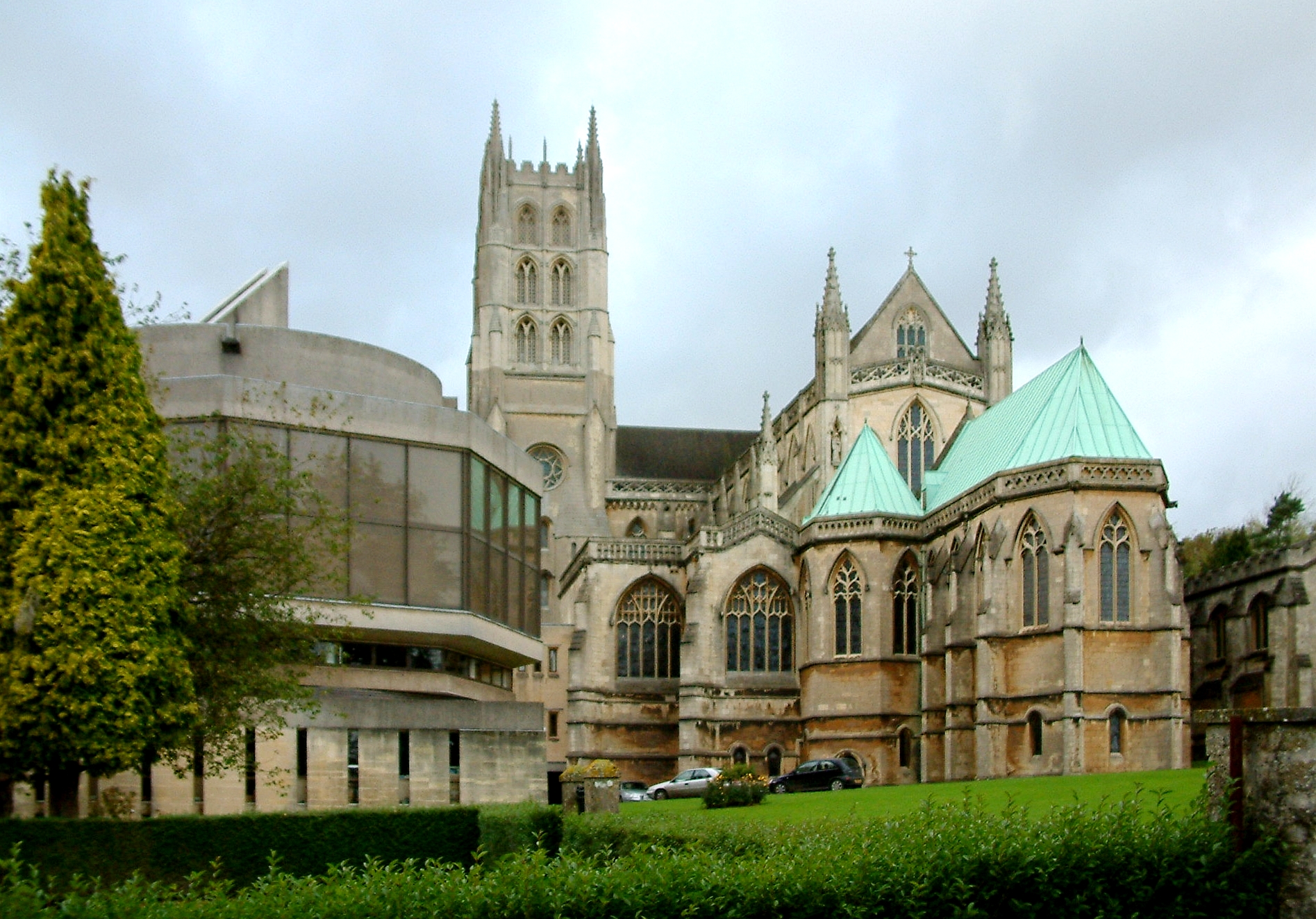
Sacred place
Downside Abbey
Benedictine monastery in Somerset, England, UK

Stratton-on-the-Fosse, United Kingdom · 1873 CE · United Kingdom
- The senior Benedictine community of its congregation was founded at Douai in 1606, a date also given as 1607, by John Roberts (martyr), and it settled at Stratton-on-the-Fosse in 1814.
- The unfinished church of St Gregory the Great was begun in 1873 by Archibald Matthias Dunn and Edward Joseph Hansom, consecrated in 1935, and ranked as a minor basilica.
- The church holds the body of Oliver Plunkett and the skull of Thomas de Cantilupe, and Sir Nikolaus Pevsner called its Gothic Revival a splendid demonstration of the renaissance of Roman Catholicism in England.
- The monks left in 2022 and in July 2025 began a two-year trial of life at Belmont Abbey, while the church remains a school chapel open on weekdays.
- The church was listed Grade I, and the monastery Grade II*, on 25 June 1986, and both entries were amended on 16 July 2024.
Visiting
The basilica is open Monday to Friday from 10:00 to 16:00 throughout the year, excluding bank holidays. Dogs are not allowed in the abbey church, except guide dogs. Sunday Mass at 10:00 is open to all. The visitor centre is temporarily closed.
History
Downside Abbey stands at Stratton-on-the-Fosse in Somerset, and it was the senior Benedictine community of the English Benedictine Congregation. John Roberts (martyr) founded the house at Douai in 1606, a beginning also dated to 1607, under the patronage of Gregory the Great. After expulsion during the French Revolution the monks lived at Acton Burnell, and in 1814 they settled at Mount Pleasant.
The church of St Gregory the Great was begun on 1 October 1873 by Archibald Matthias Dunn and Edward Joseph Hansom, and it was never finished at the west end. Thomas Garner, Frederick Walters, and Giles Gilbert Scott continued the work, and the tower was completed in 1938. The church was consecrated in 1935 and raised to a minor basilica, one of four in England and also described as one of four in the United Kingdom.
The building holds the body of Oliver Plunkett, brought from Lamspringe in 1881 or in 1883, and a reliquary with the skull of Thomas de Cantilupe in the Lady Chapel fitted by Ninian Comper. Sir Nikolaus Pevsner called the Gothic Revival a splendid demonstration of the renaissance of Roman Catholicism in England, while the community’s own history gives the words as the most splendid demonstration. Cardinal Gasquet, prior here from 1878 to 1885 and later a cardinal, is commemorated by a recumbent effigy in the south choir aisle.
The church and the north cloister were listed Grade I on 25 June 1986, and the monastery Grade II*, with both entries amended on 16 July 2024. The library of some 450,000 books, finished in 1971 to designs by Francis Pollen, was listed Grade II in 2024. The monks left in the spring of 2022, a departure also dated to 13 March 2022, lived at Buckfast, and in July 2025 began a two-year trial of life with the community at Belmont Abbey.
The school and the abbey have been separate trusts since September 2019, after investigations into the abuse of pupils by monks. The church is now used as a chapel of the school, and the monastic ranges are largely vacant, though the community remains responsible for the archive and the heritage. Weekday opening is from 10:00 to 16:00, Sunday Mass is at 10:00, and dogs are not allowed in the church except guide dogs.
A hoard of late Roman bronze coins was found in 1987 in a field north of the abbey, and the ground west of the Fosse Way has produced a stone-founded Roman building and a villa dated by coins to 260–360. Those remains lie outside the church. In March 2025 a survey on the school estate recorded two parallel lines that may be the ditches of the Roman road.
Images


Detailed History
Downside Abbey stands at Stratton-on-the-Fosse, between Westfield and Shepton Mallet in Somerset, on the line of the Fosse Way. Its full name is the Abbey of St Gregory the Great at Downside. It was a Benedictine monastery and the senior community of the English Benedictine Congregation. The church, the school, and the monastery grew on one estate.
Until 2019 the community and Downside School were closely linked. In 2020 the community numbered fifteen monks. The monks left the buildings in 2022. By 2025 the monastic ranges on the site were largely vacant, and the church was in use as a chapel of the school.
The dedication reaches back to Gregory the Great, pope from 3 September 590 until his death on 12 March 604, the sixty-fourth bishop of Rome. He was born in Rome about 540, a senator’s son who had himself been prefect of the city at about thirty, and he had lived in a monastery he established on his family estate before he became a papal ambassador and then pope. He sent missionaries to England, among them Augustine of Canterbury. The later English community took his name because he had sent Augustine at the head of a mission in 597.
Gregory is counted, with Augustine, Jerome, and Ambrose, among the four great Latin fathers. His feast on 12 March was the day chosen in 2025 for the community’s announcement that it would move again.
The house itself began at Douai, then in Flanders and part of the Spanish Netherlands, now in northern France. The community’s own account dates the foundation to 1606. Another account dates it to 1607. The founder was the Welshman John Roberts (martyr), who became the first prior.
He gathered English monks who had entered monasteries of the Spanish Benedictine Congregation, notably the principal house at Valladolid, which is recorded as the mother house. In 1611 Philippe de Caverel, abbot of St Vaast at Arras, built and endowed a monastery for them. The Priory of St Gregory was thus the first English Benedictine house to renew conventual life after the Reformation, which is why the community holds seniority in the congregation. The community’s own history adds that the founders organised a school for English boys and a base for missions in England, and that English Catholics had been given sanctuary at Douai while escaping anti-Catholic legislation after the Dissolution of the Monasteries, which that account dates from 1530.
John Roberts was born in 1577 at Trawsfynydd in Snowdonia, the son of John and Anna Roberts of Rhiw Goch. He was baptised in the Anglican faith at the parish church of St Madryn. He is said to have been taught by an elderly man who had been a Cistercian at Cymer Abbey, near Dolgellau, until its dissolution in 1537. He entered St John’s College, Oxford, in February 1595, left after two years, and studied law at Furnival’s Inn.
On a visit to Notre Dame in Paris he left both the law and his former faith. In 1598 he joined St Benedict’s at Valladolid and was known as Brother John of Merioneth. He made his novitiate at San Martín Pinario in Santiago de Compostela and his profession towards the end of 1600. Ordained, he set out for Britain on 26 December 1602.
A government spy observed the party, but he and his companions entered the country in April 1603. He was appointed vicar of the English monks of the Spanish Congregation on the Mission, then arrested and banished on 13 May. He reached Douai on 24 May. He soon returned and worked among plague victims in London.
In 1604, while embarking for Spain with four postulants, including William Scott, later Maurus Scott, he was arrested again, not recognised as a priest, released, banished, and he came back at once. On 5 November 1605, during a search of the house of Mrs Percy, the first wife of Thomas Percy, who was involved in the Gunpowder Plot, Justice Grange found Roberts and arrested him. He was acquitted of any complicity in the plot, imprisoned for seven months in the Gatehouse at Westminster, and exiled again in July 1606. He then spent about fourteen months away, nearly all of them at Douai, and there founded the house and became its first prior.
He returned to Britain in October 1607, was arrested in December, and escaped from the Gatehouse after some months. He lived in London for about a year. In May 1609 he was taken to Newgate. He might have been executed, but the French ambassador, Antonie de la Broderie, interceded, and the sentence was reduced to banishment.
He visited Spain and Douai again and returned for a fifth time within a year. On 2 December 1610 he was captured just as he finished saying Mass, followed by the former priest and spy John Cecil, who had compiled a dossier on him for James I. He was taken to Newgate in his vestments and tried on 5 December. He died on 10 December 1610, martyred at Tyburn.
For nearly two hundred years the monastery trained monks for the English mission. Six of those men were beatified by Pope Pius XI in 1929. Two of them, John Roberts and Ambrose Barlow, were among the Forty Martyrs of England and Wales canonised by Pope Paul VI in 1970.
Ambrose Barlow was born in 1585 at Barlow Hall, Chorlton-cum-Hardy, near Manchester, the fourth son of Sir Alexander Barlow and Mary Brereton. His baptismal name was Edward. The entry at Didsbury Chapel on 30 November 1585 reads as the legal son of Alexander Barlow. His paternal grandfather had died in prison in 1584 for his beliefs, and his father had two-thirds of his estate confiscated for refusing to conform.
At twelve, in 1597, Edward entered the household of a Protestant cousin, Sir Urian Leigh of Adlington, as a page. He remained Anglican until 1607, when a friend brought him back to Catholicism. He studied at the English College at Douai and at the Royal College of Saint Alban at Valladolid. On a visit to England in 1613 he was imprisoned for several months.
Released, he returned to Douai in 1615 and joined St Gregory’s, where his brother Rudesind Barlow was prior. He took the name Ambrose and was ordained in 1617. Merely entering England as a Catholic priest was then treason. He settled at Morleys Hall, Astley, the home of Sir Thomas Tyldesley, whose grandmother had arranged a pension so that he could serve poor Catholics.
For twenty-four years he worked in south Lancashire, offering Mass and saying his Office, travelling the district for four weeks and then remaining at the hall for five. He was arrested four times and released without charge. On 7 March 1641 Charles I proclaimed that all priests must leave within a month or be treated as traitors. Ambrose Barlow died on 10 September 1641.
French troops invaded Flanders during the French Revolution. One account says that by 1794 Douai was being suppressed by revolutionaries at war with Great Britain. Another says that the community was expelled after a period of imprisonment and that in March 1795 it was permitted to proceed to England. The monks settled for some twenty years as guests of Sir Edward Smythe at Acton Burnell in Shropshire.
The community’s own account calls Acton Burnell Hall the home of a former pupil, and a temporary rehousing. During those years a manor called Mount Pleasant, at Downside, was purchased as another temporary home. In 1814 the community finally settled there. A report of the later foundation day says that the monks bought about seventy acres in 1814 and in time increased the property to some three hundred and fifty acres, and that they came to be known for the best cultivated farms in that part of Somerset.
The early years at Downside were uncertain. France was still attractive, numbers in the school and the monastery were low, and the local Catholic bishop, Augustine Baines, though himself a Benedictine, was hostile. Within a decade the community had adjusted. By 1823 it had opened a chapel and new school buildings, designed by Henry Goodridge in a Gothic style meant to recall medieval monastic life.
A small single-storey lodge at the east entrance, in a plain Grecian style, was built in 1827, to designs assumed to be by the same Henry Goodridge. Adjacent gatepiers in Gothic Revival, by Edward Joseph Hansom, were added in 1871.
Through the nineteenth century the community staffed missions in industrial England, with centres at Liverpool, Warrington, Whitehaven, and in South Wales, and it forged links with New South Wales. John Bede Polding, also called Bede Polding, is listed as superior from 1805 to 1819 and later became Archbishop of Sydney. Roger Vaughan, also called Bede Vaughan, a monk of the house, became the second Catholic Archbishop of Sydney. The community’s own account says that the first two archbishops of Sydney were former monks of Downside.
By 1900 most of the missions had passed to diocesan clergy, except Little Malvern and East Anglia, which remained parishes of the house. The churches recorded as held by the community are St Benedict’s at Stratton-on-the-Fosse, the Church of the Holy Ghost at Midsomer Norton, and St Francis Xavier’s at Hereford. The house sits in the Diocese of Clifton, within the Province and metropolitan Archdiocese of Birmingham.
Before the present monastery, Charles Francis Hansom had been asked for a full scheme of school and monastic buildings. It was not carried out, though he added smaller works in the 1850s. An earlier scheme by A. W.
N. Pugin was also abandoned. In 1872 Archibald Matthias Dunn and Edward Joseph Hansom were commissioned for a more modest and affordable scheme: east and west cloister ranges, accommodation for the monks, and a lower south cloister which, because the ground falls from north to south, would be subterranean on the north side. The Hon.
William Petre, resident at Downside from 1874 to 1877, collaborated on the monastic plan. Joseph Blackwell of Bath carried out the work.
Archibald Matthias Dunn was born at Wylam in Northumberland in 1832 and died on 17 January 1917 at Wood House, Branksome Park, Bournemouth, aged eighty-five. He was educated at Ushaw and Stonyhurst, apprenticed in Bristol to Charles Francis Hansom, and there met Edward Joseph Hansom, his employer’s son. Their north-eastern work included the tower and spire of St Mary’s Cathedral in Newcastle. Dunn was an alderman, a mayor, and a justice of the peace, and in 1870 president of the Northern Architectural Association.
He designed Castle Hill House at Wylam as his own home in 1878–9. His son Archibald Manuel Dunn joined the practice in 1887, and W. Ellison Fenwicke became a partner in 1894. Dunn retired between 1883 and 1887.
The firm’s list credits Dunn and Hansom with the transepts and the base of the tower at Downside from 1873 to 1882, and with the Lady Chapel in 1888.
Edward Joseph Hansom was born on 22 October 1842 and died on 27 May 1900. He was the son of Charles Francis Hansom and the nephew of Joseph Aloysius Hansom. Articled to his father in Bath in 1859, he became a partner in 1867, when the practice was in Bristol. In 1871 he moved to Newcastle and entered partnership with Dunn.
He was admitted ARIBA in 1868 and FRIBA in 1881, and he was president of the Northern Architects’ Association in 1889–90. After a long illness he suffered from depression, was unable to work, shot himself at his office, and died on 27 May 1900. His own list names the transepts at Downside, as the first phase of the church, in 1882.
The foundation stones of the new church and of the collegiate and monastic buildings were laid on 1 October 1873. Archbishop Manning presided and laid the chief stone, the base of the north transept. Bishop Clifford of Clifton celebrated a Pontifical High Mass in strict Gregorian chant and laid the stone of the college. The Bishop of Newport and Menevia laid the stone of the monastery.
With them were the Cistercian abbot of Mount St Bernard in Leicestershire, Monsignor Capel, Monsignor Parfitt, Dr Neve the vicar-general, Dr Williams the president of Prior Park, and Dr Sweeney of Bath. Manning preached on the text “One body and one spirit”. About a hundred pounds were laid on the stone, with further promises, and about two hundred guests were entertained in the college exhibition room. The architects were named as Dunn and Hansom of Newcastle, and the style as medieval Gothic.
The account said the church would be exceptionally grand, with a lofty tower and spire, and that it would be built of stone from the quarries at Doulting, the same stone used at Wells Cathedral and Glastonbury Abbey.
The dates of the building do not agree in a single sequence. One account says the monastery and the attached cloisters were completed in 1873 except for the south end, completed in 1899. Another says the monastery was completed in 1876. The building record says the monastic buildings were begun in 1873 and first occupied in 1876, that the west range and the Petre cloister were begun in 1873 and completed about three years later, and that before this the monks had lived in earlier buildings which afterwards became part of the school.
The church is said to have been begun in 1873 with the transepts and the Lady Chapel, and also to have been built between 1879 and 1938, and between 1873 and 1938. A separate survey gives the main periods as 1872–82, about 1890, 1901–5, 1911–12, about 1923–25, and 1938, and notes an original date of 1879. The earliest part is also described as the decorated transepts by Dunn and Hansom, dating from 1882. The nave is given as about 1923–25 and as years of building running from 1873 to 1925, with completion dated both 1925 and 1935.
The tower was completed in 1938. The west end was never finished.
The west range is Bath stone ashlar under tile, in an accomplished Collegiate High Victorian Gothic. It runs north–south and forms the western enclosure of the cloister garth. As first built it had a ground-floor cloister with the chapter house, the calefactory, and a temporary library, and cells above. An elaborate stone stair in a tower rose from the lower south cloister, named for Petre, to the cells.
In 1899 a short range was added at the north end for sanitary facilities, on a site once intended for a large library wing. The west range was also raised, adding two further storeys of cells. One account completes those phases by 1892 and 1900. The fabric description completes them in 1892 and 1899, and dates a secondary stair to 1892–1899.
The cells of the 1892 addition have windows that bring borrowed light into the corridor. That light is absent from the 1899 section. A band of Tudor flower marks the original parapet before the tower was raised.
The west front is described as three storeys, rising to four at the south end, with a later attic, four gables, and a central entrance under a half-projecting two-storey octagonal tower with a conical roof. A measured account sets the same front at three storeys and attics, in seven bays, with the two upper storeys added to the 1870s building, a half-projecting octagonal entrance tower under a conical roof, and, to the right, a square tower of four full storeys with battlements. The east front of the cloister is of eight bays. The chapter room has a Gothic chimneypiece with a seated figure of St Benedict and angels.
The calefactory has a dividing wall and a fireplace flanked by pointed arches. A small chapel sits over the entrance porch on the first floor. At the foot of the south-west stair, the Petre cloister is a single-storey range of eleven bays, its flat roof level with the garth, each buttress capped by an angel, each bay a five-light Perpendicular window. In a niche at its western end is a sculpted group of the martyrdom of St Thomas of Canterbury.
The Weld cloister, the east walk, was always planned and was built only at lower level, mainly subterranean because the ground falls. Designs for heraldic glass there were drawn by Ninian Comper about 1896. The cloister was altered about 1950. A temporary structure called the White House stood on a deck above it until the 1970s.
Downside was granted the status of an abbey in 1899, together with Ampleforth and Douai. Prior Edmund Ford, who had been prior from 1894, was elected the first abbot in 1900 and remained until 1906. The superiors recorded after him are Cuthbert Butler from 1906 to 1922, Leander Ramsay from 1922 to 1929, John Chapman from 1929 to 1933, Bruno Hicks from 1933 to 1938, Sigebert Trafford from 1938 to 1946, Christopher Butler from 1946 to 1966, Wilfrid Passmore from 1966 to 1974, John Roberts from 1974 to 1990, Charles Fitzgerald-Lombard from 1990 to 1998, Richard Yeo from 1998 to 2006, and Aidan Bellenger from 2006 to 2014. Leo Maidlow Davis was prior administrator from 2014 to 2018.
Nicholas Wetz was prior administrator from 2018 to 2020 and abbot from 2020.
The choir is the work of Thomas Garner, who is buried in the church. It was opened on 20 September 1905, when the monks sang a Requiem for all the deceased of the community. Garner also shaped chapels later refitted by others. Frederick Walters designed further chapels, screens, and the sacristy woodwork, possibly executed by the De Wispelaere workshop in Bruges.
The nave, by Giles Gilbert Scott, of about 1923 to 1925, remains unfinished. Its western wall is of rough lias, bare and undecorated. A survey says the west front and two bays of the nave are missing. The building record describes an unfinished eight-bay nave and a temporary west front of coursed lias in a simplified Perpendicular manner, with three tall lancets over a relieving Romanesque arch.
Scott reordered the quire in 1934. The original high altar became the altar of the Blessed Sacrament, and a new altar was placed three steps to the west on a slightly lower level. The stools were replaced with stalls modelled on those of Chester Cathedral. That arrangement lasted until the decrees of the Second Vatican Council.
In 1968 Francis Pollen brought the high altar forward and moved the choir stools back.
The church was consecrated in 1935. Cardinal Seredi, Prince-Primate of Hungary and a Benedictine member of the Sacred College, consecrated it and represented the pope. Cardinal MacRory came from Ireland. Seven archbishops, twelve bishops, and fifteen abbots attended, with more than five hundred priests, and among the lay guests was the Lord Mayor of London.
The building was said to have cost over two hundred thousand pounds. At the same time Pope Pius XI raised the church to the rank of a minor basilica, described then as the first in England, which gave the abbot the right to wear the cappa magna. The church is one of four minor basilicas in England, and it is also described as one of only four in the United Kingdom, the others named as St Chad’s Cathedral in Birmingham, the National Shrine of Our Lady at Walsingham, and Corpus Christi Priory in Manchester. The designation is explained by architectural beauty, historical significance, and liturgical renown.
Sir Nikolaus Pevsner, the German-British historian born in Leipzig on 30 January 1902 and died on 18 August 1983, described the Gothic Revival of the church as “a splendid demonstration of the renaissance of Roman Catholicism in England”. The community’s own history gives his judgment as “the most splendid demonstration of the renaissance of Roman Catholicism in England”. He is known for the forty-six county volumes of The Buildings of England, issued from 1951 to 1974. He was removed from his post at Göttingen in 1933 and settled in England, where the county guides became his great work.
The north Somerset volume associated with his name is cited for this church in both a 1958 edition and a 2011 edition prepared with Andrew Foyle.
The church is built to rival in size the medieval English cathedrals lost to Catholic use at the Reformation. It is cruciform and aisled: an eight-bay nave with passage aisles, a crossing, north and south transepts, a seven-bay choir, an ambulatory, radiating chapels, and a crypt under the east end. The south transept is screened from the body of the church and forms part of the north cloister, with the organ and with galleried chapels above. The tower stands south of that transept.
The sacristy lies to the north. The material is local lias faced with Bath-stone ashlar, under plain clay tiles, while the east chapels are roofed in copper. Another account says Bath stone ashlar and plain red tile, and the 1873 report says Doulting stone. Windows range from one light to four, with varied tracery.
The earliest style is thirteenth-century French Gothic, with later work in Early English, Decorated, and Perpendicular.
The Perpendicular south tower is given as 166 feet, or 55 metres, and as 51 metres, and one account calls it the second highest tower in Somerset. The 1873 promise of a spire was not carried out. The south door is framed by blind arcading and a tympanum with three statues by R. L.
Boulton and Sons of Cheltenham. Above are a pair of lancets and a circular window. The upper stage narrows through three tiers of Y-tracery belfry windows to crocketed pinnacles. The choir parapet carries an elongated trefoil that continues round the east and north.
The east end is framed by towers with niches and statues. The Lady Chapel projects eastward in line with the choir. The north transept has a large wheel window over a band of blind trefoil arcading.
Inside, the vaults are moulded and ribbed in the thirteenth-century French manner, with stone infill. The nave arcade has clustered piers of four octagonal shafts. Angel corbels carry the shafts from which the ribs spring. The triforium has paired plate-tracery openings with ogee arches and quatrefoils, and the clerestory is of three lights.
The floor of the nave is parquet, and the aisles are paved in stone. At the east end of the north aisle, the Chapel of St Lawrence was designed by Dunn and Hansom and refitted by Walters in 1898, with a relic cupboard painted by Nathaniel Westlake.
The crossing is marked by tall clustered shafts with foliate capitals. In the north transept a balustraded gallery of pierced quatrefoils rests on a Lombard frieze. That transept, once the sanctuary and now the Chapel of St Oliver Plunkett, has an altar of 1882 designed by Dunn and Hansom and carved by Alfred B. Wall.
On tall stone columns stands a gilded oak reliquary of Oliver Plunkett. The south transept is closed by a stone screen with a central doorway into the north cloister. Above it, the organ screen of 1931, designed by Scott and carved by Ferdinand Stuflesser, is a Gothic wooden screen of repeated vertical openings.
Oliver Plunkett, also spelled Plunket, was born on 1 November 1625 at Loughcrew in County Meath. Earlier biographers gave 1 November 1629, but 1625 has been the consensus since the 1930s. He was Catholic Archbishop of Armagh and Primate of All Ireland, and the last victim of the Popish Plot. He was beatified in 1920 and canonised in 1975, the first new Irish saint in almost seven hundred years.
Educated by his cousin Patrick Plunkett, he went to Rome in 1647 in the care of Pierfrancesco Scarampi, while the Irish Confederate Wars were being fought, and he was ordained in 1654. The Cromwellian conquest kept him from Ireland. From 1657 he taught theology in Rome. On 9 July 1669 he was appointed to Armagh and on 30 November he was consecrated at Ghent by Eugeen-Albert, Count d’Allamont.
He set foot in Ireland on 7 March 1670. The community’s account says he landed on St Patrick’s Day 1670, Old Style, after being received in London by Catherine of Braganza at Somerset House, where a small community of Gregorian monks assisted her chaplains. The pallium was granted on 28 July 1670. He founded a Jesuit college at Drogheda in 1670.
A year later it had one hundred and fifty students, no fewer than forty of them Protestant. He is said to have confirmed forty-eight thousand people in four years. He wrote that if drunkenness were removed from an Irish priest, the priest would be a saint. The Test Act of 1673, which he would not accept, closed and demolished the college.
He went into hiding. In the Popish Plot, a fabrication associated with Titus Oates, he was arrested, held at Dublin Castle, and in 1679 taken to Newgate in London. He was accused of arranging a French invasion and of planning a massacre of the Protestant population of Ireland. He was martyred at Tyburn on 1 July 1681, described as the last priest judicially executed there under the penal laws.
His body, minus the head and part of an arm, and also described as minus the head and the forearms, was taken to Lamspringe in Germany in 1683 by Dom Maurus Corker, President General of the English Benedictines from 1680. One account brings the remains to Downside in 1881, exactly two hundred years after Lamspringe received them. The community’s account brings them in 1883, firmly closed and sealed with the episcopal seal of Dr Clifford, Bishop of Clifton, and says they had lain at Lamspringe since 1683. Another account says they lay at Lamspringe for two hundred and fifty years.
The casket was kept on the west wall of Dunn and Hansom’s original church before a permanent reliquary was made. Prior Aidan Gasquet wrote in 1883 that the relics were preserved to do honour to so eminent a prelate and so holy a martyr. The head is venerated at Drogheda, not at Downside. A small stone coffin from Lamspringe lies under the shrine.
Around the canonisation in 1975 the community gave relics to Drogheda and to other churches. An annual Mass at Downside is held on 1 July.
The choir is Early English, with a square east end and three tall openings, statues under crocketed canopies, and an east window by Ninian Comper. There is no triforium in the choir. The oak stalls, designed by Scott in 1931–32 on the model of the late fourteenth-century stalls at Chester, were carved by Stuflesser, and the front two rows, also by Stuflesser, were added in 1951. Off the north choir aisle are the chapels of the Holy Angels, St Placid, and the Seven Sorrows, all by Dunn and Hansom, with glass by Hardman and an early twentieth-century parclose by F.
C. Eden. The Holy Angels chapel has a small Flemish triptych of about 1540. St Placid has an altar and reredos of 1915–16, with six saints painted by Dame Catherine Weeks and coloured and gilded by Geoffrey Webb, who also designed the archangels above.
The Seven Sorrows has a reredos of 1892 by Dunn and Hansom, carved by Wall, recoloured and gilded by John Tolhurst in 1955, and a central Crucifixion panel, probably from Regensburg, of about 1480–90. The Chapel of St Sebastian was designed by Garner and refitted by Comper in 1929, with an alabaster figure of the saint. Gilbert Sullivan completed the west bay of its stone screen in 1972. The Chapel of St Sylvia is by Walters.
The polygonal chapels of St Joseph and St Vedast have glass by Hardman.
The Lady Chapel, by Dunn and Hansom, is counted among the most complete schemes of Ninian Comper. It has a polygonal east end and nine traceried windows by him, three in the apse fitted from 1899 to 1911 and the rest from 1919 to 1927. His fittings include an English altar with an alabaster and gilt reredos, a gilded screen with four relic chests and a central cross, a square tester of 1912 painted on the underside with the Coronation of the Virgin, and Spanish-inspired iron gates beside a painted and gilded limewood Virgin. A reliquary holds the skull of St Thomas de Cantilupe.
The Chapel of the Sacred Heart has ceramic reliefs of 1954–56 by Adam Kossowski and three windows by Comper. The chapels of St Benedict and St Isidore have glass by Lavers, Barraud and Westlake. St Benedict has a triptych by Walters painted by Westlake. St Isidore has a stone reredos by Walters and a marble pavement designed by Garner and made by Farmer and Brindley.
In the south choir aisle, the tomb of Cardinal Gasquet was designed by Scott as a recumbent effigy, the head held by an angel and, at the feet, the figure of History. Edward Carter Preston carved it in grey Palombino marble, under a canopy of carved, painted, and gilded pine. On the outer wall of that aisle, a limewood Virgin and Child is attributed to Nicolaus Gerhaert of Leiden, of about 1470. A stone stair by Garner rises to the gallery chapels.
The sacristy, of three rooms, has oak fittings designed by Walters: an altar and triptych, vestment benches tied to particular chapels, and cupboards between carved coats of arms. The north cloister has a ribbed vault with banded stone, foliate capitals, and a floor of polychrome geometric tiles.
Cardinal Gasquet was born Francis Neil Gasquet on 5 October 1846 at 26 Euston Place, Somers Town, London, and died in Rome on 5 April 1929. He was the third of six children of Raymond Gasquet, a physician whose father, a French naval officer, had come to England in the evacuation of Toulon in 1793. Educated at Downside School, he entered the Benedictines at Belmont in 1865, was professed at Downside, and was ordained on 19 December 1871. He was prior of Downside from 1878 to 1885 and resigned through ill health, but he kept a lifelong interest in the monastic buildings and especially the church.
He served on the commission of 1896 into Anglican orders that led to Apostolicae curae. In 1900 he became abbot president of the English Benedictines. From 1907 he presided over the commission for the revision of the Vulgate. He was created cardinal deacon in 1914, with the title of San Giorgio in Velabro, and in 1915 received Santa Maria in Portico.
He was archivist of the Vatican archives from 1917 and librarian of the Vatican Library from 1924. As a historian he challenged the anti-Catholic account of English history current in his time and drew attention to the Black Death in England. Later writers attacked his accuracy. Geoffrey Elton wrote of the falsehoods purveyed by Cardinal Gasquet and Hilaire Belloc.
His collaboration with Edmund Bishop was called an alliance between scholarship exquisite and deplorable. G. G. Coulton campaigned against him and appended a list of misstatements.
David Knowles, himself a monk of Downside and later Regius Professor at Cambridge, wrote in 1956 of Gasquet’s many errors and of a capacity for inaccuracy that in old age amounted almost to genius, while judging that Coulton had oversimplified the case. Eamon Duffy called him generously talented, and also a bad workman and not entirely scrupulous. Shane Leslie, who knew him, published a memoir in 1953.
The first organ was built in 1805 by George Pike England of Tottenham Court Road for the Music Room of the Brighton Pavilion. Moved in 1882, without its original case, to the gallery of the south transept, it had sixteen stops on two manuals and pedals. In 1907 it went to the church of St Vigor in Stratton-on-the-Fosse. After water damage there in 1969 it was sold and is said to survive somewhere in America.
It was to have been replaced in 1905 by an organ of three manuals and fifty-five speaking stops by Garrard of Lechlade, supplied in 1907 by the renamed firm of Garrard, Spooner and Amphlett, and never completed satisfactorily. The present organ was built by John Compton in 1931. It has one hundred and forty-two speaking stops on four manuals and pedals, drawn from thirty-eight ranks by extension and transmission. The instrument sits in three stone and concrete chambers, with swell shutters facing upward, except the Tuba, which speaks down into the transept.
The case, designed by Scott and carved by Stuflesser of Ortisei in the Italian Tyrol, is solid oak fretwork with no pipe fronts and no roof, so the sound rises into the transept vaults and travels down the nave. The console faces west from near the crossing, along the north side of the nave, and is made of timber from HMS Bellerophon, the ship that transported Napoleon after the Battle of Waterloo.
The cemetery is primarily the burial ground of the community. It contains two war graves of the Second World War, a lieutenant of the Duke of Cornwall’s Light Infantry and a sub-lieutenant of the Royal New Zealand Navy, and also the graves of Baroness Charles von Hügel and of two of her children, Friedrich and Pauline.
The library holds some four hundred and fifty thousand books, incunabula, manuscripts, and periodicals, together with the archives of the English Benedictine Congregation. The medieval manuscripts have been called the most important in the south-west of England. They are housed in a six-storey octagonal building designed by Francis Pollen, an old boy of the school, and completed in 1971. When it was listed at Grade II in 2024 it was described as a highly imaginative building with high-quality workmanship, joinery, and cabinetry.
After a public heritage grant of eight hundred and fifty-six thousand pounds in 2013, the archives were opened to the public, rare books and manuscripts were digitised, and the building was repaired. A report of that opening is dated 31 October 2015. In 2016 a Georgian recipe book of 1793 was found in the library. In March 2017 the abbey was reported to be publishing a copy of it.
Among its contents is one of the earliest known recipes in Britain for curry, and it records daily life at Begbrook House near Bristol.
Francis Pollen, born in 1926 and died in 1987, was educated at Downside, then at Cambridge and the Architectural Association. He had been influenced by Edwin Lutyens, whose son was his schoolfellow and who remodelled Lambay Castle for Pollen’s grandparents. In the late 1950s he turned to New Brutalism, preferring heavy brick and concrete. His best-known church is the abbey church at Worth, built from 1964 to 1989.
At Downside the east wing, by Brett and Pollen, was built in 1970–75 over the unfinished Weld cloister, immediately after the library, to provide cells, a monks’ refectory, a school refectory, guest rooms, and a new entrance to the church. A third floor was planned and never built. The wing is concrete-framed, clad in limestone ashlar, with bush-hammered concrete. The monks’ refectory has full-height glazing in T-shaped openings and a canted ceiling.
Abbot Christopher Butler, a scripture scholar and a prolific contributor to the Second Vatican Council, and at the time abbot president, commissioned both the library and the east wing. The optimism of that council is the context given for the expansion. The east front of the older monastery is obscured by the library of 1971 and by this wing. The monastery, including a single-storey cloister linking it to the school, was listed Grade II* in 1986, and the 1975 east wing was brought into that designation in 2024.
A twentieth-century account of the listing of Pollen’s library and east wing is dated 15 August 2024.
Downside monks founded a daughter house at Ealing in west London in 1897. It became independent in 1947 and Ealing Abbey in 1955. They founded another at Worth in West Sussex in 1933. It became independent in 1957 and Worth Abbey in 1965.
During the nineteenth century the school at Downside remained small. Leander Ramsay is called the founder of modern Downside. He planned the new buildings that opened in 1912 and now form two sides of the Quad. The school is a Catholic school for boys and girls from eleven to eighteen, and it accepts pupils who are not Catholic.
Its board of governors has eleven members, one of them from the abbey community.
Other monks of the house include Richard Connolly, a Syriac scholar who lived from 1873 to 1948; Gregory Murray, composer, liturgist, and organist, who lived from 1905 to 1992; Bernard Orchard; Illtyd Trethowan, sub-prior from 1958 to 1991 and a theologian; William Bernard Ullathorne, bishop and theologian; and Hubert van Zeller, author, sculptor, and cartoonist. In 1997 the monks and choirboys released an album of choral music. In October 2017 a television episode followed the abbey and the daily round of two monks.
From September 2019 the school and the abbey have been run by separate trusts, a reform overseen by the Charity Commission after an investigation into the abuse of pupils by monks. In January 2012 Richard White, a monk who had taught at the school and was known to pupils as Father Nick, was jailed for five years for gross indecency and indecent assault against a pupil in the late 1980s. He had been allowed to go on teaching after he was first caught abusing a child in 1987, and he went on to groom and assault another pupil in the junior school. After the second incident he was placed on a restricted ministry and had no contact with the school, but he was not arrested until 2010.
Two other monks connected with Downside, also former teachers, received police cautions during an eighteen-month investigation. One of them was named as Brother Anselm, Michael Hurt, a brother of the actor John Hurt, who transferred his stability to Glenstal Abbey in Ireland in the 1980s. Inspection reports referred to seven monks who had worked at the school and whose behaviour had been a cause for concern. The abbot apologised to parents and reported that fifty years of confidential school records showed that four of the monks had faced police action, two had restrictions imposed, and one had been cleared and had returned to monastic life.
An inspection of 2013 said that welfare, health, and safety were excellent and that safeguarding had much improved since November 2010 and met the requirements in full.
In November 2017 a national inquiry into child sexual abuse began to examine the targeting of children at Downside School together with the school at Ampleforth, as part of an investigation of the English Benedictine Congregation and of failures to protect young people over many decades. The inquiry heard that children at the two schools could still be at risk. It heard that in 2012 the then headmaster, Leo Maidlow Davis, later the senior monk at Downside, made trips with a loaded wheelbarrow to a distant part of the grounds and burned staff files dating back to the early 1980s that might have contained evidence of abuse. He said he had wanted to get rid of unnecessary old material.
He accepted that the files should have been kept for seventy years, and he conceded that he might unintentionally have destroyed information about abuse. Charles Fitzgerald-Lombard, abbot from 1990 to 1998, was among three abbots accused by Aidan Bellenger, in a private letter, of tolerating the abuse. Bellenger, abbot from 2006 to 2014, said his predecessors had protected and encouraged abusive monks. Men under suspicion were moved quietly between Benedictine monasteries and parishes.
Reference was made to instructions from Rome to destroy documents damaging to priests. In May 2020 it was reported that, after the inquiry’s report of 2018, the school faced major financial difficulty from legal costs, settlements, and falling rolls, and that it sold some Renaissance paintings.
Nicholas Wetz of Belmont was appointed prior administrator for two years from September 2018, the appointment having been announced in July 2018. In August 2020 he was elected the first abbot of Downside in six years. In the same week it was announced that the monks would seek a new home, because smaller numbers and changing circumstances made the building unsuitable. In the spring of 2022, and also dated to 13 March 2022, the community moved to Southgate House, in the grounds of Buckfast Abbey in Devon, and lived there as the Community of St Gregory the Great.
The move was said to allow up to five years of discernment. Abbot David and the Buckfast community lent their former retreat house. The monks later said that at Downside they had been overwhelmed by buildings and grounds too large for their needs. The monastery they left had once housed a community of about fifty.
A report of March 2025 counted eight monks as those who had left. By 2025 the school had turned the refectory into a sixth-form centre. A heritage statement of November 2024 records that the lower ground floor of the east range had long been used by the school, and that after 2022 the school took the former monks’ refectory and the cloister corridors for that sixth-form centre, and the former praelatura for offices and an examination room.
On 12 March 2025, the solemnity of Gregory the Great, and exactly three years after the move to Southgate House, the community announced that it would take up residence in the summer with the community of St Michael and All Angels at Belmont Abbey in Herefordshire. The two communities had voted for a trial of two years. During that time St Gregory’s would remain a separate and independent body under canon law, with the shared hope of eventually forming one community at Belmont. Abbot Brendan Thomas of Belmont welcomed them on the same day and said that, while formally separate, they would live a common life.
The move was completed in July 2025. A notice of 21 July 2025 says that St Gregory’s remains committed to its pastoral work, its oblates, and its parishes, and that it remains responsible for the heritage at Downside. The building record, describing the position in February 2024, says that the Pollen wing ceased to be part of the monastic enclosure in March 2022, that the library continues as the archive and library of the Community of St Gregory the Great, and that the wing houses the staff of Downside Abbey General Trust. The same record also says that the departure in 2022 concluded the site’s connection with the Benedictine order.
Both statements stand: residence ended, and responsibility for the archive and the heritage did not.
The abbey church and the north cloister were listed Grade I on 25 June 1986. The entry was amended on 16 July 2024. The reasons given are the succession of architects, Dunn and Hansom, Thomas Garner, Frederick Walters, and Giles Gilbert Scott; the harmony of their phases; and the quality of the fittings, among them Comper’s Lady Chapel, Stuflesser’s organ screen, Scott’s stalls, and Preston’s monument to Cardinal Gasquet. The monastery was listed Grade II* on the same day in 1986 and amended on 16 July 2024, for the High Victorian west range and Petre stair, for the quality of the interior, and for the Brutalist east wing.
The Grecian lodge and its gatepiers are separately listed. The church is not described, in the records read, as its own world-heritage inscription.
The ground around the estate has a longer archaeology than the monastery, and it should not be confused with finds from the church itself. On 14 August 1987 Francis Pugsley and David Massey found a hoard in a field north of the abbey, about four hundred metres west of the Fosse Way, on cultivated land. The hoard held five hundred and thirty-eight bronze nummi closing in the reign of Constantine I, with a terminal year of 316, in the lower part of an earthenware vessel, possibly a flagon, whose breaks were not fresh. Four further coins were found close by, and the total is also given as five hundred and forty-two.
A lathe-turned shale spindle whorl, 42.5 millimetres across, 17.4 millimetres thick, with a hole of 6.4 millimetres, was reported by the finders as lying within the hoard. Part of the hoard went to the county museum service at Taunton. A heritage statement places the same hoard, of five hundred and thirty-eight early fourth-century coins, on Ten Acre Field. West of the Fosse Way, at the northern edge of the village, pupils of the school took part in an excavation that found a substantial stone-founded building.
Survey and excavation in the 1990s read this as a high-status farmstead of the second or third century, inside a wider field system. Another record describes a large Roman villa in Linkmead field, dated by coins to 260–360, and notes that a Somerset archaeological proceedings volume refers to that site as Downside Abbey. A rescue excavation on the west side of the Fosse Way is separately recorded as locating a substantial stone-founded building. These are roadside and field sites, not deposits from the abbey church.
On 10 March 2025 the school reported a pupil project, led by an upper-sixth student named Julia, in the line of a school archaeological society of 1963. Over two days, with the Bath and Counties Archaeological Society and with technical support from John Oswin, Janet Pryke, Shaun Wilson, and Fiona Medland, magnetometry and resistivity were used on ground where the Fosse Way is thought to have crossed the school estate. The first reading showed two parallel lines, a linear feature that might be the ditches of that road. The archaeologists proposed a ground profile to test the idea, and a formal report was still to be written.
No catalogue of excavated objects was published from that survey.
The basilica is open Monday to Friday from 10:00 to 16:00 throughout the year, excluding bank holidays. Dogs are not allowed in the abbey church, except guide dogs. Sunday Mass at 10:00 is open to all. The visitor centre is temporarily closed.
On Thursday 18 September 2025, during a heritage open day, free guided tours of the church were given at 10:15 and 13:15, the church itself was open from 10:00 to 16:00, and tours of the monastery gardens, at other times closed to visitors, began at 11:45 and 14:45. A guidebook can be bought in the church.
Sources
- Downside Abbey — Wikipedia
- Abbey Church and Minor Basilica of St Gregory the Great and the north cloister, Downside Abbey — Historic England
- Monastery of St Gregory the Great, with west, south and east cloister ranges, Downside Abbey — Historic England
- History of Downside Abbey — Downside Abbey
- Visiting Downside Abbey — Downside Abbey
- St Gregory the Great: Mass Times — Downside Abbey
- Downside Abbey Visitor Centre — Downside Abbey
- News from the Community of St Gregory the Great, 12 March 2025 — Downside Abbey
- News from the Community of St Gregory the Great, 21 July 2025 — Downside Abbey
- St Oliver Plunkett, Bishop and Martyr — Downside Abbey
- Year of Mercy Pilgrimages — Downside Abbey
- A New Chapter in the Life of Belmont — Belmont Abbey
- Downside Abbey – Abbey Church of St Gregory — Taking Stock
- Downside Abbey, Stratton-on-the-Fosse: heritage impact statement, November 2024 — Somerset Council planning register
- Hoard 1859, Downside — Ashmolean Museum
- Archaeological Project — Downside School
- Shrines of St Oliver Plunkett — Saint Oliver Plunkett
- John Roberts (martyr) — Wikipedia
- Ambrose Barlow — Wikipedia
- Oliver Plunkett — Wikipedia
- Gregory the Great — Wikipedia
- Cardinal Gasquet — Wikipedia
- Archibald Matthias Dunn — Wikipedia
- Edward Joseph Hansom — Wikipedia
- Nikolaus Pevsner — Wikipedia
- Downside abbey2-2.jpg — Wikimedia Commons
- Pasture land at Killings Knap Farm - geograph.org.uk - 1068819.jpg — Wikimedia Commons
- Downside Abbey 1913.jpg — Wikimedia Commons
- Downside 1873 plan.jpg — Wikimedia Commons
- Scenes from the consecration of Downside Abbey 02.png — Wikimedia Commons
- Scenes from the consecration of Downside Abbey 03.png — Wikimedia Commons
- Scenes from the consecration of Downside Abbey 01.png — Wikimedia Commons
- Downside Abbey (Basilica of St. Gregory the Great) (37045636493).jpg — Wikimedia Commons
- Downside Abbey - geograph.org.uk - 7901035.jpg — Wikimedia Commons
- No more gas - geograph.org.uk - 8255574.jpg — Wikimedia Commons