
Highland, United Kingdom · United Kingdom
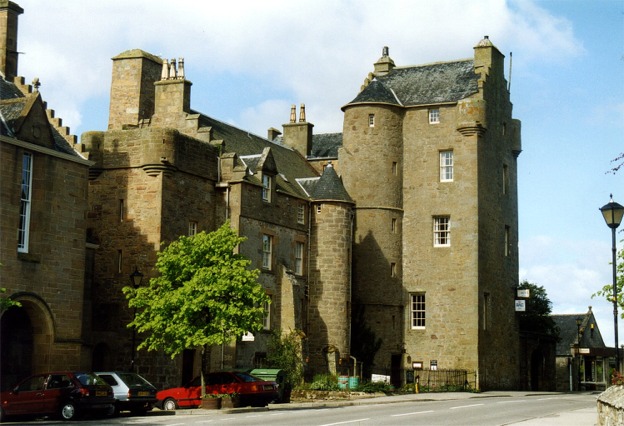
- Dornoch Castle, once the Palace of Dornoch, stands opposite Dornoch Cathedral as the former house of the bishops of Caithness.
- In 1557 it passed to the earls of Sutherland, and in 1570 it was burned in a siege while the town held the tower for a week.
- The tower later served as courthouse, jail and school, was remodelled in 1859, and has been a hotel since 1947.
- A standing-building record from 2003 to 2005 found a possible bread oven and an earlier fireplace sealed in the walls.
- The castle and its garden wall are a Category B listed building, added on 18 March 1971.
Visiting
Check-in opens at 2.30 pm and check-out is by 10:30 am. Lunch is open from 12:00 to 2:30 pm and dinner is open from 6:00 to 8:30 pm. The bar is open from 11:00 until 23:00, last orders are at 22:30, and the front door is locked daily at 23:00. After 9 pm, drinks are not allowed in an outdoor drinking area.
Dogs are allowed to enter the whisky bar and the garden. Private whisky tastings in the old dungeon are held for groups of six or more when guests book in advance.
History
Dornoch Castle, once called the Palace of Dornoch, stands on Castle Street opposite Dornoch Cathedral. It was built as a house for the Bishop of Caithness, later held by the earls of Sutherland, and it has been a hotel since 1947. The castle and its garden wall have been a Category B listed building since 18 March 1971.
Gilbert de Moravia moved the see from Halkirk after earlier bishops were attacked, and he founded the cathedral in the early thirteenth century. The foundation is dated 1214, 1224, and from 1224 to 1245. The castle is placed on the site of his palace. The oldest standing fabric is dated around 1500, in the late fifteenth century, as a fourteenth-century core rebuilt in the sixteenth, as thirteenth-century kitchen and cellar work, as an early fifteenth-century fireplace, and as an oven and brace that may be early sixteenth century.
A charter of 1557 made John Gordon, 11th Earl of Sutherland, and his heirs hereditary constables. He and the countess were poisoned at Helmsdale in 1567 and died at Dunrobin on 23 June. In 1570 the town was sacked and the palace was set alight. People held out for a week in the castle tower and in the cathedral tower.
The attackers are named as Mackays and Murrays, as the Master of Caithness with Sutherlands of Skelbo and Evelix or of Skelbo and Proncy, and as Mackays under John Sinclair after the Battle of Torran-Roy. The upper tower and its bartizans were rebuilt after the fire.
The earls kept a home here into the early eighteenth century. William, Lord Strathnaver, spent 2,300 marks, also given as 2,300 merks, on repairs in 1720. Jacobite troops were billeted in the castle in 1746, and by 1760 a blacksmith’s forge stood in the ruined basement. From 1812 the tower was re-roofed as a court and a jail, a room over the kitchens became a school, and Dornoch Sheriff Court was not finished until 1850.
William Fowler (architect) remodelled the house in 1859 for George Sutherland-Leveson-Gower, 2nd Duke of Sutherland. Around 1880 the southwest block was heightened and a three-storey east tower was added. The estates sold the castle in 1922. The Thompson family have run the hotel since June 2000.
A standing-building record from August 2003 to February 2005 found a possible bread oven and an older fireplace sealed in the walls.
Images


Detailed History
Dornoch Castle stands on Castle Street in Dornoch, opposite Dornoch Cathedral, in the parish and former royal burgh that is the only town in Sutherland. The building was the Palace of Dornoch, the residence of the Bishop of Caithness, before it passed to the earls of Sutherland. It has been a courthouse, a jail, a schoolhouse and, since 1947, a hotel. One count gives the hotel 24 rooms, with garden rooms added in the 1970s.
Another gives 21 rooms, nine of them in the fifteenth-century castle and twelve in a modern extension. A sale notice of 16 January 2014 called it a 25-bedroom hotel. The shell is a Category B listed building, the castle and its garden wall together, added on 18 March 1971. The same day the former courthouse further east, Dornoch Sheriff Court, was listed in the same category.
The town’s name is explained as a Gaelic word for a pebbly place, from stones the size of a fist. A dig in 1997 at a new business park found a building, ironworking and part of a whale from the eighth to the eleventh centuries, read as industry on the edge of a settlement that was already there by the eighth century. The first written notice of people at Dornoch is early in the twelfth century, when David I ordered Rognvald, Earl of Orkney, to respect the monks there. A later school account adds a suggestion that Saint Finbarr brought Christianity in 540 and set monks in beehive cells on the hill north of the town, and it also says there is no real historical or archaeological evidence for that story.
Before the cathedral, the same account pictures a few farms, turf houses thatched with heather, and perhaps a small stone church of Saint Finbarr east of the present graveyard.
The diocese of Caithness was one of thirteen medieval Scottish sees. Its first documented bishop was Aindréas, named between 1146 and 1151, and he may have spent his career away from the diocese. The early bishops lived at Halkirk, with a castle at Scrabster. The school account says that in 1201 Bishop John was maimed by a mob, and that about twenty-one years later Bishop Adam was burned alive on his own kitchen fire.
The bishop list calls that man Adam of Melrose, abbot of Melrose, bishop from 1213 to 1222, burned to death in his kitchen at Halkirk by the husbandmen of Caithness in a revolt over tithes. His body was later carried to Dornoch.
Gilbert de Moravia, also Saint Gilbert of Dornoch and Gilbert of Caithness, died in 1245 and is the bishop who moved the seat. He was the son of Muiredach, son of Alexander de Moravia. The name may point to the Flemish family, lords of Duffus, who during his time made the earldom of Sutherland under his possible cousin William de Moravia, or it may be a French form of the Gaelic Gille Brigte. He had an older brother John and a younger brother Simon.
A younger brother Richard de Moravia was killed fighting Scandinavians. The cathedral burial list places that death at the Battle of Embo in 1245, and Richard was buried in Dornoch Cathedral. His effigy-sarcophagus is still there. One notice calls the tomb Sir Robert de Moravia and also Sir Richard.
Gilbert was archdeacon of Moray for a long time. He was probably elected in 1223, in the presence of King Alexander II and the royal army, and he was bishop by the summer of 1224. Alexander II reigned from 1214 to 1249. The king is thought to have wanted the seat moved south from Halkirk, closer to royal protection, after Adam’s murder.
Gilbert still spent much of his time in the more violent north and kept a palace at Scrabster. He built Dornoch Cathedral and several hospices for the poor, preached, and translated the Psalms and the Gospels of the New Testament into Gaelic. The cathedral page dates the church to 1224 and dedicates it to St Mary and St Gilbert. The hotel history dates the foundation to 1214 and says that Gilbert then laid a curse of God’s wrath on anyone who would distract or injure the church.
The school account says he built on this site between 1224 and 1245, on land he owned, likely with local sandstone and with glass from Cyderhall, and that only the four central pillars and arches are now original. It also says he was later canonised. His own life says he is the last Scottish saint in the calendar of saints, and that it is not known whether he was ever formally canonised. He died in the palace at Scrabster in 1245, traditionally on 1 April, which is his feast.
He was buried at Dornoch. His relics were venerated until the Reformation, and oaths were sworn on them at least until 1545. A Sutherland folk tale collected in the late nineteenth century has him overcome a dragon, or a salamander, that was terrorising the country.
His charter for the chapter, likened to the constitution of Lincoln and copied by Charles Bentinck in 1926, says that before his time the cathedral had only one priest, because the place was poor and often invaded. He ordained ten canons besides the bishop, five of them dignitaries: a dean, a precentor, a chancellor, a treasurer and an archdeacon. The Abbot of Scone was also a canon. Each dignitary, with the bishop and the abbot, was to keep a priest for the days he was absent, and three other canons were to find deacons.
Church officers built stone houses around the cathedral. By the end of the thirteenth century the school account calls Dornoch a small thriving village that existed because of the church. William de Moravia, later the 1st Earl of Sutherland, was buried in the cathedral in 1248. Adam of Melrose was brought from Skinnet in 1239.
The castle history kept with the hotel says the present building is almost certainly on the site of Gilbert’s palace, and that nobody knows when the oldest surviving part went up. The charter of 1557 shows that a palace was already standing, and the same history allows a late fifteenth-century date. It also says that some authorities put an original palace in the fourteenth century, rebuilt and enlarged in the sixteenth, and that the vaulted rooms under the tower belong to that first build. Another account calls the standing tower a substantial sixteenth-century house that may include older work, with some of the present fabric, including the vaulted basement, thought to date to around 1500.
The standing fabric is also placed circa 1500. On 31 March 1971 the proprietor told a field visitor that part of the kitchen and cellar fabric is thirteenth-century. A survey from August 2003 to February 2005 recorded a possible bread oven and a moulded fireplace brace, and one published summary dates both possibly to the early sixteenth century. The event record of the same work says the basement showed an earlier range of the existing fireplace and a possible oven beside it, and that a first-floor fireplace of the early fifteenth century, bricked up in the nineteenth century, had part of its brace seen again for the first time since the early nineteenth century.
The palace was a residence, not a fortress built for war, though it was garrisoned and it endured a siege. It once had three towers around a courtyard. The north side was a high wall with a gatehouse. One plan puts that gatehouse at the northeast corner, and another puts the gateway a little east of where the fountain now stands, opening toward the cathedral grounds.
The surviving tower is the southwest tower. Other accounts add towers at the northwest and southeast as well. A wing left the kitchens and crossed what is now Castle Street, about where the west gable of the courthouse stands. The hotel history calls that wing the record room.
The great chimney, the Bishop’s Chimney, served the kitchen. Part of that kitchen is now the hotel bar, and the fireplace takes almost a whole wall. The south wall of this basement is said to be more than five hundred years old and nine feet thick. Both that wall and the chimney stand on a brander of oak, a raft of oak beams laid so the masonry would not sink into sand.
The listing describes a five-storey rubble tower with ashlar dressings, a stair turret on the southeast with a roll-moulded door at its foot, and corbelled angle bartizans that project unusually far at the southwest. A carved stone at the base of that corbelling may have been mutilated and reset when the tower was recast in the nineteenth century. Some windows were enlarged then. Crowstepped gables and coped stacks finish the roof, which is slated.
Before 1813 the tower joined ranges of one, two and three storeys. What survives of that arrangement is the raised two-storey south range and its large sixteenth-century stack over the vaulted kitchens. A round stair turret fills the angle between the tower and those kitchens. Inside, the ground floor is vaulted.
There are some moulded doorpieces of the sixteenth or seventeenth century, traces of nook shafts that may have carried an earlier fireplace canopy, and a chimneypiece of the later eighteenth century. The listing judges that little else of the old interior remains to remark on.
The earliest document is the charter of 1557. Bishop Robert Stewart appointed John Gordon, 11th Earl of Sutherland, and his heirs hereditary constables of the Palace of Dornoch, “situated in the Irish (Gaelic-speaking) country among the wild, unbridled, untamed, and savage Scots.” The hotel history reads the grant as a temporary placing of church property with the bishop’s relations, made because he was alarmed by Lutheran teaching. It adds that he cannot have pictured the church never receiving the property back. The palace then stayed with the Sutherlands until the sale of 1922.
Robert Stewart is listed as bishop from 1542 to 1586. He was the second son of John Stewart, 3rd Earl of Lennox, and brother of Matthew Stewart, 4th Earl of Lennox. He spent years in England as bishop postulate, became a reformer, and kept the title of bishop until his death in 1586. John Gordon’s second wife, from 1548, was Lady Helen Stewart, daughter of the same 3rd Earl of Lennox, so the bishop was the earl’s brother-in-law on that marriage.
Another account instead calls the earl’s wife Lady Janet Stewart, daughter of John Stewart, 2nd Earl of Atholl, and calls the bishop a grandson of John Stewart, 1st Earl of Atholl. John Gordon’s own life gives Lady Janet Stewart as his mother, daughter of the 2nd Earl of Atholl, not as his wife.
John Gordon, 11th Earl of Sutherland, lived from 1525 to 1567. His father Alexander, Master of Sutherland, was the son of Elizabeth Sutherland, 10th Countess of Sutherland, and of Adam Gordon, a younger son of George Gordon, 2nd Earl of Huntly. Elizabeth and Adam had defeated a rival for the earldom in 1518 at the Battle of Alltachuilain. Alexander was made earl in December 1527 when his mother resigned, and he died in 1530.
Janet then married Hugh Kennedy of Girvanmains and afterwards Henry Stewart, 1st Lord Methven. John, still a minor, sat in the Parliament of Scotland in December 1543, which rejected the Treaty of Greenwich. After May 1544 he married Lady Elizabeth Campbell, daughter of Colin Campbell, 3rd Earl of Argyll, and widow of James Stewart, Earl of Moray, a son of James IV by Janet Kennedy. John was formally earl on 4 May 1546.
In 1547 he commanded part of the rear guard at the Battle of Pinkie Cleugh. Elizabeth died that year. In 1548 he married Helen Stewart, already the widow of William Hay, 6th Earl of Erroll. Her sister Elizabeth Stewart had a son, Adam Stewart, prior of Perth Charterhouse, by James V.
In December 1554, while Alexander Sutherland, 8th of Duffus, was still a minor, John invested him, under a dispensation, as overlord of Skelbo and Invershin. On 7 November 1562 the earl erected Skelbo, Invershin, Proncy, Torboll and the rest of the Duffus lands in Sutherland into the barony of Skelbo. In the autumn of 1554 Mary of Guise paid for a ship, troops and a cannon so that John and his step-brother Hugh Kennedy could arrest Iye du Mackay. They sailed in the Lion, took Borve Castle, and Kennedy brought Iye Mackay to Edinburgh.
In September 1561 John was forwarding a marriage between Mary, Queen of Scots, and Lord Darnley, and at Stirling Castle he introduced Darnley’s tutor, Arthur Lallart or Lilliard. In September 1562 Mary and her half-brother James Stewart, newly Earl of Moray, came north. Secret letters between John and his cousin the Earl of Huntly were found after the battle of Corrichie. John fled to Louvain.
On 28 May 1563 Parliament forfeited Huntly and Sutherland in the queen’s presence. In 1565 Mary restored the Gordons who had been forfeited. A privateer named Wilson, sent by the Earl of Bedford from Berwick with Swedish letters of marque, intercepted John’s ship. John was held at Berwick, sick with an ague, and released once he was reconciled with Moray.
He then married Marie Seton, daughter of Lord Seton.
One account says that in 1564, during the forfeiture, the bishop granted the palace to Alexander Gordon, the earl’s son and heir by the second marriage. The 1557 grant had already named John and his heirs.
In 1567 the earl and the countess were poisoned at Helmsdale Castle by Isobel Sinclair, the earl’s aunt, who wanted her own son to be earl. They died at Dunrobin Castle on 23 June 1567. She also tried to poison the heir Alexander, but her own son drank the cup and died two days later, so Alexander lived. Isobel died before she could be executed, possibly by poison she took herself.
George Sinclair, 4th Earl of Caithness, may have been behind the plot because he wanted the Sutherland earldom. The hotel history calls the Earl of Caithness the chief suspect, says he took the boy Alexander, married the boy to his own daughter, who was twice Alexander’s age, and ruled both estates. The Murrays of Dornoch, with the Gordons, took the boy out of Dunrobin by a trick, crossed the Meikle Ferry in a sudden storm, and put him in the care of the Earl of Huntly.
The siege of 1570 followed that rescue. The hotel history says the young Master of Caithness, his father being away, brought the Caithness and Mackay clans and the Sutherlands of Skelbo and Evelix down on the town. After days of fighting they sacked Dornoch. The townspeople then held out for another week in the towers of the castle and of Dornoch Cathedral.
Another wording says the people endured a week in the tower of the cathedral and in the castle, and that the castle was set alight in a feud between the McKays and the Murrays. A school account names the Mackays of Strathnaver, men from Caithness, and the Sutherlands of Skelbo and Proncy, and says that three years earlier the Mackays had burned the town while the cathedral survived. In 1570, that account says, the inhabitants were driven into the cathedral and the nearby castle, and the attackers fired the cathedral, which was badly damaged apart from its tower. A further account places the fire after the Battle of Torran-Roy and says Mackays of Strathnaver under John Sinclair, Master of Caithness, attacked a castle held for the earl by the Murrays of Aberscors.
The hotel history says the southwest tower and the cathedral tower were the only two strong points to last out the siege, and that the castle was not too extensively damaged. After the 1570 fire the palace was substantially rebuilt, and the upper part of the tower, with its angle bartizans, belongs to that rebuilding. All the castle’s own records are said to have burned in the siege, which is why the earlier story rests on other documents and on legend.
The hotel history then follows a chronicle it attributes to Sir Robert Gordon, born ten years after 1570 and called Sutherland’s historian. William Sutherland of Evelix opened Gilbert’s grave, broke the coffin with his foot, and threw out the ashes. The same foot is said to have rotted, so that nobody could come near him, and he died in misery. An account of his last moments brings in the Devil.
In the peace, three Murrays were handed over as hostages and were beheaded by the Laird of Duffus. The laird is said to have sickened at once, never left his bed, and been visited by strange visions. The Master of Caithness was punished by his father for burning the church of Dornoch, thrown into a dungeon, and after seven years died of famine and vermin. A few months after that imprisonment, the Mackay of Strathnaver is said to have died, partly of grief and partly of a troubled conscience.
One of the Murrays wounded in the cheek while defending the castle and the churchyard fled to Lewis. He was called Gho-gorm, the Blue Smith, from the colour of the scar. A descendant, Dr Donald Murray, later sat in Parliament for the Western Isles, and Murray’s daughter Aleen married Alan MacDonald, a past owner of the castle.
After the siege the earls used their “fair Castel” as a home. In 1573 Alexander, then in his early twenties, divorced the Caithness wife and married Lady Jane Gordon, Countess of Bothwell. A few years earlier she had divorced the Earl of Bothwell so that he could marry Mary, Queen of Scots, after the murder of Lord Darnley. One son of Alexander and Jane was Sir Robert Gordon.
In 1604 the Earl of Orkney was entertained in the castle with comedies and every other sport Earl John could offer. Earl John died in the castle in the autumn of 1615. His son married and lived there, and most of that son’s children were born in the house. The cathedral beside it had its own disasters in these years.
On 5 November 1605, the night Guy Fawkes tried to blow up Parliament in London, a storm blew down the remaining stone pillars on the north side of Dornoch Cathedral, and only the tower was left. John, Earl of Sutherland, is credited with repairs from 1614 to 1622, which runs past the autumn of 1615 if that Earl John is the man who died in the castle. Further cathedral repairs are placed in the eighteenth century, when the congregation was still soaked by rain. Earl George died in 1703.
The next Earl John was the last earl buried at Dornoch. His son William, Lord Strathnaver, seems to have been the last of the family to live in the castle. One account ends his stay in 1715. By 1720 the house needed large repairs.
He spent 2,300 marks, also given as 2,300 merks, and one account names the master mason Alexander Stronach and says William died of consumption in that same year, before his father.
The first mention of golf at Dornoch is placed in 1616, and the links are called the third oldest after St Andrews and Leith. The club now called Royal Dornoch was founded in 1877. In 2024 a golf list ranked that course second among international courses outside the United States. That ground is the town’s, not a room of the castle.
In 1746 Jacobite soldiers of the Earl of Cromarty, a supporter of Prince Charles Edward Stuart, Bonnie Prince Charlie, were billeted in the castle. By 1760 it was derelict. Bishop Forbes, visiting Dornoch, found the building ruined and a blacksmith’s forge in the basement. The damage is laid to those troops, and the forge is suggested as a place where they made and mended weapons.
The castle history says the house was free of the local witchcraft cases. A witch of Assynt, in the early seventeenth century, was said to have flown on a broomstick and landed on the cathedral tower, and to have left the castle alone. Janet Horne was the last woman burned as a witch in Scotland. One account charges her, in 1722, with turning her daughter into a pony, riding to a meeting, and having the girl shod by the Devil.
She was paraded through the streets past the castle and burned in a barrel of tar about a hundred yards away, near the sea. Another account says she was tried and condemned in 1727, and that the Witch’s Stone is inscribed 1722.
By 1800 the roofless tower was a nuisance to people replanning the town. Schoolboys climbed the walls for jackdaws’ nests. The castle still formed three sides of a square. The south side held the tower, the vaulted kitchens and the Bishop’s Chimney, and the residential rooms stood where the courthouse is now.
Castle Close was packed with small houses among the ruins. In 1812 work began to clear those houses, move the market from the High Street into the close, straighten the burn, bridge it in Castle Street, and pull down the old chapter house and council house. The residential part of the palace came down for the public buildings, and the north wall was cleared. A delay in buying some of the houses meant the new courthouse and jail were not ready until 1850.
Until then the tower was re-roofed in a hurry and used as court and jail. A new room over the vaulted kitchens, beside the chimney, became the schoolhouse. That room is now the Terrace Lounge. The old school had been a rented house belonging to a widow too poor to make it comfortable, and a janitor had called the children with a post horn.
It is not said whether the horn continued at the castle. The first schoolmaster in the castle was dismissed in 1817 because he left his pupils in term to go back to university. The next man was kept, and he was to be paid extra: 10s 6d for every set of book-keeping, 10s 6d a session for mathematics, and 5s a quarter for Greek of French, which is the wording as printed.
The jail’s hospitality annoyed the town. In 1818 the jailor complained that visitors came to the prisoners by day and night and treated the jail as a public house. The council set visiting hours and banned vinous, malt or spiritous liquors without permission. A medical report that year called the prison rooms in the tower commodious, neatly furnished, lit by three windows in each room, well aired, and the most salubrious prison rooms the reporters had seen.
The furnishings were 20 pairs of blankets, 2 stones of straw for each bed to be changed every month, 6 pewter chamber pots, two carron fenders and a set of fire irons, a mop and a brush, and a strait jacket. The courtroom was the lofty square room now called the Magistrate’s Bar, with the bench across the northeast corner. The two rooms above were for debtors, and the dungeons below were for criminals. Those vaults were later condemned as too cold and damp.
Criminals moved to the attic. One of the old cells is now the boiler room, used to dry bathing costumes and towels. The vaulted kitchens under the former schoolhouse are still kitchens, and a neighbouring room is the dining room.
Excise laws against private stills filled the jail. Nearly every Highland croft was touched. In 1828, of 80 people in prison, 63 were men, 17 were women, and 34 of the whole number were excise offenders. Debtors were supposed to be kept at their creditors’ cost, and they often petitioned the magistrates for release when that upkeep failed and their health failed.
The two upper floors, now bedrooms, were split by wooden partitions into day and night rooms. The attic was for criminals. Women had to be given both day and night rooms, and the men were confined to the night rooms. Even so, a complaint said a woman, Mary Ross, was kept with five men.
A check found one woman with eleven men. A civil debtor among them threatened to sue the magistrates for being classed with criminals, and he eventually escaped. In 1817 the council ordered the open turrets in the attic shut, one made a fireplace, one a closet, and the third closed, and it ordered the two upper prison rooms lined with sheet iron and strongly padlocked. In 1828, after more escapes, the courtroom windows still lacked stanchions.
A man charged with cattle stealing got out. The jailors were dismissed, and a watchman was set outside from sunset until 5 o’clock in the morning, with a rattle to raise the alarm. Security then improved. An escape by Hugh MacLeod, called the notorious Assynt murderer and accused of a brutal robbery and murder, was stopped.
While he waited in the castle he dreamed that his father was digging a grave in the churchyard and saying that the grave was his, but that he would not need it for a year, after which he could not escape it. The trial was fixed for 23 September 1830, postponed because the jury was incomplete, and heard in September 1831 at Inverness, where he was sentenced to death and executed.
Court hearings stayed in that tower room, reached by the spiral stair, through the first half of the nineteenth century. Dornoch Sheriff Court, also called the County Buildings, was then built on the south side of Castle Street between the jail and the castle. Thomas Brown designed it in a Gothic Tudor revival, in ashlar, with a symmetrical front of five bays, a three-bay loggia of round-headed openings, lancet windows and a pointed-arch ceiling in the first-floor courtroom. It was finished in 1850.
In 1890, under the Local Government (Scotland) Act 1889, county councils replaced the commissioners of supply, and the commissioners’ clerk became the first county clerk. The Sutherland commissioners had met in these County Buildings, but their clerk, George Tait, sat in Golspie, so his office became the council’s first office. The first provisional meeting was in the Dornoch buildings on 13 February 1890. Dornoch was the county’s only burgh, yet it lay in the far south-east, about seven miles from the nearest railway station of that time, at the Mound.
The first official meeting was at Bonar Bridge on 22 May 1890, and later meetings were mostly at Lairg, with some at Dornoch, Golspie, Brora and Lochinver. Permanent staff offices opened in Main Street, Golspie, in 1892. The Dornoch building remained the local sheriff court until hearings moved to Tain in 2014. It was then sold and used as shops and as a restaurant called Green’s, which closed in 2026.
The tower’s restoration is dated 1813 to 1814, and also as work between 1812 and 1814 costing some £1,745. A datestone of 1814 carries the arms of the Duchess, or Countess, of Sutherland. In 1814 it was proposed to advertise the castle to let, as an inn or for a private family, and it was still unlet in November 1815. The large nineteenth-century recasting for a residence came later.
William Fowler (architect), born on 1 August 1824 at 28 Jamaica Street in Edinburgh and died on 3 February 1906 at Mount Chasse in Lasswade, remodelled Dornoch Castle in 1859. He was the son of the builder George Fowler and Margaret Kirk, nephew of the builder Alexander Fowler, and apprentice of David Bryce. The 2nd Duke of Sutherland employed him as estate surveyor, working with George Devey and overseeing the great rebuilding of Dunrobin. Fowler lived at Golspie, at 7 Duke Street from 1881, retired in 1891 to Greenend in Liberton, and in 1900 moved to Lasswade.
He was buried with his parents at New Calton in Edinburgh. His list of works also includes the Flagstaff Lodge at Dunrobin in 1850, the conversion of Girnal House at Littleferry into five houses in 1859, the school and schoolhouse at Embo in 1859, Golspie station and post office in 1868, and Helmsdale station in 1871.
The residence of 1859 was for George Sutherland-Leveson-Gower, 2nd Duke of Sutherland. He was born George Granville Leveson-Gower on 8 August 1786 at Portland Place in London, baptised at St Marylebone, and he died on 27 February 1861 at Trentham Hall in Staffordshire. The summary of his life gives his age as 74, and the narrative of his death gives 75. He was styled Viscount Trentham until 1803, Earl Gower from 1803 to 1833, and Marquess of Stafford in 1833.
His parents were George Leveson-Gower, 1st Duke of Sutherland, and Elizabeth Sutherland, countess in her own right. He was at Harrow from 1798 to 1803 and at Christ Church, Oxford, taking a bachelor’s degree in 1806, a master’s in 1810 and a doctorate of civil law in 1841. From 1806 to 1808 he travelled in Prussia and Russia and spent time at the Prussian headquarters against Napoleon’s army. In 1809 he commanded the Sutherland Local Militia.
He sat in the Commons for St Mawes from 1808 to 1812, for Newcastle-under-Lyme from 1812 to 1815, and for Staffordshire from 1815 to 1820. He was Lord Lieutenant of Sutherland from 1831 until his death, a span also given as 1830 to 1861, High Steward of Stafford from 1833, and Lord Lieutenant of Shropshire from 1839 to 1845. He was made a Knight of the Garter in 1841. In 1816 he played three cricket matches, for Marylebone Cricket Club and for a side raised by E.
H. Budd. His father died in 1833, six months after William IV created the dukedom for support of the Reform Act 1832, and the son inherited. His mother died in 1839, and he became 20th Earl of Sutherland.
He added Sutherland to the family name. The dukedom and the earldom stayed together until 1963. On 28 May 1823 he married his cousin Lady Harriet Elizabeth Georgiana Howard, daughter of George Howard, 6th Earl of Carlisle. They had eleven children.
He was partly deaf and put his energy into houses rather than a busy political life. In 1845 he employed Charles Barry to turn Dunrobin into the palace of 189 rooms that stands now, and Barry also recast Trentham, Cliveden and Stafford House in London. Queen Victoria, arriving at Stafford House, is said to have told him she had come from her house to his palace. The Dornoch residence of 1859 therefore belongs to the last two years of his life.
He died at Trentham after an illness.
Around 1880 the southwest block was heightened and a three-storey east tower was added. The listing places about 1880 the raising of the north-south range and the southwest block, the insertion of gabletted dormers, a possible conical-roofed stair turret on the north face, and an east tower probably of the 1880s. By 1881 the house was described as refitted and refurbished as a quaint dwelling for English sportsmen. Elizabeth, Countess of Sutherland, paid for the great repair of Dornoch Cathedral in 1835 to 1837, a cost given as £15,000, with William Burn as architect.
The ruined aisled nave was taken down and a narrower nave without pillars put in its place. On 30 September 1866 the Duke and Duchess of Sutherland welcomed the Prince and Princess of Wales and the Duke of Edinburgh to morning service there. Between 1924 and 1926 the minister Charles Donald Bentinck had Victorian plaster stripped to show the stone, though the medieval church would itself have been plastered. The place of the high altar was raised as a Sutherland burial ground, with large marble memorials.
The first organ, by Eustace Ingram, was the gift of Andrew Carnegie, installed in 1893 and opened in January 1894, the first organ in the county. Carnegie paid £200 to enlarge it and add hydraulic power in 1909. The school account dates an organ restoration to 1908. George Leveson-Gower, 1st Duke of Sutherland, and Elizabeth Leveson-Gower, Duchess of Sutherland, are buried in the cathedral.
The previous minister, James Simpson, was Moderator of the General Assembly in 1994. Susan Brown, minister from 1998, was nominated Moderator on 9 October 2017, took the chair in May 2018, and served a year.
The castle is believed to be haunted by Andrew McCornish, a Covenanter hanged for sheep stealing in the seventeenth century. A Covenanter belonged to the movement that, from the National Covenant of 1638, resisted the church order Charles I tried to impose, fought the Bishops’ Wars of 1639 and 1640, and later split, suffered after the Restoration when the covenant was renounced by oath, and was mostly received back after the church settlement that followed 1688. Nothing in the castle accounts ties McCornish to a named battle or gives the year of his hanging. The story of the ghost is later.
After the castle stopped being a jail it was for a time the sheriff’s house. Sheriff Mackenzie was sheriff-substitute of Sutherland for more than fifty years until he retired in 1912. His daughter Marion Mackenzie, who lived in the castle for seventeen years, told how her mother and her uncle saw the figure. The hotel history also says the ghost was reputedly seen by the Minister of Avoch, on the Black Isle, toward the end of the last century.
A newspaper of 2014 says the sightings were at the close of the nineteenth century, and it makes Marion herself the first witness, where the longer history makes the witness her mother. The figure had a strange face, long grey hair, a blue coat with two brass buttons, knee breeches, thick grey stockings, buckled shoes and a Balmoral bonnet. He was sitting in the sheriff’s study when Mrs Mackenzie came in from the garden for honeycomb for tea. She ran to tell the family, and when she returned he was gone.
Soon afterwards her brother, the Minister of Avoch, stayed the night, woke to find the same figure by the bed, told it that if it did not leave he would call the sheriff, and saw it disappear. He left the next day in a hurry. The sheriff looked through the prison records and named Andrew McCornish. The longer history does not explain how a set of clothes was matched to a name.
The 2014 retelling says the sheriff recognised him after hearing his brother and his daughter, and that McCornish had stolen ewes and rams from nearby estates and been killed. When the castle passed into private hands in 1922 the new owner had it exorcised. Since then the accounts speak of no further apparition as such, though people report unease in part of the tower, and lights have been seen by at least one person. In 2003 the hotel appeared in a programme about haunted hotels.
When old pipes were dug up near the supposed place of the hanging, bones were found and believed to be a Covenanter’s, and with them pieces of Church Place, now in Edinburgh. A tradition says that in the troubles of the Reformation the cathedral clergy hid the church valuables, including a plate of pure gold, in a secret underground passage, and that finding the golden place and the church treasure would mean the end of the present house of Sutherland. The history says no serious search has been made, and that the owner pays a nominal fief to the earl.
The Sutherland estates sold the castle in 1922 to a private developer, and it was considerably modernised. It became a hotel in 1947, with further heavy work, and care was taken to keep the character of an old residence. The Thompson family have had it since June 2000. A notice of 16 January 2014 put it on the market for £2.25 million, the fourth time in more than sixty years, and said there had been only three owners since 1947.
The sellers’ agent Euan MacCrimmond, of Strutt and Parker, named the owners as Colin and Ros Thompson and said they were preparing to retire. That notice also calls the builder the Bishop of Sutherland and calls Dornoch Cathedral a twelfth-century church, against the thirteenth-century dates and the Bishop of Caithness. A family account written for the twentieth anniversary in July 2020 still has Ros and her husband in the business, with their sons Philip and Simon working full time in the hotel and the distillery. The present hotel pages still describe that family ownership from the early 2000s.
Their arrival in 2000 coincided with the marriage of Madonna and Guy Ritchie at Skibo and with the christening of their son Rocco at Dornoch Cathedral. The school account dates that christening to December 2000. The family account says the excitement increased American bookings and the hotel’s own weddings, because a marriage in the cathedral could be followed by a reception across the street. For the 2020 season the head chef Grant Macnicol, who had trained at North Highland College, started as sous chef in 2004, was Scottish Young Chef of the Year in 2007, served as head chef for three years, left in 2008, and had returned the year before the anniversary as chef and partner.
The restaurant was refurbished in his name.
Dornoch distillery was founded by Simon Thompson and Philip Thompson in a nineteenth-century fire station. One account says 2017 and calls the distillery part of the hotel. The castle’s own short history says the family operate Dornoch distillery next to the hotel. The town account says the distillery has operated in the old fire-station house since 2016.
The products and other independent bottlings go out under the Thompson Bros name. The first release was a limited experimental gin, then what they called a single malt gin made on the site. The core gin, Thompson Bros Mediterranean Gin, came out in November 2021. The first single malt, a 2017 three-year-old from single cask number 001, an inaugural release, came out in 2022.
In September 2022 the brothers set out plans for a new distillery called Struie, costed at £7 million. A report of 13 February 2023 said the scheme had reached the planning stage. In 2025 a crowdfunding campaign aimed to raise £4 million to £5 million, and the distillery company was reorganised under Thompson Independent Traders Ltd. The bottle shop hours published with the hotel are for a unit in Station Square, not for the tower.
The hidden room called a fifteenth-century dungeon is used for private whisky tastings for groups of six or more, and in 2026 for a shared four-course feast for six to twelve people. Between August 2003 and February 2005, Stuart Farrell carried out a standing-building record and a watching brief during alterations, to a specification from the Highland archaeology service, sponsored by the hotel. The same campaign is the recorded investigation of the standing walls. The building remains the hotel on Castle Street, with a walled garden, a whisky bar and a restaurant in the old kitchen range, opposite the cathedral Gilbert moved to Dornoch.
Sources
- Dornoch Castle — Wikipedia
- Dornoch Cathedral — Wikipedia
- Bishop of Caithness — Wikipedia
- Gilbert de Moravia — Wikipedia
- John Gordon, 11th Earl of Sutherland — Wikipedia
- George Sutherland-Leveson-Gower, 2nd Duke of Sutherland — Wikipedia
- William Fowler (architect) — Wikipedia
- Dornoch — Wikipedia
- Dornoch Sheriff Court — Wikipedia
- Covenanter — Wikipedia
- Dornoch distillery — Wikipedia
- History of Dornoch Castle — Dornoch Castle Hotel
- Dornoch Castle: A Brief History — Dornoch Castle Hotel
- Dornoch Cathedral school pack — Historylinks Museum
- Castle Street, Dornoch Castle (Castle Hotel) and Garden Wall — Historic Environment Scotland
- Archaeological recording at Dornoch Castle Hotel, 2003–2005 — Highland Historic Environment Record
- Dornoch Castle — Stravaiging around Scotland
- Haunted Dornoch Castle on sale for £2.25m — The Scotsman
- Stay in Dornoch Castle — Dornoch Castle Hotel
- Booking conditions — Dornoch Castle Hotel
- Dornoch, Castle Street, Bishops' Palace — Trove
- Twenty years at Dornoch Castle Hotel — Dornoch Castle Hotel
- Dornoch Castle brief history — Historylinks Archive
- Former Bishop's Palace, Dornoch — Highland Historic Environment Record
- Dornoch Castle.jpg — Wikimedia Commons
- Dornoch Castle2009.JPG — Wikimedia Commons
- 15th Century Dornoch Castle Hotel - geograph.org.uk - 640619.jpg — Wikimedia Commons
- The Castle Hotel, Dornoch - geograph.org.uk - 846663.jpg — Wikimedia Commons
- Dornoch Castle - geograph.org.uk - 1561392.jpg — Wikimedia Commons
- Dornoch Castle Hotel (8217853263).jpg — Wikimedia Commons
- Dornoch Castle Hotel (11470692036).jpg — Wikimedia Commons
- Dornoch Castle Hotel (11470740893).jpg — Wikimedia Commons
- Dornoch Castle Hotel (11470700643).jpg — Wikimedia Commons
- Dornoch Castle Hotel (11470644786).jpg — Wikimedia Commons