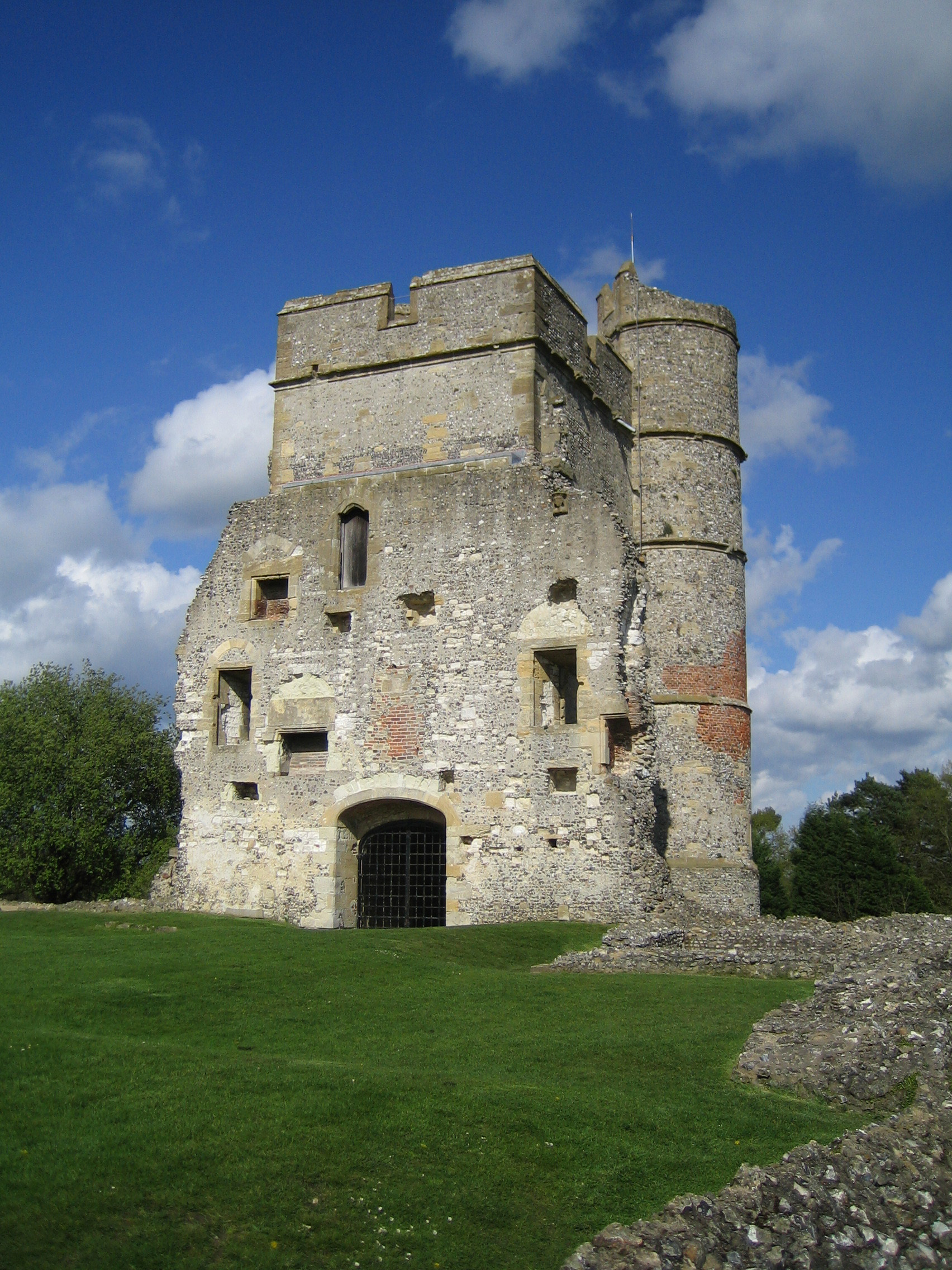

Shaw cum Donnington, United Kingdom · 1386 CE · United Kingdom
- Richard Abberbury the Elder was licensed in 1386 to fortify his manor house at Donnington, and the castle was probably built before his death in April 1399.
- The twin-towered gatehouse is what still stands of a quadrangular courtyard, a residence of flint and chalk rather than a fortress with a moat.
- Thomas Chaucer, son of Geoffrey Chaucer, gained the manor in 1398 or in about 1415, and his daughter Alice held it for about sixty years.
- In Tudor England the castle passed through the Crown and Charles Brandon, and Henry VIII and Elizabeth I both stayed here, her visit falling in 1568.
- In the First English Civil War Sir John Boys held it for Charles I through a siege of eighteen months or of twenty, and surrendered in April 1646.
- Parliament then demolished the castle except the gatehouse, and the civil-war star of earth still rings the hill.
Visiting
Entry is free, and the site is open any reasonable time during daylight hours. The car park is open from 7am to 7pm daily, and non-members pay a parking charge of £2. Dogs on leads are allowed to enter. Smoking, vaping, barbecues and naked flames are not allowed.
A guided tour on selected days must be booked in advance, and the ticket is valid only for that tour. Visitors are not allowed to enter the gatehouse or its staircase except on a booked tour.
History
Donnington Castle stands on a hill just north of Newbury, in Shaw cum Donnington, where the road from London toward the west crossed the road from Oxford toward Southampton. Sir Richard Abberbury, also called Richard Abberbury the Elder, was licensed in 1386 to fortify a house there. He had served the Black Prince, guarded the future Richard II after 1376, and become chamberlain to Anne of Bohemia in 1382. The castle was probably finished before his death in April 1399.
It was a rectangular court of flint and chalk, with round corner towers and two square towers, built more as a residence than a fortress. The walls were only about 1.5 metres thick, and there was no moat.
The gatehouse is the part that still stands. Its passage is a two-bay vault, about 17 feet 6 inches by 11 feet 9 inches inside, between round towers. The building is described as three storeys, and also as rising about 65 feet with two storeys under the battlements. William Wynford has been suggested as the designer of the vault, and Henry Yevele as the designer of the gatehouse.
One account dates the gatehouse to the 1386 licence. Another puts the east curtain first and the gatehouse later. A third reads the courtyard as a slightly earlier, perhaps mid-fourteenth-century, bailey.
The manor had belonged to the Abberbury family since a purchase in 1287–8, or since a grant of free warren in 1292. Richard’s son sold Donnington and five other manors to Thomas Chaucer in about 1415 for 1,000 marks, also written as £666. Another account places that sale in 1398. Thomas Chaucer, son of the poet Geoffrey Chaucer, was Speaker of the Commons five times.
He settled the estate on his daughter Alice. She held it for about sixty years, through marriages to Sir John Phelip, to Thomas Montagu, Earl of Salisbury, and to William de la Pole, Duke of Suffolk. William was killed in 1450, on 2 May or on 4 May, after impeachment and a failed escape into exile. Alice died in 1475 and was buried at Ewelme.
In 1503 the manor came to the Crown on the attainder of Edmund de la Pole. The years from 1485 to 1603 are Tudor England, and the castle spent much of them as a royal house. Henry VIII granted it to Charles Brandon in 1512, or in 1514. Brandon’s wife Mary Tudor had been queen of France, married to Louis XII, who is also named Louis XI, and she died in 1533.
The castle returned to the king in 1535, already decayed. Henry VIII is placed here in 1539 and in 1541, while another account gives the 1539 stay to Henry VII. Edward VI came in September 1552, held a Privy Council, and granted the manor to his half-sister Elizabeth, the grant also being dated 1550–1.
Elizabeth I visited in 1568. In 1590 she made Elizabeth Cooke, Lady Russell, keeper, called the first woman in that office, or probably the first. In 1600, or in 1601, she gave the castle to Charles Howard, Earl of Nottingham, and Lady Russell disputed the gift until a court found for him. By 1632 the manor belonged to John Packer, a Parliamentarian, who had also been described as buying it from a tenant, John Chamberlain.
During the First English Civil War, Charles I sent John Boys to hold the castle after the First Battle of Newbury, fought on 20 September 1643 and also dated 29 September. Boys came with about 200 foot, 25 horse and four cannon, or with about 225 men, and built a star of earth that cost £1,000. The siege is dated from July 1644 and from October 1644, and it is given as twenty months, as eighteen months, and as a year and a half. Middleton’s assault on 31 July failed.
Horton’s guns in September were said to have brought down three towers. At the Second Battle of Newbury, on 27 October 1644, the king left his artillery, his wounded, his crown and the Great Seal at the castle, and he relieved it on 9 November. Boys, knighted on 22 October, surrendered on 1 April 1646, or in April 1646, and marched out for Wallingford with colours flying. Parliament then demolished the castle.
Only the gatehouse remained.
Packer’s heirs kept the manor into the eighteenth century, and the Hartley and Palatiano families followed. The ruin was scheduled on 19 February 1925, the entry amended on 6 October 1993, and the standing remains were listed at Grade I on 9 September 1969. The state took charge in 1946, or received the castle as a gift in 1952. A limited dig in the courtyard in 1932 left no published catalogue of finds, and the clearance of the 1950s left no archaeological record.
The grounds are open in daylight without an admission charge. The gatehouse interior and its stair are not generally open, though a booked tour is offered on selected days.
The hospital founded here in 1393, and rebuilt in 1602, is a different house from Henry Lucas Hospital, the almshouse built at Wokingham in 1666 from the will of Henry Lucas.
Images


Detailed History
Donnington Castle stands on a hill just north of Newbury, in the parish of Shaw cum Donnington in Berkshire. What remains is a ruined quadrangular castle of the later fourteenth century, a twin-towered gatehouse still rising over the courtyard, and the earthen star thrown up around the hill in the English Civil War. The courtyard was once closed by a curtain with a round tower at each corner and a square tower about halfway along each of the longer walls. Measured inside those walls, the court ran about 67 feet, or 20 metres, from north to south, and about 108 feet, or 33 metres, from east to west.
The west side broke the rectangle, projecting outward in an irregular bay. Only the gatehouse still stands to anything like its old height. Low modern walls, about half a metre high, trace the lost ranges, and the civil-war scarps still average about 1.7 metres, or 5 feet 7 inches.
The hill was chosen because it watched a crossing of two great roads. One ran from London toward Bristol and the west, later called the Bath Road. The other ran from Oxford, where Charles I kept his headquarters in the war, south toward Southampton, and is still called Oxford Road as it passes Donnington. That crossroads is why two large battles of the war were fought at Newbury, and why a small castle on this ridge could matter out of all proportion to its walls.
There was no moat. The main walls were only about 1.5 metres thick, and they had no arrow-loops. The place was built as a country house wearing the shape of a castle, not as a fortress meant to stand a long siege. A century and a half later, cannon and earth made that old choice very clear.
The ground under the castle had been a manor long before anyone crenellated it. At the time of Edward the Confessor, Toti held Donnington of the king. By the Domesday Survey, William Lovet had succeeded him. The king himself held a manor of Deritone, which may be this Donnington, and the estate was later attached to the honour of Wallingford.
In 1166–7 Gervase of Salnerville was holding it. Philip de Sanderville held it in 1229, and in 1231–2 Richard de Coupeland and Joan his wife received a grant of land here, probably the manor. Their line kept it until 1287–8, when Alan de Coupeland sold it to Thomas de Eadburbury. He may be the Thomas de Abberbury who received a charter of free warren here in 1292.
One account therefore begins the Abberbury hold in 1287, with a purchase by Thomas Abberbury, an ordained clergyman who had risen through the church. Another begins it in 1292. By the middle of the fourteenth century the family held several manors in Oxfordshire and Berkshire.
Thomas died in 1307, seised of the manor, and it passed to his brother Walter, then aged thirty. Walter was dead by 1315–16. Richard de Abberbury, probably Walter’s son, then held it, and died in March 1333. His heir was his son John, aged sixteen.
John seems to have died without issue before 1353. In that year Richard de Abberbury, probably John’s cousin, was holding the manor. The same man is also described as the son of Thomas Abberbury of Donnington and of Steeple Aston in Oxfordshire, inheriting the Donnington estate from his father in 1353. He is Richard Abberbury the Elder, the builder of the castle.
Richard Abberbury the Elder was born in 1331, or about 1330, and he died in April 1399. He married Agnes, daughter of the chief justice Sir William Shareshull, and he was knighted in 1359 by Edward, Prince of Wales, the Black Prince. They had two sons, one of them Richard Abberbury the Younger. He was a justice of the peace in Berkshire, Oxfordshire and Wiltshire.
He fought under the prince in 1359, then in Gascony in 1366 and 1368, and he stayed in Gascony until after 1371. In 1374 he was at sea with a retinue of men-at-arms and archers. In 1378 he sailed to France with Sir John Golafre to serve for a year as captain of Brest. He was elected to Parliament for Oxfordshire in 1373 and again in 1386.
The Black Prince died in 1376. Abberbury was then made guardian of the prince’s young son, the future king, and steward of that son’s lands, and he was given charge of the property of Joan of Kent, the prince’s widow.
Richard II, son of the Black Prince and Joan of Kent, became king in 1377 as a boy of ten and reigned until he was deposed in 1399. In his reign Abberbury was a trusted courtier. In 1380 he negotiated the king’s marriage to Anne of Bohemia, daughter of the emperor Charles IV, and in 1382 he was appointed her chamberlain. Anne died in 1394, aged twenty-eight, a death put down to plague.
For his service Abberbury received a substantial income and grants of land. He treated Donnington as his main residence. In 1386 Richard II licensed him to crenellate and fortify a castle on his land at Donnington. The licence is also quoted as permission to crenellate and fortify a castle on land at Donyngton in Berkshire.
One account says the surviving gatehouse dates from that licence. Another says there is no direct dating evidence, and that the castle was probably built between 1386 and Sir Richard’s death in 1399, in a single campaign, with the east curtain raised first and the gatehouse added later, a change of design while the work was still going on. A further account says the three-storey gatehouse was added to a slightly earlier quadrangular building, and that the ruined courtyard west of the gatehouse was probably a mid-fourteenth-century bailey with buildings along its sides.
The plan is still readable. A curtain enclosed a rough rectangle. Round towers marked the four corners, and two square towers stood on the long sides. Inside, the buildings were timber-framed and three storeys high.
They probably held a hall, private rooms for Sir Richard and his family, rooms for guests, a chapel, kitchens and service rooms. The gatehouse stood apart from those ranges. The steward lived on its first floor, where he could work the portcullis and control the passage below. Fine work in the vault over that passage has suggested the hand of William Wynford, the king’s master mason.
The listed building, by contrast, says the gatehouse may be by Henry Yevele. Abberbury’s funds were limited. He built economically, in flint rubble and chalk, with stone dressings. The walls are thought to have been rendered and painted white, so that the new house would have shown as a pale landmark on the hill.
Its look has been compared, on a more modest purse, with the château of Saumur.
The gatehouse that survives is of flint with stone dressings, and some of the damage has been patched in brick. Two circular towers, of four stages, flank the entrance. They have a plinth and a battlemented parapet. The gatehall is a two-bay lierne vault, with moulded ribs, cusped panels and carved bosses.
The passage measures 17 feet 6 inches by 11 feet 9 inches inside, which is also given as 17.5 by 11.75 feet, and as 5.33 by 3.58 metres. The building is described as three storeys high, and also as remaining up to 65 feet, with two storeys roofed at battlement level. A high splayed plinth runs round it. Hollow-chamfered string-courses divide the stages, and the two upper courses carry large grotesque heads.
The outer arch has moulded jambs and a four-centred head. On the courtyard side the arch is of two orders, with a groove for the portcullis between them. Small doorways in the eastern angles once opened into the towers. Both towers originally contained stairs.
Those in the north tower have been removed. By the early twentieth century the entrance had been filled with brick and pierced by a small doorway, and ivy had taken much of the wall. A small outwork once covered the entrance. Only parts of its side walls remain.
Short lengths of the curtain still stand on either side of the gatehouse, each with a window that seems to have had a foiled head. Elsewhere the curtain is a metre or less high, and much of that line has been rebuilt.
The same years that produced the castle produced a religious household beside it. In 1366 Sir Richard founded a chantry chapel at Donnington, a private chapel where masses were said for the souls of its benefactors. In 1376 he gave part of its endowment to the Friars of the Holy Cross, in the City of London, in return for two friars to serve as priests there. In 1393 he founded a hospital at Donnington for a minister and twelve poor men drawn from the family’s tenants and servants.
The inhabitants were paid a penny a day to hear a daily mass and to pray for the Abberburys. He built almshouses on the site of the houses that still stand, which were rebuilt in 1602. That hospital is described as the oldest charity in Berkshire. Alice Chaucer and her husband later refounded it.
The manor also had a deer park and fishponds in the valley, which may already have existed in Sir Richard’s time. A park is first named in the documents in 1509, and the last reference found to it falls in 1651. Deer and game are mentioned in 1535.
In 1387 Richard II’s government was overthrown by senior noblemen led by his uncle Thomas, Duke of Gloucester, one of the Lords Appellant. Several of the king’s ministers were executed. Abberbury survived, but he was expelled from his offices, the expulsion being placed in 1388 or in 1390 as well as in 1387. When the king regained control in 1389, Abberbury returned to favour and sat on the king’s council and the queen’s council.
He died in April 1399, four months before Henry Bolingbroke deposed Richard II. He did not live to see that fall. Richard II died about 14 February 1400.
Sir Richard’s elder son, also Sir Richard, inherited the main estates, including Donnington. He is said to have died in 1416. He had served John of Gaunt and Gaunt’s son Henry Bolingbroke, and he had gone with Bolingbroke on a crusade in eastern Europe, so the change of dynasty in 1399–1400 need not have ruined him. His career did not prosper.
He stayed abroad for most of Henry IV’s reign. On his return to England in about 1415 he sold, for reasons that are not explained, the estates he had inherited. He sold Donnington and five other manors to Thomas Chaucer for 1,000 marks, a sum also written as £666. A second account places the sale of the castle in 1398, and says it was bought as a residence for Thomas’s daughter Alice.
A third says the castle was held by Chaucer’s son Thomas in 1415. Geoffrey Chaucer, the poet, died on 25 October 1400. A sale in 1415 therefore came after the poet’s death, and one account says as much. A sale in 1398 would have fallen while Geoffrey Chaucer was still alive.
Thomas Chaucer, born about 1367, died on 18 November 1434. He was the son of Geoffrey Chaucer and Philippa Roet, a commoner tied by blood and marriage to great noble houses. Geoffrey Chaucer, born about 1343, wrote The Canterbury Tales, The Book of the Duchess, The House of Fame, The Legend of Good Women, Troilus and Criseyde and the Parlement of Foules, and A Treatise on the Astrolabe for his ten-year-old son Lewis. He was a bureaucrat, a courtier, a diplomat and a member of Parliament for Kent, and he was the first writer buried in what became Poets’ Corner in Westminster Abbey.
Thomas was a politician in his own right. He was elected to Parliament fifteen times, and he was Speaker of the House of Commons for five parliaments. The years named for that Speakership are 1407, 1410, 1411 and 1414, four dates set beside the count of five. In 1399 he was granted the constableship of Wallingford Castle and the stewardship of the honours of Wallingford and St Valery, and of the Chiltern Hundreds.
He was sheriff of Berkshire and Oxfordshire in 1400 and in 1403, and he sat for Oxford from 1400 to 1420. He married Maud, daughter and co-heir of Sir John Burghersh. Their only child, Alice, was born in 1404, or about 1404. He bought the Abberbury properties for her.
In 1415 he settled Donnington and the neighbouring manors on Alice and her first husband.
Alice Chaucer married three times. In 1415, while she was still very young, she married Sir John Phelip, also called Sir John Philip, brother of William, Lord Bardolph. He died the same year, before the marriage was consummated, and he died seised of these manors. A fresh settlement left them to his widow.
Her second husband was Thomas Montagu, Earl of Salisbury, one of the chief English commanders in France in the 1420s. The marriage is placed in 1421, and he is also said to have been holding the manor in 1428. He was killed at the siege of Orléans in 1428. In 1430, when Alice was twenty-six, she married William de la Pole, Earl of Suffolk.
When Thomas Chaucer died in 1434 she was already Countess of Suffolk by that third marriage, and his remaining estates passed to her.
William de la Pole was born on 16 October 1396. He fought in the French wars under Henry V and then under Henry VI, and he was one of the English commanders at the failed siege of Orléans. He preferred negotiation to another campaign. As steward of the household to Henry VI he became the king’s first minister, and he was created Duke of Suffolk in 1448.
He arranged the Treaty of Tours in 1444 and the king’s marriage to Margaret of Anjou. Alice became one of Margaret’s ladies-in-waiting and moved in the inner circle of the court. She and William made Ewelme in Oxfordshire their main home. In 1437 they founded an almshouse there called God’s House, and they refounded the hospital at Donnington.
Alice owned a large library and was a patron of learning. She was one of the few women admitted as a Lady of the Order of the Garter. William enlarged the buildings at Donnington and used the castle as an occasional residence. His conduct of the French war and of the Crown’s policy made him hated.
In 1450 the Commons impeached him. Henry VI let him go into exile rather than stand trial. Rebels intercepted the ship. He was given a mock trial and beheaded, and his body was put ashore at Dover.
The day of his death is given as 2 May 1450, and also as an execution on 4 May 1450. His estates were forfeited to the Crown and later restored to his only son, John. Alice herself was put on trial in 1451. She lived through the Wars of the Roses, the struggle of York and Lancaster for the throne, by going over to the Yorkist side in 1455.
John de la Pole, their son, was born in 1442 and was seven years old in 1450. He died in 1491, or in 1492. He married Elizabeth, daughter of Richard, Duke of York, and sister of Edward IV and of Richard III, so that he became brother-in-law to both kings. The manor stayed with trustees until Alice died in 1475.
She had held Donnington for sixty years, the longest tenure in its history, and she probably visited it often. She was buried in St Mary’s Church at Ewelme, under a tomb with two effigies, one of her in life with a ducal coronet and the Garter on her forearm, and one of her as a corpse. In 1476 the surviving trustees handed the estate to Thomas Lee and William Martin, clerks, understood to be trustees for John, Duke of Suffolk.
John’s eldest son, John, Earl of Lincoln, died in 1487 at the Battle of Stoke, and his lands were forfeited. Edmund de la Pole, the second son, then stood as the chief Yorkist heir, after the deaths of Edward IV’s sons in 1483, of Richard III in 1485, and of that elder brother in 1487. No record has been found that Edmund actually held Donnington. On his attainder in 1503 the manor would in any case have passed to the Crown, and he is said to have been charged with treason in that year, the estates, including Donnington, being seized.
Henry VIII had him executed in 1513. The span from Henry VII’s accession in 1485 to the death of Elizabeth I in 1603 is Tudor England, and the castle’s life as a royal house falls inside it.
The manor remained with the king. In 1509 Wistan Browne, a squire of the body, was appointed keeper of the manor and park, and John Dounce was made steward. In 1513 Sir William Compton succeeded them both. Henry VIII, born on 28 June 1491, had become king on 22 April 1509, on the death of his father Henry VII.
In 1512, or in 1514, he granted Donnington to Charles Brandon, one of his closest friends. Brandon was created Viscount Lisle in 1513 and Duke of Suffolk in 1514. The grant is described both as a gift of the castle in 1514 and as a grant of the preceding year, 1512, before Edmund’s execution. Brandon was born about 1484 and died on 22 August 1545.
Through his third wife, Mary Tudor, he was Henry’s brother-in-law.
Mary Tudor was born on 18 March 1496 and died on 25 June 1533. In 1514, at eighteen, she was married to Louis XII of France, a king more than thirty years older than she was. One account names that king Louis XI. He died after less than three months, and she was left a widow and dowager queen of France.
Henry sent Brandon to Paris to bring her home. They had already formed an attachment. They married in secret in France, on 3 March 1515 in one account, with Francis I among the witnesses. Marrying without the king’s permission was treasonable.
Thomas Wolsey intervened, and the couple escaped with a heavy fine because Henry loved them both. Their main home was in Suffolk. They probably came to Donnington only now and then. Brandon does seem to have stayed at the castle in 1516.
Mary had four children with him. Through her elder daughter, Frances, she was the grandmother of Lady Jane Grey.
After Mary’s death in 1533, Brandon exchanged the castle with the king for other property. The return to the Crown is placed in 1535, when the duke had let the building fall into decay. Edward Fettiplace, a former servant of the duke, seems to have been keeper, and he was blamed for the condition in which the castle came back. In 1536–7 the king appointed William, Lord Sandys, and Thomas Wriothesley as constables of the castle, stewards of the manor, and keepers and masters of the hunt of Donnington Park, in succession.
Fettiplace remained the working steward until 1540, and he did not actually leave until 1540–1. Thomas Cawarden, a groom of the Privy Chamber, then took the place. In 1545 the manor, with its members, was raised to the rank of an honour.
Henry VIII is said to have stayed at Donnington in 1539, and also at least once in 1541, on his way to Windsor. Thomas Cromwell dated a letter from the castle on 16 August 1539, and a grant was dated there the same day, which has been taken to show that the king sometimes lodged there. A third version says that Henry VII, not Henry VIII, stayed in 1539. Henry VIII died on 28 January 1547 and was buried at Windsor.
He had broken the English church from Rome, dissolved monasteries, and married six times. He was succeeded by his son Edward VI.
Edward VI was born on 12 October 1537 and died on 6 July 1553. He became king on 28 January 1547, at nine years old, and he was crowned on 20 February 1547. He was the son of Henry VIII and Jane Seymour, and the first English monarch raised as a Protestant. A regency council ruled for him, led first by his uncle Edward Seymour, Duke of Somerset, from 1547 to 1549, and then by John Dudley, Duke of Northumberland, from 1550 to 1553.
In 1550–1 he granted the manor of Donnington to his half-sister, the Lady Elizabeth. He also stayed at the castle himself. One account places that stay in 1552. A closer account says he arrived on 10 September 1552, remained two days, and held a meeting of the Privy Council there on 11 September.
Another says he stayed briefly, held the council in September 1552, and then granted the estate to Elizabeth. The grant and the visit are thus placed in both orders. In 1553, dying at fifteen, he tried to leave the crown to Lady Jane Grey and to exclude his half-sisters. Mary set that devise aside, and Elizabeth succeeded Mary on 17 November 1558.
Elizabeth I was born on 7 September 1533, the daughter of Henry VIII and Anne Boleyn, and she died on 24 March 1603. She is known to have visited Donnington in 1568, and that year is also given simply as a visit by the queen. In 1579 she had to act against poaching in the park, described as disordered hunting. In 1590 she granted the keepership of the castle to Elizabeth Cooke, Lady Russell.
Elizabeth Russell, born Cooke, formerly Hoby, lived from 1540 to 1609. She was a poet, a patron of music, and a figure at court, and in 1596 she opposed the rebuilding of the Blackfriars Theatre. The keeper had to make the castle and its weapons available for the defence of the realm. She is called the first woman to hold such a keepership in England, and also probably the first.
In 1600, or in 1601, Elizabeth gave the castle and manor to Charles Howard, 1st Earl of Nottingham. Howard, born in 1536, died on 14 December 1624. As Lord Howard of Effingham he commanded the English fleet against the Spanish Armada in 1588. He took possession in September 1603, and Lady Russell disputed his right.
The quarrel was bitter and at times violent, and it was settled in court in Nottingham’s favour. In 1601 Nicholas Zouch and his wife Elizabeth released to the earl and his wife Catherine any interest they had in the manor. The earl seems to have granted the manor on to his son William, Lord Howard of Effingham, who died before 1616. After the earl’s death in 1624, and after his widow’s death, the manor passed to her daughter Elizabeth, Countess of Peterborough, wife of John Mordaunt, Earl of Peterborough.
They conveyed it to trustees in 1629, and in 1632 they conveyed it to William Lane and John Hardy, who may have been trustees for John Packer. The countess is also said simply to have sold it, the castle becoming Packer’s in 1632. While the Earl of Peterborough owned it, it seems to have been let to John Chamberlain, who is described as of Donnington Castle in 1623. In 1644 the castle is called the habitation of Mr Packer, who had bought it from Mr Chamberlain.
John Packer was clerk of the Privy Seal and had been secretary to George Villiers, Duke of Buckingham. He owned the manor until his death in 1649. He had sided with Parliament. The First English Civil War, from 1642 to 1646, was the English and Welsh part of the Wars of the Three Kingdoms, which ran from 1639 to 1653.
Something like fifteen to twenty per cent of adult men in England and Wales served at some point in those years, and about four per cent of the population died of the war. Charles I, born on 19 November 1600, had been king since 27 March 1625. He believed the church and Parliament were subordinate to him. Parliament, recalled in 1640 after eleven years of personal rule, would not grant him money for the Bishops’ Wars without a larger share in government.
Fighting began in August 1642. Both sides at first expected a single battle to end it. Royalist successes in 1643 brought a Scottish alliance. The Battle of Marston Moor in 1644 was the greatest of the allied victories that year.
In February 1645 Parliament formed the New Model Army, and its victory at Naseby in June 1645 decided the war in the field. The war ended in a Parliamentarian victory in June 1646. Donnington’s siege sits inside that span, and the castle surrendered before the war’s last weeks.
The First Battle of Newbury was fought on 20 September 1643, and it is also dated 29 September 1643. Charles, in person, met a Parliamentarian army under the Earl of Essex. Essex had relieved Gloucester and was trying to get back to London. The royalists overtook him at Newbury.
Essex attacked at dawn, and the London trained bands halted a royalist push at nightfall. Next morning the royalists, short of ammunition, let him pass. The fighting was on the far side of the Kennet valley from the castle, across Wash Common. The royalists had failed to stop that army returning to London.
Shortly afterwards Charles sent John Boys to take Donnington from Packer and to hold it for the king.
John Boys was born in Kent in 1607 and inherited the family estate at Bonnington in Goodnestone. He was already a soldier in the 1630s. In 1640 he served as a captain in Charles’s army against the Scots. By November 1642 he was lieutenant-colonel in the royalist regiment of John Savage, Earl Rivers.
He was sent with 200 foot of that regiment, 25 horse and four cannon. Another account says the king sent Colonel John Boys with around 225 men. He was made governor, and he was responsible for the defence. The medieval walls could not stand cannon.
He built a large star of earth around the hill, with pointed bastions set to command the slopes. The work cost £1,000, a sum put at well over £100,000 in later money. The largest point, now collapsed, aimed toward Newbury. The rampart was probably faced with timber, and vertical stakes probably stood in the bottom of the ditch.
Today the defence survives as scarps and platforms about 1.7 metres high. On the south-east, where the ground falls, air photographs show a double bank and a single ditch. Elsewhere a single bank is usual. The earthworks are placed in 1643, when the castle was garrisoned, and also in the months after the first battle, before the siege began.
From the ground the star is hard to read. From the air it is clear.
The siege is given as beginning in July 1644, and also in October 1644. It is given as lasting twenty months, as lasting eighteen months, and as lasting a year and a half. On 31 July 1644 Lieutenant-General John Middleton came with 3,000 men and demanded the castle for the king and Parliament, offering terms so that blood might be spared. Boys answered that the king’s express command had entrusted him, and that he had not learned to obey anyone else.
Middleton then assaulted with scaling ladders. The assault failed, with heavy losses. He marched on toward the west and left the castle to local forces. The blockade was rarely complete.
In quieter times Boys held a market for provisions at the castle.
In September 1644 Colonel Jeremy Horton, with troops from Abingdon and Reading, planted a battery at the foot of the hill on the Newbury side. It is said that twelve days of firing brought down three towers and part of the curtain. Horton then moved the guns to the Snelsmore side and went on. Boys’s men made a night attack on the siege works, killed many of the besiegers, and took arms and ammunition.
The Earl of Clarendon wrote that more than 1,000 cannon shot were fired at the castle in only nineteen days. The barrage stopped when the royal army came into Newbury with the king in October 1644 and began to entrench north of the town. On 22 October the king knighted Boys for the defence and promoted him to full colonel. He is therefore both Lieutenant-Colonel John Boys at the start of the siege and Sir John Boys, colonel and governor, by the autumn.
The Second Battle of Newbury was fought on 27 October 1644, in Speen, adjoining the town, close to the ground of the first battle. A heavily outnumbered royalist army under Charles faced a Parliamentarian army under the Earl of Manchester and Sir William Waller. The royalists held a line across the north of Newbury from Shaw to Speen, including a fortified Shaw House, which Lieutenant-Colonel Page defended. Parliament divided its army to strike from east and west, but the castle’s position forced a long flanking march to the north.
The fighting was fierce. Shaw House was strongly held. Charles narrowly avoided capture, and by the end of the day the royalist army was in danger. The battle is also called indecisive, the Parliamentarian attacks having been repulsed, after which Charles judged the position untenable.
Overnight the royalists slipped away toward Oxford. They left their wounded and their artillery at Donnington, and they left things the king would not risk on the road, including his crown and the Great Seal. The exhausted Parliamentarian army could not block the retreat.
The next day Waller drew the whole Parliamentarian army up before the damaged castle and demanded surrender, saying that otherwise not one stone would be left on another. Boys replied that if that happened he was not bound to repair it. A milder demand was refused as well. An assault followed.
The officer leading it was killed, with several soldiers, and the attack died away. On 9 November 1644, less than a fortnight after the battle, Charles came back with more troops to relieve the castle. There were skirmishes between two large armies, but no full battle. The king slept in the castle that night while the artillery and the abandoned treasures were recovered.
Parliament’s commanders argued. Oliver Cromwell wanted to attack. Manchester urged caution. That argument widened a split on the Parliamentarian side and is counted among the steps that raised Cromwell.
The ruined castle then stayed in royalist hands from November 1644 until 1646, while the king’s cause failed elsewhere.
During the siege the garrison sallied out through the earthwork, and they made a hidden exit so that they could ambush the besiegers. Boys, whose home was in Kent, also raided the Parliamentarian Kentish regiment six to ten miles from the castle. About 100 foot went south by night to Burghclere, across the Hampshire border, and came back with about 80 horses, weapons and other plunder. The regiment moved west to Woodhay.
Boys sent 120 foot with axes, hammers and grenades, fell on them in four houses at East or West Woodhay, and again took horses, weapons, plunder and prisoners. They withdrew further, to Balsdon House near Inkpen, ten miles from the castle, where a moat offered more protection. Boys borrowed royalist cavalry from Wallingford, joined them to his foot, and caught the regiment asleep, without sentries. The gates were broken and the men surprised.
In the autumn of 1645, after a part in the taking of Basing House, Colonel John Dalbier was sent to blockade Donnington. He reached Newbury in November. Boys had burned much of the property nearby so that the besiegers could not use it for cover or lodging. A stormy winter, and the sallies from the castle, brought little progress.
In March 1646 Dalbier brought up a heavy mortar. It quickly wrecked what was left of the castle and of its defences. There was no hope of relief. The besiegers let the garrison send officers to the king at Oxford.
The answer was that they should take the best terms they could get. The terms were settled on 30 March 1646 in a field still called Dalbier’s Mead, just north of Donnington Castle House. They were signed for the castle by Colonel Boys, Major Bennet, Captain Osborn and Captain Gregory, and for the besiegers by Colonel Dalbier, also written Dulbier, Major Rynes and Major Collingwood. The castle surrendered on 1 April 1646, the date also given simply as April 1646.
The garrison marched out for Wallingford with bag and baggage, muskets charged and primed, match lit, bullets in their mouths, drums beating and colours flying, each man carrying as much ammunition as he could. Soon afterwards Parliament ordered the castle demolished, a vote also placed in 1646. Only the gatehouse was left standing. In 1647 Thomas Baskerville called the place the ruins of Donnington Castle.
Boys made short journeys to the Netherlands after the surrender, but he spent much of his time in Kent. He took a leading part in the failed rising there in 1648. He was imprisoned for short periods and fined, yet he lived through the Commonwealth of 1649 to 1660. In 1660 he was among those who prepared for the return of Charles II.
He died in October 1664 and was buried at Goodnestone. His memorial says that his military praise would flourish like laurels and palms over his grave, and it calls Donnington Castle a noble monument to his fame.
John Packer recovered the manor after the siege. The gatehouse was all that still stood of the castle. Donnington Castle House, at the foot of the hill to the south-east, probably the old lodging of the keeper, was developed as the main house of the manor. It lies outside the protected area of the castle.
Packer died in 1649. The manor passed to his son Robert, of Shellingford Castle near Faringdon, member of Parliament for Wallingford in the Long Parliament and again in 1660 and 1679. Robert settled the manor on Ralph Willett in 1651 and died on 25 February 1682, the date also written 1681–2. A herald’s visitation of 1664 calls his brother William of Donnington.
The property descended to Robert’s grandson Robert, member for Berkshire, and then to that Robert’s elder son, Winchcombe Howard Packer, member for Berkshire in 1727, 1734 and 1741. He died without children on 21 August 1746. His brother Henry died childless on 21 October the same year and left the estates to Winchcombe Henry Hartley, son of their sister Elizabeth and of Dr David Hartley of Bath. One account says Robert Packer married Mary Winchcombe and that the property then passed to the Winchcombe family, which is the same descent under another emphasis.
Another says that from 1833 to 1881 the manor and castle belonged to Winchcombe Henry Hartley.
Winchcombe Henry Hartley married Ann Blackwell in 1787, sat for Berkshire in 1774, 1780, 1790 and 1794, and died in 1794. His son, the Reverend Winchcombe Howard Hartley, married Elizabeth Watts in 1809 and died in 1832. The next heir, Winchcombe Henry Howard Hartley, died childless in 1881. The manor then went to the four daughters of his sister Elizabeth Ann, who had married Count Demetrius de Palatiano of Corfu.
Their brother had died in 1880. In 1907 the estates were divided. The manor of Donnington fell to the eldest sister, Countess E. Ada Palatiano.
In the early 1920s the remaining Castle House estate, with the ruin, was bought by E. Festus Kelly, grandson of Frederic Festus Kelly.
Through the eighteenth century the gatehouse was drawn and engraved as a ruin. Repairs in red brick, of unknown date, patched the worst of the damage. Probably in the early nineteenth century a one-storey cottage, flint-faced, with Gothick windows, was built as a lean-to against the back of the gatehouse and linked by a short passage to a square block in the north-east corner of the old bailey. It seems to have housed a custodian.
The gatehouse itself appears to have been lived in until the beginning of the twentieth century. A photograph of about 1900 shows it still roofed and occupied in that modest way. An aerial photograph of 1947 shows the caretaker’s cottage derelict, with other ruined single-storey structures against the west side of the gatehouse. The cottage was later removed.
William Camden, looking at the castle when it was still whole enough to praise, called it a small but very neat castle, seated on the bank of a woody hill, with a fair prospect and windows on every side that made it lightsome.
The remains were scheduled as an ancient monument on 19 February 1925. The scheduling was amended on 6 October 1993. The standing remains were listed at Grade I on 9 September 1969. The castle also lies within the registered park of Donnington Grove, a separate landscape.
The monument is in the guardianship of the Secretary of State. One account places it in the care of the state in 1946, while it was still privately owned at the time of a dig. Another says that in 1952 the last private owners gave the castle, and the field around it, to the Crown. By then the gatehouse was in poor condition, the hill was overgrown, and the cottage had fallen down.
Vegetation was cleared, the gatehouse was scaffolded, and the masonry was repaired. Rubble was taken out until the curtain showed and the courtyard was back at its medieval level. The curtain and the turrets were consolidated. In 1956 a custodian’s hut was built at the foot of the path, and the castle was probably opened to visitors soon afterwards.
Limited excavation in the courtyard was carried out in 1932, while the castle was still in private hands. No catalogue of objects from that dig is given. The clearance of the 1950s was a large disturbance of the courtyard, and no archaeological record of it has been found. The relics of the second battle that have turned up in the grounds of Shaw House, some of them kept at Newbury Museum, belong to the fighting in the parish, not to a recorded excavation inside the castle walls.
Nothing in the accounts of 1932 or of the later clearance supplies a list of finds from the gatehouse or the court.
The hospital Sir Richard founded in 1393, rebuilt in 1602, is not Henry Lucas Hospital. Henry Lucas, a clergyman and politician, was born in London about 1610, the son of Edward Lucas of Thriplow in Cambridgeshire. He studied at St John’s College, Cambridge, and he was secretary to Henry Rich, 1st Earl of Holland. He sat for Cambridge University in the Short Parliament of April 1640 and in the Long Parliament from November 1640, and he was excluded in 1648 at Pride’s Purge.
He died unmarried in Chancery Lane on 22 July 1663 and was buried in the Temple Church. His will left £7,000 to build an almshouse for poor old men from the Forest division of Berkshire and the Bailiwick of Surrey, with a chaplain as master. His executors built that hospital in 1666 on an acre and a half at Wokingham. In 1675 the Drapers’ Company of London inherited the trust.
An Act of 1923 dissolved the old corporation, allowed married couples, and provided for a matron. By 1999 the Wokingham building was no longer fit for use. It was sold, and in July 2002 the charity merged with the Whiteley Homes Trust. Sixteen double cottages at Whiteley Village, near Walton-on-Thames, then housed more than twice as many people, under the name of the Henry Lucas cottages.
Lucas also left about 4,000 books, among them Galileo’s Dialogo of 1632, to Cambridge University Library, with land enough for about £100 a year to fund a professorship of mathematics, the chair that became the Lucasian Professorship. That foundation, and that hospital, stand apart from the penny-a-day house at Donnington.
The gatehouse has had a later life as an image. A print of 1778 shows it, and an engraving of 1732 shows Donnington Castle House below the hill. A plan of 1756 records the star. A plan of 1825 draws the fourteenth-century walls, filled where they survived and open where they had gone, inside the seventeenth-century earthworks.
In the twentieth century the twin towers appeared in a television episode of The Saint called Little Girl Lost, first broadcast on 2 December 1966, in the children’s film A Hitch in Time in 1978, and on the cover of a Tenpole Tudor compilation issued in 2001. None of that restored the demolished ranges.
The castle is open to the public without an admission charge, at any reasonable time in daylight. A parking charge applies to non-members. Dogs on leads may come onto the grass. Smoking, vaping, barbecues and naked flames are not permitted.
The path from the car park is a fairly steep gravel climb, and the ground among the ruins is uneven. There is no general public access into the gatehouse or up its stair to the roof. On selected days a guided tour can be booked, and the ticket covers only the tour that was booked. The star, the white-flint gatehouse, and the low flint line of the court are what the hill still has to show of Richard Abberbury the Elder’s house, of Alice Chaucer’s long ownership, of the Tudor visits, and of the twenty months, or the eighteen, in which Sir John Boys held a ruined castle for Charles I.
Sources
- History of Donnington Castle — English Heritage
- The Siege of Donnington Castle — English Heritage
- Donnington Castle — English Heritage
- Donnington Castle: a quadrangular castle and 17th century fieldwork — Historic England
- Donnington Castle — Historic England
- A History of the County of Berkshire: Volume 4, Shaw-cum-Donnington — British History Online
- Donnington Castle — West Berkshire Historic Environment Record
- Donnington Castle — Wikipedia
- Richard Abberbury the Elder — Wikipedia
- Thomas Chaucer — Wikipedia
- Geoffrey Chaucer — Wikipedia
- Henry VIII — Wikipedia
- Edward VI — Wikipedia
- First English Civil War — Wikipedia
- First Battle of Newbury — Wikipedia
- Second Battle of Newbury — Wikipedia
- Tudor period — Wikipedia
- Henry Lucas (politician) — Wikipedia
- Mary Tudor, Queen of France — Wikipedia
- Elizabeth I — Wikipedia
- Charles Howard, 1st Earl of Nottingham — Wikipedia
- Alice Chaucer, Duchess of Suffolk — Wikipedia
- William de la Pole, 1st Duke of Suffolk — Wikipedia
- Charles Brandon, 1st Duke of Suffolk — Wikipedia
- Elizabeth Russell, Lady Russell — Wikipedia
- Donnington Castle - April 2005.jpg — Wikimedia Commons
- Donnington Castle (Closer View) - geograph.org.uk - 35387.jpg — Wikimedia Commons
- Donnington Castle - geograph.org.uk - 35386.jpg — Wikimedia Commons
- Donnington Castle - geograph.org.uk - 1303846.jpg — Wikimedia Commons
- Donnington - Castle - geograph.org.uk - 827106.jpg — Wikimedia Commons
- Donnington - Castle - geograph.org.uk - 827070.jpg — Wikimedia Commons
- Donnington - Castle - geograph.org.uk - 826788.jpg — Wikimedia Commons
- Donnington - Castle - geograph.org.uk - 826748.jpg — Wikimedia Commons
- Donnington - Castle - geograph.org.uk - 826721.jpg — Wikimedia Commons
- Donnington - Castle - geograph.org.uk - 826689.jpg — Wikimedia Commons