
Settlement · Fortification
Denbigh Castle
Grade I listed castle in Denbigh, Denbighshire, Wales

Denbigh, United Kingdom · 1282 CE · United Kingdom
- Denbigh Castle was begun in October 1282 on Dafydd ap Gruffudd’s former residence, after Edward I granted the lordship to Henry de Lacy.
- The unfinished fortress was taken in the Madog ap Llywelyn revolt of 1294, then given higher walls, a three-tower gatehouse and a sally port.
- The walled town was raided in 1400 and burned in 1468, and the castle later served as a county court, a prison and a royalist hold until 1646.
- Colonel William Salesbury surrendered on 26 October 1646, and the walls were slighted after a royalist seizure in 1659, the demolition also dated to 1660.
- Excavation has yielded medieval coins and a set of Nuremberg counters from the drawbridge pit, and a 2020 dig exposed the core of the sally-port wall.
Visiting
Admission tickets may be bought on arrival, or booked online at a discount of 5 per cent, and tickets booked online are non-refundable. From 30 March to 1 November the castle is open from 10am to 5pm and is closed on Tuesday and Wednesday. From 2 November to 29 March the castle is open from 10am to 4pm and is closed on Monday, Tuesday, Wednesday and Thursday. Last admission is 30 minutes before closing.
The castle is closed on 24, 25 and 26 December and on 1 January. From 1 September 2026 to 31 March 2027 adult admission is £6.50, admission for a family of two adults and up to three children is £20.80, and admission for a family of one adult and up to three children is £14.30. Juniors aged 5 to 17 and students pay £4.50 admission, seniors aged 65 and over pay £5.80 admission, and a student photo identification card must be shown for student admission. Entry is free for members, for children under 5, and for a disabled person together with a companion.
A £1 admission ticket is available for people on Universal Credit and other named benefits. Blue Light Card holders and members of the armed forces and veterans receive 10 per cent off individual admission, and that reduction is not sold online. Dogs on short leads are allowed to enter the ground floor only. Visitors may not enter by climbing on the walls or over the guardrails, because of hidden drops.
Smoking is not permitted on admission. Admission paths cross a bridge that may be slippery when wet, and handrails are provided on the stairs to the wall walk. Dogs are not allowed to eat the vegetation, because some plants may be poisonous. In extreme weather the monument closes at short notice.
School admission for a self-led education visit is free and must be booked.
History
Denbigh Castle was begun in October 1282 on a steep limestone outcrop above the Vale of Clwyd, on the site of a Welsh residence of Dafydd ap Gruffudd. After a siege of a month, Edward I granted the new lordship to Henry de Lacy, Earl of Lincoln. The first work is described as the southern and western walls and the town circuit, and also as half-round or drum towers. A later phase, still unfinished at Henry’s death in February 1311, raised the curtains, built the great gatehouse and added a sally port.
The walled borough was settled by English tenants. Its charter of 1285 is counted both as 63 burgesses and as 39 burgesses holding 47 burgages. Space and water were poor inside the walls, and the town spread downhill. By 1305 there were 183 burgages outside and 52 within, and by 1337 the outer town covered about 57 acres.
In 1373 the figure was 438 burgages. A fair was being held by 1311. Around the castle lay parks stocked with deer from England, and a demesne of about 75 acres with granges, a byre, a dovecote and fishponds.
In September 1294 the unfinished castle was taken in the Madog ap Llywelyn revolt. Henry de Lacy was ambushed outside the town on 11 November, and the place was not recovered until December, when Edward’s army passed through Denbigh on the way to Conwy. The English then heightened the walls. Henry’s eldest son, Edmund de Lacy, died in the castle well, remembered both as a drowning and as a fall in 1308.
Alice de Lacy, born in the castle on Christmas Day 1281, inherited in 1311. Her husband Thomas, Earl of Lancaster, was executed in 1322. The lordship then passed through Hugh Despenser, Roger Mortimer and William Montagu, and the Mortimers held it again from 1355.
Owain Glyndŵr raided the town in 1400. The castle stayed in royal hands through a rebellion whose end is placed both in 1407 and as much as fifteen years after the proclamation at Sycharth. In the Wars of the Roses, Jasper Tudor was named constable in 1457, took the castle after the Rout of Ludford Bridge in 1460, and lost it to Sir Richard Herbert in late 1461. In 1468 he burned the walled town, an attack also told as a burning of the castle itself, alongside Dafydd ap Siencyn.
The inner town emptied. William Camden found it deserted in 1586, and John Leland had already counted scarce 80 households there in the 1530s.
From 1536 the gatehouse served the new county of Denbighshire. Robert Dudley took a lease in 1563, repaired rooms, and began a church he did not finish. Richard Gwyn was imprisoned in the castle from September 1581 until the spring of 1582, and after his execution on 15 October 1584 his head was spiked on the walls. The scholar William Salesbury, translator of the Welsh New Testament, is a different man from Colonel William Salesbury, called Old Blue Stockings, who held the castle in the First English Civil War.
The colonel’s garrison numbered 500. Charles I spent three days here after the Battle of Rowton Heath in September 1645. A close siege began in April 1646, and the same defence is also called a nine-month siege under Middleton and Mytton. Salesbury surrendered on 26 October 1646, on the king’s order, a day also called the fall of the last major mainland fortress.
The castle was a prison afterwards. Royalists tried to break in during 1648, once in one account and twice in another. In August 1659 they seized it during Sir George Booth’s rising, and they gave it up after the Battle of Winnington Bridge on 19 August 1659.
George Monck, 1st Duke of Albemarle, is the general who is said to have ordered the slighting. John Carter pulled down parts of the curtains and two towers over six weeks. The demolition is also dated to 1660, after which the stone was quarried for the town. A brief grant to the Earl of Portland in 1696 was reversed.
A grammar school of 1726, a bowling green of about 1769 and Castle House followed inside the old walls. A Castle Committee repaired the ruins with 300 pounds lent in 1879. The Office of Works took the site in 1914. In 2015 there were 10,154 visitors, and 600,000 pounds was spent in the mid-2010s, including a visitor centre.
The gatehouse is three octagonal towers around an octagonal hall. A seated statue over the entrance is probably Edward II in one account and probably Edward I in another. The rear tower is written both Badnes and Badness. The town walls run for about 1,100 metres, with the Burgess Gate, the Goblin Tower over the summer well, and the Red Tower of red sandstone.
John Goodall, the historian of the gatehouse, called it the most architecturally sophisticated gatehouse of the thirteenth century. The footballer John Goodall, born in 1863, has no place in this building.
Excavation by the end of the 1970s had produced fifteen medieval and later coins and forty-six jettons, a total also discussed as sixteen coins and ten single jettons beside a separate set. Thirty-six Nuremberg counters from the drawbridge pit, latest issued in 1608 to 1612, are read as a lost reckoning set. A 1991 evaluation on Castle Green found no features. In 2001, shot was found near the Goblin Tower, without siege features in the ground.
Digging in 2010 left no published find list. From 23 November to 2 December 2020, test pits exposed the core of the sally-port wall and a small collection of medieval objects, and nothing else in place. A watching brief in 2025, during work on a safety rail, likewise published no find list. The castle was designated Grade I on 2 February 1981 and is also scheduled.
These records do not give it a world-heritage inscription of its own.
The Conquest of Wales by Edward I of England, the Madog ap Llywelyn revolt, the Wars of the Roses and the English Civil War each left a mark on the same rock. What changed was the lordship itself: a Welsh llys became an English borough and a county seat, the town moved downhill, and the fortress ended as a slighted ruin in public care.
Images




Detailed History
Denbigh Castle stands on a dramatically steep outcrop of Carboniferous limestone above the Vale of Clwyd, with the walled town immediately beneath it to the north. A small tributary valley isolates the hill, higher ground rises to the west, and the later town spread down that slope toward the infilled Lenten Pool. The coast of north Wales lies some 16 kilometres away, St Asaph a little over 8 kilometres to the north, and Ruthin nearly 11 kilometres to the south-east. With Ruthin, the finished fortress was understood to control the Vale of Clwyd.
The Welsh name is Castell Dinbych. Dinbych is explained as an abbreviation of Dinas Fechan, a little fortress, and also as a compound of din and bych, a little fort. The written forms begin with Dunbeig in 1211, then Tynbey in 1230 and Dinbych in 1269, while the modern spelling Denbigh is first encountered in a document of 1536 to 1539. A predecessor of the medieval town is generally taken to be the motte and bailey at Llŷs, Pont Ystrad, about 1.4 kilometres south of the town, also called Llys Gwenllian after a daughter of Llywelyn ap Iorwerth, and reputedly Hen Ddinbych.
D. H. Owen noted in 1978 that the prominence of Dinbych before the Edwardian conquest explains why this township was chosen in 1282 as the administrative centre of the new lordship.
The hill was argued to have been a llys of Dafydd ap Gruffudd, a royal residence of the Welsh princes and the centre of the cantref of Rhufoniog, and thirteenth-century references also speak of the maerdref of Dinbych. The wider patrimony was Perfeddwlad, the pastoral lands of the Denbigh Moors, also called the Four Cantrefs, on the eastern side of Gwynedd. Its ownership was disputed, and Normans and Welsh fought over it many times in the eleventh and twelfth centuries. In 1247 the Treaty of Woodstock confined Llywelyn ap Gruffudd and his brother Owain to Gwynedd west of the Conwy, and Henry III took Perfeddwlad.
In June 1255, at the Battle of Bryn Derwin, Llywelyn defeated Owain and Dafydd and became sole ruler of Gwynedd west of the Conwy.
The Treaty of Montgomery in 1267 recognised Llywelyn ap Gruffudd’s title as Prince of Wales and his hold on the Four Cantrefs. His rule there was heavy-handed, with hostage-taking and intimidation on the March, and he fell into conflict with the Welsh church. In 1277 Edward I of England invaded. The Treaty of Aberconwy, signed by Llywelyn on 9 November 1277, restored Anglesey and parts of Snowdonia to him as Prince of Wales, with the homage of five lords, at the price of a fine of 50,000 marks and the rent of Anglesey.
The same war left Dafydd ap Gruffudd on the English side. In 1277 Edward granted him Perfeddwlad. Dafydd rebuilt the existing residence into a substantial castle, his main stronghold, with a bakehouse, a buttery, a chapel and a hall. What form it took, and exactly where on the present site it stood, is uncertain.
A chronicle says that Edward gave him the castle of Denbigh, written Dimby, with lands worth a thousand pounds a year, and gave him as wife a daughter of the Earl of Derby, a widow. That wife was Elizabeth Ferrers, daughter of William de Ferrers, fifth Earl of Derby, married sometime after 1265, the widow of William Marshal.
The Conquest of Wales by Edward I of England was fought in two campaigns, in 1277 and in 1282 to 1283. On Palm Sunday 1282 Dafydd ap Gruffudd attacked Hawarden and Rhuddlan and captured Hawarden. The attack on Hawarden is also given as the provocation for Edward’s full-scale invasion. Other Welsh princes rose.
Llywelyn, after an initial hesitation, joined his brother. Archbishop John Peckham proposed that Llywelyn accept land in England and that Dafydd go on crusade at the king’s expense. Edward’s army took Dinbych after a siege of a month, in October 1282. Llywelyn ap Gruffudd was killed on 11 December 1282 at the Battle of Orewin Bridge near Builth, separated from his army.
One account says he was tricked away from the bulk of his men and then attacked. Another, written in the east of England by monks in contact with his daughter Gwenllian ferch Llywelyn and his niece Gwladys ferch Dafydd, says he approached the forces of Edmund and Roger Mortimer, Hugo Le Strange and Gruffydd ap Gwenwynwyn on a promise of homage, and that the promise was a deception.
Dafydd ap Gruffudd was Prince of Wales from his brother’s death until his own capture on 22 June 1283. He and his younger son Owain ap Dafydd were taken at Nanhysglain, a hiding place in a bog near Bera Mawr. Dafydd was seriously wounded and was brought that night to Edward’s camp at Rhuddlan, then to Chester and on to Shrewsbury. His wife Elizabeth Ferrers, their daughter Gwladys, the infant Gwenllian ferch Llywelyn, another son and seven daughters were taken at the same time.
On 28 June his son Llywelyn ap Dafydd was also captured, and Edward summoned a parliament to Shrewsbury to decide Dafydd’s fate. On 30 September Dafydd was condemned to death, the first person known to have been tried for what would afterwards be called high treason against the king. On 3 October 1283 he was dragged through Shrewsbury at a horse’s tail, hanged alive, revived, and disembowelled, the first prominent person recorded as hanged, drawn and quartered.
Edward kept part of the conquered principalities in his own hands and granted other parts as Marcher lordships. Henry de Lacy, Earl of Lincoln, who had taken part in the conquest of 1282, received the lordship of Denbigh. Henry de Lacy was born about 1251 and died in February 1311. He was Baron of Pontefract, Lord of Bowland, Baron of Halton and hereditary Constable of Chester, son of Edmund de Lacy and Alice of Saluzzo, and great-grandson of Amadeus IV, Count of Savoy.
His father died in 1258, his grandmother Margaret de Quincy died in 1266, and he became Earl of Lincoln while still a ward. He came of age and was knighted in 1272. He was chief councillor to Edward I, Protector of the Realm while the king fought in Scotland, and present at Edward’s death in July 1307. His arms were recorded as gold, a purple lion rampant.
He fought at the Battle of Falkirk in 1298 and at the siege of Caerlaverock in 1300, commanded in Aquitaine after Edmund Crouchback’s death, and was routed by Robert II of Artois at Bonnegarde in 1297. He helped negotiate the betrothal of the future Edward II to Isabella of France, and he was an Ordainer in 1311 and regent while Edward II was in Scotland that same year. One passage writes his name de Lacey.
With James of Saint George, the king’s master mason, Edward and Henry planned a new castle on the former llys, meant to govern the district and to stand as a sign of authority. James of Saint George had worked for Philip I, Count of Savoy, at Saint-Georges-d’Espéranche, and the name Saint George, acquired after he moved to England, may refer to that castle. Around 1285 he was Master of the Royal Works in Wales at three shillings a day, with control of the works at Conwy, Caernarfon and Harlech. The career account read for him does not name Denbigh.
The castle’s own accounts say the plans were made with him, and the later official description calls the gatehouse almost certainly his, more accomplished than anything attempted at Caernarfon, Conwy or Harlech.
Construction is placed at the start in October 1282, once Denbigh had been granted to Henry de Lacy. The western and southern sides, and the new town walls, are said to have been built first, to protect the workmen, using local labour and possibly men from Henry’s English estates. Another account says the first phase enclosed the southern and western sides and the town boundary and was likely complete by 1294, and that from about 1295 the north and west sides were built, dividing the castle from the town, and were likely complete by 1311. A third account separates 1282 to about 1294, when the town walls and the south-western perimeter went up as one circuit, from about 1295 to about 1311, when the castle perimeter was finished and the great gatehouse was added.
A fourth says the hilltop was first closed with stout curtain walls and half-round towers, and that the Welsh revolt of 1294 forced a change to a much higher curtain, polygonal towers and a massive three-towered gatehouse. The walls of the first phase are also called drum towers. By 1285 Henry had given the new town its first charter. The work was not finished in September 1294, and it was still unfinished at Henry’s death in 1311.
One account assumes that by 1311 the fortifications, including the town walls, were largely complete.
The town walls enclosed about 9.5 acres, or 3.8 hectares. In 1285 the new borough is said to have held 63 burgesses, each promising an armed man for its defence. Another count for that same charter lists 47 burgages held by 39 burgesses. The townsfolk were English, many from Henry’s estates in northern England, and further English colonists took large areas of rural land round about.
By 1334, 10,000 acres in the lordship of Denbigh were occupied by English settlers. Outside the town, Henry controlled a manor with a dovecote, a barn and fishponds, and he made three parks stocked with deer brought from England. The demesne is also described as two granges, a byre, a dovecote and two fishponds, extending over 75 acres, its chronology less fully recorded than the castle’s.
From the earliest days people moved out of the walled town onto flatter ground lower down the hill, because space inside was tight and water was poor. That spread was unusual among the new walled towns of Wales. Within about fifty years the outer trading settlement, the villa mercatoria, covered around 57 acres, or 23 hectares. A second charter, somewhere between 1295 and 1305, after the Welsh attack, recorded only 45 burgages and is called the first record of the town walls, against the accounts that have those walls rising with the first building campaign.
In 1305 there were 183 burgages outside the defences and 52 within. By 1311 an annual fair was being held. The Survey of Denbigh in 1334 speaks of a borough within the walls and a market town without, and of the hamlet of Neuburgh, part of Lleweni, where the townspeople had held agricultural land. Neuburgh can no longer be traced.
It has been left uncertain whether the survey caught an abortive attempt to lay out a small borough beyond the suburbs, or the remains of an older Welsh commercial settlement. The name has been taken to argue against the second reading. By 1337 the town had spread over 57 acres. In 1373 there were 438 burgages.
The building was still unfinished in September 1294, when the Madog ap Llywelyn revolt broke out. Madog’s forces occupied Caernarfon, burnt Castell y Bere, and took Hawarden, Ruthin and Denbigh. Criccieth and Harlech were besieged for months, Morlais was captured, Cynan ap Maredudd besieged Builth for six weeks, and half the town of Caerphilly was burnt while its castle held. The same rising is called Madog’s Rebellion, and the leader’s name is also written Madog ap Llewelyn.
Henry de Lacy marched to relieve Denbigh and was ambushed outside the town on 11 November. His force was routed. Reginald de Grey had more success at Flint and Rhuddlan, neither of which fell, though Flint endured a long siege. The castle was not recaptured until December.
That December Edward led an army into north Wales, stopping at Wrexham, Denbigh, Abergele and elsewhere on the way to Conwy, which he reached shortly before Christmas. He was himself ambushed, lost his baggage, and was besieged in Conwy until relieved. Harlech was at one point held by 37 men. When the English recovered Denbigh they changed the design.
They made the curtain walls much higher, added the imposing gatehouse, and inserted a sally port, a secure hidden doorway through which defenders could slip out. The heightening of the existing walls is dated to the year after the revolt. Completion may also have been disrupted by the death of Henry’s eldest son in an accident at the castle.
That son is named Edmund de Lacy. One account says he drowned in a well at Denbigh Castle. Another says he is said to have fallen to his death in the castle well in 1308. A second son, John de Lacy, fell from a parapet at Pontefract Castle, not at Denbigh.
Their sister Alice de Lacy was born on Christmas Day 1281 at Denbigh Castle, the only daughter of Henry and Margaret Longespée. Margaret was granddaughter of Llywelyn ab Iorwerth and heir of the Longespée line. Alice married Thomas, 2nd Earl of Lancaster, Edward I’s nephew, the match arranged in her ninth year. They had no children.
In 1317 she was abducted from her manor at Canford in Dorset by Richard de St Martin, a knight of John de Warenne, Earl of Surrey, and Thomas seized two of Surrey’s castles in reply. Henry de Lacy died in February 1311 at Lincoln’s Inn, his townhouse in London, and was buried in St Paul’s Cathedral. The grave and monument were destroyed in the Great Fire of London in 1666. Alice inherited Denbigh.
Work on the castle continued until Thomas was executed for treason on 22 March 1322.
The next years were unstable. The castle passed through short-lived holders, Hugh Despenser, Earl of Winchester, and then Roger Mortimer, Earl of March, and was held for a time by William Montagu, also written William Montacute. On 26 June 1322, imprisoned and under threat of execution, Alice surrendered to the king a great part of the lands she had from her father. She was not released until she paid an indemnity of 20,000 pounds.
In 1330 Edward III gave the lordship of Denbigh to William Montacute. The Mortimer family reacquired the lordship in 1355 and spent the next fifty years repairing stonework and timber. Alice died childless on 2 October 1348 at Barlings Abbey, and the earldom of Lincoln ended with her. A Flemish silver gros of Louis II de Mâle, Count of Flanders, struck between 1346 and 1364 and found in the Postern Tower, has been read against these fourteenth-century changes of lord: the earls of Winchester, Salisbury and March may have tied the castle into long-distance provisioning, though the same coin is also left as a puzzle because so few comparanda exist.
In 1400 Owain Glyndŵr led a revolt against the Crown and raided the town of Denbigh. His name is also written Owain Glyn Dwr and Glyndwr. On 16 September 1400, at Sycharth, before about 300 people, he proclaimed himself Prince of Wales, and the next day he began a rising against Henry IV that is called both a fifteen-year rebellion and a war whose tide turned in 1407. The quarrel had been sharpened by Reginald Grey, Baron Grey of Ruthin, who had taken land of Owain’s and then left him without timely notice of a royal summons to serve on the Scottish border, so that Owain could be called a traitor.
Edmund Mortimer was only eight, so Henry IV put Henry Percy in charge of Denbigh until Percy defected to the rebels in 1403. Despite that isolation, Denbigh remained in royal hands through to the end of the rebellion as dated in the castle’s history, in 1407. The castle is also said simply to have been held for the Crown and not taken. By 1408 the English had regained Aberystwyth.
Edmund Mortimer held Denbigh until he died childless in 1425, when it passed to Richard, Duke of York.
During the Wars of the Roses the castle was fought over by Lancaster and York. Those wars are dated from 1455 to 1487, and also, in the castle’s site record, from 1455 to 1485. They grew out of the Hundred Years’ War and the great duchies created by Edward III, and they were revived by the illness of Henry VI, whose first reign ran from 1422 to 1461. Richard of York was killed at Wakefield, his son Edward took the claim, and Edward IV was crowned in June 1461 after Towton.
At Denbigh, Jasper Tudor, Earl of Pembroke, was declared constable by Henry VI in 1457, but the fortress stayed in Yorkist hands. After the Lancastrian victory at the Battle of Ludford Bridge, also called the Rout of Ludford Bridge, Jasper forced the garrison to surrender and took possession in 1460. At Ludford, Andrew Trollope and the men from Calais defected overnight, and York, Salisbury and Warwick abandoned their army. York fled to Ireland.
The war then turned. The new garrison held out for several months under Roger Puleston and was recaptured by Sir Richard Herbert in late 1461. In 1467 the Yorkist regime made William Herbert, Jasper’s rival for the earldom of Pembroke, constable and steward.
Jasper returned in 1468. He could not take the castle, but he burnt the interior of the walled town. The same attack is described as a failed assault by Jasper together with Dafydd ap Siencyn, called the Welsh Robin Hood, which burnt the town and the suburbs, and the castle is also said to have been burned down in 1468. The attack drove people from the walled town into the newer suburbs.
A rental of 1476, eight years after the extra-mural areas had been ravaged by fire during that siege by the Earl of Pembroke, still shows more than four times as many burgages outside the walls as inside. By the end of the sixteenth century the inner area was largely abandoned and had become part of the castle’s outer defence, and the Burgess Gate was the town jail. In 1586 the antiquary William Camden could write that the old town was now deserted. John Leland, in the 1530s, had already found scarce 80 householders inside the walls, most of the streets decayed, and a newer town set lower down for carriage and for water from many wells.
He wrote that the increase of the new town was the decay of the other. An early sixteenth-century survey records suburbs for three quarters of a mile to the north of the castle. Streets named from the fifteenth century include High Street, Beacon’s Hill, Pepper Lane and Sowter Lane, and the town’s crafts then included a draper, glovers, shoe-makers, mercers and weavers.
Much of the castle had fallen into decline by 1530. Six years later, after the Act of Union, it became the centre for administering the new county of Denbighshire, and Denbigh was one of four administrative capitals in Wales. The great gatehouse and nearby towers were used as a courthouse, a prison and the buildings that went with them. The rest of the castle had fallen into ruin by 1561.
In 1563 Robert Dudley, later Earl of Leicester and Lord of Denbigh, was granted a lease, partly because the Crown wanted to cut the cost of a dilapidated property. He was an absentee landlord, but he treated the lordship as part of a territorial base for a revived house of Dudley. He repaired residential parts of the castle, did some minor work, and began a large new church in the walled town, possibly intending a cathedral. The church was never finished.
It would have been not only the largest but the first post-Reformation church in England and Wales planned so that the preacher, rather than the altar, stood at the centre. His son, another Robert Dudley, was styled Lord Denbigh and was born in 1581. Leicester died at Cornbury Park near Oxford on 4 September 1588, on the way to take the waters at Buxton. John Speed’s map of 1611 still shows little housing inside the walls, St Hilary’s chapel, and Leicester’s incomplete church of the 1580s.
The market place and the town hall lay outside the walls. The town hall itself was built of stone in 1572 and restored in 1780.
The name William Salesbury belongs to two different men. The scholar William Salesbury, also written Salusbury, was born at Llansannan some time before 1520, possibly as early as 1507, and is said both to have died about 1584 and to have died likely around 1580, his burial place unknown. He was the principal translator of the Welsh New Testament published on 7 October 1567, and of the Welsh Book of Common Prayer in the same year. Nothing in that life makes him the soldier who held this castle.
The defender was Colonel William Salesbury, nicknamed Hen Hosanau Gleision, Old Blue Stockings.
During the colonel’s years the castle was a prison for people the Crown treated as traitors, including opponents of the Elizabethan religious settlement. The best known was the Welsh poet and underground Catholic schoolmaster Richard Gwyn. In September 1581 he was moved to Denbigh Castle and brought before Sir George Bromley. He was fined 280 pounds for refusing Anglican Sunday services, at 20 pounds a month, on top of an earlier fine of 140 pounds for brawling during divine service.
Asked what he could pay, he answered sixpence. At the same assizes he was joined by John Hughes and Robert Morris. In the spring of 1582 the three were returned to Wrexham. On Friday 9 October 1584 they were arraigned there.
Gwyn was executed on 15 October 1584. His head and one quarter were spiked on Denbigh Castle. The other three quarters were displayed at Wrexham, Ruthin Castle and Holt Castle. On 25 October 1970 he was canonised as one of the Forty Martyrs of England and Wales.
In England he is remembered on 4 May with the canonised and beatified martyrs of the English Reformation. In Wales he is remembered on 25 October with the Six Welsh Martyrs.
The English Civil War is the name most often used for the fighting, though historians divide it into two or three wars, and the wider struggle in England, Scotland and Ireland is the Wars of the Three Kingdoms. From the Restoration into the nineteenth century it was commonly the rebellion or the great rebellion. Walter Scott called it the Great Civil War, and some historians have called it the English Revolution. Wales, annexed into the kingdom of England, was drawn into the same crisis.
Between 1639 and 1653 an estimated 15 to 20 per cent of adult males in England and Wales served at some point, and about 4 per cent of the population died of war-related causes. The First English Civil War ran from 1642 to 1646. Charles I raised his standard at Nottingham on 22 August 1642. Early hopes of a single battle failed.
The New Model Army was formed in February 1645, and its victory at Naseby in June 1645 was decisive. One account ends the war in June 1646 with Charles in custody. Denbigh was still holding out that autumn.
When fighting began in August 1642, north Wales was solidly royalist. Denbigh was held by a garrison of 500 under Colonel William Salesbury, who repaired the defences. The site record dates that royalist hold from 1642 to 1648. After defeat at the Battle of Rowton Heath in September 1645, Charles I spent three days at the castle.
Rowton Heath has been called a major disaster for him, with about 600 dead and 900 injured, including 50 of the Life Guard and Lord Bernard. Parliament’s losses were also heavy, though the number is unknown. Charles left the next day with the remaining 2,400 horse, heading to Denbigh Castle and then on to Newark. Chester, left without that help, later surrendered.
The rooms of the stay became known as the King’s Tower. The Great Kitchen Tower was later called King Charles’ Tower, and the king’s three days are also placed in that tower.
The following month Sir William Vaughan gathered a royalist army at Denbigh Green, close to the ruins of Denbigh Friary, intending to march to the relief of Chester. Sir Thomas Mytton attacked and defeated him, and some of the royalist soldiers retreated into the castle. Mytton took the outer parts of Denbigh but could not break into the walled town or the castle. He returned in April 1646 with more equipment and put the castle and the walled town under close siege, building earthwork bastions for his guns along the eastern side and placing more guns on Galch Hill against the south-western walls.
The Goblin Tower, which held the garrison’s main well, was bombarded. Salesbury had only one gun of his own, and no royalist relief was likely, but he had promised the king he would not surrender. The siege under the parliamentarian generals Middleton and Mytton is also said to have lasted some nine months. Charles at last wrote and ordered him to give Denbigh up.
After negotiation, Salesbury surrendered on good terms on 26 October 1646. That day is also called the fall of the last major mainland fortress in Britain.
Parliament then kept a small garrison under Colonel George Twistleton, the new governor. The castle was a prison for political prisoners, including David Pennant, High Sheriff of Flintshire. In 1648 there was an abortive royalist attempt to break in and rescue the inmates. The same period is also described as two attacks, by Major Dolben and Captain Chambres, trying to take the fortress back and free the captives.
In August 1659, during Sir George Booth’s rising against the Commonwealth, royalist soldiers seized Denbigh and took the garrison prisoner. Booth’s rising was part of a plan, led by John Mordaunt, to bring back the exiled Charles II. Booth mustered at Warrington on 1 August, seized Chester, and drew in Liverpool and parts of north-east Wales. The Battle of Winnington Bridge, often called the last battle of the English Civil War, was fought on 19 August 1659.
John Lambert, with about 5,000 men, defeated Booth’s army of about 4,000. A few weeks after the seizure of Denbigh, the rebels surrendered and the government retook the castle.
General George Monk then ordered the castle slighted, put beyond military use. His name in full is George Monck, 1st Duke of Albemarle. He was born on 6 December 1608 at Potheridge in Devon and died on 3 January 1670. He had fought for the king, been captured at Nantwich in January 1644, later commanded for Parliament in Ulster and Scotland, and from 1655 to 1660 commanded the army in Scotland.
His support for a restored monarchy was decisive in Charles II’s return in May 1660. The life read for him does not describe the order at Denbigh. The castle’s history attributes that order to him. The republican politician John Carter demolished parts of the curtain walls and two towers over six weeks.
The slighting is also dated to 1660, after which the ruins were used as an informal quarry. Stone was reused in houses in the town. Dressed sandstone of the late thirteenth or early fourteenth century, of the sort used in the castle, is built into the walls of a house on High Street and is possibly reused. In 1696 the castle was granted briefly to William Bentinck, Earl of Portland.
Complaints were made in Parliament, and it returned to the Crown.
A new grammar school was built in the walled town in 1726, and a bowling green was laid out around 1769. Castle House, also Plas Castell, a large private house, was put up either in the second quarter or in the middle of the eighteenth century, using stone from the castle and from Leicester’s church. In the middle of the nineteenth century John Williams found the walled town otherwise deserted, with only three irregular rows of cottages and 163 inhabitants. Samuel Lewis complained that those dwellings materially diminished the interest of the ruins.
The western tower of the Burgess Gate was then a private house, and the eastern tower had been one until a few years before. The first Royal Eisteddfod was held inside the castle walls in September 1828. Around the middle of the century the town formed a Castle Committee. The Crown leased the committee control of the ruins and in 1879 lent 300 pounds for repairs.
The Crown took the Burgess Gate back from its occupants, conserved it, and leased it to the committee in 1908. In 1914 the Office of Works took responsibility. In the late 1950s its successor, the Ministry of Works, bought and then demolished later buildings along the walls to clear them for research and for visitors. The ruins later passed to the Welsh heritage agency.
In 2015 the castle received 10,154 visitors. In the mid-2010s, 600,000 pounds was spent on the castle and the walls, including a new visitor centre.
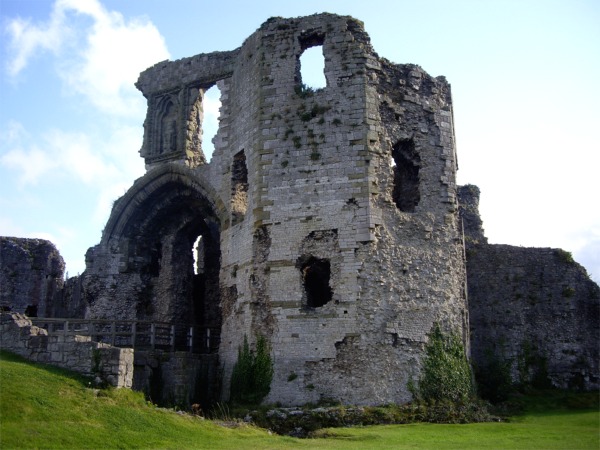
The castle is a roughly oval enclosure on the rock, about 350 by 260 feet, or 107 by 79 metres, with the main gatehouse at the upper, northern end and a postern to the south-east. The Great Gatehouse is a triangle of three octagonal towers around a central octagonal hall, once vaulted and now open, with a barbican that has gone. The towers were of three stages, with battlements and battered plinths. The two that face outward are the Porter’s Lodge Tower and the Prison Tower.
The tower to the rear is the Badnes Tower, also written Badness Tower, possibly named for an early constable. Only the Prison Tower still has its upper stage. The entrance passage had a drawbridge, gates, murder holes and arrow slits, and it is credited both with one portcullis and with two. A ditch about 30 feet, or 9.1 metres, wide lay in front.
The outer arch is a multiple four-centred arch under a projecting stage of chequered masonry, and a weathered seated figure in a trefoil niche is probably a statue of Edward II in one account and probably a statue of Edward I in the other. Bands of masonry in different colours were meant to signify royal authority. The historian John Goodall called this the most architecturally sophisticated gatehouse of the thirteenth century, one of the outstanding architectural creations of the Welsh conquest, and noted that its ideas were later reworked at Knaresborough.
East of the gatehouse stood the Queen’s Chapel, since destroyed, and the castle well, over 50 feet, or 15 metres, deep. The hexagonal three-storey Great Kitchen Tower and the White Chamber Tower, slighted after the English Civil War, flank the foundations of the Great Hall, whose dais stood toward the White Chamber. Further south, the Pitcher House Tower was probably used to store water in summer. The Green Chambers take their name from the colour of their Gwespyr stone.
Their basements were made for meat and wine, and a formerly vaulted undercroft has a heavily weathered Green Man on two springing stones. The upper floors were once exceptionally fine rooms. At the south end the Postern Tower, originally three storeys, links the castle to the town wall. The Upper Gate and the Postern Gate formed a rear entrance, with another barbican, drawbridges and a steep passage.
A mantlet of terraces and cross-walls runs along the south and east, to stop miners reaching the mural towers and the thinner stretches of curtain. On that side stand the Treasure House Tower, the Tower-next-Treasure House, the Bishop’s Tower with its sally port, and the octagonal Red Tower, named for its red sandstone, which meets the other end of the town wall. Stables, a blacksmith’s workshop and storehouses once stood inside the south-western corner. The southern and western towers are also listed, from north to south, as the Bishop’s Tower, the Tower-next-Treasure House, the Treasure House Tower and the Postern Tower.
The town walls run for about 1,100 metres, or 3,600 feet, from the north edge of the castle to its south-eastern tip, and most of them still stand. They were built in the thirteenth century and were first protected by four mural towers in an irregular pattern. The two gatehouses and the defences of the eastern salient were added in the fourteenth century. Only the foundations of the Exchequer Gate remain, on the west.
It had two circular towers and a rectangular talus against mining. The Burgess Gate, at the north-west corner, has two circular towers and a vaulted passage, again with a talus. It is white limestone and yellow sandstone in a chequer pattern, a common decoration of the time and a sign of civic pride. The top courses are lost.
It may once have stood up to 60 feet, or 18 metres. The wall east of it has gone. The circuit begins again at the north-east, where the wall survives up to 15 feet, or 4.6 metres, with the two-storey North-Eastern Tower. On the east, the first line was set back from a rocky salient and protected by the Countess Tower, an angular two-storey building with two towers.
The defence was then brought out to the edge of the cliff as the Goblin Tower, a hexagonal two-storey tower over a deep well that was the only reliable water for the defences in summer. The Bastion Tower, at the south-east corner, was originally three storeys and was chequered in sandstone and limestone like the Burgess Gate.
St Hilary’s Chapel, inside the walls, is mentioned in an extent of 1334 and, as a garrison chapel, is presumed to belong to the town’s early years. Its tower and west wall survive. The nave and chancel were demolished in 1923. The nearest parish church in the Middle Ages was at Llanfarchell, a mile to the east.
St Anne’s, or Fleming’s Chapel, was probably a guild chapel and had fallen out of use by the early sixteenth century, when Leland mentioned it. The market cross, much altered in 1760, was later moved to the bowling green near the castle and has since been returned to the edge of the market place.
By the end of the 1970s, excavations in and around the moat and the inner bailey had produced sixty-one medieval and post-medieval coins and jettons. Stuart Rigold, former Inspector of Monuments for England, was asked to study them. He died in July 1980, and the group was then held by the British Museum’s Department of Coins and Medals. Fifteen of them are coins, all single losses.
Their trenches favour the period after the two main building phases, so the medieval series starts later than the foundation, in the early to mid-fourteenth century. An Edward I to Edward III penny of uncertain class, weighing 0.71 grams and extremely worn, came from levelling on the south wall and may have been lost in the late fourteenth or fifteenth century. A London penny of Edward III’s Florin coinage, of 1344 to 1351, weighing 0.96 grams and only slightly worn, came from the Great Hall at a depth of 0.76 metres and is unlikely to have been deposited much after the 1350s or 1360s. A continental sterling imitation of the EC MONETA NOSTRA type, struck in north-eastern France, is equally unlikely to have been lost much later than that.
A Pre-Treaty Series D halfgroat of Edward III, about 1352 to 1353, weighing 1.38 grams, clipped and moderately worn, came from the triangle pit at 5.18 metres and may have circulated into the fifteenth century.
The Postern Tower also produced the silver gros of Louis II de Mâle already noted, struck in 1346 to 1364. Non-imitative silver and billon of Louis de Mâle and of his predecessor Louis I are uncommon in England and Wales: about twenty specimens are known, eight gros, two quarter-gros and ten mites, and they have been tied to a single phase of import around 1350 to 1390 or 1400, when they stood in for English groats during a shortage of silver. Denbigh lies far from the usual find-area in eastern and south-eastern England. The English series resumes with a Pinecone-Mascle penny of Henry VI, about 1431 to 1432, from the south-wall levelling, and a broken Southwark halfgroat of Edward VI struck in the name of Henry VIII, of 1547 to 1551, from the south curtain at 0.76 metres.
Then there is a gap until the eighteenth century, represented by a penny, six halfpennies and a farthing of George I, George II and George III. A George I halfpenny of 1717 to 1724, weighing 6.64 grams, came from the south moat at 1.22 metres. The latest securely dated piece is a Soho halfpenny of George III’s third issue, struck in 1799. Those late coins are read as accidental losses by visitors after the castle had been abandoned at the Restoration, in the same decades as the eisteddfod of 1828 and the Castle Committee.
The same study later speaks of a single-find assemblage of just sixteen coins and ten jettons, against the fifteen coins and the larger jetton total, and it leaves the missing Elizabethan and Stuart issues as a possible regional shortage, or as a sign of dereliction in the late sixteenth and early seventeenth centuries, or as an accident of where the trenches were dug.
Forty-six copper-alloy jettons were found as well. The earliest are Flemish and French, of the middle and later fourteenth century. Most of the fifteenth-century pieces are French, with one Anglo-Gallic example and one from Nuremberg. In the sixteenth and seventeenth centuries the balance shifts to Nuremberg, especially the workshops of the Schultes and Krauwinckel families.
All thirty-six of those later Nuremberg jettons, all but one of them of the Rose and Orb type, came from the castle drawbridge pit. They have been read as a set lost by accident, enough counters for three duodecimal calculations at once. The latest were issued by Hans Schultes III in 1608 to 1612, which gives the earliest possible date for the deposit of the set as a whole. A set of eighteen from Stoke upon Tern is half that size and likewise pairs Rose and Orb pieces with a single Lion of St Mark.
Smaller groups are known from Norwich and from the roof of a seventeenth-century building at West Bromwich. The discussion treats the whole Denbigh group as evidence of ordinary money and of reckoning counters in a medieval and early modern household and administrative centre, while warning that the sample is small and the trenches are biased.
Other digging has been narrower. An evaluation on Castle Green in 1991 failed to locate any archaeological features. In 2001, metal-detecting around the Goblin Tower during an excavation recovered a piece of bar shot, a musket ball, a pistol ball and fragments of impacted lead shot. The excavation itself found no features that could be tied specifically to the Civil War siege, though the shot is taken to be relevant to it.
An old wall behind the Crown Hotel has been suggested as a remnant of a stone castle from before Edward’s work, and that suggestion has not been authenticated. Monitoring at the hotel in 2003 found a vaulted cellar judged to be of the sixteenth century if not later. Between the castle and the church of St Mary, a watching brief in 2009 for a flood scheme found no significant features, aside from a post-medieval slag surface in three trenches near the church, and no artefacts were kept. In 2010 there was an excavation at the castle by Cambrian Archaeological Projects.
The published record of that dig gives no list of finds.
From 23 November to 2 December 2020, eight test pits each a metre square, and one evaluation trench a metre by five metres, were dug inside the castle. The only feature met in place was the core of the Sally Port wall, in the ninth trench. No other archaeological features were found in situ. A small collection of medieval artefacts was recovered, without a published catalogue of what those objects were.
In 2025 a watching brief was made while a safety rail was installed at the castle. The site record names that work and does not publish a list of finds. The castle was designated Grade I on 2 February 1981, as an exceptionally fine piece of military architecture of the late thirteenth and early fourteenth centuries. It is also a scheduled monument.
The scheduled-monument description is in the process of being updated, and the designation date on that shorter record was left blank. It is not described in these records as a world-heritage inscription of its own. The castles named beside it, when the gatehouse is compared with them, are Caernarfon, Conwy and Harlech.
The name John Goodall, as a life rather than as the historian of the gatehouse, is that of an England centre forward born on 19 June 1863 and dead on 20 May 1942. He rose with Preston North End, became Watford’s first manager in 1903, and played cricket for Derbyshire in 1895 and 1896. Nothing in that life places him at Denbigh, in the garrison, or among the builders. The judgment on the gatehouse remains with the historian who bears the same name.
Sources
- Denbigh Castle and town walls — Wikipedia
- Henry de Lacy, Earl of Lincoln — Wikipedia
- Conquest of Wales by Edward I of England — Wikipedia
- Madog ap Llywelyn — Wikipedia
- Dafydd ap Gruffudd — Wikipedia
- Llywelyn ap Gruffudd — Wikipedia
- George Monck, 1st Duke of Albemarle — Wikipedia
- First English Civil War — Wikipedia
- Wars of the Roses — Wikipedia
- Battle of Rowton Heath — Wikipedia
- Battle of Winnington Bridge — Wikipedia
- Richard Gwyn — Wikipedia
- Robert Dudley, 1st Earl of Leicester — Wikipedia
- Alice de Lacy, Countess of Lincoln — Wikipedia
- James of Saint George — Wikipedia
- Owain Glyndŵr — Wikipedia
- Denbigh Castle — Cadw
- Denbigh Castle, listed building report — Cadw
- Denbigh Castle, scheduled monument report — Cadw
- Denbigh Castle — Royal Commission on the Ancient and Historical Monuments of Wales
- A set of Nuremberg counters and other coins and jettons from Denbigh Castle — British Numismatic Society
- Historic Settlement Survey: Denbigh — Heneb
- Denbigh Castle, evaluation, 2020 — Heneb
- Denbigh Castle, excavation, 2010 — Heneb
- Results of Archaeological Works (Test Pitting) at Denbigh Castle — Archaeology Data Service
- Castell Dinbych, Dinbych, Sir Ddinbych (Denbigh Castle, Wales) - Grade 1 listed 15.jpg — Wikimedia Commons
- Denbigh Castle.jpg — Wikimedia Commons
- DenbighCastle NorthTower.JPG — Wikimedia Commons
- Denbigh Castle 227.jpg — Wikimedia Commons
- Allotments and castle - geograph.org.uk - 142423.jpg — Wikimedia Commons
- Denbigh Castle - geograph.org.uk - 447208.jpg — Wikimedia Commons
- Denbigh Castle - geograph.org.uk - 563477.jpg — Wikimedia Commons
- Denbigh and its Castle - geograph.org.uk - 595409.jpg — Wikimedia Commons
- Panorama of Denbigh Castle from Moor - geograph.org.uk - 773171.jpg — Wikimedia Commons
- Denbigh Castle - geograph.org.uk - 1118466.jpg — Wikimedia Commons