
Fortification
Delgatie Castle
castle and museum in Aberdeenshire, Scotland, UK
The photographer was probably (but not definitely) User:Topbanana or a sibling

Aberdeenshire, United Kingdom · 1049 CE · United Kingdom
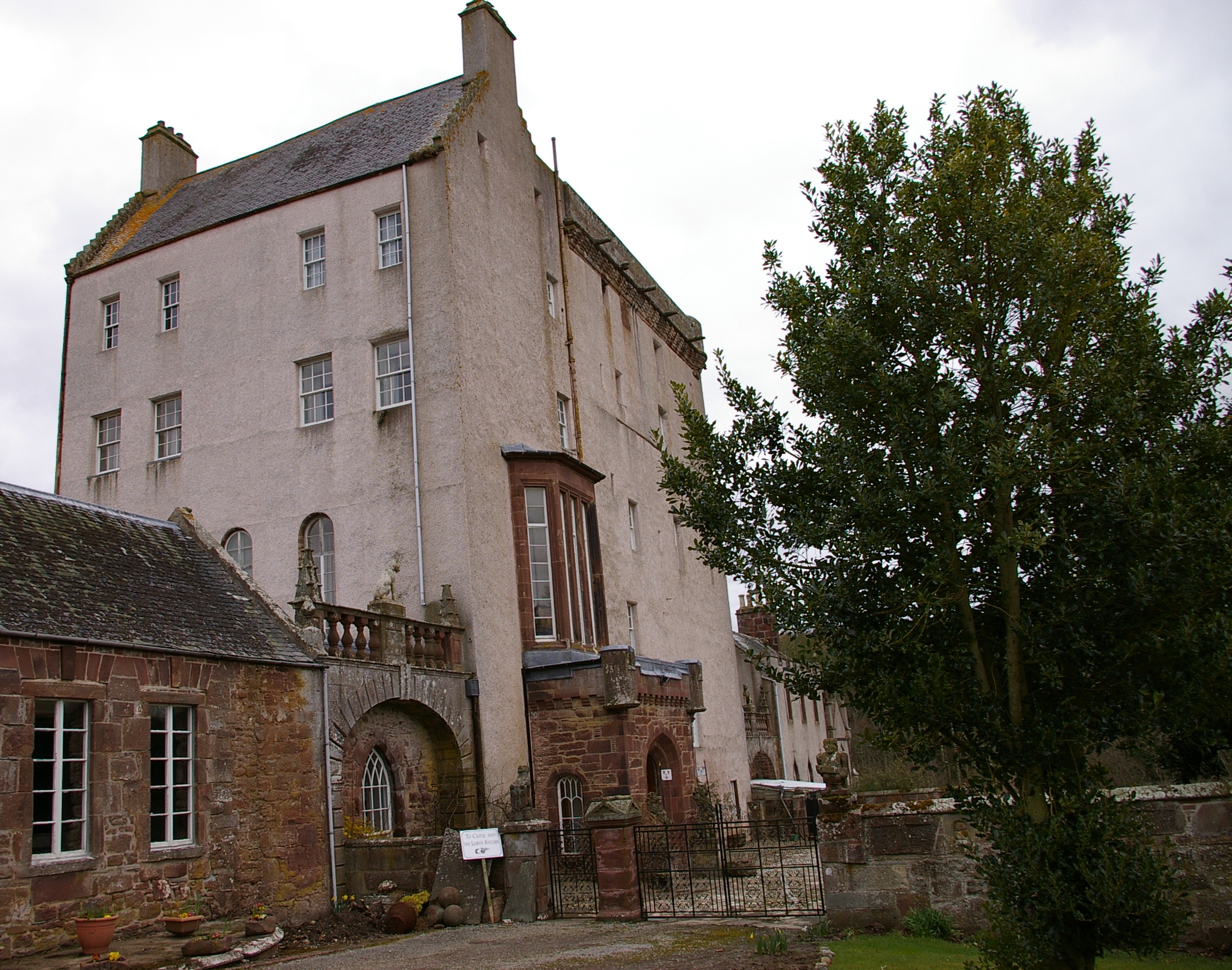
- A white-harled tower near Turriff, also called Delgaty, where a castle is dated to 1030, to 1049, to about 1050, and to a main tower of about 1100.
- The Buchan lands passed to Clan Hay after the harrying of 1308 or after the Battle of Bannockburn in 1314, and Sir Gilbert Hay became hereditary Lord High Constable.
- Mary, Queen of Scots, stayed three days in 1562 after the Battle of Corrichie, in a house whose carved dates belong to the rebuilding of 1570 to 1579.
- Painted ceilings of 1592 and 1597, also placed in 1575, survive beside a turnpike of 97 steps, and the walls are given both as 8 to 16 feet thick and as thinner after damage in 1594.
- Captain John Hay and his wife Everild restored the ruin from 1951, opened it on 9 July 1994, and left it to a trust at his death in 1997, and it was listed in category A on 24 November 1972.
Visiting
Delgatie Castle is open daily from 10.00 a.m. to 4.00 p.m. The Laird’s Kitchen tearoom is open daily from 10.00 a.m. until 4.00 p.m. Visitors may use the tearoom without paying admission to tour the castle.
History
Delgatie Castle, also called Delgaty, is a white-harled tower near Turriff in Aberdeenshire, and it is kept as the centre of Clan Hay. A castle is said to have stood here since 1030, or to have been built around 1049 or about 1050, and the main tower is also dated about 1100. The lands belonged to the earls of Buchan, and they passed to the Hays either after the harrying of John Comyn in 1308 or after the Battle of Bannockburn in 1314, when Henry de Beaumont’s claim through Alice Comyn was forfeited.
Mary, Queen of Scots, stayed three days in 1562 after the Battle of Corrichie, fought on the Hill of Fare on 28 October. Her bower is shown high in a tower whose carved dates belong to 1570–1579, so either an older house received her or the stone is earlier than those dates. The L-plan is measured both as 69 by 41 feet and as about 40 by 30 feet, with the storeys counted as four plus an attic, as five, and as eight floors linked by a turnpike of 97 steps.
Painted ceilings are dated to 1575, to 1592 and 1597, and both to 1597. The Tulip Room keeps painted beams or rafters, and the Rohaise Room also has colour on the boards above. Damage in 1594 is tied to a rebellion of Francis Hay and to a siege in which a woman called Rohaise is said to have held a breached west wall. Sir William Hay of Delgatie, also spelled Delgaite, was executed in 1650 beside Montrose and was later reburied at St Giles, in 1660 or in May 1661.
Jacobite loyalty is said both to have cost the Hays the castle after the Forty-Five and to have left the estates unforfeited. Peter Garden of Troup bought it in 1762 or 1763, and it passed toward the Earls of Fife in 1798, then to the Grant Duffs and the Ainslies in the 1860s. The wings are dated 1743, about 1768, and 1769.
Wartime barracks, including men returned from Dunkirk, and decades of dry rot left a ruin. The Countess of Erroll recovered it for the Hays in 1948, or sold it to Captain John Hay of Hayfield, who restored it from 1951 with his wife Everild, opened it on 9 July 1994, and died in 1997, leaving a trust. It was listed in category A on 24 November 1972. Pitmedden Garden and the Ythan Estuary are other places in this part of Scotland, and the castle accounts do not treat them as parts of this house.
The turnpike is described as 10 feet across and as five feet wide, with 97 steps. A solar fireplace of 1570 is cut with the words My hoyp is in ye Lord. Masons’ marks on the walls number 145, from 62 masons, and the council record lists no excavation catalogue from the castle itself.
Images


Detailed History
Delgatie Castle, also written Delgaty and Delgatty, stands near Turriff in Aberdeenshire. One visitor account places it some two miles east of the town, on higher ground above a wooded approach, with the main entrance on the south front. The authorised name used for the place is Delgatie Castle. What remains is a white-harled tower house with later wings, a wide turnpike stair, and painted rooms.
It is still occupied and open as a house, and it is the seat kept as the Clan Hay centre.
The age of the first castle is given in several ways. One account says a castle has stood on the site since 1030, built by the then Earl of Buchan. The house’s own history says it was built around 1049, and the same house also gives a building date of around 1030. Another account puts the core at about 1050.
The house history also says the main tower dates from about 1100, and that its final extension, the battlement walk above the string course, was completed in 1579. The same history says that, like many Scottish castles, Delgatie was rebuilt in the sixteenth century because the siege gun required stronger walls, and that the rebuilding of 1570 gave walls from 8 to 16 feet thick. A further account says the castle was rebuilt in 1570 to 1579 with walls 2.4 to 4.3 metres thick, which it also gives as 8 to 14 feet, and that a gabled house was built beside the tower at the same time.
The earliest owners in these accounts are the earls of Buchan. One account says the castle began as the property of the Comyn earls of Buchan and was forfeited to the Crown after they supported Edward II at the Battle of Bannockburn, then passed to the Hays in the fourteenth century. Another says that in 1308 Robert the Bruce attacked the power of John Comyn, Earl of Buchan, in what is now Aberdeenshire, that the harrying of Buchan laid waste to large stretches of country and ended the Comyns as a powerful force, and that Delgatie, presumably damaged in that campaign, was given to Sir Gilbert Hay of Erroll, who later became the first hereditary Lord High Constable of Scotland. The same account says some sources hold that this early castle was largely rebuilt in 1346.
The place record says A. W. Lyons suggested in 1910 that walls of an earlier tower may have been built into the later structure, and that Captain Hay believed the castle was rebuilt in 1346 and also noticed changes in the masons’ marks at the upper levels.
Henry de Beaumont is the man named when the castle is said to have been stripped from the Earl of Buchan after the Battle of Bannockburn in 1314 and given to Clan Hay, later the earls of Erroll. Henry de Beaumont, born about 1280 and dead on 10 March 1340, was a French nobleman in the Anglo-Scottish wars. By 14 July 1310 he had married Alice Comyn, daughter of the niece and heir of John Comyn, Earl of Buchan, and he claimed the earldom of Buchan and the constableship of Scotland through her. Alice fled to England around the time of her uncle’s defeat by Robert the Bruce in 1308, and she never exercised control over her Scottish lands.
Beaumont fought at the Battle of Bannockburn in the cavalry with Robert Clifford. In the November after the battle, he and his wife were among those forfeited by the Scottish parliament for continuing to fight with the English. He spent later years trying to recover his wife’s Scottish lands, repaired the old Comyn stronghold of Dundarg on the Aberdeenshire coast in 1333 or 1334, and surrendered Dundarg on 23 December 1334. He died in the Low Countries in 1340.
Alice died in 1349, and their son John never claimed the lost earldom. The castle accounts do not say that Dundarg and Delgatie are the same place. They attach Delgatie’s change of owner either to the harrying of 1308 or to the forfeiture after 1314, and they name both John Comyn and Henry de Beaumont.
The Battle of Bannockburn was fought on 23 and 24 June 1314 between Robert the Bruce, King of Scots, and Edward II of England, in the First War of Scottish Independence. One account calls it a decisive victory and a turning point, with the war ending fourteen years later in the Treaty of Edinburgh–Northampton. Edward II invaded after Bruce, in 1313, required supporters of the ousted John Balliol to acknowledge Bruce or lose their lands. Stirling Castle was held by the English and besieged by the Scots.
The English numbers are given differently. One passage says Edward summoned 25,000 infantry and 2,000 horses from England, Ireland, and Wales against 6,000 Scots, whom Bruce had divided into three contingents. Another says he requested 2,000 heavily armoured cavalry and 13,000 infantry, that no more than half the infantry arrived, and that the Scottish army was probably about 7,000 men, including no more than 500 mounted. A further estimate says the Scots faced an English force from one and a half to three times their number.
The Scottish host is also described as four schiltrons, under Bruce, his brother Edward Bruce, his nephew Thomas Randolph, Earl of Moray, and jointly Sir James Douglas and the young Walter the Steward. Angus Og Macdonald, Lord of the Isles, brought Islesmen, including galloglass, and was given the place of honour beside the king with the men of Carrick and Argyll.
On the first day Robert Bruce killed Sir Henry de Bohun, and the English withdrew. A second account from the Vita Edwardi Secundi calls the knight Henry de Boune and has Bruce strike him as he tried to turn back. That night Sir Alexander Seton, a Scot in Edward’s army, defected and told Bruce the English morale was low. On the second day Bruce used the schiltrons as attacking formations, which William Wallace had not done.
The Earl of Gloucester and Sir Robert Clifford were killed, and the Earl of Hereford was captured. Henry de Beaumont, with Clifford and about three hundred men-at-arms, tried to circle toward Stirling. Thomas Randolph, Earl of Moray, marched out to meet them. Sir Thomas Grey was captured after his horse was killed on the pikes, and Sir William Deyncourt was killed.
The English army spent the night in a wet marsh by the Forth beyond the Bannockburn. On the second morning Gloucester, accused of cowardice after he urged delay, charged and was surrounded and killed. Five hundred Scottish cavalry under Sir Robert Keith scattered the English and Welsh bowmen. Aymer de Valence and Giles d’Argentan led Edward away.
D’Argentan then rode back and was killed. Edward was refused entry to Stirling by Sir Philip de Moubray, because the castle was about to be surrendered, and he reached Dunbar and took ship for Berwick. One estimate, if it is right, puts English infantry at 16,000 and the dead among them at about 11,000. Thomas Walsingham counted 700 English men-at-arms killed and 500 spared for ransom.
Scottish losses are described as comparatively light, with only two knights among the dead. Stirling was then surrendered and slighted. Bothwell, Dunbar, and Jedburgh were taken. By 1315 only Berwick, among those strongholds, remained outside Robert’s control.
Elizabeth de Burgh, Christina Bruce, Mary Bruce, Marjorie Bruce, and Bishop Robert Wishart were released after eight years in England. The exact field is uncertain. A traditional site is now thought wrong for the first day. For the second day, researchers weigh the Dryfield south of Balquhiderock Wood, about three quarters of a mile east of the traditional site, and the Carse of Balquhiderock, the Wetfield, about a mile and a half to the north-east.
The fighting, wherever it began, is thought to have ended on the Carse.
After the Battle of Bannockburn the castle accounts say Delgatie was taken from the Earl of Buchan and given to Clan Hay. The clan’s own list of castles says Delgatie Castle was given to Clan Hay after the Battle of Bannockburn in 1314. The battle’s aftermath says Robert rewarded Sir Gilbert Hay of Erroll with the hereditary office of Lord High Constable of Scotland. The clan history says Gilbert de Haye of Erroll had sworn fealty to Edward I at Aberdeen in 1296, joined Robert the Bruce in 1306, supported him at the Battle of Bannockburn, received a charter of the lands of Slains in Aberdeenshire and the office of Constable, and was a signatory of the Declaration of Arbroath in 1320.
His father, Nicolas de Haya of Erroll, sheriff of Perth before 1288, had sworn fealty to Edward I on 12 July 1296 and was summoned to parliament at St Andrews in 1303 to 1304. A brother, Hugh de la Haye of Locharwart, was captured at the Battle of Methven. The Slains charter and the Delgatie grant are both rewards recorded for this family. The accounts do not print the wording of a single charter that names both.
Clan Hay, in Gaelic Garadh or MacGaradh, is a clan of the Grampian region, with its heart in historic Aberdeenshire, Banffshire, Morayshire, and Nairnshire, and with other concentrations in Perthshire, the Scottish Borders, and Shetland. The name is traced to villages called La Haye in the Cotentin of Normandy. Haye is explained from haia, a hedge, in modern French haie, and also as a stockade, in a country of old interlocking hedgerows. George Fraser Black treated the Gaelic MacGaradh as an invention of John Hay Allan, also called John Sobieski Stuart.
The historical line begins with William II de Haya, son of William I de Haya and Juliana de Soulis. He was at the Scottish court in 1160, cup-bearer to Malcolm IV and to William I, and the first Baron of Erroll. He died soon after 1201 and was succeeded by his eldest son David. His wife was Eva of Pitmilly.
A heraldic study of about 1954 argued from seals that the Hays of Erroll descended from the de La Haye of La Haye-Hue, later La Haye-Bellefond, across the Soules river from Soulles. David de Haya’s seal of about 1230 shows a silver shield with three smaller red shields, the arms still used for the Earl of Erroll, and the same arms appear for Jean de La Haye-Hue around 1368 to 1375. David’s son Gilbert was ancestor of the earls of Erroll, a line that ended in heiresses in 1717, the youngest marrying the Earl of Kilmarnock. Another son, William, received Leys in 1235.
Gilbert, sheriff of Perth before 1262, was a regent for Alexander III and married Idonea, daughter of William Comyn, Earl of Buchan.
The arms on the castle are described differently from that silver shield. The castle account says the Hay arms appear in many places in the building, including three cattle yokes which recall a farmer and his two sons who helped defeat a Danish raiding party at Cruden Bay. The clan legend, first written up by Hector Boece in 1525 and again in the 1575 edition of his history, places a countryman and his two sons at Luncarty near Perth in 980, in the reign it calls Kenneth III. They rallied fleeing Scots with a ploughshare, the Danes fled, and a parliament at Scone granted as much land on the Tay in Gowrie as a falcon flew, six miles, afterwards called Errol, with arms of silver and three red shields, said to mean that the father and two sons had been the three shields of Scotland.
George Buchanan’s history of 1582, drawn from Boece, leaves out the falcon’s flight. The date 980 sits against the reigns: Kenneth III ruled from 997 to 1005, and Kenneth II from 971 to 995. James Balfour Paul noted that armorial bearings did not occur in Scotland until long after 980, and he called Boece an incorrigible old liar in this story. Cosmo Innes noted that surnames came later and that Hay is a Norman place-name.
Walter Bower, writing about 1440, before Boece, mentioned a battle of Luncarty in which Norsemen and their king were destroyed, without the farmer. Around 1791 a minister described the opening of the last burial mounds on the reputed field and the finding of ashes, bones, weapons, and bridles, which were not examined by later archaeological methods, and some of which were taken for farm tools. The clan motto is Serva Jugum, keep the yoke. The crest is a falcon, the badge is mistletoe, and the slogan is A Hay, A Hay, A Hay.
A pipe tune is named A Hay, From A Hay To Delgatie Castle. The chief named in the clan account is Merlin Sereld Victor Gilbert Hay, twenty-fourth Earl of Erroll, Lord Hay, and Lord Slains.
The earldom of Erroll is said to have been created in 1452. In the Anglo-Scottish wars the clan suffered heavy casualties at Flodden in 1513. Another Sir Gilbert Hay fought for Joan of Arc. After the Reformation the Hays stayed Catholic and were allies of Mary, Queen of Scots, who appointed George Hay, seventh Earl of Erroll, lord lieutenant of all central Scotland.
Francis Hay, ninth Earl of Erroll, was involved in a plan with Philip II of Spain to overthrow Elizabeth of England and bring James VI to Catholicism. The defeat of the Spanish Armada ended that plan. In 1594 the Earl of Erroll went into exile, and Slains Castle was blown up under the king’s supervision and has remained a ruin. That ruined Slains is a different castle from Delgatie.
The clan still lists Old Slains and a later Slains among its houses, with Delgatie, Dupplin, Duns, Inshoch, Megginch, Neidpath, Park, and Yester.
Mary, Queen of Scots, is tied to Delgatie by every castle account of 1562, and the battle that precedes the visit is the Battle of Corrichie. One spelling in the house history is Corrachie. The battle account calls it the Battle of Corrichie and places it on the slopes of the Hill of Fare on 28 October 1562, between George Gordon, fourth Earl of Huntly, chief of Clan Gordon, and the forces of Mary under James Stewart, first Earl of Moray. Huntly had beaten the English twenty years earlier at Haddon Rig.
At Corrichie his sword charge was beaten by Moray’s pike drill, and he is said to have died of apoplexy after capture. Mary had come north to confront the Gordons. George Buchanan’s account says Huntly had lost the earldoms of Moray and Mar, which he thought his heritage, and hated the new Earl of Moray, Mary’s half-brother. Mary and Moray reached Aberdeen in mid-August and met Huntly and his countess.
Their son John Gordon had fought James Ogilvie in Edinburgh, and Mary wanted him imprisoned in Stirling. It had been suggested that John might marry Mary, only as a way to manage his father. Mary and Huntly set out toward Huntly Castle, then called Strathbogie, but she turned back. The English diplomat Thomas Randolph wrote that she came within four miles of the house and would not enter, while he himself stayed two nights and called it the fairest and best furnished house he had seen in the country.
The court went on to Inverness Castle. The Gordon captain refused to hand the royal castle to the queen’s representative. Clan Chattan left Huntly for the queen, and Frasers and Munros came in with others from the Gàidhealtachd. Inverness was taken on 9 September, and the Gordon garrison, or at least the captain, was executed.
Huntly tried to learn Mary’s plans through his cousin the Earl of Sutherland. The letters were found and Sutherland fled. Huntly lay near Aberdeen at Corrichie.
Randolph’s letters to William Cecil add that Huntly held a royal cannon at Strathbogie, given by Regent Arran, and that Mary demanded it back at short notice. Her men went to Huntly Castle on 9 October and tried to take the earl. He escaped over a low wall at the back gate. The countess stayed.
Huntly went to his house at Badenoch, the later site of Ruthven Barracks, and was declared a rebel on 17 October. John Knox records that Mary had sent Captain Stewart with sixty men to seize Findlater Castle, and that John Gordon surprised them at night at Cullen and inflicted casualties. Randolph says Huntly marched on Aberdeen with 700 men, said to mean to capture the queen. Two thousand men under the earls of Moray, Atholl, and Morton encircled his camp on 28 October.
The Gordons, then numbered at 500, were on a hill the cavalry could not reach. Arquebus fire drove them into marsh. The queen’s vanguard lost nerve and threw away their spears. Moray forced them to fight.
Randolph says the battle ended at once, that about 120 Gordons were killed and about 100 captured, and that none of the queen’s army were killed, though many were hurt and many horses died. Huntly was set on a horse for Aberdeen and died suddenly and without a sound before leaving the field. Buchanan puts Huntly in a place surrounded by marshes. He says Moray’s vanguard broke because men who would not fight Huntly fixed heather on their bonnets, that the Gordons threw down spears to use swords in a pursuit, and that Moray’s second line held with long pikes.
Knox says Huntly rose late, which hurt morale, and he places the fight at Corrichie Burn or the Fara Bank, a slope among the Hills of Fare. He credits the second line’s advance to John Wishart of Pitarrow, the Master of Lindsay, and the Tutor of Pitcur, and he gives a prayer for victory to William Maitland of Lethington.
Sir John Gordon, Huntly’s eldest son, was taken to Aberdeen and executed three days later. A younger brother, Adam Gordon of Auchindoun, was spared. Huntly’s body was preserved and taken to Edinburgh for trial. John Gordon, eleventh Earl of Sutherland, fled to Louvain.
At the Parliament of Scotland on 28 May 1563, with Mary present, Huntly, Sutherland, and, as Knox noted, eleven other earls and barons of the name Gordon were forfeited. In 1565 Mary restored the earls of Huntly and Sutherland and others of the name. Sutherland was intercepted at sea on his return, imprisoned at Berwick, and released in February 1566 after assurance that he was reconciled with Moray. He married Marion Seton, daughter of Lord Seton.
Both were poisoned at Helmsdale Castle by Isobel Sinclair and died at Dunrobin Castle on 23 June 1567.
The castle accounts place Mary at Delgatie for three days after that battle. Her bedchamber is said to be on view. A room high in the tower is called Queen Mary’s Bower. The difficulty is the date of the stone.
Most accounts put the L-plan tower in the 1570s, with 1570 carved above a ground-floor fireplace. Either the tower was already standing in 1562, or Mary stayed in an earlier Delgatie. The house history does not resolve that. It simply says she stayed three days after the battle, and that the 1570 rebuilding followed.
The tower that visitors see is described as an L-plan of 1570 to 1579. The listed-building account gives the main jamb as 69 feet by 41 feet, of four storeys, the ground floor having a dungeon mezzanine, plus an attic, and the wing as five storeys and a cape-house. The wing is harled and keeps a corbelled ashlar parapet with bartizans. The upper part of the main jamb has crow-stepped gables, perhaps from a late change of plan, or perhaps from repairs in 1597 after damage in 1594.
Another account says the main tower, running north and south, contains five storeys: barrel-vaulted cellars, a mezzanine, the old great hall, and two floors above, and that the main block measures 40 feet by just over 30, close to Towie Barclay and Craig and smaller than Gight. A visitor account speaks of eight floors linked by the stair. The place record groups Delgatie with Craig, Gight, and Towie Barclay as contemporary towers, almost certainly by the same master mason in the judgement of W. Douglas Simpson.
The council record says the mason was traditionally Alexander Conn, first of Auchry, and that there is no document to support that name. Dates are cut on the building: 1570 over a fireplace, and on the east side of the wing a date given as falling between 1570 and 1579, while the council record reads the east wing date as 1589.
Inside, the listed account puts the original entrance on the east, with a groin-vaulted vestibule, the main part vaulted in two compartments, the hall to the south, and a guard room and dungeon over it to the north. A circular turnpike stands at the centre of the south side. The wing is vaulted in one compartment. Another account says the stair was originally at the rear, reached as at Gight by a corridor from a rib-vaulted vestibule inside an original north door, and that it is now immediately to the right of the main entrance.
It calls the stair one of the finest in Scotland, cantilevered, 10 feet in diameter, and 97 steps, rising the full height of the building. A visitor account also counts 97 treads, each more than five feet wide, wholly inside the thickness of the front wall, and calls the stair one of the widest in Scotland. Another account gives the turnpike as 1.5 metres, or 5 feet, wide, and says the vaulted basement contains the old kitchen with a large fireplace. The house history does not give the step count.
The stair is therefore described both as very wide and as five feet wide, and both as a 10-foot circle of 97 steps.
On the first floor of the wing is a rib-vaulted solar. Its corbels are carved with heads believed to be William Hay of Delgatie and his wife Lady Beatrice, a daughter of the seventh Earl of Erroll. The fireplace is dated 1570 and cut with the words My hoyp is in ye Lord. The hall was remodelled as a ballroom about 1830, and the north drawing room is of about the same time.
Another account thinks the ballroom’s size comes from rebuilding after a siege in 1594, with thinner walls that enlarged the rooms, and that it may once have had a double ribbed vault, as at Towie Barclay. It opens to an ante-room and then to a drawing room in the 1835 infilling of the re-entrant angle. A visitor account says the ballroom was made from the great hall in either the 1700s or the 1800s, and that the withdrawing room behind it belongs to the later additions. The listed account says the north re-entrant was filled at ground and first floor in the eighteenth century, with further second- and third-floor additions in the nineteenth, and that a baronial south porch and a ballroom bay window of about 1850 may be by A and W Reid.
The painted ceilings are dated in more than one way. The castle account says two rooms keep sixteenth-century painted ceilings, one of 1592 and one of 1597. The same house dates the painted ceilings back to 1575. The listed account puts the Tulip Room and the Painted Room on the second and third floors of the wing, dates both ceilings to 1597, and says the Tulip Room retains beams only.
A visitor account names the Tulip Room and the Rohaise Room, dates them to 1592 and 1597, says the Tulip painting is only on the rafters, and says the Rohaise Room also has painting on the underside of the floorboards above. Another account says the second-floor chamber once had paintings of naked women, destroyed in the nineteenth century, leaving inscribed proverbs on the beams and the initials J. M., believed to be the painter John Melville, and that the upper ceiling, covered for more than a hundred years, was revealed about 1885. Its colours were kept, with minor restoration in the 1950s by a painter called Sovanov, under Captain Hay.
The listed account names V. Sozonov for the painted ceilings in the main work of 1957 to 1959. The house history says some ceilings are among the finest in Scotland and show strange animals, some with human heads thought to be the people who lived there then. A further account calls the ceilings tempera and places the 1592 and 1597 paintings on the second floor.
In the uppermost room, called Attock Fort, a visitor found the original painted ceiling removed for woodworm treatment and temporary paintings put in its place. That visit is not dated.
The 1594 damage is also told in more than one way. The listed account offers repairs in 1597 after damage in 1594 as one explanation of the crow-stepped gables. One overview says James VI destroyed part of the castle in 1594 because Francis Hay, ninth Earl of Erroll, about 1564 to 1631, rebelled with the Earl of Huntly. A family account says the tenth laird, Alexander, kept the Catholic faith after the Reformation and joined the Earl of Erroll in a Counter-Reformation rebellion in 1594.
It says the Campbells besieged the castle, that Alexander fled, and that he left it to his mistress, a six-foot redhead called Rohaise, whose ghost is said to haunt the castle. She defended it, and the west wall of the main tower was breached. Family tradition says the main tower was rebuilt afterward with much thinner walls so that it could not stand against the king again. A visitor account gives the ghost story without that siege detail: a young woman of legend called Rohaise who defended the castle, and who is said to make herself felt by young men staying in the Rohaise Room.
The same family account says scandal in the previous generation was a doubly bigamous marriage between the tenth laird and Barbara Forbes, both of whom had living spouses, and that later lairds descend from that union though they were technically illegitimate. The thinner walls of that family tradition sit beside the house history’s statement that the 1570 work made the walls thicker, from 8 to 16 feet, against siege guns. Both statements are in the accounts. One belongs to 1570 and one to a rebuilding said to follow 1594.
In May 1639 the covenanters were routed in their first skirmish with the royalist Gordons. The house history calls it the Trot of Turriff and places it near the castle. It says this proved the end for the royalist Hay of Delgatie, who was hanged alongside the Earl of Montrose eleven years later in Edinburgh. In May 1661, after the restoration of Charles II, his body was exhumed and, under the orders of the Lord Lyon King of Arms, he was given a large state funeral and laid next to the Marquis of Montrose in St Giles Cathedral.
A visitor account names him Sir William Hay of Delgatie and says he was executed alongside the Marquis of Montrose in 1650, and that the later reburial in St Giles’ Cathedral was probably no great compensation. The clan history spells him Sir William Hay of Delgaite, says he served James Graham, first Marquis of Montrose, as chief of staff in the campaign for Charles I, and says he was captured, imprisoned, and executed in 1650, then given a state funeral after the Restoration of 1660. The same clan history says James Hay led royalists against the covenanters at the Battle of Aberdeen in 1644 and that they were victorious. The titles Earl and Marquis are both used for Montrose in these accounts, and the funeral is placed both in 1660 and in May 1661.
The earls of Erroll are described as often backing the losing side between the 1500s and the 1700s. The Hays supported the Jacobite risings of 1715 and 1745. One account says that support does not appear to have forfeited the estates, as happened to many Jacobite landowners, but that it damaged the family’s fortunes. Another says the Hays were Jacobites and lost their castle after the Forty-Five.
The thirteenth Earl of Erroll received the Order of the Thistle from James Francis Edward Stuart. He was succeeded by his sister Mary, who used the ruins of Old Slains as a meeting place for Jacobite agents and who called Clan Hay out for Charles Edward Stuart. In 1762 the bankrupt James Hay, fifteenth Earl of Erroll, is said to have sold Delgatie to Peter Garden of Troup. The listed account dates that transfer to 1763 and calls him Peter Garden of Troup in Banffshire.
It says the castle was sold in 1798 to Earl Fife and considerably enlarged for his tenant, General the Honourable Sir Alexander Duff. Another account says Peter Garden’s son sold it to James Duff, second Earl of Fife, who lived from 1729 to 1809. The listed account says it was purchased for Mrs Grant Duff in 1862 and passed to Ainslie Douglas Ainslie in 1866. A visitor account says that in 1868 the castle and estate were sold to the Ainsley family.
By the mid-nineteenth century a family account places Delgatie with the Grant-Duff-Ainslie family, whose main house was Eden House, a Regency mansion nearby, while Delgatie was used by younger sons and then by estate workers.
The wings are dated 1743, about 1768, and 1769. The house history says both wings were added in 1743, with the chapel and dovecote on the west and the kitchen and servants’ quarters on the east. Another account dates the wings to 1769 and describes the same arrangement of chapel and doocot to the west and kitchen and servants to the east, with a further extension in the nineteenth century. The listed account describes semi-elliptical rusticated arches of about 1768, originally open, perhaps as gates for a courtyard, and now removed, then a symmetrical Gothic composition of the later eighteenth century: two single-storey wings with three ogee-headed windows and cross finials, the dining room, also called the chapel, in the west wing, and the kitchen in the east.
Short screen walls with buttresses, pinnacles, a gablet, and a Gothic arch close the composition. The west screen has a dummy doocot and continues as a concave-gabled wall into which a late medieval tomb recess and other fragments are built. About 1850 the dining room’s south front was rebuilt as a three-window bow, the kitchen wing was raised to two storeys with a battlemented parapet, and an addition was built behind the east screen, perhaps later. A visitor account says the tower was extended outward in 1768 by the Gardens of Troup, with further additions in the 1800s.
It describes an adjoining house to the east, apparently also of the 1500s, a west building that appears designed as a chapel, a doocot made to look like a church gable and now disused, a circular doocot near a cottage to the north that seems to have replaced it, and a flat wall of ecclesiastical design topped by a cross. The terrace runs to an iron gate flanked by cannons, and the pasture beyond holds the castle’s ponies. A 1955 field note, written on 8 August by T. G.
Reeves, says only the south wall of the chapel remains, 4.0 metres long, at the east end of the castle and level with the front face, of stone and in good repair, with the arch blocked and an inscribed tablet set in the wall above the arch. That note and the west dining room called the chapel are both in the records. They are not given as descriptions of one single wall.
By the beginning of the twentieth century, in the house history’s words, dry rot had infected the timbers and the spores had worked into the stone. Part of the roof had gone and water poured down the walls. During the second world war some of the 350,000 troops saved from the beaches of Dunkirk used the once elegant rooms as temporary barracks. By the end of the war the castle, left to crumble, was derelict.
Another account says the building the captain later bought was a ruin after decades of dry rot and after use as a temporary barracks for troops returning from Dunkirk early in the war. A further account says the army used Delgatie from 1940 to 1946 and that it then lay uninhabited and decaying. The council record says the grounds were used as an army campsite and training area. A family account says the castle was requisitioned and severely damaged.
The listed account says it was abandoned after the second world war.
The return to the Hays is also dated in more than one way. The listed account says the Countess of Erroll bought it back for the Hays in 1948, and that Captain John Hay of Hayfield gradually restored it from 1951, the main work being done in 1957 to 1959 by Leo Durnin for the architecture and by V. Sozonov for the painted ceilings. A family account says the Countess sold the castle to Captain Hay of Hayfield, who had a military engineering background and skill as a stonemason, that he moved to Delgatie in 1951, and that he lived there until his death in 1997 at the age of 91.
A visitor account says he purchased it in the early 1950s, returned it to Hay ownership after a gap of nearly two centuries, established the Clan Hay centre, and first opened the castle to the public in 1994. It also says he first visited in 1949, when it was in a very poor state, that he spent much of his career in India and on the North-West Frontier, and that during the second world war he helped organise the defence of the Shetland Islands. The room called Attock Fort is named, in the guide he wrote, because his last command in India was as Quilidar, or commandant, at Attock Fort, which that guide places at the top of the Khyber Pass. It is said that while he commanded there in the 1930s he learned that an Afghan leader with whom he had exchanged shells was, like him, a mason, that they agreed a local ceasefire while each reported invented fighting to his own superiors, and that when the British command in India found this out he was posted away.
Another overview says the Clan Hay centre opened at Delgatie in 1948, and that Captain Hay of Delgatie bought the castle in a sad state and restored it. The house history says that even when architects told him it was too late, he set out to turn a rotting heap into the restoration now seen, and that he did the work with his wife Everild. An opening on 9 July 1994 is recorded, when visitors were first welcomed and told about preservation that followed assessments in the early 1950s which had considered the building beyond repair. He died in 1997.
The castle passed to the Delgatie Castle Trust, whose role is described as keeping Delgatie as it was in his lifetime. The chief is said to have spoken of the captain’s enthusiasm and of his aim that the castle remain the Clan Hay centre. The trust oversees public access, the tearoom, and holiday accommodation. The interiors are described as domestic rather than a pristine showroom, with the captain’s room guides still out and many of his possessions in place.
The architectural notes list other pieces of the property without treating them as the tower itself: a home farm, Lady Mary’s Well, a bridge, a dovecot, the Foresters Cottage also called the Laundry, gates and garden cottages, and garden walls. A cancelled site number in those notes is not a find. The Mason’s Mark Project recorded 145 marks from 62 different masons on the castle. The council record’s section for excavations and surveys does not list an excavation or a catalogue of dug finds.
Field photographs of the castle from the south and from the north-east were made for a cultural-heritage assessment of a proposed wind farm at Greeness. Those photographs are not a published list of objects from the ground. In 2018 a memorial garden for animals that served and died in wartime was opened in front of the castle. The Delgatie Castle Tearoom near Turriff received two awards at the Scottish Café Awards in 2022, and in 2025 it was recorded as Tearoom of the Year at the Scottish Café and Bakery Awards.
The house is open to the public every day from 10.00 a.m. to 4.00 p.m. The Laird’s Kitchen tearoom keeps the same daily hours, and visitors may use it without paying admission to tour the castle. Suites inside the castle and cottages on the estate are let. One account names the Symbister Suite and the Hayfield Suite in the castle and Elmwood cottage in the coach house, and says a non-refundable deposit of 100 pounds is required for each week, with the balance due four weeks before arrival.
Another account says two self-catering apartments stand in the castle and four more in the coach house. There is a fishing area on the river that runs through the property. That account does not name the river. The castle was added on 24 November 1972 to the category A list of buildings of special architectural or historic interest, in the parish of Turriff.
The council record does not give a scheduled-monument number for it. It was not described, in the accounts read, as a world-heritage inscription of its own.
Pitmedden Garden is a separate garden near the village of Pitmedden, not this castle. It dates from around 1675 and has formal parterres, herbaceous borders, and an orchard, and it is open to the public. A house is first recorded there in the early fifteenth century, with the Panton family. By 1603 there was a garden and estate with a tower, a fortalice, orchards, a dovecote, and water meadows.
The Seton family held it from 1603 to 1893. Sir Alexander Seton and Dame Margaret Lauder took possession in 1658 and established a house and garden in 1675. The original house and the garden plans were largely destroyed by fire in 1807. By 1858 turnpike roads had changed the size of the estate, and under the Setons it appears to have been managed by tenants.
The shipping owner and politician George Thompson later occupied the house. About 1893 or 1894 it went to Major James Keith, who in 1952, the year before his death, gifted the garden, much of the land having been sold to pay for upkeep. The parterres range in shape from a thistle to Sir Alexander Seton’s coat of arms. A twentieth-century restoration based three sections on the 1647 plan of Holyrood by Gordon of Rothiemay, and the fourth is a memorial to Alexander Seton and his father John Seton.
The grounds in 1952 included a sundial of 1675, 9 feet or 2.7 metres high, with more than 200 fruit trees, 6 miles or 9.7 kilometres of hedges, and a Museum of Farming Life. Clan Forbes is named alongside that garden. Nothing in the Delgatie accounts places Pitmedden Garden on this estate.
The Ythan Estuary is the tidal reach of the Ythan, emptying into the North Sea 19 kilometres, or 12 miles, north of Aberdeen. The tide runs 7 kilometres, or 4.3 miles, inland, and the width is given between 250 and 780 metres. Mudflats, sand, shingle, and salt marsh occur, the marsh especially near the Waterside Bridge and the mouth of the Tarty Burn. The moorland east of the river near its mouth has been called the most significant area of coastal moorland in northern Britain.
The estuary is a site of special scientific interest together with the Sands of Forvie, and it forms part of the Ramsar site called Ythan Estuary and Meikle Loch. Fifty breeding pairs of common shelduck are recorded, and a mixed tern colony on the east shore about a kilometre from the mouth includes Arctic, Sandwich, little, and common terns. Birdwatching, fishing, canoeing, and wildfowling are permitted, with a voluntary refuge for wildfowlers south of the main bridge. Flounder may be fished without a permit, and visitors are advised not to disturb birds in the breeding season.
Salmon and sea trout require a permit. The Sands of Forvie, north of the mouth, hold evidence of Stone Age settlement. Dunes north of the estuary rise to about 80 metres, and lower dunes to the south to about 50 metres. Geck Island, upstream, is a haven for cormorants and is inaccessible to waders even at low tide.
The Buchan plain here is mild farmland, almost without trees, and in the glacial period the river at this point is described as a torrent of meltwater from the Highlands. Lithics from the mouth area, mostly from the Sands of Forvie, have been dated at least as early as 7000 BC. A large collection was retrieved from 1994 to 2001 from a deflation surface in the dunes. Excavation found superimposed land surfaces, hearths, and other Mesolithic artefacts.
No Viking artefacts have been recovered on the estuary. A few kilometres north, the name Saint Olaf at Cruden Bay is the place-name associated with Viking landings. That Cruden Bay is the same stretch of coast named in the castle’s story of a Danish raid and the three yokes. The estuary account does not identify the unnamed river through the Delgatie property as the Ythan.
Breeding numbers given for the protected area include 265 pairs of common tern, 41 pairs of little tern, and 600 pairs of Sandwich tern, and a winter count of 17,213 pink-footed geese. The special protection area was classified on 30 March 1998 and takes in the estuary, the Sands of Forvie, Meikle Loch, and the Kippet Hills. These are the facts of that water. They are not finds from the walls of Delgatie Castle.
Sources
- Delgatie Castle — Wikipedia
- History of Delgatie Castle — Delgatie Castle Trust
- Delgatie Castle — Delgatie Castle Trust
- The Laird’s Kitchen Tearoom — Delgatie Castle Trust
- Accommodation at Delgatie Castle — Delgatie Castle Trust
- Delgatie Castle — Historic Environment Scotland
- Delgatie Castle — Historic Environment Scotland
- Delgatie Castle — Aberdeenshire Council
- Delgatie Castle — Undiscovered Scotland
- Delgatie Castle — Gazetteer for Scotland
- The lairds of Delgatie — Clan Hay
- Delgatie Castle, the Clan Hay Centre — Clan Hay
- Battle of Bannockburn — Wikipedia
- Battle of Corrichie — Wikipedia
- Clan Hay — Wikipedia
- Henry de Beaumont — Wikipedia
- Pitmedden Garden — Wikipedia
- Ythan Estuary — Wikipedia
- Delgatie Castle.jpg — Wikimedia Commons
- Château de Delgatie.jpg — Wikimedia Commons
- Localisation Château Delgatie.png — Wikimedia Commons
- Delgatie Castle - geograph.org.uk - 106541.jpg — Wikimedia Commons
- Delgatie Castle - geograph.org.uk - 106544.jpg — Wikimedia Commons
- Delgatie Castle - geograph.org.uk - 547860.jpg — Wikimedia Commons
- Bottle Wall at Delgatie Castle - geograph.org.uk - 555504.jpg — Wikimedia Commons
- Cottage at Delgatie Castle - geograph.org.uk - 555512.jpg — Wikimedia Commons
- East Wing, Delgatie Castle - geograph.org.uk - 555484.jpg — Wikimedia Commons
- Entrance and Ballroom Window at Delgatie Castle - geograph.org.uk - 555459.jpg — Wikimedia Commons