

Dartmouth, United Kingdom · 1388 CE · United Kingdom
- A fortalice was raised here in 1388, on the order of Richard II and under John Hawley, to guard Dartmouth harbour during the Hundred Years' War.
- The late fifteenth-century gun tower, with a chain across the estuary to Godmerock, is the oldest known purpose-built coastal artillery fort in Britain.
- Sir Peter Carew seized the castle in the sixteenth century, and Thomas Fairfax took it for Parliament in January 1646 during the English Civil War.
- The guns were renewed for a Victorian battery and again for the Second World War, also called World War II, before the fort was retired in 1955.
- The enclosure holds a chapel of Saint Petroc, and the castle with its gun platforms is listed at Grade I.
- Letitia Elizabeth Landon, Thomas Allom and Paul Sandby left a poem, a painted harbour view and a drawing of the towers once the guns had grown few.
Visiting
The published opening is Saturday and Sunday from 10am to 4pm, with last entry at 3.30pm. Tickets booked online until midnight the day before the visit are sold at a discount, and tickets bought on the day, online or at the entrance, are charged at the full price. Tickets are valid all day, and tickets are free for members who bring a membership card. Dogs on leads are allowed to enter, and assistance dogs are allowed to enter.
Smoking, vaping, barbecues and naked flames are not allowed. Drone flying from or over the site is not allowed except by contractors or partners who meet the stated conditions of aviation rules, insurance and permission. Tickets do not buy a step-free visit: there is no lift, the ground floors have many steps, a narrow steep spiral stair climbs the gun tower, another steep spiral stair serves the Victorian battery, the shop is reached by four steps, wheelchair access is very restricted by slopes and stairs, and a companion is recommended.
History
Dartmouth Castle stands on the rocky point where the River Dart meets the sea, an artillery fort for a harbour that by the twelfth century could hold up to 600 vessels. Wine from Bordeaux, wool, wheat and minerals from Dartmoor, fishing, and a trade in privateering made the town wealthy and made it a target. During the Hundred Years' War the Crown pressed for new defences from the 1370s, and in 1388 Richard II authorised John Hawley, the mayor and privateer, to raise a fortalice by the sea.
The fortalice was a curtain wall with mural towers and a gate tower, set on Carew land in the manor of Stoke Fleming and built around an older chapel of Saint Petroc. Catapults, and perhaps early cannon, armed it. In 1404 a French and Breton force under Tanneguy du Chastel landed at Slapton Sands, which the fort may have forced upon them, while Hawley is also credited with a defence that ended at the Battle of Blackpool Sands. The Carews afterwards built a house in an inner corner of the enclosure.
Saint Petroc, a prince and saint of about 468 to about 564, is associated with Padstow and with Bodmin, and the castle accounts are what give his name to this chapel. The church of St Petrox beside the gun tower is three-aisled, in its present form of 1641, with alterations from a restoration in 1833. Hawley, who died on 30 December 1408, was mayor fourteen times and was remembered as the model for Chaucer's shipman.
In 1462 a subsidy of £30 a year for twenty years was granted for a chain across the estuary, and that grant is named as Edward IV's. A gun tower followed. One account has Henry VII discussing it in 1481 and paying £150 over five years, although his reign began on 22 August 1485. The other has him demand, in 1486, that the tower be finished in haste.
Completion is given as around 1493, as 1495, and as the years 1480 to 1494. The tower is three storeys high.
A round part in limestone worked the chain, and a square part in slate held the guns. One reading begins the round tower first, or on the fortalice, and then adds the square tower beside it. A close study of the masonry in 2003 and 2004 reads the limestone base as the older fort and the main round tower as later than the square tower, which it abuts.
The chain crossed to Godmerock, a name also given as Gommerock, carried on small boats called cobbellys. Seven gunports low in the square tower are called the earliest of their kind still standing in England.
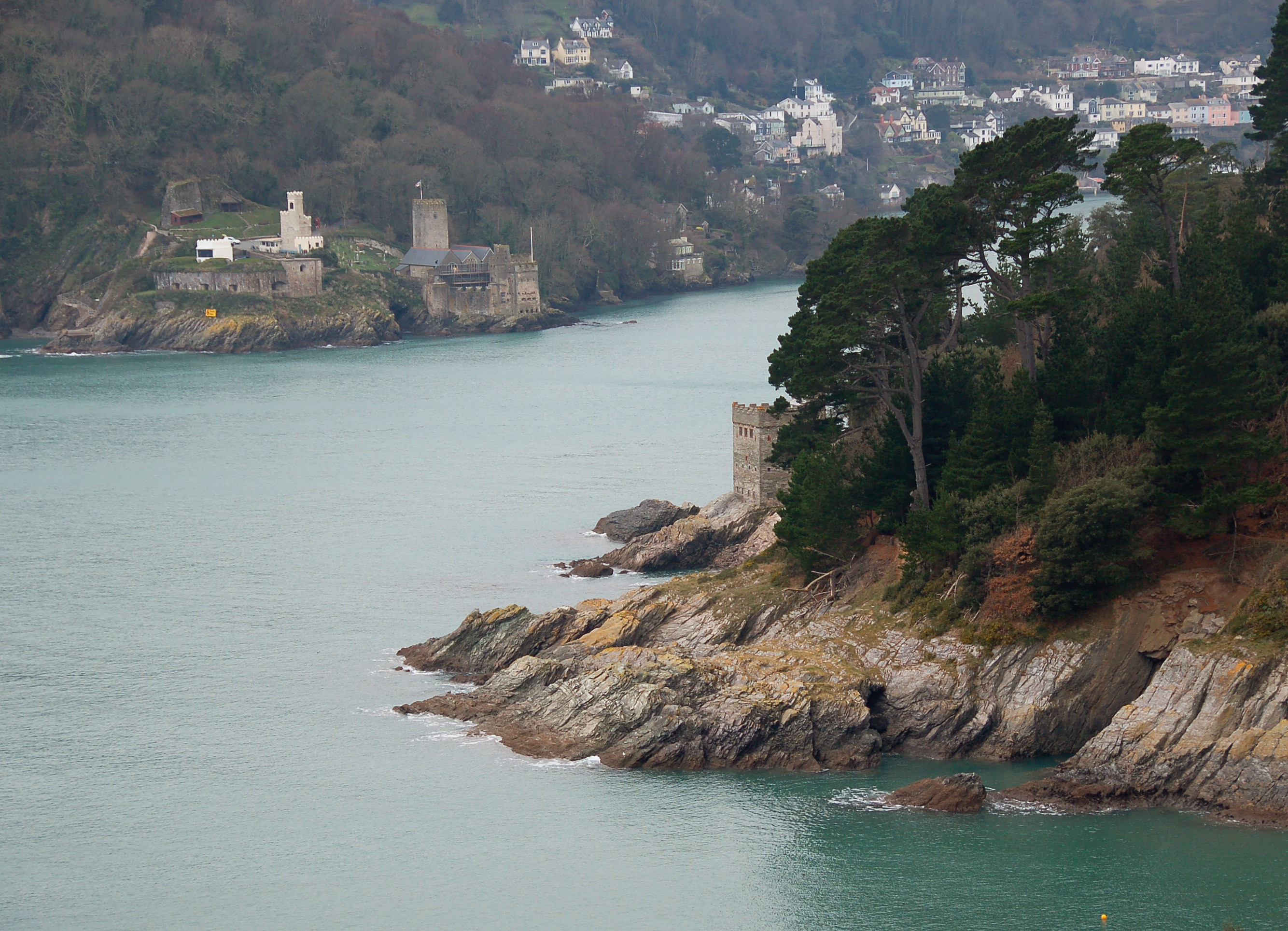
Kingswear Castle, built from 1491 to 1502, watched the opposite bank. Bayard's Cove, certainly finished by 1537 and placed by one account about 1530, was the last stop if a ship passed the chain. In the 1540s, during the French war of Henry VIII, batteries were added on either side of the tower, and Lamberd's Bulwarke was set in the corner of the fortalice. Sir Peter Carew seized the castle because that bulwark trespassed on the family house.
The seizure is dated to 1552, the town's recovery to 1554, his return to 1556, and one account keeps him in possession until his death on 27 November 1575. In 1599 Hortensio Spinola counted 24 pieces and 50 men.
In the English Civil War the town began on the side of Parliament, with five men guarding the castle. Prince Maurice took Dartmouth in 1643, after a month of resistance or by guns on the hill behind the fort. Thomas Fairfax, commander of the New Model Army, stormed the town in January 1646, on the night of 18 January in one account.
The castle then surrendered the next day, or after two days, its commander Sir Hugh Pollard giving it up. Gallants Bower, either a new earthwork or a fort of 1627 brought back into use, covered the landward side that had failed.
The Carew house was ruined in that attack and was pulled down afterwards. Sir John Fowell governed the defences until 1677, and by 1662 a royal garrison of 23 men held them. A survey in 1715 found the castle ruinous, with not one gun well mounted and with no more than 20 feet of chain left. An open battery of twelve guns, called Maiden Fort, was enlarged and renamed the Grand Battery in 1747 or in 1748.
Volunteers of the Dartmouth Artillery manned it through the Napoleonic Wars without seeing action. In 1820 only two guns were serviceable, and in 1847 the place was called picturesque, not spacious, and armed with but a few guns.
A royal commission of 1859, appointed by Palmerston, lay behind the rebuild known as Dartmouth Point Battery, finished by February 1861 in one account, with 68-pounder guns, heavy pieces on the roof and a howitzer on the harbour entrance. The new rifled guns of the national programme did not come here. A later armament is dated both to 1888 and to 1891, when five guns could fire a shell of 64 pounds out to two and a quarter miles. In 1909 the castle passed from the War Office to the Office of Works and was opened to visitors.
Quick-firing guns returned in the First World War. They returned again in the Second World War, the conflict also called World War II, set in concrete houses dated both 1939 and 1940, one of which is now the ticket office. The battery's own role ended in 1943, when Brownstone Battery took over, and a boom of steel nets echoed the old chain. The fort was repaired and reopened in 1955.
In 2007 it received 37,940 visitors. Once the guns were few, the castle entered pictures and verse.
Letitia Elizabeth Landon published a poem on it in 1833, set beside an engraving of a painting by Thomas Allom. A view dated 1794 is given to Paul Sandby, and an undated painting of his is used for the divided towers in the masonry study. He was a founding member of the Royal Academy and had trained as a military draughtsman.
Watching work in 1998 recorded the footings of the fourteenth-century curtain and its ditch. The scaffold survey of 2003 and 2004 sampled mortars and read the limestone base as earlier fabric. A signboard hole in 2016, and a watch on new fencing, on a removed bridge and on an embrasure, found no significant remains. The castle and its gun platforms are Grade I, first listed on 11 December 1969.
The Old Battery is Grade II*. The scheduling is given as 1909 with an addition in 1955, and also as 9 October 1981, amended on 16 July 1996. This castle is not described as a world-heritage inscription.
Images





Detailed History
Dartmouth Castle is an artillery fort on a rocky point at the mouth of the River Dart, built to protect the harbour of Dartmouth in Devon. The earliest work dates from the 1380s, when the town made a small enclosure castle, a fortalice, against French attack during the Hundred Years' War. It was meant to meet enemy ships with catapults and possibly with early cannon, and it took in a chapel already standing on the site and dedicated to Saint Petroc. At the end of the fifteenth century a gun tower and an iron chain were added.
The chain could be drawn across the harbour to a tower on the opposite shore at Godmerock, a name also given as Gommerock, where a hole in the rock is described as the far fixing. That gun tower is called the oldest known purpose-built coastal artillery fort in Britain. Further gun batteries were added in the French invasion scare of the 1540s. The castle was in action in the English Civil War, was rearmed several times afterwards, served again in the Second World War, which is the same conflict as World War II, and was retired from military use in 1955.
By the twelfth century the harbour, in the long sheltered estuary, was an important trading and fishing port, said to be able to hold up to 600 vessels. By the middle of that century Dartmouth was thriving. Its wealth came from trade, particularly wine from Bordeaux and wool, wheat, minerals and other produce from south Devon and Dartmoor, and from fishing. The town also had a reputation for piracy and privateering, especially against French shipping.
The narrow exit to the sea made the estuary a safe port and, once guns and a chain were in place, a port that could be closed.
The Hundred Years' War, from 1337 to 1453, was a series of conflicts between England and France, with a civil war in France, growing out of disputes over Aquitaine and from the claim of Edward III of England to the French throne. It is usually divided into the Edwardian War of 1337 to 1360, the Caroline War of 1369 to 1389, and the Lancastrian War of 1415 to 1453, with truces between them, and it is counted as lasting about 116 years of intermittent fighting. Artillery and professional armies developed during it. By the 1370s, inside the Caroline phase, Dartmouth was a key target for the French navy, and the Crown repeatedly advised the town to improve its defences.
Nothing was built until 1388.
Richard II, born on 6 January 1367 and king from 1377 until he was deposed in 1399, authorised that work. He is thought to have died in captivity about 14 February 1400. In the first years of his reign, government sat with councils influenced by his uncles, and England was still in the Hundred Years' War. The Peasants' Revolt of 1381 was the great domestic crisis of his youth.
In 1387 a group of nobles known as the Lords Appellant took control of government, and by 1389 Richard had regained it. The castle order belongs to 1388, in that interval. No account read here says that the Appellants themselves ordered the fort. What the castle accounts say is that in 1388 John Hawley, the mayor and a privateer, was authorised to raise money in the town for a new fortalice by the sea, and, in the other telling, that Richard ordered Hawley to compel the townsmen to contribute to a fortalice which was built shortly afterwards.
John Hawley, also written Hauley and called the elder, was born about 1340 or about 1350 and died on 30 December 1408. He was the son of John Hawley of Dartmouth, and the family is said to have come from the hamlet of Allaleigh. He was mayor of Dartmouth fourteen times between 1374 and 1401, and he was elected member of Parliament for the town in 1390, 1393, 1394 and 1402. He was a merchant and a licensed privateer, and he was often accused of piracy.
He conducted naval operations in the English Channel and briefly served as deputy to the Admiral of England under Henry IV. He is reputed to have been the inspiration for the shipman in Chaucer, and the account of his memorial brass says he may have inspired the burly shipman living far out west. The brass survives in the church of St Saviour in Dartmouth, showing him dressed as a fully armed knight between his two wives. His first wife, Joan, died on 12 July 1394.
His second wife, Alice, died on 7 January 1403. By Alice he had a son, John Hawley the younger, who died in 1436, was twelve times member of Parliament for Dartmouth, and is said to have married Emmeline, also called Elizabeth or Margaret, Tresilian.
The fortalice was an enclosure castle: a curtain wall with mural towers and a gate tower. It stood on land in the manor of Stoke Fleming, which belonged to the Carew family and was lent because of the French threat, outside the borough's own jurisdiction. It was built around the existing chapel of Saint Petroc. It had few permanent buildings and was used in times of danger.
A circular corner tower and an adjoining length of wall still stand. It held catapults, and it may also have had early cannon and a chain across the entrance. It did not see active service. It may have turned aside the plan of a French and Breton force in 1404.
That force, under Tanneguy du Chastel, landed at Slapton Sands and was dispersed by the local militia. Hawley's own career is also said to include organising the defence of Dartmouth in 1404 against a Breton fleet, culminating in the Battle of Blackpool Sands. The two accounts, a landing at Slapton Sands and a battle at Blackpool Sands, are both on the record. The Carew family afterwards built a house in an inside corner of the fortalice.
Documentary and antiquarian notices call it a manor house and a mansion. It is no longer visible and is expected to survive as buried remains. A flight of steps into the remaining curtain-wall tower is considered contemporary with that house and may have been made so that the tower could serve as a garden feature or a lookout.
Saint Petroc, also Petrock, Petrocus, Pedrog and Perreux, lived from about 468 to about 564. He is described as a British prince and Christian saint, probably born in South Wales, who ministered to the Britons of Devon and Cornwall in the kingdom of Dumnonia. He is associated with a monastery at Padstow, named from him, and with Bodmin, which became the main centre of his veneration after his relics were moved there in the later ninth century. The earliest life calls him a younger son of an unnamed Welsh chieftain.
A twelfth-century life written at Bodmin names that king as Glywys and calls Petroc a brother of Gwynllyw and an uncle of Cadoc. He is said to have studied in Ireland, to have made a pilgrimage to Rome, and to have founded a monastery at the mouth of the river Camel. His feast day is 4 June. In 1177 a Breton stole his relics from Bodmin, and Henry II had them restored.
His life, as read here, lists ancient dedications in Devon, mostly coastal, including one inside the old Roman walls of Exeter and the villages of Petrockstowe and Newton St Petroc, and it does not name the chapel at this castle. The castle accounts are the ones that call the chapel pre-existing and dedicated to Saint Petroc. The church of St Petrox that now stands just behind the gun tower is a three-aisled building whose present form dates to 1641, with alterations from a restoration in 1833.
The next great work was the chain and the gun tower. In 1462 the Crown agreed to pay Dartmouth £30 a year for twenty years to maintain a chain across the harbour. The heritage account names the king who made that award as Edward IV, and says it was meant to help the cost of the defences, including the laying of a massive iron chain. Edward IV was king from 4 March 1461 to 3 October 1470, and again from 11 April 1471 until he died on 9 April 1483.
Almost twenty years passed before a new tower was begun. One castle account says that in 1481 Henry VII entered into fresh discussions with the town, that the town was keen to extend the profitable chain subsidy before it expired, and that Henry agreed to pay £150 over five years for a new artillery tower, with an annual subsidy of £30 towards maintenance, later raised to £40 a year. Henry VII seized the crown on 22 August 1485 and died on 21 April 1509, so that placing of his name in 1481 sits outside the years of his reign. He was born on 28 January 1457 at Pembroke Castle, spent years in exile in Brittany, and won the throne at the Battle of Bosworth Field.
The heritage account gives the 1462 grant to Edward IV, says work on a new tower and a bulwark purpose-built for artillery began almost twenty years later, and says that in 1486 Henry VII demanded that the gun tower be finished with all godly haste. A separate account of the opposite fort dates the making of Dartmouth Castle into an artillery fort to the years between 1486 and 1495.
Stone for the tower came from Cornworthy and Kingsbridge, and the team rose to as many as twelve stonemasons. The work dragged. Fear of a French invasion grew in 1486, two great murderer guns were installed, and by 1492 there were four murderer guns and twelve serpentine guns. Completion is given as 1495, as around 1493, and as the span 1480 to 1494.
A guidebook notice, cited in the later fabric study, mentions timber bought for the roof beams of both towers between 1493 and 1495, without fixing the day those beams were set. Dendrochronology of timber at the boundary of the two towers gave a felling date between 1472 and 1508, which fits installation during the main build if that build is taken as 1481 to 1495. The chain ran to the tower at Godmerock and was supported by small boats called cobbellys. In 1491 and 1492 four watchmen were employed, hawsers and a winding cable were bought, and the chain itself was being maintained.
The chain is thought probably to have been stolen some years earlier from Fowey. When it was raised, shipping could not pass into the harbour.
The tower that took the chain is three storeys high, and its plan changed while it was being built. A semi-circular part, of limestone rubble, held the chain gear. A square part, of slate, held the guns. Each level has a round room and a rectangular room.
One list of the building says the small round tower was begun first, or was adapted from the fourteenth-century fortalice, and that the square tower was then built alongside it to the south-east, the two being merged at a higher level. It also says work stopped before the round tower was finished, that the square tower was built beside it in stone of a different size and almost entirely of slate, and that slate was afterwards used for the upper part of the round tower when the two parts were completed together. A fabric study made while the towers were scaffolded in 2003 and 2004 reads the sequence differently. The base of the round tower is almost entirely purple-brown and grey limestone, a hard limestone not seen in the rest of the tower during that inspection, and that base was taken as the remains of a fourteenth-century fortalice tower or gun platform.
The remains of that earlier tower seem to have been levelled before the later round tower rose, with some of the limestone reused. Above the base, the round tower abuts the square tower, so the major part of the round tower is later. The study envisages the square tower, almost certainly begun by 1481, standing complete for a short time with its north wall still intact, and the old fortalice base at its heel. Differences in the parapets also suggest at least a short gap between the two builds.
Plans of 1740 and 1751 appear to show no dividing wall, at least on the ground floor. A painting associated with Paul Sandby shows the two towers with the dividing wall still intact at roof level. The castle account dates a depiction by Paul Sandby to 1794. The fabric study treats the painting as undated and likely to belong to the latter half of the eighteenth century, and it suggests that alterations under the governorship of Arthur Holdsworth in 1773, marked by a lead plaque, may have removed what was left of that wall.
Paul Sandby was baptised in Nottingham in 1731, though his birth has traditionally been given as 1725, and he died on 7 November 1809. With his older brother Thomas Sandby he was a founding member of the Royal Academy in 1768. In 1745 he entered the military drawing department at the Tower of London, he left the survey in 1751, and he travelled through Britain and Ireland drawing scenery and ancient monuments. The life read here does not name Dartmouth Castle.
The castle accounts and the fabric study are what tie his name to the place.
Inside, the basement held the artillery. In the square tower there are seven gunports facing the sea, called the earliest surviving examples of this type in England. They are rectangular and splayed inside so that the gun could traverse a little, and they had outside shutters hinged on one jamb. A fireplace at the back of that room suggests men were quartered there.
In the nineteenth century the room was a guardroom, and later it was a coal store. In the round tower's basement there are four musket openings and three gunports. Those gunports were cut through masonry that was already there and are read as an afterthought. That room was later used to store gunpowder.
The chain passed out through a large opening in the seaward side of the round room, over a roller. Successive slots for the roller's axle can be seen in the jambs. The chain seems to have been hauled by ropes, with a capstan or with two wheels on an axle, and the housing may have been the holes in the back wall. The floor that replaced the original floor in the square room sits one metre higher.
Eleven small splayed square openings facing the sea may have been for handguns, and most of the other openings in that room are probably later. Three large openings facing the river are considered to have been for cannon and may have been inserted in the second part of the sixteenth century. Two other lower openings may belong to the late seventeenth century. The ground-floor rooms were offices and living space as well as the chain room.
The first floor was accommodation. There may at first have been one large room in the square tower, perhaps a common hall. Its fireplace has the remains of an oven in one side, so cooking was done there. The windows gave light and could also be used for muskets.
Later this floor was divided into at least three rooms. A spiral stair in the thickness of the wall leads to the roof. Lighter guns stood on the roof. The parapet is crenellated.
Sometime after the first build, the landward parapet was raised, against musket fire from the higher ground behind the castle and to protect the entrance below. On the south side of the roof a two-storey turret, 18 feet or 5.5 metres high, served as a lookout. Machicolations above the doorway are twentieth-century work set in the original position. Much of the interior carpentry was renewed in the twentieth century, but the first-floor barracks keep large moulded crossbeams with run-out stops, thought to be later than the fifteenth century.
Gunloops for handguns run around the basement, the ground floor and the first floor.
On the opposite bank, Kingswear Castle was begun in 1491 and finished in 1502, a three-storey square tower of slate rubble with red sandstone detail, with large rectangular gunports and wooden shutters like those at Dartmouth, covering both the sea and the anchorage. It is called one of the first purpose-built artillery forts in Britain, while the Dartmouth gun tower is called the oldest known. By 1502 a gun tower and a bulwark stood on that eastern side. A survey in the 1570s recommended that four brass guns be kept at Kingswear.
As artillery range grew, armed forts on both banks became less necessary, and by the end of the sixteenth century Kingswear was not normally manned. Closer to the town, a gun fort at Bayard's Cove was meant as a last line if a ship passed Dartmouth, Kingswear and the chain. One account places that fort by about 1530. Another leaves the start uncertain: either 1509 to 1510, at the beginning of the reign of Henry VIII, after a royal instruction to the water bailiff of Dartmouth, or 1529, when the town feared a French and Spanish attack.
It was certainly complete by 1537. Thomas Howard, Earl of Surrey, may have meant it in 1522 when he reported a blockhouse of stone in Dartmouth guarding a well defended harbour. John Leland, about two decades later, called it a fair bulwark made of late. It had eleven gunports for heavy artillery and probably began as a circular tower, like the Dartmouth gun tower.
In 1575 the town leased it to Thomas Carne, a shipwright, on the condition that it would be returned if the town needed it. In the Spanish scare of 1598 the town took it back under that agreement.
Henry VIII, born on 28 June 1491, was king from 22 April 1509 until he died on 28 January 1547. He was the son of Henry VII and Elizabeth of York. In 1543 he allied with Spain in a war against France. France and Spain made peace in 1544, and England was left open to a French invasion backed by allies in Scotland.
He ordered the defences improved, particularly on the south coast. At Dartmouth three new gun batteries were added, one on each side of the gun tower, and a third, Lamberd's Bulwarke, in the south-east corner of the fortalice. Invasion scares of 1538 to 1540 are also tied to his divorce from Katherine of Aragon, whose name is spelled Catherine of Aragon in the account of his life. Sir Peter Carew, a soldier and the member of Parliament for Dartmouth, opposed the bulwark because it trespassed on the family's house inside the castle.
He seized the castle and threw out the town's officers. The heritage account dates that seizure to 1552 and says he changed all the locks. It treats the act as the latest episode in an old feud: the 1380s fort had been built on Carew land in Stoke Fleming, outside the borough.
Sir Peter Carew was born about 1514 at Ottery Mohun, now Mohuns Ottery, in the parish of Luppitt, the third son of Sir William Carew, and he died on 27 November 1575 at Ross in County Waterford. He was sometimes called Sir Peter Carew the elder, to distinguish him from a cousin of the same name who was killed at the Battle of Glenmalure in 1580. He went to grammar school in Exeter, where he was often a truant, and to St Paul's School. He was placed with a French friend of his father, fell to the work of a muleteer, and in February 1526 was recognised by a relation on the way to the siege of Pavia.
He later served Philibert, Prince of Orange, and after Orange's death he was sent to Henry VIII with letters. The king took him into service. In 1535 he went with Lord William Howard to Scotland to present James V with the Order of the Garter. In 1540 he travelled with a cousin to Constantinople, Venice, Milan and Vienna.
He served against France on land and at sea. In July 1543 he was one of six in a friendly tournament with French soldiers from the garrison of Thérouanne. In 1544 he led a company of foot dressed in black at his own expense, together with his brother George Carew, who was in command of the Mary Rose when she sank in 1545, and he served as commander of the horse. He was knighted in 1545.
He was member of Parliament for Tavistock in 1545, for Dartmouth in 1547, for Devon in 1553 and 1559, and for Exeter in 1563, and he was High Sheriff of Devon in 1547. Another account says that in 1547 he became lord of the borough of Dartmouth as well as its member. In June 1549 he was sent to help put down the Prayer Book Rebellion in Devon and Cornwall, and he was reprimanded for the harshness of his measures, notably the burning of barns at Crediton. In 1553 he proclaimed Queen Mary at Dartmouth and at Newton Abbot.
At the end of that year he joined Wyatt's Rebellion against her proposed marriage to Philip of Spain, escaped arrest, and fled in January 1554. In May 1556 he was arrested in Flanders with Sir John Cheke and brought back in a fishing boat. He was held in the Tower of London until October 1556.
The castle's own story of those years is told in more than one way. One account says a law case followed the seizure, that in 1554 the town regained the property after Carew fled the county facing charges of treachery, that he returned in 1556 and retook the castle, and that a reprieve eventually left the fortifications with the town and the house with the Carews. The longer heritage account says the borough pursued him at law, that the castle was given back to the town in 1554, quite possibly because he had been declared a traitor that January, that he was pardoned late in 1556 and had his property restored, and that he got Dartmouth Castle back several years later, then served Elizabeth in Ireland and died in 1575. A shorter heritage summary says he probably held the castle from the seizure until his death in 1575.
Under Elizabeth he was sent to settle a dispute between Lord Grey and the Earl of Norfolk that had arisen at the Siege of Leith, and when Norfolk was convicted of treason in 1572 Carew, as Constable of the Tower, was his gaoler. From 1568 he pursued claims to lands in the south of Ireland, including the barony of Idrone in County Carlow, and his clash with the Butler family fed the first Desmond Rebellion. The queen recalled him. He returned to Ireland in 1574 and died of illness on the way to a house being prepared for him at Cork.
He was buried in Waterford Cathedral, on the south side of the chancel. The cathedral was rebuilt in the eighteenth century and nothing remains of the grave. John Hooker, his friend and legal adviser, set up a mural monument in Exeter Cathedral, first in the north choir aisle and moved to the south transept in 1805. Carew had no children.
His heirs were his cousins Peter, who died in 1580, and George, later the first Earl of Totnes. His will was dated 4 July 1574 and proved in February 1576.
In 1597, with a Spanish invasion feared, the gun tower was improved and Lamberd's Bulwarke was repaired. Two years later Hortensio Spinola, a Spanish spy, described the castle as defended with 24 pieces and 50 men, said the harbour was well protected, and called the inhabitants warlike. In 1588 the ships of the Great Armada sailed past Dartmouth on their way to meet the English fleet. An early casualty, the Spanish ship Nuestra Señora del Rosario, was captured and brought into Dartmouth as a prize by Francis Drake.
The English Civil War, also called the Great Rebellion, was a series of civil wars and political struggles between Royalists and Parliamentarians from 1642 to 1651, part of the wider Wars of the Three Kingdoms from 1639 to 1653. Historians often divide it into the First English Civil War and the Second English Civil War, and sometimes treat the Anglo-Scottish war of 1650 to 1652 as a third. The first war was fought chiefly over the balance of power between Parliament and Charles I, and it ended in June 1646 with Royalist defeat and the king in custody. Charles I was born on 19 November 1600, became king on 27 March 1625, and was executed on 30 January 1649.
The castle accounts date the fort's own service more tightly, to the English Civil War of 1642 to 1646, and one of them calls that fighting the First Civil War of 1642 to 1646. At the outbreak the town sided with Parliament, repaired and manned its defences, and spent money on the doors at Kingswear. The castle itself was guarded by five men. In September 1643 a Royalist force under Prince Maurice, Count Palatine of the Rhine and a nephew of Charles I, tried to take the town.
He met determined resistance, and the Parliamentarians fought for another month before they surrendered. Another account says that in 1643 Prince Maurice besieged the town and that the castle was overcome by artillery placed on the higher ground of the hill behind it. For about two and a half years Dartmouth stayed in Royalist hands, while Parliamentarian warships blockaded the harbour to stop supplies coming in by sea, and the king's men built new forts high above the river. An earthwork called Gallants Bower may have been built then to cover the weak landward side of the castle.
An alternative is that Gallants Bower was first built in 1627 and was only brought back into use. A similar choice is recorded for an earthwork behind Kingswear, called Mount Ridley or Kingsworth: either new in the war, or a work of 1627 reused.
Thomas Fairfax retook the place for Parliament. Thomas Fairfax, third Lord Fairfax of Cameron, was born on 17 January 1612 at Denton Hall in Yorkshire and died on 12 November 1671. Because of his dark hair his troops called him Black Tom. He was the eldest son of Ferdinando Fairfax, second Lord Fairfax of Cameron, and he succeeded to the title in 1648, though he was generally known as Sir Thomas Fairfax while his father lived.
He served under Horace Vere in the Netherlands, and on 20 June 1637 he married Vere's daughter Anne at Hackney. He was knighted in January 1641 after the Second Bishops' War. In January 1645, when Parliament new-modelled its armies, he was named commander-in-chief, and he held that command until 1650. His life records the northern campaigns, the Battle of Marston Moor, the king's surrender in 1646, the siege of Colchester in 1648, his refusal to take part in the trial of the king, his resignation in 1650, and his support for George Monck in the restoration of 1660.
That life, as read here, does not name Dartmouth. The harbour accounts do. In January 1646 he led a Parliamentary army to retake the town. One account says he took the town first, then Gallants Bower, and the next day forced the surrender of Sir Hugh Pollard, the castle's commander.
Another says that on 18 January 1646 his forces stormed the town at night, that the defenders were quickly overrun, and that the castle, isolated by the river and without an effective land defence, surrendered after just two days. The same campaign captured Kingswear from Sir Henry Cary, High Sheriff of Devon, who had been left to defend it, and seized Bayard's Cove Fort together with the five iron guns the Royalists had stationed there. The Carews' house was probably badly damaged in the attack. A watching brief of 2016, inside the fortalice, treats that house as probably ruined by the siege of 1646.
During the Interregnum, Gallants Bower was decommissioned and the castle stayed in use. The Carews' house was pulled down. Sir John Fowell was appointed governor of the castle and the local defences, and he was to prevent smuggling. In 1650 an order was given for Bayard's Cove Fort to be repaired and brought back into service, and Sir Henry Cary was heavily fined.
Charles II, born on 29 May 1630, was restored to the throne in 1660 and died on 6 February 1685. At first he granted Dartmouth Castle, and the old annual subsidy, to the town again. Another account says he briefly reasserted the town's rights over the defences and that control then passed to the Crown. By 1662 the Dartmouth fortifications were held by a royal garrison of 23 men, and Sir John Fowell continued as captain and governor until 1677.
At Kingswear, by 1661, the guns were mounted on the roof, which had been accidentally burnt during the fighting and replaced with a new lead roof. Fear of a Dutch and French attack kept Dartmouth Castle maintained through the 1690s. The reign of Charles II included the Second Anglo-Dutch War and, after the Treaty of Dover in 1670, the Third Anglo-Dutch War. Upkeep at the castle seems to have lapsed after the 1690s.
At the start of the eighteenth century the castle was neglected. In 1715 Colonel Christian Lilly, surveying the defences of the south-west, found Dartmouth Castle in a ruinous condition, with not one gun well mounted, and with no more than 20 feet, or 6 metres, left of the chain. Another account of the same survey says that none of the artillery had been adequately maintained. A drawing of 1715 shows the castle flying the union flag, with an open battery for twelve guns, then called Maiden Fort, and the town away to the right.
Kingswear, by the eighteenth century, had fallen into ruin, although 12-pounder, 9-pounder and 8-pounder guns were still installed there in 1717. By 1741 most of the guns at Dartmouth were in Maiden Fort, an open battery of twelve guns on the site of the old bulwark, with a guardhouse for the gunners and their stores. One account says Lamberd's Bulwarke was strengthened in 1741 and that in 1748 the government renamed it the Grand Battery and made it a two-tier platform armed with twelve guns. Another says the battery was enlarged in 1747, probably in case of a French invasion, and was then renamed the Grand Battery, able to house guns on two levels to control the approach to the harbour.
From that time the medieval gun tower was kept mainly for accommodation and storage, and the older parts were retained by the town. The port of Dartmouth declined, and Plymouth took over much of its former trade.
The castle was garrisoned in the Napoleonic Wars, given as the years 1793 to 1815, by the volunteer Dartmouth Artillery. It saw no action. At the end of the conflict the guns were reduced and the garrison was cut to a single caretaker gunner. Another account says that after 1815 there was only a master gunner, who lived in the gun tower.
In 1820 only two guns were serviceable. In 1847 Clarkson Stanfield wrote that the castle, while picturesque, was not spacious and mounted but a few guns.
Shell guns and steamships in the 1840s created a new fear that the French might attack along the south coast, and that fear grew again in the early 1850s. Rifled cannon and ironclad warships sharpened it further. The Royal Commission on the Defence of the United Kingdom was established in 1859 and was appointed by Palmerston. It feared for the south coast, and a national programme of forts and large rifled guns followed.
At Dartmouth the Grand Battery was rebuilt and renamed the Dartmouth Point Battery. One account gives it shell-proof granite defences, three traversing emplacements for 68-pounder guns looking out to sea, two 10-inch guns of 86 hundredweight on the roof, and one small 8-inch howitzer covering the harbour entrance. It was manned by three professional soldiers and a team of more than fifty-five reservists from the newly formed Sixth Devonshire Artillery Volunteer Corps. Another account says the War Office had rebuilt the Grand Battery as the two-tier Dartmouth Point Battery by February 1861, and that the new rifled guns of the commission's programme did not come here, so the battery was almost immediately out of date.
The description of the standing building dates the Old Battery to 1861 and places it on the former site of the Grand Battery and of Lamberd's Bulwarke. A further rearmament is dated both to 1888, when only out-of-date pieces are said to have been installed, and to 1891, when five heavy guns could fire shells of 64 pounds, or 29 kilograms, out to two and a quarter miles. Two of those guns survive, one on the open platform of the battery and one placed below. Even with the new battery, the castle was of low military priority.
It mattered because an enemy might use the harbour as a stepping point against Plymouth, and the guns given to it were called old-fashioned.
By 1909 most of the castle was considered obsolete. The War Office gave the gun tower and the battery to the Office of Works. Restoration followed, and the place was opened to visitors. Two years later, former gunner Sergeant Thomas Lawson became the first resident caretaker and guide.
During the First World War two quick-firing guns were set on Dartmouth Point Battery to stop fast gunboats and torpedo boats entering the harbour. After 1918 the Office of Works restored the castle again, and from 1922 it was leased to the borough as a tourist attraction, with a tearoom in the battery.
The military life was not over. In the Second World War, the conflict also named World War II and dated from 1 September 1939 to 2 September 1945, the harbour became a haven for merchant convoys, and the navy commissioned Philips' shipyard in the town to build boats and small ships. The castle was rearmed with two 4.7-inch quick-firing guns, a calibre also given as 11.9 centimetres. One account says those guns dated from the First World War and were housed in concrete gun houses to protect the convoys and the shipyard.
Another says they were installed to engage enemy ships up to three miles out, each protected from air attack by a concrete gun house. One of those houses stands on Dartmouth Point Battery and is now the ticket office. It is described as a white concrete building that began as a coastal gun position disguised as a medieval turret, and also as a single-storey, flat-roofed brick blockhouse with dwarf battlements, built to house a 4.7-inch quick-firing gun. The year of that blockhouse is given as 1939, and a caption dates the gun house as added in 1940.
The other gun house, 170 metres to the south-west, has been dismantled. Dartmouth Battery operated until 1943, when its role passed to Brownstone Battery on the cliffs east of the river mouth. Upstream, in an echo of the old chain, the navy laid a floating boom across the river, with steel mesh nets hanging to the bed, against enemy ships and submarines. The castle was manned by the army.
Officers lived in a nearby cottage, non-commissioned officers in the castle, and other ranks in the nineteenth-century fortifications and later in temporary Nissen huts. On the opposite bank Kingswear was used by the Royal Marines, and the site there was reinforced by a concrete blockhouse. Bayard's Cove was briefly a machine-gun post. In 1955 Dartmouth Castle was transferred back to the Ministry of Works and repaired.
The Dartmouth Point Battery, by then called the Old Battery, was leased to the town for use as a restaurant, and the site was reopened. Another account says the ministry resumed responsibility, repaired the castle, and leased it to Dartmouth Corporation for the public. In the present century the Grand Battery is displayed as it would have appeared in the nineteenth century. The castle received 37,940 visitors in 2007.
The standing buildings occupy the rocky outcrop at the harbour entrance. On the north side are the main gun tower, looking across the Dart, and the church of Saint Petrox. To the south-east is the Old Battery, facing the sea. In the south-west corner are the remains of the fortalice: a corner tower, part of the moat, and parts of the wall.
That wall is given as 7 feet 6 inches, or 2.29 metres, thick, and up to 23 feet, or 7.0 metres, high. Another account describes two lengths of curtain standing about 12 metres high and 2 metres wide, a circular tower, and a substantial rock-cut moat, and it allows that other towers and lengths of curtain may survive underground. The 2004 clearance of the curtain overlooking the present car park found a wall 7.0 metres high, mainly of grey and reddish-brown slate with some layered limestone, which appears originally to have been mud-bonded. The character of the first seaward defences, and of the buildings that once stood inside the enclosure, is not known from the fabric alone.
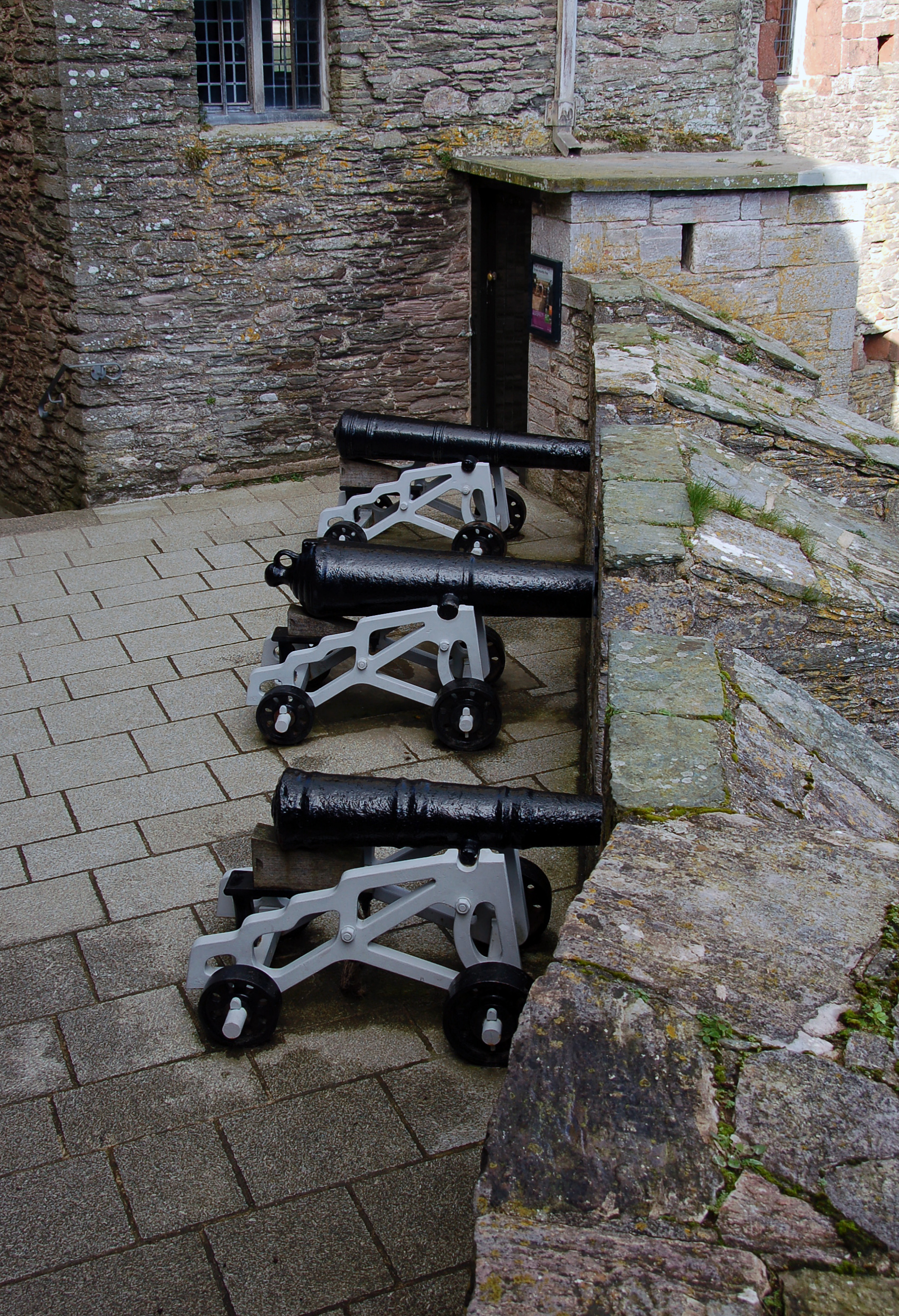
The chain tower is flanked by gun platforms. The southern platform was designed for three guns and the northern platform for five. The openings in the platform walls are eighteenth-century remodellings. The guns now in them are cast iron, of the seventeenth to the nineteenth centuries, on reproduction garrison carriages, and they were recovered from Dartmouth Quay, where they had been used as bollards.
On the north-east of the Old Battery a guard room lay above the magazines. A ditch, rifle loops and murder-holes covered the landward side. In the main battery three vaulted casemates held traversing heavy guns pointing out to sea, a smaller position covered the harbour entrance, and two further heavy guns stood on the roof. Behind the battery a nineteenth-century tower served as a lighthouse between 1856 and 1886.
The old approach came from the north, across a bridge, since rebuilt, over a chasm. An eighteenth-century doorway through the curtain has a brick segmental arch and a fielded six-panel door.
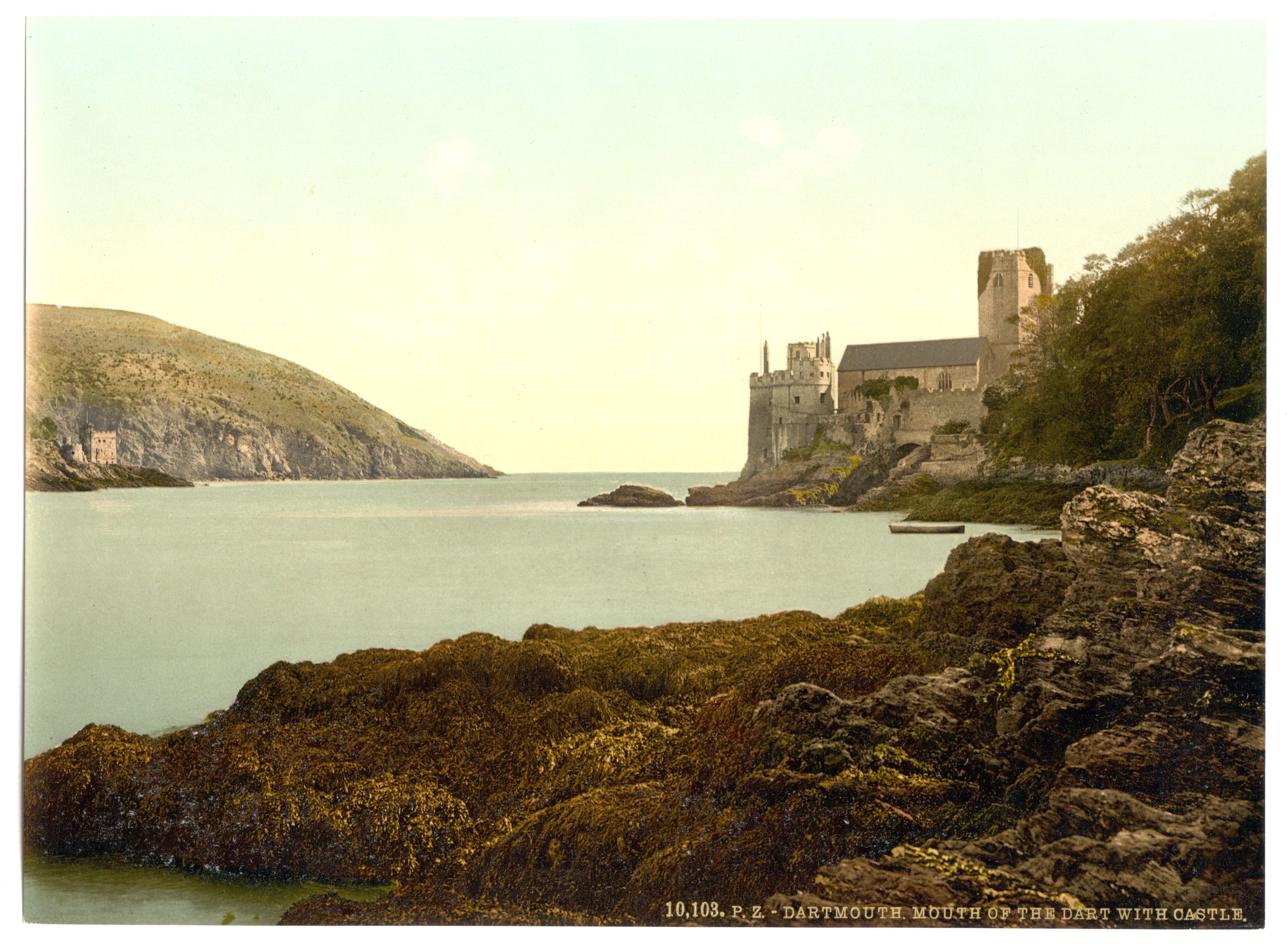
The place also entered poetry and painting once its guns had grown few. Letitia Elizabeth Landon was born on 14 August 1802 in Chelsea and died on 15 October 1838. She published as L.E.L., and her poem Dartmouth Castle was printed in Fisher's Drawing Room Scrap Book for 1833, beside an engraving of a painting by Thomas Allom of the castle and the harbour. The poem treats what had been a bastion of war as a place for holidays.
Her life, which records The Improvisatrice, her schooling at Hans Place, and a wide popularity that later faded, does not itself name this castle. Thomas Allom was born on 13 March 1804 and died on 21 October 1872. He was an architect, an artist and a topographical illustrator, and a founding member of what became the Royal Institute of British Architects. Born in Lambeth, the son of a coachman from Suffolk, he was apprenticed to Francis Goodwin from 1819 to 1826 and then studied at the Royal Academy Schools.
He worked with Charles Barry on the Houses of Parliament and on the remodelling of Highclere. His life, as read here, does not name Dartmouth. The castle account is what identifies the 1833 engraving as his painting. Paul Sandby remains the third artist attached to the fabric, by the depiction dated 1794 and by the undated painting of the divided towers used in the masonry study.
Archaeology on the site has been watching and recording rather than a single open excavation with a long find list. In 1998, observations during development inside the scheduled area established the nature and arrangement of the fourteenth-century curtain-wall footings and of the ditch that went with them. Between May 2003 and March 2004, repairs and alterations allowed a close record of the square and round towers, mortar samples, and the reading of the limestone base as earlier fortalice fabric. The curtain overlooking the car park was cleared and the top consolidated.
In August 2016 the first-floor plaster ceiling was recorded in an emergency before it was replaced. That ceiling had itself been replaced in the twentieth century. Scratch marks had been copied onto it from an earlier ceiling, and partition marks could be seen. In the same year a watching brief on a new visitor signboard, set inside the fortalice, found nothing.
The posthole stayed in topsoil. The ground there has been heavily landscaped for paths and planting, and it is suspected to be where the Carew house stood. A separate watching brief on new fencing along the northern side, on the removal of the concrete bridge between the car park and the ticket office, and on an embrasure of the Old Battery recorded no significant archaeological activity. A watching brief of 2018 is catalogued, but the summary available here does not publish a find list.
A conservation management plan was prepared for the castle and was indexed in 2019. It is a plan for care, not a catalogue of objects from a dig.
The castle and the gun platforms to the west and south are listed at Grade I, first listed on 11 December 1969, and described as work of 1480 to 1494 with later modernisation, an artillery fort earlier than the castles of Henry VIII. The walls of the ruined fortalice are a separate Grade I listing. The Old Battery is listed at Grade II*. The church of St Petrox is Grade I.
A cross shaft about a third of a metre west of the church tower, a telephone kiosk in the grounds, and the castle tearooms are Grade II. One general account says the fourteenth-century gun tower is the Grade I building and the nineteenth-century gun battery is the Grade II* building, which does not match the list descriptions of a late-fifteenth-century gun tower with its platforms, a separate fortalice, and a later battery. The scheduling of the whole monument, enclosure castle, mansion, chain tower and later coastal battery, is given as first made on 9 October 1981 and amended on 16 July 1996. Another account says the fifteenth-century gun tower and the adjoining sixteenth-century gun platforms were scheduled in 1909, although they were put back into service in both world wars, and that Dartmouth Point Battery and the remains of the fourteenth-century castle were added to the scheduling in 1955.
The records read here do not describe Dartmouth Castle as a world-heritage inscription. In September 2022 Bayard's Cove Fort, the blockhouse nearer the town and not this castle, was named among six English castles at risk from coastal erosion. That notice, and the rocky terrace there which frequently floods, belongs to Bayard's Cove.
The published opening, as given for the castle itself, is Saturday and Sunday from 10am to 4pm, with last entry at 3.30pm. Tickets booked online until midnight the day before the visit are sold at a discount. Tickets bought on the day, online or at the entrance, are charged at the full price. Tickets are valid all day.
Tickets are free for members who bring a membership card. Dogs on leads are allowed to enter, and assistance dogs are allowed to enter. Smoking, vaping, barbecues and naked flames are not allowed. Drone flying from or over the site is not allowed except by contractors or partners who meet the stated conditions of aviation rules, insurance and permission.
There is no lift. The ground floors have many steps, the upper floors of the gun tower are reached by a narrow, steep spiral stair, another steep spiral stair serves the Victorian battery, and the shop is reached by four steps. Access for a wheelchair is very restricted because of slopes, staircases and steps, and a companion is recommended. Pathways and steps are uneven.
Stone is slippery when wet. The castle stands on a steep cliff above the sea and the estuary, with a sheer drop outside the site.
Sources
- Dartmouth Castle — Wikipedia
- History of Dartmouth Castle — English Heritage
- Sir Peter Carew and Dartmouth Castle — English Heritage
- Dartmouth Castle — Historic England
- Dartmouth Castle and Gun Platforms to West and South — Historic England
- Archaeological Monitoring and Recording at Dartmouth Castle, 1998 — Exeter Archaeology
- Dartmouth Castle Phase 2 Condition Survey Works — Exeter Archaeology
- Dartmouth Castle: Results of an Archaeological Watching Brief — AC Archaeology
- Visit Dartmouth Castle — English Heritage
- Prices and Opening Times for Dartmouth Castle — English Heritage
- Access at Dartmouth Castle — English Heritage
- Facilities at Dartmouth Castle — English Heritage
- Saint Petroc — Wikipedia
- John Hawley (died 1408) — Wikipedia
- Thomas Fairfax — Wikipedia
- Letitia Elizabeth Landon — Wikipedia
- Paul Sandby — Wikipedia
- Thomas Allom — Wikipedia
- English Civil War — Wikipedia
- World War II — Wikipedia
- Peter Carew (adventurer) — Wikipedia
- Richard II of England — Wikipedia
- Henry VII of England — Wikipedia
- Edward IV of England — Wikipedia
- Hundred Years' War — Wikipedia
- Henry VIII — Wikipedia
- Charles I of England — Wikipedia
- Charles II of England — Wikipedia
- Kingswear Castle — Wikipedia
- Bayard's Cove Fort — Wikipedia
- Dartmouth Castle scheduling note — Historic England
- Dartmouth Point Battery — Historic England
- Dartmouth Castle, Devon. Archaeological Watching Brief — Archaeology Data Service
- Dartmouth Castle, Devon: Conservation Management Plan — Archaeology Data Service
- Dartmouth Castle09.JPG — Wikimedia Commons
- Cannons in Dartmouth Castle.jpg — Wikimedia Commons
- Dartmouth and Kingswear Castles.jpg — Wikimedia Commons
- Cannon, guarding the entrance to Dartmouth harbour - geograph.org.uk - 1188459.jpg — Wikimedia Commons
- Approaching Dartmouth Castle from the river - geograph.org.uk - 1747869.jpg — Wikimedia Commons
- Mouth of the Dart with castle Dartmouth England.jpg — Wikimedia Commons
- Paul Sandby - Dartmouth Castle - Google Art Project.jpg — Wikimedia Commons
- Mouth of the Dart with castle, Dartmouth, England-LCCN2002696638.jpg — Wikimedia Commons
- Mouth of the Dart with castle, Dartmouth, England-LCCN2002696638.tif — Wikimedia Commons
- Dartmouth Castle diagram labelled.png — Wikimedia Commons