
Midlothian, United Kingdom · United Kingdom
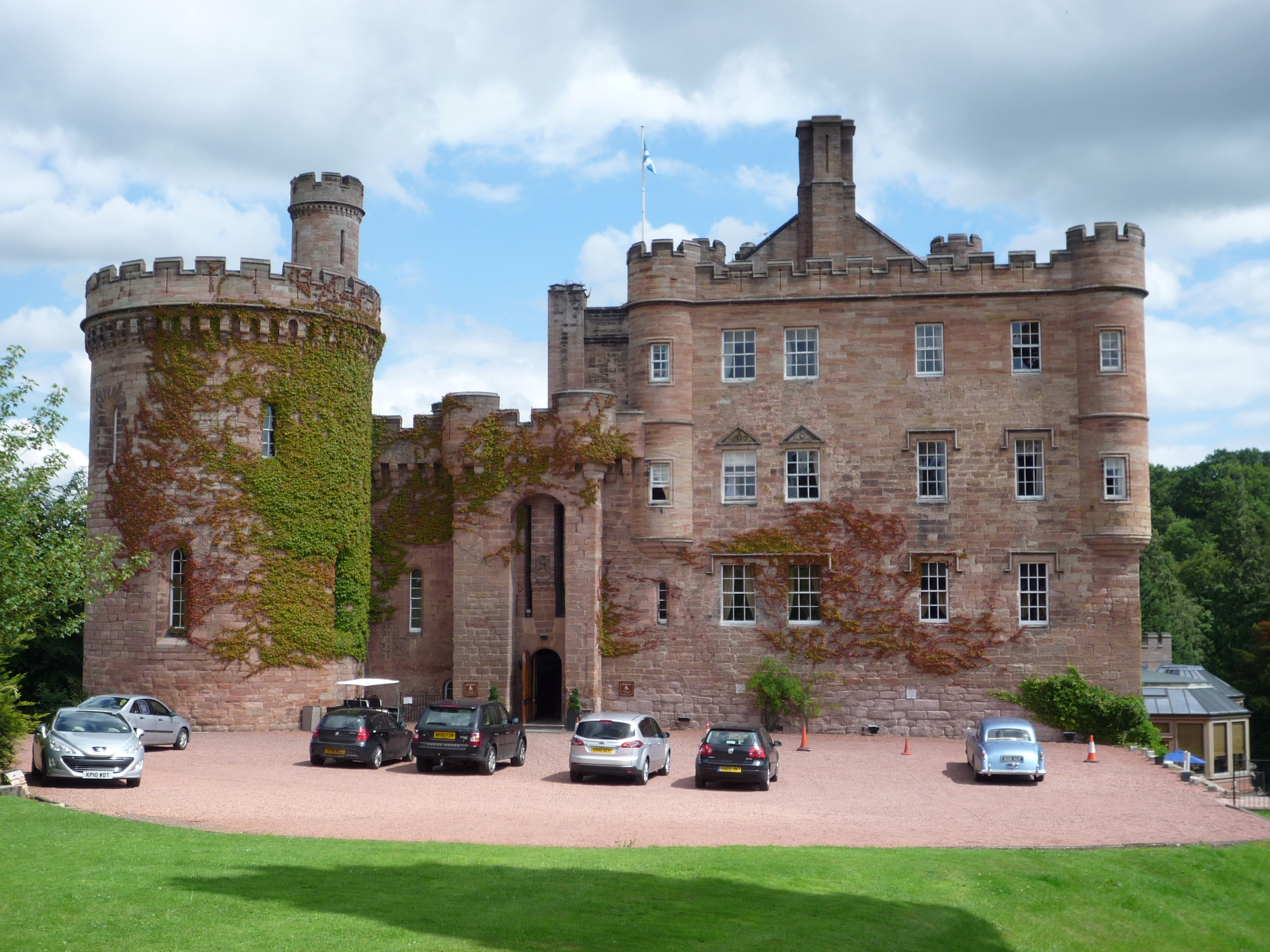
- Dalhousie Castle stands at Cockpen in Midlothian, above the South Esk and about eight miles south of Edinburgh, and it was the seat of the Earls of Dalhousie and of Clan Ramsay.
- The Ramsay line is traced to the twelfth century, and the present L-plan of pink-red sandstone, with its drum tower, curtain, and dry moat, took shape mainly about 1450.
- Edward I stayed the night before the Battle of Falkirk (1298), a later Sir Alexander Ramsay held the castle through a six-month siege in 1400, and Oliver Cromwell used it in 1648.
- William Burn restored the house in the 1820s, an upper storey burned in 1867, and the earls later moved their seat to Brechin Castle while this castle became a school and then a hotel.
- In 1996 and 1997 the clearing of the well room revealed an overflow drain, a probable soakaway, and a lime store, and the castle afterwards passed through Von Essen Hotels to Robert Parker in 2012.
History
Dalhousie Castle stands in Cockpen, Midlothian, near Bonnyrigg and about eight miles south of Edinburgh, above the River South Esk. Its walls are pink to red sandstone, thought to have been quarried on the opposite bank. It was the seat of the Earls of Dalhousie and of Clan Ramsay, and in January 1971 it was recognised in Category A, a date given as both the 21st and the 22nd.
The lands were called Dalwolsey, explained as the Vale of Wool. The founder is named in several forms, as an English knight of Norman descent from Ramsey in Huntingdonshire, as a freeman who followed David I, and as a man who witnessed a Holyrood charter in 1140. One account places the crossing in about 1140, when David inherited the crown, and another places David in Scotland from 1124. By the thirteenth century the clan had five main branches, and in 1255 William de Ramsay of Dalhousie sat on the council of the young Alexander III.
William Ramsay, known by 1280 as Ramsay de Dalwolsey, did homage to Edward I on the Ragman Roll of 1296. Edward spent a night at the castle before the Battle of Falkirk (1298), where on 22 July he defeated Sir William Wallace. Wallace, Guardian of Scotland after Stirling Bridge, resigned after Falkirk and was executed in 1305. William Ramsay later fought for Robert the Bruce at Bannockburn in 1314 and signed the Declaration of Arbroath in 1320.
English forces held Dalhousie again until Sir Alexander Ramsay’s raids. By Easter 1342 he had scaled Roxburgh, the last English-held castle, and David II made him constable there and sheriff of Teviotdale. Sir William Douglas seized him at Hawick that May and starved him at Hermitage Castle. His brother William survived capture at Neville’s Cross, and a Sir William Ramsay of Dalhousie defeated the English at Nisbet Moor in 1355.
In 1400 a later Sir Alexander Ramsay withstood a six-month siege by Henry IV. Dalhousie was the last castle in Scotland besieged by an English king in person. The accounts do not describe engines or mines, only that the defence held. Sir Alexander was killed two years later at Homildon Hill.
The present L-plan keep and curtain belong mainly to about 1450, with a drum tower and a well, a dry moat and drawbridge, and a windowless bottle dungeon measuring 10 feet 10 inches by 10 feet 3 inches. Prisoners were lowered in by rope, and the rope scores remain in walls 11 feet thick. New work of about 1633, eighteenth-century alterations by John Douglas and George Paterson, and William Burn’s restoration of 1825 to 1828 were folded into that older frame. The moat was filled, and no ditch was visible on a visit in October 1975, though it is also said to have been partly dug out again when the castle became a hotel.
Alexander Ramsay was killed at Flodden in 1513. Mary, Queen of Scots, is said to have slept here on 30 June 1563, and in 1568 the laird met her after her escape from Loch Leven and fought for her at Langside. In 1600 John Ramsay killed the Earl of Gowrie during the alleged kidnapping plot and was made Earl of Holderness. His brother George became Lord Ramsay in 1618, and George’s son William became Earl of Dalhousie in 1633, leaving initials on the west pediments of a renaissance mansion.
William commanded horse at Marston Moor, dated both 1644 and 1614, and he fought at Philiphaugh. Oliver Cromwell is placed at the castle in 1648, either after a siege or simply in occupation, with dispatches dated that October and with musket shot said to remain in the walls. The war left the house so poor that the eighth Earl’s bride crossed bare beams. After the Union of 1707 the family turned toward politics.
The fifth Earl served in 1710 in the Spanish succession wars, and a Ramsay signed the capitulation of Quebec in 1759. James Robertson laid out the grounds before 1750. Around 1800 Walter Nicol designed the walled garden. Paterson Georgianised the house in 1778 and 1779, and Sir Walter Scott complained in 1827 that Douglas had ruined its baronial character, while Burn was restoring it.
The ninth Earl, George Ramsay, fought at Waterloo, governed Nova Scotia and British North America, and commanded in India. His son James, the tenth Earl and only Marquess, was Governor-General of India from 1847 to 1856. Queen Victoria took tea at the castle in 1840. James died in 1860 without sons, and the earldom passed to his cousin.
An upper storey burned in 1867 and was rebuilt. The earls moved to Brechin Castle around the start of the twentieth century. The chief is named both James Hubert Ramsay and Guy Paul Ramsay, in each case the seventeenth Earl. Dalhousie stayed in the family until 1977, a possession claimed as longer than that of any other castle in Scotland.
It was a boys’ preparatory school from the middle of the nineteen-twenties until about 1950, and it became a hotel in accounts dated 1955, 1972, and 1985. In 1996 and 1997 the well room in a late fifteenth-century tower was cleared of about 0.3 metres of later debris. The work found an overflow drain, a probable soakaway, and a lime store.
In 2003 Von Essen Hotels bought the castle for a reported ten million pounds. A roof fire on 26 June 2004 was contained without major structural harm.
The company failed in April 2011. In March 2012 Robert Parker, owner of Doxford House, Eshott Hall, and Guyzance Hall, bought Dalhousie for an undisclosed sum.
Images


Detailed History
Dalhousie Castle stands in the parish of Cockpen, in Midlothian, near Bonnyrigg and about eight miles, or thirteen kilometres, south of Edinburgh. It overlooks the River South Esk, also called the River Esk in one account, from a site recorded at grid reference NT 32345 63595. The walls are of tooled, coursed pink sandstone with droved dressings, a stone also described as red, and they are thought to have come from a quarry on the opposite bank, now disused. The castle has been called a stately castellated pile.
On 22 January 1971, a date also given as 21 January 1971, it was recognised in Category A as a building of special architectural and historic interest, and it stands in a group with the folly on the west bank of the River South Esk, the folly on the east bank, Dalhousie Bridge, the West Lodge, and Grove Farm, the former walled garden.
The place was the seat of the Earls of Dalhousie and of the chieftains of Clan Ramsay, a Lowland clan. The lands were first called Dalwolsey, also written Dalwolsie, a name explained as the Vale of Wool. Simon de Ramsay is said to have received the barony in the early twelfth century. The founder’s name is written in several forms.
One account calls him Simundus de Ramesie, Simon of Ramsey, an English knight of Norman descent from the Huntingdonshire village of Ramsey, a vassal of David, Earl of Huntingdon, who followed his lord to Scotland in about 1140, when that account says David inherited the Scottish crown. Another calls him Simundus de Ramesia, a freeman who followed King David I from the village of Ramsay in Huntingdonshire in about 1140, the first of the line to hold land at Dalwolsey. A clan account uses Symon de Ramesie, places David of Scotland, Earl of Huntingdon, in 1124 among young Norman noblemen, and says Symon was granted lands in Midlothian and witnessed a charter to the monks of Holyrood Abbey in 1140. A castle timeline also writes Simundus de Ramseia as a French nobleman who served with King David and was the first to have lands at Dalwolsie, and it traces an earlier figure, described there as a German pirate who followed William the Conqueror, to a black eagle emblem.
The same clan account says that in the eleventh century a ram in the sea is believed to have been an emblem on the seal of an abbey in Huntingdon. He is treated as the founder of the Ramsay line and as the builder of the first castle at Dalhousie.
By the thirteenth century there were five major branches of Clan Ramsay: the Ramsays of Dalhousie, the Ramsays of Auchterhouse, the Ramsays of Banff, the Ramsay of Forfar, and the Ramsays of Clatto. In 1255, during the minority of Alexander III of Scotland, William de Ramsay of Dalhousie sat on the king’s council. The Ramsays acquired large estates by marriage with the Maules, described as a family of Norman mercenaries also hired by King David, who had secured royal grants in Midlothian and the Carse of Gowrie. The Ramsay name appears in Midlothian records through the thirteenth century.
William Ramsay, who witnessed deeds about land in 1280, was the first to be known as Ramsay de Dalwolsey, and he was styled that way as his usual and known designation, not as a man then receiving the lands for the first time. A castle timeline places the building of the inner keep, with its vaults and the bottle dungeon, in 1280.
His name stands on the Ragman Roll, also called the Ragman’s Roll, of 1296, as doing homage for those lands to Edward I of England, called Longshanks in one account. The English king spent a night in Dalhousie Castle before going on to Falkirk, where he defeated Sir William Wallace. That fight is the Battle of Falkirk (1298).
Sir William Wallace, Uilleam Uallas in Scottish Gaelic and William le Waleys in Norman French, lived from about 1270 until 23 August 1305. He was a Scottish knight and one of the main leaders in the First War of Scottish Independence. He belonged to the lesser nobility, and little is certain about his family or even his parentage. His own seal, on a letter sent to the Hanse city of Lübeck in 1297, gives his father’s name as Alan Wallace.
That Alan Wallace may be the crown tenant in Ayrshire listed in the Ragman Rolls of 1296, but there is no further confirmation. Others have guessed that this Alan held Ellerslie, near Kilmarnock, and that the estate could be a birthplace, though there is no record of Wallaces holding it in the middle of the thirteenth century. A late fifteenth-century poem offers another father, a Sir Malcolm of Elderslie in Renfrewshire, and another possible birthplace. There is no contemporary evidence linking William with either place, although both districts had connections with the wider family.
Early members held estates at Riccarton, Tarbolton, Auchincruive in Kyle, and Stenton in East Lothian, as vassals of James Stewart, the fifth High Steward of Scotland. Brothers named Malcolm and John have been claimed, but John’s relationship to William lacks verifiable evidence. The surname comes from Old English wælisċ, meaning a foreigner or a Welshman. The Wallaces of the Clyde may have been medieval immigrants from Wales, or the name may mark people seen as Welsh because of the Cumbric speech of the old kingdom of Strathclyde.
While Wallace was growing up, Alexander III ruled Scotland in a time of peace and economic stability. On 19 March 1286 Alexander died after falling from his horse. The heir was his granddaughter Margaret, the Maid of Norway. Because she was a child and still in Norway, the lords set up guardians.
Margaret fell ill on the voyage and died in Orkney in late September 1290. Thirteen contenders then claimed the throne, in the dispute known as the Great Cause. The strongest claims were those of John Balliol and of Robert Bruce, grandfather of the later king Robert the Bruce. The nobility invited Edward I to arbitrate.
Before he would begin, he required every contender to recognise him as Lord Paramount of Scotland. In early November 1292, at a feudal court in the castle at Berwick-upon-Tweed, judgment went to John Balliol.
Along with Andrew Moray, Wallace defeated an English army at the Battle of Stirling Bridge in September 1297. He was appointed Guardian of Scotland and served until his defeat at Falkirk in July 1298. After Stirling Bridge, from November 1297 until January 1298, he led a Scottish army south and raided the countryside from Newcastle upon Tyne to Carlisle, bringing back the spoils. Edward learned of the defeat of his northern army.
After a truce with the French king, Philip the Fair, in October 1297, he returned to England on 14 March 1298 to carry on a second invasion of Scotland that had been in preparation since late 1297. He moved the centre of government to York, where it remained for the next six years. A council of war met there in April. The Scottish magnates were summoned, and when none appeared they were all declared traitors.
Edward ordered the army to assemble at Roxburgh on 25 June. The force is counted at 2,000 armoured cavalry and about 12,000 infantry receiving wages, with many more likely serving without pay, for independence, for forgiveness of debts, for pardons, or for adventure. Another estimate puts the English strength at 214 knights with 900 troopers, 1,000 cavalry supplied by the earls, 500 mercenary crossbowmen, and 2,000 archers with billmen from the Lancashire and Cheshire levies, and it allows that the infantry may have totalled only 8,000.
Edward left Roxburgh on 3 July and reached Kirkliston in two weeks. He waited for supplies that were expected along the coastal ports and were delayed by weather, and in that interval he dealt with a Welsh mutiny. On 20 July he advanced, and he reached Linlithgow on 21 July. He was on the point of falling back on Edinburgh when he learned that the Scots were at Torwood, near Falkirk, ready to harass his retreat.
He is reported to have said that he would not trouble them to seek him. He placed his army south of Falkirk on the morning of 22 July. He wanted to camp and feed his men while the infantry caught up with the cavalry. His cavalry commanders favoured an immediate attack.
The Scots could have manned four schiltrons of about 1,000 men each, besides cavalry and archers, drawn from the sheriffdoms of Fife, Kinross, Midlothian, Haddington, Stirling, Linlithgow, Lanark, Merse, and Teviotdale. Wallace is supposed to have said, in the spelling of the time, that he had brought them to the ring, and that they should hop if they could. Forces under the Comyns and under Robert Bruce were absent. Andrew Moray, co-victor at Stirling Bridge, was absent because he had been mortally wounded there.
It was Moray who had used the schiltrons offensively.
On Tuesday 22 July 1298 the Scottish army, again chiefly spearmen, stood in four great hedgehogs. Long spears, or pikes, pointed outward at several heights and gave the formations a formidable and impenetrable look. Archers filled the gaps, and 500 mounted knights waited at the rear. The English cavalry, divided into four battles, advanced in echelon.
The vanguard, led by the Earl of Lincoln, moved left to avoid a marsh, followed by the battle of John de Warenne, sixth Earl of Surrey. The battle of Anthony Bek, Bishop of Durham, and then the king’s battle, moved around the marsh to the right, toward the Scottish left. Lincoln’s men and Bek’s men charged, and Lincoln quickly routed the Scottish cavalry. The Scots bowmen, commanded by Sir John Stewart, younger brother of the High Steward, stood their ground and were overrun.
The schiltrons held. The knights made little impression on the forest of spears, and 111 horses were killed in the vain attempts. The cavalry fell back as the infantry and archers arrived. Archers, crossbowmen, and slingers then rained missiles on spearmen who were inexperienced and poorly armoured.
The schiltrons had no defence and nowhere to hide. Pinned by cavalry and infantry, unable to retreat or to attack, the Scots were lost almost as soon as the first arrows fell. The English waited, this time observing the king’s command, until the ranks were thinned and disordered, and then cavalry and infantry broke the formations. The schiltrons scattered.
Edward occupied Stirling and raided Perth, St Andrews, and Ayrshire, yet he had retreated to Carlisle by 9 September. He invaded again in the summer of 1300. Casualties among Scottish leaders were not especially heavy, but they included Wallace’s second in command, Sir John de Graham, Sir John Stewart, and Macduff of Fife. One judgment is that Wallace was a good partisan leader whose abilities were not equal to organising, training, and leading a conventional army, and that at Falkirk he drew his army up in an open field and froze.
Another judgment gives the military genius and the training to Moray, and the qualities of a guerrilla leader to Wallace, and it holds that Falkirk should never have been fought, because the plan does not look like the plan of Stirling Bridge. Wallace resigned the guardianship soon after the battle, but he still represented the mass of the people, and Edward was determined to capture the man who embodied that hostility, a warrior of skill and daring who had won the heart and the imagination of the people. In August 1305 Wallace was captured at Robroyston, near Glasgow, and handed to Edward, who had him hanged, drawn, and quartered for high treason and for crimes against English civilians. Since his death he has held a legendary standing beyond Scotland.
He is the protagonist of a fifteenth-century epic poem, the subject of later literary works, and the subject of the film Braveheart.
The Falkirk Roll is a collection of the arms of the English bannerets and noblemen present at the battle. It is the oldest known English occasional roll of arms, and it contains 111 names and blazoned shields. The site of the fighting is uncertain. Three places have been proposed: Campfield, around the modern retail park; south of Callendar Woods; and Mumrills, the site of the Antonine fort.
One medieval account places the Scots on hard ground on one side of a hillock. Another places the field on this side of Falkirk. A further suggestion is the burgh muir, the plain called Falkirk, beside a consensus that puts the Scots below Callendar Wood, with the Glen Burn in front.
William Ramsay later joined the forces of Robert the Bruce. He was present at the Battle of Bannockburn in 1314, and in 1320 he was a signatory of the Declaration of Arbroath, in which the Scottish barons appealed to the pope in Rome against English oppression. He had two sons, William and Alexander. Alexander became a renowned knight.
He was praised for deeds of arms and for bodily strength said to surpass all others of his day. In those years the English had regained the initiative and held many Scottish castles, Dalhousie among them. Sir Alexander Ramsay formed a band of loyal knights and troopers and organised raids on the English. By 1342 most of the occupied castles and lands had been taken back, and David II was able to return from France.
By Easter of that year only Roxburgh Castle remained in English hands. Its titular constable, Sir William Douglas, had failed in several attempts to retake it. On the eve of Easter, Sir Alexander and his followers scaled the walls and surprised the occupants, who were celebrating the feast. David II, pleased to be rid of the last English garrison, rewarded Sir Alexander de Ramsay by making him constable of Roxburgh and sheriff of Teviotdale.
Those offices aroused the jealousy of his former friend Sir William Douglas, Lord of Liddesdale. In May 1342 Douglas seized Alexander at Hawick, one account naming St Mary’s Church, and carried him to Hermitage Castle. Alexander was shut in a dungeon and left to starve. Four and a half centuries later, masons clearing part of Hermitage Castle found his remains and his horse furniture.
The local minister recovered the curb bridle and a stirrup. They were sent to Sir Walter Scott, a close friend of the ninth Earl of Dalhousie, and the relics were given to the earl. One later telling adds a belief that Ramsay’s ghost haunts Hermitage. Alexander’s brother William was captured by the English at the Battle of Neville’s Cross and was not killed, for he lived to tell the tale.
Sir William Ramsay of Dalhousie defeated the English at Nisbet Moor in 1355.
In 1400 a later Sir Alexander Ramsay held Dalhousie against the English. King Henry IV of England laid a siege that lasted six months, and the defenders’ resistance forced the English to retreat. Dalhousie proved to be the last castle in Scotland to be besieged by an English king in person. A Siege, a word from the Latin for sitting, is a military blockade of a city or a fortress, meant to conquer by attrition or by a prepared assault.
Siege warfare is a low and constant pressure in which a garrison holds a strong, static position while the attacker invests the place, cutting supplies, reinforcement, and escape. Walls may be reduced by engines, bombardment, or mining, also called sapping, or they may be bypassed by deception. If assault fails, starvation, thirst, or disease can decide the matter, and that decision can take months or years, according to the stores inside. Attackers sometimes built a ring of rampart and trench, called circumvallation, and sometimes an outer ring, called contravallation, to protect themselves from a relieving army.
Medieval campaigns were often a succession of such blockades. Nothing in the Dalhousie accounts describes engines, mines, or a parley in 1400. What they do say is that the siege lasted six months and that Sir Alexander withstood it. Two years later he was killed at Homildon Hill, a battle mentioned in the play Henry IV, with the line that ten thousand bold Scots, two and twenty knights, were balked in their own blood.
The castle now standing took its main shape about 1450, the same century in which another account places the drum tower and the well on an L-shaped inner keep. Only the enormously thick walls at foundation level, and the vaults, are claimed for the thirteenth-century building. The fifteenth-century work is an L-plan keep and a curtain wall, built of the red or pink stone from across the South Esk. The drum tower, the oldest part of the present structure, dates to the middle or the course of the fifteenth century.
It has a well at ground level which supplied the castle and is said still to yield water fit to drink. The entrance, on the west, is defended by that drum tower, a later fifteenth-century addition at the north-west angle. Below the ground course the wall has a batter. Above it rise two modern storeys and a modern parapet.
A ravelin stands at the south-east corner, and only its basement is original. The keep is of four storeys, with a basement. It was extended on the west side about 1600. A stair tower was added in the seventeenth century in the re-entrant angle.
The chimneys, the roof, and the windows are of the later eighteenth century. The extension was at first of three storeys and was altered later in the eighteenth century with a crenellated storey and new windows. New buildings of about 1633 were incorporated with the older keep and curtain. The first Earl of Dalhousie built up the area between the keep and the curtain wall in the early seventeenth century, a change also placed about 1635.
Additions of 1825 now completely cover the court. Inside the front door there was formerly an open courtyard. A person crossed it to a low door in the keep and went up a turnpike stair. The courtyard was later roofed and made into an entrance hall, and further buildings were added between the keep and the outer wall.
The curtain has been much repaired and rebuilt, and the parapet, where it can be seen, is almost entirely modern. Crenellated parapets and angle turrets remain part of the outline. The castle has been compared with Dirleton Castle, which now stands in ruins.
Originally a visitor crossed a drawbridge over a deep dry moat. The recesses, called rainures, for the counterbalance beams of the raising gear can still be seen above the main door, and so can the machicolations from which defenders could assail anyone below. The moat was later filled in. A survey of 1889 notes a deep ditch, already filled, outside the curtain.
On 29 October 1975 the castle was in good order and in use as a hotel, and no trace of that ditch was seen. The moat is also said to have been partly dug out again in the late twentieth century, during the conversion into a hotel. A mural staircase leads from the banqueting hall to the vaults. A spiral stair leads from what was the first floor of the keep down to the top of the bottle dungeon.
That cell measures 10 feet 10 inches by 10 feet 3 inches. It has a latrine and a ventilation shaft and no window. Prisoners were lowered in by rope. The score marks of the ropes can still be seen in the stone, and the walls are 11 feet thick.
A castle timeline places, about 1500, a tradition of a mistress named Lady Catherine, shut in a turret until she died, and later spoken of as an apparition on the stairs and in the dungeons.
Sir Alexander’s great-great-grandson, also Alexander, was slain at the Battle of Flodden in 1513, during the Anglo-Scottish wars. Dalhousie then passed to his son Nicolas, a staunch supporter of Mary, Queen of Scots. A castle account dates a night of her third progress to Wednesday 30 June 1563: she slept at Daousy, that is Dalhousie, coming from Borthwick Castle and leaving the next day for Roslin, also called Rosslyn Castle. In 1568 she escaped imprisonment at Loch Leven, raised her standard, and was met by the laird of Dalwolsey.
Chroniclers name him among those who met her at Hamilton and fought for her at the Battle of Langside, near Glasgow, on 13 May, where they were defeated. After that defeat the Ramsays acknowledged her son as James VI of Scotland, and they were later rewarded for saving that king’s life.
One of Nicolas’s grandsons was John Ramsay. In 1600 he killed both the Ruthven earl of Gowrie and the earl’s brother, who were allegedly trying to kidnap the king. The episode is the Gowrie Conspiracy. A castle account says John killed the Earl of Gowrie, who was plotting a kidnapping, and that James VI visited the castle.
For saving the king, John was created Earl of Holderness and Viscount Haddington. In 1618 his brother, Sir George Ramsay of Dalhousie, received a royal charter from King James and was created Lord Ramsay. George’s initials can still be seen on the wall of the keep, also described as the outer wall. George’s son William was the second Lord.
In 1633 he was raised to Earl of Dalhousie and Lord Ramsay of Keringtoun. He converted the castle into a renaissance mansion and left his initials, and those of his wife, in the pediments on the west elevation. William opposed the religious policy of Charles I. During the civil war he raised a regiment of cavalry, fought for the parliamentarians, and commanded a regiment of horse at the Battle of Marston Moor.
One account dates that battle to 1644, and another writes 1614. He was also with Sir David Leslie’s force at the Battle of Philiphaugh, where the Marquis of Montrose was defeated. The war drained the family’s money. When the eighth Earl brought his bride home, she had to pick her way across bare beams to reach her rooms.
The earl and his wife later made considerable improvements, described as unfortunate in taste.
Oliver Cromwell was born in Huntingdon on 25 April 1599 to Robert Cromwell and his second wife Elizabeth, daughter of William Steward, and he was baptised on 29 April 1599 at St John’s Church. He died on 3 September 1658. He was an English statesman and soldier who came to prominence in the Wars of the Three Kingdoms, first as a senior commander in the parliamentarian army and later as a republican politician. He was a leading advocate of the execution of Charles I in January 1649, which led to the Commonwealth of England, and he ruled as Lord Protector from December 1653 until his death.
Elected member of Parliament for Huntingdon in 1628, he spent much of the time before 1640 in financial and personal difficulty. He became a religious Independent in the 1630s and thereafter believed his successes were the result of divine providence. In 1640 he served as member for Cambridge in the Short Parliament and the Long Parliament. He joined the parliamentarian army when the First English Civil War began in August 1642 and soon showed his military ability.
In 1645 he was appointed commander of the cavalry of the New Model Army under Thomas Fairfax, and he played a key part in winning the war in England. His birthplace, later listed, stood on the site of Huntingdon Priory. The family estate came from his great-great-grandfather Morgan ap William, a brewer from Glamorgan who settled at Putney and married Katherine Cromwell, sister of Thomas Cromwell, chief minister to Henry VIII. The family gained wealth from Thomas’s administration of the dissolution of the monasteries.
Oliver’s father, Robert Williams, alias Cromwell, married Elizabeth Steward, probably in 1591. The paternal grandfather, Henry Williams, was one of the two wealthiest landowners in Huntingdonshire. Robert, a younger son, inherited a house at Huntingdon and a little land, an income of up to about three hundred pounds a year, near the bottom of gentry incomes. In 1654 Cromwell said that he was by birth a gentleman, living neither in considerable height nor yet in obscurity.
Of ten children, Oliver, the fifth, was the only boy to survive infancy.
The death of Charles I, the exile of his son Charles II, and later victories in Ireland and Scotland established the Commonwealth and Cromwell’s dominance. After Cromwell died in 1658 his son Richard succeeded him, and Richard’s weakness left a vacuum that ended in the Stuart restoration of 1660. Cromwell’s body was then taken from Westminster Abbey and hanged at Tyburn on 30 January 1661. The head was cut off and displayed on the roof of Westminster Hall until at least 1684.
It passed through private collections for three centuries and was reburied in 1960. His reputation remains disputed, because of the use of force to gain and keep power, the execution of the king, anti-Catholic policy, and the brutality of the conquest of Ireland in 1649. A statue outside the Houses of Parliament, first proposed in 1856, was erected in 1895, most of the money given privately by the prime minister Archibald Primrose.
At Dalhousie the accounts of his stay do not all say the same thing. One says that in 1648 he laid siege to the castle and then used it as his lowland headquarters, that dispatches were dated from there in October 1648, and that musket shot is still embedded in the outer walls. Others say that he occupied the castle in 1648, and that he used it as a base for his invasion of Scotland, without describing a siege. The suggestion has been offered that his time there followed the earl’s service on the parliamentarian side.
The Treaty of Union in 1707 had a slow pacifying effect on Scotland’s quarrels with England, and the Ramsays of Dalhousie turned gradually from warfare to politics, though some descendants still appeared on battlefields. In 1710 the fifth Earl served with a brigade sent to aid the Archduke Charles in the wars of the Spanish succession. In 1759 a Ramsay signed the capitulation of Quebec to General Wolfe. One account calls that signatory another Ramsay, and another places the signature with the earl of that time.
The grounds, with open sweeps of curved woodland, were laid out by James Robertson before 1750. They were illustrated by Nasmyth and described as singularly beautiful, and they were referred to as holding an extensive collection of trees and shrubs. The landscape was altered in the middle of the nineteenth century. Around 1800, Walter Nicol designed the new layout of the walled garden.
Walter Nicol was a Scottish designer of gardens and hothouses who wrote several books on practical horticulture. One account dates him from 20 April 1769 to 5 March 1811. Another gives a birth on 16 November 1886 in Scotland, to Robert Arthur Nicol and Jane Rennie Telfer, employment on a number of Scottish estates, and a later life in Louisiana as a plumber. The dates cannot describe one lifespan if the death in 1811 is kept, and both are in the record under his name.
He is in particular credited with the walled garden at Dalhousie Castle. The books attached to the name are The Scotch Forcing and Kitchen Gardener of 1797, The Practical Planter of 1799, The Villa Garden Directory of 1809, The Gardener’s Kalender of 1810 with a second edition in 1812, and, with Edward Sang, The Planter’s Kalendar of 1812 and again of 1820.
In the eighteenth century the castle was altered by John Douglas and by George Paterson. Paterson Georgianised it between 1778 and 1779. Sir Walter Scott, writing in his journal on 23 December 1827, said that the old castle of Dalhousie had been mangled by a fellow he believed was called Douglas, who destroyed, as far as he could, its military and baronial character and roofed it after the fashion of a poorhouse, and that Burn was then restoring and repairing in the old taste. Scott is also placed at the castle in 1808.
He was an old school friend of the ninth Earl.
William Burn, also written Burns in one account, worked on the castle from 1825, a campaign also dated 1825 to 1828. He restored the mullioned and transomed windows and the gothic interiors, and he castellated the curtain wall. The ninth Earl, with that architect’s aid, undid much of the previous earl’s work and restored the building toward its older form. On 14 August 1830 the Honourable James Andrew Ramsay, later the tenth Earl, wrote to his mother, the Countess of Dalhousie, from the ancestral basement during the alterations, and said that the house now looked like a doocote because of the holes cut to ventilate the roofs.
On 19 October 1830 a letter from Christ Church, Oxford, said that the writer would have stayed longer in Scotland, but that Mr Burn had sent such a squad of plasterers, employed in the drawing room, and that the ceiling they had put up was old-fashioned and accorded very well with the character of the house. In 1867 the upper storey was lost to fire and was afterwards restored. The top of the castle was burnt out in that fire.
George Ramsay, ninth Earl of Dalhousie, was Captain-General of the Grand Order of Archers. His public life began as a colonel in the Cameronian regiment. He was present at Waterloo. Wellington, having watched him outflank the enemy, is said to have remarked that, by God, that man had more confidence in him than any other general officer in the army.
In 1816 George was appointed lieutenant-governor of Nova Scotia. He held the post for only about four years, and in that time he sowed the seed of Dalhousie University in Halifax, described as one of the finest educational establishments in Canada. He was Governor General of British North America from 1819 to 1828, and commander-in-chief of India from 1829 to 1832. He is also called Governor-in-Chief in North America.
A timeline dates that North American office to 1795, which sits beside the later dated appointments. He died in 1832, mourned by many, including Scott. After the restoration of Dalhousie, that death closed his care of the house.
His youngest son, James, tenth Earl and first Marquess of Dalhousie, the only man to hold the marquessate, was prominent in debate in the House of Lords and became President of the Board of Trade at the age of thirty-three. Three years later he went to Calcutta as Governor-General of India. One account calls him the youngest man ever appointed to that office, and another account places the appointment in 1847, when he was thirty-six. The clan account dates his term from 1847 to 1856 and says he was created Marquess of Dalhousie in 1849.
He is said to have brought to Britain the Koh-i-Noor, the Mountain of Light, strapped about his waist so that the journey would be safe, and the stone is described as the centrepiece of the Queen Mother’s state crown. Queen Victoria came to Dalhousie Castle in 1840 to take tea with her devoted servant, the tenth Earl. Lord Curzon, speaking for the British government in India, judged that no man ever gave his life to his country more completely, or with more consuming devotion. James had no sons.
He died in 1860, still only forty-eight, and the marquessate died with him. His remains lie in the family vault at Cockpen church, a few hundred yards from the castle. The older earldom passed to his cousin, Lord Panmure, as eleventh Earl, and from that cousin the later earls descend.
The Ramsays served in the great campaigns of the eighteenth and nineteenth centuries on the continent, in Canada, and in India. Other branches produced people of rank as well. Sir John Ramsay of Balmain was created Lord Bothwell in 1485, forfeited the title for treason in 1488, and saw it granted later to Clan Hepburn. The Ramsays of Balmain were created baronets in 1625 and again in 1806.
In 1666 Sir Gilbert Ramsay of Bamff, descended from Neis de Ramsay, physician to Alexander II around 1232, was created a baronet of Nova Scotia. Andrew Ramsay, better known as the Chevalier de Ramsay, left Scotland for France in 1708, became mentor to the Prince de Turenne, was appointed a Knight of the Order of Saint Lazarus by the king of France, and for a time tutored the Jacobite princes Charles Edward Stuart and Henry Benedict Stuart. Allan Ramsay, the eighteenth-century poet, and his son, the portrait painter, descended from the lairds of Cockpen, cadets of the chiefly house. Alexander Ramsay, younger son of Arthur George Maule Ramsay, fourteenth Earl of Dalhousie, married Princess Patricia of Connaught, a granddaughter of Queen Victoria.
Their son was Alexander Ramsay of Mar. The fourteenth Earl succeeded his father at the age of nine, served in the South African war of 1901 and 1902, and was wounded in Flanders during the First World War. The sixteenth Earl, Governor General of Rhodesia and Nyasaland before those territories were dissolved, died at the age of ninety-three on 16 July 1999. A clan account also says that the chef Gordon Ramsay belongs to the clan.
Since about the turn of the twentieth century, a move also placed in the early nineteen-hundreds, the Earls of Dalhousie have lived at Brechin Castle in Angus. One account names the chief James Hubert Ramsay, seventeenth Earl, living at Brechin as chieftain of Clan Maule of Panmure and of Clan Ramsay of Dalhousie. Another names Guy Paul Ramsay, seventeenth Earl of Dalhousie, as the current chief, and names Brechin Castle as the seat. Clan members may show allegiance with a crest badge and a plant badge.
The crest is a unicorn’s head couped, silver, armed gold, with the motto Ora et labora, pray and work, and the plant is the blue harebell. The most popular tartan attached to the surname Ramsay derives from a sett titled Ramsey in the Vestiarium Scoticum of 1842. That book has been shown to be a Victorian hoax, yet many of today’s clan tartans come from it, and its plate and its written description contradict each other.
The family retained Dalhousie until 1977. At the sale it had been in the same hands for more than eight centuries, longer than any other castle in Scotland, a claim also made as a longer possession than any other family has kept of a Scottish castle. Through the twentieth century the castle was leased to a series of tenants. From 1927 to 1950, a span also given as 1925 to the early nineteen-fifties, it was a private preparatory boarding school for boys, called Dalhousie School.
Its motto was Efficiunt clarum studia. In the early nineteen-fifties the school moved to Melville House, near Ladybank in Fife. What happened next is told in more than one way. One account says the castle stood uninhabited until 1972, when it was converted into a hotel.
Another says that in 1955 it became a hotel for Canadian visitors from Dalhousie College in Canada, and that in 1985 it became a hotel. A further account dates the conversion to a hotel to 1972 and says that the clan seat had by then become Brechin Castle. In 1994 major repairs and renovations were carried out. In 1997 a quarry house more than a hundred years old was bought and turned into lodge bedrooms.
In 1998 new owners took the feuhold, the freehold, and the lands. In 2000 an orangery was opened on the south patio, described as the first extension of the castle for 170 years, and storage vaults said to be 250 years old were converted into a spa, with a hydropool described as the first of its kind in Scotland. In 2014 the building called Castle Rocks, formerly the Dower House or the Lodge, was refurbished. It is described as a thirteenth-century workers’ lodge, two minutes from the castle across Dalhousie Bridge, beside the quarry from which the castle stone was taken.
On 29 October 1975 a field visit found the castle in good order as a hotel and found no trace of the old ditch. The well room, measuring 4.2 metres square, is the ground floor of a circular tower added to the north-east angle of the curtain in the late fifteenth century. In 1996 and 1997, work sponsored by the hotel removed 0.3 metres of nineteenth- and twentieth-century debris from that room. The clearance revealed an overflow drain running east from the well in the south-west corner toward a probable soakaway.
At some stage the north-east corner had been partitioned by a slight wall of stone and brick, to store lime, probably for making mortar. The archive of that excavation covers 1996 to 1997. This clearance of the well room is a different piece of work from the purchase, in 1997, of the quarry house for lodge bedrooms, and it is a different place from later prehistoric digging at Upper Dalhousie Quarry, which is not the castle.
In 2003 Dalhousie Castle was purchased by Von Essen Hotels for a reported price of ten million pounds. Andrew Davis, born on 12 February 1964, founded the von Essen group, which included Von Essen Hotels, a helicopter business, and the London Heliport. He went to school in Surrey. In the early nineteen-nineties he was involved in small property development and a small helicopter charter, and it has been reported that his first moneymaking trade was selling jewellery and silver spoons from door to door in the West Country.
By 2000 the hotel group had three properties: Mount Somerset at Taunton, Congham Hall in Norfolk, and New Park Manor in Hampshire. In 2000 it bought Ston Easton Park at Bath and Thornbury Castle in Gloucestershire for about five million pounds each. Bishopstrow House in Wiltshire followed in 2001. In 2002 Davis leased Cliveden in Buckinghamshire and the Royal Crescent hotel in Bath, for fifty million pounds.
In 2003 the group bought Lewtrenchard Manor in Devon, Dalhousie Castle near Edinburgh, three Cotswold properties, Buckland Manor, Lower Slaughter, and Washbourne Court, together with The Elms in the Teme valley for sixteen million pounds, and Sharrow Bay in Cumbria, which had opened in the nineteen-fifties as the first country-house hotel in the United Kingdom. In 2007, after claims of bungling and poor service, seven of the hotels were dropped from a leading independent hotel guide. The holding company, Von Essen Hotels, went into administration in April 2011 after defaulting on interest payments. The administrators appointed a new chairman in Davis’s place.
The portfolio was broken up, and most of the hotels had buyers by September 2011. Dalhousie Castle, listed in the country set, was offered at a guide price of 7.5 million pounds. The wider list ran to about thirty-three hotels, some freehold and some leasehold, in Britain and in France.
On 26 June 2004 a major fire broke out in the roof. The building was evacuated, and the Lothian and Borders Fire Brigade was called. The damage was significant but limited to a relatively small area. There was no major structural damage.
The damage was repaired, and the hotel resumed its ordinary work. In March 2012 it was announced that Robert Parker, owner of Doxford House, Eshott Hall, and Guyzance Hall in Northumberland, had purchased Dalhousie Castle for an undisclosed sum. A castle account of that March calls the buyers the present owners, and it places the castle in the Robert Parker collection. Eshott Hall is a privately owned mansion at Eshott, near Felton, in Northumberland, listed in Grade II.
Little is known of the first manor house there except that in 1310 Roger Mauduit was granted a licence to crenellate his moated house, and that in 1415 the fortified and moated house was owned by Sir John Heron. Sparse remains of the moat and some masonry footings have the status of a scheduled ancient monument. In the middle of the sixteenth century the manor passed to the Carr family of Etal, and about 1660 William Carr built a new manor house in a Palladian style, designed by Robert Trollope, about half a mile south of the old house. In 1792 the estate was sold to Thomas Adams.
In 1877 the hall and about 1,800 acres were bought by Emerson Bainbridge, founder of a department store in Newcastle upon Tyne that later became part of a larger partnership. In 1881 Bainbridge enlarged and improved the hall. A later owner, Ho Sanderson, a great-grandson of Bainbridge, began major restoration in 1997 and brought the building back into use as a house for accommodation, weddings, and conferences. The previous owners of that hall were Robert and Gina Parker, who sold it to Wildhive UK Ltd in November 2024.
The clearance of the well room found a drain, a soakaway, and a lime store under debris of the nineteenth and twentieth centuries. It did not recover a medieval deposit described in any further detail. The moat, the rope scores in the dungeon, the rainures above the door, and the machicolations remain the visible signs of the older fortress inside the later house.
Sources
- Dalhousie Castle — Wikipedia
- The History of Dalhousie Hotel and Spa — Dalhousie Castle
- The Ramsay Family — Dalhousie Castle
- Dalhousie Castle (LB784) — Historic Environment Scotland
- Dalhousie Castle — Historic Environment Scotland
- Clan Ramsay — Wikipedia
- Battle of Falkirk (1298) — Wikipedia
- William Wallace — Wikipedia
- Oliver Cromwell — Wikipedia
- Walter Nicol — Wikipedia
- Von Essen Hotels — Wikipedia
- Eshott Hall — Wikipedia
- Siege — Wikipedia
- Dalhousie Castle 350.jpg — Wikimedia Commons
- Dalhousie Castle.jpg — Wikimedia Commons
- Dalhousie Castle. - geograph.org.uk - 28990.jpg — Wikimedia Commons
- Dalhousie castle front GFDL.png — Wikimedia Commons
- Dalhousie Castle - geograph.org.uk - 1488036.jpg — Wikimedia Commons
- Dalhousie Castle - geograph.org.uk - 1380003.jpg — Wikimedia Commons
- Dalhousie castle back GFDL.png — Wikimedia Commons
- Dalhousie Castle 353.jpg — Wikimedia Commons
- Dalhousie Castle from the side.jpg — Wikimedia Commons
- Dalhousie Castle (3581666597).jpg — Wikimedia Commons