

Criccieth, United Kingdom · 1230 CE · United Kingdom
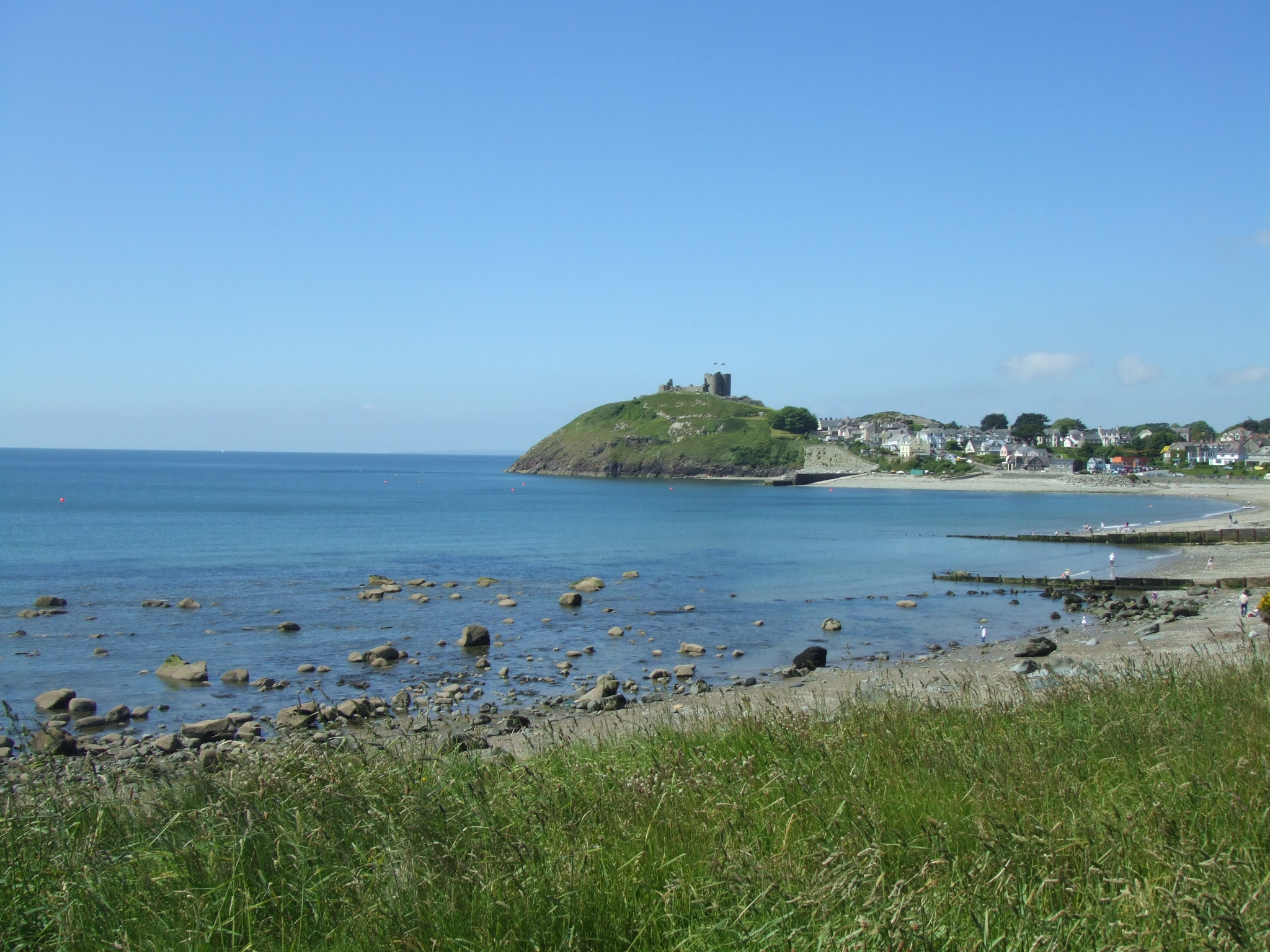
- Criccieth Castle, Castell Cricieth, is a ruined thirteenth-century stone castle on a rocky headland above Tremadog Bay in Gwynedd.
- Llywelyn ab Iorwerth probably built the inner ward and twin-towered gatehouse in the 1230s, and his grandson Llywelyn ap Gruffudd probably added the outer ward.
- Edward I of England took it by March 1283, heightened the towers, and in November 1284 planted an unwalled borough of 23 burgage plots beside it.
- Madog ap Llywelyn besieged it through the winter of 1294–1295, and Owain Glyndŵr’s war left the gatehouse and two towers burnt red.
- The Crown sold the ruin in 1858, the state took it in 1933, and it was designated a grade I listed building on 2 August 1949.
Visiting
Admission tickets can be bought on arrival, or booked in advance. Booking online takes 5 percent off the ticket price, and online tickets are non-refundable. From 30 March to 1 November the site is open from 10am to 5pm and is closed on Tuesday and Wednesday. From 2 November to 29 March the site is open from 10am to 4pm and is closed on Monday, Tuesday, Wednesday and Thursday.
Last admission is 30 minutes before closing. The site is closed on 24, 25 and 26 December and on 1 January. From 1 September 2026 to 31 March 2027 an adult ticket costs £8.20. A family ticket for two adults and up to three children costs £26.20, and a family ticket for one adult and up to three children costs £18.
A junior ticket for ages 5 to 17 costs £5.70, and a student ticket costs £5.70 on entry when photo identification is shown. A senior ticket for ages 65 and over costs £7.30. Members receive free admission, a disabled person and one companion receive free admission, and children under 5 are admitted with a free ticket. A £1 admission ticket is available for visitors receiving Universal Credit and other named benefits.
Blue Light Card holders, and members of the armed forces and veterans, receive 10 percent off an individual admission ticket, and that reduction is not sold online. Dogs on short leads are allowed to enter the ground-floor parts of the site. Smoking is not allowed. Entry is through the visitor centre.
History
Criccieth Castle stands on a rocky headland above Tremadog Bay, in Criccieth in Gwynedd. The plan is almost concentric, with a six-sided inner ward and an outer ward that follows the rock on every side but the south-east. Two ditches cover the approach from the land.
The twin-towered inner gatehouse and the inner curtain still rise nearly to their full height. The outer curtain, the inner buildings, and the other three towers are much more ruined, and some survive only as foundations. Before the stone castle, Eifionydd was run from a motte at Dolbenmaen, about four miles north, and the only local buildings were the church of St Catherine and its neighbours.
An earthen bank on the north of the rock has been read as an Iron Age hillfort. Another account allows a prehistoric camp and finds no proof of an older fortification under the present walls. Llywelyn ab Iorwerth, prince of Gwynedd from 1199 until 11 April 1240, began the castle after he had taken Eifionydd and Llŷn in 1201.
His stone castles, mostly placed between 1220 and 1230, are counted among the first sophisticated stone castles in Wales. Criccieth belongs with Dolwyddelan, Dolbadarn, Deganwy and Castell y Bere. The commote’s centre moved here in the 1230s, and the inner ward is dated about 1230, although the first record of a castle is the imprisonment of 1239.
The gatehouse is compared with Beeston in Cheshire, built in the 1220s by Ranulf de Blondeville, then Llywelyn’s ally. Both use twin D-shaped towers and a passage shut by a portcullis and doors. Criccieth gives each guardroom three arrowloops, vaults the passage in stone, and makes the towers longer, and similar ideas appear at Bolingbroke, Montgomery and White Castle.
In 1239 Dafydd ap Llywelyn imprisoned his half-brother Gruffudd and Gruffudd’s son Owain Goch in the castle. A poem of that time calls Gruffudd lord of Criccieth. After Llywelyn died in 1240, the war of 1241 forced Dafydd to surrender Gruffudd, who fell to his death from the Tower of London on 1 March 1244.
Dafydd himself died on 25 February 1246 at Abergwyngregyn, without an heir the records accept. Gwynedd then passed to Gruffudd’s sons. Llywelyn ap Gruffudd won sole rule west of the Conwy at Bryn Derwin in June 1255, took the title prince of Wales in 1258, and was recognised by Henry III in the Treaty of Montgomery in 1267.
In 1259 Welsh lords imprisoned Maredudd ap Rhys Gryg here for treason. He was reconciled in 1261, died at Dryslwyn on 27 July 1271, and his homage reached Llywelyn in 1270. A letter from Llywelyn to the English king left this castle in 1273 or 1274.
Edward I of England fought two Welsh wars. The Treaty of Aberconwy, in November 1277, left Llywelyn a smaller Gwynedd. On 11 December 1282 Llywelyn was killed at Orewin Bridge after he was drawn away from his army, and the two accounts of that killing do not agree on the ambush or on when his body was recognised.
His brother Dafydd was captured in June 1283 and executed at Shrewsbury that autumn. By March 1283 the English held Criccieth, and Edward visited in 1283 and in 1284. Royal spending from 1283 to 1292 is recorded as £332, and it may have finished nearer £500, mostly on heightening towers and cutting new doors and stairs so each floor could be defended alone.
A borough of twenty-three burgage plots, matching Caernarfon and left unwalled, was set out in November 1284. The garrison that year was sixty people, including ten crossbowmen, under Sir William Leyburn at £100 a year. Harlech matched that strength, while the constables of Conwy, Castell y Bere and Caernarfon were paid more.
In September 1294 Madog ap Llywelyn rose against new officials and a tax of one fifteenth. Criccieth was besieged for several months, with Leyburn, twenty-nine men and forty-one townspeople inside, and the siege was lifted in April 1295 by ships from Ireland. Madog was taken that summer and was still alive in London in 1305, and the castle again held prisoners, among them Scottish captives of Edward I.
Edward II was born at Caernarfon on 25 April 1284 and reigned from 1307 until January 1327. At Criccieth he raised the inner gatehouse a second time, the only work of his reign that can be picked out for certain, though repairs run across those years. A survey of 1343 for the Black Prince found the castle decayed and put the repairs at £96.
That survey names a great tower, a cistern tower, Leyburn tower and le gynnetour. One reading gives those names to the inner gatehouse, the south-west tower, the south-east tower and the north tower. Another makes the western gate-tower the cistern, calls the south-east tower Leyburn and the constable’s house, calls the north tower the engine tower, and treats the south-west tower as the great tower.
Syr Hywel y Fwyall was constable from about 1359 to about 1381, after fighting at Poitiers in 1356. Tradition says he brought down the horse of John II of France with one axe blow, and he may have led Welshmen at Crécy. His death is placed about 1381 and also between two Michaelmas feasts of Richard II, and the accounts disagree on whether he left one son or two.
Owain Glyndŵr was acclaimed prince of Wales on 16 September 1400. His rising held most of Wales in 1404 and 1405 and had lost it by 1409. Criccieth was taken in that war, placed in 1403 by one account, which says it was slighted and never lived in again, and in 1404 by another, which says the towers were burned red.
The inner gatehouse and the south-west and south-east towers are still reddened, and burnt layers were found in each. A document of 1450 calls the castle totally destroyed, yet enlarges the garrison and does not mention repairs, so the fires may belong just after 1450. No constable is recorded after the sacking, and Leland and Pennant later found the borough decayed and poor.
Pennant, writing in 1784, was sure a Welsh prince had built the gatehouse because it resembled Dolwyddelan, though he was wrong about the rounded faces. Turner drew the castle in four colour studies in 1798, and a beach watercolour of 1835, also placed about 1836, heightens the cliffs and moves the sea. The Crown sold the ruin in 1858 to William Ormsby-Gore, who repaired it in 1879, and in 1933 his son placed it with the Office of Works.
Bryan O’Neil dug from 1933 until soon after 1939 and uncovered the buried outer ward. A gilt-bronze crucifix with Limoges enamel, from the western gatehouse tower, is now in the national museum of Wales. His three phases remain the usual frame, an inner ward early in the thirteenth century, an outer ward about 1260, and English heightening, though a 1970 guide reversed the first two phases and the north tower has been called both English and Welsh.
The north tower was fitted for a stone-throwing engine, with a later ramp for ammunition. The south-west tower kept ball-stopped doors and corbels carved with leaves and a head. A spring feeds a cistern in the gate passage, a note of 1292 names the king’s hall, and a watching brief in January 2017, in a visitor building of the late 1880s, found only garden soil, a slate pen and a worn post-medieval coin.
The castle is cared for by the historic environment service of the Welsh Government and is open to visitors. Displays include the Welsh castles and Gerald of Wales, and yearly numbers have usually sat between 42,000 and 48,000, with 4,709 in 2020 and 31,527 in 2021. It was listed at grade I on 2 August 1949, a date also given as 2 October 1949, the castle and its outer banks are scheduled, and since 2024 the English name in use has been Castell Cricieth.
Images




Detailed History
Criccieth Castle, Castell Cricieth in Welsh, is a ruined stone castle of the thirteenth century on a rocky headland in Criccieth, Gwynedd, looking over Tremadog Bay. The plan is almost concentric. An inner ward is surrounded by an outer ward on every side except the south-east. The inner ward is an irregular six-sided enclosure, with a twin-towered gatehouse on the north and a tower on the south-east.
The outer ward is roughly triangular, following the headland, with towers at the north and south-west corners and a modest gatehouse on the south-east. Two ditches cover the landward side. The inner gatehouse and the inner curtain wall still stand nearly to their full height. The outer curtain, the buildings of the inner ward, and the other three towers are much more ruinous, and in places only foundations remain.
The headland was already a place of authority before the stone castle. The commote of Eifionydd lay in the cantref of Dunoding, a district named from Dunod, one of the sons of Cunedda, and the commote itself took its name from Dunod’s son Eifion. It ran from the great sands of the Traeth Mawr on the east to the Afon Erch on the west, with the sea to the south and the mountains to the north. A local dynasty is said to have held it until about 930, after which the stronger neighbour, Gwynedd, dominated the commote.
The route between Caernarfon and Ardudwy crossed the Afon Dwyfor at Dolbenmaen, about four miles, or 6.4 kilometres, north of the later town. A motte there may have been raised by the Normans in the eleventh century and was soon in Welsh hands. It is taken to be the maerdref, the administrative centre, of Eifionydd, and it is associated with the llys, the court, of the commote’s rulers. Richard Fenton, writing of a tour made in the early nineteenth century and describing the rock as he found it, said the castle stood on a high hill projecting into the sea and was almost cut off at high tide.
He also noted ruins beyond the curtain on the north and north-west, as if an earlier castle had been larger and the present one had been contracted and recast. An earthen bank on the north of the rock has been said to look like an Iron Age hillfort, and a nineteenth-century notice spoke of Iron Age foundations. Another reading allows that a prehistoric camp may have stood on the rock, and adds that there is no evidence an earlier fortification preceded the castle that stands there now. Before the 1230s the only buildings known at Criccieth itself were the parish church of St Catherine and the structures that belonged with it.
Llywelyn ab Iorwerth, also called Llywelyn Fawr and Llywelyn the Great, was the prince who began the present castle. He lived from 1173 to 11 April 1240 and was prince of Gwynedd from 1199. His grandfather Owain Gwynedd had died in 1170, and two uncles, Dafydd ab Owain and Rhodri ab Owain, divided the kingdom. Llywelyn’s father, Iorwerth Drwyndwn, died while Llywelyn was an infant.
One account places that death in battle at Pennant Melangell in 1174. Gerald of Wales, travelling while Llywelyn was about twelve, described him as the legitimate heir, already challenging those uncles, and called Iorwerth the only legitimate son of Owain. Llywelyn’s birth is placed in 1173 by a chronicle associated with Aberconwy, and he was probably born at the royal manor of Dolwyddelan in Nantconwy, though not in the stone castle of Dolwyddelan, which he himself later built. There may have been an older castle on a knoll in the valley.
His mother was Marared, daughter of Madog ap Maredudd of Powys. After Iorwerth’s death she may have married into the Corbet family of Caus in Shropshire, and Llywelyn may have spent part of his childhood there.
He took power young. Rhodri died in 1195. In 1197 Llywelyn captured Dafydd ab Owain and sent him into exile in England. On Epiphany 1199, after a battle in Arfon, he drove his cousins Gruffudd and Maredudd ap Cynan out of Gwynedd Uwch Conwy.
In July 1201 he made a treaty with King John, the earliest surviving written agreement between an English king and a Welsh ruler. He swore fealty and did homage, and in return his conquests were confirmed and cases about lands he claimed could be heard under Welsh law. In 1201 he also took Eifionydd and Llŷn from Maredudd ap Cynan on a charge of treachery. He married Joan, King John’s natural daughter, in 1205, after dropping a plan to marry the widow of his uncle Rhodri.
When John arrested Gwenwynwyn of Powys in 1208, Llywelyn annexed southern Powys and northern Ceredigion and rebuilt Aberystwyth Castle. In 1209 he went with John against William the Lion in Scotland.
The peace broke in 1210. An army led by Ranulf de Blondeville, earl of Chester, and Peter des Roches, bishop of Winchester, invaded Gwynedd while John was in Ireland. Llywelyn destroyed his own castle at Deganwy and fell back west of the Conwy. In 1211 John invaded twice.
The second campaign forced Llywelyn to give up everything east of the Conwy. He recovered those lands in 1212 with the other Welsh princes, and in 1213 he took Deganwy and Rhuddlan. He joined the barons who made John accept Magna Carta in 1215, and a clause of that charter freed his son Gruffudd, a hostage since 1211. In December 1215 he led the lesser princes to take Carmarthen, Kidwelly, Llanstephan, Cardigan and Cilgerran.
At Aberdyfi in 1216 those princes did homage to him. After John’s death he made the Treaty of Worcester with Henry III in 1218, which confirmed his recent conquests. For the next fifteen years he fought marcher lords, among them the Marshals and Hubert de Burgh, and sometimes the king, and he also married his daughters into marcher families. Gwladus Ddu married Reginald de Braose and later Ralph de Mortimer.
Marared married John de Braose of Gower. Elen ferch Llywelyn married John of Scotland, earl of Huntingdon and nephew and heir of Ranulf de Blondeville, in about 1222. The Peace of Middle in 1234 ended Llywelyn’s wars. A two-year truce was renewed year by year until he died.
Most of his stone castles are thought to have been built between 1220 and 1230. They are described as the first sophisticated stone castles in Wales. Criccieth stands in that group with Deganwy, Dolbadarn, Dolwyddelan and Castell y Bere. He also encouraged small urban settlements in Gwynedd as centres of trade.
The administrative centre of Eifionydd was moved from Dolbenmaen to Criccieth in the 1230s, when this castle was begun. The inner ward and its gatehouse are probably his work of that decade. A list description dates that inner ward to about 1230 and notes that the first reference to a castle at Criccieth is in 1239, so the building may already have stood for some years, and one reading allows that it may pre-date 1239 by about ten years. The same description calls the castle a royal residence of the princes of Gwynedd and says that its form is substantially Welsh.
Another account associates the early work with Llywelyn and with his son Dafydd.
The inner gatehouse is the castle’s great surviving work. Two D-shaped towers flank a passage. The lowest three-quarters are taken to be Llywelyn ab Iorwerth’s build. There is a wide agreement that Beeston Castle in Cheshire, raised in the 1220s by Ranulf de Blondeville, was the main model.
Ranulf was by then an ally of Llywelyn, and the marriage of Ranulf’s heir to Llywelyn’s daughter Elen belongs to the same decade. Beeston stands on a crag. Its inner gatehouse has two D-shaped towers, each with a chamber and two arrowloops facing the approach, and a passage closed by a portcullis and a pair of doors. Criccieth differs.
Each guardroom has three arrowloops. The passage was vaulted in stone rather than ceiled in wood. The towers were longer, closer in form to apsidal keeps. Likenesses have also been drawn with the gatehouse at Bolingbroke in Lincolnshire, another castle of Ranulf, with Montgomery in Powys, which Llywelyn attacked in 1228 and again in 1231, and with White Castle in Monmouthshire.
Montgomery and White Castle were associated with Hubert de Burgh, a marcher lord who was a major power in south Wales and justiciar of England. The result at Criccieth has been described as the latest military ideas set inside a somewhat haphazard Welsh way of building.
In 1230 the succession and the household were both shaken. William de Braose, captured in the Montgomery fighting of 1228 and ransomed for the £2,000 that Llywelyn had paid the king to have a half-built castle in Ceri destroyed, came to Llywelyn’s court at Easter 1230. A marriage had been arranged between William’s daughter Isabella and Dafydd. On that visit William was found in Llywelyn’s chamber with Joan.
He was hanged on 2 May. Joan was kept under house arrest for a year. Llywelyn had a paralytic stroke in 1237. Joan died in the same year.
Dafydd, their son, already had a growing part in government. Llywelyn had worked for years to make Dafydd his sole heir. Henry III recognised Dafydd in 1220, and Pope Honorius III declared Joan legitimate so that Dafydd’s claim would be stronger. Under Welsh law the elder half-brother, Gruffudd ap Llywelyn ab Iorwerth, also had a claim.
Gruffudd had been a boy hostage of King John, freed by Magna Carta. His father gave him Ardudwy and Meirionnydd, removed him in 1221 for misrule, imprisoned him from 1228 to 1234, and then gave him much of Llŷn, Ceri, Cyfeiliog, Mawddwy, Mochnant and Caereinion. Later genealogies name a daughter of Rognvaldr, king of the Isles, as the mother of Gruffudd’s son Llywelyn. Contemporary records name Senana, possibly a daughter of Caradog ap Thomas of Anglesey, as Gruffudd’s wife and as Llywelyn’s mother.
Dafydd ap Llywelyn ruled Gwynedd after his father died on 11 April 1240. His birth has been placed in 1208, in 1206, in 1215, and, in a more recent argument, shortly after Easter 1212, at Castell Hen Blas in Coleshill, Bagillt. In 1239 he seized Gruffudd, breaking a compact with him, and imprisoned Gruffudd and Gruffudd’s son Owain Goch ap Gruffydd at Criccieth. It is probable that the new castle held them.
A praise poem by Einion ap Madog ap Rhahawd calls Gruffudd Pendefic crukyeith, lord of Criccieth. Henry III would not let Dafydd keep his father’s gains outside Gwynedd. In August 1241 Henry invaded. By the Treaty of Gwerneigron, Dafydd surrendered those outer lands and handed Gruffudd to the king.
Gruffudd was taken to the Tower of London. Senana agreed to pay 600 marks for him and for their eldest son Owain, and to give their younger sons Dafydd and Rhodri as hostages. Henry kept Gruffudd and Owain anyway. On 1 March 1244 Gruffudd fell to his death while climbing down a knotted sheet from a high window.
The rope broke. He was a heavy man. The window was later bricked up. In 1248 the abbots of Strata Florida and Aberconwy brought his body back, and he was buried at Aberconwy with his father.
Gruffudd’s death freed Dafydd from the threat of a rival in English hands. He allied with other Welsh princes and by March 1245 had recovered Mold and his old lands in what is now Flintshire. Dyserth may have fallen that summer. Henry invaded again in August 1245, reached the Conwy, and began a castle at Deganwy.
Pope Innocent IV briefly recognised Dafydd’s right to rule north Wales, then reversed the decision the same year after Henry’s diplomacy. Henry’s supplies failed and he withdrew in the autumn. Dafydd died suddenly on 25 February 1246 at the royal house of Abergwyngregyn and was buried with his father at Aberconwy. A chronicle called him the shield of Wales.
His marriage to Isabella de Braose had given him no heir that the records accept, though some later genealogists gave him sons. Gruffudd’s elder sons, Llywelyn ap Gruffudd and Owain Goch, divided Gwynedd and fought Henry until the agreement at Woodstock in April 1247, which cost them a large territory. One account says Llywelyn ap Gruffudd had gone on crusade with Richard of Cornwall, the king’s brother, after 1240, and that he supported his uncle Dafydd in the hard fighting of 1245, while Owain was freed after their father’s death and given part of Eryri at Woodstock.
Llywelyn ap Gruffudd, later called Llywelyn the Last, became sole ruler of Gwynedd Uwch Conwy at the Battle of Bryn Derwin in June 1255. His brothers Owain and Dafydd had allied against him when Henry proposed to give the adult Dafydd a share of an already reduced Gwynedd. Llywelyn defeated them and took them prisoner. In the summer of 1256 the king’s son Edward, the future Edward I of England, visited Perfeddwlad, the Four Cantrefs east of the Conwy, which Henry had given him, and did not remedy complaints against his officers.
That November Llywelyn crossed the Conwy with an army and with his brother Dafydd, whom he had released. By early December he held Gwynedd Is Conwy except the royal castle of Dyserth. Campaigns in 1257 carried him across Wales. Early in 1258 he was using the title prince of Wales, first in an agreement with Scottish nobles of the Comyn party.
The English crown refused the title. In 1263 his brother Dafydd turned against him and submitted to Henry.
Maredudd ap Rhys Gryg, a prince of Deheubarth and son of Rhys Gryg and Mathilde de Clare, met Llywelyn in these years and then fell foul of him. Maredudd’s wardship after his father’s death in 1234 had gone to Gilbert Marshal. He married Gilbert’s niece Isabella in 1241. Rivalry with his brother and his nephew drove him out of the south around 1250.
He joined Llywelyn’s successful campaigns of 1256 and was given land around Llanbadarn and Cantref Buellt. He fought at the Welsh victory of Cymerau in 1257. When his nephew Rhys Fychan also joined the Welsh side, Maredudd’s place was weakened. He swore allegiance to Llywelyn in 1258 and later that year went over to the king.
On 28 May 1259 a council of native lords tried him for treason, found him guilty, and imprisoned him in the castle at Criccieth. The castle is recorded as a prison in that year for this reason. He was reconciled with Llywelyn in 1261 on severe terms. He died at Dryslwyn on 27 July 1271 and was buried at Whitland.
His son was Rhys ap Maredudd. Under the Treaty of Montgomery in 1267 the king kept Maredudd’s homage, and Llywelyn received that homage in 1270. One later account of the war of 1282 says that Aberystwyth Castle was taken and burnt by a Maredudd ap Rhys Gryg, heir of a prince of Deheubarth. That cannot be the man who had died in 1271, and the pages read do not settle the name.
The Treaty of Montgomery, in 1267, was the height of Llywelyn ap Gruffudd’s power. Henry III recognised him as prince of Wales. He was to pay 24,000 marks in instalments. He could buy Maredudd’s homage for a further 5,000 marks.
All the Welsh princes submitted except Maredudd. The pope confirmed the treaty. Trouble followed at once, including a dispute with Gilbert de Clare over a Welsh nobleman in Glamorgan and the building of Caerphilly. Henry died in late 1272 while his son was on crusade.
Edward I of England, born on 17 or 18 June 1239 and king from 1272, did not reach England until 1274, and was crowned at Westminster. One of the regents was Roger Mortimer, a marcher rival of Llywelyn. Llywelyn stopped the payments due under Montgomery. Early in 1274 his brother Dafydd plotted with Gruffydd ap Gwenwynwyn of Powys and Gruffydd’s son Owain to kill him.
Owain was to arrive with armed men on 2 February. A snowstorm stopped him. Llywelyn learned the plan when Owain confessed to the bishop of Bangor. Dafydd and Gruffydd fled to England.
When Edward called Llywelyn to Chester in 1275 to do homage, Llywelyn refused. He had married Eleanor de Montfort by proxy in 1275. Edward seized her ship as she sailed from France and held her at Windsor until Llywelyn made concessions. One of the last Welsh records of Criccieth is a letter from Llywelyn ap Gruffudd to Edward I, sent from the castle in 1273 or 1274.
Edward declared Llywelyn a rebel in 1276. The war of 1277 was meant, on Edward’s side, to discipline a vassal, not yet to conquer Wales outright. A royal army of about 15,500, of whom about 9,000 were Welshmen from the south, marched from Chester to Flint, Rhuddlan and Deganwy, with ships from the Cinque Ports. Another force took Anglesey and its harvest.
Llywelyn sought terms without a major battle. The Treaty of Aberconwy, which he signed on 9 November 1277, left him the western part of Gwynedd and the title prince of Wales, with the homage of five lords. He was to pay a fine of 50,000 marks and to give up his share of the rent of Anglesey. The Llŷn went to Owain, who had been released from prison, and Perfeddwlad went to Dafydd, with a promise of a share of Gwynedd Uwch Conwy if Llywelyn died without an heir.
Llywelyn did homage in London at Christmas 1277. He married Eleanor at the door of Worcester Cathedral on 13 October 1278, with the kings of England and Scotland present. She died in childbirth on 19 June 1282, leaving a daughter, Gwenllian. A genealogist has also identified an illegitimate son named Madog.
That Madog is not the Madog who later led the revolt of the 1290s.
War returned on Palm Sunday 1282, when Dafydd ap Gruffydd attacked Hawarden and then besieged Rhuddlan. The rising spread. Llywelyn wrote to John Peckham, archbishop of Canterbury, that he had not planned the revolt, but he joined his brother. Edward now treated the war as a conquest.
Gloucester was defeated at Llandeilo Fawr in June. William de Valence raided as far as Aberystwyth. Roger Mortimer died in October. On 6 November, while Peckham was still negotiating, Luke de Tany crossed from Anglesey on a bridge of boats and was ambushed at the Battle of Moel-y-don.
Peckham offered Llywelyn a large estate in England if he would surrender Wales, and offered Dafydd a crusade from which he could not return without leave. Llywelyn refused. He said he would not abandon the people his ancestors had protected since the days of Kamber son of Brutus. He left Dafydd to hold Gwynedd and marched south.
On 11 December 1282 he was killed at the Battle of Orewin Bridge, near Builth, separated from his army. Two accounts agree that he was drawn away by a trick, and they disagree about the rest. One, written in the north of England about fifty years later, says he and his chief minister crossed a bridge toward Edmund Mortimer and Hugh Lestrange, heard fighting as Roger Despenser and Gruffydd ap Gwenwynwyn met the main Welsh force, and that a single lancer struck Llywelyn down as he turned back. An English knight recognised the body only later.
The other account, from eastern England and connected with his exiled daughter Gwenllian and his niece Gwladys ferch Dafydd, says he approached the Mortimers, Lestrange and Gruffydd on a false promise of homage, that eighteen retainers were cut off with him, and that near dusk he was chased into a wood at Aberedw, struck down, and beheaded after he asked for a priest and gave his name. A letter said to be treasonable, written under false names, and his privy seal were found on him. Edmund Mortimer held the seal. The head was sent to Edward at Rhuddlan, shown to the troops on Anglesey, set on the London pillory for a day and crowned with ivy, then carried to the Tower and set over a gate, where it was still displayed fifteen years later.
The ivy was a mockery of a prophecy that a Welshman would be crowned in London. The body’s burial is not certain. Peckham asked the archdeacon of Brecon whether it had been buried at Cwmhir, and a chronicle says the trunk was interred at the Cistercian abbey there. The privy seals of Llywelyn, Eleanor and Dafydd are thought to have been melted into a chalice in 1284.
Edward marched into Snowdonia in January 1283 and took Dolwyddelan. Dafydd, who had succeeded his brother as prince in December, was captured in June 1283 and hanged, drawn and quartered at Shrewsbury the following autumn. By March 1283 Criccieth had been taken by the English as part of that conquest. Edward I of England visited in 1283 and again in 1284.
Between 1283 and 1292 royal accounts record £332 spent at the castle, and the final sum for those years may have been nearer £500. The money went mostly on the existing buildings, especially the towers, which were heightened, given doors on the ground floor, and reached by new external stairs to the first floors and the wall-walks. Each floor could then be held on its own. A list of the works credits Edward with raising the inner gatehouse, refacing and rebuilding the south-east and south-west towers, remodelling the north tower, and reconstructing the outer gatehouse.
The north tower was equipped for a stone-throwing engine. The borough beside the castle was established in November 1284. It had twenty-three burgage plots, the same number as Caernarfon, and it does not appear to have been walled. In 1283 and 1284, when the Welsh castles were strongly manned, Criccieth’s garrison was thirty fighting men, ten crossbowmen, and fifteen residents, among them sentinels, a doorkeeper and a caretaker, together with a superintendent of arms, a chaplain, a stonemason, a carpenter and an artisan.
That is a garrison of sixty, including the ten crossbowmen. The same strength is recorded at Harlech in those years. Conwy had fifteen crossbowmen, and its constable was paid £190 a year. Castell y Bere and Caernarfon were larger again, with fifteen crossbowmen, forty fighting men and twenty residents, and their constables were paid £130.
Sir William Leyburn, also written William de Leybourne, was constable of Criccieth and was paid £100 a year.
The lands kept in the king’s hand were organised by the Statute of Rhuddlan in 1284. They were annexed and united to the English crown and did not become part of the kingdom of England. They were the king’s personal fief. In 1301 they were given to his son Edward of Caernarfon, the future Edward II, with the title prince of Wales.
New castles and towns, among them Conwy, Caernarfon, Harlech and Beaumaris, were built under James of St George as a ring around north Wales. Criccieth was not one of those new foundations. It was a Welsh castle repaired and brought up to date.
In 1294 Madog ap Llywelyn led a revolt that lasted into 1295 and was, in length, second only to the later rising of Owain Glyndŵr. Madog was the son of Llywelyn ap Maredudd, the last vassal lord of Meirionnydd, who had lost his patrimony in 1256 for opposing Llywelyn ap Gruffudd at Bryn Derwin, had drawn an English pension in exile, had been reconciled in June 1262, and had died in a skirmish in April 1263. Madog, who may have been born in exile, received substantial gifts from Edward in 1277 and in 1278 sued the prince of Wales for his father’s cantref. After 1282 he returned to Gwynedd and received lands in Anglesey.
On Michaelmas, 29 September 1294, he put himself at the head of attacks planned for months and launched the same day across Wales. The grievances were new royal administrators in the north and west and a tax of one fifteenth on movables. In one land grant during the rising he used the title prince of Wales. There is no evidence that the aim was to restore the old principality in full.
Cynan ap Maredudd, Maelgwn ap Rhys, and Morgan ap Maredudd of Gwynllŵg led the attacks in the middle and south. The leaders had hoped Edward and his army would already be in France. Bad weather had held the fleet, and Edward cancelled the French campaign.
Caernarfon was overrun and the castle occupied. Castell y Bere was taken and afterwards burnt. Hawarden, Ruthin and Denbigh were occupied. Criccieth was besieged for several months, and so was Harlech.
At one moment Harlech was held by thirty-seven men. Cynan besieged Builth for six weeks. Half the town of Caerphilly burned, though the castle held, and Kenfig was sacked. On 11 November Henry de Lacy, lord of Denbigh, was ambushed and routed outside that town.
Reginald de Grey held Flint and Rhuddlan. Flint endured a long siege and neither castle fell. At Criccieth the constable was still Sir William Leyburn, with twenty-nine men, and forty-one townspeople had taken refuge inside. Edward reached Conwy just before Christmas, lost his baggage in an ambush, and was shut in the castle while the town burned, until his ships relieved him in 1295.
On 5 March 1295 the Earl of Warwick surprised Madog’s army at Maes Moydog in Powys. The Welsh formed a schiltron of pikes and beat off a cavalry charge, then took heavy losses from arrows. Many drowned in a swollen river during the pursuit. Madog escaped, was taken later by Ynyr Fychan of Nannau, and was handed to John de Havering in Snowdonia in late July or early August 1295.
He was sent to London and was still alive in 1305. He died after that year. The siege of Criccieth was lifted in April 1295, and the castle was resupplied by sea from Ireland. It was used again as a prison.
The accounts say that it held Scottish prisoners of Edward I as well as the high-status prisoners of the princes of Gwynedd. Edward answered the revolt with ordinances that restricted Welsh civil rights and economic life. A further rising, led by Llywelyn Bren of Senghennydd, followed in 1316.
Edward II was born on 25 April 1284, the fourth son of Edward I and Eleanor of Castile, and he is also known as Edward of Caernarfon. He became heir after the death of his elder brother Alphonso, was knighted at Westminster in 1306, and was king from 1307 until he was deposed in January 1327. He died at Berkeley Castle on 21 September 1327. Between 1307 and 1327 further repairs were made at Criccieth, and the inner gatehouse was raised a second time.
A list of the fabric says that the only work of his reign which can be identified with certainty is that second heightening. The gatehouse therefore shows three builds. The lowest part is the Welsh work. A second phase, probably Edward I’s, added battlements and holes for a hoarding.
A third, probably Edward II’s, blocked those battlements and made new ones above them. One of the newest embrasures survives on the eastern tower. The gate arch now standing is a reconstruction. The rear wall is ruined.
A stair on the east side was widened under Llywelyn ap Gruffudd and widened again under Edward I, and the first phase was built up into a platform that probably carried a wooden stair to the wall-walk.
In 1343 Edward the Black Prince, son of Edward III, commissioned a survey. The castle was again dilapidated. The repairs were priced at £96 in all. The survey names the great tower, the sister tower, also called the cistern tower, Leyburn tower, and le gynnetour.
Bryan O’Neil read those names, in that order, as the inner gatehouse, the south-west tower, which he thought contained a cistern, the south-east tower, and the north tower. A description prepared for the site reads the names differently. It calls the western tower of the inner gatehouse the probable cistern tower, fed by a spring under an iron grille at the inner end of the passage. It calls the south-east tower Leyburn tower, and says that tower became the constable’s residence.
It calls the north tower the engine tower, and it treats the south-west tower as the great tower. Both readings are in use. The engine tower has a shallow stepped ramp on its south-east side, a clear addition with a straight joint along the older face, interpreted as the way ammunition was brought to an engine. A blocked postern in the outer curtain lies beside that ramp.
It is not certain from the masonry how the engine itself was mounted. Wide shallow steps against the inner wall, built for Edward I, and a cobbled platform running south-west from their foot, have been read the same way, as a path for ammunition.
The constables after Leyburn show how the castle was staffed through the fourteenth century. William le Butiller held it until 1309. William Trumwyn followed from 1309 to 1316, John de Welles in 1316, Oillard de Welles from 1317 to 1321, John de Swennerton in 1321, Thomas Jay from 1322 to 1326, William de Shaldeford from 1326 to 1327, and Richard de Munemuth in 1327. Richard de Holland appears in 1330 and again from 1333 until his death, with Richard de Allespath also named in 1333.
Robert de Hambury served until 1338. John le Strange of Muddle served from 1338 to 1343. William de St Omer served from about 1347 to about 1359. From 1359 until about 1381 the constable was Syr Hywel y Fwyall, Hywel of the Battleaxe, Hywel ap Gruffudd.
Thomas Beushef followed from 1381 to 1391, William Frodesham in 1391, William Hugon from 1396 to 1398, John Gamull until 1398, and Hugon and Gamull together from 1398.
Hywel had fought at the Battle of Poitiers in 1356. Welsh tradition said that he took John II of France by cutting the king’s horse’s head off with one blow of his axe. The castle’s history also says that he may have commanded a corps of Welshmen at the Battle of Crécy. His own notice of his career names Poitiers and does not name Crécy.
The Black Prince knighted him. In 1359 he was made constable of Criccieth and given the rent of the Dee mills at Chester, besides other grants in north Wales. A mess of meat was ordered to be served before his axe in perpetuity, and the food was then given to the poor for the health of his soul. He was raglot, or bailiff, of Aberglaslyn.
His death is given as about 1381, and also as falling between Michaelmas in the second year of Richard II and Michaelmas in the sixth. The poet Iolo Goch names a wife, Tanglwst, daughter of Dafydd Fychan ap Hywel, and one son, Gruffydd, who left no direct heirs, and says that families in Eifionydd descend from Hywel’s elder brother Einion. Another account gives Hywel two sons, Meredydd, who lived in Eifionydd, and Dafydd, who lived at Henblas near Llanrwst.
The castle’s end came in the rising of Owain Glyndŵr. Owain ap Gruffudd Fychan, born about 1359, was lord of Glyndyfrdwy. A quarrel with his English neighbour Reginald Grey was the occasion of a national revolt. On 16 September 1400 his supporters acclaimed him prince of Wales.
Penal laws passed against the Welsh in 1401 and 1402 deepened support for him. He captured Grey and held him for nearly a year. In June 1402 he defeated Edmund Mortimer at Bryn Glas and took him. Henry IV would not ransom Mortimer, who married one of Owain’s daughters and changed sides.
In 1403 Owain had gathered about 4,000 men in a first division and about 12,000 in all. Prince Henry burned Sycharth and Glyndyfrdwy. Welsh students left Oxford and Cambridge, and Welsh soldiers left English service. In the summer of 1404 Owain’s forces took Aberystwyth and Harlech and burned Cardiff.
He held parliaments at Machynlleth and Harlech, appointed Gruffydd Young chancellor, and planned two universities, the restoration of the law of Hywel Dda, and an independent Welsh church. Envoys came from France, Scotland, and León. A French and Breton force landed at Milford Haven in 1405, burned Haverfordwest, and took Carmarthen with the Welsh. By 1409 Harlech and Aberystwyth, the last great rebel castles, had fallen.
Owain was last seen by his enemies in 1412, at an ambush in Brecon where he captured Dafydd Gam. He was never taken, and he is thought to have died in hiding about 1416.
Criccieth was captured during that war. One account places the capture, and a slighting after which the castle was never lived in again, in 1403. Another places the capture in 1404, when the towers were burned red and, with no garrison left, the town became Welsh again. The walls of the inner gatehouse, the south-west tower and the south-east tower are burned red, and excavation has found a layer of burnt material in each.
A document of 1450 calls the castle totally destroyed. The same document enlarged the garrison and does not mention repairs to the stonework, so the rising may not have been the moment of total ruin. If the fires came later, they came not long after 1450. There is no further reference to the castle as a fortress, and no constable is recorded after the sacking associated with Owain Glyndŵr.
John Leland, travelling in Wales between 1535 and 1545, called the borough clean decayed. Thomas Pennant, around 1784, called it a poor borough town.
Pennant’s tour, made in three journeys between 1773 and 1776 and published in 1784, is also the early attempt to date the fabric by looking at it. People supposed Edward I to be the founder. Pennant had no doubt that a Welsh prince had built Criccieth, because the inner gatehouse resembled Dolwyddelan. He was wrong to think that the rounded outer faces of the gatehouse towers were an addition of Edward’s reign.
Fenton’s description of about 1810 still saw a gateway between two round bastions, the entrance facing north-east, and one side of the embattled wall fairly complete, with two and in places three high ramparts toward the land and none required toward the sea. J. M. W.
Turner sketched the coast of north Wales in 1798 and made four colour studies of Criccieth. A finished watercolour, dated 1835 and also placed about 1836, shows salvage on the beach with the castle behind. In that sheet the cliffs are higher than they are, and the sea sits where the ordinary run of the tides would not put it. Turner was born in 1775 and by October 1798 told Joseph Farington that he had sixty commissions for watercolours.
His large north-Wales views, including a view of Caernarfon Castle in 1799, belong to the years just after the Criccieth studies.
The Crown may have done some repair before it sold the castle in 1858 to William Ormsby-Gore, second Baron Harlech, who was also a member of parliament. One account says that only minor repairs were carried out before the state took the castle. Lord Harlech certainly restored masonry in 1879. More work was done in 1933, before George Ormsby-Gore, third Baron Harlech, placed the ruins in the guardianship of the Office of Works.
The state consolidated the walls. Bryan O’Neil directed excavations from 1933 until shortly after the outbreak of war in 1939. Much of the outer ward, and part of the south-east tower, had been buried. Ivy, modern patching and a cairn had hidden the standing stone, which is why Harold Hughes, who surveyed the castle in April and May 1904 and published his account in 1905, could not be sure of the outer ward and even suggested that the south-east tower might have been a gateway.
O’Neil uncovered the buried parts and recovered many objects. The outstanding find was a crucifix of gilt bronze and Limoges enamel, from the western tower of the inner gatehouse. It is now in the collection of the national museum of Wales. One chamber of that tower may have been a chapel, because the crucifix lay on the ground floor.
Fragments of a chimney of the late thirteenth or early fourteenth century were also found. The north tower contained bricks and china of a recent date, and a local tradition said it had been filled in during the nineteenth century so that children would not play in the remains.
O’Neil argued for three main phases. The first, early in the thirteenth century, was most of the inner ward. The second, about 1260, was most of the outer ward. The third was the work of Edward I and Edward II after the English capture.
That three-phase reading is widely accepted. Argument since then has been about which stones belong to which phase. In a guide of 1970, C. N.
Johns suggested that the outer ward was earlier than the inner. Later writers did not follow him, and Richard Avent’s guide of 1989 returned to O’Neil’s order. Avent in 1983 thought the north tower was probably English. By 1989 he thought Llywelyn ab Iorwerth the more probable builder.
A record of the monument puts the inner gatehouse, the inner curtain and the core of the cistern tower in one build, and puts Leyburn tower, the engine tower, the inner part of the outer gatehouse and the outer curtain in a single unit of about 1255. The outer ward is also dated between 1255 and 1282, about 1260, and about 1260 to 1270. The Welsh work is poorly documented. English accounts of money spent at the castle survive, and they do not say what the sums bought.
The architecture still shows those phases on the ground. The inner curtain stands nearly to full height except between the gatehouse and the south-east tower. The wall-walk survives on the south and west, with the parapet and half an embrasure where the wall meets the west gatehouse tower. Buildings once stood against the wall.
Footings and beam holes remain, and a reference of 1292 mentions the king’s hall. In the south-east corner a simple south gate began as a postern and later linked the two wards. A square of cobbles beside it may have been an oven. The south-east tower is contemporary with the gatehouse and was refaced inside and out under Edward I.
Its original form was encased. The west wall stands about 6.1 metres, or 20 feet, and keeps part of a fireplace. The ground floor was first reached by a ladder from above. A doorway, probably inserted by Llywelyn ap Gruffudd, later opened into it.
A stair base of the refacing was left unfinished or was later taken down. Latrine chutes on the east and west imply three storeys. Four more chutes in the curtain to the north served latrines at ground and first-floor level and belong to the first build. A stair built over their ground-floor entrance when the tower was refaced led to the wall-walk and perhaps to the tower’s first floor.
A stone channel for a lead pipe on the east fed a cistern. Living rock shows in the floor, so the original floor was higher. The corners have fallen. Elsewhere the masonry of this tower survives to about 3 metres.
The outer ward’s north tower stands to the base of its first floor, marked by beam holes in the south-east corner. It is battered on the three outer sides. Two pairs of latrine chutes in the north-east wall imply two floors. The south-west tower is the largest in the outer ward and the most ruined.
Its lower walls go with the rest of that ward. The western corner has almost vanished. As first built it may have had two storeys and resembled the original east tower at Dolwyddelan. Flat stones on the ground probably carried a wooden floor.
The upper walls were refaced, probably under Edward I, a ground-floor door was inserted, a stair was built against the north-east wall, and a second upper floor was probably added. The stair blocked an older embrasure. The doors of the stair and of the first floor are chamfered and finished with ball-stops. Finds from inside include two corbels, one carved with foliage and one with a human head, and a foliate capital.
The outer gatehouse began as a simple passage with a door at the inner end. A second gate was soon added at the outer end, and the east wall was thickened, which meant lengthening the embrasure on that side. The thickened wall may have run to the southern corner of the inner ward and controlled the south gate. Under Edward I a simple barbican was built in front.
The outer curtain nowhere keeps its original height. A thicker piece between the south-east tower and the inner gatehouse is probably the site of a stair to the wall-walk. Between the south-west and north towers the bases of several embrasures remain, including the one blocked by the south-west stair. In the middle of that stretch the outer wall is narrow because a roofed passage ran between the two curtains.
That narrowness is a sign that the outer wall is later than the inner.
The gate passage itself was closed by a portcullis, whose grooves partly survive just inside the arch, and by a pair of doors about halfway along. A cistern fed by a natural spring lies at the rear. Just before it, doors open into two nearly identical guard chambers, each with three arrow slits covering the approach. The upper floors were probably divided by wooden partitions, though the first floor may have been one room and used as a hall.
A latrine at each level opens from a projection on the west tower. The upper floors were probably lit from the ruined rear wall. The only window left is at first-floor level in the east tower. The rear wall may also have held fireplaces.
In the late 1880s a building was put up that later became the visitor centre. People who knew the place said it was used as a garage at some time in the twentieth century, with vehicles repaired where the entrance now is, which would explain the quantity of concrete. On Monday 25 January 2017 work began to refurbish that centre. A lift shaft, a ramp, a sign pit and a cable route were dug under watch, inside the scheduled area.
The lift shaft was 3.10 by 2.10 metres and went down at most 1.50 metres. Under a concrete floor and a gravel bed lay a mid-brown sandy clay with garden-snail and winkle shells. From that layer came a slate pen and a coin, post-medieval and too worn to identify. Below it was a disturbed clay over the natural grey clay.
The ramp was solid concrete, and its base was not reached, so no older deposits were seen there. The sign trench, 1.30 by 0.70 metres and 0.90 metres deep, and a cable run 3.20 metres long, stayed largely in modern ground. A thin lens of crushed cockle shell, 0.04 metres thick, divided two layers of stony clay. No dating evidence came from those layers.
The conclusion was that rebuilding and landscaping since the late 1880s had disturbed the ground, and that the only historic deposits were garden soil and dump from the house, outside the footprint of the original building. The paper archive was to go to the royal commission, and the objects were to be discussed for a museum or for the visitor centre. A shoreline study of 2022 to 2023 is listed among later records of the site, and the entry as read does not publish a catalogue of finds from it.
The castle returned to public care in 1933 and is now maintained by the historic environment service of the Welsh Government. It is open to visitors. Displays treat Welsh castles and also Gerald of Wales, the twelfth-century writer. In an ordinary year it has drawn between 42,000 and 48,000 people.
The recorded figures include 43,578 in 2014, 45,715 in 2015, 47,935 in 2016, 42,863 in 2017, 47,411 in 2018 and 46,083 in 2019. The number fell to 4,709 in 2020 and was 31,527 in 2021. It was designated a grade I listed building on 2 August 1949. A citation attached to the same designation has also been dated 2 October 1949.
The castle itself and its outer bank defences are both scheduled monuments. Since 2024 the Welsh name Castell Cricieth has been the name used in English.
Sources
- Criccieth Castle — Wikipedia
- Castell Cricieth — Cadw
- Criccieth Castle listed building report — Cadw
- Castell Cricieth scheduled monument report — Cadw
- Results of Archaeological Works at Criccieth Castle: Visitor Centre — C.R Archaeology
- Criccieth Castle historic environment record — Heneb
- Llywelyn ab Iorwerth — Wikipedia
- Llywelyn ap Gruffudd — Wikipedia
- Edward I of England — Wikipedia
- Edward II of England — Wikipedia
- Madog ap Llywelyn — Wikipedia
- Owain Glyndŵr — Wikipedia
- Conquest of Wales by Edward I — Wikipedia
- Glyndŵr rebellion — Wikipedia
- J. M. W. Turner — Wikipedia
- Sir Hywel y Fwyall — Wikipedia
- Dafydd ap Llywelyn — Wikipedia
- Maredudd ap Rhys Gryg — Wikipedia
- Criccieth Castle (14393993760).jpg — Wikimedia Commons
- Criccieth - Castle.JPG — Wikimedia Commons
- Criccieth beach.JPG — Wikimedia Commons
- Castell Cricieth o'r Dref - Criccieth Castle from Castle Square - geograph.org.uk - 461626.jpg — Wikimedia Commons
- Castell Cricieth - Criccieth Castle - geograph.org.uk - 535920.jpg — Wikimedia Commons
- Bad Achub a Chastell Cricieth Lifeboat and Castle - geograph.org.uk - 761153.jpg — Wikimedia Commons
- Bad Achub a Chastell Cricieth Lifeboat and Castle - geograph.org.uk - 761158.jpg — Wikimedia Commons
- Castell Cricieth Castle - geograph.org.uk - 761206.jpg — Wikimedia Commons
- Castell Cricieth Castle - geograph.org.uk - 1010966.jpg — Wikimedia Commons
- Castell Cricieth Castle - geograph.org.uk - 1010975.jpg — Wikimedia Commons