

Dundee City, United Kingdom · United Kingdom
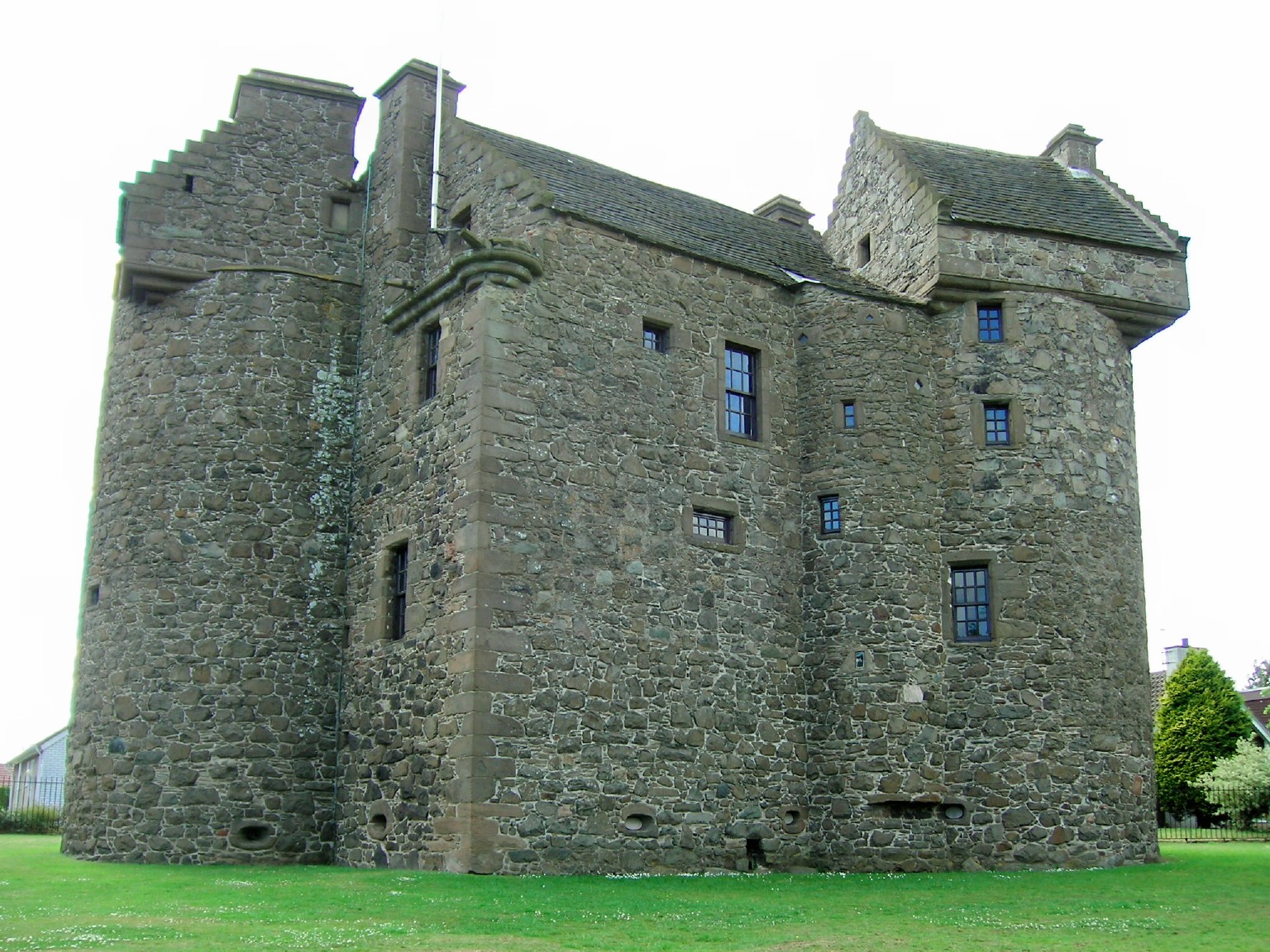
- Claypotts Castle is a late sixteenth-century Z-plan tower house in West Ferry, Dundee, with round towers at opposite corners and square garrets corbelled out above them.
- The Strachans, tenants of Lindores Abbey, built it between dates carved in 1569 and 1588, and the Grahams of Ballunie and then of Claverhouse held it through the seventeenth century.
- John Graham, Viscount Dundee, inherited it as a child and died at Killiecrankie in 1689, after which the forfeited lands were granted to the Douglas family.
- The roofed house passed through the Douglas inheritance dispute and was placed in state care in 1926 by the thirteenth Earl of Home.
- A watching brief in June 2021, dug for a lectern sign, found no significant archaeology, while the original roof timbers and fragments of wall painting remain.
Visiting
Admission to the interior is free, and no booking is required, on Sunday 28 June, Friday 24 July, Friday 21 August and Sunday 27 September. Opening hours on those days are 10:00 to 16:30, with last entry at 16:00. The interior is closed from 12:30 to 13:30. The exterior can be viewed throughout the year, and entry is free on the published interior days.
A local notice also names Sunday 24 May as a day when entry is free. By October 2026 the published interior days were already past, and no admission dates for the next year had been set out.
History
Claypotts Castle is a stone tower house in West Ferry, Dundee, built in the later sixteenth century on a Z-shaped plan. Round towers stand at opposite corners of a rectangular block, and square garrets are corbelled out above them. It is kept as an ancient monument, and it was scheduled on 30 November 1981.
Lindores Abbey held the lands by the 1240s, the grant being placed in 1246 and in 1247. The name suggests an earlier pottery works on the clay, later turned to ploughland that could grow a little wheat. The Strachans, tenants from at least 1511, were recognised as lairds from about 1550, and dates of 1569 and 1588 are cut on the towers.
John Strachan died in 1593 and his son Gilbert in 1594. The sale to William Graham of Ballunie is dated 1601, after a dispute in which the widowed mother was ordered to give up the tower. The house then passed to the Grahams of Claverhouse for 12,000 merks, a sale placed in 1619 and in 1620.
John Graham, Viscount Dundee, inherited Claypotts as a child and was killed at Killiecrankie on 27 July 1689, a death one printing puts in 1698. Whether he ever lived in the tower is disputed: one account says he never slept there, and another finds no evidence that he did, while allowing that he may have ordered work. The forfeited estate was granted in 1694 to James Douglas, second Marquess of Douglas.
After the Duke of Douglas died childless in 1761, the Douglas Cause ran until February 1769, when the Lords found for Archibald Douglas, reversing a split decision of 1767. In 1926 the thirteenth Earl of Home placed the castle in state care, described both as a gift and as a guardianship, though a mid-twentieth-century account still called the earl the owner.
The roof timbers, flagstone covering, fragments of wall painting and a closed-stool closet survive, with seventeenth-century sash windows and the loss of most dormers and the battlements. Farm labourers lived here in 1847, and by the late 1880s the roofed house was used as a store. Housing replaced the farm courts in the 1960s, the roof was re-covered in 1983 and 1984, and a watching brief in June 2021 found no significant archaeology.
Images


Detailed History
Claypotts Castle is a stone tower house in the suburban West Ferry area of Dundee, on the north bank of the Firth of Tay in Scotland. It is a late medieval house of the later sixteenth century, and one of the best preserved Z-plan castle designs in the country. A rectangular central block carries round towers at diagonally opposite corners, with stair turrets in the re-entrant angles, and at attic level those round towers are corbelled out into square garret rooms under crowstepped gables. The result is often called the quirkiest castle in Scotland, because the elevations mix cylinders, squares and a heavy corbelled roofline that has to be walked around before the geometry makes sense.
The house is tiny beside most castles of its type, yet it keeps the room sequence of much larger houses. It is maintained as an Ancient Monument. It was added as a Scheduled monument on 30 November 1981, the entry was amended on 9 January 1998, and the supplementary information was updated on 7 May 2021. The scheduled area is irregular, with maximum dimensions of 60 metres from north-east to south-west by 40 metres, taking in the castle and the ground around it where outbuildings and deposits may survive.
A Category A listing added on 8 May 1975 was removed on 14 December 2015 because the place was already designated twice. The records read for this history do not describe Claypotts as a world-heritage inscription.
The building is described as three storeys and a garret, as four storeys including the attic, and as four storeys in the central block with five in each flanking tower. Measured externally, the central block is 25 by 35 feet, and the flanking towers are 21 feet in diameter, set at the north-east and south-west corners. The walls are rubble with rough-hewn dressings and a roof of stone flags rather than thin slate. Ground-floor rooms are barrel-vaulted.
Twelve gun holes are counted around the ground floor, and shot-holes are also described more generally, including one whose outline can still be traced in the kitchen fire-back. One account treats those loops as a real defensive circuit. Another says they were a security measure more than a threat, and that a house of this domestic scale is unlikely to have had much of a defensive role. A third says the fortified look, once strengthened by iron window grilles and battlemented parapets, is still recognisably a castle, but that like most sixteenth-century Scottish castles its character is more residential than seriously fortified.
The scheduled description calls the same fabric an outstanding example of sixteenth-century defensive architecture.
The lands were already with Lindores Abbey when Alexander II confirmed them. A confirmation by David II in 1365 quotes a charter of Alexander II from 1246, and another reckoning places the grant in 1247 and more loosely in the 1240s. The 1365 text names the lands of Craigie, Milton, Claypotts and Balmaw, also written Balnaw, and says the abbey had been infeft in them before Alexander’s concession, freely and quietly. The earliest surviving reference therefore shows both that Lindores held Claypotts by 1246 and that the tenure may have been disputed.
The place-name is unlikely to be older than the twelfth century. It means what it says, and it hints that kilns and ceramic waste once stood here, kept away from the burgh of Dundee and close to the clay. A place of the same name just outside Perth went on making ceramics into the nineteenth century. The deep heavy soil also suited the heavy mouldboard plough, and the monks’ acquisition is taken to mark a shift from that industry to agriculture.
In the sixteenth century the ground could grow at least a small area of wheat, the most valuable grain in a country whose staples were barley and oats, which is read as a sign that Claypotts was first-class arable.
Lindores Abbey was a Tironensian house on the southern bank of the River Tay, on the outskirts of Newburgh in Fife, about a mile north of the village of Lindores. It was a daughter of Kelso. The foundation is placed in about 1190, in 1191, and in 1178, by David, Earl of Huntingdon, younger brother of William I, also called William the Lion, on land that brother had granted him. The first abbot was Guido, prior of Kelso, and under him the buildings were mostly completed.
The church, dedicated to the Blessed Virgin and to Andrew, was 195 feet long, with transepts of 110 feet. Edward I of England, John Balliol, David II and James III were among the monarchs who visited. The abbey ceased operation in 1559. Claypotts itself lay across the Tay from that house, about three miles east of central Dundee and a mile north of the old ferry at Portencraig.
The southern boundary of the lands is taken to have been the old Dundee to Arbroath road, because fishing rights in the Tay attached to Claypotts were confined to a pendicle in North Ferry. Gotterston, also written Gotterstone, lay to the west, Ballunie, also written Balunie, to the north, and Balgillo to the east. Later mapping puts the Dighty Burn on the north and the lane down to the ferry, now Claypotts Road, on the east.
For most of the sixteenth century the Strachans held Claypotts of the abbey. The earliest named member is John Strathachin, also John Strachan, in le Claypottis. On 25 February 1511 a precept of remission covered him and five others for the theft of seven horses and carts belonging to the chancellory of Dunkeld, committed in company with Gilbert Strathachin, who claimed the animals were his. The same episode is also told as a pardon for the brothers John and Gilbert at the head of a band of horse-rustlers or cattle-rustlers.
John is styled “in” Claypotts rather than “of” it, which marks a possessor without a hereditary feudal title, probably a short lease from the abbey or an informal occupation based on long use, and it suggests he may still have worked the land himself. The John of 1511 is unlikely to be the John who died in 1593. They are taken as father and son. Gilbert, John’s brother, was a priest: vicar of Strathmiglo in 1498 and of Fettercairn in 1527, a canon of Brechin, Aberdeen and Moray, and rector of Aberdeen.
He fought a string of disputes over his preferments, and in 1530 he was trying to compel a debtor to appear before the pope in Rome, a step attacked as a novelty that would ruin poor lieges. He was dead by 1538. His chapel survives in fragments on the south side of Devenic’s church at Creich. Their mother was a daughter of Sir Gilbert Seton of Parbroath in Fife, a prestigious match for tenants.
Through her kin, Gilbert Strachan became parson of Fettercairn in succession to his uncle David Seton, a priest and lawyer remembered for an imposing appearance. The parsonage stayed with a Strachan nephew until the 1570s.
The Strachans of Claypotts used the arms of the wider kindred, three cinquefoils on a chief, the same arms that appear on a seal of James Strachan, canon of Aberdeen, in 1541, and on a seal of Thomas Strachan of Carmyllie in 1547. On the north tower those arms are flanked by the initials J. S., and the skewputts are also read as I. S., the two letters standing for John Strachan.
Their exact place in the genealogy is unclear. They are treated as allies and cousins of the lairds of Carmyllie and Balhousie, and as a likely cadet of the Strachans of Angus and Thornton in the Mearns. From around 1550 they are generally acknowledged as Strachans of Claypotts, the change from “in” to “of” marking the step from tenants to hereditary lairds. By 1601 the title deeds take that status for granted and assign the usual obligation that each incoming laird pay the equivalent of a year’s rent.
That rise sat inside a wider change in monastic land. Short leases gave way to permanent or semi-permanent feudal grants. Claypotts came from Lindores, while Skryne and Pitskerrie were lands of Arbroath and Balmerino. The Reformation of 1560 hardened the shift.
Catholic networks granted territories to sympathetic laymen to keep them from Protestant expropriation, while incoming Protestant commendators secularised monastic lordships. A surviving letter puts the Strachans on the Catholic side: the parson of Fettercairn had moved to Claypotts, perhaps in hiding, and at least one kinsman at Carmyllie was concealing vestments and chalices. The abbey’s own life ended in 1559, and by the start of the seventeenth century the superiority of Lindores, by then nominal, passed to the family of the commendator, Patrick Leslie.
The Strachans did not always meet the military duty that came with the land. In January 1544 John Strachan in Claypotts and Alexander Guthrie in Halkhill were escheated for remaining away from the host at Leith. How much was taken is unknown, and the family stayed at Claypotts. Three years later an English force occupied Broughty Castle after a token attack.
The government called out the country because the English in the house of Broughty were expected to invade Dundee and harry, slay and destroy the lieges unless resisted. Andrew Dudley, the English commander, reported that he was using the country gently as ordered, and also that his men were given over to eating and drinking and sloth, and were the refuse of the army. Neighbouring farms are unlikely to have escaped. A French force lifted the siege in 1550.
The memory of those years is offered as one reason the Strachans later built a tower house.
The present castle is dated from stones. The south tower’s skewputt carries 1569, and the north tower’s carries 1588. One account says John Strachan built the house around 1569 to 1588, and that the span is longer than usual for so small a building. Another says the dates are carved on the crowstepped gables and that the builder was John Strachan of Claypotts in the reign of James VI, before which the family had been abbey tenants, the fall of the Catholic church giving John and his wife a higher status which they marked by taking Claypotts and building for themselves and their seven children.
A third treats 1569 as proof that work was already well advanced, and names the builder as probably the eldest son of an older John, also called John, who in 1570 witnessed a charter given at Claypotts by his younger brother James, a canon of Aberdeen. The same stones have been read not as building campaigns but as dates in the biography of the proprietor. What is held with confidence is that substantial work stood by 1569 and that the house was more or less complete in its present form by 1588, when the second stone was set.
The upper part of the north tower is argued to be later than the south. The masonry of the north tower changes above first-floor level. The top chamber of the north tower is reached only by removable wooden steps, as if by afterthought, while the south tower has a stone stair in the wall. The Jacobean cartographer Timothy Pont, mapping Angus about 1585, drew Claypots with a central block and two towers of unequal height, which may record the house before the north tower was finished about 1588.
The Z-plan itself looks intended from the start, because the basement gunloops are offset at both ends to leave room for the towers and to rake their faces. It is not known whether heightening the north tower merely finished the first design or changed it. One reading, associated with Charles McKean, is that the first intention was a symmetrical pair of tall cylindrical towers under conical roofs, revised to the present square caphouses when fashion changed, following a prototype at Drochil. The junction of the north stair and the north round tower is awkward, and the field of fire of the gunloop in the kitchen fireplace is partly blocked by the north stair, so that a groove had to be cut in the stair tower.
The northern stair may once have been smaller, in the 1560s, and rebuilt in the 1580s. Even so, the finished house is a coherent piece of architecture. In the south tower the curve of the round wall still projects outside the rectangular garret above it. In the north tower the garret sits square on the cylinder, and the corbelling resolves the difference.
Internally, the junction of the north cellar and the north tower is poor work.
The Z-plan was a prestigious idea. In the 1570s it was chosen for Regent Morton’s retreat at Drochil in the Borders, read as a Scottish imitation of French Renaissance houses. The same diagonal arrangement, a stair turret and a residential tower at opposite corners of a main block, is compared with the corps de logis at Montpoupon. Other Z-plan houses stand nearby at Powrie and at Ferryport, while Castle Menzies is comparable in layout on a much grander scale.
Further afield, the type is also represented by Brodie in Moray, Glenbuchat and Castle Fraser in Aberdeenshire, and Hatton in Angus. A tower house in general was a stone structure for defence and for living, appearing in the Middle Ages to hold a point with a small force and also serving as an aristocrat’s residence. At Claypotts the defensive and the domestic sit in the same compact footprint.
The entrance is on the ground floor, once under an heraldic panel, now a blank panel over a segmental-arched doorway with roll moulding and massive dressings. A short passage serves two principal cellars, the kitchen and the public stair. The north cellar leads on to the domestic stair and to the tower cellar beyond. The kitchen, in the basement of the south tower, keeps its original hearth, an elegant arched opening with a small oven at one end, often called a bread oven but perhaps used first for pies and similar dishes, a basin whose contents drained out through the wall, and a place for a water barrel just outside the door, tucked under the spiral stair and fed by rainwater brought through the wall in a stone sluice.
No well has been found. A stream lies nearby. The north stair is read as the private family stair and the south stair as the public or guest stair. The paired spirals let a visitor loop through the house and come out unsure how large it is.
It feels more extensive inside than the outside suggests.
The hall on the first floor is lofty, well lit, and surprisingly grand for the footprint, with the high end to the north. Extra windows high in the walls may have been meant to light the room if the lower windows had to be barricaded. A small servery in a wall recess by the stair entry was screened from the hall. Marks in the plaster still show the partition.
The fireplace now looks much taller than it was, because the lintel has gone and the opening rises to the relieving arch. A salt box sits in the left jamb. An aumbry in the window recess to the right still has part of its original wooden frame. North of the hall, the only room that opens directly from the central block rather than from a stair is a retiring room with its own aumbry, fireplace and closed garderobe, a handsome chamber beside the tiny wall-closets of more primitive towers.
Traces of decoration survive there, and fragments of wall painting are noted especially on the first floor of the north tower.
Above the hall is another large chamber, probably meant to be divided, with fireplaces at either end. The partition line is marked in the plaster, and the splay of the east window was adjusted to suit it. Plaster of two periods survives at the north end, the earlier layer scratched with a ship and other designs. The south-tower chambers are read as guest bedchambers, with one upper room possibly a chapel.
The top floor is a garret running the full length of the main block, generously proportioned and, before the dormers were lost, well lit. It is read as a gallery more than a servants’ loft. Each gable once opened onto a balcony behind a battlemented parapet. With a timber vault, probably painted, the caphouse rooms read as studies or closets rather than servants’ rooms.
From the garret one still reaches the top storeys of the towers and the short lengths of parapet walk. Adzed oak rafters remain, especially over the main range, and the heavy tiles, which are small flagstones, were held by wooden pins in the local manner. Some floor beams have tooled slots and notches that do nothing in this building and are presumed to be second-hand timbers from somewhere else. The original wall finish was probably a harl, against which dressed corbels, dormers and the heraldic panel would have stood out.
The walls are now bare rubble.
There were only two toilets in the finished arrangement, both closed-stool closets, a type that appears in Scottish castles from the 1580s, as in the north range at Crichton. A chute at the base of the east wall of the main block shows an older latrine, serving the main apartment on the second floor and perhaps another in the first-floor hall. Seventeenth-century work blocked that older chute, inserted chamber-pot closets, and left one complete stool closet, a rare survival. The basic pattern of fireplaces, window embrasures and cupboards is not thought to have been much modified, apart from the lost hall lintel.
Documents of 1593 and 1594 show the household that this plan served. John Strachan made a will in April 1593. His son Gilbert made one in early 1594. Together they list George Tailzeour and three women, Jonet Wilkie, also Janet Wilkie, Moll Feyntoun and Barbara Stewart, taken to be servants in the castle, plus four ploughmen, Patrick Abbot, John Mathow, Jamie Donaldsoun and Henry Watsoun, and a shepherd called Gavin, Gawain or Gawin Duncane.
The same four ploughmen appear in the 1593 will as tenants in Claypotts, so they lived on this property rather than on the more distant farms. The shepherd’s location is not stated. Moll Feyntoun was owed £6 13s 4d for one year. The others may have been paid on the more usual six-month term, so that stated sums of £4 for George, £3 for Jonet and 40 shillings for Barbara would double to £8, £6 and £4.
Jonet Wilkie is named in a Claypotts document of 1581, and she is also said to have been with the family at least thirteen years. She is named first among the women. The four servants are presumed to have lived in the castle, fed and housed, and perhaps clothed, as a retinue. Their exact tasks are not stated.
Women in such households are often found brewing and making clothes. A manservant might carry a letter or fetch drink from the cellar, and the class could include a secretary or a tutor. Many of the women in the wider pattern were girls in their teens, saving a wage toward a dowry or a small business.
The ploughmen likely worked as one team on a single heavy plough, and they are also the likely keepers of a herd of more than two dozen cattle, used for the plough, for beef and for milk. Their pay was owed yearly and valued at one boll of oats to five merks, or £3 6s 8d. Patrick Abbot, called the hynd, the man who steered the plough and supervised the ground, received two bolls, equated to £6 13s 4d. The others had one and a half bolls, expressed as six firlots, equal to £5.
The shepherd had three bolls, equivalent to £10. Those assessed values sit above the market price of £2 13s 4d given in the same document. If the men grew the oats on plots of their own, a ploughman’s theoretical income rises toward £12, Abbot’s toward £16, and Duncan’s toward £24. His larger basic payment may reflect the fact that he could not multiply a return as easily.
Stock and crop do not agree in every detail between the two years, or between the summaries. One count for 1594 gives 18 oxen, 2 cows, 2 horses and a flock of sheep, with 10 bolls of wheat sown on the lands of Claypotts, and barley, oats and peas in the barn and barnyard. Another reading of the same years finds a herd of over two dozen cattle, mostly mature oxen for Abbot’s team, plus about half a dozen younger male stirks, with the cows falling from five in 1593 to two in 1594, though the ploughmen may have had milking cows of their own outside the inventory. Sheep are put at about eighty in April 1593 and a quarter fewer in early 1594, partly because the second document was written before lambing, and the number of expectant ewes is higher in the second year.
Two workhorses are counted, probably packhorses rather than cart or plough horses. Both texts say the two horses are reckoned beside the heirship, so they exclude the best horse paid to the abbot of Lindores as a heriot when each new laird inherited. A riding horse for the laird is inferred and is not actually listed.
In April 1593 about fifty bolls of oats were growing, with fourteen of barley and four of peas. Wheat is put at eight bolls and at ten. In early 1594 the wheat was already in the field, and the other grains were still in the barn and barnyard, with twenty more bolls of oats, four of barley and two of peas than the previous year’s growing crop. It is uncertain whether the larger stored quantities were household supply or a reserve for sale.
At a rough estimate of one boll to an acre, arable attached to the castle comes out near eighty acres, and if at least half the property was outfield there would be at least forty further acres of pasture, which also fits a herd of that size at about one animal to an acre, plus horses and perhaps sheep. The whole property, reconstructed from later maps, looks no larger than 140 acres and perhaps nearer 120. On that reading the laird farmed the preponderance of the land as a single unit. There is little room for a large scatter of peasant smallholdings.
The four “tenants” at Claypotts, and a similar four at Skryne, read as plough teams led by a hynd rather than as separate smallholders.
The usual field pattern would have been an infield near the castle, divided between oats and barley, grazed by cattle in winter so that dung kept it in crop year after year, and a larger outfield, half grass and half plough, rotated every few years. Peas were known to return nutrients. Seaweed might be used as manure. Quicklime, later important, may not have been used in Scotland before 1600.
The 1770 estate plan shows no conventional fermtoun. It shows a small group of buildings centred on the castle, likely ancestors of the later steading and perhaps successors of the barn and barnyard named in Gilbert’s will. The ploughmen and the shepherd may have had a handful of cottages, or they may have eaten in the hall and slept in the house in the manner of retainers. When later centuries housed farm labourers in the castle, that use may have continued an old role rather than merely marking a fall in status.
The difference was that the laird no longer lived there.
Ferrytown, a small coastal settlement south of Claypotts, in the area of modern Douglas Terrace, is a puzzle in the 1590s papers because it is not mentioned. Since at least the fifteenth century a section of the shore west of Broughty, with salmon and herring fishing and probably the right to carry paying passengers across the Tay, had been attached to the property and called Ferrytown. The silence may mean the Strachans had little real presence there. It may also mean a fishing lease had been paid up, so that no debt or profit fell to be recorded.
At neighbouring West Ferry the superior leased the fishing, usually to a small consortium, for a modest cash fee, £40 a year in the 1650s, and the lairds of Claypotts may have claimed the same sort of perk that is recorded at West Ferry, a low fixed price for the part of the catch they bought for their own table. By 1770 the four pendicles at Ferrytown were larger than the individual acres at West Ferry, about the right size to grow the oats paid to the ploughmen and the shepherd in the 1590s. Those men may therefore have lived in the fishing village rather than at the castle. Ferrytown before the later eighteenth century is little more than a name, and it is pictured, by comparison with West Ferry, as a row of cottages between the coast road and the sea, perhaps with an inn or two, open boats on the foreshore, and small fields behind.
The Strachans also held other lands, with tenants of their own. They gained Skryne in 1556, and by 1594 they had Pitskerrie, Kingcaldrum and Tarquhappie. Rents from those lands and the others are totalled at £389 18s 4d, and the revenue of the whole estate is put around £400 Scots, reduced by rent payments to about £300, or about £25 in English money. That is described as a modest sum, around one hundredth of a great nobleman’s income and perhaps twice a successful craftsman’s, and it may have been eaten into by debt.
Even so, the family had a castle, a lordship and a respectable revenue, made largely by their own abilities rather than by a great inheritance. Skryne was leased to four men for £10, or fifteen merks, in cash, plus thirty-one bolls of oatmeal, seventeen of barley, eight of wheat and forty-eight capons. Another property was rented by Jonet Kid for twelve bolls of oatmeal, two of barley and six and a half oven-ready poultry. Tarquhappie was leased for £10 cash.
Both wills also show a sizeable annual payment from the Guthries, a prominent family of local lairds, which has the look of service on a loan.
The rent owed for Claypotts itself had once been 13 and a half merks, £9 Scots, and twelve chickens or capons. By 1601, and perhaps earlier, two rises and a payment of £1 in lieu of the chickens brought the cash duty to £12 12s 8d. Like others on Lindores lands, the Strachans answered to the abbot’s feudal justice rather than to royal officers, a status marked by the duty to attend three head courts at Lindores each year, and by military service equal to a quarter of a horse with a servant on foot, probably baggage-train service rather than a mounted infantryman. The 1601 charter still phrases the reddendo as due to the king in place of the monastery.
John Strachan died in 1593 and was succeeded by his son Gilbert. Gilbert died in 1594 and was succeeded by his son John, then a minor. One account says the Strachans moved out soon after the death in 1593. The other keeps them through the minority and the sale of 1601.
After Gilbert’s death there was trouble at the tower. David Maxwell of Tealing, his brothers George, Robert and Hugh, John Scrymgeour of Kirktoun, and Elizabeth Maxwell, relict of Gilbert Strachan of Claypotts and mother of the boy, were ordered to deliver the tower and were later fined. The episode is read as an attempt to exclude the lawful curators of the heir. James Strachan of Carmyllie was among the curators John had recommended to his grandson in the 1593 testament, and Gilbert had been appointed curator to the young heiresses of Carmyllie.
The sources are opaque about why the family then left. The dispute with the stepmother may be the reason, or debt, or religion, or the young laird’s choice to use a laird’s right and sell. When that John grew up he married Agnes Erskine, also written Agnes Erskyne, widow of Alexander Halkertoun. In 1602 the Privy Council offered them protection against Alexander Falconer, now of Halkertoun, and his servitor James Wishart, also Wischart.
Four months later the Strachans were themselves under surety of £1,000 not to harm Falconer. John Strachan is last heard of at Balhousie in 1613, a farm next to Skryne and close to Carmyllie, where the family had moved.
In 1601 the lands were sold to William Graham of Ballunie, later Sir William Graham of Claypotts. He was the younger brother of the laird of Fintry, already proprietor of Ballunie and soon holding Gotterston and Milton, also Warrieston in one list, so that Claypotts ceased to be a separate estate and became the baronial focus of one block. His father had been a Catholic resistance leader of international prominence, executed in 1592. An uncle was an officer of the Scottish company in the French army.
His brother led the local Graham faction. The Grahams had a castle at Mains and royal ancestors, and the knighthood marks Sir William as a man of higher rank than the local Strachans. One account says he himself later sold the castle to Sir William Graham of Claverhouse. The fuller sequence gives the house to his eldest son David in 1616, and has David sell it, with his father’s consent, to Graham of Claverhouse.
The price is 12,000 marks, also 12,000 merks Scots, equated with £1,000 in English money. The year of that sale is given as 1619 and as 1620. David was fleeing the country, having been outlawed, perhaps in connection with the family’s Catholic sympathies. In a convoluted arrangement the sale let him lend 5,000 merks back to his cousin of Claverhouse, which Claverhouse then put up as bail.
David was back in Scotland by 1624. He still called the estate “my lands of Claypotts”, but there is no evidence that he or his descendants kept any hold on the place. He may have been the last owner who actually lived in the tower.
Sir William Graham of Claverhouse, a man of local standing and a representative for Forfarshire in the parliament of 1633, died in 1642. He is not known to have had another seat of great architectural distinction, so he may have used Claypotts as his main house until he acquired the castle of Glen in 1640. After that, a family with a spare residence often put the eldest son into it at his marriage, so George Graham, and then William Graham in the 1640s, may have lived here in turn. A man styled James Graham of Claypotts does not seem to belong to the Claverhouse branch, and proof is lacking for the idea that he was a younger brother of the outlawed David, yet he was treated as a gentleman.
During the Civil War he was named among local notables who joined the royalist forces under the Marquess of Montrose. The style “of Claypotts” shows he was regarded as the laird, and he married a daughter of the laird of Tealing. It is credible that he occupied the castle when William Graham of Claverhouse, still a young bachelor, succeeded and moved to Glen. Charged with treason by the Covenanters, James Graham’s defence was that he was simply a landless labourer of the ground and had no heritage or means.
As James Graham in Claypotts he was released and confined to dwell within four miles of his house in Claypotts. His elusive status, a laird in fact without the usual legal forms, may relate to rules meant to stop Catholics inheriting, which scrupulous men hesitated to dodge by a false oath. In 1647 he fell foul of the Covenanter church authorities, perhaps for refusing the Protestant parish church. After that he drops from the record.
The next figure in the Claverhouse line is John Graham, 1st Viscount of Dundee, also called John Graham of Claverhouse, Bonnie Dundee and Bluidy Clavers. One passage names the viscount as James Graham of Claverhouse. His life is otherwise told under the name John. He was a major-general, a Tory and an Episcopalian, born on a date that is disputed and generally taken to be 1648, and specifically 21 July 1648.
He died on 27 July 1689. An older printing places that death in 1698. He inherited Claypotts at the age of four in 1653, which sits beside a father’s death placed around 1652. He was the elder son of Sir William Graham and Lady Madeline Carnegie, of a junior branch that had acquired Claverhouse near Dundee.
The Grahams were descended from Robert III through his second daughter, Princess Mary, and John was a direct descendant of Sir David Graham of Kincardine, a signatory of the Declaration of Arbroath in 1320, who received Old Montrose from Robert the Bruce. He had two sisters and was educated with his younger brother David at St Andrews, graduating in 1661. Their father, Sir William, did not join the Highland campaign of his kinsman James Graham, 1st Marquess of Montrose, the Great Montrose, in 1644 and 1645. After the father’s death the boys were wards of uncles and other relatives.
In 1660 they were burgesses of Dundee by their father’s privilege. John inherited the Claverhouse estate when he came of age in the summer of 1669. The properties then included a house at Glen Ogilvie in the Sidlaw Hills, since demolished, Claypotts Castle, and a house at Mill of Mains. In 1669 his maternal uncle, David Carnegie, Lord Lour, had him made a commissioner of excise and a justice of the peace for Angus.
He registered formal possession of the Claypotts lands only in 1678, when he was served heir. Between those dates he had left Scotland for a military career.
The Franco-Dutch War broke out in 1672, with England allied to France, in large part because of secret payments from Louis XIV to Charles II. Claverhouse was appointed captain in Sir William Lockhart’s Scots regiment, in an Anglo-Scots brigade under the Duke of Monmouth that served with the French in 1673 and 1674. The alliance was unpopular in Scotland. England left the war after the Treaty of Westminster in 1674, and many of the brigade, including Claverhouse, enrolled with the Dutch.
He fought at Seneffe in 1674, where he is alleged to have rescued the young William of Orange, a story that appears doubtful. In early 1678 he resigned and returned to Scotland. One suggestion is a disciplinary incident that cost him a promotion. With James’s recommendation, in September 1678 he was given one of the Highland companies paid by the government to police the south-west, chiefly against illegal Presbyterian field meetings, or conventicles, and also amid the quarrel between the Earl of Argyll and the Macleans over Mull.
In December 1678 the regular clergy complained when he said he had no orders to seize anyone for past offences.
On 3 May 1679 Covenanter militants killed Archbishop James Sharp. On 1 June Claverhouse found a large conventicle near Loudoun Hill drawn up in battle on advantageous ground, four battalions of foot armed with fusils and pitchforks, and three squadrons of horse, under nineteen-year-old William Cleland, with a marsh in front. About 240 dragoons advanced, stuck in the wet ground, and were charged. A pitchfork opened Claverhouse’s own horse so that its guts hung half an ell, and the horse still carried him off a mile.
The coronet Crafford and Captain Bleith were brought down. The government lost 36 men. Drumclog was a skirmish, but it raised Covenanter morale. Claverhouse fell back on Glasgow, which the Covenanters besieged briefly and could not take without artillery.
On 3 June he made for Stirling Castle to wait for Monmouth. He escaped censure but was made subordinate. On 22 June at Bothwell Brig the Covenanters were routed. Nearly 1,200 prisoners were held at Greyfriars kirkyard in Edinburgh.
Claverhouse went to London to protest at what he took to be Monmouth’s leniency, and his close relationship with James began. In 1680 James gave him the barony of Freuch in Galloway. In January 1681 he received the sheriffships of Wigtown, Dumfries, Kirkcudbright and Annandale. In December 1682 he was appointed colonel of a new regiment.
In 1683 the lords found against the Earl of Lauderdale, proprietor of the lands and lordship of Dundee and Dudhope, for 72,000 pounds. In 1684 a royal grant transferred Dudhope Castle and Lauderdale’s title of constable of Dundee to Claverhouse. In May 1683 he had been named to the Privy Council.
In 1684 he married Lady Jean Cochrane, also Jeane, granddaughter of William Cochrane, 1st Earl of Dundonald, a staunch Covenanter. After Charles II’s death in 1685 he stood up for ordinary soldiers who were being poorly treated, was dropped from the Privy Council, and was restored in May, though his expired commission of justiciary was not renewed. In 1686 he was promoted major-general and made constable and lord provost of Dundee. One of his first acts as provost was to abolish the death penalty for theft in his jurisdiction.
In 1688 he was second in command to General Douglas in the army ordered into England to aid the Stuarts, and in the same year James VII created him Viscount Dundee while he was with the Scots army in England, and gave him command of all the king’s forces in Scotland. Presbyterian writers later called him Bluidy Clavers. His own letters often recommend lenient treatment, and his marriage was into a Covenanter family. Cruelty in Dumfriesshire is in one account attributed largely to Robert Grierson of Lag, while Thomas Buchan is said by Presbyterian chroniclers to have stayed within legal limits during the Killing Time.
On 1 May 1685 Claverhouse himself ordered John Brown of Priesthill, in Muirkirk parish in Ayrshire, to be shot summarily on incriminating evidence.
James VII, despite his own Catholicism, had succeeded Charles II in February 1685 with wide support, because many feared the consequences of bypassing the natural heir and refused to back the Monmouth rebellion or Argyll’s rising in June 1685. By 1680 more than 95 per cent of Scots belonged to the established church, Catholics were under 2 per cent, and the Test Act of 1681 required office-holders to be members of that church. James’s attempts to repeal it undermined his own supporters. In June 1688 the birth of Prince James Francis Edward on 10 June opened the prospect of a Catholic dynasty instead of the Protestant Mary and William of Orange, and the prosecution of the Seven Bishops, acquitted on 30 June, looked like an assault on the established church.
William landed at Brixham on 5 November 1688 with 14,000 men. James’s army deserted, and he went into exile on 23 December. The English parliament offered the throne to William and Mary in February 1689. A convention met in Edinburgh on 14 March.
On 12 March James had landed in Ireland, opening the Williamite war there at the same time as Dundee’s revolt. The convention offered the Scottish throne to William and Mary on 11 April.
Dundee had returned to bolster the Duke of Gordon, governor of Edinburgh Castle, in holding the castle for James. The convention was hostile. A plan for a rival convention at Stirling in James’s name was given up because his associates hesitated. On 18 March 1689 he left Edinburgh with about fifty loyal dragoons.
News then came that he had been seen climbing the castle rock to confer with Gordon. He retired to Dudhope. On 30 March, despite a letter saying he was not in arms and was living quietly at home awaiting the birth of his first child, he was denounced as a traitor. Offers of a bond or parole failed.
In the latter half of April attempts were made to take him at Dudhope and at Glen Ogilvy. He outpaced the pursuers and went north. The royal standard on Dundee Law is placed on the day after 11 April, that is 12 April 1689, and also on 13 April 1689. The reception in Dundee is described as stony-faced.
He was seen as the agent of an arbitrary monarchy that was eroding burgh autonomy, and also as a man whose association with the city was brief and unpopular. When he came back with a small troop, Dundee Law then lying outside the burgh walls, he found the walls guarded and the gates shut. The city was heavily garrisoned for William, which may explain the closed gates. That garrison did not come out to fight him or to capture him, which has been read as a degree of sympathy, and cavalry based in Dundee later tried to defect to him.
For four months he rallied support in the hope that James would return from Ireland.
Whether he ever lived at Claypotts is disputed. One account says Graham never slept a night here, that his seat was Dudhope, and that Claypotts was left to farmworkers. That telling also attaches the nickname Bonnie Dundee to William Graham of Claverhouse, the ancestor, rather than to John. Another says he was born and brought up at Glen Ogilvie, travelled widely as a soldier, and made his home at Dudhope, so that a close association with this tower is unlikely, and that it is unlikely he ever visited, let alone lived here.
A third says historians have stressed the lack of evidence that he lived here, in contrast with three other properties he is known to have used near Dundee: a residence at Claverhouse itself is mentioned in 1682, he acquired Dudhope in 1683 as a mansion fit for a public figure, and Glen, acquired by his grandfather, became his primary family home after his marriage in 1684. The same review allows that he may have ordered work at Claypotts, and it resists the older claim that the house stopped being owner-occupied from about the 1620s, because no direct evidence is offered for that claim.
The seventeenth-century changes are the demolition of the battlements and balconies, the removal of all but one dormer, the insertion of chamber-pot closets and the blocking of the older latrine chute, the rebuilding of windows to a wider proportion without grooves for glazing bars so that they could take timber sashes, and the redecoration of the second floor. Sash windows indicate a date after about 1670, and so not earlier than John Graham’s own time. The removal of battlements fits the less military taste associated with James VI and I after the union of the crowns in 1603, and could belong to the early Graham lairds, who had court connections. Dormers might have been suppressed then if they carried Strachan heraldry, or simply because fashion changed.
The surviving dormer, on the south tower, has banded and moulded architraves and a fan-pattern segmental pediment with angle finials, the top finial truncated. The lost dormers’ sills remain on the wallhead and show that their decoration differed from the survivor. Doorways at the north and south gables of the top floor once opened onto the wall-walk. The parapets have been cut down and levelled.
Some corbelling remains, and the old height can be gauged where the ashlar dressing on the adjacent chimney begins. Iron grilles were removed from the windows. Inside, the roof structure still shows where the dormers were taken out.
Bills preserved after the forfeiture record a building project at the castles John Graham owned around Dundee. New window glass, which at that date implies sashes, and small areas of new roofing slate, which suggest the suppression of dormers, were part of it. The only work explicitly recorded at Claypotts itself is the pointing of the walls. That may mean the rest was already finished before confiscation.
A logical tie is proposed between a wide sash on the second floor, the suppression of an adjacent latrine that had served the chute, and a chamber-pot closet in the outer room on the same floor, so that the internal changes, and credibly the loss of the dormers, could be one campaign. A tentative suggestion, offered as speculation, is that Claverhouse was preparing a pied-à-terre for his patron the Duke of York, later James VII, if that prince visited during his term as regent of Scotland from 1679 to 1682. When the duke crossed the Forth to visit Lord Balcarres, a close friend of Claverhouse and second in command of his regiment, he had a similar two-room suite in a town house at Elie called the Muckle Yett, of which only the door survives. Claypotts could have offered the same if the duke arrived at Broughty or at Ferryport.
On that reading the second floor became a state apartment, and the modernised room off the high end of the hall, perhaps once a chamber of dais, became Claverhouse’s own bedroom. The suggestion is not established. What is established is that the understanding of the sequence, and of the motive, is not conclusive.
The Battle of Killiecrankie was fought on 27 July 1689, during the Jacobite rising of that year. A Jacobite force led by Ewan Cameron of Lochiel, also Ewen Cameron, and by Viscount Dundee defeated a Scottish government army under Lieutenant-General Hugh Mackay. The Jacobites were outnumbered and short of supplies, and they hoped a decisive victory would bring wider support. They won, and they suffered heavy casualties.
Dundee was killed in the final moments, and the rising could not capitalise on the success.
Mackay, head of the Dutch Scots Brigade, had about 3,500 men, including his own regiment and those of Balfour and Ramsay, two newly raised Scottish units, and Ferdinando Hastings’s regiment of the English army. Lochiel began recruiting when he learned of William’s landing, but clan service was short-term and had to be used at once. In April Dundee joined him at Glenroy. On 18 May he took about 1,800 Highlanders and tried to bring Mackay to battle, failed, and returned in June, after which most of the clansmen went home and left him with fewer than 200 men.
On 27 June he wrote to the Earl of Melfort for reinforcements. The loss of Kintyre after the Battle of Loup Hill made supply from Ireland extremely difficult. Edinburgh Castle’s surrender on 14 June was especially discouraging. Dundee and many Scottish Jacobites were Protestant compounders, willing to accept concessions, and they were viewed with suspicion by the Catholic non-compounders who dominated James’s court in Ireland and urged him to refuse concessions.
The only reinforcements were 300 Irish soldiers under the Catholic Alexander Cannon, who landed near Duart Castle on 21 July.
A Jacobite garrison under Patrick Stewart of Ballechin held Blair Castle, which controlled access to the Lowlands and was the seat of John Murray, 1st Marquess of Atholl. Atholl claimed ill health, went to England, and left his eldest son, also John Murray, to besiege the family house. Stewart had been a trusted Atholl retainer and one of his lieutenants against Argyll’s rising in 1685. The episode shows families balancing both sides.
In late July Jacobite reinforcements reached Blair. Murray withdrew. Mackay moved north with somewhere between 3,600 and 5,100 troops. Dundee set out to intercept and ordered the clans to follow with all haste.
Lochiel’s sons were sent for further levies. Lochiel himself, 240 Camerons, and Cannon’s Irish contingent reached Blair on 26 July.
On the morning of 27 July Dundee learned that Mackay was entering the Pass of Killiecrankie, a track nearly 3 kilometres long with the River Garry on the left and steep hills on either side. Sir Alexander McLean and 400 men were sent to skirmish with the advance guard. Dundee assembled the rest on the lower slopes of Creag Eallach, also written Creag Eallich, north of the pass. The government army had the Jacobites above them and the river behind, and the narrow track made advance or retreat equally hazardous.
Mackay left the track and deployed facing uphill in a line only three men deep, to maximise fire. His force included the regiments of Balfour, Ramsay and Mackay, the new regiments of Kenmure and Leven, part of Hastings’s regiment, and 100 cavalry. The Scots Brigade under Balfour and Lauder, the most experienced troops, stood on the left, where the field of fire was best.
The Jacobites were in column by late afternoon. Dundee waited until sunset, just after eight in the evening, to attack. Balfour’s front line fired three volleys and killed nearly 600 Highlanders, but a shallow terrace on the hillside partly masked the fire, and the regiments to their right apparently fled without firing. The Highlanders fired a single volley at about 50 metres, dropped their muskets, and went in with axes and swords.
Killiecrankie is the first major action in which British troops are known to have used the plug bayonet. Once the bayonet was plugged into the barrel, the musket could not be reloaded or fired, so fixing it was delayed to the last moment. Inexperience and the speed of the charge left the government troops defenceless. Many fled.
Balfour was killed, and so was James Mackay, Hugh’s younger brother. Mackay reformed Hastings’s and Leven’s regiments. About 800 men got back to Stirling with relative ease, and others straggled in over the following days. The Highlanders stopped to loot the baggage.
Their own loss is put between 600 and 800 wounded or killed, the great majority of them on the government left. Government losses, from muster rolls before and after, are put around 2,000 killed, wounded or missing, though some of the missing may have deserted, and colonels were paid by the number of men on the roll, so pre-battle figures may have been inflated. Losses of up to half are possible.
Dundee was fatally wounded toward the end of the battle and died shortly afterwards. He is said to have been shot through the head by a musket ball in a volley from Mackay’s regiment, the stripped body being the evidence. A traditional legend says he was shot through his breastplate, a plate now said to be kept at Blair Castle even though the body was stripped, and that the Duke of Atholl later had his blacksmith bore the hole. Another legend says he was invulnerable to lead because of a pact with the devil, and that he was killed by a silver button from his own coat.
A dying question, “How goes the day?”, with the answer that it went well for King James, and his reply that it then mattered the less for him, is part of the legend. A letter in his name to James VII, reporting an absolute victory and saying the wounds were not mortal, is generally thought to be a forgery, though it summarises the action. Other stories, that he was bewitched or betrayed by a government agent in his own army, are described as almost certainly nonsense and as fabricated. He was carried the few miles to the parish church of St Bride, above Blair Castle, and buried there.
The stone in the crypt gives his age, erroneously, as 46, when he was 41. A helmet and breastplate said to be his, removed from the vault in the nineteenth century, are preserved at Blair Castle. The tune called Bonnie Dundee is older than his viscountcy, and several eighteenth-century songs under that title mean the city, not the man. A poem of Walter Scott, published around 1828, or in another dating 1830, attached the phrase to Claverhouse.
Alexander Cannon took command. He was a less talented commander and faced the same limits: no siege equipment with which to take a port, little cavalry, heavy Cameron losses, and Highlanders going home with loot. An assault on Dunkeld in August was repulsed with heavy losses, and Cannon ended the campaign. Mackay spent the winter reducing Jacobite strongholds and building a base at Fort William, while bad weather brought severe food shortages.
Thomas Buchan replaced Cannon in February 1690, could raise only about 800 men, was surprised at Cromdale in May, and was scattered. Mackay pursued him into Aberdeenshire and in November 1690 handed command to Livingstone. In 2004 a fragment of a hand grenade was found at Killiecrankie, taken as evidence of the first use of such grenades in Britain, thirty years earlier than the previous record at Glen Shiel in 1719. A survey in 2015 confirmed the location and intensity of the close fighting and found large numbers of pistol and musket balls.
Those finds belong to the battlefield, not to the floor of Claypotts.
After the battle the Claverhouse lands, including Claypotts, were declared forfeit and reverted to the crown. In September 1689, English dragoons and horse took about seventy sheaves of oats from the lands. The civil war of 1689 to 1691 was then being fought between Jacobites and Williamites. The soldiers are identified with four English mounted regiments in the Williamite army.
Lord Colchester’s Horse and Colonel Berkeley’s Dragoons had been in Scotland for some time, and elements of both had been garrisoned in Dundee. General Lanier’s Horse and Colonel Heyford’s Dragoons were more recent arrivals, and at the time of the incident they were skirmishing with the retreating Jacobites north of Dundee. In the English army the practical difference between horse and dragoons had largely gone. Both wore a red coat and a broad black hat with the brim turned up, typically a long sword and a short musket that could be used from the saddle, and both rode large black horses that needed oats every day rather than the grass diet of Scottish light horse, which helps explain the foraging.
Troopers of horse wore a fine scarlet coat over a white waistcoat, riding breeches and tall jackboots. Dragoons wore a plainer red coat, buttoned up to hide the lack of a waistcoat, and short boots. Some dragoons may still have carried a long infantry musket and an axe instead of a sword. That last point is not clear.
The taking of the oats was witnessed by David Hunter of Burnside, a local laird who signed by surname alone as chief of his name, and by tenants Francis Graham in Linlathen, John Pattillo in Balmossie Mill, and William Patillo, also Patillo, in Balmossie. A tenant called Alexander Fyfe, written Ffyfe, in Claypotts lost the bulk of the oats. Two of his servants, William Watson, written Watsone, and William Smythe, each lost four sheaves. Those small shares look like the oat payments made to ploughmen and shepherds in the 1590s, a practice that continued widely in Scotland well after the seventeenth century.
Watson may have been a descendant of Henry Watsoun, one of the ploughmen of the 1590s, which raises the possibility of a long-settled population. Fyfe’s much larger loss, and his style as tenant in Claypotts, may mark a higher status, a laird’s son or a Dundee merchant or lawyer, or he may simply have been the hynd of his generation.
In 1694 the crown granted Claypotts and the other forfeited estates to James Douglas, 2nd Marquess of Douglas. The grant is explained by the great achievements of the Douglas family in the defence of Scotland, and by the death of Lord Angus, eldest son of the marquess, in their majesties’ service at Steenkirk, also spelled Steinkirk. James Douglas was the son of Archibald Douglas, Earl of Angus and 1st Earl of Ormond, and of Lady Anne Stuart. He was born about 1646, succeeded his grandfather in 1660, and was a privy councillor to Charles II and to James VII.
He died on 25 February 1700, in his fifty-fourth year. One dating of the same life prints the years 1646 to 1699. The lands are also said to have passed from him to his son without controversy in 1700. His eldest son, James, Earl of Angus, was born in 1671 and in 1689 raised, in one day, a regiment of eighteen hundred men, later the 26th Foot or Cameronians, of which he was appointed colonel on 19 April that year.
He was killed at Steinkirk on 3 August 1692, in his twenty-first year, unmarried. A half-brother, William, also bore the title Earl of Angus and died an infant in 1694. Archibald, the third son, succeeded as third marquess.
James Douglas married, in 1670, Lady Barbara Erskine, daughter of John Erskine, 21st Earl of Mar, and Jean Mackenzie. He later married Mary Kerr, daughter of Robert Kerr, 1st Marquess of Lothian, and Lady Jean Campbell. The end of the first marriage is the subject of the ballad known as Waly Waly, Jamie Douglas, When Cockleshells Turn Silver Bells, and The Water Is Wide, among other titles. If the verses are believed, in 1681 Lowrie of Blackwood told Douglas that Erskine had been sleeping with another man, and Douglas put her away.
Her father took her home and she never remarried. A longer telling says the marquess had been engaged to the daughter of a Widow Jack, a taverner at Perth, and was wedded at Aba House to Barbara Erskine, that Lowrie was a rejected suitor as well as the factor, and that the couple separated after she had borne one child. The prose outcome is that the marchioness obtained a decree of the Privy Council giving her a provision out of her husband’s estate. By the later marriage the marquess was the father of the Duke of Douglas and of Lady Jane Douglas.
The title Duke of Douglas belongs to that son, Archibald Douglas, 3rd Marquess and 1st Duke of Douglas, born in 1694 and died in 1761. The castle account calls him the son of the second marquess and says that after the father’s death the castle became his, and that his death in 1761 opened a legal battle of the next eight years. Queen Anne raised him to the dukedom in 1703, at the age of nine, to secure the loyalty of Clan Douglas to her new regime. He was virtually illiterate, took no part in national affairs, lived largely as a recluse, and may have suffered from insanity.
He remained unmarried until late in life and had no children. His sister Lady Jane Douglas, born in 1698 and died in 1753, was his putative heir. If she had no child, most of the fortune, with a string of titles, would pass to the Dukes of Hamilton, male-line descendants of William Douglas, 1st Marquess of Douglas. The history of the name Earl of Angus, which travelled with this family, runs from the old mormaers of the province, through Matilda’s marriage to the Norman Umfravilles, a Stewart creation of 1329, and the Douglas earls descended from George Douglas, an illegitimate son of Margaret Stewart, Countess of Mar and Angus, and William Douglas, 1st Earl of Douglas.
William Douglas, 11th Earl of Angus, was created Marquess of Douglas in 1633. The page that carries the title Duke of Douglas is the history of that earldom.
Until 1748 the Hamiltons looked secure. The duke was unmarried. In 1746 Lady Jane secretly married Colonel John Stewart, a penniless soldier of fortune whom her brother called a worn-out old rake. She was 48 and he was 60.
They travelled on the Continent to escape creditors under the name Gray. In the summer of 1748, when she was 50, she announced the marriage and a late pregnancy, and it was reported that on 10 July, at the house of Madame Le Brun in the Faubourg Saint-Germain in Paris, she gave birth to twin sons, Archibald and Sholto. Encouraged by the Hamiltons, the duke refused to recognise the boys, cut off her allowance, and when the couple returned in 1751 Stewart was imprisoned for debt. Lady Jane and Sholto both died in 1753.
The young Archibald was brought up by his kinsman Charles Douglas, 3rd Duke of Queensberry. In 1758, to general astonishment, the duke, then 63, married Margaret Douglas, a middle-aged distant relative. The duchess made it her business to redress the wrong to Lady Jane. She pressed the duke to investigate.
He did so at great expense, was satisfied, expressed remorse, and in July 1761 revoked the entail and settled the estates on Archibald Stewart. Ten days later the duke died. The dukedom died with him. The marquessate and the earldom of Angus went to the nearest male heir, the six-year-old James Douglas-Hamilton, 7th Duke of Hamilton.
The castles, properties and lands in eight Scottish counties went to Archibald Stewart, then 13, who took the surname Douglas. The income was £12,000 a year.
The Hamiltons contested the settlement. Andrew Stuart of Torrance, sent to Paris, came back claiming that Archibald had been born Jacques Louis Mignon, son of a glass worker, kidnapped in July 1748 by a lady, a gentleman and their maid, and that Sholto was the son of Sanry the rope dancer. He also said witnesses to the pregnancy could not be found, and that the couple had not stayed where they said they had. In 1762 the Hamiltons sued in the Court of Session, claiming the identity was fabricated.
By 1767 each side had published memorials of about 1,000 pages. Twenty-four lawyers addressed fifteen judges over twenty-one days, the longest pleading the court had heard. Costs are estimated at £100,000. David Hume, Adam Smith and Samuel Johnson supported Hamilton.
James Boswell supported Douglas and wrote more than twenty articles and three books. On 14 July 1767 the judges split seven and seven, and the lord president, Robert Dundas, cast his vote for Hamilton. A lawyer, Robert Stewart, wrote that poor Douglas had lost by the president’s casting vote, left without father or mother, sister or brother. The president’s life was threatened.
Douglas appealed to the House of Lords. The case opened in January 1769 and lasted more than a month. Bets of a reputed £100,000 were laid. During the hearing Andrew Stuart challenged Edward Thurlow, one of Douglas’s lawyers, to a duel for being called a liar.
Both fired and both missed. In February 1769 the Lords found unanimously for Archibald Douglas. Edinburgh rioted. Windows of the judges who had opposed him were smashed, the Hamilton apartments in Holyroodhouse were plundered, and for two days it was dangerous for his opponents to be in the city.
The military restored order. The castle account compresses this into a battle of eight years, from the death in 1761 to the courts’ ruling that Archibald Douglas was the heir. Both the 1767 defeat and the 1769 reversal belong in the same struggle, which is known as the Douglas Cause.
Archibald James Edward Douglas, 1st Baron Douglas, was born Archibald James Edward Stewart in Paris on 10 July 1748 and died on 26 December 1827. He was a Scottish politician. Intimate evidence about Lady Jane’s menstrual state was given by servants at the trials. Witnesses for the Hamiltons said they had seen nothing in her appearance to show she was pregnant.
Douglas lawyers produced evidence of a male midwife said to have delivered the twins. He was member of parliament for Forfarshire from 1782 to 1790 and lord lieutenant of Forfarshire from 1794 to 1827. In parliament he followed Henry Dundas and William Pitt, and he hoped for a peerage. He would have preferred an earldom.
In 1790 he was created Baron Douglas, of Douglas in Lanarkshire. He continued the rebuilding of Douglas Castle begun by his uncle. The collapse in 1772 of the Ayr bank of Douglas, Heron and Company hurt his finances. In 1795 he raised the Angusshire Regiment of Fencible Infantry, which served in Ireland and at Dumfries, and he was involved in founding the Angus Volunteers earlier that year.
Officials of a Douglas history archive say it was the volunteers who were on duty at the funeral of Robert Burns in 1796, though some references give that duty to the regiment. As lord lieutenant he was appointed colonel of the Forfarshire Militia when it was raised in 1798, with the brevet rank of colonel while the regiment was embodied. His son, the Honourable Archibald Douglas, took the command in 1802. He married twice and had nine children, five sons and four daughters, most of whom reached old age.
The first marriage was in 1771. His descendants include Alec Douglas-Home. In 1775 Andrew Stuart published letters attacking the Earl of Mansfield, a judge who had supported Douglas, for want of impartiality. Archibald was not ennobled at once.
The scandal lingered, and only in 1790 did he receive the lowest rank of the peerage of Great Britain. A play of 1971, The Douglas Cause, by William Douglas Home, himself a direct descendant, later retold the case.
Ownership of Claypotts is then said to have passed to the 13th Earl of Home through marriage, and he is also described as a descendant of the second marquess of Douglas. Charles Cospatrick Archibald Douglas-Home, 13th Earl of Home, was born on 29 December 1873 and died on 11 July 1951. He was styled Lord Dunglass between 1881 and 1918, and he was a peer and a banker. He was the only son of Charles Douglas-Home, 12th Earl of Home, and Maria Grey, daughter of Captain Charles Conrad Grey and great-niece of Charles, 2nd Earl Grey.
He was educated at Eton and at Christ Church, Oxford, served in the 3rd and 4th Battalions of the Cameronians and as colonel in the Lanarkshire Yeomanry, and held the Territorial Decoration. He fought in the First World War, including the Gallipoli campaign, and was mentioned in dispatches. He succeeded to the earldom on 30 April 1918. He was governor of the British Linen Bank from 1930 to 1947, a justice of the peace for Glasgow and for Berwickshire, a captain of the Royal Company of Archers, a Knight of the Thistle from 1930, and lord lieutenant of Berwickshire from 1930 until his death.
Glasgow gave him an honorary doctorate of laws. He died at his home, The Hirsel. In 1918 he inherited extensive estates from his father, including Douglas Castle, Bothwell Castle, The Hirsel, and lands which in 1878 had totalled some 107,000 acres, chiefly in Lanarkshire, Roxburghshire and Berwickshire. The next year he had to sell many pictures and treasures to meet death duties.
Many portraits came from the collection of the Earl of Clarendon through Lady Catherine Hyde, daughter of the 4th Earl of Clarendon and wife of the 3rd Duke of Queensberry. On 14 July 1902, at St Margaret’s, Westminster, he married Lady Lillian Lambton, daughter of Frederick Lambton, 4th Earl of Durham. They had seven children, among them Alec Douglas-Home, prime minister from 1963 to 1964, and George Cospatrick Douglas-Home, killed on 14 June 1943 as a pilot officer, unmarried. The castle account does not say which marriage brought Claypotts to the Homes.
It says the passage was through marriage, and the guardianship account says the 13th earl, as a descendant, entrusted the castle to the state.
That transfer is dated 1926. It is described as a gift to the state, as a taking into state care by guardianship, and, in a study of the mid-1950s, as a property of which the Earl of Home was still the owner. The period between the Douglas grant and the twentieth-century care is the least studied stretch of the castle’s history and is treated as a gap. The exterior and the main internal layout seem to have stayed substantially as the seventeenth century left them.
The house was still providing living accommodation in the mid-nineteenth century, and in 1847 it was lived in by farm labourers. It is also said to have been abandoned as a dwelling in the later 1800s. A survey of 1887 to 1892 found it in generally reasonable condition, roofed, used only as storage, with the internal floors in poor condition. Consistent occupation for nearly five hundred years of its life is offered as the reason so much original fabric, including the timber roof, survives.
It has not undergone the major rebuilding that “restored” many castles in the nineteenth century and later.
Guardianship in 1926 was followed by fairly minor repairs. Existing timbers were treated with preservative, and loose plaster was sprayed with consolidant. In the early 1960s derelict farm buildings to the west were demolished and replaced by the present housing, largely of the 1970s. Road alterations took part of the grounds on the Claypotts Road frontage at the north-east corner.
The Misses Batchelor, owners of the farm, gave a parcel of extra land at the north-west corner to safeguard the castle’s amenity. The modern setting is a railed lawn closely hemmed by bungalows. It is not a historical setting, but the building is visually robust enough to hold its place. The Roy military map of about 1750 does not distinguish the castle from the neighbouring cottages and suggests little formal setting survived then.
An estate plan of 1770 confirms the absence of a barmkin, shows the main road then passing south of the tower, a small roadside building at the junction where one now turns in beside the castle, and, a little to the north, two further buildings and some garden plots. Scottish houses of this period were typically set in a courtyard with subordinate buildings and, increasingly, at least a small walled garden. Powrie shows that a tower could be accompanied by further residential ranges of real quality. At Claypotts a document of 1594 names a barn and a yard, and little else of the original enclosure is visible.
A modern interpretative map places the western boundary on Fairfield Road, running diagonally across the old field lines and apparently too far west, enclosing the eighteenth-century sites of the Gotterstone steading and the Cotts of Gotterstone. The boundaries with West Ferry and Balunie are clearer on the 1770 plan. The West Ferry march is still followed by property lines behind the houses east of Grove Road. The Balunie march ran north-north-east from the Arbroath road to the Dighty across the middle of today’s Claypotts Park.
The march with Gotterstone must have lain on one of the two field boundaries that ran parallel between those clearer lines.
In the mid-1980s the roof was judged unsafe and the castle was closed for remedial work. In 1983 and 1984 the roof was re-covered, reusing about 40 per cent of the existing flagstones, and it was strengthened inside by a modern frame while the original timber structure was left intact. There is excellent potential for dendrochronology, both for the Scottish timber sequence and for the dating of this building, but that study is still a stated need rather than a published set of dates. Wall finishes are patchy and capable of study.
Replica furniture has been put on display to help interpret the life of a lesser gentry family. The ground level around the castle appears to have been raised over time, so lost structures and deposits may survive outside the walls. Limited archaeological work is said to suggest that the potential is high. The only recent fieldwork with a published result is a watching brief in June 2021, required while ground was broken for a new lectern sign.
No significant archaeology was identified. The archive of that brief is held with the records of the archaeologists who did the work. A visit in October 2018 did not indicate that the building was in use as a bat roost, though it has many features suitable for bats, and further investigation would be needed before works that might disturb them. At that time the site had no noted special natural-heritage value.
Grids published for the same building do not match. One places it at NO 45292 31955, another at NO 45279 31956, and the visit information prints NO 457 319. The house stands on Claypotts Road, Dundee. It can be glimpsed from the road east of the city at Claypotts Junction.
The designation describes the monument as in the care of the Secretary of State for Scotland, and as a property in care of the Secretary of State, while the twentieth-century transfer is the 1926 guardianship already described. Interior access has also changed. In 2018 the exterior was open and the interior was seen by arrangement with a key-keeper, contacted through Arbroath Abbey during ordinary opening hours on 01241 878756. The current visit information says the exterior can be viewed year-round, and that the interior is open free of charge, with no booking required, on Sunday 28 June, Friday 24 July, Friday 21 August and Sunday 27 September, from 10:00 to 16:30, last entry at 16:00, and closed for lunch from 12:30 to 13:30.
A local notice also names Sunday 24 May as a free open day. By October 2026 those interior days were being read as a season already past, and no admission dates for the next year had been published. There is no car park at the castle. There are no toilets or other facilities on the ordinary viewing of the exterior.
Volunteers guide visitors on the open days. The number of visitors is not known. Lack of parking is described as a limit on numbers. The building is well known to students of Scottish architecture because it is illustrated in surveys, largely for the singular elevations and for the way a very small plan contains the features of much larger houses.
A local primary school uses an image of the castle as its badge. Pupils visit, follow-up work is done, and some take part in a junior guides scheme. Because the house is roofed and the rooms are recognisable, it is easier to explain to children than a ruin. The school association ties the castle to this part of Dundee.
It is not known whether that link is recognised beyond the immediate area.
Legends attach to the house and should be kept separate from the documented history. One is that an industrious brownie helped the servants and left in disgust because of a lazy kitchen maid. The wider tradition of the Brownie (folklore), the Scots broonie, also brùnaidh or gruagach, is a household spirit that comes out at night while the owners sleep and does chores and farm work, usually in return for a bowl of milk or cream or some other offering by the hearth. Brownies are said to be easily offended and to leave forever if insulted or taken advantage of, and to punish or play tricks on lazy servants.
They are compared with the Roman lares. Descriptions vary. They are usually ugly, brown-skinned and hairy, human-sized or larger in the oldest stories, and small and wizened in later ones. They may turn invisible or appear as animals, and they are naked or dressed in rags.
Clothing or baptism drives them away. Regional kin include the hob, the ùruisg, the Welsh bwbach and the Manx fenodyree. The castle legend, as told for this house, is the narrower story of the industrious helper and the lazy maid. A second castle tale says Marion Ogilvy leapt from the south tower to her death when her lover, Cardinal Beaton, did not arrive as planned from St Andrews on 29 May 1546, and that her ghost returns on that anniversary.
The same telling points out that 1546 is long before this castle existed. Pupils of the local primary school retell it. A third tale says Bonnie Dundee, or Bloody Claverhouse, held a pact with the devil and witches’ sabbaths in the castle at Halloween. That belongs with the wider legends of his death, including the silver button, and it is folklore, not a record of use of the rooms.
What Claypotts changed, on the evidence, is the status of one tenant family and the look of a small Scottish tower. The Strachans turned an abbey farm that could grow wheat into a heritable lairdship with a sophisticated house, a named household, and a compact version of the public and private rooms that greater families were building. The Grahams folded that lairdship into a larger local block, and under them, or at least in their century, the military roofline was cut back in favour of sash windows and closer closets. The forfeiture after Killiecrankie moved the property from a Jacobite commander’s estate to the Douglas family, and the Douglas Cause then decided which heir kept the lands.
State care in the twentieth century, the loss of the farm courts to housing, and the survival of the roof timbers fixed the castle as a study piece rather than a farm servant’s house. The questions still open are the exact form of the 1560s upper floors, the tree-ring dates of the timbers, how much early finish survives, what the vanished outbuildings and yards were, why ownership changed so fast between the 1590s and the 1640s, how the house was used while John Graham owned it, and what happened in the little-studied years after the Grahams and in the first years of state care. No excavation has answered those questions. The June 2021 watching brief found nothing significant, and the potential under the raised ground remains potential.
Sources
- Claypotts Castle — Wikipedia
- John Graham, 1st Viscount of Dundee — Wikipedia
- Battle of Killiecrankie — Wikipedia
- James Douglas, 2nd Marquess of Douglas — Wikipedia
- Archibald Douglas, 1st Baron Douglas — Wikipedia
- Charles Douglas-Home, 13th Earl of Home — Wikipedia
- Duke of Douglas — Wikipedia
- Douglas Cause — Wikipedia
- Lindores Abbey — Wikipedia
- Brownie (folklore) — Wikipedia
- Claypotts Castle — Historic Environment Scotland
- Plan your visit: Claypotts Castle — Historic Environment Scotland
- History and stories: Claypotts Castle — Historic Environment Scotland
- Claypotts Castle statement of significance — Historic Environment Scotland
- Claypotts Castle scheduled monument — Historic Environment Scotland
- West Ferry, Claypotts Road, Claypotts Castle listed building — Historic Environment Scotland
- The Lands and Tower of Claypotts — Proceedings of the Society of Antiquaries of Scotland
- Signage lectern watching brief, Claypotts Castle, June 2021 — Archaeology Data Service
- Claypotts castle 01.jpg — Wikimedia Commons
- Claypotts Castle.jpg — Wikimedia Commons
- Claypotts Castle sideview.jpg — Wikimedia Commons
- Claypotts castle 02.jpg — Wikimedia Commons
- Claypotts castle - geograph.org.uk - 7273.jpg — Wikimedia Commons
- Claypotts Castle Interior.jpg — Wikimedia Commons
- The tower house of Claypotts Castle - geograph.org.uk - 1900587.jpg — Wikimedia Commons
- Claypotts Castle - geograph.org.uk - 2510406.jpg — Wikimedia Commons
- Claypotts Castle - geograph.org.uk - 2948452.jpg — Wikimedia Commons
- Claypotts Castle - geograph.org.uk - 3262970.jpg — Wikimedia Commons