

Cilgerran, United Kingdom · 1300 CE · United Kingdom
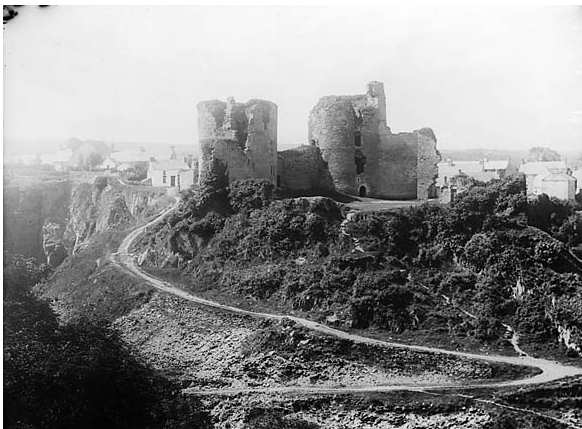
- Cilgerran Castle stands on a rocky promontory above the River Teifi in Pembrokeshire, with two round towers facing inland and the gorge on the other side.
- A first castle is dated to 1108 or to about 1110 to 1115, and the stone towers were begun after William Marshal the younger recovered the site in 1223.
- The Teifi crossing changed hands among the lords of Pembroke, the princes of Deheubarth, and Llywelyn the Great before that rebuild.
- An earth-and-clay core in the outer curtain, exposed when a modern wall fell in 2020, was recorded in 2020 and 2021.
- The ruin later served as a house, a painter's subject, a village pound, and a public monument, and entry is free.
Visiting
The castle is open from 10:00 to 16:00, with those hours given for 1 April to 31 March and also for 2 January to 23 December. Last admission is 30 minutes before closing, and a shop and two toilets are open when staff are present, though another notice says there are no facilities or toilets. It is closed on 24, 25 and 26 December and on 1 January. Entry is free, and the castle is open and unstaffed with no admission charge.
Dogs on a lead are allowed to enter the ground floor levels only. Smoking is not allowed. Visitors are not allowed to climb the guardrails, and the towers may be closed at short notice for weather or safety.
History
Cilgerran Castle, also called Castell Cilgerran, stands on a rocky promontory above the River Teifi at Cilgerran in Pembrokeshire, near Cardigan. The gorge and the Plysog, also called the Afon Plysgog, close two sides of the rock, and the heavy defence faces inland. What still stands is a thirteenth-century inner ward with two round towers, a ruined gatehouse, and an outer ward beyond a rock-cut ditch. It is the most northerly castle in Pembrokeshire, about three miles downstream from its neighbour at Cardigan on the opposite bank.
Gerald of Windsor is the man linked with the first castle, dated 1108 as a ringwork, or about 1110 to 1115 as a timber palisade. The same first site is also called Cenarth Bychan, and that identification is left unproven, with another candidate at Comen Fawr in Cenarth. In 1109 Owain ap Cadwgan carried off Nest ferch Rhys, and Gerald escaped by the garderobe, the privy, or a chute into the cesspit. The accounts differ on whether Nest went willingly.
The Lord Rhys took the castle in 1164, in 1164 to 1165, or in 1165, and two attempts to recover it failed in 1166. He was prince of Deheubarth from 1155 until his death on 28 April 1197, and his peace with Henry II is dated both 1171 and 1172.
William Marshal, earl of Pembroke, drove out Maelgwn ap Rhys in 1204. Llywelyn the Great took the castle back in 1213 or in 1215, after one day's fighting in one account. William Marshal, 2nd Earl of Pembroke, recovered it in 1223 with forces from Ireland and began the round towers. The stones are read as hurried work, and the outer curtain, exposed in 2020, is bedded in earth and clay, like the cores at Cardigan and Nevern.
After Anselm Marshal died in 1245 the castle passed to the de Cantilupe family and then to the Hastings family, in 1272 or in 1273. It was in poor repair in 1275, mostly ruinous by 1325 or 1326, and repaired in 1388 to 1390. Edward III ordered it refortified when a French attack was feared. In 1405, during the war of Owain Glyndŵr, it was damaged, and it may have been held briefly, though other accounts say it never fell to the Welsh after 1223.
Henry VII granted it to William Vaughan in 1496. A notice of 1509 that names Gruffudd Vychan as constable does not fit the Powys knight executed in 1447. The wall record names William Vaughan as constable in that year.
Painters, among them Richard Wilson and J. M. W. Turner, took the ruin as a subject.
Quarrying brought down the outer curtain in 1863. Mrs Colby gave the castle to the National Trust in 1938, and the state took the ruins in care in 1943.
The 2021 record of the fallen wall reads the outer curtain as the probable work of the younger Marshal after 1223. A mortar sample came from an earth-and-clay core, and no catalogue of buried objects was made. Entry is free, and the towers may close when the weather turns dangerous.
Images




Detailed History
Cilgerran Castle, also named Castell Cilgerran, is a ruined medieval fortress at Cilgerran in Pembrokeshire, near Cardigan. It stands on a precipitous rocky promontory above the River Teifi, where the gorge is deep and the water is fast. One side of the rock meets the cliff, and the stream on the other side is called the Plysog and also the Afon Plysgog. The ruins that remain are chiefly of the thirteenth century, and they are strongest where the castle faces inland.
The site lies in the parish of Cilgerran, in the medieval Welsh commote of Cuch and the cantref of Emlyn, within the kingdom of Deheubarth. Deheubarth was the name used for the realms of south Wales, set against Gwynedd, and the Latin writers rendered it as the southern part rather than as a single named kingdom on the model of Gwynedd, Powys, or Dyfed. The castle overlooks Cilgerran Gorge about 500 metres east of St Llawddog's Church. It is the most northerly castle in Pembrokeshire, and it is paired in situation with Cardigan Castle, on the opposite bank about 3 miles, or 4.8 kilometres, downstream.
The promontory was chosen because the cliff and the river did part of the work of a wall. An invader coming from the land had to cross a ditch cut in the rock and then two lines of defence, an outer ward and an inner ward. The inner ward has two strong round towers and a gatehouse, rather than one central keep of the sort common in other castles of the period. The walls toward the cliff were the least heavily built.
From the east tower a wall-walk looks over the gorge toward the lands of Deheubarth. The place was a border fortress for the crossing of the Teifi, held in turn by Norman adventurers, the princes of Deheubarth, the earls of Pembroke, and the crown.
Gerald of Windsor is the man tied to the first castle. He is also called Gerald de Windsor and Gerald FitzWalter, born about 1075. He was a younger son of Walter FitzOther, the first constable of Windsor Castle under William the Conqueror, and of Beatrice. His brothers were William, Robert, and Maurice.
Walter's father, Otto, had been constable of Windsor in the time of Edward the Confessor. On Walter's death after 1100, William took the constableship and Robert took Eton. Gerald went to south-west Wales in the service of Arnulf de Montgomery, a younger son of Roger de Montgomerie, earl of Shrewsbury.
After Rhys ap Tewdwr, king of Deheubarth, was killed at Brecon in 1093 by Bernard de Neufmarché, most of Deheubarth fell to the Normans. Arnulf pushed south into Dyfed and raised Pembroke as a slender fortress of turf and stakes, then left it to Gerald of Windsor, his constable. In 1096, during a Welsh rising, Uchtryd ab Edwin and Hywel ap Goronwy besieged Pembroke. Fifteen of Gerald's knights slipped away by boat at night.
He took their estates and knighted their followers. With provisions almost gone, he cut up four hogs and threw the pieces over the palisade so the besiegers would think the garrison still had meat. The next day a letter under his seal was left where Wilfred, bishop of St Davids, would find it, saying that Arnulf's help would not be needed for four months. The Welsh raised the siege.
William II rewarded Arnulf with the lordship of Demetia. In 1102, before the Montgomery revolt against Henry I, Gerald went to Ireland and negotiated Arnulf's marriage to Lafracoth, daughter of Muircheartach Ua Briain, king of Munster. From 1102 he was constable of Pembroke. Henry I later granted him Moulsford.
The date and even the name of the first work at Cilgerran are not agreed. One account says Gerald of Windsor built a ringwork in 1108. His own life says that in 1108 he built the castle of Little Cenarth, Cenarth Bychan, which is probably Cilgerran Castle. Another account puts a wooden palisade, little more than timber, around 1110 to 1115, and says an earth-and-timber castle stood here before the present masonry and was destroyed by Welsh forces.
A further account says Henry I built the first castle to tighten his hold on south-west Wales and gave the lordship to Gerald, then lord of Pembroke, and that the year of that first structure is not known. The identification of Cilgerran with Cenarth Bychan is also left unproven. Cenarth Bychan is an Anglo-Norman castle whose place is not certain, and the large motte at Comen Fawr in Cenarth is the other main candidate. One telling says that in Nest's day Cilgerran did not yet exist, and that Gerald built Cenarth Bychan to keep her safe, with historians suspecting that this was the stronghold on the later site.
Nest ferch Rhys, also Nesta, was the daughter of Rhys ap Tewdwr and Gwladys ferch Rhiwallon of Powys, of the house of Dinefwr. Her birth is given as about 1085 and as 1086, and her death as about 1136. She married Gerald of Windsor. Carew came to him as her dowry, and he cleared the fort there to build a castle on Norman lines.
Their children were William FitzGerald, lord of Carew and Emlyn, Maurice FitzGerald, lord of Llanstephan, David FitzGerald, bishop of St Davids, Angharad, and Gwladys. Through them Gerald was an ancestor of the FitzGerald, FitzMaurice, de Barry, and Keating families in Ireland, and of the Carew family of Moulsford, Carew Castle, and Mohuns Ottery. Nest is counted the female ancestor of the Fitzgeralds, and through her father the Tudors trace a line to Rhys ap Tewdwr. Henry Tudor, later king of England, was a patrilineal descendant of that king, so the Fitzgeralds stand as distant cousins of the English Tudors.
In 1109 Nest was taken from the castle. Owain ap Cadwgan, prince of part of Powys and her second cousin, is the man named in every account. He was the eldest son of Cadwgan ap Bleddyn, first recorded in 1106 when he killed Meurig and Griffri, sons of Trahaearn ap Caradog. At a feast his father gave in Ceredigion in 1109 he heard of Nest's beauty.
Gerald held Cenarth Bychan, possibly Cilgerran Castle, and Nest was the daughter of the last king of Deheubarth. Owain went to see her, and then determined to take her. One night at Christmas 1109 he and fifteen companions burrowed under the gate, rushed the castle, set it on fire, and carried off Nest and her children. Gerald fled through a garderobe.
Another account says fourteen men stormed the walls and burned the wooden buildings, and that Gerald escaped by the privy. Another says he jumped through a chute into the cesspit. The chronicle used for Gerald's life says Nest urged him out through the drain-hole of the garderobe when the noise woke him, and that Owain then seized her and the children. Some accounts say she went willingly.
One says the abduction was perhaps not entirely reluctant. One calls it a willing abduction in the story of the Helen of Wales. Some say she bore Owain two sons, Llywelyn and Einion, before she was returned to Gerald. She was later mistress to several powerful men, including Henry I, and was nicknamed Helen of Wales after Helen of Troy.
The abduction cost Owain and his father much of Powys. Richard de Beaumais, justiciar of Shropshire, offered lands to cadet branches of the Powys house if they would attack Cadwgan and Owain. Owain fled to Ireland. Cadwgan surrendered to Henry I and lost his lands.
Ceredigion was later restored on a fine of 100 pounds and a promise to have nothing more to do with Owain. Owain returned, allied with Madog ap Rhiryd, and was driven about between Powys, Ceredigion, and Ireland. He raided Dyfed and sold captives in Irish markets, and he killed William of Brabant, a prominent man of the Flemish colony. Henry I invaded Wales in 1114, mainly against Gruffudd ap Cynan of Gwynedd.
Owain joined Gruffudd, made peace, went with the king to Normandy, and was knighted. In 1116 he took arms for Henry against the rising of Gruffydd ap Rhys of Deheubarth. Gerald of Windsor was on the same side and used the chance for revenge. One account says Gerald attacked Owain's retinue of fifty men at arms and killed him.
Another says Owain had only ninety men. The Annals of Cambria date Owain's death to 1116. Most of Powys then passed to his uncle Maredudd. Gerald makes no further appearance in those annals or in the chronicles of the princes, and the presumption on his own page is that he did not long survive Owain.
A later addition that puts his death in 1135 is called erroneous there, while a further note gives about 1136, and Nest's life gives him the span about 1075 to 1135. The wall record uses 1135.
After Gerald, the timber work did not remain the whole castle. A stone outer wall is said to have replaced the palisade at some point before the attack of Rhys ap Gruffydd. The existing masonry of the ruins is still placed in the thirteenth century, and the building as a whole is thought to derive from the twelfth, with the present remains from the thirteenth onward.
Rhys ap Gruffydd, the Lord Rhys, was prince of Deheubarth from 1155 to 1197. He was born about 1132 and died on 28 April 1197. His grandfather was Rhys ap Tewdwr. His father, Gruffudd ap Rhys, recovered only a small portion, and Rhys's older brothers won more after their father's death.
Rhys became ruler in 1155. He called himself prince of Wales, or prince of the Welsh, in two surviving charters. Henry II forced his submission in 1158, invaded Deheubarth in 1163, stripped him of his lands, and imprisoned him. Released within weeks, he was given back a small part of his holdings.
He allied with Owain Gwynedd. After another English invasion of Wales failed in 1165, he won back most of his lands. From the death of Owain Gwynedd in 1170 he was the dominant power in Wales.
The name Cilgerran is first recorded when the Lord Rhys took the castle. The year is given as 1164, as 1164 to 1165, and as 1165. One account says he had taken Cardigan Castle a matter of weeks before, and that on taking Cilgerran he destroyed it entirely, then began to rebuild in stone and lime mortar. Another says the stronghold he captured in 1165 was already partly of stone, and that with the castle he captured Nest's son Robert FitzStephen.
In 1166 an army of Anglo-Normans and Flemish troops tried twice to retake it, suffered large losses, and left it in Welsh hands under Deheubarth. Robert FitzStephen, who died in 1183, was a son of Nest by her later husband Stephen, constable of Cardigan, after Gerald's death. He was one of the leaders of the Norman invasion of Ireland and received wide lands there. The short life does not itself narrate the capture at Cilgerran.
The wall record is the account that places him in Rhys's hands in 1165.
Henry II, born in 1133 and dead in 1189, sought a settlement. One account puts the truce in 1172 and says the Lord Rhys was recognised as justice on the king's behalf in Deheubarth. Rhys's own life puts the peace in 1171, confirms him in his recent conquests, and names him justiciar of South Wales. He kept good relations with Henry until 1189, then revolted against Richard I, attacked the Norman lordships around him, and took castles.
His last campaign against the Normans was in 1196. He died unexpectedly the next year and was buried in St Davids Cathedral. In his later years he could not control his sons, especially Maelgwn and Gruffudd, who feuded.
Maelgwn ap Rhys, about 1170 to 1230, was prince of part of Deheubarth, son of the Lord Rhys and Gwenllian ferch Madog, daughter of Madog ap Maredudd of Powys. He is short in the description given of him, turbulent, and a long trouble to his father. He appears at the siege of Tenby in 1187. In 1188, when Baldwin, archbishop of Canterbury, and Giraldus Cambrensis crossed Wales for the Third Crusade, Maelgwn agreed to go to the king's court and take advice on the cross.
He was a prisoner from 1189 to 1192. In 1194 he and his brother Hywel defeated their father and held him in Nevern Castle until Hywel released him. Maelgwn was in exile when Rhys died in 1197. Gruffudd had been recognised as successor.
Maelgwn, with troops from Gwenwynwyn ab Owain of Powys, took the town and castle of Aberystwyth, captured Gruffudd, handed him to Gwenwynwyn, and took Ceredigion. The wall record says that Maelgwn seized Rhys's successor Gruffudd and handed him to the English, that the English released Gruffudd in 1198, that Gruffudd regained Cilgerran, and that his brother then sold the castle to King John for 200 marks and a promise of royal protection. Maelgwn's own life tells a different sale. After Gwenwynwyn's defeat at Painscastle in 1198, Gruffudd was freed and won back all Ceredigion except the castles of Cardigan and Ystrad Meurig.
Maelgwn came to terms with John and sold Cardigan, not named there as Cilgerran. The Brut y Tywysogion, as quoted for that sale, says that about the feast of St Mary Magdalen he sold to the English, for little profit, the key and keeping of all Wales, the castle of Aberteifi, which is Cardigan. Gruffudd died in 1201, and Maelgwn then seized Cilgerran Castle. In 1204 his men wounded his brother Hywel, who later died of the wounds.
In 1205 he had an Irishman kill the captive Cedifor ap Gruffudd and his four sons with a battle-axe. The same chronicle calls Cedifor praiseworthy, gracious, strong, and generous.
William Marshal, 1st Earl of Pembroke, took the castle back in 1204 and drove Maelgwn out. William was born in 1146 or 1147 and died on 14 May 1219. He served Henry II, the Young King, Richard I, John, and Henry III. Knighted in 1166, he made his name in tournaments, and Stephen Langton's eulogy calls him the best knight that ever lived.
In 1189 he became earl of Pembroke by marriage to Isabel de Clare, daughter of Aoife MacMurrough and Richard de Clare. The title was not officially granted until 1199, and it is counted the second creation of the earldom. In 1216, on John's death, he was protector of the nine-year-old Henry III. He was buried in the Temple Church in London after taking Templar vows, fulfilling a promise he said he had made on crusade.
At Cilgerran in 1204 he forced out Maelgwn ap Rhys, repaired the castle, and garrisoned it. One account says those repairs were ineffective. Another says that when the castle was retaken he built a round stone keep. The later ruins are not described as a single keep.
They are a pair of drum towers.
Llywelyn ab Iorwerth, Llywelyn Fawr, Llywelyn the Great, was prince of Gwynedd from 1199 until his death on 11 April 1240. He was born in 1173. After thirty years of civil war in Gwynedd he made it a power that could claim suzerainty over most other Welsh rulers. He took the throne by defeating his uncles and cousins, made a treaty with John in 1200, and in 1205 married John's daughter Joan.
When John arrested Gwenwynwyn in 1208, Llywelyn annexed southern Powys. John invaded Gwynedd in 1211 and forced him to give up the lands east of the Conwy. He recovered them the next year with the other Welsh princes. He joined the barons who forced John to the Magna Carta in 1215, and by 1216 he was the dominant power in Wales, apportioning lands at a council in Aberdyfi.
Maelgwn had helped John against him in 1211, then changed sides when the lands taken from him were not returned. At Aberdyfi in 1216 Maelgwn received only the southern part of Ceredigion. Llywelyn made the Treaty of Worcester with Henry III in 1218. The Peace of Middle in 1234 ended his years of marching, and a two-year truce was renewed year by year until his death.
A stroke paralysed him in 1237. He died on 11 April 1240, and his chosen heir Dafydd ap Llywelyn, his son by Joan, succeeded to a fragile principality.
Cilgerran fell to Llywelyn during those years. The year is given as 1213 and as 1215. One account says Llywelyn the Great, in league with the princes of Deheubarth, retook the stronghold in a day-long battle, and that Marshal's repairs had proved too weak. Another says the Welsh recovery was during Llywelyn the Great's campaigns in 1215, and that eight years passed before the Marshals had it again.
The spelling Llewellyn is also used for him. The castle then stayed in Welsh hands until 1223.
William Marshal, 2nd Earl of Pembroke, retook it in 1223 and began the stone castle whose towers still stand. He was born in Normandy, probably in the spring of 1190, the eldest son of William Marshal and Isabel de Clare, and he died on 6 April 1231. He was one of the sureties of Magna Carta, and he commissioned L'Histoire de Guillaume le Mareschal, the first biography of a medieval knight, finished in 1226 in honour of his father. As a boy he was a hostage of King John after his father did homage to Philip II of France in 1205, and he lived at John's court from the age of fifteen until his majority in 1212.
He married Alice de Bethune in September 1214. She died before 1215. Her lands helped him gather a retinue that included Fulk FitzWarin, the Le Gros brothers, and Baldwin de Bethune the younger. In the First Barons' War he sided with Prince Louis while his father fought for the English king.
He was at Stamford in February 1215, one of the twenty-five executors of Magna Carta in June, and excommunicated by Innocent III on 11 December 1215. His father warned him out of Worcester Castle in 1216 just before Ranulph de Blondeville retook it. Absolved in March 1217, he fought beside his father at the Battle of Lincoln. He was with his father at the death in 1219 and succeeded as earl of Pembroke and lord marshal of England.
On 20 June 1220 he deeded the Norman family lands to his brother Richard.
In 1223 William crossed from Ireland against Llywelyn the Great, who had attacked Pembroke. The campaign succeeded, and the regents of the young Henry III thought it too independent. He regained Cilgerran with forces from Ireland. Learning from the earlier loss, he began a large rebuilding and extension.
Only early masonry is said to survive under that work. The same year is the date given for an ornate castle of mortar and stones on the older site, and for the start of the present form. The size of the stones in the surviving parts of this period is read as a sign that the work was done in great haste. On 23 April 1224 he married Eleanor of England, youngest daughter of John and Isabella of Angoulême, to bind the Marshals to the Plantagenets.
He had no surviving children from either marriage. As justiciar of Ireland from 1224 to 1226 he subdued Hugh de Lacy, founded the Dominican priory of the Holy Trinity at Kilkenny, and began Carlow and Ferns castles. He was dismissed for supporting Aedh Ua Conchobair against Richard de Burgh in Connacht, and he surrendered the office at Winchester on 22 June 1226. Later that year he was ordered to give the crown the custody of Cardigan and Carmarthen, royal castles he had taken from Llywelyn.
He went with Henry III to Brittany in 1230 and stayed in command when the king went home. In February 1231 he returned and arranged the marriage of his sister Isabel, widow of Gilbert de Clare, to Richard, earl of Cornwall. He died on 6 April 1231. Matthew Paris later recorded an accusation that Hubert de Burgh had poisoned him, and no other source is cited for that charge.
He was buried on 15 April in the Temple Church beside his father. His lack of a male heir was credited by Matthew Paris to a curse of Ailbe Ua Maíl Mhuaidh, bishop of Ferns. The titles passed to his brother Richard Marshal, 3rd Earl of Pembroke. Each brother inherited in turn, none left a child, and the male line ended at the death of Anselm Marshal in 1245.
The fabric that is pointed to as his work is the inner ward in stone, with two plain round towers and a gatehouse. The towers are also called drum towers and keep-like twins. They stand on the south side, joined by a curtain, and they project well beyond the wall. The outer skin is thicker than the inner, and the only openings on the outer face are arrow slits.
Each tower has a ground floor and three upper storeys. The eastern tower was entered at first-floor level from the courtyard, by a door to a newel stair. It had a separate way into the ground floor, and the upper floors were probably reached by a trapdoor. The west tower also began with a first-floor entrance, by a stair from the inner ward.
Its ground floor, reached by a trapdoor, may have been a strongroom or a dungeon. Later a door was cut, a newel stair was added, and a cross wall left part of the room as a strongroom. A sally port is described at the base of the east tower, with steps down to another sally port. A parapet walk links the two towers.
The gatehouse has collapsed. Its passage still shows portcullis grooves and draw-bar holes. Above it was a vaulted room, perhaps a chapel, and above that a passage in the curtain joined the round towers, which could also be reached from the wall-walk. The gatehouse is placed in the south-east in one account and to the west in others, and the chapel is suggested for the first floor of the western gatehouse.
The outer ward has its own gatehouse, surviving as low footings of uncertain date, and the footings of a rectangular building. Stables and other service buildings are inferred for that ward. A deep ditch, once crossed by a pivoting bridge or by a timber drawbridge, separates the wards. The bank and ditch that cut off the promontory may be the bailey of the first earthwork.
The outer ward wall now standing is a modern rebuild after the old wall fell because of quarrying in the cliff below.
Along the north-east and north-west of the inner ward, the curtain and the remains of buildings are dated to the second half of the thirteenth century, when the castle had passed by marriage from the Marshals to the de Cantelupes, also spelled de Cantilupes, and then to the Hastings family. Footings remain of a hall, private apartments, and a kitchen against the west wall. A lime kiln is also named among the inner buildings. The de Cantilupe work is described as limited, and they may have been the builders of that domestic range.
The west curtain, over the drop to the Plysgog, is said to be later thirteenth century. Several phases are read in the twin towers and the curtains, while the core exposed in the outer bailey in 2020 was read as a single phase of construction.
Anselm Marshal, also Ansel, the 6th Earl of Pembroke, was born in 1208 and died in 1245. On his death Cilgerran left the Marshals. It passed by a co-heiress to the de Cantilupe family of Abergavenny. One account keeps the Marshals until 1245 and the de Cantelupes until 1273.
Another puts the next passage in 1272, when that line ended and the Hastings family received the castle. The Hastings were earls of Pembroke from 1339. During the minority of Lord Hastings the crown kept the castle. Charles Oman, in the sequence published in his book Castles in 1926, is the writer who carries the palisade of about 1110 to 1115, the stone wall before 1165, the total destruction by Rhys, the English recovery of 1204, the loss after one day's battle in 1215, the hasty stones of the 1223 rebuild, the failure of later Welsh assaults, the 1258 defence, the passage to the de Cantilupe family after Anselm, the Hastings inheritance in 1272, the ruin by 1387, and a castle thought deserted by 1400 while the property still descended with the earls of Pembroke into the time of Jasper Tudor, Duke of Bedford.
The defences were tested again under the Hastings. In 1257 Llywelyn ap Gruffudd, with an alliance of Welsh princes, attacked Cilgerran. The castle held and stayed in English hands. Llywelyn ap Gruffudd, Llywelyn the Last, died on 11 December 1282.
He was prince of Gwynedd from 1255 to 1282. After campaigns across Wales in 1257 he proclaimed himself prince of Wales in 1258, and Henry III recognised him in the Treaty of Montgomery in 1267. He was killed in an ambush at Cilmeri in 1282, near the end of Edward I's conquest of Wales. A second account of Cilgerran puts the crisis in 1258, when English forces were defeated nearby and the castle had to push back the princes of Deheubarth.
One visiting history says that, despite Llywelyn ap Gruffudd and Owain Glyndŵr, the castle never again fell to the Welsh after 1223. Other accounts leave a later exception in 1405.
A report of 1275 found the castle in poor repair. The same year is given for the stripping of its furnishings, and for the castle being bypassed during the first war of Welsh independence. By 1325 it was mostly ruinous. By 1326 it was close to ruin and reputedly worth nothing in rent.
Repairs are recorded for 1388 to 1390. The large north-west tower is placed in the early fourteenth century as domestic lodging, in the later fourteenth century, and in the 1370s. In the 1370s a French invasion was feared, and Edward III ordered the derelict castle refortified. The order is also dated 1377, sparked by the defeat of John de Hastings, earl of Pembroke, at La Rochelle.
John was born in 1347 and died in 1375. Edward III was born in 1327 and died in 1377. The Hastings line is said to have ended in 1379, when the castle passed formally to the crown and repairs were made, and also in 1389, when it passed to the crown for want of heirs. After that, one account says, active military service ended.
Owain Glyndŵr, Owain ap Gruffudd Fychan, was born about 1359 and died about 1416. He was also written Owain Glyndwr. A Welsh noble and commander, he led a revolt to make Wales independent of English rule. His supporters acclaimed him prince of Wales on 16 September 1400.
Between 1404 and 1405 the rebellion controlled the whole country. English pressure and the lack of lasting foreign aid then took the rebel lands back, all of them by 1409, though he kept up scattered resistance until he vanished from the record in 1412. He was never captured, and he died in hiding around 1416. The quarrel that opened the year 1400 was with his English neighbour Reginald de Grey, lord of the lands beside Glyndyfrdwy, and it sat inside a wider hostility that brought countrymen and nobles out against the English garrisons.
Penal laws against the Welsh followed and widened his support. In 1404, after castle sieges and battlefield victories, he held a parliament at Machynlleth with envoys from France, Scotland, Castile, and Leon, and with men from every part of Wales. France, Brittany, and Scotland sent military help. In the Pennal letter of 1406 he wrote of two universities, one in the north and one in the south, of restoring the laws of Hywel Dda, and of pushing the border into England.
Harlech and Aberystwyth, the last rebel castles, fell in 1409. He refused two royal pardons. At Cilgerran the same wars are told in more than one way. The castle may have been captured and held for a short time in 1405, and it was certainly damaged.
It may have been briefly retaken by the Welsh, and it was badly damaged, or laid waste, in that attack. It is also said never to have fallen to the Welsh after 1223, and to have been thought deserted by 1400, even while the lordship continued down to Jasper Tudor. The wall record dates Glyndŵr's war from 1400 to 1415 and his death to 1415, a year earlier than the life that puts his death around 1416.
In the Tudor years the Vaughan family received the castle from Henry VII and lived in it until the early seventeenth century, when they built a new house nearby. The wall record is more particular. In 1496 Henry VII granted Cilgerran to William Vaughan and rewarded him with the title of lord of Cilgerran. In 1509 the king appointed William constable of the castle.
At the end of the sixteenth century his descendant Robert Vaughan moved the family from the castle to a new house called Glandovan. The same record still has the Vaughans in occupation until the early seventeenth century, after which the castle became a picturesque place to visit. By 1685 it had passed to the Pryse family. A separate notice names Gruffudd Vychan as steward of the lordship of Cilgerran and constable of Cilgerran Castle in 1509.
That notice cannot be the life of the Powys knight who died in 1447, and the wall record's constable of 1509 is William Vaughan.
Gruffudd Vychan, also Griffith Vaughan and Gruffydd Fychan, was a knight of Powys, born about 1395 and executed in 1447. He was lord of Burgedin, Treflydan, Garth, and Gearfawr, the second son of Gruffudd ap Ieuan ap Madoc ap Wenwys and Maud, daughter of Griffri ap Rhys Fongam. The family traced itself from Brochwel Ysgithrog through Elisedd ap Cyngen, eldest son of the last king of Powys, and its houses lay in Guilsfield, in the commote of Ystrad Marchell. He married twice, each wife named Margaret.
The first was daughter of Madoc of Hope, or Hob, and the mother of David Lloyd and Cadwaladr. The second was daughter of Griffith ap Jenkin Broughten, and the mother of Reinallt. His father was seneschal of Caus Castle for Hugh Stafford and was set to hold it against Owain Glyndŵr. After calls from Welsh students of law at Oxford, father and sons changed sides.
The family's lands and the office at Caus were forfeited in 1404. Honours returned through the capture of Sir John Oldcastle, Lord Cobham, in November 1417. The reward was assigned to the lord of Powys, who died before it was paid, though a portion reached his widow in 1422. The principal agents were four tenants of that lord, among them Ieuan and Griffith, the sons of Gruffudd ap Ieuan.
At Mathrafal on 6 July 1419 Sir Edward de Cherleton pardoned the killings and felonies of that capture. At Shrewsbury on 4 March 1420, before Henry V and Humphrey, duke of Gloucester, the four accepted their share of the reward. On 10 March 1420 Broniarth was made a mesne manor for Ieuan and Sir Griffith Vaughan, with a court three times a week.
There is a persistent tradition that Gruffudd Vychan was among the Welshmen said to have saved Henry V at the Battle of Agincourt in 1415, when the king rushed to rescue his brother Humphrey. The belief grew that he, like Dafydd Gam and Roger Vaughan, was knighted on the field. Those knights are not in Shaw's Knights of England. If he was of age he could have been in the campaign, because two of his lords, John Grey, earl of Tankerville, and Sir Hugh Stafford, lord of Caus, served in Humphrey's retinue.
The idea that he was the Griffin Fordet of a French chronicle is rejected. A Welsh cywydd says he was made an esquire in London and knighted in a town beyond Rouen. His rise is tied to Humphrey's patronage after Sir John Grey fell at Baugé in March 1421, when Gruffudd arranged for the body to come home to Welshpool. He was probably knighted by Henry VI after Henry V's death in 1422, perhaps after Pontoise fell in 1441.
On 10 August 1443 at Caus Castle he drove a lance through the heart of Sir Christopher Talbot, son of John Talbot, earl of Shrewsbury, and the champion tilter of England. It is not known whether the blow was accident or design. He was outlawed, and 500 marks, written as 333 pounds 6 shillings and 8 pence, were offered for him. He stayed at large for four years.
On 18 July 1444 his estates and those of his eldest son Reynold and his nephew David Lloyd were given to John Sutton, Baron Dudley. A general pardon in April 1447 left him out. Henry Grey, earl of Tankerville, executed him at Powis Castle in 1447 in breach of a safe conduct. The poets Lewis Glyn Cothi and Dafydd Llwyd of Mathafarn wrote elegies against that betrayal.
His children were David Lloyd, Cadwaladr, Reinallt, Gwenhwyvar, Catherine, Anne, and Margaret. Reinallt and David Lloyd were pardoned on 21 December 1448. David Lloyd's death in 1497 split wide estates among the Montgomeryshire Lloyds. His son Humphrey Lloyd was the first high sheriff of Montgomeryshire in 1541.
Reinallt was the ancestor of the Wynnes and Myttons of Garth and of the Derwas family. None of that life is a tenure at Cilgerran, and the shared name is why the 1509 constable has been attached to the wrong man.
The Battle of Agincourt was not fought at Cilgerran. It was an English victory in the Hundred Years' War, on 25 October 1415, Saint Crispin's Day, near Azincourt in northern France. Henry V led the English and fought hand to hand. Charles VI of France did not command, because of his illness.
The French were led by Constable Charles d'Albret and nobles of the Armagnac party. English and Welsh archers made up nearly four fifths of Henry's army, and the longbow decided the shape of the day. The victory is set beside Crécy in 1346 and Poitiers in 1356. It lifted English morale, damaged France, and opened about fourteen years of English advantage, until the siege of Orléans in 1429.
Shakespeare used it for Henry V, written in 1599. At least seven contemporary accounts survive, three from eyewitnesses. The heralds, with the French herald Montjoie, named the battle Azincourt after the nearest fortified place. Jean Le Fèvre de Saint-Remy and Enguerrand de Monstrelet wrote from the Burgundian side, and an English chaplain in the baggage is taken to have written the Gesta Henrici Quinti.
Henry claimed the French crown through Edward III, while English kings had often been ready to trade that claim for Aquitaine under the Treaty of Brétigny. A Great Council in the spring of 1414 pressed him to negotiate. He asked for 1.6 million crowns still owed from the ransom of John II, taken at Poitiers, and for Anjou, Brittany, Flanders, Normandy, Touraine, and Aquitaine, plus marriage to Catherine with a dowry of 2 million crowns. The French offered marriage, 600,000 crowns, and a larger Aquitaine.
Parliament granted a double subsidy in December 1414. On 19 April 1415 the council agreed to war. The army landed on 13 August 1415. The fleet was often said to be 1,500 ships and was probably much smaller.
About 12,000 men and up to 20,000 horses besieged Harfleur, which surrendered on 22 September. The English left on 8 October. Disease had cut the army, and Henry marched roughly 9,000 men toward Calais rather than sail home with only one town taken. The French blocked the Somme.
The English crossed south of Péronne, at Béthencourt and Voyennes. On the night of 24 October the armies camped in the open. The next morning Henry advanced. His line is given as about 1,500 men-at-arms and 7,000 longbowmen across 750 yards, the right under Edward, duke of York, the centre under the king, the left under Thomas Camoys, and the archers under Thomas Erpingham.
Pointed stakes protected the archers, a device perhaps learned from Nicopolis in 1396. The French are numbered at about 10,000 men-at-arms and 4,000 to 5,000 other foot, with valets perhaps besides, packed on ploughland between the woods of Tramecourt and Azincourt. Heavy rain had made deep mud. The cavalry charge against the archers failed.
The men-at-arms closed through the mud with visors down, were crowded until they could hardly use their weapons, and were broken in about three hours. Henry stood over his wounded brother Humphrey until Humphrey could be dragged clear, and an axe struck a piece from the crown on the king's helmet. The only French success was a raid on the baggage by Ysembart d'Azincourt, in which a crown was taken. The exact field is still debated, and a case has been made for a site west of Azincourt.
The ground itself is not this rock above the Teifi. What Cilgerran has is the tradition about Gruffudd Vychan, and a re-enactment of the Battle of Agincourt held at the castle in 2015 to mark the six-hundredth anniversary.
From the eighteenth century the ruin was visited by boat from Cardigan, and painters came for the gorge. By the end of that century it was a Romantic subject. Richard Wilson painted it, and so did J. M.
W. Turner. The compact form of his name, J.M.W. Turner, is the form used for Kilgarren Castle of 1798.
Three of his pictures are in the national collection: Kilgarran Castle on the Twyvey, Hazy Sunrise, previous to a Sultry Day, exhibited in 1799; Cilgerran Castle on the Teifi, Looking Upstream, of 1798; and View in Wales: Mountain Scene with Village and Castle, Evening, of about 1799 to 1800. Other views include Kilgarran Castle on the river Teivy, 1844, by David Cox, engraved by William Radclyffe; Kilgarren Castle, 1807, by John Hassell; Killgaron Castle on the Tivi, Cardiganshire, evening rain, about 1845, by John Henry Robinson and George Childs; an anonymous painting of about 1800 to 1820; Cilgerran Castle by George Barret about 1778; and a view given by Lord Pontypridd. The old spellings Kilgarran, Kilgarren, and Killgaron all appear on those sheets.
J. M. W. Turner was Joseph Mallord William Turner, born on 23 April 1775 in Maiden Lane, Covent Garden, and dead on 19 December 1851 at the house of Sophia Caroline Booth in Chelsea, where he had lived as Mr Booth or Admiral Booth.
He was buried in St Paul's Cathedral. His father, William Turner, was a barber and wig-maker who showed the boy's drawings in the shop window. His mother, Mary Marshall, died in Bethlem Hospital in 1804. He entered the Royal Academy schools at fourteen, was a Royal Academician by twenty-seven, and made about 550 oil paintings and more than 2,000 watercolours.
He never married. A long private relationship with his housekeeper Sarah Danby is generally taken to have made him the father of her daughters Evelina, born in 1801, and Georgiana, born in 1811. He left the nation about 100 finished and 200 unfinished oils, and a vast body of sketches. His estate was valued at 140,000 pounds.
After a family lawsuit the Academy received 20,000 pounds in 1856. He had wanted a gallery for the gift. The Clore Gallery at Tate Britain opened in 1987. His large watercolours of North Wales, among them Caernarfon Castle in 1799, are ranked with the great landscapes of European art.
The Cilgerran sheets belong to that early touring of Welsh castles and rivers, before the more abstract late work. The gorge, the twin towers, and the morning haze are what those three national-collection pictures take from this rock.
The nineteenth century continued the decay. The dry ditch of the bailey was turned into the village pound, and it is also said to have been made a pond. Slate quarrying in the cliff brought down the curtain of the bailey in 1863, and most of the medieval wall on the east side of the outer ward fell to ground level. A retaining wall was then built to hold what remained.
Between 1906 and 1976 part of that outer curtain was cut down to the height seen now. The surveyors' map of 1810, drawn by Thomas Budgen, does not show the castle. The 25-inch map of 1888 shows the stretch of outer curtain later examined, and so does the edition of 1906. The edition of 1976 does not.
By 1909 the ruin was in use as a public toilet and a hen-roost. There was nothing picturesque about that last domestic use.
In 1938 Mrs Colby bought the castle and gave it to the National Trust. The same year it is also said simply to have been presented to the National Trust. A notice in the Burnley Express of 19 March 1938, on page 12 under the heading Pith and Point, was later gathered into the British Newspaper Archive, which was launched in November 2011 to put historic newspapers where they could be searched without a visit to the old newspaper store. In 1943 the ruins were handed to the state.
They are owned by the National Trust and held in the guardianship of Cadw, described as the historic environment service. Since 2024 the guardians have used only the Welsh name Castell Cilgerran when writing in English, so that the name matches in both languages. The castle is a Grade I listed building, designated on 15 April 1994. It is also a scheduled medieval castle.
The scheduling treats it as a national monument for what it can still show of medieval defence, and it judges that structural evidence and intact deposits are likely to survive in the area of the ruins. Entry is free. Opening times have been described as variable, and they are also posted as 10am to 4pm, both for the run of dates from 1 April to 31 March and for 2 January to 23 December, with last admission half an hour before closing, and with closure on 24, 25, and 26 December and on 1 January. The place is open and unstaffed, with no admission charge.
One notice says there are no facilities or toilets. Another says a shop and two toilets are open when staff are present. Dogs on a lead may go onto the ground floors only. The towers may be locked at short notice for weather or safety.
Charles Oman was Sir Charles William Chadwick Oman, born on 12 January 1860 in Muzaffarpur in Bihar, and dead at Oxford on 23 June 1946. He was a military historian, taught at Oxford under William Stubbs, and spent his career at All Souls, where he was also librarian. In 1905 he became Chichele professor of modern history. He was a Fellow of the British Academy and president of the Royal Historical Society from 1917 to 1921, and of the Numismatic Society and the Royal Archaeological Institute.
During the First World War he worked for the Press Bureau and the Foreign Office. He was Conservative member of parliament for Oxford University from 1919 to 1935, and he was knighted KBE in the civilian war honours of 1920. The parody 1066 and All That, of 1930, dedicates itself with the words Absit Oman. He married Mary Maclagan in 1892.
Their daughter Carola Oman wrote history and fiction, and their son Charles C. Oman was a keeper of metalwork. Among his books, Castles appeared in 1926, and it is the account that fixes the long sequence of palisade, 1165, 1204, 1215, 1223, 1258, 1272, 1387, and 1400 summarised above. He was not a constable or a prisoner here.
He is the historian through whom that particular chain of dates entered the later telling.
The most recent examination of the fabric was not a hunt for buried treasure. It was a record of a collapsed wall. In the middle of 2020 a modern retaining wall fell and exposed the core of the outer bailey curtain. Most of that curtain had already been lost in the collapse of 1863, caused by quarrying and by the robbing of stone, so the exposed core was a rare chance to see how the outer wall had been built.
ArchaeoDomus, in the person of Ross Cook, was asked to prepare a written scheme for a level 2 buildings record and a watching brief, and to record the core before and during the rebuild. A photogrammetric survey on 9 December 2020 covered the exposed top and the west face of the wall inside the outer bailey. The reinstatement began without notice, so the watching brief was not kept. On 14 January 2021 it was decided that taking down the new work to watch the core would risk the historic wall, and the rebuild was allowed to go on.
Between 12 and 21 January 2021 the retaining wall was rebuilt on the old foundations with salvaged stone, stainless-steel ties, and lime mortar, and with drainage holes at the base. Joseph Cliff photographed the finished work on 9 July 2021. The written record is dated August 2021, with a first version of 10 August. Because so little was seen during the works, the planned level 2 record was reduced to an archaeological record of materials, form, and possible date.
A mortar sample was taken from the core. A small amount of historic mortar was lost when the modern wall fell. No list of excavated objects is given, because the ground was not dug as a trench. The aim was the wall itself.
The curtain in that south-east corner of the outer bailey runs roughly north-east to south-west. It is of medium to large limestone blocks, roughly coursed, bedded in an earth-and-clay mortar whose aggregate is mostly rounded river gravel. The stone was likely quarried from the bedrock under the castle. The modern retaining wall crosses the end of the medieval curtain on an east-west line and then turns north-east, and it is bedded in a cement mortar.
The exposed core was read as one phase. The historical reading of the whole Marshal work still allows several phases in the towers and curtains. The earth-and-clay bond matches the cores at Cardigan and Nevern, and it has been suggested for Newport, though that last comparison has not been confirmed. The Lord Rhys is said in the Brut to have built Cardigan in stone and mortar, and the cores there show that the mortar in the heart of the wall was earth and clay.
The same method at Cilgerran is taken as a regional way of building, possibly with Welsh labour, and also as a sign that quicklime was scarce and that the fortification had to go up quickly. Lime mortar may have been kept for pointing, or for joints that needed extra strength. The same question is left open for the rest of the castle: whether other masonry was earth-and-clay before twentieth-century consolidation, in particular work by the Ministry of Works. The conclusion drawn from the core is that William Marshal, the son born in 1190 and dead in 1231, probably built this outer bailey curtain after he took the castle from Llywelyn the Great in 1223, as part of a strengthening large enough that the place stayed in English hands until it was no longer needed as a fortress.
That is the change the stone castle made. Before 1223 the site changed hands whenever a prince of Deheubarth or of Gwynedd could bring a force to the Teifi, and a timber or lightly repaired wall could fall in a day. After the round towers and the rebuilt curtains, the accounts that deny any later Welsh capture treat Cilgerran as held, even when it was poor, empty of furniture, or worth nothing in rent. The accounts that allow a short occupation in 1405 still agree that the active life of the fortress ended with the damage of Glyndŵr's war.
What followed was a Vaughan house, a Pryse property, a ruin for painters, a pound, a pond, a toilet and a hen-roost, a gift to the nation in all but the legal name, and at last a guarded ruin whose towers can still be climbed when the weather allows. The 2021 record is the recent find in the fabric: not a hoard, but the earth-and-clay heart of the outer curtain, and the probability, stated with the scheduling, that more of the medieval deposits remain in the ground around it.
Sources
- Cilgerran Castle — Wikipedia
- Gerald of Windsor — Wikipedia
- William Marshal, 2nd Earl of Pembroke — Wikipedia
- William Marshal, 1st Earl of Pembroke — Wikipedia
- Rhys ap Gruffydd — Wikipedia
- Llywelyn the Great — Wikipedia
- Llywelyn ap Gruffudd — Wikipedia
- Maelgwn ap Rhys — Wikipedia
- Nest ferch Rhys — Wikipedia
- Owain ap Cadwgan — Wikipedia
- Owain Glyndŵr — Wikipedia
- Robert FitzStephen — Wikipedia
- Deheubarth — Wikipedia
- Charles Oman — Wikipedia
- Gruffudd Vychan — Wikipedia
- J. M. W. Turner — Wikipedia
- Battle of Agincourt — Wikipedia
- British Newspaper Archive — Wikipedia
- Castell Cilgerran — Cadw
- More about Castell Cilgerran — Cadw
- Cilgerran Castle listed building — Cadw
- Castell Cilgerran scheduled monument — Cadw
- Cilgerran Castle — Coflein
- Outer bailey curtain wall, Cilgerran Castle — ArchaeoDomus
- Cilgerran Castle — National Trust
- Spectacularly sited Cilgerran Castle's history and decline — Tivyside Advertiser
- 01 Cilgerran Castle.jpg — Wikimedia Commons
- Cilgerran Castle - geograph.org.uk - 50320.jpg — Wikimedia Commons
- Castle at Cilgerran - geograph.org.uk - 423455.jpg — Wikimedia Commons
- Cilgerran Castle - geograph.org.uk - 504260.jpg — Wikimedia Commons
- Cilgerran Castle and Afon Teifi - geograph.org.uk - 504248.jpg — Wikimedia Commons
- Cilgerran Castle - geograph.org.uk - 1030883.jpg — Wikimedia Commons
- Castell cilgerran 1885.jpg — Wikimedia Commons
- A view of Cilgerran castle from the wood NLW3361150.jpg — Wikimedia Commons
- A view of Cilgerran castle from the quarry NLW3361149.jpg — Wikimedia Commons
- Cilgeran Castle (1133570).jpg — Wikimedia Commons