
Sacred place
Church of St Peter ad Vincula, Tower Hamlets
Grade I listed chapel in London Borough of Tower Hamlets, UK, within the Tower of London

London Borough of Tower Hamlets, United Kingdom · 1510 CE · United Kingdom
- The Chapel Royal of St Peter ad Vincula is the parish church of the Tower of London, a royal peculiar in the Inner Ward at Tower Hamlets.
- The standing church was built for Henry VIII in 1519 and 1520 after the fire of 1512, on ground where worship is placed as early as the ninth century or in the reign of Henry I.
- Anne Boleyn, Catherine Howard, Lady Jane Grey and Lord Guildford Dudley are buried here, with Thomas More and John Fisher.
- The restoration of 1876 opened burials in the chancel, and the excavation of 2025 found earlier chapels and more than twenty people, also counted as up to fifty.
- The church is still used for Sunday worship, and a lift is being installed so the entrance can be reached without steps.
Visiting
Sunday services are open to the public free of charge, and no ticket is required to enter the Tower for the service alone. A card issued at the gate allows entry only for the duration of the service plus 15 minutes, and that admission does not include the rest of the fortress. Regular Sunday worship is open at 09:15 for Holy Communion and at 11:15 for sung Matins, with sung Holy Communion at 11:00 on the last Sunday of the month. The chapel is closed on the first Sunday after Christmas, the first Sunday after Easter, and throughout August, when no service is held.
A further notice says the Sunday service now open is Holy Communion at 09:30 in the White Tower chapel, while the service list keeps this chapel open at 09:15 and 11:15. Admission to major services, including the Christmas carol service and the Easter state parade, is by ticket issued in advance, and anyone without a ticket may be refused admission. The chapel seats 180, so admission to the most crowded services is limited, and the other Tower chapel seats about 40. For a regular Sunday service the gates open about 20 minutes beforehand, and worshippers should be at the gate 20 to 25 minutes before the stated time.
While building works continue, entry for both the 09:15 and the 11:15 services is by the Middle Drawbridge, and at other times the 09:15 service uses the West Gate. Evening services use the West Gate, except that during the same building works entry is by the Middle Drawbridge. For the 11:15 service, admission is held at the barrier outside the chapel until choir rehearsal ends, usually between 10:45 and 11:00. On the first Sunday of the month, when a major service is open at 11:15 in this chapel, the 09:15 Holy Communion is held in the other chapel.
Visitors with a palace admission ticket may see the chapel when it is open, and members are admitted free. The chapel can close when the community is using it, so a ticket does not guarantee entry on every day. On 12 November 2026 the fortress that contains the chapel is open from 09:00 to 16:30, with last entry at 15:00. A general notice on the same timetable gives last entry at 16:30, with the buildings closing at 17:30.
Only two wheelchair users are allowed to enter at one time, and the warder on duty operates the platform lift at the entrance. Visitors who cannot use the steps are allowed to enter by a ramp, which the warder on duty operates. The chapel office is open from 09:00 to 17:00, Monday to Friday.
History
The Chapel Royal of St Peter ad Vincula stands in the Inner Ward of the Tower of London, in Tower Hamlets. It is the former parish church of the fortress and a royal peculiar, the second chapel after the one in the White Tower. The name recalls the imprisonment of Saint Peter under Agrippa I.
Accounts of the first church do not agree. Worship on the site is placed more than a thousand years ago, perhaps in a Saxon chapel of the ninth century, or in a parish church from before the Norman Conquest, or in a foundation of Henry I, with a possible consecration on 1 August 1110 and a first mention between 1128 and 1134. By 1241 a writ of Henry III shows the church inside the bailey, and Edward I is said to have demolished it and rebuilt it in 1286, or in 1286 and 1287, before the fire of 1512.
The standing chapel was begun in 1519 and the last payment was made in September 1520, for Henry VIII, under Sir Richard Cholmondeley, probably to a design by William Vertue. Cholmondeley is recorded as dying in 1521 and, on the monument, in 1544. The tomb he shares with Elizabeth Pennington was found empty, and the Tudor font had been hidden inside it.
The graves follow the Tudor court. Thomas More and John Fisher were executed in 1535 for refusing the royal supremacy, and both were later canonised. Anne Boleyn was beheaded on 19 May 1536, Catherine Howard on 13 February 1542, and Lady Jane Grey and Lord Guildford Dudley on 12 February 1554, after Jane's few days as queen.
A restoration in 1876 and 1877 rebuilt the west tower, cleared later galleries, and opened the chancel. Burials found then were identified as Anne Boleyn, Margaret Pole and John Dudley, and also as Anne Boleyn and Lady Jane Grey, while another account leaves the queens' true graves unknown. The building was listed at Grade I on 30 November 1989 and stands within the Tower inscribed in 1988.
A trial in 2019 found two coffined skeletons outside the entrance. The excavation of 2025 uncovered more than twenty people, also counted as up to fifty, with earlier chapel walls, ash from the fire of 1512, and rare charcoal-filled pots. The church is still used for worship, and a lift is being made so the entrance can be reached without stairs.
Images






Detailed History
The Chapel Royal of St Peter ad Vincula stands in the Inner Ward of the Tower of London, in the London Borough of Tower Hamlets. Its name means Saint Peter in chains. It was the parish church of the fortress and remains a royal peculiar, under the monarch rather than a diocesan bishop. The priest is the chaplain of the Tower, a canon of the Ecclesiastical Household.
That canonry was abolished in 1685 and restored in 2012, when Roger Hall was installed. It was the second chapel of the Tower. The first was St John's, a smaller royal chapel built into the eleventh-century White Tower, established around 1080 by William I for the king's more private worship. St Peter was the church of the people who worked and lived in the castle.
The dedication points to the imprisonment of Saint Peter. Saint Peter, born Simon bar Jonah and also called Simon Peter and Cephas, was one of the Twelve and one of the first leaders of the church. Tradition places his death in Rome under Nero, crucified upside down, between 64 and 68. Catholic and Orthodox teaching treats him as the first bishop of Rome and of Antioch, while the churches differ over the authority of his successors.
The New Testament name Simon Peter occurs nineteen times. He was a fisherman and the brother of Andrew. The chapel's title refers to his imprisonment under Agrippa I, also called Herod Agrippa and Marcus Julius Agrippa I. Agrippa I, born about 11 BC and dead about 44, was a grandson of Herod the Great and the last client king of Judea, reigning from 41 to 44.
He was a Roman citizen, a friend of Caligula and of Claudius, and in Christian reading he is the king called Herod whose sudden death is told in Acts 12. The most direct meaning of the dedication is that release from prison. Other meanings have been suggested in a Norman and English setting, but the story of the chained apostle is the one the name itself carries.
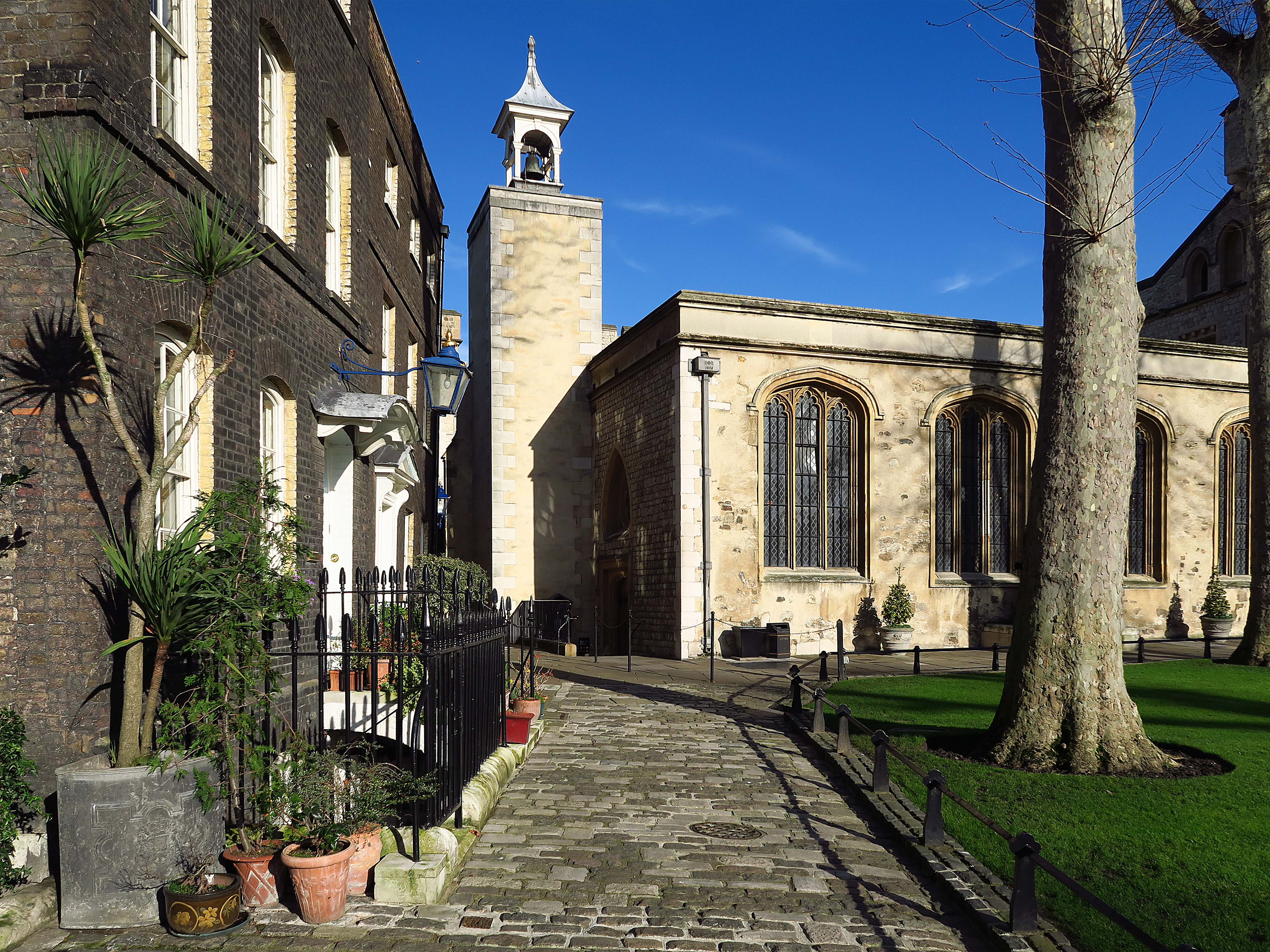
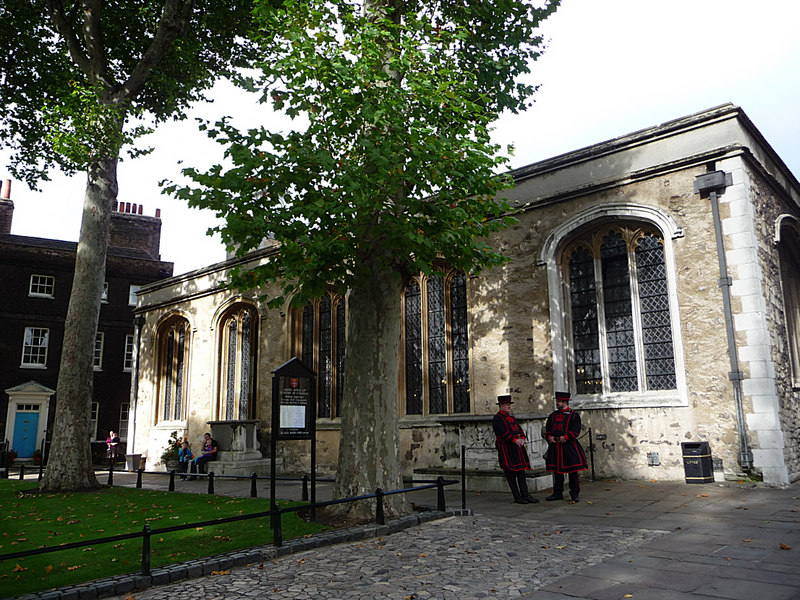
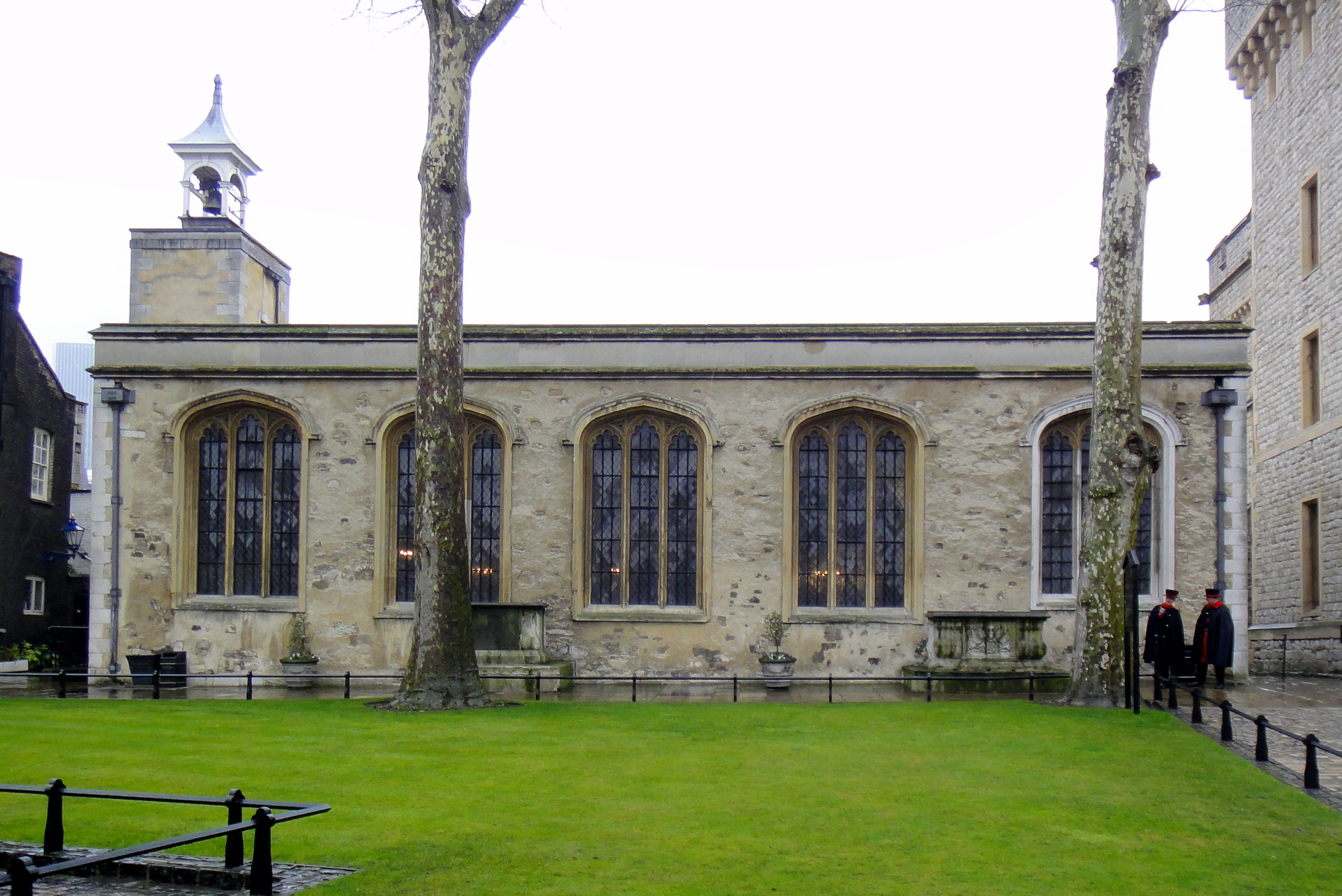
The present church is a short building of nave, chancel and a shorter north aisle, with a low west tower carrying a lantern bell-cote. The windows have cusped lights and no tracery, an early Tudor pattern. It is recorded as built about 1519 to 1520, restored in 1876 and 1877, when the west tower was rebuilt and a north-east vestry added. The walls are render over ragstone, with ashlar quoins and dressings, and the roof is lead.
The south side is of five bays, with hood-moulds over three-light Tudor-arched windows whose lights have cinquefoil heads. The north windows are of the same kind. The east window has five lights. A moulded cornice runs under a parapet with moulded coping.
The west end has a late nineteenth-century quatrefoil over a late nineteenth-century Tudor-arched doorway, a flint tower with Portland stone dressings, and a wooden bell cupola of the late seventeenth century. The vestry of 1876 to 1877 is in a matching Tudor manner. Inside, a four-bay north arcade stands on quatrefoil piers with moulded plinths and capitals, carrying Tudor arches. The roofs are flat, with moulded tie-beams.
The nave has a squint and a round-arched piscina with sunk spandrels toward the west, and an octagonal font with quatrefoil panels. A piscina and a hagioscope, a small opening at eye level toward the altar, survive from the years when the church was Catholic. The ceiling is said to have been made of Spanish chestnut so that Katherine of Aragon, Henry VIII's first queen, might worship under the timber of her own country. The building was listed at Grade I on 30 November 1989.
It stands inside the Tower, which was inscribed in 1988, and it is named among the surviving buildings that carry that inscription's outstanding universal value, together with the White Tower and the towers and gates of the concentric defences. The Tower is also a scheduled monument. The chapel is a rare early sixteenth-century chapel that had once been a parish church of the city and was taken inside the castle when Henry III extended the walls.
How old the first church was is not settled, and the accounts do not agree. The chapel's own history says there has been a place of worship on the site for more than a thousand years, older even than the White Tower, and that the earlier church was taken into the later Norman castle as other castle chapels were. Another account says the origins may belong to a Saxon chapel of the ninth century that stood near this ground. A study of the Tower's setting thinks it probable that the church was founded in the ninth century.
A further proposal is that it was a parish church before the Norman Conquest, and so older than the use of the ground as a fortification. Others conclude that Henry I founded it. Henry I, also called Henry Beauclerc, was king from 1100 to 1135. He was the fourth son of William the Conqueror, born about 1068, and he died on 1 December 1135.
One proposal dates a consecration to 1 August 1110, the feast of Saint Peter in chains. The church is also said to have been first mentioned as a parish church between 1128 and 1134, and one account says it was replaced in 1128 during Henry I's reign. The excavation of 2025 found walls and a floor in the deepest part of the trench that may belong to a church built outside the castle walls between 1110 and 1128, and that church may itself have replaced an older chapel. Those earliest deposits are difficult to date.
If the twelfth-century church stood outside the first circuit, the king could be seen at public worship there, unlike his use of St John's inside the keep.
The same years belong to the Tower's first prisoner. Ranulf Flambard, bishop of Durham, was born about 1060 and died on 5 September 1128. He had served William I, probably on the Domesday survey of 1086 and as keeper of the king's seal, and under William Rufus he raised revenue, held vacant bishoprics and abbeys, supervised London's first stone bridge and the king's hall at Westminster, and in 1099 received Durham. Henry I imprisoned him in the Tower on 15 August 1100, treating him as a scapegoat for the financial demands of Rufus.
Flambard was the first prisoner to escape the Tower. He joined Robert Curthose in Normandy, advised the invasion of 1101, and after Henry defeated Robert at Tinchebray he returned to his see and largely left politics. The dedication to the chained apostle sits beside that history of imprisonment. It is not recorded that Henry chose the name because of Flambard, only that the dedication and the first imprisonment belong to the same reign.
Henry I's own reign explains why a church just outside a royal castle mattered. He had seized the throne when William Rufus died in a hunting accident, ahead of his elder brother Robert. He promised at his coronation to correct unpopular policies, married Matilda of Scotland, and held the crown through the settlement of 1101 and the victory at Tinchebray. He strengthened the exchequer and the eyre, used new men as administrators, quarrelled with Archbishop Anselm and compromised in 1105, and after his son William drowned in the White Ship in 1120 tried and failed to secure the succession for his daughter Matilda.
He died in 1135 and his nephew Stephen took the throne, opening the civil war later called the Anarchy. A church founded, rebuilt or first recorded in that reign stood at the edge of a castle that was still a royal stronghold, not yet the great prison of the Tudor court.
For at least a century the church served as a parish before it became, in the middle of the thirteenth century, the chapel of the people who lived in the Tower. That change belongs to Henry III. Henry III, Henry of Winchester, was king from 1216 to 1272, born on 1 October 1207 and dead on 16 November 1272. He came to the throne at nine, in the First Barons' War.
He was known for piety, for lavish ceremony, and for devotion to Edward the Confessor, whose abbey at Westminster he rebuilt. He also drew heavily on the Jews of England and later issued a statute that tried to separate them from the rest of the population. His foreign wars failed, at Taillebourg in 1242 and in the Sicilian scheme, and in 1258 the barons imposed the Provisions of Oxford. Simon de Montfort seized power in 1263.
Henry was defeated and captured at Lewes in 1264, freed after his son Edward's victory at Evesham in 1265, and died in 1272 after a reign of fifty-six years, then the longest of any English king.
The expansion that swallowed the church belongs to the early part of that reign, not to the later civil war. By 1240 a second great building campaign pushed the castle beyond the Roman wall to the north and east. The expansion brought the church of St Peter ad Vincula and its graveyard inside the fortress. The campaign followed Henry's flight to the Tower in 1238, during unrest caused by his sister's secret marriage to Simon de Montfort.
On 10 December 1241 Henry issued a writ of liberate for the improvement of the church of St Peter within the bailey of the Tower. The writ shows that by 1241 the chapel was already inside the walls. That building had two chancels, one for St Mary and one for St Peter. The royal stalls were wainscoted and painted.
Two altars were dedicated to St Nicholas and to St Katherine. One account says that in 1240 Henry repaired the existing building, replaced the roof and improved the decoration, and that this work lasted forty-six years. Another says the church was embellished in 1240 with large glazed windows and with stalls for the king and queen. A 1908 account of the Tower places the crypt under the church in the middle of the thirteenth century.
The name Arthur Poyser is attached in the chapel's references to that 1908 account, but the page reached under the name Arthur Poyser is the life of Arthur George Poyser, an Australian senator born in Ballarat on 13 February 1915 and dead at Geelong on 5 August 1986. He was a soldier, a tram conductor and a Labor senator for Victoria from 1966 to 1975. He was not a chaplain, a prisoner or a builder of this church, and his life does not date the crypt.
Henry III also kept an enclosed cell for an anchorite, attached to the church or set nearby. He paid the living of at least three recluses, men and women: Brother William, the anchoress Idonee de Boclaund, and Geoffrey le Hermit. Their presence made the chapel a place of enclosed prayer as well as a parish altar and a royal stall.
What Henry did to the fabric is still argued, and the 2025 dig was opened in part to test it. A layer of powdered Reigate stone, also called a powered layer in the same account, lies above the possible twelfth-century walls. Reigate stone is a green-grey freestone from Surrey, used for tracery, columns and door and window surrounds. The powder is the waste of masons cutting a great quantity of it, and it may belong to the works of 1240.
It had not been known whether those works were a repair of Henry I's chapel or a full rebuilding. Burials of Henry III's reign cut through the walls of the earlier chapel. That is read as evidence that he built a new church and that Henry I's walls were taken down, surviving only underground. Those walls were then partly destroyed by the foundations of the next church.
That next church was Edward I's. Edward I, Longshanks, was king from 1272 to 1307, born on 17 or 18 June 1239 and dead on 7 July 1307. He was Henry III's eldest son. He had stood with the barons for a time, then defeated Simon de Montfort at Evesham, joined the Ninth Crusade, and was crowned in 1274.
He reformed administration and statute law, conquered Wales in 1282 and 1283, and later claimed a feudal right over Scotland that opened the first Scottish war of independence. In 1290 he expelled the Jews from England. The chapel's own history says that his father's work lasted forty-six years, and that Edward then demolished the entire church and rebuilt it in 1286 at a cost of £317 8s 3d. Other accounts date the same rebuilding to 1286 and 1287, or to 1287, and call it a great new church.
Its large foundations cut into the older walls. No picture of it survives. It burned in 1512. A layer of ash found in 2025 matches that fire.
One older summary says only that Edward continued work in 1286 and 1287, which can be read either as a completion or as the demolition and rebuild.
Between those medieval churches and the Tudor fire, the chapel changed its institutional place. After 1312 it is thought likely that the vigil for the making of knights of the Bath was held here. That medieval rite, in which bathing stood for purification, is not the same thing as the order founded by George I on 18 May 1725, which gave the knights statutes and a fixed number of places. From 1354 until 1548 the chapel was a small secular college.
By the 1330s the outer curtain of the Tower had been raised to its present height, and the castle was shifting from a royal house toward the offices of state and a military store. The church, already inside the westward expansion, remained the altar of that community.
The fire of 1512 destroyed Edward's church. It was not replaced at once. Work began in 1519, and the last payment was made in September 1520. The standing chapel is that building, also dated 1519 to 1520 and described as dating from 1520.
It was rebuilt for Henry VIII by the lieutenant of the Tower, Sir Richard Cholmondeley, also written Cholmeley. Henry VIII was born on 28 June 1491 and died on 28 January 1547. He became king on 22 April 1509, the second son of Henry VII and Elizabeth of York, heir after his brother Arthur died in 1502. He married Catherine of Aragon under a papal dispensation, failed to obtain an annulment from Pope Clement VII, and had Thomas Cranmer declare that marriage void in 1533.
The Acts of Supremacy made him Supreme Head of the Church of England. He dissolved the monasteries, and he ordered the deaths of Anne Boleyn and Catherine Howard. The chapel that received their bodies had been finished more than a decade before the break with Rome.
Cholmondeley was born about 1460 and is recorded as dying in 1521. He was lieutenant from 1513 to 1520. He was knighted in 1497 for conduct in battle against the Scots, served as a soldier until 1513, and held charges for the safety of castles. On Evil May Day in 1517 he ordered some of the Tower's guns fired into the city to put down the riots, and he was criticised for it.
His illegitimate son, Roger Cholmeley, became Lord Chief Justice of the King's Bench. The chapel is probably the design of William Vertue, who died in 1527. Vertue was a master mason of fan vaults. With his brother Robert he worked at Bath Abbey, and he told Bishop Oliver King that the vault would have no equal in England or France.
He designed the vault, clerestory and walls of Henry VII's chapel at Westminster between 1506 and 1509, after Robert's death. He may have advised John Wastell on the fan vault at King's College, Cambridge, though that vault is thought to be Wastell's. He had already worked at the Tower in 1501 and 1502. His last known work, the fan vault over the crossing at St George's Chapel, Windsor, was finished in 1528, after he died.
The Tower chapel is not itself described as fan-vaulted. The attribution is that he probably designed the rebuilding.
His tomb, shared with his wife Elizabeth Pennington, stands under the central arcade, an alabaster chest with recumbent effigies. The monument has also been dated to his death in 1544, and on that record the surname is spelled Cholmondley. The plaque on the tomb uses Cholmondeley, which has been called a misspelling of Cholmeley, though other branches of the family use the longer form. The tomb was opened during the restoration and found empty.
Neither husband nor wife is recorded as buried in it. The empty chest held the original Tudor font, thought to have been hidden there before parliamentary troops came, and the font was later put back in the chapel.
The dig of 2025 found the foundations of this Tudor church, including reused medieval stone, the first position of the door, which was moved in 1862, and the post holes of the Tudor scaffold. It also found Tudor walls of a structure beside the chapel that had not been known. They may be an early phase of the present church or a related building later demolished. Later, the ground was used to store coal.
A coloured reading of the layers marks Henry I, Henry III, Edward I, Henry VII, Henry VIII and Queen Victoria as successive phases. The same ground is now thought likely to have kept one footprint, with only small shifts, for more than eight hundred years.
As the Tower ceased to be a regular royal house in the later sixteenth century, the chapel was fitted out more clearly as a parish church. A new pulpit and wainscoting came in the late seventeenth century, and a gallery was set on the north and west walls in the eighteenth century. Residents were baptised, married and buried here. They were joined by people executed in the sixteenth century.
The chapel was the church of the extra-parochial place called Tower Within, part of the Liberties of the Tower. On 16 December 1729 it was added to the bills of mortality, the London record of burials, and in 1730 it was taken off again because the inhabitants showed that the place was extra-parochial and outside the ordinary parish system. Extra-parochial places were ended in the nineteenth century. In 1858 the area became a civil parish under the Act of 1857.
The liberty of the Tower was dissolved in 1894, and in 1901 the parish was absorbed by St Botolph without Aldgate.
The chapel is also the regimental church of the Royal Regiment of Fusiliers. The link begins with the raising of the Royal Fusiliers in 1685 to guard the Tower and the artillery train kept there. Officers of the regiment still have the right to marry in the chapel. The Royal Fusiliers, the 7th Regiment of Foot until 1881, existed for 283 years and served in the South African war and both world wars of the twentieth century.
In 1968 they joined the Royal Northumberland Fusiliers, the Royal Warwickshire Fusiliers and the Lancashire Fusiliers to form the Royal Regiment of Fusiliers.
The burials are the reason the chapel is widely known, and they follow the politics of the Tudor court. A table on the west wall lists remarkable persons buried between 1534 and 1747. In 1848 Thomas Babington Macaulay wrote that the little cemetery was sadder than the great churches, because the dead had been brought there by gaolers, without mourners, from the fall of captains, party leaders and courtiers.
The earliest of the famous graves belong to the start of Henry VIII's reign, before the church was rebuilt. Edmund Dudley, born about 1462 or in 1471 or 1472, and Sir Richard Empson, born about 1450, were financial agents of Henry VII. Dudley sat on the Council Learned in the Law, was Speaker of the Commons and President of the King's Council. Empson, a lawyer, was knight of the shire for Northamptonshire in 1491 and Speaker.
After Henry VIII's accession in 1509 both were imprisoned in the Tower and executed on 17 August 1510 on a charge of treason. While he waited, Dudley wrote The Tree of Commonwealth. He was the father of John Dudley, later Duke of Northumberland, and the grandfather of Robert Dudley, Earl of Leicester.
The next graves mark the refusal of the royal supremacy. Sir Thomas More was born on 7 February 1478 and died on 6 July 1535. He was a lawyer, judge, scholar and statesman, Lord Chancellor from October 1529 to May 1532, and the author of Utopia, published in 1516. He wrote against Martin Luther, Huldrych Zwingli and William Tyndale, and he would not accept Henry as supreme head of the church or the annulment of the marriage to Catherine of Aragon.
He refused the Oath of Supremacy, was convicted of treason on evidence he said was false, and at his death was reported to have said that he died the king's good servant and God's first. Pope Pius XI canonised him in 1935. In 2000 Pope John Paul II named him patron of statesmen and politicians, and noted that More's actions against heretics showed the limits of his own time. John Fisher, bishop of Rochester from 1504 to 1535 and chancellor of Cambridge, was born about 19 October 1469 and died on 22 June 1535.
He upheld papal supremacy and was named a cardinal shortly before his execution. Pius XI canonised him with More on 19 May 1935. They share the feast of 22 June, and Fisher's name is also in some Anglican calendars. Both were executed in 1535 for refusing to declare the king Supreme Head of the Church.
Their graves are in this chapel, but the exact spots are not certain.
Anne Boleyn was queen from 1533 to 1536 and was beheaded on 19 May 1536. She was born about 1501 or about 1507, the daughter of Thomas Boleyn, later Earl of Wiltshire, and Elizabeth Howard. She was educated in the Netherlands and in France, returned to England early in 1522, and became maid of honour to Catherine of Aragon after a plan to marry her cousin James Butler fell through. Early in 1523 she was secretly betrothed to Henry Percy.
His father refused the match, and Cardinal Thomas Wolsey broke it off in January 1524. In February or March 1526 Henry began to pursue her. She would not become his mistress, as her sister Mary had been. A secret wedding on 14 November 1532 was followed by a formal marriage on 25 January 1533.
On 23 May 1533 Cranmer declared the marriage to Catherine null. Five days later he declared the marriage to Anne valid. Clement VII excommunicated Henry and Cranmer. Anne was crowned on 1 June 1533.
On 7 September she gave birth to the future Elizabeth I. Henry wanted a son. Anne had three miscarriages, and by March 1536 he was courting Jane Seymour. Anne was arrested on 2 May 1536 and tried by a jury that included Henry Percy and her uncle Thomas Howard, third Duke of Norfolk.
She was convicted on 15 May and beheaded four days later. The charges, adultery, incest with her brother, and a plot to kill the king, are disputed by most historians. Her brother George Boleyn, Viscount Rochford, born about 1504, was accused with her and executed on 17 May 1536. He was buried here, as she was.
He had used the courtesy title Viscount Rochford after his father became Earl of Wiltshire in 1529. He was the maternal uncle of Elizabeth, though he died long before she became queen in 1558. When Elizabeth ruled, Anne was later treated as a martyr of the English Reformation, especially through the writing of George Wyatt. The break with Rome had used her marriage as its occasion.
The Tower was being repaired for that coronation. In the 1530s a survey led to work on the curtain walls, the mural towers, the White Tower and St Thomas's Tower. Much of it was done before June 1533 so that the royal lodgings, which no longer stand, could house Henry and Anne. On that visit Anne created eighteen knights of the Bath.
Those works are not the rebuilding of this chapel, which had been paid for by September 1520. What is now used as a crypt of the chapel, with the great stone doorways in the wall below the Devereux Tower, is described as the last remnant of the huge ordnance storehouses Henry built north of the Inner Ward. That is a different statement from the thirteenth-century crypt and from the crypt created in 1876, and the accounts do not say that the three are one room.
Jane Seymour, born about 1508 or in 1512 or 1513, became queen on 30 May 1536 and died on 24 October 1537 of complications after the birth of Edward VI. She was the only one of Henry's wives to be given a queen's funeral, and she was buried at Windsor, where Henry was later buried beside her. She is not recorded as buried in this chapel. Her brothers are.
Thomas Seymour, first Baron Seymour of Sudeley, born about 1508, died on 20 March 1549. He competed with his elder brother for influence over the boy king, married Catherine Parr, Henry's widow, in 1547, and while she lived drew the fourteen-year-old Elizabeth, then in his household, into flirtation and possibly sexual conduct. The chapel's record places his burial in 1549. Edward Seymour, first Duke of Somerset, born in 1500, died on 22 January 1552.
He was Lord Protector from 1547 to 1549. He beat the Scots at Pinkie but could not hold Scotland. In 1549 he imposed the first Book of Common Prayer by the Act of Uniformity. The Prayer Book Rebellion and Kett's Rebellion, costly war and empty finances brought him down.
In October 1549 John Dudley, then Earl of Warwick, and other councillors put him in the Tower. He was released, then accused of treason in 1551 and executed in January 1552. The chapel records that burial in 1552.
Thomas Cromwell, born about 1485, was Henry's chief minister from 1534 until the middle of 1540, and was beheaded on 28 July 1540. He drove the administrative reform of government, steered the annulment and the supremacy, and as Vicegerent in Spirituals, also called Vicar General, set a reforming course for the new church. He had a part in Anne Boleyn's fall. He was made Earl of Essex in 1540 and then destroyed by the failure of the marriage he had arranged with Anne of Cleves, annulled after six months.
He was condemned by attainder and executed on Tower Hill for treason and heresy. Henry later regretted the killing. Cromwell's burial is recorded here in 1540.
Catherine Howard was queen from July 1540 until November 1541, and she was beheaded on 13 February 1542. She was born about 1523, the daughter of Lord Edmund Howard and Joyce Culpeper, a first cousin of Anne Boleyn and a niece of the Duke of Norfolk. Her uncle placed her in the household of Anne of Cleves, where Henry noticed her. They married at Oatlands in July 1540, nineteen days after the annulment of the Cleves marriage.
Henry was forty-nine and Catherine seventeen. In November 1541, after talk of her earlier entanglements reached him, she was stripped of the title of queen and examined for adultery and treason. Three months later she was beheaded, and her body was thrown into a mass grave. On the chapel's own pages her name is also spelled Katherine Howard.
Modern reading has treated her more carefully as a very young woman used by the men around her. She is the second of the three queens buried here. The third is Lady Jane Grey.
Lady Jane Grey was born in 1536 or 1537 and died on 12 February 1554. She is also called Lady Jane Dudley after her marriage, and the nine-day queen. She was the great-granddaughter of Henry VII through his daughter Mary Tudor, grand-niece of Henry VIII, and first cousin once removed of Edward VI, Mary I and Elizabeth I. She was learned, and a convinced Protestant.
In May 1553 she married Lord Guildford Dudley, a younger son of John Dudley, Duke of Northumberland. Lord Guildford Dudley, also spelled Guilford, was born about 1535 and died on the same day as Jane, 12 February 1554. The wedding was also described as a great celebration about six weeks before the king's death. Edward VI, born on 12 October 1537 and dead on 6 July 1553, was the first English monarch raised as a Protestant.
He became king on 28 January 1547 at nine, crowned on 20 February 1547, and never ruled without a council, first under Somerset and then, from 1550 to 1553, under Northumberland. Henry VIII had broken with Rome but kept much Catholic doctrine. Under Edward, clerical marriage was allowed, the Latin mass was abolished, and English services became compulsory. In 1553, at fifteen, Edward was dying.
Since December 1552 he had meant to remove Mary and Elizabeth. In June 1553 his Devise for the Succession named Jane and her male heirs, setting aside his half-sisters as illegitimate and overriding the Third Succession Act. Northumberland's influence is recorded in that choice. The letters patent were signed by the privy council, bishops and other notables.
Edward died on 6 July 1553. Jane was proclaimed queen on 10 July, or three days after the death, and she waited in the Tower for a coronation that did not come. Mary, born on 18 February 1516, had been declared illegitimate in 1533 and restored by the Third Succession Act of 1543. She fled to the east, proclaimed herself queen, and gathered a force.
By 13 July she had up to six thousand armed supporters. Northumberland would not attack the larger body at Framlingham, retreated to Cambridge, and stopped. On 19 July the council deposed Jane and proclaimed Mary. Mary entered London on 3 August.
Northumberland, born in 1504, had been Vice-Admiral and Lord High Admiral from 1537 to 1547, had fought in Scotland and France in 1544, and led the reforming party. He was executed on 22 August 1553, less than a month after Jane's deposition. Thomas Palmer and John Gates were executed with him. The chapel records the burials of John Dudley, first Duke of Northumberland, and of John Gates in connection with the crisis of 1553.
Jane and Guildford were condemned for treason in November 1553. Mary was at first willing to spare them. They were held in different quarters of the Tower. Jane's father, Henry Grey, Duke of Suffolk, then joined Wyatt's rebellion against Mary's plan to marry Philip of Spain, and Jane and Guildford were beheaded on 12 February 1554.
Jane was sixteen or seventeen. The marriage to Philip took place in July 1554, and from January 1556 until her death on 17 November 1558 Mary was also queen of Spain. Her five years reversed the Edwardian church as far as Parliament would allow, and more than 280 dissenters were burned. Elizabeth, imprisoned for nearly a year under Mary, succeeded on 17 November 1558 and settled a church of which she was supreme governor.
The three queens were executed in different places inside the Tower and are commemorated by a memorial on Tower Green. In 1866 the ground immediately south of the church was railed off and a granite and brass plaque was set up for the execution of Anne Boleyn. That spot has been called the Scaffold Site, and also the Execution Site, ever since. A handful of people were killed on Tower Green.
A much larger number died on Tower Hill.
Two later burials close the Tudor and Stuart sequence. Philip Howard is named in the chapel's burial list as the twentieth Earl of Arundel, and his life is also titled as the thirteenth Earl of Arundel. He was born on 28 June 1557 and died on 19 October 1595. He lived mostly under Elizabeth, was charged as a Roman Catholic with leaving England without leave and with Jesuit plots, and was sent to the Tower in 1585.
He remained for ten years and died there of dysentery. He was canonised in 1970 by Paul VI as one of the Forty Martyrs of England and Wales. He was buried in this chapel for a time, and his body was later taken to Arundel. He is counted, with More and Fisher, among the saints who suffered under the Tudors, though his death belongs to Elizabeth's reign.
James Scott, Duke of Monmouth and Duke of Buccleuch, was born James Crofts or James Fitzroy in Rotterdam on 9 April 1649, the eldest illegitimate son of Charles II and Lucy Walter. He commanded in the Dutch wars and in 1685 led the Monmouth Rebellion against his uncle James II, a Roman Catholic. At Taunton an officer declared Monmouth the legitimate king. The rising failed, and he was beheaded for treason on 15 July 1685.
He was buried here under the communion table. The same year, 1685, saw the abolition of the canonry and the raising of the Royal Fusiliers.
The monuments are not all graves of the executed. In the north-west corner is the memorial of John Holland, second Duke of Exeter and second Earl of Huntingdon, Constable of the Tower, who died in 1447. His own life dates the death to 5 August 1447. He was born on 29 March 1395.
His father, a half-brother of Richard II, was executed after Richard's deposition, and the family titles were forfeited. John recovered them by service. He fought for Henry V in France by land and sea, and under Henry VI he was marshal and admiral of England and governor of Aquitaine. The monument, a tomb chest with three recumbent effigies under a Perpendicular canopy, with beasts, grotesques and carved heads, is recorded as transferred from St Katharine's Chapel in Regent's Park.
In the sanctuary is the memorial of Sir Richard Blount, lieutenant of the Tower, who died in 1564, and of his son Sir Michael Blount, also lieutenant, who died in 1610. Both would have seen many of the executions. Their alabaster and marble monument, of about 1620, sets groups of kneeling figures in a classical frame on the north wall of the chancel. Other memorials include one of about 1650 to the children of George Payler, with figures in oval niches; Allan Apsley, dead in 1630, a cartouche on an open pediment; a plain tablet to Talbot Edward, dead in 1674; a bust of General William Bridges, dead in 1716; and Captain Valentine Pyne, dead in 1677, whose memorial is flanked by cannon rather than columns and carries a ship in relief.
A late nineteenth-century memorial in the sanctuary names those executed on Tower Green. The organ is described both as a fine instrument of the seventeenth century decorated with carvings by Grinling Gibbons and as an organ by Father Schmidt, made in 1699 for the Banqueting House at Whitehall. Gibbons was born in Holland on 4 April 1648 to English parents and died on 3 August 1721. He worked chiefly in limewood, in garlands of still life, and by the time he was established he ran a large workshop, so a carving linked to his name is not always from his own hand.
The interior was altered more than once after the Tudors. Despite constant use, the building was poorly kept. In 1865 the chaplain wrote to the Office of Works that the walls were crumbling with damp, among other faults. Anthony Salvin prepared plans in 1867.
The work waited until 1876 and 1877. The seventeenth- and eighteenth-century fittings, including the gallery, were removed. The floor was replaced because it was collapsing under the number of burials made since the sixteenth century. Many of the remains were moved into a newly made crypt.
The chancel was excavated. One account says three burials were identified as Anne Boleyn, Margaret Pole, Countess of Salisbury, and John Dudley, Duke of Northumberland. The chapel's own history says the bodies of Anne Boleyn and Lady Jane Grey, among others, were identified, and that Salvin's marble floor, still in the chancel, marks their resting places. Another account says the supposed remains of Anne Boleyn were found in the chancel and reburied near the altar under a memorial pavement inscribed with the queens' names and coats of arms, and that the true places of the queens' graves remain unknown.
Margaret Pole, born Margaret Plantagenet on 14 August 1473, was the daughter of George, Duke of Clarence, brother of Edward IV and Richard III, and of Isabel Neville. She was Countess of Salisbury in her own right, one of only two women of the sixteenth century who sat as peeresses without a husband in the Lords. She survived the Wars of the Roses as one of the few Plantagenets left, and Henry VIII, son of her cousin Elizabeth of York, had her executed on 27 May 1541. Pope Leo XIII beatified her on 29 December 1886.
Her son Reginald Pole was the last Catholic archbishop of Canterbury. The nineteenth-century campaign under Salvin and his successor John Taylor stripped St Peter's of seventeenth- and eighteenth-century furniture and laid a new floor, as part of a wider Gothic revival repair of the Tower. Most of Salvin's own later fittings, the pews, the pulpit and the reredos, were taken out in the winter of 1970 to 1971, to leave a plainer arrangement. In 2014 the chapel was restored again, with new furniture and lighting, and the crypt was improved to give the choir an office and facilities.
Two large tomb chests just outside the building have been conserved, as have medieval monuments and the stone floor inside. The parish registers of this chapel and of St John are kept by the chaplain, with a digitised copy in the curators' library at the Tower.
The excavations of 2019 and 2025 were made so that a lift could give a step-free entrance. The chapel had been reached only by stairs. The project had been in preparation for almost seven years, or for more than six years, by the spring of 2025. A trial pit in 2019 found two skeletons outside the chapel, the first complete articulated skeletons dug inside the Tower for more than forty years.
They are described as a high-status Tudor woman and a young boy, buried in coffins close to the entrance, and also as people of the Tower community who probably died in the early sixteenth century. They were the first to be studied with modern scientific methods, with Cardiff University and with the heritage body that advises on ancient monuments. That first study was helped by a research grant from the London and Middlesex Archaeological Society. Isotope analysis, reading diet, health and movement from a fragment of tooth, was led by Katie Faillace at Cardiff.
The larger dig was led by the palace curators, including Alfred Hawkins, curator of historic buildings, and carried out by the archaeological contractor, with Jane Sidell inspecting for the monuments authority. Scheduled monument clearance was granted. The 2025 trench was more than ten times the area of the trial. It is called the first major excavation outside the chapel, the most important at the Tower for a generation, the first at the Tower for more than thirty years, and deeper than any dig there since the 1970s, reaching twelfth-century layers more than two metres down.
The number of people is given both as more than twenty and as up to fifty, more than had been expected. There was also a large amount of charnel, the loose bone that comes when graves are dug through older graves. The burials run from the thirteenth century to the seventeenth, or from the 1200s to the 1600s. All lie east to west, as in a Christian cemetery.
Most were in shrouds. At least four burials of the thirteenth century were in coffins, a rare and usually higher-status practice. The wood has gone. In one case the shape of a child's coffin of the 1200s survived as a stain in the clay.
Elsewhere coffin nails and the lie of the bones are the evidence. A child in a coffin, probably of the time of Edward I's chapel, had been cut through the remains of Henry I's building. A group of the 1300s, more than six people, looks hurried and less orderly than the graves before and after. They may be a mass grave of the Black Death, the plague of bubonic, pneumonic and septicemic disease caused by Yersinia pestis, or they may belong to some other crisis.
Emergency plague cemeteries were opened at West Smithfield, now the Charterhouse, and at East Smithfield near the Royal Mint, just north-east of the Tower, but local churchyards took the first deaths. These graves are also said to predate the more formal plague burials of the later reign of Edward III. Certainty waits on further analysis.
One thirteenth-century grave held two pots filled with charcoal, called gravpottes, vessels of purification that contained incense. The pots are dated to the twelfth or early thirteenth century, and also to the twelfth to thirteenth century. The custom is common in Denmark and northern France and had been recorded only once before in England. The same find is also described as known once before in England and once in Scotland.
It may mean that the dead person was not English and had asked for this rite, or that someone at the Tower knew how to bury a foreigner. A fragment of shroud is a rare survival, because textile usually lasts only where there is no air. Sieving of every bucket of soil, done so that bone fragments can be put back in the crypt, also recovered sewing pins and shroud pins, buckles, book clasps, jewellery, a pendant, sewing needles, a ring, several cannon balls, a mortar, glazed floor tiles, and stained and painted glass, including a piece that may show the letter A. The architectural sequence already described, from a possible church of Henry I, through Henry III and Edward I, the fire of 1512 and the Tudor foundations, came out of the same trench.
When the study is finished, the remains are to be reburied in the crypt of the chapel. Further analysis is expected to take years.
The chapel is still a working church of the Tower community, used for regular services, baptisms, marriages and concerts. The lift at the entrance is part of that continued use, not a closing of the building. The parish records, the memorial pavement, the empty Cholmondeley tomb and the new bones outside the west side are layers of one church, not separate monuments. What the place changed, in the years when it stood outside the walls and in the years when it stood inside them, was the relationship between the king's worship, the household's worship, and the graves of people the state had killed.
The building that survives is the church paid for in September 1520. Everything under it is older, and not all of it has yet been dated.
Sources
- Chapel of St Peter ad Vincula — Historic England
- Most significant archaeological dig at the Tower of London in a generation — Historic Royal Palaces
- Discoveries from excavations outside the Chapel of St Peter ad Vincula — Historic Royal Palaces
- Tower of London excavation reveals medieval burials and lost chapels — Pre-Construct Archaeology
- The Chapel of St Peter ad Vincula — Chapels Royal, HM Tower of London
- Getting into the Tower for services — Chapels Royal, HM Tower of London
- Chapel Royal of St Peter ad Vincula — Historic Royal Palaces
- Services — Chapels Royal, HM Tower of London
- Opening and closing times, Tower of London — Historic Royal Palaces
- Tower of London World Heritage Site management plan — UNESCO World Heritage Centre
- Church of St Peter ad Vincula — Wikipedia
- Anne Boleyn — Wikipedia
- Catherine Howard — Wikipedia
- Lady Jane Grey — Wikipedia
- Lord Guildford Dudley — Wikipedia
- Thomas More — Wikipedia
- Saint Peter — Wikipedia
- Agrippa I — Wikipedia
- Arthur Poyser — Wikipedia
- Henry VIII — Wikipedia
- St-Peter-Ad-Vincula.jpg — Wikimedia Commons
- Tower of London, Chapel of St Peter ad Vincula.jpg — Wikimedia Commons
- ToL PeteradVincula01.JPG — Wikimedia Commons
- Place of Execution in Front of St. Peter’s Chapel.jpg — Wikimedia Commons
- The Tower of London - geograph.org.uk - 844907.jpg — Wikimedia Commons
- Tower of London - geograph.org.uk - 1775785.jpg — Wikimedia Commons
- Crop ToL PeteradVincula01.JPG — Wikimedia Commons
- London tower st peter 08.03.2013 13-53-38.JPG — Wikimedia Commons
- Image taken from page 678 of 'Old and New London, etc' (11288931095).jpg — Wikimedia Commons
- St. Peter ad Vincula, August 2014 (1).JPG — Wikimedia Commons