
Perth and Kinross, United Kingdom · United Kingdom
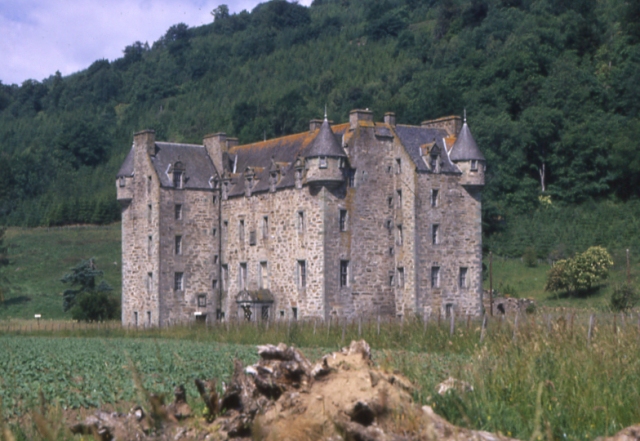
- Castle Menzies, west of Weem near Aberfeldy, is the Z-plan seat of Clan Menzies, with a doorway dated 1571 and a dormer dated 1577.
- An older house here followed the burning of Comrie Castle in 1487, was sacked or burnt in 1502, and is tied to a Menzies–Stewart marriage dated 1371, 1540, and 1571.
- Bonnie Prince Charlie rested for two nights in 1746 on the way to Culloden, and the Duke of Cumberland’s forces occupied the castle four days later.
- William Burn added a wing around 1840, and Duleep Singh, last maharajah of the Sikh Empire, lived here from 1855 to 1858 as the ward of Sir John Spencer Login.
- The clan society bought the ruin in 1957, or in one account 1958, and a restoration from 1972 reopened the house, which was flooded again in February 2026.
Visiting
The castle is open from 3 April 2026 until late October. Mondays to Saturdays, except Fridays, open from 10.30am with last entry at 4.30pm. A second notice gives those days as open from 10.30am to 4.30pm. The castle closes on Fridays for the remainder of 2026.
Sundays open from 11.00am with last entry at 4.30pm. Sundays are also given as open from 11.00am to 4.30pm. Bank and public holidays are open from the same hours as the rest of the season. The castle closes from 12.30pm on Monday 19 October and is closed on Tuesday 20 October for a private function.
The castle closes early, or all day, when a private function is booked, and a notice at the entrance gives that closure. Adult admission for the castle and garden is £16, or £17.60 on a Gift Aid ticket, and concession admission is £15, or £15.50 on a Gift Aid ticket. Castle-only adult admission is £14, or £15.40 on a Gift Aid ticket, and concession admission is £13, or £14.30 on a Gift Aid ticket. Garden-only adult admission is £5, or £5.50 on a Gift Aid ticket, and concession admission is £4, or £4.40 on a Gift Aid ticket.
Old Kirk and Menzies Mausoleum adult admission is £4.50, or £4.95 on a Gift Aid ticket, and concession admission is £4, or £4.40 on a Gift Aid ticket. Children from birth to 15 are free on admission when accompanied by a paying adult. A private tour ticket starts at £60 plus entry tickets. Lifting the Menzies Stone needs a £10 ticket plus an entry ticket.
A Gift Aid ticket allows unlimited entry for 12 months. Group tickets may be booked in advance for a minimum of 16 people. Staff reserve the right to refuse entry, and admission fees may rise from year to year. Visitors who cannot manage stairs may not enter the upper floors, though a ground-floor film shows those rooms, and a disabled toilet is provided.
No dogs except guide dogs are allowed to enter the castle. Children are not allowed inside unless accompanied by an adult, and steep steps, spiral stairs, uneven floors and low doorways require care. Haunted-tour tickets cost from £12 an adult from June to October, last about an hour and a half, are not allowed under the age of 12, and ask visitors to wear sensible footwear and to dress accordingly.
History
Castle Menzies stands a little west of Weem, near Aberfeldy, on the north side of the Tay. It is the Z-plan seat of the chiefs of Clan Menzies and of the Menzies Baronets, with the date 1571 over the door and 1577 on a dormer. One record places the building between those two years. The family’s hold on this ground is counted at more than five hundred years.
An older house, the Place or Palace of Weem, was built about 1488 after Comrie Castle burned in 1487. It was plundered, sacked, or burnt in 1502 by Stewart of Garth, also named Neil Stewart of Garth, over the lands of Fothergill or of Rannoch. James IV ordered restitution. The free barony of Menzies is dated both to that new house and to 1510.
A marriage stone of James Menzies and Barbara Stewart is said to have been set up in 1371. A clan history dates the marriage to 1540, and a landscape record dates it to 1571 and says her dowry paid for the present castle. The walls are random rubble, once harled, with blue freestone dressings of the kind used at the Old Kirk of Weem. William Burn’s wing is dated 1836, 1839 to 1840, and 1840.
In 1598 a MacGregor broke into the dungeons to free Donald Menzies. In the civil wars the Perthshire chiefs opposed Charles I, Montrose fatally wounded the chief, and the chief’s son was killed at Inverlochy. Cromwell’s forces are said to have occupied the castle in the 1650s. The Nova Scotia baronetcy of Castle Menzies was created on 2 September 1665.
The chiefs stood aside from the rising of 1745. Bonnie Prince Charlie rested here for two nights on the way to Culloden, and four days later the Duke of Cumberland’s troops took the house. They pulled down an office house and a garden wall and destroyed orchard trees. Sir Robert, the third baronet, claimed two hundred pounds, and a letter of 3 May 1750 treated the claim as a government matter.
Sir Neil, the sixth baronet, planted the waste ground and commissioned Burn. Sir Robert, the seventh, inherited in 1844 and is credited with about two million trees and an arboretum of conifers from America and Asia. A roof fire on 21 April 1878 was nearly out by ten in the evening, and Lady Menzies died the following month. Duleep Singh, last maharajah of the Sikh Empire, lived here from 1855 to 1858 as the ward of Sir John Spencer Login and Lady Login.
The eighth baronet died without heirs in 1910, and the title ended. Contents were auctioned in 1913 and papers in 1914, among them a letter of Mary, Queen of Scots, dated 31 August 1566. Francis Willey bought the castle and 11,600 acres in 1918 for 69,000 pounds. Another account dates a sale to 1914, and the widow offered the estate again in April 1930.
During the Second World War the house was a medical depot for the Polish Army.
The clan society bought the ruin in 1957 for under three hundred pounds, or in 1958 on another dating. From September 1972 Bill and Ann Dewar led a restoration that demolished the rotten eighteenth-century north wing and later reopened the Victorian ballroom as the Dewar Room. A charitable trust of 1993, also dated 1994, became The Castle Menzies SCIO in 2023. The house was listed Category A in 1971 and was descheduled on 18 December 1990, though one record still calls it a scheduled monument.
The grounds entered the inventory of gardens on 30 June 1987, or on 1 July 1987. The walled garden was bought in 1984. A watching brief in the Old Kirk found only modern bedding under the paving. In 1970 the home farm produced Iron Age querns, pottery, and a possible burial, separate from the castle walls.
A 2025 appeal sought a laser-scanned replacement for the 1816 entrance armorial, and in February 2026 storms flooded the lower structure and, on a second notice, the foundations.
Images


Detailed History
Castle Menzies stands a little west of the village of Weem, near Aberfeldy, in Highland Perthshire, on the north side of the valley of the River Tay. It is the ancestral seat of Clan Menzies and of the Menzies Baronets. The present house is a sixteenth-century Z-plan castle, and it has also been called Castle Weem, the Place of Weem, the Palace of Weem, and the Old Castle of Weem. Accounts of the chiefs’ seat say that the family held it for over five hundred years, and a record of the designed landscape says the association lasted more than five hundred years and, in one sentence, that it was uninterrupted.
The same landscape record also says that the direct family line expired in 1910 and that the present chief comes from the collateral line of the Menzies of Culdares.
The building is described as a Renaissance example of the change in Scottish castles from earlier rugged Highland fortresses to later mansion houses, and also as a transition from rugged fortresses to lightly defensible châteaux. The original part is of three storeys and an attic, in random rubble, with richly sculptured dormer heads and angle turrets. The walls were originally harled. The quoins, the turrets, and the door and window surrounds are of finely carved blue freestone, a hard-weathering stone also used for the details and monuments at the Old Kirk of Weem, which the family built and which holds their monuments and funeral hatchments.
The doorway sits in a re-entrant angle and has an iron yett. An armorial panel and the date 1571 are over that door, and the date 1577 is cut at a dormer head. A map of 1901 marks the castle with the date 1571. A designed-landscape record says the house was built between 1571 and 1577.
A field visit on 11 December 1974 found the original Z-plan then being renovated, a heraldic panel over the door dated 1571, and the nineteenth-century additions to the north demolished. A visit on 1 December 1978 found no change. Photographic surveys were made in 1954 and in October 1963.
The clan’s own account of its origins places the family at Mesnières in Normandy, then in England under the name Manners, and among the ancestors of the Dukes of Rutland. Sir Robert de Myneris appeared at the court of Alexander II of Scotland, received royal patronage, and rose to be a chamberlain in 1249. He was granted lands in Glen Lyon and Atholl. Those grants were reinforced in 1296 by a grant of Strathtay to his son Alexander.
Alexander also acquired Weem and married Egida, a daughter of James Stewart, the fifth High Steward of Scotland. The clan motto, Vil God I Zal, meaning God willing I shall, is supposed to have been first spoken by Chief Lord Robert the Menzies at the Battle of Teba in 1330, in answer to a call to action by Sir James Douglas, and the crest, a savage head erased proper, is said to come from that battle as well. The war cry is Geal ’us Dearg a suas, Up with the White and Red. The plant badge is the Menzies’ heath.
Alexander’s son, another Sir Robert, was a companion-in-arms of Robert the Bruce and was awarded lands in Glen Dochart, Finlarig, Glen Orchy, and Durisdeer.
Another Sir Robert Menzies, counted as the eighth chief, built Weem Castle, near the present house, in about 1488. A separate account says the original home was Comrie Castle in Glen Lyon, burned in 1487, and that the clan then moved to Weem. Comrie is also described as a ruinous L-plan tower four and a half miles west of Aberfeldy, burned in 1487, with the move to Weem following that fire, though branches used Comrie until about 1715. The Old Castle of Weem is said to have been built in 1488, on or near the present site, by Sir Robert de Menyrs, and also to have been built after 1487.
One account says the lands were formed into the barony of Menzies at that building. Another says that James IV erected the Menzies lands into the free barony of Menzies in 1510.
The older castle was plundered in 1502 by Stewart of Garth in a dispute over the lands of Fothergill. Janet Menzies had married a Stewart about a century earlier, and Garth claimed those lands as part of her tocher, or dowry. Menzies appealed to the Crown. James IV found in his favour and ordered Stewart to make restitution.
Other accounts say the house was sacked fifteen years after it was built, by Neil Stewart of Garth, or that it was burnt out in 1502 by Neil Stewart of Garth after a quarrel over the lands of Rannoch, or that it was destroyed about 1502. The feud between the families is said to have continued for much of the sixteenth century.
The marriage of James Menzies and Barbara Stewart is given on three dates. A marriage stone above the original entrance is said to have been installed by James Menzies in 1371 to record his marriage to Barbara Stewart, daughter of John Stewart, third Earl of Atholl, and Jean Forbes. A clan history places the marriage in 1540 and calls Barbara the daughter of John Stewart, third Earl of Atholl, and a cousin of Henry Stuart, Lord Darnley, described there as the future king. A designed-landscape record places the marriage in 1571 and calls James the great-grandson of Sir Robert.
In that account Barbara was the daughter of the Earl of Atholl, her dowry may have been in part compensation for the loss of the clan home, the present castle was rebuilt from that dowry, and she is thought to have been greatly influential in its design. Modern aerial photographs are said to show what may have been a barmkin wall around the castle at that time. The state of the landscape then is described as uncertain.
Inside, some panelling is of the seventeenth or eighteenth century, some of it is the work of William Burn in 1840, and the main hall was redecorated about 1800. A large staircase on the north, now gutted, and a new front door belong to the eighteenth century. The west wing, and a new front porch that replaced an eighteenth-century doorway, are given to William Burn in 1840. An entirely new wing is also dated 1840 and is said to have been built with stone from the same quarry on the south side of Loch Tay.
A note of the architect’s work dates alterations and additions to 1836. The designed-landscape record says Sir Neil Menzies, the sixth baronet, commissioned William Burn in the last years of his life, and that the alterations and additions were of 1839 to 1840. William Burn’s own list of works includes a new wing at Castle Menzies in 1840.
William Burn was born on 20 December 1789 in Rose Street, Edinburgh, the fourth of sixteen children of the architect Robert Burn and Janet Patterson, and he died on 15 February 1870, aged 80, at 6 Stratton Street, Piccadilly, London. He was buried at Kensal Green. He trained with Sir Robert Smirke in London from 1808, returned to Edinburgh in 1812, and designed country houses after an unsuccessful competition, against William Henry Playfair, to finish Robert Adam’s Old College. He was elected a Fellow of the Royal Society of Edinburgh in 1827.
David Bryce became his pupil in 1825 and his partner in 1841, with Bryce running the Scottish office and Burn the English office in Stratton Street. From 1844 his nephew John Macvicar Anderson was a partner in London. The partnership with Bryce ended about 1850. Burn is counted as a pioneer of the Scottish Baronial Revival.
He was Grand Architect of the Grand Lodge of Scotland from 1827 to 1844, and jointly with Bryce until 1849.
In 1598 John Dow MacWilliam, alias MacGregor, broke into the castle to rescue a thief, Donald Menzies, from the dungeons. The owner, Alexander Menzies of Weem, complained that John Murray of Tullibardine then welcomed Donald Menzies and MacGregor as his household men and servants.
During the Wars of the Three Kingdoms the clan, despite royal and Stewart links, opposed Charles I, and James Graham, first Marquess of Montrose, harried Menzies. Montrose sent a messenger seeking support. The messenger was wounded. Montrose retaliated, and in the skirmishing the chief was fatally wounded.
The chief’s son, a major in the Covenanter army, was killed at the Battle of Inverlochy. Menzies families in the north, independent of the Perthshire chiefs, fought for Montrose. Sir Gilbert Menzies of Pitfolds was with Montrose through the campaign and was at Inverlochy when the chief’s son was killed. The castle is also said to have been occupied by the forces of Oliver Cromwell in the 1650s.
In 1665 Sir Alexander Menzies was created a baronet of Nova Scotia. The Menzies Baronets, of Castle Menzies in the County of Perth, were a title in the Baronetage of Nova Scotia, created on 2 September 1665 for that Alexander. His brother, Colonel James Menzies of Culdares, claimed to have survived no fewer than nine serious wounds and is the ancestor of the present chiefs. Another brother was killed at the Battle of Worcester in 1651.
The chiefs opposed the policies of James VII of Scotland, who was James II of England. When he was forced from the throne in 1688 they supported Mary II and Prince William of Orange. The clan was divided. Major Duncan Menzies of Fornock led his men in the Highland charge at the Battle of Killiecrankie, where they defeated government troops.
Hundreds of their Perthshire kinsmen were on the government side in an Independent Highland Company. That company later fought at the Battle of Cromdale in 1690, where the Jacobites were defeated.
In the Jacobite rising of 1715, Menzies of Culdares supported the Jacobite cause. He was captured and exiled to Maryland, later returned to Scotland, and by 1745 was beyond active campaigning. He sent Prince Charles Edward Stuart a fine horse. The clan was out in force under Menzies of Shian, who was killed with his son during the campaign.
The Menzies lands of Glen Lyon sheltered refugees from the Battle of Culloden, including members of the prince’s personal staff. The chiefs themselves did not support the rising of 1745.
Bonnie Prince Charlie, the Stuart pretender, rested for two nights in the castle on his way to the Battle of Culloden in 1746. Four days later the castle was occupied by British-Hanoverian forces led by the Duke of Cumberland, son of the British monarch and commander of the government army. Charles Edward Louis John Sylvester Maria Casimir Stuart was born on 31 December 1720 at the Palazzo Muti in Rome and died on 30 January 1788. He was the elder son of James Francis Edward Stuart and the grandson of James VII and II.
Jacobites knew him as Charles III, and he is also called the Young Pretender and the Young Chevalier. He led the rising of 1745 after a French invasion plan was broken up by storms in 1744. Jacobite forces won at Prestonpans in September 1745 and at Falkirk Muir in January 1746, and were defeated at Culloden in April 1746. He was baptised with names taken from his great-grandfather Charles, from Edward the Confessor, from the king of France, from the kings of Poland, and from Saint Sylvester’s Day, the day of his birth.
Historians differ on whether Pope Clement or the Bishop of Montefiascone baptised him. His mother was Maria Clementina Sobieska. After Culloden he lived on the continent except for one secret visit to London, was exiled from France in 1748 under the Treaty of Aix-la-Chapelle, and later lived in Florence and Rome. He married Princess Louise of Stolberg-Gedern in 1772.
The garrison of 1746 is recorded as pulling down a large office house at the back of the castle and a high garden wall on the east of it, which might have proved inconvenient in an attack, and as destroying the whole front of the orchard and a great number of the fruit trees. Sir Robert Menzies of Menzies, the third baronet, claimed for damages, part of which was for rebuilding a high garden wall that had been torn down. A memorial claimed two hundred pounds for damage done by the garrison. A letter of 3 May 1750 from Sir Edward Fawkener disclaimed the Duke of Cumberland’s responsibility and treated the claim as a government matter.
Sir Robert wrote to the Duke of Argyll in 1754 that he could not use the house until it was repaired and that he had kept the claim on the moderate side. In 1747 he is said to have built the north wall of the terraced garden to plant fruit trees against it. That wall may be the present middle wall, which still carries apple trees, while the northernmost wall still has plums and pears. Repairs in 1747 were also done by Edinburgh craftsmen, among them Daniel Ross, upholsterer, Alexander Dallas, silk dyer, Adam Anderson, pewterer, Andrew Wilson, smith, and James McLearin, mason, for kitchen and cellar work, with notes of damage attested by David Hendrie, wright at Taymouth, and Donald Menzies, wright at the castle.
The eight Menzies Baronets of Castle Menzies were Sir Alexander, the first, who died in 1695; Sir Alexander, the second, who died about 1730; Sir Robert, the third, who died in 1786; Sir John, the fourth, who died in 1800; Sir Robert, the fifth, who died in 1813; Sir Neil, the sixth, who lived from 1780 to 1844; Sir Robert, the seventh, who lived from 1817 to 1903; and Sir Neil James, the eighth, who lived from 1855 to 1910. The title became extinct on the death of the eighth baronet in 1910. Between 1914 and 1917 David Prentice Menzies of Plean Castle, Stirlingshire, claimed it without success as the nearest lawful heir male of the line of Captain James Menzies.
Sir Neil, the sixth baronet, planted much of the wasteland around the castle. The New Statistical Account of 1840 describes about one hundred and ninety acres of wood around the Rock of Weem, largely oak and larch with some ash, beech, and elm, and says the proprietors paid much attention to their woods. Sir Robert, the seventh, inherited the estate in 1844 and is said to have planted at least two million trees, and in another sentence nearly two million, between 1844 and 1903. His plantings were deciduous and coniferous, much of them in Weem Wood north of the castle.
An account of 1833, before his inheritance, already describes in that wood an avenue of large beeches about one hundred and fifty to two hundred feet above the castle, appearing to connect with the old castle. Species included oak, beech, larch, and Scots pine, and he also planted newer conifers, among them Pinus nigra maritima, Pseudotsuga menziesii, and Tsuga heterophylla, with rhododendrons as cover for game. He established an arboretum from seed collected by Jeffrey and Browne and other collectors in California and British Columbia, including Pseudotsuga menziesii, Tsuga heterophylla, Abies grandis, Thuja gigantea, and Calocedrus decurrens, tried as possible forest trees, and also Cedrus deodara from Indian seed, Cryptomeria japonica, and Sequoiadendron gigantea. A specimen of Arbutus menziesii, planted about 1870, had reached about twelve feet by 1883.
Near the cottage a large Ginkgo biloba and a Thuja dolabrata were planted at the same time. The Thuja is one of the few specimens of that arboretum that remains. In 1983 Alan Mitchell measured Pinus jeffreyi, Thuja plicata, and two Chamaecyparis lawsoniana.
The designed landscape that remains was largely set out between 1823 and about 1860, with mass tree planting from 1844 to 1903, and with alterations in the middle and later twentieth century. It covers some three hundred and thirty-three acres, or one hundred and thirty-five hectares, from Weem Wood in the north to the road along the south, the lodge on the west, and the village of Weem on the east. A wall bounds the policies between the east and south lodges. Between the south lodge and the home farm a ha-ha forms the enclosure.
The castle sits about a mile, also given as two kilometres, west of Aberfeldy. North of it the ground rises to the Rock of Weem on Weem Hill, given as 1,637 feet, or 499 metres. Views from the park are confined to the Tay valley, with Drummond Hill and Ben Lawers to the west on a clear day. The parkland was once well stocked.
A double avenue along the southern boundary may be the one shown on a map of about 1750. An account of 1883 says the avenue trees could still be seen, that they had been narrowly spaced, and that individual trees were of great size, and a gazetteer of that year describes some of the finest trees in Scotland. By about 1900 the old avenue toward the Castle of Weem was less distinct. Most parkland trees have gone, except a few copper beeches of the mid-nineteenth century.
Much of Sir Robert’s planting has been felled. Woods planted about 1950 are largely coniferous and are managed commercially. The woodlands are now said to be owned by the Forestry Commission. The gardener’s cottage remains in separate ownership.
The major part of the parkland and the home farm is owned by a local farmer, and the eastern end has been developed for private housing. The west drive is a farm track between the mid lodge and the castle. Access to the castle and the walled garden is from the south drive.
On Sunday 21 April 1878, around seven in the evening, a fire broke out in the roof. A man passing on the road raised the alarm. Sir Robert and Lady Menzies were at Farleyer. Word was sent, and they returned at once.
Local efforts kept the fire under control. By ten, when a fire engine from Taymouth Castle arrived, the fire was nearly out. The excitement was thought to have affected Lady Menzies’s health, and she died the following month. A report of her funeral appeared in early May 1878.
Duleep Singh, the last maharajah of the Sikh Empire, lived at Castle Menzies between 1855 and 1858, after his exile from the Punjab in 1854. He was officially the ward of Sir John Spencer Login and Lady Login, who leased the castle for him. Maharaja Sir Duleep Singh, also spelled Dalip Singh, was born on 6 September 1838 and died in Paris on 22 October 1893, at the age of fifty-five. He was later nicknamed the Black Prince of Perthshire.
He was the youngest son of Maharaja Ranjit Singh and the only child of Maharani Jind Kaur. After Ranjit Singh’s death in 1839 he lived quietly with his mother at Jammu. They were recalled to Lahore in 1843 after the assassinations of Maharaja Sher Singh and Raja Dhian Singh, and on 16 September 1843, at the age of five, he was proclaimed maharaja, with his mother as regent. He was betrothed to Tej Kaur, granddaughter of Sham Singh Attariwala, but that betrothal was not honoured once he was under British guardianship.
After the First Anglo-Sikh War a council of regency replaced his mother, who was later imprisoned and exiled. More than thirteen years passed before he was permitted to see her again. After the Second Anglo-Sikh War and the annexation of the Punjab on 29 March 1849 he was deposed at the age of ten. He was allowed to live anywhere but the Punjab, with a pension of 120,000 rupees a year, given as 50,000 pounds.
Property reckoned at fifteen million rupees was taken, including the Koh-i-Noor. He was placed in the care of Dr John Login and sent from Lahore to Fatehgarh on 21 December 1849. He later moved to Britain, where Queen Victoria befriended him and became godmother to several of his children. He met his mother again on 16 January 1861 in Calcutta and brought her to Britain.
In June 1861 he was one of the first twenty-five Knights of the Order of the Star of India.
The Sikh Empire was a regional power in the Punjab. It is dated from 1799, when Ranjit Singh of the Sukerchakia Misl captured Lahore, to 1849, when the British East India Company annexed it after the Second Anglo-Sikh War. Ranjit Singh was crowned on 12 April 1801 by Sahib Singh Bedi, a descendant of Guru Nanak. By 1813 the remaining Sikh misls had been annexed.
Afghan power east of the Indus ended, on this account, after the fall of Multan in 1818, and Kashmir and Peshawar were later lost to the Sikhs. By 1840 Ladakh and Baltistan had been brought under Sikh suzerainty by Gulab Singh. At its peak the empire is described as reaching from Gilgit and Tibet in the north to the deserts of Sindh in the south, and from the Khyber Pass in the west to the Sutlej in the east, in eight provinces. An estimated population of twelve million in 1800 is given, and the state is called the last major region of the Indian subcontinent conquered by the British.
It was also called the Lahore State, the Kingdom of Lahore, and, in its own Persian usage, the Sarkar Khalsaji or Sarkar-i-Khalsa. The name Sikh Empire came into popular English use in the twentieth century. After Ranjit Singh’s death in 1839 the state was weakened by internal division and political mismanagement, and it was dissolved in 1849.
Sir John Spencer Login was born at Stromness in Orkney on 9 November 1809 and died on 18 October 1863. He studied medicine at Edinburgh, took his licentiate in 1828, and his doctorate in 1831. He went to Calcutta in July 1832 as an assistant surgeon of the East India Company, served in the Afghan campaign, and was resident surgeon at Lucknow. He acted in the Second Anglo-Sikh War and in 1849 was appointed governor of Lahore.
He is remembered as the guardian of Duleep Singh and of the Koh-i-Noor after the annexation of the Punjab and the last Treaty of Lahore. Under his guidance and his wife’s, Duleep Singh converted to Christianity and was escorted to England in 1854. Login died shortly after a final return from India.
Sir Neil Menzies, the eighth baronet, inherited in 1903 and died without heirs in 1910. In 1913 the house contents were auctioned and the castle was described as dismantled. In 1914 the papers were sold for 1,160 pounds. Three hundred pounds was paid for a letter of Mary, Queen of Scots, to the Laird of Weym, dated at Drymen in Menteith on 31 August 1566 and relating to the MacGregors of Rannoch.
The Proposals signed by Charles I at Holmby on 12 May 1647, resigning command of the militia for ten years and agreeing to the establishment of Presbyterianism for three years, fetched fifty-six pounds. The castle and 11,600 acres sold in 1918 for 69,000 pounds, a sum later reckoned equivalent to about 3,390,000 pounds in 2025, to Francis Willey, later Baron Barnby. On his death his widow put the estate up for sale in April 1930. A garden account dates the sale of the castle to 1914, shortly after about ten gardeners had been employed at the start of the century.
After 1910 the estate was split. Some family archives are held at Register House, and some papers are kept at Blair Castle. The castle then passed through a number of owners. During the Second World War it was used as a medical supplies depot for the Polish Army, and also as a medical stores depot for that army.
After 1945 it was neglected.
The Menzies Clan Society bought the castle as a ruin in 1957 for under three hundred pounds. A designed-landscape record dates that purchase to 1958. The society had been brought together again after two world wars, and the purchase was made with very little money, so that the resuscitated society would have a historical base. Members of the society are said to have replaced the family in a way thought unusual for a clan castle.
For the first fourteen years there were some roof repairs and some demolition of eastern outhouses. The house was not open to the public because it was too dangerous. William Hood, known as Willie, and his wife Mary Hood or Menzies kept the key at the South Lodge and often guided members who came on holiday or on the afternoon of the annual clan gathering, which was not then a weekend. Surveys in 1971 and 1972 showed that the castle would be lost without much more active work.
Plans were drawn for the sixteenth-century Z-plan block. Work began in September 1972 under Dr Albert Duncan Dewar, known as Bill, and his wife Ann. A project of forty thousand pounds was partly funded by a grant of ten thousand pounds from the Historical Buildings Council. The official account names the grant-giver as the Historic Buildings Council for Scotland.
The work took nearly ten years and allowed the building to open to the public. While it was still dangerous, visitors were mostly guided. Those unofficial viewings continued until a house for a permanent warden was finished in 1983 out of the old western outbuildings. The first castle warden was then appointed.
That role later became the castle manager.
The restoration strategy demolished the less significant eighteenth-century north wing, where dry rot was rampant, and isolated the Victorian west wing so that rot would not spread. A greatly decayed eighteenth-century wing is also described as demolished, while a large Victorian ballroom was retained. Restoration of the west wing began in 1990, after advice that one part was in danger of collapse. A connecting passage had to be built between the sixteenth-century block and the Victorian wing, restoring access only at ground level.
A tearoom opened on the ground floor. The first-floor ballroom was restored and renamed the Dewar Room. The first clan-society dinner in that room was held in 1995. It is called the largest and grandest room in the castle and is hired for weddings, celebrations, and concerts.
In 1991 a further grant of 135,900 pounds was awarded toward a final phase costed at 230,000 pounds, for the Victorian west wing and the creation of the ballroom. The second floor of the Victorian wing houses the society library, the archive, and a room called the Chief’s Sitting Room, used for council and trustees’ meetings. Further restoration of that floor, and of the floor above, was still left open.
Bill Dewar was born in Dover on 30 March 1915 and died in Edinburgh. One pair of dates gives his death as 28 November 2010, and another sentence says he died in December 2010. He was educated at Dover Grammar School and London University, moved to Scotland in 1948, and worked in physiology at the medical school of the University of Edinburgh, retiring in 1985. In 1955 he married Ann Vallack Single.
Together they developed the Edinburgh Masker, a device for suppressing stammering. From the late 1960s he worked on the castle. He and Ann first worked on the Old Kirk of Weem, also called the Menzies Mausoleum, and received a European Architectural Heritage Award in 1975. In 1997, forty years after the purchase, he received an MBE for services to conservation, and the ballroom was named for him and Ann.
Ann died in 1999.
The castle was placed in a charitable trust in 1993, so that it would keep charitable status after a change in charity law in 1992. Another account says the Menzies Charitable Trust was established in 1994 to look after the castle, the walled garden, and St Cuthbert’s Old Kirk of Weem. The 1993 trust converted in 2023 into The Castle Menzies SCIO, a body separate from the clan society, though the two are closely linked. Its trustees include the president and treasurer of the society and a representative of the current chief.
The society’s homepage says the castle receives no grants or public funding and is kept by admissions, hire, and donations. The chief is named in one place as Robert Ronald Menzies of Menzies, in another as Robert Steuart Menzies of Menzies, born in 1965, and in a note of August 2024 as Robert Menzies of Menzies, after the death of his father, David R. Steuart Menzies of Menzies, in April 2023. A clan magazine of 2024 to 2025 put the chief on the cover and had the president, Tom Stone, refer to him as Chief Rob.
The castle was designated a Category A listed building in 1971. The designation date is given as 5 October 1971. The listed description calls the Burn additions derelict, which records the state before the later restoration. That description also says the building was descheduled on 18 December 1990.
The designed-landscape record, speaking of the same house, still calls it a scheduled monument of 1571 to 1577, listed Category A, and says the west wing was separated from the main structure during the repairs. The grounds were added to the national inventory of gardens and designed landscapes on a date given both as 30 June 1987 and as 1 July 1987. That record rates the historical, architectural, and scenic interest as outstanding, the artistic interest as some, and the horticultural and nature-conservation interest as little. A silted curling pond and the woodlands supply the little nature-conservation interest.
The east lodge gatepiers, of the eighteenth century, are ashlar and carry vases with pineapple finials. The home farm is thought to date from the late eighteenth century, and the steading from about 1830 to 1840, a Gothic rubble building. The walled garden is a large terraced rubble enclosure thought to date from the eighteenth century, with a large arched stairway between two terraces.
The present walled garden lies north-east of the castle on a steep slope under Weem Rock. Old maps are said to show gardens in this place from about 1600. Formal gardens south of the castle were demolished, perhaps for defence, at about the time of the last Jacobite rising, after which attention turned to the present site. Three terraces were developed through the eighteenth and nineteenth centuries.
A plan of 1823 shows an earlier garden, and the present garden was laid out between 1823 and about 1860 on a site directly north of that earlier one, remodelled by 1860. The enclosing wall ranges from twelve feet on the south side to eighteen feet on the north, and to twenty-four feet at the highest points of the west and east sides. By about 1860 there were three terraced compartments. The highest was rectangular, with a grid of paths.
The middle compartment, with a small triangular addition at the south-west, was linked to the upper one by the arched stair, once leading to a sundial. By about 1900 the lowest compartment was planted with trees, possibly as part of the arboretum. It has since reverted to agriculture, and its enclosure has gone except for the east wall. A gate in that wall once aligned with a walk to the curling pond.
The society bought the walled garden in 1984, when it was an overgrown jungle and only the top two terraces remained. An appeal was organised by J. Menzies Thornton. A grant from the Countryside Commission helped to clear the remaining terraces and repair the central staircase.
The garden later passed to the charitable trust and then to the present charity. In 1992 a television gardening programme planted a small herb garden at the lower end of the main steps and, after clearing the upper terrace, about twenty-one saplings of trees identified by Archibald Menzies. Archibald Menzies, a nineteenth-century botanist and explorer, and also described as a surgeon, had been an apprentice in these gardens, and an exhibition in the castle commemorates his work. In 2023 a community-fund grant paid for repair of the large retaining wall across the middle of the garden, so that the upper arboretum could be opened again.
Paul Findlay, and later David Henderson and his family, with successive castle managers, did much of the clearing. At the purchase in 1957 the society had acquired only a few feet of ground around the castle itself, which is why the garden had to be bought separately.
A historic lifting stone in front of the castle is called the Chieftain’s Stone, or the Menzies Stone. It weighs 115 kilograms. It is not among the heavier stones of its kind, but its round shape and smooth surface make it difficult. A fee is charged, on top of entry, for those who try to lift it.
A second phase of watching brief inside the Old Kirk of Weem, during the lifting of paving slabs for a damp inspection, found no features or deposits of archaeological significance, only modern bedding under the slabs. The fieldwork report carries a publication date of 2024 and a catalogue date of 2025. The work was done for the kirk, not in the standing walls of the castle. At the home farm, in 1970, ploughing brought up a stone, and excavation found an oval pit 2.5 metres by 1.3 metres, half a metre below the surface, with four rotary querns, each about 0.45 metres across, coarse undecorated black pottery identified as Iron Age, and a hearth with small fragments of charcoal and bone.
About seventy-five metres to the south, another excavation found what was taken to be a probable Iron Age burial in sand, 1.80 metres by 1.0 metre and 0.75 metres deep, with no side slabs. Those finds belong to the home farm, not to the castle interior. A public note of 2001 records an excavation of a former garden area at the castle and does not set out a list of finds. A separate unenclosed settlement, with pits and a linear feature, is recorded in the wider Weem ground and is not the tower house.
In 2025 an appeal was opened to replace the carved armorial over the entrance. That stone commemorated the union of Sir Neil Menzies and Grace Conyers Norton in 1816. The appeal said that weather damage had been identified the year before, that the stone was removed because of the risk of falling pieces, and that the damage was too great for repair. The plan was to infill the damage with clay, scan the stone by laser, and cut a replica in matching stone, at an estimated cost of 100,000 pounds, with the original kept on display inside the castle.
It was described as the largest such task since the ruin was rescued in 1957.
In February 2026 Tom Stone, president of the clan society, wrote that recent storms had caused significant flooding and damage, affecting parts of the lower structure and the surrounding grounds, and that urgent repairs were needed to stabilise the building. A second notice of the same season said that severe flooding had caused significant damage to the foundations. A flood restoration fund was opened for the immediate work and for later flood prevention.
James Logan (writer) is the Aberdeen author, born in 1797 and dead in London in April 1872, whose letterpress accompanied Robert Ronald McIan’s plates of clan figures, issued from 1845 to 1847. One of those plates is a Menzies clansman. A dictionary entry gives his birth as perhaps 1794. His best-known book, The Scottish Gaël, appeared in two volumes in 1831, drawn from walking tours in the Highlands and islands, and a second edition was published by Alexander Stewart in 1876.
He also wrote for Angus MacKay’s collection of piobaireachd in 1838 and for John Mackenzie’s collection of Gaelic poetry in 1841. The early printed account of this castle draws on his clan book. He was not a resident of the house.
The castle is now a museum, a clan centre, and a place hired for weddings and concerts. Proceeds are said to go to the repair of the castle, the walled garden, and the Old Kirk. The clan motto remains Vil God I Zal. Other houses once held by branches of the clan include Meggernie in Glen Lyon, Pitfodels south-west of Aberdeen, abandoned about 1622, and Culdares near Fortingall.
None of those is this castle. The tartan has been woven in several colours on related setts. A red and white sett was certified as Menzies by the clan chief in the collection of the Highland Society of London about 1816, after appearing under another name in the Cockburn collection of about 1815. A sett from a book of 1938 was regarded by the clan in 2006 as its mourning tartan.
Pattern books of Wilsons of Bannockburn preserve an early Menzies sett, and one sett is traced to the Vestiarium Scoticum of 1842.
Sources
- Castle Menzies — Wikipedia
- Clan Menzies — Wikipedia
- Bonnie Prince Charlie — Wikipedia
- Duleep Singh — Wikipedia
- Sir John Spencer Login — Wikipedia
- William Burn — Wikipedia
- Sikh Empire — Wikipedia
- James Logan (writer) — Wikipedia
- Menzies Baronets — Wikipedia
- Castle Menzies — Castle Menzies
- Visit Castle Menzies — Castle Menzies
- Saving and restoring Castle Menzies — Castle Menzies
- Walled Garden — Castle Menzies
- Castle Menzies Walled Garden: a history — Castle Menzies
- Charity — Castle Menzies
- Haunted Tours — Castle Menzies
- CASTLE MENZIES (LB43568) — Historic Environment Scotland
- CASTLE MENZIES (GDL00095) — Historic Environment Scotland
- Castle Menzies — Canmore
- Castle Menzies Home Farm — Trove
- News — Menzies Clan Society
- Castle Menzies armorial appeal — JustGiving
- Castle Menzies, Weem Auld Kirk, Phase 2 watching brief — Archaeology Data Service
- Castle Menzies.jpg — Wikimedia Commons
- Castle Menzies - geograph.org.uk - 1659896.jpg — Wikimedia Commons
- Castle Menzies (detail) - geograph.org.uk - 968719.jpg — Wikimedia Commons
- Castle Menzies - geograph.org.uk - 968717.jpg — Wikimedia Commons
- Castle Menzies (detail) - geograph.org.uk - 968718.jpg — Wikimedia Commons
- Castle Menzies - geograph.org.uk - 329210.jpg — Wikimedia Commons
- Castle Menzies - geograph.org.uk - 403341.jpg — Wikimedia Commons
- Castle Menzies - geograph.org.uk - 632999.jpg — Wikimedia Commons
- Castle Menzies - geograph.org.uk - 1517885.jpg — Wikimedia Commons
- MA(1829) p.292 - Castle Menzies - John Preston Neale.jpg — Wikimedia Commons