

Clackmannanshire, United Kingdom · United Kingdom
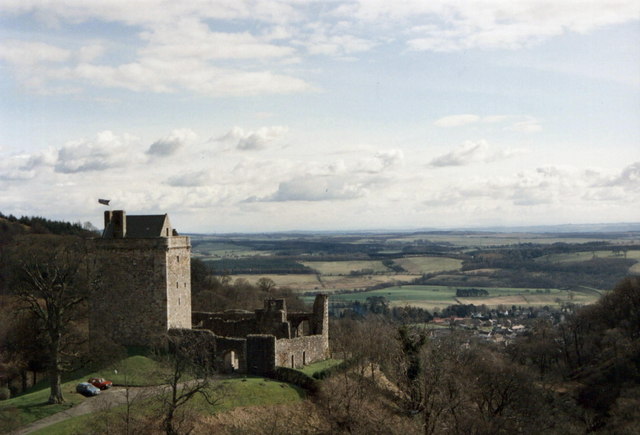
- Castle Campbell stands on a narrow spur above Dollar Glen, between the ravines of the Burn of Care and the Burn of Sorrow.
- A tower was raised in the early fifteenth century, around 1400 or around 1430, for John Stewart, Lord Lorne, on what may already have been a motte.
- Colin Campbell, 1st Earl of Argyll, acquired it through marriage about 1460, around 1465, or by 1466, and the name Castle Gloom became Castle Campbell by an act of 3 February 1489 and a petition of February 1490.
- The earls kept it as their Lowland seat until the 1660s. Mary, Queen of Scots, stayed in 1563, and royalist rebels burned the castle over two nights in July 1654, though another account names General Monck.
- Excavation in 1982 found charred floors from that fire, and digs in 2012 and 2013 found a turf building of the thirteenth to the fifteenth centuries and a stone house read both as a hunting lodge and as a farmhouse and byre.
Visiting
The castle is open daily from 1 April to 30 September, from 10:00 to 16:30. It closes from 1 October to 31 March. It closes for lunch from 12:30 to 13:30. Last entry is 30 minutes before closing.
An adult ticket, for ages 16 to 64, is £7.50 booked online and £8.50 in person. A concession ticket, for ages 65 and over, is £6 booked online and £6.80 in person. A child ticket, for ages 7 to 15, is £3.50 booked online and £4 in person. Member admission is free.
Visitors with disabilities are charged standard admission rates, and up to two accompanying carers are allowed to enter free of charge. Assistance dogs are allowed to enter roofed areas. Dogs are allowed to enter the outdoor areas.
History
Castle Campbell stands on a narrow spur above Dollar Glen in Clackmannanshire, between the ravines of the Burn of Care and the Burn of Sorrow. The place was called Castle Gloom, Castle Glume, the Place of Glom, or the Gloume, a name tied to a Gaelic word for a chasm. A motte may have stood here in the twelfth century, or in the twelfth or early thirteenth century, though that earthwork is probable rather than proved.
A tower was built in the early fifteenth century, dated around 1400, around 1430, or simply to the early 1400s, for John Stewart, Lord Lorne, who died in 1463. Colin Campbell, 1st Earl of Argyll, acquired it by marriage to Isabel Stewart about 1460, around 1465, or by 1466. Pope Paul II issued a bull against Walter Stewart for attacking the place, placed either in the year after the acquisition or in 1465 and 1466, while Colin was at the papal court.
The name became Castle Campbell by a petition of February 1490 and by an act with royal assent on 3 February 1489, also placed in 1488 and 1489. A south range, compared with the King’s Old Building at Stirling, was begun after 1493 or about 1500, with a hall, chambers and a terraced garden. In the 1590s, or about 1590 rather than 1600, the east range gained a loggia and galleries, and an inventory of 1595 lists 47 beds.
John Knox preached here in 1556, and Mary, Queen of Scots, stayed for a wedding on 10 January 1563, a visit also given as three days in January. In the Chaseabout Raid she and Henry Stuart, Lord Darnley, received the castle’s surrender. Royalist rebels burned it over two nights in July 1654 after an English garrison in 1653, while another account names General Monck as the attacker. The 9th earl left it for Argyll’s Lodging in the 1660s.
Crauford Tait bought the glen and the castle in 1805, a sale also credited to the 6th Duke, whose own succession falls in 1806. In 1948 the owners gave the glen into care, and in 1950 the state took the castle. Excavation in 1982, also placed in the 1980s, found charred joists from the 1654 fire. Digs in 2012 and 2013 found a turf building of the thirteenth to fifteenth centuries, read as a lookout or a smokehouse, and a stone house read both as a hunting lodge and as a farmhouse and byre.
Images




Detailed History
Castle Campbell stands on a narrow rocky spur at the head of Dollar Glen, about a mile north of Dollar in Clackmannanshire. The Ochil Hills close the view to the north. Ravines cut the spur off from the east, the west and the south, and the burns in those ravines are called the Burn of Care and the Burn of Sorrow. Those burn names are traced to late Georgian Romanticism, which also filled the glen with fairies.
From the spur the ground falls away toward Dollar and opens southward over the Forth valley. In the Middle Ages the castle was not as remote as it looks now. A road between Stirling and Alloa and Perth passed to the west and ran north through the Ochil Hills toward Glendevon.
The place was first called Castle Gloom, also written Castle Glume, the Place of Glom, the place of Glowm, and the Gloume. The name has been derived from a Scottish Gaelic word, glom, meaning a chasm, and tied to the gorges on either side. A naturally defended position may have carried a motte in the twelfth century. Another account places a motte in the twelfth or the early thirteenth century and treats it as probable rather than proved.
The grassy mound under the later tower looks artificial, and there is evidence of a filled ditch cutting off the promontory. The bishops of Dunkeld appear to have held the land as feudal superiors, and they remained superiors until bishops were abolished in the established Church of Scotland in 1698. The wider woodland has an earlier written life. A charter of David I in 1144 told the foresters of Stirlingshire and of Clackmannan that the abbot and convent might take what timber they needed from the woods and forests and might have pannage of pigs.
The present complex is a passage from motte to tower house to courtyard castle. The tower is one of the better-preserved tower houses in Scotland. One survey puts it at 20 metres and gives it four floors: a storage cellar at ground level, a hall on the first floor, and private chambers on the two floors above. Service entry was at ground level and the main door was on the first floor.
A measured plan gives a simple rectangle of 13 by 9 metres, roughly squared ashlar, thick walls and few windows, and reads those details as a date around 1400. The same account says the tower had been thought to date from after a recorded destruction in 1466, but that the damage was exaggerated and an early fifteenth-century tower survived, with fire damage in the east half of the first-floor hall and a rebuilt vault over the west half. A third account says the present tower was built around 1430 for John Stewart, Lord Lorne, who died in 1463, or for one of his kinsmen. He is also called John Stewart, lord of Lorn, and John Stewart, 2nd Lord Lorne.
The Lord of Lorne was a title first held by the Stewarts of Innermeath after the MacDougall heiresses were married into that family. John Stewart, 2nd Lord Lorne, died in 1463, and the significance account says he was murdered in his chief residence, Dunstaffnage Castle, leaving no male heir and a disputed title.
Colin Campbell, 1st Earl of Argyll, acquired the property through his marriage to Isabel Stewart, also called Isabella Stewart and Isabelle Stewart, the daughter of John Stewart. The castle account places the acquisition in about 1460, during that marriage. The short history of the site places the passage through marriage at around 1465. The significance account says that by 1466 Colin had acquired all of John Stewart’s unentailed lands.
Colin’s own life leaves the wedding day unknown. He was born about 1433, the son of Archibald Campbell, Master of Campbell, and Elizabeth Somerville. His father died in 1440. When his grandfather Duncan Campbell, 1st Lord Campbell, died in 1453, Colin became 2nd Lord Campbell while still a minor, in the custody of his uncle Colin Campbell of Glenorchy.
James II of Scotland made him Earl of Argyll in 1457. In 1460 he was bailie of Cowal, and in that year he was called into a feud in his wife’s family: Allan MacDougall, called Allan of Lorne of the Wood, imprisoned his elder brother John Ker of Lorne on the island of Kerrera to starve him. Colin came with galleys, burned the fleet, and restored the elder brother.
Clan Campbell had come to that strength over two centuries. Traditional genealogies take the kindred back to the Britons of Strathclyde. The earliest Campbell in a written record is Gillespie in 1263. Early grants lay mostly in east-central Scotland, and the Argyll connection came when a Campbell married the heiress of the O’Duines and the lordship of Loch Awe.
The early name was Clan O’Duine, later styled Clann Diarmaid from a claimed link to Diarmuid the Boar. The first seat was either Innes Chonnel, also called Innis Chonaill, on Loch Awe, or Caisteal na Nigheann Ruaidh on Loch Avich. The MacDougalls, then Lords of Lorne, killed the Campbell chief Cailean Mór in 1296 at the Battle of the Red Ford. Later chiefs used MacCailean Mór as their Gaelic patronymic.
In the Wars of Scottish Independence the family backed Robert the Bruce. Sir Neil Campbell, who died in 1316, married Bruce’s sister Mary, and lands taken from the MacDougalls came to the Campbells. Duncan Campbell was made 1st Lord Campbell in 1445. A later reading of the family’s Lowland seat says the first known Campbell residence was Innis Chonaill, and that an extensive building programme began when Duncan Campbell succeeded as chief in January 1413 and ran for the better part of two hundred years.
What the Lowland castle was for followed from that rise. Colin needed a secure and impressive seat near the royal court, to set beside the Highland seat at Inveraray on Loch Fyne. Castle Gloom sat within reach of Stirling. He was often sent on missions.
In 1463 James III of Scotland sent him to treat for a truce with Edward IV of England, on the term that neither king would support the other’s enemies. In 1464 he was master of the king’s household. In 1465 he was Lord Justiciary south of the Forth, first with Robert Boyd, 1st Lord Boyd, and alone after Boyd fled in 1469. That household office required him often at court, and the accession of Castle Gloom carried Campbell power from Argyll into central Scotland.
He founded a chapel of St Ninian at Dunure in 1466. Through the marriage he later took the title Lord of Lorne. His own life dates that title to 1469, when it passed from his wife’s uncle Walter Stewart, who received other lands and the title Lord Innermeath. A history of the title dates Walter’s resignation to 30 November 1463 or to 17 April 1470, and dates Colin’s creation as Lord of Lorne to 17 April 1470.
Colin took the galley from the Lorne arms. He entailed Lorne, if he had no male heir, to his uncles and then to other Campbells. In 1471 he received the heritable justiciary and sheriffdom of Lorne. On 15 January 1472 James III granted him Dunoon Castle and the lands of Borland.
On 20 February 1473 he was justiciar, chamberlain, sheriff and bailie in Cowal. On 8 May 1474 he had a charter to erect Inveraray as a burgh of barony.
James III had come to the throne as a child. He was born on 10 July 1451 or in May 1452, at Stirling Castle or at St Andrews Castle, and he died on 11 June 1488 at the Battle of Sauchieburn. His father, James II, was killed at the siege of Roxburgh on 3 August 1460, and James III was crowned at Kelso Abbey. His minority lasted nearly a decade.
A parliament of March 1461 named a council that included the Earl of Argyll. James III’s personal rule from 1469 was unpopular. He was criticised for schemes aimed at Brittany, Guelders and Saintonge, for debasing the coinage, for failing to settle feuds, and for an English alliance. Orkney and Shetland came to Scotland through his marriage to Margaret of Denmark.
In 1482 his brother Alexander, Duke of Albany, invaded with an English army. Berwick-upon-Tweed was lost, and nobles imprisoned the king for a time. Colin was again a commissioner to Edward IV in 1474. The pact was to last until July 1483 and included a marriage between Prince James and Cecily of York, which did not take place.
In 1475 Colin had a lieutenancy to execute the forfeiture of John of Islay, Earl of Ross.
The first written record of the castle is tied to a quarrel with Walter Stewart, son of Lord Lorne and John’s brother and successor. The castle account says that the year after the acquisition, Pope Paul II issued a bull against Walter for attacking and damaging the Place of Glom, and that Colin, then at the papal court, may have organised the pope’s involvement. The tower shows early rebuilding after that episode. The significance account dates the episode more tightly: Walter tried to reclaim the lands and was excommunicated for allegedly destroying a certain manor with a tower of the place of Glowm in the territory of Dollar, while Earl Colin was on official business at the papal court in 1465 and 1466 and may have engineered the excommunication.
Pope Paul II was Pietro Barbo, born in Venice on 23 February 1417. His mother, Polissena Condulmer, was the sister of Pope Eugene IV, and that election turned Barbo from a merchant’s training to the church. He was archdeacon of Bologna, bishop of Cervia and of Vicenza, and a cardinal-deacon in 1440. He was elected on 30 August 1464 to succeed Pius II, and he died on 26 July 1471.
His reign therefore sits with the 1465 and 1466 dating of the excommunication, and it sits awkwardly with a bull placed in the year after an acquisition of about 1460. Both timings are left as the accounts give them. Colin is credited with repairing and remodelling the tower after the attack.
In 1488 and 1489 Colin was among the leaders of the revolt against James III. After the king’s death at Sauchieburn, Colin was the most powerful politician in the minority government of the new king. James IV of Scotland was born on 17 March 1473 at Stirling Castle, succeeded on 11 June 1488 at the age of fifteen, and was the figurehead of the rebellion in which his father died. In February 1490 Colin petitioned the newly crowned James IV to change Gloom to Castle Campbell.
An act of the Parliament of Scotland, the Castle Campbell Act 1489, did that. Its long title is the castell callit the Gloume to be callit in tyme tocum Campbele. The citation is February 1489 chapter 23, and royal assent is dated 3 February 1489. The significance account places the successful petition in 1488 and 1489, as a way to raise a family that had a low profile in the Lowlands.
The short history dates the name change to 1489. The act and the petition therefore stand at 3 February 1489 and at February 1490. The change has been read as a sign that the word castle was prestigious enough to need royal approval. Colin’s own life says he would change Castle Gloom to Castle Campbell in February 1490, and that the castle then became the primary Lowland seat of the earls and later the dukes of Argyll for two centuries.
Around the same years the family story was being shaped for both courts and Gaelic audiences. One biography introduced the Lowland letter p into the name in 1460 to 1470 and, in Hector Boece’s Scotorum Historia of 1527, claimed a Frenchman named De Campo Bello. Another traced the line into the Leabhar Gabhála Éireann. Cattle driven from western farms toward the burgh markets of Perth, Stirling and Edinburgh sat beside the herring fisheries and the sea trade of Argyll.
A Lowland castle and a managed glen served that double life.
At the time of the renaming the castle would have been the tower, other buildings around the courtyard, and gardens outside. The east range was probably added first. Sometime after the 2nd Earl succeeded in 1493, the large south range was begun. The significance account dates Colin’s death to 1492 and the succession of his son Archibald, the 2nd Earl, to that year, and it credits Archibald with the hall block across the courtyard from the tower.
Colin’s own life dates his death to 10 May 1493. The castle account gives his death as 1493. The hall is also placed at about 1500. It has been compared with the royal lodging at Stirling Castle now called the King’s Old Building, built for James IV and completed in 1496, or dated to the 1490s.
The 2nd Earl was that king’s chancellor, and the hall has been attributed to the same royal masons around the same time. James IV made Archibald master of the royal household on 24 March 1495. After disorder in the west, Archibald was governor of Tarbert Castle and bailie of Knapdale, and on 22 April 1500 he was royal lieutenant in the former Lordship of the Isles. A draft of the 1504 parliament considered asking him to hold his sheriff court at Perth, where the king could watch the proceedings, a clause one historian links to Archibald’s kinship with Torquil MacLeod and MacLean of Duart.
The south range held a state apartment of hall, outer chamber and bedchamber, with large south-facing windows over the gardens and the Devon valley, plus further private lodgings, reached by two symmetrical stairs on the courtyard. The significance account describes a great hall, a withdrawing chamber and a kitchen on the first floor above vaulted cellars, reached by two spiral stair turrets with octagonal caps, and a timber gallery linking the turrets. The hall rose to a high roof, while the ends were two storeys of private chambers. The large south windows suggest that the terraced garden immediately south of the hall was built at the same time.
The garden is also placed in the sixteenth century. It was designated on 31 March 2007. The castle itself was scheduled on 2 December 2015.
Archibald Campbell, 2nd Earl of Argyll, was born about 1465 and was killed at the Battle of Flodden on 9 September 1513, the same day James IV was killed. James had chosen the French alliance when Henry VIII invaded France, and he was the last monarch in Great Britain to die in battle. Archibald was buried at Kilmun. By his wife Elizabeth, daughter of John Stewart, 1st Earl of Lennox, he had a large family, including Colin, the next earl, and Catherine, who married Lachlan Cattanach Maclean of Duart.
Clan Maclean, from Gillean of the Battle Axe, held Mull, Tiree, Islay, Jura, Knapdale, Morvern and Lochaber by the end of the fifteenth century, and the two kindreds were already bound by marriage and already rivals. The Campbells’ growing role as the crown’s agents in the west, after the Lordship of the Isles was broken, fed that enmity. From 1493 the Campbell lords could see themselves as successors to Clan Donald among the Hebridean Gaels. The MacLeans later appear in the war around this castle.
The next earl who reshaped the castle’s politics was Archibald Campbell, 4th Earl of Argyll, called Archibald the Red, born about 1507 and dead in 1558. He was the eldest son of Colin Campbell, 3rd Earl of Argyll, who died in 1529, and of Lady Jean Gordon. In October 1529 he was sent against an insurrection in the southern isles. Alexander MacDonald of Dunyvaig persuaded James V that the disturbances came from the Argyll lieutenancy being used for private gain.
Archibald was imprisoned, then released and stripped of his offices until after James V’s death. A charter of 28 April 1542 called him master of the king’s wine cellar. He was named on the council in the document Cardinal David Beaton produced as James V’s will, which also made Beaton governor for the infant Mary, Queen of Scots. After Beaton’s arrest on 20 January 1543, Archibald mustered against James Hamilton, Earl of Arran.
When a marriage was arranged between the child queen and Prince Edward of England, the earls of Argyll, Huntly, Bothwell and Lennox marched from Stirling with ten thousand men and took the infant back to Stirling. In the summer of 1544 Matthew Stewart, 4th Earl of Lennox, with English ships, burned the village and church by Dunoon and drove Archibald out of Dunoon Castle. Archibald later received the largest share of Lennox’s forfeited estates. At the Battle of Pinkie on 10 September 1547 he commanded the right wing with four thousand West Highlanders.
In January 1548 he advanced on Broughty Castle and was turned aside by English negotiators. At the siege of Haddington, Henry II of France made him a Knight of the Cockle. On 12 August 1554 he wrote to Mary of Guise from Dunstaffnage about a campaign toward Mull.
He became one of the leading Protestant lords and supported John Knox. The Scottish Reformation was the break with the Catholic Church and the making of a Protestant Church of Scotland. Luther’s teaching had reached Scottish scholars in the first half of the sixteenth century. In 1560 the Lords of the Congregation controlled government, and the Reformation Parliament rejected papal supremacy, though James VI formally ratified that legislation only in 1567.
John Knox directed a Presbyterian and largely Calvinist kirk. Knox was born at Giffordgate in Haddington between 1505 and 1515, the usual estimate being about 1514, and he died on 24 November 1572. His father William was a merchant and his mother was a Sinclair. He was ordained a Catholic priest in Edinburgh on Easter Eve 1536 by William Chisholm, Bishop of Dunblane, worked as a notary, and was drawn to reform by Patrick Hamilton and George Wishart.
After the murder of Cardinal Beaton in 1546 he was taken by French forces, released in 1549, and served Edward VI of England as a royal chaplain. When Mary I restored Catholicism in England he went to Geneva and to Frankfurt, met John Calvin, and produced the Forme of Prayers, later the Book of Common Order, the first book printed in any Gaelic language. Back in Scotland he led reform with the Protestant nobility, helped write the new confession, and wrote The History of the Reformation in Scotland between 1559 and 1566.
Knox visited Castle Campbell and preached there sometime in 1556, invited by the 4th Earl. The significance account says he stayed several days, preached to a large congregation, and before leaving wrote A Letter of Wholesome Council to his brethren in Scotland, telling lairds and householders to have their families, tenants and servants pray together daily and read the Bible weekly. He then left Scotland for Geneva. A rock pillar at the south-west corner of the castle is called John Knox’s Pulpit and is traditionally the place of that sermon.
He is thought more likely to have preached in the hall or in the chapel. The castle had a chapel for the household. Its place is unknown. The old east range is one candidate.
The 1595 inventory records, in the wardrobe above the great hall, a fine crimson velvet mass cloth bordered with gold, which is the evidence cited for that chapel. Knox came again in February 1564 and met the Earl of Argyll. He disapproved of the dancing at the wedding festivities of the previous year.
Mary, Queen of Scots, was born on 8 December 1542 at Linlithgow Palace, the only surviving legitimate child of James V and Mary of Guise. She became queen on 14 December 1542, six days old. Regents governed during her childhood, first James Hamilton, Earl of Arran, then her mother. In 1548 she was betrothed to the dauphin Francis and was sent to France during the Rough Wooing.
She married Francis in 1558, was queen consort of France from 1559 until his death in December 1560, and returned to Scotland in August 1561, a Catholic monarch of a Protestant kingdom. She kept James Stewart, 1st Earl of Moray, her illegitimate half-brother, and William Maitland of Lethington. Knox questioned whether subjects owed her obedience. She was imprisoned in Lochleven Castle in 1567, forced to abdicate on 24 July 1567 in favour of her son James, and was beheaded at Fotheringhay on 8 February 1587.
Of Castle Campbell she is said to have remarked that this reminds me of home.
In January 1563 she stayed at the castle for three days for the marriage of Margaret, sister of the 5th Earl, to James Stewart, Lord Doune. James Stewart, 1st Lord Doune, was born in 1529 and died in 1590. He was constable of Doune Castle and commendator of Inchcolm, often called St Colme. His own life dates the marriage to Margaret Campbell, who died in 1592, at Castle Campbell on 10 January 1563.
Mary, Queen of Scots, and James Stewart, 1st Earl of Moray, both became ill during the stay. The celebrations included a masque in which courtiers and musicians dressed as shepherds and played lutes. Wardrobe accounts, kept in French, itemise an ell and a half of white damask for six shepherd satchels, two masque cloaks of white taffeta remade for the lute players, and three white taffeta costumes with red borders that were broken up to dress the players. Jane Dawson, a historian of the Reformation and of the Earl of Argyll in the age of Mary, Queen of Scots, is the scholar associated with the noble household at that wedding.
Her work includes a 2024 study of aristocratic women in sixteenth-century Scotland and a 2002 study of the earl’s politics in Britain and Ireland, and she published a life of John Knox in 2015. In the same year, 1563, Mary and her court wore Highland clothes for a visit to Argyll and Inveraray. Mary wore a costume given by Agnes Campbell, wife of James MacDonald of Dunyvaig.
Archibald Campbell, 5th Earl of Argyll, was born in 1532 or 1537 and died on 12 September 1573. He succeeded his father in 1558. With his brother-in-law Lord James Stewart he adhered to Knox about 1556. He signed what was probably the first godly band in December 1557 and became a leader of the Lords of the Congregation.
With Stewart he negotiated English aid against Mary of Guise by the Treaty of Berwick, and he helped negotiate the Treaty of Edinburgh in 1560. William Cecil called him a goodly gentleman universally honoured of all Scotland. After Mary’s return he and Moray, as Stewart had become, kept a leading and anglophile role, and Argyll drew apart from Knox’s party. Moray himself was born about 1531, an illegitimate son of James V and Margaret Erskine, and was prior of St Andrews before he was made Earl of Moray on 30 January 1562.
He defeated George Gordon, 4th Earl of Huntly, at Corrichie in October 1562. He was regent for the infant James VI from 1567 until he was shot on 23 January 1570, the first head of government to be assassinated with a firearm.
The marriage of Mary, Queen of Scots, and Henry Stuart, Lord Darnley, changed Argyll’s place. Darnley was born at Temple Newsam in 1546, the eldest surviving son of Matthew Stewart, 4th Earl of Lennox, and Margaret Douglas, a granddaughter of Henry VII. He met Mary at Wemyss Castle in February 1565. They were married at Holyroodhouse on 29 July 1565.
He was king consort until he was murdered at Kirk o’ Field on 10 February 1567. Their son James was born on 19 June 1566. The 5th Earl was said to oppose the match. A plot to seize the couple is dated to June 1565 and also to July 1565, as they rode between Perth and Edinburgh by Loch Leven.
One account, the one set down by John Hosack, a Scottish lawyer and the author of a defence of Mary published in 1869, has Mary imprisoned at Lochleven Castle or at St Andrews Castle and Darnley taken to Castle Campbell so that the marriage could be stopped. Hosack was baptised in 1813, called to the bar in 1841, made a bencher in 1875, and died at West Brompton on 3 November 1887. Another account says both were to be imprisoned at Lochleven Castle or at Castle Campbell. The Chaseabout Raid account says the rumour placed them at St Andrews Castle and at Castle Campbell, and calls the plot the Raid of Beath, adding that it is unclear whether the plot was real or was put about to discredit Moray and Argyll.
The wedding account adds Callendar House near Falkirk, the Path of Dron in the Ochils, Beath, and, in Robert Lindsay of Pitscottie, the Parrat Well beside Dowhill near Kinross, where the Earl of Rothes would take them. Adam Blackwood wrote that the plot failed while the other conspirators waited for Argyll, after the Laird of Dowhill warned Mary. The English diplomat Thomas Randolph said Argyll came toward Kinross only to join her for dinner.
After the marriage, Argyll joined the Protestant lords in the Chaseabout Raid. The name comes from armies moving back and forth across Scotland without a battle. The rebels, including the Duke of Châtelherault and the earls of Argyll, Glencairn and Rothes, with John Knox’s support, said they acted for religion, against bad governance, and against a marriage they feared would restore Roman Catholicism. Moray said he aimed at nothing else than the maintenance of the true religion.
Mary would allow Protestant worship as permission of conscience, not as statute. She put Moray to the horn. The rebels gathered in Ayrshire and met at Dunoon in August 1565. English money was reported, including 3,000 or 4,000 crowns brought to the Countess of Moray, while Mary failed to pawn jewels in Edinburgh for 2,000 marks and imprisoned six merchants until they lent.
On 26 August 1565 she and Darnley left Holyrood for Linlithgow and Stirling, aiming for Glasgow, with cannon following. Mary, Queen of Scots, and Darnley received the surrender of Castle Campbell. When English help did not come, the rebel lords fled to England. Elizabeth censured their leader.
Argyll alone of the rebels could stay in the kingdom, because of his strength in the Highlands, and the failure of English aid began his turn away from an English policy.
He can be connected with the killings of David Rizzio in 1566 and of Darnley in 1567. He was horrified by Mary’s marriage to James Hepburn, 4th Earl of Bothwell, joined the fight that ended at Carberry Hill, and then broke with his allies over deposing the queen. After she escaped from Lochleven in 1568 he led the Queen’s Party and commanded at the defeat of Langside, where he showed little military skill. He attended a meeting at Dalkeith in February 1570 about a possible homecoming, and he reconciled with Regent Lennox in 1571.
His half-brother Colin Campbell, 6th Earl of Argyll, born about 1542, succeeded on that death. Colin was the eldest son of the 4th Earl’s second marriage, to Margaret Graham. In July 1574 he held courts through Lorne, Argyll and Cowal and hanged about 160 people convicted of slaughter, murder, theft or common sorcery. Others suspected of witchcraft were held or released on caution.
He put ministers or readers in churches to teach the Bible in the Gaelic translation of John Carswell. In January 1572 he married Agnes Keith, also called Annas Keith and Annabel, the widow of Moray. She was born about 1540 at Dunnottar and died on 16 July 1588. John Knox had preached at her first wedding, to Moray, on 8 February 1562, and had denounced the vanity of that masking.
As the regent’s wife she was the most powerful woman in Scotland from 1567 until the assassination. Her refusal to surrender Mary’s jewels to the government sparked a feud between Argyll and Regent Morton. In May 1583 James VI granted Colin and Agnes the lands of Lundie. Colin died in October 1584 and was buried at Kilmun.
His will, written at Darnaway Castle in September 1584, included 18 pieces of tapestry at Castle Campbell and three horns set in silver. Those 18 pieces are also described as decorating the castle in 1584.
Their son Archibald Campbell, 7th Earl of Argyll, was born about 1575 and died in 1638. He was called Gillesbuig Grumach, Archibald the Grim, a name that may echo his wife’s ancestor Archibald Douglas, 3rd Earl of Douglas. In the more peaceful 1590s he rebuilt the east range to link the south range with refurbished guest chambers in the tower. The new work had a loggia of two arches, also described as a two-bay loggia, in polished ashlar, with galleries behind it and new stairs to north and south.
The east front has been compared with the north courtyard façade at Crichton Castle from about the same time. Other Scottish loggias survive at Crichton, in fragments at Huntly, and at St Andrews. The significance account dates the remodelling to about 1590 and says the 1595 inventory proves it was done by then, not in 1600 as is often said. The short history says the private chambers had been altered by around 1600, and that the vaulted ceiling at the top of the tower, with two grotesque carvings of the Green Man, belongs to those works.
The tower ceiling has a pair of green-man masks from whose mouths oil lamps were hung. Parallel ribbed vaults were also given to ground-floor rooms in the east range. The upper floors were covered galleries, the little gallery and the lower gallery of the inventory, so the family could pass between tower and hall. An inventory of 1595 lists furniture, tapestries, carpets and other goods in each room, including 47 beds.
On 24 July 1592 at Dalkeith Palace he married Agnes Douglas, Countess of Argyll, the youngest daughter of William Douglas, 6th Earl of Morton. She was born at Lochleven Castle in 1574 and died on 3 May 1607, a month after the birth of her only son. She and her sisters were called the pearls of Lochleven. Adrian Vanson painted her in 1599.
In January 1600 she imprisoned Thomas Alexander of Balruidy in Castle Campbell. Her lawyer and John Archibald, captain of the castle, claimed he was a sheep rustler. The castle account gives the imprisonment without the month. In 1590 James VI of Scotland was displeased with the captain Alexander Menteith, chamberlain of Campbell, who had released a condemned prisoner, Henry Mersair, found guilty of fire-raising, murder, slaughter and other crimes.
Mersair was given a horse in the village of Fossoway to escape. James VI had been king since 24 July 1567, and from 24 March 1603 he was also king of England. In 1605 the earl arranged with his tenants to bring coal from the pits at Sauchie to warm the castle.
The 7th Earl’s public life pulled away from the Lowland house. On 15 July 1594 James VI commissioned him to use fire and sword against the Catholic earls of Huntly and Erroll. He was defeated at the Battle of Glenlivet on 3 October 1594. In June 1603 he accompanied Anne of Denmark south and quarrelled with the Earl of Sussex.
By 1619 he had surrendered his estates to his son. He announced a conversion to Catholicism from the Netherlands, was declared a traitor in Edinburgh on 16 February 1619, and was allowed back in 1621. His second wife, Anne Cornwallis, whom he married in 1608 or, in another dating, on 30 November 1610, is credited with that conversion, as is the influence of Agnes Douglas, who had died in 1607, eleven years before 1618. He was a Knight of the Golden Fleece in 1624, was indicted for recusancy in 1636, died in 1638, and was buried at Kilmun.
Their heir was Archibald Campbell, 8th Earl of Argyll, also Archibald Campbell, 1st Marquess of Argyll, born in March 1607 or in April 1607, and executed on 27 May 1661. His mother Agnes’s life says he was born in April 1607 and that his head was later set on the Tolbooth. He was educated at St Andrews, where he matriculated on 15 January 1622. As Lord Lorne he held the estates when his father renounced Protestantism and took arms for Philip III of Spain.
He was slight, red-haired, and marked by a squint, and Highlanders called him red Argyll. Baillie called him by far the most powerful subject in the kingdom, with a force of 20,000 retainers. He was a privy councillor in 1628. In the crisis of 1637 and 1638 he would not be won by Charles I of England, warned the king against his church policy, and sided with the Covenanters.
A Covenanter was a supporter of a Presbyterian Church of Scotland against the bishops favoured by Charles I. Thousands signed the National Covenant in 1638. The Bishops’ Wars of 1639 and 1640 left the Covenanters in control of Scottish government. Argyll inherited the earldom on his father’s death in 1638.
In 1641 Charles I created him 1st Marquess of Argyll. He soon led the Covenanters against the royalist James Graham, 1st Marquess of Montrose, and Castle Campbell became a covenanting stronghold.
Montrose was born in 1612 and was hanged, beheaded and quartered after his capture at Carbisdale; he died on 21 May 1650. He had signed the National Covenant and later turned to Charles I. From 1644 to 1646 he fought a campaign with an Irish Confederate brigade under Alasdair Mac Colla, winning at Tippermuir, Aberdeen, Inverlochy, Auldearn and Alford. In 1645 his men, many of them MacLeans, long adversaries of the Campbells, were on their way to the Battle of Kilsyth.
They laid waste the lands around Castle Campbell, including Dollar and Muckhart. The castle account says the castle itself was undamaged and that no siege was attempted. The significance account says the MacLeans tried to capture the castle and failed. In reply, Argyll ordered the destruction of Menstrie Castle and of Airthrie Castle, also written Airthrey Castle, both seats of royalists.
The Battle of Kilsyth was fought on 15 August 1645 near Kilsyth. It was the largest battle of the war in Scotland. Montrose had marched from Dunkeld by Kinross, Glenfarg and Alloa, crossed the Forth near Stirling, and camped by Colzium on the night of 14 August. William Baillie’s Covenanter army, given as up to 7,000 infantry in royalist accounts and as perhaps 3,500, held the higher ground and was broken.
The pursuit of Montrose by Baillie ended there. Montrose’s own force that day is given as about 3,000 foot and up to 600 horse, including Athollmen, Gordons, Irish troops and western clans. Argyll’s regiment was on the government side.
After the execution of Charles I of England on 30 January 1649, the Campbells at first supported his son. Charles II of England had been proclaimed king by the Parliament of Scotland on 5 February 1649. The Covenanters crowned him king of Britain in 1651, and Argyll placed the crown of Scotland on his head at Scone. Argyll then opposed Charles’s invasion of England.
The castle account says that in 1652 he submitted to the Commonwealth of Oliver Cromwell. The significance account says that shortly after the coronation he proclaimed for Cromwell as Lord Protector. Oliver Cromwell was born at Huntingdon on 25 April 1599 and died on 3 September 1658. He was a commander of the New Model Army, a leading advocate of the king’s execution, and Lord Protector from December 1653.
His forces defeated Charles II at Worcester on 3 September 1651. Cromwell’s soldiers were garrisoned in Castle Campbell in 1653. The significance account calls them English soldiers during the Cromwellian interlude.
In July 1654 royalist rebels attacked and burned the castle over two nights. The significance account says a royalist force attacked and badly damaged it by fire. The short history of the site names Cromwell’s lieutenant, General Monck, as the man who attacked the castle in 1654. George Monck was later governor-general in Scotland and was instrumental in the return of Charles II, who was proclaimed king in Edinburgh on 14 May 1660.
The three accounts of the 1654 attack are left side by side: royalist rebels over two nights in July, a royalist force and a bad fire, and Monck. Charred boards found long afterwards are the physical trace of the fire, whichever hand set it.
The Restoration in Scotland was the return of the monarchy in 1660. Argyll was executed for treason on 27 May 1661, soon after Charles II returned. Four men were excepted from the general pardon and put to death. His son, also Archibald, born on 26 February 1629, had his earldom restored in 1663 but not the marquessate.
As Lord Lorne he had been a royalist in the 1650s, had joined Glencairn’s rising in the winter of 1653 against his father’s warning, and had been estranged from the marquess. The 9th Earl did not repair Castle Campbell. He made his Lowland seat a town house in Stirling that had belonged to the 1st Earl of Stirling, enlarged it, and renamed it Argyll’s Lodging. The castle was left to fall into ruin.
The 9th Earl was later condemned in 1681, escaped, and in 1685 led a rising beside Monmouth’s against James VII and II. He was captured and beheaded on 30 June 1685. Apart from a brief garrison during the Jacobite rising of 1715, the castle stayed abandoned. The significance account says John Campbell, 2nd Duke of Argyll, put a small force in the old castle during that rising and that no action is recorded.
The rising was the attempt of James Francis Edward Stuart to recover the thrones. The Earl of Mar raised the standard at Braemar on 6 September 1715. On 13 November his army met a government army under the Duke of Argyll at Sheriffmuir. The fight was indecisive, and the Jacobites were defeated at Preston the next day.
James landed in December and left for France in February 1716.
In 1805 the property left the Campbells. The castle account says the 6th Duke of Argyll sold it to Crauford Tait of Harviestoun, an adjacent estate. The significance account says the 6th duke sold the castle and lands to Mr Crawford Tait of Harvieston. Crauford Tait was born at Blairlogie on 8 April 1766 and died on 2 May 1832.
He was a lawyer, an improver, and a friend of the circle around Robert Burns. His father, John Tait, bought the Harvieston estate east of Tillicoultry in 1780, and Burns visited the house twice in 1787. Crauford inherited in 1800. In 1804 John Paterson rebuilt the house in an Adam manner.
Tait’s own life says that in 1805 he bought Dollar Glen and Castle Campbell from his wife’s uncle, consolidated the castle, and left it as a romantic ruin, the fashion of the day, because it was visible from Harvieston. His wife was Susan Campbell, daughter of Ilay Campbell, Lord Succoth, whom he married on 17 June 1795. George Campbell, 6th Duke of Argyll, was born on 22 September 1768 and succeeded his father in the dukedom only in 1806, having been styled Marquess of Lorne from 1770 until then. The sale is therefore dated to 1805 under the title of 6th duke, and it is also described as a purchase from the wife’s uncle, and the duke’s own succession falls in 1806.
Tait was buried in Tait’s Tomb south-east of the house. One of his sons, Archibald Campbell Tait, became Archbishop of Canterbury. The ruins, increasingly treated as a feature in the landscape, were painted in the 1820s by William Linton, a landscape painter born in 1791 who had settled in London by 1817 and often took Scottish scenery as his subject.
In 1859 Harviestoun and Castle Campbell were bought by Sir Andrew Orr, a businessman and a former Lord Provost of Glasgow. His son James Orr had excavations carried out in the 1870s, which turned up fragments of stained glass from the windows of the south range. The significance account says Sir James Orr of Harvieston excavated in 1874 and 1875 and took measures to preserve the fabric. The scale of that dig is unknown and the damage to buried remains is thought to have been small.
Lead piping that was found was given to the National Museum of Antiquities. A stone axe, 8 and three quarter inches by 3 inches by 1 and three quarter inches, was found in 1865 at the castle and was later in the collection of John Sturrock, sold at Dowell’s in Edinburgh in 1889.
In 1948 the owners of the Harviestoun estate gave Dollar Glen to the National Trust for Scotland, which arranged for the Ministry of Works to care for the castle. The significance account names Mr Kerr of Harvieston as the man who entrusted both castle and glen to that trust, and says that in 1950 the trust kept the glen while the state, through the Ministry of Works, took the castle. Guardianship is dated to 1950. In 1956 a flat roof on the tower, which was not historic, was replaced by a pitched crow-step gabled roof with a gabled stair turret.
Clearance after the castle came into state care partly excavated and rebuilt the terraced garden and cleared the courtyard down to the rock. Work on the hall’s main fireplace and other masonry was slight. Those clearances did not empty the site. The supposed motte under and around the tower, and the garden ground to the west, may never have been dug.
In 1982 Eoin Cox, for the Inspectorate of Ancient Monuments, fully excavated the first floor of the hall block and found extensive remains of heavily charred floorboards and joists from the burning of 1654. The castle account places those charred timbers in excavations of the 1980s.
The glen around the castle was dug more recently. In 2012 about forty volunteers, guided by Liz Jones and Candice Hatherley, opened two turf banks and an earth mound on the north-west slopes behind the castle. They found pottery, glass and a piece of animal bone. The mound was a small rectangular turf building, with post-holes and signs that a fire had been lit in front of the entrance.
Late in the week Juliette Mitchell found a piece of medieval pottery inside it, which dated the building between the thirteenth and the fifteenth centuries. It was thought too small for a dwelling. Its position suggested a lookout for the castle, or a smokehouse for meat or fish. The turf bank proved to be earlier than the stone wall beside it.
It could not be dated, and the diggers believed it belonged to deer hunting in a royal forest behind the castle. A news account of the same week called the pottery possibly medieval and left the bank’s date open, with the same belief about deer.
In 2013 more than fifty volunteers, including young archaeologists and the Dollar Scouts, led by Daniel Rhodes, Liz Jones and Candy Hatherley, with Kirsty McAlister, excavated a ruined two-roomed stone building on the slopes behind the castle. It had first been thought a dwelling. The diggers then thought it more likely a medieval hunting lodge used by people from the castle. It sits among banks and enclosures read as part of a hunting estate.
Finds from the larger north-east room included sherds of pottery, glass wine bottles, glass vessels, window glass and iron objects dated to the mid seventeenth century, and the objects were taken to show high status. The square room to the south-east had a central stone-lined drain, flagged and cobbled surfaces, and a raised rectangular stone feature that may have been a trough or a plinth. That room was read as a stable, a byre, or a butchery for deer. A later synthesis by Daniel Rhodes describes the only other stone building in the glen, apart from the castle, as a farmhouse and byre, 9 metres long and 5.6 metres wide, with a cobbled byre floor and a hearth and chimney in the house.
In the house were large fragments of a seventeenth-century green-glazed wine jug and more white gritty ware. In layers after the house was abandoned were a wine bottle, a wine glass, a button, knives and furniture studs, dated between about 1750 and about 1780. The same synthesis describes two rectangular turf-walled buildings on a narrow promontory overlooking the castle, with posts for a timber roof, white gritty ware, green-glazed jugs and medieval redware of the thirteenth to the fifteenth centuries, and a higher building with a cobbled entrance, two phases of repair, and pottery on a trampled floor. Banks and ditches across the glen are read as corrals for cattle brought from the Highlands toward Lowland markets.
An inner boundary had an earlier turf phase under up to four courses of stone, 0.45 metres high. A stone boundary farther down the glen may be a medieval line protecting woodland from deer or other stock. The place-name King’s Seat, the highest peak beside the castle, is compared with the Queen’s Seat at Falkland, a place where deer driven from a park could be killed. By 1300 about 3,200 parks are estimated for England, and only 80 to 100 are known in Scotland.
The 2012 hillside dig and the stone structure beside the road are also noted in the significance account as later medieval. The lodge reading and the farmhouse reading, and the lookout or smokehouse reading, are left as the digs stated them.
The castle is now in state care. A sycamore called the Maiden Tree stands over the entrance. The origin of the name is lost. Local tradition says a princess was banished to Castle Gloom for loving below her station.
Kemp’s Score, a fissure between the castle and John Knox’s Pulpit, is said to have been cut by Kemp, a giant who stole the king’s dinner and was caught and killed here. Bats have taken the attic of the tower. The building is used for weddings. What remains is the Lowland seat of the earls of Argyll from the fifteenth century to the seventeenth, a tower and a hall range that carried royal masoncraft into a glen above Dollar, and a fire of 1654 whose charred joists were still in the hall floor when it was opened in 1982.
Sources
- Castle Campbell — Historic Environment Scotland
- Castle Campbell history and stories — Historic Environment Scotland
- Castle Campbell plan your visit — Historic Environment Scotland
- Castle Campbell statement of significance — Historic Environment Scotland
- Medieval Dollar Glen: farmland or hunting park? — National Trust for Scotland
- Dollar Glen — Ochils Landscape Partnership
- Volunteers help unearth Dollar history on dig — Daily Record
- Volunteers find part of castle's history — Daily Record
- Dollar dig is a day of discovery — Alloa and Hillfoots Advertiser
- Castle Campbell — Trove
- Planning your visit to Dollar Glen — National Trust for Scotland
- Castle Campbell — Wikipedia
- Mary, Queen of Scots — Wikipedia
- Crauford Tait — Wikipedia
- Jane Dawson — Wikipedia
- John Hosack — Wikipedia
- John Knox — Wikipedia
- Oliver Cromwell — Wikipedia
- Pope Paul II — Wikipedia
- Battle of Kilsyth — Wikipedia
- Chaseabout Raid — Wikipedia
- Colin Campbell, 1st Earl of Argyll — Wikipedia
- Archibald Campbell, 5th Earl of Argyll — Wikipedia
- Archibald Campbell, 1st Marquess of Argyll — Wikipedia
- James Graham, 1st Marquess of Montrose — Wikipedia
- Clan Campbell — Wikipedia
- Castlecampbell.jpg — Wikimedia Commons
- Castle Campbell - general view from SW.jpg — Wikimedia Commons
- Cairnpark Street, Dollar - geograph.org.uk - 293262.jpg — Wikimedia Commons
- Burn of Care towards Castle Campbell - geograph.org.uk - 323398.jpg — Wikimedia Commons
- Castle Campbell - geograph.org.uk - 1044536.jpg — Wikimedia Commons
- Castle Campbell - geograph.org.uk - 1057417.jpg — Wikimedia Commons
- Castle Campbell - geograph.org.uk - 1155835.jpg — Wikimedia Commons
- Castle Campbell - geograph.org.uk - 1322040.jpg — Wikimedia Commons
- Battlements on the tower of Castle Campbell, Dollar Glen - geograph.org.uk - 1592376.jpg — Wikimedia Commons
- Alfred de Bréanski Snr. - The stream at Castle Campbell.jpg — Wikimedia Commons