

Carrickfergus, United Kingdom · United Kingdom
- John de Courcy raised Carrickfergus Castle in 1177, a date also given as the 1170s, on a rock that once stood almost in the sea.
- King John took it in 1210, a new curtain was funded in 1217, and the gatehouse was finished around 1250 after work begun by Hugh de Lacy.
- The crown kept it after the earldom collapsed in 1333, and it was fought over in 1597, besieged for a week in 1689, and taken by the French in 1760.
- John Paul Jones drew a royal sloop out from under the walls in 1778, and a garrison remained until the army gave the castle up in 1928.
- A new oak roof was finished on the great tower in February 2020, and digs found prehistoric flint under the inner ward and a possible mason’s mark.
- Winter opening, last admission, and ticket prices are published, and the notices do not all give the same hours or the same child ages.
Visiting
From 6 October 2026 to 1 April 2027 the castle is closed on Monday apart from bank holidays, and open from 09:00 to 16:00 Tuesday to Sunday, with last admission at 15:30. A separate notice gives opening hours of 9.00am to 4.00pm with last admission at 3.30pm. Easter to September is given as open from 9:30am to 4:30pm, also described as last admission, while October to Easter is given as open from 9:00am to 4:00pm with last entry at 3:30pm. An earlier notice gives Tuesday to Sunday open from 9.30am to 5pm.
Adult tickets are £6, with summer saver tickets of £5.25 from 25 June to 1 September 2026. Child tickets are £4 for ages 5 to 17, and children under 4, or under 5, and carers are free. Concession tickets are £4.50, or £3.95 as a summer saver ticket, and a family ticket is £18, or £15.75 as a summer saver ticket. Annual tickets are £12 for an adult, £8 for a child, and £9 for a concession.
Group tickets for 15 or more are £4.50. Children under 16 are not allowed to enter unless accompanied by a responsible adult. Tickets may be bought on arrival, and visitors may also book in advance.
History
Carrickfergus Castle occupies a rocky promontory on the northern shore of Belfast Lough, in the town of Carrickfergus. John de Courcy raised it in 1177, a date also given as the 1170s and as the late twelfth century, after he had taken eastern Ulster. The inner ward, with its polygonal curtain and great hall, was the first work, and the rock then stood almost in the sea.
King John took the castle in 1210 and put it under constables. A new curtain was funded in 1217, and the gatehouse, with its vault, murder hole, and portcullises, was finished around 1250 by Henry III after a start by Hugh de Lacy. Hugh’s death is placed in 1242 or 1243 at the castle, and also in 1248. The earldom itself is dated both to a grant to de Courcy in 1181 and to grants to Hugh in 1204 and in May 1205.
After the earldom collapsed in 1333 the crown kept the castle as its centre in the north of Ireland. A heritage account names a siege by Edward Bruce in 1315. His own career says the Scots took the town that year and not the castle, and that northern kings swore fealty to him there in June. In November 1597 Sir John Chichester was killed when he charged a MacDonnell force outside the walls, and the English lost about 180 men.
Marshal Schomberg took the town and the castle in a week in August 1689, and the garrison marched out on 28 August. William III landed here on 14 June 1690. In February 1760 Francois Thurot seized the castle with about 600 men and left within a few days, and he was killed at sea on 28 February. In April 1778 John Paul Jones drew the sloop Drake out from under the walls and took her after a fight of about an hour, or one hour and five minutes.
The castle became a prison in 1797, kept an east battery of guns through the Napoleonic Wars, and from 1889 stored submarine mines in a tunnel under the inner ward. It was a garrison and ordnance store in the First World War and an air-raid shelter in the war of 1939 to 1945. The army gave it up in 1928. A new oak roof was completed on the great tower in February 2020, and excavation has found prehistoric flint beneath the ward and a possible early mason’s mark in the wall.
Images




Detailed History
Carrickfergus Castle stands on a rocky promontory in the town of Carrickfergus, County Antrim, on the northern shore of Belfast Lough. The name is given from the Irish Carraig Ḟergus, a cairn of Fergus, and Fergus is explained as meaning a strong man. The rock once commanded Carrickfergus Bay, later called Belfast Lough, and the land approaches into the walled town that grew beneath it. Three-quarters of the perimeter was surrounded by water.
Land reclamation has left only about a third of it beside the sea. The castle was useful for that reason, and it was besieged in turn by Scottish, Irish, English, and French forces. It remained in military use from 1177 until 1928 and is described as one of the best preserved medieval structures in Northern Ireland, and as one of the most complete castles of its type in the British Isles and in Britain or Ireland. It has no world-heritage inscription.
It has been in state care since 1928 and is maintained as a historic monument by the Department for Communities, through the Historic Environment Division.
The rock was used before any castle stood on it. A four-week excavation of the 1889 munitions tunnel, in the southern half of the inner ward, found that the tunnel had been cut through earlier deposits. The basal layer appeared to be the original ground surface from before the castle was built. That layer contained worked flint from the Mesolithic through to the Bronze Age, which indicates prehistoric occupation of the promontory.
A cobbled layer above it belonged to a floor or yard from before the nineteenth century, and it had been truncated when the tunnel was built. The same work exposed a concrete foundation, probably for a crane used with the mines, several earlier yard surfaces, a surface later than the tunnel, and a later brick surface.
John de Courcy built the castle. He is dated about 1150 to 1219. One account says he lived in Ireland from 1176 until his expulsion in 1204. Another says he came to Ireland around 1171 with the Norman forces brought in as mercenaries for Diarmaid Mac Murchadha, the ousted king of Leinster.
His family took its name from Courcy in Normandy. His exact parentage is unknown. The man thought to be his great-grandfather, Richard de Courcy, is named in the survey of England after the Norman conquest. His grandfather, William de Courcy I, married Emma de Falaise.
His father, William de Courcy II, married Avice de Rumilly and died before 1130, leaving estates in Somerset and elsewhere to William de Courcy III, who may have been John’s brother. John wanted land of his own. In early January 1177 he assembled 22 knights and 300 foot soldiers and marched north at about thirty miles a day. They skirted the Mourne Mountains and took Dún Dá Leathghlas, now Downpatrick, by surprise.
In February and June 1177 he defeated Ruaidhrí Mac Duinnshléibhe, the last king of Ulaid. He did this without the permission of Henry II.
After that conquest of eastern Ulster he made his seat at Carrickfergus and built a stone castle there. The castle itself is dated to 1177, to the 1170s, and to the late twelfth century, and he is described as having begun it soon after the invasion of 1177. He is also said to have ruled as a petty king until 1204. A different account says that in 1181 he was created earl of Ulster by patent from Henry II, and later lord of Connacht.
He also built at Dundrum and founded religious houses for the Benedictines and the Cistercians, including Inch Abbey. He married Affrica, also written Affreca, daughter of Godred II Olafsson, king of Mann. The marriage is treated as a political alliance with a king who paid homage to the king of Norway. John and Affreca are not recorded to have had children.
She founded the Cistercian house of Grey Abbey in 1193 as a daughter of Holm Cultram, and she is buried there, where her stone effigy can still be seen. In 1183 he provided for a priory at the cathedral of Down, with endowments to Benedictines from Chester, free of subjugation to the cathedral at Chester. That building was destroyed by an earthquake in 1245. He created a Benedictine cell at St Andrews in the Ards, called Black Abbey, for the houses of Stoke Courcy in Somerset and Lonlay in France, near Inishargy and Kircubbin.
The early monastery of Nendrum was given to the Benedictine house of St Bees so that they might establish a cell. In 1188 he invaded Connacht and was repulsed. In 1189 he plundered Armagh.
At first he built the inner ward, a small bailey at the end of the promontory, with a high polygonal curtain wall and an east gate. It held several buildings, including the great hall. From that position the castle watched the bay and the approaches to the town. The history of the great tower’s roof is given in stages.
From the 1180s to the 1240s the original roof was most likely oak covered with slate. A stone arch was added inside the great tower in the 1560s. The roof remained slated until 1754 or 1755, was covered in lead from 1755 to 1815, and from 1815 to 1930 or 1931 consisted of two brick vaults spanning east to west onto the middle stone arch. A flat roof of timber and steel beams stood from 1930 or 1931 until 2019.
After Richard I became king in 1189, John de Courcy, together with William de Lacy, was held to have offended the king by his proceedings in Ireland. De Lacy made his peace. De Courcy defied the king, and his later career was largely a feud with the de Lacys. Hugh de Lacy, younger son of Hugh de Lacy, lord of Meath, waged war on him.
The dates of the fall do not agree. John de Courcy’s life says Hugh captured him in 1204. Hugh’s life says that in 1203 Hugh marched on Ulaid with English soldiers and expelled him, and that in 1204 his lands and title were forfeited and transferred to Hugh. One account of the capture says Hugh was commanded to take him and was told by some of John’s own men that he lived always in his armour, except on Good Friday, when he wore no shield, harness, or weapon and went barefoot five times about the church before kneeling at his prayers.
On that day, the account says, they came on him suddenly, and he defended himself with a cross pole until it broke, and killed thirteen of them before he was taken.
Hugh de Lacy, first earl of Ulster, is dated about 1176 to after 26 December 1242. Around 1189 he was appointed viceroy of Ireland, a post his father had held, and was replaced in 1190 by Guillaume la Petil. He was viceroy again from 1205 to 1210. He accused John de Courcy of neglecting to pay homage to King John, and the king warned the barons of Ulster, who were de Courcy’s allies, that their land would be seized if they did not bring their lord to homage.
The creation of the earldom is given in more than one way. Hugh’s life says he was created earl of Ulster in 1204 by King John, and also that this was done in 1204 with the transfer of de Courcy’s rights. John de Courcy’s life says that in May 1205 King John made Hugh earl of Ulster and granted him all the land of the province as John de Courcy had held it on the day Hugh defeated him. The castle account says de Courcy was ousted in 1204 by Hugh, who was created earl of Ulster, and that de Courcy had ruled until then as a petty king.
The claim that de Courcy himself was made earl in 1181 stands beside those later grants.
In July 1205 John de Courcy sailed back from the Isle of Man with Norse soldiers and a hundred boats supplied by his brother-in-law Ragnold, king of Mann. He landed at Strangford and besieged Dundrum, which he had himself fortified, and failed to take it. King John then had him imprisoned. He spent the rest of his life in poverty, was released when he undertook a pilgrimage to Jerusalem, and after his return from the Holy Land died in obscurity near present-day Craigavon.
King John’s own expedition of 1210 is also told in two settings. The castle was the premier strategic garrison of Ulster, and in 1210 King John laid siege to it and took control. Constables were then appointed to command the castle and the surrounding area. Hugh’s life places the same campaign as a landing at Waterford, a march north, a quick submission by Walter de Lacy, and a defeat of Hugh, who fled to Scotland.
The cause given there is the refuge Hugh’s brother Walter gave to William de Braose, who had fallen out of favour. Hugh was exiled and spent thirteen years on the Albigensian Crusade. He returned to Ireland in 1223, allied with O’Neill against the English, invaded Ulster, and besieged Carrickfergus. He was forced to surrender to William Marshal, second earl of Pembroke.
In 1226 his lands in Ulster were handed to his brother Walter by Henry III and restored the following year. He is said to have served the king loyally after that. He died at Carrickfergus in 1242 or 1243. The castle account of the gatehouse says the work was started by Hugh de Lacey, who died in 1248 and did not live to see it finished around 1250.
Those death dates, 1242, 1243, after 26 December 1242, and 1248, are left side by side, as are the spellings Lacy and Lacey.
In 1217 the new constable, De Serlane, was assigned one hundred pounds to build a new curtain wall so that the approach along the rock could be protected, and also the eastern approaches over the sand exposed at low tide. The middle-ward curtain was later reduced to ground level in the eighteenth century, except on the seaward side, where it survives with a postern gate and the east tower. That tower has a notable array of crossbow loops at basement level. A chamber on the first floor of the east tower is believed to have been the chapel because of its Romanesque double window surround, though the original chapel must have been in the inner ward.
The ribbed vault over the entrance passage, the murder hole, and the massive portcullis at either end of the gatehouse are later insertions. They were begun by Hugh and finished by Henry III around 1250.
Lord Edmund Savage of the Ards was seneschal of Ulster and constable of the castle in the late fourteenth century under Richard II. After the collapse of the earldom of Ulster in 1333, the castle remained the crown’s principal residential and administrative centre in the north of Ireland. In the early stages of the Nine Years’ War, given as 1595 to 1603, when English influence in the north became tenuous, crown forces were supplied and maintained through the town’s port.
The year 1315 is a point of disagreement about Edward Bruce. The heritage account names a siege by Edward Bruce in 1315 among the castle’s sieges, together with King John’s siege of 1210. His own life says that on 26 May 1315 he and a fleet estimated at more than 6,000 men landed on the Irish coast at points at and between Olderfleet Castle at Larne and Glendrum. Vassals of the earl of Ulster, among them the de Mandevilles, Savages, Logans, and Bissets, with Irish allies under Sir Thomas de Mandeville, were defeated by the Scots under Thomas Randolph.
The same account says the Scots then took the town, though not the castle, of Carrickfergus. In early June, Domhnall mac Briain Ó Néill and some twelve fellow northern kings and lords met Edward at Carrickfergus and swore fealty to him as king of Ireland. The annals say he took the hostages and lordship of the whole province of Ulster without opposition and was proclaimed king, and that the Gaels agreed to grant him lordship. The same life says he never received more than nominal recognition from the more powerful Irish kings, though he did rule much of eastern and mid-Ulster directly or indirectly.
He had been proclaimed heir to his brother Robert in Scotland at Ayr on 26 April 1315, because Robert did not yet have a legitimate male heir. He was later crowned in Ireland in 1316 and was killed at the Battle of Faughart in County Louth in 1318. The siege named for 1315 and the statement that the town fell while the castle did not are both kept.
The north-east of Ulster was fought over through the sixteenth century. Carrickfergus was the base for a failed English attempt to colonise that corner of the province in the 1570s. In the following decades English influence gave way to the MacDonnells under Sorley Boy. In 1595 the Irish lords of Ulster rose under Hugh O’Neill, earl of Tyrone.
The crown’s only foothold in County Antrim was at Carrickfergus, with a small garrison in Belfast Castle. The MacDonnells waited, without committing themselves fully to the crown, though they facilitated Tyrone’s arms shipments out of Scotland, primarily from Glasgow.
The Battle of Carrickfergus (1597) was fought in November 1597, during the Nine Years’ War, between the crown forces of Elizabeth I and the MacDonnells, with military support from Hugh O’Neill. It was a defeat for the English. The recently appointed governor, Sir John Chichester, had enjoyed successes against the strongholds of the Clandeboye O’Neills and was negotiating with Sorley Boy’s nephew, James MacSorley MacDonnell, over raids and counter-raids. The Scots were aggrieved at cavalry operations carried out in the governor’s absence.
A parley was arranged for 4 November 1597 to hear their demand for reparations. Unknown to Chichester, James MacSorley had met Tyrone on 1 November. The earl offered his daughter’s hand in marriage and reinforced the Scots with 500 Irish shot armed with calivers.
On the day, MacDonnell was sighted approaching the castle at the head of 700 troops. Chichester came out with the bulk of his men, five companies of foot who were weary from a recent expedition, and one company of horse. He led them out four miles, met the Scots, and halted so that his troops could close up. One veteran urged him to proceed with the parley.
When the troops drew up, he asked Captain Merriman, also given correctly as Marmion, whether they should charge, and Merriman agreed, supported by Moses Hill, who commanded the horse. The Scots fell back over hilly ground. The English riders were unsure of their lead, and the governor was soon isolated with a small party. MacDonnell had hidden 800 troops to his rear, including Scots bowmen, swordsmen, and Irish pike, and more significantly the 500 Irish shot.
Volleys struck the English from rough ground. On a counter-charge the Scots and Irish broke the crown formation. The governor was wounded in the leg, remounted, and tried to rally his men by charging down the slope. He was shot through the head and killed.
The governor list says he was killed near Ballycarry in 1597. Another officer was hit in the head and captured, another had his horse shot from under him, and another was shot through the shoulder. Reinforcements, including the sick, so depleted was the garrison, sallied from the castle and prevented a massacre. The English death toll reached 180, with 30 to 40 wounded.
Some survived by swimming away in Larne Lough, with or without their horses, and reached Island Magee. James MacSorley had Chichester’s head cut off, packed in a barrel, and sent to the earl of Tyrone in Dungannon. The defeat was partly put down to a lack of gunpowder, and the governor’s conduct was not excused. There was an irony in the Scots’ victory, because MacDonnell’s father, Sorley Boy, had sacked the town over twenty years before in revenge for the English massacre of clan dependents on Rathlin Island.
William Piers is listed as governor in 1568. After John Chichester, Sir Arthur Chichester is listed from 1599. He was created the first Baron Chichester in 1613 and died in 1625. From 1606 the names are Sir Faithful Fortescue and Roger Langford.
From 1625 to 1648 the governor was the first Viscount Chichester. In 1648 the first Earl of Donegall was replaced, and General George Monck is listed for Parliament.
George Monck, first duke of Albemarle, was born on 6 December 1608 at Potheridge in Devon and died on 3 January 1670, also given simply as January 1670. He was the second son of Sir Thomas Monck and Elizabeth Smith. He began as a soldier in 1625, served in the Dutch army through much of the Eighty Years’ War, and returned to England in 1638. Posted to Ireland to suppress the Irish Rebellion of 1641, he gained a reputation for efficiency and ruthlessness.
After Charles I agreed a truce with the Catholic Confederacy in September 1643, he was captured fighting for the royalists at Nantwich in January 1644 and remained a prisoner for two years. Released in 1647, he was named Parliamentarian commander in Eastern Ulster, the appointment being given as September 1647. The castle list places him as governor in 1648. His position in Ulster became precarious after the execution of Charles I in January 1649, because the province was dominated by Scots Presbyterian settlers supported by a Covenanter army under Robert Monro.
They defected to the royalist and confederate alliance led by Ormond. In desperation Monck agreed a secret truce with Eoghan Ó Néill, the Catholic leader in Ulster, and did not tell Parliament until May. He was recalled, reprimanded, and later given command by Oliver Cromwell. Thomas Dalzell of Binns is listed at the castle from 1649 to 1650.
The first Earl of Donegall was restored as governor from 1660 to 1675, and the second earl held the post from 1675 to 1687.
During the sixteenth and seventeenth centuries the castle was altered for artillery, with externally splayed gunports and embrasures for cannon. Those works did not stop it being attacked and captured. In 1689 the governor is listed as Charles Macarty Moore, also written MacCarthy More.
The Siege of Carrickfergus (1689) took place in August 1689, when Williamite troops under Marshal Schomberg, Frederick Schomberg, first duke of Schomberg, landed and besieged the Jacobite garrison. After a week the Jacobites surrendered and were allowed to march out with the honours of war. Carrickfergus was a traditional crown stronghold in Ulster. In 1689, with its Irish Army garrison, it became a refuge for Catholic inhabitants as the northern rebellion against James II grew.
In February 1689 local Protestant forces failed in an attempt to storm the town. After the Break of Dromore on 14 March, Richard Hamilton’s Jacobite forces swept through eastern Ulster and brought Counties Down and Antrim under their control. Hamilton then advanced to besiege Derry. That siege dragged through the summer, in part because forces had to be diverted against Enniskillen.
Percy Kirke’s expedition broke the siege of Derry on 28 July, and the Jacobites withdrew, using a scorched-earth policy.
A second wave was assembled at Chester under Schomberg. It had been suggested that they might head for Cork, but it was decided they should land in Ulster. They sailed from Hoylake on 12 August 1689, by which time news of the relief of Derry had reached England, so Schomberg could act offensively. A council of war chose Belfast Lough rather than Carlingford Lough, so that they could join the Protestant forces of Derry and Enniskillen.
By 13 August they were in sight of the Mountains of Mourne. George Rooke brought them into Bangor Bay after a royal squadron had cleared Belfast Lough of French shipping. That afternoon Schomberg began to land. He kept the men alert in case the Jacobite garrisons of Belfast, Bangor, and Carrickfergus attacked, but there was no opposition.
Artillery and supply ships arrived a few days later. By the end of August, six cavalry and nine infantry regiments had been landed at Carrickfergus. Thomas Maxwell, the Jacobite commander in the north, ordered a withdrawal towards Newry in the face of Williamite forces in the north-west and the north-east, after the failures at Derry and Enniskillen and the defeat at Newtownbutler. At Carrickfergus he left Charles MacCarthy More’s infantry regiment and nine companies of the Protestant Jacobite Cormac O’Neill’s regiment, charged with delaying Schomberg as long as possible.
Belfast was abandoned and quickly occupied by Henry Wharton’s English regiment.
Schomberg wanted to march on Dublin before winter and intended to reduce Carrickfergus quickly. On 14 August, expecting a siege, the Jacobites set fire to the town’s suburbs to deny cover to the besiegers. Much of the town’s defences were decayed from lack of recent use. On 20 August Schomberg marched to Carrickfergus with five regiments, followed by another seven the next day, and joined newly arrived Enniskillen troops under Percy Kirke.
Skirmishes began the same day. He summoned the town. The defenders asked for time to send to King James. He rejected that as a delay.
Soon afterwards the town’s artillery fired at his command tent, but he was absent. That night the Williamites dug trenches, and fire was intense. His guns targeted the town house of the absent Lord Donegall, which the defenders had taken over and armed. Local intelligence made the fire more carefully directed.
He had at first spared the castle, probably because he hoped to use it after the town fell, and then ordered his artillery to open on it. His chief engineer, Jacob Richards, was wounded, and Schomberg had to take over much of that duty. Further infantry and cavalry arrived by boat. At another parley he rejected a demand that the garrison surrender with the honours of war and march armed to the nearest Jacobite garrison, and he insisted on unconditional surrender.
Many of the garrison wanted to agree, but a group led by Colonel Owen MacCarthy and Governor MacCarthy More were determined to hold. Fire had made a breach near the North Gate. At night the defenders tried to fill it and to repair the defences. Schomberg ordered royal ships in the harbour to join the bombardment.
The garrison had food but was running low on gunpowder. By the evening of 27 August, with Henry Wharton’s regiment poised to assault the breach, the Jacobites raised a white flag. Schomberg reversed himself and granted the honours of war, allowing them to march to Newry with weapons and baggage.
On the morning of 28 August the garrison, with their families and other camp followers, marched out. A cavalry escort under Sir William Russell was to accompany them some of the way toward Newry. Soon after they set off, Catholic troops were robbed of clothes, possessions, and weapons by local Protestant civilians, as compensation for the occupation. The escort was overwhelmed.
Many of the Catholics ran for shelter among the Williamite infantry outside the town. The castle account calls the operation a week-long siege in which Schomberg took the castle, which matches the week from the summons to the surrender. The same account says this is the place where Schomberg’s leader, King William III, first set foot in Ireland on 14 June 1690. That landing is the following summer, not the week of the siege.
Lord Mark Kerr is listed as governor in 1716, and the first Baron Conway from 1728 to 1732. Before 1754 the post is given as vacant. In 1760 the castle was taken by the French during the Seven Years’ War, and the governor list next names Nehemiah Donnellan in 1763.
The Battle of Carrickfergus (1760) took place in February 1760. A force of 600 Frenchmen led by Francois Thurot, also written François Thurot, landed near the town, overwhelmed a small garrison of 200 soldiers of the 62nd Regiment of Foot under Lieutenant-Colonel John Jennings, and captured the castle. When word reached Dublin, the lord lieutenant, John Russell, fourth duke of Bedford, sent a small force of dragoons. He feared, incorrectly, that the landing was a feint to draw forces north while a main French attack fell on Cork or Dublin, so the bulk of the Irish army stayed where it was.
Thurot held the town for five days, menaced nearby Belfast, and demanded supplies and a ransom. Large numbers of local militia mobilised under General William Strode, and a royal squadron appeared off the coast. Thurot re-embarked and left. He was subsequently killed during the Battle of Bishops Court.
In France the landing was widely hailed, and he became a national hero, in part because the daring was set against the failure of French naval officers at the Battle of Quiberon Bay.
His own life gives the raid in more detail and does not always use the same figures. Francois Thurot was born on 22 July 1727 and killed on 28 February 1760. He may have been the son of the postmaster at Nuits-St-Georges, or his grandfather may have been Captain O’Farrell of the Irish Brigade in the French army. As a teenager he rebelled against a Jesuit education and in 1743 was apprenticed to a surgeon in Dijon.
His father had died in 1739. To help pay his mother’s debts he pawned silver he found at his aunt’s house. It was not hers, and he left Dijon. From March 1744 France and Britain were on opposite sides in the War of the Austrian Succession.
He enrolled as surgeon aboard the Le Havre privateer Cerf Volant, which was captured by the British in August on its first cruise. In captivity he learned English well and met Charles Louis Auguste Fouquet, duke of Belle-Isle. Fouquet was released in exchange for prisoners taken at Fontenoy on 11 May 1745. Privateers were not part of that exchange.
In August, held on a prison hulk at Dover, Thurot escaped, stole a small boat, and crossed to France. He became a captain at twenty, operating out of Dunkirk, and captured many merchant ships before the Treaty of Aix-la-Chapelle in 1748. For a time he worked as a merchant captain, beginning with a six-ton lugger, the Levrette. A claim that about 1750 he married a Miss Sarah Smith, daughter of a London apothecary, has no surviving evidence.
In July 1753, moored off the smuggling coast near Baltimore in Ireland, his cargo vessel Argonaute was seized by customs officers. There was not enough evidence to charge him, but the vessel was impounded, and he spent more than two years trying to get it released.
He was appointed captain of the corvette Friponne in May 1756, through Fouquet’s influence, and by his return for repairs in September is said to have captured or sunk some sixty British vessels. A story that he had already gone back to privateering in 1755 is treated as possibly untrue, because the wider conflict was still confined to the western Atlantic until May 1756. A plan to attack the facilities at Portsmouth was rejected. In 1757 he was promoted to a 44-gun frigate named Maréchal de Belle-Isle after his patron.
With the frigate Chauvelin and the corvettes Bastien and Gros Thomas he sailed from St Malo on 16 July, aiming to disrupt a convoy from Russia as it passed the Orkney Islands. Bastien was captured early. Later cruises took him as far as Iceland and Gothenburg, which he reached on 1 February 1758, and into a fight on 27 May 1758 with the sloops Dolphin and Solebay off the Scottish coast.
In the winter of 1759 to 1760 his squadron was no longer a diversion from a larger invasion, because the French fleet had already been ruined, though he did not yet know it. On 5 December 1759 the squadron put to sea again and on 28 December sheltered at Westmannahavn in the Faroe Islands. Food was rationed, the islanders had little to spare, and the soldiers’ morale was very low. Brigadier General Flobert proposed abandoning the mission.
Thurot showed written orders that he, not Flobert, commanded, and proposed raids on the British coast for supplies. They sailed on 24 January 1760, came within sight of northern Ireland about a week later, and were prevented by weather from landing on the open coast. A proposed raid on Derry was driven back out of Lough Foyle by another gale. About 11 February the Amarante lost contact off Barra Head and eventually ran aground near St Malo.
The Belle-Isle’s rudder was broken. Ten or a dozen 18-pounders were moved into the hold for stability, and four of the Blonde’s guns were thrown overboard. On 16 February they moored in Claggain Bay on Islay and obtained oats and some cattle, possibly on credit rather than cash, since contemporary accounts disagree. One account says he was shown news there of the defeat of the French invasion fleet.
On 21 February the remaining troops, only about 600, because sickness had killed or disabled some 170 more besides those lost on the missing ships, were landed at Kilroot near Carrickfergus. Against a very small defensive force with inadequate ammunition they took the town and its old castle. Flobert was badly wounded and had to stay ashore. They demanded further provisions from Belfast, took what they could from Carrickfergus, including clothing against the winter, and preyed on shipping.
They embarked again, with some local dignitaries as hostages, on the night of 25 to 26 February, before the local militia could arrive. Thurot had one decent meal and a night in a comfortable bed as the guest of a local family. Because the town lies within Belfast Lough, they waited two days for a favourable wind. The five days of occupation in the battle account and the landing on 21 February with embarkation on the night of 25 to 26 February are both kept, as are the figures of 600 men and of about 600 remaining after sickness.
Three British ships caught the squadron on 28 February 1760, anchored at the entrance of Luce Bay. To avoid being trapped, Thurot sailed south-east toward the Isle of Man. About sunrise the leader, Æolus, caught the Maréchal de Belle-Isle, and the fight began within sight of the Mull of Galloway and Jurby Head. After the first broadsides Thurot tried to grapple Æolus so that his troops could board, and lost his bowsprit and many men on deck to small-arms fire.
Æolus fired a second broadside and fell back so that the other two ships could fire, then resumed the fight while Pallas and Brilliant dealt with the remaining French vessels. Terpsichore tried to escape and was caught by Pallas. Francois Thurot was killed about the time of the second broadside, apparently by a musket ball. A boarding party got aboard and the crew surrendered.
Some 160 men had been killed aboard the Belle-Isle, compared with four killed and eleven wounded aboard Æolus. His corpse was thrown overboard and washed ashore in Monreith Bay. It was claimed both that he was dressed as an ordinary sailor and not recognised, and that the body was sewn up in the silk-velvet carpet from his cabin. He was buried with full honours in the churchyard of Kirkmaiden-in-Fernis at the expense of Sir William Maxwell of Monreith, who served as chief mourner.
Within half a century the grave marker was gone. The site was remembered, and a new marker has since been provided. The battle account’s name, the Battle of Bishops Court, and this fight of 28 February 1760 are the same death told under more than one name.
In 1778 a small action of the American War of Independence began at Carrickfergus. John Paul Jones, facing reluctance by his crew to approach too close to the castle, lured a royal vessel from its moorings into the North Channel and won what the castle account calls an hour-long battle. The action is the North Channel naval duel, fought on the evening of 24 April 1778 between the Continental sloop Ranger, under Jones, and the royal sloop Drake, under Captain George Burdon. It was the first American naval success in Atlantic waters, and one of the few American naval victories in that war achieved without an overwhelming superiority of force.
Jones had sailed from Brest on 10 April 1778. After an unsuccessful attempt on Whitehaven on the night of 17 to 18 April, he harassed shipping in the North Channel, and on the night of 20 to 21 April Ranger entered Belfast Lough to seize Drake, which was moored off Carrickfergus. That attempt failed. He went back to Whitehaven, landed a party on the night of 22 to 23 April, and set fire to a merchant ship, then raided the Earl of Selkirk’s house near Kirkcudbright, and returned.
Jones’s own account and the surgeon’s diary do not tell the first approach in quite the same way. On 20 April he learned from captured sailors that Drake was anchored off Carrickfergus. The surgeon’s diary says his first intention was a daylight attack and that the sailors were unwilling, a point omitted from the official report. The attack was made just after midnight.
The mate who was to drop the anchor alongside Drake misjudged the timing in the dark. Jones says in his memoirs that the man was drunk. Jones cut his cable and ran. The crew had been recruited with the promise of fortunes from prizes, and more British merchantmen had been sunk than captured, so as not to spare men to sail prizes to France.
They blamed him for letting a customs vessel escape. He wrote that he ran a great risk of being killed or thrown into the sea. Wind and tide would have made it difficult to enter the harbour. Drake, however, was preparing to leave, which revived the crew.
Drake had been preparing since Ranger’s previous visit. Volunteers from the Carrickfergus area raised the crew from 100 to about 160, many of them landsmen meant only for close fighting, and ammunition was short. The gunner, the master’s mate, the boatswain, and the lieutenant were absent. Burdon was later reported to have been in poor health.
Drake got under way about 8 am and made little progress against wind and tide. A boat sent for a closer look was captured, because Jones hid most of the crew and the big guns. One prisoner revealed how many volunteers were aboard. About 1 pm, as Drake moved out across the lough, Lieutenant William Dobbs, a local man who had just been married, came aboard with what Drake’s pilot said was an express from Whitehaven describing the mystery ship.
Jones states that the news had arrived the previous evening and was known to his morning captives. Ranger drew Drake out into the North Channel and never got too far ahead. About 6 pm they were within hailing distance. Jones flew the American colours and answered Dobbs’s inquiry honestly.
Drake had been built as a merchant ship and bought for the royal service. Even her twenty four-pound guns were her merchant armament, not a navy issue, and navy records listed her as 16 guns, which suggests the rearmost guns were left aboard for show. Ranger had ports for 20 guns, but Jones installed 18 six-pounders, a broadside of 54 pounds against Drake’s 40. Ranger turned and fired first.
Drake’s four-pounders, with full charges, tended to tip forward, and the after guns made the ship skid. The gunner was ill at Portsmouth, and the gunner’s mate had been captured that morning. Shrapnel from Ranger’s third broadside hit Dobbs in the head. The powder boys grew reluctant.
Slow matches kept falling into their tubs and going out. The four-pound shot could not penetrate Ranger’s hull, so Drake aimed at masts and rigging. The ships never came close enough to grapple, probably because Jones knew of the extra men below. Drake’s musketeers ran out of cartridges and had to load loose powder, sharing two powder horns and passing balls around in the armourer’s hat.
Drake killed Lieutenant Samuel Wallingford by musket fire. Two more Americans, firing from the mast tops, died as a by-product of a broadside. Just under an hour into the fight Burdon was struck in the head and killed. Another four of Drake’s crew were killed.
Command passed to the master, John Walsh. The sails and rigging were in tatters and the sloop was nearly immobilised. A few minutes after Burdon died, the remaining petty officers advised surrender. The colours had already been shot away, so Walsh had to shout and wave his hat.
Jones’s records say the duel lasted one hour and five minutes, beside the castle account of an hour-long battle.
Thirty-five men were sent from Ranger to take charge of Drake. The next three days were spent on repairs while the ships moved slowly north-west between Ireland and Scotland. A cargo brig that came too close was captured and used for extra room. Six Irish fishermen captured on the first Carrickfergus approach were allowed to take a boat home, with three sick Irish sailors, a present of sails from Drake, and money from Jones.
They reported his concern for Dobbs, who remained gravely injured. Larger warships were sent in pursuit and never caught sight of them.
In 1797 the castle, which had on various occasions housed prisoners of war, became a prison. It was heavily defended during the Napoleonic Wars. Six guns on the east battery remain of the twenty-two that were used in 1811. For a century it remained a magazine and armoury.
Francis Dundas is the governor named from 8 September 1787. The next governor in the list is Sir Baldwin Leighton, from 30 January 1817 to 13 November 1828. General Francis Dundas, born about 1759, was the second son of Robert Dundas of Arniston the younger and a nephew of Henry Dundas. He was commissioned into the 1st Foot Guards in 1775, transferred to the 45th Foot in 1783, and to the 1st Foot in 1787, the year the castle list gives him the governorship.
He served in the American Revolutionary War under Cornwallis, at the Battle of Clapp’s Mills, the Battle of Green Spring, and the siege of Yorktown. In 1796 he commanded the Scots brigade, later the 94th Foot, encamped at West Barns, and was succeeded there by General Hill. He was ordered to the Cape in August 1796, after the first British occupation, and became major-general and commander of the forces in May 1797. He acted as governor of the Cape Colony from 21 November 1798 to 9 December 1799, and again from 20 April 1801 to 20 February 1803, when the colony was returned to the Batavian Republic under the Treaty of Amiens, signed on 27 March 1802.
During those years the Graaff Reinet revolt of 1798 and the Third Frontier War took place. His administration was seen as autocratic but fair. He later commanded the Kent division of the army collected on the south coast of England under Sir David Dundas during part of the invasion alarms of 1804 and 1805. He was promoted full general on 1 January 1812 and was colonel of the 71st Regiment of Foot from 1809.
In 1819 he was appointed governor of Dumbarton Castle. He married Eliza Cumming, daughter of Sir John Cumming, on 22 January 1800 at the Cape, and their children included a son Francis born in Cape Town on 16 January 1801. His death is given as 15 January 1824 and as 4 January 1824, at his house, 11 Shandwick Place, just west of Princes Street in Edinburgh.
General George Moncrieff is listed from 1 December 1828 to 22 January 1830. Lieutenant-General Sir William Hutchinson, born in 1765 and died in 1845, is listed from 12 February 1830 to 10 June 1841. The post of governor was abolished in 1841.
In 1889 the Royal Engineers built a munitions tunnel as part of the minefield defences of Belfast Lough, meant to protect the heavy industry and shipyards of Belfast. Narrow-gauge rails ran up from the harbour into the inner ward. The tunnel is a brick-vaulted passage, inclined downward from east to west, from the external wall of the stores of the 1880s on the eastern side of the inner ward to steel doors on the outer face of the crag beside the harbour. Beyond the vault the passage became shallower and met a turntable.
The rotating bridge was gone, but the brick substructure and granite coping remained. Rails ran north and east from the turntable. The northern line, gently inclined, led toward the middle and outer wards. The eastern line was not followed in the later excavation, but it would have led to another turntable and a mine store along the east wall of the inner ward.
Some of that had previously been investigated by the centre for archaeological fieldwork at Queen’s University. The tunnel from the harbour gates to the turntable was 21.5 metres long, and the turntable was about 1.4 metres across. From the turntable the rail was exposed for 0.5 metres eastward and 4 metres northward. The gauge was 0.5 metres, or 19 and a half inches, on wrought iron or steel rails fixed to iron or steel sleepers.
The trench across the open passage was 5 metres wide. This was a submarine-mining station, one of about thirty similar systems at naval bases, fuelling stations, and industrial harbours. The system had been developed in the late 1860s with reliable electrics. In Belfast Lough it was operational for only about five years.
It was a relatively inexpensive defence and avoided keeping large parts of the fleet tied up in port. It was overtaken by workable submarines with accurate torpedoes and by big-gun battleships that could stand off and bombard from a distance.
During the First World War the castle was used as a garrison and an ordnance store. That war, also called the Great War, ran from 28 July 1914 to 11 November 1918, between the Allies, or Entente, and the Central Powers. It caused 15 to 22 million deaths, counting those from war crimes and genocides, and it contributed to the spread of the influenza pandemic that followed. Its causes included the rise of the German Empire, which disturbed the balance of power in Europe, imperial rivalries, new alliances, and an arms race.
On 28 June 1914 Gavrilo Princip, a Bosnian Serb, assassinated Franz Ferdinand, heir to the Austro-Hungarian throne. Austria-Hungary blamed Serbia and declared war on 28 July. Russia mobilised in Serbia’s defence. In early August Germany declared war on Russia and France, and the United Kingdom entered after Germany invaded Belgium.
Germany’s plan to defeat France quickly was halted in September, and the western front became a near-continuous line of trenches. The eastern front was more mobile, without a decisive advantage. The Ottoman Empire joined the Central Powers in November, and the Allied campaign at Gallipoli failed. Japan and Italy joined the Allies.
The battles at Verdun, the Somme, and Passchendaele did not break the western stalemate. In April 1917 the United States joined the Allies after Germany resumed unrestricted submarine warfare against Atlantic shipping. The Bolsheviks took power in Russia later that year. Soviet Russia signed an armistice in December and a separate peace in March 1918.
Germany’s spring offensive that month exhausted its army. The Allied offensive that began in August 1918 collapsed the German line. By early November armistices had been signed with the Ottomans and with Austria-Hungary. The castle’s part in this, as stated for the place itself, was as a garrison and an ordnance store, not as a battlefield named in those campaigns.
During the 1939 to 1945 war it housed air-raid shelters.
It was garrisoned continuously for about 750 years until 1928, when ownership passed from the British Army to the new Government of Northern Ireland for preservation as an ancient monument. Many post-Norman and Victorian additions were then removed to restore a Norman appearance. The banqueting hall has been fully restored, and there are exhibits of medieval life. One account says it was built and rebuilt three times.
It remains open to the public. Historical displays are housed there, and cannons from the seventeenth to the nineteenth centuries. Rooms open to visitors include the banquet hall, the vaults, and the constable’s quarters. Guided tours are offered, and a visitor information centre stands within the castle.
On 29 April 2011, the day of his wedding, Prince William of Wales was created duke of Cambridge, earl of Strathearn, and baron Carrickfergus. The title of baron, and the geographical barony, had been extinct since Victorian times. The title is now only ceremonial and has no official connection to the castle.
The flat roof of the 1930s let water settle and seep into the walls, causing leaks and mould. A new roof on the great tower was completed in February 2020, after about a year of work by archaeologists, architects, engineers, carpenters, masons, surveyors, and photographers. The timber frame is Irish oak from trees that fell in County Wicklow in the storm of 2017. The covering is Cumbrian stone slate and lead.
The wooden frame was built without a nail. The joints use tapered timber pegs, which can move as the timber dries. Inside, the great hall at the top of the tower became a higher, brighter space than the flat-roofed room, for artefacts, displays, and small functions. From the outside little appears to have changed.
The same work made several discoveries. A stone carries a mark like an X, which may be a mason’s mark. Masons were brought from France by the Anglo-Normans and trained local craftsmen. Marks on the backs of stones could show a shipment destination, a size, or a position in a complex detail, and rarer marks were like signatures.
If this is a mason’s mark, it is the first identified at the site that connects to the earliest construction. When the flat roof was removed, seven square holes were found through the whole thickness of the west wall. They are thought to have held beams for timber hoardings, a covered timber walkway. They could confirm that the great tower had reached almost the level of the present wall-walk as early as the thirteenth century.
Similar square cavities were found on the east and north walls. A possible passage inside the south wall was recognised from the south-east spiral staircase. Three steps lead into the wall and were blocked soon after they were built. It is still not clear where they led.
In March 2018 an excavation began on the grass in front of the medieval gatehouse, and on a portion of the access ramp built nearly thirty years earlier, to inform conservation and a possible redesign of the entrance. It was expected to take up to six weeks, and the castle was to remain open. Excavations at the entrance in 1950, by Dudley Waterman, uncovered remains interpreted then as the drawbridge pit that protected access to the gatehouse. The new work was to see how much of that had survived and how it could be protected.
A photograph of the announcement shows a previous dig at the castle in 2014, without a list of what that dig found. The munitions-tunnel excavation of the same year is a separate project, with the finds of rails, turntable, yard surfaces, and prehistoric flint already described. The entrance investigation, as announced, was to look again at the buried gatehouse structures and the drawbridge pit, not to publish a new list of objects in the notice of its start.
The castle is still a military story that became a monument. It was a seat of conquest, a crown centre after the earldom failed, a port of supply in the Nine Years’ War, a Jacobite delay on the road to Dublin, a French landing place in a winter of the Seven Years’ War, a mooring that drew an American sloop into the North Channel, a prison, a magazine, a mine store, a wartime shelter, and at last a building whose Norman outline was uncovered again after 1928. The disagreements about who was earl, when Hugh died, whether Edward Bruce took the castle or only the town, how long Thurot stayed, and whether the duel lasted an hour or an hour and five minutes are part of that record, and both figures stand.
Sources
- Carrickfergus Castle — Wikipedia
- John de Courcy — Wikipedia
- Battle of Carrickfergus (1597) — Wikipedia
- Battle of Carrickfergus (1760) — Wikipedia
- Siege of Carrickfergus — Wikipedia
- François Thurot — Wikipedia
- George Monck, 1st Duke of Albemarle — Wikipedia
- Francis Dundas — Wikipedia
- World War I — Wikipedia
- Hugh de Lacy, 1st Earl of Ulster — Wikipedia
- Edward Bruce — Wikipedia
- North Channel Naval Duel — Wikipedia
- Carrickfergus Castle — Department for Communities
- Carrickfergus Castle, works to the Great Tower roof — Department for Communities
- 2018:910 Carrickfergus Castle munitions tunnel — Excavations.ie
- Major dig to begin at Carrickfergus Castle — BBC
- Carrickfergus Castle — Mid and East Antrim
- New winter opening hours for Carrickfergus Castle — Northern Ireland World
- Carrickfergus Castle, reflections at sunset - geograph.org.uk - 1098306.jpg — Wikimedia Commons
- NEWENHAM(1830) p 043 CARRICKFERGUS CASTLE.jpg — Wikimedia Commons
- Carrick Castle in County Antrim.jpg — Wikimedia Commons
- Carrackfergus-castle.jpg — Wikimedia Commons
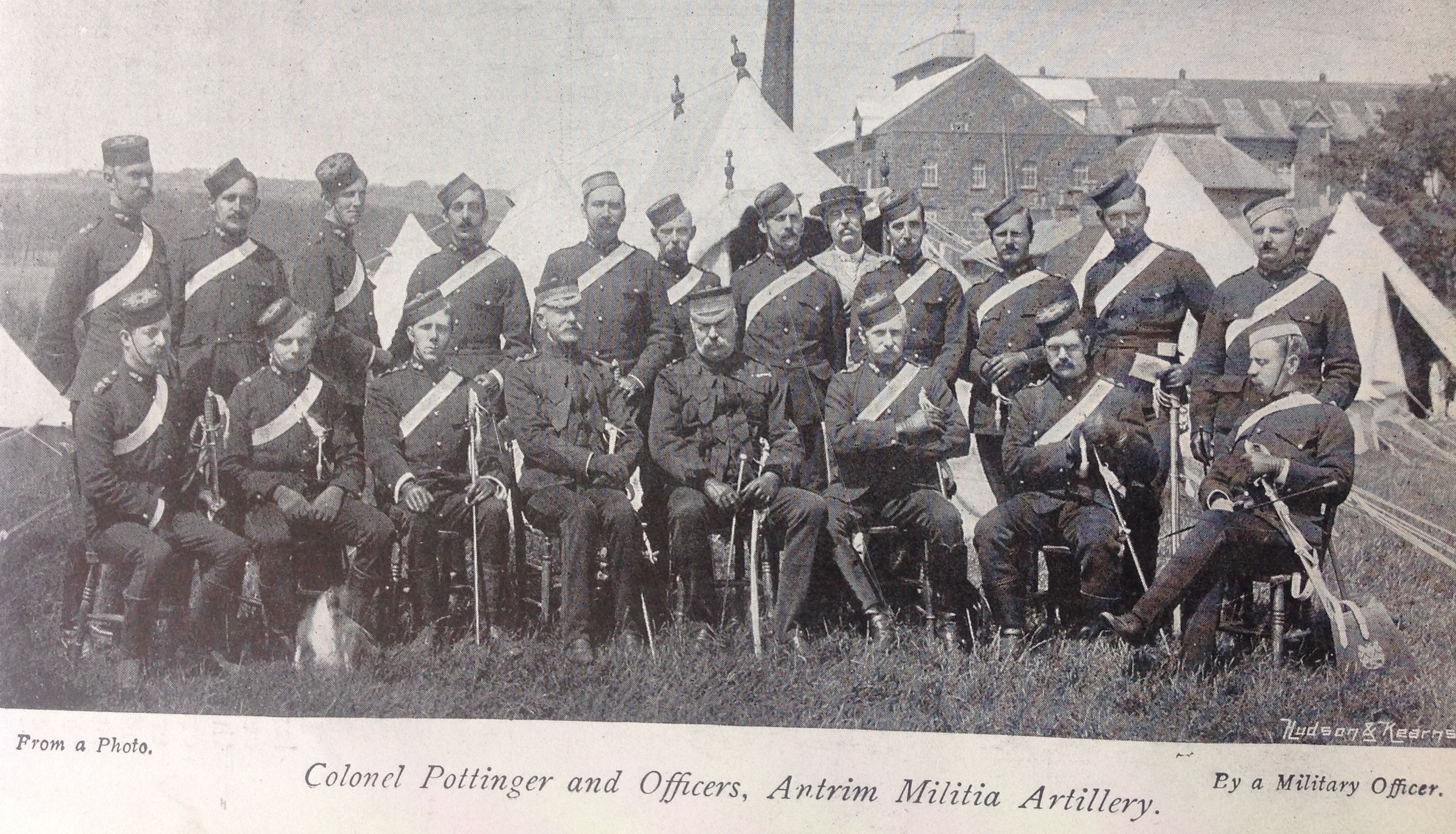
- Antrim militia artillery, 1897 01.jpg — Wikimedia Commons
- Antrim militia artillery, 1897 02.jpg — Wikimedia Commons
- Antrim militia artillery, 1897 03.jpg — Wikimedia Commons
- Cannon at Carrickfergus Castle - Carrickfergus, Ireland - August 14, 2017.jpg — Wikimedia Commons
- Carrickfergus 20180915 114241 (46782569295).jpg — Wikimedia Commons
- Carrickfergus 20180915 114409 (46782576225).jpg — Wikimedia Commons