

Dyffryn Cennen, United Kingdom · United Kingdom
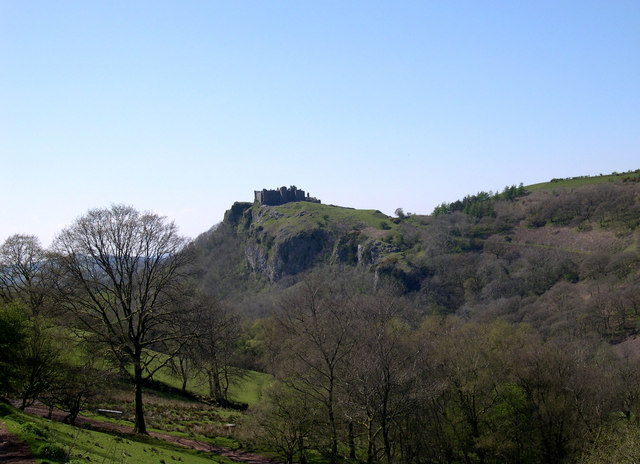
- Carreg Cennen Castle stands on a limestone crag about 90 metres above the River Cennen, near Trap in Carmarthenshire.
- A Native Welsh castle, probably begun by Rhys ap Gruffydd, was rebuilt for John Giffard, 1st Baron Giffard, after the Conquest of Wales by Edward I.
- The ruin has a twin-towered gatehouse, an east range with hall and private rooms, and a vaulted passage to a cave and spring.
- Owain Glyndŵr besieged it in 1403, and in 1462, during the Wars of the Roses, 500 men dismantled it.
- The castle is still privately owned, and the standing ruin is open to visitors every day except Christmas Day.
Visiting
The castle opens at 9.30am every day and is closed on Christmas Day. From November to March the castle closes at 4.30pm. From April to October the castle closes at 5.00pm, at 5.30pm, or at 6.00pm. Last admission is one hour before closing.
The gates of the car park are locked at 6.00pm, and overnight parking is not allowed. Admission is charged to enter the castle grounds, and entry is free for the car park, the farmyard, the tea room, and the gift shop. Adult admission is £8, admission for visitors over 65 is £7, and admission for juniors aged 5 to 17, for students showing valid student identification, and for armed forces and veterans is £5.50. A family ticket for two adults and up to three children is £25.
Groups of 15 or more receive a discount of 10 percent on tickets. Tickets must be bought in the gift shop during quieter periods, and at weekends and in the main season tickets are sold from the ticket hut on the path up to the castle. Some heritage membership cards qualify for discounted admission, and not every free-entry scheme is accepted. Drones are not allowed.
Dogs are not allowed off a lead. Only guide dogs are allowed to enter the tea room and the gift shop. The tea room opens at 9.30am and closes at 5.00pm.
History
Carreg Cennen Castle, Castell Carreg Cennen in Welsh, stands on a limestone crag about 90 metres above the River Cennen, near the village of Trap in Carmarthenshire. The name means a castle on a rock beside that river. The crag is an isolated block of Carboniferous Limestone on the Carreg Cennen Disturbance, with Old Red Sandstone in the country round it, and the castle lies within the Brecon Beacons National Park.
Human remains sealed in cave stalagmite have been taken as a sign of prehistoric activity, and the summit may once have been an Iron Age hillfort. In 1900 T. C. Cantrill found human bone there, with a perforated horse tooth that may have been a bead or a pendant.
A study published in 2021 dated the tooth, long thought to be Late Glacial, to the later Roman or early medieval period, and left the human remains undated.
The first masonry castle was a Native Welsh work, probably raised by Rhys ap Gruffydd, prince of Deheubarth from 1155 until his death in 1197. It stayed with his dynasty for about fifty years, though the earliest written notice comes only in 1248. In that year Matilda de Braose, widow of Rhys Mechyll, tried to hand the castle to the English, or to the French, and her son Rhys Fychan took it back.
For about thirty years the castle then passed between Rhys Fychan and his uncle Maredudd ap Rhys Gryg as they fought over Deheubarth. In the Conquest of Wales by Edward I it was given to the English in 1277, seized by Welsh forces in 1282, and recovered by 1283. Edward granted it to John Giffard, 1st Baron Giffard, who had taken part in the fighting in which Llywelyn ap Gruffudd was killed.
Giffard and his son rebuilt the castle, a fortress within a fortress, and the son was executed in 1322. One account ends the family's hold in 1321 and another in 1322. Rhys ap Maredudd captured the castle in his revolt of 1287, briefly in one account and for about two years in another.
The inner ward is a towered court whose twin-towered gatehouse, the tallest part, served as the keep. An outer ward and a barbican of bridges over deep pits cover the level approaches to the north and east. Hall, kitchen, and private rooms, among them the King's Chamber, line the east side, and a vaulted passage runs to a spring cave whose mouth was walled as a dovecot.
Later lords included Hugh le Despenser and the Duchy of Lancaster. From the accession of Henry IV in 1399 the castle belonged to the Crown. In July 1403 Owain Glyndŵr attacked it with 800 men and badly damaged the walls. Accounts differ on whether the castle fell, and more than five hundred pounds was spent on repairs between 1414 and 1421.
During the Wars of the Roses the custodian Gruffudd ap Nicolas held the castle for the House of Lancaster. After the Yorkist victory at the Battle of Mortimer's Cross in 1461, his sons surrendered it. In 1462 a force of 500 men slighted the castle so that it could not be held again.
J. M. W. Turner painted the ruin in 1798, and the second Earl Cawdor renovated it in the nineteenth century, leaving the edge of his work uncertain.
A mistake in a deed in the 1960s carried the castle to the Morris family of Castell Farm. It remains privately owned, and the ruin is maintained so that it can be visited.
Images




Detailed History
Carreg Cennen Castle, called Castell Carreg Cennen in Welsh, stands on a high rocky outcrop above the River Cennen, close to the village of Trap and about four miles south-east of Llandeilo in Carmarthenshire. The name means a castle on a rock next to the Cennen. The river name is taken either from cen, a word for lichen, or from a personal name. The crag rises about 90 metres, nearly 300 feet, above the valley, and the ruin commands the country around it.
The castle lies within the Brecon Beacons National Park. Since 2024 the monument has been named Castell Carreg Cennen in English as well as in Welsh.
The shape of the rock comes from the Carreg Cennen Disturbance, a belt of ancient faults and folds running from Pembrokeshire to Shropshire and seen most clearly at this castle. The outcrop is an isolated block of Carboniferous Limestone caught between two faults. The ground immediately around it is Old Red Sandstone. West of the castle the River Cennen follows the fault for more than two and a half miles, about four kilometres, because glaciers and later the river wore away the broken rock more easily than the stone on either side.
People used the rock long before a castle stood on it. Human remains were found in stalagmite inside a cave in the limestone. One account treats those remains as evidence that people were here in prehistoric times, and it has been suggested that the crag carried an Iron Age hillfort. In 1900 T.
C. Cantrill excavated in the cave and found stalagmite, human remains, and a perforated horse tooth. A study of that excavation, published in 2021, set out his account and the surviving human and animal remains. The tooth, which may have been a bead or a pendant, had been thought to belong to the Late Glacial period.
Radiocarbon dating placed it in the later Roman or early medieval period. The human remains themselves had stayed undated, as have other human bones found more recently in caves. A cave record lists four people from this cave, two adults and two juveniles, with worked animal bone and teeth, and it leaves their date unknown. Further excavation was carried out by M.
Davies in 1980 and 1981. Coins of the 1st and 2nd centuries have been reported from the site, and a permanent Roman occupation is thought unlikely. The 2021 study set the dated tooth beside other Roman finds from the neighbourhood and from caves in Wales. Later legend puts a fortress here in the Dark Ages, held by Urien Rheged, called Lord of Iskennen, and by his son Owain, and it makes them knights in the time of King Arthur.
The same stories say that a warrior sleeps beneath the castle, waiting for a call from the Welsh. That is legend, not a record of the masonry castle.
The Welsh are the nation native to Wales. In their own language they are the Cymry, a name from a Brittonic word for fellow countrymen, and Wales is Cymru. The first masonry castle on this crag was a Native Welsh work. It was probably built by Rhys ap Gruffydd, the Lord Rhys, and it stayed with the dynasty of Deheubarth for about the next fifty years.
Whatever he built has been swallowed by the later English masonry. Rhys ap Gruffydd was born about 1132 and died on 28 April 1197. He was prince of Deheubarth, the realms of south Wales, from 1155 until his death. In two surviving charters he called himself prince of Wales, or prince of the Welsh.
After Owain Gwynedd died in 1170, Rhys was the strongest ruler in Wales. His grandfather, Rhys ap Tewdwr, king of Deheubarth, was killed at Brecon in 1093 by Bernard de Neufmarché, and most of Deheubarth then fell to the Normans. His father, Gruffudd ap Rhys, recovered a small part, and Rhys's older brothers won more land after their father died. Rhys became ruler of Deheubarth in 1155.
He had to submit to Henry II of England in 1158. In 1163 Henry invaded, took all his lands, and imprisoned him. Within a few weeks he was released and given back only a small holding. He made an alliance with Owain Gwynedd.
After another English invasion failed in 1165, he recovered most of his territory. In 1171 he made peace with Henry, was confirmed in the lands he had retaken, and was named justiciar of south Wales. He kept that peace until Henry died in 1189. He then rose against Richard I and captured Norman castles around his country.
In his last years his sons, especially Maelgwn and Gruffudd, feuded with each other, and he found them hard to control. His last campaign against the Normans, in 1196, took several castles. He died unexpectedly the next year and was buried in St Davids Cathedral. Deheubarth was a regional name for south Wales, set against Gwynedd, and it was the inheritance of the house of Dinefwr rather than a kingdom of the same kind as Gwynedd or Powys.
The first written mention of a castle at Carreg Cennen comes much later than the Lord Rhys, in the year 1248.
Rhys Mechyll died in 1244. He was lord of Dinefwr, of the house of Dinefwr and of Deheubarth, from 1234 to 1244. He was the son of Rhys Gryg, called Rhys the Hoarse, who died in 1234, and he was a grandson of Rhys ap Gruffydd. He married Matilda de Braose, who died in 1248.
A Welsh chronicle enters under 1248 that Rhys Fychan ap Rhys Mechyll regained Carreg Cennen, which his mother had treacherously placed in the power of the French out of enmity for her son. Another account says that she granted the castle to the Norman English in order to spite him, and that he took it before the English could occupy it. For about the next thirty years the castle changed hands between Rhys Fychan and his uncle Maredudd ap Rhys Gryg, who were fighting for control of Deheubarth.
The Conquest of Wales by Edward I was fought between 1277 and 1283. It is distinguished from the earlier Norman advance into Wales. In two campaigns, in 1277 and in 1282 to 1283, Edward I first cut down the lands of Llywelyn ap Gruffudd and then overran them, together with the other Welsh principalities that remained. By the 13th century Wales was split between those principalities and the territories of the Anglo-Norman marcher lords.
Gwynedd led the Welsh polities. Its princes had made the other Welsh rulers their vassals and had taken the title prince of Wales. English kings had tried before to master the Welsh lands. The lasting conquest was Edward's war against Llywelyn, the last independent prince of Wales.
Most of the conquered territory was kept as a royal fief, and by custom those lands later became the endowment of the heir to the English throne, who bore the title prince of Wales. The rest was granted to Edward's supporters as new marcher lordships. Welsh lords who had sided with him, among them Gruffydd ap Gwenwynwyn, were also rewarded, though they held their land by feudal tenure. Royal land was organised under the Statute of Rhuddlan, divided into six shires, and formed into the new Principality of Wales.
The country was not folded into the kingdom of England by statute until the Laws in Wales Acts of 1535 and 1542. Edward's conquest is the point at which Welsh independence ended.
Llywelyn ap Gruffudd, called Llywelyn the Last, was prince of Gwynedd from 1255 to 1282. After campaigns across Wales in 1257 he proclaimed himself prince of Wales in 1258. Henry III recognised that title in the Treaty of Montgomery in 1267, and accepted Llywelyn's recovery of Perfeddwlad, the Four Cantrefs in the east of Gwynedd. War with England in 1241 and 1245, and a dispute over the succession, had earlier weakened Gwynedd and let Henry III take Perfeddwlad.
From 1256 Llywelyn had won it back. Sporadic fighting with marcher lords, including Gilbert de Clare, Roger Mortimer, and Humphrey de Bohun, continued after the treaty. Edward I was king of England from 1272 to 1307. He was also lord of Ireland, and from 1254 to 1306 he ruled Gascony as duke of Aquitaine.
In 1274 the strain between Llywelyn and Edward grew when Gruffydd ap Gwenwynwyn of Powys, and Llywelyn's younger brother Dafydd ap Gruffudd, went over to the English and sought Edward's protection.
At the opening of the war in 1277 the Welsh lords of the Carreg Cennen region sided with Edward against Llywelyn, and the castle was handed to the English. Documents show that some repairs followed. In 1282 the fighting entered a second phase. The local Welsh nobles changed sides, joined the wider rebellion, and seized the castle.
By the next year it was in English hands again. One account says that it was recovered briefly in 1282 by Llywelyn ap Gruffudd himself during his struggle with the Crown, and that it was then granted, in 1283, to John Giffard.
The Battle of Orewin Bridge, also called the Battle of Irfon Bridge and the Battle of Builth, was fought on 11 December 1282 near Builth Wells. An English force guided by Roger Lestrange met a Welsh force led by Llywelyn ap Gruffudd. The Welsh were defeated and Llywelyn was killed. Contemporary chronicles and later scholars contest the exact ground and the scale of the fight.
Another account places his death in an ambush at Cilmeri, and treats that death as one of the last events of the conquest. The rebellion was finished some months afterwards. Edward granted Carreg Cennen to John Giffard, 1st Baron Giffard. One account calls him the commander of the English troops at Cilmeri, where Llywelyn was killed.
His career places him in the fighting at Orewin Bridge. Another account says that he fought for Edward at Irfon Bridge in 1282, and that the castle was the reward of a grateful king. He is also named as the owner of Llandovery Castle. There are no royal building accounts for the new castle, and Edward did not visit it on his progress through Wales in 1284.
Both facts imply that the Giffard family, not the Crown, paid for the work.
John Giffard, 1st Baron Giffard, was John Giffard, baron Giffard of Brimpsfield. He was born on 19 January 1232, the son of Elias Giffard of Brimpsfield in Gloucestershire and of Alice, sister of John Mautravers of Lytchett Matravers in Dorset. He campaigned against Llywelyn ap Gruffudd in 1257 and 1258, and again in 1260 and 1261. In the Second Barons' War he began on the side of Simon de Montfort.
In 1263 he and others of that party besieged the sheriff of Gloucester in Gloucester Castle, and they abducted Peter of Aigueblanche, bishop of Hereford, and held him at Eardisley Castle. In 1264 Giffard held Kenilworth Castle and took Warwick Castle from William Maudit, earl of Warwick. He was captured at the Battle of Lewes, changed sides, and fought for Henry III at the Battle of Evesham in 1265. After Lewes he joined the retinue of Gilbert de Clare, earl of Gloucester and Hertford, and that alliance brought him money and land.
He was afterwards a firm supporter of Henry and of Edward. In 1271 he abducted Maud de Clifford, daughter of Walter de Clifford and widow of William Longespée, while the marriage was still being negotiated, and he was heavily fined for the scandal. Their daughter Katherine married Nicholas Audley, son of Ela Longespée and James de Audley. Their daughter Eleanor married Fulk le Strange.
In 1286 he married Margaret, widow of John de Neville of Hallingbury in Essex and a granddaughter of Ralph Belet and Sibyl de Cormeilles. Their son John was born in 1287. A gift of land that the elder Giffard made in Oxford led to the foundation of Gloucester College. He died at his house at Boyton in Wiltshire on 29 May 1299 and was buried at Malmesbury Abbey.
The castle on the crag today was probably begun by the elder John Giffard and finished under his son. The rebuilding is described as three phases, close to one another in time. The inner ward and the gatehouse came first, and the barbican and the outer ward followed. The south curtain may still hold masonry from the Welsh castle.
Another account says that nearly all the stone now visible was raised while Giffard and his son held the castle, and that the new work wiped out the traces of anything earlier. The son, John, was executed by Edward II in 1322 as a rebel, and Brimpsfield Castle was destroyed. One account keeps Carreg Cennen in the family's hands until 1321, and another until 1322. It probably was not Giffard's main home.
The formidable building on the older Welsh site was a sign of control, part of the wave of fortresses raised by marcher lords after the conquest. Its plan is a castle within a castle, with a twin-towered gatehouse, and it was never softened by a later conversion into a genteel house.
In 1287 Rhys ap Maredudd rebelled. He was a senior member of the royal house of Deheubarth, great-grandson of the Lord Rhys, and the last ruler of a united Deheubarth. He led the rising in south Wales in 1287 and 1288 while Edward I was away in Gascony. He captured Carreg Cennen.
One account says that he did not keep it long. Another says that the castle was out of the Giffards' hands for two years after the rebellion of 1287.
The inner ward is a strongly walled and towered court, roughly square. There are six towers, and each has a different shape, round, polygonal, or square. The great twin-towered gatehouse stands at the centre of the north side. It was the hub of the defence and the tallest part of the castle, and for that reason it served as the keep, the last refuge if the rest were entered.
The towers of the gatehouse are described as octagonal. Entry was barred by a drawbridge, arrow slits, two portcullises, and heavy wooden doors, and the top had battlements and machicolations, openings through which water or missiles could be dropped on a fire or on people below. Each octagonal tower had a guardroom on the ground floor. A spiral stair reached the upper floors and the wall-walk, and it linked the gatehouse to the two northern corner towers.
The north-east tower, which may have housed part of the garrison, had a fireplace and latrines, and it was placed so that it could watch the outer ward, the barbican, and the inner ward. The round north-west tower watched the most open approach. Its basement had three arrow slits, and one of them was later cut back for a musket.
An outer ward covers the more level, and more vulnerable, ground to the north and east. Its curtain has small round towers at the angles and a small gate. Inside it there would have been stables, workshops, and a smithy. What can be seen there now is a lime kiln, with the quarry ditch that supplied stone for the lime, and, outside the curtain to the north-east, the turf-covered footings of a rectangular building whose purpose is unknown.
The outer enclosure was laid out to trap attackers and to keep them from the inner door. The north-east tower projects into that ward, in a position to shoot into a crowd that had been forced into a narrow space.
Between the outer ward and the inner ward sits an elaborate barbican. A narrow stepped ramp rises between two gates, and each gate had a movable bridge over a deep pit. Another account counts three drawbridges over deep pits. The path turns sharply, first one way and then the other, so that anyone climbing it was channelled and exposed.
The bridges could be drawn off their supports, leaving the pits as a gap. The bridges are now fixed wooden ramps, and the pits are still open. At the west corner of the barbican a tower contains a basement that was called a prison in 1369. From that point a drawbridge led on to the gatehouse.
The same basement, in the middle gate tower, is described as the last line before the gatehouse, and as a place from which arrows could be shot down on anyone who had got that far. Just inside the gatehouse, in the inner ward, are the remains of baking ovens and of two cisterns. The cisterns are stone-lined pits with low walls, made to catch rainwater. Two cisterns are also described at the back of the gatehouse.
One account calls a clay-lined ditch just outside the gatehouse the castle's main water container, and notes the danger of leaving that supply outside the inner ward, where an attack could cut it off. The cisterns would answer for a short time. The shallow tanks would have been little help in a long siege.
The living rooms stand along the east side of the inner ward, at first-floor level, over a row of basements. A stone stair on the outside leads up to the hall, which sits in the middle of the range. Meals were served there, and guests were received there. The hall was heated by a central hearth, and the base of that hearth is still in place.
North of the hall is the kitchen, with large stone fireplaces, a buttery, and a pantry. South of the hall are the owner's private apartments, two rooms at the far end of the wing. They have a fireplace and decorative windows, and they are the rooms called the King's Chamber. The chamber has a well-carved stone fireplace and traceried windows of the late 13th or early 14th century.
One window looks into the courtyard. The other looks south, over the drop. The private rooms show signs of later alteration, which may belong to the time of John of Gaunt in 1369. A square tower projects from the range and is reached from the hall.
One account places the chapel in that tower, projecting into the outer ward. Another places the chapel in a square tower on the west wall, also reached from the hall.
The south-west and south-east corners of the inner curtain are lightly built, one as a curving projection and the other as a corner turret, because the wall there stands on the cliff. Limestone cliffs cover the south side, and rock-cut ditches cover the west. The south curtain rises to its original height, and part of the wall-walk survives, with latrines and two windows. The foundations of a rectangular building run along that wall, and its use is unclear.
The west wall, pierced with arrow slits, is built straight onto the limestone and is poorly preserved. It runs from a simply built south-west tower to the north-west tower.
In the south-east corner of the inner ward, steps go down to a postern. From there a narrow vaulted passage runs along the cliff edge to the walled mouth of a natural cave. Loopholes light the passage, and its windows look out over the drop. The passage was made so that the cave could not be used to undermine the castle.
The wall across the cave mouth includes a dovecot. This cave is one of at least nine in the castle rock. It narrows and continues for some 50 metres into the hill. A trench cut in the floor makes the way passable.
Toward the inner end, water drips into a natural basin. A freshwater spring in the cave would have supplemented the rainwater cisterns in dry weather, when the tanks were hard to fill. In the time of the castle the adapted cave may have been a grotto and a place for conversation, as well as a dove house. Cave earth was noted in two of the other caves in the rock.
After the Giffards, Hugh le Despenser is named among the owners. The castle then came to the Duchy of Lancaster. Building records of 1369 and 1370 show that large repairs were carried out. John of Gaunt is named as holder in 1369, the year in which the barbican basement was called a prison and in which the private rooms may have been altered.
His son Henry Bolingbroke became king as Henry IV in 1399. Henry IV, son of John of Gaunt and grandson of Edward III, was king of England from 1399 to 1413, and also lord of Ireland and duke of Aquitaine. With his accession, Carreg Cennen passed to the Crown.
Owain Glyndŵr, Owain ap Gruffudd Fychan, was born in or before 1359 and died about 1416. He was the son of Gruffudd Fychan and Elen ferch Tomas. His father's line went back to an earlier Gruffudd Fychan, younger brother of Llywelyn Fychan, the last lord of northern Powys, who was killed with Llywelyn ap Gruffudd in the last stage of the Edwardian conquest, and beyond that to Madog ap Maredudd, the last ruler of a united Powys. After the conquest, on 12 February 1283, that earlier Gruffudd Fychan swore fealty to Edward and was allowed to hold his land by Welsh barony.
Under that tenure he and his descendants owed the Crown military service and kept the right to hold court on their own lands. Owain's father held two lordships at opposite ends of the Berwyn range: Glyndyfrdwy in Meirioneth, inside the Principality of Wales, and half of Cynllaith in the marcher lordship of Chirk. Little of the father's career is recorded. From 1346 to 1348 he held the stewardship of a lordship belonging to Richard Fitzalan, earl of Arundel.
Owain himself was a Welsh nobleman and a military commander, lord of Glyndyfrdwy, and he led a revolt whose aim was an independent Wales. His supporters acclaimed him prince of Wales on 16 September 1400. The immediate quarrel was with his English neighbour, Reginald de Grey, and it sat inside a wider hostility between Welsh and English in Wales. The response included penal laws against the Welsh, which deepened the unrest and widened his support.
Between 1404 and 1405 the rebellion held the whole country. In 1404, after successful sieges and battlefield victories, he held a parliament at Machynlleth, with envoys from France, Scotland, and the Spanish kingdoms of Castile and Leon, and with men from every part of Wales. France, Brittany, and Scotland gave military help. In the Pennal Letter of 1406 he wrote of two universities, one in the north and one in the south, of restoring the laws of Hywel Dda, and of pushing the border of Wales into England.
English pressure and the want of lasting foreign aid then took the rebel territory back. By 1409 Harlech and Aberystwyth, the last rebel castles, had fallen. He refused two royal pardons and went on with a smaller war from the hills until he vanished from the record in 1412. He was never captured.
He died in hiding, about 1416. In Welsh memory he stands with Cadwaladr, Cynon ap Clydno, and Arthur, and he appears in Shakespeare's Henry IV as Owen Glendower.
In early July 1403 Owain Glyndŵr attacked Carreg Cennen with 800 men. The walls were badly damaged. One account says that the assault failed and that the castle was not taken, and that he stayed for a siege of several months. The man who held it against him was Sir John Scudamore of Herefordshire.
Another account says that the castle was surrendered to Owain Glyndŵr after a siege. Another says that he took it in 1403. A further account says that it was besieged in about 1403 and considerably damaged, without saying whether the garrison yielded. Sir John Scudamore was an English landowner who served as constable and steward of royal castles in south Wales.
He was fighting in Wales in 1402, and he was still alive in 1432, when it came out that he had married a daughter of Owain Glyndŵr. She was Alys ferch Owain Glyndŵr, daughter of Glyndŵr and Margaret Hanmer. One account places that marriage only a few years after the siege. The damage needed a long repair.
More than five hundred pounds was spent on the castle between 1414 and 1421.
By the middle of the 15th century the custodian was Gruffudd ap Nicolas, a powerful nobleman in Carmarthenshire who organised bardic eisteddfods in the county during the 1450s. Under him Carreg Cennen was a stronghold of the House of Lancaster in the Wars of the Roses. Those wars were a run of campaigns for the English throne from 1455 to 1487, fought between the House of York, whose badge was a white rose, and the House of Lancaster, whose badge by 1485 was a red rose. Both houses were branches of the Plantagenets.
The trouble grew from the Hundred Years' War with France, which lasted from 1337 to 1453, and from the armed followings of the great duchies created under Edward III, who died in 1377. The illness of Henry VI, of the House of Lancaster, brought his cousin Richard, duke of York, back to a claim on the throne. Fighting opened in 1455 when York captured Henry at the First Battle of St Albans and was made protector. In 1460 Richard Neville, earl of Warwick, captured Henry again at Northampton.
York was killed at Wakefield. His son Edward inherited the claim. The Yorkists lost Henry after the Second Battle of St Albans, then defeated the Lancastrians at Towton, and Edward was crowned Edward IV in June 1461.
The Battle of Mortimer's Cross was fought on 2 February 1461 near Kingsland in Herefordshire, not far from the Welsh border. Some accounts put it on 3 February, and the exact field has been debated. One army was led by Jasper Tudor and his father Owen Tudor, with nobles loyal to Henry VI, to his wife Margaret of Anjou, and to their son Edward, then seven years old and called prince of Wales. The other army was that of Edward, earl of March.
The Yorkists won. That victory forced the sons of Gruffudd ap Nicolas to give up Carreg Cennen. The castle was garrisoned for the last time by Lancastrian forces in these wars. In 1462 it was captured, in one account by Sir Roger Vaughan.
The Yorkists then slighted it, pulling it down so that it could not be held again. A force of 500 men did the work. One account says that they took four months and used picks and crowbars. Another says that, after the Yorkist victory of 1461, the castle was judged too dangerous to the Crown and was destroyed the following spring.
The gunport in the north-west tower, an older arrow slit opened for a musket, is likely to have been cut while the Lancastrians held the castle. The interior is still largely a ruin because of that demolition, though the plan of the medieval fortress can be read from what remains.
Ownership later passed to the Vaughan family and to the earls of Cawdor. Sir Rhys ap Thomas is named among the owners after the slighting, and the Vaughans of Golden Grove left the castle to the earls of Cawdor in the early 19th century. From the 18th century the ruin attracted painters. J.
M. W. Turner painted it in 1798, and he sketched the romantic ruin more than once. Joseph Mallord William Turner, known in his lifetime as William Turner, was born on 23 April 1775 and died on 19 December 1851.
He was an English landscape painter, trained first as an architectural draughtsman and a watercolourist, and he became one of the leading British painters of the 19th century. The second Earl Cawdor began a large renovation in the 19th century, in the fashion for imaginative rebuilding of medieval ruins. It is still not clear where his masonry stops and the medieval wall begins.
In 1932 Carreg Cennen was placed in the guardianship of the Office of Works. The Cawdor family nonetheless kept a hold on it well into the 20th century. In the 1960s the Morris family of Castell Farm acquired the castle, because a mistake in the wording of Lord Cawdor's deeds included the castle with the farm. It is still private property.
Margaret and Bernard Llewellyn, daughter and son-in-law of Gwilim Morris, own it, and with their daughters they manage it. The monument is maintained for the public, and the standing masonry has been stabilised and, to a limited extent, restored. Since 1982 the farm has kept a park of rare and unusual breeds of cattle and sheep. A large threshing barn serves as a tea room and a shop, while most of the other buildings around the yard remain in farm use.
The way up from the farm takes a steep walk of about ten to fifteen minutes. The castle is judged of national importance for what its walls and its buried layers can still show of medieval defence and of life inside a castle. The fabric is well preserved, and both further structure and intact deposits are likely to survive in the ground within and around the ruins.
Sources
- Carreg Cennen Castle — Wikipedia
- John Giffard, 1st Baron Giffard — Wikipedia
- Owain Glyndŵr — Wikipedia
- Rhys ap Gruffydd — Wikipedia
- Conquest of Wales by Edward I — Wikipedia
- Native Welsh — Wikipedia
- Wars of the Roses — Wikipedia
- J. M. W. Turner — Wikipedia
- Rhys Mechyll — Wikipedia
- Llywelyn ap Gruffudd — Wikipedia
- Battle of Orewin Bridge — Wikipedia
- Battle of Mortimer's Cross — Wikipedia
- Rhys ap Maredudd — Wikipedia
- Deheubarth — Wikipedia
- More about Carreg Cennen — Cadw
- Castell Carreg Cennen — Cadw
- Castell Carreg Cennen scheduled monument — Cadw
- The Castle — Carreg Cennen Castle
- Visiting Us — Carreg Cennen Castle
- Cadw monument names — Welsh Government
- Carreg Cennen Castle Cave: a review of the work undertaken by T. C. Cantrill in 1900 — Archaeology Data Service
- John Scudamore — Wikipedia
- Alys ferch Owain Glyndŵr — Wikipedia
- Gruffudd ap Nicolas — Wikipedia
- Henry IV of England — Wikipedia
- Edward I of England — Wikipedia
- Carreg Cennen seen from the southeast - geograph.org.uk - 211604.jpg — Wikimedia Commons
- Careg Cennen Castle.jpg — Wikimedia Commons
- Careg Cennen Castle1.jpg — Wikimedia Commons
- Careg Cennen Castle2.jpg — Wikimedia Commons
- Afon Cennen - geograph.org.uk - 663375.jpg — Wikimedia Commons
- Carreg Cennen - geograph.org.uk - 753135.jpg — Wikimedia Commons
- Carreg Cennen - geograph.org.uk - 1262673.jpg — Wikimedia Commons
- Afon Cennen below Carreg Cennen Castle (8660).jpg — Wikimedia Commons
- Carreg Cennen Castle (8592).jpg — Wikimedia Commons
- Carreg Cennen Castle (8599).jpg — Wikimedia Commons