

Carew, United Kingdom · 1270 CE · United Kingdom
- Carew Castle, Castell Caeriw, stands on a limestone bluff above the tidal Carew River in Pembrokeshire, and the family that took its name from the site has held it for more than 900 years.
- Gerald de Windsor raised a Norman fort here around 1100 on the dowry manor of Nest ferch Rhys, and Nicholas de Carew built the high courtyard castle about 1270.
- Sir Rhys ap Thomas, who fought for Henry Tudor at the Battle of Bosworth Field, acquired the castle by 1480, remodelled the halls, and held a five-day tournament here in 1507.
- Sir John Perrot, also written John Perrott, replaced the north wall with an Elizabethan range and died in the Tower in 1592 before that work was finished.
- During the English Civil War the castle changed hands three times or four and was abandoned in 1686, while Carew Tidal Mill beside the causeway worked until 1937 and was restored in 1972.
- Excavation found an Iron Age fort, Roman pottery, and a ditch silt dated around 270, and a 2024 exhibition displayed tiles and a gold ring from digs between 1985 and 1995.
Visiting
Last admission is 30 minutes before closing. The castle is open from 23 March to 1 November, 10am to 4.30pm. From 2 November to 18 December the castle is open from 11am to 3pm. The castle is closed on 19 December to 27 December.
From 28 December to 3 January 2027 the castle is open from 11am to 3pm. From 4 January to 5 February the castle is open from 11am to 3pm on Monday to Friday only. The castle is also open from 6 February to 21 February, 10.30pm to 3.30pm daily. The castle is also open from 22 February to 14 March, 11am to 3pm daily.
The castle is also open from 15 March to 31 October, 10am to 4.30pm daily. Adult admission is £9 for visitors aged 17 and over. Child admission is £7 for ages 4 to 16. A family ticket for two adults and two children is £28.50.
Entry is free for an annual pass holder, for a Carew and Jeffreyston parish resident showing proof of address, and for a wheelchair user with one accompanying carer. An annual pass ticket is £22.50 for an adult, £17.50 for a child, and £70 for a family. The tidal mill is open from 23 March to 1 November, 11am to 5pm. The tidal mill is closed on Thursday 22 October and Friday 23 October.
The tidal mill is closed on 2 November until 15 March 2027 in one timetable. The tidal mill is closed on 2 November until 14 March 2027 in the other timetable, and it is then open from 15 March to 31 October, 11am to 5pm. Dogs on a short lead are welcome and entry is allowed with them across the site. Boats, kayaks, canoes, and paddleboards are not allowed on the millpond.
Wheelchair users are allowed to enter the ground floor of the castle and the mill.
History
Carew Castle, called Castell Caeriw in Welsh, stands on a limestone bluff above the tidal Carew River in Pembrokeshire. The walls are local Carboniferous limestone and rise as high as 15 metres. The Carew family take their name from the site and are said to have owned it for more than 900 years, and the national park now leases it for visits.
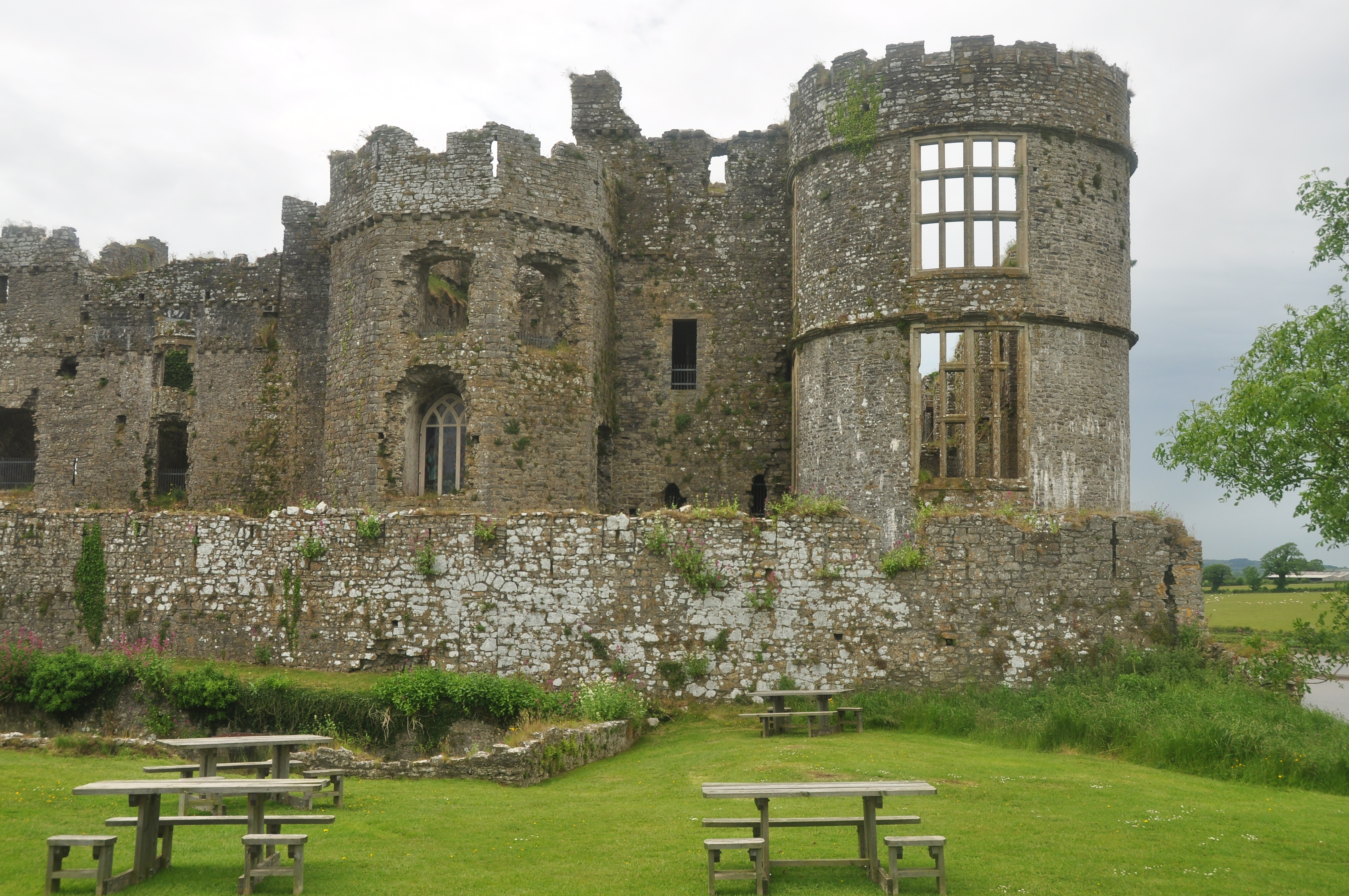
The inner ward is reached across a dry moat, with three D-shaped towers at the front and two round towers at the rear. The great hall sits in the western range between towers on spurred bases, and a polygonal tower holds the chapel. In the sixteenth century the north wall became a five-room range with a gallery more than 40 metres long.
Excavation has found an Iron Age promontory fort, described with five ditches and also with as many as six. Roman pottery of the first to the fourth century, early medieval material, and a ditch silt dated around 270 come from that ground. An exhibition opened on 16 October 2024 also framed a Stone Age beginning, beside the excavated Iron Age, Roman, and Norman sequence.
Gerald de Windsor, constable at Pembroke for Arnulf of Montgomery and also described as constable there for Henry I, married Nest ferch Rhys, whose dowry included Carew. The marriage is placed around 1095 and also in 1105, when Henry restored Gerald to Pembroke. Gerald cleared the older fort and built a castle around 1100, told both as earth and timber and as a stone keep, the Old Tower, inside timber walls.
Nest was taken by Owain ap Cadwgan in 1106 or in 1109, in tellings set at Carew, at a truce gathering, and at Cenarth Bychan. Gerald is presumed to have died in 1116, and he is also given a death in 1135. Their son William took the name de Carew, while a later William, called Gerald’s great-grandson, is tied to the House of Carrio in a letter of 1212.
King John seized the house in 1210 and 1211. Nicholas de Carew is credited with the high courtyard castle of about 1270, influenced by the Edwardian castles of north Wales, and he is given deaths in 1297 and in 1311. The earlier year belongs with the pedigree edited by John Lambrick Vivian.
After the Black Death the Carews are said to have mortgaged the castle. Sir Edmund Carew is also said to have sold or disposed of it to Rhys ap Thomas in 1480. Rhys, born in 1449, joined Henry Tudor after the landing at Mill Bay in August 1485 and fought at the Battle of Bosworth Field on 22 August.
Rhys was knighted on that field, received the chief crown offices in south Wales, and was made a Knight of the Garter on 22 April 1505. In April 1507 he held a five-day tournament at Carew for 600 nobles, remodelled the halls, and set up a doorway with the arms of Henry VII, Arthur, and Catherine of Aragon. He died in 1525, a year also given as 1524, in the summer at Carmarthen or in February.
His grandson Rhys ap Gruffudd was executed for treason in 1531, and the castle returned to the Crown. In 1558 it was granted to Sir John Perrot, also written John Perrott, who was born in 1528 or in 1530. He replaced the north curtain with an Elizabethan range and died in the Tower on 3 November 1592, before the work was finished.
The family bought the castle back in 1607. In the English Civil War it changed hands three times or four, the south wall was breached or pulled down, and the kitchens were slighted. At the Stuart Restoration the Carews returned to the eastern wing and left it in 1686.
Carew Tidal Mill, called the only restored tidal mill in Wales and also the only intact mill of its type there, stands on a causeway west of the castle. A mill is recorded in 1541, as two mills under one roof called le french mills, and also by 1542. The present wheels include one dated 1801, milling stopped in 1937, and restoration finished in 1972.
The park took a 99-year lease in 1983, while repairs funded by Cadw are also dated from 1984. The lesser hall was roofed again in 2013, and the Nest Tearoom followed in 2018. The 2024 exhibition showed tiles, a gold ring, and weaving gear from excavations of 1985 to 1995, without announcing a new dig.
Images




Detailed History
Carew Castle, also called Castell Caeriw, stands in the civil parish of Carew in Pembrokeshire, on a limestone bluff above an inlet of the Carew River where the tide runs into the Milford Haven waterway. The walls are built almost entirely of local Carboniferous limestone and rise as high as 15 metres. Window frames of the later domestic work are imported stone, given as Cotswold stone in one account and as Bath stone in another. The Carew family take their name from this place and are said to have owned it for more than 900 years.
The present owners are their Trollope-Bellew descendants. The castle is leased to the Pembrokeshire Coast National Park for administration and is open to visitors. It was designated a Grade I listed building on 14 May 1970 and is also a scheduled monument. It is not a world-heritage inscription.
The inner ward is entered across a dry moat that had a barbican and a gatehouse. The front has three D-shaped towers and crenellated walls. The rear has two large round towers. The great hall lies in the western range, between two great towers that rise from spurred bases.
A chapel occupies a polygonal tower projecting into a walled forecourt on the east, beyond which the outer court survives only in part. In the sixteenth century the northern defensive wall was converted into a domestic range. That north range has five rooms. Its second floor is a gallery more than 40 metres long, and the facade is Elizabethan, with large windows toward the millpond.
A small gatehouse leading into the outer ward is credited to the late fifteenth-century remodelling. Gardens and orchards once surrounded the castle, especially on the east, where the approach passed through grassy courts. A walled garden survives, with earthworks of further gardens, buildings, and ox-houses. West of the castle a terraced garden faces the river, and earthworks there are thought to include a lime kiln, stables, and a small dock or landing stage.
The bluff commands a crossing of the Carew River at its tidal reach, and military use of the ground is carried back at least 2,000 years. Excavation in the outer ward has found multiple defensive walls of an Iron Age fort. One account describes a substantial five-ditched promontory fort and large quantities of Roman pottery, and allows that a Dark Age settlement or fort may also have stood here. Another describes up to six ditches cutting the promontory off from the landward side, with a complex entrance.
Those ditches are tied to an unstratified ceramic assemblage that includes Roman pottery of the first to the fourth century and early medieval material. A radiocarbon determination from a primary ditch silt is centred on 270. The earlier fortress may still have been occupied when the Normans arrived. An exhibition that opened on 16 October 2024 framed the sequence as a Stone Age settlement, then an Iron Age fort, then a Norman stronghold.
The dated evidence published with the ditches remains the Iron Age walls, the Roman and early medieval pottery, and the third-century radiocarbon result.
At the end of the eleventh century the Normans extended their conquest from England into south Wales, and Pembroke became the centre of Norman rule in south Pembrokeshire. Rhys ap Tewdwr, the last king of Deheubarth, was killed in 1093. Arnulf of Montgomery, youngest son of Roger de Montgomery, earl of Shrewsbury, came south from Shrewsbury into Dyfed and raised Pembroke as a slender fortress of turf and stakes. He left the fort and a small garrison to Gerald de Windsor, also called Gerald FitzWalter, his constable and lieutenant.
Gerald was born about 1075, a younger son of Walter FitzOther, the first Norman constable of Windsor Castle. One account makes him castellan of Pembroke for Arnulf in the first Norman invasion of the county. Another says he was constable of Pembroke on behalf of Henry I when he decided to fortify a site on the Carew River, some ten miles up the tidal water from Pembroke. In 1096, during a Welsh rising, he held Pembroke through a long siege by Uchtryd ab Edwin and Hywel ap Goronwy.
Fifteen of his knights deserted by boat at night. He confiscated their land and knighted their followers. With food almost gone he cut four hogs into pieces and threw them over the palisade, then left a sealed letter where it would be found, saying he would not need Arnulf’s help for four months. The besiegers went home.
In 1102, before the Montgomery revolt against Henry I, he went to Ireland and negotiated Arnulf’s marriage to Lafracoth, a daughter of Muirchertach Ua Briain, king of Munster. For siding with the Montgomerys he was removed from Pembroke that year, and a knight named Saher was installed. Saher could not hold the place. Henry restored Gerald in 1105.
Nest ferch Rhys was born about 1085, a daughter of Rhys ap Tewdwr and Gwladys ferch Rhiwallon, of the house of Dinefwr. After 1093 she was taken to the court of William II. She may have borne Henry I an illegitimate son, Henry FitzHenry, around 1103. The castle account says Gerald married her around 1095.
Her own life places the wedding later, when the king restored Gerald to Pembroke in 1105 and gave him Nest as his wife. She brought the manor of Carew as her dowry. Gerald cleared the fort on the bluff and built his own castle on Norman lines. One account says that first work was probably earth and wooden stakes, later replaced in stone.
Another says the outer walls were timber and only the keep was stone, raised around 1100, and that this keep survives inside the later building as the Old Tower. Gerald’s life presumes that he died in 1116, not long after he killed Owain ap Cadwgan, and treats a death date of 1135 as a mistake. Nest’s life still gives him the span from about 1075 to 1135, and gives her own death as about 1136.
The taking of Nest is dated 1106 in one account and 1109 in another. Owain ap Cadwgan, her second cousin and a son of Cadwgan ap Bleddyn of Powys, came with a small company. The earliest telling, from Caradoc of Llancarfan, says he was moved by passion and made for the castle by night. One version puts the couple at an eisteddfod during a truce.
Another puts them at Carew, with Nest urging Gerald to escape down the chute of the garderobe while she faced Owain, who then carried her and the children to a hunting lodge by the Eglwyseg Rocks. A third puts the attack at Cenarth Bychan, probably the later Cilgerran, a castle Gerald is said to have built in 1108. Whether she went willingly is disputed, and later writing that multiplied her children by Owain is not supported by the genealogies. She is said to have told him to send the children home if he wanted her to stay, and the children were returned.
Norman lords, the justiciar of Shropshire, and at least one bishop paid Owain’s Welsh enemies to attack him. He and his father went into exile in Ireland, and Nest went back to Gerald. In 1116 Owain, by then pardoned and prince of Powys, met Gerald on the road while both were travelling to help the king, and Gerald killed him. Their children included William FitzGerald, lord of Carew and Emlyn, who died about 1173, Maurice FitzGerald, David FitzGerald, later bishop of St Davids, and the daughters Angharad and Gwladys.
After Gerald’s death her sons married her to Stephen, constable of Cardigan, and she had a further son, Robert FitzStephen. Through these children she was an ancestor of the FitzGerald families and of the Carews.
Gerald’s son William took the name de Carew. In the middle of the twelfth century he is credited with a stone enclosure that incorporated the first keep, and with a great hall inside it. A different William, called the great-grandson of Gerald of Windsor, is tied to the House of Carrio by a close letter of 1212, and the oldest tower still standing is thought to have belonged to that house. The two Williams are separate statements and are not collapsed into one man.
King John seized the house briefly in 1210 and 1211. The high-walled castle of rooms and halls around the courtyard is the work of about 1270, credited to Nicholas de Carew and set beside the Edwardian castles then being built in north Wales. The outer ward was walled at that time as well. Nicholas is given a death in 1297 and a death in 1311.
The earlier year travels with the Carew pedigree edited by John Lambrick Vivian, the English genealogist who lived from 1830 to 1896, inspector of militia, and editor of the heraldic visitations of Devon published at Exeter in 1895. The later year is the one given for the man responsible for the east and west ranges. A further account gives the late thirteenth and early fourteenth century rebuilding to the de Carew family without choosing between those deaths. Sir Edmund Carew, called a grandson of Nicholas, disposed of the castle in 1480, a date also given as about 1480.
How the castle left the Carews is told in more than one way. They are said to have fallen on hard times after the Black Death and to have mortgaged it, so that it came to Rhys ap Thomas. The Black Death was the plague pandemic in Europe from 1346 to 1353. It was caused by the bacterium Yersinia pestis, spread mainly by flea bites, and it killed up to 50 million people, about 30 to 60 percent of Europe’s population.
Outbreaks continued through the later Middle Ages, and Europe’s population did not return to its fourteenth-century level until the sixteenth century. The mortgage is not pinned to one year of that pandemic. A second account says Sir Edmund Carew sold the castle to Rhys in 1480, or otherwise disposed of it to him in that year. A third says Rhys spent his later years in a house the owner had mortgaged to him.
The sale, the disposal, and the mortgage remain side by side.
Sir Rhys ap Thomas was born in 1449. He was the youngest legitimate son of Thomas ap Gruffudd ap Nicolas of Llandeilo and Elizabeth, daughter of Sir John Gruffydd of Abermarlais, and he is also called the third son. His grandfather Gruffudd ap Nicolas leased the lordship of Dinefwr in 1440 for sixty years. The family tradition was Lancastrian.
In 1461, when Rhys was twelve or thirteen, Jasper Tudor’s Welsh army was defeated at Mortimer’s Cross and Rhys’s grandfather was killed. Thomas and his brother Owain held Carreg Cennen until a siege forced their surrender in 1462, after which the Yorkists slighted that castle. Father and son went into exile at the court of Philip the Good, duke of Burgundy, and returned about 1467. Thomas died in 1474.
The elder brothers were already dead, and Rhys inherited. Under Edward IV he kept a local military force. Richard III’s accession in 1483, after Edward V was set aside, was followed by Buckingham’s revolt in favour of the exiled Henry Tudor. Storms kept Buckingham from crossing the Severn, his men deserted, and he was executed.
The same weather stopped Henry landing in the west. Rhys had not joined the revolt. Richard then made him principal lieutenant in south-west Wales and gave him an annuity of 40 marks for life. He was asked to send his son Gruffudd to the court at Nottingham as a hostage and declined, saying his conscience bound him more strongly.
He is supposed to have sworn that any man ill-affected to the state who landed in the parts of Wales where he served would have to make that entrance over his belly. He is presumed to have been in touch with Henry already, through Lewis Caerleon, physician to Lady Margaret Beaufort, and one account places that contact while Henry was still in Brittany.
Henry sailed from Harfleur on 1 August 1485 with English exiles and French mercenaries. He landed unopposed on 7 August 1485 on the south-west coast of Wales, at Mill Bay near Dale on the north side of Milford Haven, close to his birthplace at Pembroke. Other accounts say only that he landed at Milford Haven. Rhys joined him instead of opposing him.
The tale that the bishop of St Davids offered to absolve the oath, and that Rhys stood under Mullock Bridge, about two miles north of Dale, while Henry passed over it, is folklore in one telling and is called legendary in another. The columns marched separately. Rhys recruited 500 men as he went, and he is also said to have joined Henry near Welshpool with levies from the vale of Towy, a Welsh force described as large enough to have annihilated the rest of Henry’s army. On 22 August 1485 they met Richard near Market Bosworth.
The fight is the Battle of Bosworth Field, the last significant battle of the Wars of the Roses. Richard’s army was the larger and was split into three battles, one under the duke of Norfolk and one under the earl of Northumberland. Henry kept most of his men together under the earl of Oxford. Norfolk’s vanguard struggled, and a contemporary ballad has Rhys’s men breaking that line.
Norfolk was killed by an arrow. Northumberland did not move when signalled. Richard charged across the field to kill Henry. Lord Stanley and Sir William Stanley had been waiting.
Sir William then led his men in, and Richard was surrounded and killed. He was the last English monarch to die in battle. A poem by Guto’r Glyn has been read as giving the blow to Rhys, from a line about killing the boar and shaving its head. The grammar makes King Henry the subject of that phrase, and the shaving is read as a rite after death, while the poem still places the killing with soldiers led by Rhys.
A local account says Richard was killed allegedly at the hand of Rhys. Henry was crowned after the victory. He was the first monarch of England from the Welsh house of Tudor, and his marriage to Elizabeth of York joined the claim to the Yorkist line. The exact ground of the battle has been disputed.
A heritage centre was built in 1974 on a site later challenged, and a survey published in October 2009, after work from 2003, proposed a place about two miles south-west of Ambion Hill.
Rhys was knighted on the field. In November 1485 he received the constableship and stewardship of Brecknock, the chamberlainship of Carmarthen and Cardigan, and the stewardship of Builth, the chief crown appointments in south Wales. He is also called justiciar of South Wales from 4 January 1496 until the summer of 1525, and governor of all Wales. He put down a Yorkist revolt at Brecon in 1486, commanded a troop of horse at the battle of Stoke on 16 June 1487 when Lambert Simnel was defeated, and took part in the expedition against Boulogne in October 1492.
At Blackheath on 17 June 1497 he captured Lord Audley and was created a knight banneret. He was present when Perkin Warbeck surrendered at Beaulieu Abbey in September 1497. He was made a Knight of the Garter on 22 April 1505. He marked that honour with a great tournament at Carew in 1507, given more closely as April 1507, lasting five days and attended by 600 nobles.
It has been called the most magnificent entertainment in the history of Wales, and the contemporary account of it was later reprinted by Fenton. He invited leading families from across Wales. He altered both the east and west ranges, remodelled the great hall, built the lesser hall, and built the dining room in the east block. He also built the gatehouse and inserted windows.
An inner doorway carries three coats of arms, those of Henry VII, of his son Arthur, prince of Wales, and of Arthur’s wife Catherine of Aragon. A large window of the great hall looks toward the inner gatehouse and the lesser hall, not out to the Carew River. That inward view has been read as a choice to display the new architecture rather than the water. He was said to rule this corner of Wales like a king, with the trust of Henry VII and of Henry VIII.
In 1513 he joined the invasion of France and the Battle of the Spurs, where troops under him captured four French standards. In 1520 he was among the Garter knights with Henry VIII at the Field of the Cloth of Gold. His legitimate son Gruffudd died in 1521. Rhys himself died in 1525.
The year is also given as 1524. The time is given as the summer of 1525 at Carmarthen Priory, and as February 1525. He was buried in the Greyfriars church at Carmarthen. The body was later moved to St Peter’s church in the same town, and the tomb there was restored in 1865.
His second wife, Janet, died at Picton Castle in 1535 and was also buried at the Greyfriars. He had first married Eva, daughter of Henri ap Gwilym of Court Henry.
The estates were meant to pass to his grandson Rhys ap Gruffudd. The offices did not. The lands were taken by the Crown and given to Lord Ferrers for life. In 1531 Henry VIII had the grandson beheaded for treason after fighting with Ferrers and after unrest in Carmarthen among people angry at the disinheritance.
The castle returned to the Crown and was leased to a series of tenants. The domestic work Rhys had begun sits inside the Tudor architectural period, 1485 to 1603, when the Gothic Perpendicular manner slowly gave way to Renaissance forms arriving from Italy by way of France and the Low Countries, and when the English Reformation turned patronage from churches to secular houses. Tudor Architecture of those years is marked by the low four-centred arch, by spreading mouldings, by naturalistic foliage, and by some of the largest oriel windows of English building. From about 1560 to 1600 the Elizabethan phase of that style produced prodigy houses meant to receive the queen on progress.
Brick spread as a fashionable material in parts of England, while in Wales the same years produced houses and altered castles such as Raglan and Plas Mawr. Edward I had conquered Wales in 1277 to 1283. The Laws in Wales Acts of 1535 and 1542 then united Wales with England in law, after this castle had already fallen back to the Crown.
In 1558 the Crown granted Carew to Sir John Perrot, whose name is also written John Perrott. He was born at Haroldston near Haverfordwest on 7 November 1528, or between 7 and 11 November 1528, and he is also given the birth year 1530. He was the only son of Thomas Perrot and Mary Berkeley, and he had two sisters, Jane and Elizabeth. It was long speculated that he was an illegitimate son of Henry VIII, and a local account still calls that parentage alleged.
Modern historians reject the story. He was Mary Berkeley’s third child, not her first, and she and the king are not recorded in the same place at the time that would be required. The tale that he called himself the queen’s brother inside the Tower depends on a lieutenant who had left that office eighteen months before the imprisonment. Perrot was educated at the cathedral school of St Davids.
He entered the household of William Paulet, marquess of Winchester, and so came to Henry VIII. He was knighted in February 1547 at the coronation of Edward VI. In 1551 he was high sheriff of Pembrokeshire and went to France in the train of the marquess of Northampton. Henry II of France wanted to keep him, and on his return the French crown paid his debts.
Under Mary I he was briefly in the Fleet, with his uncle Robert, for sheltering heretics, and after his release he refused to help the earl of Pembroke hunt heretics in south Wales. In 1571 Elizabeth I sent him to Ireland as president of Munster. His methods were violent. He hanged more than 800 rebels, failed in the mission, and resigned after two years.
Back in west Wales he enriched himself and rebuilt Carew and Laugharne in a grand style. In 1584 he returned to Ireland as lord deputy, charged with crushing resistance and planting settlers, and again he did not last. At Carew he took down the north-east tower and the north curtain to build the great north range. He was not to finish it.
He was convicted of treason in 1592, a charge his life calls false, and he died in the Tower of London on 3 November 1592, possibly of poisoning, before the range was complete. The castle reverted to the Crown and was let to tenants.
The de Carew family bought it back in 1607. In the English Civil War, the wars and political struggle between Royalists and Parliamentarians in England from 1642 to 1651, with Wales drawn in because it had been joined to the English kingdom, the castle was owned by Sir George Carew, who declared for the king. South Pembrokeshire was strongly for Parliament. The house was garrisoned by both sides.
It changed hands three times in one account and four times in another, at least once after a fierce assault. Royalist defenders refortified it. Earthworks in the outer ward are theirs from the 1640s. A low bank outside the middle gatehouse is an angular redan for guns, and a ravelin in the bailey is also recorded.
South of the castle a broad L-shaped ditch may belong to the same fighting. The south wall of the inner ward was breached. It is also said that the south wall was pulled down so the place could not again be held for the king, and that buildings on the south, including the kitchens, were slighted. The first war ended in June 1646 with Charles I in custody.
His refusal to settle with Parliament, and fear of the New Model Army, led into the second war. He was executed in January 1649 and the Commonwealth was declared. Charles II was crowned in Scotland in 1650 and was beaten at Worcester on 3 September 1651. The Stuart Restoration brought the monarchy back in May 1660.
Charles II landed at Dover on 25 May 1660 and entered London on 29 May, his thirtieth birthday, and he was crowned on 23 April 1661. At that restoration the castle was given back to the Carews, who lived in the eastern wing until 1686. George Carew, named as a descendant of the original family, is said to have been in possession by 1686. He is not here identified with the Sir George Carew who owned the castle during the war, because the accounts name them for different moments.
After 1686 the house was abandoned. Much of the fabric was robbed for building stone and for lime burning. The decline after the 1592 conviction is also given as the reason the place was finally left about 1686.
Carew Tidal Mill, in Welsh Melin Caeriw and often called the French Mill, is a corn mill driven by tidal water. It stands at the south end of a causeway about 150 metres long across the Carew River, and the castle lies about 300 metres to the east. It is called the only restored tidal mill in Wales and one of only five in the United Kingdom, and it is also called the only intact mill of this type in Wales. An older mill on the spot may have been turned by a leat from the river before the causeway dam made the great pond.
A mill is on record by 1541, when the ministers’ accounts prepared for Henry VIII mention two mills under one roof called le french mills, and a mill of some kind is also placed here by 1542. The French name may come from burr millstones brought from France. In 1558 John Bartlett leased the mill for ten sovereigns a year. The first mention of the causeway is a commission of 1630, which says that Sir John Carew had repaired the floodgates and the causeway walls some fifteen years earlier.
The dam has a clay core faced with stone. The pond is given as 11 hectares, about 27 acres, and also as 23 acres. Beside the mill it is about 13 metres wide, and it narrows to about 4.5 metres at the north end, where a spillway sits. Floodgates in the middle of the dam open as the tide rises and close at high water.
When the ebb has dropped the level outside, the miller opens sluices and the pond drains under the building, turning two undershot wheels. Each wheel is 4.8 metres in diameter. One is 1.65 metres wide and the other is 2.1 metres wide, and both have square shafts of 225 millimetres. One wheel carries the date 1801, so the present building was probably raised around that year, and it is also placed in the early nineteenth century.
It was restored in 1792 after a fire. The late eighteenth-century revival of agriculture then kept it in constant use. The mill is a three-storey stone building of five bays by two, with an attic and a slate roof. The ground floor holds the gear for the sluices and the running stones.
Six pairs of millstones stand on the stone floor, three driven by each wheel, with a grain cleaner and a flour dresser. Hoppers sit on the bin floor above. A sack hoist lifted grain to the garner. It was poured down to the winnower to take out the chaff, hoisted again into bins, sent down chutes to be ground, hoisted once more, and dressed into white flour and bran.
The miller’s house was attached, because the working hours were whatever time of day or night the tide began to fall. Milling stopped in 1937 and the building became derelict. Restoration was completed in 1972 by the Carew estate, with funds from the Historic Buildings Council of Wales, Pembrokeshire County Council, and Pembroke Rural District Council. The machinery remains intact.
The mill no longer works, and it now holds a museum of how water has been used for power.
Public care of the castle returned in the late twentieth century. In 1983 the park authority took a lease of 99 years and began a long restoration with a team of masons, grant-aided by Cadw. Another account dates the Cadw-funded work from 1984. The broken walls were consolidated, and the castle was opened to view.
Major repairs finished in 2013 put a roof back on the lesser hall and added a visitor centre, a shop, and improvements to the car park. The Nest Tearoom was built in the walled garden in 2018, and that area was developed further in 2019, with money from Cadw’s heritage tourism project, from the European regional development fund through the Welsh Government, and from the park authority. The castle is a site of special scientific interest because of its bats and because several plants here are rare in the locality or the region. Archaeological work on the promontory and the later landscapes ran for years, with published seasons of the castle project in 1992 and 1994 and with excavation between 1985 and 1995.
On 16 October 2024 the exhibition Digging Up the Past opened in a basement room of the south-east tower that had been shut for decades. Daisy Hughes, the castle manager, presented objects found over some sixty years, many of them from those excavations of 1985 to 1995. Among them are sixteenth-century glazed fireplace tiles painted with stags, lions, and deer, thought to have lined grand rooms, a gold ring of possible medieval or post-medieval date with a pewter reinforcement, and a large loom and a great wheel for weaving wool. Two handmade models show the castle in its Elizabethan form, before the later destruction.
The exhibition did not announce a new dig. It showed finds already made. No laboratory date beyond the radiocarbon result centred on 270 was stated for the ditch silts in the notices read here.
The place has been, in succession, a defended promontory, a Norman keep on a Welsh princess’s dowry, a baronial castle on a tidal crossing, a late medieval palace for a man who helped to change the English crown, an unfinished Elizabethan range, a civil-war post that was slighted, a quarry for stone and lime, and a conserved ruin beside a restored tide mill. What was at stake when Henry landed in this corner of Wales in August 1485 was the throne itself. The men who left this river for the Battle of Bosworth Field were part of the force that killed Richard III and began the Tudor monarchy. What changed in 1531 was the local price of that loyalty: the grandson lost the castle and his life, and the Crown took the house back.
What changed in the 1640s was the military usefulness of the walls, patched for artillery and then broken open on the south. What the digs changed was the length of the story under the masonry, back through Roman pottery and Iron Age ditches to a silt dated around 270, with a possible earlier fort still in use at the Norman arrival. The plan still shows the sequence in one building, the old tower and the western halls on one side and the long domestic windows on the other.
Sources
- Carew Castle — Wikipedia
- Castle and Mill History — Pembrokeshire Coast National Park
- Sir Rhys ap Thomas — Pembrokeshire Coast National Park
- Carew Castle scheduled monument — Cadw
- Carew Castle listed building — Cadw
- Carew Castle — Coflein
- Carew Castle, cropmark features — Coflein
- New exhibition reveals hidden treasures of Carew Castle — Pembrokeshire Coast National Park
- Opening Times and Prices — Pembrokeshire Coast National Park
- Carew Castle and Tidal Mill — Pembrokeshire Coast National Park
- Plan your visit — Pembrokeshire Coast National Park
- Rhys ap Thomas (1449–1525) — Dictionary of Welsh Biography
- Carew Tidal Mill — Wikipedia
- Gerald de Windsor — Wikipedia
- Nest ferch Rhys — Wikipedia
- Rhys ap Thomas — Wikipedia
- John Perrott — Wikipedia
- Battle of Bosworth Field — Wikipedia
- English Civil War — Wikipedia
- The Black Death — Wikipedia
- Tudor architecture — Wikipedia
- Stuart Restoration — Wikipedia
- John Lambrick Vivian — Wikipedia
- Carew Castle Summer 2018.jpg — Wikimedia Commons
- A view of Carew Castle from the herb garden - geograph.org.uk - 1057114.jpg — Wikimedia Commons
- Carew Castle (6340).jpg — Wikimedia Commons
- Carew Castle (6750).jpg — Wikimedia Commons
- Carew Castle (6753).jpg — Wikimedia Commons
- Carew Castle (6754).jpg — Wikimedia Commons
- Carew Castle (6755).jpg — Wikimedia Commons
- Carew Castle (6756).jpg — Wikimedia Commons
- Carew Castle (6757).jpg — Wikimedia Commons
- Carew Castle (6759).jpg — Wikimedia Commons