

Aberdeenshire, United Kingdom · 1628 CE · United Kingdom
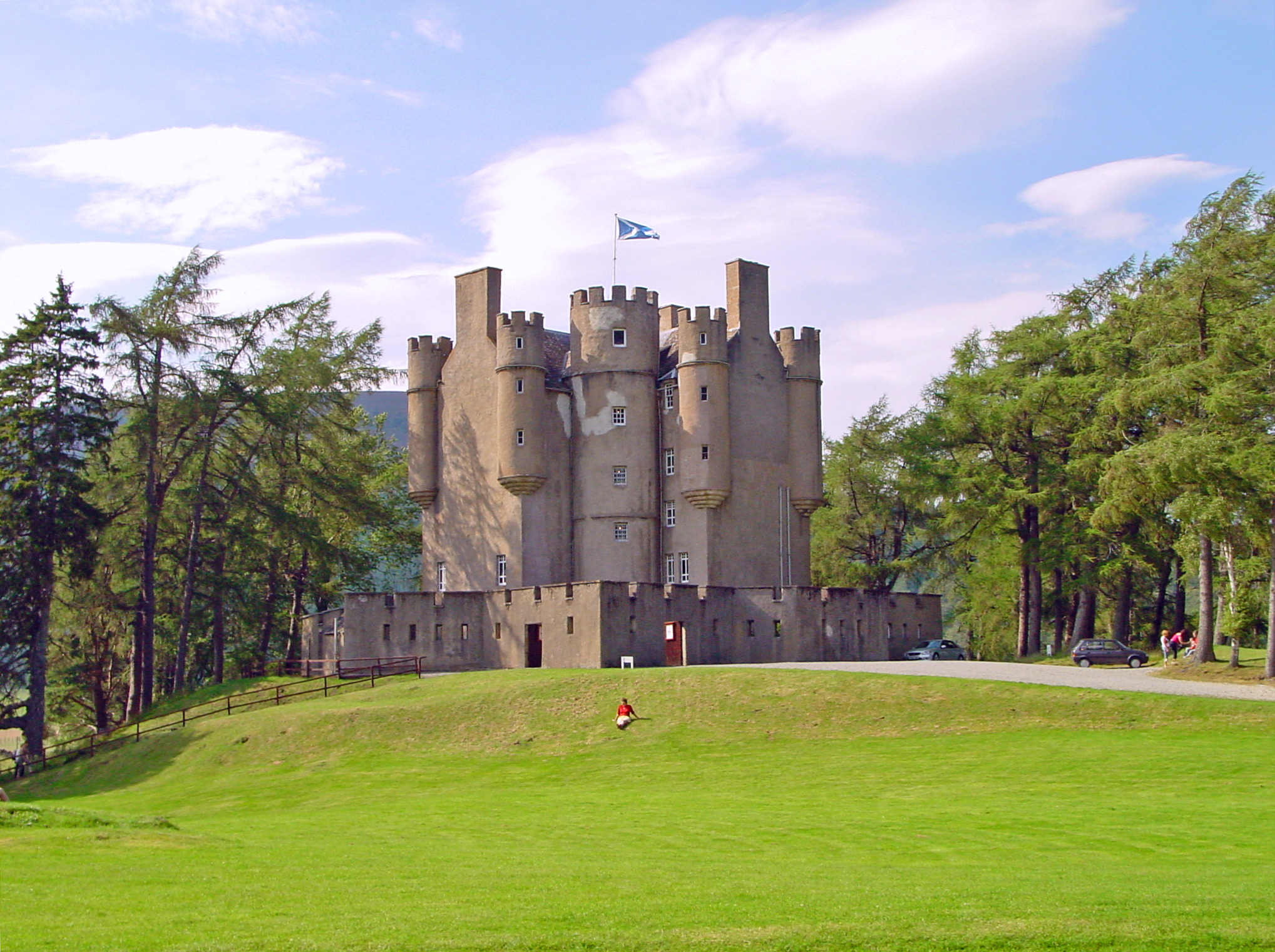
- Braemar Castle is a five-storey L-plan tower of harled granite, built in 1628 for John Erskine, Earl of Mar, as a hunting lodge and a check on Clan Farquharson.
- John Farquharson of Inverey, the Black Colonel, burned it in 1689 so a government company could not hold it, and after the 1715 rising it passed to the Farquharsons.
- From 1748 the government leased the ruin as a barracks, John Adam directed the rebuilding, and a star-shaped curtain wall was raised around the tower.
- The family made it a home in 1831 or 1832, Queen Victoria was entertained at the gatherings, and soldiers' names remain cut into the drawing-room shutters.
- The community took the lease in 2006 or 2007, and after a repair costed at 1.6 million pounds the castle reopened to the public on 2 May 2024.
Visiting
The grounds are open daily, all year. The castle opens from 3 April, Wednesday to Sunday, from 10am to 5pm, with last entry at 4.30pm. The castle is closed on 5 September for the Braemar Gathering. Last entry on 16 October is at 2pm for a private event.
The castle is closed on Sunday 25 October. Last entry on 30 and 31 October is at 3pm. Adult admission is £16. Family admission for two adults and up to three children is £33.
Concession admission is £14 for a student, a person over 65, or a Blue Light Card holder. Admission for a child aged 5 to 15 is £8. Tickets are sold from the admission office in the castle during opening hours. Individual visitors need not book in advance.
A group of ten or more must book in advance. Drone use is not allowed on the castle site, the gardens, or the grounds. A visitor at the entrance reported a parking charge of £3, while the castle charges £4 from dawn to dusk and overnight parking is not allowed.
History
Braemar Castle is a five-storey tower of harled granite near Braemar, on a mound beside the River Dee in the Cairngorms National Park. John Erskine, Earl of Mar, built it in 1628 as a hunting lodge and as a check on Clan Farquharson. He is counted as the 2nd Earl of Mar in the seventh creation and as the 19th earl of the first, and he is also called the 7th Earl. The tower replaced an older house that had succeeded Kindrochit, the castle in the village, described both as an eleventh-century work of Malcolm Canmore and as a fourteenth-century ruin where Robert II hunted.
From the Late Middle Ages the stronghold belonged to the Earls of Mar. Clan Farquharson, grown from Finla Mor, who was killed carrying the royal banner at Pinkie in 1547, had become powerful on Deeside and had joined the Chattan Confederation by 1595. In 1689 John Farquharson of Inverey, the Black Colonel, burned the castle so that government troops could not garrison it. Attempts to repair it left the tower a ruin.
A later John Erskine, Earl of Mar, opened the rising of 1715 at Braemar, and the castle was forfeited in 1716. One account gives the next owner as John Farquharson, 9th Laird of Invercauld. Another says Lord Dun and Lord Grange bought it in 1724 and sold it to the Farquharsons in 1732. After the rising of 1745 the clan leased the ruin to the government in 1748.
John Adam, Master Mason to the Board of Ordnance, oversaw the barracks, and a star-shaped curtain went up around the tower.
The end of the garrison is dated 1797, 1807, and 1831. The Farquharsons made the castle a family home in 1831 or 1832. The 12th Laird entertained Queen Victoria when she attended gatherings in the grounds, and she was also at the Gathering at Invercauld on 14 September 1848. Eighteenth-century soldiers left graffiti in the dining room, and the drawing-room shutters still show the name John Chestnut, sergeant, 1797.
The lease to the community is dated both 2006 and 2007, when the collection was at risk and closure was likely. The castle reopened in 2008, then underwent a repair begun in 2019 and costed at 1.6 million pounds. It opened to the public again on 2 May 2024. A watching brief in 2007 found a cistern between the tower and the curtain, and the 2022 works recovered musket balls, a turner of Charles I, a bawbee of Charles II, a dagger pommel, and clay pipes.
Images




Detailed History
Braemar Castle stands near the village of Braemar in Aberdeenshire, on the River Dee, inside the Cairngorms National Park. It is a five-storey L-plan tower of granite covered with harl, with a round stair tower in the re-entrant angle, crenellated angle turrets, and a star-shaped curtain wall. The chief of Clan Farquharson holds it. It is leased to the local charity Braemar Community Ltd, run by staff and volunteers, and open to the public.
One description places the tower just north-east of the village. Another places it south of the village, on a raised natural mound on the south side of the Dee. The mound has been suggested as a possible motte, but no document and no excavation has shown a medieval motte there.
The River Dee rises from a spring on the Braeriach plateau in the Cairngorms, at about 1,220 metres, the highest source of any major river in the British Isles, and it meets the North Sea at Aberdeen. The country between Braemar and Banchory is called Royal Deeside because Queen Victoria came in 1848 and took to the valley. She and Prince Albert later replaced an older castle at Balmoral with the house that still stands. The Dee, the Spey, and the Don all rise within the Cairngorms National Park.
That park was established in 2003, the second national park created by the Scottish Parliament, after Loch Lomond and the Trossachs in 2002. In 2010 it was extended into Perth and Kinross. It covers 4,528 square kilometres. About 18,000 people live in it, and Braemar is named among the largest communities, with Aviemore, Ballater, Grantown-on-Spey, Kingussie, Newtonmore, and Tomintoul.
In 2018 the park recorded 1.9 million tourism visits, and tourism is said to make up about four fifths of its economy.
The Grampian Mountains are one of the three great ranges of Scotland, with the Northwest Highlands and the Southern Uplands. They run from the Highland Boundary Fault to the Great Glen. Ben Nevis, at 1,345 metres, is the highest point in the British Isles, and Ben Macdui, at 1,309 metres, is the second. The name is traced to the Roman historian Tacitus, who recorded Mons Graupius as the place where Gnaeus Julius Agricola defeated the Caledonians in about 83 AD.
A printed edition of 1476 turned Graupius into Grampius, and in 1520 the historian Hector Boece applied a form of that mistaken name to the mountains. In the Middle Ages this country was the Mounth, the broad upland between the Highland Boundary and the Dee, a barrier that cut the north-east off from the rest of the Lowlands. Old crossings include the Causey Mounth, the Elsick Mounth, the Cairn o' Mounth, and the Cairnwell road. Kindrochit, the older castle at Braemar, is understood to have been sited for those crossings of the Mounth of the Grampian Mountains.
From the Late Middle Ages the stronghold belonged to the Earls of Mar. That label is used for the European centuries from 1300 to 1500, after the High Middle Ages and before early modern Europe. The earldom took its name from the province of Mar, running west from Aberdeen along the Dee beyond Braemar, the country called upper Mar, and north of the Don into the later district of Marr. The first named earl is Ruadrí, alive in 1128, and an unnamed earl is mentioned at the Battle of Clontarf in 1014.
In 1435 King James II seized the earldom. It was afterwards given to royal children who left no heirs. In 1565, after rebellion, Mary, Queen of Scots, restored or created the title for John, Lord Erskine. His son, another John, recovered the estates the Crown had taken away, including Kildrummy, the seat of the earldom.
The tower of 1628 replaced an older building, and that older building was the successor of Kindrochit Castle. Kindrochit stands in the village, on the Clunie Water, a tributary of the Dee. The name Castleton refers to Kindrochit, not to Braemar Castle, and Kindrochit means bridge end. Legend says that Malcolm III came about 1059, built a timber bridge between the hamlets of Auchendryne and Castleton, and that a castle was raised to guard the crossing.
Kindrochit is called both an eleventh-century castle of Malcolm Canmore and a ruined fourteenth-century fortification. The standing masonry is described as largely of the fourteenth century, replacing a presumed timber original. Robert II used it as a hunting seat and issued charters there in most years from 1371 to 1388. In 1390 Robert III licensed Malcolm Drummond to build a new tower.
The earlier royal lodge was excavated in the 1920s: a hall of about 30 by 9 metres, with a square tower at each corner. The ground floor of the later stone tower measures about 19.3 by 13 metres. In 1618 John Erskine, Earl of Mar, showed the ruin to the poet John Taylor on Taylor's Pennyles Pilgrimage. Taylor rode with the earl from the place then called Braemar Castle, a decade before the present tower is dated, and he was told that Malcolm Canmore had built Kindrochit in the eleventh century.
He thought it remarkable that he saw no other house in the next twelve days. The ruin was conserved in 2013 and 2014 and reopened at Easter 2015, with free access all year. Malcolm Drummond, licensed in 1390, was later murdered by Alexander Stewart, who took Kildrummy and forced Isabel Douglas, Countess of Mar, into marriage and into a charter of 12 August 1404 that yielded the earldom.
Braemar Castle itself is an early modern tower, not a prehistoric circle. Lowland Aberdeenshire does keep a much older class of monument, the recumbent stone circles of the early Bronze Age, in which the largest stone lies flat, generally between south and south-west, with the tallest uprights as flankers. Yonder Bognie, near Forgue, is one of these. It is ruined.
Alexander Thom allowed that a single ring could have been an oval of 18 to 22 metres, and he also suggested two circles. Nine stones remain, three of them fallen. The recumbent is 3.35 metres long and 1.70 metres high, and it seems aligned on the Foudland Hills. The western flanker stands 1.75 metres high.
The circle lies in a private field and is a scheduled monument. Nothing found at Braemar Castle connects the tower with Yonder Bognie.
Clan Farquharson is based at Invercauld and Braemar and belongs to the Chattan Confederation. The chiefs trace themselves to Farquhar, fourth son of Alexander Ciar of Rothiemurchus. Alexander Shaw was fifth chief of Clan Shaw, and his descendants took the name Farquharson. Another of Alexander's sons, Donald, married Isobel Stewart, heiress of Invercauld.
Their son Finla Mor, in Gaelic MacFionlaigh Mòr, is treated as the real progenitor. He carried the royal banner at the Battle of Pinkie Cleugh in 1547 and was killed there. Nine sons from two marriages founded the cadet branches. Invercauld House, two miles north-east of Braemar, incorporates an older tower.
It had belonged to the Stewarts and passed to the Farquharsons by that marriage. Until late in the sixteenth century the Farquharsons were outside the Chattan Confederation, and Chattan bands sometimes raided their land. In 1589 a Chattan spy, Lamont of Inverey, was caught and hanged for stealing livestock. The Scots fir used as the gallows was afterwards called the Farquharsons' Hanging Tree, and it became a plant badge of the clan.
In February 1592 the Catholic Earl of Huntly murdered his Protestant rival, James Stuart, Earl of Moray, at Donibristle. The Mackintoshes, who led the Chattan Confederation, were vassals of the dead earl and swore revenge. Late that year they raided Huntly's lands in Strathdee and Glenmuick and killed four prominent Gordons, among them Henry Gordon of Knock Castle and the Baron of Brackley. Huntly obtained a royal commission, wasted Deeside, burned houses, and killed the men he found.
He took 60 to 80 orphaned children to Strathbogie Castle and fed them from a great wooden pig trough, the children seated along either side. The Laird of Grant, horrified on a visit, took half the children to Strathspey to raise as Grants. Huntly kept the other half, who grew up under the name Gordon. The Farquharsons lived through this because the young sons of Finla Mor survived.
By 1595, too exposed, they entered the Chattan Confederation and signed a bond of manrent naming the Mackintosh chief, who was also chief of the confederation, as their native chief. At the same time the Erskine chiefs were pressing a claim to the earldom of Mar against the growing strength of the Farquharsons. The clan motto is Fide et Fortitudine, fidelity and fortitude, and the fighting men were called to gather at Carn na Cuimhe, beside the Dee east of Invercauld, a fire cross being sent round the glens.
The builder of the present castle was John Erskine, born about 1558 and dead on 14 December 1634, only son of John Erskine, 1st Earl of Mar, and Annabella Murray. He is counted both as the 19th earl in the first creation and as the 2nd earl in the seventh creation. Other accounts call the same builder the 7th Earl of Mar, and the castle's own telling calls him the 2nd Earl of Mar. He was educated with King James VI by George Buchanan and succeeded his father in 1572.
Once of age he was nominally guardian of the king, about seven years younger, who lived with him at Stirling, though the regent James Douglas, 4th Earl of Morton, held the real power until Morton fell. In October 1580, at Kincardine Castle near Auchterarder, he married Anne Drummond, daughter of Lord David Drummond and Lilias Ruthven. James VI was a guest. Anne died in 1587, leaving a son, John, who became the heir.
In 1582 the earl joined the Raid of Ruthven, in which James VI was seized. When the king escaped, the earl fled west, then took Stirling Castle, and when James marched on him he went to England. Elizabeth I pleaded for him. In 1585 he and his friends raised an army, entered the king's presence at Stirling, and soon held supreme authority.
He was restored, made governor of Edinburgh Castle, and then tutor to the king's son, Prince Henry. His lasting achievement in those years was the recovery of the Mar estates, Kildrummy among them.
On 21 February 1594 he was made keeper and governor of Prince Henry, who was to live at Stirling, and he rode in the baptism tournament dressed as a Christian Knight beside the king. Keeping the boy set him against Anne of Denmark. In June 1595 James ordered that if the king died, Henry was not to be given to Anne or to the Parliament of Scotland until the prince was eighteen and commanded it himself. Anne would not speak to Mar.
In December 1592 he had married, secondly, Marie Stewart, daughter of Esmé Stewart, 1st Duke of Lennox. Many opposed the match because she was a Catholic. In 1601 he went as envoy to London. Elizabeth assured him that James would succeed her, and she gave him a silver basin and laver set with mother-of-pearl and rubies.
She died in 1603. James VI became king of England in the Union of the Crowns, and Mar remained at Stirling with the prince. On 7 May 1603, while Mar was away on business after his mother's death, Anne came to take Henry. The countess, Marie Stewart, and Lord Erskine refused her.
Anne miscarried at the castle. Mar told the Privy Council he had heard of a plot to remove the prince during his absence. Anne refused to travel south in his company.
In 1628 this John Erskine built the present Braemar Castle, as a hunting lodge and as a bulwark against the Farquharsons, on the site of the older house. The new tower was L-plan, with the round stair in the inner angle and a turret on each corner. The corner turrets were then a single storey, and the gables were finished with corbie-steps. The entrance still has its iron yett.
A yett is a hinged gate of latticed wrought-iron bars, closed by bolts or by long bars drawn out of the wall, not a portcullis wound up on a winch. Such gates belong especially to Scottish towers from the later medieval centuries. Fixed iron grilles of the same kind were set into window openings, and many windows at Braemar keep heavy seventeenth-century grilles. The ground floor is a range of stone-vaulted rooms that held the guardroom, the ammunition store, and the first kitchen, pushed out into the salients.
In the floor of a passage an iron grill drops into the Laird's Pit, a dark hole used as a prison. On each upper floor a large room and a small room filled the two arms of the tower.
During the Scottish civil wars Donald Farquharson of Monaltrie fought for James Graham, 1st Marquess of Montrose, in 1644, and for Charles II at the Battle of Worcester in 1651. The clan gained the name of the fighting Farquharsons and stood with the Stuarts. On 28 January 1673, in a feud that followed the Earl of Airlie's lease of disputed pasture to Farquharson tenants, Farquharson of Broughdearg was killed together with two sons of the MacThomas chief. John Farquharson of Inverey, the Black Colonel, so called for his dark colouring, killed John Gordon of Brackley in 1666, a murder remembered in the ballad The Baron o' Brackley.
His house was Inverey Castle, four miles west of Braemar. The hamlet of Inverey sits on Mar Lodge Estate where the Ey Burn joins the Dee, split by the burn into Muckle Inverey and Little Inverey, and the ruins of his castle and the old burial ground are still visible north of the road.
The Jacobite rising of 1689 lasted from March 1689 to February 1692 and aimed to put James VII back on the throne after the Glorious Revolution. James II and VII had succeeded in February 1685 with broad support in his three kingdoms, even though he was a Catholic. The birth of his son, James Francis Edward Stuart, on 10 June 1688, made a Catholic line look lasting, and the trial of the Seven Bishops turned dissent into crisis. William of Orange landed at Brixham on 5 November 1688 with about 14,000 men.
James left for exile on 23 December. A Scottish convention met in March 1689, ended James's reign on 11 April, and adopted the Claim of Right. William and Mary accepted the Scottish crown on 11 May 1689. The Scottish rising was also a part of the Nine Years' War, meant to help the Jacobite campaign in Ireland.
John Graham, 1st Viscount Dundee, raised Highland troops. At Killiecrankie on 17 July 1689 those troops beat a government army under Hugh Mackay, and Dundee was killed in the final charge. His death, and the shortage of men and supply, meant the rising never seriously threatened William and Mary. The last major action was at Cromdale in May 1690.
The government did not treat the Highlands as settled until after the Massacre of Glencoe in February 1692.
The Black Colonel was commissioned by Dundee. He backed James VII. The Erskines had not stood with James, and Farquharson took Braemar Castle so that it could not become a government post. He stopped a force of about 100 men from occupying it, and he burned the house.
After Killiecrankie he returned to the Braemar country and often stayed at Inverey. When redcoat parties came for him he hid on a ledge in Glen Ey still called the Colonel's Bed. The soldiers plundered and burned his castle, which is also said to have been demolished in 1689 after the battle. His own people kept him safe until he died of old age about 1698 and was buried at Inverey.
After Dundee died, the clan followed Thomas Buchan. Repairs at Braemar were attempted in 1689 and again in 1715, but the burned tower remained a ruin.
The rising of 1715 was an attempt to restore James Francis Edward Stuart to the three thrones. The Act of Settlement 1701 had barred Catholics. Queen Anne's Protestant heir under that Act was Sophia of Hanover, who died in August 1714, two months before Anne, so the crown passed to Sophia's eldest son, George I. He was a descendant of James VI and I, and the first king of the House of Hanover in Britain.
That house was a German line, a younger branch of the House of Welf from 1635, prominent after Hanover became an electorate of the Holy Roman Empire in 1692. It ruled in Britain until Queen Victoria's death in 1901, when the crown passed to Edward VII of the house of his father, Prince Albert. French acceptance of the Protestant succession had been written into the peace after the War of the Spanish Succession, and George succeeded quietly. The Whigs then pursued the outgoing Tories.
Robert Harley was imprisoned in the Tower of London. Viscount Bolingbroke escaped to France and became secretary of state to James.
The Earl of Mar who opened this rising was a later John Erskine, born in 1675 and dead in 1732. He is counted as the 23rd earl, or as the 6th if the numbering starts from the creation of 1565. He was not the builder of 1628. He had no commission from James when he left London.
On 27 August 1715 he held a council of war at Braemar. On 6 September, still at Braemar, he raised the standard of James the 8th and 3rd before about 600 people. The clan history places that summons at Invercauld House. The mound on which the standard went up was later covered by the Invercauld Arms Hotel in Castleton.
Parliament suspended habeas corpus so that suspected Jacobites could be held without trial, and it allowed their lands to go to tenants who would swear loyalty to George I. Some of Mar's own tenants travelled to London in the hope of proving that loyalty and of receiving a share of his estate. In the north the Jacobites took Inverness, Gordon Castle, Aberdeen, and Dundee. They did not take Fort William.
An attempt on Edinburgh Castle failed when a scaling ladder proved too short. By October Mar had close to 20,000 men and held Scotland north of the Forth except Stirling Castle, but he hesitated. On 22 October a commission from James made him commander-in-chief. He outnumbered the Duke of Argyll about three to one and moved on Stirling.
At Sheriffmuir on 13 November the fighting decided nothing. Late in the day the Jacobites still numbered about 4,000 against Argyll's 1,000, and Argyll had lost some 660 men, about three times the Jacobite loss, yet Mar did not press him and the Highland army retired to Perth. That same day Inverness fell to Hanoverian troops, and a smaller Jacobite force under Mackintosh of Borlum was defeated at Preston. James landed in Scotland in December 1715 and sailed back to France in February 1716.
Mar fled to France. In 1716 he was attainted, and in the Jacobite peerages he was made Duke of Mar.
A different John Farquharson of Invercauld served in 1715 as colonel of a Chattan regiment raised for James. He was captured at Preston, imprisoned in the Marshalsea, and sentenced to death at the Tower. On the morning fixed for the execution he and two other Highland officers were reprieved. He was then on parole and forbidden to return to Scotland for more than twenty years.
In 1724 General Wade estimated the Farquharsons and the Mackintoshes together at 800 men. Braemar Castle was forfeited to the Crown in 1716 because the Earl of Mar had led the rising. The next owner is not a single story. One account says John Farquharson, 9th Laird of Invercauld, bought the castle and the lands and left the walls in ruin.
Another says that in 1724 the earl's kinsmen, Lord Dun and Lord Grange, bought it, and that they sold it to the Farquharsons in 1732. A third says that when the rising collapsed the castle passed to the Farquharsons of Invercauld. The accounts agree that the clan came to hold it, and that the shell was not yet made habitable.
The rising of 1745 was the last large Jacobite attempt, and it finished Jacobitism as a serious political cause in Britain. Charles Edward Stuart raised his standard at Glenfinnan on 19 August 1745. Edinburgh fell, and the Battle of Prestonpans was a Jacobite victory in September. In November the army, mostly Scots, entered England, looking for English risings and a French landing in the south.
Neither appeared. At Derby on 4 December the leaders voted to turn back, and the command never healed that split. They won narrowly at Falkirk Muir in January 1746 and were broken at Culloden in April. Charles reached France, could not mount another expedition, and died in Rome in 1788.
Lord Duncan Forbes of Culloden reckoned the Farquharsons at 500 men that year. On 23 December 1745 about 300 of them fought in the Jacobite success at Inverurie. Anne Farquharson, wife of Angus Mackintosh of Clan Mackintosh and cousin of the Invercauld family, was afterwards called Colonel Anne. Angus was a Black Watch officer.
Taken at Prestonpans and sent home to Moy on parole, he was met by Anne with the words your servant, captain, and he answered your servant, colonel. She helped Charles Edward Stuart escape capture in the Rout of Moy, and after Culloden she was held for six weeks. Francis Farquharson of Monaltrie led the clan on Culloden field, lived, was condemned, and had death commuted to exile. Monaltrie House was burned after the battle.
Auchindryne, on the west bank at Braemar, had belonged to a branch of the clan and was forfeited after 1745. Later in the century William Duff, 1st Earl Fife, acquired it.
After Culloden, Braemar Castle was wanted as a government garrison. In 1748 the Farquharsons leased it to the Crown. The payment is given as £14 a year, and the grant is also described as a lease of ninety-nine years covering the castle and fourteen acres. The ruin was rebuilt for Hanoverian soldiers.
John Adam oversaw that work as Master Mason to the Board of Ordnance in Scotland. He had inherited the post when his father, the architect William Adam, died in June 1748. John was born at Linktown of Abbotshall, now part of Kirkcaldy, on 5 March 1721, and he died on 25 June 1792. His brothers Robert and James were architects too.
The Board, housed at the Tower of London, kept the forts of the realm and issued munitions to the army and the navy. In the eighteenth century it also directed the artillery and the engineers. It grew until, in the nineteenth century, only the Treasury was a larger department, and it was abolished in 1855 after the failures of supply in the Crimea. Among the Scottish contracts that followed the Forty-Five was Fort George, near Inverness, designed by Colonel Skinner.
John Adam and his brother Robert took on that class of work together. In the same year, 1748, the government bought Corgarff Castle and extended it as a barracks on the military road that ran from Braemar Castle to Fort George. Soldiers remained at Corgarff as late as 1831, and the tower was afterwards used to suppress unlicensed whisky stills. The Stockdale family of Delnadamph passed it into state care in 1961, and it is now in the care of Historic Environment Scotland.
The new wall at Braemar belongs to the same military programme as the wall at Corgarff, but the plan differs. Corgarff's enclosure is oblong. Braemar's is described as nearly a square, with a salient in the middle of each side, and as a rectangular curtain whose salients make an eight-point star. The tower as it stands is also described as wrapped in a star of six sharp salients.
A later repair is said to have cut back the eastern salient and removed one point of the star, which would reconcile an eight-point design with a six-point wall. The curtain was crenellated. One account says that in 1748 the old conical roofs of the turrets were heightened and given battlements. Another says that the 1748 work put conical roofs on the turrets and the main tower, capped the crow-stepped gables with flat skews, and added heavy chimney copes, and that only in the early nineteenth century were the turrets and the stair tower raised a full storey and finished with crenellations.
Drawings of the garrison years show the main block a storey taller than the wing. A well or cistern was made in the space between the north wall and the curtain.
The date when the troops left is also more than one date. The barracks years are given as 1748 to 1797. A building survey sets 1807 as the time when the government had stopped lodging soldiers and the house was already failing. The withdrawal is also placed in 1831, matching the end of military use at Corgarff.
The 1807 survey found rain coming in at the turrets, the chimneys, and the walls, rotten floors and stairs, damaged plaster and ceilings, and missing slates. A crack in the east wall ran from near the wall-head almost to the ground. Patches of the outer roughcast had fallen. The curtain was cracked in three places, and the east side was judged close to collapse if it was not repaired.
In 1800, on a tour written up by John Leyden, the moat was still complete. Between 1760 and 1806 the wider estate was turned to commercial forestry on a huge scale. James Farquharson of Invercauld planted sixteen million firs and two million larch.
The Farquharsons made the repaired castle a family home only after the garrison ended. That change is dated 1831, under the 12th Laird of Invercauld, and also 1832, with further work in the middle of the nineteenth century. The lower floors kept much of the eighteenth-century barrack plan. The upper floors became a nineteenth-century house.
The 12th Laird entertained Queen Victoria when she came to the Braemar Gatherings held in the castle grounds. She is also recorded at the Gathering at Invercauld on 14 September 1848. She had been born at Kensington Palace on 24 May 1819, only child of Prince Edward, Duke of Kent, the fourth son of George III, and of Princess Victoria of Saxe-Coburg-Saalfeld. She inherited the throne on 20 June 1837 and kept it until 22 January 1901, a reign of 63 years and 216 days.
In 1840 she married Prince Albert. They had nine children. In 1876 she became Empress of India. She died at Osborne House on the Isle of Wight, aged 81.
In 1852 Albert bought Balmoral from the Farquharson family. The existing house was too small. William Smith of Aberdeen designed the new castle, Albert altered the plans, and the building was finished in 1856, after which the old castle was pulled down. Balmoral stands near Crathie, about nine miles west of Ballater and about fifty miles west of Aberdeen.
It is private property of King Charles III and is not part of the Crown Estate. Queen Elizabeth II died there on 8 September 2022.
The Braemar Gathering, called the Games, is held each year on the first Saturday in September, and the royal family customarily attends. Gatherings of this sort are traced, in local belief, to meetings held by Malcolm III. The Act of Proscription in 1746 banned clan assemblies. After repeal in 1782 they revived.
The Braemar Highland Society was formed in 1815 and formally constituted in 1817, and the first modern games, paying cash prizes from the society's funds, took place in 1832. Royal was added to the society's title in 1866. In 1906 the Duke of Fife gave twelve acres, about five hectares, of Mar Estate, and the Princess Royal and Duke of Fife Memorial Park became the ground used today. From Queen Victoria's day the sovereign has been patron of the Braemar Royal Highland Society and is styled Chieftain.
King Charles III holds that place now. The programme includes hill races, heavy events, light events, and Highland dancing. The castle closes for the Gathering on 5 September. Royal parties travelling to Deeside used the Deeside Railway, laid between 1853 and 1866 from Ballater to Aberdeen Ferryhill and closed in stages through 1966 and 1967 after the Beeching report.
The Royal Deeside Railway is the preserved fragment at Milton of Crathes. Its society was founded in 1996, restoration started in 2003, a one-mile passenger service began in 2007, and the first steam working ran in 2010. The historic line stopped at Ballater. It did not come on to Braemar.
Within the tower, the first floor contains the Dining Room and the Morning Room. Above are the Laird's Day Room, reached through a curved door, and the Rose Room, with a small bathroom of 1901 between them. The Drawing Room occupies the main wing at that level. Soldiers cut their names into the window shutters, and the inscription John Chestnut, Sergeant, 1797 is still clear.
Eighteenth-century military graffiti is also shown in the dining room. The third floor has the Four Poster Bedroom. The fourth has the Ladies' Guest Bedroom, the Gentleman's Guest Bedroom, and the Principal Bedroom, used by the family in the later years when they still stayed. A second kitchen was built in the Victorian period next to the staff rooms.
The stair is a stone turnpike lined with timber. Public rooms keep decorative cornices and classical chimneypieces. The doors are three-panel timber. Upper chimneypieces are simpler and tiled.
The windows are a mixture of sash-and-case and casement, some of twelve panes and some with four panes below and twelve above. On 12 January 1897 the estate factor RG Fogge listed the house as dining, dressing, and morning rooms, eleven bedrooms, two dressing rooms, a cloakroom, a back hall and a shoe hall, kitchen, scullery, pantries, larder, servants' hall, two double rooms for servants, a beer cellar, a wine cellar, and a coal store.
The family put a great deal into maintenance and still did not live there year round. From the late nineteenth century into the early twentieth the castle was let. By 1902 the tenant was Princess Alexis Dolgorouki. At her request a wooden servants' hall was built against the back door, toilets and bathrooms were put into the house, and a wooden motor garage was set beside the stables.
Damp continued. The bathroom of 1901 belongs to the same period as her tenancy. On the west and north, the gap between tower and curtain was roofed, and two chimneys were raised against the curtain. Those chimneys are later than the wall and are part of the Victorian filling of the courtyard.
West of the tower is the Fog House, a round timber summerhouse with a conical heather-thatch roof, a nineteenth-century folly looking toward Invercauld. A 2016 count of thatched roofs in Scotland found only about two hundred surviving, and this summerhouse is among them. Single-storey timber cottages stand to the north.
In the eighteenth century the road passed the north side of the castle and went on to a ford. The military road, now in part the public road of Deeside, replaced it in 1753 and 1754. Maps then show a few outbuildings to the east, and open rig and furrow to the north and east. Early in the nineteenth century trees were planted on those three sides, and the surrounding ground was enclosed into the fields that remain.
Photographs from the 1870s show a paling round the foot of the mound and a gate on the south. By the second Ordnance Survey edition, trees filled some of the ground toward the road, a curved drive had been made, a kitchen garden was marked, two lean-to structures sat on the outer angles of the curtain, and a freestanding building had been added on the north. The kitchen garden has been replanted on a plan of the 1930s, with older varieties of fruit and vegetables.
The rooms shown now follow the house as arranged by Alwyne Farquharson, 16th Laird of Invercauld, and his wife Frances Oldham. The same household account names France Farquharson as the most fashionable person to live there, a friend of Elsa Schiaparelli, and it links the strong use of pink to that friendship and to the colour Schiaparelli made famous. Frances Oldham was an American fashion editor. With Alwyne she was among the first of the family to open the house to visitors, in 1961.
Alwyne Arthur Compton Farquharson was born Alwyne Arthur Compton on 1 May 1919, son of Major Edward Compton and Sylvia Farquharson of Invercauld. The Lyon Court confirmed his name and chiefship in 1949. He served as a captain in the Royal Scots Greys during the Second World War and died on 6 October 2021. His great-nephew Philip Farquharson of Invercauld succeeded as seventeenth baron of Invercauld and Monaltrie and as chief.
On 12 August 2025 Philip presented a new coat of arms to King Charles III at Ballater. On 2 July 2026 he ratified the sept names of the clan. The castle also appears in the filmed performance of Andy Stewart's song A Scottish Soldier.
The building served as a museum until 2005. From 2006 it has been leased to the people of the place. In 2007, when the collection was in danger and permanent closure was likely, the community took on the rescue, helped by a benefactor, and Braemar Community Ltd has run it since. It reopened to visitors in 2008.
A local guide to the castle was preserved in the Wayback Machine on 9 May 2008. That archive, opened to the public in October 2001, keeps copies of pages that would otherwise disappear. In 2019 the community started a scheme called Raising the Standard, priced at 1.6 million pounds, to repair the fabric, renew the grounds, and support volunteering, learning, and wellbeing. During the works a reopening was expected in July 2023.
The public opening came on 2 May 2024, once the roof and the harling were renewed and interior repairs were done. A community day was held the day before. Historic Environment Scotland and the National Heritage Lottery Fund gave one million pounds between them. Gifts and local fundraising supplied the rest.
The community that raised it has been described as about five hundred people. The King's Foundation, founded and presided over by King Charles, added advice and practical help.
Susan Burness, conservation architect with Bell Ingram Design, led the design, and Harper and Allen carried out the masonry. The largest share of the work was outside: structural repair, and new harling and limewash on the tower and the curtain, in an oatmeal shade matched to a small patch of old limewash uncovered when cement harl was removed. The interior received new electrics, repaired windows, and better drainage, so that the collection would no longer sit in a damp house. One telling of the project says the doors opened after eighteen months locked, and places that moment in late summer.
The dated public reopening remains 2 May 2024. The grounds gained a path usable by more visitors, running from the parking ground to the castle and the Fog House, a trail of the castle's dates, a welcome cabin within the curtain wall with toilets, display panels, a shop, and the place where tickets are sold, and a walk among old Scots pine and newly planted native trees. Students of fashion at Gray's School of Art in Aberdeen design clothes each year from the building, the hills, and the example of France Farquharson and Elsa Schiaparelli. In 2023 they joined the Fife Arms Festival of Fashion and spoke with the designer Giles Deacon.
What has been dug at the castle is a series of watching briefs and fabric surveys, not an open-area excavation of the mound. In 2007 Murray Archaeological Services watched two trenches cut for services. Between the tower and the curtain they found a cistern or well, not a true circle, 1.6 to 1.65 metres across inside. A Victorian structure had been built over it, so it was disused before that structure existed, and it may belong with the military works of 1748.
In February 2009 the same firm recorded the courtyard in order to date two chimneys on the inner face of the wall and to log stonework just uncovered. Both chimneys post-date the curtain and belong to the Victorian infill. Beneath a tar layer lay an older cobbled surface, apparently the sub-floor of the Victorian rooms. In 2013 a desk study and a walk of the policies set out the changes in the grounds.
In 2022, once harling had been stripped from tower and curtain, Cameron Archaeology recorded windows and gun loops that the coating had covered. They were already known from the inside and from historic drawings.
From January to April 2022 the same firm watched drainage and path works and detected metal across the grounds before the soil was opened. The detected objects included musket balls, coins running from the sixteenth century to the twentieth, a dagger pommel, a belt mount, and a possible strap end. The coins included a turner, also called a bodle, of Charles I, a bawbee of Charles II, and later pieces among which were two shillings of George VI. Much of the soil had been moved before.
A trench beside the north-east wall found two stretches of pitch flooring, thought to belong to a nineteenth-century phase when the ground north of the tower was enclosed and used as a kitchen. Where the trench cut the curtain, that part of the wall was built differently from the east side, with smaller and more regular pinning stones. North-west of the north-west curtain, several hollows looked like pits but were mostly the holes of trees. Some contained sherds of the nineteenth and twentieth centuries and were not treated as significant.
Farther north-west a shallow ditch held pottery of the nineteenth century and later, clear glass, green bottle glass, and animal bone. Under it a second ditch on the same alignment had a plant pot of the nineteenth or twentieth century at its base. Short trenches on old ceramic drains by the northern outbuildings showed part of a stone foundation in one cutting and, in another, pieces of a three-legged iron cauldron with a handle, plus one fragment of a flat-based iron pot. North of those outbuildings a strip of rough paving, 14.5 metres long, was a single course of stone laid directly on earth.
Clay pipes included one stamped for J Elrick and Co of Aberdeen and another marked for W Smith, a tobacconist in Aberdeen, both of nineteenth-century form, and remains of three pipes carrying the mark of the London makers Swinyard.
The tower was raised so that a lord could hunt in this glen and so that the Erskines could watch a clan that was becoming strong on the same river. Burning it in 1689 kept a government company out of upper Deeside for a generation. Forfeiture after 1715 moved it from the Earls of Mar into Farquharson hands, and the lease of 1748 put Hanoverian infantry back into those hands' own walls. The star-shaped curtain and the vaulted rooms are what that military use left.
The upper floors, the gatherings, and the royal purchase of Balmoral are what the next century left, when Queen Victoria's visits turned the valley into Royal Deeside and the family tried to make a barracks feel like a house. The community lease, the musket balls and small coins found in 2022, and the oatmeal harl finished for the reopening of 2 May 2024 are the latest chapter: a clan castle kept open beside the Dee, in the Cairngorms National Park, with Kindrochit still ruinous in the village and the old roads over the Mounth still explaining why anyone fortified this bank of the river.
Sources
- Braemar Castle — Wikipedia
- Kindrochit Castle — Wikipedia
- Clan Farquharson — Wikipedia
- John Erskine, Earl of Mar (1558–1634) — Wikipedia
- Earl of Mar — Wikipedia
- Jacobite rising of 1689 — Wikipedia
- Jacobite rising of 1715 — Wikipedia
- Jacobite rising of 1745 — Wikipedia
- Queen Victoria — Wikipedia
- Braemar — Wikipedia
- Balmoral Castle — Wikipedia
- John Adam (architect) — Wikipedia
- Corgarff Castle — Wikipedia
- Inverey — Wikipedia
- Cairngorms National Park — Wikipedia
- Grampian Mountains — Wikipedia
- Royal Deeside Railway — Wikipedia
- River Dee, Aberdeenshire — Wikipedia
- Mounth — Wikipedia
- Yonder Bognie — Wikipedia
- Yett — Wikipedia
- House of Hanover — Wikipedia
- Board of Ordnance — Wikipedia
- Discover Braemar Castle — Braemar Castle
- Visit Braemar Castle — Braemar Castle
- Braemar Castle tickets — Braemar Castle
- Braemar Castle — Braemar Castle
- Braemar Castle including ancillary structures — Historic Environment Scotland
- Braemar Castle historic environment record — Aberdeenshire Council
- Braemar Castle watching brief, 2022 — Aberdeenshire Council
- Braemar Castle designed landscape — Aberdeenshire Council
- Royal Deeside castle reopens after major upgrade — BBC
- The finds from watching brief at Braemar Castle — Archaeology Data Service
- Restoration of Braemar Castle — Bell Ingram
- Schotland Braemar Castle 9-5-2010 12-16.png — Wikimedia Commons
- View Of Braemar Castle - George Washington Wilson - ABDMS050827.jpg — Wikimedia Commons
- Braemar Castle 1.jpg — Wikimedia Commons
- Braemar Castle 11.JPG — Wikimedia Commons
- Braemar Castle - geograph.org.uk - 12824.jpg — Wikimedia Commons
- Bend in the road near Braemar Castle - geograph.org.uk - 478455.jpg — Wikimedia Commons
- Approaching Braemar Castle - geograph.org.uk - 804156.jpg — Wikimedia Commons
- Braemar Castle - geograph.org.uk - 908200.jpg — Wikimedia Commons
- An ALVIS tourer in Braemar Castle car park - geograph.org.uk - 1435956.jpg — Wikimedia Commons
- Braemar Castle and curtain wall - geograph.org.uk - 1435899.jpg — Wikimedia Commons