
Palace · Fortification
Blair Castle
country house in Blair Atholl, Perth and Kinross, Scotland, UK

Perth and Kinross, United Kingdom · 1269 CE · United Kingdom
- Blair Castle, Caisteil Bhlàir, stands in Glen Garry near Blair Atholl and has been the seat of the Atholl chiefs since a tower was begun there in 1269.
- John Comyn started that tower on the earl's land, the Strathbogies lost the earldom under Robert the Bruce, and James II granted it in 1457 to his half-brother John Stewart, whose heirs brought it to the Murrays.
- Oliver Cromwell's army took the castle after 1650, and it was besieged again in the Jacobite wars, including the siege of March and April 1746.
- Georgian rooms replaced the turret line in the mid-eighteenth century, and David Bryce restored a Baronial outline for the seventh Duke in 1869 to 1871.
- Queen Victoria stayed in 1844 and granted colours to the Atholl Highlanders, the duke's private regiment, which is still based at the castle.
- The house has been open to the public since 1936, and in 1996 it was placed in a charitable trust while the chief lives in South Africa.
Visiting
House and garden tickets cost £20 online or £21 at the gate, senior citizens aged 60 and over pay £17.50 online or £18.50 at the gate, students with identification pay £17 online or £18 at the gate, and children aged 5 to 16 pay £12.50 online or £13.50 at the gate. Gardens only tickets cost £10 online or £11 at the gate for adults, senior citizens and students, and £6.75 online or £7.50 at the gate for children. A family ticket for two adults and three children is £65 online or £68 at the gate, a family ticket for two adults and two children is £57 online or £60 at the gate, and a family ticket for one adult and two children is £42 online or £44 at the gate. The Friends of Blair annual pass costs £42.50 at the gate and covers admission.
Tickets may be bought on arrival by card only, and visitors are asked to book in advance. A house and garden ticket can be converted to an annual membership at no extra cost, and the original ticket must be shown for entry again. All tickets receive a reduced tax rate between 25 June and 1 September 2026. Blair Castle and Gardens is now closed and reopens on 23 March 2027, while a booking notice gives the castle as open daily from 10am to 5pm with last entry at 3.45pm.
Young Scot membership allows £1 entry, and Blue Light and armed forces identification allows 10 percent off admission.
History
Blair Castle, called Caisteil Bhlàir in Scottish Gaelic, stands in Glen Garry near Blair Atholl, on the main route through the central Highlands. It is the ancestral seat of Clan Murray and of the Duke of Atholl, although the present chief, Bruce Murray, 12th Duke of Atholl, lives in South Africa. The oldest part is Comyn's Tower, also called Cummings or Cumming's Tower, dated from 1269 and largely of the fifteenth century, rising six storeys inside a harled house of three storeys and a basement.
John Comyn, Lord of Badenoch, began that tower in 1269 on land belonging to David Strathbogie, Earl of Atholl, while David was on crusade. David died on 6 August 1270 at Tunis, or at Carthage, in the company of Louis IX. He had complained to Alexander III, recovered the land, and kept the tower. Alexander, king from the age of seven in 1249, spent his minority between the party of Walter Comyn and the party of Alan Durward, and in the 1260s pressed a claim to the Western Isles that ended, after Largs and Haakon's death, in the Treaty of Perth.
The Strathbogie earls did not keep Atholl. David II Strathbogie rebelled against Robert the Bruce in 1307, or in 1308, and the lands were given to Sir Neil Campbell, also named as Niall mac Cailein. An Earl of Atholl had stood at Bruce's inauguration at Scone on 25 March 1306. The earldom then passed through several hands until 1457, when James II granted it to his half-brother John Stewart, whose birth is given as about 1437 to 1442 and as 1440, and whose death is given as 1512 and as 9 September 1513 at Flodden.
He was buried at Dunkeld.
A Murray of Castleton married John Stewart's daughter and died at Flodden. The Tullibardine line gained the earldom of Atholl when John Murray, son of the second Earl of Tullibardine and of Lady Dorothea Stewart, was created earl in 1629, a change also dated to 1626. His son, the royalist John Murray, was created Marquess of Atholl on 7 February 1676. In 1644 the chief had received Montrose at Blair and raised about eighteen hundred men for Tippermuir.
Oliver Cromwell's army took the castle after the invasion of 1650, and another account says it was besieged, captured, and partly blown up with gunpowder in 1653.
Cromwell had invaded after the Scots proclaimed Charles II. He broke the Scottish army at Dunbar on 3 September 1650 and destroyed the last major royalist field army at Worcester on 3 September 1651. The young Earl of Atholl backed Glencairn's rising in 1653 with about two thousand men and surrendered to George Monck the next year. After the Restoration the marquess held the great offices of Scottish law, and his son was made Duke of Atholl by Queen Anne in 1703.
In 1689 the family split. The marquess stayed with the government, or left for England claiming illness, while his factor Patrick Stewart of Ballechin held Blair for James. Lord John Murray besieged his own house. Viscount Dundee relieved it, held a council of war there on 26 July, and fought Killiecrankie the next day so he would not have to give the castle up.
The Jacobites won, Dundee was killed, and he was buried at St Bride's Kirk above the castle. His helmet and breastplate are kept there, with a legend about a hole bored in the breastplate that sits beside the account of a shot to the head. In August the Highland chiefs swore at Blair to continue the rising.
The duke's sons divided again in 1715. William, Marquess of Tullibardine, was attainted, and the honours were vested in his brother James, the second Duke. James inherited the sovereignty of the Isle of Man in 1736, fled south in 1745, and joined Cumberland, while Tullibardine occupied Blair. From 1740, or from the works of 1736 to 1758, the medieval towers were levelled into a Georgian house by John Douglas and James Winter.
Plasterwork is credited both to Thomas Clayton and to Abraham Swan, who is also named for the woodwork.
Prince Charles Edward Stuart stopped at Blair in early September 1745 on his way to Perth, and the Jacobites occupied it again in early February 1746. Sir Andrew Agnew then held it with about three hundred men of the Royal Scots Fusiliers. From 17 March to 2 April 1746 Lord George Murray besieged his brother's castle and failed to take it. The garrison was close to starvation when the Earl of Crawford relieved it.
Lord George was ordered toward Inverness and was defeated at Culloden on 16 April 1746. He died in exile in the Netherlands in 1760.
The second Duke was the first to plant European larch in Britain, in 1738 near Dunkeld. The fourth Duke, nicknamed the Planting Duke, put more than twenty million trees across 16,000 acres of the Blair estate, much of it on the common grazing of Glen Tarf, and that planting has been called the first act of the Highland clearances. He also raised the 77th Foot, the Atholl Highlanders, in 1777. They mutinied rather than sail for India and were disbanded at Berwick in 1783.
George Murray, sixth Duke, re-formed them in 1839 as his bodyguard. They escorted Queen Victoria in Perthshire in 1842 and guarded her stay at Blair with Prince Albert in 1844. She granted colours, and the regiment has been described ever since as the only legal private army in Europe. The seventh Duke, who died at the castle in January 1917, had David Bryce restore a Baronial outline in 1869 to 1871, with a ballroom of 1876 to 1877.
James Campbell Walker added another ballroom in 1885, a date also given as 1886. Archibald Elliot is credited, in one account only as a presumption, with the clock tower rebuilt after the fire of 1814.
The house has been open since 1936. Its grounds entered the national inventory of gardens on 1 July 1987, and the building was listed in category A on 5 October 1971, a date also given as 4 October. St Bride's fell out of use after the village moved in 1823. A grand fir in Diana's Grove was measured in 2009 at 62.7 metres and called the second-tallest tree in Britain.
In the Great War the castle was an auxiliary hospital. Hamish Henderson, the poet, was born in 1919 to Janet Henderson, a nurse then working in that hospital. Angela Pearson managed the estate from the 1930s and lived at Blair after 1945. Her son was the tenth Duke, who in 1966 revived the regiment and, the day before he died in February 1996, placed the castle and most of the land in a charitable trust.
The eleventh Duke, a South African surveyor, did not inherit the house but came each year to review the parade. Bruce Murray, 12th Duke of Atholl, born in 1960 on a day given as both 5 and 6 April, has been lieutenant colonel of the Highlanders since 2000 and chief since 2012.
A fire on 10 March 2011 brought down the clock tower's roof and second floor. It was restored in 2012. A new exhibition hall, the Banvie Hall, was built for the millennium, and the hydroelectric scheme of 1908 was brought back into use, a reinstatement also dated to 2015. A standing-building record of the south wing was made in 2021 before alterations.
In late 2022 the resident trustee, Bertie Troughton, found about forty bottles of whisky believed to have been casked in 1833 and bottled in 1841, later rebottled in 1932. Archive notes and carbon dating support an early nineteenth-century date, and the bottles may be the whisky served to Queen Victoria in 1844. Twenty-four of them were offered at auction from 24 November to 4 December 2023.
Images



Detailed History
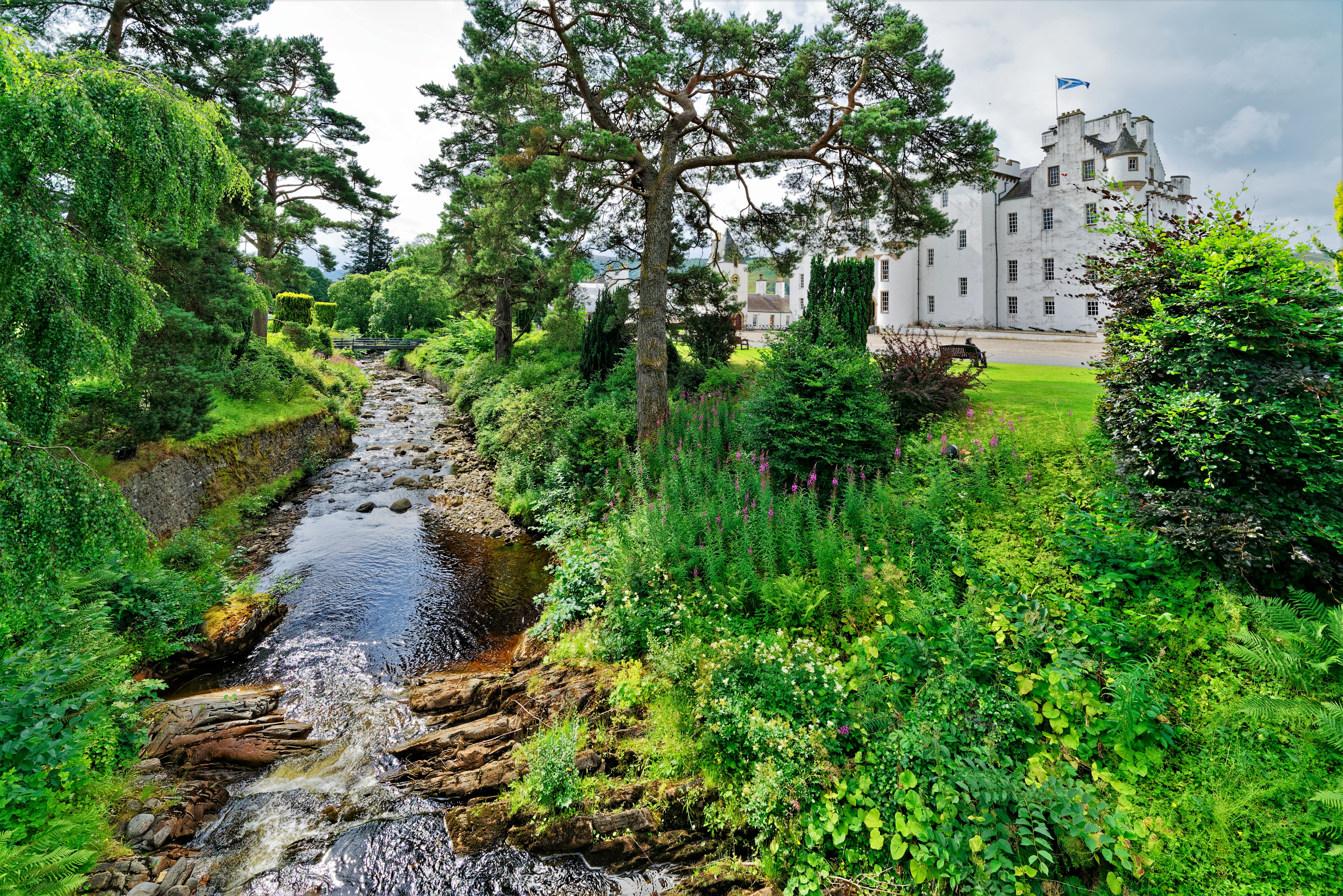
Blair Castle, Caisteil Bhlàir in Scottish Gaelic, stands in its grounds near the village of Blair Atholl in Perthshire, in Glen Garry, on the main route through the central Scottish Highlands. It is the ancestral home of Clan Murray and was historically the seat of their chief, the Duke of Atholl. The present chief, Bruce Murray, 12th Duke of Atholl, lives in South Africa, where he was born and raised. The house is a palace and a fortification that has been enlarged, stripped of its turrets, and given them back, across more than seven centuries.
The earliest known part of the present building dates from 1269 and is known as Comyn's Tower, also written Cummings Tower or Cumming's Tower. It is six storeys. It may retain some thirteenth-century fabric, though it was largely built in the fifteenth century, and one account says the tower is perhaps partly of the 1269 date and probably mainly of the fifteenth century. The castle is harled, of three storeys and a basement, with parts of four storeys, and with one- and two-storey wings.
The wing on the south has a tower, and there are angle turrets.
John Comyn, also written Cumyn, Lord of Badenoch, is said to have started the castle in 1269. He is given as born about 1215 and as dying about 1275, with other dates of death in 1274 and in 1277. He was Justiciar of Galloway in 1258. He held lands in Nithsdale, at Dalswinton and Duncow, and in Tynedale.
He was the son of Richard Comyn and the grandson of William Comyn, Earl of Buchan in right of his wife. He succeeded his uncle Walter as Lord of Badenoch in 1258 and was succeeded by his son John, called the Black Comyn. John himself was known as the Red Comyn, a nickname more commonly applied to his grandson. The Comyn family were in effective power in Scotland from 1249 to 1255, while Alexander III of Scotland was a minor, and John was one of those with influence at court.
They were ousted by Alan Durward and returned to power in 1257 and 1258, before provoking a strong English reaction. John fought for Henry III of England at the Battle of Lewes in 1265, with John Baliol the elder and Robert Bruce the elder, and was captured. In 1267 Henry III gave him licence to crenellate Tarset Castle in Tynedale, near present-day Lanehead by Hexham. Tarset had previously been held by Walter Comyn.
In 1275 John was one of the leaders of a Scottish expedition that crushed a Manx revolt against the Scottish crown.
Alexander III was the king to whom the wronged earl later complained. Alexander was born at Roxburgh, the only son of Alexander II by his second wife, Marie de Coucy, and a life span is given for him from 1241 to 1286. His father died on 6 July 1249, and Alexander became king at the age of seven, inaugurated at Scone on 13 July 1249. His minority was an embittered struggle between a party led by Walter Comyn, Earl of Menteith, and a party led by Alan Durward, Justiciar of Scotia.
Walter Comyn's party dominated the early years. At Alexander's marriage to Margaret of England in 1251, Henry III demanded homage from his son-in-law for the Scottish kingdom, and Alexander did not comply. An interview at Kelso in 1255 led to Menteith's party losing to Durward's. Two years later the disgraced party seized the king and forced a regency drawn from both sides.
On reaching his majority at twenty-one in 1262, Alexander said he would resume his father's projects in the Western Isles. He laid a formal claim before Haakon IV of Norway. Haakon rejected it and, the following year, answered with an invasion. He sailed around the west coast, halted off Arran, and entered talks which Alexander prolonged until the autumn storms.
Haakon attacked and met a storm that badly damaged his ships. The Battle of Largs on 2 October 1263 was indecisive, but Haakon's position was hopeless. He died in Orkney on 15 December 1263. In 1266 his son Magnus the Lawmender concluded the Treaty of Perth, ceding the Isle of Man and the Western Isles to Scotland for monetary payments.
Norway kept Orkney and Shetland until 1469.
It was in that decade, in 1269, that John Comyn began a tower at Blair on land belonging to David Strathbogie, Earl of Atholl, a northern neighbour, while David was away on crusade. David, the first Strathbogie earl, was the son of John de Strathbogie and Ada of Atholl. Ada was countess in her own right, and David succeeded her. He had married, before June 1266, Isabel, daughter of Richard de Dover, feudal baron of Chilham in Kent, by Maud, countess of Angus in her own right.
Isabel died in 1292. In 1266 she was heiress to her brother Richard de Dover and inherited the barony of Chilham and the manor of Chingford Earls in Essex, which in 1270 the couple leased to the Knights Templar by the king's licence. David died on 6 August 1270 at Tunis, or at Carthage, in the Eighth Crusade, in the company of Louis IX of France. On his return the earl complained of the interloper to Alexander III, won his land back, and incorporated the tower into his own castle.
He was succeeded by his only son, John of Strathbogie, ninth Earl of Atholl, warden and justiciar of Scotland.
The next Strathbogie earl, David II Strathbogie, died on 28 December 1326. He was Earl of Atholl, Constable of Scotland, and Chief Warden of Northumberland. He was the eldest son of John Strathbogie, Earl of Atholl, by Marjory, or Margaret, daughter of Donald, tenth Earl of Mar. He was a prisoner in England in 1300.
He succeeded his father in 1306 and was restored to his earldom and Scottish estates in 1307 by the surrender of them by Ralph de Monthermer, to whom a large sum was paid. That year he rebelled against Robert the Bruce, who banished him and forfeited his office, title, and lands. The lands were given to Sir Neil Campbell. Another account places the forfeiture in 1308, after rebellion against Robert the Bruce, and says the king granted the titles and estates to Niall mac Cailein.
David received three manors in Norfolk in compensation. In 1321 he was granted the feudal barony of Chilham in Kent, which had belonged to his father and grandmother. In 1322 he was summoned to the English parliament as Lord Strathbogie and appointed custos of Northumberland, responsible for defence against Scottish raids. His wife was co-heiress in 1324 to her uncle Aymer de Valence, Earl of Pembroke, and inherited Mitford Castle and manor, the manor of Ponteland, lands in Little Eland in Northumberland, and the manor of Foston in Yorkshire.
In 1325 he commanded the English troops in Gascony. He married Joan, elder daughter of Sir John III Comyn, Lord of Badenoch and joint guardian of Scotland, by Joan, daughter of Sir William de Valence. His claim to Atholl was maintained by his eldest son, David III Strathbogie, a leading supporter of Edward Balliol.
Robert the Bruce's own inauguration shows how close Atholl stood to that war. Six weeks after John Comyn was killed in Dumfries, Bruce was inaugurated King of Scots by Bishop William de Lamberton at Scone, near Perth, on Palm Sunday, 25 March 1306. The bishops of Moray and Glasgow were there, as were the earls of Atholl, Menteith, the Lennox, and Mar. The next day Isabella MacDuff, Countess of Buchan, crowned him a second time, because tradition gave that ceremony to a representative of Clan MacDuff.
The earldom of Atholl did not stay with the Strathbogies. It was granted to a number of people over the years until 1457, when James II granted it to his half-brother John Stewart.
James II was born at Holyrood Palace on 16 October 1430, the younger of the twin sons of James I and Joan Beaufort. The elder twin, Alexander, died before 22 April 1431. James was born with a large red birthmark covering one side of his face, which the Auchinleck chronicle called the fire mark in his face. He was crowned at Holyrood Abbey on 26 March 1437 by Michael Ochiltree, Bishop of Dunblane, with the celebrations held inside Edinburgh Castle for his safety.
His mother, Joan Beaufort, had hoped to be regent. In May 1437 a general council appointed Archibald, fifth Earl of Douglas, lieutenant-general instead, and left Joan the custody of the boy, who was to be kept at Stirling Castle. He was brought to Edinburgh before 1439 in the custody of William Crichton. James and Mary were married in Holyrood Abbey on 3 July 1449.
He granted Mary the earldoms of Strathearn and Atholl, among other lands, as her dower, and struggled to provide its full negotiated value of 10,000 écus. John Stewart, first Earl of Atholl, also known as Sir John Stewart of Balveny, was the eldest child of that same Joan Beaufort, widow of James I, and her second husband, Sir James Stewart, the Black Knight of Lorn. He was therefore half-brother of James II. His birth is given both as about 1437 to 1442 and as 1440, and his death both as 9 September 1513 and as 1512.
He was created Earl of Atholl in around 1457, the first earl of the eighth creation. He is believed to have had a hand in suppressing the rebellion of John Macdonald, eleventh Earl of Ross, the last of the Lords of the Isles. He became ambassador to England in 1484. The eighteenth-century historian William Guthrie says he was killed at the Battle of Flodden in 1513.
He was buried in Dunkeld Cathedral. He married, about 1459 or 1460, Lady Margaret Douglas, the Fair Maid of Galloway, daughter of Archibald Douglas, fifth Earl of Douglas. She had already been married to William Douglas, eighth Earl of Douglas, and to James Douglas, ninth Earl of Douglas, the second marriage annulled by the pope. She died between 1473 and 1475.
Their daughters were Jean, who married Alexander Gordon, third Earl of Huntly; Elizabeth, who married Andrew Gray, second Lord Gray; and Christian, who married Neil Stewart of Garth. Sometime before April 1475 he married a second wife.
Sir William Murray of Castleton married Lady Margaret, daughter of this first Stewart earl, and was killed at Flodden in 1513 with many other Scottish noblemen. His son Sir William Murray lived at Tullibardine in Perthshire. That William's grandson, Sir John Murray, was created Lord Murray of Tullibardine in 1604, and Lord Murray, Gask and Balquhidder, and Earl of Tullibardine, in 1606, all in the Peerage of Scotland. Clan Murray's ancestors were the Morays of Bothwell, established in Scotland in the twelfth century.
In the sixteenth century the Murrays of Tullibardine secured the chiefship. The Murray chiefs had supported William Wallace and Robert the Bruce in the wars of independence. One account says the first Earl of Tullibardine married the heiress of the Stewart earldom and that Atholl therefore became a Murray earldom in 1626. The fuller descent is this.
William Murray, second Earl of Tullibardine, who lived from 1574 to 1628, married as his third wife Lady Dorothea, daughter of John Stewart, fifth and last Earl of Atholl. Charles I agreed to revive the earldom of Atholl for Lord Tullibardine's children by Lady Dorothea. Tullibardine resigned his titles to his younger brother, Patrick Murray, who was created Lord Murray of Gask and Earl of Tullibardine in 1628, with remainder to his heirs male whatsoever and, it is presumed, with the precedence of 1606. John Murray, son of the second Earl by Lady Dorothea Stewart, was created Earl of Atholl in 1629.
Another sentence of the same family history says the Stewart earldom became a Murray earldom in 1629. The castle's own short history says John Murray, son of the second Earl of Tullibardine, was created Earl of Atholl in 1629, and that the title has since remained with the Murrays.
During the Wars of the Three Kingdoms the Murrays supported the royalist cause. The chief, James Murray, second Earl of Tullibardine, received James Graham, first Marquess of Montrose, at Blair Castle in 1644, and raised no fewer than eighteen hundred men for the king. That addition of men won Montrose the Battle of Tippermuir in 1644. The castle was taken by the army of Oliver Cromwell after his invasion of 1650.
Another account says that in 1653 the castle was besieged, captured, and partly destroyed with gunpowder by Cromwell's forces, and that it was still complete enough for the Earl of Atholl to try to recapture it the following year. Dunkeld House was badly damaged in 1654.
Oliver Cromwell left Ireland in May 1650 and invaded Scotland after the Scots proclaimed Charles I's son, Charles II, as king. He was less hostile to Scottish Presbyterians, some of whom had been his allies in the first English civil war, than to Irish Catholics. He called the Scots a people fearing God's name, though deceived, and he appealed to the General Assembly of the Church of Scotland to see the error of the royal alliance, begging them, in the bowels of Christ, to think it possible they might be mistaken. Their reply was to ask whether he would have them be sceptics in their religion.
The campaign went badly at first. His men were short of supplies and were held up at fortifications manned by David Leslie. Sickness spread. He was on the brink of evacuating by sea from Dunbar.
On 3 September 1650 he broke the main Scottish army at the Battle of Dunbar, killing four thousand Scottish soldiers and taking another ten thousand prisoner, and then took Edinburgh. He called it a high act of the Lord's providence and one of the most signal mercies God had done for England and his people. The next year Charles II and his Scottish allies tried to invade England and take London while Cromwell was still engaged in Scotland. Cromwell followed them and destroyed the last major Scottish royalist army at the Battle of Worcester on 3 September 1651.
Charles II escaped to exile in France and the Netherlands until 1660. In the final stages of the Scottish campaign, Cromwell's men under George Monck sacked Dundee, killing up to a thousand men and 140 women and children. Scotland was ruled from England during the Commonwealth and kept under military occupation, with fortifications sealing off the Highlands. The north-west Highlands saw another royalist rising in 1653 to 1655, put down with six thousand English troops.
Presbyterianism could still be practised, but the kirk no longer had the civil courts behind its rulings.
John Murray, later first Marquess of Atholl, was born on 2 May 1631 and died on 6 May 1703. He was the son of John Murray, first Earl of Atholl, created in 1629, by Jane, daughter of Duncan Campbell of Glenorchy. He succeeded as second Earl of Atholl on his father's death in June 1642. In 1650 he joined the unsuccessful attempt to free Charles II from the Covenanters.
In 1653 he was a chief supporter of the eighth Earl of Glencairn's rising against English plans to incorporate Scotland into the Commonwealth, and he devoted two thousand men to the fight. He was obliged to surrender the following year to George Monck. In 1670 he succeeded to the earldom of Tullibardine. One account says this was on the death of his first cousin the second Earl, and another line of the same life says it was on the death of his cousin the fourth Earl.
The ducal genealogy names the cousin as James Murray, second Earl of Tullibardine, and says the new holder was the third, or the fifth, Earl of Tullibardine. On 7 February 1676 he was created Marquess of Atholl and Viscount Glenalmond. The ducal account of the same creation adds the titles Lord Murray, Balveny and Gask, Viscount of Balquhidder, and Earl of Tullibardine, with remainder to the heirs male of his body. He commissioned William Bruce to rebuild Dunkeld House in 1676.
On 5 May 1659 he had married Lady Amelia Ann Sophia Stanley, daughter of James Stanley, seventh Earl of Derby, and Charlotte de La Tremoille. She lived from 1633 to 22 February 1702 or 1703. They had twelve children, four of whom died young. He was a leading royalist and a defender of the Stuarts from the civil wars of the 1640s until after William and Mary came to power in 1689.
After the Restoration he became a privy councillor for Scotland in 1660, obtained the hereditary sheriffdom of Fife, and in 1661 became Lord Justice-General. In 1663 he was Lord President of the Court of Session. In 1670 he was the first captain-general of the Royal Company of Archers.
When John Graham, first Viscount Dundee, launched the first Jacobite rising in April 1689, the Marquess of Atholl decided to remain loyal to the government, although two of his sons joined the Jacobites. Another account says that, claiming ill health, Atholl went to England and left his eldest son, John Murray, to besiege the ancestral home. Atholl's factor, Patrick Stewart of Ballechin, held Blair Castle for King James. Dundee visited in May.
Stewart of Ballechin had been a trusted family retainer and one of Atholl's key lieutenants in the suppression of Argyll's rising in 1685. In July, Ballechin refused entry to Atholl's son and heir, Lord John Murray. Murray laid siege to the castle. General Hugh Mackay was approaching to join him and to take the castle for the Williamites.
Dundee relieved the castle. The Battle of Killiecrankie was fought because Dundee did not want to retreat and give the castle up to Mackay. Dundee and his officers and clan chiefs held a council of war at the castle on the eve of the battle, on 26 July. Lochiel and 240 Camerons, plus the Irish contingent of Alexander Cannon, reached Blair that same day.
The battle was fought the next day, 27 July 1689.
The rising itself had begun after James VII went into exile in December 1688. In March 1689 he opened the Williamite war in Ireland, and Dundee led a simultaneous revolt in Scotland. Dundee had been James's military commander in Scotland. Despite being outnumbered and short of supplies, the Jacobite commanders hoped a decisive victory would bring wider support.
On the morning of 27 July, Dundee learned that Mackay's forces were entering the Pass of Killiecrankie, a track nearly three kilometres long, with the River Garry on the left and steep hills on either side. Mackay's strength on the march north is given as somewhere between 3,600 and 5,100. Sir Alexander McLean and 400 men were sent to skirmish, while Dundee assembled the rest on the lower slopes of Creag Eallich, north of the pass. Mackay halted, left the track, and deployed facing uphill in a line only three men deep.
Dundee waited until sunset, just after eight in the evening. Balfour's front line fired three volleys and killed nearly 600 Highlanders, but a shallow terrace masked part of the fire, and regiments to the right apparently fled without firing. The Highlanders fired one volley at about fifty metres, dropped their muskets, and broke Mackay's centre with axes and swords. Killiecrankie is the first major action in which British troops are known to have used the plug bayonet.
Mackay reformed part of his line, and some 800 men got back to Stirling, while others straggled in over the following days. Government losses, from muster rolls, were about 2,000 killed, wounded, or missing, and it is possible they lost up to half their strength. Jacobite casualties were between 600 and 800. Dundee was killed in the last moments.
One account says he was shot through the head by a musket ball in a volley from Mackay's regiment. A traditional legend says he was shot through the breastplate. That breastplate is said to be held at Blair Castle, and also said to have been forged when a duke had his blacksmith bore the hole, even though the body had been stripped on the field. He was carried the few miles to the parish church of St Bride, above Blair Castle, and buried there.
The stone in the crypt gives his age, wrongly, as 46, when he was 41. His alleged helmet and breastplate, taken from the vault in the nineteenth century, are kept in the castle. A letter sent under his name to James, reporting the victory, is generally thought to be a forgery. The Jacobites won the battle and could not use the victory.
Alexander Cannon took command. An assault on Dunkeld in August was repulsed, and he ended the campaign. In 2004 a fragment of a hand grenade was found on the battlefield, evidence of their use in Britain thirty years earlier than the previously recorded case at Glen Shiel in 1719. A survey in 2015 confirmed the place and intensity of the close fighting and found large numbers of pistol and musket balls.
After Killiecrankie, Blair Castle remained in Jacobite hands for some time. In August the Jacobite Highland chiefs swore a bond there to continue the rising. John Murray, the son who had besieged his own house, became the first Duke of Atholl. He was born on 24 February 1660 at Knowsley Hall in Lancashire and died on 14 November 1724.
He was the eldest of twelve children of the first Marquess and Lady Amelia Sophia Stanley, and he was the father of twenty-one children. He matriculated at St Andrews in 1676. He fought for William III and Mary II in the Glorious Revolution, and he took the oath of loyalty in September 1689, but he could not stop some of his clan joining Dundee under Stewart of Ballechin. He ended the siege of Blair just days before Killiecrankie.
William III created him Earl of Tullibardine in 1696, a title he held for life, and Queen Anne created him Duke of Atholl in 1703, with remainder, failing heirs male of his own body, to the heirs male of his father. The dukedom was created for him as second Marquess, with a special remainder to the heir male of his father, the first Marquess. In the planned invasion of 1708 he took no part because of illness and was placed under arrest at Blair Castle. He was a founder, in 1709, of the Society in Scotland for Propagating Christian Knowledge, and he supported its first schools at Blair Atholl and Balquhidder, without sharing its hostility to the Gaelic language.
In the Jacobite rising of 1715 the Atholl men numbered 1,400, in four regiments commanded by William Murray, Marquess of Tullibardine, Lord Charles Murray, Lord George Murray, and William Murray, second Lord Nairne. At Sheriffmuir, Tullibardine served as major-general of the Jacobite army, and his battalion was put under his cousin John Lyon, fifth Earl of Strathmore. The battle was indecisive, each wing of each army beating the wing opposite it. William was attainted.
An act of Parliament vested the family honours and estates in his younger brother James, and a later act kept William and his issue out of the descent. On 1 February 1717 William was created, in the Jacobite peerage, Duke of Rannoch, Marquis of Blair, Earl of Glen Tilt, Viscount of Glenshie, and Lord Strathbran.
James Murray, second Duke of Atholl, was born in Edinburgh on 28 September 1690 and died at Dunkeld on 8 January 1764. He was the third son of the first Duke and Lady Katherine Hamilton. In 1712 he was captain of the grenadier company of the 1st Foot Guards. He was chosen member of Parliament for Perth in 1715 and again in 1722, and he succeeded his father in 1724.
In June 1724 he became Lord Privy Seal. He was Keeper of the Privy Seal of Scotland in 1733, a representative peer, and in 1734 a Knight of the Thistle. As grandson of James Stanley, seventh Earl of Derby, he succeeded in 1736 to the sovereignty of the Isle of Man and to the ancient barony of Strange, on the death of James, tenth Earl of Derby. When the Highland army approached in 1745 he fled south, and his elder brother, the Marquess of Tullibardine, took possession of Blair Castle.
James joined the army of the Duke of Cumberland, reached Edinburgh with him on 30 January 1746, and on 9 February summoned his vassals to Dunkeld and Kirkmichael to join the king's troops. He and his first duchess patronised the portrait painter Jeremiah Davison. Given several larch trees by the Menzies of Culdares, he was the first to plant European larch in Great Britain. One of a group of five near Dunkeld Cathedral, planted in 1738, was still alive when that fact was recorded.
He was buried at Inveresk. His daughter Charlotte succeeded to the barony of Strange. The Scottish titles went to his nephew John, son of Lord George Murray, the Jacobite general whom the second Duke did not follow.
The building was being transformed through those same years. The central range is early sixteenth century, with alterations and additions by the early seventeenth century. An extension by the third Earl in 1530 formed a great hall, the present dining room, over vaulted chambers. The south end was raised in 1736 by the architect John Douglas, and was still incomplete in 1746.
A drawing of 1736 by Douglas is described as a scheme for making Blair like the work of William Adam. A two-storey south-east wing of 1743 to 1745 is by James Winter. From 1747 to 1758 Winter levelled the towers to a common wall-head, removed the angle turrets, and rebuilt and completed the south end. The estate history says that in 1740 the second Duke began turning the medieval castle into a Georgian house covering most of the footprint seen today, employed Thomas Clayton for some of the finest plasterwork in Scotland, and commissioned furniture from Scotland's best-known cabinet makers.
The listing describes rich plasterwork designed by Abraham Swan, and the craftsmen named for 1747 to 1758 are Thomas Clayton for plasterwork, Abraham Swan for woodwork, the name also written Abrahan Swan, Thomas Carter for chimneypieces, Thomas Bardnell for painted ceiling panels, and Charles Steuart for painted wall panels. The muniment room holds Winter's schemes, some more elaborate than the work carried out, an unsigned series presumed to be Swan's for the interiors, a late eighteenth-century unsigned perspective for giving the house its castle outline again, and a poor scheme of 1840 for the same idea by R. and R. Dickson.
In the Forty-Five, Prince Charles Edward Stuart and his army occupied Blair Castle twice: in early September 1745, for several days, and in early February 1746, again for several days. On the march east from Glenfinnan, where he had raised his father's standard on 19 August 1745, Charles stopped briefly at Blair Castle and reached Perth on 4 September. The Jacobites then left the castle, and government forces, including lowland Clan Agnew, occupied it. In February 1746 the Duke of Cumberland, Prince William, arrived at Perth.
He sent Lieutenant Colonel Webster with 200 men to occupy Castle Menzies, the home of Sir Robert Menzies of Weem, so as to secure the bridge over the Tay. He sent Sir Andrew Agnew of Lochnaw, fifth Baronet, lieutenant colonel of the Royal Scots Fusiliers and chief of Clan Agnew, with 300 men to Blair Castle. Blair was the seat of James, second Duke of Atholl, who supported the government, while most of his clan supported the Stuarts under his brother, Lord George Murray.
The siege came in March 1746, in the last stages of the rising. On the morning of 17 March the detached outposts around the castle were surprised and captured, and the soldiers in them were made prisoners. The Jacobites then fired on the castle from close range. The garrison, reduced to about 270, was ordered to different parts of the house and told not to fire unless attacked.
That afternoon Lord George Murray and Ewen MacPherson of Cluny, chief of Clan Macpherson, had their headquarters in the village of Blair, about a quarter of a mile south-east of the castle. They summoned Andrew Agnew to surrender the castle, the garrison, the stores, and the provisions. He refused. These days were part of the Atholl raids of 14 to 17 March, by which Lord George Murray hoped to show that guerrilla war was the better strategy.
He did not take the family home. On 19 March Agnew sent a man out on a horse to reach the Earl of Crawford, who was thought to be at Perth or Dunkeld with cavalry and Hessian troops. A Jacobite was soon seen on that horse, and the mission was assumed to have failed. In fact the messenger had fallen when the Jacobites fired, escaped on foot, and reached Crawford.
On 1 April the garrison heard that Lord George Murray had left Blair, believed to be because he had been ordered to join Charles Edward Stuart near Inverness. On 2 April, George Lindsay-Crawford, twenty-first Earl of Crawford, arrived with cavalry and raised the siege. Agnew's men had been close to starvation. Lord George Murray and his men joined Charles and were defeated a few weeks later at the Battle of Culloden, on 16 April 1746.
The Royal Scots Fusiliers fought there on the government side. Lord George had led the Jacobite right at Culloden, on the wing flanked by the Culwhiniac enclosure walls, after a failed night march he had himself suggested. Many Jacobite troops missed the battle because of that march. He died in exile in the Netherlands in 1760.
Most military historians, in the clan's account of him, concur that if he had been given sole command, the Old Pretender might well have gained the throne. His half-brother, Lord John Murray, was made colonel of the 43rd Regiment of Foot, later the 42nd, in April 1745, so that at Prestonpans there were Murray regiments on both sides.
John Murray, fourth Duke of Atholl, was born on 30 June 1755 and died on 29 September 1830. He was the eldest son of the third Duke and of Charlotte, eighth Baroness Strange, daughter of the second Duke. His parents were first cousins. He succeeded in 1774.
During his control of the Blair estate he planted more than twenty million trees over 16,000 acres, firing seed onto the high hills from cannon, and he was nicknamed the Planting Duke. He introduced Japanese larch into Britain at Dunkeld, where it hybridised with the European larch planted by his uncle, the second Duke, and produced the Dunkeld larch. In 1796 and 1797 he planted pine and larch around the Falls of Bruar as a tribute to Robert Burns and to Burns's poem The Humble Petition of Bruar Water, of 1787. He wrote Observations on Larch in 1807.
The planting on the Blair estate was largely in Glen Tarf, which had been common grazing for the people of Glen Tilt. The cattle farmers of Glen Tilt emigrated in large numbers. The Highland historian Alexander Mackenzie attributes the planting in part to a fondness for venison and calls it the first act of the Highland clearances. A survey of the designed landscape drawn by John Tinney in 1747 is among the evidence for the park, whose original layout is credited to the second Duke.
The forest plantations are credited to the fourth Duke between 1774 and 1830. He was also patron of an architect whose name is written Goerge Steuart, while drawings for subsidiary buildings are attributed to George Steuart. In December 1777 he raised the 77th Regiment of Foot, also called the Atholl Highlanders or Murray's Highlanders, as a relief for regiments serving in North America. The men were to serve for three years or for the duration of the American war.
The regiment spent most of its time in Ireland. In 1781 the three years ended and the men expected to be disbanded. They were marched to Portsmouth for India, mutinied when they learned of it, and had the embarkation cancelled. They were marched to Berwick and disbanded in 1783.
More than fifty years later, in 1839, George Murray, sixth Duke of Atholl, then Lord Glenlyon, re-formed the regiment as a bodyguard and took it to the Eglinton Tournament. He was born at Great Cumberland Place, Westminster, on 20 September 1814, and died on 16 January 1864. On 30 August 1839 he attended the tournament of the thirteenth Earl of Eglinton as the Knight of the Gael, with a retinue of Highlanders. In 1842 the regiment escorted Queen Victoria on her tour of Perthshire.
In 1844, when the queen and Prince Albert stayed at Blair Castle, the regiment mounted the guard for the whole visit. Victoria said she would present colours, which gave the regiment the status of an official Scottish regiment in perpetuity. The first stand of colours was presented by Lady Glenlyon in 1845. The sixth Duke succeeded his uncle, the fifth Duke, in 1846.
In October 1854, shortly before the death of the Jacobite claimant Charles Edward Stuart, Count Roehenstart, the duke welcomed him as a guest at Blair Castle. That guest is not the prince of 1745. The duke was Grand Master Mason of Scotland from 1843 to 1863.
Under John Stewart-Murray, seventh Duke of Atholl, the regiment regularly guarded royal visitors. Blair was a convenient stop on the way to Balmoral. The regiment attended the Braemar Gathering. The Atholl Gathering, in the first week of September, had a parade and trials of strength.
The seventh Duke was born on 6 August 1840 and died at Blair Castle in January 1917, aged 76. He was educated at Eton, served in the Scots Fusilier Guards, became a captain in 1864, the year he succeeded, and in 1865 registered the additional surname Stewart at the Lyon Court. He owned 201,000 acres in Perthshire. He was Lord-Lieutenant from 1878 to 1917, a Knight of the Thistle in 1868, and Chancellor of the Order from 1913 until his death.
He spent years editing the family records. He married Louisa Moncreiffe in 1863. She died in Italy on 9 July 1902, aged 58. Their son Major Lord George Stewart-Murray, of the 1st Battalion, the Black Watch, is dated 17 February 1873 to 14 September 1914.
He was reported missing after the First Battle of the Aisne on 12 September 1914. Five months later the family received unofficial word that he was wounded and held at a prisoner-of-war camp at Soltau. That report was false, and in 1916 he was officially reported killed in action. Despite six children who survived him, the seventh Duke has no known grandchildren.
The title passed to his son John, eighth Duke, and then to James, ninth Duke, who died in 1957.
The exterior that Victoria saw was not the exterior of today. The south-east range, with the clock tower, was rebuilt by Archibald Elliot after a fire in 1814. One account says the wing was damaged by fire in 1814, repaired, and given a clock tower, the architect presumably Archibald Elliot. Archibald Elliot was born in August 1761 at Ancrum in Roxburghshire, the son of a carrier, and died on 16 June 1823.
He trained as a joiner, worked in cabinet design in London, and practised in Edinburgh with his brother James until James died in 1810. His manner used square plans, concealed roofs, crenellated walls, and square corner towers, derived from James Playfair's Melville Castle. His works include Blair Castle and also Blair Atholl Church, of 1823. He is buried near the centre of New Calton Cemetery in Edinburgh.
Following the popularity of Scottish Baronial architecture, the seventh Duke commissioned a remodelling of the exterior in the 1860s and 1870s. The architects named for that work are David Bryce, and also David Bryce together with William Burne. David Bryce was born on 3 April 1803 at 5 South College Street in Edinburgh, the son of a grocer who also built, and he died on 7 May 1876. He joined William Burn's office in 1825, was Burn's partner by 1841, and dissolved the partnership in 1845.
He worked first in Palladian and Italian Renaissance manners and then devoted himself to the Gothic variety known as Scottish Baronial, of which he became the leading exponent. He had commissions for more than 230 buildings and is credited with perfecting that style, with crow-stepped gables, turrets, and carved doorways drawn from sixteenth-century Scottish architecture. At Blair the work of 1869 to 1871 is his: the west front approximately based on the original, Cumming's Tower widened by corbelling, an entrance hall added on the east, and that side largely redesigned. Crenellations and turrets removed in the Georgian years were put back.
New gates were installed, and bathrooms, telephones, and gas were introduced. A ballroom of 1876 to 1877 is also his, and its interior was panelled in 1899. James Campbell Walker added a new ballroom in 1885. Alterations and additions of 1886 are credited to J.
C. Walker, the same architect under a shorter name, so the ballroom wing is dated both 1885 and 1886. Walker was born on 11 April 1821 at Strathmiglo, into a family of bleachers, and died of chronic bronchitis on 10 January 1888. He trained under William Burn from January 1842 and in the 1850s moved to David Bryce.
He is known for poorhouses, schools, and Dunfermline Carnegie Library, the first Carnegie library, and his list of works includes the new ballroom at Blair Castle. Further alterations came in 1904 and 1905 by J. McIntyre Henry, and in 1920 and 1921 by Sir Robert Lorimer.
The castle has been open to the public since 1936. Its rooms hold weapons, hunting trophies, souvenirs of the Murray family, ethnographica, paintings, furniture, and needlework collected over many generations. The estate history says the story is told in thirty rooms, against eighteenth-century interiors and Scots Baronial architecture. Most of the dukes are buried in the family burial ground beside the ruins of St Bride's Kirk in the grounds.
St Bride's was the village church of Old Blair and fell into disuse after 1823, when the estate village was moved to its present site. The grounds were placed on the national inventory of gardens and designed landscapes on 1 July 1987. The seventh Duke is credited with reinstating the formal gardens. In 2009 a grand fir, Abies grandis, in Diana's Grove was measured at 62.7 metres, or 206 feet, and declared the second-tallest tree in Britain.
The castle was designated a category A listed building on 5 October 1971, while another record of the same listing dates it to 4 October 1971. The parish is Blair Atholl, and the national grid reference is NN 86577 66186.
During the Great War part of the castle was an auxiliary hospital. Hamish Henderson was born at Blairgowrie on 11 November 1919, the first Armistice Day, to Janet Henderson, a Queen's Nurse who had served in France and was then working in the war hospital at Blair Castle. His father was the army officer James Scott, who lived from 1874 to 1934. The boy was registered as James and used the Scots form Hamish.
He became a poet, songwriter, and collector of folk song, and he wrote Elegies for the Dead in Cyrenaica out of the desert war. After the First World War the regiment's parades grew fewer, though it guarded the Crown Prince of Japan in 1921 and King Faisal of Iraq in 1933, both visitors to the castle. From 1922 the family found it more convenient to live in the private apartments.
Angela Pearson, born on 27 February 1910 and dead in 1981, became Angela Murray and later Angela Campbell-Preston. She was a businesswoman, landowner, and conservationist, and a supporter of the National Trust for Scotland. Her parents were Agnes Beryl Spencer-Churchill and Harold Pearson, second Viscount Cowdray. In 1930 she married Lieutenant-Colonel George Anthony Murray.
Their only child to survive childhood became, in 1957, Iain Murray, tenth Duke of Atholl. Her husband was killed in Italy in 1945. She had helped to manage Blair Castle since the 1930s, when her grandmother had invested in the estate, and she lived there from 1945. She supervised a new management to bring the estate back into profit, donated houses on the estate to the National Trust for Scotland, and in 1960 joined its board.
In 1950 she married Robert Campbell-Preston and moved to Ardchattan Priory by Loch Etive. Their daughter Sarah was born in 1951. A portrait of Angela by Bryan Organ, painted the year before her death, is in the castle collection. Her daughter, Sarah Troughton, was the chief trustee in 2023 and the chair of the trustees in 2024.
George Iain Murray, tenth Duke of Atholl, known as Wee Iain, was born on 19 June 1931 and died on 27 February 1996. He was six feet five inches tall. He was educated at Eton and Christ Church, Oxford, and in 1957 succeeded his fourth cousin twice removed, James Stewart-Murray, ninth Duke. The estate he inherited was about 120,000 acres, or 490 square kilometres, down from about 190,000 acres, or 770 square kilometres, in the nineteenth century.
He made the ground around Blair Castle important for tourism and forestry, and he spoke on forestry in the House of Lords after his election as a Scottish representative peer in 1958. He was chairman of BPM Holdings from 1972 to 1983 and of Westminster Press Group from 1974 to 1996, and a director of Pearson Longman from 1975 to 1983. In 1980 he was a deputy lieutenant of Perth and Kinross. He died unmarried.
The day before his death it was announced that he had given Blair Castle and most of his estates to a charitable trust, shielding them from inheritance tax, which one report puts at a rate of forty percent, and leaving them under Scottish control. His heir, John Murray, had indicated that he did not want to leave South Africa, and said that he was a South African and not a Scotsman. The half-nephew Robert Troughton was the heir to the remaining estate.
John Murray, eleventh Duke, was born in Johannesburg on 19 January 1929 and died on 15 May 2012. He was a land surveyor, hereditary chief of Clan Murray, and colonel-in-chief of the Atholl Highlanders. He was educated at Michaelhouse from 1941 to 1946 and took an honours degree in engineering at the University of the Witwatersrand. He married Margaret Yvonne Leach in Pretoria on 15 December 1956.
He did not inherit the castle. Every year he came from South Africa to stay at Blair for the regiment's display. It had been feared that the regiment would be disbanded when the tenth Duke died, until the eleventh Duke wrote to the trustees that he would continue the role.
The regiment had been revived in 1966 by the tenth Duke. Eight local men, mostly estate employees, all with previous military training, were invited, and seven accepted. They paraded at Blair Castle on 8 April 1966, the first time in thirty-three years, and marched past the duke behind two pipers. In 1973 they returned to the Braemar Gathering and marched past the queen.
The Atholl Gathering was brought back at Target Park in June 1984. New colours were presented in 1979 by Myra Butter, wife of the Lord-Lieutenant of Perth and Kinross, and a third stand in 2006 by the Duchess of Atholl. The men are armed with nineteenth-century Lee-Metford rifles. There is a pipe band.
The strength is about that of an army company. They are a tourist attraction at the castle and parade each year. Joining is by the duke's invitation, and he chooses men with ties to the estate or the district. The regiment is not part of the British armed forces.
It has been described as the only legal private army in Europe. It is allied with the Solomon Mahlangu Regiment, formerly the Transvaal Scottish, and with the Fife and Forfar Yeomanry and Scottish Horse.
Bruce Murray, 12th Duke of Atholl, was born on 5 April 1960, a date also given as 6 April 1960. He is the elder son of the eleventh Duke and Margaret Yvonne Leach, now the dowager duchess. He left Jeppe High School for Boys in Johannesburg in 1979, studied at Saasveld Forestry College, and did two years of national service with the South African Infantry Corps. He is a volunteer lieutenant in the Transvaal Scottish Regiment.
He managed a tea plantation and then a business making signs for commercial buildings. He was commissioned into the Atholl Highlanders in 2000 as lieutenant colonel. He succeeded on his father's death on 15 May 2012. He married Lynne Elizabeth Andrew in Johannesburg on 4 February 1984.
They had two sons and a daughter and were divorced in 2003. In 2009 he married Charmaine Myrna du Toit, with no children, and they were divorced in 2016. In December 2015 he became an Officer of the Order of St John. He continues to travel to inspect the regiment.
The clan badge he inherited in use is a demi-savage holding a dagger and a key, with the motto Furth, Fortune, and Fill the Fetters. The late duke favoured that badge, and the clan keeps it out of respect.
In the early 1980s the English portrait photographer Allan Warren, born on 26 October 1948, set out to photograph all thirty British dukes. With Angus Montagu, twelfth Duke of Manchester, he set up the Duke's Trust, a charity for children in need. His portraits of public figures, often in black and white, belong to the same decades in which the tenth Duke was the public face of this house. Warren had begun as a child actor in London and turned to photography at twenty, while he was in the West End company of Alan Bennett's Forty Years On.
On the night of 10 March 2011 a fire broke out in the clock tower, which is not part of the medieval fabric. The tower's roof and second floor collapsed into the first floor. The tower was restored in 2012, and the clock mechanisms were restored by the Smith of Derby firm. For the new millennium the architects Jamie Troughton and Hugh Broughton built an exhibition hall called the Banvie Hall.
A hydroelectric scheme of 1908 was reinstated to supply power to the castle, and the visitor account of the charging points in the car park says the scheme was reinstated in 2015 and powers those points entirely from that water. In 2008 the castle and the Atholl estates were used in the reality series Conquer the Castle.
A standing-building record of the south wing was made in 2021 by D. W. Hall, before alterations. It treats the place as a post-medieval castle, in the parish of Blair Atholl, Perth and Kinross, and it was lodged as a report in 2021.
The abstract calls it a standing-building record prior to alterations. It is not a report of objects lifted from the soil.
In late 2022 Bertie Troughton, resident trustee, found about forty bottles of whisky in an unassuming cellar, at the back of a shelf behind a heavy door. A shelf label is reported as reading that this was Blair Castle whisky, casked in 1833 and bottled in 1841. The bottles are believed to have been distilled in 1833, bottled in 1841, and rebottled in 1932. Research in the castle and estate archives, including cellar books called bin books, and carbon dating by the Scottish Universities Environmental Research Centre, supports an early nineteenth-century origin.
A bin book of 23 July 1834, the year after the supposed casking, records store whisky in bin 65 as 72 bottles, equal to 40 gallons in wood. Whisky was consumed during the three-week stay of Queen Victoria and Prince Albert in 1844, and it has been said that this find may be the whisky tasted then. The estate described it as believed to have been sipped by a young Queen Victoria. Twenty-four bottles were prepared for sale as individual lots from 24 November to 4 December 2023, and the castle was to keep bottles for an exhibition.
The family and a local expert sampled them before that sale was arranged. The claim that they are the oldest known Scotch whisky still in existence is stated as a belief, not as a measured certainty.
The castle remains the seat named for the chief of Clan Murray, held for the family by a charitable trust, while the chief lives in South Africa and returns to review the only private regiment the dukedom is allowed to raise. The building in Glen Garry still carries Comyn's Tower inside a Georgian body and a Baronial skin, and the ground around it still shows the planting, the ruined kirk, and the parade ground of that long argument over who held the pass.
Sources
- Blair Castle — Wikipedia
- Blair Castle listed building record — Historic Environment Scotland
- History of the Atholl Estates — Atholl Estates
- Visitor information for Blair Castle — Atholl Estates
- World's oldest whisky found in Blair Castle — Atholl Estates
- Is this the world's oldest Scotch whisky? — BBC
- Standing Building Survey Blair Castle (South Wing) — Archaeology Data Service
- Blair Castle garden and designed landscape — Historic Environment Scotland
- Siege of Blair Castle — Wikipedia
- Blair castle - facade.jpg — Wikimedia Commons
- 10th Duke of Atholl 3 Allan Warren.jpg — Wikimedia Commons
- 10th Duke of Atholl 3 Allan Warren crop.jpg — Wikimedia Commons
- 2009-07-10 Blair Castle.jpg — Wikimedia Commons
- +750 Jahre ist Blair Castle Sitz der Familie Atholl. 01.jpg — Wikimedia Commons
- +750 Jahre ist Blair Castle Sitz der Familie Atholl. 03.jpg — Wikimedia Commons
- +750 Jahre ist Blair Castle Sitz der Familie Atholl. 04.jpg — Wikimedia Commons
- +750 Jahre ist Blair Castle Sitz der Familie Atholl. 05.jpg — Wikimedia Commons
- +750 Jahre ist Blair Castle Sitz der Familie Atholl. 06.jpg — Wikimedia Commons
- +750 Jahre ist Blair Castle Sitz der Familie Atholl. 07.jpg — Wikimedia Commons