
Fortification
Berwick Castle
castle, now ruinous, in Berwick-upon-Tweed, Northumberland, England, UK

Berwick-upon-Tweed, United Kingdom · United Kingdom
- A ruined stone castle above the Tweed at Berwick-upon-Tweed, first mentioned in the twelfth century and strengthened by Edward I after 1296.
- The great hall heard the choice of John Balliol in 1292, and the castle changed hands through the Wars of Scottish Independence until England took it in 1482.
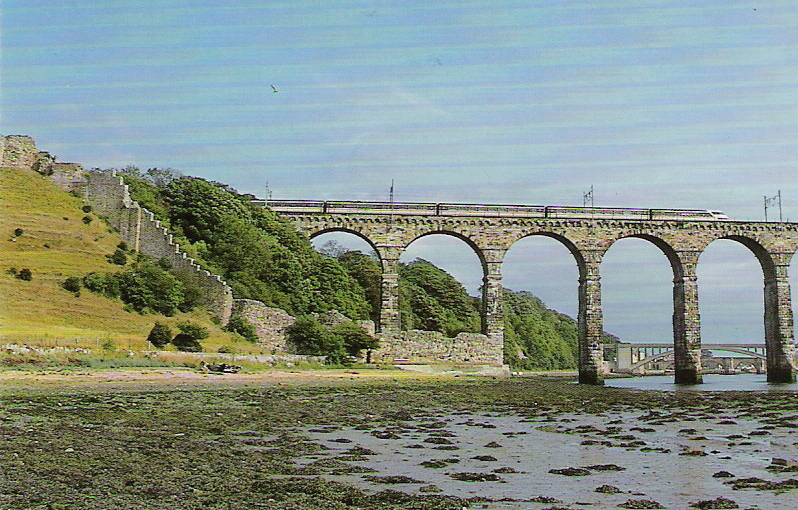
- The White Wall, the Breakneck Stairs, the Constable Tower and a long stretch of the west wall still stand beside the railway.
- Elizabethan ramparts left the castle outside the new town, and an unfinished early seventeenth-century house was begun on the site.
- A dig in 2021 and 2022 found a wall and ditch that may be an outer bailey, with a road that once linked the castle toward Edinburgh.
Visiting
Entry is free, the castle and ramparts are open daily, and there is disabled access to the ramparts. Smoking, vaping, barbecues and naked flames are not allowed, and sections of the ramparts include steep unguarded drops.
History
Berwick Castle is a ruined stone castle at the north-west corner of Berwick-upon-Tweed, on a steep rise above the estuary of the Tweed. It held the neck of the peninsula and looked over both the town and the river. One description calls it a motte and bailey, and the scheduled account describes an enclosure castle whose walls and towers were the main defence.
A castle here is first mentioned in documents of the twelfth century. One account says David I commissioned it in the 1120s, another that a royal castle is first mentioned in his reign and may be older, and a further account that it is first recorded in 1160. David became king in 1124, when Berwick was already a royal burgh, and as prince of the Cumbrians he had founded the burgh itself.
In December 1174 William I, captured at Alnwick, agreed the Treaty of Falaise and transferred the castles of Roxburgh, Berwick, Jedburgh, Edinburgh and Stirling to English soldiers. The castle’s history places the English takeover in 1175. Richard I annulled the treaty by the Quitclaim of Canterbury on 5 December 1189 for 10,000 marks, and the castle’s history says he sold Berwick back to Scotland around 1190 to fund the Third Crusade.
The Wars of Scottish Independence ran from 1296 to 1357. After Margaret, the Maid of Norway, died in 1290, thirteen claimants competed, and from May to August 1291 they pleaded at Berwick in the Great Cause. In November 1292, in the great hall, representatives of Edward I announced his decision for John Balliol against Robert the Bruce and the count of Holland.
On 30 March 1296 Edward sacked the town after crossing the Tweed at Coldstream. Figures for the dead range from 4,000 to 17,000, and William the Hardy, Lord of Douglas, surrendered the castle on terms that spared the garrison, though he was imprisoned. Edward then strengthened the castle, adding and replacing towers and building the White Wall down to the river so the place could not be outflanked.
The west wall still stands for about 75 metres, up to 6 metres high and 4 metres thick, with the Barmekin Tower at the north end and a mid-sixteenth-century gun turret at the south. The Constable Tower at the south-east angle has late thirteenth-century ashlar and arrow slits over rougher courses thought to be a twelfth-century base, though another account dates the tower to the fourteenth century. The White Wall, 82 metres long, carries the Breakneck Stairs and ends in a sixteenth-century gun tower at the river.
The English held the castle until April 1318. In February 1316, at the Battle of Skaithmuir near Coldstream, Sir James Douglas destroyed a starving garrison’s cattle raid and killed the Gascon governor Edmond de Caillou. In 1318 Peter Spalding helped Douglas into the town, and after an eleven-week siege the castle capitulated. Robert the Bruce made his son-in-law Walter Stewart keeper.
Edward Balliol’s grant of 1332 included the town, castle and county. The siege of 1333 lasted four months and ended the day after the Scottish defeat at Halidon Hill on 19 July, when Berwick surrendered on terms. Patrick de Dunbar had been governor from January to July of that year. The second war closed with the Treaty of Berwick, signed in the town on 3 October 1357.
In 1461 the town and castle returned to Scotland, given, in different accounts, by Queen Margaret or by Henry VI and Margaret of Anjou. The English invasion of Scotland (1482) took the town by negotiation and the castle after a fortnight’s siege. Chronicles put the castle’s surrender on 24 August 1482, and the castle’s history puts Richard, Duke of Gloucester’s capture of it from Patrick Hepburn in the last week of that August. Berwick has remained English since.
Repairs in 1483, under the chaplain Alexander Lee, included a hall, chambers and a lodging, while the carpenter George Porter was ordered to build 120 houses in the town. Gunpowder made the high walls obsolete. From 1558 Sir Richard Lee’s bastioned ramparts, finished only in part, enclosed a smaller town and left the castle isolated outside them.
John Knox’s first English commission, from 7 April 1549, was in the town, and the castle’s roll of officers says that Margery, sister of the marshal Sir George Bowes, married him. William Drury became marshal and deputy-governor in 1564, while the castle list places him before that year. In 1590 the only gun tower collapsed in wet weather, a repair was priced at 200 pounds in 1597, and the governor Peregrine Bertie compared the wall to a monastery orchard.
After the union of the crowns in 1603, George Home, Earl of Dunbar, began a tall house on the site, with James Murray of Kilbaberton involved in the work. It was never finished. A letter of 1607 said its gallery would make Worksop’s look like a garret, and a visitor in 1633 said the work had stopped at Home’s death in 1611.
Stone was taken for the church of Holy Trinity, and one account dates a partial demolition to 1641. The North British Railway levelled much of the castle for the station. Clearance is dated to 1843, newspaper reports describe masonry found in 1844, and the great hall came down in 1847.
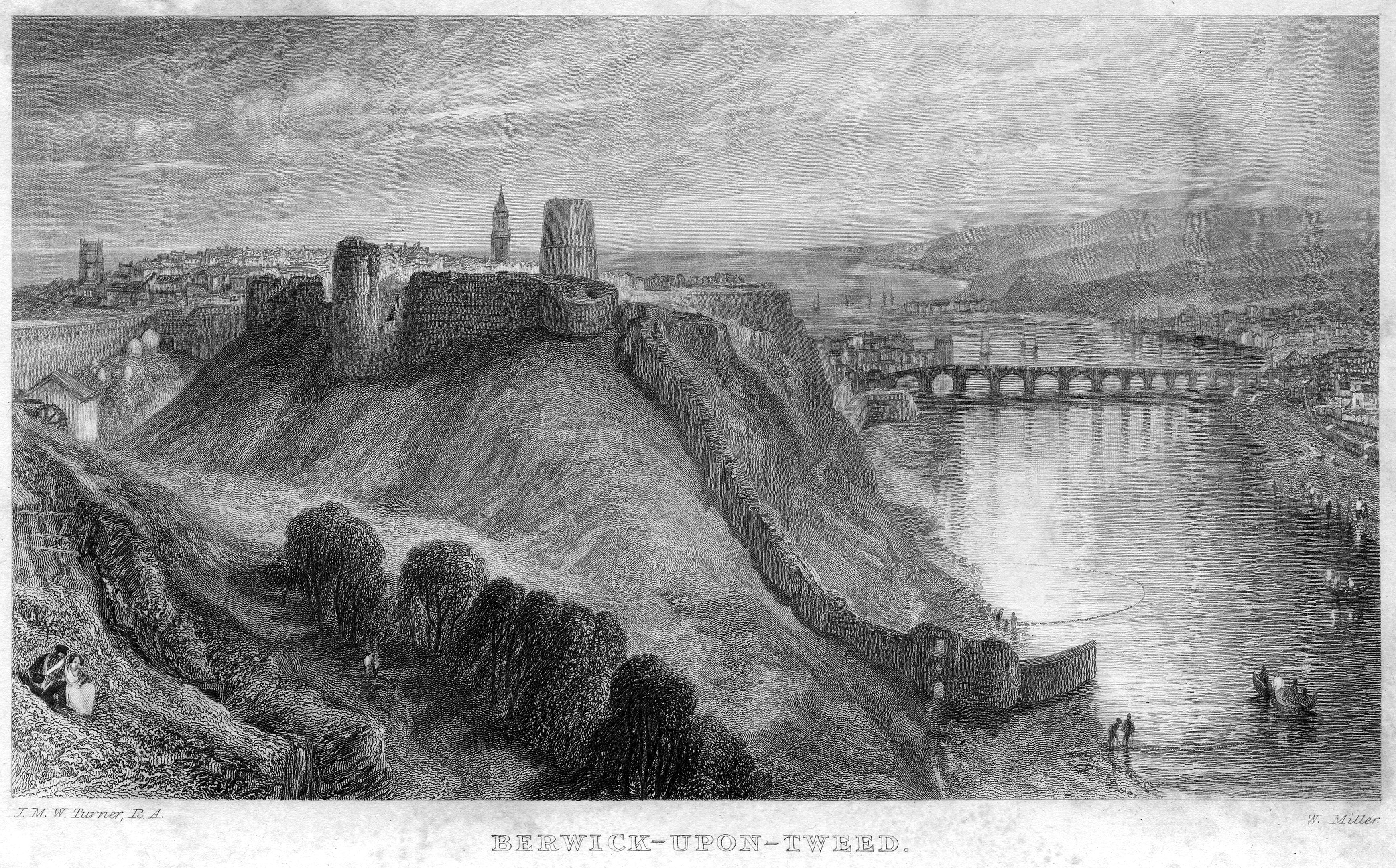
A well and the face of a tower were found that year inside the south wall, and an engraving by William Miller after J. M. W. Turner shows the castle with the bridge of 1624.
The west wall, the Constable Tower and the White Wall are listed at Grade I and stand in state care. The wider site, including the buried early seventeenth-century house and the gun turrets, was scheduled in 1965. Excavation from April 2021 to July 2022, on the old infirmary ground inside Edward I’s town walls, found a wall three metres wide and a ditch twelve metres wide that may be an outer bailey of the castle, together with a road toward Edinburgh and more than 18,000 sherds of medieval pottery.
Images




Detailed History
Berwick Castle is a ruined stone castle at the north-west corner of Berwick-upon-Tweed, in Northumberland, on a steep rise above the estuary of the River Tweed. The town lies about two and a half miles from the present border between England and Scotland. The royal castle occupied the neck of the peninsula, looking over both the town and the river. One description calls the castle a motte and bailey.
The scheduled account describes an enclosure castle, a stone stronghold whose main defence was the circuit of walls and towers, and notes that enclosure castles were sometimes reconstructions of earlier earthwork castles of the motte and bailey type. The first enclosure castles belong to the time of the Norman Conquest, and the type developed in the twelfth century, when experience from the Crusades was applied to their design. Most examples were built in the thirteenth century. Only 126 have been recorded in England.
A castle at Berwick is first mentioned in documents of the twelfth century. One account says it was commissioned by David I of Scotland in the 1120s. Another says a royal castle is first mentioned during his reign and may already have been in place before that. A further account says the castle is first recorded in 1160.
David became king in 1124, when his brother Alexander died. By then Berwick was already an economic hub and a royal burgh. As prince of the Cumbrians he had founded burghs at Roxburgh and at Berwick, settlements with defined bounds and guaranteed trading rights, where the king could collect and sell the products of his dues. In his reign a justiciarship was also created, and justice was done in his core territories, in rough chronological order, at Roxburgh, Scone, Berwick-upon-Tweed, Stirling and Perth.
Most of what can be seen today belongs to a remodelling in the late thirteenth century and later. The lower courses of the Constable Tower are rougher and less regular than the ashlar above them, and are thought to be the base of an earlier twelfth-century tower. A county assessment dates that same polygonal tower to the fourteenth century.
In December 1174 the captive William I, king of Scots, agreed the Treaty of Falaise with Henry II, king of England. During the revolt of 1173 to 1174 William had joined the rebels and was captured at the Battle of Alnwick while invading Northumbria. He was taken to Falaise in Normandy. The written treaty put England’s dominion over Scotland into text for the first time.
Its terms bound the Scottish king, the nobles and the clergy, and their heirs, and they transferred the castles of Roxburgh, Berwick, Jedburgh, Edinburgh and Stirling to English soldiers. The castle’s own history says the English took Berwick Castle in 1175 under those terms. For the next fifteen years William had to observe Henry’s overlordship, even to the point of seeking permission before he put down local risings, and Henry’s authority reached as far as the choice of William’s bride. The treaty was annulled in 1189.
Richard I, Henry’s successor, was intent on the Third Crusade, and William offered 10,000 marks sterling. On 5 December 1189 the Quitclaim of Canterbury nullified the Treaty of Falaise entirely and restored Scottish sovereignty. The castle’s history says Richard I sold the castle back to Scotland around 1190 to fund that crusade.
The Wars of Scottish Independence were two long wars, from 1296 to 1357, in which the kingdom of England tried to take full control of the kingdom of Scotland. English successes did not last. Scotland remained an independent country, and the period became one of the defining passages of its history. The first war, from 1296 to 1328, began with an English invasion and ended with the Treaty of Edinburgh–Northampton.
The second, from 1332 to 1357, began with an English-backed invasion by Edward Balliol and the lords known as the Disinherited, and ended with the Treaty of Berwick, signed at Berwick-upon-Tweed on 3 October 1357. Among the kings of Scots in these wars were Alexander III, John Balliol, Robert the Bruce and David II. William Wallace was Guardian of Scotland from 1297 to 1298. On the English side were Edward I, Edward II and Edward III, and the contested king Edward Balliol.
The longbow emerged in these wars as a principal weapon.
Alexander III died in 1286. His heir was his granddaughter Margaret, the Maid of Norway, then three years old. In 1290 the Guardians of Scotland signed the Treaty of Birgham for her marriage to Edward of Caernarvon, son of Edward I. The Scots required the treaty to say that Scotland stayed separate from England and that its rights, laws, liberties and customs were preserved.
Margaret died shortly after landing in the Orkney Islands, around 26 September 1290. Thirteen rivals then claimed the crown. The two leading competitors were Robert de Brus, fifth Lord of Annandale, grandfather of the future king Robert the Bruce, and John Balliol, Lord of Galloway. The Guardians asked Edward I to come north and judge the claims, for fear of civil war.
He met them at Norham in 1291 and insisted on being recognised as Lord Paramount of Scotland. When they refused, he gave the claimants three weeks, by which time his armies would have arrived. The claimants accepted. Many of them held large estates in England and would have lost those lands if they had defied him.
That reason does not cover churchmen such as Bishop Wishart, who were also involved.
On 11 June 1291, acting as Lord Paramount, Edward ordered every Scottish royal castle to be placed for a time under his control, and every Scottish official to resign and be reappointed by him. Two days later, at Upsettlington, the Guardians and the leading nobles swore allegiance to him. All Scots were to pay him homage, in person or at a named centre, by 27 July 1291. From May to August 1291 there were thirteen meetings at Berwick, the Great Cause, at which the claimants pleaded.
Most claims were rejected. Those left were the men who could show direct descent from David I: Balliol, Bruce, Floris V, count of Holland, and John de Hastings of Abergavenny. In November 1292 representatives of Edward I came to Berwick and, in the great hall of the castle, announced his decision for John Balliol, against Robert the Bruce and the count of Holland.
It was not until 1295 that Edward learned of secret talks between Scotland and France. Early in October he began to strengthen his northern defences. He appointed Robert Bruce, sixth Lord of Annandale, father of the future king, as governor of Carlisle Castle, and he ordered John Balliol to give up the castles and burghs of Berwick, Jedburgh and Roxburgh. In December more than two hundred of his tenants in Newcastle were summoned to form a militia by March 1296.
In February a fleet sailed north to meet his land forces at Newcastle. The war began in earnest with the sack of Berwick in March 1296, then the Scottish defeat at Dunbar and the abdication of John Balliol in July. By August most of the country was subdued. The Stone of Destiny was taken from Scone Abbey to Westminster Abbey, and Edward held a parliament at Berwick at which the Scottish nobles did homage to him as king of England.
The sack of Berwick was the first significant battle of that first war. After seven Scottish earls, those of Buchan, Menteith, Strathearn, Lennox, Ross, Athol and Mar, had raided Carlisle, Edward began the conquest. On 28 March 1296, the Wednesday in Easter week, he crossed the Tweed and spent the night in Scotland at the priory of Coldstream. He reached Berwick on 30 March.
The town was a royal burgh just north of the border, Scotland’s most important trading port, and at that point second only to London in economic weight in medieval Britain. It has been called the Alexandria of the North. Estimates put it among the most populated towns in Scotland. William Edington, a bishop and chancellor of England, said it was so populous and of such commercial importance that it might rightly be called another Alexandria, whose riches were the sea and the water its walls.
It was the most successful trading town in Scotland, and the duty on the wool that passed through it was the Scottish crown’s largest single source of income. The garrison was commanded by William the Hardy, Lord of Douglas. The besieging party was led by Robert de Clifford. Contemporary accounts of the number killed range from 4,000 to 17,000.
Some accounts say the women were spared. The monks of Lanercost say they were not. Much of the town was destroyed, and the burgesses, merchants and artisans were massacred. Douglas surrendered the castle on the agreement that his garrison would be spared, but he himself was imprisoned.
Sir William Douglas is recorded as governor from 1294 to 1296, and as the man who surrendered to Edward I following the massacre.
When Edward I took the town in 1296 he strengthened the castle that was already there. Towers were replaced and others were added. The White Wall was built at this time so that the castle could not be outflanked. It abuts the south-west angle and goes down the slope to the river, where it ended at a large wooden gate.
The wall is 82 metres long and 6 metres high, stepped, with several narrow arrow slits. A steep flight called the Breakneck Stairs was built against its inner side. In the sixteenth century the wall was thickened with more masonry, and a tower was raised on the site of its medieval predecessor at the present edge of the river. That tower has two storeys and three casemates for small cannon.
The first floor has three gun emplacements and the remains of a fireplace. On the east the castle was covered by a deep natural gully full of water. A stone causeway, and at various times wooden drawbridges, led in from a detached tower on the medieval town walls, through the main eastern gateway, which was flanked by two round towers. A county assessment names that detached work as a massive barbican, the Percy Tower or the Douglas Tower, and names the gully as the Gillies Brae, a stream falling steeply to the Tweed and acting as a natural moat between castle and town.
A curtain wall linked the town walls to the castle and crossed the same valley.
The castle as remodelled after 1296 was an outer wall strengthened with towers and turrets. Large lengths of that wall were later levelled and survive as foundations. The west wall and parts of the east wall still stand. The east wall shows four relieving arches, with some modern walling above them.
At its southern end is the south-east angle tower, the Constable Tower. Its upper courses are weathered ashlar with arrow slits, which suggests a late thirteenth-century date, and a garderobe chute is preserved on the west side. At the northern end of this stretch a second tower is partly buried. Six courses show above the raised ground, three faces suggest a polygonal plan, and the lower part of a narrow arrow slit remains.
The west wall is some 75 metres long, up to 6 metres high and up to 4 metres thick, faced with roughly coursed ashlar, with mortices inside for two levels of timber floor joists. At its northern end is the Barmekin Tower, a semi-circular tower whose rubble core stands 12 metres high, with some facing stones still in place. At the southern end of the west wall a semi-circular gun turret of the mid-sixteenth century has two floors. The lower floor keeps part of a vaulted ceiling, and the upper floor keeps the remains of a latrine.
That turret marks the change from high medieval walls and flanking towers to a defence meant for artillery. One listing dates the steep steps down to the river, with the surviving part of the west curtain, to the end of the thirteenth century, and the tower fragments to the sixteenth. Another account calls the wall west of the station the White Walls and says they formed the western curtain, while the precipitous blocking wall, with the Breakneck Stairs, runs down the bank to a mid-sixteenth-century gun tower.
Domestic ranges, now levelled, are known to survive under the ground against the south and west walls. A survey of about 1535 to 1536, the Book of the Circuit and the particular decays of the town and castle, describes the outer walls and places the main hall so that one side of it formed part of the southern curtain, overlooking the river. Howard Colvin, with Brown, gave a profile of the castle based on a Tudor plan. That plan may be the drawing called a true description of the town of Berwick, of about 1580, which shows the whole castle site, with collapsed walling and general decay.
Howard Colvin, born at Sidcup on 15 October 1919 and a fellow of St John’s College, Oxford from 1948 until his death on 27 December 2007, was general editor of the history of the king’s works published between 1963 and 1982. He was knighted in 1995. That history of the king’s works is the account in which James Murray of Kilbaberton, master of the royal building work in Scotland, is placed in the later house on this site.
The English held Berwick from 1296 until the Scots recovered it. After the Battle of Bannockburn in 1314 the Scots had taken back their strongholds except Berwick. In September 1317 Robert the Bruce besieged the town and stayed until November, then withdrew. In February 1316 the Battle of Skaithmuir was fought near Coldstream, on the border.
The English in Berwick were short of supplies once the Scots had recovered the country round the town, and the garrison was facing starvation. Edmond de Caillou, a Gascon knight and governor for the English, took about eighty men out of Berwick to raid Teviotdale for cattle. Sir James Douglas, told that the party was smaller than it was, set out to cut it off. Douglas won, and Caillou was killed.
Douglas later called it the most difficult fight of his long career. The castle’s list of governors names Edmond de Caillou as the Gascon governor killed at the Battle of Skaithmuir in 1316, and names Maurice de Berkeley as English governor about 1314.
In April 1318 Sir James Douglas, Lord of Douglas, took the town and castle from the English. Peter Spalding, an English burgess of the town, married to a cousin of Sir Robert Keith, Great Marischal of Scotland, helped followers of Robert the Bruce to enter. The party, led by Douglas and possibly by the Earl of Dunbar, took the town after a fight. They lost control of their men, who began to plunder, and the castle was warned, so the castle was not taken in that first rush.
King Robert arrived with an army. After an eleven-week siege the garrison capitulated for lack of supplies. The English burgesses were expelled. Robert re-established Berwick as a Scottish trading port and made his son-in-law Walter Stewart keeper.
The capture of the town and then the castle has been described as the completion of King Robert’s realm and kingship. The castle’s history dates the recovery to April 1318.
Robert kept Berwick for the rest of his life. In 1330 Roberto de Lawedre of the Bass, described as custodian or keeper of the marches and of the castle, received, apparently at the end of his employment, thirty-three pounds, six shillings and eight pence, and a similar sum again, from the Scottish exchequer. The governor list gives Sir Robert de Lawedre of the Bass the years 1330 to 1333. England did not accept the settlement of 1328 for long.
The newly crowned Edward III, then fourteen, was nearly captured in the English disaster at Stanhope Park. His regents, Isabella of France and Roger Mortimer, agreed the Treaty of Northampton with Robert Bruce in 1328. In England that treaty was resented. One account calls it the cowards’ peace, and another the shameful peace.
Scots who would not swear fealty to Bruce were disinherited and joined Edward Balliol, son of John Balliol, the king whom Edward I had deposed in 1296.
Five days after landing in Fife, Balliol’s force of some 2,000 men met a Scottish army of 12,000 to 15,000 and crushed it at Dupplin Moor. Much of the nobility died. Balliol was crowned at Scone on 24 September 1332 and almost at once granted Edward III Scottish estates to a value of 2,000 pounds, including the town, castle and county of Berwick. Within six months his support collapsed.
Supporters of David II ambushed him at Annan. He fled to England half-dressed and riding bareback, and asked Edward III for help. At the start of 1333 Edward dropped the pretence of neutrality, recognised Balliol, and prepared for war. Patrick de Dunbar, fifth Earl of March, was governor of Berwick Castle from January to July 1333.
The siege of Berwick in 1333 lasted four months. An advance force opened it in March. Balliol, with the disinherited lords and some English magnates, crossed the border on 10 March, burning and pillaging through Roxburghshire and taking Oxnam. He reached Berwick in late March and cut the town off by land.
Edward’s navy had already cut it off by sea. Balliol and the nobles with him are said to have sworn not to leave until Berwick fell. Edward III arrived with the main army on 9 May and pressed the attack. Sir Archibald Douglas, Guardian for the young David II and brother of James Douglas, had to relieve the town, as a matter of standing, much as Edward II had been drawn to relieve Stirling Castle in 1314.
On 11 July, the last day of a truce associated with Thomas Seton, Douglas entered England, went east to Tweedmouth and destroyed it in sight of the English army. Edward did not move. Sir William Keith, with Sir Alexander Gray and Sir William Prenderguest, led about two hundred Scottish cavalry, forced a way across the ruins of the bridge to the north bank of the Tweed, and entered the town. Douglas treated the town as relieved and told Edward to depart, or the Scottish army would devastate England.
The defenders argued that Keith’s horsemen were the relief required by the truce. Edward ruled that relief had to come directly from Scotland, whereas Keith had approached from the direction of England, so the truce was broken. A gallows was built outside the walls, and Thomas Seton, the highest-ranking hostage, was hanged while his parents watched. Edward ordered that two more hostages should be hanged for each further day the town refused to surrender.
Keith, now in command in place of Seton, made a fresh truce on 15 July.
The English army was estimated at under 10,000, and the Scots at about twice that. Knowing Berwick was near surrender, the Scots attacked at Halidon Hill on 19 July 1333. Halidon Hill is a summit about two miles west of the centre of the town and about 600 feet high. Its name indicates that a fortification once stood on the top.
The Scots came through a marshy hollow and up the north slope as fast as they could while keeping formation, because Dupplin Moor had shown how exposed they were to the longbow. An unnamed contemporary said the arrows fell as thick as motes in a sunbeam. The Lanercost chronicle says the men in front were wounded in the face and blinded, turned their faces from the arrows, and fell. The lower slope was littered with dead and wounded.
When the survivors met the English infantry the fight was short. The Scottish formations collapsed. Camp followers made off with the horses, and the English men-at-arms mounted and pursued for eight miles. The Scottish commander and many of the senior nobility were killed.
Casualties were numbered in thousands. Berwick surrendered on terms the next day. Balliol was put back as king after ceding a large part of his territory to Edward III and agreeing to do homage for the rest. He was deposed again in 1334, restored in 1335 and deposed in 1336.
In 1337 war between France and England gave David II room to recover Scotland. In 1346 the Scots were beaten at Neville’s Cross, David was captured, and eleven years passed before terms for his release included a truce that lasted four decades and closed the second war. The Treaty of Berwick of 3 October 1357 is that close.
The castle, damaged and then repaired in 1333, was occupied by the Scots on several occasions in the fourteenth century and was taken back each time by the English crown. Sir Andrew Murray is listed as governor in 1337. Sir Richard Tempest is listed for 1385 to 1386. Trade through the port was already broken by the long fighting.
An almost unbroken state of war from 1296 until 1346 hit Berwick particularly hard. Until 1296 it had been the leading Scottish seaport. Local merchants had been able to compete with Italian and other foreign merchants in the wool trade. Walter of Goswick is an example from the end of the thirteenth century, and Thomas of Coldingham, merchant and burgess, was active in the first two decades of the fourteenth.
The cathedral priory of Durham underpinned Thomas’s business, which was large beside the merchants of Newcastle. The range of goods moving through Berwick between 1265 and 1350 was wide, and then the war crippled it.
In 1435 Robert Ogle was captain. In peacetime the castle was worth about 194 pounds, with another 200 pounds to be paid in time of war. In 1464 the Scottish exchequer rolls record that Robert Lauder of Edrington was paid 20 pounds for repairs. Robert de Lawedre of Edrington, later of the Bass, is listed from 1461 or 1462 until 1474.
David, Earl of Crawford, is listed from 1474 to 1478. Sir Robert Lauder of the Bass is listed from 1478 to 1482. Sir Patrick Hepburn, first Lord Hailes, was the last Scottish governor, in 1482.
The town and castle had gone back to Scotland in 1461. One account says Queen Margaret gave them. Another says Henry VI gave them. The English invasion of Scotland (1482) gives both: Henry VI and his wife Margaret of Anjou, Lancastrian fugitives, gave Berwick to James, and the town was held by David Lindsay, Earl of Crawford, and Andrew, Lord Gray.
Edward IV later wrote that the town and castle had gone over to the Scots one-and-twenty years before, and before his coronation. The same letter, and a county reading of the siege, say that both town and castle suffered in 1481 and 1482 and that the taking of the town was not immediate, even though Edward also wrote that a small chosen band received the town’s surrender as soon as the army sat down before walls he called impregnable.
The English invasion of Scotland (1482) began from the Treaty of Fotheringhay, signed on 11 June 1482. Alexander Stewart, Duke of Albany, brother of James III, declared himself king of Scots and swore loyalty to Edward IV. Edward had been disappointed by the failure of his 1474 treaty, under which Prince James was to marry Cecily of York. The betrothal of October 1474 carried a truce of forty-five years, to 1519.
Cecily’s dowry was to be paid yearly from 3 February 1475, brought from Norham Castle to the Scottish treasurer at St Giles in Edinburgh, and a meeting was to settle the dispute over a salmon trap, the fish-garth, on the Esk. From February 1475 Edward’s officers delivered instalments of a dowry of 20,000 marks. Border war started again in 1480, perhaps because of the old alliance between Scotland and France. A chronicle says the Earl of Angus attacked Bamburgh and the Earl of Northumberland raided in Scotland.
By October James III had asked Louis XI of France for guns and gunners. Eleven ships were put on a war footing for Scotland in February 1481, and on 8 July 1480 Sir Robert Radcliffe was ordered to arm a fleet. Those ships raided in the Forth in the spring and autumn of 1481, attacking Blackness and harassing shipping. There does not seem to have been a land invasion of Scotland that year, but a Scottish army raided England three times.
Edward prepared an invasion and started north, but he went no further than Nottingham.
In May 1482 Albany landed at Southampton from France in a Scottish ship, the Michael, captained by James Douglas. Edward hired Douglas and the ship on 9 May and on 10 May summoned men for the cause of the man he called king of Scotland. At Fotheringhay, Albany, if he became king, was to reserve to Edward the town of Berwick-upon-Tweed, Lochmaben Castle, and land in Annandale, Liddesdale, Eskdale and Ewesdale. He was to do homage to Edward and break the French alliance.
If he could free himself, in the view of the Church, from other engagements, he was to marry Cecily of York. He had already married Anne de la Tour, daughter of the count of Auvergne and Bouillon, in January. On 11 June he signed as Alexander, king.
Edward had been preparing an army of 20,000 men by sea and land. On 12 June Richard, Duke of Gloucester, was made commander, and on 22 June John Elrington was named war treasurer. Francis Lovell had his orders before 24 June. The army had 2,000 sheaves of arrows and ordnance brought from Newcastle by 120 cart horses, and it assembled at Alnwick.
Gloucester and Albany went forward to take Berwick. Crawford and Gray surrendered the town by negotiation. The castle held out for Scotland. Testimony in a lawsuit of 1501 says Gloucester came to Blackadder Castle and Albany ordered the great house and tower of Blackadder destroyed.
Albany’s supporters helped convey Gloucester from Blackadder to Berwick. The Earl of Northumberland stayed on the border, taking castles and bastle houses and burning farms at places including Kirk Yetholm, Bemersyde, Morebattle, Roxburgh, Jedburgh and Ednam. Gloucester also moved west. The army reached Edinburgh but could not make Albany king.
James III remained in Edinburgh Castle, apparently a prisoner of the lords who had mutinied at Lauder, though he had secretly contracted with the keeper, Lord Darnley, and the garrison for his safety. On 2 August 1482 Albany and Gloucester signed a bond with the Earl of Argyll, Archbishop Scheves, Lord Avandale and the Bishop of Dunkeld, promising Albany a pardon. Albany, his brother’s party and the keepers of the castle were reconciled. The English left Edinburgh with a promise that the town would repay an advance on Cecily’s dowry.
Gloucester left 1,700 men to assault Berwick Castle on 11 August, and the castle was taken after a fortnight’s siege.
The lead of that campaign says the castle surrendered on 24 August 1482, and that Berwick has remained English ever since. The castle’s own history says Richard, Duke of Gloucester, captured it from Patrick Hepburn, first Lord Hailes, in the last week of August 1482. On 25 August Edward IV wrote to Pope Sixtus IV that Richard had spared the citizens of Edinburgh, helped by Albany’s intercession, and that the taking of Berwick was the chief advantage of the expedition. In that letter he writes that the castle was taken on the army’s return, not without slaughter and bloodshed.
The letter is dated before news of a surrender on 24 August, the date given in the chronicles of Raphael Holinshed, John Lesley and Edward Hall, could have reached him. After Gloucester left, Albany looked for supporters, possibly including talks with Queen Margaret of Denmark at Stirling, and then besieged Edinburgh Castle. James III came out on 29 September 1482, but Lord Darnley held the castle until 7 October. On 19 October James wrote that he had been brought from Lauder and held against his will, and that Darnley had kept the castle against Albany on James’s own orders.
On 11 December 1482 James made Albany lieutenant-general of the realm to defend the borders. When James was restored, on 8 January 1483, he rewarded the provost of Edinburgh, Walter Bertrahame, who had underwritten the bond to repay the dowry.
Planned repairs at Berwick Castle in 1483 were entrusted to Alexander Lee, a royal chaplain. The master carpenter of Berwick, George Porter, was ordered to build 120 houses in the town, and chambers, a hall and a lodging in the castle. A council memorandum of that year speaks of the making of the hall within the castle and other chambers there, and estimates at least six score houses in the town, at twenty marks a house. The castle then stayed in English hands.
High walls and flanking towers had been enough against siege engines. Gunpowder artillery in the sixteenth century destroyed the value of that kind of fortification, and it could not be adapted satisfactorily. A new artillery defence, developed in western Europe and first found at Verona, was the bastion: a gun platform projecting from the wall so that the defenders could fire along the ditch and across the face of the wall to either side. The north-east corner of Berwick was especially open to attack.
In 1539 to 1542 a massive circular work, later called Lord’s Mount, was built there. Its walls are nearly six metres, or twenty feet, thick. Henry VIII took a personal interest in the plans, which have since been lost. The lower floor survives, with six casemates for long swivel guns and living rooms, including a kitchen with a well and an oven, and a latrine.
An upper floor, with the captain’s apartments and the crowning parapet, was demolished when the later ramparts were begun. Other works were carried out elsewhere on the walls in Henry’s reign.
On 7 April 1549 John Knox was licensed to work in the Church of England, and his first commission was at Berwick-upon-Tweed. He had to use the Book of Common Prayer issued that year, which kept the shape of the Sarum rite and changed the content to the doctrine of the reformed church. He altered the use of it toward the emphasis of the continental reformers, and his congregation grew. In England he met Margery Bowes, who died about 1560.
Her father was Richard Bowes, who died in 1558, of an old Durham family, and her mother was Elizabeth Aske, an heiress of the Askes of Richmondshire. Elizabeth presumably met Knox while he was employed at Berwick, and several letters show a close friendship. It is not recorded when Knox married Margery. He tried to obtain the consent of the Bowes family.
Her father and her brother Robert Bowes were opposed. The roll of officers at the castle names Sir George Bowes of Streatlam, in County Durham, who died in 1580, as marshal of Berwick, and says that his sister Margery married John Knox. In 1568 George Bowes escorted Mary, Queen of Scots, from Carlisle to Bolton Castle.
In 1558 Mary I sent the engineer Sir Richard Lee to Berwick to replace the medieval walls with a bastioned trace. That year Calais had been lost to the French, who urged the Scots to attack England’s northern outpost. Work went on as fast as it could, and after Mary’s death in 1558 the new line became known as the Elizabethan ramparts. It stopped in 1569, before the upper ramparts had been begun.
By 1560 the northern perimeter had been brought to what was considered a secure height. Lee’s plan, early in 1558, left the northern third of the town, and the castle, outside the new circuit. The new walls enclosed a smaller area than the medieval walls and left the castle isolated some distance outside the town. By 1568, when Mary, Queen of Scots, fled to England, the threat from France and Scotland had subsided.
As it became clear that James VI of Scotland would succeed Elizabeth I as James I of England, no further work was done on the defences for the rest of her reign. The land between the new ramparts and the line of the Edwardian walls was deliberately cleared, so that it would not shelter a bombardment.
William Drury was born at Hawstead in Suffolk on 2 October 1527 and died on 13 October 1579. He was the third son of Sir Robert Drury of Hedgerley. He was educated at Gonville College, Cambridge, was taken prisoner fighting in France in 1544, and in 1549 helped to put down a rising in Devonshire. He sat in parliament for Chipping Wycombe in 1554.
In 1559 he was sent to Edinburgh to report on Scottish politics, and five years later he became marshal and deputy-governor of Berwick-upon-Tweed. The castle’s list places Sir William Drury, marshal of Berwick, before 1564, and places Francis Russell, second Earl of Bedford, as appointed in 1564. From Berwick, Drury watched the house arrest of Mary, Queen of Scots, at Lochleven and wrote constantly to William Cecil. He reported Regent Moray short of money and thinking of pawning or selling Mary’s jewels, the demolition of an artillery fort on Inchkeith in January 1568, and the custom by which border people paid a black rent, or black mail, in the East March.
In February 1568 he wrote that Mary was troubled with a disease in her side and a pain in her arm. In March he reported that English silver was bought with base Scottish coins and reminted at a profit. On 3 April 1568 he wrote of her attempted escape from Lochleven on 25 March, disguised as a laundry woman. She escaped on 2 May, was defeated at Langside, and went to England.
Drury met Moray in the great hall of Stirling on 19 January 1570. Moray was on his way to keep an appointment with Drury at Linlithgow when he was mortally wounded, and it was probably intended that Drury be killed as well. In May 1570 Drury led more than a thousand soldiers into Scotland against Mary’s supporters, toward Glasgow, Hamilton and Craignethan, and came under fire at Dumbarton. In April 1572, as ambassador with Thomas Randolph during the Marian civil war, he stayed at Restalrig.
In May 1573 he commanded the force that compelled Edinburgh Castle to surrender. Regent Morton quarrelled with him and in June asked Margaret Douglas, Countess of Lennox, to use her influence to have Drury removed from his office at Berwick.
The castle was made obsolete by the ramparts and declined through the later sixteenth century. In August 1590 John Selby reported that a round tower, the castle’s only gun emplacement, had collapsed in wet weather. In 1597 the cost of repair was estimated at 200 pounds, and John Carey wrote that the work was necessary because the gap stood wide open toward Scotland. Peregrine Bertie, thirteenth Baron Willoughby de Eresby, governor of Berwick, wrote that the castle was scarcely defended with so good a wall as an ancient monastery’s orchard.
It was patrolled by old veteran soldiers. The surveyor of fortifications recommended that the castle be demolished. In October 1600 Bertie was said to have rebuilt some structures for his own use and pleasure. Halidon Hill, overlooking the town and its fortifications, stayed in view of the governors.
An English army camped there on 27 March 1560 on the way to the siege of Leith. On 15 November 1566 Mary, Queen of Scots, came to the hill to view Berwick and met John Forster, marshal of Berwick. His horse kicked her, and she rested for two days at Dunglass on the way to Edinburgh. In April 1595, and again in April 1597, James VI and Anne of Denmark discussed a progress that would include Halidon Hill.
In 1595 the governor, Henry Carey, first Baron Hunsdon, wondered whether the town should fire a cannon salute. James vetoed the journey.
After the union of the crowns in 1603 the military presence in Berwick was scaled down, and the castle’s military use was largely abandoned. George Home, first Earl of Dunbar, began a house on the site. He was the third son of Sir Alexander Home of Manderston, in Berwickshire, and Janet, daughter of George Home of Spott. At twenty-six he was brought to the court of the sixteen-year-old James VI by Alexander Home, sixth Lord Home.
He went in the voyage to Norway and Denmark to collect the future queen, though not in the king’s own ship. James made him keeper of the royal wardrobe on that voyage. He was knighted on 4 November 1590. On 7 July 1604 he was created Baron Hume of Berwick in the English peerage.
In 1605 he was appointed a knight of the Garter and, on 3 July, Earl of Dunbar in the Scottish peerage. The scheduling account says the new lodgings became the home of Lord Hume, lieutenant of the three Scottish marches, to whom the castle was given in 1604. Documents describe the house as tall and square, with turrets either at the four corners or in the middle of each side, an ornate front, and a long upper gallery facing west.
James Murray of Kilbaberton was involved in the building. The house was never finished, but it was widely rumoured to be magnificent. In 1607 George Chaworth wrote to the Earl of Shrewsbury about reports of its size, its height, its views and its proportions, and said that its long gallery would make the gallery at Worksop Manor, built by Shrewsbury’s father, look like a garret or an attic. That letter is among the papers Edmund Lodge gathered from the Howard, Talbot and Cecil family manuscripts.
Edmund Lodge was born in Poland Street, London, on 13 June 1756, the son of Edmund Lodge, rector of Carshalton, and Mary Garrard. He briefly held a cornet’s commission, which he resigned in 1773. In 1782 he became Bluemantle Pursuivant at the College of Arms, and later Lancaster Herald, Norroy King of Arms, and Clarenceux King of Arms. In 1832 he was appointed a knight of the Hanoverian Guelphic Order, but he was not made a knight bachelor, so he did not take the prefix of a knight.
He married Jane-Anne-Elizabeth Field on 27 April 1808. She died in May 1820. They had no children. He died at his house in Bloomsbury Square on 16 January 1839.
In 1791 he published three volumes of illustrations of British history, biography and manners in the reigns of Henry VIII, Edward VI, Mary, Elizabeth and James I, drawn from those family manuscripts.
William Brereton, who visited Berwick in 1633, said the building work ended at the earl’s death in 1611. A stately platform had been begun, and a long gallery with a mantelpiece five yards long had a flat roof so that people could walk and look at the landscape. Sir Charles Stanhope recorded an anecdote that Dunbar had made 60,000 pounds from the sale of clothes from the wardrobe of Elizabeth I and had spent 20,000 pounds on the house he built on the castle site. A similar story, written down by Symonds D’Ewes on 21 January 1620, says James gave the late queen’s wardrobe to the Earl of Dunbar, who exported it to the Low Countries and sold it for 100,000 pounds.
On 27 September 1603 Home also received the manor and castle of Norham, with its fishing on the Tweed.
Large parts of the castle were reused as masonry in the seventeenth century, including for the parish church of Holy Trinity during the Commonwealth. One account says the castle was partly demolished in 1641. Another says much of the stone and timber was taken in the mid-seventeenth century for Holy Trinity, Berwick’s new parish church. After 1611 the castle was left to decline.
The ruins passed through a sequence of private owners until they became the property of the North British Railway. Large areas were levelled in the mid-nineteenth century for the railway between England and Scotland. One account says the castle was largely cleared in 1843 to build the station. Contemporary newspaper reports during the railway works in 1844 describe the uncovering of masonry, some of it arches and gateways.
The great hall was demolished in 1847 to make way for Berwick-upon-Tweed railway station. When the Royal Border Bridge was under construction in 1847, a well and the face of a large tower were found immediately inside the centre of the south wall. The bridge standing beside the curtain is the Royal Border Bridge of 1850. Masonry from the south wall was built into the station’s retaining wall, rebuilt in the nineteenth century on the line of the castle wall.
In the 1840s the northern, southern and eastern defences were demolished, apart from the Constable Tower, including the bridged causeway to the barbican and the curtain that had linked castle and town. The valley east of the station was levelled for sidings. It is now a tarmac car park. A nineteenth-century engraving of the castle, with the old bridge of 1624 in the background, was made by William Miller after J.
M. W. Turner. J.
M. W. Turner, Joseph Mallord William Turner, was born on 23 April 1775 and died on 19 December 1851. In his lifetime he was known as William Turner.
He began as an architectural draughtsman and watercolourist and became an oil painter, a student at the Royal Academy at fourteen and a Royal Academician at twenty-seven.
The standing ruins in state care are the west wall, the Constable Tower and the curtain next to it, and the White Wall. All of these are listed at Grade I. The fragments, including towers, walls and steps, were first listed on 1 August 1952. The ruins of the Constable Tower were first listed on the same day.
The wall of the castle north of the ruins of the Constable Tower was first listed on 26 May 1971. The wider monument, the enclosure castle with two sixteenth-century gun turrets and the early seventeenth-century house, was scheduled on 12 July 1965 and the scheduling was amended on 7 April 1997. The station platforms, the tracks, the sleepers, the ballast, the overhead-line gantries, the surfaces of the railway yards, Station House and its outbuildings, the outbuildings of Castle Vale that touch the outer face of the south wall, and the surfaces of modern roads, car parks, paths and drives are excluded from the scheduling. The ground beneath them is included.
Buried deposits remain under the parts levelled in the nineteenth century. Taken with the medieval and later walls of the town, the castle is one of the fullest sequences of military building in Britain, from a medieval enclosure, through gun turrets, to the trace of bastions.
From the late 1990s, work at the station and in the car park has shown that substantial structures, including the Percy Tower and the causeway across the Gillies Brae, remain in the ground that was filled in. In August 2002 one trench at the west end of the car park, outside the scheduled area, found substantial mortared masonry across the trench, half a metre below the surface. Later service trenches had cut it to a depth of nine-tenths of a metre without finding its full thickness. The date could not be confirmed.
It is considered to belong with the medieval castle, although a later date cannot be ruled out. A radar survey in 2002 found many features that could be buried foundations. Given the history of the ground since the railway, most are likely to be recent, but some may be remains of the castle. In April and May 2003 twelve evaluation trenches in the station car park found a very substantial sandstone wall, in two of the trenches, that may be the curtain linking the castle’s north-eastern tower, called Gunner’s Tower, to St Mary’s Gate on the medieval town wall, across the Gillies Brae.
The wall lay between half a metre and seven-tenths of a metre below the surface. No further medieval remains were found within the present car park. Probable medieval remains were met at the north-east corner, on the town side of the Gillies Brae.
A separate and larger excavation, from April 2021 to July 2022, was carried out on the site of the old infirmary before a new hospital was built, over an area of more than 7,800 square metres. It is the largest excavation of Berwick in the modern era. Post-excavation work was still going on at the end of 2024, when a fuller publication was still planned. The ground lies within the circuit of the town walls of Edward I.
The dig exposed a previously unknown stretch of those late thirteenth-century defences: a wall three metres wide and a parallel ditch twelve metres wide. These may be an outer bailey of the castle, or another circuit inside the walled town. A track about 120 metres long, one of the main east–west routes connecting the castle with Edinburgh, survived as a slightly curved way six metres wide, with a ditch on each side. It later needed a stone surface.
Burgage plots beside it may have been occupied from the twelfth century or earlier. Some were built over when the new defences were made. The plots had draw wells, five wells in all from the medieval period to the Victorian period, a buried barrel reused as a latrine, and a kiln. The pits and ditches produced evidence of small-scale industry, animal husbandry and butchery, marine fish processing, the malting of grain for beer, leather working, wood working, and the working of horn.
More than thirty horn cores were found in one pit. More than 18,000 sherds of medieval pottery run from the reign of Edward I to the reign of Elizabeth I, dominated by Scottish white gritty ware, with smaller amounts of possibly earlier northern gritty ware. Other finds include brooches, pins, buckles, household utensils, tools, horseshoes and six padlocks. Waterlogged deposits preserved leather, including more than two hundred pieces from offcuts to complete shoes, and possibly textiles.
More than 259 kilograms of animal bone, including bird and fish, were recovered. A jetton minted at Tournai, now in Belgium, belongs to about 1497 to 1521. A decorated knife handle of the late fifteenth or sixteenth century has a hoof-shaped end, a design influenced by Flemish cutlers. Sherds of two anthropomorphic jugs include a Scarborough ware spout of the thirteenth or fourteenth century.
A silver penny of William I of Scotland, minted in 1174 to 1195, comes from the same ground. Seven prehistoric finds, two worked flints, a stone object, three waste flakes and one sherd of pottery, were residual in later layers. Roman pottery, 132 sherds from pits and from medieval or later contexts, may date to the middle of the second century and is treated as regionally important, though it too was residual. When the Elizabethan ramparts were built, the circuit on the north was reduced and this ground, then called the Greens, was left outside the new town.
The earlier settlement there was abandoned.
The ramparts that replaced the castle as the defence of Berwick were modified in the seventeenth century and were kept in order in the eighteenth because of the alarm of the second Jacobite rising in 1745 and 1746. During the wars with Napoleonic France it was proposed to abandon those works that could not serve the defence of the estuary. The end of Berwick as a fortified town is marked in the nineteenth century by the enlargement of Scotsgate, the removal of the Main Guard to the rear of Palace Green, and, in 1837, the opening of a pedestrian way along the ramparts. The Elizabethan walls, faced in grey limestone, stand about six metres, or twenty feet, high, and the earthwork above them rises a further five metres, or sixteen feet.
The ditch outside is now dry. From Meg’s Mount the circuit includes the Cumberland Bastion, largely Elizabethan, with earthworks of 1639 to 1653 above it; Brass Bastion at the north-east corner; Windmill Bastion; and the Powder Magazine of 1749 to 1750. From King’s Mount to Meg’s Mount the Elizabethan line was never finished, and the medieval walls and towers were repaired instead. The Bell Tower, a four-storey octagonal watchtower and bell tower of 1577, stands on medieval foundations among those northern ramparts, beside the eastern half of Northumberland Avenue.
The Main Guard, a Georgian guardhouse moved in 1815 from Marygate to the southern rampart, had a soldiers’ room, an officers’ room, and a cell for drunken soldiers, deserters, petty criminals and vagrants. The castle itself remains the ruined medieval stronghold on the river bank, beside the station, with the White Wall and the Breakneck Stairs descending to the Tweed.
Sources
- Berwick Castle — Wikipedia
- History of Berwick-Upon-Tweed Castle, Main Guard and Ramparts — English Heritage
- Berwick-upon-Tweed Castle and Ramparts — English Heritage
- Enclosure castle, two 16th century gun turrets and an early 17th century house — Historic England
- Berwick Castle (Fragments, Including Towers and Walls and Steps) — Historic England
- Berwick Castle Ruins of the Constable Tower — Historic England
- Wall of Berwick Castle to North of the Ruins of Constable Tower — Historic England
- Berwick Castle, Berwick upon Tweed — Historic England
- Berwick-upon-Tweed extensive urban survey — Northumberland County Council
- Under the infirmary: Revealing the secrets of medieval Berwick — The Past
- Archaeological finds at Berwick-upon-Tweed Infirmary — Ecus
- Wars of Scottish Independence — Wikipedia
- English invasion of Scotland (1482) — Wikipedia
- Sack of Berwick (1296) — Wikipedia
- Siege of Berwick (1318) — Wikipedia
- Siege of Berwick (1333) — Wikipedia
- Battle of Halidon Hill — Wikipedia
- Battle of Skaithmuir — Wikipedia
- Treaty of Falaise — Wikipedia
- John Knox — Wikipedia
- William Drury — Wikipedia
- George Home, 1st Earl of Dunbar — Wikipedia
- Treaty of Berwick (1357) — Wikipedia
- Halidon Hill — Wikipedia
- David I of Scotland — Wikipedia
- Edmund Lodge — Wikipedia
- Howard Colvin — Wikipedia
- J. M. W. Turner — Wikipedia
- Berwick Castle - geograph.org.uk - 768511.jpg — Wikimedia Commons
- Berwick-Upon-Tweed engraving by William Miller after Turner R515.jpg — Wikimedia Commons
- Image-Lindisfarne 470.jpg — Wikimedia Commons
- Curtain Wall Berwick.jpg — Wikimedia Commons
- Berwick Castle - geograph.org.uk - 770903.jpg — Wikimedia Commons
- Berwick castle walls - geograph.org.uk - 1379713.jpg — Wikimedia Commons
- Berwick Castle Walls from the Railway Station Yard - geograph.org.uk - 1471885.jpg — Wikimedia Commons
- Lindisfarne 470.jpg — Wikimedia Commons
- Berwick castle walls.jpg — Wikimedia Commons
- Berwick on Tweed Castle Walls (3777701765).jpg — Wikimedia Commons