
Palace · Fortification
Belfast Castle
mansion in Cavehill country Park, Belfast, Northern Ireland

Low Wood, United Kingdom · 1879 CE · United Kingdom
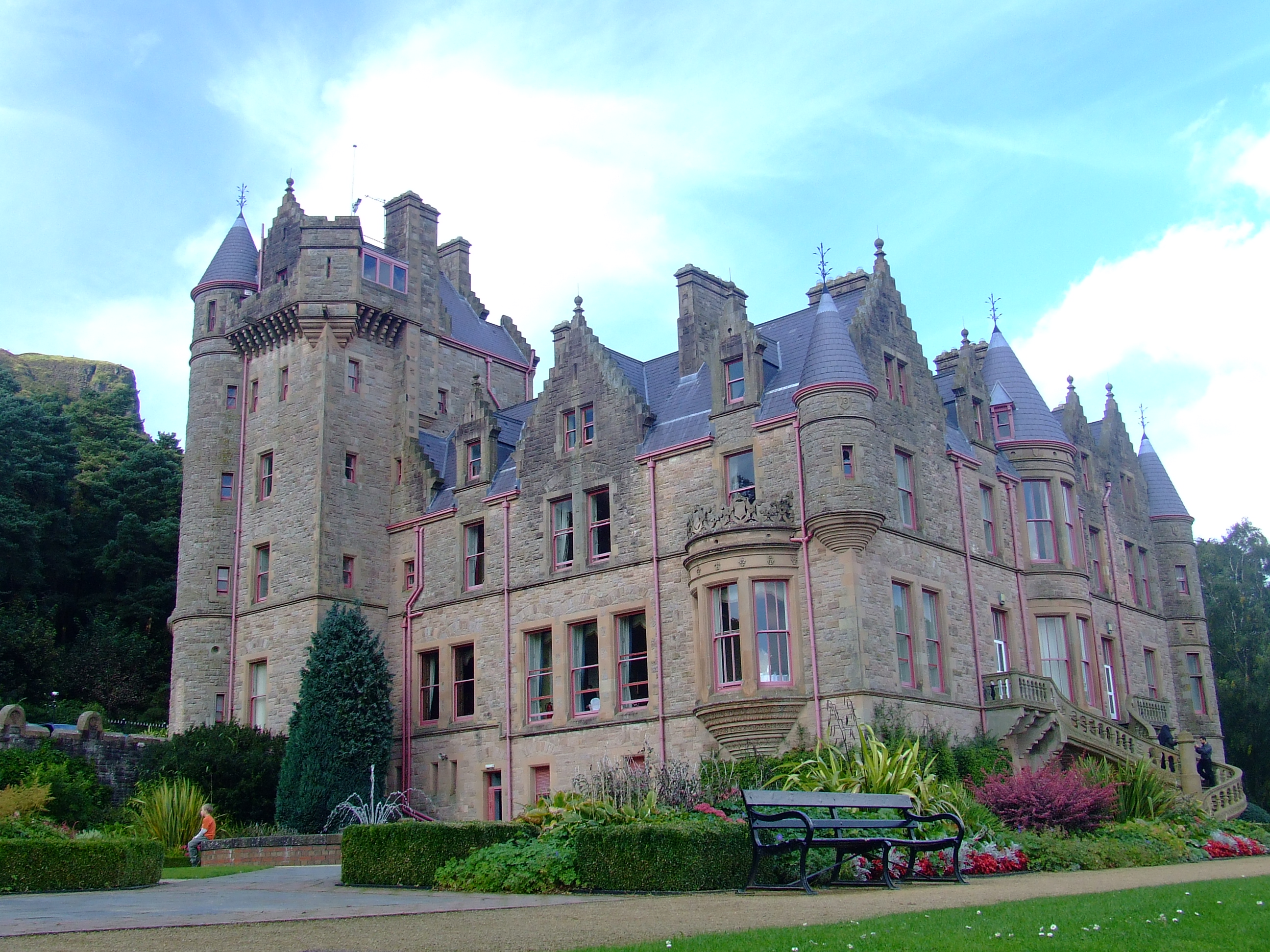
- The present Belfast Castle is a Scots Baronial mansion on the lower slopes of Cave Hill, finished in 1870 for the third Marquess of Donegall.
- Earlier castles of that name stood in the town centre, from a Norman fort by the ford of the Farset to a plantation house that burned in April 1708.
- The house passed to the Shaftesbury family in the 1880s, and the ninth earl gave the castle and estate to Belfast in the 1930s.
- It was listed in 1978, closed for a restoration of more than £2 million, and reopened on 11 November 1988.
- Belfast City Council now keeps it as a free public venue for visitors, weddings, and events, in the old deer park.
Visiting
No admission ticket is required, and Belfast Castle, including the visitor centre, is free to visit. The castle, including reception and the gift shop, is open from 9am to 6pm on Sunday and Monday. From Tuesday to Saturday the castle is open from 9am to 9pm. Opening hours may vary during bank and public holidays, and the venue might be closed to the public for a private event such as a wedding.
The Tavern Coffee Shop is open from 10am to 6pm every day. The Cellar Restaurant is closed on Monday, Tuesday, and Wednesday. On Thursday the Cellar Restaurant is open from 12 noon to 6pm. On Friday and Saturday the Cellar Restaurant is open from 12 noon to 8pm.
On Sunday the Cellar Restaurant is open from 12 noon to 6pm. The Cave Hill Visitor Information Centre is open from 9am to 5.30pm on Sunday and Monday and from 9am to 8.30pm from Tuesday to Saturday.
History
Belfast Castle, as it stands, is a Victorian Scots Baronial country house on the lower slopes of Cave Hill, about 400 feet above the city and Belfast Lough. Earlier buildings of the same name stood in the town centre, by the ford where the Farset met the Lagan, from a Norman fort of the late twelfth or thirteenth century to a plantation house of the early seventeenth. That town-centre castle was burned in April 1708 and was not rebuilt.
The O’Neills of Clandeboye held the medieval castle for much of the fifteenth and sixteenth centuries. It was taken and demolished more than once, including by Henry O’Neill in 1476, by Red Hugh O’Donnell in 1489, and by the earls of Kildare in 1503, 1512, and 1523. English forces fortified it in 1552. In 1574, after a feast, the Earl of Essex’s soldiers killed Sir Brian McPhelim O’Neill’s retainers inside the castle, and Sir Brian was later executed in Dublin.
In 1597, during the Nine Years’ War, the garrison was overwhelmed and then the castle was retaken.
Sir Arthur Chichester was granted the ruined castle in 1603 and built a new house on the same ground in 1611, or in the early 1610s. His family, later the Donegalls, owned the town until the estate was broken up in the early 1850s. The third Marquess, George Chichester, had a new mansion built in the old deer park.
Work is dated from a decision in 1862, an announcement in 1865, and construction between 1867 and 1870, to designs argued among Charles Lanyon, W. H. Lynn, and John Lanyon. Pink Scrabo sandstone and Giffnock dressings were used, and the cost ran past the £11,000 that had been set aside.
His daughter Harriet and her husband, who became the eighth Earl of Shaftesbury, inherited the house in 1883, though one account says 1884 and calls him the seventh earl. Their son, the ninth earl, added the garden stair in 1894 and held the castle until the 1930s. He gave it to Belfast, a gift dated to 1934, to a completed grant on 1 February 1935, and to a public opening on 9 July 1937. The city closed it in 1978, spent more than £2 million on repairs, and reopened it on 11 November 1988.
Entry, including the visitor centre, is free. A maze in the old rose garden was restored by volunteers and opened again in 2023.
Images




Detailed History
The building now called Belfast Castle is a Victorian country house in Scots Baronial dress, standing in Cave Hill Country Park on the lower slopes of Cave Hill, on the County Antrim side of Belfast. It sits about 400 feet, or about 120 metres, above the sea, with a clear view over the city and Belfast Lough. Belfast City Council owns it. It is used as a restaurant, a coffee shop, and a place for weddings, meetings, and public events, and a visitor centre for the hill occupies the basement.
One recent account gives the house more than 100,000 visitors a year. The name is much older than the walls. Every earlier structure called Belfast Castle stood in the middle of the town, not on this hillside. By the 1860s nothing of those earlier castles remained above ground.
The present house was given the old name as a nod to the family that had held the town.
The hill itself is a separate and older landmark. Cave Hill, also written Cavehill, rises to 368 metres, or 1,207 feet. In Irish it is Binn Uamha, and it was earlier Beann Mhadagáin, Madagán’s peak, after a king of Ulaid. One identification is Matudán mac Muiredaig, who died in 856.
Another is a later king, Matudán mac Áeda, who reigned from 937 to 950. The grandson of that later king, Eochaid mac Ardgail, was killed at the battle of Crew Hill in 1004, when the Cenél nEógain defeated the men of Ulster, and McArt’s Fort on the summit takes its name from him. The fort is a ringfort or rath, guarded on one side by a cliff and on the others by a ditch about 10 feet deep and 25 feet wide. Its flat top measures about 150 feet from north to south and about 180 feet from east to west.
A tall cliff is called Napoleon’s Nose, because from many parts of the city the profile is said to look like that emperor. The city account of the castle says the hill is named for five caves. The account of the hill itself describes three large man-made caves, the lowest about 21 feet long, 18 feet wide, and from 7 to 10 feet high, the next about 10 feet long, 7 feet wide, and 6 feet high, and a third, higher and more dangerous, said to be split into two parts. They have been read as old iron workings.
Beside the lowest cave is a steep rocky hollow called the Devil’s Punchbowl or the Devil’s Cauldron, where early farmers are said to have gathered cattle. The rock is Paleocene basalt, over Ulster White Limestone and then Lias clay. Limestone was quarried on the southern flanks in the Victorian years and taken toward the docks on a horse-worked line along the Limestone Road, abandoned in the 1890s. Two small settlements, Daddystown and Mammystown, were built for quarry workers in the early 1820s.
Most of the lower east side of the hill lies on the castle estate. The slopes had been farmland. From the 1880s a large planting made the mixed woodland that now surrounds the house. In the eighteenth century people from the town came up on Easter Monday for a fete near a spring called the Volunteers’ Well.
Belfast takes its name from the Irish Béal Feirste, the mouth of the Farset. Fearsaid means a sandbar or a tidal ford. The Farset met the River Lagan along what is now High Street, and it was culverted in the late eighteenth century. The early settlement grew at that crossing.
The place sat on the border of two Gaelic territories in Ulster, Dál Fiatach to the south and Dál nAraidi to the north. The Irish annals record a battle at the ford in the seventh century between the Ulaid of Dál Fiatach and the Cruthin of Dál nAraidi. Saint George’s church stands on the site of an early chapel used by people crossing the ford. The earliest mention of that Chapel of the Ford is in the papal taxation of 1306.
In 1177, during the Anglo-Norman invasion of Ireland, John de Courcy took land in eastern Ulster that included Belfast and soon founded the Earldom of Ulster. A fort was raised to watch the crossing, and Carrickfergus Castle was begun nearby. One account places a castle at Belfast by the 1220s, probably to guard the ford, and allows that it may have been built in the late twelfth century or the early thirteenth. Another account says the fort was probably a wooden and earthen ringwork or a motte-and-bailey, that the earliest surviving reference is 1262, and that it was most likely ordered by de Courcy or by his successor Hugh de Lacy.
In 1263 the earldom passed to the House of Burgh. The Norman territory was centred on Carrickfergus. The original castle stood on the County Antrim bank of the Lagan, on a strip of ground between the Farset to the north and the Blackstaff, the Owenvara or Abhainn Bheara, to the south. Both rivers joined the Lagan just east of the site.
The ground is the area later bounded by Donegall Place, Castle Place, Cornmarket, and Castle Lane, roughly where Castle Place meets High Street. A small settlement is thought to have grown around the castle by 1333. The castle was attacked, recovered, destroyed, and rebuilt more than once, on the same ground or immediately beside it, between the thirteenth century and the 1550s.
In 1315 Edward Bruce, brother of Robert Bruce, landed at Carrickfergus with an army and took the town. The invasion was meant to pull English forces away from Robert’s war for the Scottish crown. Many Gaelic lords in Ulster welcomed him. Some did homage and gave him the empty title of king of Ireland.
He besieged Belfast Castle that year and later destroyed it. Famine then weakened his army. He was killed at the Battle of Faughart in 1318. In 1333 William Donn de Burgh, the third Earl of Ulster, was murdered, and a civil war broke out among the de Burghs.
Bruce’s invasion and that murder were followed by the loss of English power in this part of Ulster for about three centuries. By the middle of the fourteenth century the ruined castle and its manor had passed to the O’Neills. It became part of Lower, or Northern, Clandeboye, Clann Aodha Buidhe, and it stayed under Gaelic control for more than two hundred years. The annals show the castle slighted and rebuilt from time to time.
A branch of the Uí Néill of the Cenél nEógain, probably at the end of the fourteenth century or the start of the fifteenth, seized it and almost certainly rebuilt it as a Gaelic tower house, either on the Norman site or very near it. Clandeboye was their túath in south Antrim and north Down, and Belfast Castle was one of their principal houses through the fifteenth and sixteenth centuries, with only brief interruptions.
Those interruptions came in a tight span. One count says the castle was taken five times in thirty-six years. In 1476 Éinrí mac Eoghain Ó Néill, Henry O’Neill, king of Tír Eoghain and called in his lifetime the Great O’Neill, attacked the castle, took it, and demolished it. In 1489 Aodh Ruadh Ó Domhnaill, Red Hugh O’Donnell, king of Tír Chonaill, whose chief house was Donegal Castle, invaded Clandeboye, took and demolished the castle of Belfast, and went home with a large spoil.
In the early sixteenth century the Geraldines of Kildare took it three times. Gerald, the eighth Earl of Kildare and Lord Deputy of Ireland, seized the castle and sacked Belfast in 1503 and again in 1512. In 1523 his son Gerald Óg, the ninth earl, who had succeeded as Lord Deputy in September 1513, took it from Aodh Ó Néill, lord of Clandeboye. He wrote to Henry VIII that he had broken a castle of O’Neill’s called Belfast and burned twenty-four miles of his country.
Excavation at Castle Place has found medieval pottery and timbers dated to the sixteenth century, some of the first physical evidence for the medieval occupation of the town. There is no surviving medieval castle, parish church, or town wall standing in Belfast. The street names Castle Place, Castle Street, and Castle Lane are what the town-centre castle left behind.
Henry VIII was king of England from 22 April 1509 until his death on 28 January 1547. He was born at Greenwich on 28 June 1491, the son of Henry VII and Elizabeth of York, and he was succeeded by his son Edward VI. His reign is the one in which the Kildare letter about Belfast was written, and it is the reign in which the Tudor conquest of Ireland began, in the 1540s, a conquest that ran on under Elizabeth I and broke the power of the semi-independent Irish lords. He is also known for six marriages, for the break with Rome, and for making himself Supreme Head of the Church of England.
The castle at the ford was not a house of his, but the Lord Deputy who took it in 1523 reported the fact to him.
During the Tudor conquest, which one account begins in the 1530s, the castle drew more attention from the English government in Dublin. English forces occupied it briefly in 1552, in the reign of Edward VI, and it was possibly rebuilt on the orders of Sir James Croft, then Lord Deputy. Croft put it under Hugh Mac Neil Óg, who was loyal to the Crown. Mac Neil Óg was killed by Scottish raiders in 1555, and the castle was given to Randolphus Lane.
That Randolphus Lane of 1555 is not the later Sir Ralph Lane. Sir James Croft, born about 1518 and buried at Westminster Abbey after his death on 4 September 1590, was an English politician and member for Herefordshire. He was appointed Lord Deputy of Ireland on 23 May 1551. His own life says he effected little in Ireland beyond a reputation for a conciliatory temper.
He was later imprisoned at Mary’s accession for supporting Lady Jane Grey, joined Wyatt’s rebellion, was pardoned, governed Berwick, sat on the commission that tried Mary, Queen of Scots, and died in 1590. The Belfast occupation of 1552 belongs to the start of that Irish office, not to his later years at Elizabeth’s court.
In 1568 papers record talks between Sir Brian mac Feidhlimidh Ó Néill, Brian McPhelim O’Neill, lord of Lower Clandeboye, and the Lord Deputy about a bridge over the ford, after a surrender and regrant of the castle and manor of Belfast. By 1571 he seems to have held the castle jointly with the English. In July 1571 he wrote to Elizabeth I from Belfast and suggested that the Crown keep a small garrison there together with his own men. By the next year he had learned that the queen had approved a plantation of his country, including Belfast.
In 1571, during the Enterprise of Ulster, Elizabeth granted Clandeboye land to Sir Thomas Smith. Smith did not subdue the country as his grant required, and the land later returned to the Crown under James I.
The first Earl of Essex promised Elizabeth that he would conquer parts of Ulster at his own expense. In 1573 he sailed from Liverpool. A storm scattered the convoy, and he spent the winter in Belfast. In October 1574 he and his household were invited to a feast at the castle by Sir Brian, to mark a new peace.
After three days and nights the soldiers with Essex set on Sir Brian’s family and retainers and killed most of them inside the castle. The killing is known as the Clandeboye Massacre, and it is read as Essex’s own order. Sir Brian was not killed in the hall. He, his wife, and his brother were arrested and, later in 1574, executed in Dublin.
Essex then held the castle. English forces occupied it for a few years in that short-lived Enterprise of Ulster. The plantation page for the province records the same private scheme of the 1570s, led by Thomas Smith and by Walter Devereux, the first Earl of Essex, as a failure that sparked a violent conflict in which the Lord Deputy killed many of the kin of the lord of Clandeboye.
The Nine Years’ War ran from May 1593 to 30 March 1603. It was fought between a confederacy of Irish lords, with Spanish support, and the English government in Ireland. It answered the Crown’s advance into land held by the Gaelic nobility, and it belonged to the wider Anglo-Spanish war. Hugh Maguire’s refusal of an English sheriff in Fermanagh in May 1593 is the usual start.
Hugh O’Neill, Earl of Tyrone, and Hugh Roe O’Donnell led the confederacy. They won at Clontibret in 1595 and at the Yellow Ford in 1598, where up to about 2,000 English soldiers were killed and Sir Henry Bagenal died. By 1599 the war covered the island. At its height in 1600 and 1601 more than 18,000 soldiers were serving in the English army in Ireland.
It was the largest and the costliest war England fought in Elizabeth’s reign. Charles Blount, Lord Mountjoy, took the deputy’s office in 1600. A Spanish landing ended in defeat at Kinsale. Tyrone submitted at Mellifont in 1603.
In 1607 he and other northern lords left for the continent in the Flight of the Earls, and the Plantation of Ulster followed. Early writers did not agree on the length of the war. The confederates called it an eleven years’ war. Philip O’Sullivan Beare counted fifteen years from the Armada in 1588.
The familiar nine-year name was coined in the nineteenth century by counting from 1594. One historian has called 1593 and 1594 a proxy war whose scale London did not yet see.
During that war English forces again took Belfast Castle from the Clandeboye O’Neills. In June 1597 Shane McBrian O’Neill, lord of Lower Clandeboye and son of Sir Brian, overpowered the English garrison and killed the prisoners. In July Sir John Chichester marched north, retook the castle, and wrote that his men had done it without loss to themselves and had put those they found inside to the sword. He then placed the castle and the settlement under Sir Ralph Lane, the muster-master.
The castle, the village, and the Lagan valley were devastated in the rebellion. Sir John Chichester, governor of Carrickfergus and a younger brother of the later Baron Chichester, soon quarrelled with the MacDonnells of the Glens, who had been neutral. In November 1597 at Altfrackyn, or Aldfreck, a townland just north of Ballycarry, the MacDonnells killed about 180 of his men. Chichester was killed in or just after the fight, possibly beheaded.
His head is said to have been used as a football. James Sorley MacDonnell, who commanded there, was later poisoned at Dunluce on Robert Cecil’s orders, to placate the dead man’s brother.
Sir Ralph Lane, born about 1532 and dead in October 1603, was an English explorer and soldier. He was sheriff of County Kerry from 1583 to 1585. In 1585 he led the settlers left on Roanoke Island for Sir Walter Raleigh. He quarrelled with Sir Richard Grenville, treated the local people with harsh suspicion, and in June 1586 took Sir Francis Drake’s offer of a passage home when food was short and Grenville’s relief had not come.
His account was printed by Richard Hakluyt in 1589. In January 1592 he was made muster-master general of Ireland, and he was knighted the next year. In 1594 he was badly wounded in the Nine Years’ War and never fully recovered. He died in Dublin in 1603 and was buried in St Patrick’s Cathedral.
The man given command of Belfast Castle in July 1597 was this Ralph Lane, already muster-master, and not Randolphus Lane of 1555. By 1603 the castle, by then probably a Gaelic tower house, was a ruin, largely because of the war.
The Plantation of Ulster was the organised colonisation of the province by people from England and Scotland in the early seventeenth century, under James I. Most of it was on confiscated Irish land, and it was the largest of the Irish plantations. Private planting began in 1606. The official plantation began in 1609, after the Flight of the Earls and after Sir Cahir O’Doherty’s rising at Derry in 1608.
The official scheme covered an estimated half a million acres in Armagh, Cavan, Fermanagh, Tyrone, Donegal, and Londonderry. Antrim, Down, and Monaghan were planted privately, with the king’s support. Arthur Chichester, as Lord Deputy, and John Davies, the attorney-general, helped to plan it. They meant it to control Ulster, to anglicise it, and to plant Protestant English-speaking tenants, mostly from the Scottish Lowlands and the north of England.
The native Irish reaction was generally hostile. The plantation founded many of the province’s towns, left a lasting Protestant community tied to Britain, and took land from much of the Gaelic nobility. It also fed centuries of ethnic and sectarian hostility, visible in the rebellion of 1641 and, much later, in the Troubles. Before it, Ulster was the most Gaelic province, overwhelmingly rural, with a population after the war’s famine and killing guessed at about 180,000 to 200,000, and with a report of 60,000 dead from famine and attacks on civilians.
By 1622 a survey counted 6,402 British adult men on plantation land, and about 4,000 more Scottish adult men in unplanted Antrim and Down. By the 1630s the settler population may have reached about 80,000.
Arthur Chichester, born in May 1563 and dead on 19 February 1625, was the second son of Sir John Chichester of Raleigh in north Devon and of Gertrude Courtenay. He commanded a ship against the Armada in 1588, sailed with Francis Drake in 1595, was knighted after the raid on Cádiz in 1596, and was wounded at the siege of Amiens in 1597. In 1598, after his brother Sir John was killed at Carrickfergus, the Earl of Essex made him governor there. In the Nine Years’ War he used a scorched-earth policy in Ulster.
He wrote to Cecil in 1600 that a million swords would not do the Irish as much harm as one winter’s famine. He carried that policy hard, and he was hated for it. He followed Lord Mountjoy as Lord Deputy from 3 February 1605 until February 1616. He treated Catholicism as a threat, and he ordered the execution of two bishops, among them Conor O’Devany.
After the Flight of the Earls he was a leading planter. He had first wanted a smaller Scottish settlement and more land for Irish owners. O’Doherty’s rising changed that plan, and the native lords lost their land. He did win grants for veterans of the war, with money from the London companies.
In July 1603, while he was still governor of Carrickfergus, he offered to rebuild Belfast Castle if the Crown would grant him Belfast and the lands around it. A king’s letter in August 1603 put him in charge. A patent of 5 November 1603 gave him the castle of Belfast, late in the keeping of Sir Ralph Lane, deceased, in Lower Clandeboye. A further grant followed in May 1604.
He was Lord Deputy from 1605 to 1616, and he was made Baron Chichester in the Irish peerage in 1613. One account dates his new castle to 1611, of stone and timber, on the site of the older fortification. Another says he rebuilt it in brick in the early 1610s, almost certainly on the O’Neill tower, and that he may have kept parts of that tower in the new work. When he was in Ulster he usually lived at Joymount in Carrickfergus, not in the Belfast house.
He brought masons and smiths from Britain and ordered the firing of more than a million bricks. Belfast was still a small village, with one inn, mostly Scots, English, and Manx people in timber houses, marked as insignificant on John Speed’s map of 1610. The 1612 patent still styled it a town or a village. In 1613 it was made a corporation, with a sovereign, twelve burgesses, and the right to send two members to parliament.
The first sovereign was Thomas Vesey. The first members were Sir John Blennerhassett and George Trevillian. Carrickfergus remained the greater port until Thomas Wentworth, in 1640, bought its trade privileges and gave them to Belfast, and the customs house moved. Chichester had only one child, a son who died in infancy in October 1606.
He died of pleurisy in London in February 1625 and was buried at St Nicholas in Carrickfergus. His barony died with him and was revived for his younger brother Edward, who was made Viscount Chichester in 1625. Edward’s son Arthur became the first Earl of Donegall. The head of the family was raised to that earldom in 1647, taking the title from the huge Inishowen estate Chichester had secured for himself after O’Doherty’s rising.
In July 1791 the head of the family became Marquess of Donegall. The Chichesters, later called the Donegalls, owned the town of Belfast from about 1603 until the early 1850s, when the estate was broken up and sold. They were absentee landlords for most of the eighteenth century, living in England, usually in London.
A ground plan drawn by Thomas Phillips in 1685 shows the plantation castle at the top of the town. He drew north at the bottom of the sheet. The house is described as a square Jacobean manor of two or three storeys, with gardens running south as far as the later sites of Donegall Place and Donegall Square. It was the family’s Irish residence for nearly a century.
On 24 April 1708, in one account, and on 25 April 1708 in another, it burned by accident. Three sisters of the fourth Earl of Donegall, and one servant, were killed. The fourth earl lived from 1695 to 1757. The house was never rebuilt.
The family left Belfast. The next head of the family to live in the town was the second Marquess, who settled there in 1802.
George Augustus Chichester, the second Marquess, lived from 1769 to 1844. He moved to Belfast in 1802 to escape mounting debts and took a large terraced house, Donegall House, at the corner of what is now Donegall Place and Donegall Square North, a few hundred yards from the old castle site. Belfast was still a town. It was not a city until November 1888.
He was the first head of the family in almost a century to live there. He also kept a thatched country cottage, Ormeau Cottage, on the Ormeau demesne in Ballynafeigh, on the County Down bank of the Lagan, then on the south-eastern edge of the town. One account puts the move to the cottage in 1807. In the 1820s, or more tightly from 1823 to 1830, he enlarged it into Ormeau House, a Tudor Revival mansion with many chimneys and turrets, designed by the Irish architect William Vitruvius Morrison, son of Sir Richard Morrison.
Ormeau House was 300 feet long and had more than twenty rooms. He sold Donegall House in the early 1820s. In 1824 it became the Royal Hotel. He died at Ormeau in October 1844.
He was Lord Lieutenant of County Donegal from 1831 until his death, though he rarely went there. Debt forced him to sell leases in perpetuity over much of the centre of Belfast to raise £330,000. The third marquess still found the family in debt after 1844.
Before the Victorian house existed, the hill above the town already had a political memory. In May 1795 Theobald Wolfe Tone, waiting in Belfast for a ship into exile, was taken up Cave Hill. One account says that on the cliff he and his companions vowed not to rest until Ireland was free of what he called the British yoke. The hill’s own account says that Tone and Henry Joy McCracken allegedly met there in 1795 to swear an oath toward the rebellion of 1798, and that McCracken was captured on the hill in 1798.
A crowning stone of the O’Neills, called the Giant’s Chair, is said to have stood on the summit until 1896 and to have given its name to the nearby Throne Hospital. The hill has also been thought the shape that suggested the sleeping giant in Jonathan Swift’s Gulliver’s Travels. None of that happened inside the Victorian house, which was not yet built. It belongs to the ground the house was later set on.
George Hamilton Chichester, the third Marquess of Donegall, was born on 10 February 1797 at Great Cumberland Place in London and died on 20 October 1883. He was styled Viscount Chichester until 1799 and Earl of Belfast from 1799 until 1844, when he succeeded his father. He was an Anglo-Irish landowner, courtier, and politician. He was educated at Eton and Christ Church, Oxford, and he served as a captain in the 11th Hussars.
A portrait shows him in that uniform. Unlike his father, he did not spend much of his adult life in Belfast or elsewhere in Ireland. After the army he lived mainly in Britain and was busy at Westminster. In 1818 he was elected to the Commons for Carrickfergus, and two years later for Belfast.
In July 1830 he joined the Privy Council and became Vice-Chamberlain of the Household under the Duke of Wellington. In August he was returned for Antrim. He stayed Vice-Chamberlain when Lord Grey formed a Whig government that November, was made a Knight Grand Cross of the Royal Guelphic Order in 1831, and left the post in 1834. He was again elected for Belfast in 1837, returned as Vice-Chamberlain in 1838 under Lord Melbourne, and resigned when that government fell in 1841.
He then lost Belfast as a Liberal candidate. In 1841 he was created Baron Ennishowen and Carrickfergus in the peerage of the United Kingdom, and he sat in the Lords under that title until he inherited the marquessate in 1844. He was Lord Lieutenant of Antrim from 1841 until his death. From February 1848 until February 1852 he was Captain of the Yeomen of the Guard in the first government of Lord John Russell, the years when the Great Famine was still devastating Ireland.
At his death he was the senior member of the Privy Council. In 1857 he was made a Knight of St Patrick.
The Great Famine, also called the Great Hunger, was a mass starvation and disease in Ireland from 1845 to 1852. Potato blight was the immediate cause. Excess deaths have been put between 775,000 and 1.5 million, with emigration of a million or more. About one million people died and more than one million left, and the population fell by about a fifth to a quarter between 1841 and 1871.
The worst year was 1847, called Black ’47. Longer causes included absentee landlordism and dependence on a single crop. A new Whig ministry in London cut back relief under a laissez-faire doctrine. Food continued to leave Ireland.
The crisis sharpened Irish nationalism and the quarrel with the British government, and it drove evictions. George Chichester, 3rd Marquess of Donegall, held a court post in that Whig government through the later famine years. He was himself a great landowner, with about 23,000 acres, mostly in Donegal and Antrim, and his family had been absentees from Belfast for most of the previous century. The historian F.S.L.
Lyons, born in Derry on 11 November 1923 and later a provost of Trinity College Dublin, wrote Ireland Since the Famine, a standard history of Ireland from the middle of the nineteenth century to the late twentieth. He was critical of Cecil Woodham-Smith’s famine history and is counted among the revisionist historians who reconsidered the role of the British state in the famine. His family, of Presbyterian and Church of Ireland background, lived for a time at Old Park in Belfast. He died in Dublin on 21 September 1983.
The other Belfast historian of this modern span is J. C. Beckett, James Camlin Beckett, born in Belfast on 8 February 1912 and dead on 12 February 1996. He taught at Queen’s University, held a personal chair in Irish history from 1958 until 1975, and wrote The Making of Modern Ireland in 1966 and Belfast: Origins and Growth of an Industrial City in 1967.
A chapter on the Donegalls as lords and landlords of the town was published in a volume he edited on the making of the city. Their working lives cover the decades in which this house was built, inherited, and given away. Neither man built it.
In 1822 Lord Donegall married Lady Harriet Anne Butler, daughter of the first Earl of Glengall. She died in September 1860. They had three children. A son, George Augustus, Viscount Chichester, lived only from 26 May 1826 to 18 June 1827.
Frederick Richard Chichester, Earl of Belfast, was born on 25 November 1827 and died unmarried in Naples on 11 February 1853, aged twenty-five, of scarlatina. The only surviving child was Lady Harriet Augusta Anna Seymourina Chichester, who died on 14 April 1898. In August 1857 she married Anthony Ashley-Cooper, Lord Ashley, later the eighth Earl of Shaftesbury. In 1862, after his first wife’s death, the third marquess married Harriett Graham, widow of Sir Frederick Ashworth and daughter of Sir Bellingham Graham.
There were no children. She died in March 1884. He died in Brighton in October 1883, aged eighty-six, and was buried in Belfast. Because both sons had died before him, the larger part of the estates went to his daughter Harriet, wife of the eighth earl.
The barony of Ennishowen and Carrickfergus died with him. His brother Lord Edward Chichester inherited the other peerages and became the fourth marquess. One city account dates the third marquess’s death to 1884 and says the castle then passed to Lord Ashley as the seventh Earl of Shaftesbury. The family record and the longer castle account put the death on 20 October 1883 and the inheritance with Harriet and her husband, who became the eighth earl, not the seventh.
The seventh Earl of Shaftesbury, Anthony Ashley-Cooper, lived from 28 April 1801 to 1 October 1885. He was a Tory politician and social reformer, called the Poor Man’s Earl, known for limiting child labour, for lunacy law, for education, and for evangelical religion. He was Lord Ashley from 1811 until he inherited in 1851. He was the father of the man who married Harriet Chichester.
He was not the son-in-law who paid for Belfast Castle, and he was not the earl who inherited it. His son, also Lord Ashley, was born in 1831 and died in April 1886. He married Lady Harriet in August 1857. He succeeded his father as eighth earl only in October 1885, and he died about six months later.
The city wording that calls Harriet’s husband the seventh earl collapses the father and the son.
It was only after the third marquess had sold almost all of the Belfast estate, in the 1850s, that he wanted to live there. What remained of that estate was the Ormeau demesne and most of Cave Hill. He found Ormeau House ill constructed, and he wrote that his estate was at a disadvantage for want of a more suitable family residence. Despite constant debt, he decided to build a new mansion in the deer park he still owned, north of the town and then outside the municipal boundary.
One account dates that decision, or the building itself, to 1862, and says the house was designed by Charles Lanyon and finished in 1870. Sir Charles Lanyon, born on 6 January 1813 and dead on 31 May 1889, was an English architect whose work is most closely associated with Belfast. Another account says the proposal was announced in 1865 and then delayed by a legal dispute with a neighbour, because Donegall wanted to build too close to that neighbour’s property. The heritage record says W.
H. Lynn, who had designed a house for the marquess’s sister-in-law in Tipperary, was approached, but that in 1865 Lynn was a partner in Lanyon, Lynn and Lanyon with Sir Charles Lanyon and Sir Charles’s son John, and that the design was John’s. The city account also names John Lanyon and the Scottish baronial style. The longer castle account says the firm was Lanyon, Lynn and Lanyon, that the house is popularly given to Sir Charles, and that some architectural historians give it either to W.
H. Lynn or to John Lanyon. Construction is dated 1867 to 1870, or 1868 to 1870, with the contract given to the local firm of W. B.
McMaster, and the hill account says the late 1860s and the early 1870s. It was finished in 1870. The sum set aside was £11,000. The cost ran well beyond that.
Lord Ashley, the son-in-law, acted as guarantor and paid what was outstanding, which is how the house was finished.
The style had become fashionable in Britain after the rebuilding of Balmoral in Scots Baronial form between 1852 and 1856. The house is an asymmetrical sandstone mansion of three storeys and an attic over a basement, with a taller tower, crow-stepped gables, tourelles, and a rock-faced basalt plinth. The walling is random rubble sandstone with ashlar dressings. The main stone is pink Scrabo sandstone from near Newtownards in north County Down, with Giffnock sandstone dressings brought from Renfrewshire.
Roofs are natural slate. A square tower was compared with the tower at Balmoral and described as rising a full six storeys, while the body of the house is three storeys over a basement. Sir Charles Brett called it a rugged and determined exercise in the fullness of the Scottish Baronial style, on a highly romantic site with a superb view. The entrance front faces west, with a colonnaded portico on Doric columns and a carved tympanum of a shield, animals, and the words INVITU SEQUITUR HONOR.
The Donegall arms were set on the north wall and over the front door in 1868 to 1870. The house was said to contain thirty bedrooms, a salon, a drawing room, a morning room, a dining room, a billiards room, and a servants’ wing. It was first valued at £350. A gate lodge at the Antrim Road entrance and a private chapel were built with it, both from the same office.
The Chapel of the Resurrection was built in the late 1860s, one account says 1865 to 1869, in Decorated Gothic, as a mortuary chapel and mausoleum for the family and specifically as a memorial to Frederick, Earl of Belfast. It stands just off the Antrim Road, and the design is again disputed between W. H. Lynn and John Lanyon.
In 1891 it seems to have become a chapel for regular worship as well as a mausoleum. Harriet, Countess of Shaftesbury, commissioned a white marble group by the Belfast sculptor Patrick McDowell. It shows the young earl dying on a sofa, watched by his mother, Harriet, Marchioness of Donegall, daughter of the first Earl of Glengall. After the chapel closed, the sculpture was moved to the foyer of Belfast City Hall, where it remains.
The ninth earl handed the chapel to the Church of Ireland diocese in 1938. In January 1945 the Diocese of Connor took this part of Belfast. The last service was in 1972. The building was then vandalised for decades, the glass was destroyed, and graves were desecrated.
After nearly fifty years empty it was converted into flats, finished in 2020, in a housing scheme called Donegall Park Gardens, off Innisfayle Park, and it is now called The Chapel.
The gate lodge, designed by John Lanyon and described as a High Victorian Picturesque essay, was built in the late 1860s of uncoursed squared quarry-faced sandstone, honey-coloured with pink ashlar. It stands on the Antrim Road where Strathmore Park now meets the road. The great octagonal carriage piers beside it, and the demesne wall along the road, were demolished in the middle of the twentieth century. The lodge is a dental practice.
Like the chapel, it is no longer inside the modern demesne. The main entrance to the grounds is now where Innisfayle Park meets Downview Park West. The older entrance was on the Antrim Road itself. Gate pillars at the Innisfayle Park entrance, with hounds bearing plaques, are thought more likely to be original, though they may have been moved.
Other octagonal pillars on the avenue are thought to date from improvement works around the 1970s.
In 1870, once the new castle was finished, Ormeau House was demolished. The marquess gave its grounds to Belfast Corporation, and they became Ormeau Park, described as the town’s first public park. In the same years the town around the new house was an industrial city in the making, and a violent one. By 1852 Belfast was Ireland’s first port.
Summer rioting between Catholics and Protestants had become almost yearly. In 1864 the riots were severe enough for reinforcements and two field guns to be sent from Dublin. In the summer of 1872 about 30,000 nationalists demonstrated at Hannahstown for the release of Fenian prisoners, and there were further riots. In June 1886 Protestants marked the defeat of the first Home Rule bill, and seven people were killed in Belfast rioting.
Later that year, after the Twelfth, further clashes left an official toll of thirty-one dead by the middle of September. The new castle stood above that city. It did not stop it, and it was not a fortress in those riots. It was a private house on a deer park.
When the third marquess died, Harriet and her husband inherited the castle and the remaining estates. The eighth earl had only a short time as owner. He died in April 1886. His son Anthony Ashley-Cooper, born on 31 August 1869 and dead on 25 March 1961, became the ninth Earl of Shaftesbury.
One account says he inherited at fifteen. Another says he was sixteen. Of the private owners of the new castle, he held it the longest, until the early 1930s. He was a Unionist and spent much of his youth at the house when he was not in London.
He was Lord Mayor of Belfast in 1907, and one caption extends that mayoralty into 1908. He was Lord Lieutenant of Belfast from 1904 to 1911 and of Antrim from 1911 to 1916. He was chancellor of Queen’s University from 1909 to 1923. The city account says he became chancellor in 1908.
His wife was Constance, Countess of Shaftesbury, who lived from 1875 to 1957. They used the grounds for charity fêtes. In 1907, the year of his mayoralty, a dock strike in Belfast led by Jim Larkin put about 10,000 workers out. The police mutinied rather than break the pickets, and the army was sent to restore order.
It was a rare non-sectarian mobilisation in Ulster at that time. Nothing in the castle record says the mayor personally directed that response. The year is the same year.
In 1894 the ninth earl added the Baroque stone staircase on the garden front, a present to his mother, the dowager countess, who was still living. She died in 1898. The stair is serpentine, in grey-brown stone against the pink sandstone, and a section of the Shaftesbury crest is on it. It was not in the original design.
It links the reception rooms to the garden terraces. One account says the architect is unknown. Another account dates the stair to about 1894 and names John Lanyon as its designer. A later evaluation attributes the 1894 stair to the eighth earl and calls him the son of the third marquess.
That evaluation does not match the dates. The eighth earl had been dead since 1886, and he was the son-in-law, not the son. The ninth earl was the grandson, and he was the owner in 1894. After the alteration the valuation of the castle fell from £350 to £332.
Under the Irish Land Acts of the 1880s, the 1890s, and the early twentieth century, and especially under the Land Purchase Act of 1903, the remaining great estates were broken up and sold, mainly to the tenants who farmed them. The town of Belfast had already been sold by the third marquess in the 1850s. The County Antrim estate and large parts of Inishowen passed to the Shaftesburys in 1883 and were sold off under the ninth earl in the 1890s and in the years before 1914. What remained was the castle and its demesne, and they became harder to keep.
The politics of those years were the fight over Home Rule. At the start of the twentieth century about three quarters of Belfast was Protestant and opposed to Home Rule, while about the same share of Ireland as a whole was Catholic and wanted a parliament in Dublin. From 1910 Edward Carson led the Irish Unionists, and the Ulster Volunteers were raised to resist Home Rule by force if needed. On 28 September 1912, Ulster Day, Carson was the first to sign the Ulster Covenant at Belfast City Hall.
Signatures of men and women who could show they were born in Ulster totalled 471,414. Bonfires were lit across the city, and the largest was seen from Cave Hill. In April 1914 a cargo of about 24,000 rifles and five million rounds, smuggled from Germany, was landed near Larne while a decoy ship drew attention in Belfast Lough. The ninth earl’s Unionism belongs in this climate.
The record does not say that he signed the Covenant or handled the rifles. It does say he was a prominent Unionist, and that he owned the house on the hill from which that bonfire could be seen.
The First World War, also called the Great War, ran from 28 July 1914 to 11 November 1918. It was fought between the Allies and the Central Powers. The assassination of Franz Ferdinand on 28 June 1914 was the immediate spark. Britain entered after Germany invaded Belgium.
On the Western Front the fighting settled into trenches. The dead, including those killed in war crimes and genocides, have been put at 15 to 22 million. In Ireland the approach of the war paused the drift toward civil war over Home Rule. John Redmond told the Commons that the king’s troops could be withdrawn and that nationalists and Ulstermen would join arms.
Edward Carson said that England’s difficulty was not Ulster’s opportunity. The Ulster Volunteers were largely kept together as the 36th (Ulster) Division. By early 1916 at least 210,000 Irishmen had enlisted, and nearly 28,000 of those who went to France did not come back. After the outbreak the ninth earl spent less and less time at Belfast Castle.
Running it was a growing financial burden, especially once the County Antrim estate had been sold. He owned it on into the 1930s, but the private life of the house was ending.
The gift to the city is dated in more than one way. One account says that on 26 July 1934 the earl gave the castle and the estate to the citizens of Belfast. Another says the gift was in January 1934. The heritage record says the ninth earl granted the building and a 200-acre estate to the corporation in 1934, on condition that the corporation buy the site for £10,750 and that the mansion not be used as a hospital or an institution, and that the grant was completed on 1 February 1935.
It also says the corporation altered the interior for public use, joining the dining room and the drawing room into one long ballroom with a maple floor laid over the old floor, fitting kitchens and cloakrooms, enlarging some second-floor rooms, and putting tea rooms in the cellars, which sit at garden level. The Lord Mayor opened the castle to the public on 9 July 1937. One evaluation says the earl gave the castle and the wooded grounds to the city in 1937. The rateable value was set at £300 in the first general revaluation of 1936 to 1957, and by the end of the second revaluation, 1956 to 1972, it had risen to £708.
From 1937 into the 1970s the house was a favourite place for wedding receptions, dances, and afternoon teas. There had been an earlier argument about use. A publicity manager wanted a tea and dance room, or a museum and gallery with refreshment rooms, and he imagined an open-air theatre, clay-pigeon shooting, archery, tennis, bowling, squash, and miniature golf. A sub-committee put the minimum cost at £160,000 before wages and repairs.
That full scheme was not what was built.
After the Second World War, housing of the 1950s and 1960s was laid out on the demesne land along the Antrim Road, including Innisfayle Park, Downview Park West, and Strathmore Park. The demesne shrank. Almost all of the wall along the Antrim Road was taken down, and the chapel and the gate lodge were left stranded among houses. During that war a German bomb fell short in a raid on Belfast and blew a large crater near the castle grounds.
Bomber Command is understood to have been based on Cave Hill in the early years of the war, before it moved to Castle Archdale in County Fermanagh, and the bomb has been read as possibly aimed rather than merely early. On 1 June 1944 an American B-17 crashed into the hill in heavy fog and killed all ten of the crew. The crash site is reached through Carr’s Glen, not through the castle rooms. Since 1945 the house has again been a place for weddings, teas, and similar gatherings.
A bedroom was later dressed in the manner of the 1920s, as a view of the house at the end of its private life.
By the 1970s the fabric was in poor repair. In 1971 the city council decided to sell it to a private buyer. Public protest reversed that decision, and it stayed a public venue. It was listed on 16 February 1978.
The extent of the listing is the castle, including steps, walling, and pillars. The address is Antrim Road, Belfast, in the townland of Low Wood. It was closed in 1978 for a restoration costed at more than £2 million, directed by the Hewitt and Haslam partnership. The work included roof repairs, the removal of defective roof timbers, and the cleaning and repointing of the outside stone.
William Dowling’s firm renewed the interior, replacing all 100 doors and putting new sashes in all 365 windows, one for each day of the year. The house and demesne reopened on 11 November 1988, Armistice Day. Work went on until 1990, when the basement was made into a Victorian streetscape with a restaurant, an antique shop, a bar, and a small exhibition on the natural history of Cave Hill and the history of the castle. A further refurbishment is dated to May 2003.
A survey of 5 June 2014 still found it in use for weddings, conferences, and events. In 2015 the Northern Ireland Hospice held a charity walk from the castle. The building is not a recorded World Heritage inscription. There is no excavation report of the Victorian fabric itself.
The dug evidence for a Belfast castle is at Castle Place, in the town centre, where medieval pottery and sixteenth-century timbers were found. Digs elsewhere in the Belfast Hills, including a cashel in the country park, are not digs of this house.
In the grounds, a millennium maze was planted on the site of the old rose garden and opened for the year 2000, the work carried out by the city council. It later grew unkempt. Over about two years, volunteers of the Cave Hill Conservation Campaign, with help at times from local groups and with the council’s support, cleared overhanging trees, repaired walls and paths, planted fruit trees, and dug out a coloured mural that had been buried. The restored maze was opened by the Lord Mayor, Ryan Murphy, with Cormac Hamill, chair of the campaign, speaking for the volunteers.
That report is dated 31 August 2023. It is a recovery in the garden, not a find from the medieval castle and not a dig under the Victorian foundations.
Entry to the castle, including the visitor centre, is free, and the building may be closed to the public when a private event such as a wedding is booked. Opening hours are published for the castle, the coffee shop, the restaurant, and the visitor centre, and they can change on bank holidays and with the length of the day in the grounds. A self-guided visit, with the centre in the cellar, is reckoned at about an hour. The upper rooms are the event space.
Arthur Cottage is not this castle. It is a house at Cullybackey, in County Antrim, widely reported as the place where William Arthur was raised. William Arthur, born on 5 December 1796 in the Ballymena area and dead on 27 October 1875 at Newtonville, New York, was an Irish-born Baptist minister and abolitionist, and the father of Chester A. Arthur, the twenty-first president of the United States.
In 1963 the Government of Northern Ireland bought the cottage. Terence O’Neill, then minister of finance, meant to give it to the National Trust. The Trust declined, because the link with William Arthur had not been proved. The cottage later became a museum under Ballymena Borough Council.
In 2023 the successor council was asserting, without that old reservation, that Arthur Cottage is the ancestral home of Chester Alan Arthur. The assertion belongs to Cullybackey. It does not move the Victorian house on Cave Hill, and it does not belong to the Chichester or Shaftesbury ownership of Belfast Castle.
Sources
- Belfast Castle — Wikipedia
- History of Belfast — Wikipedia
- Cavehill — Wikipedia
- About us and history — Belfast City Council
- Belfast Castle historic building details — nidirect
- Contact us and opening hours — Belfast City Council
- Visitor information and FAQs — Belfast City Council
- George Chichester, 3rd Marquess of Donegall — Wikipedia
- Arthur Chichester, 1st Baron Chichester — Wikipedia
- Plantation of Ulster — Wikipedia
- Nine Years' War (Ireland) — Wikipedia
- William Arthur — Wikipedia
- F. S. L. Lyons — Wikipedia
- J. C. Beckett — Wikipedia
- Sir James Croft — Wikipedia
- Sir Ralph Lane — Wikipedia
- Henry VIII — Wikipedia
- World War I — Wikipedia
- Great Famine (Ireland) — Wikipedia
- Anthony Ashley-Cooper, 9th Earl of Shaftesbury — Wikipedia
- Anthony Ashley-Cooper, 7th Earl of Shaftesbury — Wikipedia
- Belfast Castle maze restored by volunteers — Belfast Live
- Belfast Castle, August 2011.jpg — Wikimedia Commons
- Belfast Castle, Antrim Road Belfast.jpg — Wikimedia Commons
- Belfast castle.jpg — Wikimedia Commons
- Belfast Castle.JPG — Wikimedia Commons
- DSC01695, Belfast Castle, Belfast, Northern Ireland.jpg — Wikimedia Commons
- Belfastbanner.jpg — Wikimedia Commons
- Belfast Castle - geograph.org.uk - 53182.jpg — Wikimedia Commons
- Belfast Castle - geograph.org.uk - 589077.jpg — Wikimedia Commons
- 'Castle Cat' mosaic, Belfast Castle - geograph.org.uk - 958725.jpg — Wikimedia Commons
- Bronze 'Castle Cat', Belfast Castle - geograph.org.uk - 958727.jpg — Wikimedia Commons