
England, United Kingdom · 1539 CE · United Kingdom
- Barking Abbey was a royal house of nuns beside the River Roding, founded in the seventh century and surrendered in 1539.
- Saint Erkenwald established it for his sister Æthelburh of Barking, and the church was dedicated to Saint Mary.
- The abbess ranked first among the abbesses of England, and under Henry VIII the house was still the third-wealthiest nunnery.
- A flood about 1377 ruined marshland in Dagenham, and Katherine de la Pole later raised Edmund and Jasper Tudor here.
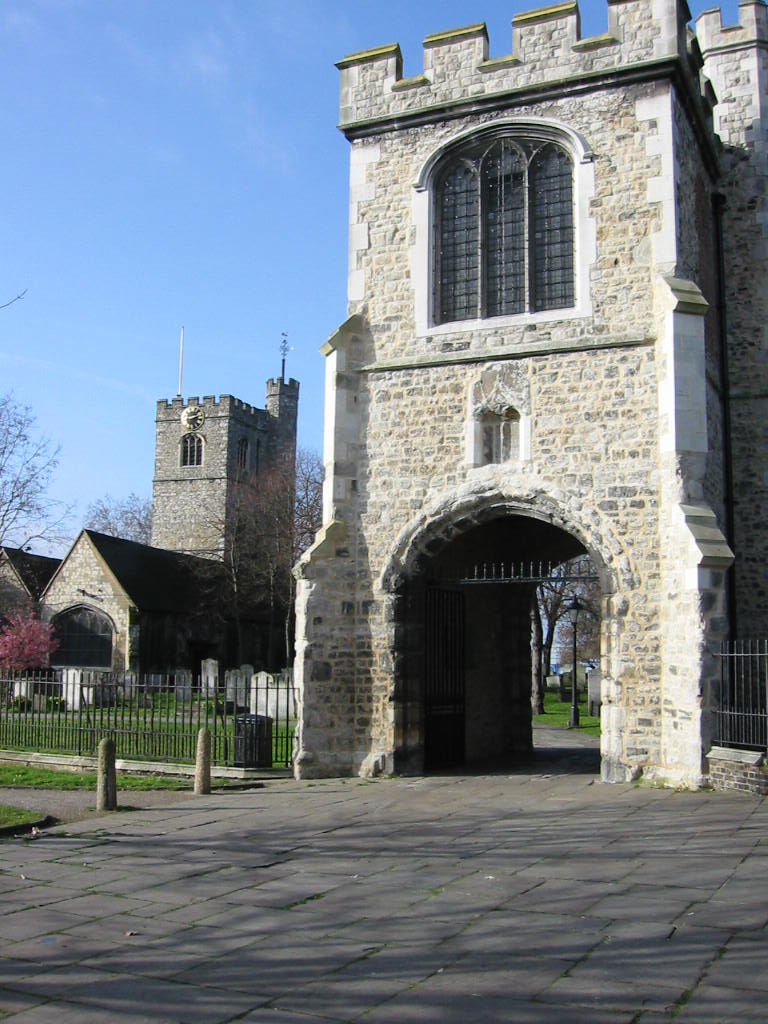
- The Curfew Tower still stands in Abbey Green, and excavation has found a mill dated to 705, gold thread, and a glass furnace.
History
Barking Abbey was a royal monastery on low ground beside the River Roding, in what is now the London Borough of Barking and Dagenham. The church was dedicated to Saint Mary, and later to Saint Mary and Æthelburh of Barking together. Saint Erkenwald founded it for his sister, traditionally in 666, though a plague narrative and early charters have been read as putting the start in 664 or between about 660 and 664. It began as a double house of monks and nuns, built in wood and wattle on reused Roman tile, and after the tenth-century restoration it was a Benedictine nunnery.
Æthelburh of Barking was the first abbess. She founded All Hallows by the Tower, died on 11 October in a year that is not known, and was buried at Barking. Her brother died at the abbey in 693 and was carried to St Paul’s. Danes burned the monastery in 870 or about 871, and the nuns are thought to have fled to their London estate.
King Edgar endowed the refoundation, and Wulfhilda ruled, was removed, and was restored, though the stories disagree about whether the queen or her son brought her back.
William the Conqueror kept Christmas of 1066 at Barking while the White Tower was rising, and there he took the submission of Edwin and Morcar. Abbess Ælfgifu rebuilt the church and had the three sainted abbesses translated into it. The abbess of Barking had precedence over every other abbess in England. Queens and royal daughters held the office, Mary Becket was appointed in 1173 in reparation for her brother’s death, and the nun Clemence wrote a life of Catherine of Alexandria.
In 1291 the temporalities were assessed at £300 13s. 1¼d. A flood about 1377 drowned about seven hundred and twenty acres, most of them in Dagenham marsh, and the house never fully recovered the land. Elizabeth Chaucer entered in 1381, identified either as a daughter of Geoffrey Chaucer or as a near relative. Katherine de la Pole, abbess from 1433 to 1473, brought up Edmund and Jasper Tudor.
The survey of 1535 still ranked Barking third among the nunneries of England.
Henry VIII’s commissioner received the surrender in the chapter house on 14 November 1539. Dorothy Barley and thirty nuns were pensioned, and demolition over the next eighteen months stripped lead for Greenwich and stone for the king’s manor at Dartford. Edward VI granted the site and demesne to Edward Clinton in 1551. The precinct then became a quarry and a farm.
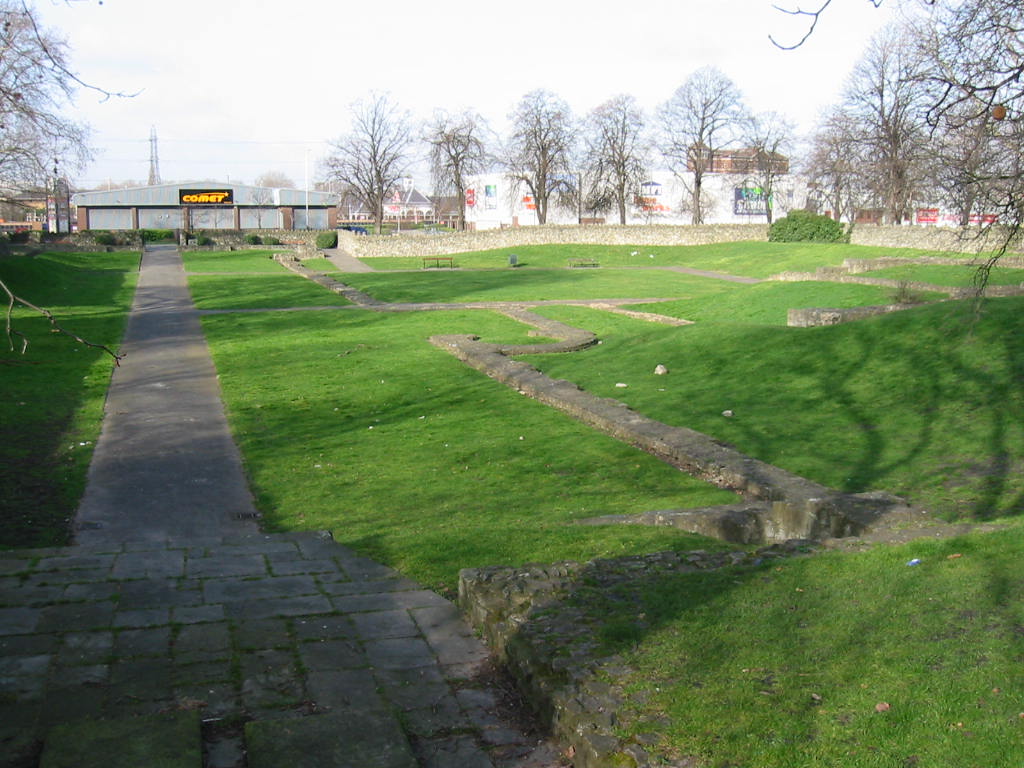
The Fire Bell Gate, also called the Curfew Tower, is the one monastic building still standing, with a twelfth-century rood in the chapel over the entrance. Saint Margaret’s, founded in the precinct, survived as the parish church. Excavation has recovered the medieval plan and, nearer the river, a mill whose timbers date to 705, gold thread, a landing stage, and a glass furnace used between 875 and 975. More recent digging has found reused Roman tile, a carved bone spoon, and a flint core from the end of the last ice.
The ruins lie in the public green called Abbey Green.
Images




Detailed History
Barking Abbey stood on low ground east of the River Roding, in Barking, now in the London Borough of Barking and Dagenham. It was a royal monastery of women for most of its life, and for nearly nine centuries it was one of the great nunneries of England. The church was dedicated first to Saint Mary, the mother of Jesus, who is venerated as a virgin and as the mother of God, and later to Saint Mary and to Æthelburh of Barking together.
The house is often called the first nunnery in England, and one account narrows that claim to the first founded after Augustine’s mission. Another account says it was not the first, because a nunnery at Folkestone is said to have been founded in 630 by King Eadbald of Kent for his daughter Eanswith. Both claims sit beside a foundation that is itself dated in more than one way.
Saint Erkenwald, also spelled Earconwald, founded the house for his sister before he became bishop of London. The traditional year is 666, the date given for his twin foundation at Chertsey. A reading of the plague narrative places Æthelburh of Barking already at the head of the community in 664, and charter evidence has been taken to suggest a start between about 660 and 664. A later legend puts the foundation thirty-three years after Augustine’s arrival and makes the founders the children of a heathen king named Offa of Lindsey.
That story also confuses Æthelburh of Barking with the Kentish princess who married Edwin of Northumbria. It does not fit a bishop who was consecrated in 675 and died in 693.
Saint Erkenwald was bishop of London from 675 until his death, in a diocese that then matched the kingdom of the East Saxons. The see had known bishops in the Roman period and had since become a pagan borderland. He is remembered as a peacemaker between Roman and Celtic Christian practice, and as the patron saint of London, called the light of London. His name joins a word for genuine or precious with a word for rule.
Traditions make him a son of Offa of Essex, of Offa of East Anglia, or of Anna of the East Angles, and one reading of his name suggests Kent. He may have been born in Lindsey, and he may have studied under Mellitus. None of those pedigrees is secure.
At the same time as Barking he founded Chertsey Abbey in Surrey for himself, and he served as its abbot. A charter says that he and Frithwald gave land at Streatham and Tooting to Chertsey, a grant confirmed under Athelstan in 933. During the Danish wars the men’s house at Chertsey was destroyed and ninety monks were killed. King Edgar and Bishop Æthelwold later refounded it.
A legend says Erkenwald preached to woodmen in the forests north of London.
Barking began as a double monastery, with monks and nuns living apart under an abbess. The early buildings were of wood, with walls of wattle and daub and foundations that reused Roman tile. The founders and their relatives are said to have lived in a patron’s house. Fragments of coloured glass, silver coins, and bone combs from the early occupation show a wealthy household.
The main endowment came from East Saxon princes rather than from Erkenwald himself. A founder’s charter printed in later collections is probably spurious. The charter of Hodilred looks genuine and belongs to about 685–687, or perhaps 691–693.
In that charter Hodilred granted and confirmed to Æthelburh of Barking, and to her monastery of Beddanhaam, the places called Ricingahaam, Budinhaam, and Decanhaam, probably Dagenham, together with Angenlabesham and the field in the wood called Widmundesfelt, later Withfield or Wyfield in Barking. Another version of the same grant speaks of forty hides given to enlarge the abbey. An Earconwald charter dated 687 also names her as recipient, but its authenticity is disputed. Not every place in the Hodilred grant has been identified, and Dagenham does not appear among the abbey’s Domesday estates.
Æthelburh of Barking was the first abbess. Early writing calls her upright in life and constantly planning for the needs of her community, and says that no one who knew her ought to doubt her entry into heaven. Around 675, on land given by her brother, she founded All Hallows Barking by the Tower, then called All Hallows Berkyngechirche, in the City of London. The nuns later fled there when the abbey was burned.
Her death day is kept as 11 October. The year is not known. One compiler places the death under 664 and again under 675. If the Hodilred charter is genuine she died after 685.
She was buried at Barking, probably in the nuns’ cemetery, and was later canonised. She eventually shared the dedication of the church with Saint Mary.
During a plague in 664 she is said to have asked where the nuns should be buried. A light brighter than day, like a great sheet, was said to have marked the cemetery. A nun called Tortgyth, or Torchtgyd, saw a figure drawn up to heaven by cords brighter than gold, a few days before the abbess died. Under the next abbess the relics were moved from the cemetery into the church.
A later legend has Æthelburh of Barking raise a storm against a priest who stole a book, and another has her summon a wolf, a bear, and a lion against a Danish raid. Those stories were written down long after her death.
Saint Erkenwald died at the abbey in 693, probably on 30 April, the day given to him in the calendar. He may have been visiting his sister if she was still alive. The canons of his cathedral and the monks of Chertsey are said to have disputed the body with the nuns. The canons prevailed, and he was taken to St Paul’s in London.
He is associated with a very early phase of building there, and one account says he began the cathedral. Centuries later he became the subject of a late fourteenth-century alliterative poem about a preserved pagan judge, a story of salvation outside the Christian community. His cult lasted for more than eight hundred years.
Hildelith, brought from Faremoutiers, taught Æthelburh of Barking and then succeeded her. One account has her in office until about 712. Another places her tenure much earlier, from about 695 to about 700, while a third says she certainly held the abbacy by 709 and lived to an extreme old age. She too was later canonised.
Cuthburga, daughter of Ine of Wessex and wife of Aldfrith of Northumbria, was at Barking under her before becoming head of the rule at Wimborne, before 705. In these years the house was a centre of learning. Around 700 Aldhelm addressed his book on virginity to the nuns of Barking. A long gap follows.
Another Ethelburga, possibly of this house, appears in a charter of her father Offa of Mercia to Chertsey in 787.
The abbey was burned by Danes at the time of King Edmund’s martyrdom in 870, or about 871 in another account. The congregation of virgins was said to have been burned by the pagans, and the buildings were destroyed. The nuns are thought to have fled to their London estate at All Hallows. A writer of the late eleventh century, using the memories of an elderly nun called Wulfruna-Judith, told of the saints’ animal defenders and of an abbess and nuns who barricaded themselves inside until the raiders set the church alight.
Those are legends attached to the raid, not a dated report of who died. The town is said to have fallen within the Danelaw. The English recovery of that territory in the tenth century opened the way for a refoundation.
The new house was for women only, and it followed the Rule of Saint Benedict. Dunstan, archbishop of Canterbury, is credited with settling that rule at Barking. Wulfhilda, or Wulfhildis, a nun who had grown up at Wilton, became abbess about 963, or in 965 in another account. King Edgar, who reigned from 955 to 979, endowed the restored abbey with estates.
One story says he had loved Wulfhilda at Wilton, that she refused him, and that he tried to trap her by having her aunt Wenflaeda, abbess of Wherwell, feign illness. She fled and left her sleeve in his hand. He then made her abbess of Barking and gave considerable estates. She herself gave twenty villages and founded a second monastery at Horton in Kent.
A second story says that Queen Ælfthryth, Edgar’s wife and overseer of the house, deposed Wulfhilda after the nuns complained, and that the queen herself restored her twenty years later. The other version says Ælfthryth deposed her after Edgar’s death, and that their son Æthelred the Unready restored her. One detailed account says the queen-mother ruled as abbess for twenty years until a vision of the first abbess induced her to recall Wulfhilda from Horton. Wulfhilda then lived seven years more and died on 9 September in London, where she had withdrawn with her community because of another invasion.
She too was canonised. The two stories disagree about who sent her away and who brought her back. They agree that she ruled Barking, founded Horton, and was removed and restored.
After the Norman conquest the abbess was Ælfgifu, or Ælfgyva. William the Conqueror stayed at Barking in the latter part of December 1066 and into the new year of 1067, while the White Tower was being built, and he confirmed her in November or December 1066. The charter gave her his peace and love and all his rights within and without the town, as fully as any abbess of Saint Mary had held them in the time of King Edward. At Barking he received the submission of Edwin, earl of Mercia, and Morcar, earl of Northumbria, brothers whose sister Ealdgyth was the widow of the defeated Harold Godwinson.
He was the first of many kings to stay in the abbey. One account names Henry VIII as the last.
Ælfgifu pulled down the old buildings and raised a church said to rival the greatest in the country. She met resistance from Bishop Maurice and, in a story written for her, the first abbess appeared to the steward and approved the work. Around 1087 she commissioned Goscelin of Saint-Bertin to write lives and miracles of Æthelburh of Barking, Hildelith, and Wulfhilda. The three saints were translated into the new church and buried under the choir.
In 1086 the abbey’s lands were set down in the Domesday survey. Besides its Essex estates it held Tyburn in Middlesex, Slapton in Buckinghamshire, Lidlington in Bedfordshire, and land at Weston in Thames Ditton and in Wallington hundred in Surrey.
Queens were closely tied to the house in the next century. Maud, wife of Henry I, built two stone bridges and a causeway over the branches of the River Lea at Stratford-by-Bow, and she gave Barking, then the nearest monastery, lands to maintain them. After Gilbert de Montfitchet founded Stratford Langthorne Abbey in 1135, closer to the bridges, an abbess of Barking transferred both the lands and the duty. The dispute lasted until 1315.
The abbess then paid the abbot two hundred pounds, and he undertook the bridges and causeway and a rent of four marks a year. Stephen later granted custody of Barking to his own queen Maud, as her aunt, Henry I’s queen, had held it. The grant reads as a temporary holding of the office rather than a permanent election. Henry I also appointed an abbess named Agnes by charter.
Stephen appointed Adeliza, sister of Payn Fitz John. He confirmed the abbey’s possessions and liberties, restored lands that Henry I had afforested, and granted the hundreds of Becontree and Barstable, offering the second grant in person at the high altar. Adeliza founded the hospital of Saint Mary and Saint Thomas of Canterbury at Ilford in 1145, first a hospice for aged and infirm men and later a house for lepers, and she funded its upkeep. Henry II confirmed the liberties.
She probably died in 1173. About 1156 Osbert of Clare wrote to her, then abbess, asking the nuns to pray for him. One modern reading finds in that letter a special devotion at Barking to Martha, the sister of Mary of Bethany and Lazarus.
In 1173 Mary, sister of Thomas Becket, archbishop of Canterbury, was made abbess in reparation for her brother’s murder. Her tenure was short if the next appointment is correctly dated. About 1175 Henry II appointed his daughter Maud, who occurs in 1198. Her brother Richard I released a rent formerly paid for Becontree hundred.
King John later appointed his own daughter Maud, elected in 1247, who died in 1252. The office was a place for royal women, for the kin of great barons, and for women of high education in scripture, law, history, and grammar.
The twelfth century also left a rare woman’s voice in writing. Clemence, a nun of Barking, wrote an innovative life of Catherine of Alexandria, a saint tied to women’s learning, among other works. The house has been called perhaps the longest-lived institutional centre of literary culture for women in Britain. In the early thirteenth century the east end was enlarged into a saints’ chapel, where the relics of Æthelburh of Barking, Hildelith, and Wulfhilda were given greater prominence.
About 1200 the east end of the presbytery was taken down and the saints’ chapel and a lady chapel were built. Abbess Mabel of Bosham, in office from 1215 to 1247, rededicated the church.
Until 1214 the king chose the abbesses of this royal foundation. In that year John, under pressure from the pope, granted English churches the right of free election. Barking was one of the first houses to use it. The abbey was vacant at the start of 1215 on the death of Christiana de Valoines.
In January the king asked the nuns to elect Sarah de Walebar. They did not. He then told the bishop of Winchester to press for the aunt of Robert de Ros, or failing her the sister of John de Bassingbourn, prioress of Elleschirch, or last the prioress, and on no account the sister of Robert Fitzwalter, leader of the barons. The prioress Sybil was elected.
The king assented on 24 June and restored the temporalities. She soon stepped aside, and Mabel of Bosham received the temporalities on 31 August. The free election and the royal pressure happened together.
The crown later claimed a nun at each accession and, in time, a corrody at each new abbess. Alice de Belhus was nominated in 1307, when Edward II became king. Margaret Swynford, daughter of Katherine Swynford and later abbess herself, was nominated in 1377, at the accession of Richard II. Maud Kylet followed in 1404, five years after Henry IV, and Goda Hampton, also called Hapton, in 1430, eight years after Henry VI.
In 1253 the abbess was excused from being charged with converts or others because she had already granted food and clothing for life to Philippa of Reading and her daughter, an early sign of the corrody claim.
The abbess had precedence over every other abbess in England. She was also named among four abbesses who, holding of the king by barony, were summoned with bishops and abbots to military service under Henry III and Edward I. The other three were Shaftesbury, Wilton, and Winchester. When service was demanded in her case, she answered that she held in free alms.
She did have thirty tenants bound to escort her on horseback and to pay five pounds in relief. The two accounts, barony and free alms, both stand. Under her, the prioress was the chief officer and the high cellaress the second. There were also a kitchener, an under-cellaress, two chantresses, two sub-prioresses, and two fratresses.
A customary of the cellaress sets out her rents, her duties, and the food and money for the nuns at ordinary times and at feasts. Thirty-seven ladies were to be provided for, some of them with a double share. The prioress, the high cellaress, and the kitchener were always among the doubles.
In the tax assessment of 1291 the temporalities came to £300 13s. 1¼d. Just over a third, £104 8s. 4d., came from the parish of Barking. The rest included about £30 from Ingatestone, £22 from Wigborough, £21 from Tollesbury, £19 from Hockley, £17 from Lidlington, £16 from Mucking, £16 from Bulphan, £15 from Slapton, £9 from Warley, and £8 from Abbess Roding, with smaller sums from more than a dozen other places, among them Stanwell, Thames Ditton, and Fulbourn. The churches of Barking, Dagenham, and Horndon on the Hill were already appropriated.
Mucking followed in 1315, with a vicarage ordained. Tollesbury was appropriated in 1355, Hockley in 1382, All Hallows by the Tower in 1385, and Lidlington in 1410. The abbey also held the advowsons of Bulphan, Ingatestone, Abbess Roding, Warley, Wigborough, and Slapton.
The abbess was lord of the manor. Her court, held in the abbey, transferred land and dealt with roads and bridges. She regulated the market and its weights and measures. She maintained the town quay, dredged the Roding, and kept miles of Thames walls that protected the grazing marshes.
She controlled the water mill on the Roding. Grain in the manor had to pass through that mill, even if it might otherwise have been ground by hand. Archaeologists have found the remains of two pillories on the site, described as the earliest known in Europe, used for minor offences.
In the forest she had hunting rights that grew over time. In 1221 she was licensed to take estovers and to hunt hares and foxes in her wood of Hainault. In 1290 she received free warren in Lidlington and Hockley. An inquisition of 1324 found that the abbess and convent had always had free chase, within the forest and without, to take hares and other vermin, and free warren in their demesne.
Two carts, each with one horse and one man, carried firewood through the year except in the fence month, without view of the foresters. Timber and fuel for the abbey and its manors came by view and livery. Outside the regard, at Barking, Warley, Ingatestone, Roding, Tollesbury, and Wigborough, they took what the house needed, though the king’s foresters still entered to keep the venison. In 1338 Edward III granted freedom from forest pleas and full power to fell and carry wood.
In 1489 she still had free chase in the bailiwick of Hainault for beasts of the forest in season, except the great game, and free chase for hares, rabbits, fox, badger, cat, and other vermin.
In 1279, after the bishop of London had visited and issued injunctions, Archbishop Peckham confirmed them and added his own. Matins were to be said at midnight and compline every day, fully, not cut short. The place for the mass of the Blessed Virgin was to keep the nuns apart from other worshippers. On Innocents’ Day the mystery was to be played by the nuns themselves, not by children, and outsiders were to be excluded.
The nuns were to receive communion on the chief feasts and on the anniversaries of their profession. Priests were not to carry drink through the cloister after a funeral. The host was not to be kept in a priest’s cubicle but in an oratory they could always reach. Gates were to be locked at sunset.
Two nuns above suspicion were to see to it. The abbess was not to linger in her chamber at sunset except for guests or urgent business, and she was to dine with the convent when she could, especially on festivals. No man was to enter the nuns’ rooms except a doctor, a confessor, or a father or brother in illness, or workmen for work women could not do. Confession was to be public in the sense of a public place, and no nun was to speak alone with a man otherwise.
Sisters were not to go out except for a grave cause, such as a dying parent, and never alone. Anyone disobedient three times was to be presented to the bishop.
The patronal feasts brought their own trouble. In 1308 the bishop ordered the suppression of tumultuous assemblies and the defilement of churches in the conventual and parish churches of Barking, and in neighbouring churches, on Sundays and holidays near the feasts of Margaret and Ethelburga. Sir John de Massingberd broke that order. After an inquisition the bishop admonished him on 8 August 1311.
Edward II, king from 1307 until he was deposed in January 1327, is the reign in which the abbey was used as a prison for royal and noble women. He was the fourth son of Edward I and Eleanor of Castile, born at Caernarfon on 25 April 1284, and he succeeded after the death of his elder brother. He had campaigned in Scotland with his father, was knighted at Westminster in 1306, and in 1308 married Isabella, daughter of Philip IV of France. His favourite Piers Gaveston was exiled, recalled, and in 1312 seized and executed by barons led by Thomas of Lancaster.
The Ordinances of 1311 tried to bind the king. In Scotland, Robert the Bruce defeated him at Bannockburn in 1314. Famine and criticism followed.
Elizabeth de Burgh, queen of Scots, had been captured by the English in 1306. She was confined at Barking from March 1313 to March 1314, in the months before that defeat.
A second confinement belongs to the Despenser years. Hugh Despenser the Younger became Edward II’s close adviser. In 1321 Lancaster and other barons seized the Despenser lands and forced an exile. Edward fought back, captured and executed Lancaster, revoked the ordinances, and confiscated estates.
In 1322 a noblewoman was held in the abbey so that she would surrender Welsh estates to Hugh Despenser the Younger. One account names her Elizabeth de Clare. Another names her Eleanor de Burgh. Valuable goods were taken from her and later recovered.
In 1319, still under Edward II, the abbess had licence to fell three hundred oaks in Hainault because her manor house of Loxfordbury had burned and the church and other abbey buildings were ruinous. Edward II later lost his crown to his son Edward III after Isabella and Roger Mortimer invaded in 1326. He died at Berkeley Castle on 21 September 1327, probably killed on the orders of the new regime.
About 1377 a flood destroyed a large part of the abbey’s lands along the Thames, about seven hundred and twenty acres, six hundred of them in Dagenham marsh and a further one hundred and twenty sown with wheat in another marsh. The cost of the dykes impoverished the house, and the land was not fully recovered. In 1380 the king released the convent from repairing about a mile and a half of the enclosure of Havering park, if they repaired twenty-seven perches at once and paid five marks a year. In 1382, when they appropriated Hockley, their income was said to have fallen to four hundred marks.
In 1384 they were allowed to impress labourers for Barking marsh, which was close to being lost. At the vacancy of 1393 the temporalities were remitted because of the losses. Liberties in Becontree hundred were granted in 1392 and again in 1462. In 1409 they were excused tenths for ten years, the tenths not to exceed fifty pounds a year, after spending more than two thousand pounds to save the lands.
In 1410, when Lidlington was appropriated, it was said that no nun had more than fourteen shillings a year for habit and clothing from the original foundation. Under Henry VII the flooded lands were exempted from the statute that extended the mayor of London’s jurisdiction as conservator of the Thames. The marsh, on that evidence, was never fully won back.
In 1381 Elizabeth Chaucer became a nun at Barking. John of Gaunt paid £51 8s. 2d. for expenses and gifts at her admission. One account identifies her as the daughter of the poet Geoffrey Chaucer and of Philippa de Roet. Another, noting the same payment and Gaunt’s known link with the poet, allows that she may have been a sister or other near relative rather than a daughter.
Geoffrey Chaucer, born in London in the early 1340s and dead on 25 October 1400, was a poet, a civil servant, a diplomat, and a member of parliament for Kent. He is buried in Westminster Abbey, in what became Poets’ Corner. His father John was a London vintner. As a youth Geoffrey Chaucer served in the household of Elizabeth de Burgh, countess of Ulster, wife of Lionel of Antwerp, and so entered the court of Edward III.
He wrote The Canterbury Tales and other poems in English at a time when literary English still stood beside French and Latin. Philippa’s sister was Katherine Swynford, who became Gaunt’s wife. Their daughter Margaret Swynford entered Barking by royal nomination in 1377 and was abbess from 1419 until her death in 1433. Elizabeth’s brother Thomas Chaucer rose in Gaunt’s service, and Thomas’s daughter became duchess of Suffolk.
By 1404 Barking had a librarian, one of only three monasteries in Britain then recorded with one. Fifteenth-century books from the house survive, including a hymnal and an ordinale and customary. The customary contains a calendar, directions for rites, and commemorations of the three sainted abbesses. On Ascension Day 1397 Bishop Braybrooke received the professions of fourteen nuns.
On 17 May 1410 Bishop Clifford held an ordination in the conventual church with seventy-seven candidates. Dame Joan de Felton, mother of Abbess Sybil de Felton, had licence in 1398 to grant land in London, Barking, and Dagenham. She founded a chantry of one chaplain at the tomb of the first abbess, for the good estate of Sybil, then abbess, and of named kin and benefactors.
The Fire Bell Gate, also called the Curfew Tower, is the one monastic building still standing. It was one of three gateways. One account gives an original tower of 1370 and a rebuilding around 1460. Another places the oratory, called the Rood Loft on the cemetery wall, towards the end of the fourteenth century.
On 22 March 1400 Pope Boniface IX allowed mass and the offices in the oratory, where a cross was kept and crowds came. Three days later he granted a relaxation of penance to penitents who visited at certain times. Above the gate is the chapel of the Holy Rood, named for a twelfth-century stone rood that is still there. The tower was repaired in 1955 and 1956, when the chapel was redecorated and the windows repaired, and again in 2005 and 2006 at a cost of £130,000, with new roof coverings, repointing, and replacement of stone that could not be saved.
It appears on the coat of arms of the borough. The smaller North Gate, or North Street Gate, survived the dissolution and was demolished around 1885.
Katherine de la Pole was abbess from January 1433 until her death in 1473. She was born about 1410 or 1411, the eldest daughter of Michael de la Pole, earl of Suffolk, and of Katherine de Stafford. One account numbers her father as the second earl. Another calls him the third earl, killed at Agincourt in 1415, and says she was four when he died.
Between 1437 and 1440 she had the care of Edmund and Jasper Tudor, the sons of Owen Tudor and of Catherine of Valois, widow of Henry V and mother of Henry VI. The council of Henry VI sent the boys to be brought up in her custody. An allowance of £52 12s. was paid for them, and her petition in 1440 said that sum was then due. She persuaded Henry VI to take an interest in his half-brothers.
He later ennobled them. Edmund’s son, by Margaret Beaufort, was Henry Tudor, who took the crown as Henry VII after Bosworth in 1485. Margaret Beaufort had been a ward of Katherine’s brother William de la Pole, steward of the household. Katherine died at Barking and is presumed to have been buried there.
Two disputes mark her later years. In 1453 a priest, Robert Colynson, took five pounds to go to Rome and say prayers for the nuns, and did not go. In 1462 John Rigby of Cranbrook, who had married Joan Malmayns, whose family were lords of Cranbrook, broke the pipes of the conduit from Cranbrook to the abbey. The repairs he had made became a demand for rent.
One account says the rent he wanted was twenty-four shillings a year. The abbess refused to depend on him and led a search for a spring on the abbey’s own land, then made a new watercourse. A register of her time also allowed the parishioners to hang a new bell over the rood chapel, in place of one said to be defective, without their interfering in the roof. In 1450 there was a fight at the churchyard gate with Robert Osbern, a clerk of the signet, who leased a house and garden from the abbey.
The abbess said she was thrown down in a scuffle over the lock and key. The quarrel was probably fed by her servants hunting on his land, where the king had given him warren. A commission of 26 February inquired. The result is not known.
The abbesses after Katherine de la Pole were Elizabeth Lexham, elected in 1473 and dead in 1479, and Elizabeth Shuldham, elected in 1479 and dead in 1499. Elizabeth Grene, the prioress, was elected in 1499 by the cellaress Margaret Shuldham announcing a unanimous choice, and she died in 1527. In March 1508 Bishop Fitzjames visited and issued injunctions about a clash between the feast of the Visitation of Saint Mary and the octave of Peter and Paul, and about keeping the translation of Æthelburh of Barking, Hildelith, and Wulfhilda as a double feast. Dorothy Barley, the last abbess, was elected on 20 December 1527 by way of inspiration.
Thomasina Jenney presided as prioress, with Elizabeth Strangman as sub-prioress, Anne Scrope as cellaress, and Margaret Scrope as first chantress, among the voters.
Henry VIII, born at Greenwich on 28 June 1491, was king from 22 April 1509 until his death on 28 January 1547. He was the second son of Henry VII and Elizabeth of York, and he inherited as a youth after his brother Arthur died. His break with Rome followed the refusal of Pope Clement VII to annul his marriage to Catherine of Aragon. In 1533 Thomas Cranmer, archbishop of Canterbury, declared that marriage void.
Henry was excommunicated, and the Acts of Supremacy made him supreme head of the Church of England. He then dissolved the monasteries and took their wealth. Barking, still rich and well connected, lasted longer than many houses. One account says it survived because the king’s representative was a close friend of Dorothy Barley.
In September 1535 the chancellor Audley asked Thomas Cromwell to postpone the visitation so that he might speak about the house. Neither the aim nor the result of that request is known.
The survey of 1535 put the gross income at £1,084 6s. 2¼d. and the net at £862 12s. 5½d., or a farthing more in a second reckoning of the net. That made Barking the third-wealthiest nunnery in England, behind Syon and Shaftesbury, with Wilton fourth. It was the greatest of the Benedictine nunneries, and the largest of six Benedictine nunneries in the area that is now Greater London. The abbess and thirty nuns surrendered the house to the royal commissioner William Petre in the chapter house on 14 November 1539.
Twelve days later pensions were assigned. The abbess received two hundred marks a year. The thirty nuns included Thomasina Jenney, Dorothy Fitzlewis, Margaret Scrope, Ursula Wentworth, Margery Paston, Mary Tyrell, and Audrey and Winifred Mordaunt, among others of gentry and noble stock. Most of them, including the abbess, were still drawing those pensions under Philip and Mary.
Demolition began in June 1540, or in 1540 in a broader account, and took about eighteen months. An account of that year shows £182 2s. 10d. from goods, grain, and cattle, £744 from 186 fodders of lead, and £122 13s. from 12,912 pounds of bell-metal from eleven bells. The plate came to 3,586 ounces, of which 2,695 were silver-gilt, 471 parcel-gilt, and 420 pure, besides a monstrance of 65 ounces with a beryl, and vestments. Some of the lead repaired the roof of Greenwich Palace.
The finest stone crossed the Thames for the king’s new manor at Dartford. Small hearths for melting lead from window surrounds have been found across the site. Only the north gate and the Curfew Tower, and the parish church of Saint Margaret, remained in use. A lower stretch of the south wall of the abbey church survived as part of the churchyard wall.
The seal used from the thirteenth century to the surrender is a pointed oval of red wax, about three inches by two when complete. At the top, Saint Mary holds the infant Jesus between Peter and Paul. In the middle, under arches, Saint Erkenwald stands with staff and book between Æthelburh of Barking and Hildelith. Below is the head of an abbess.
The legend is damaged. The image puts the patron and the three sainted heads of the house on the document that gave the abbey up.
Edward VI, born at Hampton Court on 12 October 1537, was the only surviving son of Henry VIII, by Jane Seymour, and he was king from 28 January 1547 until his death on 6 July 1553. He was crowned at nine and never ruled without a council, first under his uncle Edward Seymour, duke of Somerset, and then under John Dudley, duke of Northumberland. He was the first English monarch raised as a Protestant. His reign pushed the church further from Rome than his father had done, replacing the Latin mass and clerical celibacy with English services.
In 1551, while that minority government held the realm, he granted the abbey site and the demesne to Edward Clinton, ninth Baron Clinton, later the first earl of Lincoln. After Edward’s death the devise that tried to leave the crown to Lady Jane Grey failed, and his half-sister Mary reversed the Protestant settlement until Elizabeth restored it.
The site then served as a quarry and a farm. Gravel digging before 1874 destroyed part of the church, so that original walling survives only in places and nowhere more than about six feet high. The north gate came down around 1885. By the end of the Victorian period much of the precinct had been built over.
In 1910 Barking Urban District bought the ground for a recreation ground, and Abbey Road was cut through part of the site. The discovery of the main sewer prompted excavation in 1911 by Alfred Clapham, with the urban council and the Essex Archaeological Society. He traced the lines of the medieval church and the cloister buildings even though the sixteenth-century demolition had been thorough. What a visitor sees in the grass is partly original foundation and partly modern ragstone laid in 1911, and later, to show the plan.
The visible marker walls have been described as under a century old. The Saxon church was not found in that campaign, and the full precinct was not then fixed. The playing field opened as a public garden in 1913. A ward of the borough is named Abbey after the ruin.
The church had already been located by digging long before that public garden. In 1724 Smart Lethieullier, lord of the manor of Barking, excavated and showed that the church of Saint Mary lay north of Saint Margaret’s. The standing and buried remains occupy a park east of the Roding. Saint Margaret’s and its graveyard lie immediately south and are outside the protected monastic area.
The old churchyard walls and fragments of abbey masonry are separately protected. The upstanding monastic stone is ragstone rubble with dressings of Reigate, Binstead, and Caen stone. Some of it was exposed by excavation and some of it has been restored on the reconstructed lines.
The church was about fifty metres long in the nave, of ten bays, with north and south aisles and two towers at the west end. A central tower stood at the crossing. Surviving original walling includes parts of the lady chapel, the south side of the saints’ chapel, the south presbytery aisle, the south transept and its chapel, the south aisle of the nave, and the south-west tower. The convent lay north of the church.
The chapter house projected from the middle of the east cloister walk, about twenty metres long and seven wide, and parts of its north wall and east end remain. North of it a building about sixteen metres by seven was split by a passage to the infirmary, with the warming house in the northern part. That range is thought to be of the thirteenth century and of one storey. The refectory, on the north, is largely gone.
The dormitory stood over a vaulted undercroft with a central row of columns. Twelfth-century piers and capitals in the north aisle of Saint Margaret’s are thought to have been taken from that undercroft.
The reredorter was served by a great culvert fed from the Roding by a cutting. A narrow watercourse still branches from the river north of the precinct and keeps the line. The sewer divided into two channels under the latrine, joined again outside, and has been traced for about sixty-one metres to the south-west. The infirmary lay north-east of the chapter house.
Its hall ran north–south and was about twelve metres wide. Its length is unknown because the footings run under the playground of the church primary school. The west wall ends in a square pier beside an angle buttress of the chapter house. A fifteenth-century infirmary chapel, about fourteen metres by six, stood on an east–west axis.
Possible fragments of the misericord and of guest houses have been identified. The precinct wall survives in stretches. It was entered from the east, beside what is now the parish churchyard, by the Fire Bell Gate.
Saint Margaret’s was founded in 1215 in the precinct, south of the abbey church, perhaps as a chapel, and it became the parish church about 1300. Most of its fabric is of the fifteenth century, the oldest of the thirteenth, with twelfth-century pieces in the north aisle and chapel that are likely to be stone reused after the dissolution. Burials in the surrounding ground run from at least the parish foundation until the early twentieth century, after which the ground became a public park. The church remains the parish church.
In 2007 two small stones from the medieval London Bridge were joined as a sculpture in front of it, facing the ruins, by Joost van Santen, among other works placed in the town centre.
Excavation west of Abbey Road, from 1985 into the late 1990s, found the working side of the early monastery, closer to the river than the later church. A Bronze Age pit with three sherds of pottery was found on Abbey Road in 1998, and the same year’s work and the 1985 trenches produced Roman tile in quantity, a stone column base, a fragment of a tombstone, ditches, an enclosure, and a possible Roman timber pile in the river edge. No certain Roman building has been placed, but the material was reused for centuries. Five large truncated Saxon timber piles, driven into the river edge by a shallow bank, suggest a landing stage.
Post-built structures with clay floors yielded sceattas of about 710 to 730. Under the floors were spindle whorls and loom weights, and fragments of gold thread that may have trimmed religious vestments.
A mill of the foundation years stood in the headrace of a backfilled leat on the western edge. Dendrochronology dates the leat timbers to 705. Some uprights were repaired in the late eighth century, so the mill stayed in use. Wells of the early eighth and early ninth centuries were found nearby.
South of the mill a glass furnace, its base made of broken Roman roof tile, produced high-quality glass, including millefiori. It is dated between 875 and 975. That is the clearest sign so far of people on the site after the Danish sack and before the tenth-century restoration. Other evidence points to abandonment in between.
In 2013, at the corner of London Road and Broadway, a possible well and late Saxon pits were found, and chalk foundations were read as the meeting of the town and the eastern precinct wall. Ditches and pits of the tenth to twelfth centuries west of the road may mark a new precinct boundary at the refoundation, and crucibles and lead waste suggest industry. Medieval walls, a garderobe, the main drain, and the inner precinct boundary have been traced further north. In 2000, south of Saint Margaret’s, walls associated with cloisters were found.
A more recent excavation on the river side, at the north end of Abbey Road between the ruins and the old course of the Roding, was paid for by the developer and dug by a field team advised by archaeological consultants. Two small early medieval buildings, which may instead be one large building, were found under a chalk-block wall that may be a twelfth-century stretch of precinct wall. Roman roof tiles had been reused as floors, and one tile bears a child’s footprint. A smaller riverside structure may have been used to dry or smoke fish.
A finely carved spoon of bone or horn, broken at one end, is thought to be medieval and possibly from northern Europe. A bone pin of a type used from the middle of the second century to the Norman period was also found. Little pottery came out of the ground, so the dating stayed provisional while the dig was open. The same campaign noted that the date of the site was still under study.
On the former retail park beside the abbey, another excavation looked for the extent of the Saxon and medieval houses and for anything earlier. Chalk and flint wall foundations almost certainly belong to the abbey, and beneath the medieval walls there is evidence of a large structure that may belong to the first building of the seventh century. An Upper Palaeolithic flint core, the remains of a nodule from which long blades were struck, is the oldest object, from about twelve thousand years ago, when people returned after the last ice. Bronze Age and Iron Age features are present, and a few Iron Age pottery scraps.
Roman features were not found there, but Roman building material was built into later Saxon and medieval work. Waterlogged timbers along the old river channel form revetments, and further timbers jutting into the channel may be a jetty. A complete articulated dog skeleton was recovered. Near the centre an intensely burned structure, first seen in an evaluation trench, is thought to be a glass kiln, a rare class of monument.
The upper layers were the retail park itself, removed by machine before hand excavation reached the medieval, Saxon, and in places prehistoric deposits.
The ruins now lie in the public open space of Abbey Green. Each May they are used for outdoor classical concerts and a fireworks display, and members of the Eastern Orthodox Church make an annual pilgrimage to the site. The ground was bought for recreation, opened as a garden, and later folded into a wider town-centre open space after clearance of later buildings, including an Elizabethan court house and a match factory.
Sources
- Barking Abbey — Wikipedia
- Æthelburh of Barking — Wikipedia
- Saint Erkenwald — Wikipedia
- Saint Mary — Wikipedia
- Henry VIII — Wikipedia
- Edward II of England — Wikipedia
- Edward VI — Wikipedia
- Geoffrey Chaucer — Wikipedia
- Katherine de la Pole — Wikipedia
- Houses of Benedictine nuns: Abbey of Barking — Victoria County History
- History of Barking Abbey — Valence House Museum
- Barking Abbey — Historic England
- Barking and Dagenham Archaeological Priority Areas Appraisal — Historic England
- Fresh medieval discoveries from archaeological site near Barking Abbey — University College London
- Investigating the Abbey — Thames Valley Archaeological Services
- The Excavation — Thames Valley Archaeological Services
- Roman, Saxon and medieval artefacts unearthed by Barking Abbey ruins — Weston Homes
- Treasure found on Barking building site — RPS Group
- Barking Abbey ruins — London Borough of Barking and Dagenham
- Barking abbey curfew tower london.jpg — Wikimedia Commons
- Barking Abbey.jpg — Wikimedia Commons
- Barking abbey ruins london.jpg — Wikimedia Commons
- Barking abbey ruins.jpg — Wikimedia Commons
- Ernest Achey Loftus Barkeing Abbey.jpg — Wikimedia Commons
- Barking Curfew Tower, plaque - geograph.org.uk - 2566374.jpg — Wikimedia Commons
- Floor Tiles from Barking Abbey on Display in the Church of Saint Margaret, Barking (01).jpg — Wikimedia Commons
- Site of Barking Abbey - geograph.org.uk - 4860988.jpg — Wikimedia Commons
- Site of Barking Abbey - geograph.org.uk - 4860992.jpg — Wikimedia Commons
- Ruins of Barking Abbey (Northeast-Facing View - 01).jpg — Wikimedia Commons