

Moray, United Kingdom · United Kingdom
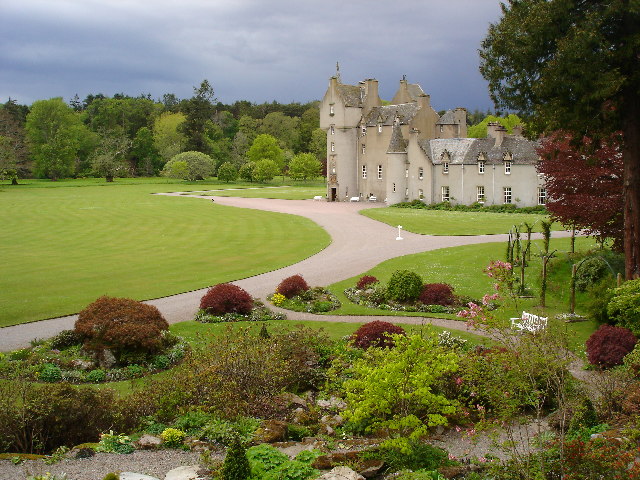
- Ballindalloch Castle stands on the haugh where the Avon meets the Spey, and the Macpherson-Grant family still lives in the house begun in the sixteenth century.
- A Z-plan tower dated 1546, probably built for John Grant and Barbara Gordon, was later wrapped in eighteenth-century wings and a Victorian remodelling.
- In 1590 the Earl of Huntly took the house in a feud over the laird's widow, and in 1645 James Graham burned it after the Battle of Inverlochy (1645).
- General James Grant, born here in 1720 and governor of East Florida, added a wing in 1770, and portraits given for his American service still hang in the dining room.
- Sir George Macpherson-Grant's Aberdeen Angus herd, begun with the cow Erica in 1860, still grazes beside the Avon, and a distillery on the estate began production in 2014.
Visiting
The castle and grounds are open from 10:00 to 17:00, Sunday through Thursday, and closed on Fridays and Saturdays, with last admission at 16:00. An adult ticket for the castle and grounds is £17, a child from 5 to 16 is £9, a child under 5 is free, a senior of 65 or over is £15, and a family ticket for two adults and up to three children is £40. A grounds-only ticket is £10 for an adult, £6 for a child from 5 to 16, free for a child under 5, £10 for a senior, and £25 for a family. A grounds-only season ticket for one person is £40 and is not transferable, and a family season ticket for two adults and up to three children is £80.
Entry tickets can be purchased at the gate, and no advance booking is required. Members who present a valid Historic Houses membership card are allowed to enter free, with no ticket required. The castle and gardens are closed on 30 September, and the next admission day is Tuesday 23 March 2027.
History
Ballindalloch Castle stands on the meadow where the River Avon meets the Spey, in the parish of Inveravon, once Banffshire and now Moray. It is called the pearl of the north, and it has been a family home since the sixteenth century. The people in it today are the latest generations of the Macpherson-Grants, and the Russell name in the modern house belongs to Clare Russell and Oliver Russell.
The lands passed from the Ballindalloch family to the Grants in 1498 or 1499. John Grant, with his wife Barbara Gordon, is the likely builder of the Z-plan tower dated 1546, and one account places the start of the work around 1542. The Spey and the Avon served as a natural moat, and a legend says a voice moved the site from the hill to the cows' meadow after the day's work was thrown down at night.
In November 1590 a feud over the widow of the laird brought the Earl of Huntly to the house, and John Gordon was killed outside Darnaway Castle on 24 November. The quarrel sat inside a larger struggle between Huntly and James Stewart, Earl of Moray, which ended with Moray's death at Donibristle in February 1592. In 1645, after the Battle of Inverlochy (1645), James Graham burned the castle, and the Grants began repairs within the year.
Colonel William Grant added a south wing in 1718, and General James Grant, born on the estate in 1720 and later governor of East Florida, added a north wing in 1770 for a French chef. He died on 13 April 1806, and the estate passed to his grandnephew George Macpherson. A flood in August 1829 filled the vaulted passages, and between 1848 and 1853 Thomas Mackenzie turned the damaged tower into a Victorian mansion while leaving the old stone visible.
The dining room was the old great hall and holds portraits of George III and Queen Charlotte by Allan Ramsay, given to General Grant. The library runs to about 2,500 volumes, begun by Colonel William Grant, and the house keeps an important collection of seventeenth-century Spanish paintings. Sir George Macpherson-Grant bought the cow Erica in 1860 and refined the Aberdeen Angus herd for nearly fifty years, and he leased the ground for Cragganmore in 1869.
In the 1960s Sir Ewan Macpherson-Grant removed a decayed north-east wing and added bathrooms. The gardens, including a walled garden renewed in 1996, a rockery, and an eighteenth-century dovecote, lie between the two rivers. Production at a distillery in a steading of the 1820s began in September 2014, and the castle is still both a home and a place open to visitors in the summer.
Images


Detailed History
Ballindalloch Castle stands on the low meadow where the River Avon joins the River Spey, in the parish of Inveravon. The old county was Banffshire, and the place now lies in Moray. The house is known as the pearl of the north. It has been a family home since the sixteenth century, and the people who live there today are the latest generations of the Macpherson-Grants.
One account says the Macpherson-Grant family has been in the house since it was begun in 1546. Another says the lands stayed with the Grants until 1806, and only then passed to George MacPherson of Invereshie, who became Sir George Macpherson-Grant. Both can be read together if the later name is the same family after an inheritance. A further account says the house has been occupied throughout by the Russell and Macpherson-Grant families.
The Russell name in the modern house belongs to Clare Russell, daughter of Sir Ewan Macpherson-Grant, and to Oliver Russell, father of the present laird. Clan Russell is a Scottish armigerous clan with a claimed origin in Normandy, and that is the clan name attached to the surname.
Before the Grants, the lands belonged to the Ballindalloch family. They passed to the Grants in 1499 in one account, and in 1498 in another. The second account says King James IV granted the lands of Ballindalloch and Glencairnie to John Grant of Freuchie in 1498, and that John's grandfather was described as Crown tacksman of Ballindalloch in 1457. Patrick Grant in Ballindalloch appears about 1520 as a prominent member of the wider Grant family.
He was one of the sureties, on 22 October 1520, for the marriage of Donald Cameron, son of Ewen Allanson, captain of Clan Cameron, to Agnes Grant. On 17 February 1529 he bought from Robert Stewart of Clava half the town of Urquhart and the lands of Cantraydown, in the barony of Clava in the sheriffdom of Nairn. A story that he was tutor to his nephew and usurped the family property is told in the Kinrara manuscript, but Sir William Fraser gave it no credence. A commission of 8 June 1555, given to John Grant, fourth of Freuchie, still excepts the lands occupied by John Grant of Ballindalloch and his father, so Patrick was treated as alive at that date.
It is not known whom he married. He left four sons and two daughters.
John Grant, first designed of Ballindalloch, received a charter of sale on 6 November 1532 from Robert Stewart of Clava for half of Easter Urquhart and the lands of Cantradoun. On 27 July 1545 he sold those lands to James Grant, third of Freuchie, and in that charter he is designated of Ballindalloch. Before 5 March 1540 he acquired, from Patrick, Bishop of Moray, and under compulsion, the lands of Advie, Tulchan, Calledir, Rirory, and Ardvoky in the barony of Strathspey. Cardinal Antonius confirmed the charter on 31 April 1540.
On 1 August 1535 James Grant of Freuchie obliged himself to infeft John Grant and his heirs in Ballindalloch and to give him leases of Pitchaish, Foyness, and Tullochcarron. John bought Tullochcarron and Drumgrane from John Gordon of Pitlurg on 23 July 1545. He also held Bogside. On 8 December 1544 he signed a general bond of the noblemen and barons of the north.
On 4 March 1549 he obtained a charter of Glenmoriston. He was slain on 11 September 1559 in a quarrel with the Grants of Carron.
John married first Isabella, daughter of John Grant of Culcabock and Glenmoriston and of Isabella Innes. Their son George claimed his grandfather's estate and failed. The mother's marriage had been dissolved, and a charter of 19 May 1538 speaks of future matrimony. John married secondly, in 1541, Barbara Gordon, widow of William Hay, lord of Lorny.
She is named as his wife in a feu-farm charter of the lands of Kirkton and Inveravon from the Bishop of Moray on 16 July 1545, and in the charters of Tullochcarron and Glenmoriston. Their son Patrick was born before the marriage. Letters of legitimation under the Great Seal were granted for him on 22 October 1542. The designation record says the Z-plan tower house was probably built by John Grant and his wife Barbara Gordon.
The first tower is dated 1546. One account says John's grandson, also John Grant, began the castle around 1542. Another places the build in the span from 1542 to 1700, altered and enlarged afterwards. The family's own account says the grandson began the work around 1542, at a time when the Highlands were full of clan feuds and when both English and Scottish monarchs pressed on the north.
The original castle was a Z-plan. A Z-plan castle has a strong central rectangular tower with smaller towers at diagonally opposite corners. Here the living quarters were a three-storey square block, flanked to north and south by two high circular towers, each covering two sides of the rectangle. The Spey and the Avon formed a natural moat to the north and west.
Over the entrance an apparatus was made to drop stones and sewage on unwanted visitors. The house was a fortress and a family home at once.
Observers have long wondered why the tower was not set on the higher ground a little to the east. The explanation that survives is a legend, and the two tellings do not match in detail. In one, the builders meant to use a stronger defensive site, but whatever was raised by day was thrown down at night. The laird, annoyed, heard a voice say, Build in the cow haughs, and you will meet with no interruptions.
He did so, and the work was left alone. In the other, John Grant set masons to build on the hill, and more than once the morning showed the foundations as rubble in the bed of the Avon. He kept a night watch and was swept off the hill by a gust from the tors of Ben Rinnes, with a voice telling him to build on the coo haugh. The castle therefore stands on the cows' meadow beside the Avon.
The same meadow later carried the black cattle.
The fabric that can be read on the building runs from 1546 to 1850. It is a castellated mansion of several builds and heights, with the 1546 Z-plan tower house as the core. The walls are harled, with tooled and polished ashlar and granite dressings and margins. The original entrance was from the north, flanked by two eighteenth-century wings, one of 1718 and one later.
In 1850 the entrance was recast to the south by Thomas Mackenzie of Elgin. One account names that architect Thomas MacKenzie. An imposing doorpiece in the base of the south tower carries strapwork, text, an armorial, and a monogram, and it is dated 1546 and 1850. The same restoration added an east wing and a service court with an arched east entrance.
The original tower has corbelled square cap-houses. Slender stair turrets sit in the re-entrant angles. Nineteenth-century gabled dormers carry decorative detail and monograms. Bartizans have slated conical roofs and apex finials.
The glazing is mainly twelve-pane. The stacks are coped at the wallhead and the ridge, and the roofs are Banffshire slate. A turnpike stair survives in a tower dated 1602. Various datestones have been reset outside and inside.
Over the entrance the Macpherson-Grant arms are cut in freestone, with the words, Ye Lord shall preserve thy going out and thy coming in. To either side are the words Erected 1546 and Restored 1850.
Inside, the vaulted entrance hall was remodelled in 1850. Richly decorated ribs spring from a central column, and there is a painted ashlar baronial chimneypiece. A wide oak staircase opens off the hall, with turned and carved balusters. The former first-floor hall was entirely redecorated in 1850 in a consciously historicist manner, with panelled walls, doors, and window shutters, nail-head detailing, an ornate strapwork and pendant plaster ceiling, and a marble chimneypiece with flanking caryatids, a coat of arms, and a monogram.
The library is panelled, with a carved chimneypiece and a marble surround. The family's account of the hallway adds unusual umbrella and fan vaulting, designed as part of the nineteenth-century restoration. A collection of military memorabilia is kept there, including Scottish dirks, a group of eighteenth-century pistols, and a naval dress sword that belonged to the grandfather of Guy Macpherson-Grant, who was Second Sea Lord and aide-de-camp to the Queen between 1953 and 1955. China is displayed in a Sheraton corner cupboard of the 1820s, with a Bureau Plat of the Louis Quinze period and a set of Scottish chairs in the Chinese Chippendale style.
The dining room is the largest room. It is reached by a wide staircase from the hallway, with large oak balustrades. It was once the great hall of the sixteenth-century fortress. A magnificent fireplace, an original feature, stands in the centre, and above it hang the arms of the Macphersons and the Grants.
The walls are American pine from the restoration of the 1840s, commissioned by the second baronet, Sir John Macpherson-Grant, and carried out by the Moray architect Thomas Mackenzie. Portraits of King George III and Queen Charlotte by Allan Ramsay hang there. They were presented to General James Grant in recognition of his military service in the American war. The drawing room, in the south-west wing, was built with that wing in the 1770s for General James Grant.
Much of its furniture is of the same age, including an oval Sheraton table and a gilt mirror of the 1750s. Next door, the laird's smoking room was where the laird and his guests retired after dinner. Its china dates from the 1770s. Lady Macpherson-Grant's bedroom, also in that wing, has a four-poster of Scottish cherry wood from the 1860s.
The room is no longer a bedroom in use.
The library was panelled in the same restoration. It holds the family's collection of original eighteenth- and nineteenth-century European literature, about 2,500 volumes. Colonel William Grant began it, as a collector of early eighteenth-century English and French books. The third baronet is said in the family's account to have added historic Spanish texts while serving as secretary to the legation in Lisbon in 1850.
The baronetcy list names Sir John Macpherson-Grant as the second baronet, from 1804 to 1850, and Sir George Macpherson-Grant as the third, from 1839 to 1907, so the Lisbon secretary of 1850 is the second baronet, and the family's wording that calls him the third is a point on which the two accounts do not agree. The house holds an important collection of seventeenth-century Spanish paintings. A tower at the junction of the wings, put up in the early 1700s in one account, contains the nursery on the first floor. The room was part of the servants' quarters and is now shown as a place where children grew up in the house.
The furnishings include an inlaid Georgian high chair of the 1770s, a cane and mahogany cradle of the 1830s, antique teddy bears, and a dolls' house made in 1975 by Oliver Russell, the present laird's father, for his daughter Lucy. Above it, the Highland Tower is a cap-house on the original tower. It once served as a watchtower. Later it was servants' quarters, and it is kept that way, with a simple wooden bed, a side table, and a washing jug.
Beneath the sixteenth-century floors is a dungeon. For the past three centuries it has been used to keep wine. It was the favourite room of General James Grant.
Patrick Grant of Ballindalloch, the legitimated son, received from his father on 9 March 1554 a charter of sale of Tullochcarron, Bellavill, Drumgrane, and Avon, with the salmon fishings in the Spey and the Avon. His wife Griselda Grant is named in the confirmation of 7 March 1566. On 27 April 1576 he granted his second wife, Margaret Gordon, the lands of Bogside. He took part in Huntly's rebellion in 1568 and obtained a remission the next year.
On 21 March 1584 he pledged himself with the clan to defend their chief, the laird of Freuchie. On 23 February 1568 he signed an obligation to John Grant of Freuchie to give a bond of manrent on his entry to Ballindalloch. He is said to have died on 8 September 1586. He married first Grissel Grant, daughter of John Grant, fourth of Freuchie, by a contract of 17 March 1559, and secondly, before 4 September 1579, Margaret Gordon, widow of Walter Innes of Auchroisk.
She survived him and married John Gordon, son of Thomas Gordon of Cluny. John Gordon was slain outside Darnaway Castle on 24 November 1590.
The marriage of that widow started a feud. John Grant, former tutor of Ballindalloch and administrator of the estate, killed one of John Gordon's servants. He is also called John Grant in Foyness, youngest brother of Patrick, and the historian of the House of Sutherland says he grudged that any of the surname of Gordon should dwell among them, and that he quarrelled with John Gordon at the instigation of the laird of Grant and killed a servant. John Gordon pressed the matter until the tutor and his adherents were pronounced rebels.
The Earl of Huntly, sheriff of the shire, obtained a commission, besieged the house of Ballindalloch, and took it by force. One account dates the taking to 2 November 1590. The Kinrara manuscript says 21 November 1590. The tutor escaped.
Another account says the Earl of Huntly went to Ballindalloch in November 1590 to arrest the tutor, and that the chief of Grant, John Grant of Freuchie, promised to deliver the tutor and his accomplices, accused of murder and other crimes, to Huntly Castle. Freuchie instead joined the tutor's men and the Earl of Moray, came to Forres and Darnaway Castle, shot pistols at Huntly's officers, fired cannon from the castle, and killed John Gordon of Birsmoir, brother of the laird of Cluny. Huntly pursued Freuchie in law for that killing as treason, but the Privy Council suspended the matter. Freuchie then claimed that Huntly was stirred up against him and caused trouble in the north.
The Earl of Huntly in that year was George Gordon, later first Marquess of Huntly. He was born in 1562, son of the fifth earl and of Anne, daughter of James Hamilton, second Earl of Arran. He was educated in France as a Roman Catholic. He took part in the plot that led to the execution of James Douglas, fourth Earl of Morton, in 1581, and in the conspiracy that saved King James VI from the Ruthven raiders in 1583.
In 1588 he signed the Presbyterian confession and still engaged in plots for a Spanish invasion. On 28 November his treasonable correspondence was found while he was captain of the guard at Holyrood, and the king pardoned him. He married Henrietta Stewart on 21 July 1588. In April 1589 he raised a rebellion in the north, met the king at the Bridge of Dee on 17 April, and was brought to Edinburgh.
He then made a private war on the Grants and the Mackintoshes, who were helped by the Earls of Atholl and Moray. On 8 February 1592 he set fire to Moray's house of Donibristle in Fife and stabbed the earl to death. That killing inspired the ballad of the Bonnie Earl of Moray. The Spanish Blanks, two of them signed by Huntly, were intercepted in December, and he was excommunicated on 25 September 1593.
On 3 October 1594 he and his allies defeated Argyll at the Battle of Glenlivet. His castle of Strathbogie was blown up, and he left Scotland about March 1595. He submitted to the Kirk in June 1597 and was restored in December. He was created a marquess on 7 April 1599.
He died at Dundee on 13 June 1636, on the way to Strathbogie, after declaring himself a Roman Catholic. His daughter Anne Gordon later married James Stuart, third Earl of Moray, so the families that fought in 1590 were joined in the next generation.
The Earl of Moray who stood with the Grants in 1590 was James Stewart, second Lord Doune and earl in right of his wife. He was born about 1565 and was murdered on 7 February 1592. He was the eldest son of James Stewart, first Lord Doune, and Lady Margaret Campbell, and a male-line descendant of Robert II. In 1580 he received the ward and marriage of the two daughters of the Regent Moray, and in January 1581 he married Elizabeth Stewart, the elder daughter.
He aimed to be the most powerful lord in the north-east at the expense of Huntly. On 1 August 1588 he was a commissioner for executing the act against the Spanish Armada, and on 5 March 1590 he was commissioned against the Jesuits. He allied himself with Francis Stewart, fifth Earl of Bothwell. In late 1590 he and the Earl of Atholl decided to assist the laird of Grant when Huntly was besieging his house.
Huntly retreated to Edinburgh, and on 23 January 1591 presented a supplication against Moray for having taken part with the malefactors in the north. Both earls were ordered to Edinburgh to sign bands to keep the peace. Huntly later obtained a commission to pursue Bothwell. Moray was induced to come south on the promise of a pardon and was at his mother's house of Donibristle when Huntly's followers set it on fire.
Moray broke out toward the shore and was killed. His mother, Margaret Campbell, brought the bodies to Leith, had her son's body displayed in the Church of St Giles, and commissioned a portrait of his wounds. Captain Gordon, one of Huntly's wounded followers, was executed in Edinburgh. Huntly entered ward in Blackness Castle on 12 March and was released on 20 March on surety to stand trial.
The ballad claims that Moray was the queen's love. There is no evidence that he was the lover of Anne of Denmark.
John Grant of Freuchie, the chief who broke his promise to Huntly, was the fifth laird of Freuchie. His house is now called Castle Grant, a mile north of Grantown-on-Spey, and he also held Ballachastell near Inverness. He was born about 1568 and died on 20 September 1622. He was the eldest son of Duncan Grant, who died in 1582, and of Margaret Mackintosh, and he became head of the family when his grandfather, also John Grant, died in 1585.
He married Lilias Murray, daughter of Sir John Murray of Tullibardine, in 1591. The contract was signed on 15 April, and James VI rode from Linlithgow to the wedding at Tullibardine on 21 June 1591, where the king and his valet John Wemyss of Logie performed a masque. In February 1596 Freuchie mustered his kin, friends, and servants able to fight for the king and the sheriff of Moray. The total was 500 men.
Three hundred were armed and able to go to war. Forty had habergeons, two-handed swords, and helmets. Another forty had bows, helmets, swords, and targes, in the Highland custom. In March 1613 the king ordered him to pursue men of Clan Gregor, and in August he captured Allester McAllester while Duncan McVcEandowy escaped.
In 1617 he was asked to provide capercaillies and ptarmigan for a royal visit. In 1618 the London water poet John Taylor stayed four days at Ballachastell. His son John became the sixth laird.
The next lairds of the castle lived through a violent local feud as well as the wider war. Patrick, son of the Patrick who died about 1586, was infeft in Ballindalloch on 3 April 1591. On 2 May 1594 he was served heir to his father in Drumnagrain and Awin, with the fishings. On 5 September 1595 he and his wife Helen Ogilvie received a crown charter of the barony of Tullochcarron.
In 1613 he was pardoned, with John Grant of Freuchie and others, for intercommuning with Clan Gregor, an offence for which he had been fined 5,000 pounds on 1 September 1613. During his time the lands passed into the hands of his brother James, and he was present at James's infeftment on 8 May 1632. He appears to have died before 1649. His son John, born about 1596, obtained a charter of Ballindalloch from his father in 1619 and redeemed the lands from his uncle James in 1633.
In 1643 he was still designed younger and fiar. On 23 July 1649 he received a charter of Morinch. In August 1628 he attacked John Grant of Carron, nephew of the outlaw James Grant called Sheumas an Tuim, who had gone to the Wood of Abernethy to cut timber. Carron was slain, and so were several of Ballindalloch's friends, including Thomas Grant of Dalvey.
Young Ballindalloch procured a remission from Charles I and, in a petition of 18 February 1630, said the slaughter was unintentional. In December 1634 Sheumas an Tuim trapped him in an ambuscade, held him in a disused kiln near Elgin for twenty-two days, and lost him when he arranged an escape in Latin with one of the guards. In 1662 he styled himself elder of Ballindalloch and said he was above sixty. He appears to have lived until 1679.
James Graham, first Marquess of Montrose, was the soldier who burned the house in that family's time. He was born in 1612 and died on 21 May 1650. He was chief of Clan Graham, the only son of John Graham, fourth Earl of Montrose, and he became the fifth earl when his father died in 1626. He studied at Glasgow and at St Salvator's College in St Andrews, married Magdalene Carnegie at seventeen, and travelled in France, Italy, and the German principalities.
In 1638, when Charles I tried to impose a prayer book, Montrose signed the National Covenant and acted with the Covenanters, including at the Brig of Dee. By 1639 he had begun to turn. He wanted the bishops removed without making the Presbyterian clergy masters of the state. He signed the Bond of Cumbernauld in August 1640 against the ambition of Archibald Campbell, Marquess of Argyll, fought at Newburn, and was imprisoned in Edinburgh Castle in June 1641.
In 1644 the king signed a warrant for his marquessate and appointed him lord lieutenant of Scotland, and in 1645 commissioned him captain general. He changed sides because he had been a Covenanter who came to think that Argyll's party, not the king, was the danger to the balance he wanted.
The Battle of Inverlochy (1645) was fought on 2 February 1645, during the Wars of the Three Kingdoms. A royalist force of Highlanders and Confederate Irish troops under Montrose routed the forces of Argyll, camped under the walls of Inverlochy Castle. The Covenanter Committee of Estates had decided to intervene in the English Civil War on the parliamentarian side, and the royalists wanted to pin Covenanter troops in Scotland. Charles had already commissioned Montrose.
Confederate Ireland, at the instigation of the Earl of Antrim and the Duke of Ormond, sent 2,000 experienced troops under Alasdair Mac Colla, who landed at Ardnamurchan in early July 1644. Montrose joined him in August. The Committee's armies were under William Baillie. Montrose won at Tippermuir and Aberdeen in September, then retreated into the Highlands, pursued by Argyll, while Baillie blocked the way east.
By late November the royalists had added about 1,000 recruits, largely from Clan Donald, and through the winter they burned and plundered Argyll's own lands, culminating in the sacking of Inveraray. Montrose left Inveraray on 14 January 1645 and headed north. By the end of January he had halted at Kilchummin in the Great Glen, short of supplies, with fewer than 2,000 men after sickness and desertion. The Earl of Seaforth blocked the road north at Inverness.
Argyll was to the south at Inverlochy with his own regiment, eight companies of Lowland foot sent by Baillie, and Clan Campbell levies. Baillie and Sir John Urry were gathering more men further south. The royalists were trapped.
Montrose marched south to attack Argyll, partly because Argyll's men threatened the lands of his supporters, and he refused a frontal approach that would be seen. The flank march crossed some of the hardest winter ground in the British Isles, partly through snow knee-deep. The royalists went up the River Tarff to Glen Buck by Culachy, across the gorge of the Calder Burn, to the head of the glen at 1,000 feet, then another 1,000 feet to Carn na Larach, and down Glen Turret and Glen Roy to Keppoch. The advance guard rested about three hours in a barn.
After fording the Spean and passing Leanachan Woods, they came out on the slopes of Ben Nevis above Inverlochy in the early hours of Candlemas, 2 February, having marched about thirty-six miles in thirty-six hours. They spent the night in the open. Argyll knew a small force was near, because pickets had been driven from Keppoch, but he did not know the whole royal army was in front of him. He had injured his arm in a fall from his horse and retired to his galley on Loch Linnhe.
Command passed to his kinsman Sir Duncan Campbell of Auchinbreck, a veteran lately recalled from Ireland. Auchinbreck anchored his left on Inverlochy Castle with 200 musketeers, placed Argyll's regiment in the centre, the Lowland companies on the flanks, and a reserve of Campbell levies with two light guns in the rear. Montrose lined his army only two deep, clansmen in the centre under himself, the Irish on the flanks under Mac Colla and O'Cahan, and about fifty horse under Sir Thomas Ogilvie of Airlie. Just before first light the royalists attacked.
The Irish went quickly to push of pike, routed both wings, and Montrose then sent the Highlanders at the centre. The fight became a massacre in the rout. More than 1,500 Covenanters died. Montrose lost very few, reputedly as few as four to eight, among them Ogilvie, hit by a stray bullet.
The small garrison in the castle surrendered. On 11 February the Parliament of Scotland found Montrose and nineteen followers guilty of high treason in their absence. The victory also secured the cooperation of the Marquess of Huntly, whose Gordon levies made him one of the most powerful nobles in Scotland. The bard Iain Lom watched from a hillside and wrote the poem The Day of Inverlochy.
The Grants of Ballindalloch had sided with the Covenanters, who stood with the English Parliament against Charles I. After the Battle of Inverlochy (1645), royalist forces under Montrose sacked, plundered, and burned the castle. The interior was burned and the Grants fled. One account says the damage was repaired in the same year.
The family's account says the royalists were defeated within the year and the repair had begun. A third account says Montrose burned three houses, Ballindalloch, Pitchaish, and Foyness. It was the only time the defences are said to have been broken by an army. Montrose's campaign continued.
He won at Auldearn, Alford, and Kilsyth, the last on 15 August 1645, and was then defeated at Philiphaugh on 13 September 1645 by David Leslie. He left for Norway in September 1646. In March 1650 he landed from Orkney, was routed at Carbisdale on 27 April, was given up at Ardvreck Castle, and was hanged at Edinburgh on 21 May 1650. His head stood on the Tolbooth until 1661, when Charles II paid for a funeral in St Giles.
The man who burned Ballindalloch was, within five years, dead on an Edinburgh scaffold, and the house he burned was already under repair before that end.
The later seventeenth century at the castle is quieter in the papers and visible in the outbuildings. A dovecote, called the doo'cot in the family's account, is dated 1696 in the historic-environment notes, and the same notes say the castle remained in much the same condition from about 1542 until 1717. The watchtower is dated 1602. John, the laird who lived into the 1670s, had a grandson, John Roy Grant, seventh of Ballindalloch, who found the estates inextricably encumbered.
Creditors took possession, and the lands were acquired by Colonel William Grant, a younger son of James Grant of Rothiemurchus and ancestor of the present possessors. John Roy Grant died before 26 April 1737. He had married Anna Francisca, second daughter of Count Patrick Leslie of Balquhain. On another part of the estate, the lands had once been divided, and the laird of the portion on the left bank of the Avon had a castle at Tullochcarron.
Foundations were found when the farm buildings of Castletown were put up. No trace of that building is visible now, and the name Castletown is the surviving mark. That find is separate from the standing castle.
Colonel William Grant added the two-storey southern wing in 1718. The eighteenth century then added a second wing, and the two wings formed the original rose garden. In 1770 General James Grant added the north wing because he needed room for a French chef who had returned with him after his time as governor of East Florida. The historic-environment notes also say two new wings were added to the north and south in 1770, so the dating of the south wing is given both as 1718 and as 1770.
The drawing room is placed in the 1770s with the south-west wing.
General James Grant, fourth of Ballindalloch, was born in 1720 on the family estate and died on 13 April 1806. He bought a captain's commission in the Royal Scots on 24 October 1744 and fought at Fontenoy in the War of the Austrian Succession. By 1757 he was a major in the 77th Foot, Montgomerie's Highlanders, in the French and Indian War. In 1758 he served under General John Forbes on the expedition toward Fort Duquesne, and there he met George Washington, Francis Marion, and Hugh Mercer.
In September he led about 800 men to test the French strength at the fort, on the future site of Pittsburgh. He split his force, hoping to draw an attack, and on 14 September 1758 he was ambushed. At the Battle of Fort Duquesne the British lost 342 killed, wounded, or captured. Grant and eighteen of his men were taken.
He was soon paroled and blamed the colonial militia. In 1761 he commanded an expedition against the Cherokee in the Anglo-Cherokee War. His regiment then fought at the siege of Havana and was disbanded in America in 1763.
By the Treaty of Paris, Britain took Florida from Spain and divided it. Grant was named governor of East Florida in 1764 and lived in the Governor's House at St Augustine. He ended raids with the Treaty of Fort Picolata, using systems of gift exchange he had learned in the Cherokee war, and he settled the Florida-Georgia border. He encouraged cotton, indigo, timber, and cochineal, and he developed plantations of his own, worked by enslaved Africans.
Illness sent him back to Scotland in 1771. He left his overseer Alexander Skinner in charge of the enslaved people and of the plantation called Grant's Villa, seven miles north of St Augustine. After Skinner's death in March 1779, Dr David Yeats managed the plantations. Grant was elected to Parliament for Tain Burghs in 1773 and became one of the most outspoken anti-American members.
Early in 1775 he said the colonists could not fight. In the summer of 1775 he returned to service as a colonel, reached Boston on 30 July, and after Bunker Hill urged General Gage to move the army to New York. He commanded the 55th Foot from December 1775 until 1791. On 17 March 1776 he left Boston with the withdrawal to Halifax.
Under General William Howe he helped plan the New York campaign. At the Battle of Long Island on 26 and 27 August he led the left-wing division, engaged the American right, and defeated William Alexander's division while Howe flanked the American rear. He was later criticised for letting most of that force escape. He arrived too late at White Plains.
In 1777 he devised the plans for the Battle of Brandywine. On 20 May 1778 he failed to trap Lafayette at Barren Hill, halting twice and letting the Americans slip away by a road the British did not know. On 27 October 1778 he captured St Lucia. A French garrison surrendered on 28 December at the Battle of La Vigie.
In 1779 he refused an order from Lord Germain to scatter small garrisons across the West Indies, and instead covered the naval bases at Saint Kitts, Saint Lucia, and Antigua. He sailed for England on 1 August 1779.
He was defeated in the election of 1780, appointed lieutenant general in 1782, and re-elected for Sutherland in 1787, holding the seat until 1802. In 1789 he was appointed governor of Stirling Castle and commanding general of the army in Scotland. In 1791 he moved from the 55th to the colonelcy of the 11th Foot. In 1796 he was made a full general and left active service.
In 1802 he retired to his estate on the Avon and the Spey as laird of Ballindalloch. In 1805 he retired from the army. He died at eighty-six on 13 April 1806, and his estate went to his grandnephew, George Macpherson. The designation record instead says the property remained with the Grants until the death of General William Grant in 1806, when it passed to George MacPherson of Invereshie, later Sir George Macpherson-Grant.
The two names, James and William, are not reconciled in the accounts. His ghost is said to walk the corridors at night, trying to find the cellar again. The dining room has its own ghostlore. It is said to be haunted by a figure known as the Green Lady, a recurring figure in Scottish stories of castles.
A 2012 account of haunted castles, carried by The Scotsman, included this dining room.
South of the house, the Bridge of Avon dates from 1754. It was once the entrance to the castle and once a military road, built after the Jacobite rising of 1745 was put down. It is carved into the rocky gorge, a high arch between two ornamental turrets. It is long disused.
Over the keystone are the Macpherson-Grant arms and the motto, Touch not the cat bot a glove. The coat of arms of the third baronet gives the second motto as Touch not the cat but a glove, beside Ense et animo, with sword and courage. The arms quarter Grant of Ballindalloch, gules a target between three antique crowns or, with Macpherson of Invereshie.
The Macpherson-Grant Baronets, of Ballindalloch in the county of Elgin, were a title in the Baronetage of the United Kingdom, created on 25 July 1838 for George Macpherson-Grant. He was born in 1781 and died in 1846, and he was Member of Parliament for Sutherland intermittently from 1809 to 1826. The holders were Sir George, first baronet, Sir John, second, from 1804 to 1850, Sir George, third, from 1839 to 1907, Sir John, fourth, from 1863 to 1914, Sir George, fifth, from 1890 to 1951, and Sir Ewan George Macpherson-Grant, sixth, from 1907 to 1983. The third baronet was Member of Parliament for Elginshire and Nairnshire from 1879 to 1886, and deputy lieutenant of Elginshire, Inverness-shire, and Banffshire.
The second breach of the house was not made by soldiers. In August 1829 a thunderstorm known locally as the Muckle Spate broke across the Cairngorms. The rivers of Strathspey and Moray burst their banks. Sir Thomas Dick Lauder, who visited soon afterwards, recorded that the garden wall protected the castle for a time and then gave way, and that for twenty-four hours a body of water twenty-five yards wide rushed against the ground storey, filling the vaulted passages.
The garden was covered four feet deep with sand, and a ravine was cut between the castle and the river bank. The family, prompted as John Grant had been three centuries earlier, rebuilt. Between 1848 and 1853 the Moray architect Thomas Mackenzie oversaw the change from a tired fortress into a Victorian mansion. A visitor of the time said he created an air of light yet massive strength, mingling modern and antique appearance, and called it one of the most perfect specimens of the old Scottish castle north of the Border.
His manner was consciously historicist. Architectural opinion since has been that he added the baronial dress his client wanted and left the original architecture visible. Other papers name Thomas Mackenzie of Mackenzie and Matthews for alterations and additions in 1853, Robert Logan's letters of 1852 describing plans and estimates, Thomas Ross for additions including a right-hand wing since removed, A. and W. Reid about 1876, and Alexander Ross in 1875.
The historic-environment notes add stables and a lodge at Levit Bridge in 1847, restoration with a courtyard and surrounding wings from 1847 to 1859, further additions in 1850, a south wing in 1875, stables and nine rooms in 1878, and alterations in 1926. One account says the extensions of 1878 were mostly demolished in a modernisation of 1965. The notes say the house was restored in 1967.
Sir George Macpherson-Grant, third baronet, was born on 12 August 1839 and died on 5 December 1907. He was the son of Sir John, the second baronet, and of Marion Helen Campbell, daughter of Mungo Nutter Campbell. He was educated at Harrow and at Christ Church, Oxford, and he succeeded on 2 December 1850, at the age of eleven. He lived at Ballindalloch Castle, at Elgin, and at Invereshie House.
He married Frances Elizabeth Pocklington on 3 July 1861. When he started to improve the cattle he already had the oldest herd of polled Aberdeen Angus in Scotland. In 1860 he bought a cow named Erica from the Earl of Southesk's Kinnaird herd, and that purchase began a famous Ballindalloch bloodline. The estate account says the herd was started in 1860, that he set about refining the breed on inheriting the practical running of the estate in 1861, and that the cattle grazing beside the Avon today, hornless and black, descend from that herd and are the oldest surviving bloodlines of Aberdeen Angus in the world.
The breed itself comes from the hornless cattle of Aberdeen, Banff, Kincardine, and Angus. Before the nineteenth century the hornless cattle of Angus were called Angus doddies, and those of Buchan were called Buchan humlies. Hugh Watson became tenant of Keillor in Angus in 1808 and gathered stock of outstanding quality. William McCombie took Tillyfour in Aberdeenshire in 1824 and founded a herd largely on Keillor blood.
The breed was officially recognised in 1835 and was first registered with the Galloway in the Polled Herd Book. Sir George bought beasts from McCombie, showed widely, and took first prize at the Paris exhibition of 1878, a year when he and McCombie showed the breed together. In 1879 he moved the motion to start the Society of Polled Cattle at a meeting in Perth. A breed society was formed that year.
He was regarded as one of the greatest exhibitors of the breed. The work lasted almost half a century. He was a justice of the peace and a deputy lieutenant for Banffshire and Inverness. In 1879 he was elected for Elginshire and Nairn and held the seat until 1886, when, as a Unionist, he was defeated by Charles Henry Anderson.
He was chairman of the Highland Railway from 1897 to 1900. He also leased the site for the foundation of the Cragganmore whisky distillery in 1869. He died in Edinburgh at sixty-eight, after success at the Scottish National Fatstock Show the previous day, and his son John succeeded as fourth baronet. The herd is still at Ballindalloch, and in recent years it has been in the care of the herd manager David Johnstone and his wife Susan.
The formal grounds were laid out mainly in the second half of the nineteenth century, after the restoration around 1850. To the north and west they are bordered by the Spey and the rising ground of Cairn Guish. To the south is the Avon, pronounced Aan, rising on Ben Macdui, with tributaries from the Cairngorms and Beinn Mheadhoin, and at thirty-eight miles the longest tributary of the Spey. A visitor enters the gardens past the eighteenth-century dovecote.
There are three gardens. Beyond the lawn in front of the castle, the rockery climbs from the lower slopes of the Avon valley. The courtyard garden, enclosed on three sides by the castle, is formal. North of the castle a laburnum arch and a tree-lined avenue lead to the walled garden, redesigned in 1996 for the four-hundred-and-fiftieth anniversary.
Daffodils come in spring, roses in autumn, and a herbaceous border through the summer. Red squirrels use the trees, and roe deer graze the banks of the Avon. An Edwardian visitor wrote that there seemed to be wood and water everywhere, and so many ornamental trees that one forgot for a moment that the castle was in the Highlands. The gardens are associated with Clare Russell, the laird's mother, and with the head gardener Kevin Clarke.
In the 1980s Clare Russell, Sir Ewan's daughter, oversaw further modernisation of the interiors of the public rooms.
Sir Ewan, the sixth baronet, carried out essential modernisation in the 1960s. He added bathrooms and reduced the Victorian excess. A north-east wing was taken down because it had dry rot, and several bathrooms were added so the plan suited modern living. The house was designated a category A listed building on 22 February 1972.
The designation covers a building of special architectural or historic interest. It is not itself a full history, and the legal part of such a designation is the address.
In the twenty-first century the family returned to distilling. Sir George had leased ground for Cragganmore in the 1860s. Clare Macpherson-Grant Russell and her son Guy Macpherson-Grant set up Ballindalloch Distillery. Production began in September 2014, after nearly three years of planning, renovation, and construction, in a farm steading of the 1820s.
One account speaks of a grant of 1.2 million pounds from the Scottish Government. Another speaks of a grant of up to 1.27 million pounds. The stills came from Forsyths, coppersmiths in Rothes, and the building work was done largely by trades based near the estate. The distillery employed three people at the opening, among them the master distiller Charlie Smith and the assistant Colin Poppy, with Brian Robinson as host.
No automation was used. A later account of the same stills names Colin Poppy as manager, with assistants David Norquoy and Ian McMurdo, and says tours are by appointment. Guy Macpherson-Grant said that, sitting in the heart of Speyside, the whisky industry was vital to the local economy in jobs and investment, and that the whisky had started but was not yet on the shelves. A second warehouse was planned about three miles from the distillery.
The estate in summer employs up to about thirty-five people across its work, and workshops in the grounds are in active use.
The castle remains a family home. It is also open to visitors in the summer months. From the twenty-first-century approach, the old Z-plan, the turrets, the later wings, the dormers, and the gables read as a fairy-tale castle, while the stone of 1546 is still there to be seen. The rivers still run through the grounds, and the fishing on them is part of the estate.
What the place was used for changed with each century, from a Z-plan tower built to be held in a feud, to a Covenanter house burned by a royalist army, to a Georgian wing built for a governor's household, to a Victorian mansion, to a working Highland estate with a cattle herd and a distillery. The people who decided its fate were John Grant and Barbara Gordon at the founding, the tutor and John Gordon and the Earl of Huntly and the Earl of Moray and John Grant of Freuchie in 1590, James Graham after the Battle of Inverlochy (1645), General James Grant in the eighteenth century, and the Macpherson-Grant Baronets from 1838. Thomas MacKenzie, or Thomas Mackenzie of Elgin, is the architect who made the Victorian house without erasing the tower. Clan Russell enters the story with Clare Russell and Oliver Russell in the twentieth century.
The Aberdeen Angus herd on the haugh is the living trace of Sir George's half-century of breeding. The Green Lady and the general's ghost are traditions, not records of a trial. The walls, the dates cut in the doorpiece, and the family still in residence are the things the sources agree on.
Sources
- History of the Castle — Ballindalloch Castle
- Tour the Castle — Ballindalloch Castle
- The Gardens — Ballindalloch Castle
- Opening times and prices 2026 — Ballindalloch Castle
- Ballindalloch Castle — Wikipedia
- Ballindalloch Castle designation — Historic Environment Scotland
- Ballindalloch Castle — Historic Environment Scotland
- Tullochcarron Castle — Historic Environment Scotland
- Ballindalloch Castle, Moray Historic Environment Record — Aberdeenshire Council
- The Rulers of Strathspey, Appendix I — Clan Grant
- James Grant (British Army officer, born 1720) — Wikipedia
- George Gordon, 1st Marquess of Huntly — Wikipedia
- James Stewart, 2nd Earl of Moray — Wikipedia
- John Grant of Freuchie (d. 1622) — Wikipedia
- Battle of Inverlochy (1645) — Wikipedia
- James Graham, 1st Marquess of Montrose — Wikipedia
- Macpherson-Grant Baronets — Wikipedia
- Sir George Macpherson-Grant, 3rd Baronet — Wikipedia
- Aberdeen Angus — Wikipedia
- Clan Russell — Wikipedia
- Aberdeen Angus at Ballindalloch — Ballindalloch Highland Estate
- The Society — Aberdeen-Angus Cattle Society
- Pioneer helped to shape Aberdeen-Angus breed — Press and Journal
- Ballindalloch Distillery — Scottish Land and Estates
- Ballindalloch Single Malt Distillery — Ballindalloch Highland Estate
- Welcome — Ballindalloch Castle
- Ballindalloch Castle2.jpg — Wikimedia Commons
- Ballindalloch Castle from the Water Garden - geograph.org.uk - 85969.jpg — Wikimedia Commons
- Ballindalloch Castle (2) - geograph.org.uk - 968662.jpg — Wikimedia Commons
- Ballindalloch Castle - geograph.org.uk - 968658.jpg — Wikimedia Commons
- Ballindalloch Castle - geograph.org.uk - 1067213.jpg — Wikimedia Commons
- Ballindaloch Castle.jpg — Wikimedia Commons
- Ballindalloch Castle - panoramio.jpg — Wikimedia Commons
- Ballindalloch Castle- The Dovecote (geograph 5032739).jpg — Wikimedia Commons
- Entrance (4678568362).jpg — Wikimedia Commons
- Ballindalloch Out (4678572288).jpg — Wikimedia Commons