
Palace · Fortification
Appleby Castle
Grade I listed English country house in Appleby-in-Westmorland, United Kingdom

Appleby-in-Westmorland, United Kingdom · 1120 CE · United Kingdom
- Caesar's Tower is a square stone keep above the River Eden, dated about 1170 and also to between 1175 and 1189, and given as about 80 feet, or 24 metres, in four storeys.
- A motte and bailey was begun in 1092 by Ivo Taillebois, and Ranulf le Meschin is also said to have founded the castle at the start of the twelfth century.
- In 1174 William the Lion took the castle, told both as a dawn raid aided by the garrison and as a surrender without a fight by the constable Gospatric.
- Lady Anne Clifford restored the castle in 1651 to 1653 after roundhead forces partly dismantled it in 1648, during the Second English Civil War.
- A Roman well was found in the basement in the 1960s, and in 2024 the castle was offered for sale at £9.5 million.
Visiting
The grounds are open daily from 10:30 to 5:30, and they are also given as open from 10:30 to 4:30. The grounds and the keep are also given as open from 10:30 to 2:30. Adult admission is £5, and adult admission is also given as £10. A family ticket is £12, and a family ticket for two adults and up to four children is also given as £22.
Admission for a child aged 16 and under is £3, and that admission is also given as £5. Admission for children under 5 is free. An older person's admission is given as £10. Tickets may be bought online or at the entrance.
The Norman Centre is closed, and entry is not allowed while no reopening date is given. Wheelchairs and prams are not allowed in the keep. Flip-flops and high heels are not allowed, and flat-soled shoes are required. Visitors who are not in good physical health are not allowed to attempt the 103 narrow steps.
Infants in slings are not allowed on the staircases. Children are not allowed to enter the Norman Centre without an adult. People with epilepsy or a heart condition should know that a flash display is used on the third floor. Photography is allowed on the roof.
The river walk steps are closed, and visitors are not allowed to use them.
History
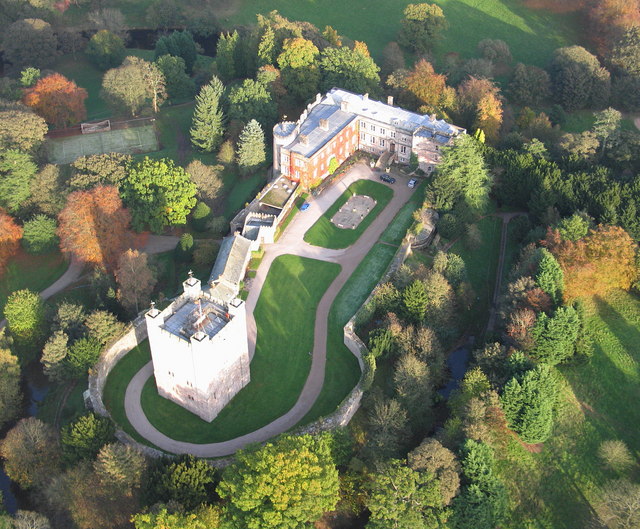
Appleby Castle stands above the River Eden in Appleby-in-Westmorland. Caesar's Tower, a square stone keep, shares a walled courtyard with a mansion house. The keep and the house are each listed Grade I, a grade also written Grade 1, and the uninhabited parts were scheduled on 10 June 1952.
The first Norman earthwork is given both as a motte and bailey begun in 1092 by Ivo Taillebois and as a foundation by Ranulf le Meschin at the start of the twelfth century, finished between 1100 and 1120. The stone keep is dated about 1170, and also to the years between 1175 and 1189, while one sale account dates the stonework to about 1100. Plantagenet Somerset Fry gave the tower as about 80 feet, or 24 metres, in four storeys.
In 1174 William the Lion took the castle. One account calls it a dawn raid aided by the garrison, and another says the constable, Gospatric son of Orm, surrendered without a fight and was fined five hundred marks. King John granted the barony to Robert de Vipont in 1203. The Cliffords then held Appleby from the 1260s for nearly four hundred years.
Thomas, eighth Lord Clifford, rebuilt the eastern range in 1454. John, ninth Lord Clifford, was killed on 28 March 1461, the day before the Battle of Towton, and the lordship passed to Richard, Duke of Gloucester. Henry VII restored the castle in 1485 to Henry Clifford, known as the Shepherd Lord. Leland found the castle ruinous, in 1539 in one account and in 1540 in another, and wrote that prisoners were kept there.
Lady Anne Clifford was born in 1590 and gained the estates in 1649, after James I had supported her uncle. Roundhead forces partly dismantled the castle in 1648, during the Second English Civil War, and she restored it in 1651 to 1653, inserting a cross-wall in the keep. She died at Brougham in 1676. The Earls of Thanet then held it and rebuilt the eastern range in 1686 to 1688.
An excavation in the 1960s found a Roman well in the basement. The castle was later a company headquarters and a rare-breeds centre, and Sally Nightingale was sole owner from 2009. It was offered for sale in 2024 at £9.5 million, and in 2025 at £5.5 million. The Norman Centre in the keep reopened in 2021 and was later closed, with no reopening date given.
Images


Detailed History
Appleby Castle stands in Appleby-in-Westmorland, above the River Eden. A square stone keep known as Caesar's Tower shares a courtyard with a mansion house, and curtain walls enclose them both. The keep and the main house are each listed at Grade I, and the auction notices also write that grade as Grade 1. The uninhabited parts, including the earthworks, the curtain wall except the inhabited section, and the square keep, were scheduled on 10 June 1952.
Caesar's Tower, on Boroughgate, was listed on 6 June 1951. The grounds were registered at Grade II* on 1 July 1985. A minor enhancement of the scheduled record was made on 23 March 2016 from an old county number, and that record had not been reviewed under the Monuments Protection Programme.
On the Ordnance Survey National Grid the castle is given as NY685200, and also as NY 68556 19927, NY 68514 19930, NY 68554 19924, and NY68511993. That grid, also called the British National Grid, describes a place in Great Britain by its distance from an origin west of the Isles of Scilly, rather than by latitude and longitude alone. The letters mark 100 kilometre squares inside larger 500 kilometre squares, and a six-figure reference picks out a square of 100 metres. The same spot is also given as latitude 54.57354 and longitude 2.48792 west, beside the mapped point 54.5742 north and 2.48878 west.
Old written forms of the name include Appelbi, Apelbi, and Ceasers Tower, and the place is also called Appleby in Westmorland.
The scheduled account calls a tower keep a fortified residence in which the keep is the main defence, free-standing or set inside an enclosure, usually square, with several floors, a ditch, a bridge, and a gatehouse, and sometimes stables and workshops. Such keeps were built from just after the Norman Conquest until the middle of the fifteenth century, with a peak in the middle of the twelfth century. The same account says 104 examples are recorded, that they are rare nationally, and that Appleby is highly representative of its period and very well preserved, with large portions of the earthwork defences and the standing structures still intact, and with archaeological deposits from a long history of building and use.
What the ground holds from before the Normans is told in more than one way. The castle's own chronology says the history reaches back to Roman times, when a fort guarded the crossing of the Eden, and that a signal station was built between 75 and 150 on the cliff over the ford, close to the road from York, then called Eboracum, to Carlisle, then called Luguvallium. It places the Roman departure between 380 and 430. An excavation in the 1960s found the remains of a Roman well in the basement.
The heritage record does not call that well a fort. It says a Roman well indicates the site of a possible settlement. No excavation report of the castle itself from the 2020s was found. Digging in the town in those years, at a garage on The Sands and at Saint Anne's Hospital, belongs to the streets of Appleby and not to the castle basement.
The same chronology then sets the valley in the centuries after Rome. Between 400 and 600, Urien, king of Rheged, was lord of the valley of the Lyvennet, a few miles west of Appleby. From 630 to 830 the district lay in the Saxon kingdom of Northumbria, while an independent British kingdom of Cumbria remained in the northern Lake District. In 875 Danes under Halfdan overran the area, and Orm settled at Ormside nearby.
In 920 Appleby is said to have been founded as a Danish settlement, the name meaning apple-place. In 945, after driving the Danes from York, King Edmund I of England turned Cumbria over to Malcolm I, king of Scots, in return for a promise of military support.
The first Norman earthwork is also given two starts. In 1092 King William Rufus occupied Cumbria and installed Ivo Taillebois as the first Norman lord of Westmorland, and Ivo began the first motte and bailey. Between 1100 and 1120 Ranulf le Meschin completed those earthworks and probably built a first stone keep. Another account says Ranulf le Meschin founded the castle at the beginning of the twelfth century, as a timber mount and bailey whose banks and ditches remain one of the most impressive examples of Norman military engineering, and that the motte was later cut down so that a stone tower could stand on the truncated summit.
Ranulf le Meschin, 3rd Earl of Chester, lived from 1070 to 1129. He came from the Bessin in Normandy, rose through kinship with Hugh d'Avranches, Earl of Chester, and through the patronage of William II and Henry I, and married Lucy, heiress of the Bolingbroke and Spalding estates. He governed in Cumberland and Westmorland and founded Wetheral Priory. After his cousin Richard d'Avranches died in the White Ship in November 1120, Ranulf became Earl of Chester and Viscount of Avranches, and passed those titles to his son Ranulf de Gernon.
His daughter Alice married Richard Fitz Gilbert de Clare.
From 1136 to 1157 the castle's chronology says the district was ceded to the Scots, and that Hugh de Morville and his son, also Hugh, were granted the barony of Westmorland in succession. In 1157 King Henry II regained Appleby and confirmed the grant to the younger Hugh. A second account says the castle came into royal hands in 1157 following the surrender by King Malcolm, and was then granted to Hugh de Morville. Henry II, born on 5 March 1133 and king from 1154 until his death on 6 July 1189, was the son of Geoffrey Plantagenet, count of Anjou, and of Matilda, daughter of Henry I.
He held England, parts of Wales and Ireland, and much of France, and for a time held power over Scotland. His quarrel with Thomas Becket, archbishop of Canterbury, ended in Becket's murder in 1170.
The younger Hugh de Morville, who died about 1173, was one of the four knights who killed Becket in Canterbury Cathedral on 29 December 1170, with Reginald Fitzurse, William de Tracy, and Richard le Breton. He was lord of Westmorland and of Knaresborough, and his father had been constable of Scotland. Geoffrey Barrow identified two charters given by this Hugh as lord of Westmorland, one of them read aloud to his court at his castle of Appleby on the upper Eden. After the murder the knights took refuge at Knaresborough.
Pope Alexander III excommunicated them on 25 March 1171. Hugh's journey to Rome was delayed because he and Fitzurse took part in the rebellion of 1173 and 1174. The pope then sent the murderers to fight in arms at the Temple in Jerusalem for fourteen years. The lordship of Westmorland passed in 1174 to Hugh's sister, or in some accounts his niece, Maud, who held the lands until his expiation.
Alan de Lascelles, a tenant of the Morvilles in Westmorland, was captured with his lord at the siege of Alnwick Castle in July 1174.
In 1173 the castle chronology says Hugh supported the rebellion of Henry's son, who had allied himself with the Scots. That rising, the Revolt of 1173–1174, also called the Great Revolt, was led by three of Henry's sons, by his wife Eleanor of Aquitaine, and by their supporters. It lasted eighteen months and failed. Henry the Young King was joined by his brothers Richard and Geoffrey and by their mother, and several European rulers allied with them.
Henry put the revolt down. In 1174 King William the Lion of Scotland captured Appleby Castle in a dawn raid, aided by the garrison. Another account says the castle was in royal hands when William invaded the Eden valley in 1174, and that the constable surrendered without a fight. The constable is named in the castle chronology as Gospatric, son of Orm and grandson of Gospatric, a Scottish earl, and he was fined five hundred marks for the surrender.
Hugh's estates were forfeit, and Appleby returned to the Crown.
William the Lion, also called William I and Garbh, the Rough, was born about 1142 and died on 4 December 1214. He reigned as king of Alba from 1165 to 1214, the longest reign of a Scottish monarch before the Union of the Crowns in 1603. Jordan Fantosme, who died about 1185, wrote an Anglo-Norman verse chronicle of the war between Henry II, Henry the Young King, and William in 1173 and 1174. The castle chronology says that chronicle records both the castle and the tower in 1174, so that both were already standing.
Fantosme was a cleric, probably spiritual chancellor of Winchester, a partisan of Henry II whose chronicle has been praised for detail and also criticised for its metre. A legal document of 10 April 1160 names a master Jordan Fantasma at Fareham, and he is recorded in the diocese of Winchester from about 1150 to 1180.
The date of the stone keep is not one date. One account says the square keep called Caesar's Tower was built about 1170, replacing the motte and bailey. Another says that sometime between 1175 and 1189 the keep was raised, the curtain walls were rebuilt in stone, and a great hall was built at the east end of the bailey. A fabric study doubts whether this keep existed before the capture of 1174, and allows that an earlier keep was destroyed in that year, while the Norman hall and postern seem older than the existing keep.
A sale description dates the conversion to stone at about 1100. The castle's own pages call the keep one of the few intact Norman keeps in Britain, more than 900 years old, and, in the wording of 2021, 950 years old. Plantagenet Somerset Fry, in a castle book of 1980, gave the tower as about 80 feet, or 24 metres, high, in four storeys. He was born Peter George Robin Fry on 3 January 1931 and died on 10 September 1996.
He added Somerset to his surname by deed poll and took Plantagenet as a university nickname because of his advocacy of Richard III. He wrote more than fifty books, among them surveys of the castles of England, Scotland, Wales, and Ireland, and of Roman Britain.
The fabric of the tower is described in layers that do not all agree. It is of grey stone rubble and ashlar, and the twelfth-century walling is small squared ashlar with clasping buttresses at the angles. One account says it was built at three storeys, and that a very tall fourth storey without windows was added before the end of the twelfth century, with the parapet and the standing angle turrets of the late thirteenth or early fourteenth century and the tops of the turrets restored much later. The scheduled summary instead understands the fourth storey as a twelfth-century addition and the angle turrets as late thirteenth century.
The listed-building note says the upper parts were altered in the seventeenth and eighteenth centuries. The keep was roofless in the seventeenth century. During the restoration of 1651 to 1653 a substantial cross-wall was inserted, bearing the arms of the countess, and the roof is probably of the eighteenth century. The castle chronology says Lady Anne Clifford inserted that cross-wall and added the corner turrets in 1651.
One sale account has her building the central spinal wall in 1653 to house the judges of assize.
In 1179 Henry II granted the castle and the Honour of Westmorland to Ranulph de Glanville, sheriff of Yorkshire. In 1189 King Richard the Lionheart took the castle back into royal possession and rebuilt the bridge over the moat in 1198. In 1203 King John gave the barony of Westmorland, including the castle, to Robert de Vipont, described as his henchman and as nephew of Hugh de Morville. The family held it for a hundred years.
The round tower on the north side is dated to this period, and other round towers on the south have vanished. A sale description dates that round tower to about 1210 and says the Viponts built it. John, the youngest son of Henry II and Eleanor of Aquitaine, was king from 1199 until his death on 19 October 1216. He lost Normandy and most of his other French lands, was excommunicated from 1209 to 1213 during the quarrel over Stephen Langton, and sealed Magna Carta in 1215.
In 1263 and 1264 the second Robert de Vipont joined Simon de Montfort's rebellion against Henry III. He died a rebel in 1264, Henry III seized the estates, and the daughters Isabella and Idonea were placed in the king's guardianship. Another account says that in 1264 the castle came to Roger de Clifford through his marriage to Isabel de Vipont, one of the two daughters and co-heiresses of Robert II de Vipont. The castle chronology separates those steps.
In 1265 the wardship of Isabella was granted to Roger Clifford the elder, who obtained a pardon for the treason of his ward's father. In 1268 Roger Clifford the younger married Isabella, and by 1275 he held Appleby Castle and the manor of Brougham, while Roger de Leyburn, husband of Idonea, held Brough and Pendragon. Simon de Montfort, 6th Earl of Leicester, born about 1208 and killed at Evesham on 4 August 1265, led the baronial opposition to Henry III in the Second Barons' War and for just over a year was de facto ruler of England.
Roger's son Robert inherited in 1282. Robert de Clifford, 1st Baron de Clifford, was born on 1 April 1274 and died on 24 June 1314. He was feudal baron of Appleby and of Skipton, and the first Lord Warden of the Marches. In 1300 King Edward I visited Appleby and lodged at the friary, which is not the same as a stay inside the castle.
In 1314 Robert, first Lord Clifford and one of the English commanders, was killed at Bannockburn. That battle was fought on 23 and 24 June 1314 between Robert the Bruce and Edward II. The English had come to relieve Stirling Castle. Sir Robert Clifford was among the commanders killed.
From 1314 to 1322 Scottish raids burned the town of Appleby, while the castle held out against four attacks.
In 1322 and 1323 Roger, second Lord Clifford, rebelled against Edward II, was wounded and captured, escaped execution, and lost his lands. Appleby Castle was held briefly by Andrew de Harcla before Harcla's execution for treason. Andrew Harclay, also Andreas de Harcla, was born about 1270 and was executed on 3 March 1323. He was sheriff of Cumberland from 1311, beat off Robert the Bruce's siege of Carlisle in 1315, and in 1322 defeated Thomas of Lancaster at Boroughbridge, for which he was made Earl of Carlisle.
After the English defeat at Old Byland on 14 October 1322 he made his own peace with Bruce on 3 January 1323. Edward II had him arrested, and on 3 March he was hanged, drawn, and quartered. In 1327 Edward II was overthrown. Edward III made peace with Scotland, and Robert, third Lord Clifford, brother of Roger, was restored to the family estates, including Appleby.
In 1333 Idonea de Leyburn died without children and her lands passed to Robert Clifford, who entertained King Edward Balliol of Scotland at Brougham, not at Appleby. In 1354 Roger, fifth Lord Clifford, inherited and carried out further works. In 1388 major Scottish raids laid the town waste, but the castle seems to have held out and was not captured. In 1391 Thomas Clifford, son of Roger, died on crusade, and Appleby Castle was said to be ruinous.
In 1411 John, seventh Lord Clifford, built a great gatehouse and probably restored the rest of the castle. A fabric study says that gatehouse, on the west side of the modern entrance, was built by Lord John Clifford before 1422, and that a massive fragment survives, probably destroyed in the Civil War. In 1415 John fought at Agincourt, and the castle was used as a court and a prison. A sale description calls the keep the county jail of Westmorland in the thirteenth to fifteenth centuries.
In 1422 John was killed at the siege of Meaux.
In 1454 Thomas, eighth Lord Clifford, undertook major building. He reconstructed the great hall, kitchen, chapel, great chamber, and other principal rooms in the eastern range, and built square towers at either end of that range. The heritage record says the eastern part of the house was built in 1454, while the north wall and the west part of the north wing, with the round tower, are of the thirteenth century, and that a house was probably built in the fourteenth century incorporating that tower and other remains. One sale account has Thomas VIII Clifford extending the round tower in 1454, and has that tower guarding the gatehouse.
In the south-east tower, fifteenth-century work seems to include everything above the second floor. In 1455 Thomas was killed at the first battle of Saint Albans, possibly by Richard Neville, Earl of Warwick.
John Clifford, ninth Baron Clifford, was born on 8 April 1435 and was killed on 28 March 1461. His father had been slain at Saint Albans, and John became a strong supporter of Queen Margaret. He had already feuded with the Nevilles in the north, including an ambush on a Neville wedding party in 1453. At Wakefield, at the end of 1460, the Lancastrian army killed Richard, Duke of York, and the Earl of Salisbury.
The castle chronology says John himself killed the duke and his young son the Earl of Rutland, and earned the nickname the Butcher. His own life says the battle killed York and Salisbury, and that Clifford slew Edmund, Earl of Rutland, York's seventeen-year-old second son, and that historians disagree about how widely the name Butcher Clifford was used. He fought, wounded, at the second battle of Saint Albans, and was then slain in a skirmish with a Yorkist advance party on 28 March 1461, the day before Towton, so he was not present at Towton. The castle chronology says he was killed in battle and that the Lancastrian cause was destroyed at Towton.
Towton was fought on 29 March 1461, on Palm Sunday, in a snowstorm near Towton in North Yorkshire. Yorkist forces defeated the Lancastrian supporters of Henry VI and secured the throne for Edward IV. One account calls it probably the largest and bloodiest battle on English soil, fought for ten hours by an estimated 50,000 soldiers. After Edward IV's coronation, John was attainted and his lands were confiscated.
From 1461 to 1485 the lordship of Westmorland was held by Richard, Duke of Gloucester, later King Richard III, and the castle was probably in the hands of Sir John Parr of Kendal. Richard was born on 2 October 1452, created Duke of Gloucester in 1461, and was king from 26 June 1483 until he was killed at Bosworth on 22 August 1485, the last English king to die in battle. He had governed the north under his brother Edward IV, and he invaded Scotland in 1482. At Bosworth, Henry Tudor defeated him and became Henry VII.
The castle chronology says that in 1485 Henry VII restored the castle to Henry, tenth Lord Clifford, known as the Shepherd Lord.
Henry Clifford, tenth Baron Clifford, was born about 1454 and died on 23 April 1523. A local legend said that, because his father had killed a Yorkist prince, the child was hidden with a shepherd family and grew up ill educated, hence the name Shepherd Lord. Historians have questioned that story. He was signing charters only a few years after his father's death, and Edward IV pardoned him in 1472.
After Bosworth he served Henry VII in the north, suffered a defeat by rebels outside York in 1487, and fought at Flodden in 1513. He rarely attended court, feuded with neighbours, and built a small castle for watching the stars. He died in April 1523. His son Henry, eleventh Lord Clifford, was made the first Earl of Cumberland in 1525 by Henry VIII, his childhood friend.
In 1536, during the Pilgrimage of Grace, Henry Clifford defended Skipton and his son Sir Thomas defended Carlisle. That rising began in Yorkshire in October 1536 under Robert Aske and spread through the north, against Henry VIII's break with Rome, the dissolution of the lesser monasteries, and the policies of Thomas Cromwell. The castle chronology does not say that Appleby itself was defended in that year.
In 1540 Appleby was described by Leland as a poor village with a ruinous castle in which the prisoners were kept. Another account dates Leland's description of the ruinous castle to 1539. Those years are long before the Civil War. A heritage summary that says the house was probably destroyed in the Civil War, but was described by Leland as ruinous in 1539, is putting two different moments side by side.
The park account says the castle was sacked by the Scots on several occasions and was described as ruinous by Leland in 1539, and it calls the castle of thirteenth-century origin, with principal alterations in the middle of the fifteenth century and the middle of the seventeenth, followed by a nineteenth-century restoration.
George Clifford, third Earl of Cumberland, was born on 8 August 1558 and died on 30 October 1605. He was a naval commander and a jouster at the court of Elizabeth I, and he neglected his estates in the far north, leaving a long dispute between his heirs. Lady Anne Clifford was born on 30 January 1590 at Skipton Castle, the only surviving child of George Clifford and Lady Margaret Russell, and she was baptised on 22 February at Holy Trinity in Skipton. Her two elder brothers died before the age of five, and her parents lived apart.
She was taught by the poet Samuel Daniel, was a favourite of Elizabeth I as a child, and in May 1603 went to see the new king, James VI and I, at Theobalds. She was kept from the coronation on 25 July for fear of plague.
On her father's death on 30 October 1605 she became Baroness de Clifford in her own right, a barony created by writ in 1299, but the earldom and the estates went to her uncle Francis Clifford, fourth Earl of Cumberland. She was left £15,000 and fought for the estates, which she argued had been granted under a rule that let a daughter inherit. She was fifteen at the time. James I supported her uncle.
In January 1617 Anne of Denmark encouraged her not to accept the settlement James promoted. She did not obtain possession until 1649, after Henry Clifford, fifth Earl of Cumberland, died in 1643 without a male heir. James VI and I was born on 19 June 1566, king of Scotland from 1567 and king of England and Ireland from 1603, and he died on 27 March 1625. After 1603 he lived in England and returned to Scotland only once, in 1617.
One account says he stayed in Appleby Castle that year, between visits to Brougham Castle and Wharton Hall. The castle chronology for 1616 and 1617 speaks instead of the furious dispute over the Westmorland estates and of James confirming Lady Anne's dispossession. The 1995 volume of the report on the manuscripts of the Marquess of Downshire, issued as Stationery Office Books, is the account cited for the stay. The Stationery Office is the publishing company created in 1996, when the publishing arm of Her Majesty's Stationery Office was privatised, and sold that year for £54 million.
It is the official publisher of legislation, Hansard, and the London, Edinburgh, and Belfast Gazettes. The 1995 volume belongs to the year before that company was created.
Lady Anne Clifford married Richard Sackville, third Earl of Dorset, on 27 February 1609. He died in 1624. Their surviving daughters were Margaret, who married John Tufton, second Earl of Thanet, and Isabella, who married James Compton, third Earl of Northampton. In 1630 she married Philip Herbert, fourth Earl of Pembroke and first Earl of Montgomery, who died in 1650.
She held the hereditary office of High Sheriff of Westmorland from 1653 to 1676. In 1646 she commissioned a triptych, the Great Picture, 8 feet 5 inches high and 16 feet 2 inches wide, attributed to Jan van Belcamp, who lived from 1610 to 1653. It formerly hung in Appleby Castle and is now in the Abbot Hall Art Gallery in Kendal. It shows her at fifteen and at fifty-six, and her parents and young brothers in the centre.
She dated her own conception to 1 May 1589. Jan van Belcamp painted it to her design.
In 1649, after a lull in the Civil War and the execution of Charles I, she travelled to Skipton and on to Appleby. She had been loyal to the Crown, and her estates had fallen to Parliament after Marston Moor. The Second English Civil War took place between February and August 1648 in England and Wales, inside the wider wars of 1639 to 1653. After his defeat in the first war, Charles I surrendered to the Scots in May 1646.
In 1648 a Scottish invasion was joined by royalist risings in South Wales, Kent, Essex, and Lancashire, and by part of the navy. Oliver Cromwell and Thomas Fairfax had defeated them by the end of August 1648. Charles was executed in January 1649. The castle was partly dismantled after a siege by roundhead forces in 1648, during that Second English Civil War.
Another account says the Parliamentary army partly demolished the house in 1648. That siege is not the same event as the occupation of 1651, when the castle chronology says the war flared again and a Parliamentary army under General Thomas Harrison occupied the castle while Lady Anne was restoring it. Thomas Harrison, born in 1616, was a lawyer and a Parliamentarian officer, a Fifth Monarchist, and one of the regicides who approved the execution of Charles I. He was hanged, drawn, and quartered on 13 October 1660.
Nothing in these accounts places that execution at Appleby.
Lady Anne Clifford began the restoration in 1651 and continued it to 1653. She also completed the Hospital of Saint Anne and restored Saint Lawrence's Church in Appleby between 1653 and 1655, and she restored churches at Ninekirks, Brougham, and Mallerstang, and the castles at Skipton, Pendragon, Brough, and Brougham as well as Appleby. In 1656 she set up the Countess Pillar near Brougham, not in the castle garden, at the place of her last meeting with her mother in 1616. She died on 22 March 1676, aged 86, at Brougham Castle, in the room where her father had been born and her mother had died.
Her tomb is in Saint Lawrence's Church in Appleby. She wrote her will at Pendragon on 1 May 1674.
On her death the castle passed to the Earls of Thanet. The title was created in 1628 for Nicholas Tufton. The second earl married Margaret Sackville, daughter of Lady Anne Clifford. Their son the third earl claimed the barony of de Clifford through her.
The castle chronology says the castle was the country seat of the earls from 1677 to 1849, and that the third earl married Lady Anne's eldest daughter. They converted the hall block into a classical mansion. From 1686 to 1688 the main eastern range was rebuilt by Lady Anne's grandson Thomas, sixth Earl of Thanet, the fourth son of her daughter Margaret. A fabric study instead names the fourth Earl of Thanet as the builder of that range in the same years, reusing the shell of the medieval range.
The sixth earl sat for Appleby in Parliament and was lord-lieutenant of Cumberland and Westmorland. He died in 1729, when the barony of de Clifford fell into abeyance between his daughters and the earldom passed to his nephew. The north-west wing, running to the thirteenth-century drum tower, was added in 1695. In the nineteenth century the house was restored again and sash windows were inserted.
The upper parts of Caesar's Tower were altered in the seventeenth and eighteenth centuries, which is the listed-building account already set beside the medieval dates for the turrets.
The castle chronology uses the year 1729 for a different note, that Augustine Washington, father of George Washington, attended Appleby Grammar School with his elder brother John. That is a fact about the school in the town, not a statement that either brother lived in the castle. The same year is the death of the sixth earl in the peerage account. The two notes are not the same event.
The eleventh and last Earl of Thanet died unmarried in France in 1849. The castle and estate passed to his illegitimate son Richard Tufton, born in 1813, who became a British subject and a baronet in 1851. The baronetcy was of Appleby Castle. In 1881 Henry Tufton, son of Sir Richard, was created the first Baron Hothfield, of Hothfield in Kent.
He was also appointed lord-lieutenant of Westmorland that year and served briefly as a government whip in the Liberal administration of 1886. His eldest son, the second baron, was mayor of Appleby. The third baron died in 1961 and that line ended. In 1962 the Hothfield family sold the castle to a private buyer.
Skipton Castle had been sold by the third baron in 1956. The family seat later named for the Tuftons is Drybeck Hall, near Appleby. The title did not end in 1961. It passed to cousins, and as of 2017 it was held by the sixth baron, who had succeeded in 1991.
Ferguson Industrial Holdings, also called FIH, bought the castle in 1973, and the castle chronology says it was sold in 1974 to Ferguson International, which used it as a headquarters and opened it to the public. It became the home of Denis Vernon, the company's chief executive, and his family, until 1990. Vernon established a rare breeds survival centre. Improvements were made to the buildings, including the twelfth-century keep, and the castle was the headquarters and training centre both for the company and for the people running the conservation centre.
In 1998 the documentary director Susannah White featured Denis Vernon and Appleby Castle in The Gypsies Are Coming, a film about the Appleby Horse Fair. The fair is not held in the castle. It is an annual gathering of Romani people and Travellers in early June, outside the town where the Roman road crosses Long Marton Road. Horses are washed in the River Eden.
It draws roughly 10,000 Roma and Travellers, about 1,000 caravans, several hundred horse-drawn vehicles, and about 30,000 visitors, and it is billed as the largest traditional Gypsy fair in Europe. It was never chartered. The medieval borough fair, held at Whitsuntide, ceased in 1885. The New Fair began in 1775 on Gallows Hill for sheep, cattle, and horses, and by the 1900s it had become a Romani and Traveller gathering.
No group has owned it, and its legal standing is treated as a prescriptive right rather than a charter.
The castle was bought by Christopher Nightingale in 1998. The castle chronology says it was sold to a private buyer in 1997. On 7 February 1998 The Westmorland Gazette carried an account of the new owner's plans, under a heading that called him king of the castle. That paper is a weekly published in Kendal, founded on 23 May 1818, and Thomas De Quincey edited it from July 1818 until he resigned in November 1819.
In 2001 there was a public inquiry into plans to develop the castle, in the year foot-and-mouth disease ravaged Cumbria. The chronology does not say the disease entered the castle. In 2009 Sally Nightingale became the sole owner, and the castle's own account calls her the first female owner since Lady Anne Clifford. On 27 January 2016 the Daily Telegraph carried a headline that a husband in a divorce had concealed £6 million by using Tipp-Ex on bank papers.
That headline is the citation attached to the 2009 ownership. The Daily Telegraph, also called The Telegraph, is a London daily founded by Arthur B. Sleigh in 1855 as The Daily Telegraph and Courier, with a first edition on 29 June 1855. In 2013 the castle reopened for guided tours, conferences, and weddings.
In 2017 the three cottages in the inner bailey were restored, and people could stay in a castle bedroom or a holiday cottage. In 2019 the exterior of the keep was restored by English Heritage. In 2021 the interior of the keep was restored and reopened as the Norman Centre, a museum of the Normans in Britain. The visitor information later said the Norman Centre was closed, with no date given for it to open again.
In 2024 the castle was put up for sale at an asking price of £9.5 million. Sally Nightingale was described as having moved there in the late 1990s and as deciding it was time to let the castle go. In 2025 the price was given as £5.5 million, and an auction was set for 30 October 2025 unless the castle was sold before then. A later listing described it as no longer on the market.
It did not state that a sale had been completed. The offered house is given with 23 bedrooms and 19 bathrooms, and also with 12 named period bedrooms, seven of them with their own bathrooms, plus a separate baron's wing of five bedrooms. The named rooms include State, Evidence, Vipont, Clifford, Thanet, Tufton, Hothfield, Lemeshin, Russel, Sackville, Demorville, and Atkinson. It gives two great halls, one of the fifteenth century seating 100, and an older hall it calls twelfth century, with a portcullis doorway.
It dates a medieval bar, or refectory, to 1180. It says the estate covers 25 acres, with a tennis court, the bee house, and fishing on the Eden. The grounds page of the castle gives 27 acres, and names two ponies, doves, buzzards, and red squirrels. The same offer has the lead roof of the castle and the keep replaced, and has the owners holding it for more than twenty years.
It also claims a line of owners that includes Richard II. The castle chronology read here does not place Richard II at Appleby. It does name Henry II, Richard the Lionheart, and Richard III among the holders of the lordship or the castle. One sale notice says fewer than twenty inhabited Norman castles remain in Britain, most of them with the royal family or heritage trusts.
Another says the keep is one of only three complete and intact Norman keeps in the country, and the castle's own account calls it one of the few intact Norman keeps.
The house is an L-shaped block at the east end of the enclosure, of grey stone rubble, with ashlar on the seventeenth-century west front, and roofs of slate and lead. A semicircular round tower projects from the north wall of the north wing, and a large square tower stands at the south end of the east wing. Considerable Norman ashlar survives in the wall around both the mount and the bailey, and one study says the timber defences had been replaced in stone before the end of the twelfth century. The hemicylindrical towers are of the thirteenth century, and one is still well preserved.
The gateway to the courtyard and two adjoining cottages are listed Grade I. The gateway is of grey stone and battlemented, and is probably of the seventeenth century. Lady Anne's bee house, in a copse to the north-east of the former stable block, was built by her in the middle of the seventeenth century. It is a square stone building of two storeys with a pyramid roof, a door on the lower level, a pointed arched window on each of three upper sides, and a door on the fourth.
It is listed Grade I. Two stretches of the sandstone outer walls, mostly of the eighteenth and nineteenth centuries, are listed Grade II, one from the South Lodge to the river and one from the North Lodge to the South Lodge. The battlemented North Lodge, of the nineteenth century, is also Grade II. Ancillary buildings, mostly of the seventeenth and eighteenth centuries, stand along the north side of the curtain wall, and in 1997 they were in use as a cafe and as private dwellings.
The earthworks include a deep ditch around both the keep platform and the bailey, a massive ditch enclosing the keep platform on all sides except the east, a ditch that once enclosed an outer bailey to the north-west, and further banks and ditches north and south of the main entrance. The interior has been levelled and altered, but the layout of the motte and bailey can still be read. The squared eastern end of the bailey is taken as the sign that the hall was always on that side, first in timber and later in stone, with a considerable part of the outer wall still in the present house. The grounds around the medieval castle were probably laid out by Lady Anne Clifford in the middle and later seventeenth century.
A prospect terrace of the middle of the eighteenth century, or earlier, survives, and a seventeenth-century gazebo relates to the earthwork remains of a formal garden. The castle is surrounded by a moat and by other earthworks of its medieval defence, and those earthworks and their immediate surroundings lie in the scheduled area.
Across those centuries the castle was a baronial and at times a royal seat, a court, and a prison, a house of the Cliffords for nearly four hundred years in one account, a Thanet country house, a company headquarters, a rare-breeds centre, and a place opened to visitors. The Norman Centre in the keep has been both an open museum and, on the later visitor page, a closed one. The disagreements that matter are the ones the accounts actually state: the first earthwork in 1092 or at the start of the twelfth century, the stone keep about 1100 or about 1170 or between 1175 and 1189, the surrender of 1174 as a dawn raid aided by the garrison or as a surrender without a fight, the Cliffords' arrival in 1264 or by 1275, Leland in 1539 or 1540, the demolition of 1648 beside the occupation of 1651, the turrets as late thirteenth century or as Lady Anne's addition, the 1686 range as the work of the sixth earl or of the fourth, the sale to Ferguson in 1973 or 1974, the private sale in 1997 or the purchase by Christopher Nightingale in 1998, and the grounds as 25 acres or as 27.
Sources
- Appleby Castle — Wikipedia
- Lady Anne Clifford — Wikipedia
- Second English Civil War — Wikipedia
- History of Appleby Castle — Appleby Castle
- Norman Centre and grounds visitor information — Appleby Castle
- The grounds — Appleby Castle
- Appleby Castle, uninhabited portions — Historic England
- Caesar's tower at Appleby Castle — Historic England
- Main Building of Appleby Castle — Historic England
- Appleby Castle park and garden — Historic England
- Appleby Castle — Gatehouse Gazetteer
- Appleby Castle, yours for £9.5 million — BBC
- Appleby Castle, Boroughgate — OnTheMarket
- Appleby Castle, bailey - geograph.org.uk - 4958736.jpg — Wikimedia Commons
- Appleby Castle from above.jpg — Wikimedia Commons
- Appleby Castle - geograph.org.uk - 66448.jpg — Wikimedia Commons
- Appleby Castle Lake District England.jpg — Wikimedia Commons
- CS p4.256 - Appleby Castle, Westmorland - Morris's County Seats, 1879.jpg — Wikimedia Commons
- Appleby Castle, Lake District, England-LCCN2002696838.jpg — Wikimedia Commons
- A sad state of affairs, Appleby Castle - geograph.org.uk - 2124887.jpg — Wikimedia Commons
- Appleby Castle Gates 01.jpg — Wikimedia Commons
- Appleby Castle wall between North Lodge and South Lodge.jpg — Wikimedia Commons
- Appleby Castle, defensive tower - geograph.org.uk - 4958709.jpg — Wikimedia Commons