

Falkirk, United Kingdom · United Kingdom
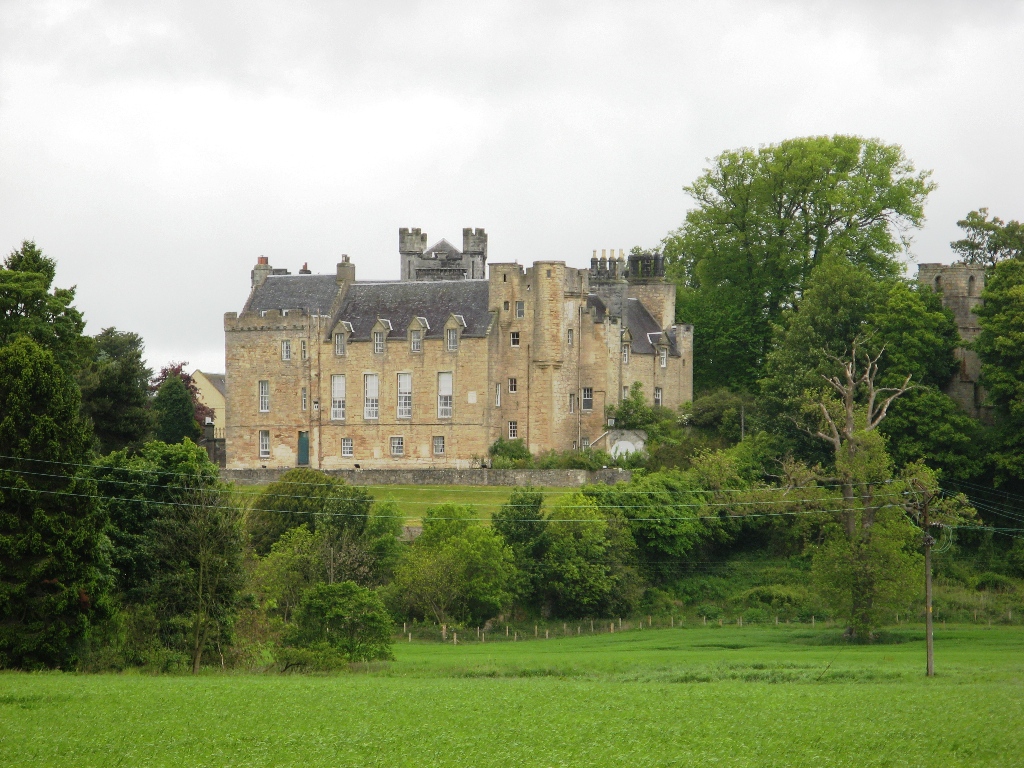
- Airth Castle stands on the Hill of Airth above the village and the River Forth, in the Falkirk area of Scotland.
- A timber fort stood here in the wars of independence, and the stone tower was rebuilt after a burning in 1488.
- The Bruces extended the house in the sixteenth century, and the Grahams added the castellated front in the early nineteenth century.
- The lands passed through the Erth, Livingston, Bruce, Elphinstone, and Graham families before the house opened as a hotel in 1971.
- The hotel closed on 14 March 2023, and a fire on 23 September 2024 destroyed parts of the former hotel buildings.
Visiting
Entry is not allowed. Visitors may not enter the former hotel building.
History
Airth Castle stands on the southern brow of the Hill of Airth, above the village and the carselands of the River Forth. The hill rises about 16 metres from the Pow of Airth and watches the old road north from Falkirk and a crossing of the estuary. The name is taken from the hill, and the place was a seat before any stone house stood there.
Finds of the Roman period on and around the hill, among them three terret rings, a lynch pin, a trumpet brooch, and a tankard handle, have been read as the belongings of a native leader. A schist lamp built into the old churchyard wall is a separate object, called an iron-age lamp in one caption and left without a period in the find note. A medieval sword pommel found north of the castle in 1997 belongs to the wars of independence, not to those earlier pieces.
In 1128 David I gave nearby lands to Holyrood Abbey, and late in the twelfth century Airth was a royal burgh under William the Lion. The church east of the castle, with early nave arcades and waterleaf capitals, is taken as the only stone building of that time. The castle was then timber, with a ditch and outer banks.
Alexander de Erth swore allegiance to Edward I in the Ragman Roll of 1296. William Wallace's victory at Stirling Bridge in September 1297 and his defeat at the Battle of Falkirk in July 1298 are the setting of the poem in which Blind Harry has him storm a wooden tower here to free a priest of Dunipace. A court record of 28 September 1300 shows a fight at Erthe, when Sir Henry le Tonk lost two horses, and it does not name Wallace.
The Erth family held the lands from Adam de Erth in 1248, and Fergus de Erth occupied the castle in 1309. Agnes of Airth brought it to the Livingstons around 1460, and Alexander Bruce took it over around 1470 and is credited with the Lady Aisle. One short account names the Falcones as owners instead of that succession.
After James III of Scotland was killed at the Battle of Sauchieburn on 11 June 1488, the place at Airth was burnt, and Robert Bruce received £100 Scots to rebuild it. The south-west block of 33 by 28 feet, later called the Wallace Tower, is that rebuilding. An eastward extension is placed early in the sixteenth century, in the mid-century, and around 1540.
Robert Bruce of Airth was killed at Flodden in 1513. Alexander Bruce, who succeeded in 1552, raised the north wing in 1581 under the inscription LAT THAIM SAY. On the last night of August 1581 his son Robert, later minister of St Giles and crowner of Anne of Denmark, described a crisis of conscience in the new chamber. Mary Bruce, a daughter of the laird, is named as a companion of Mary, Queen of Scots in England, which is not the same notice as Mary Livingston among the four Marys.
John Bruce's grant of 1597 made a free port and a burgh of barony, and debt brought a sale in 1619. The lands passed to the Earl of Linlithgow and in 1632 to the Earl of Menteith, who became Earl of Airth. Alexander Bruce bought them back with the fortune of Anna van Eck and had a crown charter in May 1648. He was abroad in 1651, when the war on the Carron passed Airth by, and he died in September 1665, though a transcribed slab says 15 September 1642.
Jean Bruce and Richard Elphinstone held the house, and then Elizabeth and Sir William Dundas, who was imprisoned after the Jacobite rising of 1715. The estate was sold in 1717 to James Graham, Judge Admiral of Scotland, and one account places the sale on Alexander's daughter. Graham repaired the towers, built the stables and the gateway of 1723, and took a garden plan from William Boutcher in 1721 that was not fully made. A design by William Adam was not built.
In 1745 and 1746 Jacobite officers used the castle, ships on the stocks at Airth were burned, and cannon crossed the Forth toward Stirling. The Battle of Falkirk Muir, on 17 January 1746, was a narrow Jacobite victory that was not followed up. The judge's son was attainted and died in Paris, and William Graham succeeded his father on 5 November 1746.
Thomas Graham cleared the old feus of High Airth and filled the open side of the L with David Hamilton's castellated front of 1807, with William Stirling on site. The parish worship moved to a new church finished in 1820, and the medieval ruin stayed in the grounds. The Grahams let the house in the later nineteenth century.
Robert McLaren was a tenant, A. F. C. Forrester bought the estate in 1935, and the house opened as a hotel in 1971.
The hotel company, formed in 2004, ceased trading at midday on 14 March 2023, described both as administration and as voluntary liquidation. A wilful fire in the early hours of 23 September 2024 destroyed parts of the empty buildings. The castle has been a Category A listed building since 25 October 1972, and the church ruin was scheduled on 30 March 1962. No excavation of the castle interior is reported, and the ghost stories of a nanny, children, a maid, a dog, and a groundsman are hotel lore rather than dated deaths.
Images




Detailed History
Airth Castle stands on the southern brow of the Hill of Airth, above the village of Airth and the flat carselands of the River Forth, in the Falkirk area of Scotland. The hill rises about 16 metres from the Pow of Airth, the burn that marks the northern end of the carse. From the brow the house looks south over the route that once ran north from Falkirk, across the River Carron, and on toward Stirling, and it also looks toward a crossing of the Forth estuary. A narrow coastal strip runs east of the hill to a point where ships could be beached, and the late medieval burgh was planted at the waist of that strip after an earlier settlement on the hill itself.
The name Airth is explained as coming from the hill, with a Celtic word for a height behind it. A later letting notice placed the house about 100 feet above the sea and about a mile from the Forth, with woods and shrubberies of about 36 acres, and it called the view one of the Ochil and Highland hills and of the valley of the Forth.
The hill was a seat before the stone castle. Over the two decades before a 2020 account, several objects of the Roman period were found on and around the Hill of Airth, and that account reads them as signs that a native leader lived there both before and after the Roman invasion. The fertile carse was worked alongside the shore, with fishing, oysters, and wildfowl. Chariot fittings from the hill are given as three terret rings, one of them enamelled, and a lynch pin, together with a trumpet brooch and a tankard handle.
An enamelled brooch and a lead weight are placed nearby rather than in that same group. A plain stone lamp of schist, with a short handle and a circular depression 86 millimetres across, was found while the old parish church graveyard was being tidied. It is broken diagonally across the bowl and had been built into the western boundary wall of the graveyard. A caption calls an iron-age stone lamp a find from the Hill of Airth, while the graveyard note does not assign the schist lamp to a period.
These objects are not the same thing as the medieval sword furniture found later beside the castle, and they are not the finds from Torwood, Dunipace, Camelon, or the temple remembered as Arthur's Oven.
In 1128 lands nearby were given by David I to Holyrood Abbey at its foundation. The bridge that carried the main road over the Pow became known as the Abbeytown Bridge, and the road climbed from that bridge to the castle and then ran north along the ridge as the main street of the village. Toward the end of the twelfth century, in the reign of William the Lion, the settlement was raised to a royal burgh. It then lay on the plateau immediately north of the castle, with the parish church to the east.
The early arcading of the nave, and the carved waterleaf capitals of the columns, are taken as signs that the burgh was wealthy and that the church was, for a time, the only stone building in the parish. The castle of that period is described as timber, with outer earthworks and a large ditch.
The political world that later put an English garrison on this height began when Alexander III died on 19 March 1286 after a fall from his horse. His heir was his granddaughter Margaret, the Maid of Norway, still a child. She sickened on the voyage to Scotland and died in Orkney in late September 1290. Thirteen claimants then competed in the dispute called the Great Cause.
The strongest claims in law were those of John Balliol and of Robert Bruce, grandfather of the later king Robert the Bruce. Edward I of England was invited to arbitrate, and he required the competitors to recognise him as Lord Paramount of Scotland. In early November 1292, at Berwick-upon-Tweed, judgment went to John Balliol. After a Scottish treaty with France, Edward I invaded, stormed Berwick, and defeated the Scots at Dunbar.
Dunbar Castle fell on 27 April 1296. John abdicated at Stracathro near Montrose on 10 July 1296, and the arms of Scotland were torn from his surcoat, the insult remembered in the name Toom Tabard. Edward's officers were told to take homage from some 1,800 Scottish nobles. Alexander de Erth, then lord of Airth, was listed in the Ragman Roll of 1296 among those who swore allegiance to Edward I.
Sir William Wallace, born about 1270, was a knight of the lesser nobility and one of the leaders of the First War of Scottish Independence. His own seal, on a letter of 1297 to Lübeck, names his father as Alan Wallace. Blind Harry's later poem instead gives him a father called Sir Malcolm of Elderslie. There is no contemporary evidence that fixes his birthplace at either Ellerslie near Kilmarnock or Elderslie in Renfrewshire.
The first act securely tied to him is the killing of William de Heselrig, the English sheriff of Lanark, in May 1297, followed by a raid on Scone with William the Hardy, Lord of Douglas. On 11 September 1297 Wallace and Andrew Moray defeated a larger English army at the Battle of Stirling Bridge. Surrey's force is given as 3,000 cavalry and 8,000 to 10,000 infantry. The narrow bridge let only a few men cross abreast.
The Scots waited until part of the army was over, then drove it back so that the bridge collapsed and many English soldiers drowned. Moray died of his wounds later in 1297. Wallace and Moray had taken the title of Guardians of the kingdom on behalf of John Balliol.
In April 1298 Edward I ordered a second invasion. Two days before the battle, 25,781 foot soldiers were paid, more than half of them Welsh, and the cavalry is estimated at about 1,500 horses. The English plundered Lothian and took some castles, while the Scots shadowed them and avoided a fight. In July, as Edward planned a return to Edinburgh for supplies, he learned that the Scots were camped near Falkirk and forced the battle he wanted.
Wallace was defeated at the Battle of Falkirk in July 1298. By September 1298 he had resigned the guardianship in favour of Robert the Bruce, Earl of Carrick, and John Comyn, nephew of John Balliol. One account of that appointment also names William Lamberton, Bishop of St Andrews, beside them. Robert the Bruce resigned the guardianship in 1300 amid his quarrel with Comyn.
Wallace stayed free until 5 August 1305, when John de Menteith handed him to English soldiers at Robroyston, near Glasgow. On 23 August 1305 he was hanged, drawn, and quartered at Smithfield in London. His head was set on London Bridge, and his limbs were sent to Newcastle, Berwick, Stirling, and Perth.
Blind Harry, also called Harry, Hary, or Henry the Minstrel, lived from about 1440 to 1492. He is remembered as the author of the long poem on Wallace, written around 1477 in one account and around 1470 in another, more than a century and a half after Wallace's death. Treasurer's accounts from 1473 to 1492 record payments to him at the court of James IV, and a payment on 2 January 1492 is tied to a ballad sung with two Gaelic harpers. William Dunbar named him in the Lament for the Makaris, and John Major wrote about him in 1518.
Those notices differ on whether he was blind from birth. He claimed a book by Father John Blair, described as Wallace's chaplain, which has not been seen in modern times and may never have existed. The poem is now widely read as a versified historical novel, written in a period of strong anti-English feeling, and some of its battles, including a Loudoun Hill of 1296, a Biggar of 1297, and possibly Elcho Park, are treated as unhistorical. The genuine Battle of Loudoun Hill belongs to Robert the Bruce, not to that story.
The earliest manuscript was written in 1488 by John Ramsay. A translation by William Hamilton of Gilbertfield, published in 1722, carried the poem to later readers.
The poem's Airth episode is the source of the story that, in 1298, William Wallace attacked a previous wooden fortification on this site to free his uncle, a priest of Dunipace. In the telling, after the victory at Stirling Bridge the English recovered and garrisoned strong points. Airth was held by about a hundred men under Thomlyn of Ware, also written Thomlyn de Ware. Wallace, with about fifty men, among them Jop, Kerlie, and Steven of Ireland, was in the Perth area and needed to reach Dumbarton.
An English garrison at Stirling blocked the direct road, so he crossed the Ochil Hills and came to the north bank of the Forth near Airth. Jop seized a fisherman of Airth and a lad. The fisherman said he had been forced to swear loyalty to Thomlyn and to work for him. He ferried Wallace's men to the south shore, and the boat was then broken up.
They crossed the moss to the Torwood, where a widow told Wallace that his uncle was a prisoner in Airth Tower. Wallace swore to free him by noon the next day. The fisherman warned that the tower was ringed by ditches of stagnant water, then led the party by the ditches, round the back, and over a bridge into the hall as the garrison rose from supper. Wallace is said to have killed Thomlyn with a blow through the head and neck.
The poem has the Scots hold the door, kill the whole garrison of about a hundred, and find the priest bound in iron in a water-floored cave under the tower. The English dead are thrown into the ditches. Women and children are shut in the cave. Wallace stays a second night, with Steven of Ireland and Kerlie on watch, then leaves for the Torwood and Dumbarton, and a servant later releases the prisoners.
The poem does not say that Wallace slighted the tower. Historians treat this rescue as one of the episodes that cannot be corroborated from a contemporary record, even while the wider wars it sits inside are historical.
A separate English court record of 1300 shows that there was fighting at Airth. Sir Henry le Tonk sought compensation for his black warhorse and for the white horse of his squire, lost in the fight with the Scots at Erthe on 28 September. That date is not the poem's raid, and the record does not name Wallace or Thomlyn of Ware. A wheel pommel from a medieval sword was found a short distance north of the castle by a metal detectorist in 1997 and is now in Falkirk Museum.
A caption also calls a sword pommel from Airth a thirteenth-century object. Silver long-cross pennies of the period are described as relatively common finds in the general area.
The owners in the thirteenth century were the Erth family. Adam de Erth, in 1248, held considerable lands in Stirlingshire, later divided into Airth, Elphinstone, Carnock, and Plean. Fergus de Erth, a kinsman of Alexander, occupied Airth Castle in 1309. The last of that family to hold the castle is given as Agnes, daughter of William Airth, in the years after the 1420s.
By a second marriage, to John Livingston of Manerston, the property passed to the Livingstons around 1460. It did not stay with them long. The Bruces of Stenhouse had been buying land nearby for decades, first from Holyrood, and around 1470 the castle was taken over by Alexander Bruce. He is credited with the Lady Aisle on the south side of the church, with an exterior niche for a statue, an ornamental canopy, and a bracket carved with a shield: a saltire for Bruce, and on a chief two mullets.
The skewputs also carry saltires. One short account says the castle was owned by the Falcones. The succession traced through the parish names the Erth family, the Livingstons, the Bruces, the Elphinstones, and the Grahams, and does not place a Falcones ownership in that line.
James III of Scotland was king from 1460 until his death on 11 June 1488. He came to the throne as a child after James II was killed at the siege of Roxburgh, and his personal rule began in 1469. His marriage to Margaret of Denmark brought Orkney and Shetland to the crown. He was criticised for favourites, for debasing the coinage, for neglecting justice ayres, and for an unpopular English alliance.
In 1482 his brother Alexander, Duke of Albany, joined an English invasion under Richard, Duke of Gloucester. James was seized at Lauder Bridge, held in Edinburgh Castle, and later recovered power. Albany's further attempts failed. In January 1488 James used a parliament to reward loyalists and to raise his second son, James, Marquess of Ormond, to Duke of Ross, which deepened the fear that the heir was being set aside.
On 2 February 1488 the fifteen-year-old James, Duke of Rothesay, left Stirling Castle without his father's knowledge. The rebels, led by the earls of Angus and Argyll and by the Home and Hepburn families, took the prince as their figurehead. Their aim is described as a council of regency, with the king in protective custody, not necessarily his death. James III broke a promise to negotiate, lost supporters including Huntly, Erroll, Marischal, and Glamis to neutrality, failed to catch the prince at Linlithgow, and used Blackness as a base before returning to Edinburgh.
On 10 June he surprised the rebels at Stirling and drove them south. On 11 June 1488 the armies met at the Battle of Sauchieburn, on the side of the Sauchie Burn about two miles south of Stirling, a field contemporaries called the field of Stirling. James carried a sword said to have belonged to Robert the Bruce. Dr John Ireland heard his confession, and the advocate John Ross of Montgrenan arrayed the royal army.
The Battle of Sauchieburn went against the royalists. Alexander Cunningham, Earl of Glencairn, and Sir Thomas Sempill of Eliotston were killed, and Roger Grierson of Lag was fatally wounded. Royalist names also include the Earl of Menteith, David Lindsay, Lord Erskine, Lord Graham, Lord Maxwell, Sir William Ruthven, and William Douglas of Cavers, with troops largely from the north and from the burghs. The rebel side included Alexander Home, the Earl of Angus, the Earl of Bothwell, Lord Gray, and Hugh Montgomerie, with troops from East Lothian, the Merse, Galloway, and the borders.
James III was killed in the course of the battle. There is no contemporary evidence for the later stories that he fled, that a grey horse given by David Lindsay threw him, or that an assassin dressed as a priest stabbed him at Milltown near Bannockburn. A parliamentary account said only that the king happened to be slain. A later indictment of John Ross said the king left the field on Ross's advice and was killed by unknown persons.
A chest of gold coins and the sword associated with Robert the Bruce were recovered, one account says from the field by Walter Simpson, and another places that recovery in 1489. The Duke of Rothesay was crowned at Scone at the end of June and reigned as James IV. He is said to have worn an iron belt in penance, adding weight each year. James III was buried at Cambuskenneth Abbey beside Margaret of Denmark.
From 1496 James IV appointed a chaplain to sing for their souls. In 1865 their remains were reburied under a new monument.
In the same year, 1488, a castle at Airth was burnt or destroyed after that defeat, and Robert Bruce of Airth was given money toward rebuilding. A precept of that year was made out to Rob Bruss of Ertht for the building of his place that was burnt, and the sum is given as £100 Scots. The building that burned is thought to have been timber, because the tower that replaced it is typical of the late fifteenth century. That tower, the south-west block, measures 33 feet by 28 feet.
It is low and squat, with a basement, two main floors, and an attic set back behind a parapet walk. The crenellated parapet sits on a single continuous corbel course with water spouts, and a small turret may have stood at the south-east angle of the wall-head. The basement was probably vaulted. The main door was at ground level on the north, with a spiral stair in the north-east corner.
The hall occupied the first floor, and a mural chamber in the south-east served as a garderobe. This block became known as the Wallace Tower. By a coincidence, the earliest known manuscript of Blind Harry's poem dates to 1488, the year of the rebuild. The stair was being called Wallace's Stair by the time a modern Scots version of the poem was printed in 1722, and probably after that printing.
An eastward extension is placed early in the sixteenth century in one architectural account, in the mid-sixteenth century in another, and around 1540 in the room-by-room description of the house.
Also in 1488 the sergeant of Stirlingshire was relieved of sums he would normally have collected for the ferry and the fishing cruives at Airth. The relief lasted until at least 1492 and has been tied to siltation of the coast rather than only to the burning. In 1505 a royal dockyard was set up at Higgin's Neuk, a short-lived boost. In the reign of James IV the harbour at the Pow is also described as a royal dockyard where the ships Margaret and James, and possibly the Great Michael, were refitted with oak brought from the Torwood.
In 1513 the battle of Flodden led to the sale of the Scottish fleet. Robert Bruce of Airth, grandson of Alexander and the man who had succeeded around 1489, was killed at Flodden. He was followed by his son, also Robert. The owner list that places "killed at Flodden" beside the year 1489 is recording that later death against the grandson's succession, not a second battle in 1489.
Around 1540 the tower was extended eastward in a three-storey block with a steep roof, slightly lower than the old tower, which has an attic. Along the basement a corridor ran the length of the new work and opened into three barrel-vaulted chambers on the south. The central chamber was the narrowest and may have had a door onto the terrace. The eastern chamber was the kitchen, with a large fireplace in an arched opening and a small turnpike stair on its south, so that food could be carried up to an ante-room and then into a lofty hall.
The large windows in that hall are early nineteenth-century insertions. Originally there were two smaller openings with roll-moulded margins. New doorways were broken through the east wall of the tower so the floors could meet, despite a slight difference in level. The main entrance faced north onto a courtyard.
A square stair tower at the south-east corner, finished with a round turret, belongs to the developed house.
The Bruces of Airth reached a high point under Alexander Bruce, who succeeded his father in 1552. His wife was Janet, daughter of Alexander Livingston. An inscription on the north wing says he built that wing in 1581. The panel, with deltoid ends, sits in the west wall of the wing just south of the new main door, at the re-entrant angle, and reads LAT THAIM SAY 1581.
The wing is two storeys, running north from the east end of the earlier house and making an L. Its basement repeats the corridor plan: a segmental barrel vault along the court, and three barrel-vaulted rooms to the east. The northern room, with a massive fireplace, became the kitchen and replaced the kitchen of about forty years earlier. The principal floor held an inner bedchamber to the north and a reception room to the south.
Two ornate dormers overlook the churchyard to the east. Their pediments have a roll and a deeply undercut cavetto, on a cornice and bracketed corbels. The finials are gone. The south tympanum has conventional stem foliage.
The north has strapwork with the Bruce mullet and a fleur-de-lys at the apex. In the lowest courses the mullets have only four points. The gables probably ended in crowsteps and were given mock battlements in the nineteenth century.
A stair tower in the re-entrant angle tied the old and new ranges together and rose above their wall-heads. A corbelled turret on the outer angle ran through two storeys and once had a conical roof on a moulded eaves course. That roof was removed sometime after 1960. A shorter turret in the other re-entrant was later altered, its curved west wall rebuilt straight and flush with the tower below, probably in the early nineteenth-century work.
The parapet is roll-moulded, on a double corbel course with a cavetto drip, and it curves into open semi-turrets with gun loops, some of them twin-holed, and cannon gargoyles. The stair is broad for the first two floors and then a smaller turnpike in the south-east turret. On the third floor a small chamber has a garderobe in the north-east angle and a study in the south-west turret. Pont's map of about 1590 shows the south front with the 1581 tower at the right.
Two estate plans, one dated 1721, show a balancing wing at the west end of the main block, running north from the old tower. If it stood, it had gone by the mid-eighteenth century, because a plan of 1762 shows an L. A carved armorial later associated with a grander west entrance may have belonged to that lost wing.
In the new loft chamber of that tower, on the last night of August 1581, Alexander's second son, Robert Bruce, went through the crisis he later described. He had been born in 1554. In 1572 he graduated from St Andrews and then studied law in Paris. His father infefted him in Kinnaird.
He wrote that for at least ten years his conscience accused him whenever he mounted or dismounted a horse, and that on that August night, awake in the new chamber, his sins were set before him with time, place, and persons, until the same night turned, as he put it, from a court of justice into a court of mercy, and he was able to rise in the morning. His mother insisted that he renounce the estate, and he did. He studied under Andrew Melville, was licensed by the presbytery of St Andrews in 1587, and became minister of St Giles in Edinburgh. In February 1588 he was moderator of the General Assembly called to prepare against a possible Spanish invasion.
In October 1589 James VI made him a privy councillor. When the king went to Norway to bring home Anne of Denmark, Robert was one of those left in charge. James VI later wrote that he was worth the quarter of his kingdom. On 17 March 1590 Robert Bruce crowned the queen.
In 1596 he was banished from Edinburgh for opposing the king's religious policy. In August 1600, after the Gowrie affair, he was among those who doubted that the threat had been real, and he would not offer the thanksgiving the king required. He was banished from Edinburgh and forbidden to preach in public in Scotland on pain of death. He left Airth Castle on 8 October 1600, went abroad, and later settled at Inverness and then at Kinnaird.
He restored the church at Larbert and preached to large crowds. He died at Kinnaird in August 1631 and was buried in Larbert churchyard. This Robert Bruce is not King Robert the Bruce. An inscription for a later Alexander Bruce of Airth claims that the barons of Airth descended from a second son of Robert Bruce, king of Scots.
That is the claim cut on the stone.
Mary, Queen of Scots, was born on 8 December 1542 at Linlithgow Palace, the only surviving legitimate child of James V and Mary of Guise, and she became queen six days later when her father died. She grew up in France, with the four girls called the four Marys, daughters of the families of Beaton, Seton, Fleming, and Livingston. She married the Dauphin in April 1558. He died in 1560.
She returned to a Scotland divided between Catholic and Protestant lords, refused to ratify the Treaty of Edinburgh, and in 1565 married Henry Stuart, Lord Darnley. Their son was the future James VI. Darnley was murdered in February 1567 after the explosion at Kirk o' Field. Mary married the Earl of Bothwell, was imprisoned in Lochleven Castle, and abdicated on 24 July 1567 in favour of her infant son.
She escaped on 2 May 1568, lost the Battle of Langside on 13 May, and crossed into England on 16 May, landing at Workington. Elizabeth I kept her in castles and manor houses in the interior of England for eighteen and a half years. In 1586 she was found guilty of plotting Elizabeth's assassination, and in 1587 she was beheaded at Fotheringhay Castle. Mary Bruce, a daughter of the laird of Airth, is named as a companion of Mary, Queen of Scots in England.
That notice is not the same statement as the genealogy that makes Mary Livingston, sister of Janet Livingston who married Alexander Bruce of Airth, one of the four Marys in the queen's youth. The two names are not collapsed into one person here. Janet's sister Mary Livingston married Sempill of Beltrees, and their son later spoke for the minister Robert Bruce.
Alexander Bruce of Airth died on 16 March 1600. The estate went to his grandson John, who had been served with the lands of Airth in 1597. A royal grant of that settlement lists the Hill of Airth with coals and fishings, an oxgang called Roishill, pieces called the Mylneholme, the Reidcruik, and the Cruikis or Dokkis, an oxgang in Powknaif, salmon and grilse in the Forth and the Pow, and the right to draw nets on the Dokkis. It erected a free port of Airth, with power to build a mill and a saltpan, to keep the ferry, and to take haven silver, customs, and anchorage.
It also erected the town as a free burgh of barony, with baillies, a market cross, a weekly market, and two free fairs, on 24 July and 8 October. Airth received that status three years before Falkirk. Coal, fish, and salt were exported through the port, and the mill, the ferry, and the farms employed the rest. Within about two decades John Bruce's debts forced a sale.
The Earl of Linlithgow bought the lands in 1619. In 1632 they were sold to the Earl of Menteith and Strathearn, who the next year had them erected into a free earldom and took the title Earl of Airth. He too overreached, and the lands were sold again. One account compresses the buyers as the Livingstons and then, in 1632, the Menteith family, also written Mentieth.
The church gained an Elphinstone burial aisle on the south-west in 1591, and in 1614 a Bruce aisle on the north for the Bruces of Powfoulis. The Lady Aisle, by then called the Airth Aisle, is presumed to have been the burial place of the Bruces of Airth. The mill of Airth is first noticed in 1618, in the hands of Lord John Bruce. For much of the seventeenth century the Logan family occupied it.
Its weir lay on the Pow west of the castle, and the lade ran along the foot of the hill.
John's eldest son, Alexander Bruce, served as a soldier under Prince Rupert in Germany and in 1635 was commissioned captain in Holland. There he married Anna van Eck, a wealthy heiress. With part of her fortune he bought back the lands and barony and received a crown charter in May 1648. A right of redemption is assumed to have been reserved in the 1619 sale.
He remained abroad through the campaigns of 1650 and 1651. In September 1650 the Scots army fighting for the king was defeated at Dunbar. The siege of Callendar House and a skirmish at Larbert Bridge followed. The Scots held a line on the north side of the Carron, with rearward points at Torwood Castle, Letham House, and Airth Castle, and the port was covered against a landing.
Cromwell crossed the Forth at Inverkeithing and turned the line, so Airth saw no action. Alexander came home in May 1665 and died that September, called the last of the Bruces of Airth. A black marble slab, missing by the end of the nineteenth century, was transcribed with a date that may be wrong. The Latin is rendered as a death on 15 September 1642 at the age of 56, after 43 years in Flanders and then royal service in England, and it claims descent from the second son of Robert the Bruce.
The narrative and the later vault give 1665 for this Alexander. Both dates are left standing because the transcription itself warns that the year may be incorrect. His original grave is thought to have been on the south side of the churchyard, opposite the Lady Aisle, where a retaining wall 2.45 metres long rose to a cavetto coping at 1 metre and held an armorial with woodhouse supporters, a saltire and a mullet, the initials A.B., and symbols of mortality. The Logan family reused that wall in 1773.
Anna van Eck died in 1673. Their only daughter, Jean or Jane Bruce, had married Richard Elphinstone of Calderhall. Anna is buried at the church. A vault under the Airth Aisle, reached by eleven steps and measuring 17 feet 3 inches by 8 feet 6 inches, was cut with the names Alexander Bruce of Airth, 1665; Anna Vanaeck, Lady of Airth, 1673; Jane Bruce, Lady Airth, died 20 March 1683; and Richard Elphinstone, laird of Airth, died 27 June 1683.
The letters R.E. and I.B. and the date 1682 flank the doorway. Richard and Jane appear to have moved her parents into that vault. In the nineteenth century the remains were moved again, into the Graham tomb north of the later parish church in Graham Terrace. When a new front was put on the castle in 1807, the armorial from above the old entrance was taken to the stable block.
Only in 2006 was it set into a wall inside the castle. It measures 3 feet 6 inches by 3 feet. The shield is quarterly: a chevron between three boars' heads erased, for Elphinstone, and a saltire and chief with a mullet, for Bruce. A griffin crest is worn.
The initials are read as R.E. and I.B. A visitor around 1820 was told that the date 1581 and the arms of Bruce and Elphinstone had stood together over the old door. That report mixes two stones, and perhaps two doorways.
On 27 September 1683 Charles Elphinstone succeeded his father in the barony. The town had split into Low Airth, or Laigh Airth, by the harbour, where ships were built, and High Airth on the hill. In 1697 Charles set up a new market cross in the Low Town, with his initials and arms, his parents' quartered arms, sundials, and the date 1697. Another sundial stood on the middle terrace south of the castle.
Its head is 1 foot 4 inches square and 1 foot 9 inches high, on a modern base, the whole 3 feet 5 inches. The south face is dated 1690. The north face has the Elphinstone shield and the mottoes Floret qui vigilat and Sic transit gloria mundi. A brass dial on top reads Hora fugit.
Its present place is unknown. Charles was killed in a duel at Torwood with his relative Captain William Bruce of Auchenbowie. His sister Elizabeth, Lady Airth, succeeded. She married Sir William Dundas of Blair, who took the surname Elphinstone.
He backed the Jacobite cause in 1715, was captured, and was imprisoned in London. On his release the couple sold Airth. In 1717 James Graham, an advocate, bought it. Another account says that Alexander Bruce's daughter, having backed the losing side, was forced to sell in 1717, two years after the rising.
The castle history names Elizabeth and her husband as the sellers.
The Jacobite rising of 1715 was an attempt by James Francis Edward Stuart, son of the deposed James II, to recover the thrones of England, Scotland, and Ireland. The Earl of Mar raised his standard at Braemar on 6 September 1715. His force, put at nearly 20,000, took Scotland north of the Forth except Stirling Castle, then met the Duke of Argyll at Sheriffmuir on 13 November. The fight was indecisive.
The next day a Jacobite force was beaten at Preston. James landed at Peterhead on 22 December, reached Perth on 9 January 1716 with fewer than 5,000 men, and sailed from Montrose on 5 February. Parliament had allowed Jacobite lands to be seized. The Airth sale sits in that aftermath, in 1717, whether the imprisoned husband or the daughter is placed at the centre of it.
James Graham had studied law at Louvain, became an advocate in Edinburgh, and in 1702 was made Judge Admiral of Scotland by the Duke of Lennox, the hereditary Lord High Admiral. His court heard maritime cases. His first wife, Marion Hamilton, died, and he married Lady Mary Livingstone, daughter of Alexander, third Earl of Callendar. He spent heavily on the house, beginning with the roofs.
The south-east stair tower, called the New Tower, was re-leaded, and James Baird, mason, later rebuilt part of its parapet. The old tower was re-slated and the walls were harled. A range of offices rose north-west of the castle. In 1718 work began on a stable and coach house about 50 metres west-north-west of the castle, above the western approach.
A courtyard open on the south had two-storey ranges on the other three sides. The coach house, in the centre, has a piended roof with bellcast eaves, three arched coach openings, and five windows above. The upper room, 12.9 by 5.2 metres, was a banqueting room, reached by a sweeping twin-flight forestair from the lime avenue to a balconied landing. James Hart and John Beg, masons in Falkirk, James Baird and James Logan, masons in Airth, and Robert Leven, plasterer, were among the men employed.
The gateway at the head of the western avenue, four pillars with curving balustraded screens and oval finials carved with festoons, was finished in 1723, when the gate was hung. The Abbeytown Bridge was rebuilt with a single arch of 25 feet span, and a panel in the east parapet reads that it was founded upon wood and rebuilt by the shire in 1726.
The grounds were terraced. The old brewhouse was demolished. A bowling green or outer court was made north of the castle. In 1726 William Gun and Thomas Bowie, quarriers, were paid for stone, kiln walls, and sand behind the terrace dykes on the south slope.
The 1690 sundial was set in an alcove on the middle terrace. Three designs were drawn for the flat ground out to the Pow, with ponds fed from the mill lade. One, dated 1721, is by William Boutcher, also written William Boutchart. Its caption calls it an exact plan of Airth, the seat of James Graham, Admiral of Scotland, surveyed on 1 August and drawn at Edinburgh on 10 September 1721.
It shows the church, the castle, the three terraces, and the western Pow correctly, but not the new stables, and it would have needed the eastern Pow to be diverted, which did not happen. It is therefore read as a proposal, partly geometric and partly wilderness, not as a garden that was fully built. Another design of about 1730 shows a baroque pond, a raised lawn with an obelisk, a bastion, and lodges by the west gate. The lodges were never built.
The gateway may have been moved. A design by William Adam for a large addition to the house was not executed. In the 1730s rooms were added at the coach house, including a library for the judge, a room for his wife, and a Red Room, with an open colonnade to the west. Stone came from Elphinstone, hearthstones from Longannet, and lime from Torphichen.
From the house in 1722, Johnston of Kirkland said that fifteen shires could be seen, and the castles of Stirling, Castle Campbell, Edinburgh, Blackness, and Bruce Castle. A north-south vista west of the geometric garden lined up toward Callendar House and still showed on maps of the 1750s and on an aerial photograph of 1950. The washhouse by the lade was re-thatched in 1730. A copper boiler marked J.M. 1747 was still being repaired in 1857.
On 14 September 1745 the Highland army of Charles Edward Stuart walked through Torwood toward Callendar House. That night James Graham, the judge's son, went to Callendar House meaning to join. He was told to wait. After the Jacobite victory at Prestonpans he went, and his servant with him.
The judge was sympathetic but left Edinburgh and would not take the field. On 4 December 1745 he wrote to the Lord Justice Clerk that he had not been asked to act, that his son's step would be blamed on him, and that he wanted company at Airth. Lord Elcho, once briefly engaged to the judge's younger daughter Lady Mary, who had married Thomas Dundas of Fingask, returned with the Jacobite army at the start of January 1746 and stayed at Kersie Mains. His cavalry were at Dunmore.
Pitsligo's Horse occupied the town of Airth. Officers dined in the castle. The government tried to stop Jacobite cannon crossing the Forth here, burned ships that were building on the stocks at Airth, and disputed the crossing. The cannon still got over and went to the siege of Stirling Castle.
The Battle of Falkirk Muir was fought near Falkirk on 17 January 1746, during the Jacobite rising of 1745. After the retreat from Derby, the Jacobite army besieged Stirling Castle from 8 January. The garrison under William Blakeney numbered about 600 to 700. Henry Hawley sent John Huske ahead with 4,000 men and followed with 3,000.
They camped outside Falkirk on 15 January. On the 17th, in failing light and heavy snow, the Jacobites attacked. Hawley's left was routed and his right held. Both sides thought they had lost, and the Jacobites did not follow up.
Hawley was replaced by the Duke of Cumberland, who advanced again on 30 January. The rising ended at Culloden in April. At Airth, Judge Graham still did not declare for the prince. James Graham the younger was attainted and fled.
He died at the Scots College in Paris, where he held the rank of colonel. The judge died on 5 November 1746 and was succeeded by his second surviving son, William. The judge's law library was moved into the castle and remained there into the 1950s. In 1748 the cherry yard, the orchards, the fir walk, and the terrace banks south of the house were let for four years at £25 a year.
The tenant could use three rooms called the Cullinades, west of the library, for fruit and for one manservant, but not for a family, and cattle were kept off the terraces.
Around 1770 the old walled garden beside the castle was demolished and a new one built at the foot of the hill, 400 metres to the west. The old site became Old Garden Park, 2.54 acres. In 1789 the old orchard was grubbed up and a new one of 4.5 acres was planted beside the new garden. Fruit sales to the public that year came only to £5, the trees being called old.
William Graham subscribed to the 1775 Treatise on Forest Trees by William Butcher, son of the William Boutcher who had drawn the 1721 plan. In 1788 he told his sister Annie that the garden wall was capped and that she should list trees for it. In 1772 he had a second slab placed over the tomb of his kinsman Sir John de Graeme in Falkirk parish church, copying the older inscription. Sir John is said to have been killed covering William Wallace's retreat from the Battle of Falkirk in 1298.
That is a family link the Grahams claimed, not a second battle at Airth. In 1789 William announced that he would buy any old feus near the castle that could be had at reasonable rates. He died in 1790, before he could finish. His trustees bought for his son James.
Purchases from 1794 to 1824 included houses of Francis Anderson, Alexander Marshall, Alexander Watson, the Airth Friendly Society, Bethia or Bethua McNare, James Bauchop, William Logan's land for £600, Robert Adam, the Addisons, and John Boyd. In 1796 the trustees stopped the Friendly Society from building in the High Town and gave it a lease in the Low Town instead. Twelve years later Thomas Graham bought the society's house for £120 to serve as a schoolhouse in place of the old church. In 1824 the last parcel in the High Town was bought, and his lawyer toasted him as laird of the whole High Town of Airth.
The buildings were demolished. Their stone went into dykes and into the old quarries, and the ground on the hill was lowered. A straight tree-lined way, Black Avenue, was laid out. The Headless Cross, a sixteenth-century market cross topped by a plain sundial and once called the heidless croce, still stands on that avenue, though on the opposite side of the road from its former place.
In 1800 a new road was being built from Dalgrain near Grangemouth, over a new bridge on the Carron, through Skinflats to Airth Mill. The Grahams helped extend it to Low Airth, giving land, and it was finished in 1803. The old road, which had wandered up the hill to the church, was bought out and grubbed up. A deep cutting made a new drive from the turnpike to the church, and spare earth went into sea dykes.
In 1804 hedges and trees were planted along the old road to Abbeytown Bridge, and a lodge was later built south of the bridge near Waterslap. Thomas Graham, William's brother, had the estate by 1805. He commissioned David Hamilton of Glasgow to fill the triangular space on the north side between the two wings of the L. Hamilton's front is dated 1806 in the drawing collection and 1807 in the building accounts, and the ashlar facade is also placed in 1807 to 1809.
William Stirling, a relative and an architect, was on site and added much of the detail. A design by William Stirling for a large addition is separately noted as not executed, beside Hamilton's design of 1806. The new work is symmetrical Gothic, of finely droved grey ashlar, unlike the local brown rubble of the older ranges. Round towers of four storeys stand at the outer corners.
A broad centre bay rises as a battlemented rectangular tower, clasped by octagonal piers that become turrets with blind arrow slots. A single-storey porch has pointed arches, clustered shafts, an ornate balustrade with quatrefoils, Gothic sidelights, and a broad flight of steps. The straight bays have three large windows on each floor, hood-moulded on the upper floors. The entrance hall has a plaster groin vault and a Gothic niche.
A two-storey saloon in an angle of the old building is top-lit by a fan-shaped skylight, with a railed balcony and plaster rosettes. The old hall became the drawing room, the ante-room a morning room, and the dining room and a library sat in the new block. Marble chimneypieces were put into the old rooms. Seen from the north-west, this front hides the tower and the sixteenth-century extensions.
From other sides the earlier masonry remains visible. A visit in 1953 found the castle largely reconstructed and modern in appearance, with the original parts still discernible. The basement of the 1807 block is masked by terracing and contains three vaulted rooms off a sunken unroofed corridor. The central vault has a bread oven and, in one corner, a three-headed stone sculpture of hooded heads with large lentoid eyes, thought to have come from a structure demolished for the extension, perhaps the lost west wing.
Stirling also remade the stable roofs so that the side blocks gained southern gables, circular louvred openings, and a more symmetrical face. Before the house contract, in 1806, Thomas Graham had a provisional agreement from most of the heritors that the old church could be removed. David Hamilton and William Stirling were asked for plans in 1816. In 1817 the old church was condemned after a survey by Hamilton and William Burn.
Stirling's plans were approved. In 1818 Graham had the consent of three quarters of the heritors and of the Court of Session. He gave a site at the north end of the village, now Graham Terrace, contributed to the cost, and the new church was finished in 1820. Burials continued in the old churchyard.
In 1824 a young man carrying a relative's coffin collapsed and died, and his body was taken to the castle before the family collected it. Body-snatchers were active. A watch-house was built near the coffin entrance, and mortsafes were bought from the Carron ironworks. The Grahams bought or exchanged most of the lairs.
The church stone was unsuitable for the new building, so the roof was taken off, an unstable north-east aisle wall was removed, and the arcades were left as a picturesque ruin in the private grounds. The early eighteenth-century gateway was moved from the west avenue to the east approach on the new road. In 1995 it was widened and set again so that coaches could pass, and it still stands.
Thomas Graham of Airth and Strowan died at the castle on 1 July 1836. His son William married Elizabeth Anstruther of Thirdpart in January 1839, and their first daughter was born in Rome that November. While they were abroad, James Strange, formerly of the East India Company, lived in the house and died there in October 1840. The cleared hill became parkland and was let for grazing.
In 1857 eleven enclosures of old pasture were rouped at noon at the Airth gate. For about forty years Matthew Jarvie took the grazing for the cattle of Learmonth and Company, fleshers, and also a long lease of Dunmore Park. An ash called the Monarch, bound with iron hoops, was blown down in the storm of October 1860. A description of 1879 gives oaks, ashes, walnuts, chestnuts, and elms, bay, Portugal laurel, and holly on the old garden ruins, and a list of plants including feverfew, brittle bladder-fern, lords-and-ladies, water speedwell, and agrimony.
In the summer of 1859, during repairs, the only person living in the house was the coachman. He was attacked on Wallace's Stair by three burglars, struck one in the face, was kicked, and escaped to the gamekeeper. The thieves left with £5 and a pair of new black cloth trousers.
The portraits then in the house included James II of England as high admiral, his son the elder Stuart claimant, Clementina Sobieska, Charles Edward Stuart, the cardinal of York, the Marquis of Montrose, Lord Dundee who fell at Killiecrankie, Admiral Crichton, and the James Graham who went with the prince in 1745 and did not return. Other pictures were attributed to Teniers, Wouwerman, Titian, and John Donaldson of Alloa, with a Judith, a Mercury and Argus, and a Christ painted on wood with a letter ascribed to Publius Lentulus. An oak chest marked D and dated 1630 was supposed to have belonged to Claverhouse. Several of the Graham portraits later went to collections shown in Charlotte Square and in Gladstone's Land in Edinburgh, and some to the Scottish National Portrait Gallery.
The judge's library was eventually given to the Advocates' Library. Twenty-four unused rolls of Chinese wallpaper, painted with birds and flowers, were sold in London for £357 when the trustees cleared the house.
William Graham supported the Stirlingshire Volunteers, and meetings were held at the castle. The estate included Eastfield, 75 acres, and Waterslap, 73 acres. From 1860 his brother Robert gave the tenants an annual dinner at the Crown Hotel in Airth. The Airth and Bruce Castle Curling Club, later joined with Dunmore, used a pond at the north end of the village.
In 1873 the castle was advertised to let, furnished, from 1 July, with the garden and the shooting over upwards of 1,000 acres. The house was said to contain two large drawing rooms, one large dining room, a parlour, and 10 or 12 bedrooms. It was called about five miles from Falkirk and eight from Stirling. Colonel Thomas Philip Graham of the Scots Guards inherited in 1883.
Captain William Morier of the Scottish Rifles stayed for a time. Thomas died at Florence in 1898, leaving daughters Helen Christina and Agnes. Helen, the elder, held the estate in trust. Tenants included J.
Frederick Noble Graham, an East India merchant, in 1900, and Robert McLaren and his wife from 1906 at £120 a year. McLaren, senior partner of an iron-founding firm in Glasgow, kept a butler and a chauffeur. In 1907 a local antiquarian society saw in the dining room a portrait of Nelson receiving colours after the Battle of the Nile, painted by order of George III, given by Nelson to Lady Hamilton, and bought by McLaren's grandfather. A pheasantry stood just west of the terraces.
Coal on the hill itself was worked out, and the flooded old workings supplied the estate and the village at low pressure. Coal continued to the south-west at Letham.
In September 1913 Captain McLean landed a government biplane, number 272, in the parks near Airth Mill, on a flight from Irvine that had taken one hour and ten minutes. He stayed at the castle as McLaren's guest and flew on the next day. Crowds came, and the aircraft was guarded against souvenir hunters. The McLarens later moved to Blair Castle near Culross.
A 1916 advertisement offered the castle furnished, with shootings of fully 1,100 acres, five public rooms, a billiard room, 13 bedrooms and dressing rooms, two bathrooms, a garage, a seven-stalled stable, and houses for the gamekeeper, gardener, and chauffeur, lit in a later notice by acetylene gas. George S. Orr, chairman of Abbots Foundry, rented it from 1917 to 1923. Francis David Robertson Wyllie was a tenant in 1930.
In 1935 A. F. C. Forrester, a director of a firm that worked collieries near Bathgate, bought the castle and estate.
He and his wife Sybil acted as lairds of the village. He became a county councillor. In July 1938 the grounds opened for the Queen's Nurses, and in June 1943 a Wings for Victory fete drew over 600 people. Forrester commanded the Airth Home Guard, number 13 Platoon of D Company in the 3rd Stirlingshire Battalion, until June 1944.
They kept equipment on the estate, probably in the stables, formed up at the castle before dusk, and marched to pillboxes at Kincardine Bridge, whose protection was their charge. Sybil Forrester convened Red Cross work parties and served with the Women's Voluntary Service and the local savings group. Meetings were held at the castle. In 1971 the Forresters sold, and the house opened as a hotel.
The hotel grew. In 1984 the derelict stables and coach house were renovated for extra rooms. In the early 1990s a large eastward extension, designed by GCA Architects, made a new courtyard, and a conference block to the north enclosed the grand stair to the banqueting hall in a glass atrium. A gymnasium projects to the west.
Around the start of the present century the mature trees of Black Avenue were felled and a housing estate was built in the fields to either side. The Headless Cross was reset in a cobbled court. The operating company, Airth Castle Hotel and Spa, was formed in 2004 and did not own the building. A public copy of the hotel's former web address was stored on 12 February 2010 in the Wayback Machine, the digital archive of the web that opened for public use on 25 October 2001.
That saved page does not describe the medieval tower or the sixteenth-century wings. The owner is Airth Castle Limited. The hotel was a busy wedding venue. At midday on 14 March 2023 the operator ceased trading.
About 26 full-time staff, and a number of part-time staff, were made redundant. The company, incorporated in 2004, blamed an extended closure during the coronavirus pandemic and then rising energy costs, and said its debt had become unmanageable. The closure is described both as administration and as voluntary liquidation. The property owner said the hotel would not be sold because of the operating company's insolvency.
Couples with bookings were offered a refund or another venue owned by the company.
On 23 September 2024 a fire destroyed parts of the former hotel. Firefighters were called to a well-developed blaze in a two-storey derelict building. One account puts the call at about 1:00 in the morning, and another at about 1:40. Six appliances and a high-reach vehicle were sent.
There were no casualties. The fire was extinguished, and one crew remained to damp down. It was treated as wilful. In the months before, there had been reports of break-ins, vandalism, and people entering to take photographs.
Fencing was in place, and patrols were increased. The public instruction after the fire was that the building was extremely dangerous and that no one should enter. Parts of the hotel range lost their roof. One news account dates parts of the fabric to the fourteenth century, and another dates the hotel to the eighteenth century.
The measured early work remains the tower rebuilt after 1488, with sixteenth-century extensions and the early nineteenth-century front.
The castle was designated a Category A listed building on 25 October 1972. The listing description calls it sixteenth- and seventeenth-century, with an early nineteenth-century front by David Hamilton, and an older note says that it was then a hotel, empty of vandalism, with the grounds kept up. The ruins of the former parish church in the grounds were scheduled on 30 March 1962 as an ecclesiastical monument, for what the surviving medieval and later fabric can show of church building, worship, and material culture. The church is not the castle, though it stands in the same policies.
The castle itself is a listed house, not a scheduled fort. It is not one of the places inscribed together on the world-heritage list of prehistoric Orkney, nor a Roman frontier inscription. Stories told while it was a hotel speak of a nanny and two children said to have died in a fire, of children heard in rooms 3, 4, 9, and 23, of footsteps that stop outside room 14, of a maid said to have been attacked and left to die, of a dog said to bite ankles, and of a groundsman on the lower floor. Those are ghost stories attached to the rooms of the hotel, not a record of a dated fire or a named death.
No excavation of the castle interior is reported. The 1955 survey, the 1953 visit, the 1997 sword pommel, the graveyard lamp, and the Roman metalwork from the hill are the finds the published accounts actually describe.
Sources
- Airth Castle — Wikipedia
- William Wallace — Wikipedia
- Blind Harry — Wikipedia
- Battle of Sauchieburn — Wikipedia
- Mary, Queen of Scots — Wikipedia
- James III of Scotland — Wikipedia
- Jacobite rising of 1715 — Wikipedia
- Battle of Falkirk Muir — Wikipedia
- Robert the Bruce — Wikipedia
- Edward I — Wikipedia
- Wayback Machine — Wikipedia
- Airth Castle — Falkirk Local History Society
- Airth — Falkirk Local History Society
- Arthur's Oven — Falkirk Local History Society
- Airth Castle — Historic Environment Scotland
- Airth — Historic Environment Scotland
- Airth Castle — Historic Environment Scotland
- Airth Old Church — Historic Environment Scotland
- Job losses as Airth Castle Hotel wedding venue closes — BBC
- Deliberate fire destroys parts of former castle hotel — BBC
- Appeal for information following wilful fire in Airth — Police Scotland
- Airth Castle Hotel (old building) - geograph.org.uk - 202445.jpg — Wikimedia Commons
- Airth Castle Location.png — Wikimedia Commons
- Airth Castle.jpg — Wikimedia Commons
- Airth-Castle 1.jpg — Wikimedia Commons
- Airth Castle - geograph.org.uk - 199533.jpg — Wikimedia Commons
- Airth Castle Hotel - geograph.org.uk - 202446.jpg — Wikimedia Commons
- Airth Castle Hotel - geograph.org.uk - 1309839.jpg — Wikimedia Commons
- MA(1829) p.304 - Airth Castle - John Preston Neale.jpg — Wikimedia Commons
- Airth castle - panoramio.jpg — Wikimedia Commons
- Henry Wallis - Airth Castle, Stirlingshire, page 4 (Volume One) - B1974.12.814 - Yale Center for British Art.jpg — Wikimedia Commons