

Aberystwyth, United Kingdom · 1277 CE · United Kingdom
- Aberystwyth Castle is a ruined concentric fortress on the town headland, begun in 1277 and finished or stopped in 1289, on a lozenge about 80 by 45 metres.
- It replaced a motte about a mile south at Tan-y-Castell, burned in 1136 and taken by Llywelyn the Great in 1221.
- The unfinished stone castle was burned in 1282, then held through the siege of 1294 to 1295 because ships could supply it from Ireland.
- Owain Glyndŵr held it from 1403 or 1404 until the English recovery of 1408 or 1409, and from 1637 the hall was a mint for local silver.
- The walls were slighted in 1645 to 1646 or in 1649, and the ruin now stands in a public park.
History
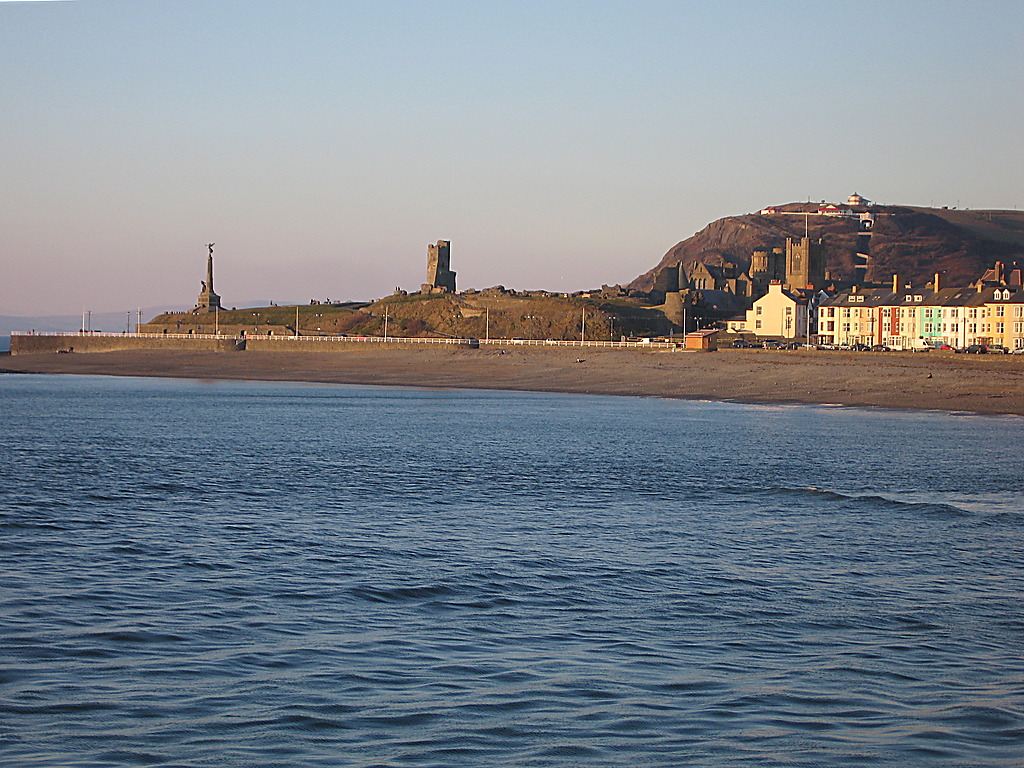
Aberystwyth Castle, Castell Aberystwyth, is a ruined concentric fortress on the headland at the south-western corner of the seafront. It is Grade I listed, designated on 14 September 1962, and the plan is a lozenge about 80 metres from north to south and about 45 metres wide, built in coursed rubble that has also been called siltstone. A dry moat lies to the west, and the surviving western gate has twin apsidal towers, a portcullis chase, and a stair turret.
An earlier castle stood about a mile south at Tan-y-Castell, also called Aberrheidol Castle and Old Aberystwyth. It is credited to Gilbert Fitz Richard about 1110, and also to a marcher lord named Gilbert de Clare in that same year. Gruffydd ap Rhys failed to take it in 1116 and burned it in 1136 with Owain Gwynedd and Cadwaladr ap Gruffydd. It was burned again in 1143, rebuilt with timber and stone, and taken by Llywelyn the Great in 1221.
One account says he razed it and built another in its place.
The headland castle and a new town were begun in 1277, after the first war against Llywelyn ap Gruffudd, at the same time as Flint, Rhuddlan, and Builth. One account says Edmund of Lancaster began it. The labour is said to have come mainly from the west of England under Master Williams of March, and the later work is attributed to James of Saint George. The cost is given as 4,000 pounds and as 4,300 pounds.
Work ended, or the castle was completed, in 1289.
In 1282, while the castle was still unfinished, it was taken and burned with the new town. The captors are named as Gruffydd ap Meredydd and Rhys ap Maelgwm, and also as Maredudd ap Rhys Gryg. The west side of the inner curtain was added after that war. In 1294 to 1295 a long siege in the revolt of Madog ap Llywelyn failed because the garrison could be supplied by sea from Ireland.
Assaults are also placed in 1287 and in 1295.
The new town was called Llanbadarn Gaerog, and local Welsh people were banned from living in it. By 1343, the year Edward of Woodstock, the Black Prince, was made prince of Wales, the gateway, drawbridges, king’s hall, kitchen, and outer bailey were falling. Owain Glyndŵr took the castle in 1403 or in 1404. A treaty with the king of France is placed there in 1404 and in 1405.
The English recovered it in 1408 or in 1409, and Henry of Monmouth is named for the recovery of 1409, with cannon brought from Bristol.
By 1636 the castle was largely a ruin. In 1637 Thomas Bushell set a royal mint of Charles I of England in the hall, coining local silver into half-crowns, shillings, and smaller pieces marked with the prince of Wales’s plumes. The mint stopped in September 1642, when the king issued the Wellington Declaration, and the bullion and tools went on to Shrewsbury and then Oxford. Parliamentarian forces are said to have taken the castle in 1646.
The slighting is dated 1645 to 1646 and 1649, and a demolition that year is also credited to Lieutenant Colonel Dawkins and Captain Barbour.
Walks were laid out in front of the ruins around 1790 by John Probert, and about 1800 by John Probart of Shrewsbury.
Excavation from late 1975 into 1988, directed by C. J. Spurgeon and David M. Browne, produced two stone cannonballs, one of Dundry limestone from near Bristol.
In 2024 the town council took on the grounds. Timber footbridges, closed for years, were rebuilt in 2025, and Richard Scott Jones recorded them that October.
Images




Detailed History
Aberystwyth Castle, Castell Aberystwyth in Welsh, is a ruined concentric fortress on the rocky headland at the south-western corner of the seafront in Aberystwyth, Ceredigion, formerly Cardiganshire. It is a Grade I listed building, designated on 14 September 1962, and a scheduled medieval castle. The plan is a lozenge, also called a diamond, about 80 metres from north to south and about 45 metres wide, of coursed rubble, and the stone has also been described as siltstone. One measured point is easting 257956 and northing 281531.
Another is easting 257958 and northing 281522. A grid is given as SN5796081529 and another as SN579815. The headland stands south-west of the town centre, between the north and south beaches, above the bay, with the mouth of the Rheidol to the south of the older site.
The inner ward has round or D-shaped towers and a twin-towered gatehouse keep. The more complete surviving gate is the western one: twin apsidal towers, a pointed entrance, a portcullis chase, a crenellated parapet, and a splayed stair turret on the north. An outer gate lies beyond it. On the east are the remains of Porth Mawr, with the footings of the hall to the south-west.
A dungeon lies at the south-west, and a mural tower stands on the south side of the inner ward. A dry moat protects the west, and the outer ward is described as a narrow circuit with round towers, and also as a twin D-shaped gatehouse, a barbican, a rock-cut ditch, and a large curtain wall with towers. There was a further enclosure to the north, since lost to the sea. Before the war of 1282 to 1283 the inner curtain did not close the west side.
That wall was added afterwards. The approach from the land was the east. A north-western gate has been read as a way through the outer wall toward a landing, which mattered whenever the place had to be fed from the water.
About a mile south, and more than a kilometre and a half from the headland, an earlier castle stood at Tan-y-Castell in the community of Llanfarian. It is also called Castell Tan-y-castell, Aberrheidol Castle, and Old Aberystwyth. What remains is a castle-ringwork and bailey on the point of a ridge. The main bank stands about 6.8 metres above the bottom of the ditch and is low on the inside.
A counterscarp bank is only about 1.6 metres high. A simple entrance is on the south. The bailey to the south is sub-rectangular, about 50 metres long, with a bank and no ditch now visible. It was scheduled on 16 September 1949.
The earth and timber work was later given timber and stone revetment and stone footings. A partial excavation by the Aberystwyth Archaeological Society in 1956 to 1961 opened part of the motte. A re-evaluation published in 2017 returned to the pottery from that first castle. Those finds belong to the southern earthwork, not to the stone lozenge on the headland.
The southern castle is credited to the marcher lord Gilbert Fitz Richard about 1110. Another account names the builder as Gilbert de Clare in the same year. Gilbert Fitz Richard, born before 1066 and dead in or before 1117, was the second feudal baron of Clare in Suffolk and was styled de Tonbridge. He was the second son of Richard Fitz Gilbert of Clare and Rohese Giffard.
He took his father’s English lands in 1088 when his father retired to a monastery, while his brother Roger Fitz Richard took the Norman lands. In 1088 the brothers fortified Tonbridge against William Rufus. The castle was stormed, Gilbert was wounded, and he was taken prisoner. He and Roger were nevertheless with William Rufus at that king’s death in August 1100, and Gilbert was with Henry I at the Christmas court at Westminster in 1101.
Modern historians have hinted that he had some part, inside a baronial conspiracy, in the suspicious death of William II. Frank Barlow’s reading is that no proof has been found either of Gilbert’s part or that such a conspiracy existed. In 1110 Henry I took Cardigan from Owain ap Cadwgan, son of Cadwgan ap Bleddyn, as punishment for crimes that included the abduction of Nest, wife of Gerald de Windsor. Henry gave Gilbert Fitz Richard the lordship of Cardigan, including Cardigan Castle.
That grant is the 1110 event in his own life. The motte a mile south of the present headland is a separate building placed in the same year by the history of Aberystwyth. He founded the Cluniac priory at Stoke-by-Clare. About 1088 he married Adeliza, also called Alice, de Clermont, daughter of Hugh, Count of Clermont, and Margaret de Ramerupt.
Their children included Richard Fitz Gilbert de Clare, who died in 1136, and Gilbert Fitz Gilbert de Clare, who died in 1148 and was the first Earl of Pembroke.
In 1116 Gruffydd ap Rhys, also written Gruffudd ap Rhys, Prince of Deheubarth, besieged the southern castle and failed. He was born about 1090 and died in 1137, a son of Rhys ap Tewdwr and brother of Nest ferch Rhys, and he was the father of Rhys ap Gruffudd, the Lord Rhys. In 1136 he took the castle and burned it, with Owain Gwynedd and Owain’s brother Cadwaladr ap Gruffydd. They were sons of Gruffudd ap Cynan, king of Gwynedd.
Owain ap Gruffudd, known as Owain Gwynedd to distinguish him from Owain Cyfeiliog of Powys, was king of Gwynedd from 1137 until his death on 23 November 1170, and he is the first recorded Welsh ruler to style himself king of Wales and prince of the Welsh. In 1136 he was not yet king. Their sister Gwenllian ferch Gruffydd, also written Gwenllian ferch Gruffudd, was Gruffydd ap Rhys’s wife. She died in 1136.
One account says she was killed in battle by Gruffudd ab Llywelyn, who commanded for the Norman Maurice de Londres, after she took a force to meet him at Kidwelly. Her own life says that the sole record of her actions is the Itinerary of her cousin Gerald of Wales: when her husband rode north to seek help from her father against Norman strongholds in the south-west, she and two of her sons raised an army and attacked Kidwelly Castle, the Norman defenders defeated her, and she was beheaded. The field is remembered as Maes Gwenllian. The wider setting was the Anarchy after Henry I died in 1135, when supporters of Stephen of Blois and of the Empress Matilda fought, and Welsh resistance rose in that gap.
Norman power at the start of the twelfth century is described as a height not seen again in Wales until the treaty that ended the war of Edward I of England in 1277.
Owain Gwynedd gave the burned castle to Cadwaladr to rebuild. In 1143 Cadwaladr was implicated in the murder of Anarawd ap Gruffydd, the new king of Deheubarth. Owain sent his son Hywel ab Owain Gwynedd to strip Cadwaladr of his lands in Ceredigion, and the castle was burned again. It was rebuilt, and later strengthened with the timber and stone revetment and the stone footings already noted.
After at least three further owners, the Welsh prince Llywelyn the Great took it in 1221. One account adds that he razed it and built another in its place. Llywelyn ab Iorwerth was the grandfather of Llywelyn ap Gruffudd. He died in 1240.
His eldest legitimate son, Dafydd ap Llywelyn, succeeded in Gwynedd. His eldest son Gruffudd was illegitimate. Gruffudd and Gruffudd’s son Owain were held first by Dafydd and then by Henry III. In 1244 Gruffudd died in a fall while trying to escape from a cell at the top of the Tower of London.
The window was later bricked up.
Llywelyn ap Gruffudd, Llywelyn the Last, was prince of Gwynedd from 1255 to 1282 and died on 11 December 1282. He was the second of four sons of Gruffudd ap Llywelyn ap Iorwerth and Senana ferch Caradog. The eldest brother was Owain Goch ap Gruffudd. The younger brothers were Dafydd ap Gruffydd and Rhodri ap Gruffudd.
Llywelyn is first heard of with lands in the Vale of Clwyd around 1244. After his grandfather’s death he went on crusade with Richard of Cornwall, brother of Henry III. He supported his uncle Dafydd in the war with Henry that began in 1245. At the Treaty of Woodstock in 1247 he and Owain were restricted to Gwynedd west of the Conwy, around Snowdonia and Anglesey, divided between them.
The Perfeddwlad, Gwynedd east of the Conwy, went to the king. When Dafydd ap Gruffydd came of age, Henry accepted his homage and meant to give him part of that reduced Gwynedd. Llywelyn refused. Owain and Dafydd allied against him.
At the Battle of Bryn Derwin in June 1255 Llywelyn defeated and captured them and became sole ruler of Gwynedd Uwch Conwy. In the summer of 1256 the young Edward, Henry’s son, visited the Perfeddwlad and did not remedy the grievances against his officers. That November Llywelyn crossed the Conwy with Dafydd, whom he had released. By early December he held Gwynedd Is Conwy except the royal castle at Dyserth.
In 1257 Llywelyn pushed into Gwrtheyrnion, Powys, and Deheubarth, as far as the Bristol Channel, during Lent. An English force came from Scotland toward Deganwy and did not cross into his territory west of the Conwy. An Irish fleet that Henry expected did not arrive. A truce in 1258 was not fully kept by the marcher lords.
Rhys Fychan of Deheubarth accepted Llywelyn as overlord, which collided with a grant already made to Maredudd. Llywelyn restored Rhys, then jailed Maredudd at Criccieth until Christmas 1259 after Maredudd had done homage to Henry in late 1257. Early in 1258 Llywelyn was using the title prince of Wales, first in an agreement with supporters and with Scottish nobles of the Comyn family. The English crown refused the title.
In 1263 Dafydd turned against him and submitted to Henry. In January 1260 Llywelyn dislodged Roger Mortimer from Builth. Armies gathered at Shrewsbury and Chester after a decree at Oxford on 1 August, then a truce of two years followed because the English government could not agree. Later castle-building provoked a Welsh revolt in Maelienydd, and Llywelyn received the fealty of Welshmen who had pushed Mortimer out of the lordship of Brecon.
On 12 December 1263 Gruffydd ap Gwenwynwyn of Powys Wenwynwyn did homage in the commote of Ystumanner and received back lands taken about six years earlier.
In England, Simon de Montfort the Younger defeated the king’s side at Lewes in 1264 and captured Henry and the Lord Edward. Llywelyn offered 25,000 marks for a permanent peace, 5,000 at once and 3,000 a year. The Treaty of Pipton on 22 June 1265 allied him with Montfort. Pope Clement IV warned him against the excommunicated earl.
He was offered the castles of Maud, Hawarden, Ellesmere, and Montgomery, and acknowledgement as hereditary prince of Wales. Montfort died at Evesham in 1265. Llywelyn took no part in that battle. He then routed Hamo le Strange and Maurice FitzGerald in north Wales, and routed Roger Mortimer at Montgomery.
With the papal legate Ottobuono behind the talks, the Treaty of Montgomery in 1267 had Henry III recognise him as prince of Wales. He was to pay 24,000 marks in instalments. The pope confirmed the agreement. He could buy the homage of the remaining native prince, Maredudd ap Rhys of Deheubarth, for 5,000 marks.
All the Welsh princes submitted except Maredudd ap Rhys Gryg. The treaty was the height of his power. A dispute with Gilbert de Clare over a Welsh nobleman in Glamorgan led Gilbert to build Caerphilly. Henry sent a bishop to hold the castle during the dispute.
Gilbert recovered it by a trick, and the king did nothing.
Henry III died late in 1272 while Edward was on crusade. One of the regents was Roger Mortimer, Llywelyn’s rival in the marches. When Humphrey de Bohun tried to recover Brycheiniog, which Montgomery had granted to Llywelyn, Mortimer backed de Bohun. Llywelyn stopped the annual payments.
Early in 1274 Dafydd, Gruffydd ap Gwenwynwyn, and Gruffydd’s son Owain plotted to kill him. Owain was to arrive with armed men on 2 February. A snowstorm stopped him. Llywelyn learned the plan when Owain confessed to the bishop of Bangor: Dafydd was to be prince of Gwynedd and was to reward Gruffydd with lands.
Dafydd and Gruffydd fled to England, were maintained by the king, and raided Llywelyn’s lands. Called to Chester in 1275 to do homage, Llywelyn did not go. He married Eleanor de Montfort by proxy in 1275. She was born about 1258, daughter of Simon de Montfort and of Eleanor of England, daughter of King John, and she was Edward’s first cousin.
Edward had her ship seized on the way from France and held her at Windsor until Llywelyn made concessions.
Edward I of England declared Llywelyn a rebel in 1276 and war in November 1276. The first operations were under Roger Mortimer, Edward’s brother Edmund, earl of Lancaster, and William de Beauchamp, ninth Earl of Warwick. Edmund Crouchback, born 16 January 1245 and dead on 5 June 1296, was earl of Leicester from 1265, of Lancaster from 1267, and of Derby from 1269, and count palatine of Champagne from 1276 to 1284. He was the second surviving son of Henry III and Eleanor of Provence, younger brother of Edward, and he assisted Edward in the conquest of Wales.
The building account says the new castle was begun by Edmund of Lancaster in 1277, as part of Edward’s Welsh castle programme. In July 1277 Edward invaded with 15,500 men, of whom 9,000 were Welsh. The campaign had no major battle. By the Treaty of Aberconwy in November 1277 Llywelyn was left with the land of Gwynedd and was allowed to keep the title prince of Wales.
His own account dates his signature to 9 November 1277 and is harder: he regained Anglesey and parts of Snowdonia, with the homage of five lords, was to pay a fine of 50,000 marks, and gave up his share of the rent of Anglesey. The Llŷn went to his brother Owain, who had been released from jail in 1254. The Perfeddwlad went to Dafydd, with a promise of a share of Gwynedd Uwch Conwy if Llywelyn died without an heir. Edward had considered disinheriting him completely, taking Gwynedd Is Conwy, and either splitting Gwynedd Uwch Conwy between Dafydd and Owain or annexing Anglesey and splitting only the mainland.
Many lesser princes had already made peace. A force from Chester reached the Conwy and camped at Deganwy. Another force took Anglesey and the harvest, and hunger drove Llywelyn to terms. Henry de Lacy came from Shrewsbury and Montgomeryshire, and Roger Mortimer toward Builth.
The present castle and a new town were begun on the headland, north of the old motte, in 1277, after that first war, at the same time as work at Flint, Rhuddlan, and Builth Wells. Work was slow. The labour force is said to have been recruited mainly from the west of England by Master Williams of March. The cost is given both as 4,000 pounds and as 4,300 pounds.
Completion, or the end of construction, is placed in 1289. Later work is attributed to the master mason James of Saint George, said to have been probable, and one account says he oversaw it. His own career is more precise and more limited. Master James of Saint George, about 1230 to 1309, Jacques de Saint-Georges, was a Savoyard master of works.
Marc Morris has called him one of the greatest architects of the European Middle Ages. Circumstantial evidence puts his birth at Saint-Prex and his father as the mason John, identified with Jean Cotereel, builder of Saint-Prex and Lausanne Cathedral. The name Saint George, used after he came to England, refers to Saint-Georges-d’Espéranche in the Viennois, not to the English patron saint. He worked first for Peter II, count of Savoy, at Yverdon-les-Bains, with his father and then alone by 1265.
In 1267 to 1268 he worked under the Gascon engineer Jean de Mézos at the château of Melphe at Salins-les-Thermes. After Peter died in 1268 he served Philip I, count of Savoy, and built at Saint-Georges-d’Espéranche, La Côte-Saint-André, Voiron, and Saint-Laurent-du-Pont between 1270 and 1275, three round-towered castles and one octagonal palace castle. A last Savoyard work may have been Châtel-Argent in the summer of 1275. There is a gap until 1278.
Marshall has suggested he may have been working for the family of Otto de Grandson, perhaps at Grandson and Lucens. A. J. Taylor in 1950 argued that Jacques de Saint-Georges and Master James were the same man, from garderobes at La Bâtiaz, windows at Chillon, and the town walls at Saillon.
Edward I of England probably met him while returning from crusade. On 25 June 1273 the king visited Saint-Georges-d’Espéranche so that his great-uncle Philip I might do homage under a treaty of 1246, by which Bard, Avigliana, the palace of Susa, and the town of Saint-Maurice had been enfeoffed to the English king. The first English form of the mason’s name, Magistri Jacobi de Sancto Georgio, is dated 8 November 1280, two years after he arrived. In April 1278 he was described as going to Wales to put the castle works in order, the mason charged with design, technical direction, and management.
He was recorded travelling to inspect the castles of Flint and Rhuddlan, at a time when four new castles were being built: Flint, Rhuddlan, Builth, and Aberystwyth. From 1277 until 1280 his main recorded work was the supervision of Rhuddlan and the canalisation of the River Clwyd, and then Flint. Flint is likened to his earlier castle at Yverdon. Around 1285 he was master of the king’s works in Wales, at three shillings a day, with control of Conwy, Caernarfon, and Harlech, begun in 1283.
Harlech was effectively finished in 1289. On 3 July 1290 he became constable of Harlech, after John de Bonvillars, who had died in August 1287, and he held the post until 14 December 1293. Beaumaris, started in April 1295, was unfinished at his death in 1309. He was with Edward in Scotland from about September 1298, oversaw new defences at Linlithgow in February 1302, and was at the siege of Stirling in 1304.
His wife Ambrosia is not recorded with a pension after his death, so she probably died before him. Two sons, Giles and Tassin of Saint George, survived him. Nothing in that career states that he designed the diamond on the Aberystwyth headland. The headland accounts attribute the later work to him, while his own record places Aberystwyth among the four castles already rising when he was sent to order the works, and places his own supervision at Rhuddlan and Flint.
The second war began in 1282. The Welsh are said to have seen it as a war for national identity and for Welsh law, provoked by the use of English law to dispossess landowners, many of them Edward’s former opponents. For Edward it became a war of conquest, to put an end to what he called the malice of the Welsh. It started with Dafydd, discontented with his reward of 1277.
On Palm Sunday 1282 Dafydd attacked the English at Hawarden and then besieged Rhuddlan. The rising spread. Aberystwyth Castle, still unfinished, was taken and burned, and the new town with it. One account names the captors as Gruffydd ap Meredydd and Rhys ap Maelgwm.
Another names Maredudd ap Rhys Gryg, called heir of the prince of Deheubarth, and says the southern rebellion was inspired by Dafydd, with Carreg Cennen also taken. A third account says only that the Welsh took and burned the castle and the town. Llywelyn wrote to John Peckham, archbishop of Canterbury, that he had not planned the revolt. He joined his brother anyway.
In June, Gloucester was defeated at Llandeilo Fawr. On 6 November, while Peckham was negotiating, Luke de Tany, Edward’s commander on Anglesey, crossed a bridge of boats and was ambushed. The fight is the Battle of Moel-y-don. The English took Gwynedd Is Conwy and Anglesey and the harvest, as in 1277.
Peckham offered Llywelyn a large estate in England if he would surrender Wales, and proposed that Dafydd go on crusade and not return without leave. Llywelyn refused. He said he would not abandon the people his ancestors had protected since the days of Kamber son of Brutus. He left Dafydd to hold Gwynedd and went south to open a second front.
On 11 December 1282, at the Battle of Orewin Bridge by Builth Wells, he was killed, separated from his army.
Two accounts agree that he was drawn away from the main body and then killed, and they disagree about the rest. One, written in the north of England about fifty years later, says he and his chief minister crossed a bridge toward Edmund Mortimer and Hugh Le Strange, heard the battle as Roger Despenser and Gruffydd ap Gwenwynwyn met the main army, turned back, and were pursued by a single lancer. An English knight recognised the body only later. The other, written in the east of England by monks in touch with his exiled daughter Gwenllian ferch Llywelyn and his niece Gwladys ferch Dafydd, says he approached Edmund and Roger Mortimer, Hugo Le Strange, and Gruffydd ap Gwenwynwyn because they had promised homage.
The promise was a deception. A large part of the army was routed. Llywelyn and eighteen retainers, clergy among them, were separated, ambushed at dusk, and chased into a wood at Aberedw. Dying, he asked for a priest and gave his name.
He was then killed and his head was cut off. A list of conspirators, which may have been faked, and his privy seal were taken from him. Edmund Mortimer had custody of the list, the seal, and other things found in the same place. The privy seals of Llywelyn, of his wife Eleanor, and of Dafydd are thought to have been melted down after they were found on the bodies, to make a chalice in 1284.
Eleanor had married him at the door of Worcester Cathedral on 13 October 1278, a small ceremony with the kings of Scotland and England and the earl of Lancaster present. She died in childbirth on 19 June 1282, the year of the burning, after the birth of their daughter Gwenllian. Peter Bartrum also identified an illegitimate son, Madog.
After the burning, the English rebuilt. The inner curtain on the west belongs to that second phase. The castle was finished, or the work stopped, in 1289. By the Statute of Rhuddlan in 1284 the principality was given an English pattern of counties and sheriffs.
English law was used in criminal cases. Welsh customary law remained for some property disputes. After 1277, and more after 1283, Edward planted new towns, among them Flint, Aberystwyth, and Rhuddlan. The new residents were English.
Local Welsh people were banned from living in them. Many of the towns had extensive walls. The adjoining town took its name from the older village of Llanbadarn Fawr and was called Llanbadarn Gaerog, fortified Llanbadarn. One account says that by 1307 a town was thriving outside the walls.
In the south-west, in Cardiganshire and Carmarthenshire, sheriffs pressed the same anglicising policy that was used on the four cantrefs of the court of Chester. In 1280 Peckham met Llywelyn about the quarrel between the churches. Llywelyn said the truce had been broken by Gruffydd ap Gwenwynwyn. The archbishop answered that a grievance framed in the law of Hywel Dda would not be heard.
The castle is also said to have withstood Welsh assaults in 1287 and in 1295. In 1294 to 1295 it was besieged at length in the revolt of Madog ap Llywelyn and held because it could be supplied by sea from Ireland. Madog ap Llywelyn, who died after 1305, led that revolt. It was surpassed in length only by the later rising of Owain Glyndŵr.
Madog was of a junior branch of the house of Aberffraw and a distant relation of Llywelyn ap Gruffudd. In a land grant during the revolt he used the title prince of Wales.
By the time of the Black Prince, in 1343, the castle was in a bad state. The main gateway and drawbridges, the king’s hall and long chamber, the kitchen range, and the outer bailey were falling. Edward of Woodstock, the Black Prince, was born on 15 June 1330 and died on 8 June 1376, eldest son of Edward III. He died before his father, so his son Richard II inherited.
He was made duke of Cornwall in 1337, the first English dukedom, and prince of Wales in 1343, on 12 May, in a parliament at Westminster. He was knighted by his father at La Hougue in 1346 and commanded the vanguard at Crécy that year. In 1356 his army captured John II of France at Poitiers. In 1360 he negotiated the Treaty of Brétigny.
He was prince of Aquitaine and Gascony from 1362, won at Nájera in 1367, returned to England in 1371, and resigned Aquitaine and Gascony in 1372. The name Black Prince is late. John Leland used it in the 1530s or early 1540s, about 165 years after the death, and the earlier texts he was summarising do not contain it. John Speed in 1611 said the name came from dreaded acts in battle, not from complexion.
Nothing in his life says he repaired Aberystwyth. The disrepair is dated to the year he became prince of Wales.
In the rising of Owain Glyndŵr the castle changed hands again, and the years do not agree. Owain ap Gruffydd Fychan, Owain Glyndŵr, about 1359 to about 1416, was a Welsh nobleman and commander who tried to make an independent Wales. His supporters acclaimed him prince of Wales on 16 September 1400 at Sycharth, before his family, his in-laws, men from Berwyn, friends from north-east Wales, and the dean of St Asaph, about 300 men in all. The next day the rising against Henry IV began.
The quarrel with his English neighbour Reginald de Grey, Lord Grey of Ruthin, sat inside a wider hostility. Parliament in 1401 and 1402 passed penal laws against the Welsh. The resentment enlarged his support. He captured Grey and held him for almost a year until Henry IV paid a ransom.
In June 1402 he defeated Sir Edmund Mortimer at Bryn Glas, or Pilleth, and captured him. Henry IV would not ransom Mortimer, whose nephew had a claim that could be set against Henry’s. Mortimer allied with Owain and married one of Owain’s daughters. In the spring of 1403 Prince Henry burned Sycharth and Glyndyfrdwy, the commote of Edeirnion, and parts of Powys.
For ten days in July 1403 Owain toured the south and south-west until the south rose. In 1403 he is said to have had 4,000 men in a first division and 12,000 in all. A Welsh army with a French contingent, mainly from Glamorgan and the Rhondda, under Owain, Rhys Gethin, and Cadwgan, lord of Glyn Rhondda, defeated a force reputedly led by Henry IV at Stalling Down. Welsh students left Oxford and Cambridge, and Welsh labourers in England went home.
Welsh archers and men-at-arms left English service.
One account says Glyndŵr took the castle in 1403. Another says his forces took Aberystwyth and Harlech in 1404, after a prolonged siege, and then burned Cardiff. The castle became a seat of government. Gatherings are placed at Machynlleth, Harlech, Dolgellau, Llanbadarn, which is Aberystwyth, and Cefn Caer at Pennal.
The number of those meetings is not known. A treaty with the king of France, Charles VI, is placed at the castle both in 1404 and in 1405. A formal Franco-Welsh treaty was negotiated in 1405, the year a French force landed at Milford Haven, burned Haverfordwest, failed at Pembroke, and with the Welsh took Carmarthen. On 31 March 1406, at St Peter ad Vincula in Pennal, Owain wrote to Charles VI asking for continued military help and offering to recognise Benedict XIII of Avignon.
He asked for a Welsh parliament, the law of Hywel Dda, an independent church by enlarging the bishopric of St Davids, and two universities, one in the south and one in the north. His great seal and a letter of 1406 are in Paris. The royal great seal of 1404, given to Charles IV of France, carries the title Owain, by the grace of God, prince of Wales. The English return is dated four years after the 1404 capture, and also four years after the treaty of 1405.
It is also dated 1408, by 1408, and 1409. Henry of Monmouth, later Henry V, is named as the commander who recovered it in 1409. Another account says that the year after the 1404 capture he brought cannon from Bristol, and that he retook the castle in 1408, in one of the earliest records of cannon used there. A further account says the place was seized in 1404, besieged three years later by the prince of Wales, the duke of York, and the earl of Warwick, was near surrender when Glyndŵr himself led the defence, and fell a year after that siege.
After the loss he is described as no more than a guerrilla leader, and as the hero of the common people.
Henry of Monmouth was born on 16 September 1386 and died on 31 August 1422. He was the eldest son of Henry IV, prince of Wales after his father took the throne from Richard II in 1399, and king from 1413. He learned war in Wales against this rising and against the Percys, and he fought at Shrewsbury at sixteen. On the Glyndŵr chronology, Prince Henry turned from his father’s punitive raids to an economic blockade, using the castles still in English hands and cutting trade and weapons.
By 1408 the English had regained Aberystwyth and then marched north. Harlech surrendered in the cold winter into 1409. Edmund Mortimer died in that siege. Owain’s wife Margaret, two daughters including Catrin, and three of Mortimer’s granddaughters were taken at Harlech and died in the Tower in 1413.
They were buried at St Swithin, London Stone. An escape in disguise as an old man, past a blockade at night, belongs to that Harlech fall, not to a separate story that has to be moved onto the Aberystwyth headland. By 1409 the last rebel castles, Harlech and Aberystwyth, are said to have been taken. A later passage places an autumn surrender of Aberystwyth while Owain was away fighting, in the same stretch of years as a raid into Shropshire in 1410, an ambush in Brecon in 1412 in which he captured and ransomed Dafydd Gam, and the death of Henry IV in 1413.
He refused pardons. On 21 December 1411 the king pardoned the Welsh except Owain and Thomas of Trumpington, until 9 April 1413, when Owain was no longer excepted. He was last seen by his enemies in 1412. He was never captured.
He is said to have died in hiding about 1416, and Adam of Usk says the burial was at night and that the grave was found, so the body was buried again. Henry V, once king, was more conciliatory. His French war, Harfleur and Agincourt in 1415 and the Treaty of Troyes in 1420, lies after the castle had already gone back to the English.
By 1636 the castle was largely ruinous. In 1637 Thomas Bushell persuaded Charles I of England to put a royal mint in the castle hall, to coin silver from mines in Ceredigion, also called Cardiganshire. Charles I was born on 19 November 1600 and was king of England, Scotland, and Ireland from 27 March 1625 until his execution on 30 January 1649. Bushell, lessee of the royal mines, complained of the cost of sending silver to London.
A deed of 30 July 1637, in the public records, authorised the half-crown, the shilling, the half-shilling, the twopence, and the penny, from Welsh silver only. A commission in October added the groat, the threepence, and the halfpenny. Another list of the same mint gives half-crowns, shillings, half-shillings, groats, threepences, half-groats, pennies, and halfpennies, and orders the prince of Wales’s plume on both sides. One account gives the mint-mark as an open book, and says the dies came from the Tower.
The Tower monopoly in precious metals was broken in 1637 by this small branch. Silver was 11 ounces 2 pennyweights fine, at 62 shillings to the pound troy, with a remedy of 2 pennyweights in the pound, about 0.83 per cent, for fineness and for weight. The indenture provided for a trial of the pyx, which was probably never held. The mint stood in the hall.
The operator raised a regiment of royalist soldiers when war came.
The English Civil War, also called the Great Rebellion, was the series of wars and political struggles between royalists and parliamentarians in England from 1642 to 1651, inside the wider Wars of the Three Kingdoms from 1639 to 1653. Wales, annexed to the kingdom of England, shared the same crisis. Royalist strength lay in the countryside, the cathedral cities of York, Chester, Worcester, and Oxford, and the poorer north and west, including Wales. Parliament’s strength lay in the industrial towns, the ports, and the richer south and east.
The first war was about the balance between parliament and Charles. It ended in June 1646 with the king in custody. Another dating ends the first war when Charles surrendered to the Scots on 5 May 1646. He had raised his standard at Nottingham on 22 August 1642.
Passing through Wellington, he issued the Wellington Declaration, that he would uphold the Protestant religion, the laws of England, and the liberty of parliament. The mint at Aberystwyth ceased in September 1642 when that declaration was issued. Bushell is said to have removed bullion and equipment to Shrewsbury, and the work was diverted to Oxford. A closer itinerary says the king reached Wellington on 20 September, made the declaration before the army, and fixed his headquarters at Shrewsbury the next day.
On 28 September he told the gentlemen of the county that he had sent for a mint. The workers, those of Aberystwyth, arrived within a few days. The first coins there were issued on 21 October. At the end of December the king moved to Oxford, and the mint reached Oxford on 3 January.
Those Shrewsbury pieces are the declaration type: the pound, the half-pound, the crown, the half-crown, and the shilling, all silver. If smaller coins were struck, they cannot be told from Aberystwyth coins. Bushell later said that, apart from the shilling, the larger pieces were first issued at his suggestion as medals to reward the troops, the pound for colonels and the half-pound for senior ranks. Aberystwyth plumes, with very few exceptions, have no bands under the coronet.
Oxford plumes of 1643 have bands. Coins of 1642 with bandless plumes on both sides, or with an Aberystwyth obverse, are accepted as Shrewsbury. At the relocated mint the joint wardens were Thomas Bushell and Sir William Parkhurst. A branch at Bristol from 1643 to 1645 was run by Bushell.
Oliver Cromwell was born on 25 April 1599 and died on 3 September 1658. He was a parliamentarian cavalry commander, a regicide, and Lord Protector from December 1653. His forces are said to have taken Aberystwyth Castle in 1646. The slighting is dated 1649 and attributed to him, and it is also dated 1645 to 1646.
Another account says the fragmentary state comes from a thorough demolition after parliamentarians routed the royalists in 1644, that the walls were blown with carefully placed charges, and that large pieces of mortared masonry still lie thrown clear of the wall line. The same account says the castle held a great store of gunpowder for the mines, and that this is probably why the demolition organised in 1649 by Lieutenant Colonel Dawkins and Captain Barbour was so complete. Cromwell himself, in 1646, was finishing the first war in Devon and Cornwall, and in 1649 he was preparing, and from 15 August conducting, the invasion of Ireland. The demolition of this year is therefore dated to him, and also to Dawkins and Barbour, without a statement that he stood on the headland.
In the second civil war of 1648 he put down a royalist rising in south Wales under Rowland Laugharne, retook Chepstow on 25 May, received the surrender of Tenby six days later, and took Pembroke after eight weeks. Charles I of England was executed on 30 January 1649. The monarchy was abolished. It was restored in 1660 under Charles II.
On 30 January 1661 Cromwell’s body was taken from Westminster Abbey and hanged at Tyburn. The head was displayed at Westminster Hall until at least 1684 and was reburied in 1960.
Around 1790 John Probert laid out walks on the ground in front of the castle. That ground is now partly covered by St Michael’s Church. Another account says John Probart, an architect of Shrewsbury, laid out the grounds about 1800. The remains were much restored and became part of a public park.
A druid circle from the eisteddfod of 1916 stands in the recreational grounds. A retaining wall on the north has a terrace below it, with a Victorian crescent-shaped shelter of eight bays on ornamented cast-iron columns. Aerial reconnaissance in 2001 noted parallel ridges at the western end, between the moat and the war memorial. They may be cultivation ridges, gardens, or allotments.
The choice among those three is not settled.
Excavation on the headland ran from late 1975 into 1988. C. J. Spurgeon and David M.
Browne directed the work. An archive of field notes, drawings, photographs, day books, notebooks, and context records covers about 1976 to 1985. Published panels treat 1975 to 1979, 1982 to 1983, 1984 to 1986, and 1987 to 1988. Two stone cannonballs from that dig were examined about thirty years later, in 2016.
One is Dundry limestone, from near Bristol. The other is a dense green-grey sandstone that could be from Somerset or from south Wales. They weigh five and a half pounds and six and a half pounds, and each is just under six inches across. The surfaces are crudely tooled and pitted.
One is scarred on the side, which could be the mark of an impact. A reading that ties the Dundry ball to the cannon brought from Bristol in the Glyndŵr siege treats the ball as probably carved nearby and brought with those guns. That is a probability, not a find-spot that dates the ball by itself. The balls are not evidence from Tan-y-Castell, and the pottery of the 1956 to 1961 dig is not evidence from the headland.
In 2024 to 2025 the town council took responsibility for the castle grounds, devolved from the county council, along with Plascrug Avenue and gardens on Queen’s Square. A picnic area that had once been the town’s cemetery was re-levelled and re-turfed. New beds were planted with perennials chosen for pollinators. The playground in the grounds received sensory boards and parent-and-child swing seats in 2024.
On Saturday 14 September 2024 the council held Gŵyl y Castell in the grounds, from 10 in the morning until 9 at night, just before Owain Glyndŵr Day on 16 September. The mayor, Maldwyn Pryse, opened it. The music, stalls, and children’s entertainment were free to the people who came. A grant of 120,000 pounds under the Transforming Towns scheme covered green-space work across the town in the same adoption of parks.
Two timber footbridges on the castle grounds, fenced off for a number of years, were replaced under scheduled-monument consent. The new bridges were designed to follow the old wooden ones closely. Installation was under way on 24 July 2025. They were open again by 4 November 2025.
By 31 October 2025 both bridges were finished, in time for the Remembrance service at the war memorial on Castle Point. The county council completed that bridge work, with funding from the Levelling Up Fund. In October 2025 Richard Scott Jones recorded the timber footbridges in an archaeological building investigation. By 18 May 2026 the castle lighting works were largely complete, with some electrical work and light fittings still to come.
The ruins stand in the public park on the headland.
Sources
- Aberystwyth Castle — Wikipedia
- Edward I of England — Wikipedia
- Llywelyn ap Gruffudd — Wikipedia
- James of Saint George — Wikipedia
- Owain Glyndŵr — Wikipedia
- Charles I of England — Wikipedia
- Oliver Cromwell — Wikipedia
- English Civil War — Wikipedia
- Edward the Black Prince — Wikipedia
- Gilbert Fitz Richard — Wikipedia
- Edmund Crouchback — Wikipedia
- Henry V of England — Wikipedia
- Gwenllian ferch Gruffudd — Wikipedia
- Madog ap Llywelyn — Wikipedia
- Owain Gwynedd — Wikipedia
- Gruffudd ap Rhys — Wikipedia
- Aberystwyth Castle listed building report — Cadw
- Aberystwyth Castle scheduled monument report — Cadw
- Aberystwyth Castle — Coflein
- Wales history map — Cadw
- Castle Tan-y-Castell — Ancient Monuments UK
- Aberystwyth Castle — The Gatehouse Gazetteer
- The mint of Aberystwyth — British Numismatic Society
- The coins of the Shrewsbury mint, 1642 — British Numismatic Society
- The metrology of the English Civil War coinages of Charles I — British Numismatic Society
- Notices of the Mint at Shrewsbury — Archaeological Journal
- Silver coins of King Charles I — Baldwin's
- Annual Report 2024-25 — Aberystwyth Town Council
- Aberystwyth Castle — Aberystwyth Town Council
- The revitalised promenade — Ceredigion County Council
- Castle ground bridges repaired in time for Remembrance Sunday — Cambrian News
- Cannon balls at the castle — Letter from Aberystwyth
- Castell Tan-y-Castell excavation — Heneb
- Arfordir Aberystwyth, Ceredigion - Aberystwyth SAC Special Areas of Conservation, West Wales Marine 43.jpg — Wikimedia Commons
- Aber Castle.jpg — Wikimedia Commons
- Aberystwth Castle (Wales).JPG — Wikimedia Commons
- Aberystwyth castle - geograph.org.uk - 1746753.jpg — Wikimedia Commons
- Aberystwyth Castle - Ceredigion, Mid Wales - 16 Feb. 2013.jpg — Wikimedia Commons
- Aberystwith - panoramio - Tanya Dedyukhina.jpg — Wikimedia Commons
- Aberystwyth - panoramio (19).jpg — Wikimedia Commons
- Aberystwyth - panoramio (21).jpg — Wikimedia Commons
- Aberystwyth - panoramio (22).jpg — Wikimedia Commons
- Aberystwyth - panoramio (23).jpg — Wikimedia Commons